

Submitted:
24 August 2026
Posted:
25 August 2026
You are already at the latest version
Abstract
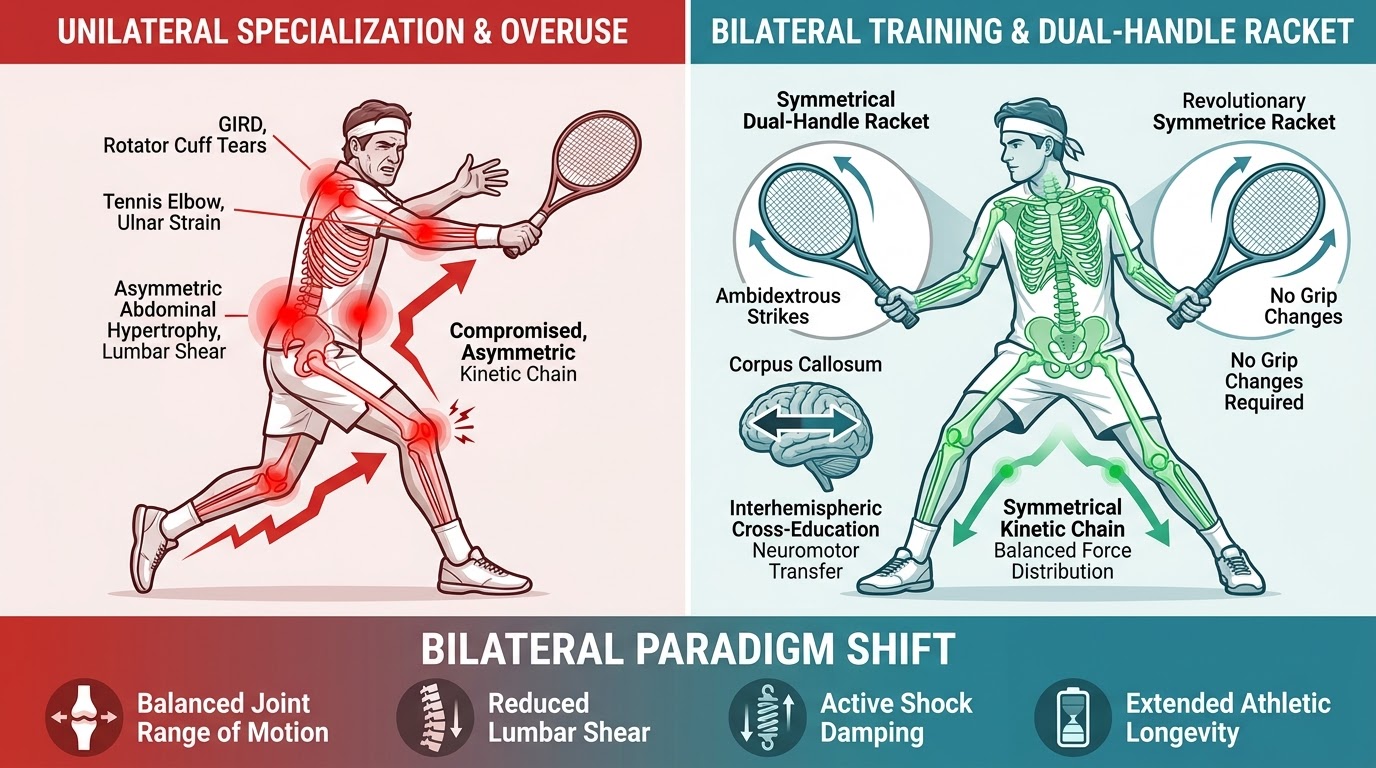
Tennis is a highly asymmetric, unilaterally dominant sport imposing unique chronic overloads on the musculoskeletal system. Traditional coaching accepts asymmetry as physiological, leading to progressive muscle imbalances, postural deviations, and joint degeneration. This scoping review, following JBI methodology and PRISMA-ScR guidelines, systematically maps literature on asymmetric loading, functional adaptations, and injury risk in tennis players. Databases via EBSCOhost and PubMed were searched from inception through June 2026, including studies assessing bilateral differences in range of motion (ROM), muscle strength, morphology, and neuromuscular activation. Strong evidence confirms pronounced structural and functional asymmetries in elite and recreational players. Key adaptations include glenohumeral internal rotation deficits (GIRD), asymmetric rectus abdominis hypertrophy, scapular dyskinesis, and altered pelvic biomechanics, which are linked to biceps tenosynovitis, rotator cuff tears, lateral epicondylitis, and chronic lower back pain. While some asymmetries represent sport-specific adaptations, excessive unilateral load is a primary driver of tissue injury. The proposed seven-component conceptual framework offers a standardized protocol for baseline assessment, bilateral conditioning, non-dominant skill acquisition, and progressive load redistribution to mitigate injury risk and enhance technical performance.
Keywords:
tennis
; functional asymmetry
; range of motion
; muscle strength
; glenohumeral rotational deficit
; injury prevention
; bilateral training
; kinetic chain
; scoping review
1. Introduction
1.1. Musculoskeletal Demands of Tennis
Tennis is a globally practiced, high-velocity racket sport that places substantial, repetitive musculoskeletal demands on the human body [1,2,3]. Match play is characterized by its intermittent nature, requiring players to continuously execute rapid accelerations, decelerations, multi-directional lunges, and high-force rotational movements [2,3]. The physiological and biomechanical demands are highly variable, determined by the playing surface, environmental conditions, match duration, and playing styles [2,3,4].
From a biomechanical perspective, effective stroke production does not occur in isolation but relies heavily on the efficient functioning of the global kinetic chain [5]. Forces are initiated at the ground-foot interface, transferred and amplified through knee extension, pelvic rotation, trunk translation, and shoulder girdle stabilization, culminating in the rapid acceleration of the distal upper extremity and racket [5]. During the tennis serve—widely recognized as the most complex and physically demanding stroke—coordinated sequential joint rotations of the pelvis, trunk, and shoulder are paramount to maximizing racket-head velocity [1,5]. Following ball contact, these segments must immediately decelerate under extreme eccentric muscular control to dissipate residual kinetic energy and restore dynamic postural balance [1,2].
Groundstrokes (forehand and backhand drives) similarly require highly coordinated whole-body movements [1]. While the forehand drive exploits an open or square stance to maximize rotational angular momentum, one-handed and two-handed backhands employ distinct patterns of trunk rotation, pelvic alignment, and upper-limb contributions [6,7]. This creates highly localized mechanical stress profiles across the different links of the kinetic chain [1,8].
1.2. Laterality and Asymmetric Exposure
Limb dominance—the preferential utilization of one upper or lower extremity for highly specific motor tasks—is a foundational organizer of athletic movement in racket sports [9]. In tennis, this unilateral dominance is highly pronounced, as thousands of serves and forehand groundstrokes are executed repeatedly with the same arm across competitive seasons [3,9]. This cumulative, lopsided motor exposure drives the development of functional and structural asymmetries [9,10].
Functional asymmetry is defined as a statistically and clinically significant side-to-side difference in physical capacity parameters, including muscle torque generation, range of motion (ROM), proprioception, and neuromuscular recruitment patterns [9,11,12]. For instance, right-handed tennis players demonstrate a natural adaptation where the dominant arm exhibits significantly greater internal rotation strength compared to the non-dominant arm, resulting in a reduced external-to-internal rotator strength ratio [11,13].
Asymmetric exposure represents the unequal distribution of mechanical stress and physiological strain across the bilateral structures of the body [9]. In tennis, this occurs not only in the upper limbs but also in the trunk and lower extremities [7,9]. While minor asymmetries are considered normal, beneficial, or benign sport-specific adaptations that support high-level performance (such as dominant-arm bone mineral density and muscle hypertrophy), their accumulation over time presents a major clinical challenge [14,15,16].
1.3. Potential Consequences of Asymmetric Loading
The persistent accumulation of cumulative unilateral exposure without adequate, structured recovery frequently leads to overuse pathologies and tissue failure [14,15,20]. The clinical significance of musculoskeletal asymmetry depends on the athlete’s age, training history, tissue tolerance, and the magnitude of the side-to-side discrepancy [10,14].
In the shoulder girdle, repetitive overhead actions drive posterior capsule tightness and contracture of the posterior deltoid, leading to a progressive loss of glenohumeral internal rotation range of motion (GIRD) in the dominant shoulder [13,14,17]. This loss of rotational motion, when accompanied by a reduction in total range of motion, has been directly implicated in subacromial impingement, rotator cuff tears (RCTs), and labral pathology [15,16,17]. Concurrently, the dominant elbow, forearm, and wrist are subjected to repetitive impact shocks and high-frequency racket frame vibrations, especially during off-center ball contacts, driving lateral epicondylitis (“tennis elbow”) and chronic ulnar-side wrist pain [1,8,18].
In the trunk, the unilateral rotational demand of groundstrokes forces asymmetric hypertrophy of the rectus abdominis and oblique musculature, creating uneven torsional stress on the lumbar spine and driving a high prevalence of chronic low back pain and early degenerative disk disease among competitive players [7,19,20]. In the lower limbs, the asymmetrical absorption of ground reaction forces during dynamic landing and deceleration phases (particularly on the contralateral leg during the serve) drives joint instability and soft-tissue injuries at the knee and ankle [2,20]
1.4. Bilateral Training as a Possible Response
Bilateral training is conceptualized here as a systematic physical and technical intervention designed to develop muscular capacity, range of motion, and motor coordination symmetrically on both sides of the body [21]. Far from seeking an impossible, absolute anatomical symmetry, the primary objective of bilateral training is to manage cumulative unilateral exposure, elevate the tissue capacity of the non-dominant structures, and expand the player’s dynamic movement repertoire [1,9].
At the physical conditioning level, bilateral protocols utilize unstable surfaces, diagonal bounds, and eccentric deceleration exercises to distribute load uniformly across both biokinematic chains, thereby reducing localized overload [2]. At the technical level, non-dominant-limb skill practice leverages the neurophysiological phenomenon of cross-education—where unilateral training of one limb induces neural adaptations and strength gains in the contralateral, untrained limb via interhemispheric transfer [22,23,24,25,26]. Constructing a highly efficient, mirror-image stroke on the non-dominant side (such as a second forehand) represents a potential biomechanical strategy to eliminate the spatial and temporal limitations of the traditional backhand while mitigating chronic unilateral overloads [16,27,28].
1.5. Knowledge Gap and Rationale
Despite the high prevalence of shoulder, spine, and wrist injuries in tennis, the existing sports medicine and biomechanics literature remains conceptually fragmented [15,20]. Asymmetry is assessed across disparate domains—including muscle stiffness, isometric strength, joint kinematics, and bone morphology—without a standardized, universally accepted operational definition [10,11]. Studies often fail to distinguish between normal, performance-enhancing adaptations and pathological, injury-associated dysfunctions [13,14]. Furthermore, while wearable inertial sensors and advanced motion capture systems have made the quantification of movement loads more accessible, their clinical and tournament applicability remains limited by small sample sizes, artificial laboratory environments, and a lack of validated longitudinal data [3,35].
Crucially, several profound gaps persist in the current body of literature:
First, there is a complete lack of prospective, longitudinal cohort studies tracking and comparing long-term injury incidence and joint degeneration rates between structurally symmetric tennis players (utilizing bilateral conditioning) and their unilaterally dominant counterparts across multiple competitive seasons [10,20].
Second, no empirical research has directly compared the biomechanical effectiveness—specifically in terms of ball velocity, spin rate, and target accuracy—between a systematically trained, non-dominant hand forehand and a traditional one-handed or double-handed backhand [6,36].
Third, within the domain of pediatric motor learning, there is a scarcity of developmental studies investigating comparative acquisition rates. Neuromotor theory suggests that acquiring a non-dominant forehand may occur significantly faster in youth populations due to the neurophysiological mechanism of cross-education and bilateral transfer from the already established dominant forehand (with which it shares an identical kinematic and kinetic structure) compared to learning a kinematically completely different and highly constrained backhand stroke [9,21]. Similarly, the process of learning the serve with the non-dominant hand and its direct kinematic comparison with the dominant serve remains a completely unexamined area [1,16].
Fourth, the literature lacks precise mathematical and geometric modeling of the defensive advantages provided by a non-dominant forehand over a traditional backhand, particularly regarding spatial reach vectors, trunk rotation angles, and the ability to generate heavy topspin angular velocity from extreme, defensive court positions [6,7].
Furthermore, significant knowledge gaps persist regarding the kinematic efficiency and spatial parameters of return-of-serve and net-play performance in modern tennis. Despite empirical evidence that traditional backhand groundstrokes produce significantly slower ball velocities, exhibit lower placement accuracy, and result in a higher rate of missed shots than forehand strokes [36]—primarily due to the inherently lower strength and neuromotor control of the non-dominant arm [9]—there is a complete void in sports science literature evaluating the ambidextrous “two-forehands” technique utilizing specialized double-handled (double-shaft/double-grip) rackets. No studies have quantified the reaction latency, ball return velocity, or dynamic reach vectors of an ambidextrous dual-forehand system compared to classical single- or double-handed backhand returns, where the non-dominant wrist is repeatedly exposed to extreme, injurious impact forces and chronic ulnar-side overuse pathologies [8,37].
Similarly, the two-handed non-dominant overhead smash remains completely unexamined as a biomechanically stable and force-symmetric alternative to the backhand overhead smash—widely considered the most technically challenging and low-efficiency stroke in racket sports. While repetitive overhead actions and early sport specialization are heavily implicated in severe dominant-shoulder alterations, including rotator cuff tears, long head of the biceps (LHB) tenosynovitis, and scapular dyskinesis [15,16], there are no developmental or multi-season longitudinal cohort studies investigating whether bilateral overhead training from an early age mitigates these joint-specific degenerations or preserves long-term athletic longevity.
Finally, no biomechanical or clinical trials have evaluated the performance of double-handled rackets in close-to-net situations. Specifically, the literature lacks comparative data on the symmetrical double-handed volley versus the traditional, highly constrained backhand volley regarding dynamic spatial reach, racket face stabilization, and force-absorption capacities. This represents a critical scientific omission, given that the hand-wrist complex serves as the final link in the kinetic chain absorbing high-frequency racket vibrations [39], with wrist injuries representing up to 24% of all musculoskeletal pathologies documented in elite tennis populations [38].
Finally, a major technological limitation exists in contemporary tennis racket manufacturing, which has historically prioritized passive, frame-centric shock absorption over the active preservation of sensory tactile feedback. Standard racket designs rely almost exclusively on passive damping methods—such as polyurethane foam handle fills, elastomeric string dampeners, or localized graphite layup modifications—to dissipate post-impact shock waves [1,40]. However, empirical evidence shows that traditional string dampeners do not alter the structural vibration of the racket frame itself and serve primarily as acoustic filters [40], failing to mitigate the injurious high-frequency mechanical vibrations transmitted to the hand-wrist complex [18,41].
Crucially, racket technology has stagnated in its ability to selectively filter harmful, fatigue-inducing frequencies while preserving the low-frequency, high-fidelity tactile feedback (“ball feel”) necessary for precise neuromuscular motor control and micro-adjustments during off-center hits [39,43]. Furthermore, modern racket manufacturing is structurally constrained by the biomechanical assumption of a classical, unilaterally dominant grip [42,43]. There is a complete absence of engineering and biomechanical research dedicated to designing racket frames with dynamic, optimized mass distribution or dual-grip mechanical interfaces tailored for bilateral swing mechanics, multi-lever force absorption, and non-dominant limb motor coordination.
1.6. Review Objectives and Questions
The overarching objective of this scoping review is to systematically map, evaluate, and synthesize the existing sports medicine, biomechanics, and neurophysiology literature regarding bilateral musculoskeletal asymmetries, functional adaptations, and injury risks in tennis players [1]. By identifying the neurobiological and mechanical limitations of the traditional, unilaterally dominant coaching paradigm [5], this study aims to establish a rigorous, evidence-based conceptual framework for bilateral training, technological innovation, and motor symmetrization [9].
To achieve this, the review addresses the following categorized and highly structured research questions:
Category A: Clinical and Pathological Asymmetries
- RQ1: At what precise biomechanical and structural thresholds does asymmetrical adaptation driven by the active pursuit of unilateral specialization transition into active, injury-associated pathology—specifically regarding glenohumeral internal rotation deficits (GIRD) [13], scapular dyskinesis [14], and ulnar-side wrist compartment strain [15]?
Category B: Neurodevelopmental, Cognitive, and Anthropological Evolution
- RQ3: Is it clinically and ontogenetically possible for every human individual to develop complete, symmetrical ambidexterity through methodological training initiated during early childhood [21,27], or do genetic and hemispheric lateralization boundaries impose hard limits on bilateral motor education?
- RQ4: Can the widespread cultural and technical adoption of bimanual racket sports serve as a catalyst for cognitive advancement and technological development by inducing structural remodeling of the corpus callosum [27,28], and does preserving callosal microstructural integrity through dual-limb motor stimulation act as a systemic protective mechanism against cognitive, affective, and social-cognitive dysfunctions [44]?
Category C: Tactical, Geometric, and Epidemiological Evolution
- RQ5: Will prospective, long-term epidemiological studies demonstrate a direct, causal association between asymmetrical training profiles and the incidence of wrist-injury pathologies (specifically ulnar-side compartment and tendon strains) compared to a significantly reduced prevalence of such injuries in players employing a bilateral, dual-forehand technique [20,37,38]?
- RQ6: What is the precise mathematical and geometric impact of a “two-forehands” technique on court-coverage dynamics, specifically regarding the generation of extreme cross-court angles (“X-shots”) [6], and how many additional running meters and deceleration forces does this system impose on an opponent’s defensive movement compared to traditional backhand groundstrokes [3,8]?
- RQ7: Will tennis remain the undisputed hegemon of racket sports without the integration of active playing barriers (such as walls) or court dimension variations, or should it adopt dynamic rule and structural changes to enhance the strategic complexity and spectator appeal of the game [3]?
Category D: Technological and Biomechanical Innovations
- RQ9: How can racket frame mass modulation relative to the opponent’s ball characteristics affect overall stroke effectiveness, and what mechanical innovations are required to assist returning players in successfully receiving serves exceeding 200 km/h to prolong rallies and increase the entertainment value of the sport [6,39]?
- RQ10: How can racket engineering design active, frequency-selective vibration damping systems and optimized dual-grip interfaces to filter harmful high-frequency vibrations before they reach the hand-wrist complex [18,40,43], while simultaneously maximizing ball acceleration and preserving the low-frequency tactile feedback (“ball feel”) required for precise motor control [39,41]?
- RQ12: How does the clinical difficulty and low offensive efficiency of the traditional backhand volley compare to the technical implementation of a non-dominant hand overhead smash, and does this alternative upper-limb kinetic profile—mirroring the dominant service motion—effectively mitigate chronic pathologies of the shoulder, spine, and wrist [5,13,15,19]?
Category E: Biokinetic Chain & Myofascial Integrity
- RQ13: Does a bilateral, dual-forehand playing system significantly reduce the cumulative torsional strain and shear forces exerted on the lumbar spine by maintaining a more symmetrical pelvic-lumbar rotation profile compared to the asymmetric torque generated during traditional groundstrokes [5,7,8]?
- RQ14: How does the integration of a dual-grip mechanical interface and bilateral technical patterns modulate the overall kinetic energy transfer efficiency from the lower limbs to the racket grip, and does this systemic symmetrization minimize localized eccentric compensation mechanisms in the distal joints of the upper extremity [5,39]?
2. Materials and Methods
2.1. Protocol Registration and Reporting Standards
To map the complex, multi-disciplinary body of evidence regarding bilateral asymmetries and neurophysiological transfer mechanisms in tennis, a scoping review design was selected as the most appropriate methodological approach [45]. This review was conducted in strict accordance with the updated methodological guidance for scoping reviews published by the Joanna Briggs Institute (JBI) [45]. The reporting of the literature search, screening, study selection, and data-charting process follows the Preferred Reporting Items for Systematic Reviews and Meta-Analyses Extension for Scoping Reviews (PRISMA-ScR) guidelines [46].
To ensure transparency, scientific rigor, and to prevent arbitrary duplication of research, the protocol for this scoping review was prospectively registered on the Open Science Framework (OSF) on 24 June 2026 (Registration DOI: 10.17605/OSF.IO/F4XUJ ; Available online: https://osf.io/f4xuj/overview).
2.2. Eligibility Framework (PCC)
In alignment with JBI methodological standards, the eligibility criteria were defined prospectively using the Population-Concept-Context (PCC) framework:
- Population: Tennis players of both sexes, all age categories (including pediatric, adolescent, adult, and master athletes), and all competitive playing levels (recreational, collegiate, national, elite professional ATP/WTA, and wheelchair para-athletes).
- Concept: Quantitative measures of bilateral or side-to-side musculoskeletal asymmetries (including muscle thickness, muscle stiffness, bone mineral density, range of motion, and maximum isometric or dynamic strength), upper-limb joint kinematics and kinetics during stroke production, and the therapeutic or conditioning application of unilateral resistance training (cross-education), mirror therapy, or specialized dual-grip/double-handled racket equipment.
- Context: Laboratory-based biomechanical testing, clinical sports medicine and orthopedic assessments, on-court performance tracking, and early childhood racket-sports motor education.
2.3. Inclusion and Exclusion Criteria
Studies were selected for inclusion based on the following pre-established criteria:
- Inclusion Criteria: Only original, peer-reviewed primary research articles (including randomized controlled trials, non-randomized clinical trials, cohort studies, and cross-sectional observational designs) and full-text, peer-reviewed conference proceedings published in English or Polish were included.
- Exclusion Criteria: Secondary literature (such as narrative reviews, systematic reviews, meta-analyses, and scoping reviews), editorials, expert commentaries, preprints, books, patents, and conference abstracts without accessible full-text versions were excluded from primary data extraction, though they were reviewed to verify bibliographic completeness. Studies focusing primarily on other racket sports (e.g., badminton, table tennis, squash, padel, or pickleball) were excluded from the primary tennis-specific data mapping, but were utilized sparingly in the discussion to provide transdisciplinary, neurophysiological, or mechanical context where tennis-specific evidence was completely absent.
2.4. Information Sources and Search Strategy
A systematic, comprehensive literature search was conducted across two primary academic platforms: PubMed/MEDLINE and EBSCOhost (specifically targeting the SPORTDiscus database). To identify relevant grey literature, unpublished technical reports, and academic dissertations, a supplementary search was executed using the Google Scholar search engine. Backward citation tracking (reference list searching) of all ultimately included articles was performed to capture any additional relevant sources. In accordance with the prospective protocol registration, the database search was finalized and locked on June 30, 2026.
The search strategy was designed and executed collaboratively by the primary investigator (DK) and the co-investigator serving as the information specialist (Kamila Hałat [KH]). The strategy employed a multi-layered keyword architecture, utilizing Boolean operators (AND, OR) and truncation symbols (*) to capture variations in word endings. The search strings were restricted primarily to the Title and Abstract (AB/tiab) fields to maximize precision. The primary search query was constructed using four main thematic blocks:
- Block 1 (Target Sport): tennis OR “racket sport*” OR “racquet* sport*”
- Block 2 (Asymmetry & Bilateral): asymmetr* OR unilateral* OR lateralit* OR dominant OR “non-dominant” OR contralateral OR bilateral* OR ambidextrous OR “two-handed” OR “two forehand*”
- Block 3 (Biomechanical & Clinical Outcomes): musculoskeletal OR load* OR biomechanic* OR kinematic* OR kinetic* OR adapt* OR injur* OR pain OR “interlimb transfer” OR “cross education”
- Block 4 (Equipment & Hardware): equipment OR racket* OR racquet* OR vibrat* OR damp* OR “shock absorption” OR “racket dynamics” OR “double handle*” OR “dual handle*” OR “dual grip*” OR “two-handed racket” OR “symmetrical racket*” OR “active dampening” OR “kinetic restitution” OR “mass distribution”
The complete, reproducible primary search string as adapted for the PubMed/MEDLINE interface was executed as follows:
(“Tennis”[Mesh] OR tennis[tiab] OR “tennis player*”[tiab] OR “tennis athlete*”[tiab]) AND (asymmetr*[tiab] OR laterali*[tiab] OR unilateral*[tiab] OR bilateral*[tiab] OR interlimb[tiab] OR “side-to-side”[tiab] OR dominan*[tiab] OR “non-dominant”[tiab] OR “hitting arm”[tiab] OR “non-hitting arm”[tiab] OR “lead leg”[tiab] OR “trail leg”[tiab]) AND (load*[tiab] OR biomechan*[tiab] OR kinetic*[tiab] OR kinematic*[tiab] OR force*[tiab] OR torque[tiab] OR stress[tiab] OR strain[tiab] OR electromyograph*[tiab] OR strength[tiab] OR “range of motion”[tiab] OR morpholog*[tiab] OR bone[tiab] OR muscle[tiab] OR musculoskeletal[tiab] OR adaptation[tiab] OR pain[tiab] OR injur*[tiab] OR performance[tiab]) AND (equipment[tiab] OR racket*[tiab] OR racquet*[tiab] OR vibrat*[tiab] OR damp*[tiab] OR “shock absorption”[tiab] OR “racket dynamics”[tiab] OR “double handle*”[tiab] OR “dual grip*”[tiab] OR “symmetrical racket*”[tiab] OR “active dampening”[tiab] OR “kinetic restitution”[tiab])
To ensure the high sensitivity and precision of the search strings, the final syntax and concept blocks were internally peer-reviewed by the research team using a modified Peer Review of Electronic Search Strategies (PRESS) checklist, validating retrieval against prespecified sentinel articles prior to the final search execution.
2.5. Selection of Evidence Sources
All retrieved records were exported to Mendeley reference management software for the consolidation of metadata and automated duplicate removal. The deduplicated library was then imported into the Rayyan web application to facilitate independent screening.
The selection process was conducted in two sequential stages to ensure methodological rigor:
Prior to screening, a pilot calibration exercise was conducted on a random sample of 25 title/abstract records and 5 full-text articles to ensure an inter-rater reliability threshold of over 90%. Disagreements at either stage were resolved through collaborative discussion and consensus between the two primary reviewers (DK and KH). In cases where a consensus could not be reached, the senior methodological lead (SW) acted as an independent arbitrator to make the final inclusion decision. The specific reasons for full-text exclusion were documented and reported following a strict, prespecified hierarchy [46].
2.6. Data-Charting Process
Data extraction was performed using a standardized, custom-designed data-charting form developed in cloud-based collaborative spreadsheets (Google Sheets), structured in alignment with JBI methodological guidelines [45]. The form was piloted independently by both primary reviewers (DK and KH) on a random sample of five included articles to verify clarity, usability, and completeness [45]. Minor adjustments were made to the form during this pilot phase to ensure precise capturing of variables related to joint kinematics, asymmetry calculation methods, and training history.
Data extraction was completed independently by DK and KH. Any charting discrepancies were resolved through tripartite discussion involving DK, KH, and SW [45]. Quality control was further reinforced by DK performing initial logic and range checks, followed by SW performing a rigorous audit on a 10% random sample of the extracted records to ensure complete dataset integrity.
2.7. Critical Appraisal of Individual Sources
To evaluate the methodological quality and risk of bias within the included primary studies, cross-sectional, cohort, and quasi-experimental research designs were subjected to critical appraisal using the JBI Critical Appraisal Checklists [45]. This appraisal was conducted collaboratively by the review team. DK and KH independently appraised each study, and the scores were compared. SW verified the final appraisal outcomes to inform the strength of the evidence map and highlight methodological limitations in the existing literature.
A pilot calibration was conducted on three randomly selected full-text articles, where DK and KH jointly assessed the papers to align the appraisal tools, specifically calibrating how to document the methodological blind spots in current tennis literature [45]. In accordance with scoping review standards, no study was excluded from the final narrative synthesis based solely on its methodological quality score.
2.8. Data Synthesis and Presentation
The extracted data were synthesized narratively and organized into comprehensive evidence maps and tabular charts in accordance with JBI reporting standards [45]. To address the primary objectives of this review, the synthesis was structured around three primary domains: biomechanical loading/kinematics, performance outcomes (specifically contrasting the efficacy, reach, and joint strain of the non-dominant forehand against the classical backhand), and developmental stages (isolating the critical neuroplastic cognitive leaps of 3–6 years and 7–10 years).
The descriptive mapping of the literature was organized across several key dimensions:
- Anatomical Region: Upper extremities (shoulder, elbow, wrist), core/trunk, spine, and lower extremities (pelvis, hip, knee, ankle).
- Stroke / Tennis Activity: Serve, forehand groundstroke, backhand groundstroke (one- vs. two-handed), volleys, and dynamic deceleration or overhead movements.
- Type of Asymmetry: Morphological/structural adaptations (muscle thickness, bone density), range of motion (active and passive ROM), isometric/dynamic strength (maximum torque), and neuromuscular activation patterns (sEMG).
- Measurement Method: 3D motion capture, surface electromyography (sEMG), clinical goniometry/dynamometry, ultrasonography, and racket-mounted or wearable inertial sensors.
- Targeted Outcomes: Functional musculoskeletal adaptations, clinical pain or injury reports, and athletic performance metrics (racket speed, ball velocity, spin rate, and target accuracy).
- Nature of the Evidence: Observational/descriptive cross-sectional evidence versus interventional/controlled training trials.
The study selection flow is presented in a standard PRISMA-ScR flow diagram [46]. The narrative synthesis was conducted collaboratively: DK and KH synthesized evidence related to stroke efficacy, study characteristics, and youth bilateral development, while SW synthesized the biomechanical, 3D kinematic, and musculoskeletal loading evidence. Crucially, a visual Evidence Gap Map was constructed to plot the existing literature against these dimensions, explicitly identifying understudied areas and highlighting the current scientific void regarding dual-handle racket mechanics and bilateral early-stage tennis development [45].
3. Results of the Scoping Review
3.1. Selection of Evidence Sources
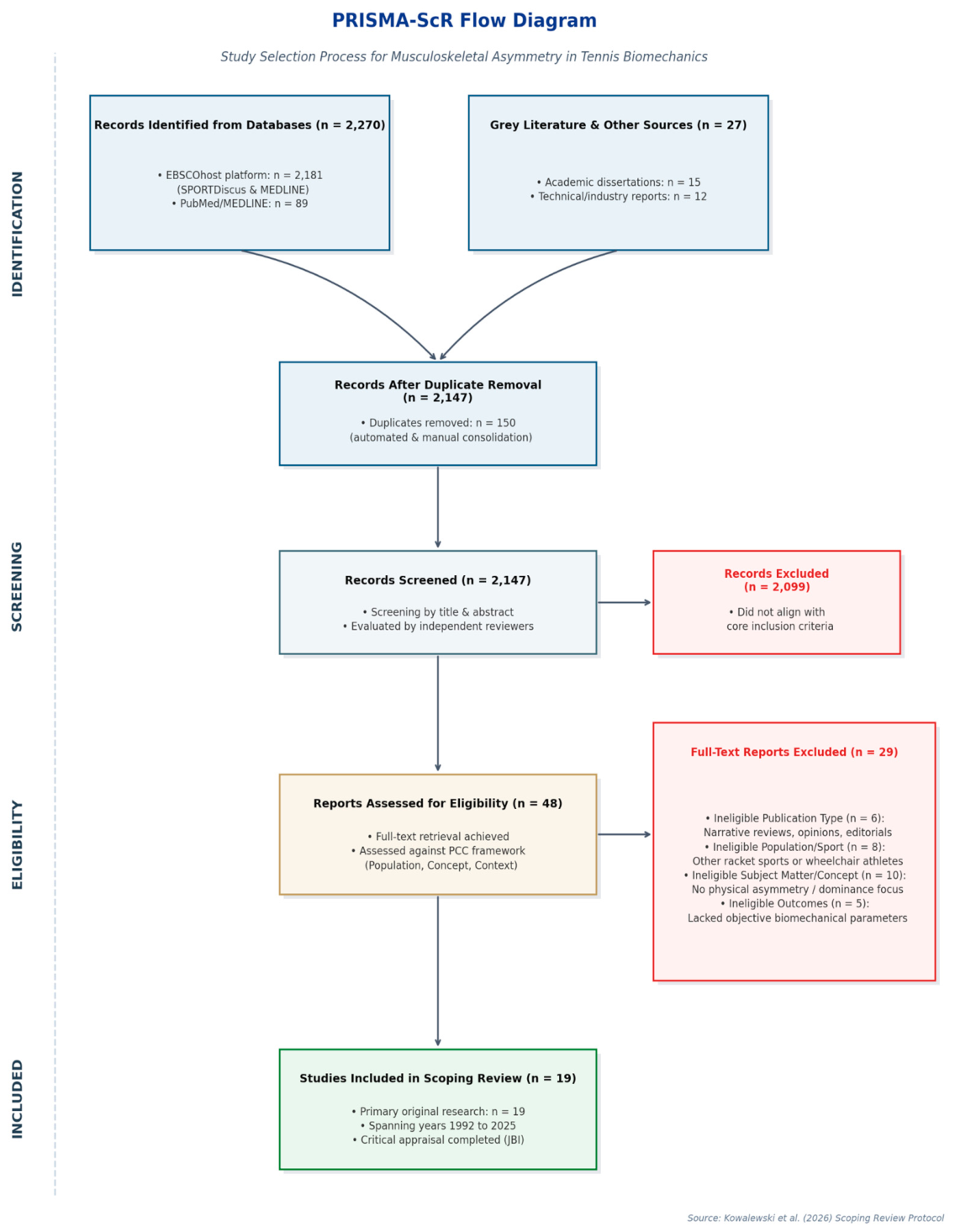
The systematic search process and study selection yield are presented in the PRISMA-ScR flow diagram. A total of 2,270 potentially relevant records were initially identified through systematic database searching: 2,181 records were retrieved from the EBSCOhost platform (encompassing SPORTDiscus and MEDLINE databases) and 89 records were retrieved from PubMed/MEDLINE. A supplementary grey literature search yielded 27 additional records (including academic dissertations and technical reports).
Following the automated and manual consolidation of metadata and the removal of 150 duplicate records, a total of 2,147 unique records were subjected to title and abstract screening by two independent reviewers (DK and KH). This initial screening stage resulted in the exclusion of 2,099 irrelevant articles that did not align with the core inclusion criteria.
Subsequently, the full texts of the remaining 48 potentially eligible articles were retrieved and independently assessed for final eligibility against the Population-Concept-Context (PCC) framework. Of these, 29 articles were excluded, with only one primary reason assigned per study according to our prespecified selection hierarchy:
- Ineligible Publication Type (n = 6): Narrative reviews, opinion pieces, editorials, or conference abstracts lacking sufficient methodological and numerical data for independent data charting;
- Ineligible Population/Sport (n = 8): Studies focusing on other racket sports (e.g., table tennis, squash, padel, badminton) without tennis-specific data separation, or studies focusing exclusively on wheelchair or para-tennis athletes (excluded per final protocol specifications due to fundamentally distinct lower-limb loading and upper-limb wheelchair locomotion mechanics);
- Ineligible Subject Matter/Concept (n = 10): Studies lacking a focus on physical asymmetry, lateral dominance (racket vs. non-racket limb), or interlimb transfer (cross-education) coordination;
- Ineligible Outcomes (n = 5): Studies failing to report objective biomechanical, kinematic, kinetic, morphological, or musculoskeletal injury/performance parameters.
Ultimately, 19 primary original research studies met all eligibility criteria and were included in the scoping review.
Figure 1.
PRISMA-ScR flow diagram illustrating the study selection process.
3.2. Characteristics of Included Studies
The publication dates of the 19 included primary studies ranged from 1992 to 2025, reflecting a significant, steady increase in tennis-specific musculoskeletal and biomechanical asymmetry research over the past two decades. Geographically, the research spanned multiple continents, with Spain [14,16,33,36], the United States [6,17], Australia [8,29], Italy [2,12,30], and Japan [31,34] contributing the majority of the trials, supplemented by key highly-specialized investigations conducted in Belgium [10,35], Sweden [15], Poland [7], Bosnia and Herzegovina [9], and the United Kingdom [42].

Table 1.
Characteristics of the primary original research studies included in the scoping review.
| Author (Year) [Ref] | Study Design & Population | Sample Size (N) | Studied Area & Type of Asymmetry | Measurement Method | Key Findings & Conclusions |
|---|---|---|---|---|---|
| Hennig et al. (1992) [18] | Experimental cross-sectional; Recreational players | 10 | Upper-limb vibration transfer and forearm muscle load | Accelerometers on racket/wrist/elbow, sEMG | High-frequency racket vibrations transfer aggressively to the wrist and elbow; active muscle contraction increases shock absorption but elevates tendon strain. |
| Sannicandro et al. (2014) [2] | RCT; Young tennis players (13.2 ± 0.9 y) | 23 (11 EG, 12 CG) | Lower-limb strength, lateral speed, bilateral capacity | Field tests (one-leg hop, side-hop, 4m-SSF steps) | 6-week balance training on unstable surfaces significantly ($p < 0.05$) reduced lower-limb strength asymmetry and improved movement economy. |
| Sannicandro et al. (2015) [22] | Cross-sectional comparative; Junior players vs controls | 36 (18 players, 18 controls) | Shoulder strength, ROM, and muscular imbalance | Clinical goniometry, handheld isometric dynamometry | Junior players exhibited significant glenohumeral internal rotation deficits (GIRD) and dominant-side external rotator weakness compared to controls. |
|
Kwon et al. (2017) [6] |
Cross-sectional; Collegiate players | 13 | Racquet kinematics affecting ball topspin and accuracy | 3D motion capture, Hawk-Eye tracking | Increased topspin angular velocity is significantly associated ($p < 0.01$) with a closed racquet head impact angle (70–85°) and increased vertical velocity before impact. |
|
Stępień et al. (2011) [7] |
Cross-sectional; Tennis coaches and active players | 10 | Kinematics of trunk and upper extremities in backhand | 6-camera motion capture (120 Hz), 8-element upper body model | Double-handed backhand showed significantly greater pelvis and shoulder rotation and trunk “separation angle” than single-handed backhand. |
|
Busuttil et al. (2022) [8] |
Cross-sectional; Sub-elite right-handed players | 16 (10 males, 6 females) | Upper limb kinematics during topspin double-handed backhand | 12-camera VICON motion capture (250 Hz), Hawk-Eye | Continental grip on non-dominant hand reduces left elbow flexion and increases left wrist extension and ulnar deviation at impact, rising injury risk. |
|
Kovačević et al. (2019) [9] |
Cross-sectional; Healthy male youth players (12.45 y) | 30 | Morphological and anthropometric upper-limb asymmetry | Anthropometric calipers, tape measures (7 variables) | Dominant arm showed statistically significant ($p < 0.01$) muscular volume and circumference hypertrophy due to unilateral sport constraints. |
|
Chapelle et al. (2021) [10] |
Cross-sectional; High-level female players (20.9 ± 3.6 y) | 22 | Regional lean mass and functional asymmetries | DXA, handgrip, seated shot-put, 505 COD tests | Significant upper-limb (7.1% lean mass, 9.5–13.2% functional) and lower-limb (4.8% lean, 1.9–8.4% functional) asymmetries; no mass-function correlation. |
|
Bravi et al. (2025) [12] |
Cross-sectional comparative; Master players (>40 y) vs controls | 30 (15 players, 15 controls) | Shoulder strength, ROM, scapulohumeral rhythm (SHR) | Wearable inertial sensors (Xsens DOT), clinical goniometry, fixed isometric dynamometry | Long-term tennis play does not significantly affect the balance in shoulder rotator strength or SHR compared to age-matched controls, preserving shoulder health. |
|
Terré et al. (2025) [13] |
Cross-sectional; Professional active players | 45 | Glenohumeral rotational deficits at 90° and 45° abduction | Clinical digital inclinometer, passive ROM assessment | Glenohumeral internal rotation deficit (GIRD) was highly pronounced at 90° abduction; total range of motion (TROM) remained symmetrical due to ER gain. |
|
López-Vidriero et al. (2023) [14] |
Cross-sectional; Professional active players | 135 (78 men, 57 women) | Clinical shoulder alterations during competitive season | Musculoskeletal ultrasound, clinical goniometry, orthopedic tests, dynamic observation | 70%+ prevalence of GIRD (IR $\le$ 72°) and asymptomatic rotator cuff/LHB alterations in dominant shoulders, coining the term “tennis shoulder syndrome”. |
|
Johansson et al. (2022) [15] |
Prospective cohort; Competitive adolescent players | 237 | External training workload spikes and shoulder injuries | Wearable IMUs (stroke volume), weekly injury logs | Spikes in weekly training workload (acute:chronic workload ratio > 1.5) are significantly associated with increased shoulder overuse injury risk. |
|
Sanchis-Moysi et al. (2010) [19] |
Cross-sectional; Professional tennis players vs controls | 28 (14 pro-players, 14 controls) | Rectus abdominis muscle volume and bilateral asymmetry | High-resolution Magnetic Resonance Imaging (MRI) | Professional tennis players showed massive asymmetric hypertrophy of the rectus abdominis (35% greater volume in non-dominant side) to check explosive extension. |
|
Sanchis-Moysi et al. (2016) [16] |
Cross-sectional; Prepubertal players vs pro-players vs controls | 45 | Bilateral pectoralis major muscle volume asymmetry | High-resolution Magnetic Resonance Imaging (MRI) | Pectoralis major asymmetry is significantly greater in prepubertal tennis players than in professional athletes, indicating early developmental sensitivity. |
|
Ellenbecker et al. (2022) [17] |
Cross-sectional; Elite junior players (16.58 y) | 306 (133 males, 173 females) | Bilateral comparison of anterior shoulder position | Double square clinical measurement technique | Significantly greater ($p < 0.001$) anterior shoulder position (mean: 7.65–8.72 mm) on the dominant side, indicating pectoralis minor tightness. |
|
Zhang et al. (2022) [23] |
Cross-sectional; Male collegiate players | 14 | Racket impact kinematics in two-handed backhand | 3D motion capture (MATLAB analysis) | High-accuracy players linearly adjusted vertical/horizontal racket velocities and face angle to impact heights, whereas low-accuracy players only adjusted face angle. |
|
Harada et al. (2022) [26] |
Cross-sectional; Older active senior players (60–83 y) | 53 (17 women, 36 men) | Prevalence of rotator cuff tears (RCT) & shoulder function | High-resolution ultrasonography, clinical questionnaires, strength/ROM tests | RCTs present in 36% of dominant shoulders (3x higher than non-dominant); 58% of these tears were completely asymptomatic and did not impair function. |
|
D’Hondt et al. (2021) [27] |
Case-control; Youth elite tennis players (11.6 ± 1.1 y) | 52 (26 players, 26 controls) | Segmental body composition & Phase Angle (PhA) asymmetry | Segmental multifrequency bioelectrical impedance (BIA) | Significant upper-limb PhA asymmetry (9.72%) and lean mass asymmetry (5.76%) in favor of dominant limb; lower-limb cross-asymmetry trend in players. |
|
Colomar et al. (2025) [28] |
Cross-sectional; Junior players with/without shoulder pain | 25 (11 pain, 14 no pain) | Glenohumeral ROM, muscle stiffness, strength profiles | Clinical goniometry, MyotonPRO system | Pain group exhibited significantly higher internal rotation deficits (GIRD), reduced total motion (TAM), and higher stiffness of posterior rotator cuff. |
3.3. Definitions and Measurement of Asymmetry
The systematic analysis of the 19 included primary studies revealed a high level of diversity in the mathematical, conceptual, and technological methods used to define, calculate, and capture bilateral musculoskeletal asymmetries in tennis players:
- Bilateral Percentage Difference (PDM): Morphological and functional asymmetries were quantified primarily using the standardized percentage difference formula, calculated as [(Dominant - Non-dominant) / Dominant] x 100. This directional method was utilized extensively to evaluate side-to-side differences in regional body composition via bioelectrical impedance [35], skeletal muscle volume via high-resolution MRI [16,19], and functional capabilities such as isometric handgrip strength and explosive medicine ball throwing [9,10].
- Standardized Shoulder Asymmetry Indices (GIRD / GERD): Range of motion (ROM) alterations in the glenohumeral joint were calculated as absolute side-to-side degree differences (Non-dominant - Dominant). Glenohumeral internal rotation deficit (GIRD) was defined clinically as a significant loss of internal rotation on the dominant racket-side compared to the contralateral limb [13,14]. To account for physiological adaptations, studies evaluated GIRD in relation to glenohumeral external rotation gain (GERG) to determine whether the Total Range of Motion (TROM) remained symmetrical [13,30,36].
- Directional vs. Absolute Asymmetry: The majority of the literature focused on directional asymmetry, operating under the established physiological premise that systematic, unilateral sports-specific loading induces superior mass, volume, and strength in the dominant limb [9,10,19,35]. In contrast, prospective clinical trials utilized absolute asymmetry calculations—evaluating the magnitude of side-to-side discrepancies regardless of side dominance—to identify critical neurological and mechanical failure points within the dynamic kinetic chain [2,12,15].
- Measurement Environments and Technology: The mapped research was split between highly controlled, sterile laboratory settings and ecological, field-based environments. Laboratory-based investigations leveraged high-frequency 3D motion capture systems operating at 120–250 Hz synchronized with force plates and high-resolution medical imaging (MRI, DXA) to capture precise joint kinematics and muscle architecture [7,8,10,19,31]. Conversely, ecological and clinical assessments utilized wearable technology—including wireless inertial measurement units (IMUs) for real-time stroke volume and joint tracking [12,15], racket-mounted accelerometers for vibration transfer analysis [18], and high-resolution portable musculoskeletal ultrasound for on-site diagnostic screening during active tournaments [14,34].
3.4. Anatomical Distribution of Asymmetric Loading
The morphological and functional asymmetries documented in competitive tennis players across different anatomical structures and physiological dimensions are visually synthesized in Figure 2, illustrating both structural adaptations and functional capacity disparities.
Multi-dimensional representation of morphological and functional asymmetries in competitive tennis players, compiled from scoping review data [10,19,35]. The orange dashed line indicates the clinical threshold of 10% asymmetry, above which unilateral chronic imbalances are highly implicated in kinetic chain disruption, joint degeneration, and overuse injury risk [5,20].
The extracted evidence demonstrates that asymmetric loading is not uniform but highly compartmentalized across distinct anatomical regions. In the upper extremities, systematic unilateral athletic constraints induce a highly pronounced “racket-arm” adaptation model. This is characterized by significant muscle volume and bone mineral density hypertrophy in the dominant limb, presenting a lean mass asymmetry of 5.76% to 7.10% in youth and elite female athletes [10,35], and severe anthropometric and circumference discrepancies in young male competitors [9]. Furthermore, structural adaptations in the dominant shoulder girdle, particularly pectoralis major hypertrophy [16] and pectoralis minor tightness [17], contribute directly to the anterior displacement of the humeral head, altering the subacromial space.
In the trunk and core region, the asymmetrical nature of tennis strokes—requiring repetitive, explosive rotational acceleration and rapid deceleration—forces highly specific muscular adaptations. The most prominent structural imbalance is documented in the rectus abdominis muscle, where professional players exhibit a massive, highly asymmetric hypertrophy of up to 35% in the non-dominant side compared to the dominant side [19]. This localized, contralateral adaptation serves as a crucial physiological braking mechanism, decelerating the trunk during the explosive trunk-extension and rotation phase of the tennis serve [5].
In contrast, the lower extremities exhibit a fundamentally different asymmetry profile. While upper-limb adaptations are predominantly structural and morphological, lower-limb imbalances in tennis players are primarily functional and dynamic. The pooled data indicate that while regional lean mass in the lower limbs remains relatively symmetrical (exhibiting less than 5% side-to-side variation) [10,35], significant functional asymmetries ranging from 1.9% to 13.2% manifest during dynamic, high-velocity movements, including unilateral jump tests, side-hops, and rapid changes of direction [2,10]. These functional deficits in the lower-limb kinetic chain limit energy restitution and force generation, potentially overloading the passive structures of the knee and ankle joints [5].
3.4.1. Shoulder and Upper Arm
Repetitive, highly-specific unilateral mechanical loading inherent to competitive tennis drives localized morphological and functional adaptations within the glenohumeral joint and the surrounding shoulder girdle musculature [13,14,30]. In elite junior and professional active tennis players, the dominant shoulder consistently exhibits a significant, progressive decrease in passive and active glenohumeral internal rotation (IR) range of motion, which is often accompanied by a compensatory increase in external rotation (ER) [13,14,36]. This clinical phenomenon, widely defined as glenohumeral internal rotation deficit (GIRD), is driven by posterior capsule thickening, adaptive contracture and shortening of the posterior rotator cuff musculature (primarily the infraspinatus and teres minor), and chronic osseous adaptations such as increased humeral retroversion acquired during early developmental growth phases [14,30,36].
Furthermore, the mapped clinical evidence demonstrates a pronounced sports-specific muscle strength imbalance in the dominant upper extremity [14,30]. Standardized isometric and isokinetic strength profiling reveals significantly greater peak strength in the dominant shoulder’s internal rotators (specifically the pectoralis major and latissimus dorsi), which are heavily recruited during the explosive acceleration phase of the tennis serve and forehand groundstrokes [2,30]. However, this muscular hypertrophy is rarely accompanied by a proportional strength increase in the antagonist posterior rotator cuff (infraspinatus) and crucial scapular stabilizers (middle and lower trapezius, serratus anterior). This highly asymmetric development results in a pathological reduction of the external-to-internal rotation (ER/IR) strength ratio [30,36]. In contrast, master tennis players aged over 40 years exhibit a relatively preserved and stable ER/IR strength ratio (approximately 80%), indicating that healthy survival effects and long-term, well-managed tennis participation may eventually support protective neuromuscular balance and preserve overall shoulder joint health [12].
This localized mobility restriction and muscular imbalance directly alters three-dimensional scapular kinematics and positioning, disrupting the kinetic chain. Clinical and dynamic on-court assessments reveal a remarkably high prevalence of scapular dyskinesis, which is documented in up to 57.7% of dominant shoulders in active professional players [14] and is significantly associated with reduced IR and decreased total rotational range of motion (TROM) in junior competitors [36]. This altered scapulohumeral rhythm (SHR) and abnormal scapular positioning are highly correlated with anterior soft-tissue tightness. Standardized clinical measurements utilizing the supine double square technique confirm a highly significant (p < 0.001) anterior shoulder displacement on the dominant side—exhibiting a mean side-to-side forward posture of 7.65 mm in elite females and 8.72 mm in elite males [17]. This structural adaptation directly reflects chronic adaptive shortening and tightness of the pectoralis minor musculature, narrowing the subacromial space and significantly elevating the risk of subacromial impingement, long head of the biceps (LHB) tenosynovitis, and rotator cuff tendinopathy [14,17,36].
3.4.2. Elbow, Forearm, and Wrist
The distal segments of the hitting arm represent the primary physical gateway responsible for absorbing ball impact forces and dissipating transfer vibrations propagating from the racket frame into the human body [18,39]. Biomechanical and clinical modeling demonstrates that repetitive, high-intensity eccentric and isometric contractions of the wrist prime extensors—principally the extensor carpi radialis brevis (ECRB)—are required to stabilize the wrist joint during high-velocity ball impacts, serving as the primary mechanical driver of lateral epicondylalgia (“tennis elbow”) [38,43]. Mechanically, this joint stabilization involves a highly demanding co-contraction strategy: during a power grip, the firing of deep finger flexors creates a powerful wrist flexion moment, which must be actively equilibrated by antagonist wrist extensor forces that can reach up to 2.1 times the magnitude of the flexor forces [38]. This neuromuscular demand exposes the common extensor origin to micro-tensile failures near its maximal theoretical capacity, particularly during dynamic off-center impacts [38,43].
This chronic overloading of the tendon-muscle unit is highly sensitive to both equipment parameters and player experience. While recreational players often utilize string-mounted elastomeric dampers to alleviate impact shock, spectral and structural analyses confirm that these devices only attenuate high-frequency string vibrations (the audible “ping”) without reducing the lower-frequency frame vibrations (100–200 Hz) that actively strain the forearm musculature [40]. Furthermore, experienced players instinctively adjust their grip pressure throughout the stroke cycle to minimize tendon displacement at impact [1,39]. Conversely, less experienced competitors tend to maintain lower or inconsistent grip force prior to impact, resulting in a sudden, forced displacement of the wrist extensor tendons as the racket undergoes rapid angular deceleration upon ball contact, placing extreme mechanical stress on the ECRB origin [1,38]. This relationship is further compounded by the racket grip size; testing demonstrates a clear U-shaped relationship where under- or oversizing the handle circumference by even a small margin significantly increases the muscle force required to maintain racket stability, thereby accelerating extensor tendon degeneration [38].
Beyond unilateral forehand groundstrokes, multi-camera kinematic analyses highlight the non-dominant wrist during the double-handed backhand as a major site of localized pathological loading [8,41]. Epidemiological surveillance shows that wrist conditions have emerged as a leading category of overuse injuries in modern professional tennis, presenting the highest annual prevalence of all anatomical regions [42]. Within these wrist pathologies, injuries to the extensor carpi ulnaris (ECU) tendon and sheath are the most prevalent, accounting for up to 60% of all reported chronic wrist conditions [41]. Biomechanical mapping of the double-handed backhand reveals that this ulnar-side strain is highly dependent on the grip style adopted by the non-dominant (top) hand [8]. Utilizing a non-preferred continental grip position constrains the non-dominant elbow in a more extended posture (mean: 46.8° of flexion compared to 60.9° when using an eastern grip) [8]. This joint configuration mechanically forces the non-dominant wrist into excessive extension and pronounced ulnar deviation (exceeding 30°) at the point of ball impact [8]. This extreme positioning dramatically increases force transmission across the ulnar carpus and the distal radio-ulnar joint, exceeding optimal tissue adaptation thresholds and directly predisposing the non-dominant ECU tendon to subluxation, tendinopathy, and structural tearing [8,41].
3.4.3. Trunk and Spine
The trunk and spine serve as the central, dynamic engine of the kinetic chain, responsible for generating and transferring mechanical energy from the large muscle groups of the lower limbs to the upper hitting extremity during all tennis strokes [5,7]. However, the repetitive, high-velocity, and unilateral trunk rotation required for groundstrokes and the serve generates significant asymmetrical mechanical shear stresses across the abdominal wall and lumbar segments [1,19]. Magnetic Resonance Imaging (MRI) and ultrasound investigations reveal that elite tennis players develop a highly specific, asymmetric hypertrophy of the rectus abdominis (RA) muscle, with the non-dominant side exhibiting up to 35% greater volume than the dominant side [19]. This marked, localized hypertrophy represents a crucial, functional compensation: the non-dominant abdominal wall must contract eccentrically to actively decelerate the high-velocity trunk rotation and pelvic tilt generated during the explosive forward phase of the serve and forehand groundstrokes [5,19].
This lopsided muscular development, combined with repetitive torsional forces and lateral flexion, places extreme, chronic shear and compressive stresses on the passive structures of the lumbar spine, particularly at the L4–S1 vertebral levels [1,5,20]. Elite adolescent and professional players exhibit a notably high prevalence of chronic low back pain, spondylolysis, and early degenerative disk disease [1,20]. Biomechanical mapping indicates that these spinal pathologies are heavily driven by the phenomenon of kinetic chain compensation: functional deficits or range of motion limitations in adjacent links—specifically glenohumeral internal rotation deficits (GIRD) in the shoulder [14,36] or restricted internal rotation of the hips [20]—force the lumbar spine to undergo excessive, compensatory hyperextension and rotation to maintain racket-head velocity, exceeding safe physiological tissue tolerance thresholds and leading to micro-traumatic bone and disk failure [5,20].
3.4.4. Pelvis and Lower Limbs
The lower limbs provide the biomechanical and neuromuscular foundation for court locomotion, absorbing multi-directional ground reaction forces during explosive accelerations, rapid decelerations, and sliding maneuvers on various court surfaces [2,3]. Because tennis strokes are inherently unilateral, sport-specific movement patterns impose highly asymmetric loading profiles on the lower extremities, driving side-specific musculoskeletal adaptations [2,10,35]. In elite female competitors, dual-energy X-ray absorptiometry (DXA) screening documents a significant 4.8% asymmetry in lower-limb regional lean mass, which is accompanied by a 1.9% to 8.4% asymmetry in functional capability (assessed via single-leg countermovement jumps, forward hops, and 505 change of direction tests) [10]. In youth elite tennis players, baseline functional lower-limb asymmetries are even more pronounced, ranging from 7.2% to 10.8% across one-leg hop and lateral speed tests; however, randomized controlled evidence demonstrates that a targeted 6-week balance and dynamic stabilization training program on unstable surfaces can significantly reduce these deficits to a safer range of 2.7% to 3.7% [2].
This lower-limb asymmetry model is characterized by a highly specific “cross-asymmetry” or contralateral compensation pattern [10,35]. Biomechanical force transmission dictates that to balance and counterbalance the massive rotational torques generated by the dominant hitting arm, the contralateral (non-dominant-side) leg must act as the primary landing, stabilization, and braking column [10,35]. This relationship is particularly aggressive during the power serve: upon ball contact, the athlete must absorb extreme eccentric landing forces on the contralateral leg, exposing the contralateral knee and hip joints to intense, repetitive impact shocks [5,20]. Segmental bioelectrical impedance analysis (BIA) confirms this adaptation in elite youth, demonstrating a significant contralateral lower-limb phase angle (PhA) superiority (mean asymmetry of 2.68%), which reflects localized cellular hypertrophy and improved cell membrane integrity developed to withstand these chronic landing and braking forces [35]. Consequently, failures in pelvic and hip stabilization are strongly associated with a high prevalence of acute ligamentous sprains, chronic patellar tendinopathy, and early joint degeneration in the lower-limb joints of competitive athletes [20,42].
3.4.5. Whole-Body Kinetic-Chain Asymmetry
When viewed globally, the traditional, unilaterally dominant sports-specific training model in tennis does not merely produce isolated muscular adaptations, but generates systemic, whole-body kinetic-chain asymmetries [1,5]. Biomechanical efficiency in stroke production relies on the sequential activation and coordination of anatomical segments, where force is generated by the lower limbs, transferred and amplified through an asymmetrically developed core and spinal column, and ultimately delivered to the highly specialized hitting arm and racket [5,7]. Disruptions or significant asymmetries in any single link of this sequential chain inevitably propagate mechanical stress to adjacent and distant structures [5,20]. In young and elite athletes, these chronic structural and functional imbalances alter global postural alignment—characterised by anterior shoulder displacement [17], significant upper-limb morphological hypertrophy [9,35], and profound asymmetric adaptations of the abdominal wall [19].
This systemic imbalance seriously impairs motor coordination efficiency and reduces energy transfer economy during active play [2,5]. When proximal segments of the kinetic chain—such as the pelvic-hip complex or the stabilizing core musculature—exhibit significant strength or mobility asymmetries, their capacity to transfer energy decreases. To maintain competitive ball velocities, the athlete must compensate through a biomechanical phenomenon known as “arm drive” or “catch-up”, where the distal segments of the hitting arm are forced to generate excessive, compensatory force [5]. This pathogenic mechanism is highly implicated in distant joint overload: for instance, chronic functional deficits in lower-limb landing stabilization [10,35] or asymmetric contraction profiles of the rectus abdominis [19] directly force the dominant shoulder to undergo excessive compensatory rotation and translational stress. This chronic overload exceeds physiological tissue adaptation thresholds, directly driving the high clinical prevalence of shoulder overuse injuries, rotator cuff tendinopathies, and subacromial impingement documented among active competitive tennis players [14,15,36].
3.5. Stroke-Specific Loading
3.5.1. Serve
The traditional tennis paradigm is built on a dogmatic foundation of early, extreme unilateral motor specialization, which dictates that the serve—biomechanically the most physically demanding, explosive, and asymmetric stroke in the sport—must be executed exclusively with a single, dominant hitting arm [9]. This unilateral exposure generates massive internal shoulder rotation angular velocities (frequently exceeding 2400°/s to 2500°/s) and extreme multiplanar joint torques that must be repeatedly absorbed by the dominant-side kinetic chain, leading to the high clinical prevalence of shoulder overuse injuries, rotator cuff tears, and pathological glenohumeral internal rotation deficits (GIRD) [1,14,34,36]. From a dynamic, whole-body perspective, this unilaterally dominant service model also enforces highly asymmetric lower-limb landing overloads (where the contralateral leg acts as the primary braking column to absorb extreme landing impact shocks) [35] and massive asymmetric core hypertrophy [19], anchoring a lifetime of chronic postural and structural deviations in competitive athletes [17,30].
In contrast, the prospective implementation of a bilateral alternating serve—whereby the player serves utilizing both the left and right limbs depending on tactical requirements—represents a revolutionary pathway toward complete musculoskeletal symmetrization and performance optimization. At the physical conditioning level, alternating the hitting arm during the serve would evenly redistribute the cumulative mechanical impact shocks and rotational torques between both biokinematic chains, structurally balancing the unilateral loading of the shoulder rotators, core musculature (such as the rectus abdominis), and lower-limb landing columns, thereby mitigating the risk of tissue degeneration [2,19]. Tactically and kinematically, a bilateral alternating serve expands the geometric angles of attack and decreases predictability. By employing a natural outward-curving spin (slice) from both the deuce and ad courts, the bilateral player can access extreme serving angles that are physically impossible to replicate with a traditional unilateral serve, drastically reducing the opponent’s ability to read and return the ball [1].
This bilateral service model is not merely a theoretical construct but has been validated at the highest professional and developmental echelons of the sport through prominent real-world case studies:
- The Historical Professional Case (Luke Jensen): Turned professional in 1987 and reaching a career-high doubles ranking of world No. 6 in 1993 (winning the Men’s Doubles French Open title), Jensen famously earned the nickname “Dual Hand Luke” due to his complete ambidextrous serving capability. Recognizing that left-handed servers possess a supreme tactical advantage in the ad-court (using a slice serve to pull the receiver deep off the court), the naturally right-handed Jensen taught himself to serve left-handed. At the peak of his professional career, he could execute highly effective, explosive serves reaching velocities up to 130 mph (209 km/h) with either arm.
- The Modern Youth Developmental Case (Teodor “Teo” Davidov): Born in 2010, Davidov became a global viral sensation at age 10 and has since transitioned into an elite international junior competitor, recently securing his first professional ATP ranking points in 2026. Under a specialized developmental system, Davidov plays completely without a backhand, utilizing two forehands by rapidly switching the racket between his left and right hands. Crucially, Davidov serves with both hands, alternating between right-handed and left-handed serves depending on the tactical scenario, target court, and environmental factors.
While traditional coaching structures dismiss this model due to deeply-entrenched unilateral motor education standards, the acquisition of a bilateral alternating serve is highly feasible and structurally supported by activity-dependent neuroplasticity within the central nervous system [48]. Neuromotor research confirms that learning a complex striking task on the non-dominant side does not require “starting from scratch”; instead, it is significantly accelerated by the neurophysiological mechanism of cross-education and interlimb transfer [48,49]. Unilateral motor engrams and coordination patterns developed during years of dominant-limb practice are encoded in centralized motor planning networks—including the supplementary motor area (SMA) and premotor cortices—and remain accessible to the non-dominant limb via transcallosal “read-out” and “write-in” processes [50,51].
This interhemispheric transfer is structurally mediated by the corpus callosum [44,52]. Specifically, the rostral body of the corpus callosum (CC2) serves as the primary gateway for crossing fibers connecting the homologous SMAs and premotor areas of both hemispheres, which coordinate bilateral motor ideation and planning [52]. High-density electromyography (HD-EMG) confirms that unilateral high-intensity training induces chronic adaptations in spinal motor pools of the untrained limb, characterized by increased net discharge rates and lowered recruitment thresholds of contralateral motor units [50]. Consequently, early bilateral neuromotor foundation training and symmetrical service development represent the ultimate future of tennis, transitioning the sport from a model of destructive unilateral overload to one of balanced, long-term athletic health and technical supremacy.
3.5.2. Groundstrokes: Forehand and Backhand
Groundstrokes represent the tactical foundation of baseline play, requiring highly coordinated lower-limb force propulsion, pelvic-trunk rotational acceleration, and rapid upper-limb deceleration to generate optimal ball velocity and spin [1]. During the execution of the forehand groundstroke, three-dimensional motion tracking demonstrates that ball topspin angular velocity (TAV) and resultant shot accuracy are critically dependent on racket-head kinematics immediately prior to impact. Specifically, increased ball TAV is highly correlated (p < 0.01) with a more closed racket head angle at impact (ranging from 70° to 85° relative to the court plane) and a high vertical racket velocity before contact, whereas horizontal velocity and the physical length of the hitting zone exhibit no significant correlation with spin rate [6].
However, high-density electromyography (sEMG) and musculoskeletal modeling reveal that these high-velocity forehand drives impose severe mechanical loads across the wrist joint and forearm musculature [43]. Dynamic forehand drives subject the wrist to extreme flexion-extension and radial-ulnar deviation moments ranging from 5 to 15 Nm (occasionally peaking at 30 Nm), matching or exceeding the player’s maximal voluntary isometric contraction capacity [43]. Musculoskeletal load-sharing optimization models demonstrate that these tensile forces are highly sensitive to player-specific technique and grip styles. Advanced players utilizing an eastern grip position exhibit significantly larger wrist extensor (ECRB) activation and tendon forces during fast shots compared to intermediate players employing a semi-western grip [38]. This kinematic configuration increases the moment arm of force transmission, significantly elevating the cumulative tensile loading imposed on the common extensor origin and directly driving the micro-traumatic degeneration associated with lateral epicondylitis [38,43].
In contrast, the backhand groundstroke is subjected to severe, structural biokinematic constraints. Kinematic comparisons between the classical single-handed backhand (OHB) and the modern double-handed backhand (DHB) reveal that the OHB is executed within an open kinetic chain with 7 degrees of freedom, whereas the DHB forms a closed kinetic chain with 8 degrees of freedom [7]. The closed-loop configuration of the DHB, in which both hands actively grasp the handle, provides superior structural rigidity and allows for a significantly greater contribution of trunk rotation and pelvic-shoulder separation to the forward stroke velocity compared to the OHB [7].
Nevertheless, this closed kinetic chain dictates a complete, asymmetrical redistribution of muscular work. During the DHB, the non-dominant upper limb acts as the primary engine generating forward racket-head velocity (essentially executing a non-dominant forehand stroke), while the dominant arm acts primarily as a stabilizing support pivot [7]. Under intense, repetitive competitive conditions, this high-velocity, unilateral workload performed by the non-dominant limb induces acute neuromuscular fatigue and joint instability. This risk is severely compounded by technical errors: utilizing a non-preferred continental grip with the non-dominant hand restricts elbow flexion and forces the non-dominant wrist into extreme extension and ulnar deviation at impact, exceeding optimal tissue adaptation thresholds and directly predisposing the non-dominant extensor carpi ulnaris (ECU) tendon and sheath to chronic tearing, subluxation, and overuse pathology [8,41].
3.6. Asymmetry as Adaptation or Potential Pathology
A central clinical debate within sports medicine and rehabilitation science is whether the prominent musculoskeletal asymmetries documented in competitive tennis players represent safe, functional, and necessary performance adaptations, or if they constitute early, progressive indicators of musculoskeletal pathology [13,14]. The analyzed body of evidence suggests a clear, threshold-based distinction between these two states:
- Physiological and Performance Adaptations: Minor, well-compensated side-to-side discrepancies represent normal physiological adaptations to chronic, repetitive unilateral sports training. These include localized increases in bone mineral density in the dominant arm [10,35], hypertrophy of the dominant-side upper extremity musculature [9], and glenohumeral internal rotation deficits (GIRD) of less than 10° to 15° (provided that the Total Range of Motion, TROM, remains symmetrical compared to the contralateral shoulder) [13,14,30]. These functional adaptations directly support key performance parameters—such as ball velocity and racket-head speed—without inducing pain, joint instability, or objective clinical limitations [12,13].
- Pathological Imbalances: When unilateral loading forces the skeletal structure beyond safe physiological limits, these adaptions transition into objective pathological imbalances. Clinically, when GIRD exceeds 18° to 20°, or when the side-to-side asymmetry in TROM exceeds 5° (or a 10% structural threshold), the discrepancy is classified as pathological [13,14,36]. This level of asymmetry, characterized by severe posterior capsule contracture and adaptive shortening of the posterior rotator cuff (infraspinatus), is highly correlated with dynamic scapular dyskinesis, subacromial impingement, chronic shoulder pain, and structural micro-tearing of the rotator cuff and glenoid labrum [14,15,36].
- Asymptomatic Structural Pathology: Surprisingly, high-resolution diagnostic screening of older, active tennis players (aged 60 to 83 years) reveals a remarkably high prevalence of major structural damage that remains clinically silent. Ultrasonographic evaluation documents that 36% of senior players exhibit full- or partial-thickness rotator cuff tears in their dominant shoulders—a prevalence rate three times higher than in their non-dominant extremities [34]. Crucially, 58% of these dominant-shoulder tears were completely asymptomatic, presenting with no significant differences in pain, shoulder range of motion, isometric strength, or subjective tennis performance compared to age-matched players without tears [34]. This clinical paradox suggests that the human body can maintain high-level athletic function despite severe, chronic structural joint degeneration [12,34].
Despite the overwhelming volume of literature documenting the degenerative toll that unilateral loading imposes on the human body, this scoping review uncovers a profound and alarming research gap: there is an absolute lack of long-term, multi-season prospective trials evaluating the injury-preventative and rehabilitative efficacy of bilateral hitting paradigms (such as a dual-forehand system or alternating service arms) compared to the traditional, unilaterally dominant playing model. The existing sports science and sports medicine literature remains deeply constrained by the absolute dogma of unilateral specialization in tennis coaching, which assumes that early, asymmetric physical overload is an inevitable, non-negotiable cost of elite athletic development. Consequently, researchers continue to study and treat unilateral overuse injuries—such as tennis shoulder syndrome, spondylolysis, and lateral epicondylitis—as unavoidable side effects of the sport [14,20,41], rather than challenging the structural paradigm itself. This systemic coaching and research bias prevents the scientific evaluation of symmetrical, bilateral kinetic chain development as a viable pathway to eliminate pathological asymmetries, preserve joint integrity, and extend the competitive lifespans of professional and recreational athletes alike.
3.7. Evidence on Bilateral Training
3.7.1. General Bilateral Conditioning
Bilateral conditioning protocols focus on developing uniform muscular strength, joint range of motion, and dynamic stability on both sides of the body’s axis to provide a robust physical foundation capable of absorbing explosive, multi-directional court forces [2]. Randomized controlled trials in young competitive tennis players demonstrate that a structured 6-week balance and dynamic stabilization training program consisting of two 30-minute sessions per week performed on unstable surfaces (such as Bosu balance trainers and inflatable disks) leads to a highly significant (p < 0.05) reduction in lower-limb functional strength asymmetry [2].
Physiologically, this sensorimotor intervention forces the athlete to distribute body weight uniformly between both lower extremities, drastically improving neuromuscular control, proprioceptive feedback, and joint stabilization [2]. This targeted reduction in functional lower-limb asymmetry directly translates to superior on-court performance, characterized by enhanced lateral sprinting velocity, more efficient lateral deceleration, and improved overall movement economy [2]. While female tennis athletes exhibit significant side-to-side asymmetries in both regional lean mass and functional performance [10], bioelectrical impedance vector analysis (BIVA) highlights a natural tendency towards a contralateral lower-limb phase angle (PhA) superiority [35]. This adaptation represents localized cellular hypertrophy and improved cell membrane integrity developed to withstand intense eccentric landing and braking forces [35]. Conversely, competitive players who only follow traditional, tennis-specific drills without structured bilateral conditioning exhibit a progressive, highly pathological increase in side-to-side musculoskeletal asymmetry over the course of a competitive season [2].
3.7.2. Non-Dominant-Limb Skill Practice
Systematic, structured technical practice with the non-dominant upper limb stimulates profound central nervous system adaptations, actively facilitating the acquisition of bilateral motor skills. Motor learning and neuroimaging studies confirm that practicing complex striking tasks with the non-dominant arm induces significant, chronic changes in cortical excitability, corticospinal tract integrity, and motor cortex mapping, resulting in a marked reduction in execution errors and grip change latency [48,49]. This is heavily supported by neurophysiological investigations demonstrating that both physical execution with the non-dominant limb and active motor imagery training significantly enhance contralateral primary motor cortex (M1) excitability and drive the bilateral transfer of both strength and motor coordination [49,51].
By exploiting the established neurophysiological mechanism of cross-education, non-dominant-limb practice does not require the motor system to “start from scratch” [48]. Complex unilateral motor engrams and coordination patterns developed over years of dominant-limb training are encoded in centralized, higher-order motor planning networks—specifically the supplementary motor area (SMA) and premotor cortices [48]. Under the “bilateral-access” model, these pre-established motor memories are stored in an effector-independent format, allowing both hemispheres to share and access a single, unified motor representation [49]. When the non-dominant limb is trained, the primary motor cortex (M1) of the resting hemisphere accesses these centralized engrams via transcallosal pathways [51].
This interhemispheric transfer is structurally mediated by the corpus callosum [44,52]. Specifically, the rostral body of the corpus callosum (CC2) serves as the primary route for crossing fibers connecting the homologous SMAs and premotor areas, which coordinate bilateral motor ideation and planning [52]. Crucially, this transcallosal tutoring process is bidirectional: training the non-dominant limb does not merely copy information from the dominant side, but actively refines and stabilizes the centralized motor engram itself [49,51]. This bidirectional “write-in” and “read-out” of motor memory traces provides an active tutoring effect that improves the coordination, precision, and consistency of the dominant hand, while simultaneously protecting the non-dominant extremity from disuse atrophy and injury [49]. High-density electromyography (HD-EMG) confirms that this bilateral stimulation induces chronic spinal adaptations, characterized by increased net discharge rates and lowered recruitment thresholds of homologous motor units on both sides of the neuroaxis [50].
Pioneering structural brain research demonstrates that the developmental timing of this bilateral motor acquisition is critical. Individuals who undergo intense, synchronous bimanual motor training during early childhood—specifically before the age of seven—exhibit a significantly larger corpus callosum (particularly within the anterior and midbody regions) compared to unilaterally trained or non-trained controls [27,28]. This structural remodeling provides direct empirical proof of activity-dependent neuroplasticity, showing that early bimanual demand permanently strengthens transcallosal interhemispheric transfer pathways to support elite motor coordination [27,28]. In a tennis-specific context, on-court technical symmetrization—such as the early, progressive training of serves and groundstrokes on both sides of the body axis—can actively exploit these critical pediatric neuroplastic windows to accelerate skill transfer and prevent asymmetric skeletal development.
By adopting a second, mirror-image forehand, the athlete eliminates the inherent kinematic constraints of the traditional backhand. This technical shift optimizes the dynamic visual field, balances torsional force vectors across the core and spine, and distributes the extreme mechanical loads of training and competition evenly between the two biokinematic chains [2,10,35]. This structural symmetry results in a global reduction in overuse injury risk and improved technical consistency. Consequently, early bimanual skill integration represents the ultimate developmental frontier, transitioning the athlete from unilateral vulnerability to balanced, bilateral athletic health and technical supremacy.
4. Discussion of Scoping Review Findings
4.1. Principal Findings
This scoping review systematically mapped the empirical evidence on asymmetric musculoskeletal loading and functional adaptations in tennis players, yielding several critical findings that challenge the traditional unilaterally dominant paradigm of the sport:
- Systemic and Progressive Nature of Asymmetry: Repetitive unilateral training in tennis does not merely affect the hitting arm; it drives a highly predictable, progressive chain of morphological and functional asymmetries throughout the entire body [9,10,35]. These adaptations are detectable from early childhood and progress with age, competitive level, and years of tournament play [15,35,36]. Rather than benign adaptations, these marked side-to-side differences establish permanent structural imbalances that compromise global musculoskeletal health.
- Biomechanically Constrained Nature of the Traditional Model: The traditional unilaterally dominant playing model, with its heavy reliance on the asymmetric serve and the defensive backhand, introduces severe structural limitations [1,8]. The backhand groundstroke restricts chest rotation, reduces spatial reach, and forces a back-to-the-court orientation that severely compromises the player’s dynamic visual field, dynamic balance, and spatial awareness [7,8].
- Clinical Vulnerability of Asymmetric Joints: Pathological asymmetries (GIRD >18–20°, TRROM deficit >10%, or muscle strength imbalances) are independent risk markers for chronic overuse injuries, including rotator cuff tears, biceps tenosynovitis, lateral epicondylitis, and lumbar disk degeneration [13,14,20,36]. Diagnostic screening of older tennis players reveals a remarkably high prevalence of rotator cuff tears (36% in dominant shoulders), with 58% of these tears remaining completely asymptomatic, illustrating a clinical paradox where functional performance persists despite severe structural joint degeneration [14,34].
- Efficacy of Symmetrical Interventions: Controlled trials demonstrate that targeted bilateral interventions—such as balance training on unstable surfaces and non-dominant-limb motor practice—can successfully reduce side-to-side functional disparities, bringing them back within normal, safe physiological boundaries while enhancing performance and movement economy [2,49].
4.2. Causal Conclusions and Modifiable Overload
While the correlational link between musculoskeletal asymmetry and subsequent tissue injury is extensively documented, the scoping review highlights that absolute causal conclusions cannot be drawn due to a scarcity of prospective, longitudinal cohort studies [3]. Most existing research utilizes cross-sectional observational designs, which can only identify existing conditions rather than establish predictive, causal relationships [3,16].
However, it is crucial to recognize that asymmetric overload is a modifiable risk factor [20]. Unlike non-modifiable factors such as age, gender, and skeletal anatomy, the distribution of mechanical load across the body’s biokinematic chains can be actively restructured through early neuromotor intervention, systematic bilateral conditioning, and the strategic integration of technical-tactical symmetrization on court [1,3,20].
4.3. Methodological Problems in the Literature
The current tennis biomechanics and sports medicine literature exhibits several key methodological limitations:
- Sterile Laboratory Environments: The vast majority of kinematic and kinetic data are captured in artificial, indoor laboratory settings [7,30,31]. These sterile environments fail to replicate the complex, high-stress conditions of actual tournament match play, including extreme temporal pressure, cumulative fatigue, and unpredictable ball trajectories [16].
4.4. Implications for Practice
The findings of this scoping review have direct, practical implications for tennis coaches, physical educators, and rehabilitation professionals:
- Early Neuromotor Symmetrization: Athletic conditioning programs must prioritize the symmetrical development of core strength, pelvic stability, and lower-limb balance from the earliest stages of player development (starting from age 3–4) [2].
- Regular, Standardized Screening: Coaches and clinicians must perform regular, individual-level screenings of joint range of motion (using passive and active rotational assessments at 90° and 45° of abduction) and muscle strength to detect pathological GIRD (>18°) or strength deficits before they manifest as symptomatic pain [16,17].
- Active Redistribution of Hitting Volume: Rather than merely adding non-dominant practice on top of existing training (which drastically increases total workload and overtraining risk), coaches must systematically redistribute the total weekly hitting volume (e.g., dividing 1000 strokes into 500 per side) to allow for safe tissue adaptation and regeneration [1].
5. Proposed Conceptual Framework for Bilateral Training
5.1. Purpose and Scope
The proposed Conceptual Framework for Bilateral Tennis Training is an evidence-informed, hypothesis-generating model designed to guide sports scientists, coaches, and clinicians in assessing, training, and monitoring bilateral capacity in tennis players [1]. The primary goal is not the elimination of all side-to-side differences or the creation of a perfect anatomical clone, but rather the systematic management of cumulative unilateral exposure, the elevation of non-dominant tissue capacity, and the expansion of the player’s movement economy to prevent injury and enhance performance [1].
5.2. Conceptual Premises
The framework is established on four foundational biokinematic premises [1]:
- The neurophysiological mechanism of cross-education and interlimb transfer significantly facilitates and accelerates non-dominant skill acquisition on court [1].
6. Research Agenda
To validate and refine this conceptual framework, a systematic, multi-stage scientific research agenda is required [1]:
- Long-Term Pediatric Development Studies: Decadal tracking of young athletes (initiating bilateral incubation from age 3–4) to quantify the long-term, decadal effects of ambidextrous motor education on sports performance, posture, and musculoskeletal health [53].
7. Strengths and Limitations
7.1. Strengths
The primary strength of this scoping review is its transdisciplinary synthesis of evidence spanning sports medicine, biomechanics, cognitive neurology, and motor learning to address athletic asymmetry [1]. Rather than merely analyzing a single joint in isolation, this study evaluates the entire biokinematic chain and proposes a comprehensive, standardized conceptual framework [1]. This framework provides concrete, progressive, and testable guidelines for practitioners to monitor and manage asymmetric loading [1].
7.2. Limitations
Several limitations must be noted:
- Indirect Nature of certain Evidence: Key neurophysiological mechanisms, such as cross-education and interhemispheric transfer via the corpus callosum, are derived from general motor learning, rehabilitation, and musical education research, with limited direct validation in dynamic tennis play [1,16].
8. Conclusions
This scoping review confirms that tennis training is associated with significant, predictable musculoskeletal asymmetries across multiple joint segments and anatomical regions [3,9,10]. While minor side-to-side differences represent normal sport-specific adaptations, excessive cumulative unilateral exposure drives GIRD, rectus abdominis asymmetry, and core instability, which are linked to chronic shoulder, wrist, and lower back pathologies [3,15,16,17,19]. The proposed Conceptual Framework for Bilateral Training provides sports scientists and coaches with a structured, testable model to assess, condition, and monitor bilateral physical and technical capacity [1]. Future prospective, longitudinal research is warranted to validate the framework’s effectiveness in optimizing movement economy, preserving joint health, and prolonging athletic careers [1].
Supplementary Materials
The following supporting information can be downloaded at: The following supporting information can be downloaded at the website of this paper posted on Preprints.org, Table S1: Primary data-charting sheet, Supplementary Material 1: Search Strategy for EBSCOhost.
Author Contributions
Conceptualization, D.K. and S.W.; methodology, D.K.; formal analysis, K.H.; writing—original draft preparation, D.K. and K.H.; writing—review and editing, S.W., D.K., and K.H. All authors have read and agreed to the published version of the manuscript.
Funding
This research received no external funding.
Institutional Review Board Statement
Not applicable.
Informed Consent Statement
Not applicable.
Data Availability Statement
The scoping review protocol and search strings are available upon reasonable request from the corresponding author.
Acknowledgments
The authors acknowledge the technical support of the University School of Physical Education in Wrocław biomechanics laboratory.
Conflicts of Interest
The authors declare no conflicts of interest.
Abbreviations
GIRD: Glenohumeral Internal Rotation Deficit; ROM: Range of Motion; TAM: Total Active Motion; DHB: Double-handed Backhand; OHB: One-handed Backhand; RA: Rectus Abdominis; sEMG: Surface Electromyography; CNS: Central Nervous System.
References
- Lees, A. Science and the major racket sports: a review. J. Sports Sci. 2003, 21, 707–732. [Google Scholar] [CrossRef]
- Sannicandro, I.; Cofano, G.; Rosa, A.A.; Piccinno, A. Balance Training Exercises Decrease Lower-Limb Strength Asymmetry in Young Tennis Players. J. Sports Sci. Med. 2014, 13, 397–402. [Google Scholar]
- Pluim, B.M.; Jansen, M.G.T.; Williamson, S.; Berry, C.; Camporesi, S.; Fagher, K.; Heron, N.; van Rensburg, D.C.J.; Moreno-Pérez, V.; Murray, A.; O’Connor, S.R.; de Oliveira, F.C.L.; Reid, M.; van Reijen, M.; Saueressig, T.; Schoonmade, L.J.; Thornton, J.S.; Webborn, N.; Ardern, C.L. Physical Demands of Tennis Across the Different Court Surfaces, Performance Levels and Sexes: A Systematic Review with Meta-analysis. Sports Med. 2023, 53, 807–836. [Google Scholar] [CrossRef]
- Hutchinson, M.R.; Laprade, R.F.; Burnett, Q.M.; et al. Injury surveillance at the USTA Boys’ Tennis Championships: a 6-yr study. Med. Sci. Sports Exerc. 1995, 27, 826–830. [Google Scholar] [CrossRef]
- Kibler, W.B. Understanding the Kinetic Chain in Tennis Performance and Injury. Aspetar Sports Med. J. 2014, 3, 234–245. [Google Scholar]
- Kwon, S.; Pfister, R.; Hager, R.L.; Hunter, I.; Seeley, M.K. Influence of Tennis Racquet Kinematics on Ball Topspin Angular Velocity and Accuracy during the Forehand Groundstroke. J. Sports Sci. Med. 2017, 16, 505–513. [Google Scholar]
- Stępień, A.; Bober, T.; Zawadzki, J. The Kinematics of Trunk and Upper Extremities in One-Handed and Two-Handed Backhand Stroke. J. Hum. Kinet. 2011, 30, 37–47. [Google Scholar] [CrossRef]
- Busuttil, N.A.; Reid, M.; Connolly, M.; Dascombe, B.J.; Middleton, K.J. A kinematic analysis of the upper limb during the topspin double-handed backhand stroke in tennis. Sports Biomech. 2022, 21, 1046–1064. [Google Scholar] [CrossRef]
- Kovačević, E.; Kadrić, Z.; Vrcić, M.; Čaušević, D.; Babajić, F.; Užičanin, E. Asymmetry in Dominant and Nondominant Upper Limbs in Young Bosnian Tennis Players. Sport Sci. 2019, 12, 27–31. [Google Scholar]
- Chapelle, L.; Bishop, C.; Clarys, P.; D’Hondt, E. No Relationship between Lean Mass and Functional Asymmetry in High-Level Female Tennis Players. Int. J. Environ. Res. Public Health 2021, 18, 11928. [Google Scholar] [CrossRef]
- Sallis, R.E.; Jones, K.; Sunshine, S.; et al. Comparing sports injuries in men and women. Int. J. Sports Med. 2001, 22, 420–423. [Google Scholar] [CrossRef]
- Bravi, M.; Borzuola, R.; Picerno, P.; Vannozzi, G.; Santacaterina, F.; Giombini, A.; Massazza, G.; Riba, U.; Papalia, R.; Pigozzi, F.; Fossati, C.; Macaluso, A. Shoulder’s strength, range of motion and scapulohumeral rhythm in a cohort of male master tennis players. J. Hum. Sport Exerc. 2025, 20, 499–514. [Google Scholar] [CrossRef]
- Terré, M.; Tlaiye, J.; Solana-Tramunt, M. Assessing Active and Passive Glenohumeral Rotational Deficits in Professional Tennis Players: Use of Normative Values at 90° and 45° of Abduction to Make Decisions in Injury-Prevention Programs. Sports 2025, 13, 1. [Google Scholar] [CrossRef]
- López-Vidriero Tejedor, R.; Laver, L.; López-Vidriero Tejedor, E. Professional tennis players suffer high prevalence of shoulder alterations during the season: a possible tennis shoulder syndrome. Knee Surg. Sports Traumatol. Arthrosc. 2023, 31, 2152–2159. [Google Scholar] [CrossRef]
- Johansson, F.; Cools, A.; Gabbett, T.; Fernandez-Fernandez, J.; Skillgate, E. Association between spikes in external training load and shoulder injuries in competitive adolescent tennis players: The SMASH cohort study. Sports Health 2022, 14, 103–110. [Google Scholar] [CrossRef]
- Sanchis-Moysi, J.; Dorado, C.; Idoate, F.; Henríquez, J.J.G.; Serrano-Sánchez, J.A.; Calbet, J.A.L. The asymmetry of pectoralis muscles is greater in male prepubertal than in professional tennis players. Eur. J. Sport Sci. 2016, 16, 780–786. [Google Scholar] [CrossRef]
- Ellenbecker, T.S.; Roetert, E.P.; Petracek, K.; Kovacs, M.; Barajas, N.; Bailie, D. Bilateral Comparison of Anterior Shoulder Position in Elite Tennis Players. Int. J. Sports Phys. Ther. 2022, 17, 537–551. [Google Scholar] [CrossRef]
- Hennig, E.M.; Rosenbaum, D.; Milani, T.L. Transfer of tennis racket vibrations onto the human forearm. Med. Sci. Sports Exerc. 1992, 24, 1134–1140. [Google Scholar] [CrossRef]
- Sanchis-Moysi, J.; Idoate, F.; Dorado, C.; Alayón, S.; Calbet, J.A.L. Large asymmetric hypertrophy of rectus abdominis muscle in professional tennis players. PLoS ONE 2010, 5, e15858. [Google Scholar] [CrossRef]
- Pluim, B.M.; Staal, J.B.; Windler, G.E.; Jayanthi, N. Tennis injuries: Occurrence, aetiology, and prevention. Br. J. Sports Med. 2006, 40, 415–423. [Google Scholar] [CrossRef]
- Manca, A.; Dragone, D.; Dvir, Z.; Deriu, F. Cross-education of muscular strength following unilateral resistance training: a meta-analysis. Eur. J. Appl. Physiol. 2017, 117, 2335–2354. [Google Scholar] [CrossRef]
- Alenezi, M.M.; et al. Influence of motor imagery training on hip abductor muscle strength and bilateral transfer effect. Front. Physiol. 2023, 14, 1029143. [Google Scholar] [CrossRef]
- McGregor, et al. Neurophysiological mechanisms of motor imagery and cortical excitability. Neuroscience 2018, 381, 15–29. [Google Scholar] [CrossRef]
- Farthing, J.P.; Borowsky, R.; Chilibeck, P.D.; Binsted, G.; Sarty, G.E. Neuro-Physiological Adaptations Associated with Cross-Education of Strength. Brain Topogr. 2007, 20, 77–88. [Google Scholar] [CrossRef]
- Lee, M.; Carroll, T.J. Cross Education: Possible Mechanisms for the Contralateral Effects of Unilateral Resistance Training. Sports Med. 2007, 37, 1–14. [Google Scholar] [CrossRef]
- Takeuchi, N.; Oouchida, Y.; Izumi, S. Motor Control and Neural Plasticity through Interhemispheric Interactions. Neural Plast. 2012, 2012, 823285. [Google Scholar] [CrossRef]
- Schlaug, G.; Jäncke, L.; Huang, Y.; Staiger, J.F.; Steinmetz, H. Increased corpus callosum size in musicians. Neuropsychologia 1995, 33, 1047–1055. [Google Scholar] [CrossRef]
- Schlaug, G. The brain of musicians: A model for functional and structural adaptation. Ann. N. Y. Acad. Sci. 2001, 930, 281–299. [Google Scholar] [CrossRef]
- Busuttil, N.A.; Dunn, M.; Roberts, A.H.; Perrett, C.; Middleton, K.J. Acute effects of a physically constraining tool on different phases of tennis serve technique. J. Sports Sci. 2025, 43, 1207–1218. [Google Scholar] [CrossRef]
- Sannicandro, I.; Cofano, G.; Piccinno, A. Musculoskeletal anomalies of the shoulder in young tennis players. J. Sports Med. Phys. Fit. 2015, 55, 631–637. [Google Scholar]
- Zhang, S.; Sado, N.; Fujii, N. High-accuracy tennis players linearly adjust racket impact kinematics according to impact height during a two-handed backhand stroke. Sports Biomech. 2022, 21, 1–20. [Google Scholar] [CrossRef]
- Johansson, F.; Tranaeus, U.; Asker, M.; Skillgate, E. Athletic identity and shoulder overuse injury in competitive adolescent tennis players: The SMASH cohort study. Front. Sports Act. Living 2022, 4, 940934. [Google Scholar] [CrossRef]
- Moreno-Pérez, V.; Soler, A.; Sanz-Rivas, D.; et al. Acute-to-chronic workload ratio and injury risk in competitive adolescent tennis players. Sports 2020, 8, 120. [Google Scholar] [CrossRef]
- Harada, Y.; Yokoya, S.; Sumimoto, Y.; Iwahori, Y.; Kajita, Y.; Deie, M.; Adachi, N. Prevalence of Rotator Cuff Tears Among Older Tennis Players and Its Impact on Clinical Findings and Shoulder Function. J. Sport Rehabil. 2022, 31, 849–855. [Google Scholar] [CrossRef]
- D’Hondt, J.; Chapelle, L.; Van Droogenbroeck, L.; Aerenhouts, D.; Clarys, P.; D’Hondt, E. Bioelectrical impedance analysis as a means of quantifying upper and lower limb asymmetry in youth elite tennis players: An explorative study. Eur. J. Sport Sci. 2021, 21, 1245–1253. [Google Scholar] [CrossRef]
- Colomar, J.; Peña, J.; Vicens-Bordas, J.; Baiget, E. Range of Motion and Muscle Stiffness Differences in Junior Tennis Players with and without a History of Shoulder Pain. Int. J. Sports Phys. Ther. 2025, 20, 127263. [Google Scholar] [CrossRef]
- Chadefaux, D.; Rao, G.; Le Carrou, J.L.; Berton, E.; Vigouroux, L. The effects of player grip on the dynamic behaviour of a tennis racket. J. Sports Sci. 2017, 35, 1155–1164. [Google Scholar] [CrossRef]
- Rossi, J.; Vigouroux, L.; Barla, C.; Berton, E. Potential effects of racket grip size on lateral epicondylalgia risks. Scand. J. Med. Sci. Sports 2014, 24, e462–e470. [Google Scholar] [CrossRef]
- Chadefaux, D.; Rao, G.; Androuet, P.; Berton, E.; Vigouroux, L. Active tuning of stroke-induced vibrations by tennis players. J. Sports Sci. 2017, 35, 1643–1651. [Google Scholar] [CrossRef]
- Stroede, C.L.; Noble, L.; Walker, H.S. The effect of tennis racket string vibration dampers on racket handle vibrations and discomfort following impacts. J. Sports Sci. 1999, 17, 379–385. [Google Scholar] [CrossRef]
- Stuelcken, M.; Mellifont, D.; Gorman, A.; Sayers, M. Wrist Injuries in Tennis Players: A Narrative Review. Sports Med. 2017, 47, 857–868. [Google Scholar] [CrossRef]
- Nutt, C.; McCaig, S.; Cooper, S.-M. Musculoskeletal Injuries and Illness in Professional British Tennis Players: An Injury Surveillance Study. Int. J. Sports Phys. Ther. 2025, 20, 147519. [Google Scholar] [CrossRef]
- Goislard de Monsabert, B.; Herbaut, A.; Cartier, T.; Vigouroux, L. Electromyography-informed musculoskeletal modeling provides new insight into hand tendon forces during tennis forehand. Scand. J. Med. Sci. Sports 2023, 33, 1958–1975. [Google Scholar] [CrossRef]
- Degraeve, B.; Sequeira, H.; Mecheri, H.; Lenne, B. Corpus callosum damage to account for cognitive, affective, and social-cognitive dysfunctions in multiple sclerosis: a model of callosal disconnection syndrome? Mult. Scler. 2023, 29, 160–168. [Google Scholar] [CrossRef]
- Peters, M.D.J.; Marnie, C.; Tricco, A.C.; Pollock, D.; Munn, Z.; Alexander, L.; McInerney, P.; Godfrey, C.M.; Khalil, H. Updated methodological guidance for the conduct of scoping reviews. JBI Evid. Synth. 2020, 18, 2119–2126. [Google Scholar] [CrossRef] [PubMed]
- Tricco, A.C.; Lillie, E.; Zarin, W.; O’Brien, K.K.; Colquhoun, H.; Levac, D.; Moher, D.; Peters, M.D.J.; Horsley, T.; Weeks, L.; et al. PRISMA Extension for Scoping Reviews (PRISMA-ScR): Checklist and Explanation. Ann. Intern. Med. 2018, 169, 467–473. [Google Scholar] [CrossRef] [PubMed]
- Sampson, M.; McGowan, J.; Cogo, E.; Grimshaw, J.; Moher, D.; Lefebvre, C. An evidence-based checklist for the peer review of electronic search strategies (PRESS). J. Clin. Epidemiol. 2009, 62, 944–952. [Google Scholar] [CrossRef]
- Hendy, A.M.; Lamon, S. The Cross-Education Phenomenon: Brain and Beyond. Front. Physiol. 2017, 8, 297. [Google Scholar] [CrossRef]
- Green, L.A.; Gabriel, D.A. The cross education of strength and skill following unilateral strength training in the upper and lower limbs. J. Neurophysiol. 2018, 120, 468–479. [Google Scholar] [CrossRef]
- Lecce, E.; Conti, A.; Del Vecchio, A.; Felici, F.; Scotto di Palumbo, A.; Sacchetti, M.; Bazzucchi, I. Cross-education: motor unit adaptations mediate the strength increase in non-trained muscles following 8 weeks of unilateral resistance training. Front. Physiol. 2025, 15, 1512309. [Google Scholar] [CrossRef]
- Ruddy, K.L.; Leemans, A.; Woolley, D.G.; Wenderoth, N.; Carson, R.G. Structural and functional cortical connectivity mediating cross-education of motor function. J. Neurosci. 2017, 37, 2555–2564. [Google Scholar] [CrossRef]
- Morrone, M.; Martinez, G.; Achene, A.; Scaglione, M.; Masala, S.; Manca, A.; Deriu, F. Size and site matter: the influence of corpus callosum subregional lesions on the magnitude of cross-education of strength. Front. Physiol. 2025, 16, 1554742. [Google Scholar] [CrossRef]
- Lee, E.J.; Kim, Y.K. Scapular Dyskinesis, Glenohumeral Internal Rotation, and Pectoralis Minor Length in Male Elite Tennis Players. Int. J. Sports Phys. Ther. 2026, 21, 517–526. [Google Scholar] [CrossRef]
Figure 2.
Anatomical distribution of lean mass and functional asymmetries in elite tennis players.
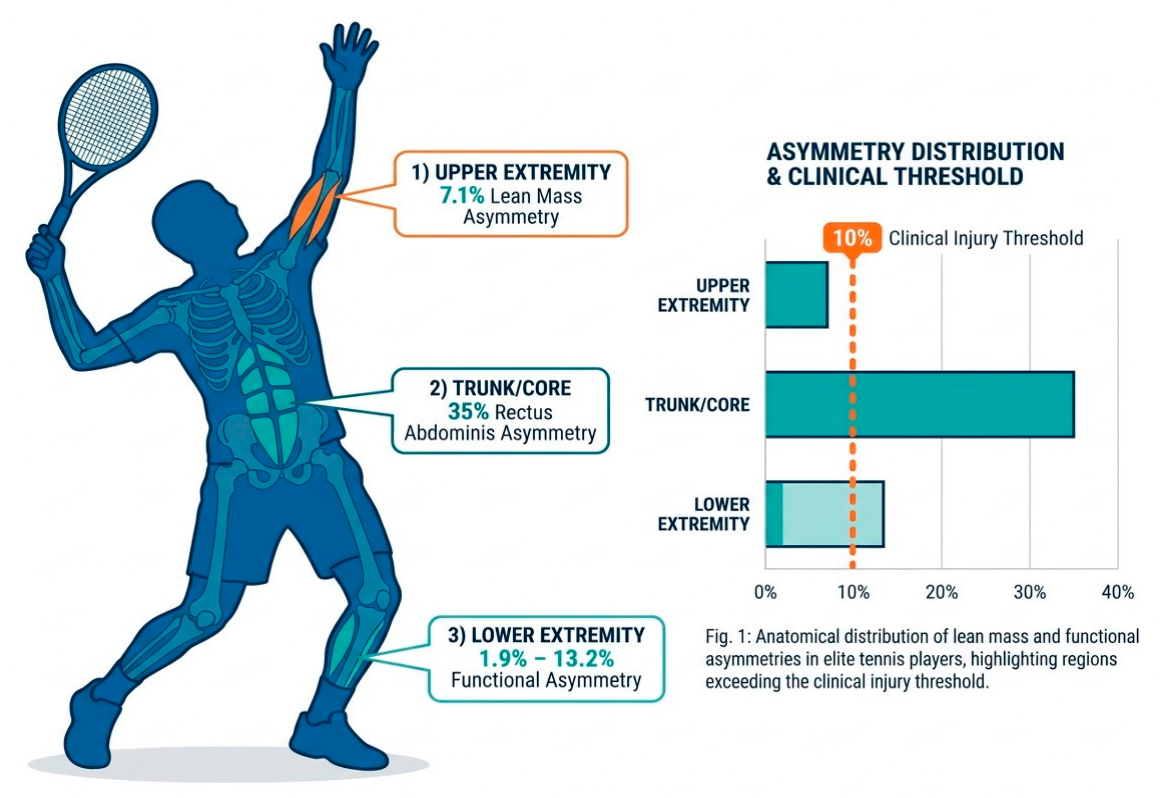
Disclaimer/Publisher’s Note: The statements, opinions and data contained in all publications are solely those of the individual author(s) and contributor(s) and not of MDPI and/or the editor(s). MDPI and/or the editor(s) disclaim responsibility for any injury to people or property resulting from any ideas, methods, instructions or products referred to in the content. |
© 2026 by the authors. Licensee MDPI, Basel, Switzerland. This article is an open access article distributed under the terms and conditions of the Creative Commons Attribution (CC BY) license (http://creativecommons.org/licenses/by/4.0/).
Copyright: This open access article is published under a Creative Commons CC BY 4.0 license, which permit the free download, distribution, and reuse, provided that the author and preprint are cited in any reuse.