
Submitted:
23 August 2026
Posted:
25 August 2026
You are already at the latest version
Abstract
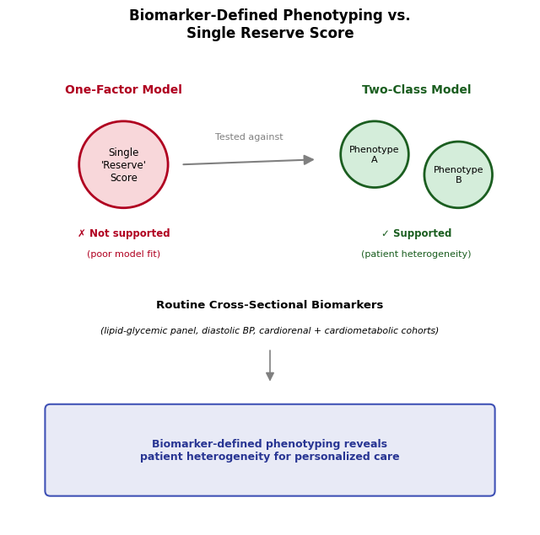
Background: Patient heterogeneity in routine biomarkers is often collapsed into a single physiological reserve score, but whether that one-dimensional representation holds across acute and chronic settings — or whether it obscures biomarker-defined subgroups relevant to individualized care — is unclear. Methods: We harmonized routine biomarkers (BMI, blood pressure, eGFR, LDL and total cholesterol, HbA1c) across two cohorts from the same health system: an acute cardiorenal syndrome cohort and a chronic outpatient cohort treated with dapagliflozin and/or semaglutide, excluding 15 patients common to both. We tested whether these biomarkers supported a one-factor structure via exploratory factor analysis, then a categorical alternative via Gaussian mixture modeling, assessed six-month class persistence in the chronic cohort, and applied the derived classes to the acute cohort for descriptive external validation. Results: A one-factor representation was not supported (KMO = 0.485; covariance concentrated in two definitionally related variable pairs). Gaussian mixture modeling favored a two-class solution, distinguished mainly by LDL, total cholesterol, HbA1c, and diastolic blood pressure. Class assignment showed moderate six-month agreement (κ = 0.46) in a subgroup enriched for closer monitoring. In the acute cohort, class structure was not clearly associated with age, BNP, ejection fraction, length of stay, CKD stage, HF phenotype, NYHA class, or comorbidities; associations with outcomes were descriptive, not causal. Conclusions: Rather than reducing to a single reserve score, these biomarkers were better described by an exploratory two-class, biomarker-defined phenotype structure that captured meaningful patient heterogeneity, showed moderate short-term persistence, and was not clearly related to acute illness severity. These findings are specific to the biomarkers and cohorts studied and should not be generalized without independent replication.
Keywords:
personalized medicine
; biomarker-defined phenotyping
; patient heterogeneity
; latent class analysis
; cardiorenal syndrome
; physiological reserve
; Gaussian mixture modeling
Copyright: This open access article is published under a Creative Commons CC BY 4.0 license, which permit the free download, distribution, and reuse, provided that the author and preprint are cited in any reuse.