

Submitted:
21 August 2026
Posted:
25 August 2026
You are already at the latest version
Abstract
Autism spectrum disorder is characterized by substantial heterogeneity in developmental trajectories, therapeutic engagement, and intervention responsiveness. Although early intervention is widely emphasized, developmental timing is often interpreted primarily in chronological terms. This Hypothesis and Theory article proposes adaptive neurodevelopmental window accessibility (ANWA) as a hypothesis-generating translational construct for studying timing-sensitive intervention responsiveness in autism. ANWA is defined as the dynamic, context-dependent degree to which an autistic child is currently accessible to therapeutic learning, given the interaction among developmental timing, biological burden, adaptive reserve or energetic capacity, regulatory availability, contextual support fit, therapeutic engagement accessibility, and neuroplastic responsiveness. ANWA is not proposed as a fixed critical period, a universal sensitive period, a measure of developmental readiness alone, or a validated clinical tool for determining treatment timing. The manuscript clarifies the conceptual novelty of ANWA by distinguishing it from critical periods, sensitive periods, neuroplasticity, developmental readiness, early intervention timing, therapeutic engagement, biological burden, treatment response, and intervention intensity. It also proposes candidate latent domains, observable indicators, feasible clinical measures, testable hypotheses, falsifiability criteria, and a staged validation roadmap. A hierarchical dynamic model is proposed in which biological burden, energetic capacity, regulatory state, therapeutic engagement accessibility, and contextual support fit may moderate the relationship between intervention exposure and responsiveness. ANWA remains theoretical and requires empirical validation. It should not be used to deny intervention, determine service eligibility, assign responsibility to children or families, or imply that developmental opportunity has been permanently missed. Its value is to support future longitudinal research into when, how, and under which modifiable conditions therapeutic input becomes more accessible, tolerable, and developmentally usable.
Keywords:
autism spectrum disorder
; developmental timing
; neuroplasticity
; therapeutic engagement
; intervention responsiveness
; precision psychiatry
; adaptive reserve
; translational stratification
Introduction
Autism spectrum disorder is a heterogeneous neurodevelopmental condition characterized by variability in developmental trajectories, adaptive functioning, therapeutic engagement, and response to intervention [1,2,3,4,5,6]. Early intervention has long been emphasized because developmental plasticity may be greater during earlier periods of life and because early supports can influence communication, social interaction, regulation, adaptive functioning, and family participation [4,5]. However, intervention responsiveness varies substantially even among children who receive broadly comparable intervention types, intensities, or developmental timing [6].
This variability suggests that developmental timing cannot be understood only as chronological age or early service access. A young child may be biologically dysregulated, sleep deprived, overwhelmed, fatigued, energetically depleted, or poorly accessible to therapeutic input. Conversely, an older child may be well regulated, relationally accessible, supported by a well-matched environment, and currently available for learning. These observations do not diminish the importance of early intervention; rather, they suggest that timing-sensitive intervention research should consider whether the child is functionally accessible to therapeutic learning at a given time and context.
This manuscript proposes adaptive neurodevelopmental window accessibility (ANWA) as a hypothesis-generating construct for studying timing-sensitive intervention responsiveness in autism. ANWA refers to the dynamic, context-dependent degree to which the child is currently accessible to therapeutic learning, given the interaction among developmental timing, biological burden, adaptive reserve or energetic capacity, regulatory availability, contextual support fit, therapeutic engagement accessibility, and neuroplastic responsiveness.
The central argument is not that intervention windows are fixed, closed, or biologically predetermined. Rather, ANWA reframes developmental timing as a modifiable accessibility state. In this framework, a developmental window is not defined only by age or developmental stage, but by the degree to which the child’s neurodevelopmental system can receive, tolerate, process, consolidate, and generalize therapeutic input under current biological, contextual, relational, and intervention conditions.
The manuscript has four goals. First, it clarifies the conceptual background of the FIAP® ecosystem and the place of ANWA within it. Second, it distinguishes ANWA from related constructs such as critical periods, sensitive periods, developmental readiness, neuroplasticity, early intervention timing, therapeutic engagement, biological burden, and treatment response. Third, it proposes candidate domains, observable indicators, and feasible measurement sources for future research. Fourth, it outlines testable hypotheses, falsifiability criteria, ethical safeguards, and a validation roadmap.
Conceptual Background: FIAP® and ANWA
FIAP® refers here to a broader conceptual research ecosystem for precision-oriented autism care. It is not presented as a validated clinical model, diagnostic system, treatment protocol, or autonomous decision tool. Within this ecosystem, autism intervention responsiveness is conceptualized as emerging from interactions among multiple translational constructs, including biological burden, energetic capacity or adaptive reserve, therapeutic engagement accessibility, neuroplastic accessibility, and timing-sensitive developmental availability.
The Biological Burden Index (BBI) is a proposed upstream construct describing multidomain biological and physiological load that may constrain regulation, adaptive reserve, and therapeutic accessibility. Candidate burden domains may include sleep disruption, gastrointestinal discomfort, autonomic dysregulation, inflammation, oxidative stress, metabolic or mitochondrial vulnerability, pain, fatigue, sensory overload, and stress-related physiological instability [7,8,9,10,11,12].
The Therapeutic Engagement Index (TEI) is a proposed therapeutic-process construct describing the degree to which a child can access, tolerate, respond to, sustain, and generalize therapeutic input in a specific intervention context. TEI is not equivalent to attendance, compliance, motivation, or treatment response. Rather, it represents the functional accessibility of therapeutic input during interaction.
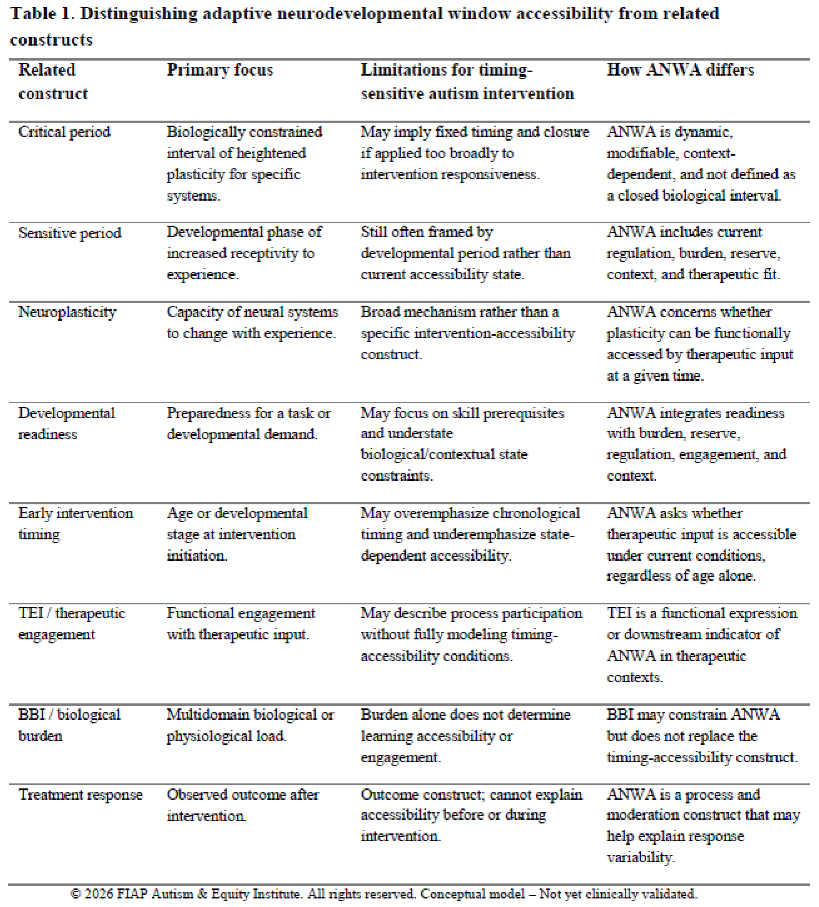
ANWA is distinct from both BBI and TEI. BBI refers primarily to burden constraints; TEI refers to functional therapeutic engagement; ANWA refers to timing-sensitive accessibility to developmental learning. ANWA is therefore positioned as an integrative construct linking upstream biological and reserve conditions with downstream therapeutic engagement and intervention responsiveness. Table 1 distinguishes ANWA from related constructs.
Conceptual Novelty and Differentiation from Related Constructs
ANWA is not proposed as a replacement for established concepts of critical periods, sensitive periods, neuroplasticity, early intervention, developmental readiness, therapeutic engagement, or treatment response. Instead, its novelty lies in combining timing, state-dependence, modifiability, and translational stratification into a single accessibility construct.
Critical periods are often understood as restricted developmental intervals during which specific circuits or functions are especially sensitive to experience [13]. Sensitive periods are generally broader and less sharply bounded, indicating phases of heightened receptivity rather than absolute closure. Neuroplasticity refers to the capacity of the nervous system to change in response to experience, learning, or environmental input [14]. Developmental readiness concerns whether a child has prerequisite capacities or contextual supports for a given task. Early intervention timing emphasizes age or developmental period at service initiation.
ANWA differs from these constructs in three ways. First, it is not fixed solely by chronological age. Second, it is explicitly state-dependent and modifiable by regulation, reserve, sleep, stress, environmental fit, pacing, and relational support. Third, it is translational: it aims to explain why the same intervention exposure may be more or less accessible to different children or to the same child at different times.
This distinction is important ethically and clinically. A narrowed ANWA profile should not be interpreted as a closed developmental opportunity or as evidence that intervention is futile. It should be interpreted as a signal that therapeutic accessibility conditions may need to be adapted, supported, or measured more carefully.
Definition of Adaptive Neurodevelopmental Window Accessibility
ANWA is defined as the dynamic, context-dependent degree to which an autistic child’s neurodevelopmental system is currently accessible to therapeutic learning, given the interaction among developmental timing, biological burden, adaptive reserve or energetic capacity, regulatory availability, contextual support fit, therapeutic engagement accessibility, and neuroplastic responsiveness.
This definition intentionally avoids three forms of overclaiming. First, ANWA is not a validated clinical measure. Second, it does not claim that biological markers can currently determine whether a child is ready for intervention. Third, it does not imply that any developmental opportunity is permanently lost. ANWA is a research construct designed to organize hypotheses about timing-sensitive intervention responsiveness.
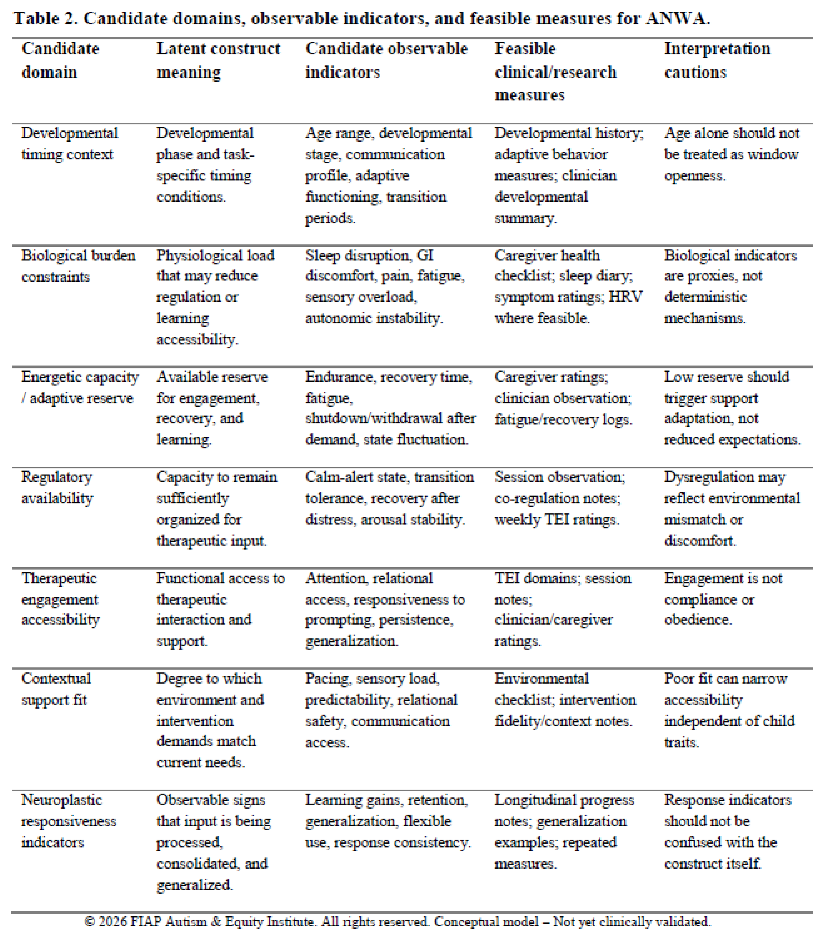
ANWA is best understood as a latent construct inferred from multiple observable indicators. The latent construct is not directly measurable in the same way as age, attendance, or a behavioral count. Instead, candidate observable proxies may include sleep quality, fatigue, recovery after distress, sensory tolerance, arousal stability, engagement persistence, responsiveness to support, generalization, contextual stability, and session-to-session variability.
Hierarchical and Dynamic Model
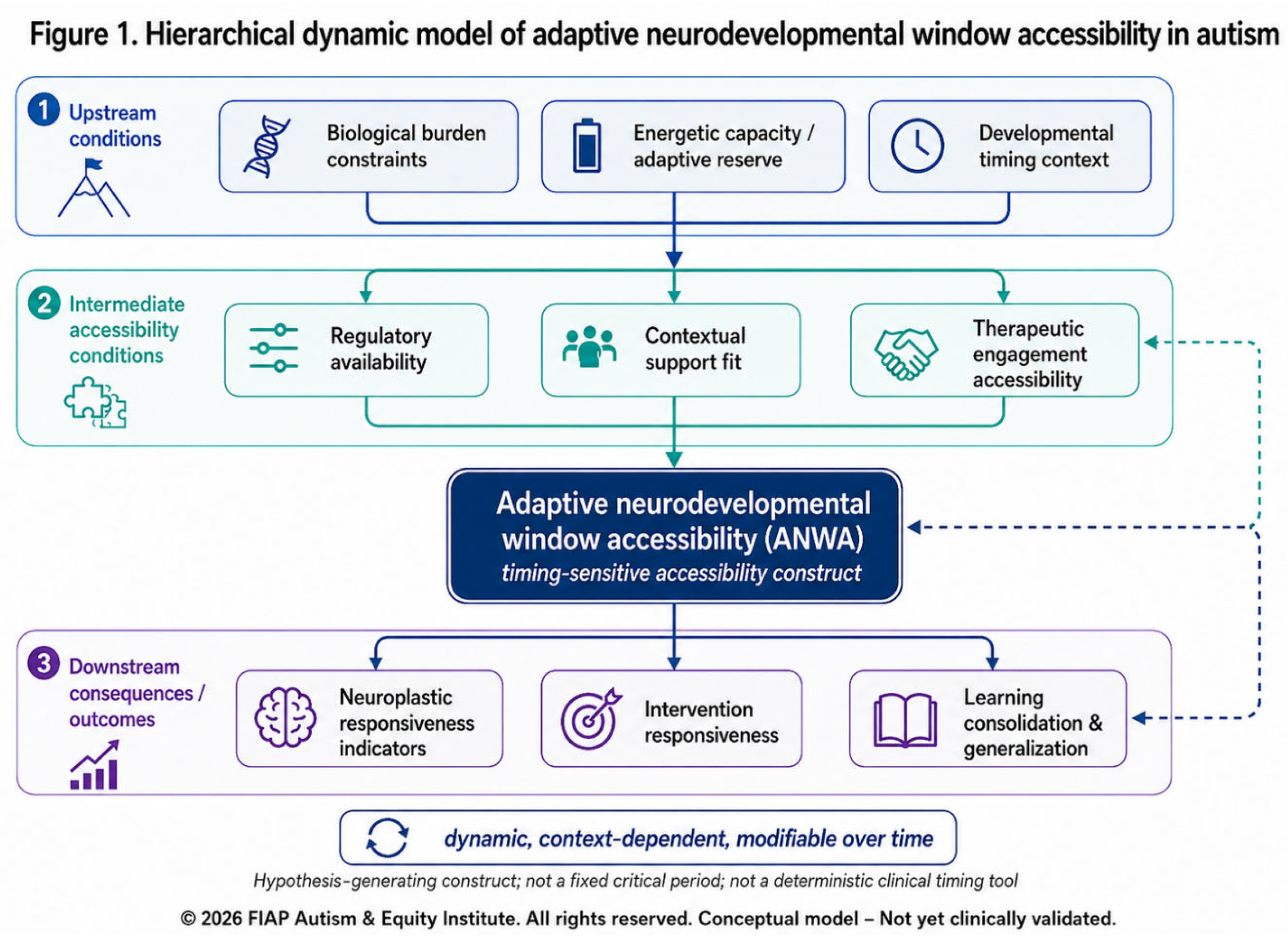
The revised framework proposes a hierarchical and dynamic model rather than a linear causal chain. At the upstream level, biological burden and energetic capacity may influence regulation, arousal, fatigue, and recovery. At the intermediate level, developmental timing, regulatory availability, contextual support fit, and therapeutic engagement accessibility may shape whether therapeutic input becomes usable. At the downstream level, neuroplastic responsiveness, learning consolidation, generalization, and intervention responsiveness may emerge when therapeutic input is accessible and adequately supported.
ANWA is positioned as a moderation construct. It may moderate the relationship between intervention exposure and intervention responsiveness. Intervention exposure alone may not produce comparable outcomes if the child differs in burden, reserve, regulation, contextual fit, or engagement accessibility. ANWA may also interact with TEI: TEI can be considered a functional therapeutic expression of window accessibility, while ANWA represents the broader timing-sensitive accessibility state that includes but is not limited to therapeutic engagement.
The model should be interpreted probabilistically, not deterministically. A high-accessibility state does not guarantee response, and a low-accessibility state does not imply inability to learn. Rather, ANWA generates testable hypotheses about the modifiable conditions under which therapeutic input becomes more accessible.
Figure 1 summarizes this hierarchical dynamic model, showing ANWA as a timing-sensitive accessibility construct influenced by upstream burden/reserve conditions and expressed through therapeutic engagement and intervention responsiveness.
Candidate Domains, Observable Indicators, and Feasible Measures
Future empirical work will require a distinction between latent domains and observable proxies. Table 2 proposes candidate domains, indicators, feasible measures, and interpretation cautions. These domains are not validated scales; they are starting points for content validity, feasibility testing, and construct refinement.
Biological Burden, Reserve, and Biomedical Caution
Elevated multidomain biological burden may constrain ANWA by reducing regulation, energetic reserve, attention, tolerance of demand, recovery, or sleep-dependent consolidation [7,8,9,10,11,12,15,16,17]. Potential contributors include sleep disruption, gastrointestinal discomfort, autonomic dysregulation, immune or inflammatory processes, oxidative stress, mitochondrial or metabolic vulnerability, sensory overload, pain, fatigue, and chronic stress.
However, this framework must avoid biomedical overreach. The current evidence does not justify using biomarkers to determine whether an individual child is ready for intervention, nor does it justify biological intervention claims. Biological and physiological indicators should be considered candidate correlates or moderators requiring validation, not direct clinical determinants of timing-sensitive intervention planning.
ANWA therefore supports a cautious research question: do combinations of burden, reserve, regulation, engagement, and context help explain variability in intervention responsiveness beyond chronological age, intervention intensity, or baseline developmental measures alone?
Therapeutic Engagement and ANWA
TEI can be understood as a functional therapeutic expression of ANWA, but the two constructs are not identical. ANWA refers to the broader timing-sensitive accessibility state. TEI refers to observable therapeutic engagement accessibility within a specific intervention context. A child may have some developmental readiness but low TEI because the task, environment, support style, sensory load, or relational context is poorly matched.
This distinction is important because therapeutic engagement is often misinterpreted as motivation, cooperation, or compliance. Within the ANWA framework, low engagement should first raise questions about modifiable accessibility conditions: fatigue, pain, sensory load, pacing, predictability, communication access, support fit, and relational safety.
Testable Hypotheses and Falsifiability Criteria
- ANWA will predict intervention responsiveness beyond chronological age alone.
- ANWA will explain variance in therapeutic engagement beyond intervention intensity or attendance.
- Biological burden and low energetic capacity will be associated with lower ANWA, but these associations will be moderated by contextual support fit.
- TEI will partially mediate the relationship between ANWA and intervention responsiveness in therapeutic contexts.
- ANWA will vary across time and context within the same child, producing interpretable session-to-session or week-to-week variability.
- Improvements in sleep, regulation, pacing, sensory fit, recovery time, or relational safety will be associated with improved ANWA indicators.
- ANWA profiles will show incremental explanatory value beyond baseline severity, age, developmental level, and generic readiness measures.
The construct would be weakened or falsified if ANWA cannot be distinguished empirically from readiness, TEI, BBI, chronological age, or treatment response; if candidate indicators show poor reliability; if longitudinal ANWA ratings do not track meaningful contextual or engagement changes; or if ANWA adds no explanatory value beyond established predictors.
Validation Roadmap
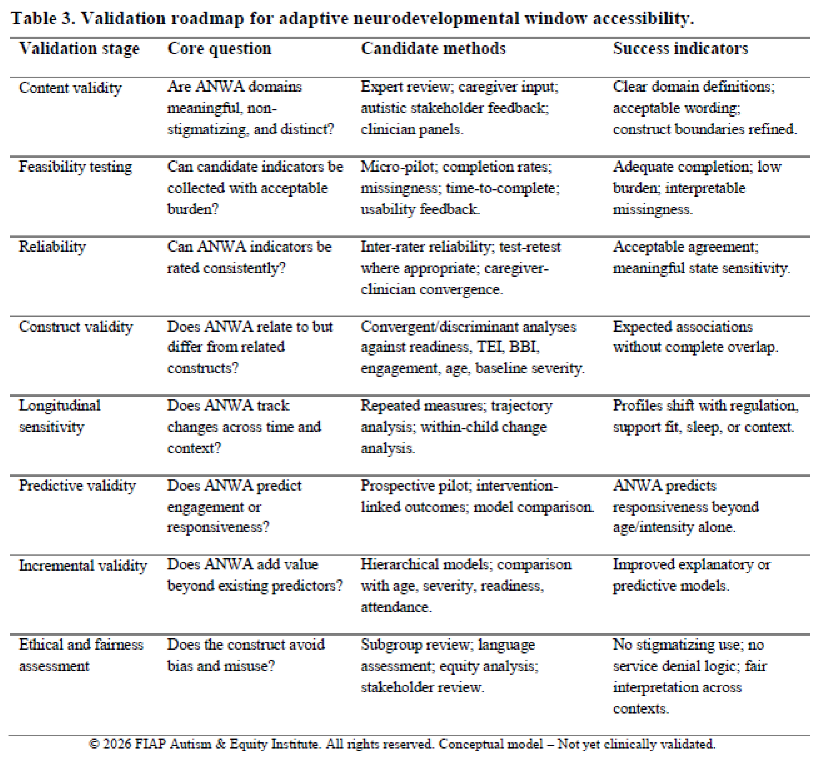
A staged validation roadmap is required before ANWA can be interpreted as anything more than a hypothesis-generating construct. Table 3 summarizes the minimum validation domains required.
Clinical and Translational Implications
If validated, ANWA may support a more nuanced research approach to intervention timing in autism and may contribute to precision-oriented stratification research [18,19]. It suggests that intervention planning should consider not only the type, intensity, and age of intervention, but also the conditions under which therapeutic input is most accessible. Potential research implications include monitoring fatigue and recovery, adapting pacing, prioritizing regulation before high-demand learning tasks, identifying context-dependent accessibility, and examining whether high-accessibility periods correspond to better engagement or generalization.
These implications remain provisional. ANWA should not be used to prescribe intervention schedules, determine service eligibility, reduce access to care, or replace clinical judgment. Its appropriate current use is to guide research questions, feasibility studies, and future longitudinal validation.
Ethical Safeguards and Boundary Conditions
ANWA requires strong ethical safeguards. A narrowed window should not be used to deny intervention, reduce expectations, label a child as unable to learn, or assign responsibility to families or clinicians. It should indicate that additional support, adaptation, pacing, regulation, or contextual modification may be required to make therapeutic input more accessible.
Families should never be told that a developmental window is permanently closed. The framework conceptualizes window accessibility as dynamic and potentially modifiable. Even if certain developmental periods involve heightened plasticity, intervention accessibility can still be supported through individualized pacing, environmental adaptation, relational safety, and ongoing learning opportunities.
ANWA should also not be used as a biomarker-based tool or deterministic precision-medicine label. Current evidence supports a hypothesis-generating model, not clinical timing prediction. Ethical use requires transparency about uncertainty, avoidance of overinterpretation, protection against inequitable service allocation, and careful communication that low accessibility reflects a need for support adaptation rather than child failure.
Discussion
Adaptive neurodevelopmental window accessibility is proposed as a timing-sensitive construct for autism intervention research. Its goal is to refine the concept of developmental timing by adding state-dependence, modifiability, and construct-level differentiation. Rather than treating intervention timing as age alone, ANWA asks whether therapeutic input is currently accessible, tolerable, processable, and generalizable under specific biological, contextual, relational, and support conditions.
The revised framework addresses key conceptual concerns by distinguishing ANWA from critical periods, sensitive periods, developmental readiness, neuroplasticity, early intervention timing, therapeutic engagement, biological burden, and treatment response. ANWA is not intended to absorb all of these constructs. Instead, it is proposed as a latent accessibility construct that may be influenced by burden and reserve, expressed through therapeutic engagement, and tested against intervention responsiveness.
The framework also addresses methodological concerns by proposing candidate domains, observable indicators, feasible measurement sources, testable hypotheses, falsifiability criteria, and a validation roadmap. These additions are intended to make ANWA empirically tractable while preserving caution about its unvalidated status.
The ethical significance of the framework is central. A timing-sensitive construct can be useful only if it avoids deterministic or exclusionary interpretations. The appropriate interpretation of a narrowed adaptive window is not that intervention should stop, but that the conditions of intervention access may need to be modified.
Limitations
- This manuscript is conceptual and does not present original empirical data.
- ANWA is not a validated construct, measurement scale, clinical algorithm, or intervention-timing tool.
- The proposed domains and indicators are candidate domains requiring feasibility testing, content validity, reliability analysis, and construct validation.
- Biological and physiological indicators are discussed as possible correlates or moderators, not as clinically validated determinants of readiness or timing.
- The hierarchical model is provisional and may require revision after empirical testing.
- The framework may not apply equally across ages, support needs, communication profiles, intellectual disability status, cultures, service contexts, or intervention models.
Conclusion
Adaptive neurodevelopmental window accessibility is proposed as a hypothesis-generating construct for studying timing-sensitive intervention responsiveness in autism. It reframes developmental timing as a dynamic accessibility phenomenon shaped by developmental phase, biological burden, adaptive reserve, regulatory availability, contextual support fit, therapeutic engagement accessibility, and neuroplastic responsiveness.
The revised framework clarifies that ANWA is not a fixed window, not a deterministic model, not a biomarker-based timing tool, and not a basis for limiting intervention. Its scientific value depends on whether it can be operationalized, measured reliably, differentiated from related constructs, validated longitudinally, and shown to explain responsiveness beyond chronological age and conventional predictors.
Future research should begin with feasibility testing, stakeholder review, candidate indicator refinement, and longitudinal micro-pilots before proceeding to larger validation studies. If validated, ANWA may contribute to a more precise, ethical, and developmentally sensitive understanding of when and under what modifiable conditions therapeutic input becomes accessible for autistic children.
Author Contributions
YF conceived the ANWA framework, developed the conceptual architecture, defined the Fuel, Support, Trigger, and Engine domains, formulated the dual-output and safety-aware logic, and wrote the manuscript.
Funding Statement
No specific external funding was received for the preparation of this manuscript.
Ethics Statement
This manuscript does not report human-subject data, animal data, clinical intervention, identifiable health information, or retrospective record review. It presents a conceptual and translational research architecture. Therefore, research ethics board approval was not required for the present manuscript. Future feasibility studies, pilot validation, data collection, or implementation research involving autistic children, caregivers, clinicians, educational contexts, health-related information, or service records will require appropriate ethics review, consent procedures, privacy safeguards, and governance approval before initiation.
Data Availability Statement
No datasets were generated or analyzed for the present manuscript. ANWA is presented as a conceptual and hypothesis-generating Framework. Future empirical studies will require predefined data governance procedures, privacy protections, data minimization, and ethics-approved data-sharing arrangements where applicable.
Acknowledgments
Generative artificial intelligence tools were used for language refinement and figure-development support. All AI-assisted outputs were critically reviewed, revised, verified, and approved by the author, who takes full responsibility for the accuracy, originality, integrity, and scientific content of the manuscript. The tools used included ChatGPT (OpenAI) for language refinement and figure development support.
Conflicts of Interest Statement
The author is the founder of FIAP Autism & Equity Institute and the originator of the ANWA conceptual Framework. ANWA, FIAP-related constructs, figures, terminology, translational models, and future digital implementation concepts may constitute intellectual assets under development. The present manuscript is conceptual and does not present a validated clinical product, commercial device, medical intervention, diagnostic tool, or autonomous decision-support system.:
Clinical and Translational Caution
ANWA is not a validated clinical instrument, diagnostic system, biomarker panel, medical device, treatment-selection algorithm, or autonomous decision-making technology. It should not be used to make clinical decisions, determine service eligibility, restrict care, diagnose autism or any other condition, or modify intervention delivery outside an approved research protocol.
Intellectual Property Notice
© 2026 FIAP Autism & Equity Institute / Yves Fuamba. All rights reserved. The conceptual architecture, terminology, figures, tables, and translational model described in this manuscript are presented for scientific communication and hypothesis generation. No license is granted for unauthorized clinical, commercial, digital, algorithmic, educational, or derivative use without prior written authorization.
References
- Lord, C.; Brugha, T.S.; Charman, T.; Cusack, J.; Dumas, G.; Frazier, T.; et al. Autism spectrum disorder. Nat. Rev. Dis. Prim. 2020, 6, 5. [Google Scholar] [CrossRef]
- Lai, M.-C.; Lombardo, M.V.; Baron-Cohen, S. Autism. Lancet 2014, 383, 896–910. [Google Scholar] [CrossRef]
- Lombardo, M.V.; Lai, M.-C.; Baron-Cohen, S. Big data approaches to decomposing heterogeneity across the autism spectrum. Mol. Psychiatry 2019, 24, 1435–1450. [Google Scholar] [CrossRef]
- Dawson, G.; Rogers, S.; Munson, J.; Smith, M.; Winter, J.; Greenson, J.; et al. Randomized, controlled trial of an intervention for toddlers with autism: the Early Start Denver Model. Pediatrics 2010, 125, e17–e23. [Google Scholar] [CrossRef]
- Schreibman, L.; Dawson, G.; Stahmer, A.C.; Landa, R.; Rogers, S.J.; McGee, G.G.; et al. Naturalistic developmental behavioral interventions: empirically validated treatments for autism spectrum disorder. J. Autism Dev. Disord. 2015, 45, 2411–2428. [Google Scholar] [CrossRef]
- Vivanti, G.; Prior, M.; Williams, K.; Dissanayake, C. Predictors of outcomes in autism early intervention: why don’t we know more? Autism Res. 2014, 7, 132–142. [Google Scholar] [CrossRef]
- Estes, M.L.; McAllister, A.K. Immune contributions to the pathophysiology of autism spectrum disorders. Nat. Rev. Neurosci. 2015, 16, 469–486. [Google Scholar] [CrossRef]
- Rossignol, D.A.; Frye, R.E. Mitochondrial dysfunction in autism spectrum disorders: a systematic review and meta-analysis. Mol. Psychiatry 2012, 17, 290–314. [Google Scholar] [CrossRef]
- Rossignol, D.A.; Frye, R.E. Evidence linking oxidative stress, mitochondrial dysfunction, and inflammation in the brain of individuals with autism. Front Physiol. 2014, 5, 150. [Google Scholar] [CrossRef]
- Cryan, J.F.; O’Riordan, K.J.; Cowan, C.S.M.; Sandhu, K.V.; Bastiaanssen, T.F.S.; Boehme, M.; et al. The microbiota-gut-brain axis. Physiol. Rev. 2019, 99, 1877–2013. [Google Scholar] [CrossRef] [PubMed]
- Cohen, S.; Conduit, R.; Lockley, S.W.; Rajaratnam, S.M.W.; Cornish, K.M. The relationship between sleep and behavior in autism spectrum disorder: a review. Sleep Med. Rev. 2014, 18, 379–389. [Google Scholar] [CrossRef]
- Kushki, A.; Drumm, E.; Mobarak, M.P.; Tanel, N.; Dupuis, A.; Chau, T.; et al. Investigating the autonomic nervous system response to anxiety in children with autism spectrum disorders. PLoS ONE 2013, 8, e59730. [Google Scholar] [CrossRef]
- Hensch, T.K. Critical period plasticity in local cortical circuits. Nat. Rev. Neurosci. 2005, 6, 877–888. [Google Scholar] [CrossRef]
- Citri, A.; Malenka, R.C. Synaptic plasticity: multiple forms, functions, and mechanisms. Neuropsychopharmacology 2008, 33, 18–41. [Google Scholar] [CrossRef]
- Bélanger, M.; Allaman, I.; Magistretti, P.J. Brain energy metabolism: focus on astrocyte-neuron metabolic cooperation. Physiol. Rev. 2011, 91, 479–504. [Google Scholar] [CrossRef]
- Harris, J.J.; Jolivet, R.; Attwell, D. Synaptic energy use and supply. Neuron 2012, 75, 762–777. [Google Scholar] [CrossRef]
- Tononi, G.; Cirelli, C. Sleep and the price of plasticity: from synaptic and cellular homeostasis to memory consolidation and integration. Neuron 2014, 81, 12–34. [Google Scholar] [CrossRef]
- Insel, T.R. The NIMH Research Domain Criteria (RDoC) Project: precision medicine for psychiatry. Am. J. Psychiatry 2014, 171, 395–397. [Google Scholar] [CrossRef] [PubMed]
- Fernandes, B.S.; Williams, L.M.; Steiner, J.; Leboyer, M.; Carvalho, A.F.; Berk, M. The new field of precision psychiatry. BMC Med. 2017, 15, 80. [Google Scholar] [CrossRef]
Figure 1.
Hierarchical dynamic model of adaptive neurodevelopmental window accessibility in autism. Legend. This figure illustrates adaptive neurodevelopmental window accessibility as a timing-sensitive, hypothesis-generating construct. Upstream biological burden and energetic capacity influence regulatory availability and contextual support fit. These conditions shape whether therapeutic input becomes accessible, tolerable, processable, and generalizable. Therapeutic engagement accessibility represents the functional expression of ANWA in intervention contexts, while neuroplastic responsiveness and intervention responsiveness are downstream outcomes requiring longitudinal validation. The model is probabilistic and non-deterministic; it does not imply fixed windows, missed developmental opportunity, or clinical timing decisions.
Figure 1.
Hierarchical dynamic model of adaptive neurodevelopmental window accessibility in autism. Legend. This figure illustrates adaptive neurodevelopmental window accessibility as a timing-sensitive, hypothesis-generating construct. Upstream biological burden and energetic capacity influence regulatory availability and contextual support fit. These conditions shape whether therapeutic input becomes accessible, tolerable, processable, and generalizable. Therapeutic engagement accessibility represents the functional expression of ANWA in intervention contexts, while neuroplastic responsiveness and intervention responsiveness are downstream outcomes requiring longitudinal validation. The model is probabilistic and non-deterministic; it does not imply fixed windows, missed developmental opportunity, or clinical timing decisions.
Disclaimer/Publisher’s Note: The statements, opinions and data contained in all publications are solely those of the individual author(s) and contributor(s) and not of MDPI and/or the editor(s). MDPI and/or the editor(s) disclaim responsibility for any injury to people or property resulting from any ideas, methods, instructions or products referred to in the content. |
© 2026 by the authors. Licensee MDPI, Basel, Switzerland. This article is an open access article distributed under the terms and conditions of the Creative Commons Attribution (CC BY) license (http://creativecommons.org/licenses/by/4.0/).
Copyright: This open access article is published under a Creative Commons CC BY 4.0 license, which permit the free download, distribution, and reuse, provided that the author and preprint are cited in any reuse.