
Submitted:
22 August 2026
Posted:
25 August 2026
You are already at the latest version
Abstract
The electricity grid is a collective good that tends toward monopoly. It links private electricity generation to private electricity use. Its design converged near-globally at the end of the 20th century. Large-scale producers have separated ownership from transmission system operators. Quasi-markets link them. New challenges and opportunities render that design obsolete. Solar and wind energy are low-cost but intermittent. Secondary electricity, decentralized, becomes low-cost as well. Fast switches enable real-time adjustments in electricity production and use. Low-cost High-Voltage Direct Current lines centralize while also enabling decentralized frequency control. Centralizing and decentralizing options do not fit the currently fragmented markets and grid. Their integrated redesign is due.
Key design elements include: a multi-layered meshed grid; multiple independent grid nodes; market rules that prohibit ownership of multiple linked nodes; real-time nodal pricing; equal prices for all purchasers at a node; and automatic nodal and full-grid equilibrium.
The new driving mechanisms improve electricity system efficiency and resilience, contributing to several SDGs. They include a single real-time integrated market, car batteries replacing in-grid batteries, and system expansion linking to low-cost renewables. Costs are reduced by 1/4 in North America and Northeastern Asia and by 2/3 (!) in Western Europe-Mediterranean, currently highly fragmented.
Keywords:
transcontinental HVDC
; Electricity grid collective good
; ultrafast switches electricity
; monopoly prevention
; automatic grid equilibrium
; efficiency and optimality
; ownership separation between production and grid
; long-term technology prediction impossible
; nodal pricing electricity
; nodal grid resilience
1. Introduction
1.1. The Electricity Market and Grid Must Always Adapt, Now Again
Monopolistic tendencies
Since Edison established the first electricity market and grid in 1882, societies have struggled to control its natural monopolistic tendencies while dynamically incorporating emerging technologies. Within years, Tesla's alternating current (AC) systems replaced Edison's direct current (DC) systems. AC enabled lower-cost long-distance transmission, allowing for larger-scale monopolies. Controlling monopolies has taken two forms. Common solutions are public ownership and public control of private ownership. Both tend toward high prices and stagnation. The other option is to break up monopolies and create markets. The separation of ownership between wholesale producers and transmission system owners has occurred nearly globally over the last quarter century, creating markets between them. The EU Unbundling Directive has been exemplary, established in the First and Second Energy Package (1996/1998 and 2003) [1,2].
Climate technologies with over- and undersupply
For climate and increasingly cost-related reasons, primary electricity generation will shift toward highly scalable but fully intermittent renewables, solar and wind. This trend is well reflected in the IEA Net Zero Emissions by 2050 Scenario (NZE) [3] (Ch. 7), in many high- and medium-ambition IPCC scenarios, as surveyed in [4] (p. 617 and Figure 6.1), and in OECD scenarios [5]. For the same reasons, electricity use will become the main energy carrier in buildings, transport, and industry, ushering in the Age of Electricity [6] and [7] (p. 8). The current market and grid structure [8] cannot resolve overloads when the wind blows and the sun shines, nor avoid shortages when it does not. This is a key challenge to address.
New opportunities
Alongside this deep challenge, several new technologies create opportunities. Wind and solar are low-cost and can be developed in a decentralized, small-scale manner. The same holds more broadly for renewable energy and its integration. Next, high-voltage direct current (HVDC) long-distance lines are increasingly low-cost and have limited losses. They link low-cost production regions to high-volume use areas, leading to centralization. They also enable decentralization by reducing the size of the areas subject to frequency control. Fast switches enable real-time price-volume adaptations, both central and decentralized, with digital information supporting choices by all actors. Secondary supply is nearly fully decentralized. Battery electric vehicles have high energy and power volumes at low cost, and their numbers are increasing. Further cost reductions and performance improvements are on the horizon if incentivized. Their specific technological details are hard to predict. In the long term, institutions mostly drive their direction and more reapid development.
Institutional economics
This paper addresses the gap in institutional redesign, following a line of reasoning that begins with Commons [9] in the 1930s “…. institutional economics […..] is future physical control.” (p. 7). The three founders of the Society of New Institutional Economics (1997) each received the Nobel Memorial Prize in Economic Sciences: Ronald Coase [10] in 1991, Douglas North [11,12,13] in 1993, and Oliver Williamson [14] in 2009. The institutional approach was again reflected in the 2025 Prize awarded to Joel Mokyr, Philippe Aghion, and Peter Howitt, all of whom focus on long-term developments1. This conceptual line of reasoning is followed here.
Generic and applied institutions
Industrialized societies have specific institutions governing ownership, the functioning of product and financial markets, liability rules, safeguards against the monopolization of economic and political power, rules on education, the organization and funding of research, constitutional rules, and more. These institutions are not fixed; they adapt to cultural, technical, and physical developments, guided by broader normative considerations. Several studies indicate that when economic and political power merge and concentrate in societies, those societies become highly unequal and tend to collapse [15,16,17] in the turmoil of revolutions and wars. Institutions in the electricity market and grid may play a role in this larger picture, albeit a small one, by preventing monopolization.
Collective goods are not produced through generic market mechanisms, as private goods are. They require applied institutions within these collective domains. Electricity is produced and used privately. But the connecting grid is a collective good with a natural market tendency toward monopoly, so it requires applied institutions.
Applied electricity institutions
Redesign of the current electricity markets has been on the agenda for the last decade, appearing in several journal publications [1,18,19,20] and more recently in book form [21] and in an extensive IEA analysis in [22][2]. These design approaches all aim to resolve specific problems with specific solutions; they are piecemeal. The closest is an EU study surveying several directions for redesign, with open market development as one option [23] (Ch. 2). However, the core market considered is the current wholesale quasi-market, with price caps and capacity payments. Neither study covers a system redesign as an open strategic institutional approach.
From specific technologies policies to generic drivers
Predicting future technologies over the long term is nearly impossible because it requires detailed knowledge of data and mechanisms. This is a fundamental limitation of all long-term scenarios, as their quantification depends on the assumed absolute and relative costs of key products and technologies involved.
Drivers of short- and long-term developments operate in the private-goods domains of electricity production and use. They cannot operate in the collective goods domain of the electricity market and grid. For any collective electricity system, these drivers must be designed and redesigned in response to societal dynamics. This paper addresses the gap in the institutional redesign of the current electricity market and grid. The quantified driver specifications presented here rely on sources that assume costs and volumes for specific technologies. The driver quantifications avoid technology-specific details where possible.
Designing long-term drivers
The redesigned electricity system integrates new challenges and opportunities and aligns them with overarching societal goals. Low-cost but intermittent wind and solar are to be incorporated into the design, along with new low-cost long-distance transmission lines and low-cost secondary production, especially batteries, all technically connected using new fast low- and high-voltage switches.
The general goals and mechanisms of industrial societies are a first step in the redesign, focusing on efficiency and reliability. All costs are reflected in prices, and markets are integrated across the full grid system, both vertically and horizontally. Monopoly prevention is built in, not added on
Key design elements
The design addresses several physical aspects, particularly using meshed overlays to enhance stability and resilience. The second aspect is a highly distributed nodal ownership structure, which prevents monopoly and enables a competitive market structure. Nodes have horizontal and vertical connections, with limits to prevent market power from building up. Market rules require nodes to purchase electricity at the lowest cost and to set equal prices for all purchasers from a given node, thereby creating a micro-level merit order. Automatic equilibrium is achieved on a millisecond timescale, ensuring grid stability and high overall power quality.
Efficiency increases following
The mechanisms set in motion cannot be tied to specific long-term technological developments. However, developments will align with the general dynamics in industrialized societies toward greater efficiency. Real-time markets are substantially more efficient than time-of-use rates. Market creation also decentralizes, reducing peak use and hence installed capacity. The vertically integrated market aligns otherwise diverging prices, reducing overall costs, including transport costs. A technology-specific mechanism uses car batteries for grid stabilization, replacing in-grid batteries that are ten times more expensive and placing them more efficiently in decentralized locations. A final mechanism is grid expansion, linking low-cost renewable production to high-volume use areas. The cost reductions from car batteries and grid expansion relate to specific technologies. These may become more attractive over time, but they may also be outcompeted by new technologies and behaviors in other domains, to which the redesign is neutral.
Preliminary, and by necessity rough, quantifications indicate overall cost reductions of around a quarter for North America (USA+) and Northern Asia (China+), and about two-thirds (!) for Europe-Mediterranean (EU+).
Novelty
Institutional redesign around the year 2000 has increased dynamic efficiency, but only in regional quasi-markets and only for the high-voltage transmission parts of the electricity system. The institutionally redesigned electricity market and grid develop real-time markets, integrate central and decentralized markets, and expand the market and grid system to the transcontinental regional level. This encompassing approach is entirely new.
1.2. Historical Perspective on Electricity Institutions
Electricity production for a grid serving several users began in 1882. These systems were fully monopolistic, with a single owner of both the generator and the grid. In New York, a coal-fired steam engine produced electricity [24] for its grid. In Wisconsin, a hydroelectric generator started in a similar way [25]. Edison built both and used direct current. Rapid technological development soon made these grids obsolete, as Nikola Tesla's alternating current systems entered the market within a decade. Transforming AC to higher voltages enabled longer-distance transmission lines with lower losses and costs. Soon, several producers and users were linked to the same enlarged grid. The development of large-scale hydropower increased the relevant transport distances. In the US, for example, north-south lines starting in Canada were already linked to several eastern states in the 1920s. Increasing production scales and grid sizes, along with growing monopolistic power, were countered by public ownership of emerging production and transmission monopolies, or by extremely binding regulations on private monopolies, such as setting a fixed profit margin by political decree. Vertical and horizontal integration created more market power. This tendency towards monopolization was countered regularly [26]. The ideal is to maintain an at least somewhat open-access system, where newcomers can creatively destroy established producers, to use the terminology of Schumpeter [27] (p. 116) and [28].
Current market mechanisms wholesale
Toward the end of the 20th century, high-voltage transmission systems expanded and became increasingly interconnected. Wholesale producers, whether operating independently or in combination, acquired ownership of high-voltage transmission lines. To reverse this monopolistic tendency, a new institutional structure was created, which ultimately became quite uniform globally. In all large electricity systems, several wholesale producers were linked to several cooperating transmission systems through a regional market. This institutional redesign required a full separation of ownership between wholesale producers and transmission systems. To balance production and use, Transmission System Operators (TSOs) regulate electricity production to match consumption, using quasi-markets. Rough market equalization occurs the day before. On the day itself, the final equalization involves TSOs and some producers making short-term decisions about prices and volumes [29]. In capacity markets, producers are paid to keep idle production capacity ready to come online at peak demand during shortage periods. This subsidized production establishes price caps, reducing the total proceeds of all other producers. This partial quasi-market cannot adequately handle the new challenges and opportunities. The envisaged redesign will again be for a next-generation electric energy system, toward 2050 or 2060, and ideally beyond.
1.3. Applied Electricity Institutions in Context
Generic and applied institutions
Generic institutions constitute the primary long-term regulatory mechanisms of industrialized societies. They include constitutions, the rule of law, ownership rules, liability rules, and trade rules. These mechanisms apply to transport systems for people, goods, and information, as well as to electricity.
One key issue to resolve is the grid's natural tendency toward monopoly, driven by the high costs of multiple parallel connections. This tendency is linked to generic institutions regarding ownership and market rules. However, their application to electricity is malleable, as shown by the major separation of ownership between wholesale production and transmission grids at the end of the 20th century. Adapting to new centralization and decentralization, the system redesign can reduce costs, improve performance, and reduce monopolistic tendencies. Such adaptive malleability of institutions to changing technologies and contexts is indicated by [30] (p. 74), in the main lines following Ostrom regarding the role of smaller units in solving socio-economic problems. Breaking up grid ownership into smaller units is a key solution here. This allows for decentralized ‘distributed’ inputs in the electricity system, a major new requirement.
Market and grid redesign integrated
The design here combines the market and physical grid system and is ultimately intended for embedding in public and private organizations. In public policy reports on electricity system development, political processes set boundaries, as in Antonopoulos et al. [26] and similar studies [23,31]. The scope of analysis is broader here, serving as input to wider political and social processes. The focus is on the integrated design of the rules system and its adjoining physical grid infrastructure, combining engineering and economic perspectives as advocated by Scholten and Küneke [32]. This redesign paves the way for deep technological innovations in private electricity production and private use. In innovation theory, deep innovations result from a landscape change - an institutional redesign – that influences regime development and next creates niches for specific technologies, see Geels [33] (Figure 1). Dynamic incentives drive niche developments not only in the electricity market and grid itself. They extend to broader energy domains and beyond, see Figure 1. This paper focuses on electricity-only, on the collective good part of the system in the blue circle.
2. Methods
Methods first address generic aspects: the scope of the analysis, the specific characteristics of electricity as a product, the collective good nature of the market and grid, and the embedded nature of electricity institutions. Next, new specifics require new adaptations: the challenges and opportunities. The substantial share of intermittent, non-dispatchable renewables, wind and solar, creates oversupply and undersupply that must be resolved through combinations of flexibility mechanisms. Finally, quantified, technology-specific analysis is not available to support institutional redesign. Long-term technology predictions can only indicate directions of development, not outcomes.
2.1. Scope of Analysis, Electricity-Specifics, Collective Goods, and Embedded Institutions
Scope of analysis
The scope of analysis here is electricity-only, the blue part in Figure 1, confusingly named energy-only as well [23]. Energy-only may also have a broader meaning, indicating that market forces are prime:
“An essential feature of an energy-only market design would be efficient spot pricing to reflect opportunity costs.” (Hogan [34] (p. 8)).
The scope of analysis and the market considerations are treated separately. Grid-connected car batteries are part of the electricity system, like any primary or secondary supply. Off-grid electricity systems are not part of the electricity system and are not covered here.
The market and grid system, within the dark blue circle, connects private-good electricity production to its private-good use. That connecting system has a Collective Good character. Collective goods cannot emerge from market mechanisms. Public rules determine its functioning. With free access, the collective good is a public good that might be depleted. With access restrictions, it becomes a Common-Pool Good. For the electricity market and grid, payment is publicly arranged, making it a Club Good. This also holds, in whole or in part, for several other transport systems. The grid, like many other collective goods, is conducive to natural monopoly. Without adequate rules on ownership, use, and pricing, the grid may become a costly, static, monopolistic system, as has happened several times in the history of electricity systems. The institutional redesign relates to the market and grid aspects of electricity.
Electricity is different
Electricity itself is a private good. It differs from all other products in three respects. First, it is not a material good. Electrons flow to-and-fro in alternating currents, but you cannot buy them. What is produced and bought is electric energy, measured in kilowatt-hours (kWh) or joules (J). Product differentiation is not possible for electric energy. At the electricity supply, you cannot specify the source of the supplied energy in a multi-source grid; it is a mix of all sources. What emerges from the electricity grid is fully fungible ‘energy’. Second, electric energy cannot be stored, either privately or in the grid transport system, except for a now limited role for capacitors. Electricity produced must be used immediately, within seconds. Third, storing electric energy requires transforming it into a storable form, either physically, as in pumped hydro, flywheels, and pressurized gas, or chemically, as in batteries and metal oxides. That energy may then be used later for secondary electricity production, always with losses and subject to capacity constraints.
Electricity embedded in institutions
The surveyed literature on electricity system designs does not cover the electricity system's full institutional framework. Redesigns are partial and address specific problems. Solutions to these problems typically begin by assuming current structures. Today's day-ahead markets with Transmission System Operators (TSOs) still play a central role in most partially improved systems. Here, a more strategic, encompassing approach to redesigning the electricity market and grid is adopted. It operates within its broader institutional surroundings. There is no uniform framework for this hierarchy, but the principle of hierarchy seems broadly accepted [14] (Figure 1).
Focusing the scope on the electricity market and grid - the collective good (the blue parts in Figure 1) - enables a focused strategic redesign. Most current redesigns include adjoining energy and climate policy domains.
These climate and equity considerations, in turn, relate to broader institutional domains, whether supportive or detrimental. The WTO, established in 1995, was a successful global institution that contributed to two decades of unprecedented global economic growth. That growth was accompanied by rising electricity demand. Its side effects included severe balance-of-payments disturbances and the wiping out of entire industrial sectors in OECD countries. The WTO and adjoining financial institutions might have been adapted. Instead, the WTO collapsed in its final decade, with deep consequences for energy institutions and, next, for electricity institutions. An undisturbed global supply of fossil fuels and uranium can no longer be taken for granted, forcing faster development of intermittent wind and solar energy, other energy sources such as geothermal and hydropower, and, in the longer term, lower-cost nuclear fission and fusion power [7]. A more efficient electricity market and grid system has become more pressing after the WTO collapse.
Focused but broader related
A basic choice in methods is to develop the market and the grid according to their own requirements, with a focus on efficiency and reliability. This approach is focused. Supply security deserves its own institutional design, as do climate considerations. See Huppes [35,36,37,38] on focused institutional design of climate policy instrumentation. In that domain, significant cost reductions can be achieved while easing the burden on political and administrative systems. Social and equity considerations for electricity users also fall within their respective domains. Price differentiation between users would increase costs for everyone together. Income support can support lower-income groups more efficiently and effectively than electricity price support. Income support will, in turn, relate to the tax system, social security system, housing policy, education, and more. If electricity prices better reflect costs in a non-monopolistic market structure, overall costs will decrease, increasing affordability. Several Sustainable Development Goals (SDGs) relate to a more efficient electricity market and grid. Lower costs support energy affordability (SDG 7) and reduced inequality (SDG 10). Reduced costs and resource use relate to several Sustainable Development Goals [39] (Figure 6). Current fixed access rates for electricity users are regressive, as electricity is a basic necessity that disproportionately burdens lower-income groups. They are not part of an efficient market and grid.
Efficiency for unspecified optimality
Optimality is a broad concept that encompasses all aspects relevant to social welfare. Here, efficiency is treated as a partial concept, specifically productive efficiency. It is measured in monetary terms by the amount of inputs required to produce a given volume of output. Dynamic efficiency increases are reductions in the inputs required to produce the same or greater output. Efficiency increases are a core mechanism of economic growth and a core input in optimality analysis. The institutional redesign addresses neither in technical detail, if only because institutions relate to long-term incentive creation rather than specific technologies. The combined electricity market and the grid should be neutral regarding the technologies involved, both in production and in use. Efficiency is the core generic value in industrialized societies, with reliability and underlying resilience particularly important in the electricity domain. Without electricity, production and use will break down.
Institutions for efficiency and resilience
The electricity market and grid must deliver the core values of efficiency and resilience, given new challenges and the new opportunities that will continually arise in dynamic societies. The institutional approach differs from most current policy approaches in that it does not prescribe specific technologies or behaviors. Supply-and-demand responses result mainly from technology-neutral market and grid redesign, avoiding many specific policy measures.
The institutional approach for the collective good of the electricity market and grid uses an incentive framework that integrates centralized and decentralized behavioral mechanisms within a unified physical grid, forming the new market and grid structure for the entire electricity system.
2.2. New Challenges and Opportunities Detailed
Several new challenges and opportunities do not fit within the currently only partially developed market system and the fractured structure of current markets and the physical grid. They put the system under stress. Under current institutions, strain on grid capacity and stability will increase.
1. Solar and wind electricity are both intermittent and are highly expandable, at decreasing costs. Their intermittency expands across space and time. Over subcontinental regions, there are periods of several weeks during which the wind hardly blows, the waves calm down, and the sun shines dimly in winter and only during the day. Volumes are increasing because of climate- and cost-related factors and economic growth. They also increase as electricity replaces fossil fuels in transport, industry, and buildings. In an extreme emission reduction scenario, such as the IEA Current Policies Scenario, electricity use hardly doubles [3] (p. 138), a modest assumption.
The current market and grid structures cannot accommodate large-scale intermittent and secondary supply, so a redesign is required.
2. High-voltage direct current (HVDC) lines have evolved, reducing long-distance transmission costs. They drive grid expansion and centralization by linking distant, low-cost renewable generation to large consumption centers. These cost reductions are ongoing, with higher voltages (see SM 2.1), lower-cost connectors, more efficient cables [40] and cost reduction by standardization [41]. For Ultra HVDC at 1.1 kV, as used in China, transport losses have already fallen below 1.5% per 1000 km, with connections up to several thousand kilometers. Such U-HVDC lines and cables far exceed the size of the regional wholesale markets in all large economies. These lines do not fit into the current market and grid structure. Further loss reductions can also come by transforming current AC lines to DC [40].
At the same time, these HVDC technologies enable decentralization. Alternating current (AC) transmission systems are now interconnected and regulated to maintain a constant frequency and voltage. If one transmission system fails, it can cause havoc across all connected transmission systems, from the continental level down to the underlying distribution systems. With HVDC replacing high-voltage alternating current (HVAC) lines, transmission systems can become mutually independent in terms of voltage and frequency. Lower-voltage DC may also better support distributed production [42]; see SM 2.2.
HVDC lines support centralized system expansion and decentralization at levels below those of current transmission systems, neither of which is compatible with current electricity institutions.
3. Secondary production is widely expandable at decreasing costs, mostly decentral. It can reduce the strain on the electricity system caused by intermittent wind and solar, and variable final demand. A share of the storage capacity of transport batteries can cover the daily variation in solar electricity production [43,44]. This is a clear advantage for their owners, see Table SM 5.1D and 5.1E. Pumped hydro, already used since the 1920s, can be expanded in a decentralized market.
Such decentralized production does not fit into the current wholesale quasi-market.
4. Real-time variation in primary and secondary production and in final and intermediate use could support system equilibration at all time scales, including for many technologies at the millisecond level. The current wholesale market is not real-time but day-ahead and hour-ahead (or quarter-hour ahead). It does not cover decentralized production and use [45], though capacities are investigated [46].
Incorporating real-time central and decentralized volume and price variations sets new requirements for market and grid design.
5. Ultrafast switches allow for real-time price-volume adaptations, automatically and at the millisecond level. This holds for primary and secondary production to the grid, including variable nuclear power [47] and batteries. It also applies to several use cases, such as battery charging, heat and cold storage, and many Internet of Things applications. Slower adaptations may follow.
The current market & grid cannot use these fast-switching options. Their use sets new requirements on institutions.
Summarizing
All challenges and opportunities share one thing in common: they do not fit the current market and grid system. They require both market centralization and decentralization, along with adjoining grid adaptations. Without a basic redesign, avoidable costs will be high, grid resilience will be hard to maintain, and monopolistic market mechanisms will emerge.
2.3. Resolving Oversupply and Undersupply
Grid stability is a key requirement for the electricity system. Oversupply and undersupply must always be resolved at all regional levels and time scales. The share of non-dispatchable intermittent renewables in primary supply will increase, with peaks and troughs, while the share of dispatchable primary supply will decrease. The variability of final use will increase, with heating and cooling varying over days and seasons, and electric car charging over hours, weeks, and seasons. See exemplary SM 2.3 and Figure 1 there. With high shares of wind and solar, dispatchable production cannot compensate for the intermittency of these renewables when demand variations are misaligned. Cutting production during oversupply and cutting use during undersupply will become the main solutions within the current institutional framework, aided by the patchwork of partial improvements currently being developed. These costs are avoided in the redesigned market and grid.
Grid stability can be affected by variability in primary production, variable secondary production and intermediate use, variable final uses, and expanded transport capacity across larger areas. The technologies involved at all levels differ in their marginal costs and capacities, which are continuously changing. Efficient equilibration through planning and control of all actors becomes impossible. Beyond the electricity system, combined production may improve variability, as with hydrogen alongside electricity from nuclear installations [48] and similarly with wind electricity. Flexibility may also come from variable electricity use for thermal and heat-pump applications [49]. Similar considerations apply to hydrogen transport replacing HVDC, where hydrogen is produced at the destination from electricity [50,51]. A clear electricity market will make these options more viable to assess economically.
Flexibility requirements
Flexibility requirements arise from the non-dispatchable nature of primary wind and solar supply, as well as from mismatches between primary supply and final demand. Both underproduction and overproduction must be addressed. Underproduction is addressed by additional primary and secondary production and by reducing intermediate and final demand. Overproduction is addressed by additional primary production and by reducing intermediate and final demand.
The share of intermittent renewables sets requirements for equilibration. An estimate of these requirements is based on the average of the IEA Stated Policies Scenarios (STEP) and the Net Zero Emissions by 2050 Scenario (NZE); see Table SM 5.1A and SM 5.1B in the Supporting Materials. In this combined “middle” scenario, wind and solar together account for around two-thirds of total power generation (in GW) and a similar share of total energy generation (in TWh). For transcontinental regions, these shares may be even higher. At the transcontinental regional scale, low-wind and low-solar periods will be more widely spaced, requiring adequate long-distance transport. This holds even more with further grid expansion, as between Northern Asia and Western Europe [52] Assuming overall compensating requirements of around half the share of wind and solar to cover underproduction, this amounts to one third of total primary electricity production.
Flexibility mechanisms
Increased electricity demand, as now for car charging, bitcoin mining, and artificial intelligence [53], already creates strains. New users in transport, industry, and housing cannot connect to the grid due to capacity constraints in major industrialized regions. Current options to equalize supply and demand are extremely disruptive, especially supply reduction by some producers at oversupply and the temporary exclusion of some users at undersupply [54,55]. This problem applies globally, also to developing countries [56]. It can be avoided by design. The mechanisms are surveyed.
Flexibility in primary supply
Apart from new renewables, all other production is dispatchable to some extent. This also holds for nuclear energy, which has marginal costs lower than those of fossil fuels but is mostly outcompeted by wind and solar. With reduced total output at low prices due to sufficient renewable energy, total proceeds will fall, and hence the capital cost per kWh will rise. Hydropower is fully dispatchable, but constrained by water capacity. Not using this capacity also reduces proceeds. In part due to climate change, total renewable hydropower capacity is already constrained after low-rainfall years in several major regions [46,47,48,49,50,51,52] and by faster runoff due to deforestation and increased evaporation at higher temperatures. Hydropower operators must manage a multiyear inventory of stored water, of uncertain volumes. They will reduce production at very low prices, to have higher capacity at high prices, based on these complex considerations.
To compensate for periods of low solar and wind output, dispatchable primary generation might cover a part of the 35% shortage, including fossil, nuclear, hydro, geothermal, tidal, and biomass. Their low total production results in high total costs. Other variability options, such as secondary production and in-use variation, could be more economically attractive under vertically integrated market mechanisms.
Flexibility in secondary supply
All forms of secondary production are highly dispatchable. Pumped hydropower may be used more extensively to balance the system. Combining it with variable precipitation-based hydro would reduce capital costs. At high wind and solar production, secondary production can be reduced; at low wind and solar production, it can be maximized. This holds only if its marginal adaptation costs are lower than those of other flexibility options, including transport costs. All secondary production requires capacity replenishment during lower-priced periods, creating intermediate demand. The cost of secondary production includes the uncertain cost of replenishment.
Flexibility in new intermediate and final demand
Variable demand is a largely unused resource because market mechanisms for demand response are now largely absent, especially in the sub-minute domain. The combination of technical implementation options, economic considerations, and aspects of private function and comfort is complex and varies among individuals and over time. Under redesign, decentralized adaptation mechanisms can become available to all individuals for car battery market use, aided by battery management systems [57]. Similar support could apply to virtually all household electricity uses. Individuals can factor in their risk aversion, expected income growth, travel plans, and other factors. This holds for current technologies. Similar considerations guide investment decisions in areas such as batteries, heat pumps, heat-and-cold storage, and the Internet of Things, as well as focused technological developments in these domains.
New demand variation can fill a large share of the gap between primary production and final demand, spanning from seconds to seasons.
Increased transmission capacity
The third route to stability is through increased in-system electricity transport. East-west electricity transport can even out daily variations in both primary supply and final use. Shifts of several hours of sunlight are possible in most subcontinental regions. Long-distance HVDC lines can bring electricity from regions with low-cost oversupply to regions with high-priced undersupply. Overall cost reductions could be substantial [58]. They are only partly used [59] with proceeds mostly earned by service parties under the current institutions.
Expanding long-distance transport can improve grid stability, lower overall electricity production costs, and better match final-demand preferences.
Low to zero marginal costs
Fossil technologies have high operating costs but relatively low capital costs. Their short-term marginal costs are higher than for nuclear. Wind and solar generation incur only capital costs, with zero marginal costs at the point of generation. The trend toward lower marginal costs is present in many economic domains; see Rifkin [60]. For a zero-marginal-cost product, as for any product, its capacity investments and fixed operational costs must be funded from proceeds. Full zero marginal cost occurs rarely. In the electricity domain, locational marginal pricing adds several in-grid cost elements, related to transport cost and capacity constraints. Additionally, real-time locational marginal pricing will have a price element based on capital constraints [61] (pp. 17-18). Under adequate design, these prices fund investments and behavioral adaptations, contrary to the views based on partial analysis involving partial quasi markets, as in [23] (p. 6).
2.4. Limits on Long-Term Predictions
When assessing the long-term effects of electricity institutions and their variants, one would like to compare the resulting quantified outcomes. As indicated for hydropower, this is already difficult for climate-related reasons. The issue is broader, however, as technologies can develop quickly and in unexpected directions, even within existing generic institutions. An example may indicate the deep consequences of this lack of predictive knowledge.
Several main scenarios for 2050 expected long-term cobalt supply constraints for car batteries to be severe [62,63]. However, short-term shifts in battery technologies largely avoided that cobalt application within years after these scenario studies were published, as an IEA publication on battery developments showed [64]. Cobalt was used in 90% of all car batteries produced in 2019, as input in these long-term scenarios published in 2020 and 2022. But by 2023, that share had already fallen to 20%, replaced by battery types that were hardly present in 2019 [64] (Figure 1.6). The standard incentives for private goods in industrialized societies drove this shift[3]. In this shift, strategies to avoid later constraints on critical materials [65] may have already played a role.
Long-term technology-specific predictions are hardly possible. With given drivers, predictions may indicate interesting development directions, as pathways [66]. Backcasting from interesting scenario results may give some insight into the conditions for a possible long-term development [67].
In our quantitative analysis of six efficiency drivers, we mostly assume generic ‘reasonable' reduction percentages (nrs. 1-4). When comparing car batteries with in-grid batteries (nr. 5), we follow IEA cost estimates. However, the main cost difference is that car batteries are mainly purchased for car driving, with a limited role for grid stabilization. We set the allocated cost share somewhat arbitrarily at 15%. Only the quantification of grid expansion (nr. 6) we base on the technology-specific analysis. It assumes low-cost future HVDC transport costs (already low) and low-cost solar energy around the Mediterranean. The price difference with more Northern solar is primarily climate-related: Northern regions have less solar irradiation. Their model assumptions on ideal grid markets align with our institutional redesign.
Summarizing
Wholesale variations in dispatchable supply cannot accommodate natural fluctuations in the broadly expanded solar and wind output. Only the combination of variable primary and secondary production, variable intermittent and final demand, and increased transport capacity can technically maintain grid stability. Under current electricity institutions, mechanisms for grid stability are largely absent. Only institutional redesign can unlock these essential resources.
3. Redesign Goals
3.1. Efficiency and Optimality
The institutional redesign has its roots in the broader values of industrialized societies, namely efficiency and reliability, including the prevention and control of monopolies. These values constitute a core of institutional economics and a broad part of welfare theory. Efficiency in the electricity domain includes dynamic efficiency as a prerequisite for long-term sustainability. This efficiency here pertains only to the market and grid, thereby indirectly improving efficiency across broader energy domains and beyond.
When efficiency increases in a domain, fewer resources are needed to maintain or expand that domain. Those resources can be shifted to volume and quality increases in other domains or used to increase leisure. The overall effect then moves towards optimality, which encompasses ‘all that is relevant’. This overall concept of optimality might guide choices, as many economists use it conceptually. However, Baumol [68], Sen [69], and Portney and Weyant [70] gave basic reasons why encompassing optimality cannot be an operational goal. Baumol explained the impossibility of empirical specification under different optimality schemes. Sen indicated the basic inadequacy of any optimality scheme. Portney and Weyant showed that a key element of any dynamic optimality reasoning is discounting, and that methods and data are so diverse that operationality is lacking. Still, operational social cost of carbon is applied in the electricity market domain, as part of market optimality analysis [71]. However, their analysis shows that not accounting for the social cost of carbon is less relevant than not accounting for real-time price fluctuations. Short-term electricity market efficiency is based on the merit order with real-time locational marginal pricing. Dynamic efficiency results from incentives for capacity expansion created within the same system. To quantify this, current models tend to assume specific technologies and their relative costs.
3.2. Core Goals: Dynamic Efficiency, Resilience, Monopoly Prevention
These goals pertain to the efficiency of the electricity-only system, excluding broader energy and climate considerations, as part of a broader integrated welfare analysis. Even that limited goal cannot be specified quantitatively because long-term technology prediction is impossible and discounting is required. However, efficiency-increasing mechanisms can be specified in terms of institutionally created drivers. A comparative-static analysis can provide some quantitative indications while avoiding predictions about specific technologies and products. Dynamic efficiency pertains to all actors in primary and secondary supply and in intermediate and final use, connected by the new design of the market and grid as a collective good linking them.
Dynamic efficiency is the primary operational goal in redesigning electricity market and grid institutions.
For this collective good of the electricity market and grid, efficiency comes first. In the electricity domain, resilience is especially important because electricity itself cannot be stored, unlike most other products. Because the grid can easily create monopolies, preventing them is a third goal of its institutional redesign.
Efficiency requires that markets linking production and use reflect all production and transmission costs in purchasers' prices. It also requires incentives for long-term dynamic cost reductions. This dynamic efficiency is also a prerequisite for broader optimality, including intergenerational sustainability, see Stavins et al. [72] (pp. 339-343). This is not quantifiable in practice due to a lack of technology forecasts and accepted operational discounting methods.
Resilience is the capacity to withstand disruptions arising from additions, renewals, maintenance, technical failures, accidents, and disasters across production, the grid, and in use. This applies to all complex product systems, which must avoid fragility while building robustness. This requirement holds especially for electricity, as it cannot be stored. Disruptions must be resolved in real time, within parts of a second.
Monopoly prevention requires that no owner of parts of the grid can be the sole provider to its electricity purchasers and final users.
Combined, these goals may be realized more operationally in terms of complementarity and substitutability among the system components, see Elliott & Golub [73] (p. 666).
4. Redesigned Electricity Market & Grid ‘2060’: Main Design Elements
The three key market requirements are nodal pricing, real-time pricing, and equal market access for all suppliers and purchasers. A nodal grid structure designed for this purpose can meet these three requirements. Reliability imposes additional requirements on the nodal grid structure, ensuring resilience against disturbances. Over the longer term, net proceeds must also fund investments in production and transport nodes. From the now-dominant planner’s point of view, this is the missing-money problem, which is currently resolved through capacity subsidies. The redesigned market and grid system resolves this funding issue without subsidies.
4.1. Nodal Grid and Markets
Nodal independence
A node is an administrative and physical segment of the electricity-only network, separate from both producers and users. Nodal pricing replaces currently common zonal pricing, which sets equal prices for larger grid networks and users; see the red box in Figure 2.
Nodal pricing
Equal prices for all are a key prerequisite for efficiency. However, to ensure efficiency, pricing should include not only the cost of electricity purchased by the node but also the transport costs within the node, which are charged to any purchaser from that node. Producers located farther away incur higher transport costs to reach the nodes they are directly linked to, and users farther away from the delivering node also incur higher transport costs to reach their destinations. During periods of capacity constraint on specific lines, a congestion-pricing element is added, similar to road congestion pricing in several countries. Congestion pricing prevents grid overload and breakdowns.
Small nodes
The efficiency advantage of the nodal structure is greatest when nodes are small, and hence their numbers are high, with higher granularity [74] (p. 15). The number of administrative units in current electricity systems varies across countries, states, and provinces. In the EU, there are 44 transmission system operators and 2556 distribution systems [75] (pp. 7-8). Freedom of choice in node size appears to exist. The current number of administrative units may well suffice under the nodal structure.
Multiple connections
Each node maintains a minimum number of connections in both purchase and supply for market and resilience reasons. To avoid the buildup of market power, each node may span at most two voltage levels. Similarly, a node cannot integrate horizontally to a great extent, as large nodes then tend to become zonal nodes, leading to higher overall costs and monopolistic tendencies. In principle, prices from a single node's delivery are equal. In special cases, they may diverge across delivery locations, reflecting specific line costs. Compared to planning-based systems, the physical grid capacity requirements will be lower.
Linking small-scale final users to multiple nodes may be costly. Specific solutions might be developed; see SM 4.1.
Summarized
The first element of the institutional redesign is nodal pricing using small-scale nodes with multiple upstream and downstream connections. There are no disadvantages to such a decentralized electricity system.
4.2. Real-Time Pricing
The second link to efficiency is real-time pricing, where costs and prices change at the millisecond level. Technically, real-time volumes can now be established at the millisecond level. Reaction speeds vary across technologies. Millisecond-level responses are possible for nuclear power and for much secondary power, especially batteries, and in use applications, such as heat pumps, storage recharging, and many electric devices. All grid nodes can react at the millisecond level. The mix of primary and secondary producers changes continuously, including shifts in use, leading to ongoing changes in production costs. Additionally, the routes through the multi-grid system change continuously as supply and transport costs shift. To reflect these continuously shifting costs, Real-Time Pricing (RTP) is required. Real-time markets enable real-time price-volume adjustments. RTP differs fundamentally from time-of-use rates, which many current systems use. Hogan [76] (pp. 1-3) states that even very good time-of-use rates would miss most of the efficiency gains from using actual real-time prices. Supply and demand fluctuations are first met with high-speed reactions, followed by slower ones as lower-cost options replace limited-capacity high-speed reactions. This is a soft-layered mechanism. To prevent dynamic instability, a limit on the rate of volume change may be required to avoid pig-cycle-type dynamics.
Price hedging
For some people and organizations, variable pricing might be a nuisance. They may choose to pay a fixed price by hedging the pricing risk. They then miss out on short- and long-term cost-reduction options, such as charging their car battery during low-cost periods. The avoidable behavioral cost of not participating might reach double-digit percentages, making this option unattractive even for small-scale users.
Summarizing
The second element in the redesign is millisecond-level real-time pricing across all nodes. This choice has no disadvantages.
4.3. Equal Market Access for All Suppliers and All Users
No price differentiations
Price differentiation of the homogeneous electric energy product creates avoidable costs and undermines efficiency. Equal market access avoids these costs by ensuring open access and non-discrimination for all producers and users. This non-differentiation applies to the nodal in-system grid parts in their mutual supply and purchases. Open access in supply means equal prices for all purchasing nodes and users at any time, while including transport costs and congestion pricing. Non-discrimination also implies no price differentiation among user groups. Open access and nondiscrimination set a single price for all purchases from a producer or node, whether the provider is a primary or secondary producer and whether the purchaser is a node, a small or large entity, or a rich or poor person. High-volume, high-voltage users may have lower transport costs, depending on their location.
Transmission system operators
Even a market-efficiency-oriented author, such as Hogan, still assumes that a transmission system operator (TSO) is responsible for optimal pricing [53] (pp. 16-17). Even for the transmission system alone, this is an impossible task in real time, as Tesfatsion explains [77] (pp. 104-105, 114). This problem increases exponentially if system operators must also account for variable decentralized primary and secondary production and for decentralized variations in intermediate and final demand. This would require setting locational marginal prices for each primary and secondary producer and for each node, per millisecond, reconciling varying transport costs. The conclusion is that system operators cannot consistently determine prices for each period across all supply locations for the newly optimized system every second. Efficient system equilibrium can come automatically only by design.
Summarized
After the redesign, the automatic equilibrium in the integrated market makes the planner's role superfluous.
4.4. Information Requirements
In the current quasi-market system, transmission system operators have rough information on wholesale production plans from the day-ahead market, based on the supply offered by fixed and flexible producers. On the day of operation, they update this information hourly. Within the hour, they match total supply with developments in total demand through frequency control, using adjustments by standby producers. Trading between regions adds complexity, requiring coordination with adjoining TSOs to align plans. Information exchange occurs through written and spoken contact. With variable HVDC-based long-distance far-away production, variable decentralized primary production, and demand response, the number of relevant decision makers explodes. Information requirements also explode because many actors can react quickly to price changes. This is most pronounced when real-time price-volume reactions are involved, which are key to improving efficiency.
Strielkowski et al. [78] have investigated options for improving information supply in the current system, assuming developments towards digitization, decentralization, and electrification to increase flexibility in the energy system (Figure 1, p. 3). IoE (Internet of Energy) information systems can support peak reduction by guiding flexible demand, micro-generation, and energy storage technologies (p. 8-9). Strielkowski et al. [79] and many others have further detailed the strategic design of such data-driven information systems for predictive analysis, with steps toward operationalization following, e.g. [80,81]. Better information still links to improved planning, with only partial decentralization.
In the redesigned system, the decentralized real-time market system equilibrates through continuous adaptation. Information on market developments can prepare decision makers. Understanding how volume reacts to price changes resolved the pig cycle. Non-human decision makers are also involved, as in the IoT (Internet of Things). Billions of devices can react automatically to price changes, guided by their owners' preferences. Current solutions by system aggregators [82,83] are wasteful after redesign. Trading in financial markets is mostly automated and increasingly involves AI. Such strategic information is also relevant in the redesigned electricity system, with different requirements. It is not for controlling the billions of decision makers.
Taxing requirements
In combined primary and secondary production, broader requirements apply to connected external institutions. If electricity used for charging batteries or filling lakes is taxed and secondary production is taxed again, it results in double taxation of the secondary electricity. Turnover taxes may be more prone to this issue than value-added taxes. Many countries implement specific electricity taxes, which can aggravate this problem for secondary production. Combined with general taxes, these specific taxes can effectively double electricity costs for secondary production, potentially hindering most decentralized secondary activities. A key challenge in tax adaptation is that the amount of primary energy used in secondary production is not always fixed or easy to identify. For instance, partly pumped hydro, rain-based hydro, and car batteries charged with home solar electricity all exemplify this. This taxation concern warrants careful consideration. A current technical solution to avoid double taxation is to install batteries at the production site before the product enters the market. This may be the most expensive battery option, as low-cost car batteries would be substantially cheaper in real-time markets.
4.5. Nodal Grid Resilience
Multiple connections
For resiliency, supply failures and grid transport breakdowns must not cause disruption. This requirement can be met if each node has several suppliers, including producers, at any linked voltage level, and delivers to several purchasers at that level, up to users. The minimum number of suppliers to a node will be around three, with a similar minimum number of purchasers.
These multiple connections create supply resilience. If a node or part of it fails, flows can divert to parallel nodes; when those reach full capacity, flows can divert to additional nodes, as shown around the red node in Figure 2. They also protect against monopoly tendencies. In some circumstances, purchasers can become suppliers. The direction of electrical energy flow then reverses, changing the number of suppliers and purchasers. Grid system design must account for this. Some users may not connect directly to several in-grid nodes, as this would require costly parallel distribution lines. A group of users might connect and act as a single user and producer. Some considerations are in SM 4.1.
The resilient physical nodal system requires an adapted market system as specified here. This choice has limited disadvantages within the electricity system, related to bidirectional line use. Relations with other institutional domains require attention.
Summarized
The multiple-connected nodal structure and the adjoining market design create high grid resilience and avoid monopolization.
4.6. Investments Funding
Investment funding concerns the financing of primary and secondary grid supply, the grid itself, and technologies for grid-based uses.
Funding primary and secondary production
Funding the supply to the grid is problematic in current systems, a problem referred to as the missing money problem [84,85,86]. The basic cause of missing money is the effective implementation of a price cap, as with capacity payments. The resulting lower peak prices cannot offset the low prices during periods of high production at low-to-zero marginal cost, as with high levels of wind and solar generation [34] (p. 4). Unrestricted prices, with high proceeds during some periods, can compensate primary and secondary producers for low-priced periods [61]while also reducing overall average costs by avoiding capacity payments for loss-making reserve supply.
In-grid investments
Capital costs at a node must be funded by its normal operations, covering long-term marginal costs, as in any production domain. Node expansion capital can be funded by congestion-pricing proceeds, which will be administered separately. Investments in nodes other than the one where congestion pricing occurred may be more relevant, such as creating new nodes in attractive locations. Developing the grid's overall nodal structure will therefore be a public task, both in grid planning and in financing start-up investments.
User investments
On the use side, investments must be linked to the variable prices induced by the redesigned system and used to their advantage. They help create equilibrium, thereby reducing the need for primary production capacity and grid capacity. Subsidies are not needed for electricity reasons. However, new technologies may require support for innovation and regulatory adaptations. Underground heat and cold storage, for example, can develop broadly only with clear ownership rules and coordinated permit applications. Car battery electricity trading, a major contributor to electricity equilibration, requires tax adjustments to avoid double taxation, without additional funding.
Summarizing
Normal operations fund investment in production, nodes, and demand variation, while congestion pricing funds capacity expansion in the nodal grid.
5. Cost Reductions of Institutional Redesign
5.1. Efficiency-Raising Drivers
It is virtually impossible to detail the technologies and electricity volumes that will come by '2060'. Technology scenarios are not predictions. The incentives created will guide relevant developments. Some partial quantification is possible, with orders of magnitude for three major regions shown in Table 1. These quantifications indicate the potential importance of the redesign. The cost reductions from the integrated market & grid redesign also contribute to overall economic growth.
An overview related to the focus on decentralization is in [45].
Five new mechanisms increase efficiency compared with the current institutional framework, reducing costs, CO2 emissions, and material use. Secondary effects relate to technology development induced within the electricity system and beyond, across the entire energy system. Quantitative effects, also extending beyond the energy domain, might be substantial [33]. An increase in efficiency will increase electricity consumption, as a Jevons paradox for electricity [87]. Increased income not spent on electricity can increase other consumption, leading to additional electricity demand there. Part of the rise in income can be used for leisure, as Keynes advised much earlier [88], reducing all material inputs and emissions.
5.2. Cost Reductions Indicated for Six Induced Drivers
The cost concept used here is based on market prices. It does not include the pricing of external effects, such as the costs of global warming and resource depletion. Market prices also depend on tax and tariff systems, which vary over time and place [89]. The cost concept is comparative-static, relating to future situations as they may change in response to specific drivers.
These cost concepts differ from the Life Cycle Costs of Energy (LCOE) values surveyed with analytic precision in [90]. These cost values assume steady employment of the technology under investigation at a fixed price, indicating its potential. LCOE abstracts from market dynamics and does not account for variable market prices, which depend heavily on institutions and the time- and location-dependent primary and secondary energy mix.
Cost-Benefit Analysis
Similarly, Cost-Benefit Analysis can compare specific measures leading to specific product or technology combinations, as in [91]. It does not apply to the general analysis of the full, real-time-priced, large-scale systems analyzed here, but see differently [92].
Induced Economic Growth
Another method links non-fossil energy sources to economic growth, based on a large set of empirical data series [93]. Wind and solar energy made the greatest contributions to economic growth and emission reductions. In contrast, hydroelectric and nuclear energy were associated with lower growth contributions and smaller CO2 emission reductions, with geothermal energy in between. Linking these dynamic results to a redesigned electricity system is not straightforward. Also, the redesigned institutions will change the empirical relations derived from the current institutional design. We use a qualitative analysis only.
5.3. Cost-Reducing Mechanisms with Their Quantification
The Supplementary Materials detail and quantify the cost-reduction mechanisms. We apply these reductions to the IEA-estimated total electricity production across the three main areas considered. The USA+ covers North America; China+ covers East Asia plus Russia; and the EU+ covers Western Europe and includes most Mediterranean countries.
See more detailed reasoning for quantifications in SM 5.1
1 Micro-markets
Micro-level, real-time, millisecond markets replace time-of-use rates.
Overpayment and underproduction together create welfare losses of about 0.015 $/kWh. At an average cost price of around 0.05 $/kWh, that is 30%. A moderate 15% is assumed.
2 Single market prices
The single integrated grid market equalizes prices for all nodal purchasers and users, with transmission costs adjusted. Treating all users equally increases efficiency by about 10%.
3 Peak use reduction
Reducing peak use avoids investments in high-cost production, set at a cautious 5%.
4 Car battery use
The cost-reduction effect is set at a modest 1%.
5 Replacement of in-grid batteries
Replacing expensive in-grid batteries with low-cost car batteries [65] reduces costs by 36B$/a for USA+; ~77B$/a for China+; and ~24B$/a for EU+.
6 System integration
System integration can reduce costs by 5% in the USA+, 13% in China+, and 52% in the EU+.
6. Cost Reduction Total
6.1. Six Cost Reductions Combined
The cost reductions are combined into a total reduction (see details in the Supporting Materials). The first four reduction mechanisms are partially interdependent and therefore do not fully add up; see the table for details. The shift from expensive in-grid batteries to low-cost car batteries is fully additive. System integration applies to the costs already reduced by the other mechanisms.
The combined results show a one-quarter cost reduction for USA+ and China+, and a two-thirds reduction for the EU+. The EU+ has a significant system-integration advantage because the currently limited integration among countries is highly costly.
6.2. Induced but Uncertain Technology Development
The new institutional framework will create incentives for innovation. Deep, long-term innovations and market developments involve high levels of uncertainty, not even tentatively quantified here. However, dynamic drivers will be of overriding importance. The uncertainty stems from technical and economic unknowns, as well as from drivers shaped by broader institutional frameworks that are themselves evolving in difficult-to-predict ways. Relevant directions for innovation may exist with medium-term relevance; see the framework in [66] (Figure 1).
However, the pace of their development remains difficult to predict for long-term options. Fusion power has been on the horizon for decades. When it becomes technically feasible at scale, will it be competitive? Similarly, ongoing R&D spans about 60 different designs of small modular fission reactors [7]. Their economic and environmental relevance is still uncertain. Conversely, solar cells and batteries broke through within decades, with specific redesigns within years. Prescribing technologies and behavior is the most widely used policy approach, but it requires many detailed policy measures; see, for example, [94]. But will they attract enough societal support? Will they remain competitive? Will the right innovations be supported? They will likely gravitate toward technologies stakeholders already expect under the current market and grid design. The redesign would drive different directions for dynamic electricity and broader energy cost reductions.
Summarizing
New incentives created by the comprehensive redesign of the electricity system will drive deep but unknown innovations, lowering costs, reducing CO2 emissions, and reducing material use, with broader impacts across society.
7. Focal Points for Modeling Development
The effects of institutional redesign have been approached here tentatively, with methodological improvements both possible and due. This section highlights several interesting topics related to designing the collective electricity market and grid.
Optimal nodal grid transport structure
For the redesigned grid and market, achieving optimality requires a deeper understanding of the costs and benefits of increased transport capacity at different voltage levels. This optimality analysis aligns with cost-effective standardization. The voltage levels to be distinguished are part of the design.
Multiple connections to a node
The number of grid connections required for stability is an independent factor in the optimal grid design. More node connections will increase stability, but at the cost of additional infrastructure, including materials costs.
Dynamic instability resolved
Delays in reaction time in a system with many independent participants may lead to autonomous fluctuations in prices and volumes, as in the economic pig cycle. Solutions may go in two directions: learning mechanisms for participants and imposing behavioral constraints on reaction speed, especially in the sub-second domain. These also relate to empirical data on maximum switching speeds.
Multiple producers to a node
When three producers per node are infeasible due to high transport requirements, are there alternative solutions that meet the resilience and competition requirements? Parallel nodes linked to a single producer might be a viable option.
Tax design for technology neutrality
Current tax systems may lead to double taxation of secondary production, substantially increasing marginal costs. This applies to general taxes such as turnover tax and value-added tax, as well as to specific electricity taxes and broader energy taxes. Solutions may create new suboptimalities, requiring an overview tax analysis that extends well beyond the electricity domain.
Income distribution effects of the redesign
Lower-income groups benefit from removing the fixed grid-connection rate and from lower electricity prices resulting from the redesign. How the variable price works out for each client will also depend on circumstances beyond the energy and electricity domain. Reducing poverty and income inequality are subjects in their own right.
From current to redesigned institutions
Transforming current institutional systems into the redesigned market and grid systems may be a gradual or a shock process. These options must be specified and compared. The basic redesign under the Unbundling Directive in the European Union took a few years, with only minor repairs afterward.
8. Conclusions
- Redesigning institutions of the electricity market & grid solves new challenges and seizes new opportunities by combining centralization and decentralization, and incentivizing substantial secondary production.
- A fine-layered nodal system can allocate all costs to all users across all voltage levels and all periods, from seconds to years, while safeguarding resilience and preventing monopoly.
- Core design elements include a single-priced market, at all spatial and voltage levels, with prices reflecting all costs in production and transport for all electricity users.
- Partial improvements cannot match the efficiency gains achieved through integrated redesign.
- Subsidizing one technology, as with capacity payments, will reduce the proceeds of all others. The resulting missing-money problem drives more subsidies.
- Low-cost ultra-long-distance transport lines play a key role in both centralization and decentralization, using high-voltage direct current up to well over a million volts.
- Without the redesign of its currently country-level fragmented grid system, electricity costs in the EU+ will remain at least twice as high as in China+ and USA+.
- Current tax systems place a heavy burden on secondary electricity production. A revision towards a technology-neutral tax system for electricity is due.
- Institutional redesign will create deep cost reductions, with the largest reductions in the now highly fragmented European electricity grid.
- The significant reductions in electricity costs will benefit all, from low-income households to large companies.
- Restricting the redesign to electricity-only reduces the complexity of analysis and design. Focused institutional redesign can apply to climate policy, energy policy, and socioeconomic equality.
- Efficiency gains in the electricity system will drive cost reductions across the broader energy sector.
Supplementary Materials
The following supporting information can be downloaded at the website of this paper posted on Preprints.org.
References
- Kustova, I. Towards a comprehensive research agenda on EU energy integration: policy making, energy security, and EU energy actorness. J. Eur. Integr. 2016, 39, 95–101. [Google Scholar] [CrossRef]
- EC; Directive 2003/54/EC of the European Parliament and of the Council of 26 June 2003 concerning common rules for the internal market in electricity, in L 176/37, E. Commission. Official Journal of the European Union: Luxembourg, 2003.
- IEA, World Energy Outlook 2025, IEA; IEA: Paris, 2025.
- IPCC, Climate Change 2022: Mitigation of Climate Change, in Contribution of Working Group III to the Sixth Assessment Report of the Intergovernmental Panel on Climate Change, P. R.S.e. al.; Cambridge University Press, Intergovernmental Panel on Climate Change: Cambridge, 2022b. [Google Scholar]
- Guillemette, Y. OECD global long–run economic scenarios; OECD Economic Policy Paper, 2025. [Google Scholar]
- Helm, D.; Hepburn, C. The age of electricity. Oxf. Rev. Econ. Policy 2019, 35(2), 183–196. [Google Scholar] [CrossRef]
- IEA, The Path to a New Era for Nuclear Energy; International Energy Agency: Paris, 2025b.
- Richard, L. Fostering grid flexibility and renewables integration with advanced composite overhead conductors. Electra 2024, 335, 1–6. [Google Scholar]
- Commons, J.R. Institutional Economics. Am. Econ. Rev. 1931, 21, 648–657. [Google Scholar]
- Coase, R. The problem of social cost. In Classic Papers in Natural Resource Economics; Palgrave Macmillan: London, UK, 1960; pp. 87–137. [Google Scholar] [CrossRef]
- North, D.; Wallis, J.J.; Weingast.
- North, D.C. Institutions, Institutional Change and Economic Performance; Cambridge University Press: Cambridge UK, 1990. [Google Scholar]
- North, D.C. Economic performance through time. Am. Econ. Rev. 1994, 84(3), 359–368. [Google Scholar]
- E Williamson, O. The New Institutional Economics: Taking Stock, Looking Ahead. J. Econ. Lit. 2000, 38, 595–613. [Google Scholar] [CrossRef]
- Motesharrei, S.; Rivas, J.; Kalnay, E. Human and nature dynamics (HANDY): Modeling inequality and use of resources in the collapse or sustainability of societies. Ecol. Econ. 2014, 101, 90–102. [Google Scholar] [CrossRef]
- Scheidel, W. The Great Leveler: Violence and the History of Inequality from the Stone Age to the Twenty-First Century; Princeton University Press: Princeton, 2017. [Google Scholar]
- Acemoglu, D.; Robinson, J.A. Why Nations Fail: The Origins of Power, Prosperity and Poverty; Crown Business: New York, NY, USA, 2012. [Google Scholar]
- Cramton, P. Electricity market design. Oxf. Rev. Econ. Policy 2017, 33(4), 589–612. [Google Scholar] [CrossRef]
- Hu, J.; Harmsen, R.; Crijns-Graus, W.; Worrell, E.; van den Broek, M. Identifying barriers to large-scale integration of variable renewable electricity into the electricity market: A literature review of market design. Renew. Sustain. Energy Rev. 2018, 81, 2181–2195. [Google Scholar] [CrossRef]
- Newbery, D.; Pollitt, M.G.; Ritz, R.A.; Strielkowski, W. Market design for a high-renewables European electricity system. Renew. Sustain. Energy Rev. 2018, 91, 695–707. [Google Scholar] [CrossRef]
- Pollitt, M.G. The future design of the electricity market. In Handbook on electricity markets; Edward Elgar Publishing, 2021; pp. 428–442. [Google Scholar]
- IEA; Electricity Market Design. Building on strengths, addressing gaps; IEA: Paris, 2025. [Google Scholar]
- Thomaßen, G.; Redl, C.; Bruckner, T. Will the energy-only market collapse? On market dynamics in low-carbon electricity systems. Renew. Sustain. Energy Rev. 2022, 164, 112594–112594. [Google Scholar] [CrossRef]
- Sulzberger, C. Thomas Edison’s 1882 Pearl Street Generating Station. IEEE Global History Network, 2010. [Google Scholar]
- Allerhand, A. Hydroelectric Power: The First 30 Years [History]. IEEE Power Energy Mag. 2020, 18, 76–87. [Google Scholar] [CrossRef]
- Künneke, R.W. Electricity networks: how ‘natural’ is the monopoly? Util. Policy 1999, 8, 99–108. [Google Scholar] [CrossRef]
- North, D.C. Open Access Orders, in Violence and Social Orders: A Conceptual Framework for Interpreting Recorded Human History; North, D.C., Wallis, J.J., Weingast, B.R., Eds.; Cambridge University Press: Cambridge, 2009b; pp. 110–147. [Google Scholar]
- Aghion, P.; Howitt, P. The Creative Destruction Approach to Growth Economics. Eur. Rev. 2023, 31, 312–325. [Google Scholar] [CrossRef]
- Jin, M.; Xing, Y.; Sun, T. PJM capacity market and Enlightenment to China's capacity market design. 2023 IEEE 6th International Electrical and Energy Conference (CIEEC); LOCATION OF CONFERENCE, ChinaDATE OF CONFERENCE; pp. 53–58.
- Rayamajhee, V.; Paniagua, P. The Ostroms and the contestable nature of goods: beyond taxonomies and toward institutional polycentricity. J. Institutional Econ. 2020, 17, 71–89. [Google Scholar] [CrossRef]
- Thomassen, G.; et al. Redesigning the European Electricity Market; Publications Office of the European Union: Luxembourg, 2023. [Google Scholar]
- Scholten, D.; Künneke, R. Towards the Comprehensive Design of Energy Infrastructures. Sustainability 2016, 8, 1291. [Google Scholar] [CrossRef]
- Geels, F.W. Micro-foundations of the multi-level perspective on socio-technical transitions: Developing a multi-dimensional model of agency through crossovers between social constructivism, evolutionary economics and neo-institutional theory. Technol. Forecast. Soc. Chang. 2020, 152. [Google Scholar] [CrossRef]
- Hogan, W.W. On an “energy only” electricity market design for resource adequacy; John F. Kennedy School of Government: Cambridge MA, 2005. [Google Scholar]
- Huppes, G. Strategic Designs for Climate Policy Instrumentation; Taylor & Francis: London, United Kingdom; ISBN, 2018. [Google Scholar]
- Huppes, G. Instruments for Effective Global Climate Policy; The Carbon Deposit System: Leiden, Netherlands, 2011; Available online: https://scholarlypublications.universiteitleiden.nl/handle/1887/18319.
- Huppes, G.; Deetman, S.; Huele, R.; Kleijn, R.; De Koning, A.; van der Voet, E. Strategic design of long-term climate policy instrumentations, with exemplary EU focus. Clim. Policy 2016, 17, S8–S31. [Google Scholar] [CrossRef]
- Huppes, G.; Huele, R. Institutionalist climate governance for pleasant cities and the good life, in Cultures of Sustainability and Wellbeing: Theories, Histories and Policies; Spinozzi, P., Mazzanti, M., Eds.; Routledge: Abingdon, 2018. [Google Scholar]
- Mancini, L.; et al. Mapping the role of raw materials in sustainable development goals. A preliminary analysis of links, monitoring indicators, and related policy initiatives; JRC, Ed.; Publications Office of the European Union: Luxembourg, 2019; p. 70. [Google Scholar]
- Kwon, T.; Lee, S.H.; Kim, J.H.; Hong, S.-K.; Kim, M.; Kim, M.; Kim, D.-K.; Kim, I.J.; Song, J.; Lee, D.H.; et al. Polypropylene nanocomposites doped with carbon nanohorns for high-voltage power cable insulation applications. Adv. Compos. Hybrid. Mater. 2023, 6, 1–10. [Google Scholar] [CrossRef]
- Wang, M.; et al. Review and outlook of HVDC grids as backbone of transmission system. CSEE J. Power Energy Syst. 2021, 7(4), 797–810. [Google Scholar] [CrossRef]
- Qi, Q.; Long, C.; Wu, J.; Yu, J. Impacts of a medium voltage direct current link on the performance of electrical distribution networks. Appl. Energy 2018, 230, 175–188. [Google Scholar] [CrossRef]
- Wang, Q.; Zhang, C.; Ding, Y.; Xydis, G.; Wang, J.; Østergaard, J. Review of real-time electricity markets for integrating Distributed Energy Resources and Demand Response. Appl. Energy 2015, 138, 695–706. [Google Scholar] [CrossRef]
- Xu, C.; Behrens, P.; Gasper, P.; Smith, K.; Hu, M.; Tukker, A.; Steubing, B. Electric vehicle batteries alone could satisfy short-term grid storage demand by as early as 2030. Nat. Commun. 2023, 14, 1–11. [Google Scholar] [CrossRef]
- Xu, Z. The electricity market design for decentralized flexibility sources; Oxford Institute for Energy Studies: Oxford, 2019; p. 27. [Google Scholar]
- Zhu, J.; Niu, J.; Tian, Z.; Zhou, R.; Ye, C. Rapid quantification of demand response potential of building HAVC system via data-driven model. Appl. Energy 2022, 325. [Google Scholar] [CrossRef]
- Cany, C.; Mansilla, C.; Mathonnière, G.; da Costa, P. Nuclear power supply: Going against the misconceptions. Evidence of nuclear flexibility from the French experience. Energy 2018, 151, 289–296. [Google Scholar] [CrossRef]
- ahin, S.; Şahin, H.M. Generation-IV reactors and nuclear hydrogen production. Int. J. Hydrogen Energy 2021, 46(57), 28936–28948. [Google Scholar] [CrossRef]
- Jesper, M.; Pag, F.; Vajen, K.; Jordan, U. Hybrid solar thermal and heat pump systems in industry: Model based development of globally applicable design guidelines. Sol. Energy Adv. 2023, 3. [Google Scholar] [CrossRef]
- Wu, W.-P.; Wu, K.-X.; Zeng, W.-K.; Yang, P.-C. Optimization of long-distance and large-scale transmission of renewable hydrogen in China: Pipelines vs. UHV. Int. J. Hydrogen Energy 2022, 47, 24635–24650. [Google Scholar] [CrossRef]
- Semeraro, M.A. Renewable energy transport via hydrogen pipelines and HVDC transmission lines. Energy Strat. Rev. 2021, 35. [Google Scholar] [CrossRef]
- Reichenberg, L.; Hedenus, F.; Mattsson, N.; Verendel, V. Deep decarbonization and the supergrid – Prospects for electricity transmission between Europe and China. Energy 2022, 239. [Google Scholar] [CrossRef]
- IEA, Energy and AI; International Energy Agency: Paris, 2025b.
- Hennig, R.J.; de Vries, L.J.; Tindemans, S.H. Risk vs. restriction—An investigation of capacity-limitation based congestion management in electric distribution grids. Energy Policy 2024, 186. [Google Scholar] [CrossRef]
- Brockway, A.M.; Conde, J.; Callaway, D. Inequitable access to distributed energy resources due to grid infrastructure limits in California. Nat. Energy 2021, 6, 892–903. [Google Scholar] [CrossRef]
- Samy, M.; Emam, A.; Tag-Eldin, E.; Barakat, S. Exploring energy storage methods for grid-connected clean power plants in case of repetitive outages. J. Energy Storage 2022, 54. [Google Scholar] [CrossRef]
- Hu, J.; Morais, H.; Sousa, T.; Lind, M. Electric vehicle fleet management in smart grids: A review of services, optimization and control aspects. Renew. Sustain. Energy Rev. 2016, 56, 1207–1226. [Google Scholar] [CrossRef]
- Yang, H.; Deshmukh, R.; Suh, S. Global transcontinental power pools for low-carbon electricity. Nat. Commun. 2023, 14, 1–12. [Google Scholar] [CrossRef]
- Safavi, L.; Kemp, J.M.; Gorman, W.; Millstein, D.; Wiser, R. Interregional Electricity Transmission in the United States: Realized Savings and Opportunities for Increased Value, 2014 to 2023. Energy J. 2025, 47, 51–79. [Google Scholar] [CrossRef]
- Rifkin, J. The zero marginal cost society: The internet of things, the collaborative commons, and the eclipse of capitalism; Macmillan, 2014. [Google Scholar]
- Hogan, W.W. Electricity Market Design and Zero-Marginal Cost Generation. Curr. Sustain. Energy Rep. 2022, 9, 15–26. [Google Scholar] [CrossRef]
- Deetman, S.; de Boer, H.; Van Engelenburg, M.; van der Voet, E.; van Vuuren, D. Projected material requirements for the global electricity infrastructure – generation, transmission and storage. Resour. Conserv. Recycl. 2021, 164. [Google Scholar] [CrossRef]
- van der Meide, M.; et al. Effects of the energy transition on environmental impacts of cobalt supply: A prospective life cycle assessment study on future supply of cobalt. J. Ind. Ecol. 2022, 26(5), 1631–1645. [Google Scholar] [CrossRef]
- IEA, Batteries and Secure Energy Transitions Special Report in WEO2024, in World Energy Outlook; IEA: Paris, 2024b.
- Mauler, L.; Duffner, F.; Zeier, W.G.; Leker, J. Battery cost forecasting: a review of methods and results with an outlook to 2050. Energy Environ. Sci. 2021, 14, 4712–4739. [Google Scholar] [CrossRef]
- Robinson, D.K.; Huang, L.; Guo, Y.; Porter, A.L. Forecasting Innovation Pathways (FIP) for new and emerging science and technologies. Technol. Forecast. Soc. Chang. 2013, 80, 267–285. [Google Scholar] [CrossRef]
- Robinson, J. Future subjunctive: backcasting as social learning. Futures 2003, 35, 839–856. [Google Scholar] [CrossRef]
- Baumol, W.J.; Oates, W.E. The Use of Standards and Prices for Protection of the Environment. Swed. J. Econ. 1971, 73, 42. [Google Scholar] [CrossRef]
- Sen, A.K. Rational fools: A critique of the behavioral foundations of economic theory. Philos. Public Aff. 1977, 6(4), 317–344. [Google Scholar]
- Portney, P.R.; Weyant, J.P. Discounting and Intergenerational Equity; Taylor & Francis: London, United Kingdom; ISBN, 2013. [Google Scholar]
- Borenstein, S.; Bushnell, J.B. Do Two Electricity Pricing Wrongs Make a Right? Cost Recovery, Externalities, and Efficiency. Am. Econ. J. Econ. Policy 2022, 14, 80–110. [Google Scholar] [CrossRef]
- Stavins, R.N.; Wagner, A.F.; Wagner, G. Interpreting sustainability in economic terms: dynamic efficiency plus intergenerational equity. Econ. Lett. 2003, 79, 339–343. [Google Scholar] [CrossRef]
- Elliott, M.; Golub, B. Networks and Economic Fragility. Annu. Rev. Econ. 2022, 14((Volume 14), 665–696. [Google Scholar] [CrossRef]
- Lété, Q.; Smeers, Y.; Papavasiliou, A. An analysis of zonal electricity pricing from a long-term perspective. Energy Econ. 2022, 107. [Google Scholar] [CrossRef]
- Prettico, G.; Marinopoulos, A.; Vitiello, S. Distribution System Operator Observatory 2020; Publications Office of the European Union: Luxembourg, 2021. [Google Scholar]
- Hogan, W.W. Time-of-use rates and real-time prices, in John F. Kennedy School of Government, Harvard University; Harvard, 2014; Available online: https://lmpmarketdesign.com/papers/Hogan_TOU_RTP_Newark_082314.pdf.
- Tesfatsion, L. Locational Marginal Pricing: A Fundamental Reconsideration. IEEE Open Access J. Power Energy 2024, 11, 104–116. [Google Scholar] [CrossRef]
- Strielkowski, W.; Streimikiene, D.; Fomina, A.; Semenova, E. Internet of Energy (IoE) and High-Renewables Electricity System Market Design. Energies 2019, 12, 4790. [Google Scholar] [CrossRef]
- Strielkowski, W.; Vlasov, A.; Selivanov, K.; Muraviev, K.; Shakhnov, V. Prospects and Challenges of the Machine Learning and Data-Driven Methods for the Predictive Analysis of Power Systems: A Review. Energies 2023, 16, 4025. [Google Scholar] [CrossRef]
- El Hafdaoui, H.; Khallaayoun, A. Internet of energy (IoE) adoption for a secure semi-decentralized renewable energy distribution. Sustain. Energy Technol. Assess. 2023, 57, 103307. [Google Scholar] [CrossRef]
- Laroussi, I.; Huan, L.; Xiusheng, Z. How will the internet of energy (IoE) revolutionize the electricity sector? A techno-economic review. Mater. Today Proc. 2022, 72, 3297–3311. [Google Scholar] [CrossRef]
- Contreras-Ocana, J.E.; Ortega-Vazquez, M.A.; Zhang, B. Participation of an Energy Storage Aggregator in Electricity Markets. IEEE Trans. Smart Grid 2017, 10, 1171–1183. [Google Scholar] [CrossRef]
- Ullah, Z.; Ullah, K.; Diaz-Londono, C.; Gruosso, G.; Basit, A. Enhancing Grid Operation with Electric Vehicle Integration in Automatic Generation Control. Energies 2023, 16, 7118. [Google Scholar] [CrossRef]
- Milligan, M.; Frew, B.A.; Bloom, A.; Ela, E.; Botterud, A.; Townsend, A.; Levin, T. Wholesale electricity market design with increasing levels of renewable generation: Revenue sufficiency and long-term reliability. Electr. J. 2016, 29, 26–38. [Google Scholar] [CrossRef]
- Strbac, G.; Papadaskalopoulos, D.; Chrysanthopoulos, N.; Estanqueiro, A.; Algarvio, H.; Lopes, F.; de Vries, L.; Morales-Espana, G.; Sijm, J.; Hernandez-Serna, R.; et al. Decarbonization of Electricity Systems in Europe: Market Design Challenges. IEEE Power Energy Mag. 2021, 19, 53–63. [Google Scholar] [CrossRef]
- Wolak, F.A. Market Design in an Intermittent Renewable Future: Cost Recovery With Zero-Marginal-Cost Resources. IEEE Power Energy Mag. 2021, 19, 29–40. [Google Scholar] [CrossRef]
- Sorrell, S. Jevons’ Paradox revisited: The evidence for backfire from improved energy efficiency. Energy Policy 2009, 37, 1456–1469. [Google Scholar] [CrossRef]
- Keynes, J.M. Economic Possibilities for Our Grandchildren (Afterword by D. Shestakov). Vopr. Èkon. 2009, 60–69. [Google Scholar] [CrossRef]
- Castillo, V.Z.; de Boer, H.-S.; Muñoz, R.M.; Gernaat, D.E.; Benders, R.; van Vuuren, D. Future global electricity demand load curves. Energy 2022, 258. [Google Scholar] [CrossRef]
- Xi, J.; Zhang, B.; Yang, Y. Calculation and Monte Carlo uncertainty analysis of the levelized cost of electricity for different energy power generation in the smart grid under time scales. Energy Strategy Rev. 2025, 58. [Google Scholar] [CrossRef]
- Hahn, R.W.; Sunstein, C.R. A New Executive Order for Improving Federal Regulation? Deeper and Wider Cost-Benefit Analysis. Univ. Pa. Law. Rev. 2002, 150, 1489. [Google Scholar] [CrossRef]
- Xiang, Y.; Cai, H.; Gu, C.; Shen, X. Cost-benefit analysis of integrated energy system planning considering demand response. Energy 2020, 192. [Google Scholar] [CrossRef]
- Li, R.; Wang, Q.; Hu, S. Economic growth without carbon emission: Comparative perspectives on solar, wind, hydroelectric, nuclear, and geothermal energy. Energy Strategy Rev. 2025, 59. [Google Scholar] [CrossRef]
- van Heerden, R.; et al. Demand-side policies can significantly reduce emissions from energy use in buildings and transport. Nat. Energy 2025, 10(3), 293–294. [Google Scholar] [CrossRef]
Figure 1.
The electricity system as part of the full energy system.
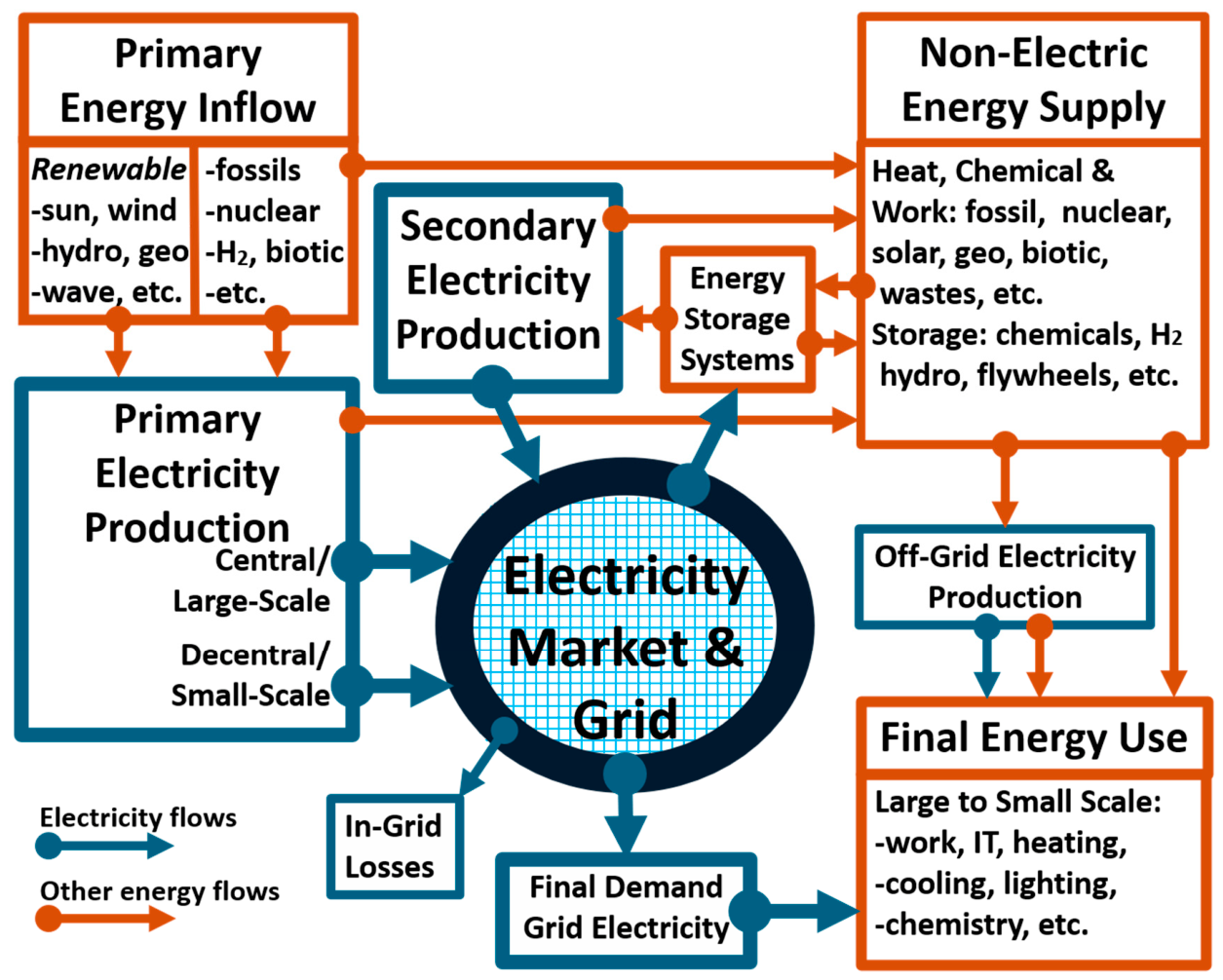
Figure 2.
Nodal grid structure with a minimum of three sources for any nodal purchases.
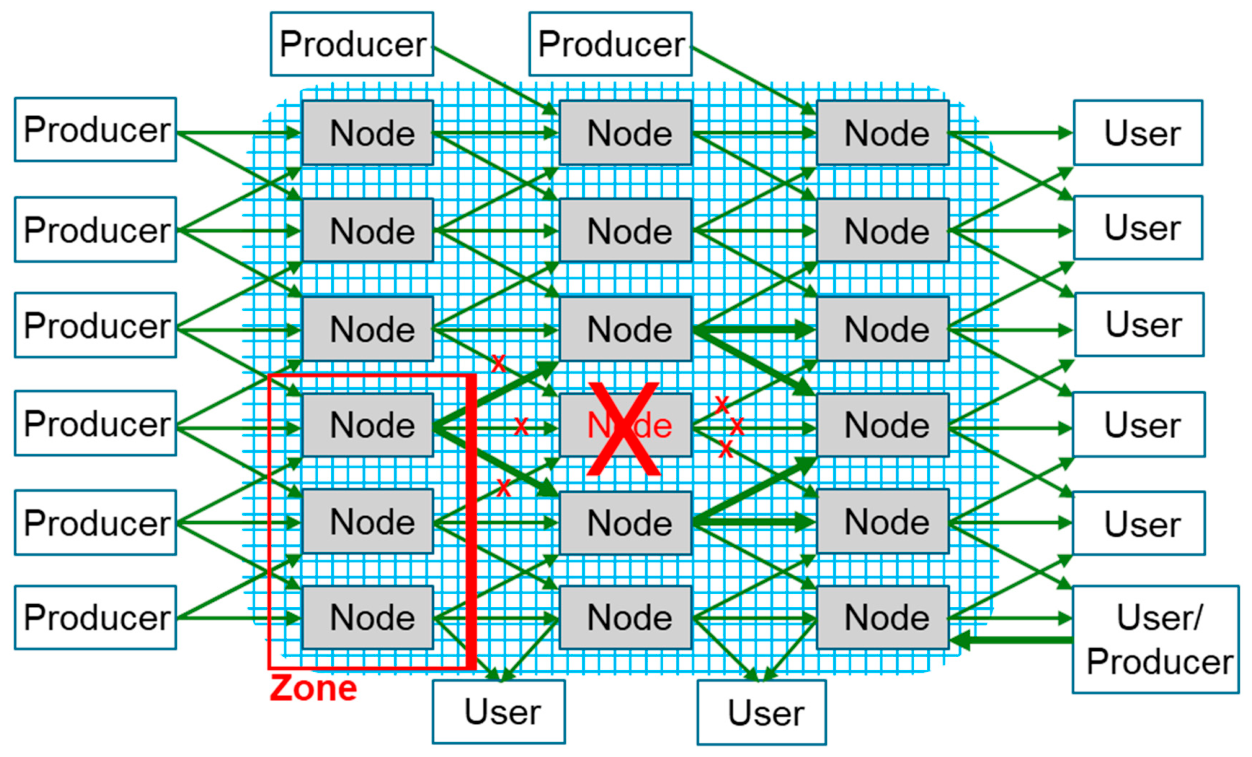

Table 1.
Cost reductions by redesign quantified and combined.
| USA+ | China+ | EU+ | |||||||
|---|---|---|---|---|---|---|---|---|---|
| Mechanisms* | Cost reduction % | Total cost 2050 B$/a | Avoided cost B$/a | Cost reduction % | Total cost 2050 B$/a | Avoided cost B$/a | Cost reduction % | Total cost 2050 B$/a | Avoided cost B$/a |
| 1 Micro-markets | 15 | 12 | 15 | 56 | 15 | 29 | |||
| 2 Single market prices | 10 | 8 | 10 | 37 | 10 | 19 | |||
| 3 Peak use reduction | 5 | 4 | 5 | 19 | 5 | 10 | |||
| 4 Additional battery use | 1 | 1 | 1 | 4 | 1 | 2 | |||
| 5 BEV batt replace in-grid | 13 | 36 | 6 | 77 | 4 | 24 | |||
| 6 System integration | 5 | 14 | 13 | 168 | 52 | 363 | |||
| Total cost without redesign | 279 | 1334 | 692 | ||||||
| Reduced cost with redesign | 27 | 204 | 75 | 27 | 973 | 361 | 65 | 245 | 447 |
| Cost / kWh before redesign | 0.05 | $ | 0.06 | $ | 0.09 | $ | |||
| Cost / kWh after redesign | 0.03 | $ | 0.04 | $ | 0.03 | $ | |||
| * Avoided cost mechanisms 1-4 reduced with combination factor R | R = | 0.28 | |||||||
| R = 100-(1-0.15)*(1-0.1)*(1-0.05)*(1-0.01) | |||||||||
| Data from Table SM 5.1A to 5.1F integrated. | |||||||||
| 1 | See on their prize https://www.kva.se/en/news/the-prize-in-economic-sciences-2025/. |
| 2 | Two general editors; 6 key contributors; 17 IEA comments and feedback; 40 government officials and international experts gave advice and comments on intermediate versions; over 60 participants were in the Power Market Design Expert Workshop in May 2025. |
| 3 | I asked my students at the IUE CAS institute in Xiamen (November 2025) about the role of state subsidies in CATL's rapid development of non-cobalt batteries. They laughed and said that applying for state subsidies would have delayed development by years. |
Disclaimer/Publisher’s Note: The statements, opinions and data contained in all publications are solely those of the individual author(s) and contributor(s) and not of MDPI and/or the editor(s). MDPI and/or the editor(s) disclaim responsibility for any injury to people or property resulting from any ideas, methods, instructions or products referred to in the content. |
© 2026 by the authors. Licensee MDPI, Basel, Switzerland. This article is an open access article distributed under the terms and conditions of the Creative Commons Attribution (CC BY) license (http://creativecommons.org/licenses/by/4.0/).
Copyright: This open access article is published under a Creative Commons CC BY 4.0 license, which permit the free download, distribution, and reuse, provided that the author and preprint are cited in any reuse.