

Submitted:
21 August 2026
Posted:
25 August 2026
You are already at the latest version
Abstract
Let \(\Phi\) be the theta kernel of the Riemann \( \Xi \)-function and \( D(z)=\int_0^\infty\Phi(u)\cos(zu)\,du \). The Riemann hypothesis is equivalent to the positivity of \( \partial_y|D(x+iy)|^2$ for $y>0 \), and it is natural to seek that positivity by decomposing the growth derivative over the phase-aligned blocks \( J_m=[m\pi/x,(m+1)\pi/x] \) on which the oscillation completes a full period, and controlling each block separately. We derive the exact two-variable representation of \( \partial_y|D|^2 \), obtain the resulting longitudinal--transverse decomposition \( \partial_y |D|^2 = 2 \int_{0}^{\infty} \big[ Q_y(a)\sin(2xa)+\varepsilon_x(a;y) \big] da \), and establish a complete oscillatory hierarchy: the structural fact is that a phase-aligned block annihilates one Taylor order against a sine but two against a cosine. On compact phase regions where \( Q_y' \) is bounded away from zero, the longitudinal block is of order \( x^{-2} \) while the transverse residual is two powers smaller, with explicit leading coefficients. We then prove that the decomposition cannot localise the positivity. Writing \( S=\sum_mC^{(Q)}_m \) and \( E=\sum_{m}C_{m}^{(\varepsilon)} \), both sectors admit complete algebraic asymptotic expansions in \( 1/x \), and these are termwise negatives of one another: \( S+E \) is exponentially small while each sector is of size \( x^{-5} \), so that \( E/S\to-1 \)(Theorem 5). As a concrete consequence we obtain a representation-specific no-go theorem for universal phase-aligned block positivity: for every \( y>0 \) and all sufficiently large \( x \) at least one aligned block is negative (Theorem 6). The latter proof is fully analytic and unconditional, resting only on the expansion\( Q_y(a)=\frac{4}{3}y\,p'(0)\Phi(0)^2a^4+O(a^6) \) together with a rigorous proof that \( \Phi''(0)<0 \); in particular it is independent of the truth of RH. Within this exact phase-aligned decomposition, therefore, the strategy of deducing global positivity from positivity, or from independent domination, of every block is not merely unproved but impossible: positivity is intrinsically nonlocal.
Keywords:
Riemann hypothesis
; Riemann Xi-function
; theta kernel
; growth derivative
; oscillatory integral
; phase-aligned blocks
; nonlocal cancellation
; asymptotic expansion
; no-go theorem
; positivity criterion
MSC: 11M26; 30D15; 41A60; 42A38
1. Introduction
1.1. Setting
Write
and let
The kernel is real, even and real-analytic, and it together with all its derivatives decays doubly exponentially.
1.2. Background
The Fourier representation of by the theta kernel is the starting point of a long tradition. Pólya [1] initiated the study of RH through the zeros of Fourier transforms of such kernels; de Bruijn [2] introduced the heat deformation of and showed that has only real zeros for ; Newman [3] proved the existence of the constant for which has only real zeros exactly when , RH being the assertion , and Rodgers and Tao [4] proved . A convenient modern account, with the normalisation used here, is the Polymath treatment of the flow [5]. Positivity and hyperbolicity conditions on objects attached to remain an active line of attack; see for instance the work of Griffin, Ono, Rolen and Zagier on Jensen polynomials [6]; the classical Turán-inequality analysis of the same theta kernel by Csordas, Norfolk and Varga [7] belongs to the same tradition. In [8,9] the present author studied the onset of Jensen hyperbolicity, in the first paper exhibiting a structural obstruction to that route and in the second a candidate moment-positivity structure; the present obstruction is of a similar spirit to the former but arises in a different representation and by a different mechanism. A second strand concerns the growth of away from the critical line. Hinkkanen [10] and Lagarias [11] showed that RH is equivalent to on ; Sondow and Dumitrescu [12] reformulated this as horizontal monotonicity of in zero-free half-planes; Goldštein and Grigutis [13] study the positivity of in the right half of the critical strip, including the behaviour in the hypothetical presence of off-line zeros. These criteria situate the present work: our object, , is exactly the growth derivative appearing there (Theorem 2).
1.3. The Question, and What We Prove
Given the exact decomposition of into phase-aligned blocks constructed in §§3–5, it is natural to hope that positivity can be established block by block. We show that it cannot.
The main result (Theorem 5) is that the longitudinal and transverse sectors cancel to all algebraic orders: each is of size , their sum is exponentially small, and . Its sharp local consequence (Theorem 6) is that some aligned blocks are necessarily negative.
Novelty.
This paper does not propose another sufficient positivity condition for RH. It proves that a natural localisation of the growth derivative into independently controlled aligned blocks is structurally incompatible with the nonlocal cancellation carried by the exact theta-kernel representation. Both theorems are unconditional: they are statements about the internal sign structure of one particular exact decomposition, and they hold whether or not RH is true.
Scope.
We prove that the individual phase-aligned blocks cannot all be nonnegative, and that estimating the two sectors independently destroys the quantity whose sign is at issue. We do not claim that no use of the partition can succeed: grouping blocks, retaining correlations between the sectors, or resummation identities are not excluded. What is excluded is the strategy of blockwise positivity or independent blockwise domination.
Organisation.
Section 2 proves the two elementary properties of the theta kernel used throughout — positivity, strict monotonicity, and — so that the paper is unconditional from the outset. Section 3 derives the exact two-term representation of , fixes the normalisation , reduces to , and records the growth criterion linking the object to RH. Section 4 establishes the master identity and identifies the longitudinal envelope and the transverse residual . Section 5 proves the phase-aligned moment lemma — the structural fact that a sine-block annihilates one Taylor order and a cosine-block two — and deduces the oscillatory hierarchy, with explicit leading coefficients for and . Section 6 contains the main result, the nonlocal cancellation theorem: the two sectors cancel to all algebraic orders, so that while each is of size . Section 7 draws the sharp local consequence, the no-go theorem for blockwise positivity. Section 8 collects the numerical illustrations, and Section 9 concludes.
2. The Kernel: Positivity and Monotonicity
All results used in the main theorems of §§6–7 are unconditional; the numerical material of §8 illustrates them but is never used in their proofs. We therefore begin by proving the two elementary properties of that are used throughout. Set
Since and ,
Lemma 1
(Positivity and strict decrease). on , and for every . Consequently
Proof.
Positivity. For we have , so for every ; every summand in (4) is positive. Evenness gives on .
Monotonicity. Differentiating (4) with respect to x and using , one finds after dividing by that is equivalent to
The quadratic is positive for . Since , for we get , so every summand in (6) is positive and .
For we argue instead from and , using Lemma 3 below: (as is even) and on , so there, and hence by Lemma 2
Therefore . □
Lemma 2
(). With ,
and . Consequently .
Proof.
Differentiating the n-th summand twice at and collecting terms gives (8). Throughout this proof denotes the n-th summand of (8) including the prefactor , that is
The term is an explicit cubic in , and .
For we have . The cubic satisfies , while for (the larger root of ); hence on , so there. Also for , so on and therefore with . For ,
so and
Therefore . (For reference, , , .) □
Lemma 3
(A majorant for near the origin). With and ,
For one has .
Proof.
Let , so with .
Sign facts. has largest root , so on ; together with , and , successive integration gives on . Moreover
since and the quadratic has both roots below . Hence for .
Term . Here . On this interval (its values at the endpoints are and , and is monotone there), so is decreasing; since we get , hence is increasing and . As , the term is at most .
Term . Here , and is increasing on , so ; with the term is at most .
Terms . Using for , these terms are together at most .
Summing and multiplying by gives ; positivity of every summand gives . (The true maximum on is .) □
3. The Exact Two-Variable Representation
Definition 1.
and .
M is even in b and A odd in b; since ,
Proposition 1
(Normalisation). .
Proof.
In the normalisation of [5], with . Our kernel satisfies . Substituting ,
□
Theorem 1
(Exact two-term identity). For , ,
Proof.
D is entire and with , so
and, with ,
The measure is symmetric in , so we may symmetrise. Put , and set , ; then , , and
Combined with and , the symmetrised integrand collapses to . Finally , the region is , and the integrand is even in b; the factors give (17). □
Proposition 2
(Reduction to ). and its y-derivative are even in x; and for , .
Proof.
Since is real and cos is even, for real u, so
whence and is even in x. The case is immediate from . □
Henceforth .
3.1. The Growth Criterion
Theorem 2
(Bridge to RH). For , , put . Then
an identity between entire quantities, valid also at zeros of ξ. Moreover for all and all if and only if the Riemann hypothesis holds.
Proof.
Let . From and we get , so . Since we have , and therefore
Now by Proposition 1, giving (22).
The map is a bijection from onto the half-plane . Suppose RH holds. Then has no zero with , and the Hadamard logarithmic derivative, summed in the standard symmetric order, gives
every term being positive; see [10,11]. Hence . Conversely, if RH fails then by the functional equation there is a zero with ; at we have and hence , so positivity fails. □
Remark 1.
Two s-variables occur here and should be distinguished. The substitution attaches to the point
which for lies in thelefthalf-plane ; it is the functional equation, in the form , that transfers the computation to
where the real-part criterion lives. In the z-variable itself one has, away from zeros, theimaginary-part condition
Remark 2
(What the classical criteria do and do not say). The criteria of [10,11,12] concern the sign of the complete logarithmic derivative or, equivalently, the horizontal monotonicity of in zero-free half-planes. They determine the sign of thetotalquantity under RH; they say nothing about the signs of the phase-aligned block integrals introduced in §5, nor do they introduce the objects S, E, and of the decomposition below. These are logically independent questions: an integral may be positive while the integrals of its restrictions to a partition of the domain have any prescribed pattern of signs, and conversely all those restricted integrals may be positive even when the integrand oscillates. The results of §§6–7 are unconditional statements about the internal sign structure of one particular exact decomposition, and are not deduced from — and do not imply — the classical criteria.
4. The Longitudinal–Transverse Decomposition
Definition 2.
Proposition 3.
, and consequently
Proof.
The identity is immediate from . For we have , so by Lemma 1, with strict inequality on a set of positive measure; and , . □
Theorem 3
(Master identity). For , ,
Proof.
Write (17) as , where
with and .
Integrating by parts in b, using and ,
whence
Integrating by parts in a (boundary terms vanish by the decay of G) gives
and by the Leibniz rule
so that
Remark 3.
The cancellation is between thetransversesector (integration by parts in b) and thelongitudinalsector (integration by parts in a). It is not visible from a one-term starting point, which is why the two-term identity (17) is essential.
5. The Phase-Aligned Oscillatory Hierarchy
Fix and set
so that and . Put
so that .
Lemma 4
(Moments over a full aligned period). With and (so ),
Proposition 4
(Sine- and cosine-block orders). Let on a neighbourhood of , and . Then
Proof.
Set , Taylor-expand F to second order with remainder, and apply Lemma 4. Against a sine the constant term dies; against a cosine both the constant and the linear term die. The remainder is at most . □
This asymmetry — one annihilated Taylor order against a sine, two against a cosine — drives the entire hierarchy.
Lemma 5
(Transverse expansion). For ,
Proof.
Four integrations by parts in b; all endpoint contributions at vanish by (15). □
Definition 3.
Put
where .
Multiplying Lemma 5 by gives, uniformly on compact a-sets,
Theorem 4
(Oscillatory hierarchy). Let and let be compact. For all x large enough that every block with satisfies , one has, uniformly over such blocks,
The implied constants depend only on y and on the quantities
Proof.
Since , for x large every block with lies in , and Proposition 4 may be applied with derivative norms taken over . Formula (47) is that proposition applied to . For (48), insert (46): the term is a cosine-block, contributing ; the term is a sine-block, contributing . The terms of order and in Lemma 5 are again cosine- and sine-blocks, contributing ; the final integral remainder is pointwise and is integrated over a block of length . □
Corollary 1
(Residual ratio). If in addition , then uniformly for ,
Remark 4
(The uniformity is essential). Corollary 1 holds only where is bounded away from zero. It fails near , near a zero of , and in the far tail. In particular, forfixedm we have as ; since near 0 (Lemma 6), the block is then itself of size , not , and does not tend to 0. The correct summary is:on compact phase regions where is bounded away from zero, each transverse residual block is two powers of x smaller than its longitudinal counterpart.Theorem 5 shows that this local smallness does not survive global summation.
6. Nonlocal Cancellation
Lemma 6
(Small-a expansion). As , uniformly for y in compacts,
so for all sufficiently small .
Proof.
is even, so and , giving for . Also and . Hence the integrand in (30) equals , and . Positivity of is Lemma 2. □
The next lemma is a standard estimate; we record it only because we shall need it, and we claim no novelty for it. It quantifies the well-known exponential decay of in vertical strips, and follows from Stirling’s formula together with a Cauchy estimate. Its role here is purely comparative: it supplies the right-hand side against which the algebraic expansions of the two sectors are measured in Theorem 5.
Lemma 7
(Exponential smallness of I). Fix . There are and such that
Proof.
By Theorems 3 and 2, with ; this is an identity between entire functions, so
holds unconditionally, with no hypothesis on the zeros of .
Let , so that the closed disc lies in the closed strip , strictly to the right of the critical line. On that strip Stirling gives, uniformly,
while is polynomially bounded on vertical lines with [14], and . Hence for . Cauchy’s estimate then gives . Multiplying yields the claim with . □
Theorem 5
(Nonlocal cancellation). Fix and set
so that . Then:
- (i)
-
S has the complete asymptotic expansionwhose first nonvanishing term gives
- (ii)
- (Cancellation to all algebraic orders.)For every N, . Hence E has an asymptotic expansion which istermwise the negativeof (56); in particular
- (iii)
- as .
Proof. (i) , and together with all its derivatives decays doubly exponentially, so repeated integration by parts gives, with ,
By Lemma 6, and , so the terms vanish and the term is .
(iii) By Lemma 2, , so for large x; now divide. □
Remark 5
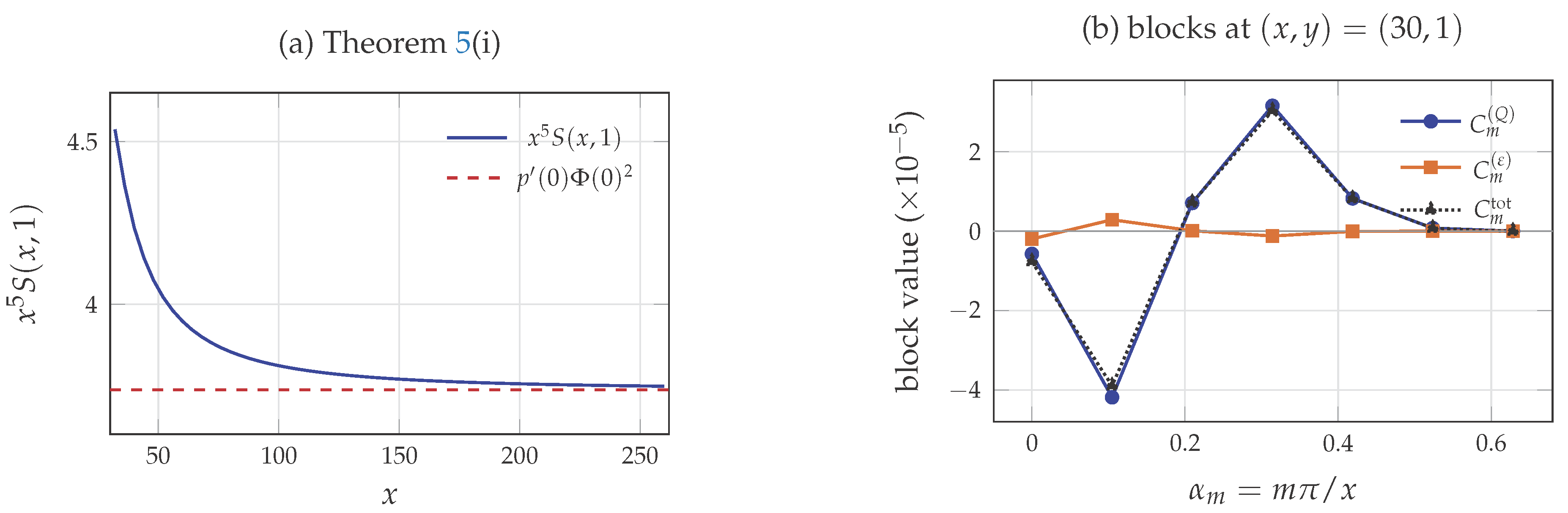
(Interpretation). Block by block, on compact phase regions where is bounded away from zero, the transverse residual is two powers of x smaller than the longitudinal term (Corollary 1). Globally it is not: the two sectors are each of size and cancel to all algebraic orders, the sign-carrying quantity surviving only in the exponentially small remainder. There is no contradiction: the have mixed signs and cancel among themselves, so , and the residuals survive at exactly the order of what is left. Numerically (§Section 8), at , the individual blocks are of size while .
Consequentlyanyargument that estimates the two sectors independently and then adds them discards, at every step, quantities enormously larger than the answer. This is intrinsic to the decomposition, not a deficiency of the estimates.
It should be emphasised what is, and what is not, new here. The exponential estimate for the complete growth derivative (Lemma 7) is standard. The point of Theorem 5 is its comparison with the algebraic endpoint expansions of the two sectors created by the exact decomposition: S and E are individually of size , with complete asymptotic expansions in that are termwise negatives of one another. Neither S nor E exists outside this decomposition, so no such statement is available from the classical global criteria.
7. A Representation-Specific No-Go Theorem for Blockwise Positivity
Theorem 6
(No-go). Fix . By Lemma 6 choose with on , and fix a nondegenerate interval ; put . Then there is such that for all and every m with ,
Moreover, as soon as , at least one lies in K. Hence for every and all sufficiently large x there exists a negative aligned block, and the blocks are not all nonnegative.
Proof.
K is a compact subset of on which , so Theorem 4 applies uniformly (choose any compact with ): we have and . Choose so that the two remainders together are bounded by . For the last statement, if the grid spacing is smaller than the length then some multiple of lies in . □
Corollary 2.
The strategy of deducing from the nonnegativity of every aligned block, or from independent blockwise domination of by , cannot succeed.
Remark 6.
Theorem 6 is fully analytic and unconditional; it uses only Lemmas 2, 6 and Theorem 4, and requires no information about the global shape of — in particular no uniqueness hypothesis for the zeros of . It also makes no use of RH, or of the sign of the complete integral : it remains true whether RH holds or fails.
Remark 7
(Block signs are not determined by global positivity). It is worth stressing that Theorem 6 is not a consequence of the positivity of together with the oscillation of the integrand. Neither oscillation of an integrand, nor positivity of its total integral, constrains the signs of the integrals over complete phase-aligned blocks. Indeed let with decreasing, and put . Substituting and splitting at its midpoint gives
for every m, since the bracket is positive. Thus every block integral can be strictly positive although the integrand changes sign inside each block. What drives Theorem 6 is instead thelocal geometryof near the origin — the strict increase supplied by Lemma 6 — together with the uniform two-power separation of Theorem 4.
Remark 8
(Why the residual cannot compensate). One might hope that , whose sign is not fixed, could be positive and large enough to offset a negative . Theorem 4 forecloses this: on the relevant compact region is smaller than by at least two powers of x, uniformly (). The failure occurs at leading order, and is therefore not a matter of sharper estimates.
8. Numerical Illustrations
The tables and figure of this section illustrate, but do not prove, the analytic results of §§Section 6Section 7; no statement proved above depends on them. Computations use the series for truncated at (tail on the relevant range) and Gauss–Legendre quadrature, with evaluated in log-space. A script producing every table and both panels of Figure 1 below, together with quadrature orders, interval transformations, precision settings and explicit theta-series truncation bounds, is provided as Supplementary Material.
Independence of the evaluation of I.
In the tables below is never obtained by subtracting E from . It is computed independently as with D and each evaluated by direct quadrature. This matters: at the quantity I lies several orders of magnitude below and , so an ordinary-precision subtraction would return noise. The agreement between the independent value of I and is therefore a genuine test of Theorem 3, not a tautology.
The master identity.
Relative errors between computed directly and via (31): , , , , at , , , , .
Nonlocal cancellation (Theorem 5).
With and :
| x | ||
| 40 | ||
| 80 | ||
| 160 | ||
| 240 |
| x | y | ||
| 10 | 1 | ||
| 20 | 1 | ||
| 30 | 1 | ||
| 30 | 5 |
Negative blocks (Theorem 6), .
Blocks on which changes sign are omitted; the rows listed are blocks lying either strictly inside or strictly outside the region where .
| x | m | sign | |||
| 20 | 0 | − | |||
| 20 | 1 | − | |||
| 20 | 2 | + | |||
| 30 | 0 | − | |||
| 30 | 1 | − | |||
| 30 | 3 | + |
Graphical summary.
Figure 1 displays the two proved core phenomena. Panel (a) shows the convergence of to the level predicted by Theorem 5(i). Panel (b) shows the block structure at : the pre-transition blocks are negative (Theorem 6), the transverse contributions are visibly smaller than the longitudinal ones (Theorem 4), and the sign reversal occurs once passes beyond the region where .
Figure 1.
The two proved core results. (a) against x, with the limiting level of Theorem 5(i) shown dashed. (b) the longitudinal blocks , the transverse blocks and their sum at , in units of , plotted against the left endpoint of the block. The blocks lying strictly inside the region where are negative, the transverse contribution is uniformly the smaller of the two, and the sign reverses further out. Both panels illustrate the analytic statements of Theorems 5 and 6; they do not prove them.
Figure 1.
The two proved core results. (a) against x, with the limiting level of Theorem 5(i) shown dashed. (b) the longitudinal blocks , the transverse blocks and their sum at , in units of , plotted against the left endpoint of the block. The blocks lying strictly inside the region where are negative, the transverse contribution is uniformly the smaller of the two, and the sign reverses further out. Both panels illustrate the analytic statements of Theorems 5 and 6; they do not prove them.
9. Conclusions
The theta-kernel decomposition of into phase-aligned blocks is exact, and admits a complete oscillatory hierarchy; the dependencies of the implied constants are specified in Theorem 4. Nevertheless it cannot deliver the positivity it was designed to capture. The reason is not the sharpness of any estimate but the architecture of the decomposition: the longitudinal and transverse sectors are each of size and cancel to all algebraic orders, so that the sign-carrying quantity lives entirely in an exponentially small remainder (Theorem 5). The concrete symptom is that some aligned blocks are necessarily negative (Theorem 6).
Within this exact phase-aligned decomposition, positivity is intrinsically nonlocal. Any successful approach through this representation must retain the correlation between the two sectors — for instance by grouping blocks, or by a resummation identity that keeps track of the cancellation — rather than estimating them independently. We emphasise once more the limits of the claim. Theorems 5 and 6 are unconditional statements about one particular decomposition; they are not statements about every conceivable local approach to the growth criterion, and they neither assume nor bear on the truth of the Riemann hypothesis itself.
Funding
This research received no external funding.
Data Availability Statement
The original contributions presented in this study are included in the article. A supplementary Python script implementing the full numerical pipeline is provided as Supplementary Material alongside this article: reproduce.py. It requires numpy, scipy, mpmath and sympy (exact versions are listed in the accompanying requirements.txt); the high-precision constants of §Section 2 are computed with mpmath. A README.md file describes the pipeline, the quadrature orders and the required precision settings. Further inquiries may be directed to the corresponding author.
Acknowledgments
The author acknowledges the use of generative AI tools, including OpenAI’s ChatGPT 5.5 and Anthropic’s Claude Opus 4.8, for assistance with numerical checks, consistency verification, language refinement, and editorial suggestions during the preparation of this manuscript. Some numerical computations used Python 3.12.3. All mathematical results, proofs, interpretations, and conclusions were independently reviewed and validated by the author, who assumes full responsibility for the content of the paper.
Conflicts of Interest
The author declares no conflicts of interest.
References
- Pólya, G. Über die algebraisch-funktionentheoretischen Untersuchungen von J. L. W. V. Jensen . Kgl. Dan. Vid. Sel. Math.-Fys. Medd. 1927, 7, 3–33. [Google Scholar]
- de Bruijn, N.G. The roots of trigonometric integrals . Duke Math. J. 1950, 17, 197–226. [Google Scholar] [CrossRef]
- Newman, C.M. Fourier transforms with only real zeros . Proc. Amer. Math. Soc. 1976, 61, 245–251. [Google Scholar] [CrossRef]
- Rodgers, B.; Tao, T. The de Bruijn–Newman constant is non-negative . Forum Math. Pi 2020, 8, e6. [Google Scholar] [CrossRef]
- Polymath, D.H.J. Effective approximation of heat flow evolution of the Riemann ξ function, and a new upper bound for the de Bruijn–Newman constant . Res. Math. Sci. 2019, 6, 31. [Google Scholar] [CrossRef]
- Griffin, M.; Ono, K.; Rolen, L.; Zagier, D. Jensen polynomials for the Riemann zeta function and other sequences . Proc. Natl. Acad. Sci. USA 2019, 116, 11103–11110. [Google Scholar] [CrossRef] [PubMed]
- Csordas, G.; Norfolk, T.S.; Varga, R.S. The Riemann hypothesis and the Turán inequalities . Trans. Amer. Math. Soc. 1986, 296, 521–541. [Google Scholar] [CrossRef] [PubMed]
- Planat, M. Asymptotic hyperbolicity of Jensen polynomials and the finite-strip obstruction to the Riemann hypothesis . Mathematics 2026, 14, 1884. [Google Scholar] [CrossRef]
- Planat, M. Parity bifurcation, PIII(D6) topology, and a Stieltjes framework to Jensen polynomial hyperbolicity . Mathematics 2026, 14, 2240. [Google Scholar] [CrossRef]
- Hinkkanen, A. On functions of bounded type . Complex Var. Theory Appl. 1997, 34, 119–139. [Google Scholar] [CrossRef]
- Lagarias, J.C. On a positivity property of the Riemann ξ-function . Acta Arith. 1999, 89, 217–234. [Google Scholar] [CrossRef]
- Sondow, J.; Dumitrescu, C. A monotonicity property of Riemann’s xi function and a reformulation of the Riemann hypothesis . Period. Math. Hung. 2010, 60, 37–40. [Google Scholar] [CrossRef]
- Goldštein, E.; Grigutis, A. On a positivity property of the real part of the logarithmic derivative of the Riemann ξ-function . J. Math. Inequal. 2024, 18(no. 3). [Google Scholar] [CrossRef]
- Titchmarsh, E.C. The Theory of the Riemann Zeta-Function, 2nd ed.; Heath-Brown, D.R., Ed.; Oxford University Press: Oxford, UK, 1986. [Google Scholar]
Disclaimer/Publisher’s Note: The statements, opinions and data contained in all publications are solely those of the individual author(s) and contributor(s) and not of MDPI and/or the editor(s). MDPI and/or the editor(s) disclaim responsibility for any injury to people or property resulting from any ideas, methods, instructions or products referred to in the content. |
© 2026 by the authors. Licensee MDPI, Basel, Switzerland. This article is an open access article distributed under the terms and conditions of the Creative Commons Attribution (CC BY) license (http://creativecommons.org/licenses/by/4.0/).
Copyright: This open access article is published under a Creative Commons CC BY 4.0 license, which permit the free download, distribution, and reuse, provided that the author and preprint are cited in any reuse.