

Submitted:
21 August 2026
Posted:
24 August 2026
You are already at the latest version
Abstract
Chromatin spatial organization is commonly described through compaction, contact frequencies, chromosome territories, loops and polymer dynamics, yet these measures do not address how nuclear confinement shapes accessible genome configurations. We introduce the concept of chromatin congestion to describe changes in the geometrically, topologically and mechanically admissible chromatin configurations within a confined nucleus, integrating directional geometric constraints, topological obstruction, stochastic exploration, mechanical deformation and long-range dependence into a common description. We performed stochastic simulations of 480 nuclei across six microchannel widths from 14 to 4 micrometers, keeping chromatin content constant and quantifying collision-free path length, locus displacement, topological encounters, curvature, bending work, perturbation propagation and DNA-damage burden. As confinement progressed, chromatin displacement initially increased, consistent with exploration of the configurations still available, but declined under stronger restriction. Topological encounters, curvature and mechanical work increased, while perturbations extended across progressively larger nuclear regions and were associated with greater damage burden. Our simulations suggest that progressive confinement can drive transition from locally buffered chromatin dynamics to increasingly collective genome behaviour, characterized by stronger spatial interdependence among genomic regions. Potential applications include microfluidic migration experiments, single-cell nuclear phenotyping and the integration of imaging, mechanical and genome-organization measurements.
Keywords:
genome
; biophysics
; mechanobiology
; polymer
; epigenetics
Introduction
Current models of three-dimensional genome organization describe chromosome territories, radial positioning, compartments and topologically associating domains shaped by mechanisms including loop extrusion, compartmentalization and lamina-associated interactions (Zheng and Xie 2019; Crosetto and Bienko 2020). Specific molecular components modify this architecture: for instance, HP1 regulates clustering, chromosome folding and B-compartment formation (Zenk et al. 2021), while telomeric chromatin adopts distinct compact and open conformations (Soman et al. 2022), loop-extrusion programs influence nuclear morphology (Patta et al. 2024) and transcription-factor dosage can alter compartments, boundaries and loops (Grant et al. 2026). However, contact maps and compaction or density measures do not directly quantify the spatial configurations accessible within a finite nuclear volume, whereas computational reconstructions depend on incomplete observations and experimental resolution. Consequently, confinement, topology, mechanics and stochastic motion lack a common description of how they jointly restrict physically realizable chromatin configurations. Recent findings emphasize the importance of chromatin’s physical state. DNA structures can dynamically assemble within confined environments (Agarwal et al. 2021), while distinct chromatin conformations influence higher-order packing (Soman et al. 2022). Nucleosome geometry and linker-DNA length can determine interaction networks and material properties of chromatin condensates (Zhou et al. 2025), while solid-like nucleoprotein condensates can stabilize selective long-range genomic contacts (Pulupa et al. 2025). Chromosomes can also behave as ionic gels with expanded and collapsed states separated by a volume phase transition (Beel, Matteï, and Kornberg 2026). Together with the coupling of genome folding to nuclear morphology (Patta et al. 2024) and the sensitivity of chromatin architecture to transcription-factor dosage (Grant et al. 2026), these observations motivate examining how physical and regulatory conditions constrain the configurations available to the genome.
We introduce the concept of chromatin congestion to describe the progressive change of geometrically, topologically and mechanically admissible configurations under increasing nuclear confinement. We suggest combining complementary mathematical approaches, each capturing a distinct aspect of configurational restriction, including spatial competition, directional organization, topological cost, stochastic exploration and perturbation propagation. Incidence and Kakeya geometry could describe how finite-thickness chromosome segments compete for space while maintaining different orientations (Guth, Solomon and Wang 2019; Wang and Zahl 2025), whereas knot distortion could capture the deformation costs imposed by loops and entanglements (Pardon 2011). Propagation-of-randomness methods could test whether stochastic motion islocal or spreads between interacting regions (Deng, Nahmod and Yue 2022). Negative dependence could represent competition among incompatible configurations (Borcea, Brändén and Liggett 2009), while entropy-based sampling could measure the diversity of accessible arrangements (Oveis Gharan, Saberi and Singh 2011). Log-concavity could characterize their global organization (Anari, Oveis Gharan and Vinzant 2018) and spectral independence could quantify how strongly local rearrangements influence distant regions as configurational freedom decreases (Anari, Liu and Oveis Gharan 2020). Finally, o-minimal geometry could represent biologically realizable chromatin states as a structured subset of all conceivable configurations (Bakker, Brunebarbe and Tsimerman 2022). Our simulation implements these ideas at a coarse-grained level by progressively confining nuclei with approximately constant chromatin content and measuring collision-free path length, displacement, topological encounters, curvature, mechanical work, perturbation propagation and DNA-damage burden.
We will proceed as follows. First, we formulate chromatin congestion and its geometric, topological and probabilistic components. Then, we describe the computational model and progressive-confinement simulation. Next, we quantify configurational restrictions, mechanical cost and perturbation propagation across confinement levels. Finally, we present the simulated functional readouts and their relationships with the preceding structural variables.
Methods
We studied chromatin congestion as a progressive restriction of the spatial configurations available to chromatin during controlled nuclear confinement. We used a stochastic simulation in which nuclei were progressively confined through microchannels ranging from 14 to 4 μm, while chromatin content was kept constant and nuclear volume varied only modestly. Eighty independent stochastic realizations were generated at each of six confinement levels, yielding 480 simulated nuclei. We quantified chromatin mobility and configurational exploration, collision-free path length, long-range coupling, topological encounters, local curvature, minimum bending work, and topological and mechanical burden, together with DNA-damage burden. We aimed to determine whether increasing confinement produces experimentally distinguishable changes in these properties, revealing how chromatin could explore alternative configurations, accommodates spatial constraints locally and transmits perturbations across the nucleus.
Confinement model. Confinement was represented by the microchannel width , expressed in micrometres, with
To convert channel narrowing into a continuous congestion variable, we used a sigmoidal control function centered near the transition between moderate and severe confinement,
with
Thus approaches zero for weak confinement and one for severe confinement. This variable did not represent a measured biological quantity, rather it served as the latent control variable linking the imposed geometry to the simulated observables. The nuclear volume was maintained near a constant baseline to separate congestion from simple changes in chromatin abundance. For realization at confinement width , nuclear volume was sampled as
Therefore, the mean volume decreased only modestly as confinement intensified. For each width, 80 independent realizations were sampled,
giving
simulated nuclei. A fixed random seed was used to ensure reproducibility across the complete numerical experiment. All subsequent variables were conditionally generated from the same confinement state so that geometric, topological, stochastic, mechanical and functional observables were coordinated by a common imposed physical restriction rather than generated as unrelated outputs.
Geometric freedom. Local configurational freedom was represented through a collision-free chromatin path length, defined as the distance over which a coarse-grained chromatin segment could extend before encountering a geometric or configurational obstruction. The expected free path incorporated two components: a nonlinear term representing congestion and a smaller linear term representing progressive channel narrowing,
with measured in micrometres. For each realization,
where
To exclude nonphysical negative lengths, values below m were truncated at that lower boundary,
This quantity provided the main geometric congestion readout used in panel A. Changes in were interpreted operationally as changes in locally available trajectories rather than direct measurement of total chromatin density.
The use of a directional free-path variable was motivated by the geometric principle that the coexistence of multiple elongated structures with heterogeneous orientations imposes constraints beyond volume fraction alone (Guth, Solomon and Wang 2019). In our implementation, we did not explicitly reconstruct individual Kakeya tube families in three dimensions, but rather the finite-path statistic acted as a coarse-grained surrogate for the progressive restriction of tube-like chromatin trajectories under confinement (Wang and Zahl 2025). More generally, the set of biologically admissible configurations could be regarded as a structured subset of the much larger space of mathematically conceivable conformations, following the regularity perspective provided by o-minimal geometry (Bakker, Brunebarbe and Tsimerman 2022).
The first technical sequence to assign , compute , sample , calculate , sample , enforce the physical lower bound and retain for subsequent comparison with stochastic and topological variables.
Stochastic motion. Chromatin motion was modeled as a non-monotonic response to confinement. The intended behavior was increased exploratory motion under intermediate restriction followed by suppression under severe congestion (Deng 2012). For each width, the mean chromatin locus displacement over 60 seconds was
with displacement measured in nanometres. Individual realizations followed
and values below nm were excluded by
The displacement model combined a Gaussian term centered at m representing an intermediate-confinement component, with an additional term proportional to representing the severe-confinement component.
Randomness was introduced independently for every nucleus after conditioning on , so that within-condition heterogeneity did not arise from deterministic interpolation (Deng, Nahmod and Yue 2022). The stochastic step was performed after the free-path calculation, but was not made directly dependent on the sampled free path. This distinction allowed both variables to respond to confinement without forcing a perfect correlation between them. The empirical distribution of across all 80 realizations was used at each width, thereby preserving the simulated variability associated with chromatin motion (Deng, Nahmod and Yue 2024).
Topology and curvature. Topological burden was represented as the number of encounters or entanglement-like constraints per 100 m of coarse-grained chromatin centreline. For each confinement level,
and the standard deviation changed with congestion according to
Individual values were sampled as
and truncated at
events per 100 m. Chromatin curvature was modeled separately but driven by the same confinement state. Its mean was
with
and
Values were restricted to
Therefore, the topology-curvature relation shown in panel C was not imposed through a direct algebraic mapping of into . Instead, both quantities were generated independently conditional on the same confinement state. This preserved stochastic dispersion while producing a population-level association. Our simulation treated topological encounters as a countable coarse-grained proxy for constraints such as crossing avoidance, linking, loop interactions or entanglement-like interference. Curvature provided the corresponding geometric deformation variable. The numerical construction was motivated by the principle that topological constraints can impose irreducible geometric distortion, but our simulation did not assign a formal knot type or calculate an exact knot invariant for each realization (Pardon 2011).
Mechanical cost. Mechanical burden was represented by the minimum coarse-grained bending work required to sustain a sampled chromatin configuration. The simulated variable was expressed in piconewton-micrometres and was built to increase nonlinearly when the congestion variable became large,
Its condition-dependent variability was
giving
Negative mechanical energies were excluded by
The quantity can be related conceptually to the classical bending-energy functional of a semiflexible polymer,
where is the bending rigidity, is contour length and is local curvature. We did not integrate this expression explicitly for a reconstructed polymer chain, because the simulation did not generate a spatially resolved centreline for every chromosome. Instead, was used as an effective minimum work variable whose nonlinear dependence on congestion represented the increasing energetic cost of maintaining spatially restricted configurations. The exponent was selected to represent a nonlinear dependence on confinement severity, without assuming a linear relationship across the investigated range. The condition means and standard errors were
where is the sample standard deviation across realizations at a given microchannel width.
Perturbation coupling. To represent the transition from local to increasingly collective chromatin rearrangements, we introduced a perturbation propagation length , measured in micrometres. Its expected value was
with variability
For each simulated nucleus,
subject to
An exponent greater than one was used to model spatial coupling as a nonlinear function of confinement severity, rather than assuming a linear dependence across the investigated range. This variable acted as a coarse-grained analogue of an influence radius: a small value represented a perturbation absorbed locally, whereas a larger value represented a displacement affecting progressively more distant chromatin regions. The construction was inspired by the logic of bounded versus increasing long-range dependence (Anari, Liu and Oveis Gharan 2020). Although the simulation did not explicitly construct a full influence matrix, the corresponding mathematical object would be
where and denote occupation or state variables for chromatin regions. Then, spectral independence would be assessed through the largest eigenvalue (Anari, Liu and Oveis Gharan 2020),
In our simulation, served as a physical-space surrogate for increasing influence range (Deng and Hani 2021). The complete realization-level values were retained so that this quantity could subsequently be related to the simulated functional endpoint rather than treated only as a group-level summary.
Damage readout. DNA-damage burden was represented as a discrete number of foci per nucleus. Because the outcome is count-valued, we sampled it from a Poisson distribution rather than from a Gaussian model. The Poisson intensity was linked to mechanical work, perturbation propagation and topological encounter burden,
The simulated number of damage foci was then
This construction produced non-negative integer-valued outcomes while allowing several upstream variables to contribute simultaneously. No additional direct term for microchannel width was included once , and were specified, so confinement influenced the damage count indirectly through the simulated geometric, topological and mechanical state.
A first-order least-squares trend line was estimated as
with coefficients obtained by minimizing
The fitted line was used only as a visualization of the simulated association and not as an inferential model for biological data. No hypothesis testing was performed on the synthetic realizations.
Overall, the final dataset contained for each nucleus: confinement width, nuclear volume, collision-free path, locus displacement, topological encounters, curvature, bending work, perturbation propagation length and damage-foci count.
Software toolsv. The simulation was implemented in Python. Numerical sampling and deterministic transformations were performed with NumPy, tabular data were organized and exported with pandas and all quantitative panels were generated with Matplotlib. The NumPy pseudorandom number generator was initialized with seed 20260813 to make the 480 realizations exactly reproducible. No external experimental dataset, image-analysis package, molecular-dynamics engine, polymer-simulation software or specialized chromatin reconstruction package was used in the numerical experiment.
Results
We report the behavior of 480 simulated nuclei generated across six confinement conditions, with 80 independent realizations at each microchannel width. Analyses addressed geometric freedom, stochastic chromatin motion, topological burden, curvature, mechanical work, perturbation propagation and DNA-damage burden.
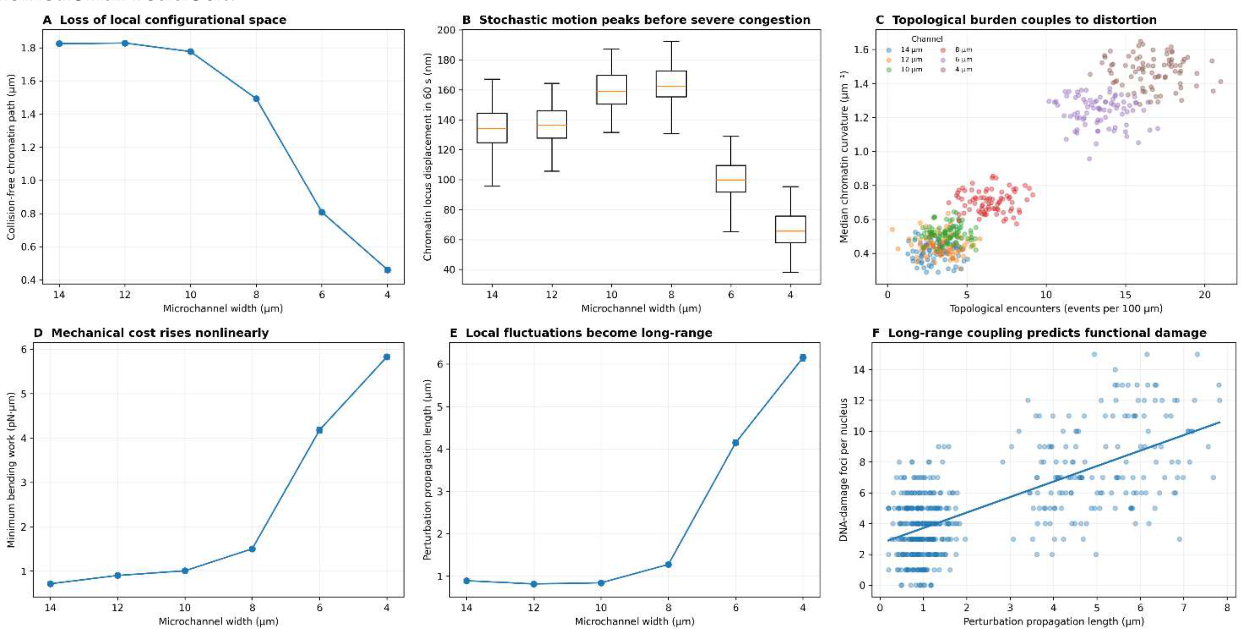
Configurational restriction. Progressive confinement produced marked changes in local configurational freedom while nuclear volume changed comparatively modestly, although differences across confinement conditions were significant by one-way ANOVA (p < 0.001). Collision-free chromatin path length progressively decreased (Fig. A), with a significant overall confinement effect and a significant reduction during the transition from moderate to severe confinement (p < 0.001). Chromatin locus displacement followed a different, non-monotonic trajectory, initially increasing before declining under stronger confinement (Fig. B), with significant differences across conditions (p < 0.001). Topological encounters and median curvature increased with progressive restriction (Fig. C) and were strongly correlated across individual realizations.
Together, these distributions identify a configurational transition in which declining collision-free path length coincided with reversal of stochastic mobility and increasing topological and geometric restriction.
Mechanical coupling. Increasing restriction was associated with nonlinear changes in mechanical and collective variables. Minimum bending work increased with confinement (Fig. D), with significant differences among conditions and across the transition from moderate to severe confinement (p < 0.001). Collision-free path length and bending work were strongly inversely associated across individual realizations (p < 0.001). Perturbation propagation length also increased markedly under stronger confinement (Fig. E), with a significant overall confinement effect and an inverse association with collision-free path length (p < 0.001). DNA-damage burden increased across confinement conditions and correlated positively with perturbation propagation length (p < 0.001) (Fig. F).
Together, these realization-level relationships connect decreasing geometric freedom with increasing mechanical expenditure and the extension of perturbation coupling from predominantly local responses toward larger nuclear regions.
Our results show that simulated chromatin congestion was characterized by coordinated rather than uniform responses to confinement. Stochastic mobility initially increased and subsequently declined, whereas topological encounters, curvature, mechanical work and perturbation range increased as collision-free configurational space contracted. The strongest changes occurred across the transition from moderate to severe confinement. The association between perturbation propagation and damage burden further links the modeled loss of local configurational independence with our functional readout.
Figure 1.
Geometric, topological, stochastic, mechanical and functional signatures of chromatin congestion. The simulation examines the progressive response of chromatin to nuclear confinement using 80 stochastic realizations at microchannel widths of 14, 12, 10, 8, 6 and 4 µm. (A) Collision-free chromatin path length, expressed in micrometres, decreases with progressive confinement. It represents the characteristic distance over which a chromatin segment can extend before encountering a spatial or configurational constraint, providing a geometric measure of the progressive loss of locally accessible configurations. (B) Chromatin locus displacement over 60 s, expressed in nanometres, shows a non-monotonic response to confinement. Initially, moderate restriction increases displacement, consistent with stochastic exploration of alternative spatial configurations, whereas severe confinement suppresses this mobility as accessible alternatives become progressively exhausted. Boxplots show the distributions across simulated realizations. (C) Relationship between topological encounters, expressed as events per 100 µm of chromatin centreline and median local chromatin curvature, expressed in µm−1. Each point represents one simulated nucleus, with confinement conditions identified according to microchannel width. Increasing confinement shifts configurations toward greater topological encounter frequency and larger curvature, representing the conversion of spatial restriction into topologically constrained geometric deformation. (D) Minimum coarse-grained bending work required to maintain the chromatin configuration, expressed in pN·µm, increases nonlinearly with progressive confinement. Mechanical requirements are comparatively limited under weak and moderate restriction, but increase markedly at the narrowest microchannel widths as low-cost configurations become less accessible. (E) Perturbation propagation length, expressed in micrometres, measures the spatial extent over which a local chromatin displacement affects surrounding chromatin regions. Although perturbations are predominantly local under weak confinement, they propagate over progressively larger nuclear distances as confinement increases, representing increasing collective coupling among chromatin regions when alternative configurations become restricted. (F) Relationship between perturbation propagation length, expressed in micrometres and DNA-damage foci per nucleus. Each point represents one simulated realization and the fitted trend describes the association between the spatial propagation of chromatin disturbances and simulated damage burden. Configurations characterized by short-range perturbations display fewer DNA-damage foci, whereas increasingly long-range propagation is associated with a greater number of foci. Error bars in panels showing mean responses represent the standard error across the 80 stochastic realizations performed for each confinement condition.
Conclusions
We asked whether chromatin congestion can be described as a loss of accessible spatial configurations rather than solely as an increase in chromatin density or compaction and whether geometric restriction can become coupled to topological, mechanical and stochastic changes. Our simulations compared nuclei distributed across progressively narrower confinement conditions, while maintaining approximately stable chromatin content and nuclear volume. We found that collision-free path length progressively decreased, whereas chromatin motion showed a non-monotonic response, increasing under moderate confinement before declining sharply under stronger restriction. The transition from moderate to severe confinement was characterized by pronounced increases in topological encounters, curvature, minimum bending work and perturbation propagation length. Still, longer propagation distances were associated with greater simulated DNA-damage burden. Within the assumptions of our model, these findings are consistent with a transition from predominantly local accommodation of spatial restriction to increasingly collective responses when the available configurations become restricted.
Our approach differs from established methods primarily in what aspect of genome organization is quantified. Hi-C and Micro-C measure contact probabilities but do not determine how many alternative spatial arrangements are physically accessible (Krietenstein et al. 2020; Jerkovic and Cavalli 2021; Liu, Zhu, and Wang 2024; Yang and Hansen 2024; Zhu, Liu, and Wang 2024). Chromosome tracing and super-resolution microscopy reconstruct realized spatial relationships but do not quantify the configurations excluded by nuclear geometry (Nir et al. 2018; Rajpurkar et al. 2021; Hafner et al. 2023; Lacen and Lee 2024). Polymer simulations describe possible chain conformations, whereas molecular-dynamics and coarse-grained models examine how specified interactions and physical parameters generate particular structural behaviors. In contrast, we focus on the progressive reduction of the configurational possibilities available to chromatin as nuclear space becomes restricted. Rather than considering geometry, topology, stochastic motion and mechanics separately, we examine how spatial competition, topological obstruction, configurational exploration and mechanical cost change together during the same confinement process. Thus, established approaches primarily characterize observed or simulated chromatin structures and the mechanisms producing them, whereas our analysis asks a complementary question: how progressively restrictive nuclear geometry reduces the range of alternative physically admissible chromatin configurations and changes the capacity of the genome to accommodate further spatial perturbations.
Our study has limitations. Our simulations are hypothesis-generating rather than reconstructions of experimental nuclei and model coefficients were not estimated from biological measurements. Absolute values and apparent confinement thresholds should not be interpreted as experimentally established. Because several variables depend on confinement, some correlations may arise from this shared determinant rather than direct causal interactions. Topological encounters, bending work and perturbation propagation were represented by coarse-grained quantities rather than explicit topological invariants, experimentally measured chromatin mechanics or spectral influence matrices. The damage model excludes repair kinetics, cell-cycle state and chromatin composition. We did not examine DNA without nuclear enclosure, leaving unresolved which predicted behaviors specifically depend on the nuclear boundary. Whether congestion has a reproducible critical regime, is reversible or depends on the mechanism of confinement is not tackled. Negative dependence, entropy-based ensembles and log-concavity were used as mathematical interpretations rather than directly measured properties of the simulated chromatin. Finally, our coarse-grained polymer description does not explicitly include topological friction, which can generate heterogeneous and subdiffusive polymer dynamics (Wang et al. 2026), or cooperative mechanisms capable of producing long-range extended polymer configurations (Chen et al. 2026).
Our approach suggests experimentally testable hypotheses. First, progressive confinement should produce a non-monotonic mobility response rather than a simple decrease: in our simulation, mean 60-second locus displacement increased from approximately 135 nm at 14 micrometres to approximately 164 nm at 8 micrometres before falling below 100 nm at 6 micrometres. Live-cell tracking across graded microchannels could test both the existence and position of this maximum.
Second, geometric restriction should change more strongly than nuclear volume. Between the widest and narrowest conditions, the simulated collision-free path decreased by approximately 75 percent, while mean nuclear volume changed by only about 3 percent. Three-dimensional chromosome tracing could determine whether an analogous disproportion exists experimentally.
Third, mechanical cost should exhibit nonlinear rather than proportional scaling with confinement: simulated bending work increased approximately fourfold between 8 and 6 micrometres despite only a 25 percent reduction in channel width. Measurements combining controlled confinement with chromatin curvature and nuclear force measurements could examine this scaling.
Fourth, the spatial influence of a local perturbation should expand sharply near severe congestion; simulated propagation increased from approximately 1.3 micrometres at 8 micrometres to approximately 4.1 micrometres at 6 micrometres. Targeted chromatin displacement followed by high-speed imaging could directly estimate this length.
Fifth, nuclei matched for DNA content and similar nuclear volume should display different damage burdens when perturbation propagation differs; in our simulation, propagation length and damage-foci number showed a correlation of approximately 0.69.
Future empirical research should replace prescribed distributions with parameters inferred from imaging, micromechanical measurements and chromosome-conformation data. Still, spatially resolved polymer simulations could explicitly calculate entanglement, curvature, forces and influence matrices and determine whether a critical transition persists without imposing its functional form.
Practical applications would depend on experimental validation of these predictions. A congestion-based description could complement conventional nuclear phenotyping by providing measurements sensitive to the capacity of chromatin to reorganize under imposed deformation. These measurements could be incorporated into microfluidic assays of cells undergoing narrow-pore migration, where nuclear passage can be monitored together with chromatin dynamics and subsequent recovery. The same principle could support comparisons of cells exposed to mechanical compression, altered extracellular stiffness or pharmacological manipulation of chromosome-organizing proteins. In screening experiments, interventions could be ranked according to their effects on configurational mobility and recovery trajectories rather than exclusively according to static nuclear morphology. Congestion-related measurements could also be incorporated into image-analysis pipelines combining nuclear shape, locus trajectories, chromosome tracing and damage markers at single-cell resolution, allowing heterogeneous cell populations to be stratified according to their response to controlled mechanical challenges.
In conclusion, we introduced the concept of chromatin congestion as the progressive restriction of configurations available to the genome under nuclear confinement. Our simulations connect this loss of configurational freedom with changes in chromatin mobility, topology, mechanical cost and perturbation propagation. Our quantifiable predictions provide a basis for testing whether congestion stands for a distinct organizational property of the three-dimensional genome.
Author Contributions
The Author performed: study concept and design, acquisition of data, analysis and interpretation of data, drafting of the manuscript, critical revision of the manuscript for important intellectual content, statistical analysis, obtained funding, administrative, technical and material support, study supervision.
Funding
This research did not receive any specific grant from funding agencies in the public, commercial or not-for-profit sectors.
Institutional Review Board Statement
Ethics approval statement is not applicable. This research does not contain any studies with human participants or animals performed by the Author.
Informed Consent Statement
The Author transfers all copyright ownership, in the event the work is published. The undersigned author warrants that the article is original, does not infringe on any copyright or other proprietary right of any third part, is not under consideration by another journal and has not been previously published.
Data Availability Statement
All data and materials generated or analyzed during this study are included in the manuscript. The Author had full access to all the data in the study and took responsibility for the integrity of the data and the accuracy of the data analysis.
Acknowledgments
none. During the preparation of this work, the author used ChatGPT 5.3 to assist with data analysis and manuscript drafting and to improve spelling, grammar and general editing. After using this tool, the author reviewed and edited the content as needed, taking full responsibility for the content of the publication.
Conflicts of Interest
The Author does not have any known or potential conflict of interest including any financial, personal or other relationships with other people or organizations within three years of beginning the submitted work that could inappropriately influence or be perceived to influence their work. The views expressed are those of the author and do not necessarily reflect those of the affiliated institutions.
References
- Agarwal, Siddharth; Klocke, Melissa A.; Pungchai, Passa E.; Franco, Elisa. Dynamic Self-Assembly of Compartmentalized DNA Nanotubes. Nat. Commun. 2021, 12, 3557. [Google Scholar] [CrossRef]
- Anari, Nima; Liu, Kuikui; Gharan, Shayan Oveis. Spectral Independence in High-Dimensional Expanders and Applications to the Hardcore Model. arXiv 2001.00303. 2020. [Google Scholar] [CrossRef]
- Anari, Nima; Gharan, Shayan Oveis. The Kadison-Singer Problem for Strongly Rayleigh Measures and Applications to Asymmetric TSP. arXiv 2015, arXiv:1412.1143. [Google Scholar] [CrossRef]
- Anari, Nima; Gharan, Shayan Oveis; Vinzant, Cynthia. Log-Concave Polynomials I: Entropy and a Deterministic Approximation Algorithm for Counting Bases of Matroids. 2018 IEEE 59th Annual Symposium on Foundations of Computer Science (FOCS), 2018. [Google Scholar]
- Bakker, Benjamin; Brunebarbe, Yohan; Tsimerman, Jacob. o-Minimal GAGA and a Conjecture of Griffiths. arXiv 2022, arXiv:1811.12230. [Google Scholar] [CrossRef]
- Bakker, Benjamin; Grimm, Thomas W.; Schnell, Christian; Tsimerman, Jacob. Finiteness for Self-Dual Classes in Integral Variations of Hodge Structure. Épijournal de Géométrie Algébrique, Special Volume in Honour of Claire Voisin 2023. [Google Scholar] [CrossRef]
- Beel, Andrew J.; Matteï, Pierre-Jean; Kornberg, Roger D. The Eukaryote Chromosome, a Two-State System with Interconversion by a Volume Phase Transition. Science 2026, 393(6812). [Google Scholar] [CrossRef]
- Borcea, Julius; Brändén, Petter; Liggett, Thomas M. Negative Dependence and the Geometry of Polynomials. J. Am. Math. Soc. 2009, 22, 521–567. [Google Scholar] [CrossRef]
- Chen, Min; Wang, Dongyang; Zou, Ye; Chen, Changsheng; Yang, Xixian; et al. Long-Range Extended Chains Arising from Polymerization-Driven Spontaneous Assembly. Science 2026, 393(6807), 172–177. [Google Scholar] [CrossRef]
- Crosetto, Nicola; Bienko, Magda. Radial Organization in the Mammalian Nucleus. Front. Genet. 2020, 11, 33. [Google Scholar] [CrossRef]
- Deng, Yu. Two-Dimensional Nonlinear Schrödinger Equation with Random Radial Data. Anal. PDE 2012, 5(5), 913–960. [Google Scholar] [CrossRef]
- Deng, Yu; Hani, Zaher. On the Derivation of the Wave Kinetic Equation for NLS. Forum Math. 2021, Pi 9, e6. [Google Scholar] [CrossRef]
- Deng, Yu; Hani, Zaher. Full Derivation of the Wave Kinetic Equation. Invent. Math. 2024a, 237, 1015–1141. [Google Scholar] [CrossRef]
- Deng, Yu; Hani, Zaher. Long Time Justification of Wave Turbulence Theory. arXiv 2024b, arXiv:2311.10082. [Google Scholar]
- Deng, Yu andrea R.; Nahmod; Yue, Haitian. Random Tensors, Propagation of Randomness and Nonlinear Dispersive Equations. Invent. Math. 2022, 228, 539–686. [Google Scholar] [CrossRef]
- Deng, Yu andrea R.; Nahmod; Yue, Haitian. Invariant Gibbs Measures and Global Strong Solutions for Nonlinear Schrödinger Equations in Dimension Two. Ann. Math. 2024, 200(2), 399–486. [Google Scholar] [CrossRef]
- Grant, Zoe L.; Kuang, Shuzhen; Zhang, Shu; Horrillo, Abraham J.; Chen, Zhe; et al. Dose-Dependent Sensitivity of Human Three-Dimensional Chromatin to a Heart Disease-Linked Transcription Factor. Science 2026, 393(6809). [Google Scholar] [CrossRef]
- Guth, Larry; Solomon, Noam; Wang, Hong. Incidence Estimates for Well Spaced Tubes. Geom. Funct. Anal. 2019, 29, 1844–1863. [Google Scholar] [CrossRef]
- Hafner, A.; Park, M.; Berger, S. E.; Murphy, S. E.; Nora, E. P.; Boettiger, A. N. Loop Stacking Organizes Genome Folding from TADs to Chromosomes. Mol. Cell 2023, 83(9), 1377–1392.e6. [Google Scholar] [CrossRef]
- Jerkovic, I.; Cavalli, G. Understanding 3D Genome Organization by Multidisciplinary Methods. Nat. Rev. Mol. Cell Biol. 2021, 22(8), 511–28. [Google Scholar] [CrossRef]
- Krietenstein, N.; Abraham, S.; Venev, S. V.; Abdennur, N.; Gibcus, J.; Hsieh, T. S.; Parsi, K. M.; et al. Ultrastructural Details of Mammalian Chromosome Architecture. Mol. Cell 2020, 78(3), 554–565.e7. [Google Scholar] [CrossRef]
- Lacen, A. N.; Lee, H. T. Tracing the Chromatin: From 3C to Live-Cell Imaging. Chem. Biomed. Imaging 2024, 2(10), 659–82. [Google Scholar] [CrossRef]
- Liu, T.; Zhu, H.; Wang, Z. Learning Micro-C from Hi-C with Diffusion Models. PLoS Comput. Biol. 2024, 20(5), e1012136. [Google Scholar] [CrossRef]
- Nir, G.; Farabella, I.; Pérez Estrada, C.; Ebeling, C. G.; Beliveau, B. J.; Sasaki, H. M.; Lee, S. D.; et al. Walking along Chromosomes with Super-Resolution Imaging, Contact Maps, and Integrative Modeling. PLoS Genet. 2018, 14(12), e1007872. [Google Scholar] [CrossRef]
- Gharan, Oveis; Shayan; Saberi, Amin; Singh, Mohit. A Randomized Rounding Approach to the Traveling Salesman Problem. 2011 IEEE 52nd Annual Symposium on Foundations of Computer Science, 2011. [Google Scholar]
- Pardon, John. On the Distortion of Knots on Embedded Surfaces. Ann. Math. 2011, 174(1), 637–646. [Google Scholar] [CrossRef]
- Patta, Indumathi; Zand, Maryam; Lee, Lindsay; Mishra, Shreya; Bortnick, Alexandra; et al. Nuclear Morphology Is Shaped by Loop-Extrusion Programs. Nature 2024, 627, 196–203. [Google Scholar] [CrossRef]
- Pulupa, Joan; McArthur, Natalie G.; Stathi, Olga; Wang, Miao; Zazhytska, Marianna; et al. Solid Phase Transitions as a Solution to the Genome Folding Paradox. Nature 2025, 643, 820–829. [Google Scholar] [CrossRef]
- Rajpurkar, A. R.; Mateo, L. J.; Murphy, S. E.; Boettiger, A. N. Deep Learning Connects DNA Traces to Transcription to Reveal Predictive Features beyond Enhancer-Promoter Contact. Nat. Commun. 2021, 12(1), 3423. [Google Scholar] [CrossRef]
- Soman, Aghil; Wong, Sook Yi; Korolev, Nikolay; Surya, Wahyu; Lattmann, Simon; et al. Columnar Structure of Human Telomeric Chromatin. Nature 2022, 609, 1048–1055. [Google Scholar] [CrossRef]
- Yang, J. H.; Hansen, A. S. Enhancer Selectivity in Space and Time: From Enhancer-Promoter Interactions to Promoter Activation. Nat. Rev. Mol. Cell Biol. 2024, 25(7), 574–91. [Google Scholar] [CrossRef]
- Wang, Hong; Zahl, Joshua. Volume Estimates for Unions of Convex Sets and the Kakeya Set Conjecture in Three Dimensions. arXiv 2025, arXiv:2502.17655. [Google Scholar] [CrossRef]
- Wang, Zhenhua; Lu, Yuyuan; An, Lijia; Wang, Zhen-Gang. Topological Friction: Insight from Dynamics of a Test Chain in a Fixed-Topology Polymer Network. Phys. Rev. Lett. 2026, 136, 248101. [Google Scholar] [CrossRef]
- Zenk, Fides; Zhan, Yinxiu; Kos, Pavel; Löser, Eva; Atinbayeva, Nazerke; et al. HP1 Drives De Novo 3D Genome Reorganization in Early Drosophila Embryos. Nature 2021, 593, 289–293. [Google Scholar] [CrossRef]
- Zheng, Hui; Xie, Wei. The Role of 3D Genome Organization in Development and Cell Differentiation. Nat. Rev. Mol. Cell Biol. 2019, 20, 535–550. [Google Scholar] [CrossRef]
- Zhou, Huabin; Huertas, Jan; Maristany, M. Julia; Russell, Kieran; Hwang, June Ho; et al. Multiscale Structure of Chromatin Condensates Explains Phase Separation and Material Properties. Science 2025, 390(6777). [Google Scholar] [CrossRef]
- Zhu, H.; Liu, T.; Wang, Z. C2c: Predicting Micro-C from Hi-C. Genes 2024, 15(6), 673. [Google Scholar] [CrossRef]
Disclaimer/Publisher’s Note: The statements, opinions and data contained in all publications are solely those of the individual author(s) and contributor(s) and not of MDPI and/or the editor(s). MDPI and/or the editor(s) disclaim responsibility for any injury to people or property resulting from any ideas, methods, instructions or products referred to in the content. |
© 2026 by the author. Licensee MDPI, Basel, Switzerland. This article is an open access article distributed under the terms and conditions of the Creative Commons Attribution (CC BY) license.
Copyright: This open access article is published under a Creative Commons CC BY 4.0 license, which permit the free download, distribution, and reuse, provided that the author and preprint are cited in any reuse.