

Submitted:
23 August 2026
Posted:
24 August 2026
You are already at the latest version
Abstract
TOI-2076 is a young, compact multi-planet system whose orbital architecture places its adjacent planets close to low-order mean-motion commensurabilities. We investigate the dynamical stability and near-resonant behaviour of the system using direct N-body simulations with the REBOUND package and the WHFast symplectic integrator. Three independent realizations, initialized with randomized orbital phases, were integrated for t = 2 ×10⁶ yr using a timestep of Δt = 0.5 days. All three realizations remained stable throughout the simulations, with no planetary ejections or collisions. The eccentricities showed bounded oscillations without clear secular growth, with mean standard deviations of \( {\sigma }_{e_{b}}=0.00382, {\sigma }_{e_{c}}=0.00329 \), and \( {\sigma }_{e_{d}}=0.00335 \) for TOI-2076 b, c, and d, respectively. The nominal period ratios are \( \frac{P_{c}}{P_{b}}=1.6577 \) and \( \frac{P_{d}}{P_{c}}=2.0461 \), compared with the exact 5:3 and 2:1 commensurabilities of 1.6667 and 2.0000, respectively. The corresponding resonance angles circulate through the full 0°C–360°C range rather than remaining confined to a bounded libration region, indicating that the simulated configurations remain near-resonant without evidence of resonance locking over the 2 Myr integration. The period ratios also remain nearly constant throughout the simulations, with no systematic evolution toward exact commensurability. Overall, the results show that the adopted TOI-2076 configuration remains dynamically stable over the simulated interval while maintaining a near-resonant, non-librating orbital architecture. These results provide a numerical baseline for future studies using longer integrations and a broader exploration of uncertainties in the planetary orbital and physical parameters.
Keywords:
exoplanets
; multi-planet systems
; orbital dynamics
; N-body simulations
; mean-motion resonance
; TOI-2076
; celestial mechanics
1. Introduction
Compact multi-planet systems provide valuable laboratories for investigating planetary formation, orbital evolution, and long-term dynamical stability. When several planets occupy relatively closely spaced orbits, their mutual gravitational interactions can produce measurable departures from purely Keplerian motion and can place adjacent planets close to mean-motion resonances (MMRs). Such configurations are particularly useful for studying resonance capture, resonance breaking, and subsequent orbital divergence, which can provide information about the dynamical history of planetary systems (Fabrycky et al., 2014; Lithwick & Wu, 2012). TOI-2076 is a young planetary system orbiting a nearby K-type star that was identified through observations from the Transiting Exoplanet Survey Satellite (TESS), followed by photometric and spectroscopic follow-up observations (Hedges et al., 2021; Osborn et al., 2022). Subsequent observations have further improved the characterization of its planetary architecture (Damasso et al., 2024; Barber et al., 2025). The system contains multiple transiting planets, with TOI-2076 b, c, and d forming an outer planetary configuration of particular interest for dynamical studies. The orbital solution adopted in the present analysis gives periods of approximately 10.36, 17.17, and 35.12 days for planets b, c, and d, respectively (Osborn et al., 2022). The proximity of these orbital periods to low-order mean-motion commensurabilities makes the system dynamically interesting. In particular, the b–c pair lies close to the 5:3 commensurability, while the c–d pair lies close to the 2:1 commensurability. These relationships can be expressed through the period-ratio offsets
and
For the adopted orbital periods, these ratios indicate that the planetary pairs are close to, but not exactly at, the corresponding commensurabilities. However, proximity to an exact period ratio alone does not establish the existence of a dynamical resonance. A resonant configuration is more appropriately identified through the behaviour of its critical resonant angles. In a dynamically resonant system, the relevant critical angle remains confined to a bounded interval and undergoes libration, whereas circulation through the full angular range is characteristic of a non-resonant or near-resonant configuration (Murray & Dermott, 1999). This distinction is important because systems that are close to resonance but are not currently resonance-locked can preserve signatures of previous dynamical interactions. Statistical studies of multi-planet systems have identified an excess of planetary pairs close to, but slightly offset from, exact low-order resonances, while theoretical work has shown that dissipative processes can drive planets away from exact commensurability following resonant interaction (Fabrycky et al., 2014; Lithwick & Wu, 2012). Previous observational studies have established TOI-2076 as a young multi-planetary system and have progressively refined its orbital and physical characterization (Hedges et al., 2021; Osborn et al., 2022; Damasso et al., 2024; Barber et al., 2025). These studies provide the observational foundation for examining the dynamical behaviour of the system. Consequently, the relevant question is not simply whether the planetary periods are numerically close to 5:3 and 2:1, but whether the corresponding resonant angles exhibit libration or circulation and whether the resulting behaviour remains consistent when the initial orbital phases are varied. Direct N-body integration provides a suitable approach for addressing this question because the mutual gravitational interactions among the planets are explicitly propagated throughout the integration. Repeating the integrations with different initial mean anomalies allows the robustness of the resulting orbital behaviour to be assessed across independent realizations. Such an approach provides a numerical baseline for subsequent investigations involving larger ensembles, observational uncertainties, and substantially longer integration times. In this study, we investigate the dynamical behaviour of the adopted TOI-2076 b–c–d configuration using direct N-body simulations with the REBOUND package and the WHFast symplectic integrator (Rein & Liu, 2012; Rein & Tamayo, 2015). Three independent realizations with randomized initial orbital phases are evolved for using a timestep of 0.5 days. We examine the evolution of the orbital elements, period ratios, and critical resonant angles to assess the dynamical stability of the system and determine whether the near-5:3 and near-2:1 configuration exhibit libration or circulation. The objective is to provide a direct numerical assessment of the stability and phase-dependent dynamical behaviour of the adopted configuration over the simulated interval.
2. Methods
2.1. N-Body Integration
The TOI-2076 planetary system was simulated using REBOUND, an open-source N-body integration package widely used for gravitational dynamics (Rein & Liu, 2012). The integrations were performed using the WHFast symplectic integrator (Rein & Tamayo, 2015), which implements the Wisdom–Holman approach for efficient long-term integration of planetary systems (Wisdom & Holman, 1991). The simulations were performed in units of years, astronomical units, and solar masses. A fixed timestep of 0.5 days was adopted. This corresponds to approximately 1/20 of the orbital period of the innermost planet and therefore provides multiple integration steps per orbital cycle while maintaining computational efficiency. The initial orbital parameters of the three planets and the host star were taken from the adopted orbital solution of Osborn et al. (2022). For each planet , the initial state was specified by its mass , semi-major axis , eccentricity , inclination , longitude of ascending node , argument of pericenter , and mean anomaly . Because the present analysis focuses on the robustness of the dynamical behaviour to orbital phase, three independent realizations were generated. For each realization, the initial mean anomaly was independently sampled from a uniform distribution,
for each planet. The remaining adopted orbital parameters were kept fixed. This procedure allows the influence of the initial orbital phase to be examined without changing the underlying planetary architecture.
Each realization was integrated forward for
2.2. Period-Ratio Analysis
The proximity of adjacent planetary pairs to the 5:3 and 2:1 mean-motion commensurabilities was quantified using the instantaneous period ratios
and
The nominal resonant values are
and
The temporal evolution of and was monitored throughout each integration to determine whether the system remained near the nominal commensurabilities or developed significant departures during the simulated interval.
2.3. Resonance-Angle Analysis
Period-ratio proximity alone cannot establish resonant locking. The dynamical state of each planetary pair was therefore assessed through the evolution of the corresponding critical resonant angle (Murray & Dermott, 1999).
For the b–c pair near the 5:3 commensurability, the resonant angle was defined as
where denotes mean longitude and denotes longitude of pericenter.
For the c–d pair near the 2:1 commensurability, the resonant angle was defined as
The angles were evaluated modulo ,
The dynamical interpretation was based on the temporal behaviour of these angles. Libration corresponds to confinement of a resonant angle within a bounded angular interval, whereas circulation corresponds to repeated passage through the full range. Libration is therefore taken as evidence for resonant locking, while circulation indicates that the corresponding near-commensurability is not dynamically locked over the simulated interval (Murray & Dermott, 1999).
2.4. Dynamical-Stability Assessment
Dynamical stability was assessed using complementary orbital and numerical criteria. First, each realization was monitored for planetary escape, ejection, or collision during the integration. A realization was considered numerically surviving when all three planets remained within the simulated planetary system throughout the -year integration. Second, the temporal evolution of the orbital elements was examined. In particular, the eccentricity and inclination histories of all three planets were monitored for unbounded growth or large secular excitation. The maximum eccentricity reached by each planet was calculated as
while the standard deviation of the eccentricity was calculated as
These quantities were used to characterize the amplitude of the eccentricity variations across each realization.
Similarly, the inclination evolution was monitored to identify any systematic secular increase. The absence of escape or collision together with bounded eccentricity and inclination variations was interpreted as evidence of dynamical stability over the simulated -year interval, rather than as proof of stability over the full estimated age of the system. The adopted system parameters are listed in Table 1 (Osborn et al., 2022), and the resulting orbital evolution is shown in Figure 1.
3. Results
3.1. Orbital Stability
All three planets remained bound and dynamically stable throughout the full 2 × 10⁶ yr integration in every one of the three realizations, with no ejections or collisions recorded by REBOUND's escape-detection routine. Semi-major axes remained essentially constant for all three planets over the full integration span (Figure 1a), as expected for a well-separated, non-migrating system. Eccentricities oscillated within small, bounded ranges approximately 0.010–0.020 for planets b and c, and 0.020–0.030 for planet d (Figure 1b) with the amplitude and phase of these oscillations consistent across all three realizations. Similarly, inclinations oscillated within a narrow band of roughly 88.6°–89.6° for all three planets (Figure 1c), again without secular drift. Critically, none of the orbital elements show evidence of long-term growth or divergence over the integration timescale, indicating the system is dynamically stable on this timescale rather than undergoing slow chaotic diffusion toward instability.
3.2. Resonance Analysis
To determine whether the near-commensurate period ratios reported by Osborn et al. (2022) reflect genuine mean-motion resonance locking, we tracked the resonance angles and (as defined in Section 2) throughout the integration. In every realization, and for both angles, the resonance angle circulates freely across the full range rather than librating about a fixed value (Figure 2a,b). Circulation of this kind is the classic dynamical signature of a system sitting near, but not trapped in, mean-motion resonance (Murray & Dermott 1999). Because neither angle librates, we conclude that resonant or near-resonant dynamics do not govern the long-term evolution of this system over the timescale probed here consistent with the small-amplitude, non-secular eccentricity oscillations reported in Section 3.1.
This circulation is mirrored in the period ratios themselves, which stay essentially flat throughout the integration and show no sign of drifting toward exact commensurability (Figure 3). The b–c pair settles near
noticeably offset from the exact 5:3 ratio of
while the c–d pair settles near
offset from the exact 2:1 ratio of 2.000. Both ratios display only small, high-frequency scatter consistent with ordinary orbital perturbations rather than any systematic trend reinforcing the picture of a system that sits close to, but is dynamically decoupled from, both commensurabilities.
3.3. Ensemble Robustness
All three independently seeded realizations remained dynamically stable over the full integration span, with peak eccentricities differing by no more than ~0.0007 (roughly 3%) across realizations for any given planet (Figure 4; Table 2). This close agreement across randomized initial orbital phases indicates that the stability and non-resonant behaviour reported above are robust, general properties of the TOI-2076 system's architecture, rather than artifacts arising from a single, arbitrarily chosen orbital-phase realization.
4. Discussion
The results presented here show that TOI-2076 occupies an interesting dynamical position: both adjacent planet pairs lie close to low-order mean-motion commensurabilities, yet neither pair is dynamically trapped in the corresponding resonance over the simulated interval. The b–c pair has a period ratio of approximately 1.653, close to the 5:3 commensurability, while the c–d pair has a ratio of approximately 2.087, close to 2:1. However, proximity to a commensurability alone does not establish resonance. In the present integrations, the corresponding resonance angles circulate through the full range rather than librating, providing direct dynamical evidence that the two pairs are near-resonant but not resonance-locked. This distinction is important because resonant capture is associated with libration of an appropriate critical resonant angle, whereas a circulating angle indicates that the system is not presently trapped in the tested resonance (Murray & Dermott, 1999; Lithwick & Wu, 2012). The statistical occurrence of near-resonant architectures among compact multi-planet systems further demonstrates that proximity to low-order commensurabilities does not necessarily imply active resonance locking (Fabrycky et al., 2014). The result is particularly relevant because TOI-2076 is a young, compact multi-planet system whose orbital architecture has been established through TESS observations and subsequent photometric and spectroscopic follow-up (Hedges et al., 2021; Osborn et al., 2022). More recent observational studies have further refined the characterization of the system, including constraints from radial-velocity observations and additional follow-up analyses (Damasso et al., 2024; Barber et al., 2025). The system therefore provides a useful case for examining how closely spaced planets can occupy the neighbourhood of important resonances without necessarily being dynamically locked. Our simulations indicate that the adopted present-day architecture remains dynamically stable without requiring an active 5:3 or 2:1 resonance over the -year interval examined here. All three planets remain bound, with bounded variations in their orbital elements and no evidence of secular eccentricity growth across the three independent realizations. Thus, within the limits of the adopted initial conditions and integration interval, the near-resonant architecture is compatible with stable, non-resonant evolution. One possible interpretation is that the planets may have experienced stronger resonant interactions earlier in their evolution and subsequently moved away from exact commensurability. Lithwick and Wu (2012) showed that dissipative evolution can produce divergent displacement from exact period commensurabilities, providing a physical framework for interpreting systems that lie close to, but outside, resonance. The prevalence of near-resonant configurations in observed multi-planet systems also supports the broader relevance of such evolutionary pathways (Fabrycky et al., 2014). In this context, the approximately 0.8% offset of the b–c pair from 5:3 and the approximately 4.4% offset of the c–d pair from 2:1 place TOI-2076 within the broader class of systems that reside near, but are not necessarily captured into, low-order mean-motion resonances. At the same time, the present results do not demonstrate that TOI-2076 previously underwent resonant capture. The current circulation of the resonance angles establishes the dynamical state sampled by the integrations, but it does not uniquely reconstruct the system's past. The planets could have undergone an earlier resonant phase followed by divergent evolution, or they could have reached their present configuration without becoming permanently trapped in resonance. Distinguishing between these possibilities would require modelling the system's evolutionary history rather than integrating only its present-day orbital configuration. We therefore regard the absence of resonance locking as a constraint on the current dynamical architecture rather than as definitive evidence for a particular formation or migration pathway. The observational characterization of TOI-2076 also makes this distinction important. The discovery studies established the three-planet architecture and provided the orbital parameters adopted in the present integrations (Hedges et al., 2021; Osborn et al., 2022), while subsequent work has continued to refine the physical and orbital characterization of the system (Damasso et al., 2024; Barber et al., 2025). Consequently, a dynamical analysis based on one adopted set of planetary parameters should not be interpreted as an exhaustive exploration of the system's allowed phase space. Uncertainties in planetary masses and orbital elements can influence the detailed structure of resonant and secular dynamics. The use of three independent initial mean anomalies in the present study reduces the possibility that the reported qualitative behaviour is solely an artefact of one particular orbital-phase configuration, since all three realizations exhibit the same overall behaviour. Nevertheless, a substantially larger ensemble sampling the observational uncertainties would provide a stronger assessment of the robustness of the non-resonant configuration. A second limitation concerns the integration timescale. The present simulations demonstrate stable orbital behaviour and persistent resonance-angle circulation over years across three independent realizations. This interval is substantial compared with the orbital periods of the planets, but it remains short relative to the estimated age of approximately 300 Myr for the system (Osborn et al., 2022; Barber et al., 2025). Consequently, the present calculations should not be interpreted as proof of stability over the entire lifetime of TOI-2076. Very slow secular evolution or chaotic diffusion, if present, could occur on timescales substantially longer than those sampled here and would not necessarily be detectable within the current integrations. Future work should therefore extend the integrations to at least years and, ideally, use a substantially larger ensemble of initial conditions. In particular, systematic sampling of the uncertainties in planetary masses, eccentricities, and orbital phases would allow the stability and resonance classification to be tested across the observationally permitted parameter space. Such an analysis could determine whether circulation of the 5:3 and 2:1 resonance angles remains a robust property of the system or whether a subset of allowed configurations enters a resonant or weakly chaotic regime. Combining these longer-term N-body calculations with increasingly refined observational constraints on TOI-2076 (Damasso et al., 2024; Barber et al., 2025) would provide a more complete picture of its dynamical history. Overall, the present study establishes a clear dynamical baseline for TOI-2076: the system remains stable over the -year interval tested, while neither the b–c pair at 5:3 nor the c–d pair at 2:1 exhibits resonance-angle libration. The system is therefore best described, within the adopted initial conditions and integration timescale, as near-resonant but not dynamically trapped in either tested commensurability. This result does not by itself determine how the planets formed or migrated, but it provides a quantitative dynamical constraint for future evolutionary models of this young multi-planet system.
5. Conclusion
We have presented a dedicated N-body dynamical and resonance-angle analysis of the TOI-2076 multi-planet system using three independent REBOUND/WHFast realizations integrated over 2 × 10⁶ years. Across all three realizations, the three-planet configuration remained dynamically stable, with bounded, non-secular variations in eccentricity and inclination and no evidence of instability over the simulated interval. Quantitatively, the b–c period ratio is approximately 0.8% wide of the 5:3 commensurability, while the c–d period ratio is approximately 4.4% wide of the 2:1 commensurability. Despite these close period-ratio configurations, the corresponding resonance angles circulate rather than librate in all three realizations, indicating that neither pair is captured in a sustained mean-motion resonance over the 2 Myr integration interval. The system can therefore be characterized as near-resonant but not resonance-locked on the timescale investigated. These results establish a quantitative dynamical baseline for TOI-2076 and provide constraints for future investigations of its orbital evolution. However, the 2 Myr integration represents only a small fraction of the system's estimated ~300 Myr age. Therefore, the present results demonstrate stability over the simulated interval but cannot exclude slower secular evolution or chaotic diffusion on substantially longer timescales. Future work should extend the integrations to 10⁷–10⁸ years, using a larger ensemble of initial conditions and systematic sampling of the uncertainties in planetary masses, eccentricities, and orbital parameters. Such calculations would determine whether the observed near-resonant, non-librating configuration persists over timescales comparable to the system's age and would provide stronger constraints on the long-term dynamical evolution of TOI-2076. Overall, this study establishes that TOI-2076 remains stable over 2 Myr, with the b–c pair approximately 0.8% offset from 5:3, the c–d pair approximately 4.4% offset from 2:1, and circulating resonance angles across all three realizations. These quantitative results provide a clear foundation for future studies of the system's long-term stability and formation history.
Funding
The author received no specific funding or financial support for this research.
Declaration of Conflict of Interest
The author declares that there is no conflict of interest associated with this manuscript.
Declaration on the Use of Artificial Intelligence
Artificial intelligence tools were not used to generate the scientific content, analysis, results, or conclusions of this manuscript. Grammarly was used solely for grammar, spelling, punctuation, and language correction. The author remains fully responsible for the content, interpretation, and conclusions presented in the manuscript.
Appendix A. Pseudocode for the N-Body Stability and Resonance-Analysis Pipeline
The following pseudocode summarizes the numerical procedure used to investigate the long-term orbital evolution and resonance behaviour of the TOI-2076 system. The simulations employ three independent realizations with different initial mean anomalies while retaining the adopted planetary and stellar parameters.
Appendix A.1. Input Parameters and Simulation Configuration
Input: stellar and planetary parameters adopted from the observational characterization.
For the host star,
For each planet , the initial orbital parameters are
where is the orbital period, is the semi-major axis, is the eccentricity, is the inclination, and is the planetary mass.
The numerical configuration is defined as
and
An array containing output times is generated over the interval
Appendix A.2. Initialization of the Output Arrays
For each realization , the following quantities are stored at every output time:
together with the resonance angles
and the instantaneous period ratios
A survival indicator is initialized for each realization as
Appendix A.3. Ensemble Initialization
For each realization,
a unique random seed is assigned to ensure reproducibility while allowing different initial orbital phases.
A new N-body simulation is then created using stellar units and the WHFast symplectic integrator. The central star is inserted with mass , followed by planets b, c, and d.
For each planet, the mean anomaly is randomly sampled according to
The initial orbital state is therefore specified by
where the initial argument of pericenter and longitude of ascending node are set to
After all bodies have been inserted, the simulation is transformed into the center-of-mass frame.
Appendix A.4. Numerical Integration
The system is integrated from
At every output time , the simulation is advanced to using the WHFast integrator.
If an escape or ejection event is detected, the corresponding realization is marked as unsuccessful:
and the integration for that realization is terminated.
For every successful output time, the instantaneous orbital elements are calculated relative to the host star:
together with the mean longitude and longitude of pericenter .
Appendix A.5. Resonance-Angle Calculation
The dynamical state of the two near-commensurable planet pairs is evaluated using resonant critical angles.
For the 5:3 b–c pair, the monitored resonance angle is
where and are the mean longitudes of planets b and c, respectively, and is the longitude of pericenter of planet c.
For the 2:1 c–d pair, the monitored resonance angle is
The resulting angles are stored throughout the integration.
The resonance behaviour is subsequently classified from the temporal evolution of the angles. Continuous bounded oscillation about a preferred angular value is interpreted as libration, whereas repeated circulation through the full angular range is interpreted as circulation.
Appendix A.6. Instantaneous Period-Ratio Calculation
The instantaneous orbital periods are obtained from the simulated orbital states and used to calculate
and
The nominal commensurability values used for comparison are
and
The relative offset from an exact commensurability can be expressed generally as
where is the measured period ratio and is the corresponding exact resonance value.
Appendix A.7. Stability Diagnostics
For each surviving realization, the maximum eccentricity reached by each planet is calculated as
while the standard deviation of eccentricity is calculated as
The mean eccentricity is
These quantities are used to quantify the amplitude of eccentricity variation and to identify any secular growth during the integration.
The nominal period ratios obtained from the adopted literature periods are also calculated:
Appendix A.8. Figure Generation
The post-processing stage produces four principal diagnostic figures.
- Figure 1—Orbital-element evolution: The temporal evolution of is plotted for planets b, c, and d, with the surviving realizations overlaid.
- Figure 2—Resonance-angle evolution: The two resonance angles, and , are plotted for all realizations. Because the angles are defined modulo , wrapped angular trajectories are displayed accordingly.
- Figure 3—Period-ratio evolution: The temporal evolution of and is plotted together with horizontal reference levels corresponding to and , respectively.
- Figure 4—Maximum eccentricity: The maximum eccentricity is summarized for each planet and realization to facilitate comparison of the dynamical response among the three simulations.
Appendix A.9. Pipeline Summary
The complete computational sequence can therefore be summarized as:
followed by
References
- Barber, M. G.; Mann, A. W.; Vanderburg, A.; Boyle, A. W.; Lopez Murillo, A. I. TESS Investigation—Demographics of Young Exoplanets (TI-DYE). III. An Inner Super-Earth in TOI 2076. The Astronomical Journal 2025, 170(1), 32. [Google Scholar] [CrossRef]
- Bonfanti, A.; Gandolfi, D.; Hedges, C.; Leleu, A.; Fortier, A.; Futyan, D.; Walton, N. Uncovering the true periods of the young sub-Neptunes orbiting TOI-2076. Astronomy & Astrophysics 664. [CrossRef]
- Damasso, M.; Locci, D.; Benatti, S.; Maggio, A.; Baratella, M.; Desidera, S.; Zingales, T. The GAPS Programme at TNG: LIX. Characterisation study of the∼ 300 Myr-old multi-planetary system orbiting the star BD+ 40 2790 (TOI-2076). Astronomy & Astrophysics 2024, 690, A235. [Google Scholar]
- Fabrycky, D. C.; Lissauer, J. J.; Ragozzine, D.; Rowe, J. F.; Steffen, J. H.; Agol, E.; Van Cleve, J. Architecture of Kepler's multi-transiting systems. II. New investigations with twice as many candidates. The Astrophysical Journal 2014, 790(2), 146. [Google Scholar] [CrossRef]
- Gaidos, E.; Hirano, T.; Lee, R. A.; Harakawa, H.; Hodapp, K.; Jacobson, S.; Vievard, S. Planet (esimal) s around stars with TESS (PAST) III: A search for triplet He I in the atmospheres of two 200 Myr-old planets. Monthly Notices of the Royal Astronomical Society 2023, 518(3), 3777–3783. [Google Scholar] [CrossRef]
- Hedges, C.; Hughes, A.; Zhou, G.; David, T. J.; Becker, J.; Giacalone, S.; Smith, J. C. TOI-2076 and TOI-1807: two young, comoving planetary systems within 50 pc identified by TESS that are ideal candidates for further follow up. The Astronomical Journal 2021, 162(2), 54. [Google Scholar] [CrossRef]
- Howard, A. W. Transiting Exoplanet Survey Satellite; 2014. [Google Scholar]
- Hu, Z.; Dai, F.; Zhu, W.; Wang, M. T.; Goldberg, M.; Lammers, C.; Masuda, K. Unexpected near-resonant and metastable states of young multiplanet systems. The Astrophysical Journal 2025, 995(2), 206. [Google Scholar] [CrossRef]
- Karkadakattil, Aswin. “Spectral-Type Dependence of Habitable Zone Classification Differences in Confirmed Exoplanets: A Systematic Comparison of Temperature-Dependent and Constant-Flux Models”. International Astronomy and Astrophysics Research Journal 2026, 8(1), 66–79. [Google Scholar] [CrossRef]
- Lithwick, Y.; Wu, Y. Resonant repulsion of Kepler planet pairs. The Astrophysical Journal Letters 2012, 756(1), L11. [Google Scholar] [CrossRef]
- Murray, C. D.; Dermott, S. F. Solar system dynamics; Cambridge university press: Cambridge, 1999; Vol. 592. [Google Scholar]
- Pelletier, S.; Benneke, B.; Darveau-Bernier, A.; Boucher, A.; Cook, N. J.; Piaulet, C.; Vandal, T. Where is the water? Jupiter-like C/H ratio but strong H2O depletion found on τ Boötis b using SPIRou. The Astronomical Journal 2021, 162(2), 73. [Google Scholar] [CrossRef]
- Rein, H.; Liu, S. F. REBOUND: an open-source multi-purpose N-body code for collisional dynamics. Astronomy & Astrophysics 2012, 537, A128. [Google Scholar] [CrossRef]
- Rein, H.; Tamayo, D. WHFAST: a fast and unbiased implementation of a symplectic Wisdom–Holman integrator for long-term gravitational simulations. Monthly Notices of the Royal Astronomical Society 2015, 452(1), 376–388. [Google Scholar] [CrossRef]
- Wisdom, J.; Holman, M. Symplectic maps for the n-body problem. Astronomical Journal (ISSN 0004-6256) 102, 1528-1538.. 1991, vol. 102, 1528–1538. [Google Scholar] [CrossRef] [PubMed]
Figure 1.
Time evolution of orbital elements for TOI-2076 b, c, and d over the 2 × 10⁶ yr integration, shown for Realization 1 (solid lines) with the remaining two realizations overlaid (faint lines) for comparison. (a) Semi-major axis (AU); (b) eccentricity; (c) inclination (deg).
Figure 1.
Time evolution of orbital elements for TOI-2076 b, c, and d over the 2 × 10⁶ yr integration, shown for Realization 1 (solid lines) with the remaining two realizations overlaid (faint lines) for comparison. (a) Semi-major axis (AU); (b) eccentricity; (c) inclination (deg).
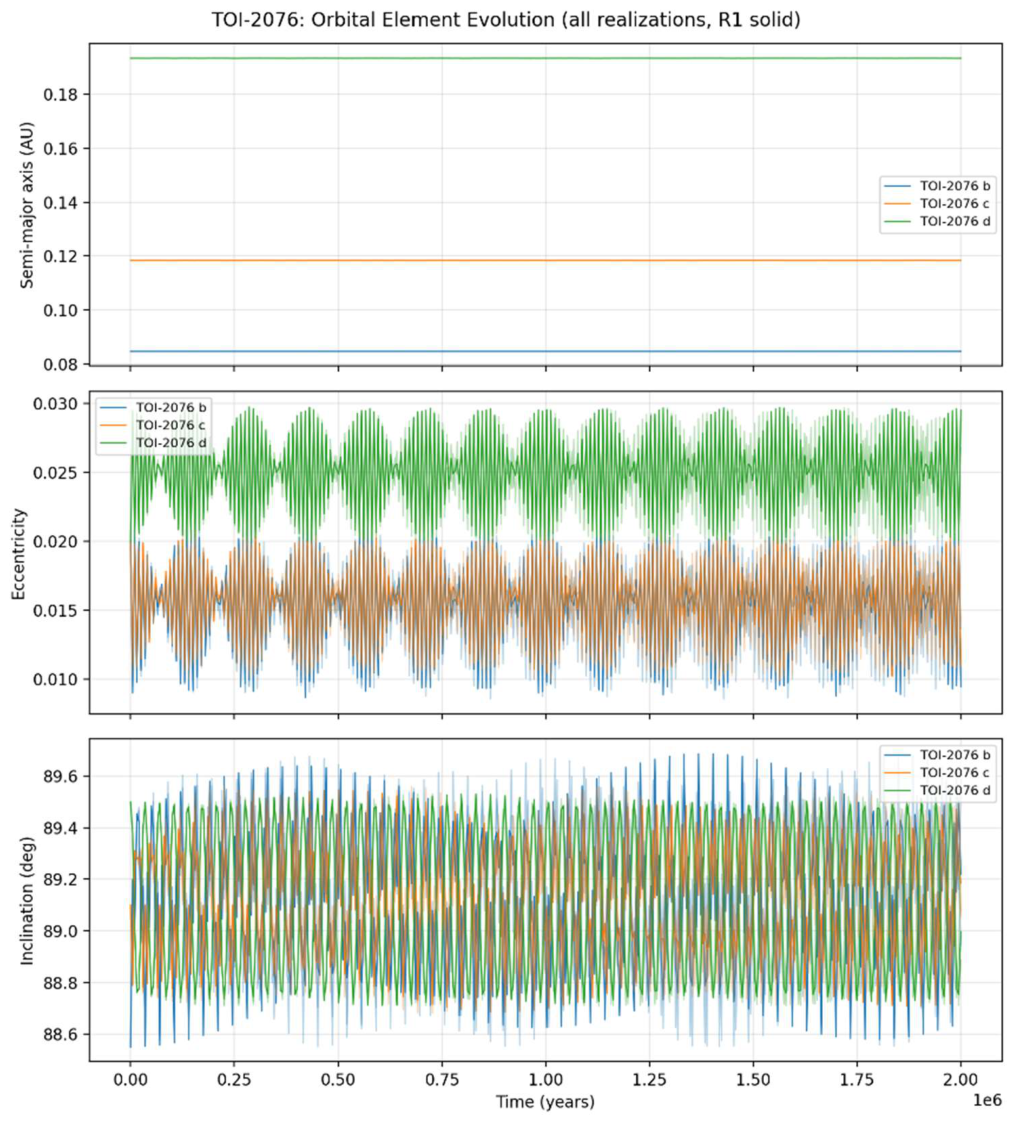
Figure 2.
Resonance angle evolution across all three realizations (distinguished by colour) over the integration. (a) , the resonance angle for the b–c planet pair near the 5:3 commensurability; (b) , the resonance angle for the c–d planet pair near the 2:1 commensurability.
Figure 2.
Resonance angle evolution across all three realizations (distinguished by colour) over the integration. (a) , the resonance angle for the b–c planet pair near the 5:3 commensurability; (b) , the resonance angle for the c–d planet pair near the 2:1 commensurability.
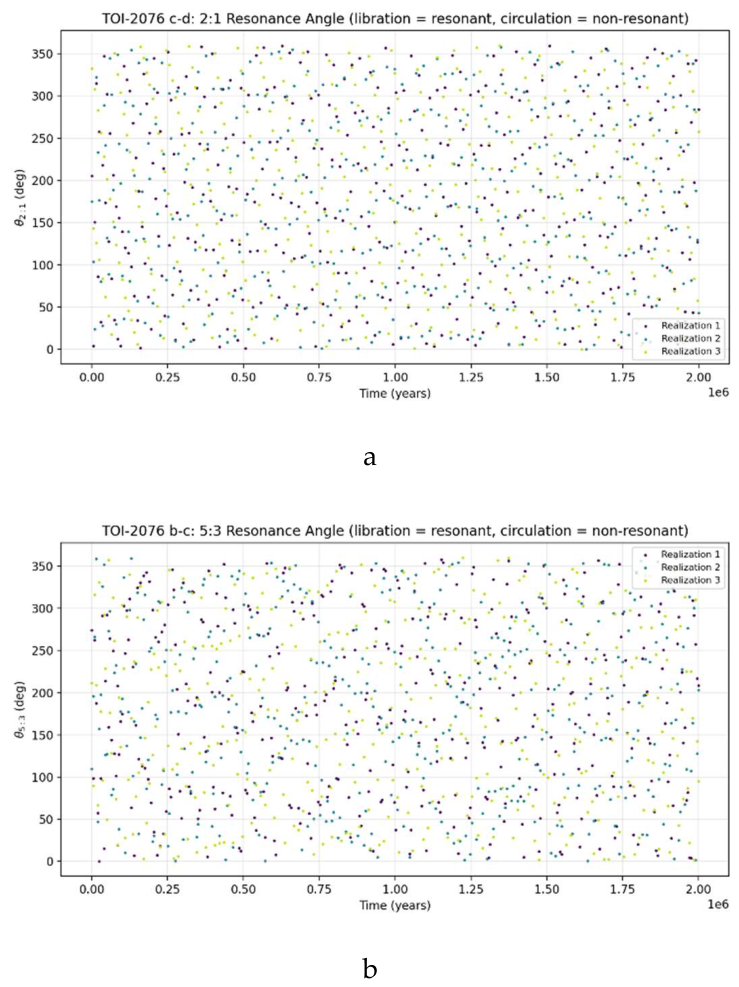
Figure 3.
Period ratio evolution over the integration for all three realizations. Top panel: , with the exact 5:3 commensurability () marked as a dashed line. Bottom panel: , with the exact 2:1 commensurability (2.000) marked as a dashed line.
Figure 3.
Period ratio evolution over the integration for all three realizations. Top panel: , with the exact 5:3 commensurability () marked as a dashed line. Bottom panel: , with the exact 2:1 commensurability (2.000) marked as a dashed line.
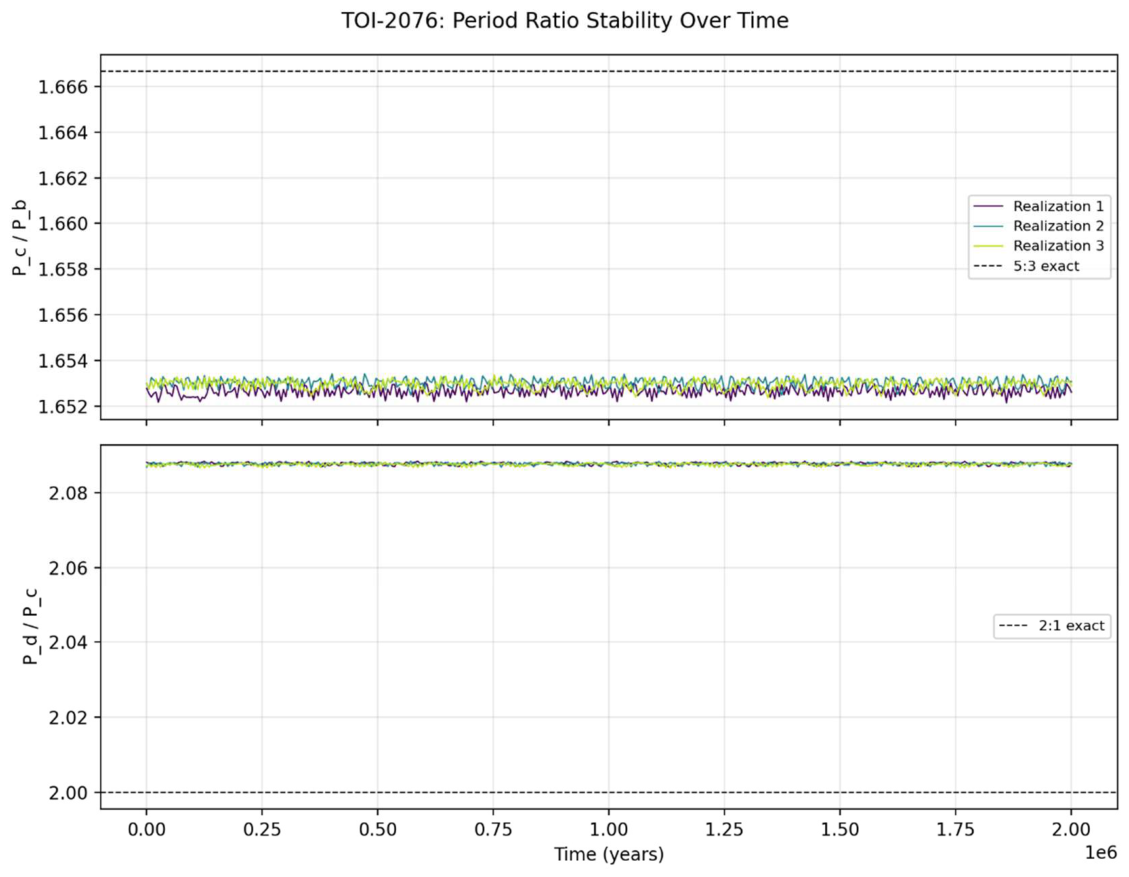
Figure 4.
Maximum eccentricity reached by each planet (b, c, d) over the full 2 × 10⁶ yr integration, compared across the three independent realizations (distinguished by colour).
Figure 4.
Maximum eccentricity reached by each planet (b, c, d) over the full 2 × 10⁶ yr integration, compared across the three independent realizations (distinguished by colour).
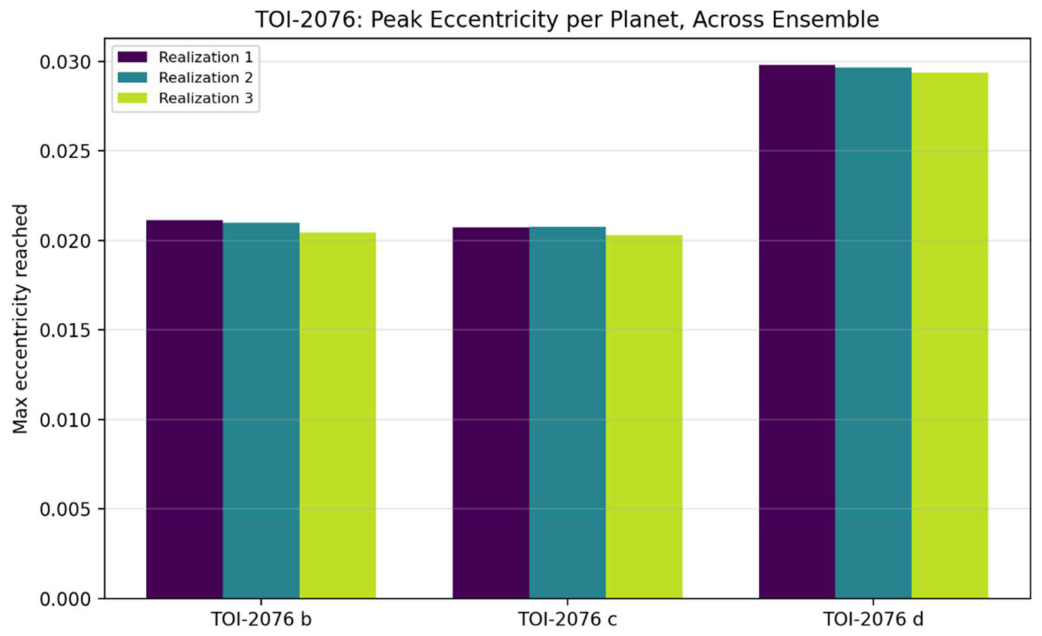

Table 1.
Adopted system and planetary parameters for TOI-2076, adapted from Osborn et al. (2022).
| Planet | Period (days) | (AU) | (deg) | Mass () | |
|---|---|---|---|---|---|
| b | 10.355 | 0.0847 | 0.02 | 88.55 | 6.6 |
| c | 17.166 | 0.1184 | 0.02 | 89.10 | 8.2 |
| d | 35.124 | 0.1934 | 0.02 | 89.50 | 6.9 |
| Host star () | — | — | — | — | 0.87 |
Table 2.
Summary of stability outcomes and eccentricity statistics for each of the three ensemble realizations.
Table 2.
Summary of stability outcomes and eccentricity statistics for each of the three ensemble realizations.
| Realization | Outcome | max(e_b) | max(e_c) | max(e_d) | std(e_b) | std(e_c) | std(e_d) |
|---|---|---|---|---|---|---|---|
| 1 | Stable | ~0.0211 | ~0.0207 | ~0.0298 | — | — | — |
| 2 | Stable | ~0.0210 | ~0.0207 | ~0.0296 | — | — | — |
| 3 | Stable | ~0.0204 | ~0.0203 | ~0.0294 | — | — | — |
| Ensemble mean | 3/3 stable | — | — | — | 0.00382 | 0.00329 | 0.00335 |
Disclaimer/Publisher’s Note: The statements, opinions and data contained in all publications are solely those of the individual author(s) and contributor(s) and not of MDPI and/or the editor(s). MDPI and/or the editor(s) disclaim responsibility for any injury to people or property resulting from any ideas, methods, instructions or products referred to in the content. |
© 2026 by the authors. Licensee MDPI, Basel, Switzerland. This article is an open access article distributed under the terms and conditions of the Creative Commons Attribution (CC BY) license (http://creativecommons.org/licenses/by/4.0/).
Copyright: This open access article is published under a Creative Commons CC BY 4.0 license, which permit the free download, distribution, and reuse, provided that the author and preprint are cited in any reuse.