
Submitted:
21 August 2026
Posted:
24 August 2026
You are already at the latest version
Abstract
Silica aerogels are among the most extraordinary porous materials produced through sol–gel chemistry, distinguished by ultralow density, exceptionally high porosity, large specific surface area, and extremely low thermal conductivity. Despite these characteristics, widespread application of conventional silica aerogels has been constrained by inherent brittleness, poor mechanical strength, and moisture sensitivity. Significant research has therefore focused on silica aerogel composites, in which reinforcing or functional phases — fibers, polymers, carbon nanomaterials, metal oxides, and biopolymers — are integrated into the silica network to enhance mechanical robustness, flexibility, hydrothermal stability, electrical conductivity, catalytic activity, and multifunctionality while largely preserving the parent aerogel's desirable properties. This chapter reviews the synthesis, characterization, properties, and applications of silica aerogel composites. Sol–gel processing and drying technologies are discussed, followed by composite-formation strategies and the advanced techniques used to evaluate structural, mechanical, thermal, surface, and functional properties. The effects of reinforcing phases on mechanical performance, thermal conductivity, and hydrothermal stability are analyzed, and current and emerging applications in thermal insulation, environmental remediation, catalysis, acoustic damping, aerospace systems, biomedical engineering, and energy storage are highlighted. Finally, key challenges and future directions involving multifunctional materials, green synthesis, and data-driven materials design are discussed.
Keywords:
silica aerogel composites
; sol–gel synthesis
; thermal insulation
; mechanical reinforcement
; multifunctional materials
; advanced applications
1. Introduction
Silica aerogels are one of the most astonishing nanoporous materials generated via sol-gel chemistry and have also been the most intensely scientifically and technologically investigated materials for more than 9 decades. Since Kistler (1931) invented the replacing the liquid phase inside a wet gel by gas while preserving its 3-D solid network, silica aerogels have become advanced engineering materials that are found suitable in such applications as thermal insulation, heterogeneous catalysis, environmental remediation, renewable energies and storage, aerospace, optics, biomedical and sustainable construction from an oddity initially (Kistler, 1931; Hüsing & Schubert, 1998; Pierre & Pajonk, 2002; Maleki et al., 2014; Sarathchandran et al., 2024; Zhu et al., 2025). Because of their unique combination between their ultralow density, great porosity and a large specific surface area, along together with a low k level and low thermal conductivity, most common porous materials struggle to rival the merits found in silica aerogels. Therefore, silica aerogels have continuously differentiated themselves from almost all types of engineered porous solids because of their combination of structural and functional features even at present [1], at same time that diversification of synthesis strategies, composite architectures and their applications have grown rapidly (Chemere et al., 2025). Typical silica aerogels possess porosities ranging from 80% to 99.8%, specific surface areas between 500 and 1200 m² g⁻¹, and thermal conductivities as low as 0.015–0.020 W m⁻¹ K⁻¹, making them among the most efficient thermal insulating materials currently available (Aegerter et al., 2011; Koebel et al., 2012; Pierre & Pajonk, 2002).
The spectacular insulating properties of silica aerogel originate from its porous structure. During sol-gel processing silica monomers link and condense into an open 3D skeleton formed from agglomerates of nanoscale silica that has a interconnected porosity with micro, meso and macro pores. In such an architecture, heat transfer can be effectively suppressed by eliminating gaseous convection with pore sizes smaller than the mean free path length of gas molecules and minimise heat conduction in solid with a discontinuous solid skeleton (Fricke & Emmerling, 1992; Pierre & Pajonk, 2002). This sol-gel route offers flexibility to tailor chemical nature of the precursor, kinetics, pore morphology, density, surface chemistry, nanostructured of silica aerogel by careful choice of: the nature of the catalyst, the precursors' concentration, type of solvent, aging conditions and method of drying (Brinker & Scherer, 1990; Hüsing & Schubert, 1998). Sol-gel synthesis of aerogels must achieve a precise balance between maintaining structural integrity and high porosity. Super critical drying and ambient pressure drying have increased the scalability of silica aerogel production (Figure 10) as well as the use of Freeze Drying to prepare aerogel has reduced the drying process. With recent developments additive manufacturing such as direct ink writing technique has been used to tailor morphology, mechanical, chemical properties of silica aerogels (Aegerter et al., 2011; Koebel et al., 2012; Zhao et al., 2020). The use of traditional monolithic silica can now be expanded for more complex applications.
Despite these excellent properties, neat monolithic silica aerogels suffer from several drawbacks, which has discouraged their large-scale production and application in industry up to now. The high porosity renders a weak silica backbone, leading to low fracture toughness, low tension strength, poor resistant to impact, along with high brittleness so that the monolithic aerogels are prone to cracking when fabrication, cutting work piece, traveling or during service in use (Leventis, 2007; Maleki et al., 2016). On the other hand, a huge amount of surface silanol (Si-OH) has formed during the sol-gel process causing silica aerogels to absorb water than repel it. The silica aerogels are intrinsically hydrophilic. Moisture adsorption to the network increases the thermal conductivity, enhances hydrolytic degradation of silica backbone at humid working environment and diminishes the long-term size stability (Sarathchandran et al., 2024; Zhu et al., 2025). Therefore, in spite of the superior thermal insulation performance of neat silica aerogels, their poor mechanical reliability and long-term environmental durability have constituted the core bottleneck toward industrial utilization.
These limitations have stimulated extensive research into silica aerogel composites, which incorporate reinforcing or functional secondary phases into the nanoporous silica matrix to simultaneously preserve the desirable characteristics of the aerogel framework while overcoming its mechanical and environmental deficiencies. Reinforcing phases—including ceramic and glass fibers, polymeric crosslinked networks, carbon nanotubes (CNTs), graphene derivatives, nanocellulose, biopolymers, metal oxides, and various nanoscale functional fillers—have been successfully integrated within the silica network through a wide range of synthesis strategies (Leventis, 2007; Maleki et al., 2016; Zhan et al., 2023). It increases the compressive strength, fracture toughness, flexibility, elasticity, hydrothermal stability and long-term durability; meanwhile, it also brings up unique properties, such as electric conductivity, EMI shielding ability, photocatalytic activity, sensing ability, selective adsorption and energy-storage performance (Du et al., 2013; Luo et al., 2025; Sarathchandran et al., 2024; Zhu et al., 2025). These achievements not only improve the intrinsic properties but extend the applications of silica aerogels, enabling them to meet with the unprecedented increasing demands from modern complex engineering system and have changed them from single materials into multifunctional composite materials.
Literature has elucidated that reinforcing strategy selection dictates whether resulting silica aerogel composites are fit for application in a certain functional sector. Fibres reinforcement results in significant improvement in the compressive, flexural, fracture resistance and handling characteristics while remaining excellent thermal insulation, which makes them the most commercially viable aerogel composite architecture for building sector (envelope, industrial insulators and cryogenic and aerospace installations) and also for building insulator applications (Meador et al., 2007; Luo et al., 2025). Polymer-crosslinked aerogels strengthen the silica backbone by forming continuous conformal polymer networks around silica nanoparticles, producing dramatic improvements in toughness, elasticity, resilience, and recoverable deformation (Leventis et al., 2010). Carbon-based composites incorporating CNTs, graphene, or graphene oxide establish conductive networks that simultaneously enhance mechanical performance, electrical conductivity, electromagnetic shielding, sensing capability, and electrochemical energy storage (Du et al., 2013; Zhu et al., 2025). Similarly, metal oxide–silica hybrid aerogels containing TiO₂, Al₂O₃, ZrO₂, Fe₃O₄, and related oxides have demonstrated considerable promise in photocatalysis, heterogeneous catalysis, adsorption, environmental remediation, and renewable energy conversion owing to the synergistic combination of high surface area and uniformly dispersed active phases (Maleki et al., 2016). More recently, sustainable biopolymer-reinforced aerogels and multifunctional hybrid composites have emerged as rapidly growing research directions that integrate multiple reinforcement strategies within a single material to achieve simultaneously optimized structural and functional performance.
Over the past decade, the research landscape has expanded considerably beyond conventional synthesis optimization toward the rational design of multifunctional silica aerogel composites through advanced materials engineering. Significant progress has been achieved in precursor chemistry, ambient-pressure drying, additive manufacturing, hierarchical pore engineering, surface functionalization, nanomaterial integration, and sustainable processing routes based on inexpensive and environmentally benign precursors. Concurrently, advances in characterization techniques—including high-resolution electron microscopy, synchrotron X-ray scattering, X-ray photoelectron spectroscopy, nitrogen physisorption, nanoindentation, and multiscale computational modeling—have substantially improved understanding of the relationships between composite architecture, interfacial interactions, and macroscopic performance. More recently, machine learning and data-driven materials design have begun to emerge as promising tools for optimizing synthesis parameters and accelerating the development of next-generation multifunctional aerogel composites with application-specific performance characteristics.
Most review articles have focused on a particular aspect, be it synthesis chemistry, drying techniques, polymer crosslinking, carbon-based composites or selected applications, among several others. However, with the rapid advance in reinforcement strategies, manufacturing technologies, characterisation methods and multifunctional applications, there has become a need for an updated and comprehensive overview of aerogel science and technology. As an approach to this, this literature review presents a critical and systematic review of silica aerogel composites. With the sol-gel chemistry and composites fabrication principles, the main reinforcement strategies and processing technologies for preparing high performance aerogel composites are overviewed. Advanced characterisation methods for finding structure properties relationship as well as recent developments of mechanical reinforcement, thermal insulation, hydrothermal stability, electrical functions and multifunctional performance will be discussed. Additionally, established and prospective applications, spanning thermal insulation, environmental remediation, catalysis, energy storage, aerospace engineering, biomedical technologies and smart functional materials are summarised. Eventually remaining scientific, technological, economic and sustainability challenges are critically evaluated along with the future directions, towards scalable manufacturing, environmentally friendly processing, multifunctional composites architectures and advanced materials design aided by additive manufacturing and artificial intelligence. By attempting to bring the various avenues of ongoing research on to one level plane, the review tries to present a complete understanding of aerogel status of research as well as trends and breakthroughs to scientists and researchers working with advanced materials.
2. Synthesis of Silica Aerogel Composites
2.1. Sol–Gel Chemistry Basics
Silica aerogels and their composites are synthesized primarily via the sol-gel process for the reason that precursor chemistry and processing conditions can be controlled to tailor the composition, pore structure, surface functionality, density and microstructure of the materials within considerable flexibility (Brinker & Scherer, 1990; Hüsing & Schubert, 1998). A homogeneous precursor solution containing a silicon source, solvent, water and catalyst is prepared at first. Silicon alkoxides (tetraethyl orthosilicate (TEOS), tetramethyl orthosilicate (TMOS)) are currently the most extensively adopted precursors, with another inexpensive and sustainable one (sodium silicate, water glass) being more and more intensively investigated for potential commercial applications (Brinker & Scherer, 1990; Pierre & Pajonk, 2002) (Sarathchandran et al., 2024; Zhu et al., 2025).
Hydrolysis of silicon alkoxide in the presence of water replaces alkoxy groups with silanol (Si–OH) groups: Si(OR)₄ + H₂O → (RO)₃Si–OH + ROH, where R is an alkyl group. Condensation reactions between silanol groups then form siloxane (Si–O–Si) bridges that build a three-dimensional network: (RO)₃Si–OH + HO–Si(OR)₃ → (RO)₃Si–O–Si(OR)₃ + H₂O. Both reactions proceed simultaneously once hydrolysis has begun, so the relative rates of hydrolysis and condensation — controlled by pH, water-to-alkoxide ratio, catalyst identity, and temperature — determine whether the growing network is dominated by chain extension or by branching, which in turn sets the primary particle size and the connectivity of the eventual gel.
The catalytic regime governs network morphology: acid catalysis favors chain-like, weakly branched networks with small pores, whereas base catalysis favors particulate, three-dimensional networks with larger pores and higher surface area (Brinker & Scherer, 1990; Hüsing & Schubert, 1998), a structural bifurcation mapped in detail across precursor, pH, and modifying-agent combinations (Sinkó, 2010). Catalyst selection is therefore a primary design lever for final pore architecture, independent of any reinforcing phase, and is frequently exploited in composite synthesis to pre-tune the silica matrix so that it accommodates a specific reinforcement geometry — for example, base-catalyzed, particulate networks are often preferred ahead of nanoparticle or nanofiber incorporation because their larger initial pore throats reduce the risk of filtration or exclusion of the secondary phase during gelation.
Further condensation results in gelation and aging (13.5) before drying (sol-gel, aging result in network build up in silica) that determines pore architecture and mechanical and structural integrity (Pierre & Pajonk, 2002) (Hüsing & Schubert, 1998; Aegerter et al., 2011). This occurs through formation of necks between particles which leads to a increase in mechanical strength and reduction of shrinkage and stress within the gel by promoting the relaxation and reorganization of the structure. Aging duration and temperature must be balanced carefully in composite systems: insufficient aging leaves interparticle necks too weak to survive subsequent solvent exchange, while excessive aging can promote pore coarsening that reduces surface area before the reinforcing phase has an opportunity to lock the structure in place. Solvent exchange then replaces the pore liquid with one of lower surface tension, such as ethanol or liquid CO₂, reducing capillary stress prior to drying (Sarathchandran et al., 2024; Zhu et al., 2025).
Drying is the most technically demanding stage: supercritical drying eliminates the liquid–vapor interface entirely, with supercritical CO₂ the preferred industrial route owing to its low critical temperature (31.1 °C), moderate critical pressure, and chemical inertness (Pierre & Pajonk, 2002; Aegerter et al., 2011). Ambient-pressure drying (APD), by contrast, relies on silylation with reagents such as TMCS, HMDS, or MTMS to replace hydrophilic silanols with hydrophobic groups, reducing capillary forces without requiring supercritical conditions (Maleki et al., 2016; Rao et al., 2006). The generalized fabrication pathway that links precursor selection, hydrolysis-condensation, gelation, aging, solvent exchange, and drying into a coherent process sequence is summarized schematically in Figure 1, which also indicates the points at which a reinforcing phase is typically introduced.
Composite synthesis builds on this sequence by introducing fibers, polymers, carbon nanomaterials, metal oxides, or biopolymers before gelation, during network formation, through post-gelation infiltration, or during post-synthesis surface modification. Both the timing of incorporation and the drying route strongly influence dispersion, network integrity, and interfacial interactions, and ultimately the mechanical, thermal, electrical, and functional properties of the resulting composite (Maleki et al., 2016; Sarathchandran et al., 2024; Zhu et al., 2025). The resulting materials retain the characteristic interconnected nanoporous silica framework spanning micropores, mesopores, and macropores while accommodating the reinforcing phase within this hierarchical architecture, as illustrated in Figure 2.
2.2. Strategies for Composite Formation
The intrinsic brittleness and limited load-bearing capability of monolithic silica aerogels remain the principal barriers to broader engineering application (Leventis, 2007; Maleki et al., 2016). Reinforcement strategies can improve compressive strength, fracture toughness, flexibility, hydrothermal stability, and electrical or catalytic functionality without substantially compromising the nanoporous architecture (Leventis, 2007; Maleki et al., 2016; Sarathchandran et al., 2024; Zhu et al., 2025). Reinforcing phases may be introduced through pre-gelation mixing, in situ network formation, post-gelation infiltration, or post-synthesis surface modification; regardless of stage, effectiveness is governed less by the reinforcement's intrinsic properties than by its dispersion, interfacial bonding, and the survival of a continuous porous network through drying (Maleki et al., 2016; Zhao et al., 2018). Recent mechanistic work confirms that covalent, silane-mediated bonding at the reinforcement–silica interface measurably improves load transfer and compressive performance relative to weakly bonded interfaces, establishing interfacial engineering — not merely reinforcement loading — as the primary lever governing mechanical outcome (Hu et al., 2024).
Generally the Aerogel Silica Composites materials can be broadly categorized according to their reinforcement morphology and role by the silica matrix. These categories are (as summarized in Table 1) fibrous composites, polymer-crossed linked composites, carbon-based composites, metal oxide hybrid composites, biopolymer-reinforced composites and multi-functional hybrid composites. Whereas fibrous composites and those which are polymer-crossed linked predominantly provide enhanced structural performance of the silica matrix, carbon based materials and metal oxides provide enhanced electrical conductivity or EMI shielding as well as photocatalytic, sensing and magnetic responsive capabilities. Biopolymer-based composites have attracted increasing attention for their renewable origin and biodegradability (Yang et al., 2023; Yuvaraja et al., 2025; Sikiru et al., 2025). Fiber reinforcement remains the most mature commercial approach, bridging microcracks and increasing flexural strength and dimensional stability while retaining low thermal conductivity (Leventis, 2007; Aegerter et al., 2011; Maleki et al., 2016). Polymer crosslinking forms continuous interpenetrating networks that coat or bond with the silica skeleton, substantially improving compressive strength, elasticity, and impact resistance (Leventis, 2007; Maleki et al., 2016).
Carbon-based composites (CNTs, graphene, GO, rGO) establish conductive pathways for sensors, supercapacitors, batteries, and EMI shielding (Zhao et al., 2018; Yang et al., 2023). Metal oxide hybrids (TiO₂, Al₂O₃, ZrO₂, Fe₃O₄) primarily add catalytic, photocatalytic, magnetic, or adsorption functionality (Maleki et al., 2016; Sarathchandran et al., 2024; Zhu et al., 2025). Biopolymer-reinforced systems (cellulose, chitosan, alginate, lignin, starch) improve toughness and biodegradability for sustainable insulation, water purification, and biomedical applications (Yang et al., 2023; Yuvaraja et al., 2025; Sikiru et al., 2025). Finally, multifunctional hybrids combine several reinforcing phases to exploit synergistic effects across mechanical, thermal, electrical, and catalytic performance (Yang et al., 2023; Yuvaraja et al., 2025). The classification presented in Table 1 is not strictly partitioned in practice, since many reported composites deliberately straddle two or more categories — for instance, a fiber scaffold that is subsequently silylated and impregnated with a conductive carbon coating combines fibrous, hydrophobic, and carbon-based functionality within a single material, and is best read as occupying an intermediate position on the classification scheme shown schematically in Figure 3, which maps the reinforcement classes against the silica network.
Selecting among the six reinforcement classes summarized in Table 1 is ultimately an exercise in matching mechanism to requirement. A designer targeting a lightweight, low-cost insulation panel for a building envelope will typically favor fibrous reinforcement because the thermal penalty is small and the manufacturing process is already well established at scale, whereas a designer targeting a load-bearing structural component with repeated cyclic loading will typically favor polymer crosslinking because of its superior elastic recovery, even though this comes with a larger increase in thermal conductivity and density. Composites intended for sensing, energy storage, or electromagnetic applications instead prioritize carbon-based or metal oxide reinforcement, where the functional gain — conductivity, catalytic activity, magnetic response — is the primary design objective and thermal insulation performance is a secondary, though still relevant, consideration. This application-first framing recurs throughout Section 4 and Section 5 and is the organizing logic behind the trade-off map presented later in Figure 15.
2.3. Typical Synthesis Routes for Silica Aerogel Composites
Six principal fabrication strategies have been developed, distinguished by the reinforcing phase and the stage at which it is introduced: fiber infiltration, polymer crosslinking, in situ nanoparticle incorporation, carbon nanomaterial dispersion, co-gelation with functional oxides, and ambient-pressure drying assisted by surface modification. Each carries distinct advantages and processing challenges relating to dispersion, interfacial compatibility, drying-induced shrinkage, and network preservation (Brinker & Scherer, 1990; Aegerter et al., 2011; Maleki et al., 2016). The following subsections examine each route in turn, drawing out the specific dispersion and interfacial challenges that distinguish it from the general strategies already summarized in Table 1.
2.3.1. Fiber-Reinforced Aerogel Composites
Fiber reinforcement remains the dominant strategy in commercial insulation. Pre-cast fiber mat infiltration impregnates a prefabricated fiber blanket with silica sol before gelation, producing homogeneous reinforcement and excellent dimensional stability — the preferred method for commercial aerogel blankets (Aegerter et al., 2011; Koebel et al., 2012). Chopped fiber dispersion instead disperses short fibers throughout the precursor, potentially yielding more isotropic properties at the cost of a more difficult dispersion problem requiring ultrasonication and fiber surface treatment (Maleki et al., 2016; Ślosarczyk, 2021). Fiber selection is application-driven: glass fibers for low cost and thermal stability, ceramic fibers for high-temperature service, carbon fibers for multifunctionality, and polymeric or basalt fibers for flexibility and sustainability. Fiber diameter and areal density are additional levers: finer fibers distribute more crack-bridging sites per unit volume for a given mass loading, whereas coarser fibers are easier to handle during mat pre-forming and tend to dominate large-panel commercial production. Commercial fiber-reinforced blankets are typically produced in continuous roll form at thicknesses ranging from a few millimeters to several centimeters, and this format has become the reference product against which nearly all newer composite classes are implicitly benchmarked, since it defines the cost, handling characteristics, and installation practice that alternative reinforcement strategies must match or improve upon to gain market acceptance.
2.3.2. Polymer-Crosslinked Aerogels
By means of polymer crosslinking this brittleness is corrected, as an organic network is formed, which interpenetrates into the silicate skeleton and results in a higher compressive strength, fracture strength and impact resistance (Leventis, 2007; Leventis et al., 2002; Maleki et al., 2016). Wet gels are typically immersed in solutions of multifunctional monomers — hexamethylene diisocyanate (HMDI), methylene diphenyl diisocyanate (MDI), polyurethane precursors, or epoxy monomers — that polymerize in situ to reinforce interparticle necks (Leventis et al., 2002). The monomer must be able to diffuse into the pore network if the gel is still wet to be cured efficiently; over reactive crosslinkers will polymerize preferentially at the gel surface to produce a hard shell around a comparatively weak core and so reaction kinetics must be tuned to the gel's characteristic pore diffusion length. There has been in interest in biobased methods spurred on by sustainability concerns. For example, lignin derived polymer materials have been introduced and bio epoxies are being commercialised, but the development of these systems in composites is relatively early but offer much promise in a sustainable low impact future (Wei et al., 2026; Su et al., 2025; Li et al., 2025; Zhang et al., 2026).
2.3.3. Carbon Nanomaterial Composites
Carbon nanotubes, graphene, GO, rGO, and carbon black simultaneously improve mechanical, electrical, and thermal properties owing to their high stiffness, conductivity, and aspect ratio (Du et al., 2013). In the in situ sol–gel approach, nanomaterials are dispersed into the precursor before gelation, promoting stress transfer and conductive pathways, though agglomeration typically requires ultrasonication, surfactants, or functionalization to overcome (Du et al., 2013; Yang et al., 2025). Molecular dynamics simulations of anisotropically dispersed CNT–GO hybrid networks reveal a non-monotonic, loading-ratio-dependent tensile response, with high carbon loading maximizing strength at low strain and low loading better preserving structural integrity at large strain — indicating that in situ dispersion should match loading ratio to the expected service deformation regime rather than simply maximizing loading (Guo et al., 2025). Post-synthesis impregnation instead infiltrates a preformed aerogel with carbon precursors such as sucrose or phenolic resin followed by pyrolysis, offering greater control over loading at the cost of additional thermal processing (Zhao et al., 2018). The in situ method produces better electrical percolation at a given carbon loading than impregnating silica with carbon because during the aerogel being made the carbon reinforcement is incorporated right through the silica network whereas impregnating the silica has finer control over depth and evenness of carbon-isation but there is the risk that if it is applied from the outside through the inside is underreinforced. It is possible in addition to that to functionalize the carbon nanomaterial being incorporated - this is generally oxidizing the surface to give carboxyl or hydroxyl groups or by applying a coupling agent (silane etc.) to the surface before adding it into the precursor - because this helps the dispersion during the first stage and then helps the interfacial bonding with the surrounding silica when the aerogel forms. The same general principle to reinforcement strategies as a whole can be seen here in that the interface is engineered when bonding with the aerogel.
2.3.4. Metal Oxide Hybrid Aerogels
There are two popular methodologies to form such composites: co-gelation method by forming mixed oxide network where metal alkoxide precursor also undergoes hydrolysis at same period as silica precursor; impregnation after the synthesis were in which a metal salt solution is used as reagent to form monoliths and then subjected to hydrolysis followed by heat treatment of composite material in controlled atmosphere (Pierre & Pajonk, 2002; Yuvaraja et al., 2025; Sikiru et al., 2025). Co-gelation favors uniform dispersion, whereas impregnation offers finer control over crystallinity and interfacial bonding — a trade-off between homogeneity and control that ultimately governs catalytic efficiency and long-term stability. A further practical consideration is the relative hydrolysis rate of the metal alkoxide compared with the silicon alkoxide: many transition-metal alkoxides hydrolyze considerably faster than TEOS or TMOS, so co-gelation routes often require chelating agents or staged addition to prevent premature, silica-poor metal-oxide precipitation before the two networks can interpenetrate.
2.3.5. Ambient Pressure Drying (APD) Composites
Given the cost and complexity of supercritical drying, APD has become an important commercially viable alternative (Rao et al., 2006; Sarathchandran et al., 2024; Zhu et al., 2025). Hydrophobization with TMCS, HMDS, or MTMS reduces capillary stress during evaporation, and this route benefits directly from the reinforcement strategies above: fibers, polymer crosslinkers, or carbon nanomaterials provide additional structural support during drying, allowing APD-derived composites to approach the pore structure and thermal conductivity of supercritically dried aerogels at substantially lower cost (Rao et al., 2006; Sarathchandran et al., 2024). APD is therefore best understood as a processing route compatible with, and strengthened by, each reinforcement strategy rather than an independent seventh category. Table 2 compares the principal drying approaches on the basis of mechanism, advantage, and limitation, underscoring why reinforcement-assisted APD has become the preferred route for cost-sensitive, large-volume production while supercritical drying remains the benchmark for applications where minimal shrinkage is paramount.
3. Characterization Techniques
In the case of silica aerogel composites their success depends on a composite of hierarchical pore structure/ reinforcement morphology/ interfacial interaction and chemical composition making a multi technique approach to fully characterise them absolutely essential (Brinker & Scherer, 1990; Hüsing & Schubert, 1998; Aegerter et al., 2011; Maleki et al., 2016; Rouquerol et al., 2026). Characterization methodology has evolved from simple surface-area and density measurements toward integrated multi-scale approaches spanning X-ray photoelectron spectroscopy (XPS), micro-computed tomography (micro-CT), nanoindentation, dynamic mechanical analysis (DMA), and laser flash analysis (LFA). This chapter groups characterization methods into five categories: structural/morphological, mechanical, thermal, hydrophobicity/moisture resistance, and functional characterization, each addressed in the subsections below with its principal techniques summarized in Table 3, Table 4 and Table 5.
3.1. Structural and Morphological Characterization
Structural and morphological characterization provides the foundation for understanding composite performance, since virtually all mechanical, thermal, and functional properties originate from the hierarchical organization of the silica framework and its interaction with reinforcing phases. Table 3 summarizes the principal techniques used, which together progress from bulk-averaged pore statistics, to direct surface imaging, to bulk crystallographic and chemical-bonding information, and finally to quantitative surface composition and volumetric architecture.
Nitrogen adsorption–desorption remains the benchmark for bulk pore structure and surface area, with the BET method used for specific surface area and the BJH model for mesopore size distribution (Pierre & Pajonk, 2002; Rouquerol et al., 2026). Pristine aerogels typically show surface areas of 500–1200 m² g⁻¹ and pore volumes exceeding 4 cm³ g⁻¹; polymer crosslinking and nanoparticle incorporation often reduce accessible surface area by partially filling mesopores, whereas fiber reinforcement has comparatively little effect owing to its much larger characteristic dimensions (Maleki et al., 2016; Zhao et al., 2018; Rouquerol et al., 2026). Most silica aerogel composites retain Type IV adsorption behavior, indicating that reinforcement generally preserves the interconnected pore network while modifying accessible pore volume, as illustrated by the representative isotherms and BJH distributions in Figure 4.
SEM is the most widely used imaging technique, confirming the characteristic "pearl-necklace" silica-nanoparticle morphology (Aegerter et al., 2011) and revealing fiber–matrix adhesion, polymer coating thickness, and nanofiller dispersion in reinforced systems. As shown schematically in Figure 5, progressively more elaborate microstructural evolution — from pristine, unbridged interparticle necks, to fiber-scaffolded matrices, to polymer-thickened skeletons, to conductive carbon networks — provides direct visual confirmation of the reinforcement mechanisms discussed later in Section 4. TEM/HRTEM extend resolution to nanometer and sub-nanometer scales, particularly valuable for graphene, CNTs, and metal oxide nanoparticles, while EDS elemental mapping visualizes spatial reinforcement distribution.
XRD is primarily used to identify crystalline reinforcing phases (TiO₂, Al₂O₃, ZrO₂, Fe₃O₄) since the silica framework itself is amorphous (Pierre & Pajonk, 2002). FTIR identifies functional groups associated with hydrophobization (attenuated silanol bands, new Si–CH₃ vibrations), polymer crosslinking (carbonyl and N–H bands), and metal oxide incorporation (Ti–O–Ti, Al–O, Fe–O, Si–O–Ti vibrations) (Leventis, 2007; Maleki et al., 2016), with representative spectra for each modification pathway compared in Figure 6.
XPS provides quantitative surface chemistry, while micro-CT enables non-destructive 3-D visualization of reinforcement architecture. Recent time-resolved micro-CT imaging of silylated silica gels during APD has directly visualized evolving liquid, gaseous, and solid phase fractions, tracking shrinkage and spring-back recovery at the level of the intact 3-D structure (Gonthier et al., 2023) — illustrating micro-CT's evolution from post-hoc verification toward in operando observation of network formation, and complementing the bulk and surface-level techniques already summarized in Table 3. In practice, no single laboratory routinely runs the full slate of techniques listed in Table 3 on every composite formulation; instead, researchers typically pair a bulk technique (nitrogen physisorption) with an imaging technique (SEM) as a baseline characterization pair, reserving TEM, XPS, and micro-CT for formulations that show anomalous bulk behavior or that are being advanced toward publication or scale-up, where the additional cost and instrument access are justified by the need for a more complete structural picture.
3.2. Mechanical Characterization
Mechanical characterization is central to evaluating reinforcement effectiveness, since the primary motivation for composite development is to overcome the intrinsic brittleness of conventional silica aerogels. Table 4 summarizes the five complementary techniques most commonly applied, spanning bulk, component, and local length scales.
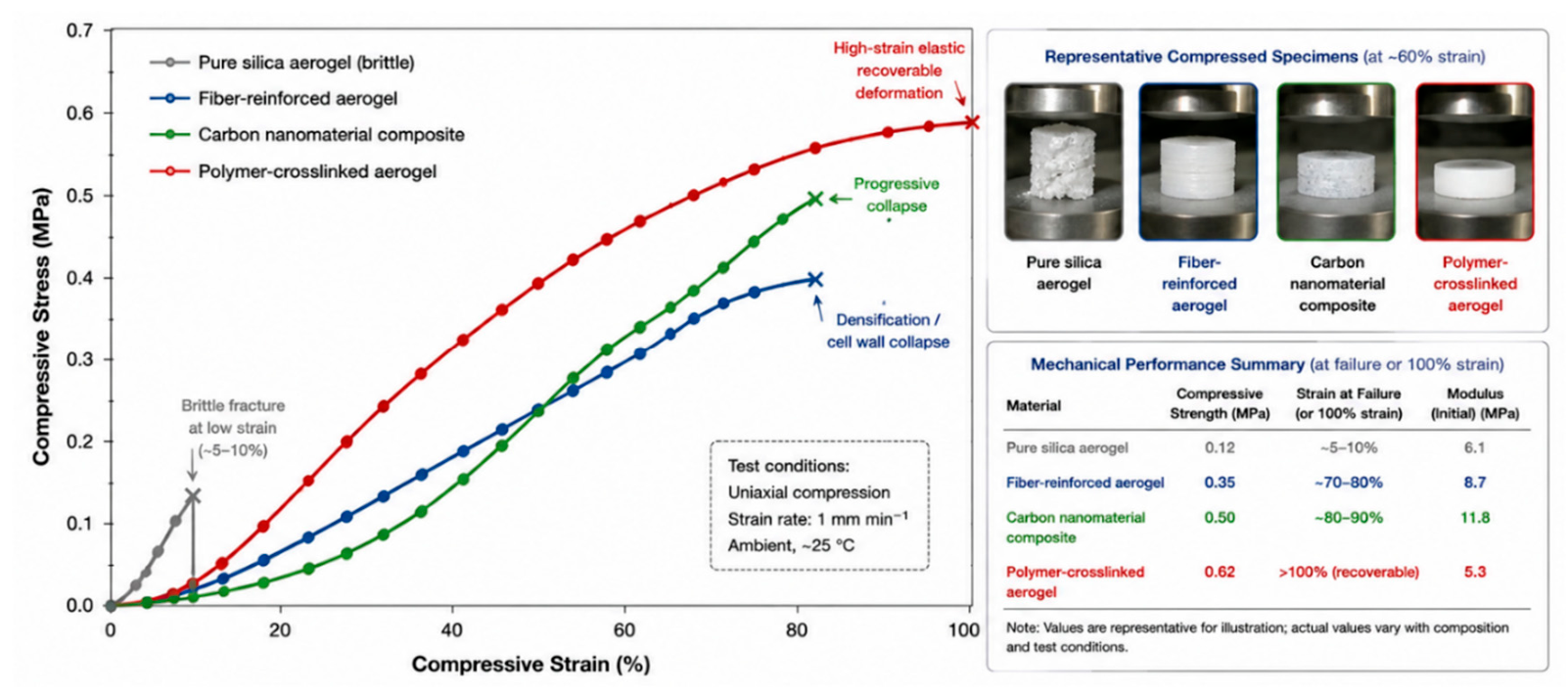
The compression test is the most frequently reported mechanical technique. Generally pristine aerogels exhibit linearly elastic deformation followed by abrupt brittle fracture (Leventis, 2007), while reinforced composites progressively show more ductile behaviour in which fibre reinforcement result in postponement of crack initiation through load transfer and polymer cross-linking permits elasticity recovery after experiencing strains as large as 60%, summarized in representative stress-strain curves shown in Fig (Leventis et al., 2002; Maleki et al., 2016) 7.
Figure 7.
Representative compressive stress–strain curves of pristine and reinforced silica aerogel composites, synthesized from representative experimental observations (Leventis et al., 2002; Leventis, 2007; Aegerter et al., 2011; Maleki et al., 2016).
Figure 7.
Representative compressive stress–strain curves of pristine and reinforced silica aerogel composites, synthesized from representative experimental observations (Leventis et al., 2002; Leventis, 2007; Aegerter et al., 2011; Maleki et al., 2016).
Flexural and fracture toughness testing are useful for investigation of crack initiation/propagation under bending where fibre reinforcement flexural strengths could be increased by over an order of magnitude, more compared with pristine aerogels (Aegerter et al., 2011; Koebel et al., 2012). Interfacial adhesion between matrix and reinforcement is a dominating factor of resistant to fracture in nearly every type of reinforcement presented in Table 4 (Leventis et al., 2002; Maleki et al., 2016). Nanoindentation resolves local stiffness within heterogeneous microstructures, though conventional sharp indenters can crush the ultralow-density skeleton before a stable response is obtained; ultralow-load or spherical/flat-punch indenters are recommended instead (Parale et al., 2024). DMA extends characterization to time- and temperature-dependent viscoelastic response, showing that polymer-crosslinked aerogels possess substantially greater damping capacity than pristine aerogels, useful for vibration isolation and acoustic applications discussed in Section 5.4. Collectively, mechanical performance depends less on reinforcement type in isolation than on dispersion, orientation, loading, and interfacial bonding at the scale each technique probes (Parale et al., 2024). A recurring methodological difficulty across all five techniques in Table 4 is the lack of a single standardized test protocol specific to ultralow-density aerogel composites; many studies adapt ASTM or ISO procedures developed for dense engineering materials, and specimen geometry, loading rate, and gauge length can all measurably shift reported strength and modulus values, complicating direct comparison of results reported by different research groups and motivating calls for aerogel-specific mechanical testing standards.
3.3. Thermal Characterization
Because thermal insulation remains the principal application driver for silica aerogel composites, thermal characterization aims not only to quantify overall conductivity but also to resolve the individual contributions of solid conduction, gaseous conduction, and radiation. Table 5 summarizes the principal techniques used.
Thermal conductivity arises from solid conduction, gaseous conduction (suppressed by the Knudsen effect), radiation, and, minimally, convection. Pristine aerogels typically achieve 0.015–0.020 W m⁻¹ K⁻¹ (Fricke & Emmerling, 1992; Koebel et al., 2012). Reinforcement adds solid conduction pathways that tend to raise conductivity, while improved rigidity helps preserve the pore architecture responsible for suppressing gaseous conduction — a trade-off explored further in Section 4.2 and illustrated across composite classes in Figure 8. Infrared opacifiers such as SiC or titania counteract added solid conduction by increasing radiative scattering; SiC-opacified composites developed for battery thermal-runaway suppression maintained 0.021–0.045 W m⁻¹ K⁻¹ across 600–1200 °C despite added solid-phase reinforcement (Liu et al., 2025).
TGA shows pristine aerogels remain stable to 500–600 °C, with mass loss below 150 °C corresponding to moisture/solvent evaporation (Pierre & Pajonk, 2002); polymer-crosslinked composites typically decompose earlier (200–350 °C), though the residual silica framework often retains structural integrity (Leventis, 2007; Maleki et al., 2016). Metal oxide hybrids and ceramic/glass fiber composites generally show improved thermal stability and dimensional stability at elevated temperature. Thermal cycling studies increasingly evaluate coupled thermal-mechanical durability; a SiC-opacified composite retained stable structure and insulation performance under combined stress (0.01–0.9 MPa) and cycling to 1200 °C, sufficient in thickness alone to suppress thermal-runaway propagation between battery cells (Liu et al., 2025). Thermal and moisture characterization are closely coupled in practice: because water conducts heat roughly twenty times more effectively than air, a composite's measured thermal conductivity is only meaningful when reported alongside its moisture content and the relative humidity at which the measurement was taken, a coupling that motivates the joint treatment of hydrophobicity and thermal performance pursued in Section 3.4 and Section 4.3 of this chapter.
3.4. Hydrophobicity and Moisture Resistance
Surface silanol groups render pristine aerogels intrinsically hydrophilic, leading to moisture adsorption, capillary condensation, and degraded thermal/mechanical performance (Pierre & Pajonk, 2002; Maleki et al., 2016). Hydrophobic performance is evaluated via water contact angle (WCA), moisture uptake, and hydrothermal aging. Untreated aerogels show WCA below 90°; silylation with TMCS, HMDS, or MTMS raises WCA to 130–150°, with hierarchically rough, optimized surfaces exceeding 150° (superhydrophobic) (Rao et al., 2015; Maleki et al., 2016; Aegerter et al., 2011), as illustrated by the representative contact-angle images and uptake data compiled in Figure 9. This behavior follows the Cassie–Baxter wetting model, in which nanoscale roughness traps air pockets beneath a water droplet, reducing effective liquid–solid contact (Scheff et al., 2025); chemistry sets the intrinsic surface energy while pore-scale roughness amplifies its macroscopic expression.
Moisture uptake in untreated aerogels commonly reaches 10–20 wt%, reduced to below 5 wt% in hydrophobically modified composites (Maleki et al., 2016), which matters because water conducts heat roughly twenty times more effectively than air. Polymer crosslinking provides an additional physical barrier against water penetration and hydrolytic degradation of Si–O–Si bonds (Leventis et al., 2002; Maleki et al., 2016; Rao et al., 2015). Long-term atmospheric aging trials comparing aerogel and conventional fiber insulation under simulated solar radiation, humidity, and thermal cycling found aerogel thermal conductivity remained essentially stable while basalt fiber insulation degraded by 9–11%, confirming superior resistance to environmental aging over time (Akhmetova et al., 2025).
3.5. Functional Characterization
Beyond thermal insulation, silica aerogel composites are increasingly engineered for energy storage, environmental remediation, sensing, catalysis, EMI shielding, biomedicine, and optoelectronics (Leventis, 2007; Maleki et al., 2016; Sarathchandran et al., 2024; Zhu et al., 2025). Electrical conductivity is assessed via the four-point probe method; CNT- and graphene-reinforced composites typically achieve 10²–10⁶ Ω sq⁻¹, reflecting formation of a percolating conductive network (Du et al., 2013). Conductivity depends on network percolation rather than filler concentration alone, and the same percolation principle underlies EMI shielding: multilayer silica-aerogel/fiber composites combining magnetic nanoparticles with a conductive carbon network have achieved shielding effectiveness above 60 dB across 8–12 GHz (Wu et al., 2025).
Electrochemical performance (cyclic voltammetry, galvanostatic charge–discharge, impedance spectroscopy) evaluates supercapacitor and battery electrode candidates, where well-dispersed carbon networks improve conductivity and ion diffusion (Du et al., 2013; Zhu et al., 2025). Catalytic and photocatalytic performance is dominated by TiO₂–silica systems, in which the silica framework suppresses nanoparticle agglomeration while preserving active-site accessibility (Pierre & Pajonk, 2002; Maleki et al., 2016). Adsorption capacity — equilibrium capacity, kinetics, regeneration efficiency — is central to environmental remediation, with hydrophobic composites showing high oil-sorption selectivity and amine-functionalized composites enhancing CO₂ capture (Maleki et al., 2016; Sarathchandran et al., 2024). Optical characterization via UV–Vis spectroscopy shows optimized monolithic aerogels can reach roughly 90% visible transmittance at 1 cm thickness (Aegerter et al., 2011), though reinforcement generally increases scattering and reduces transparency except for carefully dispersed nanoscale fillers. Taken together, the five characterization categories reviewed in this section — structural, mechanical, thermal, hydrophobicity, and functional — are rarely applied in isolation; contemporary studies increasingly report combined data sets so that a single composite formulation can be assessed simultaneously against the performance benchmarks discussed in Section 4. This shift toward integrated, multi-property reporting also reflects the growing expectation from funding agencies and industrial partners that a proposed composite formulation demonstrate not merely one exceptional property in isolation, but a defensible overall performance profile — a requirement that has, in turn, accelerated adoption of the machine-learning-assisted, multi-objective optimization workflows discussed later in Section 6.6.
4. Properties and Performance Enhancements
Composite aerogels derive their properties from synergy between the nanoporous network and the reinforcing phase, through crack bridging, stress redistribution, interparticle neck strengthening, conductive network formation, and pore stabilization (Leventis, 2007; Maleki et al., 2016; Sarathchandran et al., 2024; Zhu et al., 2025). Critically, no reinforcement mechanism is a pure win: increasing solid volume fraction improves stiffness but raises solid-state heat conduction; polymer crosslinking improves fracture resistance but may reduce transparency and increase density; carbon nanomaterials provide conductivity but require careful dispersion. Composite design is therefore fundamentally an exercise in balancing competing requirements against the intended application, a theme quantified in the following subsections and summarized visually in the property trade-off map presented later as Figure 15.
4.1. Mechanical Reinforcement
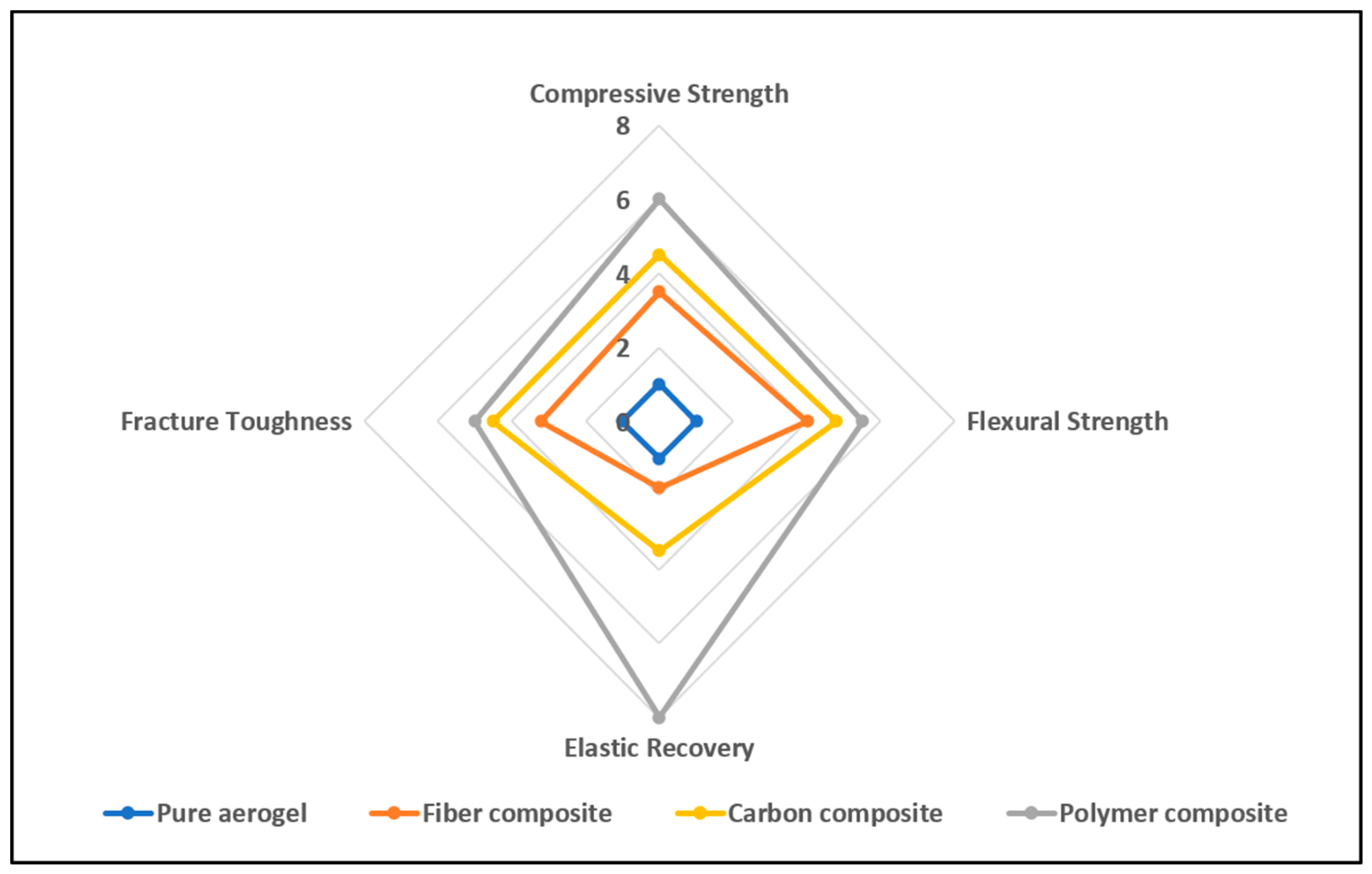
Monolithic aerogels typically exhibit compressive strengths of only 0.01–0.30 MPa and negligible elastic recovery (Pierre & Pajonk, 2002; Leventis et al., 2002). Fiber reinforcement raises flexural strength from below 0.1 MPa to roughly 1–5 MPa — a one-to-two-order-of-magnitude gain — with minimal thermal penalty, explaining the dominance of fiber-reinforced blankets in commercial insulation (Koebel et al., 2012; Maleki et al., 2016). Polymer crosslinking generally provides the greatest single-strategy improvement: compressive modulus can increase by one to two orders of magnitude and compressive strength by nearly 100-fold, with elastic recovery after strains exceeding 60% (Leventis et al., 2002; Meador et al., 2007), at the cost of reduced transparency and increased density. Carbon nanomaterials enhance mechanical performance while adding conductivity, though the magnitude of reinforcement depends strongly on dispersion and loading ratio, which must be matched to the expected deformation regime rather than simply maximized (Guo et al., 2025). Increasing work combines multiple reinforcing phases — fiber/polymer, polymer/CNT, fiber/graphene — to achieve simultaneous gains in stiffness, toughness, fatigue resistance, conductivity, and thermal stability (Chen et al., 2025; Zhao et al., 2026). Figure 10 (below) presents these mechanical gains as normalized performance indices, and Table 6 tabulates representative ranges for each major composite class.
Figure 10.
Normalized comparison of key mechanical properties of pure silica aerogels and reinforced aerogel composites, expressed as performance indices relative to pristine silica aerogel (normalized value = 1).
Figure 10.
Normalized comparison of key mechanical properties of pure silica aerogels and reinforced aerogel composites, expressed as performance indices relative to pristine silica aerogel (normalized value = 1).
The ranges summarized in Table 6 should be read as representative rather than absolute, since reported gains depend strongly on baseline aerogel density, reinforcement loading fraction, and the specific mechanical test protocol used, as already noted in Section 3.2. Nonetheless, the consistent qualitative ordering across independent studies — polymer crosslinking delivering the largest single-strategy compressive gain, fiber reinforcement delivering the most favorable strength-to-thermal-penalty ratio, and carbon nanomaterials delivering the most loading-sensitive, application-specific response — provides a robust basis for the application-driven selection logic introduced in Section 2.2 and revisited throughout Section 5.
4.2. Thermal Conductivity Trade-Off
Reinforcement inevitably raises solid fraction and introduces materials of differing intrinsic conductivity, so the central challenge is minimizing the conductivity penalty while maximizing mechanical or functional gain (Aegerter et al., 2011; Maleki et al., 2016). Fiber-reinforced aerogels show one of the most favorable balances, rising only to 0.025–0.035 W m⁻¹ K⁻¹ (Koebel et al., 2012). Polymer-crosslinked aerogels show the largest increase, 0.040–0.080 W m⁻¹ K⁻¹, owing to the continuous conducting polymer phase (Maleki et al., 2016), though still well below conventional polymeric insulation. Carbon nanomaterial composites present an apparent paradox — despite carbon's exceptionally high intrinsic conductivity, CNT/graphene-reinforced aerogels typically remain within 0.020–0.050 W m⁻¹ K⁻¹, because low, discontinuous loading and substantial phonon-mismatch thermal boundary resistance at each carbon–silica contact (as low as 0.05–0.30 W K⁻¹ m⁻¹; Ong & Pop, 2009) prevent formation of a continuous conducting pathway (Du et al., 2013). Metal oxide hybrids generally remain within 0.020–0.045 W m⁻¹ K⁻¹ (Maleki et al., 2016). These trends are compared directly in Figure 11 and tabulated in Table 7.
Across all classes summarized in Table 7, thermal conductivity is governed less by the intrinsic conductivity of the reinforcement than by the continuity of the solid conduction network and the degree of preserved pore connectivity — the same principle explaining why well-dispersed, interfacially mismatched carbon nanofillers outperform continuous polymer coatings on thermal grounds despite carbon's far higher intrinsic conductivity (Ong & Pop, 2009). It is worth emphasizing that the conductivity ranges in Table 7 are typically measured at or near room temperature and under dry conditions; at elevated temperature, radiative heat transfer becomes an increasingly significant contributor, which is why infrared opacifiers such as SiC and titania — discussed in Section 3.3 in the context of high-temperature battery insulation — are frequently added specifically to composite formulations intended for service above a few hundred degrees Celsius, even though they contribute little benefit at room temperature.
4.3. Hydrothermal Stability
Hydrothermal stability is engineered through chemical surface modification, polymer crosslinking, and hybrid reinforcement, approaches that typically complement rather than compete with one another. Silylation with TMCS, HMDS, or MTMS remains the most widely adopted strategy: TMCS offers dense trimethylsilyl coverage, HMDS avoids corrosive HCl byproducts, and MTMS can be incorporated directly as a co-precursor for intrinsic hydrophobicity (Sarathchandran et al., 2024; Zhu et al., 2025). Modified aerogels routinely reach WCA of 130–150° (exceeding 150° for optimized hierarchical surfaces) with dramatically reduced moisture uptake (Rao et al., 2006; Sarathchandran et al., 2024; Zhu et al., 2025), as summarized in the comparative images and uptake values of Figure 9. Polymer crosslinking provides a complementary physical barrier, encapsulating the silica skeleton and resisting capillary stresses during wetting–drying cycles (Leventis et al., 2002; Maleki et al., 2016). Combined chemical and mechanical protection strategies deliver superior long-term durability; long-term aging trials directly comparing aerogel and conventional fiber insulation under simulated environmental cycling confirm that hybrid-protected aerogel composites can outperform conventional insulation specifically in resistance to environmental aging, not merely in initial performance (Akhmetova et al., 2025).
5. Applications
Reinforcement strategy is largely application-driven: fiber-reinforced composites dominate commercial thermal insulation, polymer-crosslinked composites provide mechanical resilience, carbon-based composites enable electrochemical and electromagnetic functionality, metal oxide hybrids enhance catalysis, and biopolymer-based systems support sustainable and biomedical applications (Aegerter et al., 2011; Maleki et al., 2016; Sarathchandran et al., 2024; Zhu et al., 2025). Table 8 maps the principal application domains against their dominant reinforcement class, providing an overview that the following subsections examine in greater depth.
5.1. Thermal Insulation: The Dominant Commercial Application
Thermal insulation is the most mature and commercially significant application, as noted in Table 8. Fiber-reinforced blankets combine the aerogel's nanoporous insulation with fiber-network mechanical integrity, manufactured by infiltrating fiber mats with silica sol followed by gelation, aging, solvent exchange, and drying (Aegerter et al., 2011; Koebel et al., 2012; Maleki et al., 2016). In construction, extremely low conductivity enables thinner wall sections than mineral wool or polyurethane foam, valuable in urban retrofitting (Baetens et al., 2011). In oil and gas, blankets insulate pipelines, subsea flowlines, and LNG facilities, improving flow assurance and providing corrosion-under-insulation protection through hydrophobicity (Aegerter et al., 2011). Cryogenic applications extend the operating envelope to liquefied hydrogen, oxygen, and LNG storage owing to low density, thermal stability, and minimal thermal contraction (Fesmire, 2006; Meador et al., 2015; Jin et al., 2023). Aerospace applications impose the most demanding requirements, where every kilogram affects payload capacity, extending from spacecraft insulation to reusable launch vehicles and hypersonic thermal protection (Fesmire, 2006; Meador et al., 2015; Jin et al., 2023).
As shown in Figure 8, even after reinforcement, aerogel composite conductivity remains substantially below fiberglass, mineral wool, expanded polystyrene, polyurethane foam, and calcium silicate. Fire performance is an increasing focus alongside conductivity: glass-fiber aerogel blankets incorporating mullite fiber and TiO₂ have achieved conductivity as low as 0.028 W m⁻¹ K⁻¹ while meeting UL-94 V0 flame-retardancy classification, demonstrating that low conductivity and fire safety are jointly achievable (He et al., 2025). The global market for aerogel-based insulation has grown rapidly over the past decade as energy codes have tightened and industrial operators have sought to reduce heat loss across aging pipeline and process infrastructure; this commercial pull continues to be the single largest driver of investment in continuous manufacturing methods and lower-cost drying routes discussed later in Section 6.1 and Section 6.2, since incremental cost reductions in blanket production translate directly into expanded addressable markets across construction, energy, and industrial insulation.
5.2. Oil Spill Cleanup and Selective Sorption
Chemical surface modification transforms intrinsically hydrophilic silica aerogels into hydrophobic, oleophilic sorbents that selectively absorb oils while repelling water (Maleki et al., 2016; Zhao et al., 2018). Silylated surfaces reduce surface energy while the interconnected pore network generates capillary forces that rapidly draw oil inward, as illustrated schematically in Figure 12. Reinforcement with polymers, graphene, or CNTs enhances both sorption efficiency and mechanical durability for repeated compression cycling (Yang et al., 2025). Reported oil-sorption capacities typically range from 10–50 g g⁻¹, with a SiO₂ nanofiber/graphene oxide interpenetrating-network aerogel recently achieving 69.35 g g⁻¹ for dichloromethane alongside flame-retardant performance, illustrating that hierarchical, multi-component network design can push composite sorbents beyond typical single-reinforcement capacities (Chang et al., 2025). These composites typically retain over 80% of initial capacity after repeated regeneration by mechanical compression, solvent extraction, or thermal desorption (Maleki et al., 2016; Zhao et al., 2018; Yang et al., 2025).
5.3. Catalyst Supports and Photocatalysis
The high surface area and interconnected mesoporosity of silica aerogels provide an ideal dispersion platform for catalytically active species, offering greater accessibility, reduced agglomeration, and improved mass transport relative to conventional supports (Pierre & Pajonk, 2002; Maleki et al., 2016). TiO₂–SiO₂ composites are the most extensively studied system, suppressing TiO₂ agglomeration while increasing exposed active surface for pollutant degradation, water purification, and hydrogen production (Yuvaraja et al., 2025; Sikiru et al., 2025). Alumina–silica composites serve thermally stable petrochemical supports; zirconia–silica composites offer acid–base catalysis for biomass conversion; and magnetic Fe₃O₄–silica composites combine catalytic activity with magnetic separability for wastewater treatment (Pierre & Pajonk, 2002; Maleki et al., 2016). These systems illustrate the metal-oxide hybrid category already introduced in Table 1 and Table 8, applied here specifically to reaction engineering rather than structural reinforcement.
5.4. Acoustic Insulation and Vibration Damping
Silica aerogel composites dissipate acoustic energy through viscous friction, thermal relaxation, and multiple scattering within their tortuous nanoporous network, enabling efficient sound absorption at exceptionally low weight (Hüsing & Schubert, 1998; Aegerter et al., 2011). Fiber reinforcement adds vibrational energy dissipation while preserving porosity, and polymer crosslinking adds viscoelastic damping (Maleki et al., 2016); fiber-reinforced aerogels using reclaimed cotton textile fibers have achieved peak sound absorption coefficients of 0.89 alongside thermal conductivities below 27 mW m⁻¹ K⁻¹, showing competitive acoustic and thermal performance using low-cost, circular-economy feedstocks (Linhares et al., 2023). Applications span automotive, railway, marine, and aerospace acoustic and vibration management (Aegerter et al., 2011; Meador et al., 2015).
5.5. Aerospace and Defense Applications
Aerospace and defense demand lightweight, thermally stable, mechanically reliable, multifunctional materials, extending the thermal-insulation applications already summarized in Table 8 and Figure 8 to the most extreme service conditions. Ceramic-fiber-reinforced composites provide efficient thermal barriers for hypersonic and re-entry applications (Fesmire, 2006; Jin et al., 2023), while the same fiber-reinforced blanket architecture serves cryogenic propellant insulation, where low density directly benefits payload optimization (Fesmire, 2006; Meador et al., 2015; Jin et al., 2023). Silica aerogels historically captured hypervelocity cosmic dust for NASA's Stardust mission, and current research targets reinforced composites offering greater mechanical robustness for planetary exploration and orbital debris collection (Meador et al., 2015). Conductive carbon reinforcement provides lightweight EMI shielding, with fiber-reinforced multilayer silica-aerogel/magnetic-nanoparticle composites achieving shielding effectiveness above 60 dB across 8–12 GHz (Wu et al., 2025), while magnetic nanoparticle incorporation enables radar-absorbing materials that reduce radar cross-section (Du et al., 2013; Jin et al., 2023).
5.6. Emerging Applications
Combining silica aerogels' intrinsic advantages with functional reinforcement has produced composites addressing energy storage, sensing, smart buildings, and biomedical engineering. Transparent silica aerogel glazing has demonstrated visible transmittance exceeding 90% at 550 nm while significantly reducing heat loss, attracting interest for daylighting and net-zero-energy architecture (Baetens et al., 2011). Carbon-reinforced composites serve as electrode materials for supercapacitors and lithium-ion, lithium–sulfur, and sodium-ion batteries, where CNT/graphene networks provide physical confinement of lithium polysulfides alongside efficient electron transport, improving sulfur utilization and cycle life (Du et al., 2013). Sensing applications now extend to multiparameter, self-powered devices: a PEDOT:PSS-functionalized conductive silica aerogel achieved simultaneous pressure (sensitivity to 54.88 kPa⁻¹, 5 Pa detection limit), temperature (0.1 K resolution), and humidity (4 s response) sensing without external power, illustrating a move toward genuinely multiparameter, self-powered monitoring for wearables and IoT (He et al., 2023). Biomedical applications exploit high surface area and mesoporosity for tunable drug loading and release, with biopolymer reinforcement (chitosan, cellulose, alginate, gelatin) improving biocompatibility for wound dressings and tissue scaffolds (Maleki et al., 2016; Stark et al., 2025). Collectively, these emerging directions extend the application landscape introduced in Table 8 into more actively functional territory than the passive insulation role that dominates current commercial deployment. As these emerging applications move from proof-of-concept demonstrations toward field deployment, regulatory and standardization frameworks specific to nanostructured, nanofiller-containing composites are only beginning to be established, particularly for biomedical and food-contact contexts; the absence of harmonized testing and certification standards for silica aerogel composites, relative to the mature standards already available for conventional insulation materials, remains an underappreciated barrier to commercialization that parallels the manufacturing and interfacial challenges discussed in Section 6.
6. Challenges and Future Outlook
Despite substantial advances, scientific, technological, economic, and environmental challenges continue to constrain the transition of silica aerogel composites from laboratory materials to widely deployed products (Aegerter et al., 2011; Maleki et al., 2016; Sarathchandran et al., 2024; Zhu et al., 2025). The following subsections examine these challenges by category, with the principal issues and candidate solutions summarized in Table 9, Table 10 and Table 11.
6.1. Manufacturing Cost and Drying Challenges
Manufacturing cost is the single most significant adoption barrier, with drying as the primary cost source. Supercritical drying requires specialized high-pressure equipment (~73 bar, 31 °C for CO₂) and is inherently batch-based, limiting throughput (Brinker & Scherer, 1990; Pierre & Pajonk, 2002). Ambient-pressure drying addresses this through chemical elimination of capillary stress, enabling atmospheric drying without catastrophic pore collapse (Rao et al., 2006; Sarathchandran et al., 2024; Zhu et al., 2025; Wei et al., 2026; Su et al., 2025; Li et al., 2025; Zhang et al., 2026), as summarized in Table 9.
6.2. Scalability and Industrial Manufacturing
Transitioning from batch to continuous manufacturing of sol-gel derived composites is difficult, since gel chemistry is sensitive towards interdependent variables that are difficult to control reproducibly on a large-scale: precursor concentration, water to silane ratio, type of catalyst, pH value, temperature and aging time of the composites (Brinker & Scherer, 1990). Roll to roll impregnation and the principle of additive manufacturing are currently pursued to improve throughput. Fiber-reinforced blankets already present an example of successful continuous composite processing (Koebel et al., 2012). Maintaining a consistent grade of batch-to-batch reproducibility is difficult, since minor deviations in ambient humidity or precursor purity lead to alterations in gelation time (and therefore depth into the fiber mat that the sol penetrates before setting).
6.3. Interfacial Compatibility and Composite Design
Performance is governed equally by the chemistry and durability of the matrix–reinforcement interface. Poor adhesion causes inefficient stress transfer and premature debonding under thermal or hydrothermal cycling (Leventis, 2007; Maleki et al., 2016). Surface functionalization — silane coupling agents, covalent oxidative functionalization of carbon nanomaterials, and plasma activation of fibers — is the most effective strategy for improving interfacial compatibility across reinforcement classes (Du et al., 2013; Cao et al., 2026; Ślosarczyk, 2021), reinforcing the interfacial-engineering principle introduced earlier in Section 2.2 as the primary determinant of composite mechanical outcome.
6.4. Environmental and Sustainability Concerns
Conventional synthesis relies on energy-intensive alkoxysilane precursors and multi-step solvent exchange that generates substantial organic-solvent waste (Sarathchandran et al., 2024; Zhu et al., 2025). Sodium silicate has emerged as the most practically promising low-cost, environmentally benign alternative precursor (Zhao et al., 2018), while bio-based polymer crosslinkers and natural fiber reinforcements offer sustainable alternatives to petroleum-derived systems (Stark et al., 2025), as summarized in Table 10.
6.5. Multifunctional and Smart Aerogel Composites
Multifunctional design seeks composite systems whose integrated value exceeds the sum of individual property contributions (Yuvaraja et al., 2025; Sikiru et al., 2025). Titania-loaded composites combine passive insulation with active photocatalytic self-cleaning; CNT- and graphene-silica composites combine insulation, structural reinforcement, conductivity, and EMI shielding (Du et al., 2013; Yang et al., 2025), extending the multifunctional hybrid category first introduced in Table 1 toward genuinely integrated, application-ready material systems.
6.6. Artificial Intelligence and Data-Driven Materials Design
The synthesis and processing of silica aerogel composites involves an exceptionally large number of interdependent variables whose synergistic effects define a high-dimensional parameter space unsuited to conventional one-variable-at-a-time experimentation (Agrawal & Choudhary, 2016; Butler et al., 2018). Table 11 summarizes the principal applications of machine learning within this workflow, and Figure 13 illustrates the closed-loop discovery cycle these applications support.
Predictive models trained on literature-compiled datasets have demonstrated the ability to screen candidate formulations and identify promising synthesis conditions with reduced experimental effort (Agrawal & Choudhary, 2016). Bayesian optimization is particularly well suited to aerogel research, where each iteration requires days of sol–gel processing, aging, drying, and characterization: a probabilistic Gaussian process surrogate model balances exploitation of known high-performance regions with exploration of uncertain regions, refining its accuracy as characterization data are fed back at each cycle, as depicted in Figure 13. Digital twin technology offers a transformative extension to the scale-up challenge discussed in Section 6.2, enabling virtual simulation and risk assessment of scale-up decisions before physical implementation (Butler et al., 2018).
6.7. Future Outlook
Thermal insulation will remain the largest commercial application, driven by the global imperative for energy efficiency and building decarbonization. Environmental remediation, catalysis, multifunctional systems, and biomedical applications represent the next generation of growth domains, enabled by advances in surface functionalization, reinforcement engineering, and sustainable synthesis, as summarized across the full application landscape depicted in Figure 14.
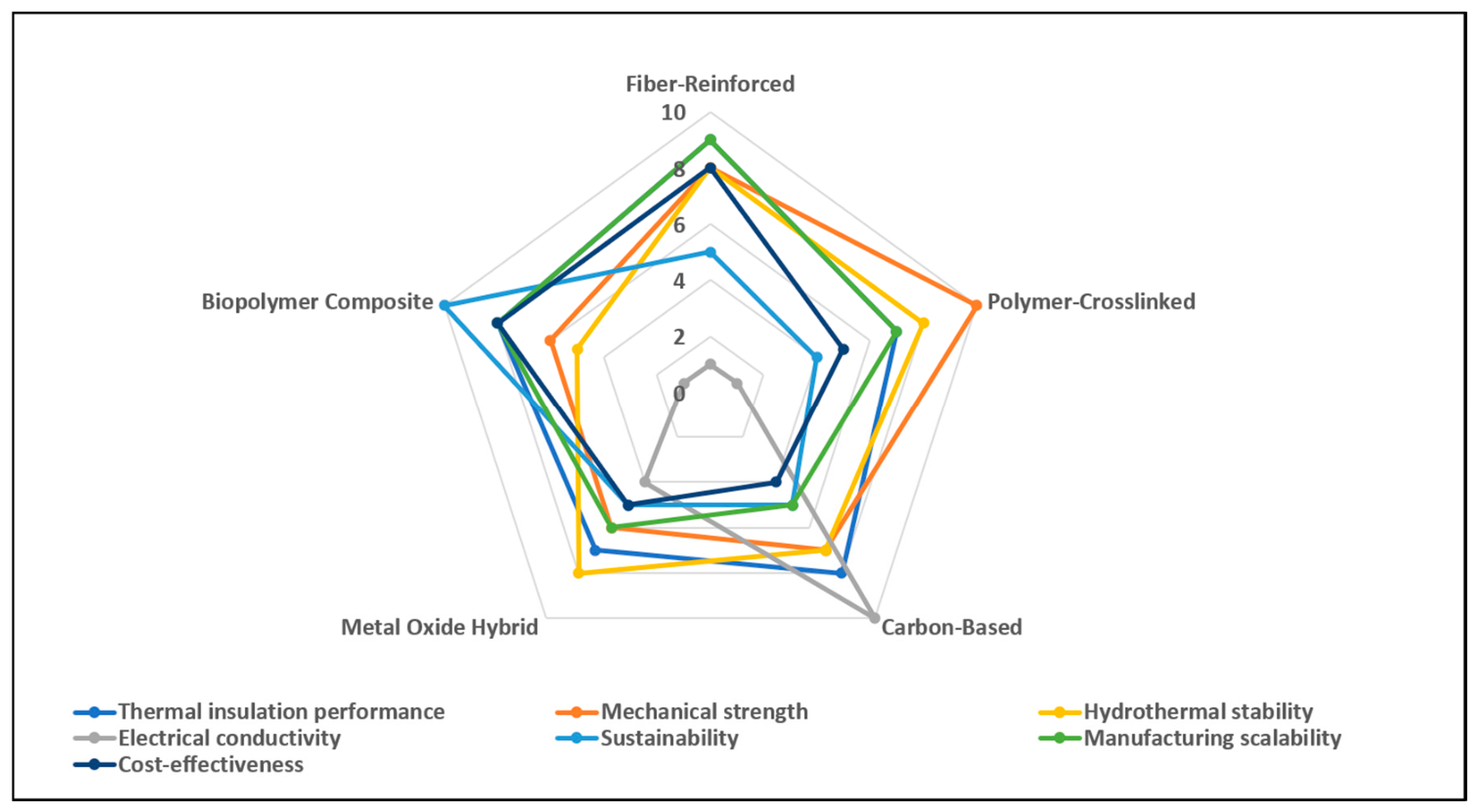
Achieving the best tradeoff or balance among various performance indexes including thermal insulation, mechanic strength, hydrothermal stability, electrical property, sustainability as well as producibility and cost-effectiveness poses a challenge when balancing these competing requirements in aerogel-based composite design (Aegerter et al., 2011; Du et al., 2013; Maleki et al., 2016; Yang et al., 2025; Zhao et al., 2018). At this stage, fiber-reinforced aerogels yield the greatest balance, so they are commercialized most; polymer cross linked aerogels show best performance in mechanic strength but poor in terms of conductivity and cost/ease for production; carbon aerogels show unparalleled electrical property related multifunctionality; biopolymer reinforced materials show promise mainly because of better sustainability while metal oxide ones target at niche application such as catalysis or magnetism according to Figure 15 and other figures above.
Figure 15.
Property trade-off map for major silica aerogel composite classes, illustrating relative strengths in thermal insulation, mechanical performance, hydrothermal stability, electrical conductivity, sustainability, manufacturing scalability, and cost-effectiveness.
Figure 15.
Property trade-off map for major silica aerogel composite classes, illustrating relative strengths in thermal insulation, mechanical performance, hydrothermal stability, electrical conductivity, sustainability, manufacturing scalability, and cost-effectiveness.
The future of silica aerogel composites will be defined by four converging imperatives: multifunctionality, requiring concurrent thermal, mechanical, electrical, chemical, and biological performance within unified architectures; sustainability, requiring replacement of energy-intensive synthesis with green-chemistry and circular-economy-compatible processes; scalability, requiring translation of laboratory concepts into continuous, cost-competitive industrial manufacturing; and intelligent design, relying on machine learning, digital twins, and autonomous experimentation to navigate multi-objective optimization at a pace unattainable through conventional experimentation. Realizing these imperatives simultaneously — rather than pursuing any one in isolation — is likely to determine which composite architectures move beyond the specialty applications reviewed in Section 5 and into broadly adopted, cost-competitive engineering materials over the coming decade. Achieving this outcome will require closer collaboration across disciplines that have historically operated somewhat independently: sol–gel chemists optimizing precursor and catalyst systems, materials scientists developing and characterizing reinforcement strategies, process engineers scaling drying and manufacturing routes, and data scientists building the predictive models discussed in Section 6.6. The composite classes and property trade-offs reviewed throughout this chapter — summarized collectively in Table 1 through 11 and Figure 1 through 15 — provide a common reference point for that collaboration as the field continues to mature.
7. Conclusions
Silica aerogel composites have provided an advancement in the development of aerogel technology. By overcoming the brittleness, moisture instability and limited functionality of pristine silica aerogels, they have enabled the definition of density, porosity, specific surface area and thermal insulation to remain. In incorporating reinforcing and functional phases into pristine silica aerogels such as fibres and polymers, carbon nanomaterials, metal oxides and biopolymers, multifunctional silica aerogel composites with improved mechanical strength and hydrothermal stability as well as excellent electrical conductivity, catalytic activity, electromagnetic shielding and environmental protection properties have successfully evolved. These advances have transformed silica aerogels from fragile laboratory materials into versatile engineering composites capable of addressing demanding requirements across a broad spectrum of scientific and industrial applications.
In this review, we have provided an overview of the ongoing research into the field of silica aerogel composites. With the principles of sol-gel synthesis and composite creation strategies, characterisation methods, structure-property relationships, performance enhancement and recent applications outlined. Literature highlights that there is no superior reinforcement strategy in each given design of composites there is a trade-off of mechanical performance, thermal insulation, multifunctionality, manufacturability and cost. Fiber-reinforced composites currently represent the most commercially mature technology because they combine excellent thermal insulation with improved mechanical integrity and scalable manufacturing. Polymer-crosslinked systems provide exceptional toughness and flexibility, carbon-based composites enable electrically conductive and electrochemically active materials, while metal oxide and biopolymer hybrids extend silica aerogel technology into photocatalysis, environmental remediation, biomedical engineering, and sustainable material development. Collectively, these advances illustrate the transition of silica aerogel composites from single-function insulation materials to multifunctional platforms capable of meeting increasingly complex engineering requirements.
However great the advancements made so far, there remain several outstanding scientific and technical challenges which need to be overcome. Production cost of conventional supercritical drying remains high limiting commercial spread, also it is difficult to achieve good dispersion of reinforcement in large quantities; interfacial compatibility of different phase materials has to be improved, durability of the materials under harsh condition should be improved and traditionally alkoxide precursors have toxic effects. It entails concurrent advances in precursor chemistry, processing technology, interface engineering and scalable manufacturing. The ongoing study into ambient pressure drying, sodium silicate (waterglass) produced aerogels, renewables (wood fibres reinforced and bio-aerogels reinforced composite), continuous (roll to roll type manufacture) and additive manufacturing techniques will play increasing roles in reducing the production cost and toxicity while improving sustainability and productivity.
Future studies on aerogel composites are expected to go beyond conventional, composite optimisation to rational design of multifunctional and intelligent aerogel systems. Combination of hierarchical microstructural engineering, surface functionalisation, hybrid reinforcement and advanced manufacturing techniques would allow the aerogel composites to have an application-specific combinations of thermal insulation, high mechanical properties, electrically conductive properties, catalytic, sensing and reversible responding properties. Integration of AI (artificial intelligence), machine learning, high throughput experiment, digital twin manufacturing and multi-scale computational modelling is expecting to accelerate materials discovery, optimisation of synthesis parameters and shorten the development of synthesis cycle of novel aerogel composites.
Overall, silica aerogel composites have evolved from an academic research topic into an increasingly mature class of advanced functional materials with substantial commercial and societal relevance. Continued progress in sustainable processing, multifunctional design, scalable manufacturing, and data-driven materials engineering is expected to further expand their adoption across energy-efficient buildings, industrial thermal insulation, aerospace thermal protection, environmental remediation, renewable energy systems, biomedical technologies, electronics, and smart infrastructure. As advances in materials science, manufacturing, and computational design continue to converge, silica aerogel composites are well positioned to become one of the key enabling material platforms for sustainable, high-performance engineering applications in the coming decades.
Author Contributions
Conceptualization: Sayeed Rushd, Md Arifuzzaman, Md Enamul Hoque, Aminur Rahman. Methodology: Sayeed Rushd, Md Arifuzzaman. Investigation: Sayeed Rushd. Resources: Md Arifuzzaman, M H Rahman, Aminur Rahman. Data Curation: Sayeed Rushd. Formal Analysis: Sayeed Rushd, Md Arifuzzaman. Visualization: Sayeed Rushd. Validation: Sayeed Rushd, Md Arifuzzaman, Md Enamul Hoque, Aminur Rahman. Supervision: Md Arifuzzaman, Md Enamul Hoque. Project Administration: Md Arifuzzaman, Md Enamul Hoque. Writing – Original Draft: Sayeed Rushd. Writing – Review & Editing: Sayeed Rushd, Md Arifuzzaman, M H Rahman, Md Enamul Hoque, Aminur Rahman. Funding Acquisition: Sayeed Rushd, Md Arifuzzaman, Aminur Rahman. All authors have read and approved the final manuscript and agree to be accountable for all aspects of the work.
Funding
This work was supported by the Deanship of Scientific Research, Vice Presidency for Graduate Studies and Scientific Research, King Faisal University, Saudi Arabia (Grant No. KFU264268).
Acknowledgments
The authors gratefully acknowledge the institutional patronage provided by King Faisal University and the University of Tabuk, which facilitated the completion of this work. The authors also acknowledge the use of publicly accessible artificial intelligence (AI) tools, including ChatGPT, DeepSeek, Claude, and Grammarly, solely for language editing, proofreading, and improving the clarity and readability of the manuscript. These tools were not used for the generation, interpretation, or validation of scientific content, and all intellectual contributions, technical analyses, conclusions, and final manuscript preparation remain the responsibility of the authors.
Conflicts of Interest
The authors declare that they have no known competing financial interests or personal relationships that could have appeared to influence the work reported in this paper.
References
- Aegerter, M. A.; Leventis, N.; Koebel, M. M. (Eds.) Aerogels handbook; Springer, 2011. [Google Scholar] [CrossRef]
- Agrawal, A.; Choudhary, A. Perspective: Materials informatics and big data: Realization of the "fourth paradigm" of science in materials science. APL Mater. 2016, 4(5), 053208. [Google Scholar] [CrossRef]
- Baetens, R.; Jelle, B. P.; Gustavsen, A. Aerogel insulation for building applications: A state-of-the-art review. Energy Build. 2011, 43(4), 761–769. [Google Scholar] [CrossRef]
- Brinker, C. J.; Scherer, G. W. Sol–gel science: The physics and chemistry of sol–gel processing; Academic Press, 1990. [Google Scholar] [CrossRef]
- Butler, K. T.; Davies, D. W.; Cartwright, H.; Isayev, O.; Walsh, A. Machine learning for molecular and materials science. Nature 2018, 559, 547–555. [Google Scholar] [CrossRef] [PubMed]
- Cao, Y.; Li, R.; Chen, Z.; Liu, M.; Duan, Y.; Li, S.; Li, Z. Carbonized Composites Containing Silica Aerogels with Enhanced Hydrophobicity and Thermal Insulation via Glass Fiber and Hollow Microsphere Reinforcement. Gels 2026, 12(5), 439. [Google Scholar] [CrossRef]
- Chemere, E. B.; Mhlabeni, T. L.; Mhike, W.; Mavhungu, M. L.; Shongwe, M. B. A comprehensive review of types, synthesis strategies, advanced designing and applications of aerogels. R. Soc. Open Sci. 2025, 12(5), 241975. [Google Scholar] [CrossRef]
- Chen, Y.; Yan, X.; Wang, R.; Jin, G.; Kong, L.; Xu, Q.; Zhao, H.; Kuang, M.; Zhang, X. High-temperature-resistant aerogel composites for pressure and temperature sensing. Chem. Mater. 2025, 37(9), 3295–3304. [Google Scholar] [CrossRef]
- Cheng, Y.; Xia, M.; Luo, F.; Li, N.; Guo, C.; Wei, C. Effect of surface modification on physical properties of silica aerogels derived from fly ash acid sludge. Colloids Surf. A Physicochem. Eng. Asp. 2016, 490, 200–206. [Google Scholar] [CrossRef]
- Du, A.; Zhou, B.; Zhang, Z.; Shen, J. A Special Material or a New State of Matter: A Review and Reconsideration of the Aerogel. Materials 2013, 6(3), 941–968. [Google Scholar] [CrossRef]
- Fesmire, J. E. Aerogel insulation systems for space launch applications. Cryogenics 2006, 46(2–3), 111–117. [Google Scholar] [CrossRef]
- Fricke, J.; Emmerling, A. Aerogels—Preparation, properties, applications. In Chemistry, spectroscopy and applications of sol-gel glasses; Reisfeld, R., Jørgensen, C. K., Eds.; Springer, 1992; Vol. 77, pp. 1–27. [Google Scholar] [CrossRef]
- Gonthier, J.; Rilling, T.; Scoppola, E.; Zemke, F.; Gurlo, A.; Fratzl, P.; Wagermaier, W. In operando μCT imaging of silylated silica aerogels during ambient pressure drying and spring-back. Chem. Mater. 2023, 35(18), 7683–7693. [Google Scholar] [CrossRef]
- Guo, L.; Du, M.; Li, J.; Li, W.; Yang, M.; Xin, G. Tensile resistance and fracture mechanisms of silica aerogels reinforced by nanotube–graphene hybrid networks. Gels 2025, 11(6), 471. [Google Scholar] [CrossRef]
- He, S.; Du, C.; Sheng, H.; He, C.; Liu, X.; Jin, X.; Chen, Q.; Tian, F. Ultrasensitive and self-powered multiparameter pressure–temperature–humidity sensor based on ultra-flexible conductive silica aerogel. Gels 2023, 9(2), 162. [Google Scholar] [CrossRef]
- He, S.; Guo, S.; Zhang, Y.; Huang, Y. High performance thermal insulation blanket integrated with silica aerogel composites. Ceram. Int. 2025, 51(Part A), 33263–33272. [Google Scholar] [CrossRef]
- Hu, H.; Wang, J.; Li, C.; Li, L. Reinforcement strategies to improve the mechanical properties of nanofibrous aerogels: A review. ACS Appl. Nano Mater. 2024, 7(23), 26546–26578. [Google Scholar] [CrossRef]
- Hüsing, N.; Schubert, U. Aerogels—airy materials: Chemistry, structure, and properties. Angew. Chem. Int. Ed. 1998, 37(1–2), 22–45. [Google Scholar] [CrossRef]
- Jin, R.; Zhou, Z.; Liu, J.; Shi, B.; Zhou, N.; Wang, X.; Jia, X.; Guo, D.; Xu, B. Aerogels for Thermal Protection and Their Application in Aerospace. Gels 2023, 9(8), 606. [Google Scholar] [CrossRef]
- Koebel, M. M.; Rigacci, A.; Achard, P. Aerogel-based thermal superinsulation: An overview. J. Sol.-Gel Sci. Technol. 2012, 63(3), 315–339. [Google Scholar] [CrossRef]
- Kistler, S. S. Coherent expanded aerogels and jellies. Nature 1931, 127, 741. [Google Scholar] [CrossRef]
- Leventis, N. Three-dimensional core-shell superstructures: mechanically strong aerogels. Acc. Chem. Res. 2007, 40(9), 874–884. [Google Scholar] [CrossRef]
- Leventis, N.; Sotiriou-Leventis, C.; Zhang, G.; Rawashdeh, A.-M. M. Nanoengineering strong silica aerogels. Nano Lett. 2002, 2(9), 957–960. [Google Scholar] [CrossRef]
- Leventis, N.; Sotiriou-Leventis, C.; Chandrasekaran, N.; Mulik, S.; Larimore, Z. J.; Lu, H.; Churu, G.; Mang, J. T. Multifunctional polyurea aerogels from isocyanates and water: A structure–property case study. Chem. Mater. 2010, 22(24), 6692–6710. [Google Scholar] [CrossRef]
- Li, Y.; Lv, T.; Xing, X.; Zhu, D.; Zhang, X.; Wu, X.; Yu, W.; Wang, L. Dual-crosslinked architecture in silica-based aerogels with self-ceramization for superior thermal insulation at high temperatures. Ceram. Int. 2025, 51(Part A), 27903–27911. [Google Scholar] [CrossRef]
- Linhares, T.; Carneiro, V. H.; Pessoa de Amorim, M. T.; Durães, L. A comparative thermoacoustic insulation study of silica aerogels reinforced with reclaimed textile fibres: Cotton, polyester and wool. Gels 2023, 9(7), 548. [Google Scholar] [CrossRef]
- Liu, W.; Song, M.-S.; Kong, B.; Cui, Y. Flexible and stretchable energy storage: Recent advances and future perspectives. Adv. Mater. 2017, 29(1), 1603436. [Google Scholar] [CrossRef] [PubMed]
- Luo, R.; Li, J.; Bao, K.; Hu, C.; Pang, S.; Yan, M.; Zhao, R.; Liang, B.; Gao, K.; Liu, Z.; Zhang, Z.; Cheng, H.-M.; Ritchie, R. O.; Tang, S. Exceptionally strong and damage-tolerant carbon aerogel composite with high thermal stability and insulation. Mater. Today 2025, 87, 1–10. [Google Scholar] [CrossRef]
- Maleki, H.; Durães, L.; García-González, C. A.; del Gaudio, P.; Portugal, A.; Mahmoudi, M. Synthesis and biomedical applications of aerogels: Possibilities and challenges. Adv. Colloid Interface Sci. 2016, 236, 1–27. [Google Scholar] [CrossRef]
- Maleki, H.; Durães, L.; Portugal, A. An overview on silica aerogels synthesis and different mechanical reinforcing strategies. J. Non-Cryst. Solids 2014, 385, 55–74. [Google Scholar] [CrossRef]
- Meador, M. A. B.; Alemán, C. R.; Hanson, K.; Ramirez, N.; Vivod, S. L.; Wilmoth, N.; McCorkle, L. Polyimide aerogels with amide cross-links: A low cost alternative for mechanically strong polymer aerogels. ACS Appl. Mater. Interfaces 2015, 7(2), 1240–1249. [Google Scholar] [CrossRef]
- Meador, M. A. B.; Capadona, L. A.; McCorkle, L.; Papadopoulos, D. S.; Leventis, N. Structure–property relationships in porous 3D nanostructures as a function of preparation conditions: Isocyanate cross-linked silica aerogels. Chem. Mater. 2007, 19(9), 2247–2260. [Google Scholar] [CrossRef]
- Parale, V. G.; Kim, T.; Choi, H.; Phadtare, V. D.; Dhavale, R. P.; Kanamori, K.; Park, H.-H. Mechanically strengthened aerogels through multiscale, multicompositional, and multidimensional approaches: A review. Adv. Mater. 2024, 36(18), 2307772. [Google Scholar] [CrossRef] [PubMed]
- Pierre, A. C.; Pajonk, G. M. Chemistry of aerogels and their applications. Chem. Rev. 2002, 102(11), 4243–4265. [Google Scholar] [CrossRef]
- Rao, A. V.; Bhagat, S. D.; Hirashima, H.; Pajonk, G. M. Synthesis of flexible silica aerogels using methyltrimethoxysilane (MTMS) precursor. J. Colloid Interface Sci. 2006, 300(1), 279–285. [Google Scholar] [CrossRef]
- Rouquerol, J.; Rouquerol, F.; Sing, K.; Llewellyn, P.; Maurin, G.; Denoyel, R.; Coulet, M.-V.; Beurroies, I. Adsorption by powders and porous solids: Principles, methodology, and applications, 3rd ed.; Academic Press, 2026. [Google Scholar]
- Sarathchandran, C.; Renjith, P. K.; Sekkar, V. Silica aerogels: Synthesis, properties, and applications. In Engineering of natural polymeric gels and aerogels for multifunctional applications; Thomas, S., Seantier, B., Joseph, B., Eds.; Elsevier, 2024; pp. 313–342. [Google Scholar] [CrossRef]
- Scheff, T.; Acha, F.; Diaz Armas, N.; Mead, J. L.; Zhang, J. Tuning wetting properties through surface geometry in the Cassie–Baxter state. Biomimetics 2025, 10(1), 20. [Google Scholar] [CrossRef]
- Stark, F. W.; Thue, P. S.; Missio, A. L.; Machado, F. M.; Delucis, R. d. A.; Andreazza, R. Cellulose-Based Aerogels for Environmentally Sustainable Applications: A Review of the Production, Modification, and Sorption of Environmental Contaminants. Polymers 2025, 17(2), 236. [Google Scholar] [CrossRef] [PubMed]
- Sikiru, S.; Busari, Y. O.; Olutoki, J. O.; Mahat, M. M.; Kolawole, S. Y. Recent advances in polymer-based photocatalysts for environmental remediation and energy conversion: A review. J. Polym. Mater. 2025, 42(1), 1–31. [Google Scholar] [CrossRef]
- Sinkó, K. Influence of chemical conditions on the nanoporous structure of silicate aerogels. Materials 2010, 3(1), 704–740. [Google Scholar] [CrossRef]
- Ślosarczyk, A. Carbon Fiber—Silica Aerogel Composite with Enhanced Structural and Mechanical Properties Based on Water Glass and Ambient Pressure Drying. Nanomaterials 2021, 11(2), 258. [Google Scholar] [CrossRef]
- Su, J.; Liu, R.; Liu, S.; Ru, C.; Yan, X.; Su, D.; Li, X. Preparation of low-thermal-conductivity and high-strength GPTMS polymer cross-linked SiO₂ aerogels via a two-step modification method. J. Non-Cryst. Solids 2025, 668, 123798. [Google Scholar] [CrossRef]
- Wei, Z.; Guo, X.; Gong, M.; Guo, Y.; Yang, H. G.; Yang, S. Recent progress on mechanical reinforcement of silica aerogels and their applications. Mater. Des. 2026, 267, 116352. [Google Scholar] [CrossRef]
- Yang, J.; Han, X.; Yang, W.; Hu, J.; Zhang, C.; Liu, K.; Jiang, S. Nanocellulose-based composite aerogels toward the environmental protection: Preparation, modification and applications. Environ. Res. 2023, 236(Part 1), 116736. [Google Scholar] [CrossRef]
- Yang, Z.; Hu, Q.; Wang, L.; Cao, J.; Song, J.; Song, L.; Zhang, Y. Recent advances in the synthesis and application of graphene aerogel and silica aerogel for environment and energy storage: A review. J. Environ. Manag. 2025, 377, 124668. [Google Scholar] [CrossRef]
- Yuvaraja, G.; Wen, C.-T.; Huang, S.-Y.; Wang, Y.-L.; Munagapati, V. S.; Vijaya, Y.; Koteswararao, R.; Choi, H. Y.; Sangaraju, S. Recent advances on TiO₂ based hybrid aerogels for photocatalytic degradation of dyes: A review. Inorg. Chem. Commun. 2025, 179(Part 1), 114649. [Google Scholar] [CrossRef]
- Zhang, F.; You, C.; Cai, L.; Wang, F. Bio-based aerogels: Advanced strategies for sustainable fabrication and multifunctional applications. Adv. Mater. Technol. 2026, 11(4), e02584. [Google Scholar] [CrossRef]
- Zhao, S.; Malfait, W. J.; Guerrero-Alburquerque, N.; Koebel, M. M.; Nyström, G. Biopolymer aerogels and foams: Chemistry, properties, and applications. Angew. Chem. Int. Ed. 2018, 57(26), 7580–7608. [Google Scholar] [CrossRef]
- Zhao, D.; Wan, K.; Wan, X.; Liu, Y.; Li, J.; Shi, M. High Structural Stability, High Compressive Strength, Excellent Thermal Insulation and Mechanism of Needled Quartz Fiber Felt/Phenolic Aerogel Composites. Polymers 2026, 18(6), 705. [Google Scholar] [CrossRef] [PubMed]
- Zhan, W.; Chen, L.; Kong, Q.; Li, L.; Chen, M.; Jiang, J.; Li, W.; Shi, F.; Xu, Z. The Synthesis and Polymer-Reinforced Mechanical Properties of SiO2 Aerogels: A Review. Molecules 2023, 28(14), 5534. [Google Scholar] [CrossRef]
- Zhu, Z.; Zhang, W.; Huang, H.; Li, W.; Ling, H.; Zhang, H. A Review of High-Temperature Resistant Silica Aerogels: Structural Evolution and Thermal Stability Optimization. Gels 2025, 11(5), 357. [Google Scholar] [CrossRef]
Figure 1.
Schematic representation of the generalized fabrication pathway for silica aerogel composites (Aegerter et al., 2011; Brinker & Scherer, 1990; Sarathchandran et al., 2024; Zhu et al., 2025; Hüsing & Schubert, 1998; Maleki et al., 2014; Pierre & Pajonk, 2002; Rao et al., 2006).
Figure 1.
Schematic representation of the generalized fabrication pathway for silica aerogel composites (Aegerter et al., 2011; Brinker & Scherer, 1990; Sarathchandran et al., 2024; Zhu et al., 2025; Hüsing & Schubert, 1998; Maleki et al., 2014; Pierre & Pajonk, 2002; Rao et al., 2006).
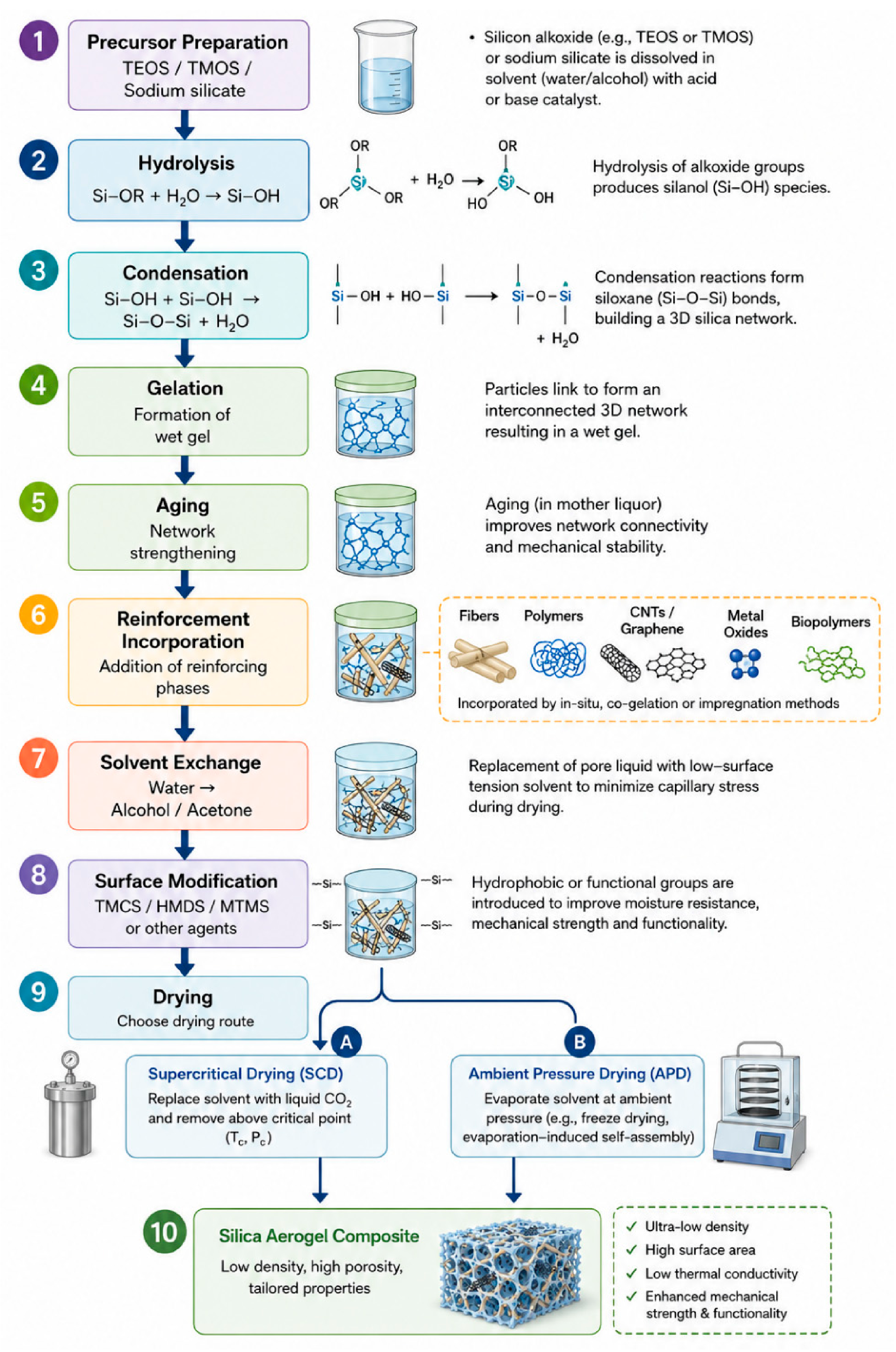
Figure 2.
Schematic illustration of the hierarchical structure of a silica aerogel composite, showing the interconnected silica nanoparticle network, nanopores (<2 nm), mesopores (2–50 nm), and macropores (>50 nm), together with representative reinforcing phases including fibers, polymers, carbon nanotubes, and graphene (Aegerter et al., 2011; Sarathchandran et al., 2024; Zhu et al., 2025; Hüsing & Schubert, 1998; Maleki et al., 2014; Pierre & Pajonk, 2002; Zhao et al., 2018).
Figure 2.
Schematic illustration of the hierarchical structure of a silica aerogel composite, showing the interconnected silica nanoparticle network, nanopores (<2 nm), mesopores (2–50 nm), and macropores (>50 nm), together with representative reinforcing phases including fibers, polymers, carbon nanotubes, and graphene (Aegerter et al., 2011; Sarathchandran et al., 2024; Zhu et al., 2025; Hüsing & Schubert, 1998; Maleki et al., 2014; Pierre & Pajonk, 2002; Zhao et al., 2018).
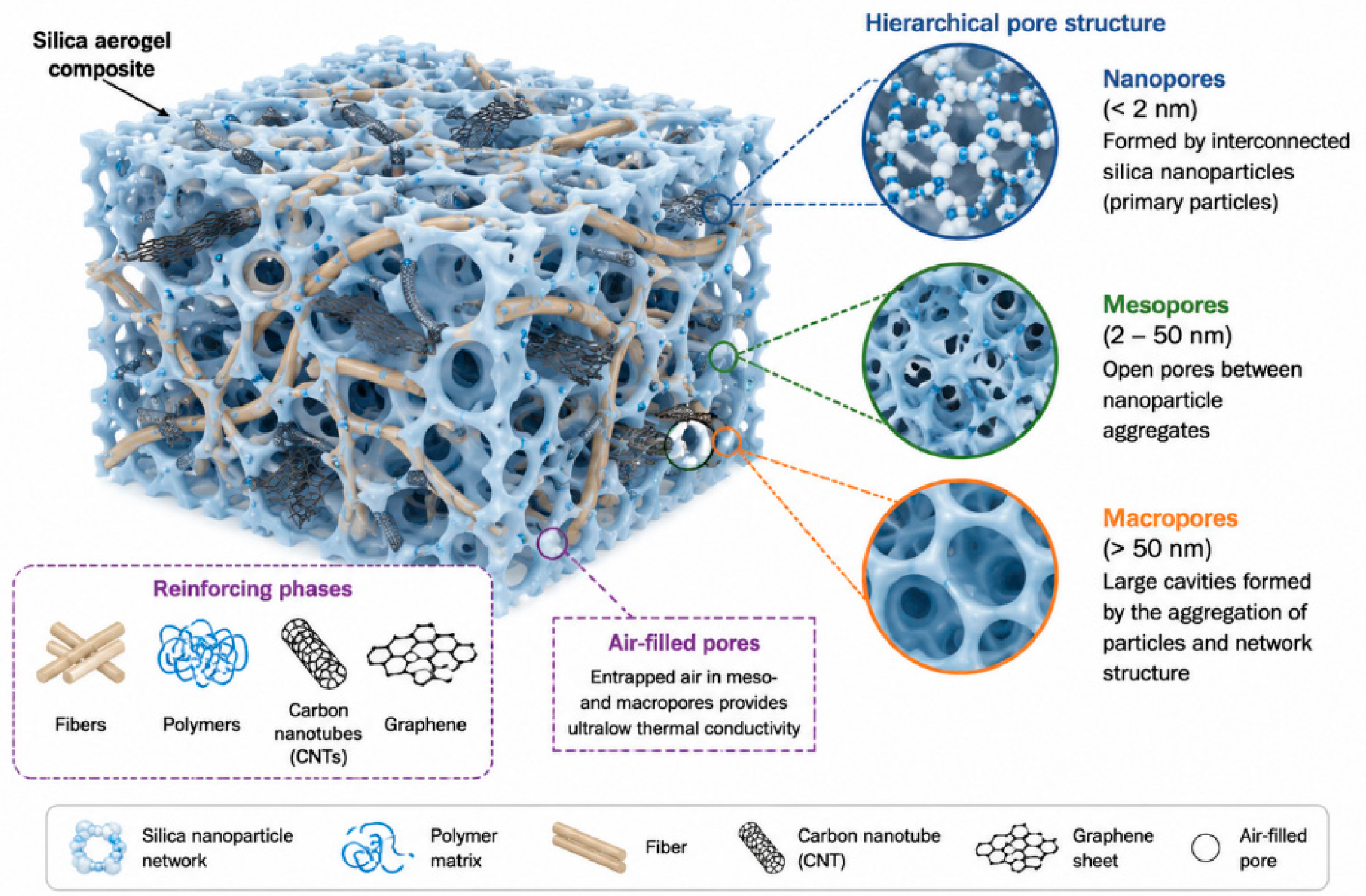
Figure 3.
Classification of silica aerogel composites according to the nature of the reinforcing or functional phase incorporated into the silica network.
Figure 3.
Classification of silica aerogel composites according to the nature of the reinforcing or functional phase incorporated into the silica network.
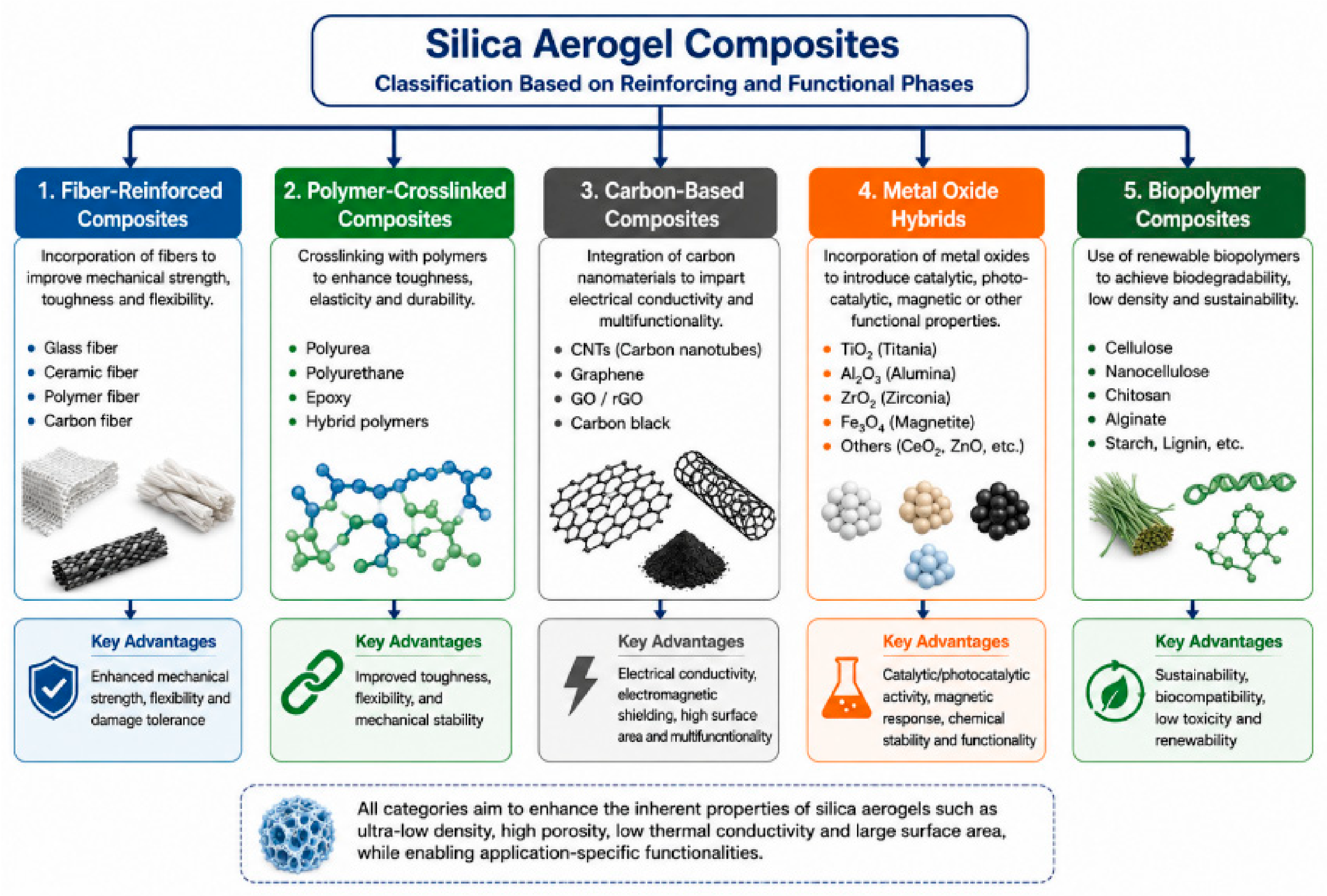
Figure 4.
Representative nitrogen adsorption–desorption isotherms and BJH pore size distributions of pristine and reinforced silica aerogel composites, synthesized from published experimental studies (Rouquerol et al., 2026; Pierre & Pajonk, 2002; Aegerter et al., 2011; Maleki et al., 2016; Du et al., 2013). (a) Type IV adsorption–desorption isotherms obtained by nitrogen physisorption at 77 K, illustrating the influence of fiber reinforcement, polymer crosslinking, and carbon nanomaterial incorporation on adsorption capacity and hysteresis behavior. (b) Corresponding BJH pore size distributions showing representative changes in mesopore diameter and pore volume resulting from different reinforcement strategies. The curves are schematic representations synthesized from published experimental studies.
Figure 4.
Representative nitrogen adsorption–desorption isotherms and BJH pore size distributions of pristine and reinforced silica aerogel composites, synthesized from published experimental studies (Rouquerol et al., 2026; Pierre & Pajonk, 2002; Aegerter et al., 2011; Maleki et al., 2016; Du et al., 2013). (a) Type IV adsorption–desorption isotherms obtained by nitrogen physisorption at 77 K, illustrating the influence of fiber reinforcement, polymer crosslinking, and carbon nanomaterial incorporation on adsorption capacity and hysteresis behavior. (b) Corresponding BJH pore size distributions showing representative changes in mesopore diameter and pore volume resulting from different reinforcement strategies. The curves are schematic representations synthesized from published experimental studies.
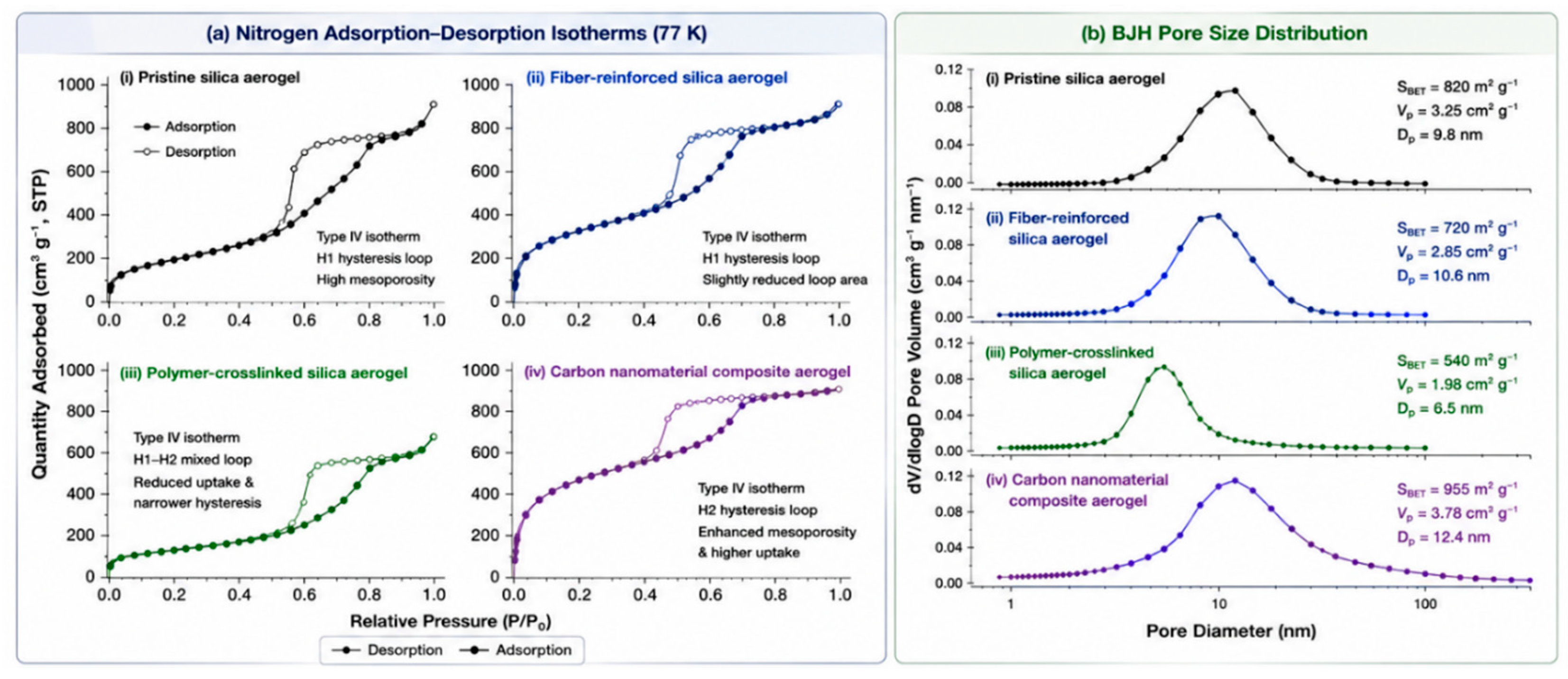
Figure 5.
Representative SEM morphologies illustrating structural evolution following different reinforcement strategies: (a) pristine silica aerogel (Aegerter et al., 2011); (b) fiber-reinforced silica aerogel (Maleki et al., 2016); (c) polymer-crosslinked silica aerogel (Leventis, 2007); (d) graphene/CNT-reinforced aerogel (Yang et al., 2025).
Figure 5.
Representative SEM morphologies illustrating structural evolution following different reinforcement strategies: (a) pristine silica aerogel (Aegerter et al., 2011); (b) fiber-reinforced silica aerogel (Maleki et al., 2016); (c) polymer-crosslinked silica aerogel (Leventis, 2007); (d) graphene/CNT-reinforced aerogel (Yang et al., 2025).
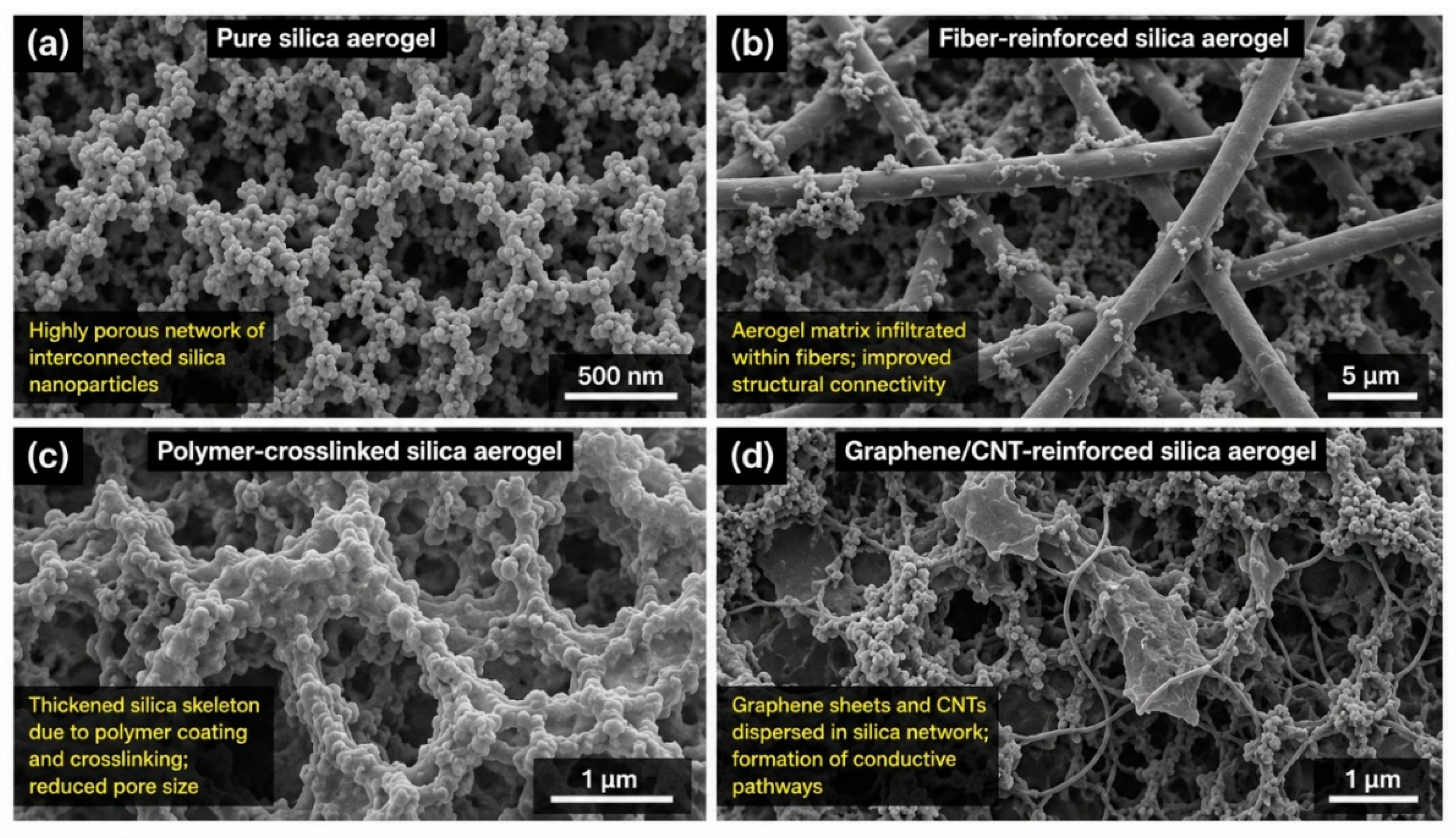
Figure 6.
Representative FTIR spectra of pristine and modified silica aerogel composites, synthesized from published literature (Pierre & Pajonk, 2002; Rao et al., 2015; Leventis, 2007; Aegerter et al., 2011; Maleki et al., 2016; Du et al., 2013).
Figure 6.
Representative FTIR spectra of pristine and modified silica aerogel composites, synthesized from published literature (Pierre & Pajonk, 2002; Rao et al., 2015; Leventis, 2007; Aegerter et al., 2011; Maleki et al., 2016; Du et al., 2013).
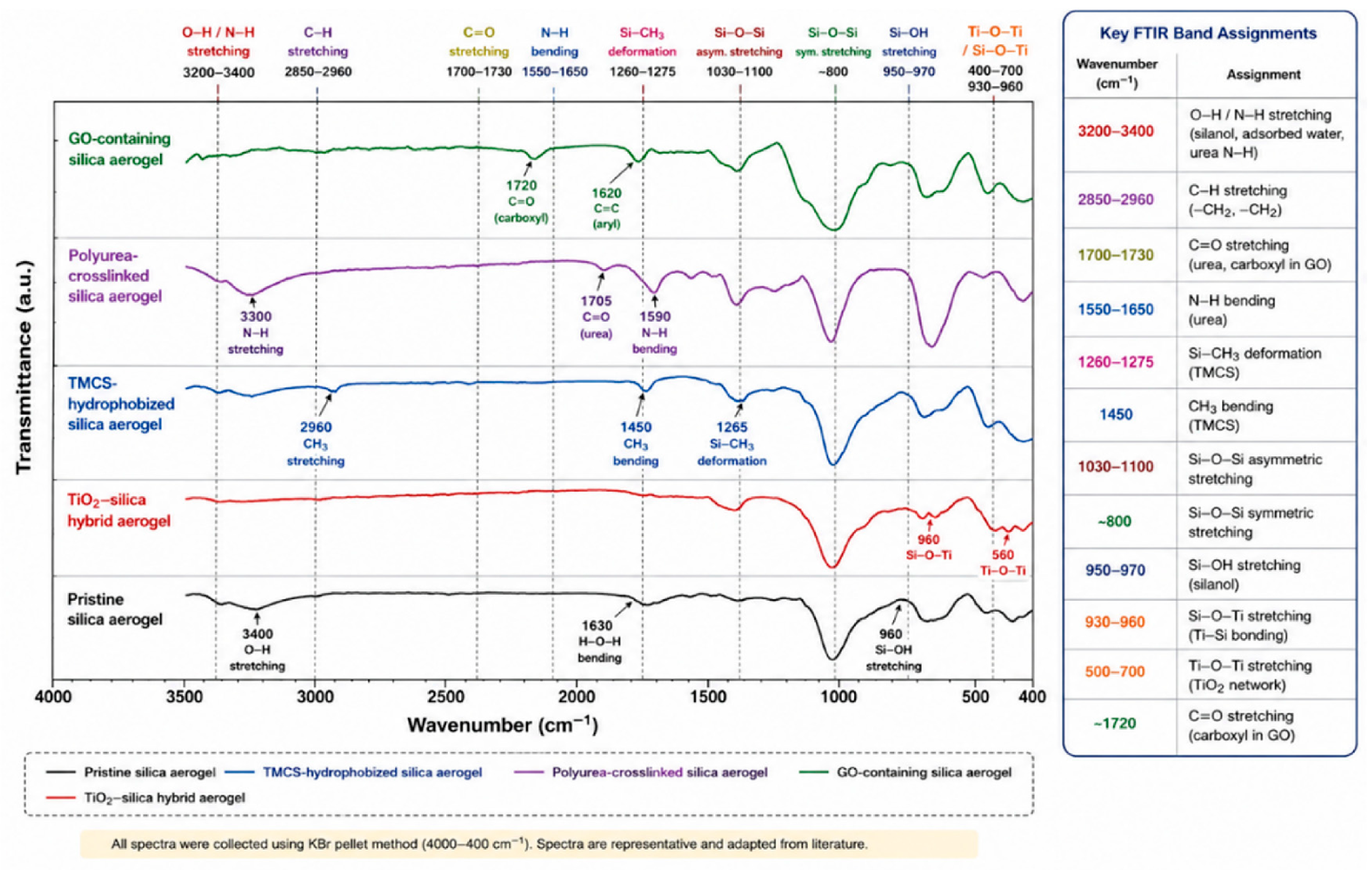
Figure 8.
Comparison of representative thermal conductivity values for silica aerogel composites and conventional insulation materials, synthesized from published literature (Fricke & Emmerling, 1992; Pierre & Pajonk, 2002; Koebel et al., 2012; Maleki et al., 2016).
Figure 8.
Comparison of representative thermal conductivity values for silica aerogel composites and conventional insulation materials, synthesized from published literature (Fricke & Emmerling, 1992; Pierre & Pajonk, 2002; Koebel et al., 2012; Maleki et al., 2016).
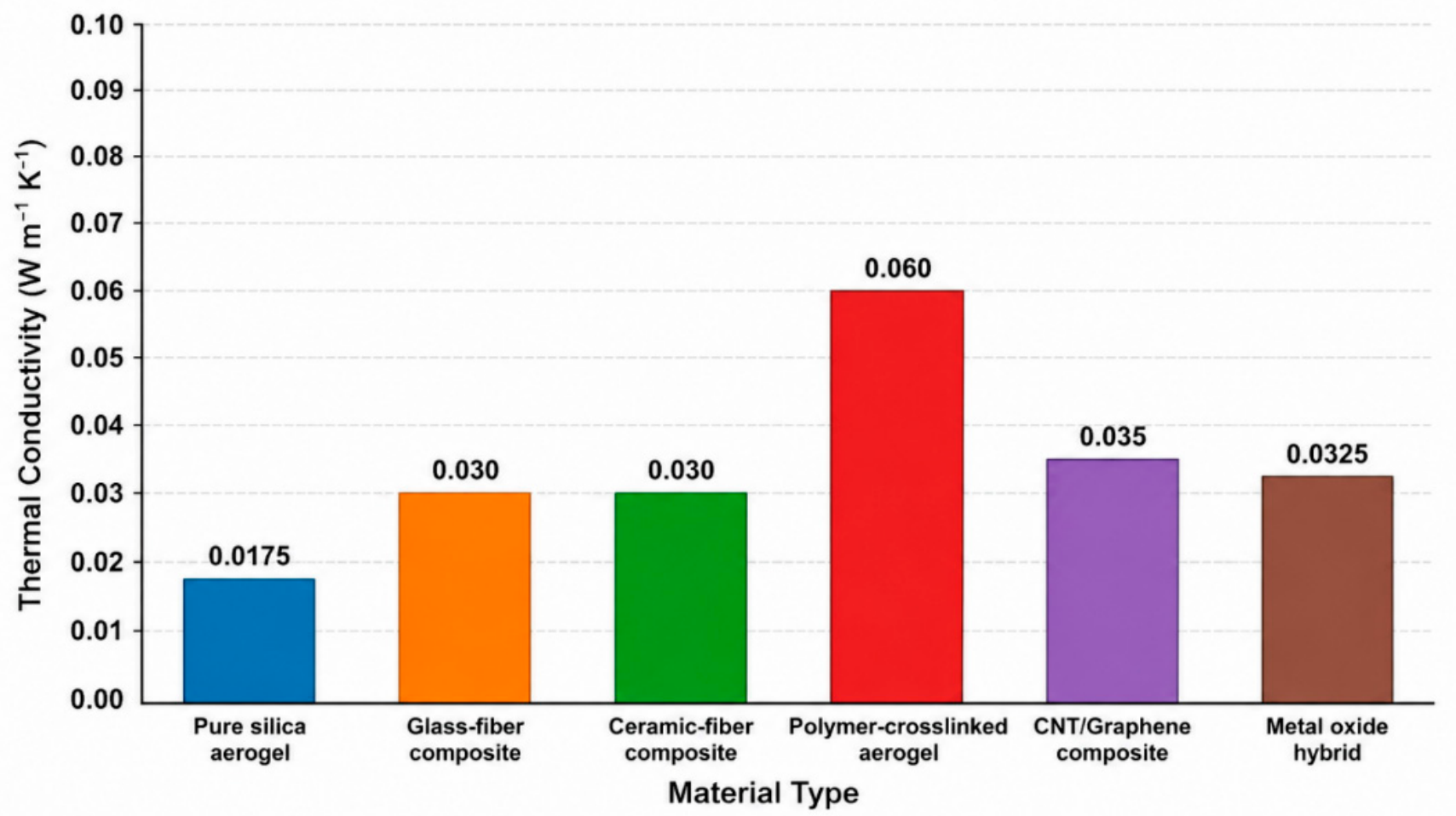
Figure 9.
Representative water contact angle images and moisture uptake values for untreated, TMCS-modified, superhydrophobic, and polymer-crosslinked silica aerogel composites, synthesized from published literature (Pierre & Pajonk, 2002; Rao et al., 2015; Maleki et al., 2016; Aegerter et al., 2011).
Figure 9.
Representative water contact angle images and moisture uptake values for untreated, TMCS-modified, superhydrophobic, and polymer-crosslinked silica aerogel composites, synthesized from published literature (Pierre & Pajonk, 2002; Rao et al., 2015; Maleki et al., 2016; Aegerter et al., 2011).
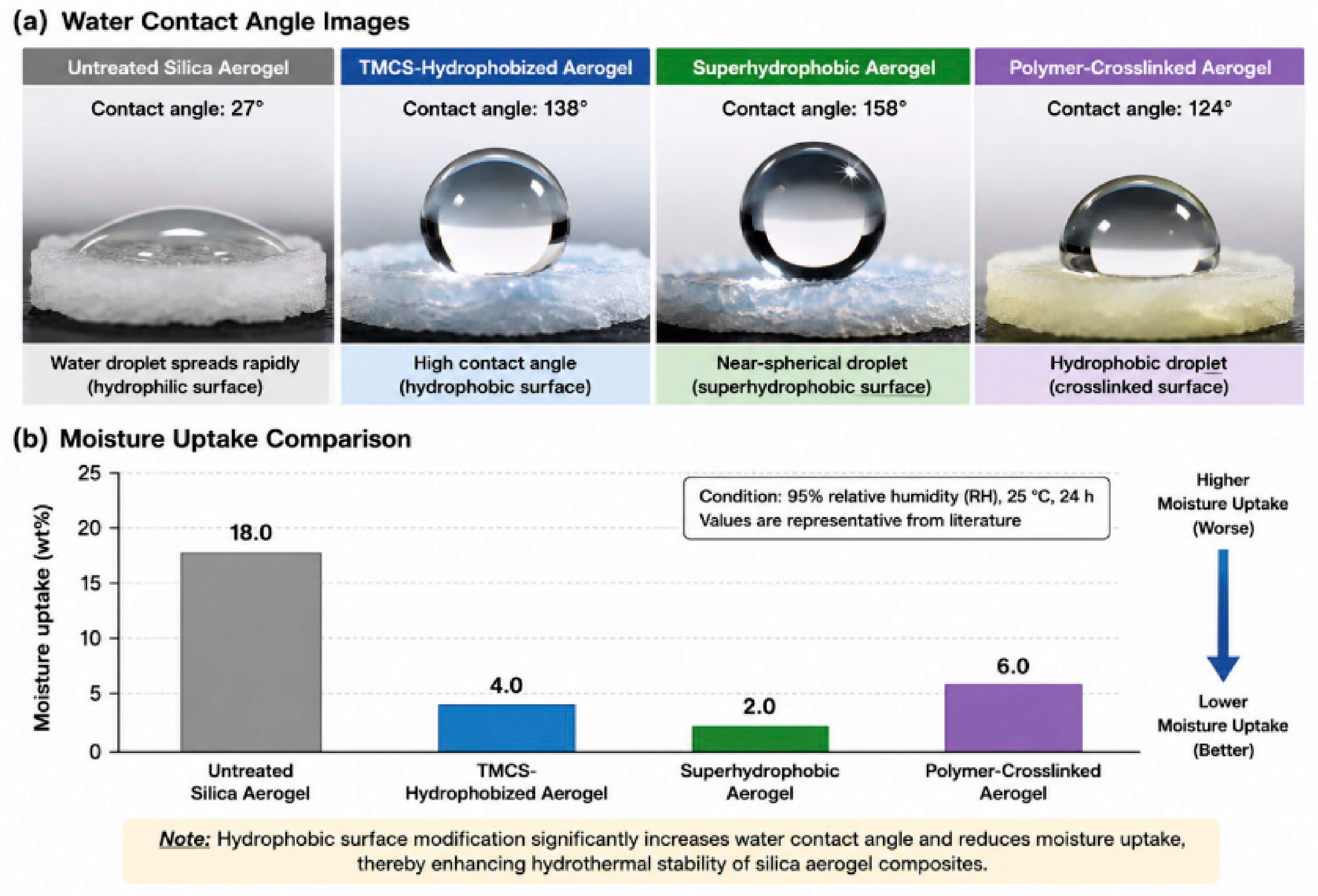
Figure 11.
Comparison of the average thermal conductivity of pure silica aerogel and representative silica aerogel composite systems, based on the arithmetic mean of literature-reported ranges.
Figure 11.
Comparison of the average thermal conductivity of pure silica aerogel and representative silica aerogel composite systems, based on the arithmetic mean of literature-reported ranges.
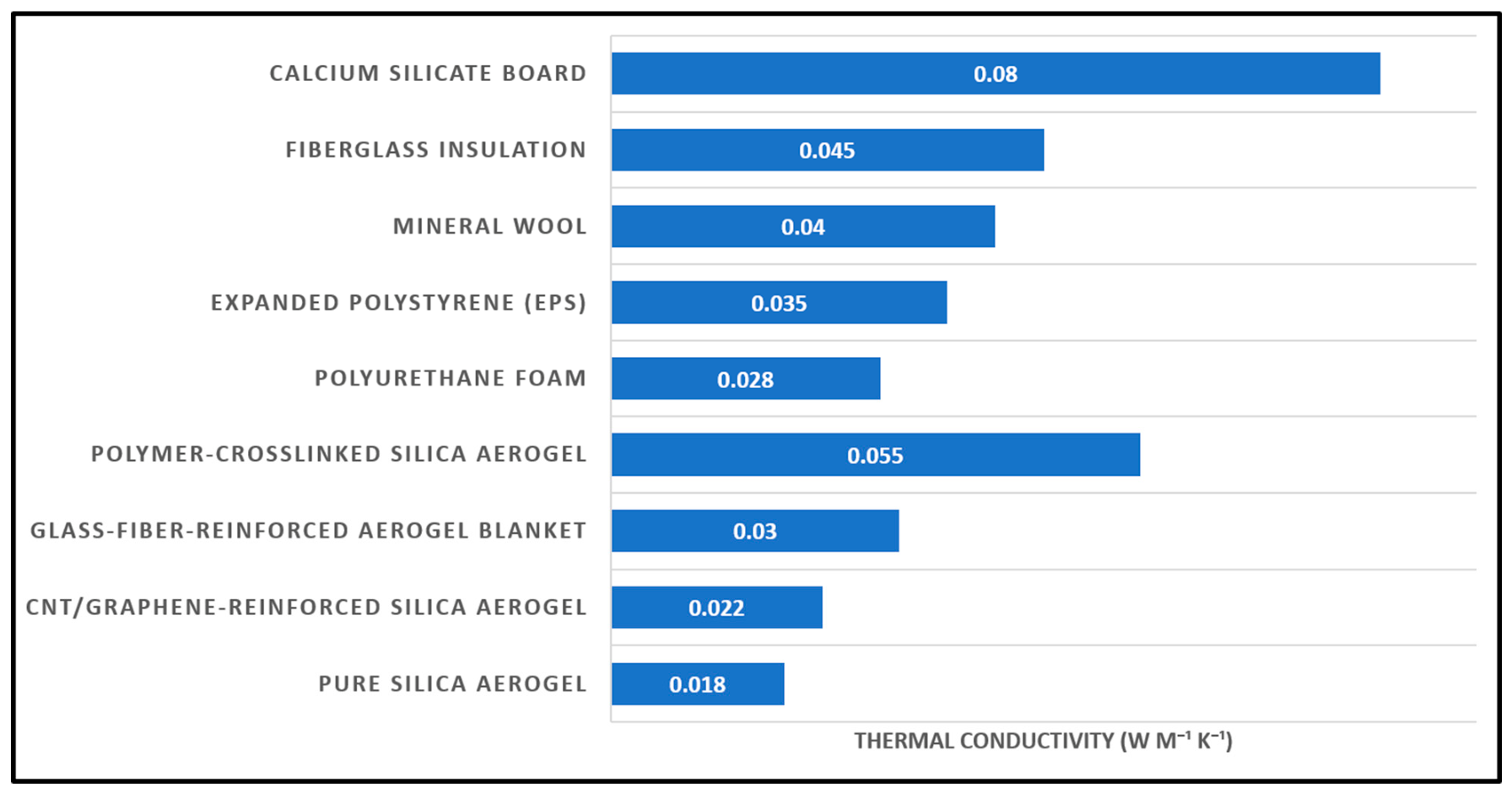
Figure 12.
Oil sorption mechanism and regeneration cycle of hydrophobic silica aerogel composites, illustrating selective absorption of hydrocarbons and recovery through mechanical squeezing, solvent washing, or thermal desorption.
Figure 12.
Oil sorption mechanism and regeneration cycle of hydrophobic silica aerogel composites, illustrating selective absorption of hydrocarbons and recovery through mechanical squeezing, solvent washing, or thermal desorption.
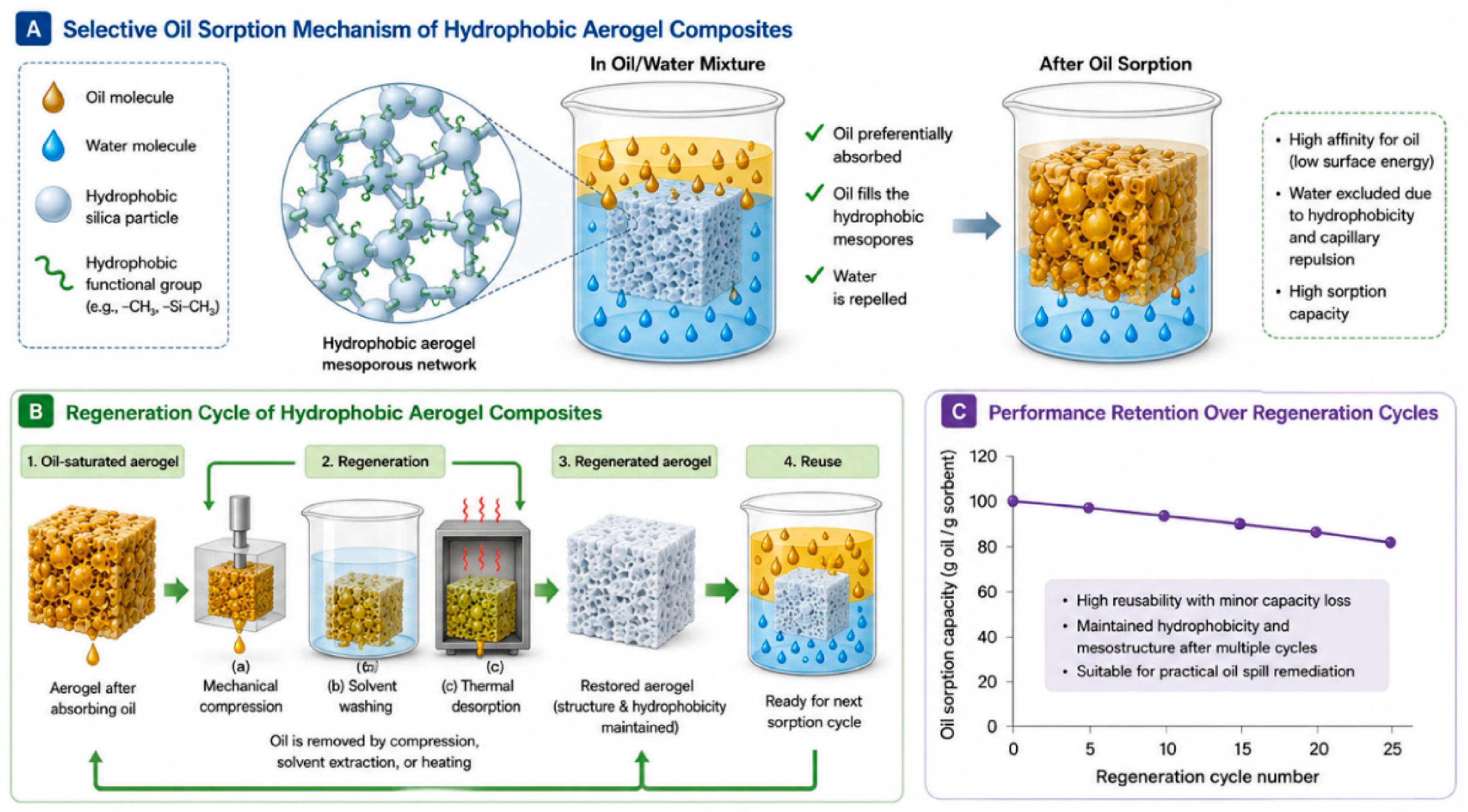
Figure 13.
Machine learning workflow for aerogel composite design and optimization, illustrating literature data curation, supervised model training, Bayesian optimization, automated experimental execution, multi-technique characterization, and convergence to an optimized formulation, with optional digital twin extension.
Figure 13.
Machine learning workflow for aerogel composite design and optimization, illustrating literature data curation, supervised model training, Bayesian optimization, automated experimental execution, multi-technique characterization, and convergence to an optimized formulation, with optional digital twin extension.
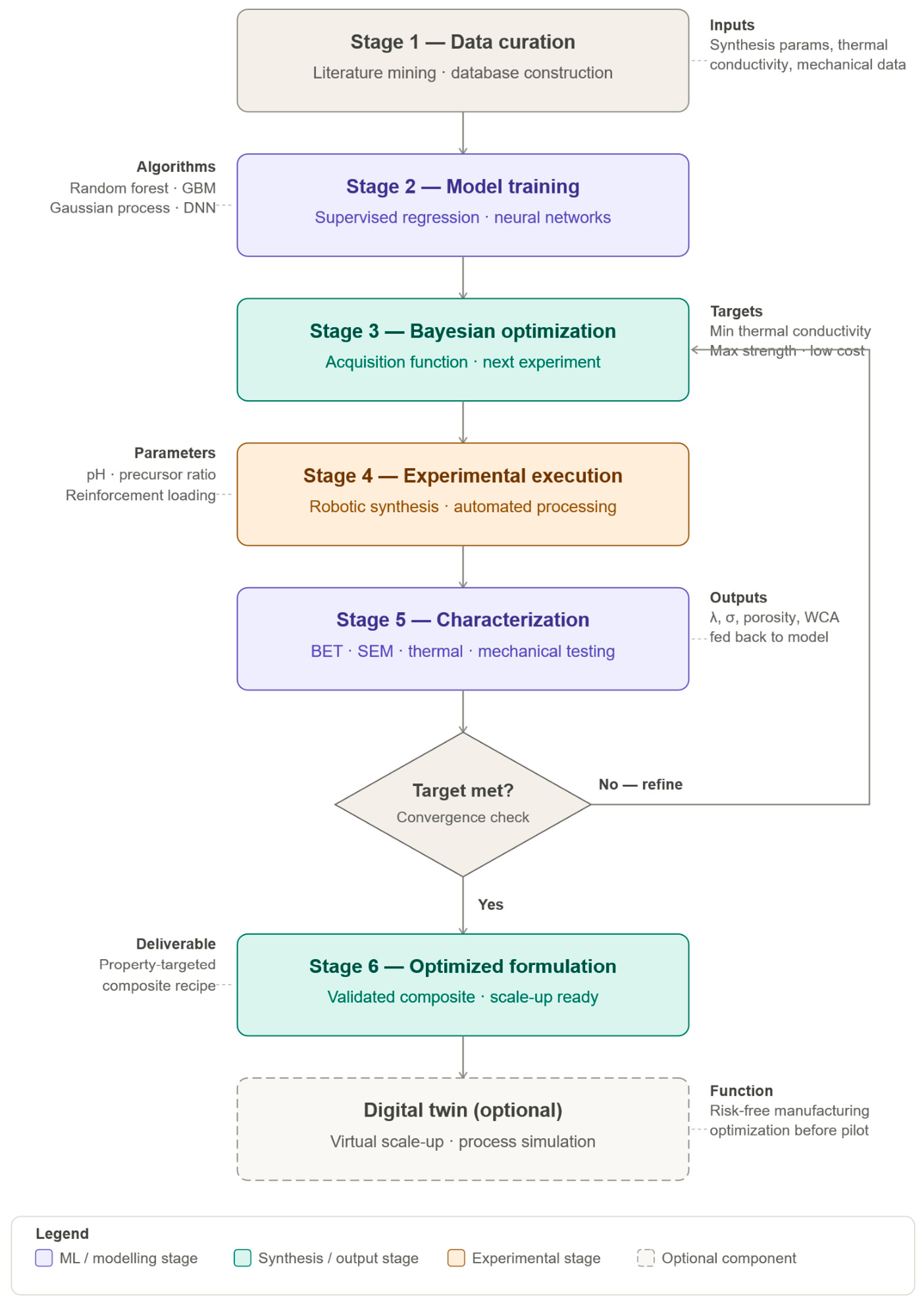
Figure 14.
Current and emerging application landscape of silica aerogel composites, spanning thermal insulation, environmental remediation, catalysis, acoustic damping, aerospace engineering, smart building technologies, biomedical systems, and advanced energy storage.
Figure 14.
Current and emerging application landscape of silica aerogel composites, spanning thermal insulation, environmental remediation, catalysis, acoustic damping, aerospace engineering, smart building technologies, biomedical systems, and advanced energy storage.
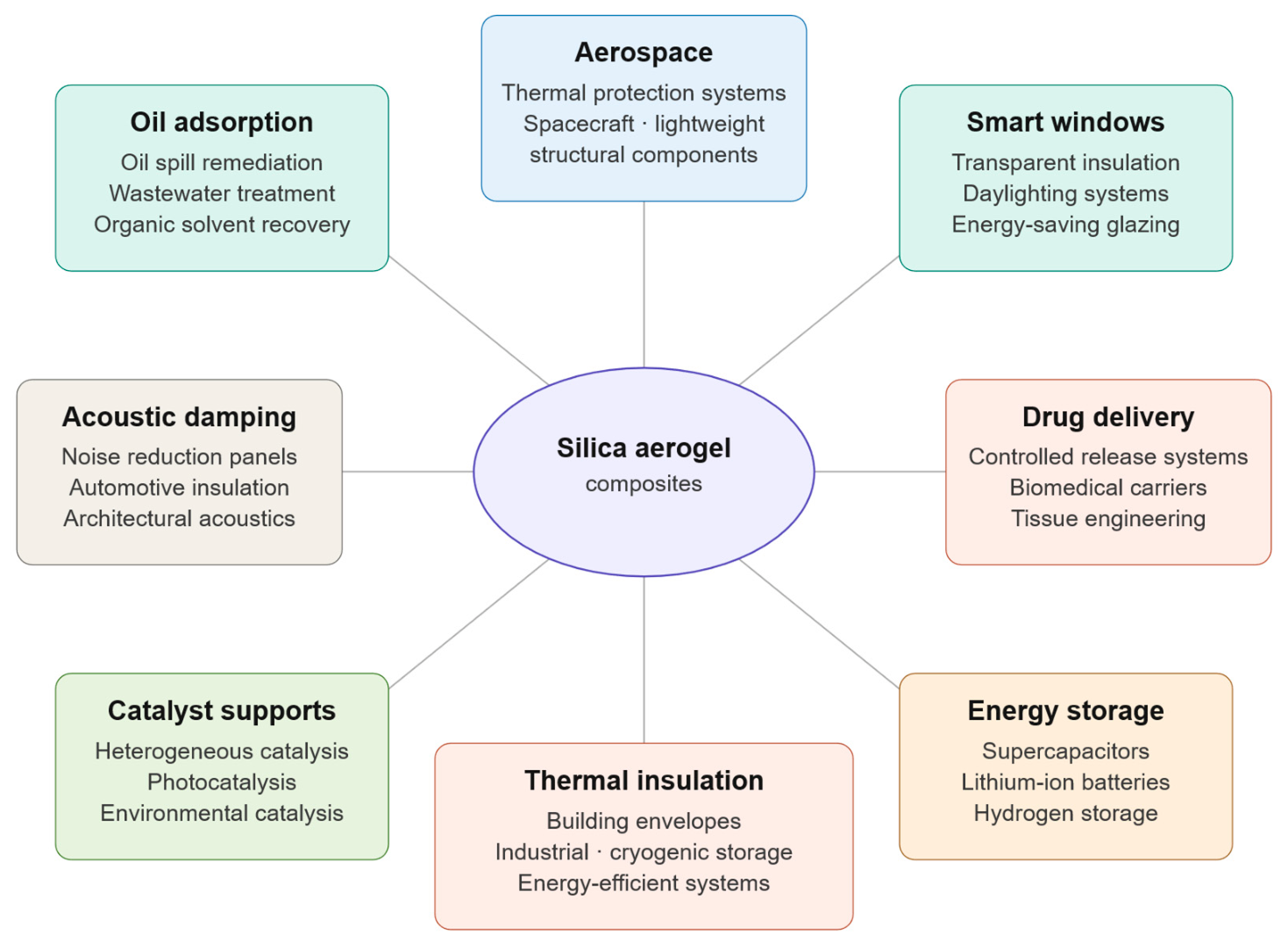

Table 1.
Major Strategies for the Formation of Silica Aerogel Composites and Their Functional Benefits (Adapted from Leventis, 2007; Aegerter et al., 2011; Maleki et al., 2016; Zhao et al., 2018; Yang et al., 2023; Yuvaraja et al., 2025; Sikiru et al., 2025).
Table 1.
Major Strategies for the Formation of Silica Aerogel Composites and Their Functional Benefits (Adapted from Leventis, 2007; Aegerter et al., 2011; Maleki et al., 2016; Zhao et al., 2018; Yang et al., 2023; Yuvaraja et al., 2025; Sikiru et al., 2025).
| Reinforcement class | Representative materials | Primary functional benefit | Typical incorporation stage |
|---|---|---|---|
| Fibrous | Glass, ceramic, carbon, basalt fibers | Flexural strength, crack bridging, dimensional stability | Pre-gelation infiltration or dispersion |
| Polymer-crosslinked | Polyurea, polyurethane, epoxy, PMMA | Compressive strength, toughness, elastic recovery | Post-gelation infiltration/polymerization |
| Carbon-based | CNTs, graphene, GO/rGO, carbon black | Electrical conductivity, EMI shielding, energy storage | In situ dispersion or post-synthesis impregnation |
| Metal oxide hybrid | TiO₂, Al₂O₃, ZrO₂, Fe₃O₄ | Catalysis, photocatalysis, magnetic separation | Co-gelation or post-synthesis impregnation |
| Biopolymer-reinforced | Cellulose, chitosan, alginate, lignin | Toughness, biodegradability, biocompatibility | Pre-gelation mixing |
| Multifunctional hybrid | Combinations of the above | Simultaneous mechanical, thermal, electrical gains | Sequential/combined incorporation |
Table 2.
Comparison of Drying Approaches for Silica Aerogel Composites.
| Drying method | Mechanism | Key advantage | Key limitation |
|---|---|---|---|
| Supercritical CO₂ drying | Eliminates liquid–vapor interface via supercritical fluid | Preserves pore structure with minimal shrinkage | High capital cost; batch processing |
| Supercritical ethanol drying | Supercritical solvent removal | Avoids solvent-exchange to CO₂ | High temperature/pressure requirements |
| Ambient-pressure drying (APD) | Silylation reduces surface tension/capillary stress | Low cost; scalable; atmospheric conditions | Requires reinforcement or careful silylation to limit shrinkage |
| Freeze-drying | Sublimation of frozen pore solvent | Avoids capillary stress via ice–vapor transition | Ice-crystal growth can damage pore network |
Table 3.
Common Structural and Morphological Characterization Techniques for Silica Aerogel Composites.
Table 3.
Common Structural and Morphological Characterization Techniques for Silica Aerogel Composites.
| Technique | Information obtained | Typical length scale |
|---|---|---|
| N₂ physisorption (BET/BJH) | Specific surface area, pore volume, mesopore size distribution | Bulk-averaged, nm-scale |
| SEM | Pore morphology, reinforcement dispersion, fracture surfaces | µm–nm |
| TEM/HRTEM, EDS | Primary particle size, neck geometry, elemental mapping | nm–sub-nm |
| XRD | Crystalline reinforcing phases, phase transformations | Bulk, crystallographic |
| FTIR | Functional groups, hydrophobization, crosslinking, hybrid bonding | Molecular |
| XPS | Surface elemental composition, oxidation state, bonding | Outermost surface |
| Micro-CT | 3-D reinforcement architecture, defect distribution, in operando drying dynamics | mm–µm, volumetric |
Table 4.
Mechanical Characterization Techniques for Silica Aerogel Composites.
| Technique | Property measured | Typical application |
|---|---|---|
| Compression testing | Young's modulus, compressive strength, recoverable strain | Bulk structural evaluation |
| Flexural (3-/4-point bending) | Flexural strength, crack initiation/propagation | Fiber-reinforced panels |
| Fracture toughness (K_IC, G_IC) | Critical stress intensity/energy release rate | Crack-bridging assessment |
| Nanoindentation | Local elastic modulus, hardness, creep | Phase-resolved stiffness mapping |
| Dynamic mechanical analysis (DMA) | Storage/loss modulus, damping | Viscoelastic, polymer-containing composites |
Table 5.
Thermal Characterization Techniques for Silica Aerogel Composites.
| Technique | Property measured | Notes |
|---|---|---|
| Guarded heat flow meter (ASTM C518) | Steady-state thermal conductivity | Preferred for commercial panels/blankets |
| Transient hot-wire / TPS | Thermal conductivity, diffusivity | Rapid, laboratory-scale |
| Laser flash analysis (LFA) | Thermal diffusivity, specific heat | Small specimens, high-temperature capable |
| TGA | Decomposition temperature, mass loss | Thermal stability, moisture/solvent content |
| DSC | Phase transitions, oxidation resistance | Complementary to TGA |
Table 6.
Typical Mechanical Property Improvements in Silica Aerogel Composites.
| Composite class | Compressive strength gain | Flexural strength gain | Elastic recovery |
|---|---|---|---|
| Fiber-reinforced | ~2–10× | ~10–50× | Limited |
| Polymer-crosslinked | up to ~100× | Substantial | Recoverable after >60% strain |
| Carbon nanomaterial | Moderate; loading-dependent | Moderate | Variable |
| Multifunctional hybrid | High (combined mechanisms) | High | Application-dependent |
Table 7.
Thermal Conductivity of Representative Silica Aerogel Composites.
| Composite class | Thermal conductivity range (W m⁻¹ K⁻¹) | Governing mechanism |
|---|---|---|
| Pristine silica aerogel | 0.015–0.020 | Knudsen-suppressed gas conduction; minimal solid conduction |
| Fiber-reinforced | 0.025–0.035 | Low fiber loading; matrix continuity preserved |
| Polymer-crosslinked | 0.040–0.080 | Continuous conducting polymer phase |
| Carbon nanomaterial | 0.020–0.050 | Low loading; carbon–silica interfacial thermal resistance |
| Metal oxide hybrid | 0.020–0.045 | Porous silica framework still dominates heat transfer |
Table 8.
Major Application Areas of Silica Aerogel Composites.
| Application domain | Dominant reinforcement class | Representative use cases |
|---|---|---|
| Thermal insulation | Fiber-reinforced blankets | Building envelopes, pipelines, cryogenic tanks, aerospace |
| Oil spill / sorption | Hydrophobic polymer/carbon composites | Oil–water separation, VOC/solvent recovery |
| Catalysis & photocatalysis | Metal oxide hybrids | Pollutant degradation, water splitting, CO₂ conversion |
| Acoustic insulation | Fiber/polymer composites | Automotive, aerospace, marine damping |
| Aerospace & defense | Ceramic fiber, carbon, magnetic hybrids | Thermal protection, EMI shielding, radar absorption |
| Energy storage | Carbon-based composites | Supercapacitors, Li-ion/Li–S batteries |
| Sensing | Conductive polymer/carbon composites | Pressure, temperature, humidity, gas sensing |
| Biomedical | Biopolymer-reinforced composites | Drug delivery, wound dressings, tissue scaffolds |
Table 9.
Manufacturing Challenges and Potential Solutions for Silica Aerogel Composites.
| Challenge | Underlying cause | Potential solution |
|---|---|---|
| High drying cost | Supercritical equipment, batch processing | Ambient-pressure drying with silylation |
| Long processing time | Aging, solvent exchange, drying sequence | Optimized aging protocols; continuous processing |
| Reinforcement dispersion | Nanomaterial agglomeration | Ultrasonication, surfactants, functionalization |
| Shrinkage/cracking | Capillary stress during drying | Hydrophobization; reinforcement-assisted APD |
| Precursor cost | Alkoxysilane synthesis | Sodium silicate (water glass) precursors |
Table 10.
Sustainability Challenges and Green Synthesis Alternatives.
| Challenge | Conventional approach | Greener alternative |
|---|---|---|
| Precursor cost/impact | TEOS/TMOS alkoxysilanes | Sodium silicate (water glass) |
| Solvent consumption | Multi-step organic solvent exchange | Reduced-solvent or CO₂-based routes |
| Reinforcement sourcing | Petroleum-derived polymers, synthetic fibers | Bio-based polymers, natural/biopolymer fibers |
| Energy intensity | Supercritical drying | Ambient-pressure drying with silylation |
Table 11.
Potential Applications of Machine Learning and AI in Aerogel Composite Research.
| ML/AI application | Purpose | Anticipated benefit |
|---|---|---|
| Predictive property models | Map synthesis inputs to thermal/mechanical/porosity outputs | Reduced experimental effort |
| Bayesian optimization | Select next experiment via probabilistic surrogate model | Faster convergence to optimal formulation |
| Automated experimentation | Execute prioritized synthesis/characterization runs | Accelerated discovery cycle |
| Digital twin / scale-up simulation | Integrate sensor data with process models | De-risked scale-up decisions |
Disclaimer/Publisher’s Note: The statements, opinions and data contained in all publications are solely those of the individual author(s) and contributor(s) and not of MDPI and/or the editor(s). MDPI and/or the editor(s) disclaim responsibility for any injury to people or property resulting from any ideas, methods, instructions or products referred to in the content. |
© 2026 by the authors. Licensee MDPI, Basel, Switzerland. This article is an open access article distributed under the terms and conditions of the Creative Commons Attribution (CC BY) license (http://creativecommons.org/licenses/by/4.0/).
Copyright: This open access article is published under a Creative Commons CC BY 4.0 license, which permit the free download, distribution, and reuse, provided that the author and preprint are cited in any reuse.