

Submitted:
23 August 2026
Posted:
24 August 2026
You are already at the latest version
Abstract
Recently, Abbas introduced the notion of an h-open set as a class of generalized open sets in a topological space. The subsequent corrigendum and addendum of Sharma, Saproo, Billawria and Digra clarified the theory and established that the family of all h-open sets is itself a topology, denoted by
τh, without any T1/2 assumption. Motivated by this topological interpretation, we introduce and study the separation axioms h-D1 and h-D2 by means of h-difference sets. We prove that these two axioms coincide, relate them to the classical Di axioms in the associated topology (X,
τh), examine their interaction with h-Ti and h-symmetric spaces, and obtain preservation results under h-irresolute and h-continuous mappings. Finite and infinite examples are included to distinguish the original topology from the associated topology of h-open sets. We also correct the overly strong assertion that h-symmetry alone implies h-T1: the additional h-T0 hypothesis is essential. In addition, we place the h-R0, h-RH and h-RD conditions in the associated-topology framework, establish a compatible subspace theorem, and clarify the interaction between h-compactness and h-T2. Three vector diagrams summarize the structural relationships among the separation axioms considered.
Keywords:
h-open set
; h-closure
; h-difference set
; h-D1 space
; h-symmetric space
; separation axiom
MSC: 54A05; 54D10; 54C10
1. Introduction
The systematic study of generalized open sets began with notions such as semi-open, -open, preopen and b-open sets [3,6,7,8]. These classes have generated numerous weakened forms of continuity, compactness and separation and provide the broader setting for the present work. Abbas introduced the notion of an h-open set, together with the associated notions of h-closure, h-continuity and h-irresoluteness [1]. Early corrections to some statements and examples were pointed out by Cakalli and Ince Dagci [4]. The theory was subsequently revisited in a systematic corrigendum and addendum by Sharma, Saproo, Billawria and Digra [10]. That work rectified an important characterization from the initial paper and established, in particular, that the family of all h-open subsets of a topological space forms a topology
without requiring a hypothesis.
This fact changes the natural viewpoint. Rather than treating h-open sets merely as generalized open sets, one may regard them as the open sets of the associated space . Consequently, an h-topological property is often a classical topological property computed with respect to . The comparison between and , however, remains meaningful because the two topologies may differ substantially. The role of weak separation assumptions in this context is related to the classical condition of Dunham [5], although the topological character of does not depend on that hypothesis [10].
The literature has also begun to apply h-open sets beyond elementary point-set topology. Examples include -open sets and their associated mappings [2], h-irresolute topological vector spaces [11], and h-topological groups [9]. These developments reinforce the usefulness of a precise separation theory for the associated topology.
Tong introduced the separation axiom , lying between and , by using differences of open sets [12]. The aim of the present paper is to develop the corresponding theory based on h-open sets. We introduce h-difference sets and the axioms h- and h-, prove that the latter two conditions are equivalent, and study their relationships with h- and h-symmetric spaces. We also investigate preservation under natural classes of mappings and provide finite examples illustrating the distinction between the original topology and the associated h-topology.
2. Preliminaries
Throughout, and denote topological spaces, with no separation axiom assumed unless explicitly stated. The ordinary interior and closure with respect to the original topology are denoted by Int and Cl, respectively.
Definition 1.
for every nonempty proper open set . The complement of an h-open set is calledh-closed. We write and for the families of all h-open and h-closed subsets of X, respectively.
The definition above is the journal formulation used in [1,10]; the corrections in [4,10] should be kept in mind whenever results from the earliest version of the theory are invoked.
Definition 2.
A point is anh-cluster point of if every h-open set containing x meets A. The set of all h-cluster points of A is theh-closure of A, denoted by . Equivalently, is the closure of A in .
A subset is an h-neighborhood of x if there exists such that .
Lemma 1.
For all and every family of subsets of X, the following hold:
- (1)
- arbitrary intersections of h-closed sets are h-closed;
- (2)
- arbitrary unions of h-open sets are h-open;
- (3)
- A is h-closed if and only if ;
- (4)
- ;
- (5)
- ;
- (6)
- if , then ;
- (7)
- is h-closed.
Proof.
These are the standard closure properties in the topological space . □
Definition 3.
For , the space is called h- if is . Explicitly:
- (i)
- h-: distinct points are distinguished by an h-open set;
- (ii)
- h-: for distinct , each point has an h-open neighborhood missing the other;
- (iii)
- h-: distinct points have disjoint h-open neighborhoods.
Definition 4.
A mapping ish-irresolute if for every . It ish-continuousif for every .
3. h-Difference Sets and h- Spaces
Definition 5.
A subset is anh-difference set, briefly an -set, if
for some with .
Every proper h-open set is an -set, by taking . The converse fails in general.
Definition 6.
A space is called h- if for every pair of distinct points there are -sets G and E such that
It is called h- if the sets G and E can be chosen disjoint.
Remark 1.
Every h- space is h-, every h- space is h-, and every h- space is h-.
3.1. Examples and Finite Computations
For finite spaces the associated topology can be computed directly from the definition. If is finite, then a subset belongs to if and only if
Thus one may test each subset of X against the finitely many nonempty proper open sets. Once has been determined, h-closures, -sets and the corresponding h-separation properties are obtained by applying the ordinary topological operations in . The following examples illustrate both the computation and the extent to which passage from to may improve separation.
Example 1.
Let
The only nonempty proper member of τ is . For every one has
Indeed, if , then ; if , then and . Hence every subset of X is h-open and
Thus is h-, and therefore h- and h-. On the other hand, the original space is neither nor (and hence not ), since a and b have exactly the same open neighborhoods.
Remark 2.
Example 1 shows that h-separation axioms may be strictly weaker than their counterparts in the original topology.
Example 2
(An infinite example). Let A be an infinite set and choose . Set
The only nonempty proper open set is A. If , then ; if , then and hence . Consequently every subset of X is h-open and . Thus is h- and h-, although the original topology is not even whenever A contains at least two points.
Remark 3.
Examples 1 and 2 show that the passage from τ to may dramatically increase separation, even producing a discrete associated topology from a highly non-separated original space.
Theorem 1.
A topological space is h- if and only if it is h-.
Proof.
Only the forward implication requires proof. Let . Since X is h-, there are
where , , , and .
If , then either or . If , set
These are disjoint -sets containing x and y, respectively. If , then and are disjoint -sets containing x and y. Notice that , because .
If , then implies . Since , the sets and N are disjoint -sets containing y and x, respectively; moreover because . Thus X is h-. □
Proposition 1.
Every h- space is h-.
Proof.
Let . Choose an -set such that and , where and . If , then the h-open set U contains x and misses y. If , the condition yields , while ; hence the h-open set V contains y and misses x. Therefore is . □
Combining Remark 1, Theorem 1 and Proposition 1, we obtain the implication diagram in Figure 1. The double arrow records the equivalence between h- and h-.
Proposition 2.
The following are equivalent:
- (i)
- is h-;
- (ii)
- is a classical space;
- (iii)
- is h-;
- (iv)
- is a classical space.
Proof.
The notions of -set and classical difference set in coincide by definition. The equivalences now follow from Theorem 1 and the corresponding classical terminology. □
3.2. The Associated-Topology Viewpoint
The construction used throughout the paper can be summarized by the chain
Figure 2 records this dependence. It emphasizes that the original topology enters through the definition of the family of h-open sets, whereas all subsequent notions are ordinary topological notions in .
Remark 4.
Proposition 2 shows that the intrinsic h- theory is formally the classical theory of . The genuinely new information therefore lies in the comparison of with the original topology τ and in conditions ensuring that properties pass from one topology to the other.
3.3. h-Symmetry
Definition 7.
The space ish-symmetric if
for all .
A subset is called h-generalized closed, briefly -closed, if
whenever and .
Theorem 2.
A space is h-symmetric if and only if every singleton is -closed.
Proof.
Assume first that X is h-symmetric. Let and take . By h-symmetry, . If , then the h-closed set contains y, and therefore contains , contradicting . Hence and .
Conversely, assume that every singleton is -closed and let . If , then
is an h-open set containing y. Since is -closed, , which contradicts . Thus . □
Corollary 1.
Every h- space is h-symmetric.
Proof.
In an h- space each singleton is h-closed, hence -closed. Apply Theorem 2. □
Theorem 3.
A space is h- if and only if it is both h- and h-symmetric.
Proof.
The forward implication follows from Corollary 1. Conversely, let . Since X is h-, one of the points, say x, has an h-open neighborhood missing y. Equivalently, . By h-symmetry, . Hence there is also an h-open neighborhood of y missing x. Therefore X is h-. □
Remark 5.
Theorem 3 corrects the overly strong statement that h-symmetry alone implies h-. As in ordinary topology, symmetry corresponds to an -type condition; a hypothesis is needed to obtain .
Definition 8.
The space is called h- if, whenever x belongs to an h-open set U, one has . Equivalently, is an space.
Proposition 3.
A space is h- if and only if it is h-symmetric.
Proof.
Suppose first that X is h- and that . If , then the h-open set contains y. By the h- property, , contradicting . Thus .
Conversely, suppose that X is h-symmetric, let , and take . By symmetry, . If , then the h-closed set contains y and therefore contains , contradicting . Hence , and . □
Corollary 2.
A space is h- if and only if it is both h- and h-.
Proof.
Combine Theorem 3 with Proposition 3. □
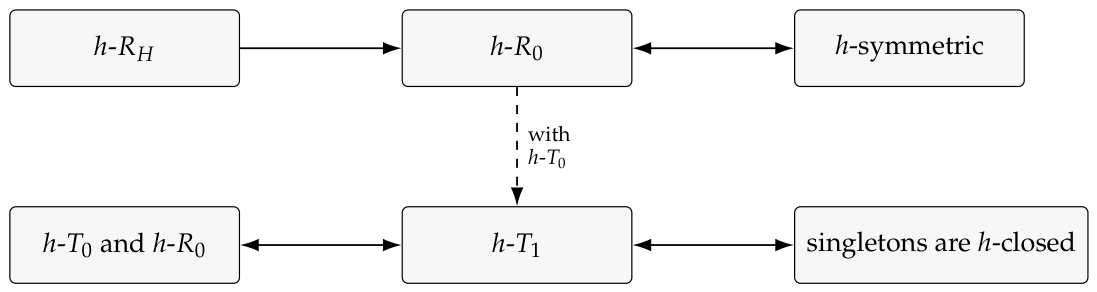
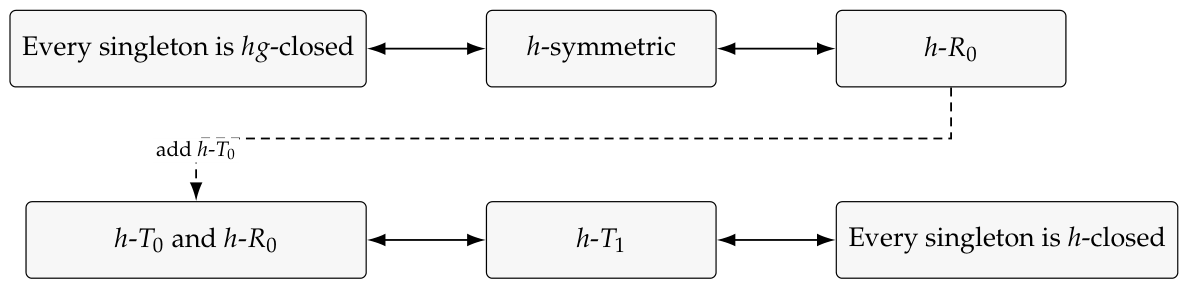
The relationships proved in this subsection are summarized in Figure 3.
3.4. The h- and h- Conditions
We next record two singleton-closure conditions that are naturally expressed in the associated topology. The notation is used here for the semisimple condition adopted in the companion discussion on h-regularity.
Definition 9.
A space is calledh-(orh-semisimple) if is h-open for every . Equivalently, every closure of a singleton in is open in .
Proposition 4.
Every h- space is h-.
Proof.
Let . Since is the smallest h-closed set containing x, the h- condition is equivalent to the fact that every h-open neighborhood of x contains . In an h- space the specialization classes are h-open as well as h-closed; hence each h-open set is saturated with respect to these classes, and therefore . □
Definition 10.
A space is calledh-if
is h-closed for every .
Example 3.
Let
A direct computation gives
The associated topology is a partition topology, whose specialization classes are and . Consequently the space is h-. Moreover,
and all these sets belong to . Hence the space is h-.
On the other hand,
The set is not h-closed, since its complement does not belong to . Thus the space is not h-. In particular,
The same example is not h-, because a and c have exactly the same h-open neighborhoods; hence it is not h- either.
Remark 6.
The preceding example shows that the h- condition refines the singleton-closure structure of an h- space without forcing point separation. Thus h- should not be placed in a chain ending in h- unless an additional h- hypothesis is imposed. With that hypothesis, Corollary 2 yields h-.
Figure 4.
Relations among h-, h-, h-symmetry and h-. The dashed implication requires the additional h- hypothesis.
Figure 4.
Relations among h-, h-, h-symmetry and h-. The dashed implication requires the additional h- hypothesis.
3.5. h-Compactness and the Associated Topology
Recall that a space is called h-compact if every cover by h-open sets has a finite subcover [10]. This is the direct h-analogue of ordinary compactness as treated in standard topology texts such as [13]. Since the h-open sets are exactly the members of , this notion admits an immediate reformulation.
Proposition 5.
A topological space is h-compact if and only if the associated space is compact.
Proof.
The two definitions quantify over exactly the same families of sets, namely the open covers of . □
Proposition 6.
In an h- space, every h-compact subset is h-closed.
Proof.
If is h-, then is Hausdorff. By Proposition 5, an h-compact subset is compact in . Compact subsets of Hausdorff spaces are closed, so the subset is closed in , that is, h-closed. □
Remark 7.
Proposition 6 identifies the precise classical mechanism behind the result. The conclusion is not automatic in an h- space, because is strictly weaker than Hausdorff separation. This distinction delineates the range in which familiar compactness theorems remain valid after passing to the associated topology.
Proposition 7.
Let be an h- space, and let . If
then the subspace is h-.
Proof.
Since X is h-, the associated space is a classical space. The axiom is hereditary: if belong to Y, difference sets of X separating them restrict to difference sets of the subspace . By the compatibility hypothesis, this subspace topology is exactly . Hence is , which means that is h-. □
Remark 8
(Subspaces). The compatibility hypothesis in Proposition 7 is essential to the argument. In general one must distinguish the topology obtained by applying the h-open construction to from the subspace topology . The proposition gives a useful hereditary theorem precisely when these two constructions agree.
4. Mappings and Preservation Properties
Theorem 4.
Let be an h-irresolute surjection. If G is an -set in Y, then is an -set in X.
Proof.
Write , where and . Since f is h-irresolute,
Surjectivity and imply . Therefore
is an -set. □
Lemma 2.
If is h-continuous and open, then is h-open in X for every h-open set V in Y.
Proof.
This is (Theorem 3.9, [1]). □
Corollary 3.
Let be an h-continuous open surjection. If G is an -set in Y, then is an -set in X.
Proof.
By Lemma 2, f is h-irresolute. Apply Theorem 4. □
Theorem 5.
Let be an h-irresolute bijection. If Y is h-, then X is h-.
Proof.
Let in X. Since f is injective, . Choose -sets with
By Theorem 4, and are -sets with the required separation properties. □
Theorem 6.
A space X is h- if and only if, for every pair of distinct points , there exist an h- space Y and an h-irresolute surjection such that .
Proof.
If X is h-, take and .
Conversely, let and choose Y and f as in the hypothesis. Since Y is h-, Theorem 1 yields disjoint -sets containing and , respectively. Their inverse images are disjoint -sets in X by Theorem 4; in particular they separate x and y. Hence X is h-. □
Theorem 7.
Let be a family of topological spaces. If every is h-, then the product is h-.
Proof.
Let and be distinct points of the product. Choose with . The projection
is a continuous open surjection. By Lemma 2, it is h-irresolute. Since is h- and , Theorem 6 implies that the product is h-. □
5. Concluding Remarks
This paper establishes the associated topology as the definitive framework for interpreting separation properties built from h-open sets. Within this framework, -sets are precisely the classical difference sets of , and the axioms h- and h- become the corresponding and axioms. This viewpoint yields the equivalence h--, gives transparent proofs of the preservation results, and separates genuine interactions with the original topology from statements that are ordinary topological facts in .
The analysis also resolves ambiguities in the surrounding literature. In particular, h-symmetry is identified with the h- condition, while h- is obtained exactly by adjoining h-. The h- and h- conditions are stated in terms of singleton h-closures, and Example 3 shows that an h-, h- space need not be h- or h-. Likewise, Proposition 6 recovers the compact-subset theorem at the correct h-Hausdorff level, whereas Proposition 7 provides a rigorous hereditary result under the natural compatibility condition for associated subspace topologies.
Accordingly, the paper supplies a coherent reference point for future work on h-separation, h-regularity, h-compactness and algebraic structures defined through h-open sets. Further developments should formulate their hypotheses directly in terms of and explicitly distinguish properties intrinsic to from those depending on the comparison between and .
References
- F. Abbas, On h-open sets and h-continuous functions, Bol. Soc. Paran. Mat. 41 (2023), 1–9, doi:10.5269/bspm.51006.
- B. S. Abdullah, S. W. Askandar and R. N. Balo, hα-open sets in topological spaces, J. Educ. Sci. 31(3) (2022), 91–98, doi:10.33899/edusj.2022.134241.1251.
- D. Andrijević, On b-open sets, Mat. Vesnik 48 (1996), 59–64.
- H. Cakalli and F. Ince Dagci, On h-open sets and h-continuous functions, J. Appl. Comput. Math. 10(5) (2021), Article 473.
- W. Dunham, T1/2-spaces, Kyungpook Math. J. 17 (1977), 161–169.
- N. Levine, Semi-open sets and semi-continuity in topological spaces, Amer. Math. Monthly 70 (1963), 36–41, doi:10.2307/2312781.
- A. S. Mashhour, M. E. Abd El-Monsef and S. N. El-Deeb, On precontinuous and weak precontinuous mappings, Proc. Math. Phys. Soc. Egypt 53 (1982), 47–53.
- O. Njåstad, On some classes of nearly open sets, Pacific J. Math. 15 (1965), 961–970, doi:10.2140/pjm.1965.15.961.
- P. Saproo, N. Digra, S. Billawria and S. Sharma, On h-topological groups, Asia Pac. J. Math. 11 (2024), Article 40.
- S. Sharma, P. Saproo, S. Billawria and N. Digra, Corrigendum and addendum to “h-open sets in topological spaces”, Bol. Soc. Paran. Mat. 43 (2025), 1–6, doi:10.5269/bspm.63732.
- S. Sharma, N. Digra, P. Saproo and S. Billawria, On h-irresolute topological vector spaces, J. Adv. Math. Stud. 16(3) (2023), 304–319.
- J. Tong, A separation axiom between T0 and T1, Ann. Soc. Sci. Bruxelles 96 (1982), 85–90.
- S. Willard, General Topology, Dover Publications, Mineola, NY, 2004.
Figure 1.
Basic implications among the h-separation axioms. A double-headed arrow denotes equivalence.
Figure 1.
Basic implications among the h-separation axioms. A double-headed arrow denotes equivalence.
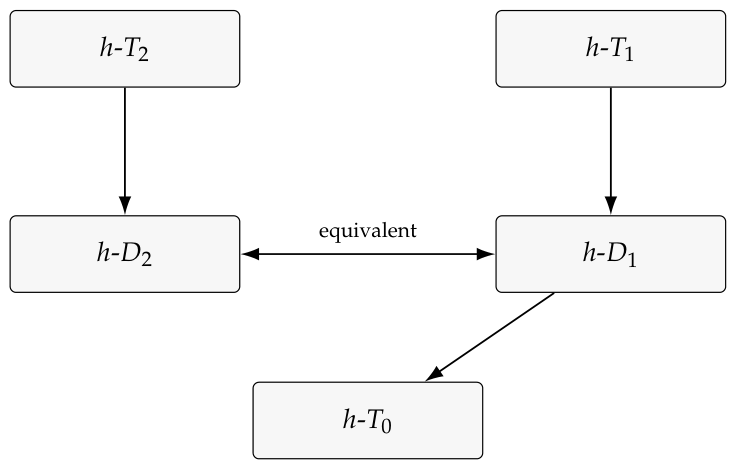
Figure 2.
Conceptual organization of the theory through the associated topology .
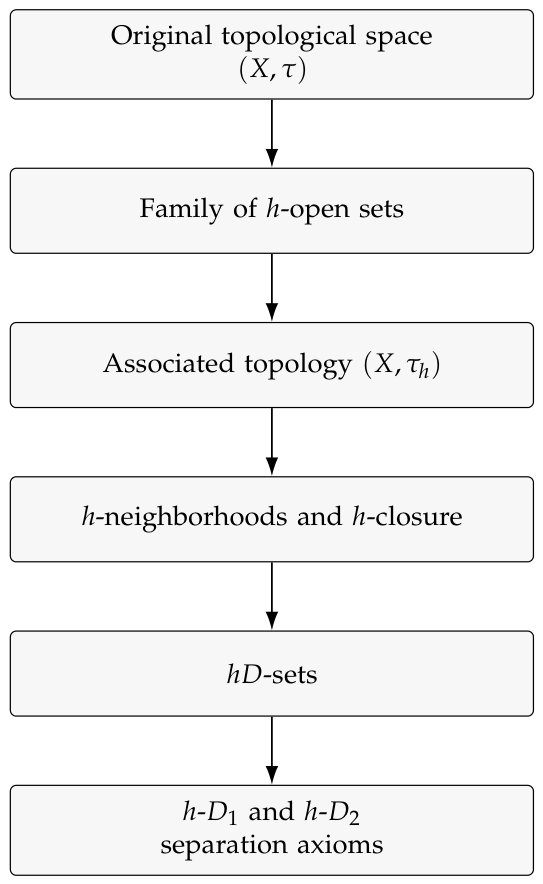
Figure 3.
Equivalent characterizations involving h-, h-symmetry and h-. The dashed arrow records the additional h- hypothesis.
Figure 3.
Equivalent characterizations involving h-, h-symmetry and h-. The dashed arrow records the additional h- hypothesis.
Disclaimer/Publisher’s Note: The statements, opinions and data contained in all publications are solely those of the individual author(s) and contributor(s) and not of MDPI and/or the editor(s). MDPI and/or the editor(s) disclaim responsibility for any injury to people or property resulting from any ideas, methods, instructions or products referred to in the content. |
© 2026 by the authors. Licensee MDPI, Basel, Switzerland. This article is an open access article distributed under the terms and conditions of the Creative Commons Attribution (CC BY) license (http://creativecommons.org/licenses/by/4.0/).
Copyright: This open access article is published under a Creative Commons CC BY 4.0 license, which permit the free download, distribution, and reuse, provided that the author and preprint are cited in any reuse.