
Submitted:
21 August 2026
Posted:
24 August 2026
You are already at the latest version
Abstract
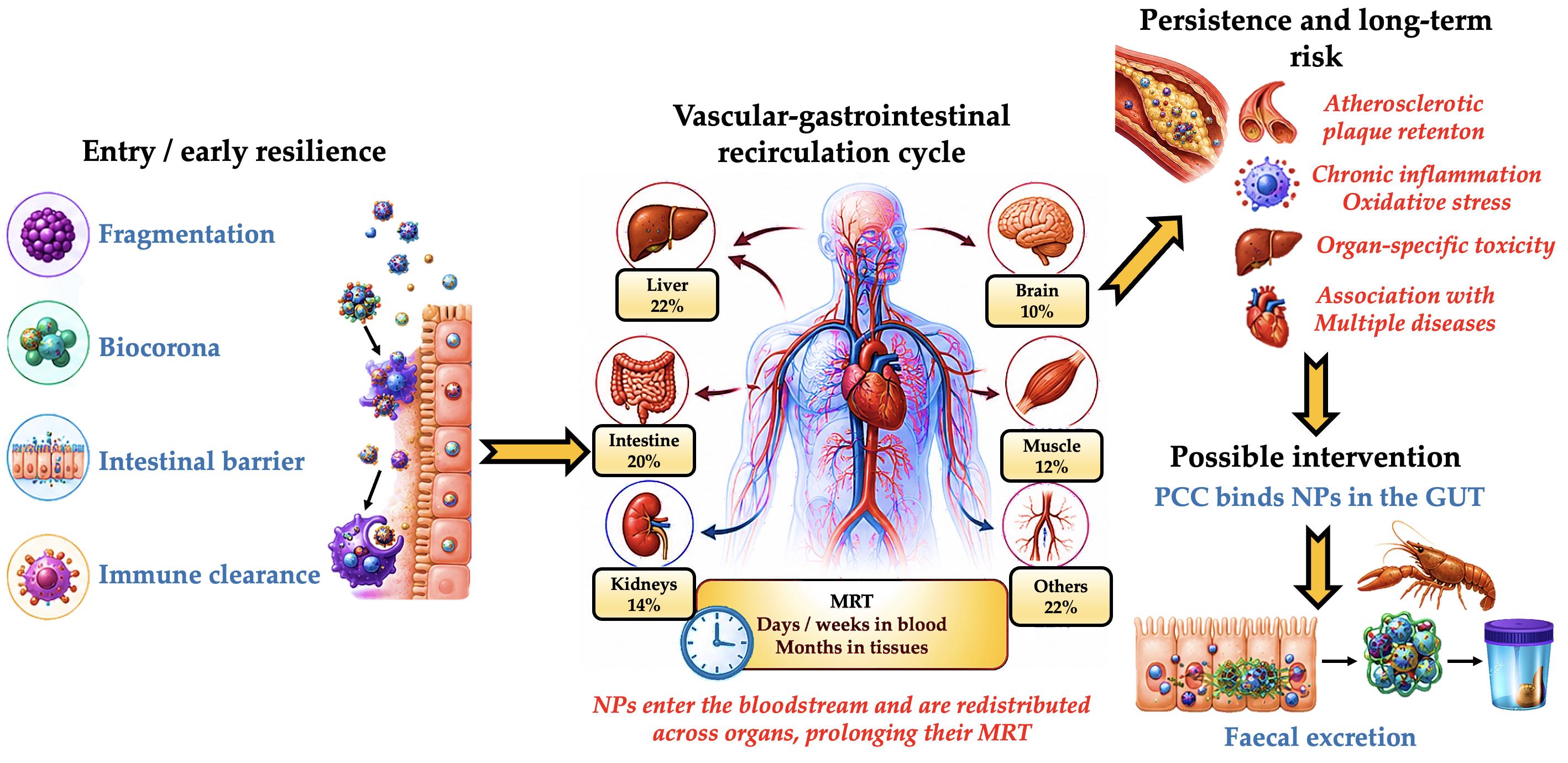
The long-term biological fate of nanoparticles (NPs), which are increasingly identified in human blood and tissues, is still uncertain. Although toxicity remains the primary focus of current study, the human body also exhibits internal resilience mechanisms that alter the impact and transformation of NPs over time. Specifically, we establish forth a framework at the systems level that explains three pillars of resilience: (1) the formation of protein corona, which promotes biological adaptation and expanded circulation; (2) the capacity for fragmentation, which is stimulated by repeated exposure to gastrointestinal tract (GI) motility, shear forces, bile, and enzymatic activity; and (3) vascular to GI recirculation, which carries particles toward the GI, the only physiological compartment that can mechanically process and reduce NPs due to material breakdown. Most of them persist in this dynamic loop, undergoing cycles of cellular release, tissue absorption, recirculation, and GI reentry, which eventually allow for progressive disintegration. Conversely, after macrophage infiltration of the vascular intima, a fraction of particles gets permanently immobilized in the interstice of several organs or in the atherosclerotic plaques; along with privileged immunological or vascular compartments such as the brain parenchymal interstitium, represent important sites where the dynamic resilience loop may be disrupted due to localized macrophage entrapment and restricted lymphatic clearance. Procambarus clarkii chitosan (PCC) administered orally increases faecal elimination and considerably reduces blood levels of NPs. The PCC could potentially have a positive effect on the resilience process.
Keywords:
nanoplastics
; Procambarus clarkii chitosan
; atherosclerosis
; epithelial cells
; endothelial cells
; resilience
Copyright: This open access article is published under a Creative Commons CC BY 4.0 license, which permit the free download, distribution, and reuse, provided that the author and preprint are cited in any reuse.