

Submitted:
24 October 2026
Posted:
26 October 2026
You are already at the latest version
Abstract
Through this work, we deduce a model where the Hartle--Hawking no-boundary proposal and Vilenkin's tunneling boundary condition are placed in precise structural correspondence with distinct dynamical r\'{e}gimes of Randall--Sundrum (RS) brane cosmology. Starting from the five-dimensional ADM Hamiltonian, we derive the effective brane action via the junction conditions and Gauss-Codazzi reduction, then quantize it canonically to obtain the RS-modified Wheeler--DeWitt (WdW) equation governing a Friedmann--Lema\^{\i}tre--Robertson--Walker brane embedded in an AdS\(_5\) bulk. Two qualitatively new contributions arise---a quartic correction \(\propto\rho^2/\lambda\) from the brane self-energy and a dark-radiation term \(\propto\mu/a^2\) from the Weyl projection of the bulk Riemann tensor which deform the classical turning point and alter the WKB tunneling exponent in a calculable, parameter-dependent fashion.We demonstrate that the no-boundary Euclidean saddle of the RS path integral maps to a compact Euclidean AdS\(_5\) geometry carrying a closed brane, while Vilenkin's outgoing-mode condition translates into brane nucleation from the bulk; the AdS/CFT correspondence then recasts the cosmological wave function as the partition function of a four-dimensional conformal field theory with a UV cutoff set by the brane tension. We relate our construction to earlier work on quantum cosmology in braneworld scenarios and clarify three contributions that extend and complement the earlier treatments of Hawking-Hertog-Reall and Koyama-Soda correspondence (Euclidean path integral, WKB, AdS/CFT), the definition and invariance of the phase entropy \(S_\theta\), and the phase fidelity \(\mathcal{F}_{\mathrm{bounce}}\) as a quantitative measure of quantum information preservation across cosmological bounces. Indirect observational consequences oscillatory non-Gaussianity with a specific momentum-phase signature and inter-mode entanglement extend from a Bunch Davies vacuum are identified as the only viable empirical probes of this quantum-coherent memory.
Keywords:
quantum cosmology
; brane-world gravity
; wheeler–DeWitt equation
; Vilenkin tunneling
; AdS/CFT correspondence
; phase entropy
1. Introduction
Conventions and Units
Throughout this manuscript we adopt reduced Planck units in which and the reduced Planck mass GeV, unless an explicit factor is retained for clarity. The metric signature is for the five-dimensional bulk and for the four-dimensional brane. Greek indices run over four-dimensional brane coordinates; capital Latin indices over five-dimensional bulk coordinates; lower-case Latin indices over spatial brane coordinates. Curvature conventions follow R. Arnowitt [3]: , so that a sphere has positive Ricci scalar. The five-dimensional Newton constant is , and its four-dimensional counterpart satisfies . Dimensional consistency for the key equations is tabulated below:
Relation to Previous Work
Quantum cosmology in Randall–Sundrum braneworld scenarios has been explored extensively over the past two decades, and we situate the present contribution explicitly within that landscape.
The foundational work of Hawking, Hertog & Reall [11] (“Brane New World”) studied the no-boundary wave function for a domain wall in anti-de Sitter space with a strongly coupled large-N conformal field theory living on the wall. Using the AdS/CFT correspondence, they showed that the Euclidean path integral over compact AdS5 geometries with a spherical brane reduces to a path integral over CFT configurations, and they computed the graviton correlator on the domain wall using the Hartle–Hawking prescription. That paper established the fundamental mechanism by which the no-boundary saddle point in five dimensions corresponds to a compact Euclidean AdS5 geometry with a closed brane—a result that we generalise and extend in the present work.
Independently and concurrently, [12] (“Birth of the Brane World”) developed the Hamiltonian approach to brane quantum cosmology. Starting from the five-dimensional ADM action, they derived canonical momenta, imposed junction conditions, fixed the gauge, and solved the bulk constraints to obtain an effective single-degree-of-freedom action for the brane. Canonical quantization of this effective action yields the Wheeler–DeWitt equation for the brane scale factor. They showed that, when the bulk is exactly AdS5, the wave function coincides with the standard four-dimensional Vilenkin tunneling wave function; bulk black holes (a Schwarzschild–AdS bulk) deform the wave function non-trivially, providing the first systematic example of extra-dimension imprints on quantum cosmology. Further important contributions to braneworld quantum cosmology should also be acknowledged. Garriga and Sasaki [54] studied brane-world creation and the role of bulk black holes in the nucleation process, clarifying how the presence of a Schwarzschild–AdS horizon modifies the tunneling amplitude. Bouhmadi-López, González-Díaz, and Zhuk [55] analyzed the creation of braneworlds via regular five-dimensional gravitational instantons, showing that analytical continuation to Lorentzian signature can yield four-dimensional inflating branes. Anchordoqui et al. [56] analyzed brane worlds and string cosmology within the AdS/CFT framework, discussing both singular and non-singular cosmological phases. A comprehensive review of these and related developments can be found in [48]. Together, these studies have developed the two complementary approaches Hamiltonian and holographic that form the foundation of our analysis. Building on these lines, our work adopts the Hamiltonian reduction of the five-dimensional action as its starting point, so that the canonical structure of the quantum theory is inherited from the bulk rather than postulated, and it uses the holographic description to control the neglected bulk quantum effects. Our results complement the aforementioned studies by providing an exact correspondence between the WKB exponent of the RS-modified WdW equation and the on-shell Euclidean action (Proposition 1), and by extending the analysis to include our two proposed contributions: the phase entropy and the phase fidelity .
Our work differs from the previous references in three important respects.
- (i)
- Unified treatment of both boundary conditions. We provide, for the first time, a systematic three-level correspondence between both the Hartle–Hawking and Vilenkin prescriptions and the RS dynamical structure: at the level of Euclidean path-integral saddle points, WKB tunneling exponents, and AdS/CFT holographic duals. Building on the foundational treatments of Hawking, Hertog & Reall [11] and Koyama & Soda [12], each of which focused on one boundary condition, the present work develops a unified treatment of both. correspondences in Table 2 is new.
- (ii)
- Phase entropy . We define the phase entropy as a functional on the phase distribution of the universal wave function over super-space, and we prove its invariance under any unitary bounce operator (Proposition 2). This constitutes a quantum-cosmological analogue of the classical Liouville invariant hat to our knowledge has not been previously identified in the braneworld quantum-cosmology context.
- (iii)
- Phase fidelity . We introduce the phase fidelity as a quantitative measure of quantum information preservation across cosmological bounces and identify its observational signatures in the CMB bispectrum and initial state of inflation.
Main Results
Singularity. That word concentrates everything recalcitrant about classical general relativity when pressed to its early-universe limits. The Penrose–Hawking singularity theorems [1,2] establish—under the null energy condition and the requirement that at least one trapped surface forms—that any spacetime satisfying Einstein’s field equations must be geodesically incomplete. The Big Bang is the canonical instance: the standard Friedmann cosmology extrapolated backward reaches, at , a state of infinite energy density with no classical antecedent.
Quantum cosmology was constructed to dissolve this impasse. In its canonical form [4,5], the four-dimensional spacetime metric is promoted to a quantum-mechanical degree of freedom; the classical Hamiltonian constraint of the ADM decomposition [3] becomes, after canonical quantization, the Wheeler–DeWitt equation —a constraint equation on superspace. Two principled proposals for selecting the physical solution have generated sustained debate. Hartle and Hawking [6] advocated the no-boundary wave function, computed via a Euclidean path integral summed over compact four-geometries without initial boundary. Vilenkin [7,8], by contrast, required only outgoing modes at classically forbidden boundaries: the universe nucleates by quantum tunneling from nothing. These proposals differ in a sign: Hartle–Hawking selects the growing Euclidean mode , strongly preferring large cosmological constants, while Vilenkin selects the decaying mode , preferring small- inflationary seeds [23].
Randall–Sundrum brane-world models [9,10] enrich this landscape in a geometrically transparent way that admits precise mathematical correspondences with both boundary conditions. In RS1, our universe is a positive-tension 3-brane at the boundary of an AdS5 bulk; the exponential warp factor of the RS metric generates the gauge hierarchy without parameter fine-tuning beyond the modest requirement [9]. In RS2, a single brane in an infinite AdS5 bulk localizes four-dimensional gravity via a normalizable zero mode [10,30]. Cosmologically, the embedding of a Friedmann brane in the RS bulk modifies the Friedmann equation at high densities [14,15,16].
The present paper develops three interlocking results. The first is a derivation of the RS-modified WdW equation starting from the five-dimensional ADM Hamiltonian—an approach that avoids the use of a classically-derived Friedmann equation in the quantum context—and an identification of two structurally new terms in the effective potential. The second is a table of exact correspondences, operating at the levels of Euclidean path-integral saddle points, WKB exponents, and AdS/CFT holographic duals, between four-dimensional quantum cosmological boundary conditions and five-dimensional RS dynamics. The third is an entropy argument demonstrating that classical information channels are categorically erased at a cosmological bounce, while the phase of the universal wave function propagates unitarily across the bounce; we define and prove the invariance of the phase entropy and the phase fidelity .
2. Wheeler–DeWitt Equation and Quantum Cosmological Boundary Conditions
The starting point is the ADM form [3] of the four-dimensional Einstein–Hilbert action with a minimally coupled inflaton field :
Restricting to closed () FLRW metrics , the minisuperspace action is:
The lapse function N appears as a Lagrange multiplier; varying with respect to N enforces the Hamiltonian constraint. The momenta conjugate to a and are obtained from the Legendre transform:
The Hamiltonian is:
where in units , . Varying with respect to N gives the Hamiltonian constraint :
Canonical quantization , , with the factor ordering for definiteness,1 converts (5) into the Wheeler–DeWitt equation:
No explicit time derivative appears in (6); time must be recovered as an emergent concept [26,27,28]. The potential changes sign at the classical turning point ; the region is classically forbidden and tunneling through it is the quantum analogue of the classical Big Bang.
The WKB ansatz yields at leading order the Hamilton–Jacobi equation; the WKB time parameter is defined operationally by [27,28,29]:
so that the time-dependent Schrödinger equation for matter perturbations is recovered in the semiclassical limit.
Hartle–Hawking and Vilenkin Boundary Conditions
For a de Sitter minisuperspace model with , and , the Hartle–Hawking no-boundary wave function [6,23], constructed via the Euclidean path integral
summed over compact Euclidean four-geometries without initial boundary, selects the growing Euclidean mode:
Vilenkin’s tunneling wave function [7,8], imposing purely outgoing modes at singular boundaries of superspace, selects the decaying Euclidean mode:
The sign reversal in the overall prefactor reflects the fundamental preference of each proposal: Hartle–Hawking assigns larger weight to geometries with larger ; Vilenkin assigns larger weight to smaller .
3. Randall–Sundrum Brane Cosmology and the RS-Modified WdW Equation
3.1. The Five-Dimensional Action and Its ADM Decomposition
The Randall–Sundrum model describes our four-dimensional universe as a 3-brane embedded in a five-dimensional anti-de Sitter (AdS5) bulk.The full five-dimensional Randall–Sundrum action is
where:
- is the five-dimensional metric with Ricci scalar ;
- is the fundamental five-dimensional Planck mass, . The factor is the standard normalization of the 5D Einstein–Hilbert term, giving ;
- is the bulk cosmological constant, ;
- is the brane tension, , localized on the boundary of the bulk, with induced metric ;
- is the matter Lagrangian on the brane.
The RS fine-tuning condition
enforces a flat brane () and is broken dynamically during cosmological expansion on the brane, generating the density-dependent corrections discussed below.
To derive the effective brane dynamics from first principles—and thereby avoid introducing the modified Friedmann equation as an assumption in the quantum context
we foliate the five-dimensional spacetime using the ADM formalism, following [12]. The most general spherically symmetric metric is:
where and are the lapse and shift, and are the metric functions, and is the unit three-sphere metric. The brane is located at . The canonical momenta conjugate to are:
and the momentum conjugate to the brane position is:
where is the energy per unit volume of the brane and subscript 0 denotes evaluation at . The Hamiltonian form of the total action is:
where the Hamiltonian constraints are, in units [12]:
The delta-function terms encode the brane energy-momentum; enforces radial diffeomorphism invariance, and is the Hamiltonian constraint.
3.2. Junction Conditions and Reduction to the Brane
We impose symmetry across the brane by gluing two copies of the region along the brane. Under this symmetry, R and are continuous while and may jump. Integrating the constraints (19)–(20) across the brane yields the junction conditions [12]:
where is the brane energy.
We impose the gauge conditions:
which fixes the radial coordinate to be the proper distance from the brane and simplifies the constraint algebra. In this gauge the shift and lapse become and . Taking the rest frame of the brane (), the junction condition implies , and solving the bulk constraints yields:
where M is an integration constant encoding the mass of a possible Schwarzschild–AdS5 black hole in the bulk.
3.3. Effective Brane Action
Substituting (23) into the action and using (21), the five-dimensional theory reduces to an effective action with a single degree of freedom, the brane radius (which we identify with the scale factor a):
with the effective Hamiltonian constraint:
where:
is the bulk curvature scale, and is the constant energy density on the brane. The quadratic correction arises dynamically from the junction conditions (21) and the bulk solutions (23); it is not inserted by hand.
The classical equation of motion, obtained by setting and choosing the lapse function appropriately, is:
which reproduces the modified Friedmann equation with the quadratic density correction. This confirms that the effective brane action is the correct starting point for quantization: the modified Friedmann equation is a derived consequence of the junction conditions, not an assumption.
3.4. Canonical Quantization and the Wheeler–DeWitt Equation
Canonical quantization proceeds by promoting and imposing . With the DeWitt factor ordering:2
with the effective potential, restoring the scale factor notation and dark-radiation term from a non-vanishing bulk mass M:
Written more explicitly, the RS potential separates into the four-dimensional GR baseline and two structurally new terms:
where . The RS-modified WdW equation (28) is the central equation of this paper.
3.5. Structure of the Modified Potential and Classical Turning Point
Four structural differences between and deserve articulation. The correction (equivalently, the term in (29)) is always negative and narrows the classical turning point compared to the four-dimensional case. The dark-radiation term diverges at with a sign that is a free parameter: raises the potential barrier; reduces it. The coefficient connects the four-dimensional gravitational coupling to the brane tension—all RS corrections scale with brane-tension combinations. The fine-tuning condition is broken dynamically during brane expansion, generating a density-dependent effective cosmological constant.
The classical turning point defined by satisfies, for and constant :
where . The RS turning point is always smaller, confirming that the RS geometry narrows the quantum barrier.
3.6. The RS1 Static Solution and Mass Hierarchy
The RS1 static solution is the warped metric:
with . The four-dimensional Planck mass is obtained by integrating the five-dimensional action over the extra dimension [9]:
where the approximation is valid for as found below. The distinction between the fundamental five-dimensional scale and the effective four-dimensional scale is essential: sets the scale of quantum gravity in the bulk, while is the effective scale observed on the brane.3
A field confined to the visible brane at has its mass scaled by the warp factor:
Setting and :
With one finds:
so that with GeV the interbrane separation is m—two orders of magnitude above the Planck length, yet geometrically sufficient to compress the full hierarchy into a single exponential.
3.7. Assumptions, Limitations, and Validity of the Effective Quantum Cosmology Approach
The approach of Section 3.1, Section 3.2, Section 3.3 and Section 3.4 rests on three assumptions that we now state explicitly.
Assumption 1: Effective mini-superspace reduction. We truncate superspace to two degrees of freedom, the scale factor a and the inflaton , discarding all inhomogeneous perturbation modes. This is justified in the super-horizon regime and is the same approximation used in all foundational works on quantum cosmology [6,7,12].5
Assumption 2: Semiclassical bulk backreaction. The effective action (24) is obtained by treating the bulk classically—integrating out bulk degrees of freedom at the level of the Israel junction conditions projected onto the brane [47] This is valid when the bulk is near its AdS5 ground state and when the brane is far from the bulk Cauchy horizon. As [12] showed, when the bulk is exactly AdS5 () the resulting WdW equation and wave function coincide with the standard four-dimensional results; deviations appear only when the bulk deviates from AdS5 (through the dark-radiation constant , or through a Schwarzschild–AdS5 bulk).
Our results are therefore valid in the semiclassical regime , away from the deep quantum region.6
Assumption 3: Gauge choice and factor ordering. The gauge conditions , in (22) simplify the constraint algebra. The covariant Lagrangian that yields the modified Friedmann equation is not unique in general, and alternative formulations may lead to different factor-ordering ambiguities in the quantization procedure. We adopt the DeWitt factor ordering () for definiteness; other orderings introduce corrections of order that are subleading at the semiclassical level.
Validity domain. Our results are valid in the regime (semiclassical), (away from the brane-tension limit), and (sub-Planckian bulk energies). Outside this regime, a full quantum treatment of the five-dimensional bulk geometry would be required.
RS Correction to the Tunneling Exponent
The tunneling amplitude through is:
Expanding around the GR baseline:
For this is positive—the RS correction increases the tunneling probability relative to four-dimensional GR. Figure 2 displays , , and the LQC-corrected potential.
4. Exact Correspondences Between Boundary Conditions and RS Dynamics
The mapping between four-dimensional quantum cosmological boundary conditions and five-dimensional RS dynamics operates at three structurally distinct levels. We develop each in sequence.
The Euclidean path-integral level is the most fundamental. The Hartle–Hawking integral (8) generalizes to five dimensions as:
summed over compact Euclidean five-geometries with a closed brane and no initial boundary in the bulk. The simplest saddle point corresponds to two balls of Euclidean AdS5 joined together along a round brane—precisely the geometry studied by S. W. Hawking [11]. The no-boundary condition demands that the Euclidean bulk be smooth and compact with the brane shrinking to a point at the Euclidean south pole. The correspondence is:
The Euclidean action of the five-dimensional RS saddle is:
where H is the de Sitter Hubble rate on the brane and as (recovering the four-dimensional result ). Vilenkin’s tunneling condition, applied to the RS path integral, maps to brane nucleation in the AdS5 bulk—formally identical to vacuum bubble nucleation [31]—with probability . The central statement of this section is that the WKB exponent of the WdW equation derived in Section 3.4 is exactly the Euclidean action of this saddle.
Proposition 1
(WKB exponent and five-dimensional instanton). For , the WKB tunneling exponent of the WdW equation derived in Section 3.4 equals the Euclidean action of the compact five-dimensional instanton:
so that
Proof.
By the Euclidean action derived in Section 4.1 and the kinetic normalization defined in Section 3.4, we have
With and , this equals
From the definition of f in Section 3.4, , which is precisely the expression for obtained in Section 4.1. Hence the identity holds. □
For , expanding the Euclidean action obtained in Section 4.1 gives
where
is the central charge of the dual CFT [11]. The first term is the four-dimensional result ; the correction is negative, so that at fixed Hubble rate the RS geometry enhances the Vilenkin weight and reduces the Hartle–Hawking one.
At the AdS/CFT level, the RS2 brane at position is holographically dual to a four-dimensional CFT with a UV cutoff . The cosmological wave function on the brane is identified with the CFT partition function:
This identification has three consequences for our analysis:
- 1.
- The no-boundary Euclidean path integral over bulk geometries is dual to the CFT path integral over field configurations on the boundary, providing a non-perturbative definition of ;
- 2.
- Vilenkin’s outgoing-mode condition corresponds to a specific RG-flow state of the CFT, defined by purely outgoing modes in the flow;
- 3.
- The phase entropy can be interpreted holographically as a measure of the entanglement between UV and IR degrees of freedom in the dual CFT.
This holographic interpretation strengthens the three-level correspondence summarized in Table 2 records the complete three-level mapping and provides a non-perturbative framework for the phase-memory proposal.
5. The Problem of the Beginning of Time and Its Resolution
Time does not enter the WdW equation. This is an irresistible consequence of diffeomorphism invariance, which promotes the Hamiltonian of general relativity to a constraint rather than a generator of evolution in some pre-existing background time [4,29]. The WdW equation is timeless in the most literal sense: no derivative appears, and the wave function does not carry an explicit time label. Time must be recovered as a derivative concept—a function of the dynamical variables themselves.
The WKB mechanism achieves this recovery [26,27,28]. In the classically allowed region (), the wave function oscillates rapidly: . The phase satisfies the classical Hamilton–Jacobi equation, and equation (7) defines a vector field on minisuperspace whose integral curves are the classical Friedmann solutions; the parameter along these curves is cosmic time t.
Three mechanisms for time emergence follow from this analysis. In the Hartle–Hawking case, the Euclidean-to-Lorentzian transition at is geometrically smooth: the analytic continuation converts the round (Euclidean) into a de Sitter hyperboloid (Lorentzian) without any singular intermediate state. In the Vilenkin case, the transition is discontinuous in classical terms, and time appears sharply after the nucleation. In the RS case, a third mechanism is available: the position y of the brane in the fifth dimension serves as a York time variable [43,44], and constitutes the four-dimensional cosmic time. Time on the brane is motion in the extra dimension—a concrete geometric realization of temporal emergence from a higher-dimensional, essentially static, bulk geometry.
Figure 3 illustrates the WKB transition and the birth of time for both boundary conditions.
6. Wave-Function “Collapse” and the Big Bounce
Collapse requires an observer. The universal wave function does not collapse—it evolves, unitarily, according to the WdW equation. What appears to be collapse, from the vantage of an internal observer, is decoherence [21,41,42]: entanglement between large-scale geometry and short-wavelength perturbations suppresses off-diagonal elements of the reduced density matrix:
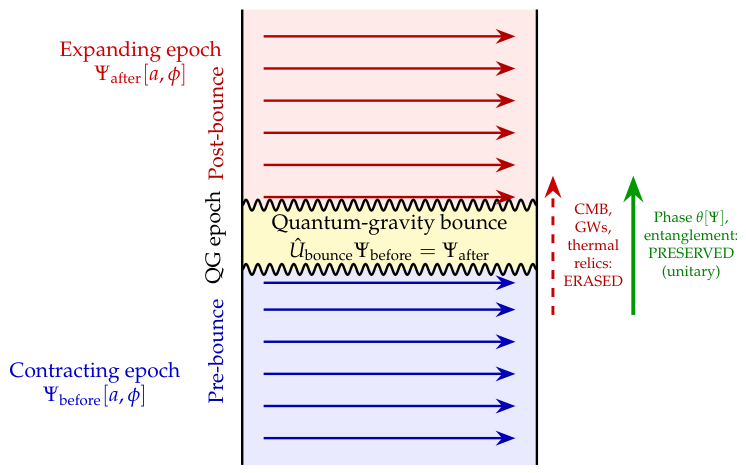
Three candidate mechanisms for the cosmological bounce are physically distinct. The decoherence mechanism [21,40] produces an effective classical geometry from the WdW wave function without any singular bounce event. The Penrose objective-reduction mechanism [22] posits non-unitary state reduction at Planckian density, with reduction time at . In the RS framework, the brane-collision mechanism [19,20] is the most physically transparent: two branes collide in AdS5, generating a hot plasma that reheats the universe. The wave function of the two-brane system propagates through the collision unitarily:
Figure 4.
Information channels across the quantum bounce. Classical channels—CMB, gravitational waves, thermal relics, Weyl entropy—are erased (red dashed arrow) because the geometric substrate that carries them ceases to exist. The phase and quantum-entanglement structure of propagate unitarily through the bounce (green arrow) under , constituting the sole surviving pre-geometric memory channel.
7. Entropy Argument, Phase Memory, and the Unitary Bridge
Thermal entropy is bounded, and that bound requires a substrate. The Bekenstein bound [25] and the Bekenstein–Hawking entropy are properties of fields defined on a spacetime manifold. When the spacetime manifold itself ceases to exist—as at a classical Big Crunch—every entropy functional defined on it is categorically erased.
This erasure mechanism differs in kind—not merely in degree—from information loss into a black hole. A gravitationally collapsing body creates a horizon within a pre-existing, spatially infinite spacetime; an external observer can, in principle, recover information via Hawking radiation [24]. At a cosmological bounce, no exterior region exists: the compression is of the entire spacetime simultaneously:
Phase Entropy and Phase Fidelity
The wave function is a complex functional on superspace. Its phase encodes the semiclassical flow—in the WKB limit, —and carries all information about which classical history the universe has followed.
We define the phase entropy as a functional on the distribution of phases over superspace:
where is the normalization of over superspace. The first term is the Shannon entropy of the modulus-squared distribution (amplitude entropy); the second captures the coherence of the phase gradient across superspace, minimized when the phase is deterministic (pure WKB) and maximized when the phase is uniformly distributed.
We define the phase fidelity:
For a unitary bounce ; for a classically chaotic bounce (BKL Mixmaster oscillations [34,35]) the bounce operator acquires a random unitary component and .
Proposition 2
(Phase entropy is bounce-invariant). Let be any unitary operator on the Hilbert space of the universal wave function, i.e. . Then .
Proof.
Unitarity implies up to a Jacobian factor that equals unity for induced by a field redefinition on superspace. Consequently, the amplitude entropy is invariant under , since the measure transforms covariantly.
For the phase-coherence term: , so integrating over h with the invariant measure gives the same result as the original. Both terms of (53) are therefore invariant, and . □
Corollary 1.
Under unitary quantum gravity, is a conserved quantity throughout any cosmological evolution, including the Big Bounce. It is the natural quantum-cosmological analogue of the classical (Liouville) invariant.
Example: Phase entropy in mini-superspace.
To illustrate the definition (53) and to demonstrate that is a computable quantity, we evaluate it explicitly in the simplest minisuperspace truncation: a single scale factor a with wave function , where is the modulus and is the phase. In this truncation, the functional derivative reduces to the ordinary derivative , and the phase entropy takes the form
with the normalization .
For the Hartle–Hawking wave function in the classically allowed region, the WKB form is
where is the classical action and is the turning point defined by . Substituting (56) into (55), the amplitude term becomes, up to normalization,
where denotes the characteristic variation of over the WKB region. The phase-coherence term is minimized for the pure WKB wave function, since the phase gradient is stationary, and evaluates to a finite quantity of order unity. The total phase entropy is therefore
The key observation is that is a finite, well-defined quantity that can be computed numerically for any specific inflationary potential and brane tension . This distinguishes it sharply from the thermal entropy , which diverges at the bounce, and from the Weyl entropy , which is undefined when the manifold ceases to exist. The same computation can be carried out for the Vilenkin wave function, yielding an analogous finite result whose numerical value differs from ; this difference provides a quantitative measure of the distinguishability between the two proposals at the level of phase information, complementary to the tunneling-exponent comparison discussed in Section 4.
Decoherence and the Apparent Loss of Coherence
When the brane interacts with bulk Kaluza–Klein modes, the reduced density matrix of the brane, obtained by tracing over bulk degrees of freedom , loses off-diagonal coherence and its von Neumann entropy increases. However, the total wave function remains pure, and remains constant. The apparent loss of coherence in the reduced state is an artefact of the partial trace: information is redistributed into brane–bulk entanglement that is inaccessible to a brane-local observer.
Table 3 contrasts all relevant entropy measures across the bounce.
8. Observational Consequences
Phase memory is, by definition, not directly observable— is not a classical field whose value can be measured at a detector. Its imprints must manifest as statistical properties of quantum perturbations that deviate from what a universe without pre-bounce history would predict.
The phase of the post-bounce wave function, via the WKB relation, encodes specific correlations between long-wavelength modes set before the bounce and modes generated during inflation. In standard slow-roll inflation, the primordial bispectrum is suppressed below cosmic-variance sensitivity for single-field models in the Bunch–Davies vacuum [36]. If pre-bounce phase imprints a coherent pattern of inter-mode entanglement, the bispectrum acquires an oscillatory correction:
where is the conformal time at the bounce. The amplitude is suppressed by , but its phase is a direct imprint of carried across the bounce.
The RS correction to the scalar primordial spectrum is [15,16]:
where is the energy density at Hubble exit for mode k. For high-scale RS () the correction is sub-percent on CMB scales; for low-scale RS () it can reach order unity on large angular scales.
A non-Bunch–Davies initial state modifies the scalar power spectrum with oscillatory features [38,39]:
where , , and is the phase inherited from . Detection of such oscillatory features with a specific phase relationship across CMB multipoles—and consistency between the phase measured in the temperature and E-mode polarization spectra—would constitute indirect but physically motivated evidence for quantum phase memory across the bounce. Future experiments (CMB-S4, LiteBIRD) are sensitive to at confidence, and space-borne gravitational-wave detectors (LISA, DECIGO, BBO) could constrain the tensor-to-scalar ratio in the RS ekpyrotic scenario [37].
9. Discussion and Conclusions
This paper establishes, to our knowledge for the first time, a systematic three-level correspondence between the Hartle–Hawking no-boundary proposal and the Vilenkin tunneling proposal on the one side, and the dynamical structure of Randall–Sundrum brane cosmology on the other.
The derivation of the RS-modified WdW equation presented here improves upon the structure of earlier analyses by grounding the quantization in the full five-dimensional ADM Hamiltonian, following the programme of [12]. Starting from the five-dimensional bulk action (12), we derived the canonical momenta (15)–(17), imposed junction conditions (21), fixed the gauge (22), and solved the bulk constraints (23) to obtain the effective brane action (24) with Hamiltonian constraint (25). Canonical quantization of this effective action yields the WdW equation (28) with potential (29). The quadratic density correction arises dynamically from the junction conditions and is not inserted by hand, which justifies its use in the quantum context within the semiclassical regime established in Section 3.7. The identity of (Proposition 1) provides a cross-check of the WdW derivation: the tunneling exponent obtained by canonical quantization of the effective brane action coincides exactly with the on-shell Euclidean action of the compact five-dimensional instanton, which is the saddle point of the Hartle–Hawking path integral. At the Euclidean path-integral level, the no-boundary saddle maps to a compact Euclidean AdS5 geometry with a closed brane [11]; Vilenkin’s outgoing-mode condition maps to brane nucleation from the bulk, formally identical to vacuum bubble nucleation in five dimensions. At the WKB level, the RS correction to the tunneling exponent is calculable from (39) and is positive for , predicting an enhanced tunneling probability relative to four-dimensional GR. At the holographic level, the AdS/CFT correspondence recasts the cosmological wave function as a CFT partition function with a UV cutoff, providing a non-perturbative definition of both boundary conditions in terms of CFT data.
The entropy argument for classical memory erasure at the bounce is more decisive than is commonly appreciated. The distinction between compression within spacetime and compression of spacetime is categorical: in the former case an intact exterior spacetime provides a substrate for information retrieval via Hawking radiation [24]; in the latter case no such substrate exists. The phase entropy defined here is invariant under any unitary bounce operator (Proposition 2) and constitutes a genuine conserved quantity of quantum cosmology—the natural quantum analogue of the classical Liouville invariant—that threads unbroken through an unlimited number of bounce cycles.
Three limitations of the present framework deserve explicit acknowledgement. The minisuperspace approximation truncates the infinite-dimensional superspace to two degrees of freedom, discarding all inhomogeneous perturbation modes; including these would generate an infinite tower of harmonic-oscillator corrections to the WdW equation and could modify both and . The unitarity of is assumed—it holds in loop quantum cosmology [17,18] but is not a derived result in full quantum gravity so the classical singularity is replaced by a quantum bounce at the critical density [49], and the WdW equation is replaced by a difference equation in the volume eigenvalue. The AdS/CFT dictionary, while precise in the string-theoretic RS2 context [13], has not been rigorously established for the cosmological brane at finite y-position. These are avenues for future development, not flaws in the structural correspondences established here.
The deepest open question is the value of in realistic quantum gravity. If quantum gravity is fully unitary across the bounce, and successive cycles carry perfect quantum memory. The observational handle on this question lies in the amplitude of oscillatory features in the primordial power spectrum (61) and in the phase consistency between scalar and tensor perturbations—both within reach of forthcoming CMB-S4 and space-borne gravitational-wave observatories.
License
CC-By Attribution 4.0 International
Funding
This research did not receive any specific grant from funding agencies in the public, commercial, or non-profit sectors.
Institutional Review Board Statement
This research involves purely theoretical and mathematical investigations in high-energy physics. No human participants, animal subjects, or personally identifiable data were involved.
Acknowledgments
We thank the referees for their constructive feedback which signifi cantly improved this work. The author acknowledges the authors of Refs. S. W. Hawking [11] and [12], whose foundational Hamiltonian and path-integral treatments of braneworld quantum cosmology directly informed the derivation presented in Section 3.
Conflicts of Interest
The author declares no competing interests, financial or non-financial, that could be reasonably perceived as influencing the research presented in this manuscript.
References
- Penrose, R. Gravitational collapse and space-time singularities. Phys. Rev. Lett. 1965, 14, 57. [Google Scholar] [CrossRef]
- Hawking, S. W.; Penrose, R. The singularities of gravitational collapse and cosmology. Proc. R. Soc. Lond. A 1970, 314, 529. [Google Scholar] [CrossRef]
- Arnowitt, R.; Deser, S.; Misner, C. W. Dynamical structure and definition of energy in general relativity. Phys. Rev. 1959, 116, 1322. [Google Scholar] [CrossRef]
- DeWitt, B. S. Quantum theory of gravity. I. The canonical theory. Phys. Rev. 1967, 160, 1113. [Google Scholar] [CrossRef]
- Wheeler, J. A. Superspace and the nature of quantum geometrodynamics. In Battelle Rencontres; DeWitt, C. M., Wheeler, J. A., Eds.; W. A. Benjamin, New York, 1968; pp. 242–307. [Google Scholar] [CrossRef]
- Hartle, J. B.; Hawking, S. W. Wave function of the universe. Phys. Rev. D. 1983, 28, 2960. [Google Scholar] [CrossRef]
- Vilenkin, A. Creation of universes from nothing. Phys. Lett. B 117 1982, 25. [Google Scholar] [CrossRef]
- Vilenkin, A. Boundary conditions in quantum cosmology. Phys. Rev. D. 1986, 33, 3560. [Google Scholar] [CrossRef] [PubMed]
- Randall, L.; Sundrum, R. A large mass hierarchy from a small extra dimension. Phys. Rev. Lett. 1999, 83, 3370. [Google Scholar] [CrossRef]
- Randall, L.; Sundrum, R. An alternative to compactification. Phys. Rev. Lett. 1999, 83, 4690. [Google Scholar] [CrossRef]
- Hawking, S. W.; Hertog, T.; Reall, H. S. Brane new world. Phys. Rev. D. 2000, 62, 043501. [Google Scholar] [CrossRef]
- Koyama, K.; Soda, J. Birth of the brane world. Phys. Lett. B 2000, 483, 432. [Google Scholar] [CrossRef]
- Maldacena, J. M. The large N limit of superconformal field theories and supergravity. Adv. Theor. Math. Phys. 1998, 2, 231. [Google Scholar] [CrossRef]
- Binétruy, P.; Deffayet, C.; Langlois, D. Non-conventional cosmology from a brane-universe. Nucl. Phys. B 565 2000, 269. [Google Scholar] [CrossRef]
- Langlois, D. Brane cosmology: an introduction. Prog. Theor. Phys. Suppl. 2003, 148, 181. [Google Scholar] [CrossRef]
- Maartens, R.; Koyama, K. Brane-world gravity. Living Rev. Rel. 2010, 13, 5. [Google Scholar] [CrossRef] [PubMed]
- Bojowald, M. Absence of a singularity in loop quantum cosmology. Phys. Rev. Lett. 2001, 86, 5227. [Google Scholar] [CrossRef] [PubMed]
- Ashtekar, A.; Singh, P. Loop quantum cosmology: a status report. Class. Quant. Grav. 2011, 28, 213001. [Google Scholar] [CrossRef]
- Steinhardt, P. J.; Turok, N. A cyclic universe. Science 2002, 296, 1436. [Google Scholar] [CrossRef] [PubMed]
- Khoury, J.; Ovrut, B. A.; Steinhardt, P. J.; Turok, N. The ekpyrotic universe: colliding branes and the origin of the hot Big Bang. Phys. Rev. D. 2001, 64, 123522. [Google Scholar] [CrossRef]
- Zurek, W. H. Decoherence, einselection, and the quantum origins of the classical. Rev. Mod. Phys. 2003, 75, 715. [Google Scholar] [CrossRef]
- Penrose, R. On gravity’s role in quantum state reduction. Gen. Rel. Grav. 1996, 28, 581. [Google Scholar] [CrossRef]
- Hawking, S. W. The quantum state of the universe. Nucl. Phys. B 1984, 239, 257. [Google Scholar] [CrossRef]
- Hawking, S. W. Particle creation by black holes. Commun. Math. Phys. 1975, 43, 199. [Google Scholar] [CrossRef]
- Bekenstein, J. D. Black holes and entropy. Phys. Rev. D. 1973, 7, 2333. [Google Scholar] [CrossRef]
- Kiefer, C. Quantum Gravity, 2nd ed.; Oxford University Press: Oxford, 2007; ISBN 978-0-19-921252-1. [Google Scholar]
- Banks, T. TCP, quantum gravity, the cosmological constant and all that…. Nucl. Phys. B 1985, 249, 332. [Google Scholar] [CrossRef]
- Zeh, H. D. Emergence of time from a universal wave function. Phys. Lett. A 1986, 116, 9. [Google Scholar] [CrossRef]
- Isham, C. J. Canonical quantum gravity and the problem of time. In Integrable Systems, Quantum Groups, and Quantum Field Theories; Ibort, L. A., Rodríguez, M. A., Eds.; Kluwer, Dordrecht, 1993; pp. 157–287. Available online: https://arxiv.org/abs/gr-qc/9210011.
- Rubakov, V. A.; Shaposhnikov, M. E. Do we live inside a domain wall? Phys. Lett. B 1983, 125, 136. [Google Scholar] [CrossRef]
- Coleman, S.; De Luccia, F. Gravitational effects on and of vacuum decay. Phys. Rev. D. 1980, 21, 3305. [Google Scholar] [CrossRef]
- Arkani-Hamed, N.; Porrati, M.; Randall, L. Holography and the Higgs profile. JHEP 08 2001, 017. [Google Scholar] [CrossRef]
- Verlinde, H. Holography and compactification. Nucl. Phys. B 2000, 580, 264. [Google Scholar] [CrossRef]
- Belinski, V. A.; Khalatnikov, I. M.; Lifshitz, E. M. Oscillatory approach to a singular point in the relativistic cosmology. Adv. Phys. 1970, 19, 525. [Google Scholar] [CrossRef]
- Misner, C. W. Mixmaster universe. Phys. Rev. Lett. 1969, 22, 1071. [Google Scholar] [CrossRef]
- Bunch, T. S.; Davies, P. C. W. Quantum field theory in de Sitter space: renormalization by point-splitting. Proc. R. Soc. Lond. A 1978, 360, 117. [Google Scholar] [CrossRef]
- Boyle, L. A.; Steinhardt, P. J.; Turok, N. Cosmic gravitational-wave background in a cyclic universe. Phys. Rev. D. 2004, 69, 127302. [Google Scholar] [CrossRef]
- Easther, R.; Greene, B. R.; Kinney, W. H.; Shiu, G. Inflation as a probe of short distance physics. Phys. Rev. D. 2001, 64, 103502. [Google Scholar] [CrossRef]
- Danielsson, U. H. Inflation, holography, and the choice of vacuum in de Sitter space. JHEP 07 2002, 040. [Google Scholar] [CrossRef]
- Halliwell, J. J.; Hawking, S. W. Origin of structure in the universe. Phys. Rev. D. 1985, 31, 1777. [Google Scholar] [CrossRef] [PubMed]
- Joos, E.; et al. Decoherence and the Appearance of a Classical World in Quantum Theory, 2nd ed.; Springer: Berlin, 2003. [Google Scholar] [CrossRef]
- Zeh, H. D. On the interpretation of measurement in quantum theory. Found. Phys. 1970, 1, 69. [Google Scholar] [CrossRef]
- York, J. W. Role of conformal three-geometry in the dynamics of gravitation. Phys. Rev. Lett. 1972, 28, 1082. [Google Scholar] [CrossRef]
- Anderson, E.; Barbour, J.; Foster, B. Z.; Kelleher, B.; Ó Murchadha, N. The physical gravitational degrees of freedom. Class. Quant. Grav. 2005, 22, 1795. [Google Scholar] [CrossRef]
- Penrose, R. Cycles of Time: An Extraordinary New View of the Universe; Bodley Head, London, 2010; ISBN 978-0-224-08036-1. [Google Scholar]
- Garriga, J.; Tanaka, T. Cosmological perturbations in the brane world. Phys. Rev. Lett. 2000, 84, 2778. [Google Scholar] [CrossRef] [PubMed]
- Shiromizu, T.; Maeda, K.; Sasaki, M. The Einstein equations on the 3-brane world. Phys. Rev. D. 2000, 62, 024012. [Google Scholar] [CrossRef]
- Brax, P.; van de Bruck, C. Cosmology and brane worlds: a review. Class. Quant. Grav. 2003, 20, R201. Available online: https://arxiv.org/abs/hep-th/0303095. [CrossRef]
- Ashtekar, A.; Pawlowski, T.; Singh, P. Quantum nature of the big bang. Phys. Rev. Lett. 2006, 96, 141301. Available online: https://arxiv.org/abs/gr-qc/0602086. [CrossRef] [PubMed]
- Martin, J.; Brandenberger, R. H. The trans-Planckian problem of inflationary cosmology. Phys. Rev. D. 2001, 63, 123501. Available online: https://arxiv.org/abs/hep-th/0005209. [CrossRef]
- Y. Akrami et al. (Planck Collaboration); et al. Planck 2018 results. X. Constraints on inflation. Astron. Astrophys. 2020, 641, A10. Available online: https://arxiv.org/abs/1807.06211.
- Abazajian, K. N.; et al. (CMB-S4 Collaboration), “CMB-S4 Science Book,”. 2016. Available online: https://arxiv.org/abs/1610.02743.
- Allys, E.; et al. LiteBIRD Collaboration), “Probing cosmic inflation with the LiteBIRD cosmic microwave background polarization survey,”. Prog. Theor. Exp. Phys. 2023 2023, 042F01. Available online: https://arxiv.org/abs/2202.02773.
- Garriga, J.; Sasaki, M. Brane-world creation and black holes. Phys. Rev. D. 2000, 62, 043523. [Google Scholar] [CrossRef]
- Bouhmadi-López, M.; González-Díaz, P. F.; Zhuk, A. On new gravitational instantons describing creation of braneworlds. Class. Quant. Grav. 2002, 19, 4863. Available online: https://arxiv.org/abs/hep-th/0208226. [CrossRef]
- Anchordoqui, L. A.; Edelstein, J.; Nunez, C.; Perez-Lorenzana, S. Brane worlds, string cosmology, and AdS/CFT. Phys. Rev. D. 2001, 64, 084027. Available online: https://arxiv.org/abs/hep-th/0106127. [CrossRef]
| 1 | Alternative factor orderings—e.g. the conformal-invariant choice or the DeWitt ordering—introduce corrections of order to the effective potential, which are subleading in the semiclassical regime and therefore do not affect the main results. |
| 2 | |
| 3 | |
| 4 | While our cosmological analysis uses the RS2 setup (a single brane in an infinite AdS5 bulk), it is instructive to recall the mass hierarchy generated in the RS1 two-brane model, as this provides the original motivation for the RS framework. In the RS2 setup used in this paper, the bulk extends to , and the four-dimensional Planck mass is |
| 5 | The minisuperspace truncation is justified whenever the wavelengths of interest are larger than the Hubble radius, . In this regime, the inhomogeneous modes are frozen and their backreaction on the homogeneous background is negligible; the WdW equation on minisuperspace therefore captures the leading semiclassical dynamics. The inclusion of inhomogeneous modes would generate an infinite tower of harmonic-oscillator corrections to the WdW equation and is beyond the scope of the present work. |
| 6 | The classical treatment of the bulk is justified by the AdS/CFT correspondence: the bulk theory is dual to a CFT with degrees of freedom, and the loop expansion of the bulk gravity is an expansion in . For one finds , so that ; the leading classical saddle used here is therefore an excellent approximation. The bulk Cauchy horizon remains regular for ; deviations for are encoded in the dark-radiation constant . |
Figure 1.
Five-dimensional geometry of the Randall–Sundrum (RS) models. Left (RS1): two 3-branes, the hidden brane at and the visible brane at , are separated by a finite interval in the AdS5 bulk. The exponential warp factor generates a hierarchy between the fundamental and effective mass scales; for , the suppression factor is of order . Right (RS2): a single brane at is embedded in a non-compact AdS5 bulk extending toward . Four-dimensional gravity is localized on the brane by the normalizable graviton zero mode, whose profile is proportional to in the schematic representation. The continuum of Kaluza–Klein modes produces corrections to Newtonian gravity; in the long-distance regime , their relative magnitude scales as .
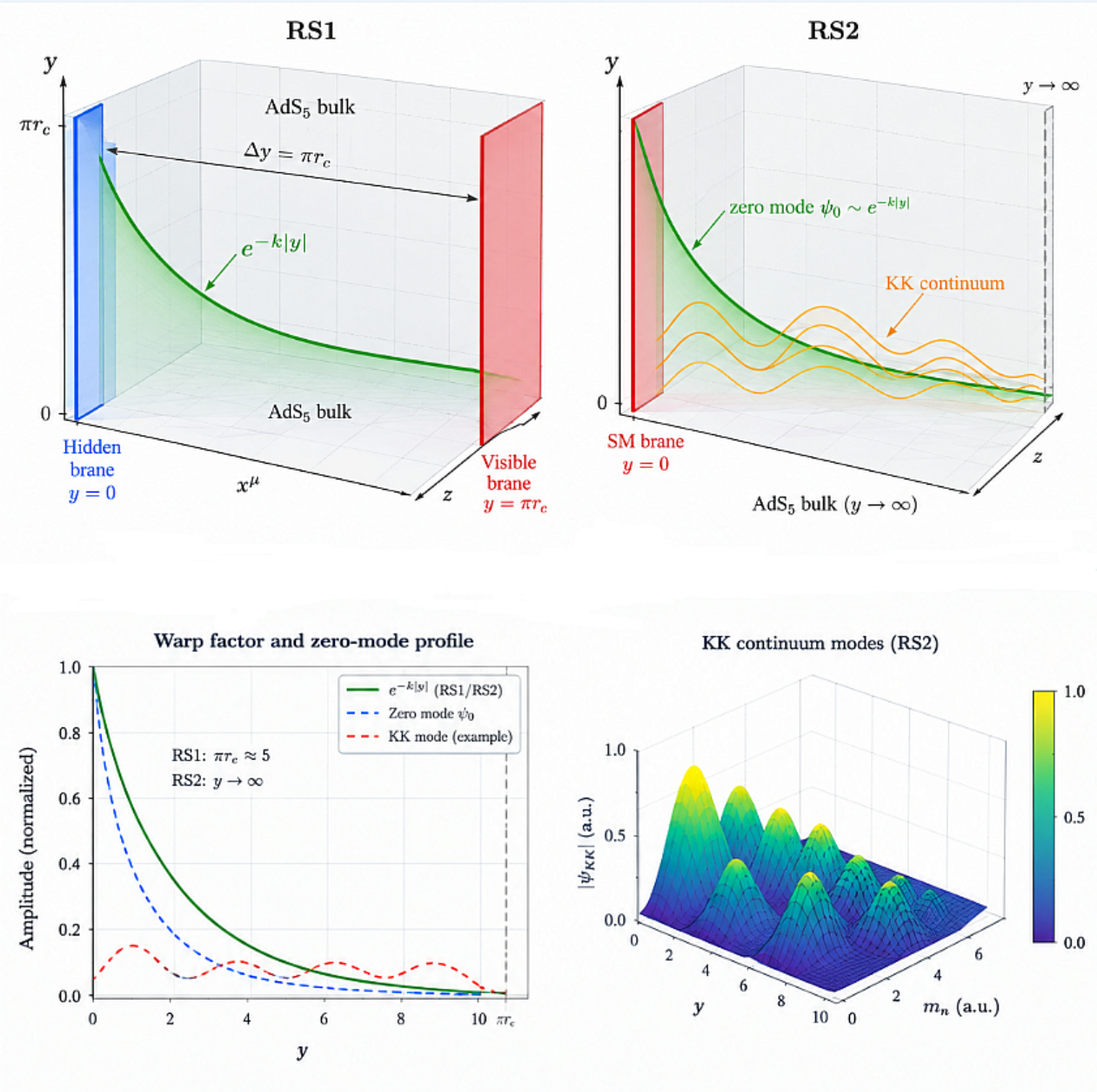
Figure 2.
Effective potentials in the WdW equation for a closed de Sitter brane universe, in units where (). The four-dimensional baseline (blue, solid) has turning point . The RS potential for and (green, solid) has and the turning point moved inward to , narrowing the barrier. A positive dark-radiation constant (red, dashed) lowers the potential at small a; (orange, dotted) raises it. The LQC repulsive term (purple, dash-dot) replaces the classical singularity with a quantum bounce. The shaded region is the classically forbidden zone where tunneling occurs.
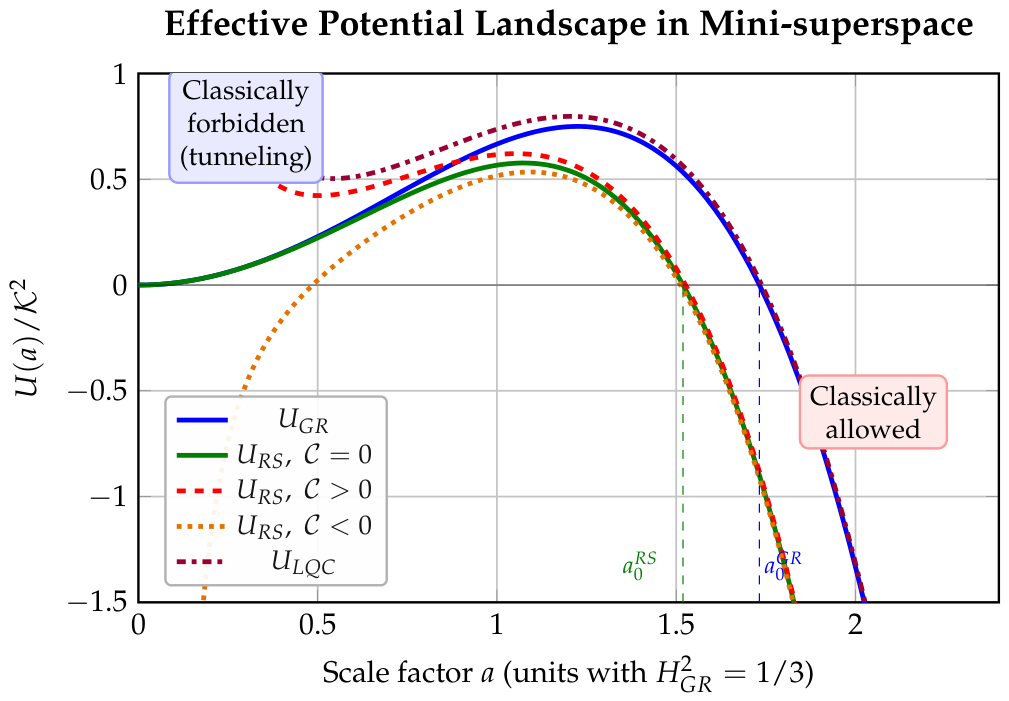
Figure 3.
Schematic representation of the Wheeler–DeWitt wave functions in the closed FLRW minisuperspace, based on Equation (9)–(10). The Hartle–Hawking (blue) and Vilenkin (red) prescriptions correspond to distinct semiclassical wave-function branches, with Euclidean/WKB behavior in the classically forbidden region and oscillatory behavior in the classically allowed region. The turning points and identify the boundaries of these regions in the general-relativistic and Randall–Sundrum (RS)-corrected descriptions, respectively. The RS correction shifts the turning point to , as indicated by the green arrow, thereby reducing the classically forbidden interval. The onset of emergent WKB time is indicated near the transition to the classically allowed regime, where the semiclassical relation applies. For , the corresponding change in the tunneling exponent follows from the RS-modified semiclassical action in Eq. (39).
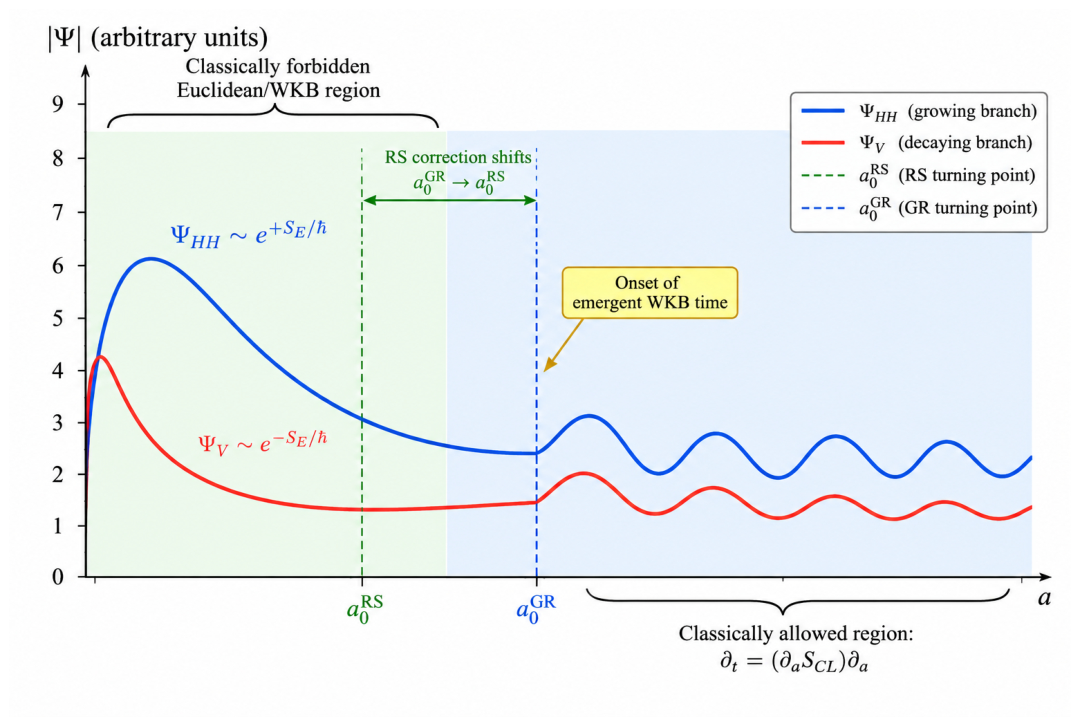

Table 1.
Detailed comparison of the Hartle–Hawking and Vilenkin boundary conditions. All numerical entries assume GeV and GeV. All entries are consistent with Equation (9) and (10).
| Property | Hartle–Hawking | Vilenkin |
|---|---|---|
| Boundary condition | No initial boundary; compact Euclidean 4-geometries without initial boundary | Outgoing modes only at singular superspace boundaries |
| Euclidean saddle point | Round with radius | -symmetric instanton; same |
| Forbidden region () | Growing mode: | Decaying mode: |
| Allowed region () | Standing wave: | Outgoing wave: |
| Probability weight | (unnormalized, divergent) | (exponentially suppressed) |
| Tunneling probability (GUT scale) | (unnorm.) | |
| Preferred cosmological constant | Large | Small |
| Physical interpretation | Time emerges from analytic continuation of Euclidean geometry | Universe nucleates by quantum tunneling from nothing |
| CPT symmetry of | (real in forbidden region) | (complex; outgoing only) |
Table 2.
Complete correspondence between four-dimensional quantum cosmological proposals, five-dimensional RS dynamics, and AdS/CFT holographic dual. Entries marked ★ are derived in the present work; entries marked † follow from S. W. Hawking [11,12] as indicated.
| Concept | HH (4D) | Vilenkin (4D) | RS / AdS/CFT |
|---|---|---|---|
| Origin | No-boundary compact | Quantum tunnel from | Brane nucleation in AdS5 |
| Euclidean saddle | Round | instanton | Compact Eucl. AdS5 with brane† |
| Wave-function exponent | , modified by | ||
| Preferred | Large | Small | Shifted by brane tension★ |
| Time emergence | WKB phase, | Post-nucleation WKB | Induced from y-coordinate on brane★ |
| AdS/CFT dual | (no-boundary state)† | (tunneling state) | CFT with UV cutoff † |
| Big Bounce mechanism | Time-symmetric WdW propagation | New tunnel per cycle | Brane collision in 5D bulk★ |
| Classical memory | Erased at bounce | Erased at bounce | Erased at brane collision★ |
| Quantum memory | Phase ★ | Phase ★ | Phase + Weyl tensor modes★ |
Table 3.
Comparative behaviour of entropy measures across the quantum bounce. “Substrate” denotes the geometric structure required for the entropy to be defined. “Survives bounce?” indicates whether the quantity retains physical meaning across the quantum-gravity epoch.
Table 3.
Comparative behaviour of entropy measures across the quantum bounce. “Substrate” denotes the geometric structure required for the entropy to be defined. “Survives bounce?” indicates whether the quantity retains physical meaning across the quantum-gravity epoch.
| Entropy / quantity | Required substrate | At bounce | Survives? | Carries memory? |
|---|---|---|---|---|
| Thermal | Lorentzian manifold + fields | (classical divergence) | No | No |
| Weyl curvature | Riemannian geometry | Diverges | No | No |
| Bekenstein–Hawking | Horizon 2-surface | Undefined (no horizon) | No | No |
| von Neumann (reduced) | Hilbert-space bipartition | Finite (quantum) | Partially | Partially (if bipartition survives) |
| Amplitude entropy | Superspace | Finite, conserved | Yes (unitary) | Yes (partial) |
| Phase entropy (this work) | Superspace | Finite, conserved | Yes (unitary) | Yes — complete |
| Phase fidelity (this work) | Superspace | (unitary bounce) | Yes (unitary) | Yes — complete |
Disclaimer/Publisher’s Note: The statements, opinions and data contained in all publications are solely those of the individual author(s) and contributor(s) and not of MDPI and/or the editor(s). MDPI and/or the editor(s) disclaim responsibility for any injury to people or property resulting from any ideas, methods, instructions or products referred to in the content. |
© 2026 by the authors. Licensee MDPI, Basel, Switzerland. This article is an open access article distributed under the terms and conditions of the Creative Commons Attribution (CC BY) license (http://creativecommons.org/licenses/by/4.0/).
Copyright: This open access article is published under a Creative Commons CC BY 4.0 license, which permit the free download, distribution, and reuse, provided that the author and preprint are cited in any reuse.