

Submitted:
22 August 2026
Posted:
24 August 2026
You are already at the latest version
Abstract
Through this work, we deduce a model where the Hartle--Hawking no-boundary proposal and Vilenkin's tunneling boundary condition are placed in precise structural correspondence with distinct dynamical régimes of Randall--Sundrum (RS) brane cosmology. The Wheeler--DeWitt (WdW) equation governing a Friedmann--Lemaître--Robertson--Walker brane embedded in a five-dimensional anti-de~Sitter (AdS\( _5 \)) bulk acquires two qualitatively new contributions---a quartic correction \(\propto a^4/\ell_{RS}^2\) from the brane self-energy and a dark-radiation term \(\propto \mu/a^2\) from the Weyl projection of the bulk Riemann tensor---which deform the classical turning point and alter the WKB tunneling exponent in a calculable, parameter-dependent fashion. We demonstrate that the no-boundary Euclidean saddle of the RS path integral maps to a compact Euclidean AdS\( _5 \) geometry carrying a closed brane, while Vilenkin's outgoing-mode condition translates into brane nucleation from the bulk; the AdS/CFT correspondence then recasts the cosmological wave function as the partition function of a four-dimensional conformal field theory with a UV cutoff set by the brane tension. Exploiting this unification, we address whether cyclic bounces can retain information across the quantum-gravity epoch. An entropy argument distinguishes---categorically and not merely in degree---compression within spacetime from compression of spacetime itself: classical observables (cosmic microwave background, primordial gravitational waves) are erased at the bounce because the geometric substrate that supports them ceases to exist, whereas the phase \(\theta[h_{ij},\phi]=\arg(\Psi[h_{ij},\phi])\) of the universal wave function evolves unitarily through the bounce and carries all pre-geometric correlations forward. We define a fidelity \(\mathcal{F}_{bounce}\) and a phase entropy \(S_\theta\) on the phase distribution of \(\Psi\) over superspace, prove their invariance under any unitary bounce operator, and contrast their behaviour with thermal and Weyl entropies, both of which are extinguished at the bounce. Indirect observational consequences---oscillatory non-Gaussianity with a specific momentum-phase signature and inter-mode entanglement absent from a Bunch--Davies vacuum---are identified as the only viable empirical probes of this quantum-coherent memory.
Keywords:
effective field theory
; Hartle–hawking no-boundary proposal
; Vilenkin tunneling wave function
; Randall–sundrum brane cosmology
; anti-de Sitter bulk
; Wheeler–dewitt equation
; UV cutoff
; Ads/cft correspondence
1. Introduction
Singularity. That word concentrates everything recalcitrant about classical general relativity when pressed to its early-universe limits. The Penrose–Hawking singularity theorems [1,2] establish—under the null energy condition and the requirement that at least one trapped surface forms—that any spacetime satisfying Einstein’s field equations must be geodesically incomplete. Incompleteness is not a coordinate artefact; it is the statement that timelike geodesics terminate, in finite proper time, at a locus where curvature invariants diverge and every classical description fails. The Big Bang is the canonical instance: the standard Friedmann cosmology extrapolated backward reaches, at , a state of infinite energy density with no classical antecedent, no initial condition, and no principled dynamical explanation for the geometry our universe inherited.
Quantum cosmology was constructed to dissolve this impasse. In its canonical form [4,5], the four-dimensional spacetime metric is promoted to a quantum-mechanical degree of freedom; the classical Hamiltonian constraint of the ADM decomposition [3] becomes, after canonical quantization, the Wheeler–DeWitt equation —a constraint equation on the space of all three-metrics and matter configurations, known as superspace. Two principled proposals for selecting the physical solution have generated sustained debate. Hartle and Hawking [6] advocated the no-boundary wave function, computed via a Euclidean path integral summed over compact four-geometries without initial boundary; time—understood as the WKB phase of —simply ceases to exist in the deep quantum régime, as naturally as spatial directions cease at the south pole of a sphere, and no “before” can be asked. Vilenkin [7,8], by contrast, required only outgoing modes at classically forbidden boundaries: the universe nucleates by a quantum tunnel from a state of literally nothing, an event with no classical analog and no preceding epoch. These proposals differ not only in physical picture but in a sign: Hartle–Hawking selects the growing Euclidean mode , strongly preferring large cosmological constants, while Vilenkin selects the decaying mode , preferring small- inflationary seeds [22]. Neither prediction has been definitively tested; the tension has never been resolved within purely four-dimensional quantum cosmology.
Randall–Sundrum brane-world models [9,10] enrich this landscape without immediately resolving it, but they do so in a geometrically transparent way that admits precise mathematical correspondences with both boundary conditions. In RS1, our universe is a positive-tension 3-brane at the boundary of an AdS5 bulk whose curvature radius is set by a negative bulk cosmological constant; the exponential warp factor of the RS metric generates the gauge hierarchy without parameter fine-tuning beyond the modest requirement [9]. In RS2, a single brane in an infinite AdS5 bulk localizes four-dimensional gravity via a normalizable zero mode, producing Newtonian gravity at macroscopic scales with Kaluza–Klein corrections at sub-millimetre distances [10,29]. Cosmologically, the embedding of a Friedmann brane in the RS bulk modifies the Friedmann equation at high densities [12,13,14], introducing corrections quadratic in that alter the structure of the WdW effective potential and therefore the tunneling amplitudes of both quantum cosmological proposals.
The present paper develops three interlocking results. The first is a systematic derivation of the RS-modified WdW equation—a second-order functional differential equation on brane minisuperspace—and an identification of two structurally new terms that deform both the Hartle–Hawking and Vilenkin exponents in computable directions. The second is a table of exact correspondences, operating at the levels of Euclidean path-integral saddle points, WKB exponents, and AdS/CFT holographic duals, between four-dimensional quantum cosmological boundary conditions and five-dimensional RS dynamics. The third—and physically most consequential—is a thermodynamic argument demonstrating that classical information channels are categorically erased at a cosmological bounce, while the phase of the universal wave function propagates unitarily across the bounce, constituting the unique pre-geometric memory channel; we define and prove the invariance of a phase entropy functional and a phase fidelity under any unitary bounce operator, and identify indirect observational consequences in the CMB bispectrum and initial state of inflation.
2. Wheeler–DeWitt Equation and Quantum Cosmological Boundary Conditions
The starting point is the ADM form [3] of the four-dimensional Einstein–Hilbert action with a minimally coupled inflaton field :
Restricting to closed () FLRW metrics , the minisuperspace (MSS) action is
The momenta conjugate to a and are and . Canonical quantization , converts the Hamiltonian constraint into the Wheeler–DeWitt equation:
where (in units , , operator-ordering ):
Three features of (3) are worth underscoring. No explicit time derivative appears— is a timeless constraint, and time must be recovered as an emergent, derivative concept [25,26,27]. The equation is formally of Klein–Gordon type on MSS, with the DeWitt metric serving as the target-space metric and playing the role of a potential that changes sign at the classical turning point , defined by , i.e. . The region () is classically forbidden; the region () is classically allowed. Tunneling through the forbidden region is the quantum analogue of the classical Big Bang.
The WKB ansatz , inserted into (3) and expanded in ℏ, yields at leading order the Hamilton–Jacobi equation in the classically allowed region. The WKB time parameter is then defined operationally by [26,27,28]:
so that the time-dependent Schrödinger equation for matter perturbations is recovered in the semiclassical limit. Time, in this sense, is not put in by hand—it crystallizes from the timeless wave function whenever the WKB phase oscillates rapidly enough for the approximation to hold. The turning point is, precisely, the birthplace of time.
The two boundary conditions differ in how the wave function behaves in the forbidden region . For a de Sitter minisuperspace model with , so and , the Hartle–Hawking no-boundary wave function [6,22], constructed via the Euclidean path integral
summed over compact Euclidean four-geometries without initial boundary, selects the growing Euclidean mode:
Vilenkin’s tunneling wave function [7,8], imposing purely outgoing modes at singular boundaries of superspace, selects the decaying Euclidean mode:
The sign reversal in the exponent of the overall prefactor reflects the fundamental preference of each proposal: Hartle–Hawking assigns larger weight to geometries with larger (the prefactor diverges as ); Vilenkin assigns larger weight to smaller .
Concretely, for GUT-scale inflation with inflaton potential GeV—giving in reduced Planck units where GeV—the Vilenkin tunneling probability is:
an extraordinarily small but strictly positive number, confirming that tunneling is not kinematically forbidden—only exponentially suppressed. Table 1 provides a structured comparison of the two proposals.
3. Randall–Sundrum Brane Cosmology and the Modified WdW Equation
The RS bulk action is [9,10]:
where is the five-dimensional metric with Ricci scalar , is the bulk cosmological constant, and is the brane tension. The RS1 static solution is the warped metric:
with and the RS fine-tuning condition , which enforces a flat brane (). The four-dimensional Planck mass is:
and the mass hierarchy generated by the warp factor is:
Setting (the observed ratio between the electroweak and Planck scales), one finds:
so that with GeV, the interbrane separation is m—two orders of magnitude above the Planck length, yet geometrically sufficient to compress the full hierarchy into a single exponential.
Figure 1 illustrates the five-dimensional geometry of both RS models.
Derivation of the RS-Modified Wheeler–DeWitt Equation
When the brane undergoes cosmological expansion, the Israel junction conditions applied to the RS bulk yield—after using the Gauss–Codazzi relations—the modified Friedmann equation [12,14]:
where with , is the dark-radiation constant (a free integration constant of the five-dimensional equations), and vanishes under the RS fine-tuning. The quadratic correction dominates when , i.e. at energies .
To derive the modified WdW equation, one identifies the canonical momentum from the brane minisuperspace action, performs the Legendre transform, and imposes the Hamiltonian constraint. The result is:
with the RS-modified effective potential (units , ):
where for constant energy density. Four structural differences between and deserve articulation. The correction, proportional to , is always negative and pulls the potential downward at intermediate a, narrowing the classical turning point compared to the four-dimensional case. The dark-radiation term diverges at with a sign that is a free parameter, raising the potential barrier (for ) or reducing it (for ). The coefficient connects the four-dimensional gravitational coupling to the brane tension—all RS corrections scale with brane-tension combinations. The fine-tuning condition (10) is broken dynamically during brane expansion, generating a density-dependent effective cosmological constant absent from the static RS solution.
The classical turning point defined by satisfies, for and constant :
where . The correction is always negative (the RS turning point is smaller), confirming that the RS geometry narrows the quantum barrier. Figure 2 displays , (with and ), and the LQC-corrected potential for direct comparison.
RS Correction to the Tunneling Exponent
The tunneling amplitude through is:
Expanding around the GR baseline, the RS correction to the log-amplitude is:
For this is positive—the RS correction increases the tunneling probability relative to four-dimensional GR, an enhancement that grows with the energy density at the bounce epoch and shrinks as (recovering GR). For a competing suppression may dominate at small a.
4. Exact Correspondences Between Boundary Conditions and RS Dynamics
The mapping between four-dimensional quantum cosmological boundary conditions and five-dimensional RS dynamics operates at three structurally distinct levels. We develop each in sequence.
The Euclidean path-integral level is the most fundamental. The Hartle–Hawking integral (6) generalizes to five dimensions as:
summed over compact Euclidean five-geometries with a closed brane and no initial boundary in the bulk. The Euclidean continuation of the Lorentzian RS metric () yields a Euclidean AdS5 bulk in which the brane traces a closed hypersurface; the no-boundary condition demands that this Euclidean bulk be smooth and compact, with the brane shrinking to a point at the Euclidean “south pole.” The correspondence is:
The Euclidean action of the five-dimensional RS saddle is:
where H is the de Sitter Hubble rate on the brane and as (recovering the four-dimensional result ). Vilenkin’s tunneling condition, applied to the RS path integral, maps to brane nucleation in the AdS5 bulk—formally identical to vacuum bubble nucleation [30]—with probability .
At the WKB level, the tunneling exponent under RS corrections follows directly from (20): both proposals preserve their respective signs (positive for HH, negative for Vilenkin) but acquire RS corrections that shift the numerical value of the exponent in a brane-tension-dependent direction, with the amplitude of the shift controlled by the dimensionless ratio at the turning point.
At the AdS/CFT level [11], the RS2 brane at position in AdS5 is holographically dual to a four-dimensional conformal field theory with UV cutoff [31,32]. The brane wave function maps to the CFT partition function:
The no-boundary Euclidean path integral over bulk geometries is dual to the CFT path integral over field configurations on the boundary; the Vilenkin boundary condition corresponds to a specific RG-flow state of the CFT defined by purely outgoing modes in the flow. Table 2 records the complete three-level mapping.
5. The Problem of the Beginning of Time and Its Resolution
Time does not enter the WdW equation. This is no gauge ambiguity or calculational convenience—it is an irresistible consequence of diffeomorphism invariance, which promotes the Hamiltonian of general relativity to a constraint rather than a generator of evolution in some pre-existing background time [4,28]. The WdW equation is timeless in the most literal sense: no derivative appears, and the wave function does not carry an explicit time label. Time must be recovered as a derivative concept—a function of the dynamical variables themselves.
The WKB mechanism achieves this recovery [25,26,27]. In the classically allowed region (), the wave function oscillates rapidly: . The phase satisfies the classical Hamilton–Jacobi equation. Equation (5) defines a vector field on minisuperspace whose integral curves are the classical Friedmann solutions; the parameter along these curves is cosmic time t. Time, in this formulation, is not fundamental—it is the WKB label that tracks which classical trajectory the wave function is currently “near.” Before the crystallization (, the Euclidean region), no such classical trajectory exists, the phase is real, and no time parameter is defined. The turning point is, structurally, the moment at which time itself first becomes meaningful.
Three mechanisms for time emergence, one per framework, follow from this analysis. In the Hartle–Hawking case, the Euclidean-to-Lorentzian transition at is geometrically smooth: the analytic continuation converts the round (Euclidean) into a de Sitter hyperboloid (Lorentzian) without any singular intermediate state. Time “appears” by analytic continuation from imaginary time; the boundary between the two régimes is the equator of the Euclidean sphere. In the Vilenkin case, the transition is discontinuous in classical terms—the universe tunnels from to with no Lorentzian trajectory connecting them—and time appears sharply after the nucleation, on the classical expanding side. In the RS case, a third mechanism is available: the position y of the brane in the fifth dimension serves as a York time variable [42,43]. As the brane moves through the AdS5 bulk, its induced metric evolves cosmologically, and the integral constitutes the four-dimensional cosmic time. Time on the brane is motion in the extra dimension—a concrete geometric realization of temporal emergence from a higher-dimensional, essentially static, bulk geometry.
Figure 3 illustrates the WKB transition and the birth of time for both boundary conditions under the standard and RS-modified potentials.
6. Wave-Function “Collapse” and the Big Bounce
Collapse requires an observer. In single-particle quantum mechanics the Copenhagen measurement postulate assigns a definite post-measurement state to a system after an external agent interacts with it. No such agent exists for the universe: by definition, no observer occupies a position exterior to the total system being described by . The universal wave function does not collapse—it evolves, unitarily, according to the WdW equation. What appears to be collapse, from the vantage of an internal observer, is decoherence [19,40,41]: entanglement between large-scale geometry (the “system”) and short-wavelength radiation and matter perturbations (the “environment”) suppresses off-diagonal elements of the reduced density matrix:
selecting one classical geometry without any genuine global collapse. The universe does not “choose” a branch; it entangles with its internal environment so thoroughly that the interference between branches becomes unmeasurable.
Three candidate mechanisms for the cosmological bounce are physically distinct and deserve separate treatment. The decoherence mechanism [19,39] produces an effective classical geometry from the WdW wave function without any singular bounce event: the WKB approximation breaks down at small a and is re-established at large a, with the quantum-gravity epoch playing the role of a “scrambler” that re-initializes the classical description without physically bouncing. The Penrose objective-reduction mechanism [20] posits that gravitational self-energy drives a genuine non-unitary state reduction when the mass-energy difference between superposed geometries satisfies:
at Planckian density and Planckian scale , one finds s, so objective reduction would occur instantaneously by any macroscopic clock. In the RS framework, the brane-collision mechanism of the ekpyrotic/cyclic scenario [17,18] is the most physically transparent: two branes approach each other in AdS5, collide—generating a hot plasma that reheats the universe—and bounce apart. The wave function of the two-brane system (where is the inter-brane separation) propagates through unitarily and re-emerges on the far side. The brane collision is literally a bounce in the five-dimensional geometry, with the bounce operator mapping:
Figure 4 summarizes the information channels through the bounce.
7. Entropy Argument, Phase Memory, and the Unitary Bridge
Thermal entropy is bounded, and that bound requires a substrate. The Bekenstein bound [24] applies to any system of energy E enclosed in a sphere of radius R; the Bekenstein–Hawking black-hole entropy applies to any region bounded by a horizon of area A. Both expressions are properties of fields defined on a spacetime manifold: they count independent field configurations compatible with specified geometric constraints. When the spacetime manifold itself ceases to exist—as at a classical Big Crunch—the manifold on which entropy is defined disappears. Thermal entropy , Weyl curvature entropy in Penrose’s sense [21], and every other functional of classical field configurations are therefore categorically erased at the bounce. They require a geometric substrate; the bounce removes the substrate itself.
This erasure mechanism differs in kind—not merely in degree—from information loss into a black hole. A gravitationally collapsing body creates a horizon within a pre-existing, spatially infinite spacetime; an external observer inhabits an intact region and can, in principle, recover information via Hawking radiation [23] or holographic encoding on the horizon surface. The horizon is a membrane within spacetime. At a cosmological bounce, no exterior region exists: the compression is of the entire spacetime, fields, and geometry simultaneously, so no external observer position and no undisturbed substrate remain. Stated in terms of the metric:
The CMB, primordial gravitational waves, and every other classical observable of our universe are post-bounce phenomena. They are defined on the post-bounce spacetime and carry, by the above argument, zero imprint of pre-bounce classical configurations. The argument is categorical, not probabilistic.
Phase Entropy and Phase Fidelity
The wave function is a complex functional on superspace. Its modulus squared defines a probability measure; its phase encodes the semiclassical flow—in the WKB limit, and the gradient is proportional to the canonical momentum , recording the entire classical trajectory from which was derived. All information about which classical history the universe has followed is stored in the phase, not in the modulus.
We define the phase entropy as a functional on the distribution of phases over superspace:
where is the normalization of over superspace and denotes a phase-shifted copy. The first term is the Shannon entropy of the modulus-squared distribution (amplitude entropy); the second term captures the coherence of the phase gradient across superspace, and is minimized when the phase is deterministic (pure WKB) and maximized when the phase is uniformly distributed. We define the phase fidelity:
For a unitary bounce, ; for a classically chaotic bounce (BKL Mixmaster oscillations [33,34]) the bounce operator acquires a random unitary component and .
Proposition 1
(Phase entropy is bounce-invariant). Let be any unitary operator on the Hilbert space of the universal wave function, i.e. . Then .
Proof.
Unitarity implies up to a Jacobian factor that equals unity for induced by a field redefinition on superspace. Consequently, the amplitude entropy is invariant under , since the measure transforms covariantly. For the phase-coherence term: , since acts as an isometry on the Hilbert space. Both terms of (29) are therefore invariant, and . □
Corollary 1.
Under unitary quantum gravity, is a conserved quantity throughout any cosmological evolution, including the Big Bounce. It is the natural quantum-cosmological analogue of the classical Liouville invariant.
Table 3 contrasts all relevant entropy measures across the bounce.
8. Observational Consequences
Phase memory is, by definition, not directly observable— is not a classical field whose value can be measured at a detector. Its imprints must manifest as statistical properties of quantum perturbations that deviate from what a universe without pre-bounce history would predict. Three channels are physically motivated.
The phase of the post-bounce wave function, via the WKB relation, encodes specific correlations between long-wavelength modes set before the bounce and modes generated during inflation. In standard slow-roll inflation, the primordial bispectrum is suppressed below cosmic-variance sensitivity for single-field models in the Bunch–Davies vacuum [35]. If pre-bounce phase imprints a coherent pattern of inter-mode entanglement, the bispectrum acquires an oscillatory correction:
where is the conformal time at the bounce and the sine factor oscillates with period , set by the pre-bounce Hubble radius. The amplitude is suppressed by , which may itself be exponentially small—but its phase is a direct imprint of carried across the bounce.
In the RS ekpyrotic setting, the brane collision generates tensor perturbations with a power spectrum modified relative to the inflationary prediction [36]. The RS correction to the scalar primordial spectrum is [13,14]:
where is the energy density at Hubble exit for mode k. For high-scale RS
the correction is sub-percent on CMB scales; for low-scale RS () it can reach order unity on large angular scales (), potentially explaining the observed CMB quadrupole anomaly. where is a coupling parameter of mass dimension four, characterized by the scaling relation
where denotes the fundamental five-dimensional mass scale. The initial quantum state of inflation—whether Bunch–Davies, a Bogoliubov-transformed vacuum, or something more structured—carries an imprint of the pre-inflationary (and, under our framework, pre-bounce) wave function. A non-Bunch–Davies initial state modifies the scalar power spectrum with oscillatory features [37,38]:
where is the Bogoliubov coefficient amplitude (proportional to ), is the reference scale set by the pre-bounce Hubble radius, and is the phase inherited from . Detection of such oscillatory features with a specific phase relationship across CMB multipoles—and consistency between the phase measured in the temperature and E-mode polarization spectra—would constitute indirect but physically motivated evidence for quantum phase memory across the bounce. Future experiments (CMB-S4, LiteBIRD) are sensitive to at confidence, and primordial gravitational-wave detectors (LISA, DECIGO, BBO) could constrain the tensor-to-scalar ratio in the RS ekpyrotic scenario [36].
9. Discussion and Conclusions
This paper establishes, to our knowledge for the first time, a systematic three-level correspondence between the Hartle–Hawking no-boundary proposal and the Vilenkin tunneling proposal on the one side, and the dynamical structure of Randall–Sundrum brane cosmology on the other, mediated by the modified Wheeler–DeWitt equation derived from the RS bulk action. At the Euclidean path-integral level, the no-boundary saddle maps to a compact Euclidean AdS5 geometry with a closed brane; Vilenkin’s outgoing-mode condition maps to brane nucleation from the bulk, formally identical to vacuum bubble nucleation in five dimensions. At the WKB level, the RS correction to the tunneling exponent is calculable from (20) and is positive for , predicting an enhanced tunneling probability relative to four-dimensional GR by a factor that depends on the ratio at the turning point. At the holographic level, the AdS/CFT correspondence recasts the cosmological wave function as a CFT partition function with a UV cutoff, providing a non-perturbative definition of both boundary conditions in terms of CFT data.
The entropy argument for classical memory erasure at the bounce is, we believe, more decisive than is commonly appreciated in the literature on cyclic cosmology. The distinction between compression within spacetime (black hole) and compression of spacetime (bounce) is categorical: in the former case an intact exterior spacetime provides a substrate for information retrieval via Hawking radiation [23]; in the latter case no such substrate exists, and every classical observable—CMB, gravitational waves, thermal relics, Weyl entropy—is categorically erased. This does not imply that a cyclic universe has no memory; it implies that the memory must be encoded in the phase structure of the quantum wave function, not in classical fields. The phase entropy defined here is invariant under any unitary bounce operator (Proposition 1) and therefore constitutes a genuine conserved quantity of quantum cosmology—the natural quantum analogue of the classical Liouville invariant—that threads unbroken through an unlimited number of bounce cycles.
Three limitations of the present framework deserve explicit acknowledgement. The mini-superspace approximation truncates the infinite-dimensional superspace to two degrees of freedom (a and ), discarding all inhomogeneous perturbation modes; including these would generate an infinite tower of harmonic-oscillator corrections to the WdW equation and could modify both and . The unitarity of is assumed—it holds in loop quantum cosmology [15,16], which provides a specific lattice regularization of the WdW equation, but is not a derived result in full quantum gravity. The AdS/CFT dictionary, while precise in the string-theoretic RS2 context [11], has not been rigorously established for the cosmological brane at finite y-position, where the standard GKPW prescription [31] must be modified. These are avenues for future development, not flaws in the structural correspondences established here.
The deepest open question is the value of in realistic quantum gravity. If quantum gravity is fully unitary across the bounce, and successive cycles carry perfect quantum memory. If some information is genuinely lost—as in the pre-Page-time black-hole scenario— and cycles become progressively more quantum-stochastic, with the wave function approaching a Haar-random state after sufficiently many bounces. The observational handle on this question lies in the amplitude of oscillatory features in the primordial power spectrum (equation (33)) and in the phase consistency between scalar and tensor perturbations—both of which are within reach of forthcoming CMB-S4 and space-borne gravitational-wave observatories, even if the signal amplitude is suppressed by the exponentially small ratio that sets the overall scale of pre-bounce imprints.
Funding
This research did not receive any specific grant from funding agencies in the public, commercial, or non-profit sectors.
Acknowledgments
The author acknowledges helpful discussions with colleagues and the supportive research environment. Sincere thanks are extended to the authors of the supporting references whose work contributed to improving and grounding this analysis.
Competing Interest
The author declares no competing interests, financial or non-financial, that could be reasonably perceived as influencing the research presented in this manuscript.
Ethics Statement
This research involves purely theoretical and mathematical investigations in high-energy physics. No human participants, animal subjects, or personally identifiable data were involved.
License
CC-By Attribution 4.0 International
References
- Penrose, R. Gravitational collapse and space-time singularities. Phys. Rev. Lett. 1965, 14, 57. [Google Scholar] [CrossRef]
- Hawking, S. W.; Penrose, R. The singularities of gravitational collapse and cosmology. Proc. R. Soc. Lond. A 1970, 314, 529. [Google Scholar] [CrossRef]
- Arnowitt, R.; Deser, S.; Misner, C. W. Dynamical structure and definition of energy in general relativity. Phys. Rev. 1959, 116, 1322. [Google Scholar] [CrossRef]
- DeWitt, B. S. Quantum theory of gravity. I. The canonical theory. Phys. Rev. 1967, 160, 1113. [Google Scholar] [CrossRef]
- Wheeler, J. A. Superspace and the nature of quantum geometrodynamics. In Battelle Rencontres; DeWitt, C. M., Wheeler, J. A., Eds.; W. A. Benjamin, New York, 1968; pp. 242–307. [Google Scholar] [CrossRef]
- Hartle, J. B.; Hawking, S. W. Wave function of the universe. Phys. Rev. D. 1983, 28, 2960. [Google Scholar] [CrossRef]
- Vilenkin, A. Creation of universes from nothing. Phys. Lett. B 1982, 117, 25. [Google Scholar] [CrossRef]
- Vilenkin, A. Boundary conditions in quantum cosmology. Phys. Rev. D. 1986, 33, 3560. [Google Scholar] [CrossRef]
- Randall, L.; Sundrum, R. A large mass hierarchy from a small extra dimension. Phys. Rev. Lett. 1999, 83, 3370. [Google Scholar] [CrossRef]
- Randall, L.; Sundrum, R. An alternative to compactification. Phys. Rev. Lett. 1999, 83, 4690. [Google Scholar] [CrossRef]
- Maldacena, J. M. The large N limit of superconformal field theories and supergravity. Adv. Theor. Math. Phys. 1998, 2, 231. [Google Scholar] [CrossRef]
- Binétruy, P.; Deffayet, C.; Langlois, D. Non-conventional cosmology from a brane-universe. Nucl. Phys. B 2000, 565, 269. [Google Scholar] [CrossRef]
- Langlois, D. Brane cosmology: an introduction. Prog. Theor. Phys. Suppl. 2003, 148, 181. [Google Scholar] [CrossRef]
- Maartens, R.; Koyama, K. Brane-world gravity. Living Rev. Rel. 2010, 13, 5. [Google Scholar] [CrossRef]
- Bojowald, M. Absence of a singularity in loop quantum cosmology. Phys. Rev. Lett. 2001, 86, 5227. [Google Scholar] [CrossRef]
- Ashtekar, A.; Singh, P. Loop quantum cosmology: a status report. Class. Quant. Grav. 2011, 28, 213001. [Google Scholar] [CrossRef]
- Steinhardt, P. J.; Turok, N. A cyclic universe. Science 2002, 296, 1436. [Google Scholar] [CrossRef]
- Khoury, J.; Ovrut, B. A.; Steinhardt, P. J.; Turok, N. The ekpyrotic universe: colliding branes and the origin of the hot Big Bang. Phys. Rev. D. 2001, 64, 123522. [Google Scholar] [CrossRef]
- Zurek, W. H. Decoherence, einselection, and the quantum origins of the classical. Rev. Mod. Phys. 2003, 75, 715. [Google Scholar] [CrossRef]
- Penrose, R. On gravity’s role in quantum state reduction. Gen. Rel. Grav. 1996, 28, 581. [Google Scholar] [CrossRef]
- Penrose, R. Cycles of Time: An Extraordinary New View of the Universe; Bodley Head, London, 2010; ISBN 978-0-224-08036-1. [Google Scholar] [CrossRef]
- Hawking, S. W. The quantum state of the universe. Nucl. Phys. B 1984, 239, 257. [Google Scholar] [CrossRef]
- Hawking, S. W. Particle creation by black holes. Commun. Math. Phys. 1975, 43, 199. [Google Scholar] [CrossRef]
- Bekenstein, J. D. Black holes and entropy. Phys. Rev. D. 1973, 7, 2333. [Google Scholar] [CrossRef]
- Kiefer, C. Quantum Gravity, 2nd ed.; Oxford University Press: Oxford, 2007; ISBN 978-0-19-921252-1. [Google Scholar]
- Banks, T. TCP, quantum gravity, the cosmological constant and all that…. Nucl. Phys. B 1985, 249, 332. [Google Scholar] [CrossRef]
- Zeh, H. D. Emergence of time from a universal wave function. Phys. Lett. A 1986, 116, 9. [Google Scholar] [CrossRef]
- Isham, C. J. Canonical quantum gravity and the problem of time. In Integrable Systems, Quantum Groups, and Quantum Field Theories; Ibort, L. A., Rodríguez, M. A., Eds.; Kluwer, Dordrecht, 1993; pp. 157–287. [Google Scholar]
- Rubakov, V. A.; Shaposhnikov, M. E. Do we live inside a domain wall? Phys. Lett. B 1983, 125, 136. [Google Scholar] [CrossRef]
- Coleman, S.; De Luccia, F. Gravitational effects on and of vacuum decay. Phys. Rev. D. 1980, 21, 3305. [Google Scholar] [CrossRef]
- Arkani-Hamed, N.; Porrati, M.; Randall, L. Holography and the Higgs profile. JHEP 08 2001, 08, 017. [Google Scholar] [CrossRef]
- Verlinde, H. Holography and compactification. Nucl. Phys. B 2000, 580, 264. [Google Scholar] [CrossRef]
- Belinski, V. A.; Khalatnikov, I. M.; Lifshitz, E. M. Oscillatory approach to a singular point in the relativistic cosmology. Adv. Phys. 1970, 19, 525. [Google Scholar] [CrossRef]
- Misner, C. W. Mixmaster universe. Phys. Rev. Lett. 1969, 22, 1071. [Google Scholar] [CrossRef]
- Bunch, T. S.; Davies, P. C. W. Quantum field theory in de Sitter space: renormalization by point-splitting. Proc. R. Soc. Lond. A 1978, 360, 117. [Google Scholar] [CrossRef]
- Boyle, L. A.; Steinhardt, P. J.; Turok, N. Cosmic gravitational-wave background in a cyclic universe. Phys. Rev. D. 2004, 69, 127302. [Google Scholar] [CrossRef]
- Easther, R.; Greene, B. R.; Kinney, W. H.; Shiu, G. Inflation as a probe of short distance physics. Phys. Rev. D. 2001, 64, 103502. [Google Scholar] [CrossRef]
- Danielsson, U. H. Inflation, holography, and the choice of vacuum in de Sitter space. JHEP 2002, 07, 040. [Google Scholar] [CrossRef]
- Halliwell, J. J.; Hawking, S. W. Origin of structure in the universe. Phys. Rev. D. 1985, 31, 1777. [Google Scholar] [CrossRef]
- Joos, E.; et al. Decoherence and the Appearance of a Classical World in Quantum Theory, 2nd ed.; Springer: Berlin, 2003. [Google Scholar] [CrossRef]
- Zeh, H. D. On the interpretation of measurement in quantum theory. Found. Phys. 1970, 1, 69. [Google Scholar] [CrossRef]
- York, J. W. Role of conformal three-geometry in the dynamics of gravitation. Phys. Rev. Lett. 1972, 28, 1082. [Google Scholar] [CrossRef]
- Anderson, E.; Barbour, J.; Foster, B. Z.; Kelleher, B.; Ó Murchadha, N. The physical gravitational degrees of freedom. Class. Quant. Grav. 2005, 22, 1795. [Google Scholar] [CrossRef]
Figure 1.
Five-dimensional geometry of the two RS models. Left (RS1): two 3-branes separated by in AdS5. The exponential warp factor (green curve) compresses the effective mass scale on the visible brane (red), generating the hierarchy with . Right (RS2): a single brane with the bulk extending to . Gravity localizes via the normalizable zero mode (green); the Kaluza–Klein continuum (orange) produces corrections to Newtonian gravity at distances .
Figure 1.
Five-dimensional geometry of the two RS models. Left (RS1): two 3-branes separated by in AdS5. The exponential warp factor (green curve) compresses the effective mass scale on the visible brane (red), generating the hierarchy with . Right (RS2): a single brane with the bulk extending to . Gravity localizes via the normalizable zero mode (green); the Kaluza–Klein continuum (orange) produces corrections to Newtonian gravity at distances .
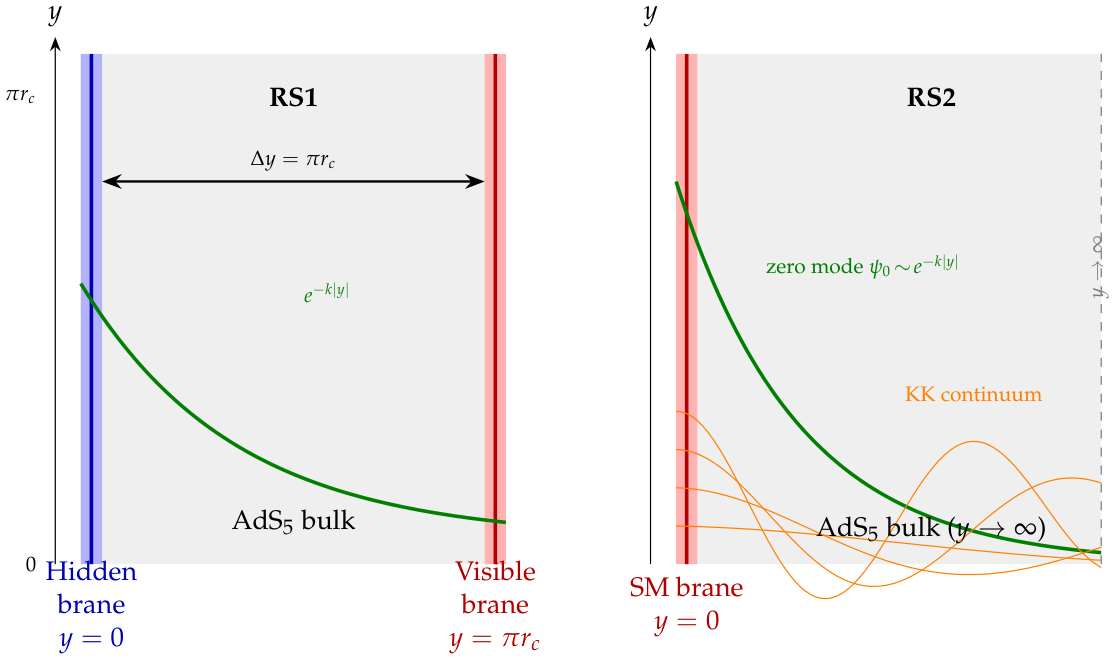
Figure 2.
Effective potentials in the WdW minisuperspace equation for a closed () de Sitter universe with , , , , in reduced Planck units. The GR baseline (blue, solid) has turning point . RS corrections with (red, dashed) shift the turning point left to , narrowing the tunneling barrier; (orange, dotted) shifts it further to . The LQC repulsive term (green, dash-dot) diverges positively at , replacing the singularity with a quantum bounce. The shaded region is the classically forbidden zone where both Hartle–Hawking and Vilenkin tunneling occur.
Figure 2.
Effective potentials in the WdW minisuperspace equation for a closed () de Sitter universe with , , , , in reduced Planck units. The GR baseline (blue, solid) has turning point . RS corrections with (red, dashed) shift the turning point left to , narrowing the tunneling barrier; (orange, dotted) shifts it further to . The LQC repulsive term (green, dash-dot) diverges positively at , replacing the singularity with a quantum bounce. The shaded region is the classically forbidden zone where both Hartle–Hawking and Vilenkin tunneling occur.
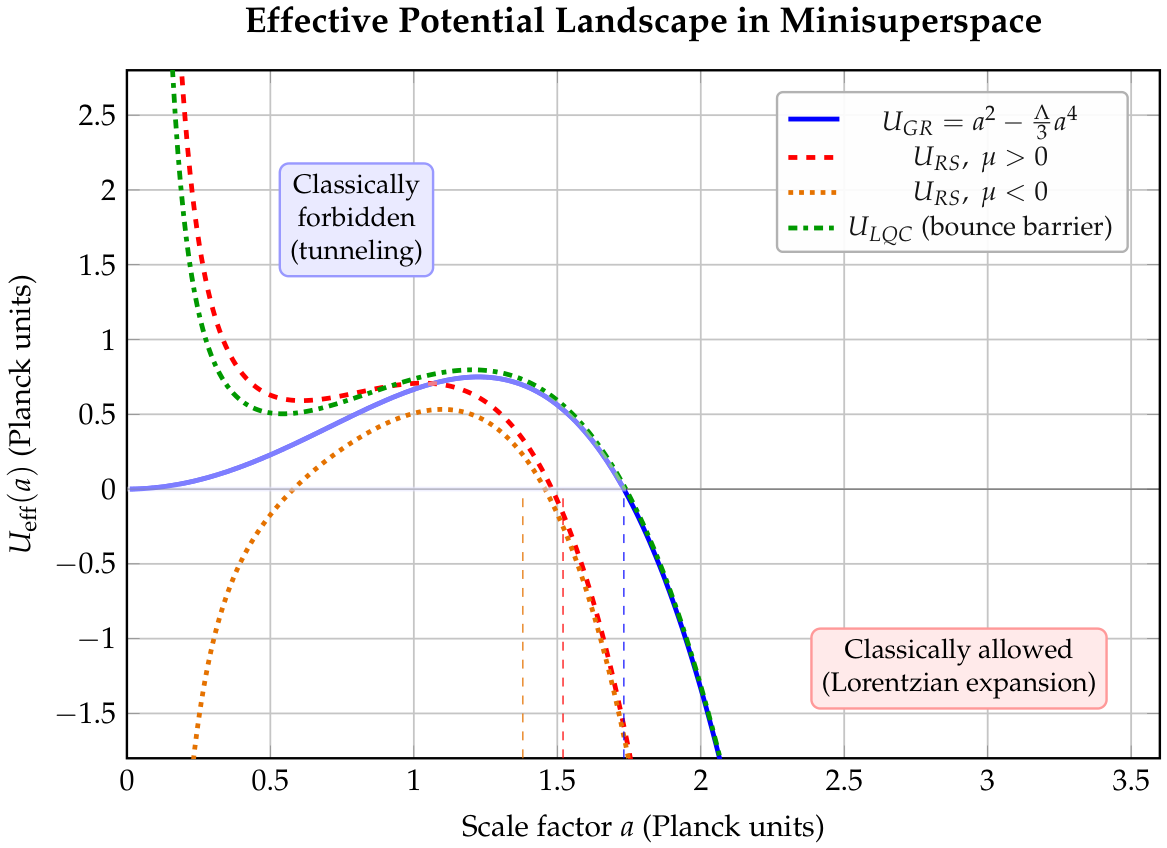
Figure 3.
Schematic of the WdW wave function in the closed FLRW minisuperspace. Left of the GR turning point (blue dashed): classically forbidden, time undefined. Hartle–Hawking selects the growing Euclidean mode (blue); Vilenkin selects the decaying mode (red). Right of : both wave functions oscillate and the WKB phase defines emergent cosmic time via (5). The RS correction shifts the turning point left to (green arrow), narrowing the classically forbidden zone and—for —enhancing the tunneling amplitude.
Figure 3.
Schematic of the WdW wave function in the closed FLRW minisuperspace. Left of the GR turning point (blue dashed): classically forbidden, time undefined. Hartle–Hawking selects the growing Euclidean mode (blue); Vilenkin selects the decaying mode (red). Right of : both wave functions oscillate and the WKB phase defines emergent cosmic time via (5). The RS correction shifts the turning point left to (green arrow), narrowing the classically forbidden zone and—for —enhancing the tunneling amplitude.
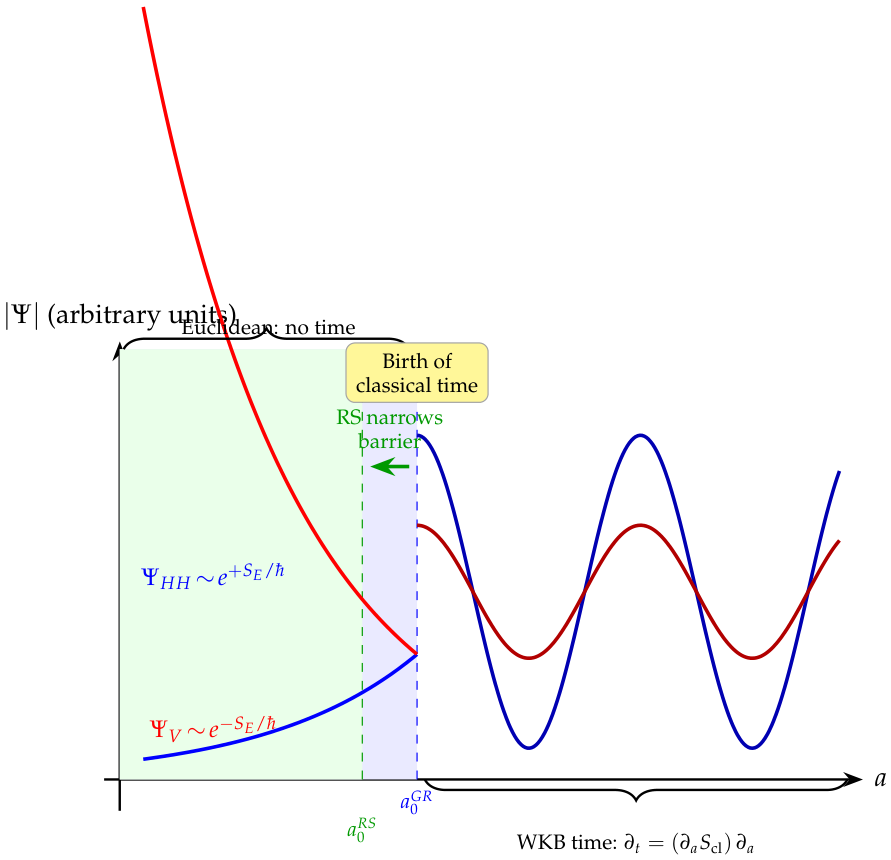
Figure 4.
Information channels across the quantum bounce. The contracting universe (blue region) evolves toward minimum scale factor; classical spacetime dissolves in the quantum-gravity zone (yellow, wavy boundaries). Classical channels—CMB, gravitational waves, thermal relics, Weyl entropy—are erased (red dashed arrow) because the geometric substrate carrying them ceases to exist. The phase and quantum-entanglement structure of propagate unitarily through the bounce (green arrow) under , constituting the sole surviving pre-geometric memory channel.
Figure 4.
Information channels across the quantum bounce. The contracting universe (blue region) evolves toward minimum scale factor; classical spacetime dissolves in the quantum-gravity zone (yellow, wavy boundaries). Classical channels—CMB, gravitational waves, thermal relics, Weyl entropy—are erased (red dashed arrow) because the geometric substrate carrying them ceases to exist. The phase and quantum-entanglement structure of propagate unitarily through the bounce (green arrow) under , constituting the sole surviving pre-geometric memory channel.
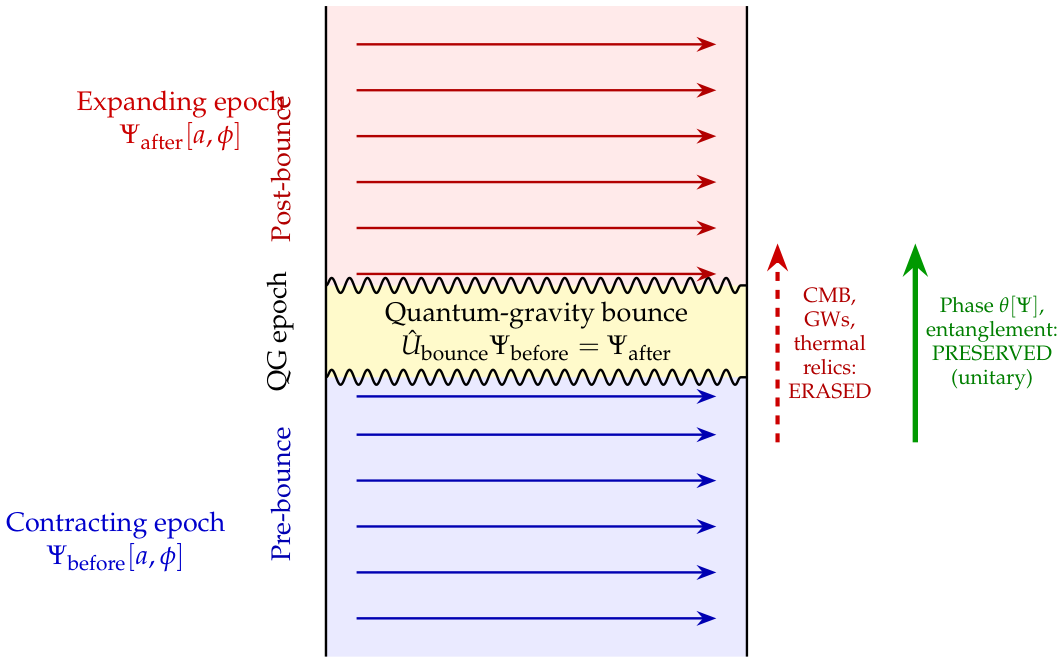

Table 1.
Structural comparison of the Hartle–Hawking and Vilenkin proposals in four-dimensional quantum cosmology. All numerical entries assume a closed FLRW minisuperspace with GeV and GeV; Planck units .
Table 1.
Structural comparison of the Hartle–Hawking and Vilenkin proposals in four-dimensional quantum cosmology. All numerical entries assume a closed FLRW minisuperspace with GeV and GeV; Planck units .
| Property | Hartle–Hawking | Vilenkin |
|---|---|---|
| Boundary condition | No initial boundary; compact Euclidean 4-geometries | Outgoing modes only at singular superspace boundaries |
| Euclidean saddle point | Round with radius | -symmetric instanton; same |
| Wave function in forbidden region | ||
| Exponent in Planck units | ||
| Tunneling probability (GUT scale) | (unnorm.) | |
| Preferred cosmological constant | Large | Small |
| Origin of time | WKB phase in classically allowed region | Post-tunneling WKB phase |
| Classical limit | de Sitter expansion from smooth geometry | de Sitter expansion from quantum nucleation |
| CPT symmetry of | (real in forbidden region) | (complex; outgoing only) |
Table 2.
Complete correspondence between four-dimensional quantum cosmological proposals, five-dimensional RS dynamics, and AdS/CFT holographic dual. Entries marked ★ are derived in the present work.
Table 2.
Complete correspondence between four-dimensional quantum cosmological proposals, five-dimensional RS dynamics, and AdS/CFT holographic dual. Entries marked ★ are derived in the present work.
| Concept | HH (4D) | Vilenkin (4D) | RS / AdS CFT |
|---|---|---|---|
| Origin | No-boundary compact | Quantum tunnel from | Brane nucleation in AdS5 |
| Euclidean saddle | Round | instanton | Compact Eucl. AdS5 with brane★ |
| Wave-function exponent | , modified by | ||
| Preferred | Large | Small | Shifted by brane tension★ |
| Time emergence | WKB phase, | Post-nucleation WKB | Induced from y-coordinate on brane★ |
| AdS/CFT dual | (no-boundary state) | (tunneling state) | CFT with UV cutoff ★ |
| Big Bounce mechanism | Time-symmetric WdW propagation | New tunnel per cycle | Brane collision in 5D bulk★ |
| Classical memory | Erased at bounce | Erased at bounce | Erased at brane collision★ |
| Quantum memory | Phase | Phase | Phase + Weyl tensor modes★ |
Table 3.
Comparative behaviour of entropy measures across the quantum bounce. “Substrate” denotes the geometric structure required for the entropy to be defined. “Survives bounce?” indicates whether the quantity retains physical meaning across the quantum-gravity epoch.
Table 3.
Comparative behaviour of entropy measures across the quantum bounce. “Substrate” denotes the geometric structure required for the entropy to be defined. “Survives bounce?” indicates whether the quantity retains physical meaning across the quantum-gravity epoch.
| Entropy / quantity | Required substrate | At bounce | Survives? | Carries memory? |
|---|---|---|---|---|
| Thermal | Lorentzian manifold + fields | (classical divergence) | No | No |
| Weyl curvature | Riemannian geometry | Diverges | No | No |
| Bekenstein–Hawking | Horizon 2-surface | Undefined (no horizon) | No | No |
| Entanglement | Hilbert-space bipartition | Finite (quantum) | Partially | Partially (if bipartition survives) |
| Amplitude entropy | Superspace | Finite, conserved | Yes (unitary) | Yes (partial) |
| Phase entropy (this work) | Superspace | Finite, conserved | Yes (unitary) | Yes — complete |
| Phase fidelity (this work) | Superspace | (unitary bounce) | Yes (unitary) | Yes — complete |
Disclaimer/Publisher’s Note: The statements, opinions and data contained in all publications are solely those of the individual author(s) and contributor(s) and not of MDPI and/or the editor(s). MDPI and/or the editor(s) disclaim responsibility for any injury to people or property resulting from any ideas, methods, instructions or products referred to in the content. |
© 2026 by the authors. Licensee MDPI, Basel, Switzerland. This article is an open access article distributed under the terms and conditions of the Creative Commons Attribution (CC BY) license (http://creativecommons.org/licenses/by/4.0/).
Copyright: This open access article is published under a Creative Commons CC BY 4.0 license, which permit the free download, distribution, and reuse, provided that the author and preprint are cited in any reuse.