

Submitted:
22 August 2026
Posted:
24 August 2026
You are already at the latest version
Abstract
The global textile industry generates waste at multiple stages, including fiber production, fabric manufacturing, chemical processing, garment production, finishing, and post-consumption. This study examines approaches for effective textile waste management and maps them across stages of activity. It includes two components: a bibliometric trend analysis and a review of developments, practices, and strategies in textile waste management and valorization. The review identifies 2,693 research articles and 988 distinct keywords, highlighting themes such as recycling, value-added products, circular economy, and sustainability.
The study maps in-process, after-process, and post-consumer waste within the supply chain or redirects it into value-added products within a circular economy framework. In some cases, textile waste is reused in production through reduction, reuse, and repurposing without recycling. Recent research focuses on converting natural and synthetic textile waste such as fibers, yarns, fabrics, trims, and dyes into outputs including recycled fibers and fabrics, nonwovens, lactic acid, glucose, ethanol, biogas, char, and compost. Mechanical recycling is gaining importance for post-industrial waste. When reuse or mechanical recycling is not feasible, chemical and biological treatments are applied. Advances in artificial intelligence and machine learning support efficient sorting, waste prediction, and recycling processes.
Keywords:
textile waste
; recycling
; valorization
; sustainability
; artificial intelligence
1. Introduction
The textile industry is one of the oldest and largest globally, driven by demand and increase in population. Production grew from 70.6 million tons in 2007 to 123 million tons in 2023 and is expected to surpass 150 million tons by 2030 [1]. In 2024, the global textile market was valued at approximately $1.6 billion and is projected to reach 2.89 billion by 2032, growing at a compound annual growth rate (CAGR) of 6.8%. Fabrication of textiles starts with raw fibers that could be either natural (such as cotton, wool, silk, etc.) or synthetic materials (such as polyester, nylon, etc) [2,3]. They are then spun into yarn, woven, or knitted into fabric; after that, treated through dyeing and finishing processes. Finished textiles are transformed into garments, which are worn and maintained throughout their useful life [4]. At the end of their life cycle, these garments are either recycled into new materials or discarded as waste [5]. Textile waste is produced both during the manufacturing process and after consumer use. [6]. Currently, only 20% of textile and clothing waste is recycled or reused, while the remaining 80% is sent to landfills or incinerators, resulting in significant resource loss and environmental damage [7,8]. The wasted materials may be in the form of fibers, yarn, fabrics, along trims such as buttons, zippers, threads, laces, labels, dyes, chemicals, and effluent. These wastes represent serious concerns for the environment. Over the past two decades, significant studies have focused on strategies for textile waste management, reuse and recycling [8,9]. Mechanical and chemical recycling have been developed to convert textile waste into new fibrous materials, allowing for the creation of value-added products such as insulation, carpets, and new garments [10,11]. Biological recycling, which involves use of enzymes or microorganisms to break down fibers, is also gaining attention as a sustainable method for textile recycling [12].
The use of AI and machine learning technologies are playing a key role in enhancing textile waste management by improving sorting efficiency, predicting waste patterns, and optimizing recycling processes [13,14]. AI-driven sorting systems can identify and segregate materials more accurately, leading to better recycling outcomes [14,15]. Machine learning algorithms also facilitate the creation of more efficient processes for converting waste into useful products [16,17]. Policies like the EU Eco-design Roadmap, along with cross-sector collaborations, are key drivers of sustainability and waste reduction in the textile industry [18,19].
Previous studies on textile waste management often focus on specific recycling techniques or type of wastes (e.g., natural, bio-based, non-bio-based), with limited integration into holistic approaches [19,20,21]. However, studies related to the scalability of recycling technologies, innovative applications, and the role of AI [22,23,24,25] are still needed. Despite its significance, the field remains underexplored in terms of comprehensive literature reviews and bibliometric analyses, relying largely on empirical studies. This review is an attempt to address this gap by exploring innovative and eco-driven strategies for managing textile waste with the help of standard bibliometric data. It considers recovery techniques, reuse technologies and waste converting processes. Current and emerging methods for recycling and valorizing textile materials into high-value products are also reviewed in this paper. It further highlights the role of AI in textile waste management and valorization.
2. Methodology
The study uses Scopus database to explore research trends related to the subject of this review, following Preferred Reporting Items for systematic reviews and meta-analyses (PRISMA). Bibliometric analysis is performed with VOS viewer to generate knowledge maps based on co-authorship and keyword co-occurrence [25].
The methodology for this review study composed of three main subsections: (i) selection of the database and formulation of search criteria, (ii) determining selection criteria for literature, and (iii) suggesting research questions. The selection of relevant literature focuses on the management and valorization of waste in the textile supply chain and its various applications. The review considers relevant publications covering the period from 2005 to Sep 2025. The search process began with the Boolean search string:(“textile waste” OR “fabric waste” OR “garment waste” ) AND ( “management” OR “recycling” OR “valorisation” OR “value-added” OR “circular economy” OR mechanical recycling OR repurpose OR reuse OR reduce) AND (pubyear > 2004 AND pubyear < 2025) AND (LIMIT-TO (doctype, “ar” ) OR LIMIT-TO ( doctype, “cp” ) ). This string provided 3342 results. Further, additional keywords were incorporated to refine and optimize the search results. These include: Textiles, Textile Industry, Cotton, Dye, Textile Waste, Textile Wastewater, Textile Fibers, Yarn, Cotton, Wool, Weaving, Dyeing, Polypropylene, Polyester, Spinning, Reuse, Textile Recycling, Nonwoven fabrics, Textile Effluent, Textile Processing, Textile Finishing, Garment and Clothing. Inclusion and exclusion criteria were applied to refine the search results, filtering out 2693 studies that met the established parameters [30].
Inclusion criteria consider the following:
- Research covering any category of textile waste, primarily solid waste and sludge.
- Studies focusing on the collection of textile waste and management from pre-spinning to post-consumer waste.
- Novel applications of textile waste management, valorization of textile waste, and conversion into value-added products.
- Studies in various geographical locations and different types of textile manufacturing.
Exclusion criteria include the following:
- Studies focusing on by-products not originating from the textile industry.
- Studies focusing on only environmental impact assessment or life cycle assessment.
- Duplicate studies, with preference given to publications ranked higher in the research hierarchy.
Lastly, the selected papers were analyzed based on predefined research questions, ensuring the extraction of essential insights needed to formulate conclusions on the effective utilization of textile waste in various applications. This review suggests the following research questions:
- What type of textile material is used, and which method(s) are applied in management and conversion?
- What is the application, and is it relevant to the scope of this study?
- Is there any novelty in the methodological process, and is the proposed application feasible?
- What are the key control parameters, indicators, and challenges against valorization in each study?
- Does the utilization of the proposed waste comply with environmental regulations?
A knowledge map was constructed with the help of bibliometric analysis on the VOS viewer software. The knowledge map displays the connections between authors and their countries, considering collaborations and the co-occurrence of prominent keywords. Co-occurrence analysis highlights the relationship between author keywords, showing which keywords frequently appear together in different publications.
3. Analysis and Discussion
This section addresses the research questions outlined earlier, focusing on the central theme of textile waste management and valorization. Only carefully selected articles are considered to provide quality insights and suggest valuable recommendations for future work.
3.1. Bibliometric Analysis
Publication trends in the field of textile waste management and valorization show a clear upward trajectory over time (Figure 1). From 2005 to 2013, the number of documents remained relatively low and stable. However, a gradual increase began in 2014, with a sharp increase from 2018 onward. The number of publications reached its highest point in 2024, totalling 422. This pattern reflects a growing academic and research interest in the field over the past decade.
As depicted in Figure 2, the data indicate a worldwide distribution of research activity. China leads by a significant margin, contributing 388 documents, followed by India with 222 and Turkey with 161. The United States, Spain, and the United Kingdom also reveal strong engagement. A broad range of countries across Asia, Europe, the Americas, and Africa are represented, reflecting the widespread interest and research in textile-related topics. While developed countries dominate the top ranks, emerging economies like Pakistan, Malaysia, Romania, and Bangladesh also show notable contributions, indicating a growing global focus and collaboration in this area.
Figure 3 presents worldwide knowledge map overlay of textile waste management and valorization based on author keywords co-occurrence. From the dataset, a total of 1,330 keywords were initially extracted. Due to VOSviewer’s threshold, which allows analysis of up to 1,000 keywords at a time, the software selected the most frequently occurring words/terms. After consolidating synonyms and similar phrases, the final list included 988 distinct keywords, each appearing at least twice.
According to the co-occurrence network presented in Figure 3, the term “recycling” emerged as the most significant keyword, showing 309 connections, a total link strength of 833, and 309 occurrences. Other frequently associated terms include “textile waste” (273 links, 592 total link strength, 240 occurrences), “circular economy” (237 links, 571 total link strength, 200 occurrences), “sustainability” (215 links, 460 total link strength, 153 occurrences), “cotton” (159 links, 271 total link strength, 86 occurrences), “textile wastewater” (138 links, 245 total link strength, 123 occurrences), “reuse” (106 links, 185 total link strength, 164 occurrences), and “mechanical properties” (103 links, 198 total link strength, 79 occurrences).
The prominence of large nodes associated with keywords such as recycling, textile waste, circular economy, and sustainability indicates that these are central themes in textile waste management research. Figure 4, which presents the keyword density visualization, highlights the research focus around these core topics. The knowledge map further illustrates that dense areas cluster around terms like recycling, textiles, circular economy, and sustainability, while gradually expanding toward related concepts such as wastewater, cotton, polyester, biomass, biodegradation, reuse, reduction, and Internet of Things.
3.2. Generated Waste in the Textile Product Life Cycle
Waste generated in the textile product life cycle can be divided into three categories: during manufacturing, during use, and post-consumption [26]. Figure 5 illustrates the stages for the textile product life cycle, while Table 1 displays an overview of waste generation throughout the textile product life cycle from spinning to post-consumer stages, listing waste types, estimated amounts, and potential for reuse or recycling. Waste is generated at various processes, including fiber extraction, ginning, spinning, weaving (weaving, knitting, nonwoven manufacturing), chemical processing, dyeing, printing, finishing, garment manufacturing, and retailing [6]. Worth mentioning that waste generated in these processes can often be reused within the same cycle after cleaning, mending, or refurbishing. However, certain portion of the waste can not be reused and must be recycled. Table 1 and Figure 5 also depict that seeds, seed coats, vegetable material, Peduncle waste, pupae waste, cocoon waste, fiber, yarn, fabrics, dyes, chemicals, trims, and accessories are the common waste generated in the textile manufacturing supply chain [4,27]. Waste generated during the use phase of textiles primarily originated from such activities as washing, dry cleaning, and regular wear and tear. Washing contributes to water pollution through detergent residues, dye runoff, and the release of microplastics from synthetic fibers [28]. Dry cleaning generates chemical waste, particularly from solvents like perchloroethylene, which can be harmful to the environment. Additionally, repeated washing and drying cause fiber degradation, leading to fabric abrasion, thinning, pilling, and eventual disposal. Wear and tear over time also result in textile waste as garments become damaged, faded, or out of shape, prompting users to discard or replace them. Post-consumption waste includes discarded garments, household textiles, and misfit clothing, which may be resold, donated, repurposed, and recycled [29,30].
Textile waste is normally disposed of through outlets, industry tie-ups, jobbers, or non-profits. It is either sent to landfills, reused, incinerated, or recycled. Landfills pose significant environmental risks, with natural fibers taking weeks to years to decompose and synthetics, requiring 30–40 years or more, releasing harmful gases and pollutants [31]. To minimize environmental impact, reuse and recycling are preferred over incineration and landfilling, as they reduce virgin fiber production and additional processing. However, textile recycling becomes more complex with blended materials, requiring efficient separation systems during production for better recyclability [3,6,32].
3.3. Processes for Converting Textile Waste into Value-Added Products
Conversion of the textile waste involves the collection, sorting, and processing of the waste. Accurate recognition and sorting of textiles are the keys to the process of converting them into value-added products. Identifying textile fibers is particularly challenging due to complex fabric structures, colors, and added garment components like zippers and buttons [14]. Manual sorting remains common, with limiting scalability, and traditional methods, such as microscopy, are slow and often ineffective at distinguishing similar compositions (cotton, Viscose) or synthetic fibers [15]. Advanced technologies, such as Near-Infrared (NIR) and Fourier Transform Infrared (FTIR) spectroscopy, have shown high accuracy in fiber identification and offer potential for automation, although each has limitations with coated fabrics and core yarns. While thermal analysis techniques also aid in identification, their destructive and time-consuming nature make them less practical for large-scale recycling [20,21]. AI and machine learning are streamlining the process of sorting and classification [16,17]. After sorting, textile waste can be converted into value-added products using various technologies. These technologies involve reduce, reuse, recycle, or recover technologies [33,34]. Other studies [35,36,37,38] classified these techniques into four specific recycling methods: Primary recycling, which uses industrial textile waste in its original form, for example use of spinning waste to make open-end yarn [19,37]. Secondary recycling (mechanical), which involves cutting or shredding textiles into fibers to create new products such as garments, insulation, or padding. Tertiary recycling (chemical), which breaks textiles into chemical components using such methods as pyrolysis or hydrolysis, allowing materials like polyester to fabricate new fibers. Quaternary recycling involves the recovery of energy by incinerating non-recyclable textiles to produce heat or electricity [21,39,40]. While primary and secondary methods are more sustainable, tertiary and quaternary methods are useful to manage hard-to-recycle waste. Figure 6 presents the various approaches for the valorization of textile pre- and post-consumer waste. For a deeper understanding, 202 publications are identified as the most relevant from a bibliometric database of 2,693 papers covering the period 2005–2024, which focus specifically on waste management strategies such as reducing, reusing/repurposing, and recycling/recovering. As shown in Figure 7a, the analysis reveals that recycling/recovery is the most frequently studied topic (122 papers), followed by reuse/repurposing (51 papers) and reduction (29 papers). Further, the bibliometric analysis reveals that out of 122 studies on recycling, chemical recycling shares the largest at 44.26%; this is followed by mechanical recycling at 28.68%, biological recycling at 22.13%, and combined recycling processes at 4.91% (Figure 7b).
3.3.1. Reduce and Reuse (2R) for Textile Waste
Reduce aims to minimize textile waste t by promoting efficient production, sustainable materials, and conscious consumption. It involves optimizing resources and adopting slow fashion practices [31]. In the yarn manufacturing industry, two types of waste, namely soft (fiber) and hard waste (yarn), are produced. Reducing waste in the spinning industry requires a systematic approach to managing this waste at various stages of production, as shown in Table 1 [10,13]. In the blowroom, waste may include such materials as droppings, seed coats, dust, dirt, and floor sweepings. These can be reduced by ensuring optimal cleaning efficiency through proper maintenance of machine components such as beater spikes, grid bars, and feed rollers [37,38]. Ensuring optimal beater speed, fan speed, and grid bar settings can reduce waste generation. In carding, waste may include such materials as flat strips, licker-in waste, sliver cuts, and filter waste. Controlling waste involves adjusting licker-in speed, wire point density, and flat strip settings to enhance cleaning efficiency while minimizing lint loss [8,10]. In the ring frame, soft waste includes pneumaphill (bonda) waste, and hard waste includes faulty yarn bobbin and traveler waste. To reduce breakages, waste can be minimized by optimizing drafting parameters, such as spindle speeds and traveler selection [6,10,33]. Proper maintenance of top rollers, aprons, and ring travelers can prevent defective yarn production. Also, maintaining humidity (50-55%) helps control static electricity, reducing fiber fly and uncontrolled waste generation. In the autoconer (winding), waste is resulted from yarn clearing, splicing, and package formation [38]. Pneumafil suction waste, clearer waste, and filter waste can be minimized through precise yarn-clearing settings, proper calibration of tension and splicing parameters, and regular maintenance of suction nozzles, sensors, and cutters. Minimizing waste in weaving processes (Table 1) requires optimizing parameters across various stages, including warping, sizing, loom operations, and defect management [40,41]. A recent study emphasizes the importance of maintaining optimal relative humidity levels in the loom shed to reduce warp breakages and enhance efficiency; the study reveals that adjusting relative humidity can greatly reduce warp yarn breakage, improve loom productivity, and minimize waste [39]. Additionally, integrating AI-driven machine vision systems in the weaving process enables precise real-time defect detection, allowing early identification and rectification of flaws. Minimizing waste in the dyeing process requires optimization across various parameters, including water and chemical consumption, dye fixation efficiency, and defect reduction. A recent study demonstrates that adopting low-liquor ratio dyeing and foam dyeing can significantly reduce water and energy usage, and decreasing effluent load [42]. Moreover, the use of enzyme-based pre-treatment instead of conventional alkaline scouring enhances dye uptake while reducing chemical waste [48]. Auto dispenser and AI-driven monitoring systems enable real-time tracking of dye exhaustion rates, ensuring optimal dye utilization and minimizing re-dyeing needs [43]. Plasma and ultrasonic-assisted dyeing methods also improve fixation efficiency, reducing dye run-off into wastewater [5,44]. Waste in garment manufacturing can be reduced by implementing marker efficiency optimization and fabric utilization techniques during the cutting process. Additionally, adopting lean production systems and digital sample development can minimize excess inventory and sample-related waste [45,46,47,48].
Reuse is another option to manage the textile waste. Reuse extends the life of textiles by transferring them to new owners through resale, donation, renting, or upcycling, with or without modification [34,35,55]. Reusing spinning waste, such as carding waste, comber noil, and sliver waste, promotes sustainability by reducing reliance on virgin raw material and minimizing environmental impact in the textile industry [34,37]. One common approach is to blend these waste fibers with virgin cotton or synthetic fibers to produce new yarns in the same spinning system, particularly for coarse yarn fabric applications. Open-end spinning technology also allows the conversion of these waste fibers into yarns that are suitable for denim, towels, and upholstery. Additionally, nonwoven textiles, such as automotive interiors, insulation, and industrial wipes, benefit from the reuse of spinning waste [32,33]. Spinning waste has applications in fiber-reinforced composites and specialized paper products. In weaving, excess warp and weft yarns, as well as selvage waste, can be repurposed for handloom weaving, handicraft, decorative trims, or even braided into ropes and mats. Factories and artisans often reuse discarded fabric pieces for patchwork, quilting, or accessory-making, minimizing waste [40,49]. Dyeing and printing waste, including misprinted fabrics and off-cut materials, can be repurposed by different methods. Misprinted fabrics can be over-dyed to create unique designs, while leftover dyed fabrics can be converted into smaller items such as scarves, pouches, or home décor [51]. Large-scale textile companies and fashion brands increasingly incorporate upcycling techniques to use defective or excess printed materials in new product lines [47,50,51].
In textile manufacturing, wastewater reclamation and reuse are increasingly adopted to address water scarcity and reduce environmental impact. Recycled water is used for such processes as dyeing, washing, and cooling, thus conserving fresh water and promote sustainable production [53].
3.3.2. Recycling or Recovering
Textile recycling involves processing pre- or post-consumer textile waste into new textile or non-textile products. Textile recycling can be broadly classified into open-loop and closed-loop systems [33,35,54]. In open-loop recycling, waste materials are converted into different products, often of lower quality than the original. This method does not restore the waste textile to its initial form but allows repurposing for other industries, such as turning old textiles into insulation, carpets, industrial padding, or PET bottles, which can be converted into polyester fiber [55]. Closed-loop recycling, by contrast, preserves the original material properties, allowing the recycled product to serve as a direct substitute for virgin material [56]. For example, polyester garments can be chemically recycled into polyester fibers for new clothing, reducing the environmental impact of textile production. Fabric recycling technologies can be classified as mechanical, chemical, biological, and thermal recovery [57,58,59].
Physical Methods for Recycling or Recovering
Physical methods of recycling consist of mechanical and thermo-mechanical recycling of textile waste. Mechanical recycling involves shredding textiles into fibers for re-spinning into yarns or creating nonwoven materials [60]. Mechanical recycling preserves almost all fiber properties; however, fiber length is reduced due to the tearing or cutting of the fabric. The color of recycled fibers depends on the classification or sorting of the raw materials. If color sorting is performed effectively, re-dyeing can be avoided. Mechanical recycling is mainly used for natural textile fabrics. It is recommended for monofiber fabrics like cotton and wool. It is rarely used for viscose due to its fiber structure and lower yield [61,62]. Table 2 presents the different physical recycling processes and technologies used for various types of textile waste.
Various thermomechanical pretreatment techniques can be employed to convert textile waste into bioenergy, including mechanical comminution, extrusion, and ultrasonic treatment. The process begins with mechanical action, where textile waste is reduced to smaller particles through milling, chipping, or grinding [63]. This process improves material handling and increases the surface area, thereby enhancing the efficiency of subsequent bioenergy conversion. The extrusion method exposes textile waste to high temperatures (above 300 °C), shearing, and mixing, resulting in changes to the polymer’s physical structure. This method requires single or compatible polymers, as mixed fibers may weaken the material or cause process failure. Dyes, finishes, and mixed colors may reduce quality of the recycled fiber; thus, proper sorting is crucial. This method suits heat-resistant synthetics like polyester and polyamide [64,65]. However, with each recycling cycle, the polymer undergoes slight degradation, leading to a gradual decline in fiber quality over time. It is also used for cellulosic fibers in which cellulosic fiber waste, such as cotton, linen, or viscose, cannot be directly converted by standard thermo-mechanical recycling, as these fibers do not melt like synthetic polymers. Instead, when exposed to high temperatures, cellulosic fibers tend to burn or degrade and are primarily utilized for energy recovery. To recover energy from cellulosic waste, thermal processes such as combustion, pyrolysis, or gasification can be used [66]. Combustion burns fibers to generate heat and electricity, while pyrolysis heats them in absence of oxygen to produce bio-oil, syngas, and biochar [65,67]. Ultrasonic treatment employs high-frequency sound waves to disrupt hydrogen bonds in crystalline cellulose, enhancing polymer breakdown conversion efficiency [63,64,65,66].
Chemical Methods for Recycling or Recovering
Chemical recycling involves break down textile materials into their original monomers or chemicals, which can then be reused to produce new fibers or other materials [11]. Chemical processes such as acid, alkali, peroxide, and ozone treatments are commonly used [67,68]. In these processes, for example, polymer depolymerization breaks down synthetic polymers such as PET and nylon into their monomers (e.g., terephthalic acid, ethylene glycol) for reuse. Another example involves cellulose dissolution, which dissolves cotton or other cellulosic fibers in solvents (e.g., ionic liquids, Lyocell process) to convert them into new fibers without harmful by-products [69]. Table 3 presents a summary of various efforts over the past 20 years to process different textile materials, highlighting technologies used and the challenges across different substrates.
One common method involves dissolving cotton in selected solvents to recover either chemically modified or pure cellulosic fibers. This approach allows the recycled cotton to be used as feedstock to produce recycled man-made cellulosic fibers [70]. The dissolution process can be achieved through different processes, such as the Lyocell process, alkali/urea, or ionic liquid processes. The Lyocell process has gained attention in recent years as a promising alternative to traditional viscose technology. It offers a safer and more sustainable approach to regenerating cellulosic fibers by eliminating hazardous by-products typically generated in other processes, such as carbon disulfide (CS2), hydrogen disulfide (H2S), and heavy metals [71,72]. This makes it an environmentally friendly option for the chemical recycling of cotton fabrics. Moreover, the ionic liquid process is also being actively researched and developed, presenting another promising method for the chemical recovery of cellulosic fibers [73].
Chemical recycling of polyester textiles involves breaking down PET into monomers or oligomers, primarily through solvolysis using solvents such as methanol, ethylene glycol, or amines in processes like methanolysis, glycolysis, and aminolysis. Pyrolysis is less commonly used, as it generates CO2 and CO. Recycling PET, particularly from cotton–PET blends, remains challenging due to fiber degradation and difficulties in the sorting step [74].
Chemical recycling of wool waste is not widely practiced; however, small-scale recovery of wool keratin for applications such as biomaterials and adhesives has been demonstrated [76]. While regenerating wool keratin into fibers has not been successful, keratin extraction is reported. Wool fibers consist of approximately 82% keratin, which is rich in cysteine (10–15%) and forms strong disulphide bonds that significantly limit solubility [83,84].
Combination recycling refers to the strategic integration of mechanical with chemical or biological recycling methods to maximize the recovery and reuse of textile materials, thereby supporting a circular economy. This approach effectively breaks down complex fiber blends, such as polyester, cotton, spandex, and nylon, into their monomer components, facilitating the recycling of textiles that are challenging to process mechanically. Post-consumer mixed textile waste using microwave-assisted glycolysis over a ZnO catalyst, followed by solvent dissolution, is an example of combination recycling [66,77].
Biological Recycling/ Recovering
Biological recycling involves the decomposition of textiles by microorganisms through such processes as composting and anaerobic digestion [11,12,43,89]. It also includes enzymatic depolymerization of textile polymers into monomers and subsequent fermentation to convert the feedstock into valuable products. Textile waste consists of both biodegradable and non-biodegradable waste materials. Biodegradable textile waste typically decomposes within two weeks to six months, depending on its composition and level of microbial activity [90,91]. Biodegradable textile waste (natural fiber, regenerated fiber, natural dyes, etc) is highly susceptible to microbial degradation. Cotton, composed mostly of cellulose, is vulnerable to microbial attack by such species as Bacillus, Fusarium, Clostridium, Myrothecium, Sporocytophaga, and Memnoniella, which are able to hydrolyze and oxidize cellulose. Fungi are also highly efficient in breaking down cotton-based textiles [57,92]. Polyamide (nylon) fibers can be degraded using laccase-mediator and protease enzymes. Bacteria such as Flavobacterium and Pseudomonas species have been reported to degrade nylon oligomers, while lignolytic fungi oxidases can depolymerize polyamide [88,89,95].
Enzymatic hydrolysis is an effective biological method for textile degradation. Enzymes such as cellulase, protease, amylase, and lipase can hydrolyze textile materials, breaking them down into monomeric forms based on their constituents [92,93,94,95]. Enzymatic saccharification is particularly important in recycling cotton-based textile waste, offering an eco-friendly alternative to conventional methods. For protein-based fibers, such as wool, keratinolytic enzymes can convert keratin into useful nutrients such as carbon, sulfur, and nitrogen [93,96,97]. In synthetic textiles, PET hydrolysis has attracted growing interest, particularly with the discovery that certain bacteria can utilize PET as a carbon source. Enzymes such as PETase and MHETase have been genetically engineered to improve the efficiency of PET degradation [57,98]. Another study showed that cutinases from Cunninghamella echinulata can degrade polyester films, while lipases from Candida cylindracea and Pseudomonas species target various polyesters [83,88,99]. Oxidative mechanisms attributed to laccase enzymes from Phanerochaete chrysosporium have been shown to break down polypropylene, demonstrating the potential of enzymatic treatment of this resistant plastic [99]. Other microbial communities found in the gut microbiota of mealworms have demonstrated their ability to degrade polystyrene, thereby promising biological insights to manage persistent polymer waste through natural processes [100]. In addition to the above, biological methods provide an eco-friendly approach to dye removal; however, they can generate toxic intermediates, involve high operational costs, and require extended retention time [101].
3.4. Value-Added Products from Textile Waste
3.4.1. Textile Products from Pre- and Post-Consumer Waste
Recovery of textile products from in-process and post-consumer waste offers a sustainable, resource-efficient approach to minimize textile waste [71]. Discarded spinning waste, yarns, fabric clippings, and other remnants are commonly reprocessed into valuable fibers or yarns through mechanical recycling [103,104]. Research demonstrates that in-process waste, especially yarn waste, has superior fiber length, uniformity, and a higher percentage of floating fibers compared to post-consumer waste such as rag and garment waste [62,105]. Open-end spinning is an effective technique for converting waste fibers into new yarns [106]. Selecting the right blend ratios and utilizing soft waste components, such as liker-in waste fibers, can enhance yarn performance while reducing variability [36,37]. The resulting yarns can be used in high-quality textile applications, including denim, chino fabrics, and towels, offering a viable alternative to virgin fiber-based products [107]. This approach reduces costs and supports sustainable textile practices by extending the life cycle of materials [108]. Mechanical recycling methods, such as shredding, opening, and carding, are preferably applied to natural and single-composition waste, including post-consumer garments made of 100% cotton or 100% wool. Before garments are shredded, non-textile components like zippers and buttons are removed [104,105,106]. The fibers are then disentangled and aligned through a carding process, after which they can be spun into new yarn. Mechanically recycled fibers tend to be shorter than virgin fibers, necessitating blending with longer virgin fibers to maintain quality and durability [37,108]. It can be used in open-end spinning without the need for blending. Table 4 summarizes various research studies focus on converting textile waste into both conventional and technical textile products.
In addition to mechanical recycling, textile products can also be derived through chemical recycling of textile waste, which enables the regeneration of textile fibers. For instance, cotton waste can be pulped and dissolved, such as with NMMO, then respun into regenerated fibers like Lyocell. Furthermore, pretreatment with phosphoric acid has demonstrated 100% polyester and 79.2% for glucose [73,79,81,82].
3.4.2. Bioethanol Production from Textile Waste
The production of ethanol from food crops raises concerns about food scarcity and threats to biodiversity [35]. Second-generation bioethanol utilizes lignocellulosic feedstocks to mitigates concerns related to food scarcity and biodiversity [7,116]. Bioconverting textile waste into bioethanol supports a sustainable solution for waste management and renewable energy. The process generally includes pretreatment, enzymatic hydrolysis, fermentation, commonly using Saccharomyces cerevisiae, and distillation for ethanol recovery. Textile waste, especially cotton-based materials, is rich in cellulose (96%), a polysaccharide that can be converted into fermentable sugars [117]. However, the complex structure of cellulose, along with the presence of dyes and other additives in textile waste, necessitates pretreatment to enhance enzymatic accessibility [119]. The primary challenge, however, is breaking the hydrogen bonds between glucan chains to reduce crystallinity and enhance accessibility. An investigation showed an ethanol yield of 92.5% from cotton gin residue using an over-lime steam-explosion process, resulting in 191 L (50 gal) per ton [119]. The study considered dilute sulfuric acid pretreatment at 180 °C followed by yeast fermentation. Another study 120] reported ethanol production from cotton linters and jeans textiles using enzymatic hydrolysis and fermentation with Saccharomyces cerevisiae, achieving a 99% yield following NaOH pretreatment. Figure 8 illustrates an approach to valorizing textile waste by converting plant-based fibers and sizing agents into fuel-grade ethanol. The process includes pretreatment, physical, chemical, or biological, to release fermentable sugars, followed by microbial fermentation and ethanol purification [119,120,121].
Researchers have successfully separated cellulose from cotton-polyester blends using N-methylmorpholine-N-oxide (NMMO), yielding 48–50 g ethanol/g for cotton and viscose fibers [121,122]. Alkaline pretreatment of polyester-cotton blends with 12% sodium hydroxide for one hour enhances glucose and ethanol yields, while simultaneously recovering polyester fibers with near-original properties, enabling both bioethanol production and fiber reuse [58,85,122]. Additionally, researchers have explored alternative pretreatment methods, including ammonia-based processes, high-temperature treatments, ozone pretreatment, and microwave-assisted techniques [66,78]. Another study demonstrates that mercerization pretreatment significantly enhances ethanol yield, approximately three times higher than that achieved with corona-pretreated cotton waste [116,120]. Different types of garments yield varying amounts of ethanol; for instance, waste white T-shirts subjected to separate hydrolysis and fermentation produced the highest yield at 83.5% after 24 hours. White T-shirts generate 537 mL/kg of ethanol, outperforming materials like rice straw, pine, and oak. Yellow T-shirts, linen, denim, and white towels follow in yield. This demonstrates strong potential for white T-shirts as a low-cost bioethanol source [11,78,122]. Waste jeans composed of cotton and polyester have also been successfully utilized for bioenergy production following sodium carbonate (Na2CO3) pretreatment. Optimum results are obtained using 0.5 M Na2CO3 at 150 °C, enhancing both polyester breakdown and cellulose digestibility. This led to high yields of methane (up to 361.1 mL/g VS), glucose (up to 88.0%), and ethanol (up to 69.4%). The process proved effective with minimal cellulose loss, establishing waste jeans as a viable feedstock for both biogas and ethanol production [145]. Cottonseed oil (CSO) processed via heterogeneous catalysis has demonstrated the highest conversion rate of 98%, while cotton-seed cake (CSC) and waste cotton cooking oil (WCCO) also show excellent yields of 96.5% and 96.0%, respectively [123,124].
3.4.3. Biogas Production from Textile Waste
Biogas production from textile waste reveals a sustainable approach to managing textile-based biowaste while generating renewable energy [123]. The anaerobic digestion (AD) is a well-known process for this purpose, which involves the breakdown of organic textile waste materials by microbial action in the absence of oxygen, producing biogas primarily composed of methane (CH4) and carbon dioxide (CO2) [117,125]. Figure 9 illustrates a sustainable, integrated approach for treating textile waste and wastewater treatment, encompassing four main stages: hydrolysis, acidogenesis, acetogenesis, and methanogenesis [126]. It has been shown that textile-based biowaste, such as cotton stalks, cotton seed hulls, and cotton oil cakes, can yield substantial amounts of biogas at optimized conditions that significantly enhance methane production [123]. Moreover, co-digestion with organic materials, such as swine manure or cow dung, has been found to improve biogas yield, making the process more efficient [123,126]. Textile wastewater, originating from such processes involving yarns, fabrics, dyeing, and fiber production, contains different types of pollutants such as synthetic compounds, carbohydrates, proteins, lipids, and humic substances [128,129]. These pollutants can be treated by two technologies, namely microbial fuel cells (MFCs) and anaerobic digestion (AD) [126]. MFCs utilize electroactive bacteria to oxidize organic matter, thereby degrading the pollutant removal and produce energy [130]. Anaerobic digestion decomposes organic contaminants, such as cellulose, lipids, and proteins, into biogas, primarily methane (CH4) [131], which can be converted into electricity or utilized directly as a combustion fuel. The residual digestate can be separated into solid and liquid components. The solid fraction undergoes gasification or pyrolysis, resulting in production of syngas (a mixture of H2 and CO2) and char. Syngas can be further refined into cleaner fuels, supporting the model’s energy recovery goals [128]. The liquid fraction from digestate is treated through algal water treatment systems. Microalgae play a crucial role in absorbing nutrients, removing dyes and heavy metals, and improving water quality. This process produces treated water suitable for reuse in agricultural or fiber farming applications [131]. Moreover, the algal biomass obtained from this process is a valuable source of bio-based products, including bioplastics, natural fertilizers or soil conditioners, animal feed additives, biopolymers, natural dyes and pigments, and ingredients for cosmetics [132,133].
Pretreatment of textile waste is essential for enhancing biogas production, as untreated fibers are difficult to digest. Techniques such as chemical (NaOH, ammonia, NMMO), enzymatic, and ultrasonic treatments improve the material’s biodegradability. Pretreated cotton/polyester blends and cotton linters have significantly demonstrated higher methane production compared to untreated samples [74,129]. It has been shown that desizing wastewater is also suitable for biogas production [128]. Thermophilic conditions have been shown to significantly enhance biogas yields, especially from medical cotton waste, increasing methane production up to 92% compared to mesophilic conditions [130,131]. A comprehensive study on biogas production from various textile-based biowastes demonstrates significant variations in methane yields, largely dependent on substrate composition and pretreatment methods. Bleached cotton linter achieved the highest methane yield at 449 mL/g volatile solids (VS), followed by viscose/polyester and cotton/polyester textile fabrics at 415 mL/g VS. In contrast, cotton plant residues such as stalks and bolls yielded 246 mL/g VS, while cottonseed hulls produced only 86 mL/g [130,132].
3.4.4. Bioelectricity from Textile Waste
Microbial fuel cells (MFCs) generate electricity by utilizing microorganisms that oxidize organic and inorganic substrates under anaerobic conditions, simultaneously treating textile wastewater (Figure 9) [130]. An MFC has anode and cathode chambers separated by an ion-exchange membrane, where microorganisms degrade organic matter in the anodic chamber [135]. The efficiency of MFC depends on microbial activity, substrate type, electron transfer mechanisms, dye concentration, and electrode materials. As illustrated in Figure 9, MFC represents a bio-electrochemical system that can treat textile wastewater while simultaneously generating electricity. Materials such as carbohydrates, synthetic compounds, and humic substances from the textile effluent serve as substrates for electroactive microbes within the MFC. These microbes, located in the anode chamber, oxidize the organic matter, releasing electrons that flow through an external circuit to the cathode chamber, producing an electric current [136]. Different types of textile waste have been treated using various reactor configurations, yielding diverse power densities. Various studies demonstrated the ability of single-chamber MFCs to handle wastewater containing azo dyes and other synthetic colorants, resulted in different levels of power output. In contrast, dual-chamber systems treating such materials as polylactic acid-based textile waste or certain acidic dyes have revealed varying current densities and voltage outputs [136,137]. Worth mentioning that the power densities depend on several factors, such as the type of dyes, reactor design, and operating conditions.
3.4.5. Composting of Textile Waste
Composting is an environmentally friendly method to break down organic textile waste, such as cotton, converting it into nutrient-rich soil supplements. This bio-oxidative process, driven by microorganisms, significantly reduces waste volume [138]. Vermicomposting, using earthworms, enhances soil fertility beyond conventional composting by increasing bacterial density and humus quality. Studies have explored composting willow waste from ginning factories, typically discarded in landfills. When mixing with cow dung slurry, enzymes, and microbial solutions, organic textile waste can decompose within 20 days [123,126]. Earthworms then transform it into high-quality compost, promoting plant growth. Cotton gin waste is also composted due to hygiene risks in direct reuse [139]. It has also been reported that over 90% of oyster mushroom growers using cotton waste substrates [126,140]. Composting of textile waste mixed with green and paper waste was evaluated for biosafety, showing non-phytotoxic compost at up to 60% textile input. All composts met heavy metal standards, indicating composting as a safe and effective method for textile waste valorization [138,139,140].
3.4.6. Textile Waste for the Value-Added Chemicals and Bioplastics
Value-added chemicals are compounds derived from various waste materials or biomass and transformed into products with higher economic value and broader applications [121]. Several methods, including chemical recycling, enzymatic hydrolysis, pyrolysis, anaerobic digestion, and solvent dissolution, are employed to convert waste into these valuable chemicals (Table 3). Cellulosic waste like cotton, jute, and flax is converted to glucose, then to lactic acid (LA) via enzymatic hydrolysis and fermentation, used in bioplastics (PLA) and pharmaceuticals. Glucose extracted from textile waste can also be converted into sorbitol through acid hydrolysis and hydrogenation, used in biodegradable polymers and sweeteners. Polyester waste can be converted into EG and TPA [94]. Succinic acid can be produced from cotton textile waste using a fibrous bed bioreactor through microbial fermentation. It is used in detergents, surfactants, food, and pharmaceuticals. It also helps make tetrahydrofuran, 1,4-butanediol, and succinate polymers [116]. Silk waste contains sericin and fibroin, which can be extracted using hot water or alkali for use in biomedical and cosmetic formulations. Wool waste yields keratin and amino acids through enzymatic or alkaline digestion, useful in fertilizers and biodegradable materials [95]. Jute waste provides lignin and furfural via acid hydrolysis or pyrolysis, which are used in biofuel additives, resins, and carbon materials [34]. Dye sludge or effluent produces methane and volatile fatty acids (VFAs) through anaerobic digestion, generating bioelectricity and heating fuel [135,137,141].
Several studies have shown that low molecular weight cellulose sources like cotton linters, MCC, and CNCs can be effectively converted into bioplastics [141,142]. Bioplastic films have been produced from cellulose derivatives such as cellulose acetate by hot-pressing. In another study, low-quality cotton fibers are dissolved in a DMAc/LiCl system and processed into strong, transparent, and flexible films through regeneration and hot-pressing. These films showed improved mechanical and surface properties. In another study, flax waste was catalytically converted into valuable aromatic hydrocarbons using USY zeolite, with optimized Si/Al ratios enhancing furan yields [143,144].
3.4.7. Textile Waste for Value-Added Material in the Construction, Furniture, and Geoengineering Industry
Textile waste fibers provide sustainable solutions in construction, furniture, and geotechnical engineering by improving mechanical properties, reducing environmental impact, and offering cost-effective alternatives. Researcher [145] shows that recycled textile waste can be used to design sustainable and eco-friendly furniture.
Further researchers demonstrate that denim textile waste can be converted into 3D needle-punched composites and high-density fiberboards for furniture use [115,146].
Textile waste is increasingly used as a secondary raw material in fiber-reinforced composites, enhancing compressive strength, flexural resistance, and crack mitigation [129]. Incorporating 1% recovered cotton fibers from denim into fiber concrete increases compressive strength by 40% and flexural strength by 7%. Recycled nylon fibers from fishing nets also improve tensile strength and toughness in cement mortars [147,148,149]. Chemical treatments, such as maleic anhydride modification, enhance fiber-polymer adhesion, improving mechanical performance. Additionally, cotton/polyester blends demonstrate improved structural properties in heat compression molded composites [112,113,114,150]. Textile waste also strengthens pavements, columns, bridge decks, and airport runways. Lightweight bricks incorporating cotton waste and limestone powder exhibit mechanical properties comparable to conventional bricks [150,151]. Fiber-reinforced soil composites with polypropylene, polyester, and nylon improve shear strength and load-deformation behavior. Longer fibers enhance soil strength by increasing internal friction. Mixing synthetic fibers with fly ash or cement boosts compressive strength and durability. Natural fibers also improve stress-strain responses in stabilized clay soils [151,152]. The moisture level within the soil also plays a vital role, as it affects cohesion and the soil’s ability to support loads when reinforced with fibers [153]. The addition of shredded polypropylene fibers boosts both triaxial compressive and residual strength. Randomly distributed fibers (0.6–1%) improve soil performance under traffic loads, and combining them with fly ash boosts stress-strain behavior further [154]. Fiber reinforcement improves slope stability by boosting load-bearing capacity and reducing soil volume, cost, and time. Synthetic fibers like polypropylene and polyester, mixed with clay and admixtures (fly ash, lime), enhance UCS and STS to a certain limit [155]. Geotextile made from recycled nonwoven supports erosion control and slope stabilization. Polypropylene fiber-reinforced sand improves bearing capacity, stiffness, and ductility. It performs comparably to traditional geotextiles in retaining walls and slopes [156,157].
3.5. Role of AI in Waste Textile Waste Management
During bibliometric analysis, it is found that in the last five years, Artificial Intelligence (AI) and Machine Learning (ML) have been playing an important role in textile waste management [16,17]. These technologies are applied in three ways: data-driven waste reduction, intelligent sorting, and valorization process with quality prediction [159]. AI uses data-driven methods to track product life cycles and identify high-waste stages. Machine learning predicts waste before processing, helping optimize raw materials and machine settings, reducing fiber waste in spinning, fabric waste in weaving, and garment waste in manufacturing. They can also reduce waste by predicting quality issues and defects [160]. In air-jet spinning, AI techniques help improve airflow dynamics by analyzing factors within the spinning nozzle, leading to better nozzle designs and reduced fiber loss [161]. Further, AI combined with digital twin technology reduces waste in garment manufacturing by analyzing parameters like marker efficiency, fabric utilization, and cut order planning to optimize cutting layouts and predict material loss. Digital twin also helps [163].
AI is also showing a significant role in the sorting of textile waste. Traditional textile waste sorting methods are predominantly manual, labor-intensive, and prone to human error, thereby limiting both the efficiency and scalability of recycling operations [15,16]. Researchers found that AI-enabled systems use computer vision, spectral imaging, and machine learning to automate textile sorting. These systems identify natural vs. synthetic fibers, separate blends, and detect fabric wear or contamination [164,165]. Further autonomous sorting pipelines integrate robotics, spectral imaging, and AI-based classification models to enhance sorting accuracy and efficiency [163]. Smart recycle bins use AI classifiers and sensor technology to automatically segregate waste into categories like plastic, metal, paper, and organic material. Image recognition and real-time sensor input ensure efficient recycling and reduce human effort [166]. An infrared spectroscopy-based classification method using PCA, CVA, and k-NN algorithms has demonstrated 100% accuracy in identifying synthetic and natural textile fibers, offering a promising pathway toward fully automated textile sorting. This approach significantly enhances the efficiency of post-consumer textile waste recycling [167]. The Eco-Detect system utilizes the YOLOv7 algorithm combined with IoT technologies to automate real-time waste sorting with high speed and accuracy [168]. The EcoSort-AI system developed offers a smart waste management solution that uses convolutional neural networks (CNNs), IoT-enabled bins, and machine learning to automate waste classification and improve recycling efficiency [166,169]. By integrating Raman spectroscopy with machine learning and deep learning algorithms, textile waste can be sorted at a rate of 1 item per second with over 95% precision, effectively categorizing complex fiber combinations and significantly enhancing recycling quality within a circular economy framework. Using online near-infrared (NIR) spectroscopy and a convolutional neural network (CNN), researchers achieved over 95% accuracy in identifying and sorting 13 types of waste textiles with a processing speed of less than 2 seconds per item, enabling fast, non-destructive, and intelligent textile recycling [170]. The integration of an AI-enhanced vision system using YOLOv8 with a PLC-controlled conveyor system significantly improves waste sorting efficiency, achieving up to 91% accuracy for plastic bottles and an overall mean average precision (mAP50) of 86%, demonstrating strong potential for scalable, real-time, and sustainable industrial recycling applications [171]. AI-powered recycling turns plastic waste into useful products through smart, automated processes [172].
Beyond sorting and tracking, AI is increasingly involved in the development of advanced recycling technologies. AI helps in assessing the quality of textile waste and forecasting the potential of recycled products. In chemical recycling, for example, AI aids in optimizing reaction conditions for depolymerizing polyester and cotton into monomers such as terephthalic acid and ethylene glycol [173]. In bioconversion processes, textile waste is transformed into bio-based chemicals like bioethanol, sorbitol, and lactic acid through enzymatic hydrolysis and microbial fermentation, with AI modeling reaction pathways and predicting outputs under varying conditions [174]. The research presents a data-driven circular economy framework that integrates advanced AI and IoT technologies to enable waste-to-energy systems and sustainable material recovery in the Industry 4.0 era [174]. Moreover, AI-powered digital platforms are facilitating the development of closed-loop supply chains, wherein post-consumer garments are traced, collected, and converted into new textiles or alternative products [174,175].
4. Conclusions
The textile industry is economically crucial, but it also causes significant environmental pollution. Waste management is increasingly seen as both an environmental necessity and an opportunity for value creation. Bibliometric analysis shows that over the past decade, there has been a surge in global scholarly and industrial interest in transforming textile waste management and valorization through methods such as mechanical and chemical recycling, thermal recovery, and biotechnological methods. China leads in research output, followed by India and Turkey, with strong contributions also coming from the U.S., Spain, and the U.K. Emerging economies like Pakistan and Malaysia show growing involvement. Notably, cellulosic fibers like cotton, bast fibers, and rayon have been successfully converted into regenerated fibers or bio-based products, whereas synthetic fibers such as polyester are increasingly being depolymerized into monomers like ethylene glycol and terephthalic acid through chemical recycling techniques. Moreover, emerging biorefinery models integrate thermochemical and enzymatic processes to yield high-value compounds, including lactic acid and glucose, ethanol, and biogas from diverse textile waste streams. AI and machine learning tools like PCA, CVA, and k-NN enable accurate sorting of synthetic and natural fibers. Technologies such as Eco-Detect, EcoSort-AI, and spectroscopy systems enhance recycling efficiency and support circular economy efforts. Additionally, textile waste is increasingly being repurposed in fiber-reinforced material for the construction industry.
Author Contributions
The authors acknowledge that all listed authors have made significant contributions to this work, approved the final manuscript, and agree to take public responsibility for its content. Akhtarul Amjad, Conceptualization, methodology design, data collection, bibliometric analysis, interpretation of results, manuscript drafting, and final approval of the version to be published. Sameer Al-Asheh, Data analysis support, visualization preparation, critical revision of the manuscript for important intellectual content, and final approval of the version to be published.
Availability of Data and Materials
The data supporting the findings of this study are derived from publicly available bibliographic databases used for the bibliometric analysis. All processed data are included within the article. Additional materials can be made available from the corresponding author upon request.
Conflicts of Interest
The authors declare that they have no known competing financial interests or personal relationships that could have appeared to influence the work reported in this paper.
References
- Grand View Research (2024) Textile market size, share & trends analysis report by raw-material by product, application, region, and segment forecasts, 2024–2030 (Report ID: GVR-1-68038-736-0). Available online: https://www.grandviewresearch.com/industry-analysis/textile-market (accessed on 15 May 2025).
- SkyQuest Technology Consulting Pvt. Ltd. Textile market by raw-material, product application, region – Industry forecast 2025–2032 (Report ID: SQMIG25M2022). 2025. Available online: https://www.skyquestt.com/report/textile-market (accessed on 15 Sep 2025).
- Singh, A.; Sahay, S.S.; Sharma, P. Nanotechnology-Assisted Recycling of Textile Waste. In Forensic examination of fibers; Macarthur, S., Hemmings, F.J., Eds.; CRC Press, 2025; pp. 1–27. [Google Scholar]
- Wojnowska-Baryła, I.; Bernat, K.; Zaborowska, M.; Kulikowska, D. The growing problem of textile waste generation—The current state of textile waste management. Energies 2024. [Google Scholar] [CrossRef]
- Yacout, D.M.; Hassouna, M.S. Identifying potential environmental impacts of waste handling strategies in textile industry. Environ. Monit. Assess. 2016, 188, 1–13. [Google Scholar] [CrossRef]
- Pervez, M.N.; Mondal, M.I.H.; Cai, Y.; Zhao, Y.; Naddeo, V. Textile waste management and environmental concerns. In Fundamentals of natural fibres and textiles; Woodhead Publishing, 2021; pp. 719–739. [Google Scholar]
- Mitsigiorgi, K.; Stefi, A.L.; Vorgias, C.E. The recycling and valorisation of textile waste. Serb. J. Eng. Manag 2025, 10(1). [Google Scholar] [CrossRef]
- Judijanto, L.; Yamtana, Y.; Pahrijal, R. Bibliometric analysis of the effectiveness of waste management and recycling programs in the textile industry. West Sci. Interdiscip. Stud. 2024. [Google Scholar] [CrossRef]
- Seifali Abbas-Abadi, M.; Tomme, B.; Goshayeshi, B.; Mynko, O.; Wang, Y.; Roy, S.; Kumar, R.; Baruah, B.; De Clerck, K.; De Meester, S.; D’hooge, D.R.; Van Geem, K.M. Advancing textile waste recycling: Challenges and opportunities across polymer and non-polymer fiber types. Polym (Basel) 2025. [Google Scholar] [CrossRef]
- Wanassi, B.; Azzouz, B.; Hassen, M.B. Value-added waste cotton yarn: optimization of recycling process and spinning of reclaimed fibers. Ind. Crops Prod. 2016, 87, 27–32. [Google Scholar] [CrossRef]
- Ribul, M.; Lanot, A.; Tommencioni Pisapia, C.; Purnell, P.; McQueen-Mason, S.J.; Baurley, S. Mechanical, chemical, biological: Moving towards closed-loop bio-based recycling in a circular economy of sustainable textiles. J. Clean. Prod. 2021. [Google Scholar] [CrossRef]
- Tripathi, M.; Sharma, M.; Bala, S.; Thakur, V.K.; Singh, A.; Dashora, K.; Hart, P.; Gupta, V.K. Recent technologies for transforming textile waste into value-added products: A review. Curr. Res. Biotechnol. 2024. [Google Scholar] [CrossRef]
- Tang, K.H.D. State of the art in textile waste management: A review. Textiles 2023, 3(4), 454–467. [Google Scholar] [CrossRef]
- Zhang, L.; Dehghani, A.; Su, Z.; King, T.; Greenwood, B.; Levesley, M. Development of a mechatronic sorting system for removing contaminants from wool. IEEE/ASME Trans. Mechatron. 2005, 10(3), 297–304. [Google Scholar] [CrossRef]
- Du, W.; Zheng, J.; Li, W.; Liu, Z.; Wang, H.; Han, X. Efficient recognition and automatic sorting technology of waste textiles based on online near infrared spectroscopy and convolutional neural network. Resour. Conserv Recycl 2022, 180, 106157. [Google Scholar] [CrossRef]
- Kishaija, E. Combining neural fuzzy inference system and machine learning algorithms to improve fabric prediction models using technical parameters. 2024. [Google Scholar]
- Yuldoshev, N.; Tursunov, B.; Qozoqov, S. Use of artificial intelligence methods in operational planning of textile production. J. Process Manag New Technol. 2018, 6(2). [Google Scholar] [CrossRef]
- Coscieme, L.; Manshoven, S.; Gillabel, J.; Grossi, F.; Mortensen, L.F. A framework of circular business models for fashion and textiles: the role of business-model, technical, and social innovation. Sustain Sci. Pract. Policy 2022. [Google Scholar] [CrossRef]
- Dissanayake, D.G.K.; Weerasinghe, D.U. Fabric waste recycling: a systematic review of methods, applications, and challenges. Mater. Circ. Econ. 2021, 3, 1–20. [Google Scholar] [CrossRef]
- Rotimi, E.O.O.; Topple, C.; Hopkins, J. Towards a conceptual framework of sustainable practices of post-consumer textile waste at garment end of lifecycle: a systematic literature review approach. Sustainability 2021, 13(5), 2965. [Google Scholar] [CrossRef]
- Juanga-Labayen, J.P.; Labayen, I.V.; Yuan, Q. A review on textile recycling practices and challenges. Textiles 2022. [Google Scholar] [CrossRef]
- Niinimäki, K.; Peters, G.; Dahlbo, H.; Perry, P.; Rissanen, T.; Gwilt, A. The environmental price of fast fashion. Nat. Rev. Earth Environ. 2020, 1(4), 189–200. [Google Scholar] [CrossRef]
- Acharya, S.; Rumi, S.S.; Hu, Y.; Abidi, N. Microfibers from synthetic textiles as a major source of microplastics in the environment: a review. Text. Res. J. 2021, 91(17–18), 2136–2156. [Google Scholar] [CrossRef]
- Altun, S.J.E.E. Prediction of textile waste profile and recycling opportunities in Turk. Fibres Text. East Eur. 2012, 20(5), 94. [Google Scholar]
- Knobloch, K.; Yoon, U.; Vogt, P.M. Preferred reporting items for systematic reviews and meta-analyses (PRISMA) statement and publication bias. J. Cranio-Maxillofac. Surg. 2011, 39(2), 91–92. [Google Scholar] [CrossRef]
- Bartl, A. Textile waste. In Waste; Academic Press, 2011; pp. 167–179. [Google Scholar]
- Singh, N. Circular economy in textile and apparel supply chains. In Innovation and sustainability through circular economy in businesses; IGI Global Scientific Publishing, 2025; pp. 25–64. [Google Scholar]
- Yilmaz, D.; Yelkovan, S.; Tirak, Y. Comparison of the effects of different cotton fibre wastes on different yarn types. Fibres Text. East Eur. 2017, 25(4), 124. [Google Scholar] [CrossRef]
- Stanescu, M.D. State of the art of post-consumer textile waste upcycling to reach the zero waste milestone. Environ. Sci. Pollut. Res. 2021, 28(12), 14253–14270. [Google Scholar] [CrossRef]
- Vats, S.; Rissanen, M. Parameters affecting the upcycling of waste cotton and PES/CO textiles. Recycling 2016, 1(1), 166–177. [Google Scholar] [CrossRef]
- Weber, S.; Lynes, J.; Young, S.B. Fashion interest as a driver for consumer textile waste management: reuse, recycle or disposal. Int. J. Consum Stud. 2017, 41(2), 207–215. [Google Scholar] [CrossRef]
- Kaplan, S.; Goktepe, O. Investigation into navel selection for rotor spinning machine using cotton waste. Fibres Text. East Eur. 2006, 14(3), 58. [Google Scholar]
- Yurtaslan, Ö.; Altun Kurtoğlu, Ş.; Yılmaz, D. Closed-loop mechanical recycling opportunities in industrial cotton wastes. J. Nat. Fibers 2022, 19(15), 11802–11817. [Google Scholar] [CrossRef]
- Yang, X.; Fan, W.; Wang, H.; Shi, Y.; Wang, S.; Liew, R.K.; Ge, S. Recycling of bast textile wastes into high value-added products: a review. Environ. Chem. Lett. 2022. [Google Scholar] [CrossRef]
- Pensupa, N.; Leu, S.Y.; Hu, Y.; Du, C.; Liu, H.; Jing, H.; Wang, H.; Lin, C.S.K. Recent trends in sustainable textile waste recycling methods: current situation and future prospects. Top Curr Chem 2017. [Google Scholar] [CrossRef]
- Das, A.K.; Hossain, M.F.; Khan, B.U.; Rahman, M.M.; Asad, M.A.Z.; Akter, M. Circular economy: a sustainable model for waste reduction and wealth creation in the textile supply chain. SPE Polym. 2025, 6(1). [Google Scholar] [CrossRef]
- Goyal, A. Management of spinning and weaving wastes. In Waste management in the fashion and textile industries; Woodhead Publishing, 2021; pp. 61–82. [Google Scholar]
- Yin, R.; Ling, Y.L.; Fisher, R.; Chen, Y.; Li, M.J.; Mu, W.L.; Huang, X.X. Viable approaches to increase the throughput of ring spinning: a critical review. J. Clean. Prod. 2021, 323, 129116. [Google Scholar] [CrossRef]
- Patil, V.A.; Gulhane, S.S.; Turukmane, R.N.; Patil, R.; NMIMS, S.C. Productivity improvement of loom shed by optimizing relative humidity. Int. J. Text. Eng. Process 2017, 3(1), 36–40. [Google Scholar]
- Gloy, Y.S.; Sandjaja, F.; Gries, T. Model based self-optimization of the weaving process. CIRP J. Manuf. Sci. Technol. 2015, 9, 88–96. [Google Scholar] [CrossRef]
- Gloy, Y.S.; Cloppenburg, F.; Gries, T. Integration of the vertical warp stop motion positioning in the model-based self-optimization of the weaving process. Int. J. Adv. Manuf. Technol. 2017, 90, 3619–3632. [Google Scholar] [CrossRef]
- Mohsin, M.; Sardar, S. Multi-criteria decision analysis for textile pad-dyeing and foam-dyeing based on cost, performance, productivity and sustainability. Cellulose 2019, 26(6), 4143–4157. [Google Scholar] [CrossRef]
- Rai, H.S.; Bhattacharyya, M.S.; Singh, J.; Bansal, T.K.; Vats, P.; Banerjee, U.C. Removal of dyes from the effluent of textile and dyestuff manufacturing industry: a review of emerging techniques with reference to biological treatment. Crit. Rev. Environ. Sci. Technol. 2005, 35(3), 219–238. [Google Scholar] [CrossRef]
- Shamey, R.; Zhao, X. Modelling, simulation and control of the dyeing process; Elsevier, 2014. [Google Scholar]
- Joshi, J.; Chowdhury, A. Creating products from textile waste generated during fabric cutting stage in the garment production process. In Advanced manufacturing systems and innovative product design: select proceedings of IPDIMS 2020; Springer Singapore, 2021; pp. 79–91. [Google Scholar]
- Alsamarah, W.; Younes, B.; Yousef, M. Reducing waste in garment factories by intelligent planning of optimal cutting orders. J. Text. Inst. 2022, 113(9), 1917–1925. [Google Scholar] [CrossRef]
- Dares, J.L. Fashion upcycling: a Canadian perspective. In Circular economy: assessment and case studies; Springer Singapore, 2021; pp. 19–75. [Google Scholar]
- Ejeimi, S. Grading zero waste design using digital and virtual methods; Kansas State University, 2020. [Google Scholar]
- Botticello, J. Between classification, objectification, and perception: processing secondhand clothing for recycling and reuse. Textile 2012, 10(2), 164–183. [Google Scholar] [CrossRef]
- Cao, H.; Cobb, K.; Yatvitskiy, M.; Wolfe, M.; Shen, H. Textile and product development from end-of-use cotton apparel: a study to reclaim value from waste. Sustainability 2022. [Google Scholar] [CrossRef]
- Thavagnanam, K.; Santhirarasa, S.; Abeysooriya, R.P.; Munasinghe, P.D. From offcuts to outfits: transforming material waste into wearable fashion. In 2024 Moratuwa Engineering Research Conference (MERCon); IEEE, 2024; pp. 742–747. [Google Scholar]
- Kamble, Z.; Behera, B. K. Upcycling textile wastes: Challenges and innovations. Textile Progress 2021. [Google Scholar] [CrossRef]
- Lu, X.; Liu, L.; Liu, R.; Chen, J. Textile wastewater reuse as an alternative water source for dyeing and finishing processes: A case study. Desalination 2010, 258(1–3), 229–232. [Google Scholar] [CrossRef]
- Lanz, I. E.; Laborda, E.; Chaine, C.; Blecua, M. A mapping of textile waste recycling technologies in Europe and Spain 2024. [CrossRef]
- Shen, L.; Worrell, E.; Patel, M. K. Open-loop recycling: A LCA case study of PET bottle-to-fibre recycling. Resour. Conserv. Recycl. 2010, 55(1), 34–52. [Google Scholar] [CrossRef]
- Charnley, F.; Cherrington, R.; Mueller, F.; Jain, A.; Nelson, C.; Wendland, S.; Ventosa, S. Retaining product value in post-consumer textiles: How to scale a closed-loop system. Resources, Conservation and Recycling 2024. [Google Scholar] [CrossRef]
- Subramanian, K.; Chopra, S. S.; Cakin, E.; Li, X.; Lin, C. S. K. Environmental life cycle assessment of textile bio-recycling–valorizing cotton-polyester textile waste to PET fiber and glucose syrup. Resour. Conserv. Recycl. 2020, 161, 104989. [Google Scholar] [CrossRef]
- Wang, Y. Fiber and textile waste utilization. Waste Biomass Valorization 2010, 1, 135–143. [Google Scholar] [CrossRef]
- Yao, P.; Shan, F.; Li, D.; Wang, H.; Song, L.; et al. Balancing textile waste recovery technologies from the environmental, economic, and technological perspectives. Sustain. Prod. Consum. 2025. [Google Scholar] [CrossRef]
- Damayanti, D.; Wulandari, L. A.; Bagaskoro, A.; Rianjanu, A.; Wu, H. S. Possibility routes for textile recycling technology. Polymers 2021. [Google Scholar] [CrossRef]
- Choudhury, K.; Tsianou, M.; Alexandridis, P. Recycling of blended fabrics for a circular economy of textiles: Separation of cotton, polyester, and elastane fibers. Sustainability 2024, 16(14), 6206. [Google Scholar] [CrossRef]
- Nemeša, I.; Pešić, M.; Bozoki, V. Mechanical recycling of textile waste. Tekstilna Industrija 2024. [Google Scholar] [CrossRef]
- Fan, W.; Wang, Y.; Liu, R.; Zou, J.; Yu, X.; Liu, Y.; Zhi, C.; Meng, J. Textile production by additive manufacturing and textile waste recycling: A review. Environ. Chem. Lett. 2024. [Google Scholar] [CrossRef]
- Dedieu, I.; Peyron, S.; Gontard, N.; Aouf, C. The thermo-mechanical recyclability potential of biodegradable biopolyesters: Perspectives and limits for food packaging application. Polym. Test. 2022. [Google Scholar] [CrossRef]
- Tujjohra, F.; Hoque, E.; Kader, M. A.; Rahman, M. M. Sustainable valorization of textile industry cotton waste through pyrolysis for biochar production. Clean. Chem. Eng. 2025, 11, 100161. [Google Scholar] [CrossRef]
- Siddiqui, M. N.; Redhwi, H. H.; Achilias, D. S. Recycling of poly(ethylene terephthalate) waste through methanolic pyrolysis in a microwave reactor. J. Anal. Appl. Pyrolysis 2012, 98, 214–220. [Google Scholar] [CrossRef]
- Andini, E.; Bhalode, P.; Gantert, E.; Sadula, S.; Vlachos, D. G. Chemical recycling of mixed textile waste. Sci. Adv. 2024. [Google Scholar] [CrossRef]
- Arslan-Alaton, I. Degradation of a commercial textile biocide with advanced oxidation processes and ozone. J. Environ. Manag. 2007, 82(2), 145–154. [Google Scholar] [CrossRef]
- Ma, J.; Yang, K.; Wang, M.; Shan, J.; Yang, D.; Tian, G. Advancements in component separation through chemical methods for recycled polyester/cotton blended textiles. Cellulose 2024. [Google Scholar] [CrossRef]
- Roy Choudhury, A.K. Green chemistry and the textile industry. Text. Prog. 2013, 45(1), 3–143. [Google Scholar] [CrossRef]
- Liu, W.; Liu, S.; Liu, T.; Liu, T.; Zhang, J.; Liu, H. Eco-friendly post-consumer cotton waste recycling for regenerated cellulose fibers. Carbohydr. Polym. 2019, 206, 141–148. [Google Scholar] [CrossRef]
- Haule, L.V.; Carr, C.M.; Rigout, M. Preparation and physical properties of regenerated cellulose fibres from cotton waste garments. J. Clean. Prod. 2016, 112, 4445–4451. [Google Scholar] [CrossRef]
- Baloyi, R.; Gbadeyan, O.J.; Sithole, B.; Chunilall, V. Recent advances in recycling technologies for waste textile fabrics: A review. Text. Res. J. 2023. [Google Scholar] [CrossRef]
- Han, M.W.; Kang, K.S.; Song, J.K. Chemical recycling technology from polyester wastes. Elastomers Compos 2012, 47(2), 96–103. [Google Scholar] [CrossRef]
- Gholamzad, E.; Karimi, K.; Masoomi, M. Effective conversion of waste polyester–cotton textile to ethanol and recovery of polyester by alkaline pretreatment. Chem. Eng. J. 2014. [Google Scholar] [CrossRef]
- Rouse, J.G.; Van Dyke, M.E. A review of keratin-based biomaterials for biomedical applications. Materials 2010, 3(2), 999–1014. [Google Scholar] [CrossRef]
- Vouvoudi, E.C.; Dimaki, M.I.; Ainali, N.M.; Koronaiou, L.A.; Lambropoulou, D.A.; Nikolaidis, N.F.; Bikiaris, D.N. Alkali hydrolysis of wool fibres using microwave irradiation as a recycling approach for handling wool-waste. Polym. Degrad. Stab. 2024, 223, 110744. [Google Scholar] [CrossRef]
- Bjorquist, S.; et al. Textile qualities of regenerated cellulose fibers from cotton waste pulp. Text. Res. J. 2018, 88, 2485–2492. [Google Scholar] [CrossRef]
- Biswas, M.C. Strengthening regenerated cellulose fibers sourced from recycled cotton T-shirt using glucaric acid for antiplasticization. Polysaccharides 2021, 2, 138–153. [Google Scholar] [CrossRef]
- Wang, L.; Huang, S.; Wang, Y. Recycling of waste cotton textile containing elastane fibers through dissolution and regeneration. Membranes 2022, 12, 355. [Google Scholar] [CrossRef]
- Asaadi, S.; et al. Renewable high-performance fibers from the chemical recycling of cotton waste utilizing an ionic liquid. ChemSusChem 2016, 9, 3250–3258. [Google Scholar] [CrossRef]
- Hou, W.; et al. Preparation and characterization of microcrystalline cellulose from waste cotton fabrics by using phosphotungstic acid. Int. J. Biol. Macromol. 2019, 123, 363–368. [Google Scholar] [CrossRef]
- Quartinello, F.; et al. Highly selective enzymatic recovery of building blocks from wool-cotton-polyester textile waste blends. Polymers 2018, 10, 1107. [Google Scholar] [CrossRef]
- Lebedyte, M.; Sun, D. A review: can waste wool keratin be regenerated as a novel textile fibre via the reduction method? J. Text. Inst. 2021, 113, 1750–1766. [Google Scholar] [CrossRef]
- Al-Sabagh, A.; et al. Greener routes for recycling of polyethylene terephthalate. Egypt J. Petrol. 2016, 25, 53–64. [Google Scholar] [CrossRef]
- Geyer, B.; Lorenz, G.; Kandelbauer, A. Recycling of poly(ethylene terephthalate) – a review focusing on chemical methods. Expr. Polym. Lett. 2016, 10, 559–586. [Google Scholar] [CrossRef]
- Robello, R. Method of polyamide recycling from elastomeric fabrics; The World Intellectual Property Organization: Geneva, Switzerland, 2013. [Google Scholar]
- Haslinger, S.; et al. Upcycling of cotton polyester blended textile waste to new man-made cellulose fibers. Waste Manag 2019, 97, 88–96. [Google Scholar] [CrossRef]
- Freeman, A.; Glover, J.; Interlandi, P.; Lawrie, A.C. Improving textile waste biodegradation through fungal inoculation. Clean. Waste Syst. 2024. [Google Scholar] [CrossRef]
- Edalatmanesh, M.; Sain, M.; Liss, S.N. Enzymatic modification of secondary sludge by lipase and laccase to improve the nylon/sludge composite properties. J. Reinf. Plast. Compos 2012, 31(3), 179–188. [Google Scholar] [CrossRef]
- Seidu, R.K.; Eghan, B.; Acquaye, R. A review of circular fashion and bio-based materials in the fashion industry. Circ Econ Sustain 2023. [Google Scholar] [CrossRef]
- Hong, F.; Guo, X.; Zhang, S.; Han, S.; Yang, G.; Jönsson, L.J. Bacterial cellulose production from cotton-based waste textiles: enzymatic saccharification enhanced by ionic liquid pretreatment. Bioresour. Technol. 2012, 104, 503–508. [Google Scholar] [CrossRef]
- Berechet, M.D.; Niculescu, M.; Gaidau, C.; Ignat, M.; Epure, D.G. Alkaline-enzymatic hydrolysis of wool waste for different applications. Rev. Chim. 2018, 69(7), 1649. [Google Scholar] [CrossRef]
- Kawai, F. The current state of research on PET hydrolyzing enzymes available for biorecycling. Catalysts 2021, 11(2), 206. [Google Scholar] [CrossRef]
- Kiumarsi, A.; Parvinzadeh, M. Enzymatic hydrolysis of nylon 6 fiber using lipolytic enzyme. J. Appl. Polym. Sci. 2010, 116(6), 3140–3147. [Google Scholar] [CrossRef]
- Mihalyi, S.; Sykacek, E.; Campano, C.; Hernández-Herreros, N.; Rodríguez, A.; Mautner, A.; Prieto, M.A.; Quartinello, F.; Guebitz, G.M. Bio-upcycling of viscose/polyamide textile blends waste to biopolymers and fibers. Resour. Conserv Recycl 2024, 208, 107712. [Google Scholar] [CrossRef]
- Jibia, S.A.; Mohanty, S.; Dondapati, J.S.; O’hare, S.; Rahman, P.K.S.M. Biodegradation of wool by bacteria and fungi and enhancement of wool quality by biosurfactant washing. J. Nat. Fibers 2018, 15(2), 287–295. [Google Scholar] [CrossRef]
- Abid, U.; Sun, G.; Soong, Y.H.V.; Williams, A.; Chang, A.C.; Ayafor, C.; Patel, A.; Wong, H.-W.; Sobkowicz, M.J.; Xie, D. Evaluation of enzymatic depolymerization of PET, PTT, and PBT polyesters. Biochem Eng. J. 2023, 199, 109074. [Google Scholar] [CrossRef]
- Shimpi, N.; Borane, M.; Mishra, S.; Kadam, M.; Sonawane, S.S. Biodegradation of isotactic polypropylene (iPP)/poly(lactic acid)(PLA) and iPP/PLA/nano calcium carbonates using Phanerochaete chrysosporium. Adv. Polym. Technol. 2018, 37(2), 522–530. [Google Scholar] [CrossRef]
- Przemieniecki, S.W.; Kosewska, A.; Ciesielski, S.; Kosewska, O. Changes in the gut microbiome and enzymatic profile of Tenebrio molitor larvae biodegrading cellulose, polyethylene and polystyrene waste. Environ. Pollut. 2020, 256, 113265. [Google Scholar] [CrossRef]
- Islam, A.; Teo, S.H.; Taufiq-Yap, Y.H.; Ng, C.H.; Vo, D.V.N.; Ibrahim, M.L.; Hasan, M.M.; Khan, M.A.R.; Nur, A.S.M.; Awual, M.R. Step towards the sustainable toxic dyes removal and recycling from aqueous solution-A comprehensive review. Resour. Conserv. Recycl. 2024, 175, 105849. [Google Scholar]
- Amjad, A.I.; Kumar, R. Sustainable production and performance analysis of cotton melange fabrics. J. Nat. Fibers 2022, 19(15), 11831–11844. [Google Scholar] [CrossRef]
- Majumdar, A.; Shukla, S.; Singh, A.A.; Arora, S. Circular fashion: Properties of fabrics made from mechanically recycled poly-ethylene terephthalate (PET) bottles. Resour. Conserv Recycl 2020, 161, 104915. [Google Scholar] [CrossRef]
- Lindström, K.; van der Holst, F.; Berglin, L.; Persson, A.; Kadi, N. Mechanical textile recycling efficiency: sample configuration, treatment effects and fibre opening assessment. Results Eng. 2024. [Google Scholar] [CrossRef]
- Lindström, K.; Sjöblom, T.; Persson, A.; Kadi, N. Improving mechanical textile recycling by lubricant pre-treatment to mitigate length loss of fibers. Sustainability 2020, 12(20), 8706. [Google Scholar] [CrossRef]
- Gun, A.D.; Oner, E. Investigation of the quality properties of open-end spun recycled yarns made from blends of recycled fabric scrap wastes and virgin polyester fibre. J. Text. Inst. 2019. [Google Scholar] [CrossRef]
- Arafat, Y.; Uddin, A.J. Recycled fibers from pre- and post-consumer textile waste as blend constituents in manufacturing 100% cotton yarns in ring spinning: a sustainable and eco-friendly approach. Heliyon 2022, 8, e11275. [Google Scholar] [CrossRef]
- Ütebay, B.; Çelik, P.; Çay, A. Effects of cotton textile waste properties on recycled fibre quality. J. Clean. Prod. 2019, 222, 29–35. [Google Scholar] [CrossRef]
- Yu, X.; et al. Twisting in improving processing of waste-derived yarn into high-performance reinforced composite. J. Clean. Prod. 2021, 317, 128446. [Google Scholar] [CrossRef]
- Glasper, M.J.; Picerno, G.; Tausif, M.; Russell, S.J. Closed loop mechanical recyclability of post-consumer waste wool fabrics based on fibre length retention. Clean. Eng. Technol. 2024, 22, 100796. [Google Scholar] [CrossRef]
- Cai, Z.; et al. Sustainable lightweight insulation materials from textile-based waste for the automobile industry. Materials 2021. [Google Scholar] [CrossRef]
- Rubino, C.; et al. Wool waste used as sustainable nonwoven for building applications. J. Clean. Prod. 2021. [Google Scholar] [CrossRef]
- Broda, M.; Frankl, P.; Müller, W.W. Nonwoven geotextiles made of recycled fibers for erosion control applications. Geotext. Geomembr. 2017. [Google Scholar] [CrossRef]
- El Wazna, M.; et al. Development, characterization and thermal performance of insulating nonwoven fabrics made from textile waste. J. Ind. Text. 2019. [Google Scholar] [CrossRef]
- Meng, X.; et al. Production of three-dimensional fiber needle-punching composites from denim waste for utilization as furniture materials. J. Clean. Prod. 2021, 281, 125321. [Google Scholar] [CrossRef]
- González-Gloria, K.D.; Tomás-Pejó, E.; Amaya-Delgado, L.; Rodríguez-Jasso, R.M.; Loredo-Treviño, A.; Singh, A.; Hans, M.; Martín, C.; Kumar, S.; Ruiz, H.A. Biochemical and biorefinery platform for second-generation bioethanol: fermentative strategies and microorganisms. Fermentation 2024. [Google Scholar] [CrossRef]
- Taherzadeh, M.J.; Karimi, K. Pretreatment of lignocellulosic wastes to improve ethanol and biogas production: a review. Int. J. Mol. Sci. 2008. [Google Scholar] [CrossRef]
- Tekin, K.; Hao, N.; Karagoz, S.; Ragauskas, A.J. Ethanol: a promising green solvent for the deconstruction of lignocellulose. ChemSusChem 2018, 11(20), 3559–3575. [Google Scholar] [CrossRef]
- Agblevor, F.A.; Batz, S.; Trumbo, J. Composition and ethanol production potential of cotton gin residues. Appl. Biochem Biotechnol. 2003. [Google Scholar] [CrossRef]
- Nikolić, S.; Lazić, V.; Veljović, Đ.; Mojović, L. Production of bioethanol from pre-treated cotton fabrics and waste cotton materials. Carbohydr. Polym. 2017, 164, 136–144. [Google Scholar] [CrossRef]
- Cho, E.J.; Lee, Y.G.; Song, Y.; Kim, H.Y.; Nguyen, D.-T.; Bae, H.-J. Converting textile waste into value-added chemicals: an integrated bio-refinery process. Environ. Sci. Ecotechnol 2023. [Google Scholar] [CrossRef]
- Hasanzadeh, E.; Mirmohamadsadeghi, S.; Karimi, K. Enhancing energy production from waste textile by hydrolysis of synthetic parts. Fuel 2018. [Google Scholar] [CrossRef]
- Rojo-Gutiérrez, E.; Buenrostro-Figueroa, J.J.; López-Martínez, L.X.; Sepúlveda, D.R.; Baeza-Jiménez, R. Biotechnological potential of cottonseed, a by-product of cotton production. In Valorisation of agro-industrial residues–volume II: non-biological approaches; Springer: Cham, 2020; pp. 63–82. [Google Scholar]
- Durge, A.; Watkar, P.; Chand, B.; Kazi, K.; Jangitwar, D.; Durge, N. Biogas generation from cotton waste. Int. J. Res. Appl. Sci. Eng. Technol. 2024. [Google Scholar] [CrossRef]
- Isci, A.S.L.; Demirer, G.N. Biogas production potential from cotton wastes. Renew. Energy 2007, 32(5), 750–757. [Google Scholar] [CrossRef]
- Venkateshkumar, R.; Shanmugam, S.; Veerappan, A.R. Anaerobic co-digestion of cow dung and cotton seed hull with different blend ratio: experimental and kinetic study. Biomass Convers. Biorefin 2022, 12(12), 5635–5645. [Google Scholar] [CrossRef]
- Kumar, P.; Samuchiwal, S.; Malik, A. Anaerobic digestion of textile industries wastes for biogas production. Biomass Convers Biorefin 2020. [Google Scholar] [CrossRef]
- Lin, C.Y.; Nguyen, M.L.T.; Lay, C.H. Starch-containing textile wastewater treatment for biogas and microalgae biomass production. J. Clean. Prod. 2017, 168, 331–337. [Google Scholar] [CrossRef]
- Opwisa, K.; Gutmanna, J.S. Generation of biogas from textile waste waters. Chem. Eng. 2012, 27, 103–108. [Google Scholar]
- Parwate, S.A.; Xue, W.; Koottatep, T.; Salam, A. Organic waste for bioelectricity generation in microbial fuel cells: effects of feed physicochemical characteristics. Processes 2024. [Google Scholar] [CrossRef]
- Ismail, Z.Z.; Talib, A.R. Recycled medical cotton industry waste as a source of biogas recovery. J. Clean. Prod. 2016, 4413–4418. [Google Scholar] [CrossRef]
- Khan, A.A.; Gul, J.; Naqvi, S.R.; Ali, I.; Farooq, W.; Liaqat, R.; Juchelková, D. Recent progress in microalgae-derived biochar for the treatment of textile industry wastewater. Chemosphere 2022, 306, 135565. [Google Scholar]
- Mishra V, Mudgal N, Rawat D, Poria P, Mukherjee P, Sharma U, ... Sharma RS (2023) Integrating microalgae into textile wastewater treatment processes: Advancements and opportunities. J Water Process Eng 55:104128. [CrossRef]
- Xiao, L.; He, Z. Applications and perspectives of phototrophic microorganisms for electricity generation from organic compounds in microbial fuel cells. Renew. Sustain Energy Rev. 2014, 37, 550–559. [Google Scholar] [CrossRef]
- Sharma, M.; Sharma, S.; Alkhanjaf, A.A.M.; Arora, N.K.; Saxena, B.; Umar, A.; Ibrahim, A.A.; et al. Microbial fuel cells for azo dye degradation: a perspective review. J. Ind. Eng. Chem. 2024. [Google Scholar] [CrossRef]
- Qi, X.; Bo, Y.; Ren, Y.; Wang, X. The anaerobic biodegradation of poly(lactic) acid textiles in photosynthetic microbial fuel cells: self-sustained bioelectricity generation. Polym. Degrad. Stab. 2018. [Google Scholar] [CrossRef]
- Mittal, Y.; Dash, S.; Srivastava, P.; Mishra, P.M.; Aminabhavi, T.M.; Yadav, A.K. Azo dye containing wastewater treatment in earthen membrane based unplanted two chambered constructed wetlands-microbial fuel cells: a new design for enhanced performance. Chem. Eng. J. 2022, 427, 131856. [Google Scholar] [CrossRef]
- Guha, A.K.; Rahman, O.; Das, S.; Hossain, M.S. Characterization and composting of textile sludge. Resour. Environ. 2015, 5(2), 53–58. [Google Scholar] [CrossRef]
- Aishwariya, S.; Amsamani, S. Evaluating the efficacy of compost evolved from bio-managing cotton textile waste. J. Environ. Res. Dev. 2012, 6(4), 941–952. [Google Scholar]
- Biyada, S.; Jawhari, F.Z.; Urbonavičius, J.; et al. Assessment of textile waste circularity through composting using the seed germination index as indicator for a sustainable management. Waste Biomass Valor 2025. [Google Scholar] [CrossRef]
- Jiang, S.; Xia, Z.; Farooq, A.; Zhang, M.; Li, M.; Liu, L. Efficient recovery of the dyed cotton–polyester fabric: cellulose nanocrystal extraction and its application in composite films. Cellulose 2021. [Google Scholar] [CrossRef]
- Rumi, S.S.; Liyanage, S.; Abidi, N. Conversion of low-quality cotton to bioplastics 2021. [CrossRef]
- Wang, J.; Jiang, J.; Ding, J.; Wang, X.; Sun, Y.; Ruan, R.; Tsang, D.C. Promoting Diels-Alder reactions to produce bio-BTX: co-aromatization of textile waste and plastic waste over USY zeolite. J. Clean. Prod. 2021, 314, 127966. [Google Scholar] [CrossRef]
- Park, Y.K.; Lee, H.W.; Lee, J.Y.; Kim, Y. The use of high density polyethylene (HDPE) as a co-feeding feedstock on the catalytic pyrolysis of yellow poplar over Al-MCM-48 and Al-MSU-F. J. Anal. Appl. Pyrolysis 2018, 135, 390–396. [Google Scholar] [CrossRef]
- Wang, Y.; Liu, C.; Zhang, X.; Zeng, S. Research on sustainable furniture design based on waste textiles recycling. Sustainability 2023. [Google Scholar] [CrossRef]
- Wojciechowska, M.; Kowaluk. Challenges and opportunities in recycling upholstery textiles: enhancing high-density fiberboards with recycled fibers. Fibers 2024. [Google Scholar] [CrossRef]
- Rahman, S.S.; Siddiqua, S.; Cherian, C. Sustainable applications of textile waste fiber in the construction and geotechnical industries: a retrospect. Clean. Eng. Technol. 2022. [Google Scholar] [CrossRef]
- Oliveira, D.V.; Silva, R.A.; Fernandes, F.M. Development of textile reinforced mortar for enhancing the performance of rammed earth. Constr. Build. Mater. 2017. [Google Scholar]
- Spadea, S.; et al. The effect of recycled nylon fibers on cement mortar properties. Cem. Concr. Compos 2015, 57, 77–83. [Google Scholar]
- Ramamoorthy, S.K.; et al. Mechanical properties of heat compression molded textile composites. Mater. Des. 2014, 62, 40–47. [Google Scholar]
- Algin, H.M.; Turgut, P. Cotton and limestone powder wastes as brick material. Constr. Build. Mater. 2008. [Google Scholar] [CrossRef]
- Diambra, A.; Ibraim, E.; Russell, A.R.; Muir Wood, D. Fibre reinforced sands: experiments and modelling. Geotext. Geomembr. 2010, 28(3), 238–250. [Google Scholar] [CrossRef]
- Sharma, R.; Phanikumar, B.R.; Rao, B.V.S. Engineering behavior of a remolded expansive clay blended with lime, calcium chloride, and rice-husk ash. J. Mater. Civ. Eng. 2008. [Google Scholar] [CrossRef]
- Santoni, R.L.; Tingle, J.S.; Webster, S.L. Engineering properties of sand–fiber mixtures for road construction. J. Geotech. Geoenviron Eng. 2001. [Google Scholar] [CrossRef]
- Chauhan, M.S.; Mittal, S.; Mohanty, B. Performance evaluation of silty sand subgrade reinforced with fly ash and fiber. Geotext. Geomembr. 2008. [Google Scholar] [CrossRef]
- Kumar, A.; Walia, B.S.; Bajaj, A. Influence of fly ash, lime, and polyester fibers on compaction and strength properties of expansive soil. J. Mater. Civ. Eng. 2007. [Google Scholar] [CrossRef]
- Subhradeep, S.; Monowar, H. Effect of fiber content on strength and stiffness response of fiber-reinforced soil. Int J Geosynthetics Ground Eng 2019. [Google Scholar] [CrossRef]
- Elkhaoudi, M.; El Bakkali, M.; Messnaoui, R.; Cherkaoui, O.; Soulhi, A. Literature review on artificial intelligence in dyeing and finishing processes. Data Metadata 2024, 3, 360. [Google Scholar] [CrossRef]
- Karmali, I.M.; Valilai, O.F. Exploring the role of artificial intelligence for pattern recognition of textile sorting and recycling for circular economy. Procedia Comput Sci. 2025. [Google Scholar] [CrossRef]
- Atik, C.; Kut, A.; Birant, D.; Ş. Prediction of cloth waste using machine learning methods in the textile industry. In 2022 9th International Conference on Electrical and Electronics Engineering 2022, 2022. [Google Scholar]
- Koetzsch, A.; Weide, T. Enhancing airflow dynamics in airjet spinning: a machine learning approach to optimize nozzle design. J. Eng. Fibers Fabr. 2024. [Google Scholar] [CrossRef]
- Besigomwe, K. AI-driven process design for closed-loop manufacturing. Cogniz. J. Multidiscip. Stud. 2024, 4(12), 372–380. [Google Scholar] [CrossRef]
- Aroul, G.G. Enabling circular economy through integrated digital twins: a framework for AI-driven business transformation. Int. J. Sci. Res. Eng. Manag 2024, 08(01), 1–6. [Google Scholar] [CrossRef]
- Spyridis, Y.; Argyriou, V.; Sarigiannidis, A.; Radoglou, P.; Sarigiannidis, P. Autonomous AI-enabled industrial sorting pipeline for advanced textile recycling. arXiv 2024. [Google Scholar] [CrossRef]
- Ho, S.C.; Cao, J. Feasibility study of visual computing and machine learning application for textile material sorting. In Eco-Friendly Energy Processes and Technologies for Achieving Sustainable Development; IGI Global, 2021; pp. 243–267. [Google Scholar]
- Ziouzios, D.; Dasygenis. A smart recycling bin for waste classification. In 2019 Panhellenic Conference on Electronics & Telecommunications (PACET); IEEE, 2019; pp. 1–4. [Google Scholar]
- Riba, J.-R.; Cantero, R.; Canals, T.; Puig, R. Circular economy of post-consumer textile waste: classification through infrared spectroscopy. J. Clean. Prod. 2020. [Google Scholar] [CrossRef]
- Manjula, N.K.S.; Aishwarya, K.J.; Chetankumar; Prakash, K.N.B.; Chandan, V. Eco-Detect: a sustainable solution to advanced waste sorting using AI and IoT. In 2024 4th International Conference on Ubiquitous Computing and Intelligent Information Systems (ICUIS), 2024. [Google Scholar] [CrossRef]
- Sharma, M.S.; Patil, A.S.; Raksha, H.; Singh, S. Waste management system ECOSORT-AI. Int. J. Sci. Res. Eng. Manag 2024. [Google Scholar] [CrossRef]
- Tsai, P.-F.; Yuan, S.-M. Using infrared Raman spectroscopy with machine learning and deep learning as an automatic textile-sorting technology for waste textiles. Sensors 2025. [Google Scholar] [CrossRef]
- Natheer, A.; Viraj, R.; Sutton, M.; Nedvidek, A.; Karn, C.; Ryalat, M.; Elmoaqet, H.; Rawashdeh, N. PLC-controlled intelligent conveyor system with AI-enhanced vision for efficient waste sorting. Appl. Sci. 2024. [Google Scholar] [CrossRef]
- Kristombu, S.; Thilakarathne, B.S.; Perera, S.; Mendis, P.; Weerasinghe, P.; Ruwanpathirana, G.; Rohanawansha, H.; Wijesinghe, N.; Mallikarachchi, C.; Herath, S. AI-powered smart recycling: turning plastic trash into treasure. Bolgoda Plains Res. Mag. 2023. [Google Scholar] [CrossRef]
- Kamkar, M.; Leonard, K.C.; Ferrer, I.; Loo, S.C.J.; Biddinger, E.J.; Brady, D.; Carrier, D.J.; et al. Artificial intelligence (AI) for sustainable resource management and chemical processes. ACS Sustain Resour. Manag 2024, 1(2), 178–180. [Google Scholar] [CrossRef]
- Aniza, R.; Chen, W.H.; Pétrissans, A.; Hoang, A.T.; Ashokkumar, V.; Pétrissans, M. A review of biowaste remediation and valorization for environmental sustainability: artificial intelligence approach. Environ. Pollut. 2023, 324, 121363. [Google Scholar] [CrossRef]
- Zhou, Y.; Zhao, J. Leveraging computational systems for lifecycle management and enhancement of circular economy in fashion: a study on tracking, recycling, and reuse technologies. Appl. Comput Eng. 2024, 87, 148–153. [Google Scholar] [CrossRef]
Figure 1.
Trends in the number of research publications on textile waste-based value-added materials over time.
Figure 1.
Trends in the number of research publications on textile waste-based value-added materials over time.
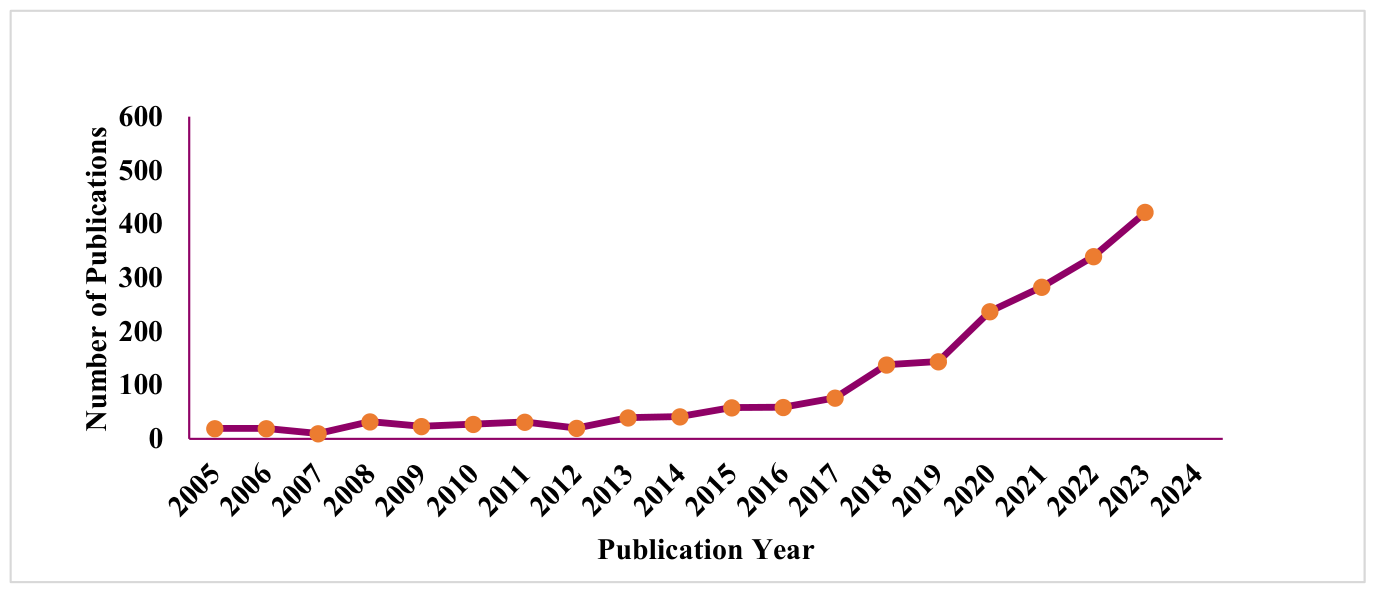
Figure 2.
Top 20 countries by research output in textile waste management and valorization.
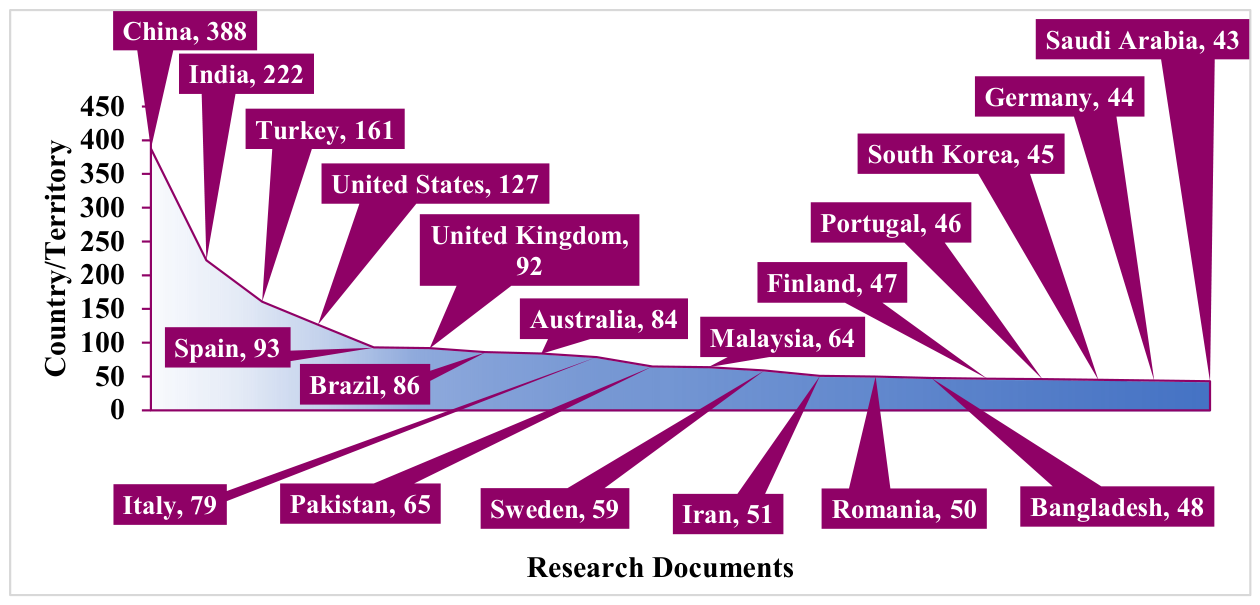
Figure 3.
Knowledge map network visualization mode of textile waste management based on author keywords co-occurrence (Created by author and provided on (https://app.vosviewer.com/?json=https%3A%2F%2Fdrive.google.com%2Fuc%3Fid%3D1pAqdCZvKFIE3bI1_JmMl7znvD_NzNZ1Q).
Figure 3.
Knowledge map network visualization mode of textile waste management based on author keywords co-occurrence (Created by author and provided on (https://app.vosviewer.com/?json=https%3A%2F%2Fdrive.google.com%2Fuc%3Fid%3D1pAqdCZvKFIE3bI1_JmMl7znvD_NzNZ1Q).
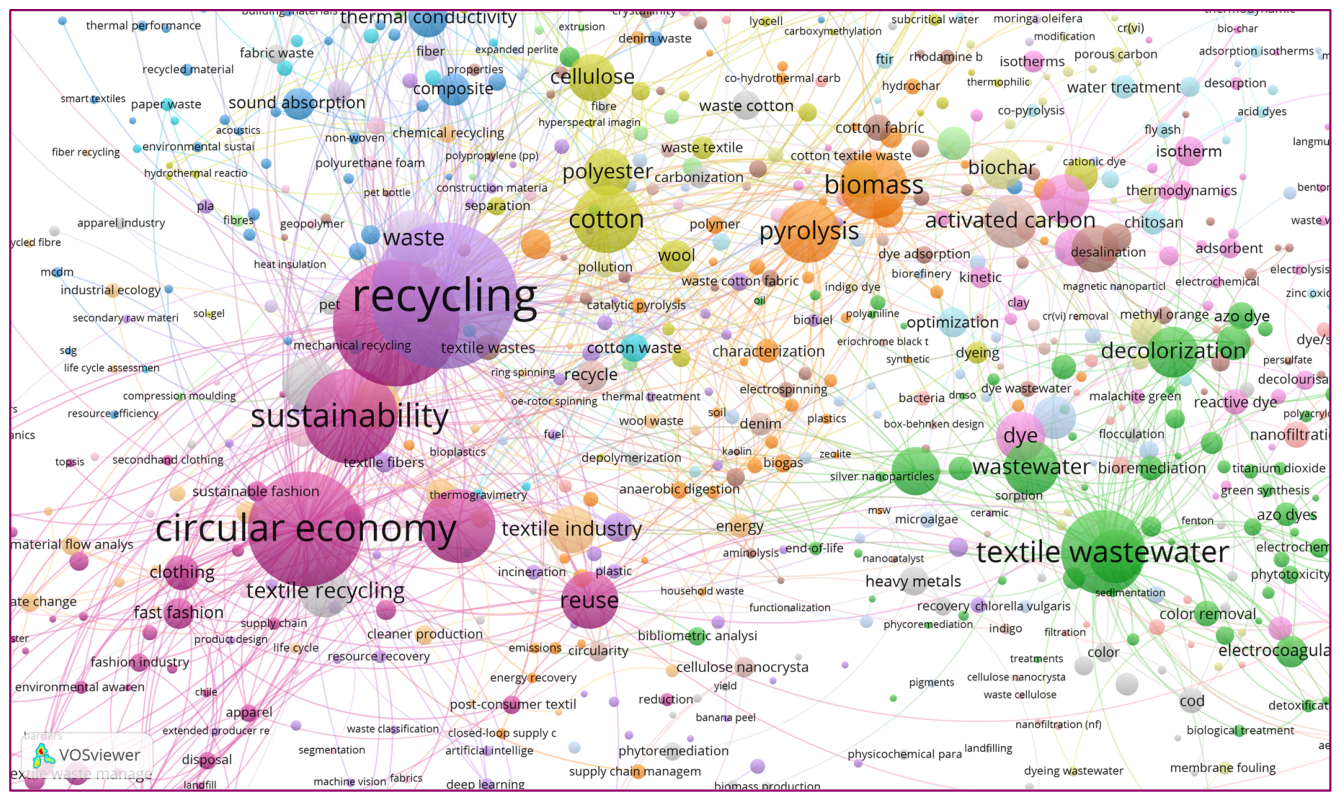
Figure 4.
Bibliometric knowledge map-density visualization mode of textile waste management based on keywords co-occurrence (Created by author and provided on https://app.vosviewer.com/?json=https%3A%2F%2Fdrive.google.com%2Fuc%3Fid%3D1ZmLWho9DMg_9WmBDpAbUdccMIMciaQoM).
Figure 4.
Bibliometric knowledge map-density visualization mode of textile waste management based on keywords co-occurrence (Created by author and provided on https://app.vosviewer.com/?json=https%3A%2F%2Fdrive.google.com%2Fuc%3Fid%3D1ZmLWho9DMg_9WmBDpAbUdccMIMciaQoM).
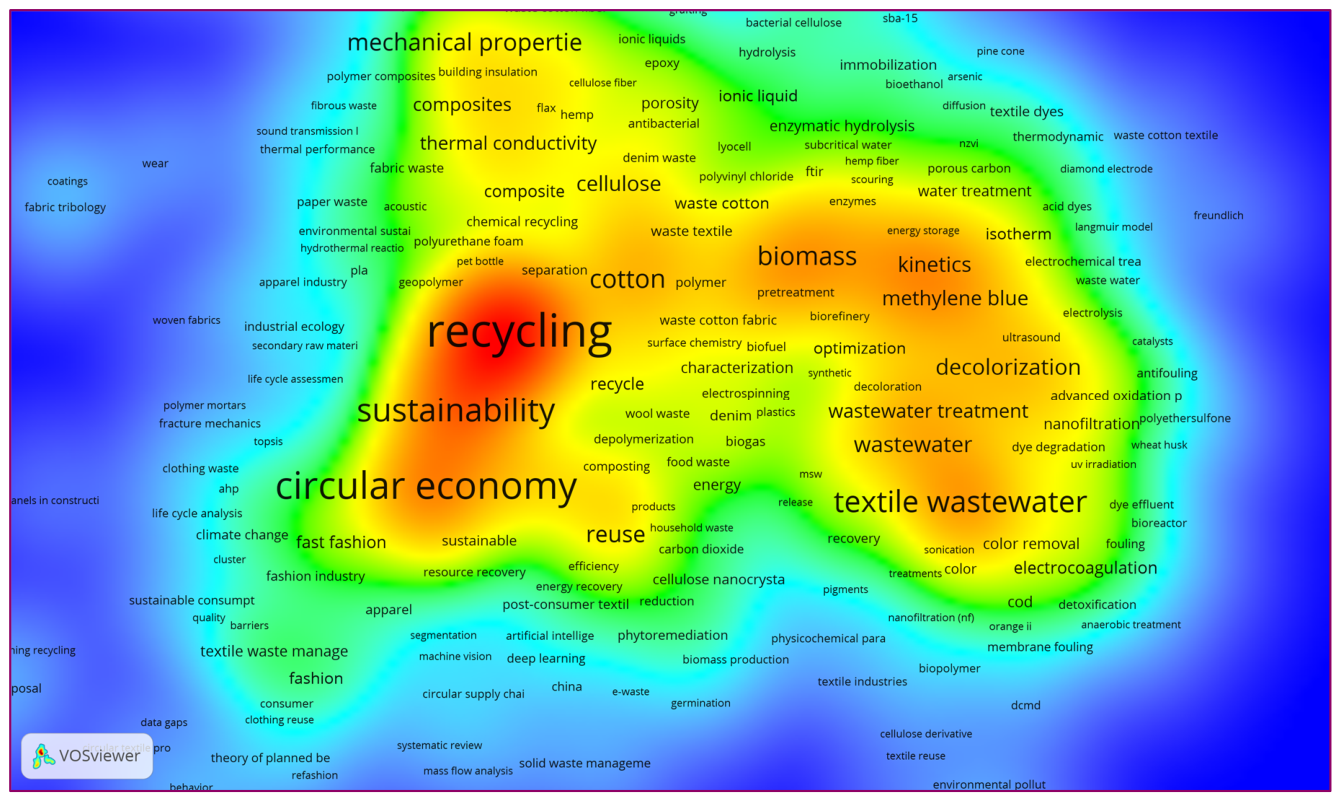
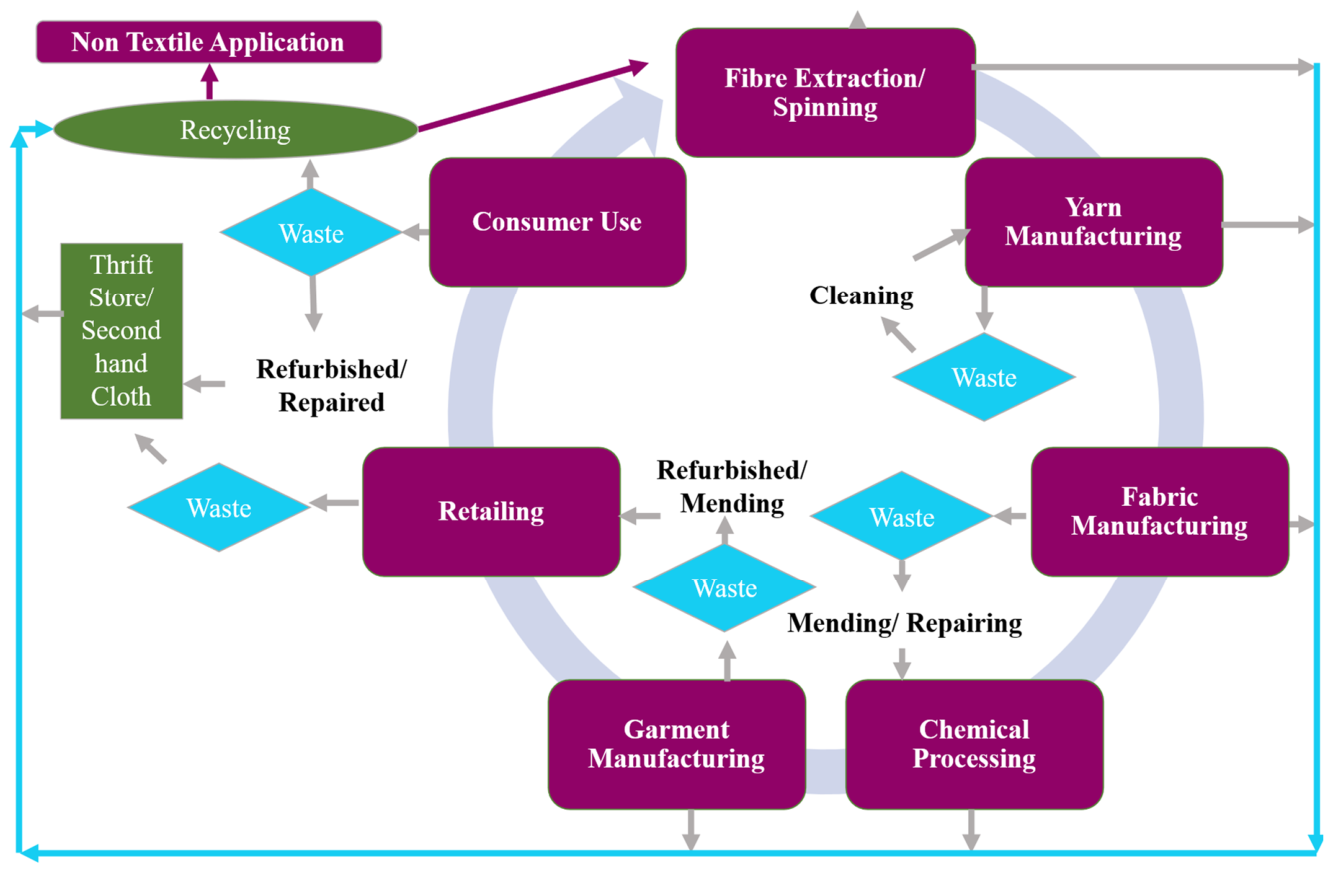
Figure 6.
Various approaches for conversion of textile waste into value-added products [6,21,23,27,35,36,37].
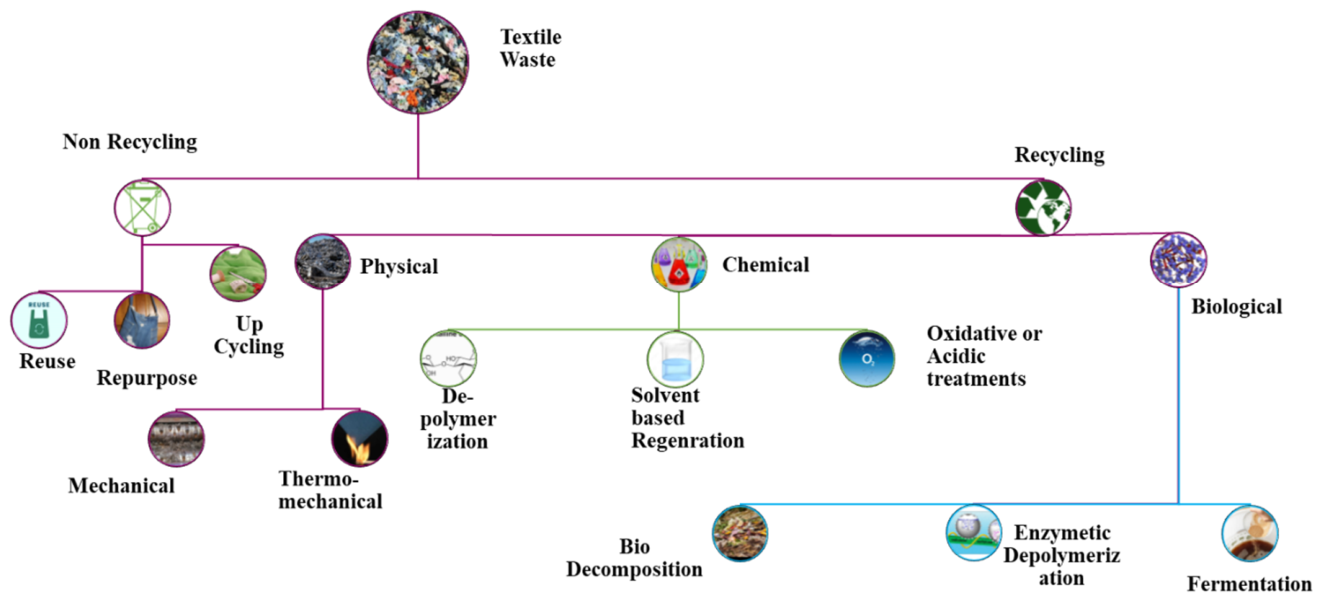
Figure 7.
(a&b): Bibliometric insights into reuse, reduce, and recycle studies conducted over the past 20 years.
Figure 7.
(a&b): Bibliometric insights into reuse, reduce, and recycle studies conducted over the past 20 years.
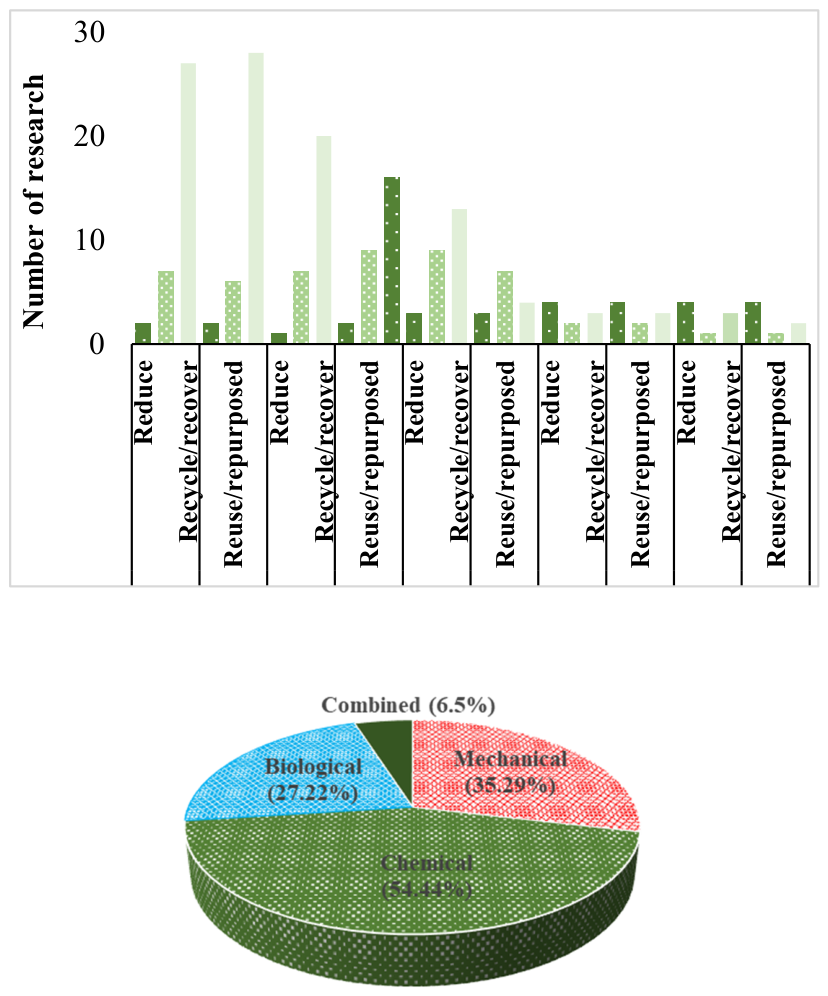
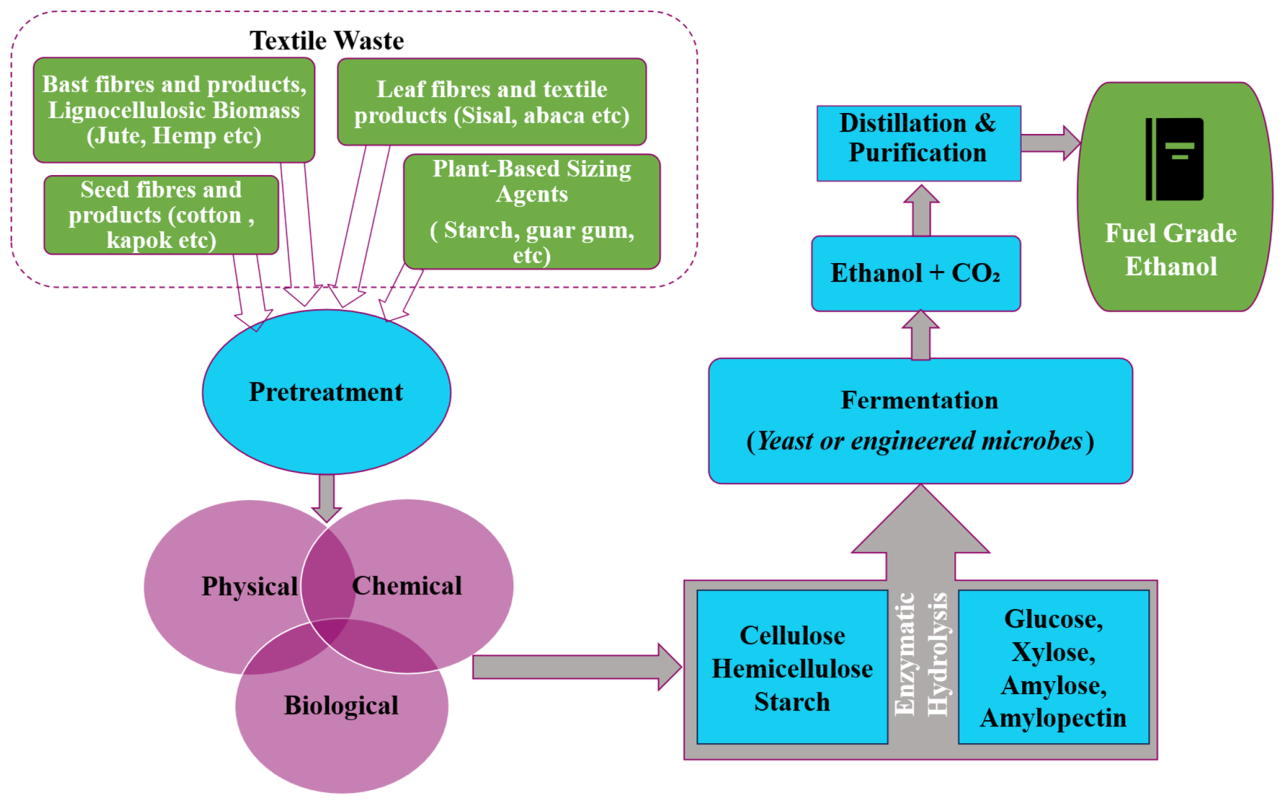
Figure 9.
Converting textile and textile industry pollutants into energy, clean water, and bio-based products using microbial, algal, and thermal processes [79,80,117,127,128,129].
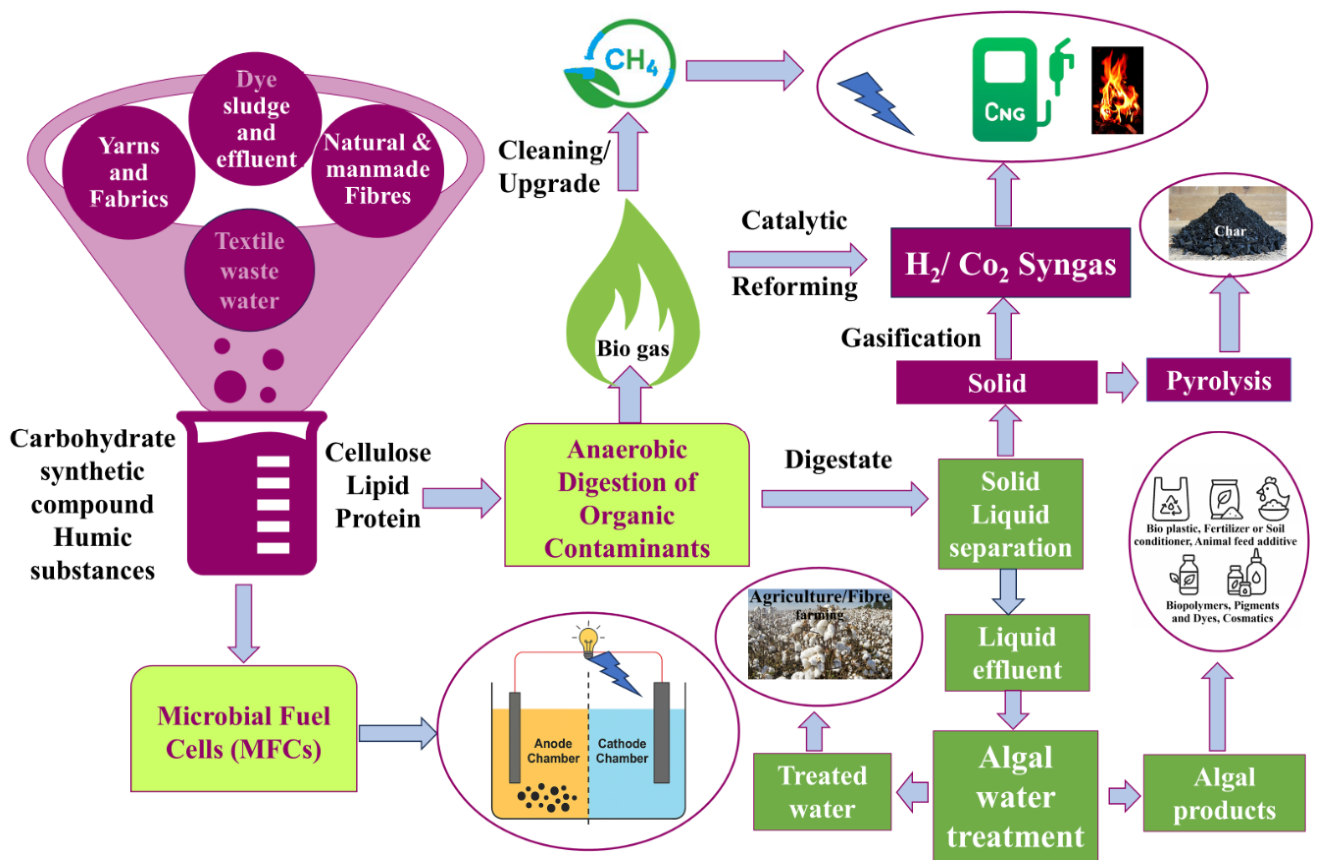

Table 1.
Waste generation, recovery, and recycling processes across textile production zones [4,7,27,28,29,30,31,32,33].
| Process Zone | Sub processes | Waste% and Waste Type | Reusable/ Reprocess/Recyclable (%) |
|---|---|---|---|
| Pre spinning | Fiber extraction, fiber spinning, ginning, and reeling | 5-10%; seed, seed coats, leaf particles, short fibers (linters), trash (dust, twigs), woody core, bark residues, dirt, lanolin, and vegetable matter, Peduncle waste, pupae waste, cocoon waste | Reused for oil extraction, animal feed, and compost. The remaining part is recycled for biomass fuel, paper, and chemical industries. Lanolin is extracted and used in cosmetics. |
| Spinning | Preparatory (blow room, carding, combing, Speed frame) | Up to 15% for Carded; up to 25% for combed, 10% Manmade Fiber spinning; Natural Fiber loss (Fiber, sliver, roving, noil) | 60-70% of cotton and 80-90% of manmade fiber waste can be processed into low-grade yarn, but dust and dirt can’t be recycled. |
| Ringframe/open end and Winding | 1-2%; Fiber loss (Bonda) | 90-100% can be reused in the same process | |
| 5%; Yarn Loss (defective bobbins, Suction waste of winding) | 100% recycled | ||
| Weaving | Preparatory Warping/sizing/Drawing in/Denting | 2-3%; Yarn Loss (Yarn Breakages, cone/Beam Tail Ends, Knotting Losses) | 70-80% Rewinding and reuse for secondary operation. The remaining can be recycled. |
| Loom shed/Inspection/mending | 3-8%; Yarn waste (warp & weft breakages), Selvedge Waste, Defective Fabric | 20-30% of waste can be repaired and sold, with some repurposed for industrial use or patchwork, and the rest recycled. | |
| Knitting | knitting and inspection | 4-6%; Yarn waste, knitted fabric, defective fabric | 20–30% of waste can be repaired for sale, repurposed for industrial use, patchwork, or handlooms, while the remaining can be recycled. |
| Non-woven | Web formation and bonding | 2-3%; fiber/filaments | 80-90% of waste can be reused in the same process, remaining can be recycled |
| Chemical processing | Dyeing/printing and finishing | 1-2.5% (Defective Fabrics, dyes, and chemicals), | 5-10% of waste can be repaired or re-dyed for secondary shades, with the remaining recycled. |
| Garment Manufacturing | Cutting, pattern making, marker planning | 8-10%; Cutting scrap, Edge Waste, Marker Waste, paper waste | 5-10% can be reused. The remaining can be recycled. |
| Sewing and Inspection, and Packaging | 2-3%; Fabric scraps, trims, defective pieces, Thread Waste, Trim Waste, Plastic, Paperboard, Tags, Polybags | Used in small products (bags, home decor), collected for remanufacturing. The remaining can be recycled. | |
| Retailing | Inventory, Packaging, Returns & In-store Operations | 10-20%; Garment (Unsold stock, returns), hangers, tags, promos, damaged goods) | 20–30% of waste can be accommodated through discounts, donations, repairs, refurbishing, second-hand sales, rentals, trial fittings, training, and fixture reuse, with the remaining recycled. |
| Post-Consumer waste | Garments after wearing | 100%; Worn-out garments, old-fashioned clothes, household textiles, misfit clothes | 10–20% of waste can be accommodated through resale, thrift stores, and donations, with the remaining recycled. |
| Process | Textile Waste | Description |
|---|---|---|
| Mechanical shredding | Woven/knit cotton, polyester fabrics, yarns | Waste is cut and shredded into fibers for reuse in low-grade yarn or insulation. |
| Garnetting | Wool, cotton waste | Opens up old textiles into fibers, mainly for blankets, felts, or padding. |
| Carding and re-spinning | Cotton/polyester blends | Aligns fibers for spinning into low-quality yarns. |
| Open-end spinning | Short staple fibers (cotton, synthetics) | Converts waste fibers into yarn without roving, suitable for coarse yarns. |
| Needle punching | Nonwoven applications | Turns loose fibers into mats or felts for automotive and construction use. |
| Thermal bonding | Synthetic fiber waste (e.g., PET) | Heat fuses fibers for nonwoven fabric production. |
| Melt extrusion | Thermoplastic synthetics (e.g., nylon) | Waste is melted and re-extruded into filaments or granules. |
Table 3.
Chemical Recycling Technologies for various textile waste.
| Type of material | Process | Key Outcomes | Challenges | References |
|---|---|---|---|---|
| Cellulosic waste (Plant fiber and regenerated cellulosic fiber) | Solvent-based regeneration (Lyocell Process (NMMO)) | Regenerated fibers without hazardous by-products | Energy consumption and fibrillation issues | [71,72,78,79] |
| Ionic liquid process (Alkali/urea, Lithium chloride & DMAc dissolution) | Regenerated fiber | Cryogenic dissolution (e.g., LiCl/DMAc) needs additives for strength; AMIMCl and Ioncell-F face viscosity issues. | [73,75,79,80] | |
| Acid Hydrolysis | High glucose yield for ethanol or Microcrystalline Cellulose (MCC) Extraction, |
Require further optimization | [81,82] | |
| Protein Waste | Wool fiber Keratin extraction, degradation (reduction, oxidation, sulfitolysis, ionic liquid reagents) | Keratin | Low keratin solubility; brittle form | [76,84] |
| Polyester waste (PET) | Chemical recycling (depolymerization via hydrolysis, alcoholysis, glycolysis), | PET converted to TPA and EG | Requires high pressure/temperature, toxic agents, complex purification, and separation | [85,86] |
| Polyamide 6,6 and PU Blended Fabrics | Selective thermal degradation, solvent (ethanol, DMF) | Polyamide 6,6 and PU fibers were separated and recovered | Needs temperature control and washing; fiber degradation and PU removal are challenging | [87] |
| Polyester-cotton Blended waste | Solvent-based and Ionic liquid separation | Dissolved cotton and polyester are reused as raw material | Complex separation of polyester and cellulose | [69,73,75,88] |
Table 4.
Summary of efforts to convert pre- and post-consumer textile waste into fiber, yarn, and fabrics.
Table 4.
Summary of efforts to convert pre- and post-consumer textile waste into fiber, yarn, and fabrics.
| Type of waste | Operations | Output | References |
|---|---|---|---|
| Pre- and post-consumer cotton fabric/yarns | Cut, shredded, followed by ring/rotor spinning | 100% recycled cotton or recycled cotton with virgin cotton yarn | [32,33,55,67] |
| 100% cotton knitted textile waste | Cut, shredded, sliver blending, spun | Recycled blended O/E yarn | [11,51,61,107] |
| Cotton fabrics/yarns | Cutting/shredding/ twisting, followed by on-woven production | low-cost materials for oil spill clean-up, mulching films, thermal and acoustic insulation | [37,103,104] |
| Wool fabrics | Mechanical recycling and respinning | wool or blended wool yarn | [15,88,110] |
| Wool fabrics | Non-woven production | Insulator pads for automotive, furniture, mattress stuffing, and geotextiles | [109,111,112,113] |
| Mixed textile waste (Nylon/spandex, Acrylic/wool, cotton, polyester) | Isothermal hot-press with sawdust, Compression molding with PU waste, Needle-punching technique, Shredding + wastepaper pulp mixing | composite fabric, thermal insulation fabric, and acoustic panels | [63,67,107] |
| Denim waste/off-cuts | Opening-carding-needling-vacuum-assisted resin transfer molding (VARTM) technology using epoxy as the matrix. | High mechanical 3D composites | [114,115] |
Disclaimer/Publisher’s Note: The statements, opinions and data contained in all publications are solely those of the individual author(s) and contributor(s) and not of MDPI and/or the editor(s). MDPI and/or the editor(s) disclaim responsibility for any injury to people or property resulting from any ideas, methods, instructions or products referred to in the content. |
© 2026 by the authors. Licensee MDPI, Basel, Switzerland. This article is an open access article distributed under the terms and conditions of the Creative Commons Attribution (CC BY) license.
Copyright: This open access article is published under a Creative Commons CC BY 4.0 license, which permit the free download, distribution, and reuse, provided that the author and preprint are cited in any reuse.