

Submitted:
21 August 2026
Posted:
24 August 2026
You are already at the latest version
Abstract
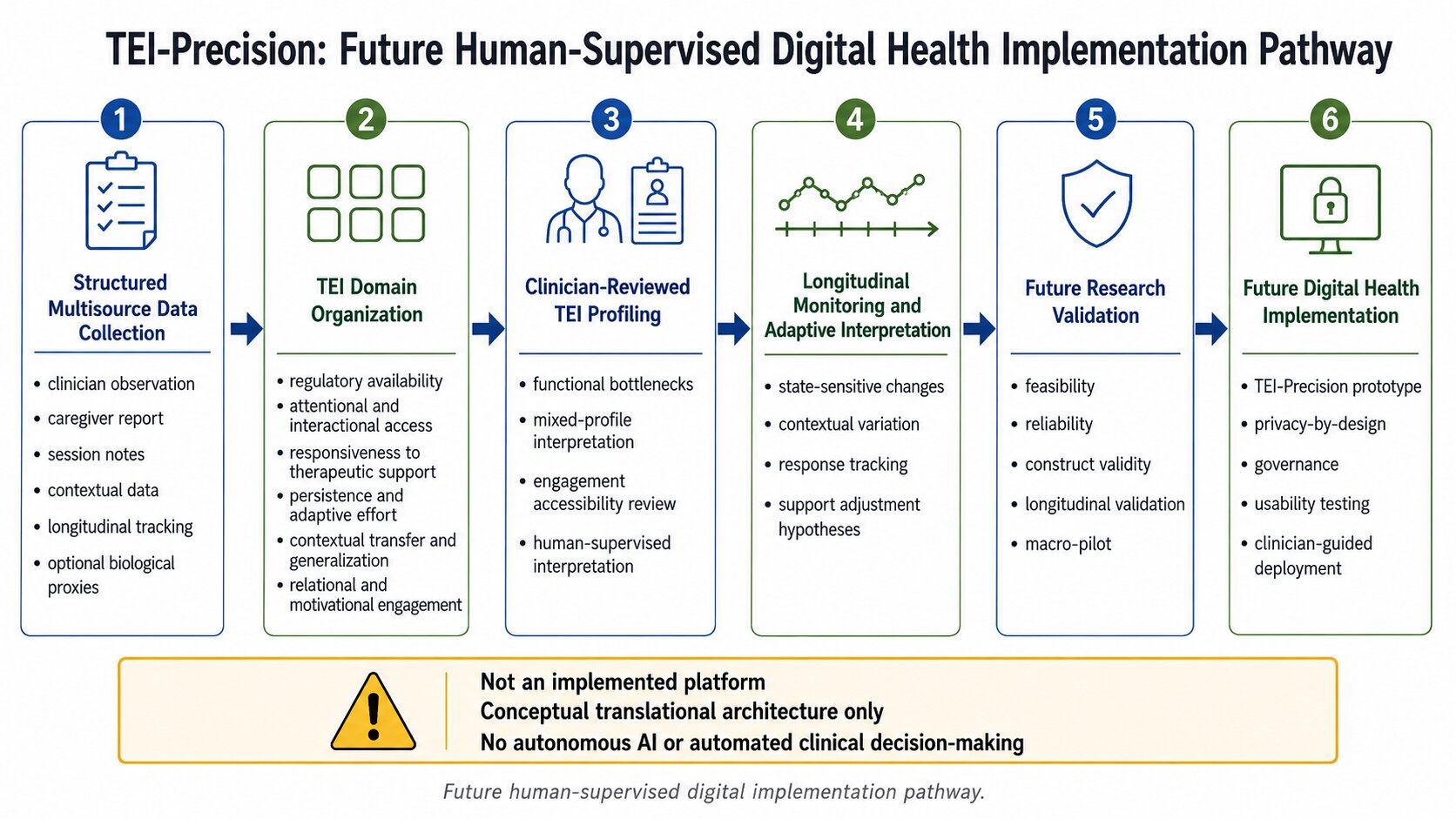
Autism spectrum disorder is characterized by substantial heterogeneity in developmental trajectories, biological profiles, adaptive functioning, regulatory capacity, family-contextual factors, and response to intervention. Although evidence-informed interventions may benefit many autistic children, therapeutic response remains variable, limited, or fluctuating in a significant proportion of cases. This variability highlights the need for stratification frameworks that can better characterize when, how, and under what conditions an autistic child becomes accessible to therapeutic input. This Hypothesis and Theory manuscript proposes the Therapeutic Engagement Index (TEI) as a hypothesis-generating stratification construct for understanding variability in therapeutic accessibility and intervention responsiveness in autism. TEI is situated within FIAP® — Framework for Integrated Autism Precision Care — and is conceptualized as a multidimensional framework integrating regulatory availability, attentional and interactional access, responsiveness to therapeutic support, persistence and adaptive effort, contextual transfer, and relational/motivational engagement. The manuscript further clarifies the concept of functional bottlenecks as multidimensional constraints that may limit access to intervention despite the availability of therapeutic support. These bottlenecks may involve regulatory instability, sensory overload, fatigue, sleep disruption, anxiety, communication barriers, family-contextual stress, or mismatch between intervention demands and the child’s adaptive capacity. TEI is not presented as a validated clinical scale, diagnostic instrument, predictive model, or intervention protocol. Rather, it is proposed as a research-oriented conceptual architecture requiring feasibility testing, inter-rater reliability assessment, construct validation, longitudinal evaluation, and empirical testing in clinical and community contexts. Similarly, TEI-Precision is framed as a conceptual translational architecture for future human-supervised digital implementation, not as an implemented digital health platform, autonomous artificial intelligence system, or validated decision-support tool. By operationalizing TEI domains, clarifying illustrative engagement profiles, and outlining a staged validation roadmap, this manuscript aims to support future research on precision autism care, therapeutic responsiveness, biological burden, and responsible digital health translation.
Keywords:
autism spectrum disorder
; therapeutic engagement index
; precision care
; intervention responsiveness
; biological burden
; neurodevelopment
; stratification
; digital health implementation
Copyright: This open access article is published under a Creative Commons CC BY 4.0 license, which permit the free download, distribution, and reuse, provided that the author and preprint are cited in any reuse.