

Submitted:
20 August 2026
Posted:
24 August 2026
You are already at the latest version
Abstract
Urban regeneration increasingly uses tourism scenario activation to renew heritage, public space and local economies. Yet the production of urban attractiveness can intensify tourism gentrification, commercial reorientation and the erosion of ordinary urban life. This integrative review synthesises research across urban regeneration, touristification, tourism gentrification, place branding, speculative and platform urbanism, liveability, publicness and collaborative governance. Through a problem-driven comparison of these literatures, it formalises touristic desirability as the relational and institutionally organised value logic through which anticipated visitor-oriented attention, experience and value shape what becomes visible, investable, programmable and materially actionable. It develops urban cohabitation as an evaluative criterion for whether tourism-led regeneration sustains heterogeneous forms of residence, use, livelihood, memory and collective agency. The review identifies four operations of desirability and eight interdependent conditions of cohabitation, then translates their relationship into governance principles centred on anticipation, shared urban capacities, alignment of value, voice and responsibility, and sustained public and collective direction. It concludes that regeneration becomes inclusive when becoming more visitor-oriented strengthens, rather than narrows, the conditions through which cities remain inhabitable, plural and collectively governable.
Keywords:
urban regeneration
; touristic desirability
; urban cohabitation
; tourism scenario activation
; tourism gentrification
; inclusive urban tourism
; urban governance
1. Introduction: When Regeneration Becomes Touristically Desirable
Urban regeneration and urban tourism increasingly converge around a shared promise: renewed places can attract investment, recover neglected assets, stimulate cultural activity and expand urban experience. Tourism enters regeneration through heritage reuse, public-space renewal, cultural programming, visitor services and destination positioning, making it part of wider processes of spatial planning and urban transformation rather than a sector added after physical renewal [1].
Tourism-led regeneration can produce meaningful benefits. It can mobilise resources for heritage conservation, return abandoned buildings to use, improve public environments, sustain cultural activity and create opportunities for local enterprise. Its urban consequences, however, depend on the relations through which renewal is organised. Research on tourism gentrification and touristification has documented how tourism-oriented investment may raise housing pressures, facilitate short-term rental conversion and reorient diverse neighbourhoods towards increasingly specialised spaces of visitor consumption [2,3,4,5]. Tourism can therefore become part of a wider urban redevelopment process through which capital, policy and consumption reorganise residential and commercial space.
These transformations extend beyond the physical displacement of residents. Touristification can weaken the material and emotional relations through which people inhabit a neighbourhood even when they remain in their homes. Cocola-Gant’s [4] account of place-based displacement shows how changes in commerce, social relations and everyday environments can disintegrate the places on which residents depend and with which they identify. Research on the touristification of consumption spaces likewise identifies retail-capital concentration, standardisation, functional reorientation and, in some contexts, business displacement as differentiated processes through which urban commerce can become less capable of supporting ordinary life [5]. Tourism-related urban transformation therefore concerns housing and population displacement, together with the reorganisation of the practices, services, rhythms and attachments that make places inhabitable.
Tourism gentrification and touristification provide indispensable accounts of these processes. The former connects visitor economies with capital investment, property restructuring and class transformation, while the latter captures the wider territorial reorientation of places through tourism [2,6,4]. This review isolates a more specific analytical moment within and sometimes before that wider transformation: the prospective valuation through which particular visitor-oriented futures become preferable and actionable in regeneration. This is the problem addressed through the concept of touristic desirability.
Touristic desirability captures the prospective urban value logic through which anticipated visitor-oriented attention, experience and value begin to influence regeneration. Rather than describing tourism demand or destination appeal, it directs attention to how expectations of external attraction enter decisions about what is restored, narrated, programmed, encouraged and prioritised. The concept is formalised and differentiated from neighbouring terms in Section 3.
This translation occurs through four connected operations. First, urban value is made visible through selective representation and the foregrounding of particular places, histories and practices. Second, curation and programming organise how selected value can be encountered through design, atmosphere, events, itineraries and temporal scripting. Third, desirability becomes durable when it is embedded in property, commerce, regulation and infrastructure. Fourth, platforms, social media and recommendation systems connect visibility, transaction and feedback, recursively amplifying attention and revaluation. Touristic desirability consequently describes a broader process than the arrival of tourists. It identifies how the anticipated gaze, movement and spending of external users can enter the organisation of regeneration itself.
Visitor growth, investment volumes, renewed building stock and the number of tourism scenarios created cannot adequately assess the effects of this process. Accessibility, participation and local-benefit mechanisms also remain partial when separated from the urban relations being transformed. A project may include consultation and accessible visitor services while weakening residential continuity, everyday commerce, cultural plurality or community influence over the future of the place. Inclusive urban tourism therefore requires a criterion capable of examining what forms of urban life regeneration enables people to sustain.
To evaluate that transformation, the review develops urban cohabitation as a second concept. It asks whether tourism-led regeneration sustains the material, relational and institutional conditions through which heterogeneous forms of residence, use, livelihood, memory and collective agency remain viable and able to shape change. Cohabitation therefore extends beyond interpersonal conviviality to the wider urban relations that make plural life possible.
The concept is developed from research on liveability, urban social sustainability, publicness, the right to the city, conviviality and atmospheric justice [7,8,9,10,11,12]. It brings these concerns into a single evaluative field encompassing residential continuity, plurality of uses, economic reciprocity, urban publicness, temporal compatibility, cultural memory, infrastructural sufficiency and collective agency.
The relationship between touristic desirability and urban cohabitation provides the central analytical architecture of the review. Touristic desirability identifies how tourism-oriented value becomes active within regeneration. Urban cohabitation examines how the resulting transformation redistributes the conditions of urban life. The relationship is not predetermined. Increased desirability can support heritage continuity, public investment, local economies and new forms of encounter. It can also concentrate value, displace ordinary functions and narrow the range of people, practices and relations that the regenerated place can sustain. The analytical task is therefore to determine how desirability is produced, whose urban worlds it strengthens, whose exposure it intensifies and which forms of cohabitation it enables.
What happens to urban life when tourism-led regeneration is organised through touristic desirability, and under what conditions can tourism scenario innovation sustain urban cohabitation?
The review makes three connected contributions. First, it develops touristic desirability as a diagnostic concept for explaining how anticipated visitor-oriented attention, experience and value become active within urban regeneration. Second, it develops urban cohabitation as an evaluative criterion for examining whether this transformation sustains plural urban life across residential, economic, public, temporal, cultural and infrastructural relations. Third, it connects diagnosis and evaluation with governance by specifying the public and collective capacities required to sense emerging change, shape its conditions and redirect trajectories that begin to narrow cohabitation. Together, these contributions form a single framework for understanding, evaluating and governing tourism-led urban regeneration.
The review proceeds through a problem-driven integrative synthesis of scholarship on urban regeneration, tourism gentrification, touristification, urban liveability, public space, place-based displacement, digital mediation and inclusive tourism governance. Section 2 explains the review design. The subsequent sections develop touristic desirability, trace its principal urban operations, elaborate the urban cohabitation framework and translate the resulting diagnosis into principles for governance. The conclusion returns to the relationship between visitor orientation and inhabitability.
2. Integrative Review Design and Conceptual Synthesis
2.1. Review Scope and Literature Domains
This study is designed as a critical integrative review of how tourism becomes an organising force within urban regeneration. It connects bodies of scholarship that have often developed alongside one another: urban regeneration; touristification and tourism gentrification; place branding, urban entrepreneurialism and speculative valuation; platform urbanism and digital mediation; liveability, publicness and the right to the city; and community and governance capacity. These conversations are brought together around one problem: how the production of visitor-oriented urban value redistributes the conditions through which places are inhabited, used, valued and governed.
The review follows a problem-driven integrative approach. Integrative reviews are particularly appropriate when a research problem extends across fragmented literatures and the objective is to generate a new conceptual perspective from their intersection [13]. Conceptual research requires an explicit design that clarifies the role of the literatures brought together and the form of contribution being pursued [14]. The present review combines theory synthesis with framework development. It synthesises insights from adjacent debates and reorganises them around two connected concepts: touristic desirability, which identifies an urban logic of valuation and reorganisation, and urban cohabitation, which provides a criterion for interpreting its consequences.
The review begins from the phenomenon to be explained. Across diverse cities, regeneration increasingly combines heritage renewal, cultural programming, public-space redesign, commercial transformation, visitor services and the strategic production of visibility. These interventions differ in scale, institutional setting and consequence, but they share one feature: tourism can enter regeneration before visitor growth becomes visible as an outcome. Anticipated visitors, circulating images, desirable experiences and tourism-related investment can already shape what is restored, promoted, permitted and prioritised.
Six connected literature domains are used to examine this problem. Tourism-led regeneration research establishes the material, cultural and spatial promises of activation. Touristification and tourism-gentrification scholarship explains territorial reorientation, property restructuring, displacement and changing everyday functions. Urban entrepreneurialism, destination attractiveness, place branding, speculative urbanism and valuation clarify how anticipated futures become institutionally actionable. Platform-urbanism research shows how representation, transaction and regulatory influence become recursively connected. Liveability, conviviality, publicness, social sustainability and the right to the city provide vocabularies for the urban capacities at stake. Community-capacity, collaborative-planning and governance research clarifies how affected actors may interpret, shape and redirect change.
Table 1 summarises the six literature domains, representative search-term families and the analytical role each performs in the synthesis.
2.2. Source Identification and Analytical Comparison
The source base was developed iteratively from the review problem and the six literature domains. Targeted thematic searches were organised around the search-term families summarised in Table 1 and supplemented by citation tracing from foundational and recent contributions. No fixed publication window was imposed because several of the concepts require earlier landmark sources; the recent literature was updated through August 2026. Sources were retained for conceptual relevance, explanatory contribution and capacity to illuminate recurring mechanisms across different geographical and institutional contexts. Empirical studies substantiate processes and consequences, while theoretical contributions support the definitions, distinctions and relationships developed in the framework. Digital research is included where it explains how visibility, desirability and urban coordination are intensified rather than as a separate technological strand.
Because the purpose is theory synthesis and framework development rather than exhaustive evidence aggregation, the review is not presented as a systematic or scoping review.
The literature is read relationally across these domains through four questions: what generates urban transformation, what becomes valuable within it, which urban relations are altered, and how inclusiveness is assessed. Tourism-gentrification research explains displacement and property restructuring; touristification captures territorial reorientation; branding and entrepreneurial-city research explain the deliberate production of attractiveness; platform research shows how visibility and transaction are technologically mediated; and liveability and right-to-the-city scholarship foreground the urban conditions and political capacities at stake. Each illuminates part of the problem, while the relationship between tourism-oriented valuation and the continuing composition of plural urban life remains dispersed across them.
2.3. Conceptual Synthesis and Framework Development
The synthesis develops through three connected movements. The first isolates the prospective value logic linking regeneration with visitor-oriented attention and actionability. This produces the concept of touristic desirability and four operations: making urban value visible; curating and programming the urban experience; embedding desirability in property, commerce and infrastructure; and recursive amplification and revaluation. The second movement examines the urban relations affected by this logic and develops urban cohabitation from research on displacement, ordinary uses, local economies, public space, cultural memory, urban rhythms, infrastructure and political agency.
The third movement connects diagnosis and evaluation with governance. Touristic desirability explains how tourism-oriented urban value is produced; urban cohabitation provides the criterion through which its consequences can be evaluated; and the governance principles identify the public and collective capacities required to sustain more inclusive trajectories. The resulting architecture is explanatory, evaluative and practical, without being presented as a validated index or universal policy model.
The concepts are developed through comparison with their closest neighbouring terms. A conceptual contribution gains precision by clarifying how it organises existing knowledge differently and what becomes visible through that reorganisation [15]. Touristic desirability is therefore examined alongside touristification, tourism gentrification, destination attractiveness, place branding, aestheticisation and platform-mediated visibility. Urban cohabitation is positioned alongside liveability, conviviality, social sustainability, publicness and the right to the city. The intention is to build conceptual connections while preserving the distinct analytical work performed by each term.
This review design supports analytical breadth while retaining a focused purpose. It neither catalogues every form of tourism-led urban transformation nor offers a comprehensive classification of regeneration policies. It reorganises dispersed insights around the relationship between the production of touristic desirability and the conditions of urban cohabitation, offering a conceptual proposition that can subsequently be examined, refined and operationalised through comparative urban research. Figure 1 summarises the resulting review architecture, from the literature domains through diagnosis and evaluation to governance and the final regenerative criterion.
3. Tourism Scenario Activation and the Production of Urban Value
3.1. Scenario Activation as Regenerative Coordination
Urban regeneration commonly brings together physical renewal, economic restructuring, institutional intervention and the reactivation of social and cultural life. Heritage-regeneration research shows how place-making and the selection of urban meanings become central to these processes [16]. Adaptive reuse adds a material and environmental dimension by extending building life and introducing new functions [17]. In tourism settings, cultural policy and strategic management shape whether heritage activation contributes to wider urban regeneration [18].
The language of tourism scenario activation gives contemporary expression to this regenerative promise. A tourism scenario is more than a bounded attraction or physical site. It combines spatial arrangements, programming, services, narratives, infrastructures and visitor practices into an urban proposition that can be experienced, communicated and managed. Scenario activation can therefore renew heritage and public space while also reorganising the relations among urban functions, institutions and publics.
Activation therefore names a process of coordination. Buildings, public spaces, infrastructures, enterprises, cultural signs and visitor practices are assembled into an identifiable and accessible urban proposition. This coordination can return abandoned sites to use, support heritage and cultural activity, improve public environments and create opportunities for locally embedded enterprise, particularly where adaptive reuse is connected with community needs and social continuity.
Digital and smart technologies can intensify scenario activation by expanding visibility, coordinating services, monitoring flows and personalising visitor experiences. Yet smart-tourism innovation cannot be evaluated through technological adoption or territorial marketing alone. Its urban value depends on whether it improves habitat, civic life, sustainability and the capacity of territorial actors to participate in shaping transformation [19].
Its effectiveness as an activation strategy does not establish the quality or inclusiveness of the resulting regeneration. The same processes that renew buildings and increase activity may alter housing markets, commercial functions, public-space access, neighbourhood meanings and the balance among residential, civic and visitor-oriented uses. The analytical problem is therefore how a strategy of renewal becomes a wider process of selective urban reorganisation [20].
Tourism scenario activation operates within these wider dynamics. Scenarios give spatial and experiential form to regeneration, but they also define an implicit urban public. Their design anticipates particular bodies, movements, interests, expenditures and ways of seeing. The selection of routes, uses, businesses, visual elements and cultural narratives helps establish who the regenerated place is expected to welcome and what they are expected to do there. A scenario oriented mainly towards temporary consumption creates different urban possibilities from one that integrates housing, education, care, local commerce, cultural production and visitor use.
The language of activation can nevertheless obscure what is already present. Places described as neglected, obsolete or underused may support informal economies, low-rent activities, social networks, care practices, migrant businesses, cultural experimentation and unprogrammed public use that remain weakly visible to planners and investors. To designate a place as requiring activation is therefore already to make a judgement about which activities count as valuable urban life.
Regeneration makes that judgement material. Investment, design and regulation strengthen some relations and weaken others: a market becomes a gastronomic destination, a residential street an experiential route, or a workshop district a cultural quarter. Such changes may preserve previous urban life, generate hybrid uses or replace locally embedded functions with externally oriented ones. The relevant issue is how the renewed scenario reorganises relations among property, commerce, public space, culture and everyday practice.
The issue lies in the basis on which urban components are selected and coordinated. A scenario may incorporate resident needs, sustain multiple functions, create shared infrastructures and increase local capacity to shape change. It may also privilege externally oriented value, concentrate returns and weaken the relations through which ordinary life remains viable. Distinguishing these trajectories requires an evaluative criterion that reaches beyond activation itself [6,4].
3.2. From Urban Activation to Prospective Valuation
Touristification has become a central concept for examining the transformation of places through tourism. Its uses vary across tourism studies, geography and urban research, although a common core can be identified: tourism reorganises territory, property, economic activity, everyday practices and the social composition of places. Touristification therefore captures a broad process through which spaces become increasingly produced and organised for tourism purposes [6].
Tourism gentrification provides a more focused account of this transformation. It connects tourism development with capital reinvestment, rising property values, residential displacement, commercial substitution and changes in the class composition or effective users of urban space. The concept has become especially important for understanding historic centres and neighbourhoods where short-term accommodation, visitor-oriented businesses and external investment alter the conditions under which residents and locally embedded activities can remain. Residential conversion and place-based displacement show how tourism gentrification affects housing, economic functions and attachments to place [2,3,4].
These concepts reveal how tourism participates in urban restructuring at different analytical levels. Touristification names an encompassing territorial transformation, while tourism gentrification foregrounds reinvestment, class restructuring and displacement. Their strength lies in explaining the wider process and political economy of tourism-related urban change. The question developed here is more specific: how anticipated tourism-oriented value enters regeneration decisions and helps make particular urban futures actionable before, during and alongside those broader transformations.
Regeneration decisions already distinguish among buildings selected for adaptive reuse, histories chosen for interpretation, streets targeted for redesign, businesses encouraged, atmospheres cultivated and activities programmed. These decisions are not merely technical responses to existing demand. They express expectations about which urban qualities can attract attention, host experience and generate future symbolic or commercial value [21,22,23].
Touristic desirability names this prior and continuing movement of urban valuation. It sits between the production of urban appeal and the material reorganisation documented by touristification and gentrification research, following how expected tourism value becomes translated into urban selection, coordination and material change [24].
The contribution claimed here does not depend on the phrase touristic desirability being unprecedented. It lies in formalising touristic desirability as an analytical concept for urban regeneration: a prospective value logic whose effects can be traced through selection, coordination and material change. The review therefore focuses on what the concept enables us to explain rather than on claiming lexical novelty.
Touristic desirability is the relational and institutionally organised urban value logic through which anticipated visitor-oriented attention, experience and value influence which spaces, practices, histories, uses and futures become visible, investable, programmable and materially actionable within regeneration.
Four elements of this definition require clarification.
First, desirability is relational. It is not an intrinsic quality residing in a building, neighbourhood or cultural practice. Urban elements become desirable through relations among representations, planning decisions, investment, mobility systems, cultural narratives, visitor expectations and established tourism imaginaries. A former industrial building, traditional market or residential street does not automatically possess tourism value. Its desirability emerges as particular architectural, historical, sensory or social characteristics are connected to wider circuits of attention and consumption.
Second, touristic desirability is organised. Public authorities, destination organisations, developers, cultural institutions, property owners, tourism businesses, platforms and media actors influence what becomes visible and investable. Urban entrepreneurialism helps explain why cities actively pursue competitive attractiveness [25], while place-branding research clarifies how identities, meanings and stakeholder relations become strategically organised around that pursuit [26].
Third, desirability is prospective. Regeneration decisions are oriented towards imagined futures in which visitors, investment, media attention or symbolic recognition are expected to arrive. Speculative-urbanism research shows how expectations and narratives make urban futures actionable in the present [27]. Real-estate valuation research demonstrates how expertise, calculation and risk practices perform value and shape development possibilities [28], while work on urban displaceability shows how valuation can alter residential vulnerability before actual displacement occurs [29].
Fourth, touristic desirability is performative. It contributes to producing the urban qualities it appears merely to recognise. When institutions repeatedly describe an area as creative, authentic, historic, undiscovered or vibrant, these descriptions guide investment, design, business formation and visitor attention. The resulting changes may then confirm the original representation, creating a recursive process through which anticipated desirability becomes increasingly material. Digital platforms intensify this recursion by allowing images, reviews, rankings, listings and recommendations to participate in the ongoing production of tourism space. Airbnb listings, platform institutions and attention-oriented investment show how digital representation can co-produce neighbourhoods as tourism environments and influence material urban decisions [30,31,32].
Touristic desirability is therefore not a preference held by tourists but an urban arrangement through which anticipated preferences acquire influence in planning, investment, representation and everyday spatial organisation. It marks the point at which the imagined visitor enters decisions about what a place should become.
3.3. Positioning Touristic Desirability
Conceptual precision requires locating touristic desirability alongside related terms. The purpose is to clarify the particular analytical work it performs within a field that already contains strong accounts of tourism-related urban change.
These distinctions position touristic desirability as a meso-level concept. It connects large-scale political-economic processes with specific urban interventions and experiences. It does not attempt to explain the complete political economy of tourism development, nor does it remain at the level of individual visitor preference. It follows how expectations of tourism value become translated into urban selection, coordination and material change.

Table 2.
Touristic desirability in relation to adjacent concepts.
| Concept | Primary analytical focus | Typical question | Main explanatory strength | Distinction from touristic desirability |
| Destination attractiveness | Attributes influencing visitor interest, choice and satisfaction | What makes a place appealing to potential visitors? | Explains tourism demand and destination competitiveness | Touristic desirability examines how the pursuit of appeal reorganises the city, rather than how visitors evaluate destination attributes. |
| Place and city branding | Strategic production and communication of place identity | How is a city represented to targeted audiences? | Explains selective narratives, images and positioning strategies | Touristic desirability follows how representation is translated into planning, investment, programming, infrastructure and urban use. |
| Urban entrepreneurialism | Interurban competition for investment, consumers and recognition | How do cities mobilise projects and partnerships to compete for mobile capital? | Locates tourism within growth-oriented urban governance and political economy | Touristic desirability focuses specifically on how anticipated tourism-oriented attention and value guide urban selection and regeneration. |
| Touristification | Increasing reorientation of places towards tourism functions and users | How does tourism transform the economic, spatial and social organisation of a place? | Captures broad territorial transformation under tourism pressure | Touristic desirability identifies a valuation logic that may initiate or intensify touristification before its outcomes are fully established. |
| Tourism gentrification | Tourism-related reinvestment, property restructuring, class change and displacement | How does tourism contribute to the displacement or replacement of residents, businesses and uses? | Reveals the political economy and distributional consequences of tourism-led urban change | Touristic desirability explains how places, practices and appearances become selected for tourism-oriented revaluation, including before observable displacement. |
| Aestheticisation | Visual, sensory and atmospheric curation of urban environments | How are urban spaces made coherent, attractive and consumable? | Explains the design and experiential production of urban appeal | Aesthetic curation is one operation of touristic desirability, alongside commercial, temporal, infrastructural, semiotic and digital reorganisation. |
| Platform urbanism | Digital mediation of urban services, visibility, transactions and governance | How do platforms reorganise access, mobility, accommodation and urban attention? | Explains the infrastructural and algorithmic production of urban space | Platforms amplify touristic desirability, but desirability also operates through planning, heritage, investment, marketing and material regeneration. |
| Touristic desirability | Urban valuation through anticipated external attraction, experiential circulation and symbolic-commercial value | How does becoming desirable to visitors enter the organisation of urban regeneration? | Connects representation, anticipation, planning and material transformation before and during touristification | Provides the review’s diagnostic concept. |
Every process of desirability involves selection. Some histories acquire public visibility, while others remain peripheral. Certain architectural forms receive investment, while less marketable infrastructures continue to deteriorate. Particular cultural practices become signs of authenticity, while ordinary or contested forms of life receive less institutional recognition. Some forms of commerce fit the projected visitor experience, while others appear incompatible with the regenerated environment.
Selection also occurs within apparently inclusive representations. A district may be promoted through the diversity, informality or cultural vitality of its residents while the economic and regulatory conditions supporting those forms of life become weaker. The value of cultural difference may be retained symbolically even as the people and institutions carrying it face rising costs or reduced control. Touristic desirability can therefore detach desirable signs from the relations that produced and sustained them.
The consequences remain contingent. Touristic desirability can attract resources to neglected heritage, strengthen cultural activity, support locally embedded enterprises and make public environments accessible to wider groups. It can also accelerate extraction, functional specialisation and displacement. The concept does not predetermine whether tourism-oriented attractiveness is beneficial or harmful. Its analytical purpose is to make visible the value logic at work and create the basis for examining how its consequences are distributed.
The concept can now be carried forward through four claims. Touristic desirability becomes active when anticipated visitor-oriented value influences the selection and coordination of regeneration. It may reorganise places before intensive visitation or measurable tourism gentrification becomes established. Digital systems increase its speed, reach and recursive force without constituting its origin. Its regenerative quality depends on how these processes affect the conditions through which plural urban life remains viable and capable of shaping change.
4. How Touristic Desirability Becomes Urban Transformation
Touristic desirability acquires urban force through four connected operations. They do not constitute a fixed sequence, and they rarely originate from a single actor or policy. They emerge through the interaction of regeneration plans, public investment, cultural institutions, property markets, tourism enterprises, urban design, destination communication, digital platforms and everyday practices. Together, they influence what receives attention, how selected value is encountered, how it becomes materially embedded, and how visibility and valuation are recursively intensified.
The same operations can support valuable forms of renewal. Greater visibility may attract resources to overlooked heritage. Experiential programming may return abandoned spaces to collective use. Commercial change may support new enterprises, while infrastructural improvements can benefit residents and visitors simultaneously. Their consequences depend on how they are configured and on the urban relations within which they intervene. Touristic desirability becomes exclusionary when its organising operations progressively privilege external attraction and consumption over the wider conditions required to sustain plural urban life.
4.1. Making Urban Value Visible
The first operation makes urban value visible. Regeneration renders some urban qualities more perceptible, narratable and institutionally actionable than others. Architectural features, cultural practices, local histories, commercial environments and everyday scenes are identified as capable of supporting a distinctive tourism scenario [21,24].
Visibility therefore involves more than promotion. It helps organise urban value. A building recognised as industrial heritage becomes eligible for adaptive reuse. A neighbourhood represented as creative may attract cultural investment and new enterprises. A street associated with distinctive food, design or nightlife can become part of the visitor economy. Recognition opens possibilities for preservation and renewed activity, while also exposing places to investment, appropriation and intensified external use.
The resulting selectivity often produces an edited account of the place. Complex histories are condensed into narratives that can be encountered within limited periods of time. Cultural practices become recognisable signs. Everyday environments are framed as discoveries, authentic quarters or emerging destinations. These representations need not be false. Their selectivity lies in how they foreground certain relations and place others beyond the principal frame through which the area is publicly understood.
Digital media have expanded the urban significance of this process. Social-media visibility, geotagged images, recommendation systems and viral circulation can rapidly reposition places within urban attention. Recent research shows that investors and other actors involved in shaping cities increasingly anticipate how urban projects and locations may appear and circulate through social media. Visibility consequently feeds back into decisions concerning design, investment and use, allowing the anticipated digital image of a place to participate in its material production.
4.2. Curating and Programming Urban Experience
The second operation curates and programmes the urban experience. Tourism scenario activation turns urban spaces into settings for organised encounter through events, routes, interpretation, cultural activities, markets, exhibitions, wellness practices and temporary uses. Programming connects physical regeneration with specific practices and audiences and gives the renewed environment a rhythm and experiential form [18,12].
Programming can expand the public life of the city. Cultural events may make heritage accessible, support creative practitioners and bring diverse groups into shared spaces. Temporary uses can test possible functions for vacant sites. Urban micro-tourism may encourage residents to encounter unfamiliar parts of their own city. Health, cultural and recreational activities can diversify the uses of public space. Scenario innovation can therefore connect urban regeneration and tourism by giving renewed spaces new forms of use, encounter and visibility.
Programming simultaneously establishes a temporal and behavioural script. It indicates when the place becomes active, what visitors are invited to do, which routes they follow, what forms of attention are expected and which organisations acquire authority within the scenario. A heritage district programmed around guided visits, gastronomy and evening events develops a different urban composition from one combining visitor activities with education, community services, affordable workspaces and resident-led cultural use.
The intensity of programming also matters. Occasional events may coexist readily with residential and everyday uses. Constant activation can reduce the availability of spaces for unscripted use and create an expectation that public environments should continually generate activity, attention and expenditure. A square becomes successful when occupied by events or terraces, while periods of quiet or informal appropriation appear as underuse. The same logic that seeks to overcome urban inactivity may thus narrow the range of activities recognised as legitimate.
Programming also reorganises urban time. Arrival patterns, opening hours, event calendars, seasonal peaks and evening economies intersect with the rhythms of residence, work, education, care, worship, maintenance and rest. Regeneration therefore changes not only what happens in a place, but when particular uses become dominant and whose temporal needs guide its organisation.
Temporal coordination can be productive. Extended opening hours and improved transport may make areas more accessible. Festivals and seasonal activities can create shared occasions and support economic life. Pedestrianisation may change daily mobility in ways that improve public space. Problems arise when tourism-oriented rhythms become sufficiently intensive to make other temporalities difficult to maintain.
Temporal compatibility therefore becomes part of the evaluative problem. Inclusive regeneration does not eliminate friction among uses, but it requires institutions capable of recognising cumulative temporal pressures and negotiating visitor-oriented rhythms with the time needed for residence, work, care and rest [33,34].
4.3. Embedding Desirability in Property, Commerce and Infrastructure
The third operation embeds desirability in property, commerce and infrastructure. Anticipated visitor expenditure changes expectations about viable and profitable uses, directing premises and districts towards accommodation, hospitality, food, leisure, cultural retail and experience-oriented services. Holiday-rental conversion shows how tourism-oriented use can alter housing markets and residential viability [3]. Valuation practices can also create displaceability before actual displacement becomes visible [29].
Commercial recoding is shaped by differences in purchasing power and potential revenue. Businesses serving a large or affluent temporary population may sustain higher rents than enterprises oriented towards routine local needs. This creates incentives for landlords and investors to replace low-margin, locally embedded activities with visitor-oriented formats. Research on touristification in retail landscapes identifies a tourism-related rent gap through which increased demand for tourist goods and services contributes to higher commercial rents and changing retail composition [5].
The consequences extend beyond individual business closures. Commercial environments are relational infrastructures. Food shops, repair services, pharmacies, cafés, childcare facilities, community premises and affordable meeting places support routines of care, sociability and mutual recognition. Their disappearance changes how residents inhabit the neighbourhood and can generate social and emotional forms of displacement even when residential occupation continues. Scholarship on touristification and commercial gentrification has documented these indirect experiences of loss and estrangement alongside direct physical displacement [4,29].
Locally owned tourism businesses do not automatically resolve this tension. They may retain more value within the place, cultivate meaningful interpretations and maintain stronger community relationships. They still operate within property, market and regulatory conditions that influence which activities can survive. Inclusive commercial regeneration therefore requires attention to ownership, tenure, affordability, supply relationships, labour conditions and the balance between visitor-oriented and everyday functions [35,36].
From the perspective of cohabitation, commercial success concerns the ability of the regenerated area to support a diverse economy. Tourism enterprises form part of that diversity. Their expansion becomes problematic when the capacity to extract visitor expenditure determines the viability of an increasing proportion of urban space.
The same operation extends through infrastructure. Transport, water, sanitation, waste, energy, digital connectivity, public-space maintenance and visitor information make tourism scenarios usable and materially durable. Tourism-related transport demand can place shared urban systems under supply pressure [37]. Water and waste pressures, by contrast, vary with visitor volume, seasonality, land-use form, accommodation type and the spatial concentration of demand [38,39,40]. Investment in these systems can improve the city for multiple publics, while their design and allocation also determine whose needs become standard, which costs are publicly absorbed and where pressure is displaced.
Digital systems now form part of this infrastructural environment. Booking platforms, navigation services, digital payment, visitor analytics and smart terminals organise how urban spaces are found, accessed and evaluated. They can improve accessibility and distribute visitor flows. They can also channel attention toward already visible places, privilege actors able to optimise their platform presence and make commercial performance increasingly dependent on private technological infrastructures.
Infrastructural prioritisation therefore concerns more than the amount of investment. It concerns the purposes that infrastructures are designed to serve, the users whose needs become standard, and the dependencies created through their operation. Urban cohabitation requires infrastructures able to support overlapping residential, civic, economic and visitor functions. It also requires public capacity to assess and govern systems whose consequences extend beyond the immediate tourism scenario.
4.4. Recursive Amplification and Revaluation
The fourth operation is recursive amplification and revaluation. Platforms do more than circulate representations: they rank options, personalise recommendations, organise reviews, facilitate transactions and feed users’ responses back into subsequent visibility. These processes co-shape where visitors go, which places appear credible or desirable and how urban attention becomes commercially actionable [41,42,24].
Recent urban-tourism research makes the recursive structure especially visible. Algorithmic recommendation can stimulate desire, embodied visits generate standardised and shareable performances, user-generated content renews platform visibility, and commercial actors reorganise places around the resulting attention. The interaction among algorithms, users, institutions and capital can therefore connect digital mediation with retail homogenisation, displacement and material urban renewal [43].
The speed of this recursion can exceed conventional planning cycles. A location may become highly visible before public authorities have assessed its capacity, regulated new uses or established mechanisms for community participation. Viral attention can direct large numbers of visitors toward spaces without the infrastructure or governance arrangements associated with established tourism districts. It can also shift rapidly, leaving businesses and public investments exposed when attention moves elsewhere.
Digital circulation can nevertheless broaden representation and enable local actors to construct their own narratives. Residents, independent businesses, artists and community organisations can use platforms to make overlooked histories and alternative urban practices visible. The political issue concerns the conditions under which such visibility is produced, who captures the value it generates, and whether urban institutions retain the capacity to govern its spatial consequences.
The review therefore treats platforms as amplifiers of touristic desirability rather than its origin. Cities were selected, curated and promoted for visitors long before digital platforms. Contemporary technologies increase the speed, reach, granularity and recursive force of these processes, bringing representations, transactions and urban transformation into closer interaction.
The four operations reinforce one another. Visibility identifies and legitimises selected urban value. Curation and programming make that value encounterable through atmosphere, activity and rhythm. Property, commerce and infrastructure give it material durability. Recursive amplification circulates the resulting environments, transactions and evaluations, feeding renewed attention and investment back into the process.
The relation is neither inevitable nor uniformly exclusionary. Governance, ownership, community agency and institutional design can influence every operation and the connections among them. Visibility can attract speculative investment or support overlooked heritage; programming can commercialise public life or expand collective use; infrastructure can externalise pressure or strengthen shared capacity. The framework therefore identifies points at which trajectories remain open to intervention.
Touristic desirability therefore describes a field of urban possibility rather than a predetermined outcome. Its regenerative quality depends on how its operations redistribute the conditions through which residence, livelihood, publicness, memory, infrastructure and collective agency remain viable. This directs analysis towards the review’s second central concept: urban cohabitation.
5. Urban Cohabitation as the Criterion for Inclusive Regeneration
Tourism-led regeneration is frequently assessed through physical renewal, visitor activity, accessibility, investment, employment and participation. These indicators matter, but they do not establish whether the transformed place continues to sustain plural urban life. A project may renovate buildings, improve visitor services and consult residents while increasing housing pressure, narrowing ordinary commerce or weakening community influence over the future of the area.
The review develops urban cohabitation as the evaluative criterion connecting the diagnosis of desirability with the governance of regeneration. It is defined as:
the capacity of a place undergoing tourism-led regeneration to sustain heterogeneous and potentially conflicting forms of residence, use, livelihood, memory and collective agency by maintaining the material, relational and institutional conditions through which they can remain viable and participate in shaping change.
Cohabitation describes an urban capacity rather than a condition of harmony. Cities bring together residents, visitors, workers, enterprises, institutions and cultural practices with unequal degrees of permanence, mobility, dependence and influence. Their interests may overlap, diverge or conflict. Inclusive regeneration depends on whether these differences remain materially viable and politically negotiable within a shared urban environment [11,44,45].
Urban cohabitation extends beyond physical coexistence. Residents and visitors may occupy the same neighbourhood while depending on separate infrastructures, services and economies. Locally oriented and visitor-oriented businesses may remain side by side while rent increases weaken the former. A culture may appear prominently in heritage narratives while the people and institutions carrying it lose space and influence. Presence alone is therefore an incomplete indication of inclusion.
The concept draws on established work concerning conviviality, liveability, urban social sustainability and the right to the city. Conviviality foregrounds encounter and negotiated difference [11]. Liveability examines the environmental, infrastructural and social conditions supporting urban life [44], while urban social sustainability connects equity with community continuity [9]. The right to the city foregrounds inhabitants’ capacity to use, appropriate and shape urban space [8]. Urban cohabitation brings these concerns into the specific problem of how tourism-oriented valuation redistributes residence, commerce, publicness, culture, infrastructure and agency.
This relational focus matters because inclusion cannot be secured through isolated measures. Accessible visitor services may broaden participation while housing conversion narrows residential continuity. Consultation may improve cultural programming while investment and licensing decisions remain outside local influence. Tourism employment may generate income while workers face precarious conditions and distant housing. Each intervention acquires meaning through its relation to the wider transformation.
Cohabitation is dynamic. Its purpose is not to preserve neighbourhoods in a fixed social or functional condition. Urban life changes through migration, demographic shifts, economic restructuring, cultural innovation and mobility. Tourism can contribute positively by supporting heritage, infrastructure, cultural production and locally embedded enterprise. The concern is whether change expands the place’s capacity to sustain plural urban life or increasingly organises it around a narrower set of tourism-oriented values.
This makes cohabitation inherently political. Housing, commerce, public space and infrastructure are shaped through regulation, ownership, investment and institutional decisions. Their future cannot be secured through interpersonal tolerance or voluntary responsibility alone. Cohabitation requires public and collective capacity to identify pressures, negotiate conflict, distribute value and redirect transformation [7,8].
Table 3 organises urban cohabitation through eight interdependent dimensions. They are grouped into three movements: remaining in and using the city, sustaining urban life, and carrying the place forward. The grouping clarifies their analytical roles without turning them into independent scores or a universal index.
5.1. Interdependence, Trade-Offs and Contextual Thresholds
The eight dimensions form an interdependent urban ecology and should not be combined mechanically. Residential continuity depends on housing regulation, commerce, infrastructure and urban rhythms. Cultural continuity requires communities and institutions capable of remaining active. Publicness is shaped by programming, commercial occupation, surveillance and access. Economic reciprocity affects whether workers and locally embedded businesses can continue to participate, while collective agency influences how every relation is interpreted and governed [9,46].
The first cluster concerns the capacity to remain in and use the city. Residential continuity, plurality of uses and urban publicness ask whether regeneration sustains viable residence, everyday functions and genuinely shared spaces rather than making presence increasingly conditional on purchasing power or visitor-oriented use [4,29,10].
A second cluster concerns the material reproduction of urban life. Economic reciprocity, temporal compatibility and infrastructural sufficiency examine how tourism-generated value, daily and seasonal rhythms, and shared urban systems are distributed across residents, workers, enterprises and visitors. The issue is not whether tourism creates activity, but whether those who sustain that activity can continue to inhabit and benefit from the urban environment on viable terms [35,36,33].
The final cluster concerns the capacity to carry the place forward. Mnemonic and cultural continuity asks whether communities, practices and institutions remain able to inhabit, contest and renew the meanings mobilised through tourism, while collective agency concerns their organisational and institutional capacity to influence priorities, implementation and revision [47,48,46,49,50].
Regeneration may strengthen one dimension while placing another under pressure. Pedestrianisation may improve environmental quality while increasing commercial rents. Heritage restoration may preserve buildings while encouraging residential conversion. Event programming may expand cultural activity while reducing unprogrammed public use. Tourism employment may increase while housing becomes less affordable for workers. The purpose of the framework is to make these relations visible and politically negotiable before they become structurally embedded.
Cumulative effects are especially important because cohabitation is rarely lost through one dramatic intervention. Small changes in housing, commerce, public space, infrastructure and timing can reinforce one another until the social and functional composition of the place changes substantially. A manageable increase in visitor accommodation may alter property expectations, encourage further conversion and weaken long-term rental supply; new tourism businesses may coexist with ordinary services until rent escalation accelerates functional substitution [4,29].
Cohabitation thresholds are points at which interacting changes begin to reduce the place’s ability to sustain plural urban life. They vary with housing conditions, tenure, infrastructure, institutional capacity and existing vulnerability and cannot be transferred mechanically between neighbourhoods or cities. Their significance lies in combination and trajectory: a consistent pattern across several dimensions signals deeper urban reorganisation [33,29].
Monitoring must combine quantitative and qualitative evidence. Housing conversion, rent levels, business turnover and infrastructure use provide measurable indicators, while displacement, altered belonging, cultural loss and reduced political influence require situated inquiry. Cohabitation cannot be evaluated through statistics alone because many of its conditions concern relations, meanings and capacities visible only through lived experience [50,51].
Urban cohabitation offers an affirmative orientation for regeneration. A transformed place can expand cohabitation by increasing housing security, supporting diverse enterprise, improving shared infrastructure, creating accessible cultural spaces and strengthening collective agency. Tourism can contribute to these outcomes when it is integrated within a wider urban strategy rather than treated as the organising principle of the place.
The relevant question is which forms of tourism participate productively in urban life. Cohabitation-oriented tourism supports multiple functions, retains value within the place, strengthens public capacity and remains responsive to residential and cultural rhythms. It creates encounter without making consumption the condition of presence, allows communities to renew their representations and remains governable as circumstances change.
This affirmative formulation clarifies the relationship between visitor orientation and inhabitability. They need not be opposed. A city can become easier and more meaningful to visit while improving the conditions through which people live, work and participate. The tension arises when visitor orientation becomes the dominant principle guiding investment, design and governance.
Urban cohabitation therefore provides the criterion through which tourism scenario activation can become genuinely regenerative. A successful scenario forms one viable component within a plural urban ecology, contributing to the capacity to receive visitors while remaining socially, materially and politically inhabitable.
6. From Evaluation to Cohabitation-Oriented Governance
Touristic desirability is produced through planning, representation, investment, programming, infrastructure and digital circulation. Urban cohabitation shows how these processes redistribute the conditions of residence, use, livelihood, memory and collective agency. Governance follows directly from this relationship: the same institutions and actors that help make visitor-oriented value actionable also possess varying capacities to influence how its benefits, pressures and trajectories are organised.
Cohabitation-oriented governance neither suppresses urban attractiveness nor treats tourism as external to the city. It keeps tourism-oriented regeneration accountable to the wider urban relations from which its value emerges and on which its viability depends. This requires intervention in the production of desirability itself, before displacement, functional narrowing or infrastructural stress become structurally embedded.
The framework therefore shifts the timing, object and criteria of urban-tourism policy. Intervention begins while regeneration priorities and expectations remain open to influence. Its object expands from visitor flows and tourism services to the housing, commercial, cultural, infrastructural and digital systems through which visitor-oriented value is produced. Its criterion becomes the capacity of regenerated places to sustain plural urban life [52].
6.1. Anticipate Desirability Before Effects Become Entrenched
Tourism-related regulation often becomes politically urgent only after visible problems intensify: short-term accommodation is restricted after housing pressure becomes severe, commercial uses are regulated after ordinary services decline, and noise or crowding is addressed after conflict becomes persistent. Such responses remain necessary, but their effectiveness diminishes once property expectations, investment patterns and urban functions have already been reorganised.
Touristic desirability offers an earlier point of intervention. Heritage designation, public-space improvement, cultural programming, destination communication, transport investment, platform visibility and planning permissions already alter expectations about the future of an area. These decisions should be treated as part of tourism governance even when they sit formally within culture, mobility, housing, economic development or land-use planning [53].
Anticipatory governance would examine probable effects across housing, commerce, publicness, infrastructure, cultural continuity and urban rhythms before a scenario becomes difficult to redirect. It does not require precise prediction. It requires identifying which relations may become vulnerable, which actors are positioned to capture value, which burdens may be externalised and which safeguards must accompany regeneration from the beginning [39,54].
This changes how regeneration projects are evaluated. Visibility, investment and activity cannot count automatically as success. Decision-makers must ask which forms of value are being intensified, whose futures are being made actionable and how the project may alter the viability of less commercially visible uses and relations.
Governance should therefore begin with a relational diagnosis of the existing urban ecology: residential patterns, local services, informal uses, cultural institutions, public-space practices, infrastructural dependencies and temporal rhythms, together with the relations among them. Places described as declining, inactive or underused may already contain low-intensity activities essential to inhabitability. These should be treated as urban capacities to be strengthened, adapted or negotiated, not as an empty background awaiting activation [55].
6.2. Protect and Expand Shared Urban Capacities
The second principle protects and expands the shared capacities on which residence, tourism, work, culture and public life depend. Protection does not freeze the city. It secures the conditions through which different functions can continue to evolve without one acquiring a persistent capacity to displace the others.
These measures are often presented as constraints on tourism development. In this framework they are conditions of its long-term viability. Tourism depends on functioning neighbourhoods, cultural continuity, public infrastructure and urban environments with social and experiential depth. Residential continuity, plurality of uses, publicness and infrastructural sufficiency are therefore productive capacities for both urban life and meaningful visitation [44,12].
6.3. Align Value, Voice and Responsibility
The third principle aligns value, voice and responsibility. Tourism-led regeneration can produce visible gains while distributing costs through housing, labour, infrastructure, public budgets and everyday life. Visitor activity can increase municipal waste loads [54], and those additional flows can generate measurable public management costs [56]. Aggregate tourism growth may therefore coexist with weakened local capacity when revenues and obligations remain institutionally disconnected.
Governance should examine who owns tourism assets, controls platforms and premises, captures profits, organises labour and bears the public costs of increased activity. Local benefit cannot be inferred from visitor expenditure alone.
Voice must be connected to consequential decisions. Residents, workers and locally rooted organisations require timely access to information about property conversion, licensing, investment plans, platform data and anticipated visitor flows, together with institutional capacity to influence acceptable uses, priorities, thresholds and trade-offs.
This requires a differentiated account of actors. “Community” can obscure inequalities among tenants, owners, workers, businesses, cultural organisations, migrant groups and residents with different degrees of permanence and political access. “Tourism actors” likewise include platforms, large investors, independent enterprises, cultural organisations and locally rooted operators whose interests and capacities diverge.
Influence and responsibility should follow exposure, consequence and value capture. Those who live with the long-term effects of regeneration require sustained influence over its direction. Actors who capture substantial value should assume corresponding obligations towards labour, infrastructure, housing and the social and environmental systems on which their activity depends.
6.4. Sustain Public and Collective Direction
Tourism-led regeneration develops through feedback: visibility changes investor expectations, new businesses alter the commercial environment, platform circulation redistributes visitor flows, and changes in atmosphere and property value generate further attention and investment. Public and collective direction must therefore continue beyond project approval and formal completion.
The consequences of desirability cannot be fully known in advance, yet governance need not wait for consolidated impacts. Anticipatory governance makes possible futures discussable while intervention remains open [57]. Reflexive governance supports revision of goals, assumptions and unintended effects [58]. Collaborative-governance research clarifies the institutional conditions of joint action and cross-boundary coordination [59,60]. Urban-transformations research shows that redirection may affect institutions and development pathways, not only operational instruments [61].
This longer horizon changes the meaning of success. Regeneration is successful when the place retains the capacity to learn from change and alter its direction. A tourism scenario that performs strongly at first but becomes socially, materially or institutionally ungovernable cannot be considered regenerative over time.
Cohabitation-oriented governance is not a single policy model. It reorganises the questions through which tourism-led regeneration is designed and assessed: which capacities are already present, how attractiveness changes them, where value and costs circulate, who can shape consequential decisions and when intervention remains capable of altering the trajectory.
Taken together, the four principles give practical expression to urban cohabitation without reducing it to a standardised checklist. Their application depends on the history, scale, institutional capacity and social composition of each place; their common purpose is to keep tourism development embedded within a plural urban ecology and publicly governable as conditions change [59,60].
7. Discussion
The framework addresses a recurring difficulty in tourism-led urban regeneration: the same processes that renew heritage, public space and local economies can also intensify housing pressure, commercial narrowing and the displacement of ordinary urban life. Existing literatures illuminate different parts of this tension. The contribution here lies in connecting them through one architecture that explains how visitor-oriented urban value becomes actionable, evaluates what that transformation does to plural urban life and identifies the capacities through which its trajectory can remain publicly and collectively governable.
The central implication is that inclusion cannot be inferred from the internal qualities of a tourism scenario. Accessibility, employment, consultation and public-space improvement may coexist with wider changes that reduce residential continuity, ordinary commerce or collective influence. Inclusive regeneration is therefore a property of the relationship between the scenario and the urban ecology into which it intervenes [20].
7.1. From Tourism Impacts to Prospective Urban Valuation
The first contribution is to identify prospective urban valuation as a missing analytical moment between destination attractiveness and the broader transformations described by touristification and tourism-gentrification research. Touristic desirability makes visible how anticipated visitor-oriented attention, experience and value begin to influence urban selection, coordination and investment before those wider outcomes are fully established [62,6,2].
This emphasis matters because tourism can reorganise a place before visitor numbers become intensive or displacement becomes statistically visible. Regeneration strategies may already privilege buildings with experiential potential, visually circulable environments, visitor-oriented mobility, distinctive cultural signs and businesses aligned with anticipated external demand. The concept makes this prefigurative moment visible without treating later touristification as merely an outcome [27,28,32].
Touristic desirability should therefore be treated as a contingent urban logic rather than an inherently exclusionary force. External visibility can support conservation, cultural initiatives and renewed use. Its consequences depend on ownership, institutional capacity, community agency and the political economy of regeneration. The concept’s value lies in allowing these outcomes to be examined through a common question: how does anticipated external attractiveness reorganise what receives urban attention, investment and protection? [16,18]
7.2. From Inclusive Measures to Urban Cohabitation
The second contribution is to shift the evaluation of inclusion from isolated measures towards the continuing capacity of the transformed place to sustain heterogeneous urban lives and their ability to participate in shaping change. Urban cohabitation makes that relational criterion explicit [55].
Accessibility, benefit distribution and community participation remain indispensable. Urban cohabitation places them within a wider field that also includes housing, commerce, infrastructure, cultural continuity, publicness, urban rhythms and collective agency. Their meaning depends on how they interact across the transformed place [9,8,46].
This perspective resists treating inclusion as a specialised component added to an otherwise settled regeneration strategy. An accessible and participatory scenario may still operate through property markets, labour conditions or commercial dynamics that narrow the capacity to remain; evaluation must therefore address the combined urban transformation rather than isolated programme features [44,9].
This relational approach also avoids reducing the city to opposed blocs of residents and visitors. Residents differ in tenure, income, origin and dependence on tourism; visitors differ in duration, purpose and relation to place; and tourism workers may occupy positions that cross both categories. The relevant issue is how benefits, exposure and influence are distributed among these differentiated positions [11,45].
7.3. From Sectoral Tourism Policy to Integrated Urban Governance
The combined framework alters the policy question surrounding tourism scenario innovation. Scenario activation is not simply a tourism product decision. It is a form of urban intervention whose consequences depend on how regeneration, tourism policy and territorial governance are connected [1,52]. The issue becomes how to organise tourism-related attractiveness so that it contributes to a wider urban ecology rather than progressively becoming its dominant value principle.
The framework opens several directions for empirical research. Comparative studies can examine how touristic desirability develops under different property, planning and governance regimes and how its four operations interact. Longitudinal research can identify when visibility and activation begin to alter housing, commerce, publicness or infrastructure. Further work should investigate how cohabitation thresholds are recognised, who participates in defining them and which institutional responses can reverse cumulative pressure.
The framework is conceptual and carries corresponding limitations. It provides neither universal thresholds nor a standardised measurement instrument, and the eight dimensions are not assumed to exhaust every relevant urban relation. Their purpose is to organise inquiry and support context-sensitive diagnosis. Empirical applications may refine, combine or extend them.
Despite these limitations, the framework moves beyond an opposition between tourism activation and tourism restriction. The relevant question is how attractiveness is produced, how its value circulates and whether it strengthens the place’s capacity to sustain plural urban life.
Tourism scenario innovation becomes genuinely regenerative when it contributes to that capacity by connecting visitor activity with housing continuity, local enterprise, public infrastructure, cultural agency and shared urban space. The city remains open to visitors because it remains capable of being inhabited, shaped and renewed by those whose lives extend beyond the tourism scenario.
8. Conclusions: From Visitor Orientation to Inhabitability
Urban regeneration increasingly uses tourism to reactivate heritage, renew public space, attract investment and create new forms of urban experience. These processes can return neglected places to use and strengthen cultural and economic activity. Their regenerative quality cannot, however, be inferred from activation alone. A place may become more visible, investable and visitable while becoming less capable of sustaining the relations through which urban life continues.
The review addresses that tension through two connected concepts. Touristic desirability identifies how anticipated visitor-oriented value enters the organisation of regeneration; urban cohabitation asks whether the resulting transformation sustains the conditions for plural urban life.
The connection between the two concepts has direct implications for governance. Heritage renewal, cultural programming, promotional activity, infrastructure investment, planning permissions and platform visibility should be treated as part of tourism governance because they help produce the conditions through which later transformation unfolds. Intervention must therefore begin while futures remain open, protect and expand shared urban capacities, align value with voice and responsibility, and sustain the public and collective capacity to sense, shape and redirect change.
The framework establishes neither universal tourism limits nor a standard policy model. Its contribution is to reorganise the evaluative question: not simply whether tourism activates a place, but whether the production of attractiveness expands the capacity of that place to sustain plural urban life.
Visitor orientation and inhabitability need not be opposed. Cities are shaped by mobility, encounter and temporary presence as well as residence and continuity. Tourism can support local economies, cultural exchange and public investment. The issue is whether visitor orientation remains one component within a wider urban ecology or becomes the principle to which other forms of value are subordinated.
A cohabitable city does not protect everyday life by excluding change. It maintains the public and collective capacity to sense how change is forming, participate in shaping its conditions and redirect trajectories that begin to close alternative urban uses and futures. Tourism becomes regenerative when it contributes to that capability.
The task is therefore not simply to make regenerated places more visitable. It is to ensure that becoming visitable does not make them less inhabitable. More positively, tourism-led regeneration should help cities remain places in which visiting, living, working, remembering and collectively shaping the future are possible together.
Author Contributions
Conceptualization, J.G. and M.A.T.; methodology, J.G. and M.A.T.; investigation, J.G. and M.A.T.; formal analysis, J.G. and M.A.T.; writing—original draft preparation, J.G.; writing—review and editing, J.G. and M.A.T.; visualization, J.G. and M.A.T. All authors have read and agreed to the published version of the manuscript.
Funding
This research received no external funding.
Data Availability Statement
No new data were created or analysed in this study. Data sharing is not applicable to this article.
Acknowledgments
During the preparation of this manuscript, the authors used ChatGPT (OpenAI) for analytical support, organisation and language editing. The authors reviewed and edited the output and take full responsibility for the content of this publication.
Conflicts of Interest
The authors declare no conflicts of interest.
References
- Amore, A. Tourism and urban regeneration: Processes compressed in time and space; Routledge: Abingdon, UK, 2019. [CrossRef]
- Gotham, K. F. Tourism gentrification: The case of New Orleans’ Vieux Carré (French Quarter). Urban Studies 2005, 42(7), 1099–1121. [CrossRef]
- Cocola-Gant, A. Holiday rentals: The new gentrification battlefront. Sociological Research Online 2016, 21(3), 112–120. [CrossRef]
- Cocola-Gant, A. Place-based displacement: Touristification and neighborhood change. Geoforum 2023, 138, Article 103665. [CrossRef]
- Hagemans, I. W.; Spierings, B.; Weltevreden, J. W. J.; Hooimeijer, P. Geographies of touristification of consumption spaces: How retail capital shapes the effects of tourism on shops, services and hospitality businesses. Annals of Tourism Research Empirical Insights 2024, 5(2), Article 100148. [CrossRef]
- Ojeda, A. B.; Kieffer, M. Touristification. Empty concept or element of analysis in tourism geography? Geoforum 2020, 115, 143–145. [CrossRef]
- Mitchell, D. The end of public space? People’s Park, definitions of the public, and democracy. Annals of the Association of American Geographers 1995, 85(1), 108–133. [CrossRef]
- Purcell, M. Excavating Lefebvre: The right to the city and its urban politics of the inhabitant. GeoJournal 2002, 58, 99–108. [CrossRef]
- Dempsey, N.; Bramley, G.; Power, S.; Brown, C. The social dimension of sustainable development: Defining urban social sustainability. Sustainable Development 2011, 19(5), 289–300. [CrossRef]
- Németh, J.; Schmidt, S. The privatization of public space: Modeling and measuring publicness. Environment and Planning B: Planning and Design 2011, 38(1), 5–23. [CrossRef]
- Huijbens, E. H. Convivial encounters in the city: On welcoming the other. Current Issues in Tourism 2023, 26(2), 258–269. [CrossRef]
- Paiva, D. The paradox of atmosphere: Tourism, heritage, and urban liveability. Annals of Tourism Research 2023, 101, Article 103600. [CrossRef]
- Snyder, H. Literature review as a research methodology: An overview and guidelines. Journal of Business Research 2019, 104, 333–339. [CrossRef]
- Jaakkola, E. Designing conceptual articles: Four approaches. AMS Review 2020, 10, 18–26. [CrossRef]
- MacInnis, D. J. A framework for conceptual contributions in marketing. Journal of Marketing 2011, 75(4), 136–154. [CrossRef]
- Pendlebury, J.; Porfyriou, H. Heritage, urban regeneration and place-making. Journal of Urban Design 2017, 22(4), 429–432. [CrossRef]
- Foster, G. Circular economy strategies for adaptive reuse of cultural heritage buildings to reduce environmental impacts. Resources, Conservation and Recycling 2020, 152, Article 104507. [CrossRef]
- Lak, A.; Gheitasi, M.; Timothy, D. J. Urban regeneration through heritage tourism: Cultural policies and strategic management. Journal of Tourism and Cultural Change 2020, 18(4), 386–403. [CrossRef]
- Sigalat-Signes, E.; Calvo-Palomares, R.; Roig-Merino, B.; García-Adán, I. Transition towards a tourist innovation model: The smart tourism destination: Reality or territorial marketing? Journal of Innovation & Knowledge, 5(2), 96–104.. [CrossRef]
- Kowalczyk-Anioł, J. Rethinking tourism-driven urban transformation and social tourism impact: A scenario from a CEE city. Cities 2023, 134, Article 104178. [CrossRef]
- Boy, J. D.; Uitermark, J. Reassembling the city through Instagram. Transactions of the Institute of British Geographers 2017, 42(4), 612–624. [CrossRef]
- Huszka, V. Searching for discoveries with Instagram: Touristification ‘from below’ in the German Ruhr. Tourism Geographies 2024, 26(4), 599–617. [CrossRef]
- Zou, S. Transcoding a wanghong city: Mediatized culturalization of urban places in China. Media, Culture & Society 2025, 47(1), 22–40. [CrossRef]
- Zheng, Y.; Luo, Q.; Wang, J. Becoming famous: Producing platform-mediated destination visibility. Annals of Tourism Research 2026, 117, Article 104136. [CrossRef]
- Harvey, D. From managerialism to entrepreneurialism: The transformation in urban governance in late capitalism. Geografiska Annaler: Series B, Human Geography 1989, 71(1), 3–17. [CrossRef]
- Hanna, S.; Rowley, J.; Keegan, B. Place and destination branding: A review and conceptual mapping of the domain. European Management Review 2021, 18(2), 105–117. [CrossRef]
- Fields, D. Speculative urbanism. Environment and Planning A: Economy and Space 2023, 55(2), 511–516. [CrossRef]
- Robin, E. Performing real estate value(s): Real estate developers, systems of expertise and the production of space. Geoforum 2022, 134, 205–215. [CrossRef]
- Ansenberg, U. Beyond displacement: The role of real-estate valuations in shaping urban displaceability. Environment and Planning C: Politics and Space 2025, 43(8), 1483–1505. [CrossRef]
- Stors, N.; Baltes, S. Constructing urban tourism space digitally: A study of Airbnb listings in two Berlin neighborhoods. Proceedings of the ACM on Human-Computer Interaction 2018, 2(CSCW), Article 166, 1–29. [CrossRef]
- van Doorn, N. A new institution on the block: On platform urbanism and Airbnb citizenship. New Media & Society 2020, 22(10), 1808–1826. [CrossRef]
- Törnberg, P. Social media imaginaries and the city: How the attention economy is reshaping urban built environments. Social Media + Society 2025, 11(1), Article 20563051251323389. [CrossRef]
- Degen, M. M. Timescapes of urban change: The temporalities of regenerated streets. The Sociological Review 2018, 66(5), 1074–1092. [CrossRef]
- Sang, S. The rhythm-making of an island destination community. Annals of Tourism Research 2024, 107, Article 103775. [CrossRef]
- Garrigós-Simón, F. J.; Galdón-Salvador, J. L.; Gil-Pechuán, I. The economic sustainability of tourism growth through leakage calculation. Tourism Economics 2015, 21(4), 721–739. [CrossRef]
- Rylance, A.; Spenceley, A. Reducing economic leakages from tourism: A value chain assessment of the tourism industry in Kasane, Botswana. Development Southern Africa 2017, 34(3), 295–313. [CrossRef]
- Albalate, D.; Bel, G. Tourism and urban public transport: Holding demand pressure under supply constraints. Tourism Management 2010, 31(3), 425–433. [CrossRef]
- Gössling, S.; Peeters, P.; Hall, C. M.; Ceron, J.-P.; Dubois, G.; Lehmann, L. V.; Scott, D. Tourism and water use: Supply, demand, and security. An international review. Tourism Management 2012, 33(1), 1–15. [CrossRef]
- Hof, A.; Schmitt, T. Urban and tourist land use patterns and water consumption: Evidence from Mallorca, Balearic Islands. Land Use Policy 2011, 28(4), 792–804. [CrossRef]
- Arbulú, I.; Lozano, J.; Rey-Maquieira, J. Tourism and solid waste generation in Europe: A panel data assessment of the Environmental Kuznets Curve. Waste Management 2015, 46, 628–636. [CrossRef]
- Celata, F.; Capineri, C.; Romano, A. A room with a (re)view. Short-term rentals, digital reputation and the uneven spatiality of platform-mediated tourism. Geoforum 2020, 112, 129–138. [CrossRef]
- Gazilas, E. T. The algorithm made me visit. Annals of Tourism Research 2025, 114, Article 104007. [CrossRef]
- Ma, J.; Wu, Z. Platformized tourism circuits and urban space: Xiaohongshu, Wanghong places, and Dongshankou’s transformation. Journal of Travel Research 2026, advance online publication. [CrossRef]
- Liu, J.; Nijkamp, P.; Huang, X.; Lin, D. Urban livability and tourism development in China: Analysis of sustainable development by means of spatial panel data. Habitat International 2017, 68, 99–107. [CrossRef]
- Oliver, C. Transforming paradise: Neoliberal regeneration and more-than-human urbanism in Birmingham. Urban Studies 2023, 60(3), 519–536. [CrossRef]
- Chaskin, R. J. Building community capacity: A definitional framework and case studies from a comprehensive community initiative. Urban Affairs Review 2001, 36(3), 291–323. [CrossRef]
- Smith, L. Uses of heritage; Routledge: London, UK, 2006. [CrossRef]
- De Cesari, C. Heritage between resistance and government in Palestine. International Journal of Middle East Studies 2017, 49(4), 747–751. [CrossRef]
- Healey, P. Building institutional capacity through collaborative approaches to urban planning. Environment and Planning A 1998, 30(9), 1531–1546. [CrossRef]
- Savini, F. The endowment of community participation: Institutional settings in two urban regeneration projects. International Journal of Urban and Regional Research 2011, 35(5), 949–968. [CrossRef]
- Beard, V. A. Community-based planning, collective action and the challenges of confronting urban poverty in Southeast Asia. Environment and Urbanization 2019, 31(2), 575–596. [CrossRef]
- Kim, S.; Bramwell, B. Boundaries and boundary crossing in tourism: A study of policy work for tourism and urban regeneration. Tourism Management 2019, 75, 78–89. [CrossRef]
- Ferreri, M.; Sanyal, R. Platform economies and urban planning: Airbnb and regulated deregulation in London. Urban Studies 2018, 55(15), 3353–3368. [CrossRef]
- Diaz-Farina, E.; Díaz-Hernández, J. J.; Padrón-Fumero, N. The contribution of tourism to municipal solid waste generation: A mixed demand-supply approach on the island of Tenerife. Waste Management 2020, 102, 587–597. [CrossRef]
- Altaba Tena, P.; Ginés Sánchez, X.; Querol Vicente, V. A.; García-Esparza, J. A. Unpacking World Heritage cultural clusters through the interplay of urban tourism and gentrification. Cities 2025, 158, Article 105634. [CrossRef]
- Martins, A. M.; Cró, S. The impact of tourism on solid waste generation and management cost in Madeira Island for the period 1996–2018. Sustainability 2021, 13(9), Article 5238. [CrossRef]
- Guston, D. H. Understanding ‘anticipatory governance’. Social Studies of Science 2014, 44(2), 218–242. [CrossRef]
- Voß, J.-P.; Kemp, R. Sustainability and reflexive government: Introduction. In Reflexive Governance for Sustainable Development; Voß, J.-P.; Bauknecht, D.; Kemp, R., Eds.; Edward Elgar: Cheltenham, UK, 2006; pp. 3–28.
- Ansell, C.; Gash, A. Collaborative governance in theory and practice. Journal of Public Administration Research and Theory 2008, 18(4), 543–571. [CrossRef]
- Emerson, K.; Nabatchi, T.; Balogh, S. An integrative framework for collaborative governance. Journal of Public Administration Research and Theory 2012, 22(1), 1–29. [CrossRef]
- Hölscher, K.; Frantzeskaki, N.; McPhearson, T.; Loorbach, D. Capacities for urban transformations governance and the case of New York City. Cities 2019, 94, 186–199. [CrossRef]
- Boivin, M.; Tanguay, G. A. Analysis of the determinants of urban tourism attractiveness: The case of Québec City and Bordeaux. Journal of Destination Marketing & Management 2019, 11, 67–79. [CrossRef]
Figure 1.
Integrative review architecture linking tourism scenario activation, touristic desirability, urban cohabitation and cohabitation-oriented governance. Source: authors.
Figure 1.
Integrative review architecture linking tourism scenario activation, touristic desirability, urban cohabitation and cohabitation-oriented governance. Source: authors.
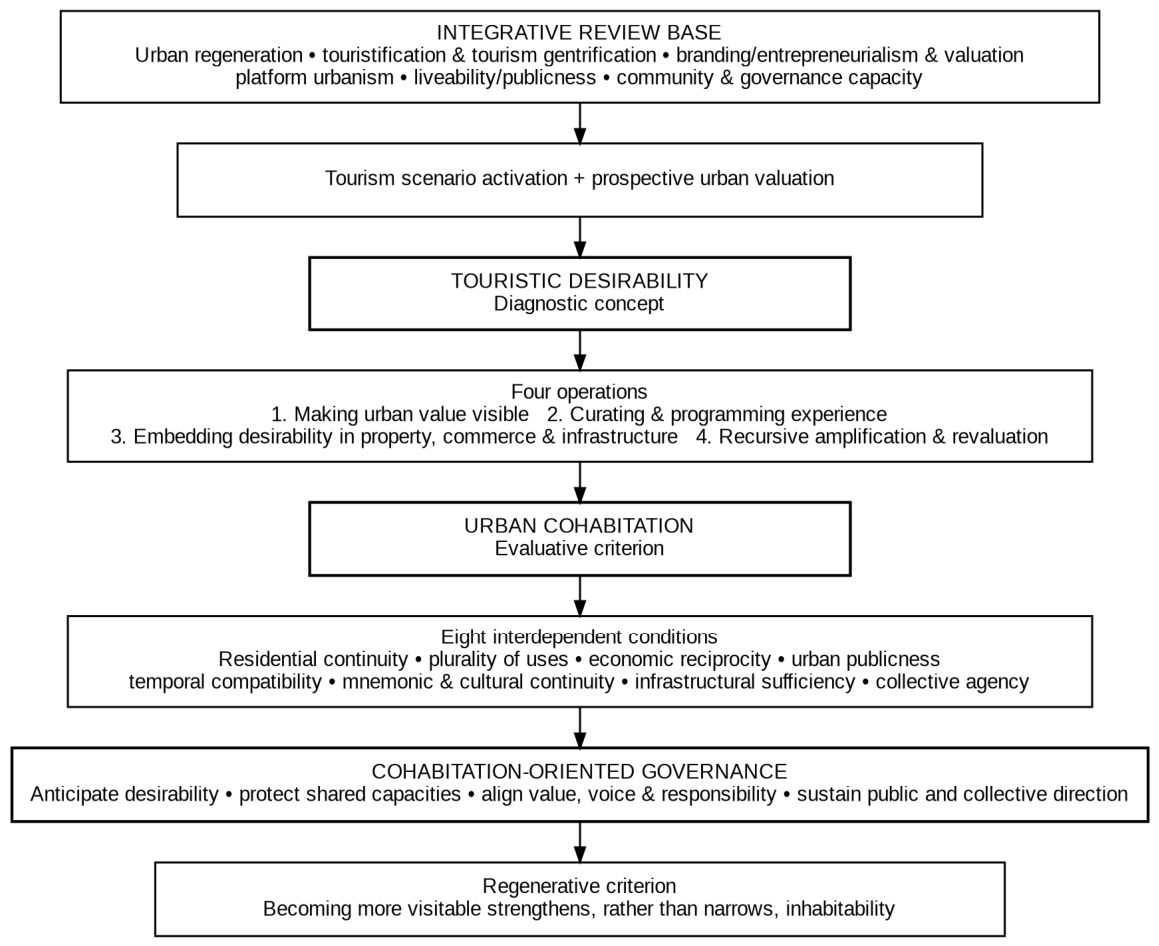
Table 1.
Literature domains and analytical role in the integrative review.
| Literature domain | Representative search-term families | Primary contribution to the review problem | Role in synthesis |
| Tourism-led urban regeneration | tourism + urban regeneration; heritage tourism + regeneration; tourism scenario activation | Promises and mechanisms of activation, adaptive reuse and spatial renewal | Establishes the regenerative starting point and the problem of selective coordination |
| Touristification and tourism gentrification | touristification; tourism gentrification; short-term rentals; displacement | Territorial reorientation, property restructuring, functional substitution and displacement | Clarifies downstream transformations and distributional consequences |
| Attractiveness, branding, entrepreneurialism and valuation | destination attractiveness; place branding; urban entrepreneurialism; speculative urbanism; real-estate valuation | Production of appeal, competitive positioning, anticipated futures and actionable value | Supports the formulation of touristic desirability as prospective urban valuation |
| Platform urbanism and digital mediation | platform urbanism; Airbnb; social media; algorithmic recommendation; destination visibility | Recursive relations among representation, ranking, transaction and urban attention | Explains amplification and feedback without treating platforms as the origin of desirability |
| Liveability, publicness and urban social sustainability | urban liveability; publicness; social sustainability; right to the city; conviviality; atmospheric justice | Material, social, experiential and political conditions of plural urban life | Provides conceptual resources for the urban cohabitation criterion |
| Community and governance capacity | community capacity; collaborative planning; anticipatory governance; urban transformation governance | Collective agency, institutional capacity, participation and redirection of change | Supports the translation from diagnosis and evaluation to governance principles |
Table 3.
Dimensions of urban cohabitation in tourism-led regeneration.
| Dimension | Core concern | Central evaluative question |
| Residential continuity | The capacity of diverse residents and workers to remain in, return to or enter the regenerated area under viable housing conditions | Does regeneration support long-term residence and everyday life, or does tourism-oriented revaluation make continued residence progressively less viable? |
| Plurality of uses | The coexistence of residential, civic, cultural, productive, commercial, recreational and visitor functions | Does the regenerated area retain a diverse urban ecology, or do visitor-oriented uses increasingly displace other functions? |
| Economic reciprocity | The circulation, retention and distribution of tourism-generated value across local economies, labour and shared urban systems | Who captures the value created through tourism, who sustains it, and how far does it reinforce locally embedded livelihoods and services? |
| Urban publicness | The capacity of public spaces to remain available for diverse, non-commercial and politically legitimate forms of urban presence | Do regenerated spaces remain genuinely public, or does accessibility become increasingly conditioned by consumption, programming, surveillance or behavioural conformity? |
| Temporal compatibility | The negotiation of visitor rhythms with residence, work, care, rest, maintenance and seasonal continuity | Can visitor-oriented rhythms remain negotiable with the temporal requirements of everyday urban life, or does one regime acquire persistent priority? |
| Mnemonic and cultural continuity | The continuing presence, livelihood viability and interpretive authority of communities, practices and institutions carrying cultural meaning | Can cultural meaning remain living, plural and renewable, and can the people who sustain it remain present and able to authorise, contest and reinterpret it? |
| Infrastructural sufficiency | The capacity, spatial distribution, maintenance and recovery of shared mobility, water, waste, energy, sanitation, digital and public-service systems under resident and visitor demand | Can shared systems absorb fluctuating tourism demand while serving everyday urban needs, distributing costs fairly and avoiding the externalisation of pressure? |
| Collective agency | The organisational, informational and institutional capacity of affected groups to shape priorities, decisions, implementation and revision | Who can define what regeneration is for, influence its conditions and redirect trajectories when cumulative pressures emerge? |
Disclaimer/Publisher’s Note: The statements, opinions and data contained in all publications are solely those of the individual author(s) and contributor(s) and not of MDPI and/or the editor(s). MDPI and/or the editor(s) disclaim responsibility for any injury to people or property resulting from any ideas, methods, instructions or products referred to in the content. |
© 2026 by the authors. Licensee MDPI, Basel, Switzerland. This article is an open access article distributed under the terms and conditions of the Creative Commons Attribution (CC BY) license (http://creativecommons.org/licenses/by/4.0/).
Copyright: This open access article is published under a Creative Commons CC BY 4.0 license, which permit the free download, distribution, and reuse, provided that the author and preprint are cited in any reuse.