

Submitted:
21 August 2026
Posted:
21 August 2026
You are already at the latest version
Abstract
Improving the efficiency of pelleted compound feed production requires optimizing process parameters while considering the use of new protein components that provide high nutritional value without compromising technological properties. The aim of the study was to optimize the parameters for producing pelleted compound feed using a feed enrichment concentrate (FEC) based on natural, multi-protein raw materials of animal origin. The study examined the effects of mixing duration, feed mixture moisture content before pelleting, and the FEC addition rate on pelleted feed quality. Process efficiency was assessed based on feed mixture homogeneity, pellet strength and crumbliness, and key chemical composition indicators. The optimal mixing duration was 9 minutes, while the most favorable moisture content before granulation was 16%, ensuring high mixture homogeneity, maximum pellet strength, and minimal crumbling. The introduction of FEC did not negatively affect production processes or the physical and mechanical properties of pelleted feed compared to the control. At the same time, FEC increased crude and digestible protein and crude fiber content while maintaining high energy value. The 20% FEC treatment was the most effective, confirming the feasibility of its industrial application.
Keywords:
feed enrichment concentrate (FEC)
; pelleted compound feed
; pelleting
; granulation
; mixing
; optimization
1. Introduction
In recent years, Kazakhstan has seen an intensification of modernization in the feed industry: new feed mills are being commissioned, production capacity is being expanded, and modern technologies for pelleting, extrusion, and precise dosing of components are being introduced. State support for the agricultural sector, as well as the growth of the livestock population, are contributing to increased demand for domestically produced complete feed [1,2].
Increasing the productivity of cattle kept on livestock farms and complexes is associated with the complete mechanization of all labor-intensive production processes, one of which is animal feeding [3]. Despite the successes achieved, the problem of increasing the nutritional value of compound feed, optimizing formulations taking into account local raw materials and the natural and climatic conditions of Kazakhstan, and reducing production costs remains pressing.
Alone from most current problems facing scientists And researchers V areas animal husbandry is security full-fledged ration cheap, high quality, rich protein fodder products. Low content squirrel V fodder diet of livestock leads To sharp decrease nutritious values feed And inflicts big harm development animal husbandry [4].
A major role is given to the use of highly efficient resource-saving technologies that can reduce the environmental impact and are also less costly for agricultural enterprises. High-quality resource provision is one of the key components of the proportional and balanced development of grain processing and livestock farms as structural elements of the meat, dairy, and grain product industries subcomplexes [5,6,7].
With the intensive development of livestock farming, one of the key tasks of the agro-industrial complex is to provide livestock with complete feed capable of satisfying their needs for energy, protein, essential amino acids, vitamins, and minerals. The quality of feed is determined not only by its formulation but also by the excellence of the production process, as these processes significantly influence the preservation of nutrients, the physical and mechanical properties of the pellets, and the efficiency of feed utilization by animals. Modern research shows that optimizing conditioning and pelleting processes is a key factor in improving the quality of feed products.
One of the priority tasks of the feed industry is to improve the efficiency of feed resource utilization while simultaneously reducing production costs. A significant portion of feed production costs is attributed to protein components, the cost of which is constantly increasing, spurring the search for alternative sources of complete protein. One promising area is the use of feed additives derived from secondary resources from the food and meat processing industries, which can increase the biological value of feed while simultaneously reducing the generation of organic waste [8,9].
Of particular interest is the use of feed enrichment concentrates (FECs) made from natural, multi-protein raw materials of animal origin. These concentrates contain processed meat products, particularly bone and blood meal, which are high in complete protein, essential amino acids, calcium, and phosphorus. The use of FECs increases the digestible protein content of compound feeds, improves their amino acid and mineral composition, and ensures more rational use of meat processing by-products in accordance with the principles of resource conservation and a circular economy [10,11].
The introduction of FECs into compound feed formulations alters the physiochemical properties of the feed mixture. Increasing the protein and mineral content impacts the moisture content, bulk density, flowability, and plasticity of the mixture, which in turn affects the efficiency of mixing, conditioning, and granulation processes. Consequently, traditional processing methods do not always produce granules with the required physicomechanical properties, necessitating scientific justification and optimization of production parameters, taking into account the characteristics of the new raw materials [12,13].
Granulation is a key step in the feed production process. During conditioning and pressing, temperature, moisture, and mechanical pressure cause structural changes in the feed mixture components, resulting in the formation of granules with high mechanical strength. However, deviations in process parameters from optimal values can lead to increased crumbling, decreased granule strength, reduced nutrient retention, and decreased productivity of granulation equipment [14]. The main factors determining the quality of the finished product are the moisture content of the mixture, conditioning temperature, processing time, FEC content, and the granulation mode.
The quality of pelleted feed directly impacts its safety during transportation and storage, animal consumption, and the efficiency of nutrient utilization. Increasing pellet strength and reducing crumbling help reduce process losses, ensure a stable feed composition, and improve its performance properties. At the same time, optimization of process conditions should ensure not only improved physical and mechanical properties of the pellets but also maximum preservation of the feed's biological value [15].
In recent years, mathematical modeling and statistical analysis methods, including Design of Experiments (DoE), Response Surface Methodology (RSM), regression analysis, and analysis of variance (ANOVA), have been widely used to optimize feed production processes. The use of these methods allows for a quantitative assessment of the influence of individual technological factors and their interactions, the determination of optimal production modes, and the production of compound feed with specified quality characteristics at minimal production costs [16,17,18].
Despite a significant number of studies devoted to improving feed pelleting technologies, the impact of FECs made from natural, multi-protein raw materials of animal origin on process parameters has been insufficiently studied. Specifically, there are no comprehensive studies to determine the optimal combination of concentrate content, mixture moisture, conditioning temperature, and pelleting mode to ensure high pellet strength, minimal crumbling, and the preservation of the feed's nutritional value. This underscores the relevance of this study, which aims to optimize the process parameters for producing pelleted feed using FECs made from natural, multi-protein raw materials.
2. Materials and Methods
2.1. Raw Materials
The research was conducted in a laboratory and production setting at a feed mill. The experiment involved producing pilot batches of pelleted feed based on FEC for dairy cows, followed by an assessment of the impact on production parameters, the physical and mechanical properties of the pellets, and the nutritional value of the finished product.
To enhance the nutritional value of compound feed, a FEC was developed based on natural multi-protein raw materials of plant and animal origin. The concentrate included plant protein components (sunflower meal, corn gluten) and animal protein components (blood and bone meal). The ratio of ingredients was selected based on crude protein content, amino acid composition, and minerals. The FEC formula is presented in Table 1.
The control feed was developed using a traditional formula and grain and mineral raw materials. A distinctive feature of the developed feed was the inclusion of a copolymer of natural, multi-protein raw materials of plant and animal origin. Soybean and sunflower meal, produced domestically (in Shymkent, Republic of Kazakhstan), were used as plant protein components. Blood and bone meal, produced at a meat processing plant in Ust-Kamenogorsk (Republic of Kazakhstan), served as animal protein sources. The combination of plant and animal protein components ensured an optimal amino acid composition and increased crude protein and mineral content, thereby improving the nutritional value of the feed.
Based on preliminary research, scientifically validated formulas for dairy cow feeds using FECs were developed. In the experimental formulas, some traditional components were replaced with FECs based on natural multi-protein raw materials at levels of 20% (variant 1) and 25% (variant 2). The grain component content was adjusted based on the concentrate addition level to ensure balanced nutritional value in the formulas. Differences between the formulas allowed us to evaluate the impact of FEC addition levels on the feed production parameters and the quality of the resulting pellets. These parameters were used as process optimization criteria. The FEC-based feed recipe is presented in Table 2.
All raw materials complied with current feed safety and quality regulations. Before use, raw materials underwent incoming inspection, including determination of organoleptic properties, moisture content, crude protein content, and the absence of foreign impurities.
2.2. Production of Pilot Batches of Compound Feed
Pilot batches of compound feed were produced in laboratory and production conditions using a KZM-500 compound feed mill designed for compound feed production. The process line included a receiving bin, a hammer mill, a component dosing system, a vertical mixer, conveyor augers, and a device for unloading the finished feed mixture.
Before the start of the production process, all components underwent visual quality control and were weighed according to the developed recipes. The grain raw materials (bran, corn, and barley) were ground in a hammer mill to a particle size of 0.5–1.0 mm , ensuring uniform mixing of the components and subsequent high-quality granulation. After grinding, the raw materials were transferred to a storage bin, from where they were fed into the mixer.
The components were dosed according to the feed formula. In the experimental variants, some of the grain was replaced with FEC at levels of 20% and 25% of the feed weight. The control variant was prepared without the addition of the concentrate.
To assess the impact of mixing duration on feed mixture homogeneity in the SM500RE horizontal mixer, a control feed mixture and experimental variants with 20 and 25% FEC were tested. Mixing durations were 3, 5, 7, 9, and 12 minutes. After mixing, samples were taken from various zones of the mixer to determine the homogeneity coefficient.
The homogeneity of the feed mixture was ensured by continuous mixing of the components, which facilitated uniform distribution of the FEC throughout the mixture. After mixing was complete, the feed mixture's moisture content was determined and, if necessary, adjusted to the target level of 14–18% by adding water in measured doses. The prepared mixture was then sent for pelleting.
Feed pelleting. Pelleting was performed on a ZLSP-120 pellet mill with a flat die with a diameter of 120 mm and a hole diameter of 5 mm . Pellet formation was achieved by pressing rollers, which forced the feed mixture through the die openings. During the study, the stability of the feed feed, the uniformity of pellet formation, and the equipment performance were monitored. The resulting pellets were cylindrical and had uniform geometric dimensions, meeting the requirements for cattle feed.
After exiting the pellet mill, the pellets were cooled naturally to ambient temperature, which stabilized the pellet structure, reduced residual moisture, and increased mechanical strength. The feed was then left to rest for 24 hours to complete the structure formation and redistribute moisture within the pellets.
All experimental feed variants were produced in three independent replicates under identical process conditions. After feed stabilization, average samples were collected using the quartering method to determine physical, mechanical, and chemical quality parameters, including moisture, pellet strength and crumbliness, as well as crude protein, fat, fiber, and ash content.
Experimental Design
Optimization of the technological parameters of compound feed production was carried out by successively changing individual technological factors while keeping the remaining process conditions unchanged.
The influence of the following factors was studied:
- FEC content - 20 and 25% ;
- moisture content of the feed mixture before granulation - 14, 16 and 18% ;
- mixing time – 3.5, 7, 9 and 12 min .
A separate experimental batch of compound feed was prepared for each variant. All studies were conducted in triplicate .
2.3. Determination of Feed Quality Indicators
After producing pilot batches of compound feed, the finished product's technological, physical, mechanical, and physical quality parameters were assessed. For laboratory testing, an average sample weighing at least 1 kg was taken from each batch by successively dividing the original sample until the required amount of material was obtained. The resulting sample was thoroughly mixed and used for subsequent analysis.
The mass fraction of moisture was determined by drying the sample to a constant mass in a drying oven in accordance with the requirements of GOST ISO 6496–2015 "Feed. Determination of moisture and other volatile matter content" [19].
The mass fraction of crude protein, crude fat, crude fiber and crude ash was determined by near infrared spectroscopy (NIR spectroscopy) in accordance with the requirements of GOST 32040–2012 “Feed, compound feed. Method for determining chemical composition by near infrared spectroscopy” [20].
To evaluate the technological properties of the compound feed, granule friability was determined in accordance with GOST 28497–2014 [21]. Tests were conducted after cooling the granules to ambient temperature. Friability was determined by mechanically shaking the granules, followed by separation of the resulting small particles by sifting. The result was expressed as a percentage of granules destroyed relative to the initial sample mass.
The bulk density and angle of repose were determined in accordance with the requirements of GOST 28254–2014 “Compound feed, compound feed raw materials. Methods for determining the bulk density and angle of repose” [22].
The organoleptic evaluation of the compound feed was conducted based on the appearance, color, odor, and integrity of the pellets. The finished product was required to have a uniform structure, cylindrical pellets, a characteristic odor, and no signs of mold, rancidity , or foreign matter.
All experimental studies were performed in three independent replicates . The results were processed using variation statistics and presented as the arithmetic mean and standard deviation ( Mean ± SD ). The significance of differences between the mean values of the experimental and control variants was assessed at a statistical significance level of p < 0.05 , which made it possible to determine the influence of the studied technological factors on the quality indicators of pelleted compound feed.
3. Results
3.1. Chemical Composition of Raw Materials Used in the Production of Compound Feed
Locally available components were used for the experiment. These included grain crops and a FEC based on natural multi-protein raw materials of plant and animal origin.
To develop pilot batches of compound feed and optimize production processes, components were prepared according to the recipe. Average samples of the raw materials were collected, their organoleptic properties were determined, and the quality indicators of the components used in developing the compound feed recipes were determined . The results are presented in Table 3.
One of the most important and widely recognized indicators of feed quality is the amount of crude protein it contains. Protein deficiency leads to slower or cessation of growth, reduced or worsened productivity, poor health, and decreased absorption of certain nutrients. Of the protein components , bone meal and blood meal are the most valuable for animals . These raw materials are characterized by high protein content.
An analysis of the physical and chemical composition of the components used in the development of compound feed recipes in Table 1 showed significant differences in the content of essential nutrients, which determines their functional role in forming the nutritional value of the finished compound feed.
The highest content of crude protein was found in FEC - 23.67% , which is 1.6 times higher than in wheat bran 14.46%, almost 2 times higher than in barley 12.22%, and more than 2.8 times higher than the protein content in corn 8.32%.
The obtained results confirm the feasibility of using FEC as a high-protein component of compound feed to increase their nutritional value.
Wheat bran was characterized by a relatively high crude fiber content of 9.62% and crude fat of 4.64% , which improved the structure of the feed mixture and provided animals with additional energy sources. Corn had the highest content of nitrogen-free extractive substances (76.07%) , serving as the main source of easily digestible carbohydrates and metabolizable energy.
Barley contained 12.22% crude protein and 4.33% crude fiber, providing an optimal balance of energy and protein value in the feed. The grain mixture had an average chemical composition and was used as the base component of the formula.
Of particular note is the low moisture content of FEC (9.0%) , which is significantly lower than that of grain components (12.06–16.08%) . This contributes to increased raw material stability, improved shelf life, and a reduced risk of microbiological development.
In terms of crude fat content, the FEC (3.22%) was inferior to wheat bran (4.64%) and corn (4.51% ), but exceeded barley (2.01%) and grain mixture (1.04%) . The crude fiber content in the concentrate was 3.48 % , indicating good digestibility of this component and its suitability for use in complete feed for cattle.
Thus, the study results indicate that FEC has the highest protein value among the components studied, with a relatively low moisture content and moderate fat and fiber content. This allows it to be considered an effective ingredient for partially replacing traditional protein components in compound feed formulations, providing an increase in protein content without compromising the feed mixture's technological properties.
3.2. The Influence of the Content of Feed Enrichment Concentrate on the Technological Properties of the Feed Mixture
20% and 25% FEC were used as experimental variants , while the control variant was produced without the addition of concentrate. Particular attention was paid to characteristics such as the angle of repose, bulk density, flowability, and feed stability into the pelletizer.
The results of the study showed that the introduction of FEC changed the structural and mechanical properties of the feed mixture, but the nature of these changes depended on the amount of the introduced feed enrichment concentrate (Table 4).
Analysis of the obtained data in Table 4 showed that the introduction of FEC in quantities of 20 and 25% has different effects on the physical and mechanical properties of the feed mixture compared to the control variant.
The bulk density of the control feed mixture was 550 kg/ m3 , at the introduction of 20% FEC this indicator decreased slightly to 458 kg/ m3 This change is within the experimental error and indicates that the introduction of 20% FEC had virtually no effect on the density of the feed mixture.
When introducing 25% FEC, the bulk density increased to 554 kg/m3 , which is 6 kg/m3 higher than the control variant and 8 kg/m3 higher than variant 1. The increase in bulk density can be explained by the higher density of the protein components of FEC.
The addition of FEC to the compound feed affected the angle of repose. In the control variant, this value was 33 ° , while in variant 1, the angle of repose increased to 35 ° , which is 2 ° higher than the control variant and was statistically significantly higher than the control (p < 0.05 ). Despite this increase, the feed mixture retained good technological properties and moved freely through the conveying devices.
When introducing 25% of the FEC, the angle of natural slope was 42 0 , which is 9 0 exceeds the control variant and is 70 % higher than variant 1. The obtained results indicate an increase in the internal friction forces between the mixture particles and a decrease in their mobility, which is typical for a composition with a high content of finely dispersed protein components. The nature of the change in the angle of repose is confirmed by the results of assessing the flowability of the feed mixture. The control variant is characterized by high flowability, similar to variant 1, which indicates the absence of a negative effect of this dosage of feed enrichment concentrate on the transportability of the mixture. However, with the introduction of 25% FEC, the flowability decreased to satisfactory, which is associated with an increase in contact interaction between the mixture particles. Despite the decrease in particle mobility, the mixture retained the ability to be uniformly fed into the granulator, which ensured a stable granulation process.
3.3. Influence of Mixing Duration on the Homogeneity of the Feed Mixture
A study of the effect of mixing duration on the homogeneity of a compound feed mixture showed that increasing the mixing time from 3 to 9 minutes promoted a more uniform distribution of components in all experimental variants (Figure 1). Moreover, the pattern of change in this indicator was virtually identical for all studied formulations, indicating similar component distribution dynamics during mechanical mixing.
The lowest homogeneity values were recorded with a mixing duration of 3 minutes. In the control variant, the indicator was 84.6%, while in variant 1 it was 85.0%. and in variant 2—85.1%. These values indicate that the specified time is insufficient for the complete distribution of the feed mixture components. During this period, localized areas with varying concentrations of individual ingredients remain in the mixture, resulting in uneven nutrient content in the finished product.
Increasing the mixing time to 5 minutes resulted in a significant increase in homogeneity. In the control variant, the homogeneity reached 88.9%, in variant 1, 89.3%, and in variant 2, 88.8%.
With a mixing time of 7 minutes, the formation of a homogeneous structure was almost complete. Homogeneity reached 93.3% in the control variant, 93.1% in variant 1, and 92.7% in option 2.
The maximum values of the studied parameter were obtained with 9 minutes of mixing. The homogeneity of the compound feed mixture was 94.8% in the control variant, 94.7% in variant 1, and 93.9% in variant 2. Moreover, the differences between the control and experimental variants did not exceed 0.9%, which indicates the absence of a negative effect of the introduction of the feed enrichment concentrate on the efficiency of the mixing process. A further increase in the mixing duration to 12 minutes did not provide an additional increase in homogeneity. A slight decrease in the parameter was observed in all variants. In the control variant, homogeneity decreased to 94.2, in variant 1 - 94.3%, in variant 2 - 93.6%. Despite the small magnitude of changes, this trend confirms that excessive mixing time does not improve the quality of the compound feed and can contribute to the occurrence of partial stratification of the mixture due to differences in the physical properties of individual components.
3.4. The Influence of Feed Mixture Moisture on the Granulation Process
The results of the studies shown in Figure 2 and Figure 3 showed that the moisture content of the feed mixture before pelleting has a significant impact on the strength and crumbliness of the compound feed pellets. In all studied variants, increasing the moisture content of the mixture from 14 to 16% improved pellet quality, while further increasing the moisture content to 18% resulted in a slight deterioration in the studied parameters.
Analysis of granule strength data showed that in the control variant, at 14% moisture content, the strength was 89.4%. Increasing the moisture content to 16% resulted in an increase in strength to 95.8%, indicating improved granule formation conditions and increased interparticle bond strength. At 18% moisture content, the strength decreased to 93.2%, but remained above the level obtained at 14% moisture content.
In Variant 1, with the addition of 20% FEC, the granule strength was 90.1%, 97.2%, and 95.0% at 14% moisture content, respectively. The maximum value was obtained at 16% moisture content, which was 1.4% higher than the control variant. In Variant 2, with the addition of 25% FEC, the granule strength was 90.8%, 96.5%, and 94.5%.
In the control variant, with a feed mixture moisture content of 14%, crumbling was 8 %. Increasing the moisture content to 16% contributed to a decrease in this indicator to 4.2%, which indicates an improvement in conditions . Granule formation and increasing the strength of interparticle bonds. With a further increase in moisture content to 18%, friability increases to 5.8%. In variant 1 with the introduction of 20% FEC, the friability of granules at a moisture content of 14% was 8.1 %. The lowest value of this indicator was obtained at a moisture content of 16% - 3.6%. Compared to the samples with a moisture content of 14%, friability decreased by 55.6%, which indicates a significant improvement in the quality of the granules. At a moisture content of 18%, the indicator increased to 5.2%. In variant 2 with the introduction of 25% FEC at a moisture content of 14% was 7.8 %, and at a moisture content of 16% it decreased to 4%, and at a moisture content of 18% it increased to 6.1%. Despite the increase in friability at a moisture content of 18%, the obtained values remained comparable with the control variant.
A comparative analysis revealed that the best results were achieved in Variant 1, which included 20% FEC. With a feed mixture moisture content of 16%, this variant was characterized by minimal granule friability of 3.6 %, compared to - 4.2% in the control variant and - 4.2% in Variant 2. The obtained data indicate that the addition of 20% FEC, combined with a feed mixture moisture content of 16%, ensures the production of high-quality pellets with minimal losses due to friability. The results were processed using the analysis of variation statistics. The figures show mean values and standard deviations. The significance of differences between variants was assessed at a significance level of p ≤ 0.05.
3.5. The Influence of Feed Enrichment Concentrate on the Quality of Pellets Digestible Protein Content
The data obtained in Table 5 indicate that the crude protein content in the control variant was 17.5%, while in the variants with 20 and 25% FEC it increased to 19.1 and 20.5%. Relative increase in protein compared to the control was 9.1% for variant 1 and 17.7% for variant 2. The increase in protein value is associated with the high content of protein components in the FEC. The crude fat content was within 3.06-3.50%. A slight decrease in this indicator in the experimental variants did not have a negative impact on the energy value of the compound feed. The amount of crude fiber increased from 6.29 in the control variant to 7.18 and 7.43%. The increase in the indicator was 14.1 and 18.1%.
The content of nitrogen-free extractive substances decreased consistently with the increase in the proportion of FEC in the recipe. In the control variant of the compound feed, this indicator was 61.21%, while in the experimental variants it decreased to 56.56 and 55.45%. The decrease in nitrogen-free extractive substances is explained by the replacement of some grain components with high-protein concentrates. However, this change was not accompanied by a decrease in the energy value of the feed, which is confirmed by the indicators of feed units. The ash content increased from 5.59% in the control variant to 5.66 and 5.79% in the experimental variants. Digestible protein in the control variant was 124.27 g per feed unit. With the introduction of 20% FEC, this indicator increased to 133.72 g, and at 25% FEC - 146.03 g. The feed unit indicator also tended to increase. In the control variant, it was 1.22 kg, but in the experimental variants it reached 1.23 and 1.24 kg . This indicates the preservation of the high energy value of the feed while simultaneously increasing the content of protein and minerals.
4. Discussion
The results of the studies showed that the quality of pelleted compound feed is determined by the complex influence of the mixing duration, the moisture content of the feed mixture and the pelleting conditions. It was found that with an increase in the mixing time from 3 to 9 minutes, the homogeneity of the feed mixture increased from 84.6–85.1 to 93.9–94.8 % , indicating a more uniform distribution of the components throughout the volume of the mixture. However, a further increase in the mixing duration to 12 minutes did not provide an additional improvement in the indicator and was accompanied by a slight decrease to 93.6–94.3%. This pattern is explained by the occurrence of secondary segregation processes, when particles of different densities and sizes begin to separate again under the action of mechanical loads [22]. In studies by Groesbeck which established that the optimal mixing time for multi-component feed mixtures is 8-10 minutes and ensures maximum homogeneity. Similar conclusions are presented in the work of Fairfield [23], where it is shown that a further increase in the mixing time does not lead to a significant improvement in the quality of the mixture, but increases the energy costs of production. High homogeneity of the feed mixture is important for the subsequent granulation process. According to Thomas and van der Poel uniform distribution of components ensures the same density of the feed mass in the granulator matrix, promotes the formation of granules of the same structure and reduces the amount of small fraction in the finished product [24].
One of the most significant factors in pellet quality is the moisture content of the feed mixture before pelleting. The studies examined the effects of moisture levels of 14, 16, and 18%. In the control sample, pellet strength increased from 89.4% at 14% moisture to 95.8% at 16 % moisture. Afterwards, with an increase in moisture content to 18%, it decreased to 93.2%. A similar pattern was observed in the experimental variants with the introduction of FEC. In variant 1, the granule strength reached a maximum of 97.2%, while in variant 2 it reached 96.5%. The obtained results indicate that a moisture content of 16% provides the most favorable conditions for the formation of strong interparticle bonds and increased structural integrity of the granules.
The observed increase in granule strength in the samples with FEC may be due to the high content of protein components in the concentrate. It is known that during the granulation process, under the influence of pressure and temperature, partial denaturation of proteins, which are capable of acting as a natural binder, occurs. Similar mechanisms were described by Abdollahi [26], who noted the positive effect of protein components on the physical quality of the granules and their resistance to mechanical stress. The effect of humidity on the friability of the granules was particularly noticeable. In the control variant, friability decreased from 8% at a humidity of 14% to 4.2% at a humidity of 16%, indicating a significant improvement in the quality of granulation. At a humidity of up to 18%, the indicator increased to 5.8%. A similar trend was observed in the experimental variants. The minimum friability was recorded in the variant with 20% FEC at a humidity of 16% and amounted to 3.6%, which is 55.6 lower compared to the other variants . In the variant with 25% FEC, the minimum crumbling value was 4.0%, while at 18% moisture, this figure increased to 6.1%. The obtained results are fully consistent with the Chevanan studies. which established that the optimal moisture level ensures maximum pellet durability and minimal fine particle formation. The authors showed that a lack of moisture leads to insufficient particle deformation during pressing, while an excess of moisture worsens the stability of the formed structure after cooling the pellets [27]. The obtained results are consistent with the findings of Behnke , according to whom the quality of pellets is determined not only by the pelleting parameters, but also by the feed formulation [28].
The authors note that protein components are capable of improving the physical structure of granules, but their excessive content can change the rheological properties of the feed mass and reduce the efficiency of pressing [29].
Additional confirmation of the positive effect of FEC on the quality of compound feed is provided by the results of a study of its chemical composition. It was established that the introduction of FEC contributed to an increase in the content of essential nutrients while maintaining the high energy value of the compound feed. The crude protein content in the control variant was 17.5%, while in the experimental variants this indicator increased to 19.1 and 20.5%. The relative increase in protein compared to the control was 9.1 and 17.1%. The obtained results indicate the high efficiency of using FEC as a source of complete protein. Similar data are presented by Stein and Shurson [30], who note that the use of alternative protein components allows for a significant increase in the protein concentration in compound feed without reducing its technological characteristics. According to Khan [31,32], an increase in protein content contributes to a more efficient use of nutrients and an increase in animal productivity.
Of particular importance is the digestible protein index, which characterizes the biological value of feed. In compound feeds supplemented with a fortifying concentrate, digestible protein increased from 124.27 g per feed unit in the control to 133.72 and 146.03 g in the experimental samples. According to NRC recommendations [33], digestible protein content is one of the most important criteria for assessing the adequacy of dairy cattle diets. An increase in this index indicates improved availability of the amino acids necessary for milk protein synthesis and maintaining high productivity.
The crude fat content in the studied samples ranged from 3.06 to 3.50%. Despite a slight decrease in this indicator in the experimental variants, the energy value of the compound feed remained high. This is consistent with the data of Palmquist and Jenkins , according to which minor changes in fat content do not have a significant impact on the energy supply of diets while maintaining the overall nutrient balance [33,34].
The introduction of FEC also contributed to an increase in crude fiber content. In the control variant, the crude fiber content was 6.29 % , while in the experimental variants it was 7.18% and 7.43%, which is 14.1% and 18.1% higher, respectively, than the control variant. According to Van According to Soest and other authors, fiber plays an important role in maintaining normal rumen function, providing optimal conditions for the development of microflora and fermentation processes. Therefore, increasing fiber content within physiological limits can positively influence the digestive processes of dairy cows [35,36].
Thus, the obtained results indicate that the introduction of FEC has a comprehensive positive effect on both the technological properties of the compound feed and its nutritional value. The most effective variant was the one with 20% FEC, providing an optimal combination of high pellet strength, minimal crumbling, and an improved chemical composition. These results confirm the feasibility of using FEC in industrial feed production for dairy cows and are consistent with current trends in improving feed production efficiency through the use of alternative protein sources.
5. Conclusions
The quality of pelleted compound feed is determined by the complex influence of production parameters, the main ones being the duration of mixing of the components, the moisture content of the feed mixture before pelleting, and the level of FEC addition. The optimal mixing duration was 9 minutes, which ensured high homogeneity of the feed mixture without secondary segregation.
It has been established that the most favorable conditions for pellet formation are achieved with a feed mixture moisture content of 16%. This regime ensures maximum pellet strength and minimum crumbling (3.6–4.0%), whereas a decrease or increase in moisture content leads to a deterioration in the physical and mechanical properties of the finished product.
It was shown that the introduction of FECs into the compound feed formula does not negatively impact the technological processes of pelleted compound feed production. Furthermore, the use of FECs increased the crude and digestible protein content, as well as the crude fiber content, without reducing the energy value of the compound feed. These results demonstrate the feasibility of using FECs in compound feed for dairy cows without degrading the technological characteristics of production while simultaneously enhancing its nutritional value.
6. Patents
Patent for Utility Model No. 12202, “Method for Producing Compound Feed.”
Author Contributions
Conceptualization, Zh.A. and A.А.; methodology, M.B., Zh.A., and A.A.; software, M.B., and A.A..; Validation, Zh.A. and A.A.; formal analysis, Zh.A., K.Sh. and K.F.; Investigation, M.B., A.A., and Zh.A.; Data Curation, K.Sh. and K.F.; writing-original draft preparation, A.A., Zh.A. and M.B.; writing-review and editing, A.A., K.Sh. and K.F.; visualisation, M.B. and K.Sh.; supervision, Zh.A. and A.A.; project administration, Zh.A. All authors have read and agreed to the published version of the manuscript.
Funding
This research was funded by the Ministry of Agriculture of the Republic of Kazakhstan No. BP24892775 Developing technology for deep processing of agricultural raw materials to ensure high-quality, safefood production.
Data Availability Statement
The original contributions presented in the study are included in the article; further inquiries can be directed to the corresponding author.
Conflicts of Interest
The authors declare no conflicts of interest.
Abbreviations
The following abbreviations are used in this manuscript:
| FEC | Feed enrichment concentrate |
| NFE | Nitrogen-free extractives |
References
- Daribaeva, E.B.; Maidankyzy, B.; Kerimova, U.K. Livestock Sector of the Republic of Kazakhstan: Realities and Internal Reserves. Probl. AgriMarket 2021, 2, 152–160. [Google Scholar] [CrossRef]
- Dzhanov, R.A. Opportunities for the Development of Livestock Farming in Kazakhstan. MNIЖ in Russian. 2014, 8–2 (27. [Google Scholar]
- Shulga, L.V.; Starovoitov, D.P.; Lantsov, A.V. Influence of Different Methods of Keeping Cows on the Duration of Productive Use. Actual Probl. Intensive Dev. Anim. Husb. in Russian. 2015, 18(1), 210–216. [Google Scholar]
- Asqarov, I.; Djamolov, K.; Yulchiev, A.; Khamidova, M. Enrichment of a Balanced Feed Composition through the Rational Use of Food Industry Waste. Univers. Chem. Biol. 2022, 5-3(95), 37–41. [Google Scholar] [CrossRef]
- Amantayeva, A.; Batyrbayeva, N.B.; Alimkulov, Zh.S. Use of By-Products of Non-Traditional Oilseeds in the Production of Compound Feed. J. Almaty Technol. Univ. 2025, 147(1), 123–130. [Google Scholar] [CrossRef]
- Mizanbekova, S.K.; Tireuov, K.M.; Aitmukhanbetova, D.A. Compound Feed Industry of the Republic of Kazakhstan: Modernization Trends. Probl. AgriMarket in Russian. 2022, 4, 104–111. [Google Scholar] [CrossRef]
- Alimkulov, Zh.S.; Zhiyenbayeva, S.T. Kazakhstan Strengthens Its Feed Base. Kombikorma in Russian. 2012, 4, 21–22. [Google Scholar]
- Thomas, M.; van der Poel, A.F.B. Fundamental Factors in Feed Manufacturing: Towards a Unifying Conditioning/Pelleting Framework. Anim. Feed Sci. Technol. 2020, 268, 114612. [Google Scholar] [CrossRef]
- Bektursunova, M.; Sidorova, V.; Zhiyenbayeva, S.; Mukhramova, A.; Assylbekova, S. Technology for the Production of Extruded Starter Feed for Juvenile Fish. Sci. Horiz. 2024, 27(9), 42–53. [Google Scholar] [CrossRef]
- Thomas, M.; van Vliet, T.; van der Poel, A.F.B. Physical Quality of Pelleted Animal Feed. 3. Contribution of Feedstuff Components. Anim. Feed Sci. Technol. 1998, 70(1–2), 59–78. [Google Scholar] [CrossRef]
- Thomas, M.; van der Poel, A.F.B. Physical Quality of Pelleted Animal Feed. 1. Criteria for Pellet Quality. Anim. Feed Sci. Technol. 1996, 61(1–4), 89–112. [Google Scholar] [CrossRef]
- Briggs, J.L.; Maier, D.E.; Watkins, B.A.; Behnke, K.C. Effect of Ingredients and Processing Parameters on Pellet Quality. Poult. Sci. 1999, 78(10), 1464–1471. [Google Scholar] [CrossRef]
- Loar, R.E.; Corzo, A. Effects of Feed Formulation on Feed Manufacturing and Pellet Quality Characteristics of Poultry Diets. World's Poult. Sci. J. 2011, 67(1), 19–34. [Google Scholar] [CrossRef]
- Amantayeva, Zh.; Alimkulov, N.; Batyrbayeva, E.; Mrkvicová, M.; Bektursunova, M.; Shayliyeva, K.; Fazulova, K. Mathematical Modeling and Optimization of the Granulation Process of Biomass-Based Products with Potential Applications in the Feed and Food Industries. Scifood 2025, 19(1), 412–425. [Google Scholar] [CrossRef]
- Dos Santos, R.O.F.; Bassi, L.S.; Schramm, V.G.; da Rocha, C.; Dahlke, F.; Krabbe, E.L. Effect of Conditioning Temperature and Retention Time on Pellet Quality, Ileal Digestibility and Growth Performance of Broiler Chickens. Livest. Sci. 2020, 240, 104110. [Google Scholar] [CrossRef]
- Muramatsu, K.; Massuquetto, A.; Dahlke, F.; Maiorka, A. Factors That Affect Pellet Quality: A Review. J. Agric. Sci. Technol. A 2015, 5, 717–722. [Google Scholar] [CrossRef]
- Nielsen, S.K.; Mando, M.; Rosenørn, A.B. Review of Die Design and Process Parameters in the Biomass Pelleting Process. Powder Technol. 2020, 364, 971–985. [Google Scholar] [CrossRef]
- Bektursunova, M.; Sidorova, V.; Zhiyenbayeva, S.; Mashentseva, N.; Assylbekova, S. Effect of Extrusion Process Parameters on Pellet Crumbliness in Fish Feed Production. Potravin. Slovak J. Food Sci. 2023, 17, 594–605. [Google Scholar] [CrossRef]
- GOST ISO 6496–2015; Feeds. Determination of Moisture and Other Volatile Matter Content. in Russian.
- GOST 32040–2012; Feeds and Compound Feeds. Method for Determination of Chemical Composition by Near-Infrared Spectroscopy. in Russian.
- GOST 28497–2014; Feeds and Compound Feeds. Method for Determination of Pellet Crumbliness. in Russian.
- Groesbeck, C.N.; McKinney, L.J.; DeRouchey, J.M. Effect of Mixing Time on Feed Uniformity. J. Anim. Sci. 2007, 85, 123–128. [Google Scholar]
- Fairfield, D.A.; Behnke, K.C.; Moritz, J.S. Feed Manufacturing Practices and Feed Quality. Feedstuffs 2014, 86(12), 18–23. [Google Scholar]
- Thomas, M.; van der Poel, A.F.B. Fundamental Factors in Feed Manufacturing: Towards a Unifying Conditioning/Pelleting Framework. Anim. Feed Sci. Technol. 2020, 268, 114612. [Google Scholar] [CrossRef]
- Abdollahi, M.R.; Ravindran, V.; Svihus, B. Pelleting of Broiler Diets: An Overview with Emphasis on Pellet Quality and Nutritional Value. Anim. Feed Sci. Technol. 2013, 179, 1–23. [Google Scholar] [CrossRef]
- Chevanan, N.; Muthukumarappan, K.; Rosentrater, K.A. Effect of Moisture Content on Pellet Durability of Feed Materials. Biosyst. Eng. 2010, 107(3), 266–271. [Google Scholar]
- Behnke, K.C. Factors Affecting Pellet Quality. Feed Technol. 2001, 5(4), 19–22. [Google Scholar]
- Fahrenholz, A.C. Ingredient Composition and Feed Manufacturing Efficiency. Feedstuffs 2012, 84(15), 12–16. [Google Scholar]
- Bergeron, A.N.; Stark, C.R.; Boney, J.W.; et al. The Feed Milling Process: A Focus on the Pelleting, Liquid Application, and Their Effects on Animal Production. J. Appl. Poult. Res. 2026, 35, 100705. [Google Scholar] [CrossRef]
- Stein, H.H.; Shurson, G.C. Board-Invited Review: The Use and Application of Feed Ingredients in Animal Diets. J. Anim. Sci. 2009, 87(4), 1292–1303. [Google Scholar]
- Khan, N.A.; Yu, P.; Ali, M.; et al. Nutritional Evaluation of Protein Sources for Dairy Cattle. Anim. Feed Sci. Technol. 2015, 210, 1–12. [Google Scholar]
- National Research Council. Nutrient Requirements of Dairy Cattle, 8th ed.; National Academies Press: Washington, DC, USA, 2021; p. 405 pp. [Google Scholar]
- Palmquist, D.L.; Jenkins, T.C. Fat in Lactation Rations: Review. J. Dairy Sci. 1980, 63(1), 1–14. [Google Scholar] [CrossRef]
- Masey O'Neill, H.V.; Phillips, S.M. Alternative Protein Sources in Animal Nutrition. Feed Compd. 2016, 36(2), 22–28. [Google Scholar]
- Tedeschi, L.O.; Fox, D.G. Predicting Milk Production from Nutrient Supply in Dairy Cattle. J. Dairy Sci. 2018, 101(6), 5132–5145. [Google Scholar] [CrossRef]
- Kalashnikov, A.P.; Fisinin, V.I.; Shcheglov, V.V.; Kleymenov, N.I. Nutrient Requirements and Feeding Rations for Farm Animals; 456 pp. [in Russian]; Rosselkhozakademiya: Moscow, Russia, 2003. [Google Scholar]
Figure 1.
Effect of mixing duration on homogeneity feed mixture.
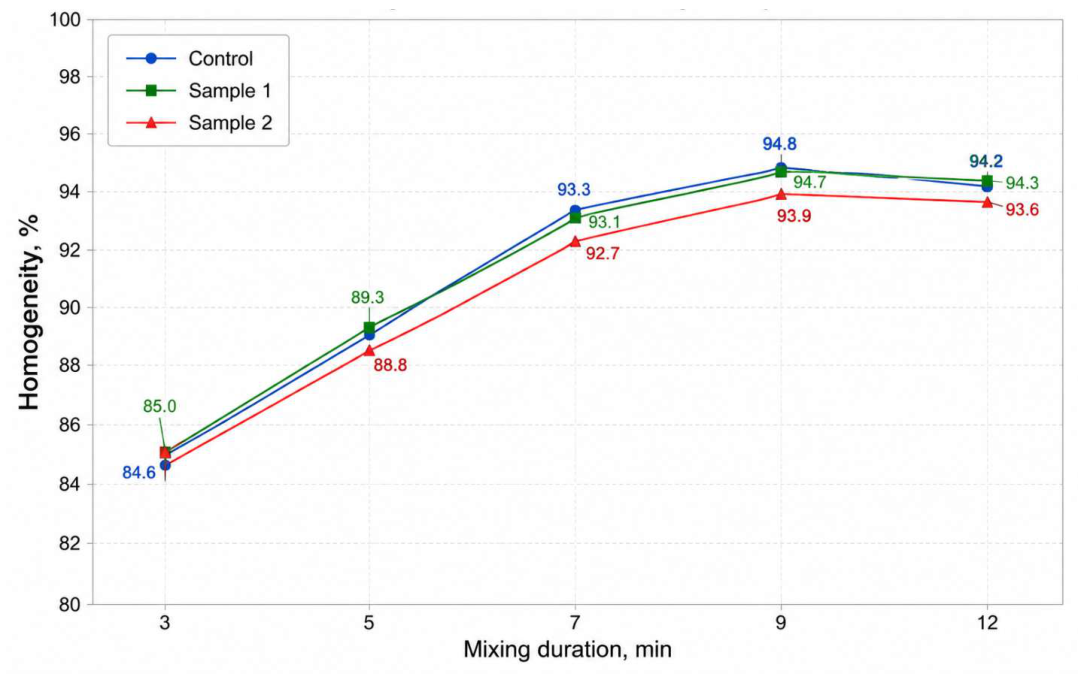
Figure 2.
Effect of humidity on the strength of pellets with the introduction of feed enrichment concentrate.
Figure 2.
Effect of humidity on the strength of pellets with the introduction of feed enrichment concentrate.
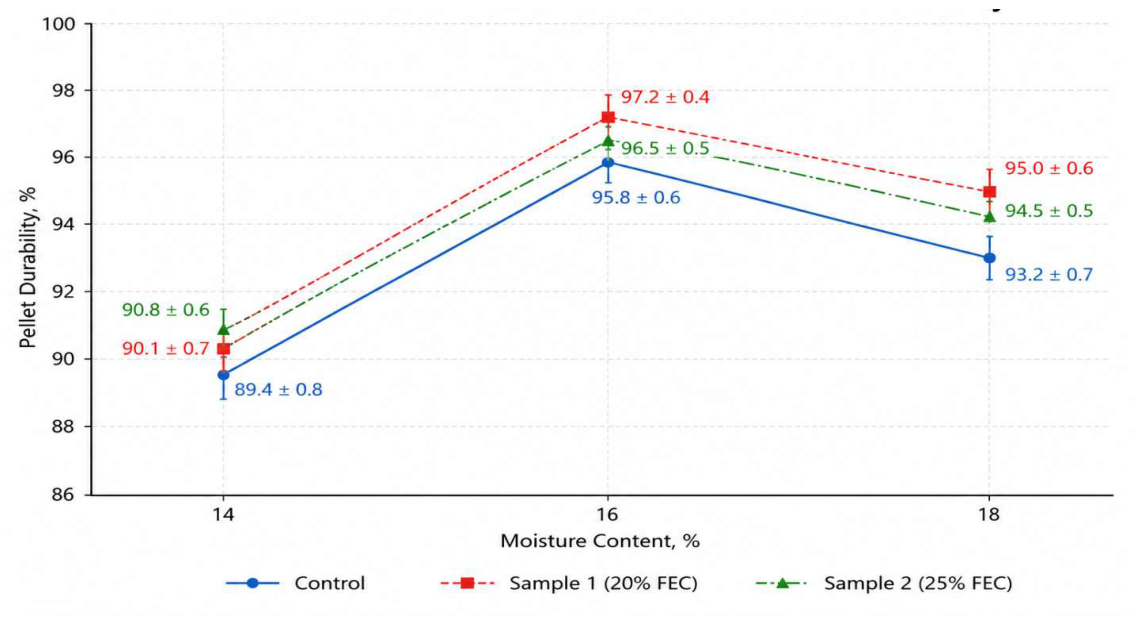
Figure 3.
Effect of humidity on granule crumbliness with the addition of feed enrichment concentrate.
Figure 3.
Effect of humidity on granule crumbliness with the addition of feed enrichment concentrate.
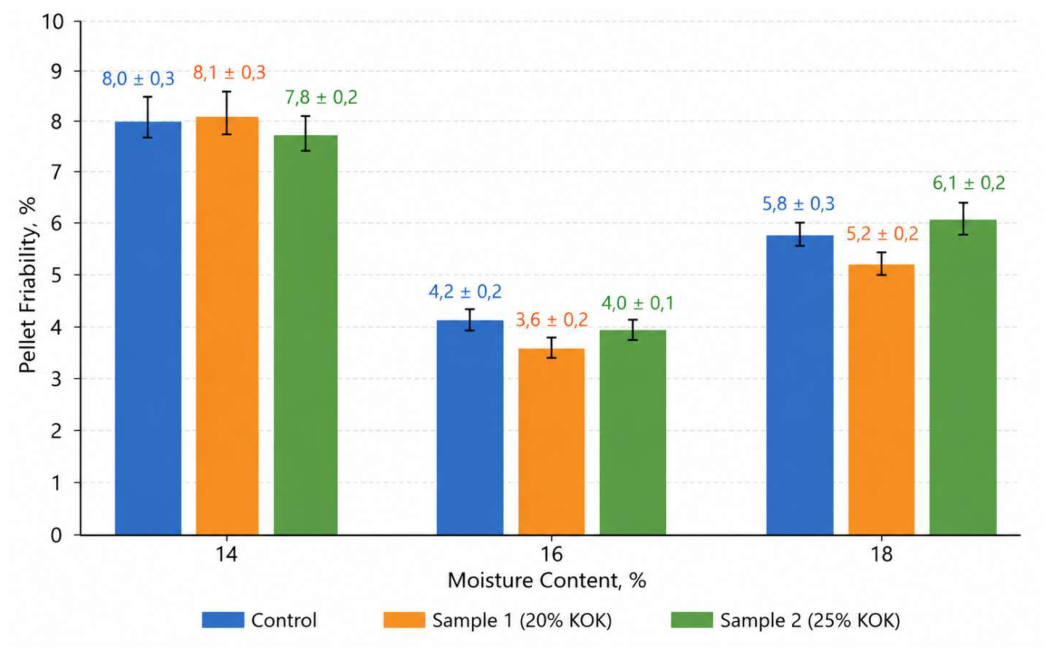

Table 1.
Recipe for feed enrichment concentrate.
| Name of components, % | Quantity |
|---|---|
| Crushed corn | 16.0 |
| Corn gluten | 12.0 |
| Soybean meal | 21.0 |
| Wheat bran | 31.0 |
| Blood meal | 7.0 |
| Bone meal | 5.0 |
| Tricalcium phosphate | 3.0 |
| Chalk | 3.0 |
| Salt | 2.0 |
| Total | 100.0 |
Table 2.
Recipe for compound feed based on FEC.
| Name components | Quantity | |||
|---|---|---|---|---|
| Control sample | Sample 1 | Sample 2 | ||
| Corn | 30 | 30.0 | 35.0 | |
| Barley | 30 | 10.0 | 10.0 | |
| Wheat | 10 | 10.0 | 10.0 | |
| Wheat bran | 25 | 20.0 | 20.0 | |
| Salt | 1.0 | - | - | |
| Fodder chalk | 2.0 | - | - | |
| Tricalcium phosphate | 2.0 | - | - | |
| Feed enrichment concentrate (FEC) | - | 20.0 | 25.0 | |
| Total | 100.0 | 100.0 | 100.0 | |
Table 3.
Chemical composition of components used in the development of compound feed recipes.
| Components | Moisture, % | Crude protein, % | Crude fat, % | Crude fiber, % | Raw ash, % | BEV, % |
|---|---|---|---|---|---|---|
| Wheat bran | 13.0 | 14.46 | 4.64 | 9.62 | 4.47 | 54.65 |
| Corn | 16.08 | 8.32 | 4.51 | 2.07 | 1.42 | 76.07 |
| Barley | 13.51 | 12.22 | 2.01 | 4.33 | 1.01 | 12.43 |
| Wheat | 12.06 | 10.41 | 1.04 | 4.21 | 1.03 | 7.85 |
| Feed enrichment concentrate | 9.0 | 23.67 | 3.22 | 3.48 | 5.66 | 55.45 |
Table 4.
Effect of FEC content on the technological properties of the feed mixture.
| Name of indicators | Control variant |
Experimental variant 1, feed mixture with the addition of 20% FEC | Experimental variant 2, feed mixture with the addition of 25% FEC |
|---|---|---|---|
| Bulk density, kg/ m3 | 5.50 ±5 | 548 ±5 | 554 ±6 |
| Angle of natural repose, 0 | 33 ±0.6 | 35 ±0.8 | 42 ±1.2 |
| Flowability | High | High | Satisfactory |
| Stability of feed into the granulator | High | High | Average |
Table 5.
Chemical composition of compound feed.
| Name of indicators | Control variant | Experimental variant 1 with the introduction of 20% FEC | Experimental variant 2 with the introduction of 25% FEC |
|---|---|---|---|
| Moisture, % | 10 | 10 | 12 |
| Protein, % | 17.5 | 19.1 | 20.5 |
| Fat, % | 3.5 | 3.06 | 3.22 |
| Fiber, % | 6.29 | 7.18 | 7.43 |
| NFE, % | 61.21 | 56.56 | 55.45 |
| Ash, % | 5.59 | 5.66 | 5.79 |
| Feed unit, kg | 1.22 | 1.23 | 1.24 |
| Digestible protein, g | 124.27 | 133.72 | 146.03 |
Disclaimer/Publisher’s Note: The statements, opinions and data contained in all publications are solely those of the individual author(s) and contributor(s) and not of MDPI and/or the editor(s). MDPI and/or the editor(s) disclaim responsibility for any injury to people or property resulting from any ideas, methods, instructions or products referred to in the content. |
© 2026 by the authors. Licensee MDPI, Basel, Switzerland. This article is an open access article distributed under the terms and conditions of the Creative Commons Attribution (CC BY) license (http://creativecommons.org/licenses/by/4.0/).
Copyright: This open access article is published under a Creative Commons CC BY 4.0 license, which permit the free download, distribution, and reuse, provided that the author and preprint are cited in any reuse.