

Submitted:
14 August 2026
Posted:
21 August 2026
You are already at the latest version
Abstract
Background. Malignancy risk in hysteroscopic polypectomy specimens rises with age and postmenopausal status, but decade-stratified absolute rates from large, unselected cohorts remain scarce. Objective. To estimate decade-specific absolute malignancy rates and to determine how postmenopausal bleeding and other procedural indications modify that risk. Methods. Retrospective multicenter cohort with SNOMED-coded histology. All hysteroscopic polypectomies at five Assuta Medical Center sites from January 2019 to April 2026 with a linked histology result (n = 9,269; 75.1% of a base cohort of 12,339). Primary outcome: histologically confirmed endometrial malignancy. Multivariable logistic regression adjusted for weight category, hospital site, and calendar year. Results. The overall malignancy rate was 1.63% (151/9,269), increasing monotonically with age: 0.45% (under 50 years), 1.25% (50–59), 3.79% (60–69), and 4.58% (70 or older). Adjusted odds ratios versus the reference group were 2.02 (95% CI, 1.13–3.60), 5.77 (95% CI, 3.39–9.83), and 8.03 (95% CI, 4.51–14.30). Postmenopausal bleeding carried a malignancy rate of 6.32%; among women aged 70 or older presenting with postmenopausal bleeding, the rate reached 13.1%. Non-postmenopausal abnormal uterine bleeding was not associated with excess risk (0.36%). Weight over 80 kg was an independent predictor (adjusted OR, 3.05; 95% CI, 1.92–4.84). Conclusions. Malignancy risk rises more than tenfold across age groups. Postmenopausal bleeding carries substantially higher risk than other uterine bleeding indications, while non-postmenopausal bleeding carries none. Age and postmenopausal bleeding status, considered jointly, are the most clinically useful predictors for stratifying histological examination decisions.
Keywords:
endometrial polyp
; polypectomy
; malignancy risk
; age
; postmenopausal bleeding
; indication-stratified
; obesity
1. Introduction
The risk of endometrial malignancy in a polypectomy specimen has long been known to rise with age and postmenopausal status. A 2025 systematic review and meta-analysis of 11,204 patients reported a malignancy rate of 2.75% (95% CI, 2.16–3.42) in peri- and postmenopausal women, identifying menopause (OR, 5.63; 95% CI, 3.87–8.20) and abnormal uterine bleeding (OR, 1.89; 95% CI, 1.06–3.35) as independent predictors.1 A single-center retrospective study similarly identified menopause (OR, 8.37), abnormal uterine bleeding (OR, 7.42), and obesity (OR, 3.22) as independent predictors.2 A multi-institutional cohort of 813 patients found age per year (OR, 1.08) and abnormal uterine bleeding (OR, 3.53) to be independently significant.3
These findings are consistent with a 2019 meta-analysis of 35,345 women reporting higher rates in postmenopausal than premenopausal women (4.93% vs. 1.12%) and in women with bleeding symptoms than without (5.14% vs. 1.89%).4 A meta-analysis of 21,057 patients identified age over 60 years (prevalence ratio, 2.41; 95% CI, 1.84–3.16), diabetes, and hypertension as independent risk factors.5 Atypical hyperplasia confined to a completely resected polyp carries additional risk: concurrent endometrial carcinoma was identified at hysterectomy in 30.8% to 50% of such cases.6,7
Decade-specific absolute malignancy rates from large, unselected cohorts remain sparse, and few series have simultaneously examined how the procedural indication — particularly the distinction between postmenopausal bleeding and other forms of abnormal uterine bleeding — modifies the age-related gradient. This analysis estimated the absolute malignancy rate for each age decade and compared malignancy rates between postmenopausal bleeding and non-postmenopausal abnormal uterine bleeding as procedural indications.
2. Materials and Methods
2.1. Study Design and Cohort
This was a retrospective cohort study with histology outcomes coded using the Systematized Nomenclature of Medicine (SNOMED). Data were extracted from the integrated electronic medical records of the Assuta Medical Network, a five-site private health system in Israel (Ramat HaHayal, Rishon LeZion, Ashdod, Beer Sheva, and Haifa). The observation period was January 2019 to April 2026. Procedures performed before January 2019 were excluded because SNOMED pathology linkage was absent in 2017 and only partially implemented in 2018 (18.6% linkage rate), which would have introduced systematic, non-age-related selection into the analytic cohort.
The base cohort comprised all hysteroscopic polypectomies at any Assuta site during the study period (n = 12,339). The analytic cohort was restricted to procedures with a linked SNOMED-coded histology result (n = 9,269; 75.1%). Histology submission rates were similar across age groups: 74.3% for women under 50, 76.1% for 50–59, 74.8% for 60–69, and 77.2% for 70 or older (chi-squared P = .23). Residual variation by calendar year (range, 63.6%–91.1%) and hospital site (range, 57.2%–80.7%), reflecting phased SNOMED implementation, was addressed by including both as covariates. The statistical analysis plan was finalized before any outcome data were examined.
2.2. Primary Outcome and Predictors
The primary outcome was histologically confirmed endometrial malignancy, defined as any SNOMED morphology record containing CARCINOMA, ADENOCARCINOMA, SARCOMA, or CARCINOSARCOMA, restricted to cases in which the topography field indicated endometrial or uterine body site. Eight cases with non-endometrial topography were excluded.
The primary predictor was patient age group at the time of the procedure: 18 to under 50 years (reference), 50–59, 60–69, and 70 or older. Two clinical indication categories were secondary predictors: postmenopausal bleeding (PMB) and non-PMB abnormal uterine bleeding, each coded binary from the primary EMR-documented procedural indication. Covariates were weight category (under 65 kg, 65–80 kg, over 80 kg, used as a body mass index surrogate given unavailability of height data), hospital site (five categories, fixed effect), and calendar year (continuous, centered at 2020).
2.3. Statistical Analysis
Logistic regression modeled malignancy risk as a function of age group, weight category, PMB status, hospital site, and calendar year. Both unadjusted and adjusted odds ratios with 95% confidence intervals are reported. Absolute rates are presented with 95% Wilson score confidence intervals. A formal likelihood ratio test evaluated whether an age-by-PMB interaction improved model fit. Model calibration was assessed with the Hosmer-Lemeshow goodness-of-fit test. A sensitivity analysis used inverse probability weighting (IPW), with weights derived from a selection model incorporating age group, calendar year, and hospital site, truncated at the 99th percentile. With 148 events in the complete-case model and 11 estimated parameters, the events-per-variable ratio was 13.5, exceeding the recommended minimum of 10.8 All analyses were performed in R (version 4.4). A two-tailed P < .05 was considered statistically significant.
2.4. Ethical Approval
The study was conducted in accordance with the Declaration of Helsinki, and the protocol was approved by the Ethics Committee of Assuta Medical Centers (0042-26-ASMC) on July 7, 2026. Patient identifiers were replaced with study codes before data access. Individual informed consent was waived under Israeli regulations governing anonymized retrospective registry analyses.
3. Results
3.1. Cohort Characteristics
The analytic cohort comprised 9,269 hysteroscopic polypectomies from 9,003 unique patients (mean age, 52.1 years; SD, 11.7; range, 18–90). Histology availability did not vary significantly by age group (P = .23).
3.2. Age-Stratified Malignancy Rates
The overall malignancy rate was 1.63% (151/9,269), with rates increasing monotonically across age decades (Table 1 and Figure 1). The adjusted odds ratio for the oldest group relative to the reference was 8.03 (95% CI, 4.51–14.30). Attenuation of the adjusted relative to the crude estimates reflects confounding by weight and postmenopausal bleeding. Calendar year was not independently associated with malignancy (OR, 0.985; 95% CI, 0.91–1.07; P = .72). Hyperplasia rates did not increase significantly with age, ranging from 1.10% to 1.93% across age groups.
3.3. Malignancy Risk by Procedural Indication
Malignancy rates varied markedly by procedural indication (Table 2). Postmenopausal bleeding carried a rate of 6.32% (29/459; crude OR, 5.06; 95% CI, 3.26–7.87; adjusted OR, 3.04; 95% CI, 1.96–4.72) relative to incidental polyp finding. Among women aged 70 or older presenting with postmenopausal bleeding, the rate reached 13.1% (n = 61). Non-PMB abnormal uterine bleeding was associated with a rate of 0.36% (2/558; OR, 0.27; 95% CI, 0.07–1.10), no different from non-bleeding indications. The likelihood ratio test for an age-by-PMB interaction did not reach significance (P = .667).
The IPW sensitivity analysis yielded weighted odds ratios within 11% of the unweighted primary estimates across all age groups, supporting the main results.
4. Discussion
Although postmenopausal status has long been recognized as a strong predictor of malignancy in endometrial polyps, with reported odds ratios of 8.37 in a recent single-center series,2 risk continued to increase well beyond the typical menopausal transition in this cohort. The adjusted odds ratio reached 8.03 for women aged 70 or older relative to those under 50. The pooled postmenopausal malignancy rate from a 2019 meta-analysis of 35,345 women was 4.93%,4 similar to the rate in the oldest group here (4.58%), but that estimate combines all postmenopausal women; in this cohort, rates ranged from 1.25% in the sixth decade to 4.58% in those aged 70 or older. Because the median age at natural menopause is approximately 51 years,9 the sixth decade spans the menopausal transition itself, which means chronological age alone cannot fully substitute for confirmed menopausal status in that age band.
Among women aged 70 or older presenting with postmenopausal bleeding, the malignancy rate was 13.1% — the highest in any subgroup. This substantially exceeds the pooled estimate of approximately 3% for postmenopausal bleeding with polyps reported by Clarke et al.,10 and likely reflects the age-specific amplification that pooled cross-age estimates cannot capture. Non-PMB bleeding carried a malignancy rate of 0.36%, no different from non-bleeding indications. Excess risk was confined to postmenopausal bleeding and did not extend to premenopausal abnormal uterine bleeding — a distinction not captured by the pooled odds ratio of 7.42 for uterine bleeding as a single category.2 A systematic review restricted to premenopausal abnormal uterine bleeding reported comparably low absolute risk (intermenstrual bleeding: 0.52%; 95% CI, 0.23%–1.16%),11 consistent with these findings.
Weight over 80 kg (adjusted OR, 3.05) was associated with malignancy, consistent with published data.2,5 In a prospective series of 421 women with postmenopausal bleeding and hysteroscopically benign-appearing polyps, Ghoubara et al. found body mass index and endometrial thickness to be among the strongest predictors of malignancy or hyperplasia.12 Whether this association operates partly through endometrial thickness cannot be established from registry data.
The malignancy rate rose more than tenfold from the youngest to the oldest age group, yet hyperplasia prevalence remained essentially flat (1.10%–1.93%). One possible explanation is that, in older women, a larger fraction of lesions that would earlier have been classified as hyperplasia had already progressed to carcinoma by the time of polypectomy, reducing the detectable hyperplasia pool. This registry did not separate atypical hyperplasia from hyperplasia without atypia — a distinction that carries substantial prognostic weight, given that progression to carcinoma was observed in 23% of untreated atypical hyperplasia over 13 years versus 1.6% without atypia.13
Limitations
Menopausal status was not recorded; postmenopausal bleeding reflects a procedural indication rather than a confirmed menopausal marker, and chronological age cannot be disentangled from time since menopause. SNOMED coding did not distinguish endometrial intraepithelial neoplasia from hyperplasia without atypia. The registry lacked data on nulliparity, polyp number and diameter, hormone therapy use, diabetes, hypertension, and endometrial thickness, all of which are established risk factors. Weight category was used as a body mass index surrogate because height was unavailable. The age-by-PMB interaction did not reach significance; age-stratified PMB rates are presented as descriptive only.
5. Conclusions
Malignancy risk in polypectomy specimens rises steeply with age, reaching an adjusted odds ratio above 8 from women under 50 to those aged 70 or older. Among the oldest women presenting with postmenopausal bleeding, one in eight harbored endometrial carcinoma. Non-postmenopausal uterine bleeding carried no excess risk. Age and postmenopausal bleeding status, rather than uterine bleeding as a single category, are the most clinically useful predictors for stratifying histological examination decisions in hysteroscopic polypectomy.
Author Contributions
CRediT author contribution statements: Rina Tamir Yaniv: Conceptualization, Data curation, Formal analysis, Writing – original draft, Writing – review & editing. Tamar Tzur: Conceptualization, Data curation, Formal analysis, Writing – original draft, Writing – review & editing. Equal contribution to first author. Hila Goldstein: Data curation, Investigation, Writing – review & editing. Gadi Ben-Shitrit: Data curation, Investigation, Writing – review & editing. Gabi Haran: Conceptualization, Supervision, Methodology, Writing – review & editing.
Funding
This research received no external funding.
Institutional Review Board Statement
The study was conducted in accordance with the Declaration of Helsinki, and the protocol was approved by the Ethics Committee of Assuta Medical Centers (0042-26-ASMC) on July 7, 2026.
Informed Consent Statement
Patient consent was waived because the study used anonymized retrospective registry data with no patient contact, in accordance with Israeli regulations governing anonymized retrospective analyses.
Data Availability Statement
The anonymized dataset supporting the conclusions of this article is available from the corresponding author on reasonable request, subject to the Assuta Medical Centers institutional data-sharing agreement and Helsinki Committee approval.
Acknowledgments
The authors thank the Assuta Medical Centers medical informatics team for data extraction support. Artificial intelligence tools (Claude, Anthropic) were used for language editing and manuscript formatting only; all data collection, statistical analysis, interpretation, and scientific conclusions are entirely the work of the authors.
Conflicts Of Interest
The authors declare no conflicts of interest.
References
- Al-Rayes, S.; Mohamed, M.; Suarthana, E.; et al. Risks of malignancy among 11,204 patients with endometrial polyp: A systematic review and meta-analysis. Gynecol. Minim. Invasive Ther. 2025, 14, 40–50. [Google Scholar] [CrossRef]
- Jang, S.; Hwang, S.O. The risk factors for premalignant and malignant endometrial polyps in premenopausal and postmenopausal women: A retrospective study. Eur. J. Obstet. Gynecol. Reprod. Biol. 2024, 295, 118–123. [Google Scholar] [CrossRef]
- Litta, P.; Di Giuseppe, J.; Moriconi, L.; et al. Predictors of malignancy in endometrial polyps: A multi-institutional cohort study. Eur. J. Gynaecol. Oncol. 2014, 35, 382–386. [Google Scholar]
- Uglietti, A.; Buggio, L.; Farella, M.; et al. The risk of malignancy in uterine polyps: A systematic review and meta-analysis. Eur. J. Obstet. Gynecol. Reprod. Biol. 2019, 237, 48–56. [Google Scholar] [CrossRef]
- Sasaki, L.M.P.; Andrade, K.R.C.; Figueiredo, A.C.M.G.; Wanderley, M.D.S.; Pereira, M.G. Factors associated with malignancy in hysteroscopically resected endometrial polyps. Gynecol. Obstet. Invest. 2018, 83, 112–120. [Google Scholar]
- Jacobs, I.; Tibosch, R.; Geomini, P.; et al. Atypical endometrial polyps and the incidence of endometrial cancer: A retrospective cohort study. BJOG 2020, 127, 1006–1012. [Google Scholar] [CrossRef]
- Wong, C.L.H.; So, P.L. Prevalence and risk factors for malignancy in hysteroscopy-resected endometrial polyps. Int. J. Gynaecol. Obstet. 2021, 155, 479–485. [Google Scholar] [CrossRef]
- Peduzzi, P.; Concato, J.; Kemper, E.; Holford, T.R.; Feinstein, A.R. A simulation study of the number of events per variable in logistic regression analysis. J. Clin. Epidemiol. 1996, 49, 1373–1379. [Google Scholar] [CrossRef] [PubMed]
- Santoro, N.; Roeca, C.; Peters, B.A.; Neal-Perry, G. The menopause transition: Signs, symptoms, and management options. J. Clin. Endocrinol. Metab. 2021, 106, 1–15. [Google Scholar] [CrossRef]
- Clarke, M.A.; Long, B.J.; Del Mar Morillo, A.; et al. Association of endometrial cancer risk with postmenopausal bleeding in women: A systematic review and meta-analysis. JAMA Intern Med. 2018, 178, 1210–1222. [Google Scholar]
- Gregoriou, O.; Baka, S.; Vitoratos, N.; et al. Prevalence of endometrial carcinoma in premenopausal women with abnormal uterine bleeding. Eur. J. Gynaecol. Oncol. 2002, 23, 247–250. [Google Scholar]
- Ghoubara, A.; Sundar, S.; Ewies, A.A.A. Endometrial pathology in recurrent postmenopausal bleeding: A prospective study. Climacteric 2019, 22, 270–275. [Google Scholar] [CrossRef]
- Lacey, J.V., Jr.; Mutter, G.L.; Ronnett, B.M.; et al. PTEN expression in endometrial biopsies as a marker of progression to endometrial carcinoma. Cancer Res. 2008, 68, 6650–6656. [Google Scholar] [CrossRef]
Figure 1.
Absolute malignancy rate in hysteroscopic polypectomy specimens by age group, with 95% Wilson score confidence intervals. Rates were 0.45% (95% CI, 0.29%–0.71%) for women aged 18 to under 50, 1.25% (95% CI, 0.89%–1.75%) for 50–59, 3.79% (95% CI, 2.98%–4.81%) for 60–69, and 4.58% (95% CI, 3.31%–6.30%) for 70 or older. Group sizes are shown beneath each bar. P for trend < .001.
Figure 1.
Absolute malignancy rate in hysteroscopic polypectomy specimens by age group, with 95% Wilson score confidence intervals. Rates were 0.45% (95% CI, 0.29%–0.71%) for women aged 18 to under 50, 1.25% (95% CI, 0.89%–1.75%) for 50–59, 3.79% (95% CI, 2.98%–4.81%) for 60–69, and 4.58% (95% CI, 3.31%–6.30%) for 70 or older. Group sizes are shown beneath each bar. P for trend < .001.
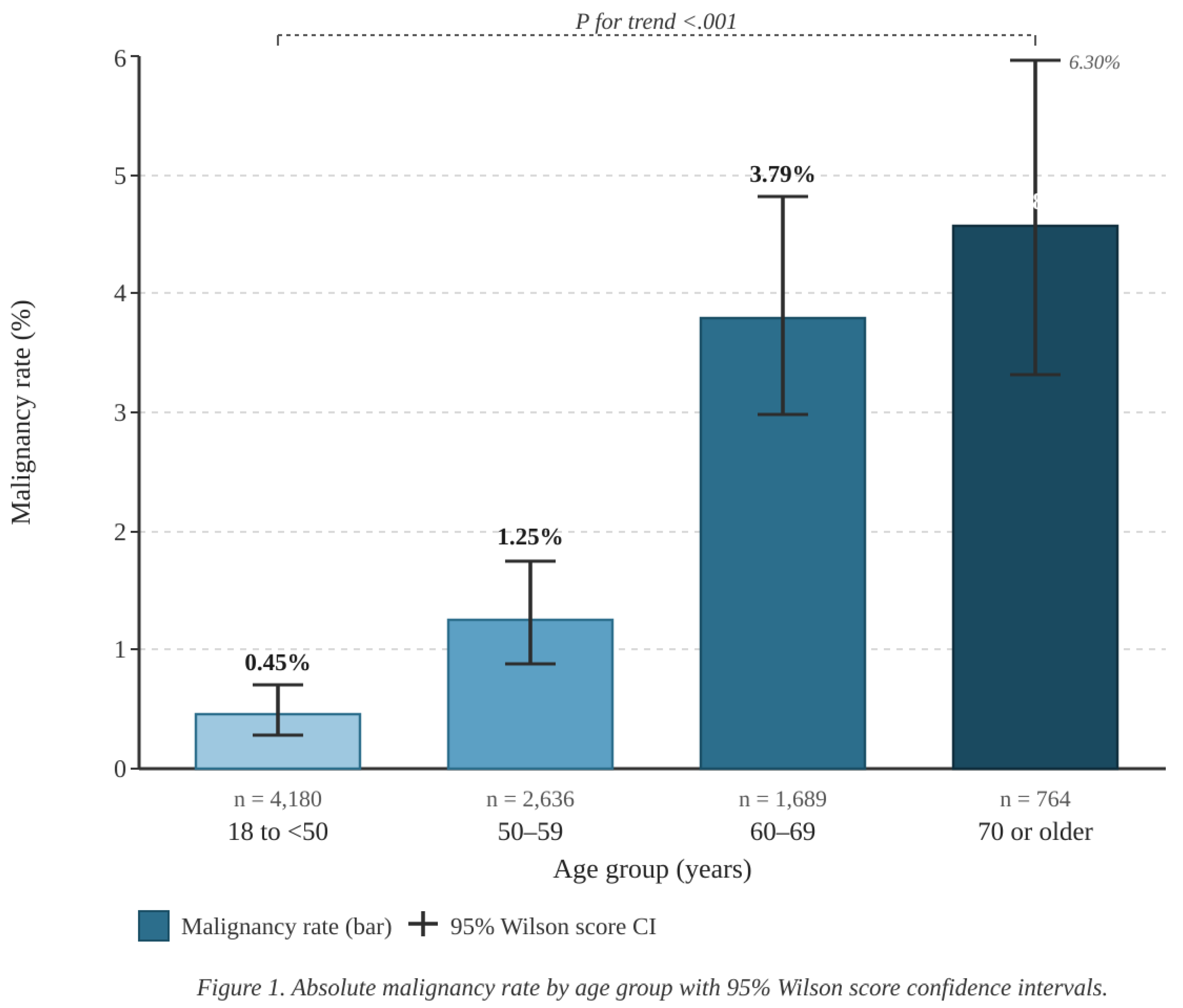

Table 1.
Age-stratified malignancy rates, crude and adjusted odds ratios (OR), and hyperplasia rates in hysteroscopic polypectomy (analytic cohort, n = 9,269). Crude ORs calculated directly from the malignancy counts and group sizes shown in each row. *Adjusted for weight category, hospital site, calendar year (centered at 2020), and postmenopausal bleeding as the documented procedural indication. CI, confidence interval.
Table 1.
Age-stratified malignancy rates, crude and adjusted odds ratios (OR), and hyperplasia rates in hysteroscopic polypectomy (analytic cohort, n = 9,269). Crude ORs calculated directly from the malignancy counts and group sizes shown in each row. *Adjusted for weight category, hospital site, calendar year (centered at 2020), and postmenopausal bleeding as the documented procedural indication. CI, confidence interval.
| Age group | Analytic n (%) | Malignanciesn (%; 95% CI) | Crude OR (95% CI) | Adjusted OR*(95% CI) | Hyperplasian (%) |
| 18 to <50 (ref) | 4,180 (45.1%) | 19 (0.45%; 0.29–0.71%) | 1.00 (reference) | 1.00 (reference) | 46 (1.10%) |
| 50–59 | 2,636 (28.4%) | 33 (1.25%; 0.89–1.75%) | 2.78 (1.58–4.89) | 2.02 (1.13–3.60) | 51 (1.93%) |
| 60–69 | 1,689 (18.2%) | 64 (3.79%; 2.98–4.81%) | 8.63 (5.15–14.44) | 5.77 (3.39–9.83) | 32 (1.89%) |
| 70 or older | 764 (8.2%) | 35 (4.58%; 3.31–6.30%) | 10.51 (5.98–18.48) | 8.03 (4.51–14.30) | 9 (1.18%) |
| Total | 9,269 | 151 (1.63%) | — | — | 138 (1.49%) |
Table 2.
Indication-stratified malignancy rates in hysteroscopic polypectomy (n = 9,269). Fisher exact test used for all comparisons. Postmenopausal bleeding (PMB) adjusted OR (adjusted for age group, weight category, hospital site, and calendar year): 3.04 (95% CI, 1.96–4.72). OR, odds ratio. †Non-PMB abnormal uterine bleeding and menorrhagia are mutually exclusive EMR-coded categories reflecting registry structure, not a clinical hierarchy.
Table 2.
Indication-stratified malignancy rates in hysteroscopic polypectomy (n = 9,269). Fisher exact test used for all comparisons. Postmenopausal bleeding (PMB) adjusted OR (adjusted for age group, weight category, hospital site, and calendar year): 3.04 (95% CI, 1.96–4.72). OR, odds ratio. †Non-PMB abnormal uterine bleeding and menorrhagia are mutually exclusive EMR-coded categories reflecting registry structure, not a clinical hierarchy.
| Indication | n | Malignanciesn (%) | Crude OR vs incidental(95% CI) | P value |
| Postmenopausal bleeding | 459 | 29 (6.32%) | 5.06 (3.26–7.87) | <.001 |
| Suspicious ultrasound finding | 530 | 11 (2.08%) | 1.59 (0.84–3.02) | .17 |
| Intracavitary fibroid | 80 | 2 (2.50%) | 1.92 (0.46–7.98) | .29 |
| Incidental polyp (reference) | 5,552 | 73 (1.31%) | 1.00 (reference) | — |
| Non-PMB abnormal uterine bleeding† | 558 | 2 (0.36%) | 0.27 (0.07–1.10) | .07 |
| Menorrhagia† | 119 | 0 (0.00%) | Not calculable | >.99 |
| Infertility workup | 84 | 0 (0.00%) | Not calculable | >.99 |
| Retained products of conception | 38 | 0 (0.00%) | Not calculable | >.99 |
| No coded indication | 1,849 | 34 (1.84%) | 1.41 (0.93–2.12) | .11 |
| Total | 9,269 | 151 (1.63%) | — | — |
Disclaimer/Publisher’s Note: The statements, opinions and data contained in all publications are solely those of the individual author(s) and contributor(s) and not of MDPI and/or the editor(s). MDPI and/or the editor(s) disclaim responsibility for any injury to people or property resulting from any ideas, methods, instructions or products referred to in the content. |
© 2026 by the authors. Licensee MDPI, Basel, Switzerland. This article is an open access article distributed under the terms and conditions of the Creative Commons Attribution (CC BY) license (http://creativecommons.org/licenses/by/4.0/).
Copyright: This open access article is published under a Creative Commons CC BY 4.0 license, which permit the free download, distribution, and reuse, provided that the author and preprint are cited in any reuse.