

Submitted:
20 August 2026
Posted:
21 August 2026
You are already at the latest version
Abstract
Background: Previous research has demonstrated the positive impact of parent’s engagement on young children’s cognitive and social and emotional development. Parents’ engagement in young children’s lives can also be beneficial for the development of healthy behaviors that may reduce childhood obesity. Objective: The major purpose of this narrative review was to identify studies that examined the role of parents’ engagement in young children fundamental movement skills (FMS) and physical activity (PA). The primary research question was what is the role of parents engagement on young children’s FMS and PA outcomes. Method: The databases SPORTDiscus, Professional Development Collection, SocINDEX, and Family and Society Studies Worldwide were searched in January 2024, and a grand total of 1975 citations were found. Nineteen articles were evaluated, underwent data extraction, and were assessed for methodological quality. Results: Studies were conducted in North America (6), followed by Europe (5), Australia (3), Asia (2), South America (2), and Africa (1). Parent engagement variables were evaluated and classified into the following categories: parents own PA, parents PA practices, parent’s engagement/involvement, parents’ psychological characteristics. Children’s FMS outcomes included gross, fine, locomotor, object, and overall motor skills. Children’s PA outcomes included time, duration, and percentage of light, moderate, vigorous, and moderate to vigorous PA. Conclusion: Overall, parent’s engagement can be beneficial for young children’s FMS and PA outcomes. Future studies should consider including father, father-figures, and single mothers and identifying strategies to include their participation.
Keywords:
parent engagement
; early childhood
; physical activity
; fundamental movement skills
1. Introduction
Over the past few decades, obesity among young children (i.e., ages 2-19 years) has steadily increased in the United States [1]. According to the World Health Organization [2], 39 million children under age five were classified as having overweight or obese body composition in 2020. Once thought to be conditions that affected people in high income countries, these conditions are increasing in low- and middle-income countries too [2]. Being overweight or obese during early childhood (i.e., 0-7 years) can have numerous consequences for children such as cognitive impairment [3], physical ailments [4], and psychological distress [5]. Additionally, some researchers believe that childhood obesity can predict obesity during adulthood [6]. Obesity during adulthood can diminish quality and outlook on life and put adults at increased risk for chronic diseases [7] and mental health issues [8]. Indeed, obesity can have detrimental effects during both childhood and adulthood. From an economic perspective, overweight and obesity impacts health care costs and productivity [9]. Therefore, there is a need to investigate this global health epidemic and implement innovating strategies that target and reduce children’s unhealthy behaviors.
1.1. Children’s Fundamental Movement Skills (FMS) and Physical Activity (PA)
Human movements are generally categorized into gross and fine movements. Gross movements incorporate the large muscles of the body such as the quadriceps (legs), and fine movements can be achieved with smaller muscles such as the abductor pollicis brevis (hands). Both types of movements are necessary because they work together to move the body [10]. One mechanism that can alleviate overweight and obesity throughout the lifespan is the acquisition of fundamental movement skills (FMS) during childhood. FMS are considered to be foundational to more complex movement sequences. They usually include stationary or balance skills, locomotor skills, and object control or manipulation skills [11,12,13]. Stationary skills include balancing one leg at a time or standing on toes only. Locomotor skills are walking, running, or galloping. Object control skills include catching a ball with both hands and throwing a ball with one hand [13,14]. According to the conceptual model proposed by Stodden and colleagues [15], acquisition of FMS in early childhood can set a child on a positive spiral of engagement, which includes greater involvement in PA and can indicate a healthier weight. In contrast, when FMS are not learned early on, children can embark on a negative spiral of disengagement, which includes lower PA and unhealthy and obese weight statuses. PA is any bodily movement that results in energy expenditure [16]. The Physical Activity Guidelines for Americans recommend that preschool-aged children (ages 3-5 years), should aim for engaging in activities of various intensities for three hours daily, and caregivers and parents should encourage children to be active. School-aged children (ages 6-17 years) should aim for 60 minutes of activity. For youngsters, who engage in regular participation in PA can improve their bone health and weight status [17]. Studies have shown the benefits of PA on children’s cognitive (e.g., executive functions, language) [18] and social and emotional development (e.g., social maturity [19].
Longitudinal studies provide evidence about early childhood FMS acquisition and PA in late childhood [20] and adolescence [21]. Barnett et al. [21] found that object control skills were a significant predictor of adolescent moderate to vigorous PA, but not locomotor skills. Moreover, other studies have examined PA levels and sport participation of older children who were classified as having low, average, and high FMS in early childhood [20,22]. These studies showed early FMS classifications are significantly associated with later PA. Children of low FMS decreased in PA over a four-year period, in contrast to children of high PA whose PA remained stable over time [20]. Furthermore, high FMS children demonstrated greater physical strength (e.g., sit-ups, standing broad jumping) and club level sport participation than children of low FMS [22].
Both FMS and PA are necessary for young children’s healthy development. Many early childhood education centers have designated times for children to be active and develop their movement skills. Researchers have implemented FMS and PA programs in various early childhood settings such as day care and Head Start [23,24]. These programs focused on delivering activity sessions during the center’s hours. Additionally, many programs have been delivered by teachers or research staff. However, studies that examine the role of parents’ engagement in young children’s FMS and PA are rare [25]. Including parents and involving them in their children’s FMS and PA development can be a potential source for remedying childhood overweight and obesity.
1.2. Parents’ Engagement in Young Children’s Development
Parents’ engagement is defined as when a parent or caregiver is present and active in their child’s life [26,27]. Parents’ are a child’s first teachers and role models and can teach children skills such as identifying letters and numbers [28] and encourage children to be physically active [29]. The term parent engagement can be synonymous with parent involvement. Goodall and Montgomery [27] distinguish between these terms by suggesting that parent involvement with their children’s school is different from parent engagement in their children’s learning. Researchers have examined various levels of parent engagement and parent involvement and their effect on children’s cognitive and social and emotional development. A systematic review [30] categorized parent involvement as a positive parenting behavior and overall, positive parenting behaviors were associated with young children’s executive functions. Other researchers [31] evaluated interventions that were either school based (i.e., parent involvement with the child’s school) or home-based (i.e., parents’ engagement with their child at home). Researchers concluded that parent engagement interventions had a positive effect on young children’s social and emotional competence and that parent engagement interventions were more effective than parent involvement interventions [31].
A few systematic reviews have evaluated the role of parents in young children’s FMS and PA. Mitchell and colleagues [32] reviewed studies that examined a variety of parental influences on young children’s physical activities (e.g., parent behaviors, perceptions, social learning variables), but the studies included were reviewed until the year 2011. Recently, Stevenson et al. [33] reviewed motor skill interventions that included direct or indirect parent engagement. Both reviews included studies that examined parents’ role on young children’s FMS or PA, but not both. Given that previous reviews have synthesized the role of parents’ engagement on children’s developmental domains (e.g., cognitive, social and emotional), the major aim of this study was to fill this gap and add to the existing literature by conducting a narrative review to identify studies that examined the role of parent’s engagement on young children’s FMS and PA. The primary research question was 1.) What role does parent’s engagement play in young children’s FMS and/or PA? It is hypothesized that parent’s engagement would have a positive impact on young children’s FMS and/or PA.
2. Materials and Methods
The following databases were searched in January 2024: SPORTDiscus, Professional Development Collection, SocINDEX, and Family and Society Studies Worldwide. The keywords “parent engagement” OR “parent involvement” AND “motor skills” OR “motor development” AND “physical activity” OR “exercise” AND “young children” OR “early childhood” were entered in each database to identify works published between January 2010 and January 2024. All citations were peer reviewed, written in English, and included access to the full text. A total of 1975 citations were identified and downloaded on the Zotero reference manager. Using Google sheets, 690 duplicates were removed, leaving 1285 unique citations to review (see Figure 1).
Titles and abstracts were screened by authors to determine eligibility for a full review. Citations were eligible for full text review if they included a parent construct in the title or abstract, a child construct or variable related to FMS or PA, and the study was about children. Citations were excluded if they were a position or protocol paper, the study focused on sports participation, the study included adolescents/adults, or if the sample was non-typically developing (e.g., spine deficiencies, cerebral palsy, autism, brain dysfunctions, developmental coordination disorder). This reduced the number of citations to 94. Data extraction was guided by Harris and colleagues’ [34] guidelines and included year of publication, country where the study was conducted, primary focus of study, participant characteristics and setting, research design, description of parent’s variable(s), description of children’s variable(s), data source(s), analysis, and outcome(s). Articles were excluded at this phase if the mean or standard deviation of the children’s age was over 7 years or if the age was not mentioned (N = 22), the parent variable measured was not relevant to the study such as parent education level or demographic characteristics (N = 18), if the overall scope of the paper was not related to the subject (N = 39), or if the paper was not originally written in English (N = 1). This process resulted in 14 studies. Four additional articles were added from the first author’s own citation manager, and one article was added as a follow-up study from a previously excluded citation (i.e., protocol paper). A grand total of 19 articles were included.
2.1. Quality Assessment
A quality assessment checklist was developed according to the Strengthening the Reporting of Observational Studies in Epidemiology (STROBE) [35,36]. Ten criteria were included that best characterized studies on this topic. Each author independently reviewed each article and rated whether the article adequately presented the information with a 1, or if it was inadequately presented or absent with a 0. The authors initially achieved ≥ 70% agreement for each of the articles. They met and discussed the inconsistent ratings to reach consensus and achieve 100% agreement. The scores for each article were summed up to determine overall quality. Articles that scored 0-3 were considered low quality, 4-7 moderate, and 8-10 high quality (see Table 6A). The Physiotherapy Evidence Database scale (PEDro) [37] was also included to assess the quality of two randomized controlled trials. Eleven items were scored with a 1 indicating “yes” the criteria was present or 0 indicating “no” as absence. The authors achieved 100% agreement on the quality of the two studies (see Table 6B).
- Background/rationale: Explain the scientific background and rationale for the investigation being reported (STROBE #2). Description of the background (e.g., health, obesity) and rationale for the current study.
- Objectives: State specific objectives, including any prespecified hypotheses (STROBE #3)
- Study design: Present key elements of study design early in the paper (STROBE #4).
- Setting: Describe the setting, locations, and relevant dates, including periods of recruitment, exposure, follow-up, and data collection (STROBE #5)
- Data sources/measurement: For each variable of interest, give sources of data and details of methods of assessment (measurement). Describe comparability of assessment methods if there is more than one group (STROBE #8). Description of the parent variables, how they were measured, the children’s FMS/PA variables, and how they were measured.
- Statistical methods: (a) Describe all statistical methods, including those used to control confounding. The statistical methods addressed the research question/objectives of the study.
- Descriptive data: (a) Give characteristics of study participants (e.g., demographic, clinical, social) and information on exposures and potential confounders (b) Indicate number of participants with missing data for each variable of interest(c) Cohort study—Summarise follow-up time (eg, average and total amount) (STROBE #14). Participant descriptives, means/SD’s of parent and children’s variables are presented in the text or table/graph.
- Outcome data: Cohort study—Report numbers of outcome events or summary measures over timeCase-control study—Report numbers in each exposure category, or summary measures of exposureCross-sectional study—Report numbers of outcome events or summary measures (STROBE #15). Results from the analysis (e.g., correlation, ANOVA, etc.) are presented with statistically significant and non-significant results.
- Key results: Summarize and discuss key results with reference to aims/purpose, study objectives and/or research questions. (STROBE #18)
- Interpretation: Give a cautious overall interpretation of results considering objectives, limitations, multiplicity of analyses, results from similar studies, and other relevant evidence (STROBE #20)

Table 1.
Inclusion and exclusion criteria.
| Inclusion Criteria | Exclusion Criteria |
|---|---|
| Included a parent construct construct/variable | Study included a parent construct/variable about parent’s education/demographic characteristic |
| Included a child construct related to FMS/PA | Study included constructs/variables that were not FMS/PA related |
| Study was about typically developing children ages 0-7 years | Study included non-typically developing sample (i.e., adolescents, adults) |
| Position or protocol paper |
Note: FMS: Fundamental Movement Skills; PA: Physical Activity.
3. Results
3.1. Study Characteristics
Nineteen articles met the inclusion criteria (see Table 2, Table 3). Most of the studies were conducted in North America (6), followed by Europe (5), Australia (3), Asia (2), and South America (2), and Africa (1). Fifteen studies were cross sectional, one was longitudinal, two were randomized controlled trials, and one was a quasi-experimental design. Two articles from Europe were cross sectional studies about the Skilled Kids program [38,39]. Across these studies, 53 parent variables were evaluated and classified into the following categories: parents own PA, parents PA practices, parent’s engagement/involvement, parents’ psychological characteristics (see Table 4). Thirty-three variables that measured children’s FMS (19) and PA (14) were identified (see Table 5).
3.2. Children’s Measurement Tools
Thirteen studies measured children’s FMS [38,39,40,41,42,43,44,45,46,47,48,49,50]. Most studies measured children’s FMS using the Test of Gross Motor Development-2 [41,43,47] and Test of Gross Motor Development-3 [38,39,48]. One study measured FMS using the Motoriktest for Vier-bis Sechsjahrige Kinder test [40], the Peabody Developmental Motor Scales [51], and the Movement Assessment Battery for Children-2 [46]. Szeszulski et al. [42] used the locomotor skills section of the TGMD-3 to measure children’s locomotor skills. Additionally, they included the Progressive Aerobic Cardiovascular Endurance Run (PACER) to measure product of locomotor skills. Williams et al. [45] measured functional motor skills (e.g., holding a pencil, catching) by asking parents about their children’s skills. Two studies [49,50] used the Ages and Stages Questionnaire-3 to assess motor skills.
3.3. Parents’ Measurement Tools
3.4. Themes of Parent’s Engagement
3.4.1. Parent’s Own PA and Children’s FMS and PA
Ten studies examined the relationship between parent’s own PA and children’s FMS [40,41,42,47] or PA [51,52,53,54,55,56]. One study reported positive associations between parent’s PA and children’s FMS [41], two studies reported no relationships [42,47], and Cools and colleagues [40] reported both positive and negative associations. When examining parent’s PA and children’s PA, Carson et al. [52] and Neshteruk et al. [54] reported similar patterns, such that, parents who reported low PA also had children who were 2.77 times more likely to have low PA and parents who spent the most time in MVPA also had children who spent a substantial amount in MVPA over a 10-hour period (i.e., 59 minutes). Two studies [51,53] reported no significant relationships between parents’ PA and children’ PA. Furthermore, Barkin et al. [56] and Ruiz et al. [55] reported positive and negative associations based on PA intensity and duration. Low and moderate PA levels were related, but not vigorous levels of PA. As parent’s duration in MVPA increased from one to 10 minutes and 30–40 minutes, children’s time in MVPA increased. However, once parent’s reach 40–50 minutes in MVPA, children’s time decreased.
3.4.2. Parent’s PA Practices and Children’s FMS and PA
Five studies examined the role of parent’s PA practices on children’s FMS [40,43,54] and PA [43,54]. PA practices were measured with questionnaires developed for studies [40,43,54], the Family Physical Activity Environment Questionnaire [38], and the Preschool Physical Activity Parenting Practices Instrument [42]. These questionnaires included a variety of behaviors that parents’ do to impact their children’s FMS or PA, such as asking the school teacher about the children’s motor skills [40], co-participating in PA with children, providing direct support for children’s PA, encouragement/praise when children participate in PA [38], providing transportation to do PA, watching children participate in PA, and informing children of the health benefits of PA [43]. Szeszulski et al. [42] also included discouraging practices such as screen time promotion and parents’ concern for children’s safety.
Two studies evaluated parent’s PA practices and children’s FMS [40,42]. Cools et al. [40] reported a negative association between parent’s inquiry about children’s motor development and girls’ FMS. Interesting, Szeszulski et al. [42] found that discouraging PA practices such as promotion of screen time was associated with greater locomotor skills performance. Concern for children’s safety was related to lower locomotor scores on the PACER test. Laukkanen et al. [38] examined mothers and fathers PA practices and found that fathers reported significantly higher practices and provided more direct PA support for their children, compared to mothers.
Two studies examined parent’s PA practices and children’s PA [43,54]. Trost and Brooks [43] evaluated the Moovosity intervention’s effectiveness on parent’s support and children’s FMS. The intervention did not have a significant impact on parent’s support for their children’s PA. Neshteruk et al. [54] conducted a latent profile analysis based on parents PA practices and created three groups: Rewarder, Activity Supportive, and Screen Time Permissive. Children in the Rewarder group spent more time in MVPA compared to the other two groups.
3.4.3. Parents Engagement/Involvement and Children’s FMS and PA
Six studies examined parent’s engagement or involvement in children’s FMS [40,45,47,48,49,50] and PA [48]. Parent’s engagement was measured with questionnaires [40], face to face interviews [45,50], survey [47,48], or observation [49]. Brian and colleagues [48] reported positive associations between parent’s engagement and children’s FMS and PA. Both Barnett et al. [47] and Williams et al. [45] reported non-significant relationships between parent’s engagement and children’s FMS and functional motor skills, respectively. Cools et al. [40] reported both positive and negative associations based on children’s gender. Greater father involvement was related to boys’ higher FMS performance. In contrast, father involvement with girl’s dance activities was significantly negatively related to girls FMS. Onyango et al. [50] reported increases in mother’s motor engagement activities from baseline to endline in a RCT in Africa. Mother’s engagement had the largest effect size on children’s gross motor skills. Nurulfa et al. [44] conducted an observational study of parent’s and children’s interactions. Researchers measured their appreciation of each other and their interactions. When children were divided into three separate age groups (i.e., 3-4, 4-5, 6-7 years), it was discovered that the parents of children, ages 4-5, engaged with them more than the parents of children in the other two age groups. Solis-Cordero et al. [49] also employed a similar observation method in their RCT. Caregiver engagement increased from baseline to endline in the intervention group, but the increase was non-significant.
3.4.4. Parents Psychological Characteristics and Children’s FMS and PA
Four studies examined parent’s psychological characteristics and children’s FMS [39,40,46,47]. Parent’s psychological characteristics included their beliefs, perspectives, attitudes, or confidence towards their children’s movements. Two studies [39,40] reported positive associations between parent’s beliefs of the importance of children’s PA and children’s FMS, and parent’s perspective of their children’s FMS and children’s FMS. Hu and colleagues [46] reported a negative relationship between parent’s attitude and children’s functional motor skills. In one study, separate analysis was conducted for locomotor and object control skills [47]. While parents’ confidence in children’s PA was not a significant predictor for children’s locomotor skills, it was a significant predictor for children’s object control skills. In Laukkanen and colleagues study [38], parents were asked about their perception of their partner’s PA practices (e.g., co-participation in PA with children, encouragement/praise when children participate in PA). Partners PA practices were a significant predictor in parent’s PA practices.
3.5. Quality Assessment
Seventeen studies were evaluated using the adapted STROBE checklist and two were assessed with the PEDro scale. One study was categorized as being of low quality [39], six were moderate quality [40,41,42,44,46,53] and 10 were of high quality [38,45,47,48,50,51,52,54,55,56]. The two RCT’s achieved the maximum score indicating that they were high quality [43,49].
Table 6.
A Quality assessment for each article.
| Author and Year | Back. | Obj. | Design | Setting | Data Sources | Stat. Meths. |
Descr. | Outc. | Results | Interp. | Total Score |
|---|---|---|---|---|---|---|---|---|---|---|---|
| Cools et al. (2011) | 1 | 0 | 0 | 0 | 1 | 1 | 0 | 1 | 1 | 1 | 6 |
| Honda Barros et al. (2012) | 1 | 0 | 1 | 1 | 1 | 1 | 0 | 1 | 1 | 1 | 8 |
| Carson et al. (2015) | 1 | 1 | 0 | 1 | 1 | 1 | 1 | 1 | 1 | 1 | 9 |
| Salaj et al. (2016) | 1 | 0 | 0 | 0 | 1 | 1 | 1 | 1 | 1 | 1 | 7 |
| Laukkanen et al. (2018) | 1 | 0 | 1 | 1 | 1 | 1 | 1 | 1 | 1 | 0 | 8 |
| Szeszulski et al. (2021) | 1 | 0 | 0 | 0 | 1 | 1 | 1 | 1 | 1 | 1 | 7 |
| Sääkslahti & Niemistö (2022) | 0 | 0 | 0 | 0 | 0 | 1 | 0 | 0 | 0 | 0 | 1 |
| Rutkauskaitė et al. (2021) | 1 | 0 | 0 | 1 | 1 | 1 | 0 | 1 | 1 | 0 | 6 |
| Nurulfa et al. (2021) | 1 | 0 | 0 | 1 | 1 | 1 | 1 | 0 | 1 | 0 | 6 |
| Williams et al. (2014) | 1 | 0 | 1 | 1 | 1 | 1 | 1 | 1 | 1 | 0 | 8 |
| Hu et al. (2014) | 1 | 0 | 0 | 1 | 1 | 1 | 0 | 1 | 1 | 1 | 7 |
| Neshteruk et al. (2020) | 1 | 0 | 1 | 1 | 1 | 1 | 1 | 0 | 1 | 1 | 8 |
| Ruiz et al. (2011) | 1 | 0 | 1 | 0 | 1 | 1 | 1 | 1 | 1 | 1 | 8 |
| Barnett et al. (2013) | 1 | 0 | 1 | 1 | 1 | 1 | 1 | 1 | 1 | 1 | 9 |
| Barkin et al. (2016) | 1 | 0 | 1 | 1 | 1 | 1 | 1 | 1 | 1 | 1 | 9 |
| Brian et al. (2022) | 1 | 1 | 1 | 1 | 1 | 1 | 1 | 1 | 1 | 1 | 10 |
| Onyango et al. (2023) | 1 | 0 | 1 | 1 | 1 | 1 | 1 | 1 | 1 | 1 | 9 |
Note: Total score scale 0-3 low quality, 4-7 moderate quality, 8-10 high quality.
Table 6.
B Quality assessment for each article based on PEDro scale.
| Author and Year | 1 | 2 | 3 | 4 | 5 | 6 | 7 | 8 | 9 | 10 | 11 | Total |
|---|---|---|---|---|---|---|---|---|---|---|---|---|
| Trost and Brooks (2021) | 1 | 1 | 1 | 1 | 1 | 1 | 1 | 1 | 1 | 1 | 1 | 10 |
| Solis-Cordero et al. (2023) | 1 | 1 | 1 | 1 | 1 | 1 | 1 | 1 | 1 | 1 | 1 | 10 |
4. Discussion
The major purpose of this narrative review was to evaluate published studies that examined the role of parent’s engagement on young children’s (i.e., ages 0-7 years) FMS and PA. Nineteen articles met the inclusion criteria. Fifteen studies were cross-sectional and primarily conducted in North America (N=6). Thirteen studies examined parent’s engagement and children’s FMS and ten studies examined parent’s engagement on children’s PA. Fifty-three parent variables were extracted from the studies and placed in four categories of parent’s own PA, parent’s PA practices, parent’s engagement/involvement, parent’s psychological characteristics. Additionally, 31 variables were extracted and placed into the broad categories of children’s FMS and PA.
4.1. The Role of Parent’s Engagement on Children’s FMS
Of the thirteen studies that examined parents’ engagement in children’s FMS, six studies reported that parent’s engagement was beneficial for children’s FMS performance. In one study, authors conducted separate analysis for mother’s and father’s engagement and children’s FMS. Cools et al. [40] showed that father’s engagement (i.e., father’s own PA, engagement in play) was beneficial to boys FMS. However, when fathers engaged with girls, girls scored lower in FMS. Additionally, this study reported how fathers who were physically active less than once a month and exercised daily, also had children with low FMS. Several authors have examined the unique role of fathers in children’s development. Fagan and colleagues [57]examined the role of fathers’ and father-figure’s engagement (e.g., reading to their child) and children’s language competence. Children whose father’s read to them at home reported greater language competence. A systematic review by Amodia-Bidakowska et al. [58] focused on father-child play and its role in children’s development and concluded that it can have a beneficial role on children’s social, emotional, and cognitive development. These studies demonstrate the important role fathers may have in young other domains of children’s development; however, our results showed otherwise for girls. In the current review, most parent participants reported were female [42,45,47,48]. Davison and colleagues [59] reported on the scarcity of father participants in childhood obesity prevention research and the lack of studies where researchers conduct analysis on father’s variables. Given that the current review included few father participants and previous research highlighted the underrepresentation of fathers, future researchers should actively recruit fathers and involve them in childhood obesity prevention interventions to further understand their role in children’s FMS.
Parent’s engagement yielded mixed findings on children’s locomotor and object control skills. For example, Trost and Brooks [43] and Barnett and colleagues [47] both reported positive associations between parent’s engagement and children’s object control skills, but not children’s locomotor skills. These differences may be attributed to the suggestion that object control skills may require greater perceptual resources, in comparison to locomotor skills [60]. Due to the higher demand needed to execute object control skills, parent’s may be more inclined to be engaged with their children when learning these skills. In contrast, Brian and colleagues [48] reported increases in both locomotor skills and object control skills as parent’s attended monthly motor skill sessions. In Barnett et al.’s [47] study, parent’s engagement was defined under the broad categories of parent’s own PA, engagement, and psychological characteristics and in Trost and Brooks [43], parent’s engagement was under the parent’s PA practices category. The greater impact of parent’s engagement on children’s locomotor and object control skills in Brian and colleagues [48] study may be attributed to the nature of parent engagement activities. Parents participated in activities such as learning about the importance of FMS, opportunities to practice teaching FMS, and were provided resources (e.g., website, bag of equipment) that may have been meaningful strategies to impact young children’s locomotor and object control skills. This observation is noteworthy given that worldwide, young children are more proficient in locomotor skills than object control skills [61] and participation in object control skills may predict later childhood and adolescent MVPA. Future researchers can consider instructional sessions embedded with behavioral change strategies to promote parent’s engagement in young children’s locomotor and object control skills. Additionally, professionals who work with children (e.g., pediatricians, early childhood educators), should encourage parents and caregivers to be active with their children and engage with them in different activities.
4.2. The Role of Parent’s Engagement on Children’s PA
Ten studies also examined the role of parent’s engagement on children’s PA. Parent’s engagement can also have a positive impact on young children’s PA. Most studies that examined the relationships between parent’s own PA and children’s PA showed that parent’s PA was beneficial for children’s PA [52,54,55,56]. Furthermore, Carson and colleagues [52] showed that this relationship was dependent on family structure (i.e., single, two-parent homes). Essentially, parent’s low PA was related to child’s low PA in two-parent homes, however, this relationship was not observed in single parent homes. In Carson et al.’s [52] study, most parents were female and part of a two-parent home. Parents in two-parent homes may have greater availability to devote time to their children and role model behaviors for them. Single-parent homes are associated with less time and less supervision towards young children [62]. The disparate characteristics in family structure can influence young children’s development. Parents in single parent homes may spend less time with their children and as a result, associations between parent and children’s PA are absent. Furthermore, single parents may be less available to role model healthy behaviors, such as PA participation. Future researchers should consider the challenges faced by single parents in their children’s PA engagement and provide opportunities for them to be active. Developing strategies and programs specifically for single parents with limited time, while supporting the importance of PA may be a viable avenue to promoting PA in single-parent homes.
Studies in this review also reported on the intensities of children’s PA (i.e., low, moderate, vigorous, MVPA). Two studies by Ruiz et al. [55] and Barkin et al. [56] showed similar patterns. Children’s low PA was associated with parent’s low PA. Ruiz and colleagues [55] showed that parent and children’s moderate PA levels were not associated. In a similar vein, Barkin et al. [56] also reported that as parents PA increased, so did children’s. Children’s MVPA continued to increase as parents went from 1 to 10 minutes and 30 to 40 minutes. However, once parents reached 40-50 minutes, children’s MVPA decreased. These studies showed that parent and children’s PA are related, however this relationship is dependent on the amount of time that parents spend in PA and the intensity of the PA. These studies suggest that preschoolers and parents do not engage in higher levels of PA (i.e., moderate, moderate-to vigorous, vigorous). More intense PA is necessary to achieve greater health benefits and offset health conditions such as obesity and overweight [63]. Both researchers and practitioners can develop activities and programs to help children, parents, and people of all ages learn about PA of various intensities and how to implement them.
4.3. Strengths and Limitations
This study has some strengths. It adds to the literature about parents’ engagement in children’s developmental domains (e.g., cognitive, social and emotional) by broadening the scope to include motor development and PA. Second, this study expands on the previous findings from Mitchell et al. [32] and includes motor competence. FMS are considered to be the building blocks of later PA and understanding parent’s role in this domain could be a potential avenue for early intervention to mediate developmental delays. While this study adds to motor development and parent engagement literature, its limitations must be noted. First, four databases were searched, and an updated search could not be conducted due to lack of accessibility to the databases. Therefore, this restricts the studies that were found and reviewed. Second, most studies that met the inclusion criteria were conducted in North America (N=6). These studies shaped the current perspective on parent’s engagement in children’s motor competence and PA. Third, most of the parents in these studies were female with only a few studies reporting father participants.
5. Conclusions
Childhood overweight and obesity continue to be a public health concern in early childhood. When children learn FMS and engage in regular PA during early childhood, they are more likely to maintain their PA participation in the middle and later childhood years. Therefore, caregivers, parents, and childhood early childhood professionals should encourage and facilitate opportunities for children to be physically active.
In summary, this narrative review evaluated 19 studies to understand parent engagement and how it impacts young children’s (ages 0-7) FMS and PA. Parent’s engagement (i.e., parents own PA, parents PA practices, parent’s engagement/involvement, parents’ psychological characteristics) is beneficial for young children’s FMS and PA development. Future researchers should consider targeting fathers, father figures, and single mothers in their studies and identifying strategies to enhance their participation. Including these populations may be unexplored avenues to help mediate effects of childhood overweight and obesity.
Author Contributions
A.A., S.G., and T.Z.; Methodology, A.A., S.G., and T.Z.; Software, D.H.E.; Validation, A.A. and S.G.; Formal Analysis, A.A. and S.G.; Investigation, A.A. and S.G.; Resources, A.A. and S.G.; Data Curation, A.A., S.G., and T.Z.; Writing—Original Draft Preparation, A.A., S.G., and T.Z.; Writing—Review and Editing, A.A., S.G., and T.Z.; Visualization, A.A. and S.G. All authors have read and agreed to the published version of the manuscript.
Funding
This research received no external funding.
Institutional Review Board Statement
Not applicable.
Informed Consent Statement
Not applicable.
Data Availability Statement
No new data were created or analyzed in this study. Data sharing is not applicable to this article.
Acknowledgments
We would like to acknowledge and thank Jo Monahan, librarian at the University of North Texas. Jo Monahan assisted in identifying search terms and databases for this review.
Conflicts of Interest
The authors declare no conflicts of interest.
Abbreviations
The following abbreviations are used in this manuscript:
| FMS | Fundamental movement skills |
| PA | Physical activity |
References
- Fryar C.D.; Carroll M.D.; Afful J. Prevalence of overweight, obesity, and severe obesity among children and adolescents aged 2–19 years: United States, 1963–1965 through 2017–2018. NCHS Health E Stats [Internet]. 2020.
- World Health Organization. Obesity and overweight. Available online: https://www.who.int/news-room/fact-sheets/detail/obesity-and-overweight.
- Martin, A.; Booth, J.N.; Young, D.; Revie, M.; Boyter, A.C.; Johnston, B.; et al. Associations between obesity and cognition in the pre-school years. Obesity 2016, 1, 207–14. [Google Scholar] [CrossRef]
- 4. Gauthier, K.I.; Gance-Cleveland, B.; Hispanic parental perceptions of child weight in preschool-aged children: An integrated review. Child. Obes. 2015, 5, 549–59. [CrossRef]
- 5. Harriger, J.A.; Thompson, J.K.; Psychological consequences of obesity: Weight bias and body image in overweight and obese youth. Int. Rev. Psychiatry 2012, 3, 247–53. [CrossRef]
- Simmonds, M.; Llewellyn, A.; Owen, C.G.; Woolacott, N. Predicting adult obesity from childhood obesity: A systematic review and meta-analysis. Obes. Rev. 2016, 2, 95–107. [Google Scholar] [CrossRef]
- Piché, M.E.; Tchernof, A.; Després, J.P. Obesity phenotypes, diabetes, and cardiovascular diseases. Circ. Res. 2020, 11, 1477–500. [Google Scholar] [CrossRef]
- Chu, D.T.; Minh Nguyet, N.T.; Nga, V.T.; Thai Lien, N.V.; Vo, D.D.; Lien, N.; et al. An update on obesity: Mental consequences and psychological interventions. Diabetes Metab. Syndr. Clin. Res. Rev. 2019, 1, 155–60. [Google Scholar] [CrossRef]
- Shekar, M.; Popkin, B. Obesity. Health and economic consequences of an impending global challenge; The World Bank: Washington, DC; United States, 2020. [Google Scholar] [CrossRef]
- Payne, G.V.; Isaacs, L.D. Human motor development, 10th ed.; Routledge: New York: United States, 2020. [Google Scholar]
- Adolph, K.E.; Franchak, J.M. The development of motor behavior. Wiley Interdiscip. Rev. Cogn. Sci. 2017, 8. [Google Scholar] [CrossRef]
- Webster, E.K.; Ulrich, D.A. Evaluation of the psychometric properties of the Test of Gross Motor Development—Third Edition. J. Mot. Learn Dev. 2017, 1, 45–58. [Google Scholar] [CrossRef]
- Folio, M.R.; Fewell, R.R. Peabody Developmental Motor Scales, Second Edition; Pearson, 2000. [Google Scholar]
- Ulrich, D.A. Test of gross motor development, 3rd ed.; Pro-Ed: Austin, 2019. [Google Scholar]
- Stodden, D.F.; Goodway, J.D.; Langendorfer, S.J.; Roberton, M.A.; Rudisill, M.E.; Garcia, C.; et al. A developmental perspective on the role of motor skill competence in physical activity: An emergent relationship. Quest 2008, 2, 290–306. [Google Scholar] [CrossRef]
- Caspersen, C.J.; Powell, K.E.; Christenson, G.M. Physical activity, exercise, and physical fitness: Definitions and distinctions for health related research. Public Health Rep. 1985, 2, 126–31. [Google Scholar]
- US Department of Health and Human Services. Physical activity guidelines for Americans, 2nd ed.; Washington, DC, 2018. [Google Scholar]
- Carson, V.; Hunter, S.; Kuzik, N.; Wiebe, S.A.; Spence, J.C.; Friedman, A.; et al. Systematic review of physical activity and cognitive development in early childhood. J. Sci. Med. Sport 2016, 7, 573–8. [Google Scholar] [CrossRef]
- Feleihi, S.; Abedanzadeh, R.; Saemi, E. ‘Let them play’ the effect of active play on motor proficiency and social maturity of children. Early Child Dev. Care 2022, May 2022. [Google Scholar] [CrossRef]
- Lopes, V.P.; Rodrigues, L.P.; Maia, J.A.R.; Malina, R.M. Motor coordination as predictor of physical activity in childhood. Scand. J. Med. Sci. Sports 2011, 5, 663–9. [Google Scholar] [CrossRef]
- Barnett, L.M.; van Beurden, E.; Morgan, P.J.; Brooks, L.O.; Beard, J.R. Childhood motor skill proficiency as a predictor of adolescent physical activity. J. Adolesc. Health 2009, 3, 252–9. [Google Scholar] [CrossRef]
- Fransen, J.; Deprez, D.; Pion, J.; Tallir, I.B.; D’Hondt, E.; Vaeyens, R.; et al. Changes in physical fitness and sports participation among children with different levels of motor competence: A 2-year longitudinal study. Pediatr. Exerc Sci. 2014, 1, 11–21. [Google Scholar] [CrossRef]
- Roach, L.; Keats, M. Skill-based and planned active play versus free-play effects on fundamental movement skills in preschoolers. Percept. Mot. Ski. 2018, 4, 651–68. [Google Scholar] [CrossRef]
- Johnson, J.L.; Rudisill, M.E.; Hastie, P.; Wadsworth, D.; Strunk, K.; Venezia, A.; et al. Changes in fundamental motor-skill performance following a nine-month mastery motivational climate intervention. Res. Q. Exerc Sport 2019, 4, 517–26. [Google Scholar] [CrossRef]
- Van Capelle, A.; Broderick, C.R.; van Doorn, N.; Ward, R.E.; Parmenter, B.J. Interventions to improve fundamental motor skills in pre-school aged children: A systematic review and meta-analysis. J. Sci. Med. Sport 2017, 7, 658–66. [Google Scholar] [CrossRef]
- Kim, Y. Minority parental involvement and school barriers: Moving the focus away from deficiencies of parents. Educ. Res. Rev. 2009, 2, 80–102. [Google Scholar] [CrossRef]
- Goodall, J.; Montgomery, C. Parental involvement to parental engagement: a continuum. Educ. Rev. (Birm) 2014, 4, 399–410. [Google Scholar] [CrossRef]
- Coba-Rodriguez, S.; Cambray-Engstrom, E.; Jarrett, R.L. The home-based involvement experiences of low-income Latino families with preschoolers transitioning to kindergarten: Qualitative findings. J. Child Fam. Stud. 2020, 10, 2678–96. [Google Scholar] [CrossRef]
- Lora, K.R.; Cheney, M.; Branscum, P. Hispanic mothers’ views of the fathers’ role in promoting healthy behaviors at home: Focus group findings. J. Acad. Nutr. Diet. 2017, 6, 914–22. [Google Scholar] [CrossRef]
- Valcan, D.S.; Davis, H.; Pino-Pasternak, D. Parental behaviours predicting early childhood executive functions: A meta-analysis. Educ. Psychol. Rev. 2018, 3, 607–49. [Google Scholar] [CrossRef]
- Cosso, J.; von Suchodoletz, A.; Yoshikawa, H. Effects of parental involvement programs on young children’s academic and social–emotional outcomes: A meta-analysis. J. Fam. Psychol. 2022, 8, 1329–39. [Google Scholar] [CrossRef]
- Mitchell, J.; Skouteris, H.; McCabe, M.; Ricciardelli, L.A.; Milgrom, J.; Baur, L.A.; et al. Physical activity in young children: a systematic review of parental influences. Early Child Dev. Care 2012, 11, 1411–37. [Google Scholar] [CrossRef]
- Stevenson, A.; Wainwright, N.; Williams, A. Interventions targeting motor skills in pre-school-aged children with direct or indirect parent engagement: A systematic review and narrative synthesis. Educ 2022, 0, 1–14. [Google Scholar] [CrossRef]
- Harris, J.D.; Quatman, C.E.; Manring, M.M.; Siston, R.A.; Flanigan, D.C. How to write a systematic review. Am. J. Sports Med. 2014, 11, 2761–8. [Google Scholar] [CrossRef]
- von Elm, E.; Altman, D.G.; Egger, M.; Pocock, S.J.; Gøtzsche, P.C.; VandenbrouckeJ, P. The Strengthening the Reporting of Observational Studies in Epidemiology (STROBE) statement: Guidelines for reporting observational studies. J. Clin. Epidemiol. 2008, 4, 344–9. [Google Scholar] [CrossRef]
- Vandenbroucke, J.P.; von Elm, E.; Altman, D.G.; Gøtzsche, P.C.; Mulrow, C.D.; Pocock, S.J.; et al. Strengthening the Reporting of Observational Studies in Epidemiology (STROBE). Epidemiology 2007, 6, 805–35. [Google Scholar] [CrossRef]
- Maher, C.G.; Sherrington, C.; Herbert, R.D.; Moseley, A.M.; Elkins, M. Reliability of the PEDro Scale for rating quality of randomized controlled trials. Phys. Ther. 2003, 8, 713–21. [Google Scholar] [CrossRef]
- Laukkanen, A.; Niemistö, D.; Finni, T.; Cantell, M.; Korhonen, E.; Sääkslahti, A. Correlates of physical activity parenting: The Skilled Kids study. Scand. J. Med. Sci. Sports 2018, 12, 2691–701. [Google Scholar] [CrossRef]
- Sääkslahti, A.; Niemistö, D. Outdoor activities and motor development in 2–7-year-old boys and girls. J. Phys. Educ. Sport 2021, 1, 463–8. [Google Scholar] [CrossRef]
- Cools, W.; De Martelaer, K.; Samaey, C.; Andries, C. Fundamental movement skill performance of preschool children in relation to family context. J. Sports Sci. 2011, 7, 649–60. [Google Scholar] [CrossRef]
- Salaj, S.; Krmpotic, M.; Stamenkovic, I. Are specific programs a threat to overall motor development of preschool children? Kinesiol. Slov. 2016, 1, 47–55. [Google Scholar]
- Szeszulski, J.; Lorenzo, E.; O’Connor, T.; Hill, J.L.; Shaibi, G.Q.; Buman, M.P.; et al. Exploring correlates of preschool-aged children’s locomotor skills: Individual and parent demographics and home environment. Percept. Mot. Ski. 2021, 2, 649–71. [Google Scholar] [CrossRef]
- Trost, S.G.; Brookes, D.S.K. Effectiveness of a novel digital application to promote fundamental movement skills in 3- to 6-year-old children: A randomized controlled trial. J. Sports Sci. 2021, 4, 453–9. [Google Scholar] [CrossRef]
- Nurulfa, R.; Lubis, J.; Dlis, F.; Aninggar, R.; Mamesah, E. Fundamental movement skills project: Efforts to keep children in Indonesia active during the pandemic. J. Phys. Educ. Sport 2021, 4, 2350–6. [Google Scholar] [CrossRef]
- Williams, K.E.; Berthelsen, D.; Viviani, M.; Nicholson, J.M. Participation of Australian Aboriginal and Torres Strait Islander families in a parent support programme: Longitudinal associations between playgroup attendance and child, parent and community outcomes. Child Care Health Dev. 2017, 3, 441–50. [Google Scholar] [CrossRef]
- Hu, B.Y.; Wu, Z.; Kong, Z. Family physical activities choice, parental views of physical activities, and Chinese preschool children’s physical fitness and motor development. Early Child Educ. J. 2022, 5, 841–53. [Google Scholar] [CrossRef]
- Barnett, L.; Hinkley, T.; Okely, A.D.; Salmon, J. Child, family and environmental correlates of children’s motor skill proficiency. J. Sci. Med. Sport 2013, 4, 332–6. [Google Scholar] [CrossRef]
- Brian, A.; Taunton Miedema, S.; Starrett, A.; Griffin, S.; Stribing, A.; Miedema, B.; et al. SKIPping With PALS: Exploring parental engagement in a motor intervention for their preschool children. Res. Q. Exerc Sport 2022, 00, 1–10. [Google Scholar] [CrossRef]
- Solís-Cordero, K.; Marinho, P.; Camargo, P.; Takey, S.; Lerner, R.; Ponczek, V.P.; et al. Effects of an online play-based parenting program on child development and the quality of caregiver-child interaction: A randomized controlled trial. Child Youth Care Forum 2023, 4, 935–53. [Google Scholar] [CrossRef]
- Onyango, S.; Kitsao-Wekulo, P.; Langat, N.; Okelo, K.; Murdock, D.E.; Utzinger, J.; et al. Maternal stimulation and early child development in sub-saharan Africa: Evidence from Kenya and Zambia. BMC Public Health 2023, 1, 2418. [Google Scholar] [CrossRef]
- Honda Barros, S.S.; Lopes Ada, S.; de Barros, M.V.G. Prevalence of low physical activity leve among preschool children. Braz. J. Kinanthropometry Hum. Perform. 2012, 4, 390–400. [Google Scholar] [CrossRef]
- Carson, V.; Stearns, J.; Janssen, I. The relationship between parental physical activity and screen time behaviors and the behaviors of their young children. Pediatr. Exerc Sci. 2015, 3, 390–5. [Google Scholar] [CrossRef]
- Rutkauskaitė, R.; Daniusevičiūtė-Brazaitė, L.; Jaruševičiūtė, E. Interaction between pre-school children’s physical activity and physical fitness and their parents’ physical activity. Balt. J. Sport Health Sci. 2021, 122, 4–10. [Google Scholar] [CrossRef]
- Neshteruk, C.D.; Mazzucca, S.; Vaughn, A.E.; Jones, D.J.; Ward, D.S. Identifying patterns of physical activity and screen time parenting practices and associations with preschool children’s physical activity and adiposity. Prev. Med. Rep. 2020. [Google Scholar] [CrossRef]
- Ruiz, R.; Gesell, S.B.; Buchowski, M.S.; Lambert, W.; Barkin, S.L. The relationship between hispanic parents and their preschool-aged children’s physical activity. Pediatrics 2011, 5, 888–95. [Google Scholar] [CrossRef]
- Barkin, S.L.; Lamichhane, A.P.; Banda, J.A.; JaKa, M.M.; Buchowski, M.S.; Evenson, K.R.; et al. Parent’s physical activity associated with preschooler activity in underserved populations. Am. J. Prev. Med. 2016, 4, 424–32. [Google Scholar] [CrossRef]
- Fagan, J.; Iglesias, A.; Kaufman, R. Associations among Head Start fathers’ involvement with their preschoolers and child language skills. Early Child Dev. Care 2016, 8, 1342–56. [Google Scholar] [CrossRef]
- Amodia-Bidakowska, A.; Laverty, C.; Ramchandani, P.G. Father-child play: A systematic review of its frequency, characteristics and potential impact on children’s development. Dev. Rev. 2020, 58. [Google Scholar] [CrossRef]
- Davison, K.K.; Gicevic, S.; Aftosmes-Tobio, A.; Ganter, C.; Simon, C.L.; Newlan, S.; et al. Fathers’ representation in observational studies on parenting and childhood obesity: a systematic review and content analysis. Am. J. Public Health 2016, 11, e14–21. [Google Scholar] [CrossRef]
- Morgan, P.J.; Barnett, L.M.; Cliff, D.P.; Okely, A.D.; Scott, H.A.; Cohen, K.E.; et al. Fundamental movement skill interventions in youth: A systematic review and meta-analysis. Pediatrics 2013, 5, 1361–83. [Google Scholar] [CrossRef]
- Bolger, L.E.; Bolger, L.A.; O’Neill, C.; Coughlan, E.; O’Brien, W.; Lacey, S.; et al. Global levels of fundamental motor skills in children: A systematic review. J. Sports Sci. 2021, 7, 717–53. [Google Scholar] [CrossRef]
- Wasserman, M. The disparate effects of family structure. Future Child. 2020, 1, 55–81. [Google Scholar] [CrossRef]
- U.S. Department of Health and Human Services. Physical activity guidelines for Americans, 2nd ed.; Washington, DC, 2018. [Google Scholar]
Figure 1.
PRISMA flow diagram with results for search.
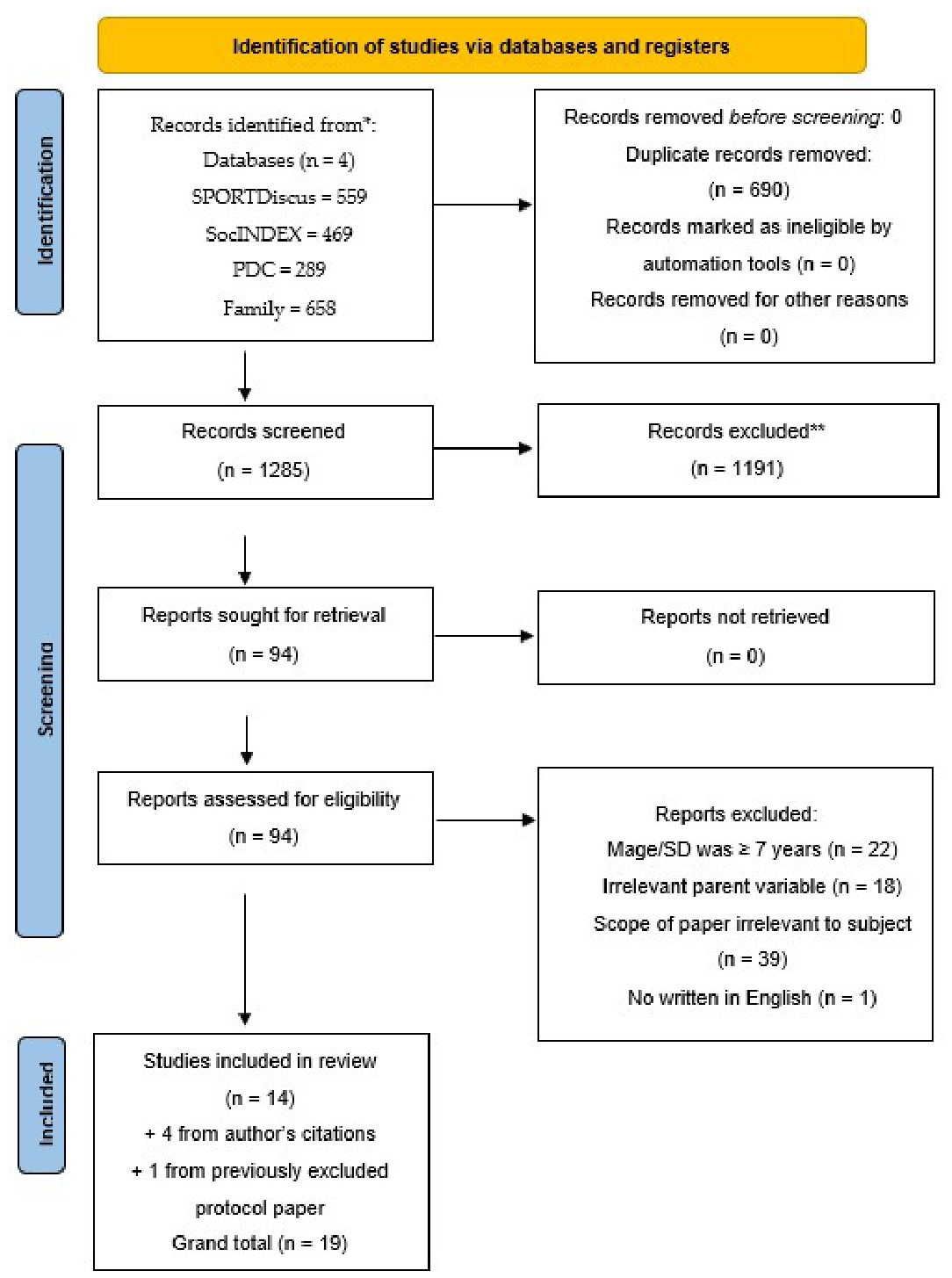
Table 2.
Background (country, focus, participants/setting, research design) for each study, N = 19.
| Author and Year | Country | Primary Focus of Study | Participants and Setting | Research Design |
|---|---|---|---|---|
| Cools et al. (2011) | Belgium | The focus of this study was to examine the relationships between preschool children’s FMS, family (parents), and neighborhood contexts. | 846 preschool children Mage 5.1 years (SD = 0.6), N = 471 boys, N = 375 girls. Setting: Preschool. | Cross-sectional |
| Honda Barros et al. (2012) | Brazil | The focus of this study was to examine various factors and their relationship to preschool children’s low PA. | 265 children, girls Mage = 5.90 (SD = 0.90), boys Mage = 4.80 (SD = 0.80); 220 parents. Setting: Private schools. | Cross-sectional |
| Carson et al. (2015) | Canada | The focus of this study was to examine the relationships between parents and young children’s PA and screen time behaviors. | 738 children, 17.3% of children were 0-24 months, 82.7% of children were 25-71 months, 53.7% were male, 46.3% were male; 738 parents, 91.9% female, 8.1% male. Setting: Parents were recruited from childcare centers and public health and community programs. | Cross-sectional |
| Salaj et al. (2016) | Croatia | The focus of this study was to examine the motor skills of preschool children enrolled in organized exercise programs and children not enrolled in programs. | 78 children Mage 5.30 years (SD = 1.14). Setting not described. | Cross-sectional |
| Laukkanen et al. (2018) | Finland | The focus of this study was to examine the relationships between physical activity parenting (PAP) practices and child, family, and environment correlates. | 993 children Mage 5.14 years (SD = 1.14). 993 parents Mage 35.8 years (SD = 5.29), mothers N = 865, fathers N = 128. Setting: Children attended childcare centers. | Cross-sectional |
| Szeszulski et al. (2021) | United States | The focus of this study was to explore individual, parent, and home environment correlates of preschooler’s locomotor skills. | 144 children Mage 53.22 months (SD = 4.46), 78.9% Hispanic, N = 73 boys, N = 71 girls. 144 parents Mage 31.72 years (SD = 7.74), 93.1% females, 76% Hispanic. Setting: Children attended urban, community-based childcare, and education centers. | Cross-sectional |
| Sääkslahti & Niemistö (2022) | Finland | The focus of this study was to examine motor development of 2–7-year-old children and their outdoor activities. | 1,136 children between ages 2-7-years-old). Setting: Children attended early childhood centers. | Cross-sectional |
| Trost & Brooks (2021) | Australia | The focus of this study was to evaluate the Moovosity program and its impact on parent’s support, children’s FMS, and children’s PA. | 34 parent and child dyads, children Mage = 5.30 (SD = 1.3) placed in a control group (N = 17, 47.1% girls) or intervention group (N = 17, 52.9% girls). Setting: Families were recruited from the university’s listserv, database, and word of mouth. | Randomized controlled trial |
| Rutkauskaitė et al. (2021) | Lithuania | The focus of this study was to identify preschool children’s PA and evaluate its relationship with parents PA and parents’ physical fitness. | 59 children ages 5-6 years. 101 parents, N = 57 mothers, N = 44 fathers. Setting: Families were from two kindergartens. | Cross-sectional |
| Nurulfa et al. (2021) | Indonesia | The focus of this study was to examine young children’s FMS and parent’s level of involvement during the COVID-19 pandemic. | 109 children ages 2-7 years (N = 42 children were 2-3 years, N = 36 children were 4-5 years, N = 31 children were 6-7 years). Setting: Parents and children did activities at home. | Cross-sectional |
| Williams et al. (2017) | Australia | The focus of this study is to explain supported playgroup participation of Australian Aboriginal and Torres Strait Islander families and examine how participation is related to children’s, parents, and community outcomes. | 622 children ages 20-53 months, N = 304 girls, N = 304 boys. 554 children identified as Aboriginal, N = 36 were Torres Strait Islander, N = 32 were both. 622 parents, N = 561 mothers, N = 9 mothers, N = 32 aunts/uncles and adoptive /foster parents, N = 20 grandparents. N = 450 parents were Aboriginal, N = 31 were Torres Strait Islander, N = 22 were both, N = 118 were neither. Setting: Families living in urban regional and remote sites. | Longitudinal with 3 waves; Wave 2 children Mage = 25 months (SD = 5), Wave 3 Mages = 37 months (SD = 5), Wave 4 children Mage = 48 months (SD = 5). |
| Hu et al. (2014) | China | The focus of this study was to examine Chinese preschoolers’ physical fitness, motor development, and family activities. | 284 children ages 4-5 years, N = 147 boys, N = 137 girls. Setting: Preschools. | Cross-sectional |
| Neshteruk et al. (2020) | United States | The focus of this study was to describe parents screen time and PA parenting practices and examine differences in children’s PA based on the parents’ behaviors. | 319 parent-child dyads, children Mage 3.5 years (SD = 0.8), 51% male, 49% female. 319 parents ages Mage = 35.4 (SD = 6.0), 40% Black, 52% White 6% Hispanic/Latino, 8% Other. | Cross-sectional |
| Ruiz et al. (2011) | United States | The focus of this study was to examine the relationship between Hispanic parents and children’s PA levels. | 106 parent-child dyads, children Mage 4.2 years (SD = 0.9), 50.9% were females. Parents Mage 31.4 years (SD = 5.5), 97.2% were females. 81.1% of parents were of Mexican origin, 5.7% were from United States, 13.2% were from another country. Setting: Local community center. | Cross-sectional of a RCT |
| Barnett et al. (2013) | Australia | The focus of this study is to examine child, family, and environmental correlates of young children’s FMS. | 76 children and their parents, Mage 4.10 years (SD = 0.68), 55% of children were girls. Parents were 95.8% female, 66.2% were born in Australia, 33.8% were born in other countries. Setting: Preschool and childcare centers. | Cross-sectional |
| Barkin et al. (2016) | United States | The focus of this study was to examine the relationships between parents and children’s accelerometer-based PA. | 1003 parent and child dyads, children Mage 3.9 years (SD = 0.9), 75% were Latino, >10% were African American. Setting: Nashville, TN, USA; St. Paul, Minnesota, USA. | Cross-sectional of a RCT |
| Brian et al. (2022) | United States | The focus of this study was to examine the role of parental engagement in a motor skill intervention on preschool children’s FMS and PA. | 104 children Mage 48.30 months (SD = 6.90), N = 53 boys, N = 51 girls, 74% White, 12.5% Black, 11.5% Hispanic, 1.9% Multiracial. 134 Parents, N = 106 mothers, N= 20 fathers, N= 8 guardians. Parents 71.9% White, 17.8% Black, 8.1% Hispanic, .7% multiracial. Setting: Rural, early childhood center. | Quasi-experimental |
| Solis-Cordero et al. (2023) | Brazil | The focus of this study was to evaluate the effectiveness of the BEM (Brincar Ensina a Mudar, Play Teaches Change) on children’s development and interactions between caregiver and child. | 129 children and their female caregivers, children Mage = 16.3 (SD = 3.6 mos) placed in a control group (N = 63, 54% boys) or Mage 16.1 (SD = 3.2 mos) placed in an intervention group (N = 66, 56.1% boys). | Randomized controlled trial |
| Onyango et al. (2023) | Kenya, Zambia | The focus of this study was to examine the associations between maternal stimulation and child developmental outcomes. | 220 mother-infant pairs from Kenya (51.8% female child), mother’s Mage = 26.7 (SD = 8.7), 340 mother-infant pairs from Zambia (50.0% female child), mother’s Mage = 27.4 (SD = 8.3). In Kenya, mothers were recruited from Ayucha, Border 1, and Wanganga sub-locations of the Awasi Ward. In Zambia, mothers were recruited from the Mwantaya and Chamuku Wards. | Cross-sectional |
Table 3.
Parent and children variables, data sources, analyses, and outcomes for each study, N = 19.
Table 3.
Parent and children variables, data sources, analyses, and outcomes for each study, N = 19.
| Author and Year | Parent Variable(s) | Child Variable(s) | Data Source(s) | Analysis | Outcome(s) |
|---|---|---|---|---|---|
| Cools et al. (2011) | Parents (mothers, fathers) PA, parents (mothers, fathers) involvement in children’s play, parents (mothers, fathers) inquiry about child’s motor development, parent’s beliefs about children’s PA | FMS (fine, gross motor skills) | Parent questionnaire (Parents PA, parents’ involvement in children’s play, parent’s inquiry about motor development, parents beliefs about children’s PA); child assessment, Motoriktest für Vier- bis Sechsjährige Kinder (MOT 4-6) | Partial Pearson correlation, two-way ANCOVAs, Least significant differences (LSD) | Boys: Father’s PA was positively associated with boys FMS performance. Higher parental inquiry about girl’s motor development was significantly, negatively related to girls FMS. Father’s involvement in boy’s active play was significantly related to boy’s greater FMS performance. Father involvement in girls dance activities was significantly negatively related to girls low FMS. There was a significantly positive relationship between parent’s beliefs (importance) of children’s PA and boys FMS. Fathers who were physically active less than one time per month had children with significantly lower FMS. Fathers who reported daily PA also had children who scored significantly lower on their FMS. |
| Honda Barros et al. (2012) | Parents and partners practice of PA (yes/no) | PA (duration in minutes) | Parent questionnaire administered face to face (Parents, partners, children’s PA) | Descriptives, chi-square, binary logistic regression | 28.5% of mothers and 32.6% of fathers practiced PA. Mothers and fathers practice of PA were not significant predictors for children’s low level of PA. |
| Carson et al. (2015) | Parents PA (frequency) | PA (frequency, duration) | Parent questionnaire (Parent PA, Godin Leisure Time Exercise Questionnaire; child PA, Statistic Canada’s National Longitudinal Study of Children and Youth (NLSCY) | Descriptives, correlations, logistic regression models | Parents PA was significantly positively related to children’s PA. Parents who were categorized in the low PA quartile were 2.77 times more likely to have a child in the low PA quartile, compared to parents who were categorized in the high PA quartile. The family structure (single, two parent homes) was a modifier in that parents PA of two parent homes who were categorized in the first and second PA quartiles had a significantly higher chance of having a child in the low PA quartile. However, in single parent homes, parents PA was not related to children’s low PA. |
| Salaj et al. (2016) | Parents PA (frequency and duration of moderate and strenuous PA, walking) | FMS (locomotor, manipulative skills, gross motor quotient), PA (duration) | Parent questionnaire (Parents PA, International Physical Activity Questionnaire, child’s PA); child assessment, Test of Gross Motor Development-2 | One-way ANOVA, Bonferroni post-hoc test | Parents strenuous PA was significantly positively associated with children’s FMS. Parents average daily walking was significantly positively associated with children’s FMS. |
| Laukkanen et al. (2018) | Parents PAP practices (co-participation, direct support, encouragement), partners PAP practices frequency (co-participation, direct support, encouragement), parents’ perception of partners PAP practices, parent and partners exercise frequency | FMS (locomotor, object-control skills) | Parent questionnaire (PAP practices: co-participation, direct support, encouragement, Family Physical Activity Environment Questionnaire, parents’ perception of partners PAP practices, parent and partners exercise frequency); child assessment, Test of Gross Motor Development-3 | Mann-Whitney U tests, descriptive, independent sample t-test, hierarchical linear mixed models | Fathers had significantly greater PAP practices and direct support for their children’s PA compared to mothers. Boys scored significantly greater on FMS compared to girls. The parents exercise frequency (partially) significantly predicted their PAP practices. Partners PAP practices (partially) significantly predicted the parents PAP practices. |
| Szeszulski et al. (2021) | Parents PA parenting practices (encouragement, discouragement of PA), parents PA | LS | Parent questionnaire (PA parenting practices, Preschooler Physical Activity Parenting Practices instrument, PA, Stanford Leisure Time-Categorical Item); child assessments, Progressive Aerobic Cardiovascular Endurance Run (PACER), CHAMPS motor skill protocol (CMSP) | Descriptives, independent t-test, chi-square test, Pearson, point-biserial correlation, stepwise regression | Parent’s discouraging PA practices (i.e., promotion of screen time) was significantly associated with greater PACER and CMSP scores. Parent’s discouraging PA practice (i.e., concern for children’s safety) was significantly associated with lower PACER scores. Parents own PA level was not significantly related to children’s locomotor skills on the PACER or CMSP. |
| Sääkslahti & Niemistö (2022) | Parents answered questions about their child’s PA. | FMS (locomotor, ball skills, gross motor quotient) | Parent questionnaire (about child PA); child assessment, Test of Gross Motor Development-3 | Descriptives, linear mixed effects model, hierarchical linear regression models | Parent’s perspective of their children’s FMS and enjoyment of PA were related to a child’s better FMS. |
| Trost & Brooks (2021) | Parents support for child PA | FMS (locomotor, object control skills), PA | Parent checklists (5-item scale by Trost et al. (2013), Burdette outdoor playtime checklist); child assessment, Test of Gross Motor Development-2 | General linear mixed models, Cohen’s D | The Moovosity program had a significant impact on the intervention group’s object control skills, but not on their locomotor skills. The effect was large for object control skills and medium for locomotor skills. The program did not have a significant impact on children’s PA or parents’ support. The impact on children’s PA was trivial and small for parents support of children’s PA. |
| Rutkauskaitė et al. (2021) | Parents PA (frequency, duration, intensity) | PA, Actigraph accelerometer, questions answered by parent | Parent questionnaire (Parents PA, child PA); child ActiGraph accelerometer device | Descriptives, ANOVA, chi-square test, Pearson correlation | 72.6% of parents were sufficiently active and 27.4% of parents were insufficiently active. Mothers and fathers rated their PA similarly, but fathers rated their physical fitness higher. Mothers with children 6 years of age indicated their children’s PA significantly higher than mothers of children ages 5 years. There were no significant relationships between parents’ and children’s PA. |
| Nurulfa et al. (2021) | Parent involvement (support and appreciation of each other, interaction) | FMS (stationary, locomotor, object manipulation) | Parent and child, video recordings; child assessment, Peabody Developmental Motor Scale-2 | Descriptives | Parental involvement (support and appreciation of each other, interaction) was higher for children ages 4-5 years |
| Williams et al. (2014) | Parent engagement in home activities at Wave 2 (2-3 years) and Wave 4 (4-5 years) | FMS at Wave 4, (ages 4-5 years) | Face-to-face interview (parent engagement); child assessments, functional motor skills (5-parent reported items) | Path analysis | The path between playgroup participation at 2-3 years (through parent engagement in home activities at 4 years) and child functional motor skills at 4 years was not significant. |
| Hu et al. (2014) | Parental Attitude Toward Physical Activities Scale | FMS (manual dexterity, aiming and catching, balance) | Parent questionnaire (Parents attitude, Parental Attitude Towards Physical Activities Scale); child assessment, Movement Assessment Battery for Children-Second Edition | One-way ANOVAs, hierarchical multiple regression analysis | Parental (positive) attitude was not a predictor of children’s motor ability. Parental attitude was a negative predictor of post coins by non-dominant hand in motor test. |
| Neshteruk et al. (2020) | Parents PA, PA practices | PA | Parent questionnaire (PA, parenting practices), Actigraph accelerometer; child Actigraph accelerometer | Latent profile analysis | Three groups of parents were identified: Rewarder, Activity Supportive, Screen Time Permissive. There were no significant differences in children’s MVPA between the 3 groups. Children in the Rewarder group spent the most time in MVPA, followed by Activity Supportive, and Screen Time children. |
| Ruiz et al. (2011) | Parents PA (low, moderate, vigorous) | PA (low, moderate, vigorous) | Parent and child, Actigraph accelerometer | Pearson correlations, Cohens d | Parent’s and children’s low and moderate PA were significantly correlated. Parent’s and children’s vigorous PA was not. |
| Barnett et al. (2013) | Parents perception of children’s motor skills, Parents confidence to support children’s PA, Parents interaction with children’s PA, Parents moderate and vigorous PA (minutes) | PA, FMS (locomotor, object control skills) | Parent survey (Parents perception of children’s motor skills, Parents confidence to support children’s PA, Parents interaction with children’s PA, Parents moderate and vigorous PA (minutes); child assessment, Actigraph accelerometer, Test of Gross Motor Development-2 | Multiple regression models | Most parents do not agree that their child does not have good motor skills. Parent’s confidence for children’s PA, parent’s interaction with children’s PA, and parent’s moderate and vigorous PA were not significant predictors of children’s locomotor skills. Parent’s interaction with children’s PA, and parent’s moderate and vigorous PA were not significant predictors of children’s object control skills. Parent’s confidence of children’s PA was a significant predictor of children’s object control skills. |
| Barkin et al. (2016) | Parents PA | PA | Parent and child, Actigraph accelerometer | Descriptives, multiple linear regressions | For each 1-minute increase in parent’s light PA, children’s light PA increased by 0.06 minutes. As parents’ MVPA increased from 1 to 10 minutes, children’s MVPA increased from 95 to 98.5 minutes. As parent’s MVPA increases from 30 to 40 minutes, children’s MVPA increased from 103 to 103.5 minutes. When parents’ MVPA increased from 40 to 50 minutes, children’s MVPA decreased from 103.5 to 102.5 minutes. |
| Brian et al. (2022) | Parent engagement frequency | FMS (locomotor, ball skills), PA | Parent survey (engagement frequency); child assessment, Test of Gross Motor Development-3, Movband 4 | Descriptives, one-way ANCOVA, linear regression | For each session attended by parents, children’s locomotor skills increased by 1.87 when assessed at retention For each session attended by parents, children’s object manipulation skills increased by 1.95 at retention. When parents attended a session, there was a 1455 step increase in children’s PA. |
| Solis-Cordero et al. (2023) | Quality of caregiver-child interactions (involvement), Caregiver’s engagement in play activities | FMS (fine, gross motor skills) | Quality of caregiver-child interactions (Coding Interactive Behavior tool), Caregiver’s engagement in play activities (5-minute video) child assessment, Ages and Stages Questionnaire-3 | Descriptives, t-test, Wilcoxon-Mann-Whitney test, chi-square, linear mixed models, general linear mixed models, Cohen’s d. | The BEM program did not significantly improve the intervention group’s fine and gross motor skills. However, the intervention group showed improvement in their fine and gross motor skills at endline in comparison to the control group. The BEM program did not have a significant effect on the intervention group’s caregiver involvement. However, caregiver involvement slightly improved at endline compared to the control group. Finally, the BEM program did not have a signficant effect on caregiver’s engagement in children’s play activities. Engagement increased for the intervention group at endline in comparison to the control group. |
| Onyango et al. (2023) | Maternal motor stimulation activities | FMS (gross, fine motor skills) | Maternal stimulation (interviews); child assessment, Ages and Stages Questionnaire-3 | Descriptives, linear regression, multiple linear regression, effect size | Maternal motor stimulation activities increased in both countries from baseline to endline. Maternal stimulation activities had the largest effect size on children’s gross motor skills. |
Table 4.
Summary of 53 parent’s variables.
| Author(s) and Year | Variables | Parents Own PA | Parents PA Practices | Parents Engagement |
Parents Psychological Characteristics |
|---|---|---|---|---|---|
| Cools et al. (2011) | Parents (mothers, fathers) PA, parents (mothers, fathers) involvement in children’s play, parents (mothers, fathers) inquiry about child’s motor development, parent’s beliefs about children’s PA | 2 | 2 | 2 | 1 |
| Honda Barros et al. (2012) | Parents and partners practice of PA (yes/no) | 2 | |||
| Carson et al. (2015) | Parents PA (frequency) | 1 | |||
| Salaj et al. (2016) | Parents PA (frequency and duration of moderate and strenuous PA, walking) | 3 | |||
| Laukkanen et al. (2018) | Parents PAP practices (co-participation, direct support, encouragement), partners PAP practices frequency (co-participation, direct support, encouragement), parents’ perception of partners PAP practices, parent and partners exercise frequency | 2 | 6 | 1 | |
| Szeszulski et al. (2021) | Parents PA parenting practices (encouragement, discouragement of PA), parents PA | 1 | 6 | ||
| Sääkslahti & Niemistö (2022) | Parents answered questions about their child’s PA. | 2 | |||
| Trost & Brooks (2021) | Parents support for child PA | 1 | |||
| Rutkauskaitė et al. (2021) | Parents PA (frequency, duration, intensity) | 1 | |||
| Nurulfa et al. (2021) | Parent involvement (support and appreciation of each other, interaction) | 2 | |||
| Williams et al. (2014) | Parent engagement in home activities at Wave 2 (2-3 years) and Wave 4 (4-5 years) | 1 | |||
| Hu et al. (2014) | Parental Attitude Toward Physical Activities Scale | 1 | |||
| Neshteruk et al. (2020) | Parents PA, PA practices | 1 | 1 | ||
| Ruiz et al. (2011) | Parents PA (low, moderate, vigorous) | 3 | |||
| Barnett et al. (2013) | Parents perception of children’s motor skills, Parents confidence to support children’s PA, Parents interaction with children’s PA, Parents moderate and vigorous PA (minutes) | 2 | 1 | 2 | |
| Barkin et al. (2016) | Parents PA | 2 | |||
| Brian et al. (2022) | Parent engagement frequency | 1 | |||
| Solis-Cordero et al. (2023) | Quality of caregiver-child interactions (involvement), Caregiver’s engagement in play activities | 2 | |||
| Onyango et al. (2023) | Maternal motor stimulation activities | 1 |
Table 5.
Summary of 33 children’s variables.
| Author and Year | Variables | FMS | PA |
|---|---|---|---|
| Cools et al. (2011) | FMS, MOT (4-6) total score | 1 | |
| Honda Barros et al. (2012) | PA, duration in minutes | 1 | |
| Carson et al. (2015) | PA, frequency, duration | 1 | |
| Salaj et al. (2016) | FMS, gross motor quotient; PA, duration | 1 | 1 |
| Laukkanen et al. (2018) | FMS, Test of Gross Motor Development-3 total score | 1 | |
| Szeszulski et al. (2021) | LS, completed laps on PACER, locomotor score on CMSP | 2 | |
| Sääkslahti & Niemistö (2022) | FMS, gross motor quotient | 1 | |
| Trost & Brooks (2021) | FMS, locomotor skills raw score, object control skills raw score; PA, duration (activity index) | 2 | 1 |
| Rutkauskaitė et al. (2021) | PA, total and average time spent in sedentary, light, moderate, vigorous, MVPA, questions answered by parent | 2 | |
| Nurulfa et al. (2021) | FMS, Peabody Developmental Motor Scale score | 1 | |
| Williams et al. (2014) | FMS, Functional motor skills (5-parent reported items) at Wave 4, 4-5 years | 1 | |
| Hu et al. (2014) | FMS, MABC-2 total score | 1 | |
| Neshteruk et al. (2020) | PA, minutes in MVPA | 1 | |
| Ruiz et al. (2011) | PA, minutes per day in light, moderate, vigorous | 3 | |
| Barnett et al. (2013) | PA, % of time in MVPA; FMS, locomotor, object control skills scores | 2 | 1 |
| Barkin et al. (2016) | PA, minutes per day in light, MVPA | 2 | |
| Brian et al. (2022) | FMS, locomotor skills raw score, ball skills raw score; PA, moves | 2 | 1 |
| Solis-Cordero et al. (2023) | FMS (fine, gross motor skills) | 2 | |
| Onyango et al. (2023) | FMS (fine, gross motor skills) | 2 |
Disclaimer/Publisher’s Note: The statements, opinions and data contained in all publications are solely those of the individual author(s) and contributor(s) and not of MDPI and/or the editor(s). MDPI and/or the editor(s) disclaim responsibility for any injury to people or property resulting from any ideas, methods, instructions or products referred to in the content. |
© 2026 by the authors. Licensee MDPI, Basel, Switzerland. This article is an open access article distributed under the terms and conditions of the Creative Commons Attribution (CC BY) license.
Copyright: This open access article is published under a Creative Commons CC BY 4.0 license, which permit the free download, distribution, and reuse, provided that the author and preprint are cited in any reuse.