
Submitted:
20 August 2026
Posted:
20 August 2026
You are already at the latest version
Abstract
Healthy lifestyle behaviors established during childhood shape health trajectories across the lifespan. Although considerable evidence supports the benefits of physical activity, healthy eating, adequate sleep, and limited sedentary behavior, interventions targeting these behaviors often yield modest and short-term effects. This perspective argues that childhood health promotion should move beyond individual behavior change toward an ecological framework integrating family, school, community, healthcare, and digital environments. We discuss how social determinants of health, socioeconomic inequalities, mental well-being, and digital technologies interact to influence children’s lifestyle behaviors. We also highlight the growing role of artificial intelligence, wearable technologies, and personalized health promotion in supporting healthier lifestyles while emphasizing ethical and equity considerations. Finally, we propose priorities for future research, policy development, and multidisciplinary interventions that recognize children as active participants within interconnected social systems. This perspective aims to stimulate discussion on innovative strategies capable of generating sustainable improvements in child health.
Keywords:
child health
; healthy lifestyles
; lifestyle behaviors
; ecological framework
; health promotion
; digital health
; artificial intelligence
; life course
; health equity
; implementation science
1. Introduction
Childhood represents a critical developmental period during which health behaviors are established and maintained across the life course. Physical activity, healthy eating, adequate sleep, limited sedentary behavior, and emotional well-being are strongly associated with physical, cognitive, psychosocial, and metabolic health throughout adulthood [1,2,3,4,5]. Consequently, promoting healthy lifestyles during childhood has become a major public health priority worldwide.
Despite substantial advances in preventive medicine, adherence to international recommendations for physical activity, nutrition, sleep, and screen time remains insufficient in many countries. Childhood overweight and obesity continue to increase globally, while physical inactivity, excessive recreational screen exposure, poor diet quality, and inadequate sleep frequently coexist and interact, producing cumulative adverse effects on health and development [6,7,8,9,10,11,12].
Accumulating evidence indicates that these behaviors rarely occur independently. Instead, they form interconnected behavioral clusters influenced by reciprocal biological, psychological, family, educational, environmental, socioeconomic, and cultural determinants [13,14,15,16,17]. Therefore, interventions addressing a single behavior often achieve only modest and short-term improvements because they fail to consider the broader contexts in which children live and develop.
Traditional health promotion strategies have primarily focused on increasing knowledge and individual motivation through educational interventions. Although these approaches improve awareness, their long-term effectiveness is generally limited because children’s opportunities to adopt healthy lifestyles depend largely on family routines, parenting practices, school environments, neighborhood characteristics, healthcare systems, social inequalities, and public policies [18,19,20,21,22,23].
In parallel, the rapid expansion of digital technologies—including mobile health applications, wearable sensors, artificial intelligence (AI), telemedicine, and personalized health platforms—is transforming childhood health promotion. These technologies offer unprecedented opportunities for behavioral monitoring, individualized interventions, and precision public health. However, they also raise important concerns regarding privacy, digital literacy, algorithmic bias, commercial influences, excessive screen exposure, and unequal access to technology [24,25,26,27,28,29].
Current conceptual models have significantly improved understanding of childhood health determinants but generally emphasize either individual behaviors or traditional ecological environments. Few frameworks explicitly integrate digital ecosystems, social determinants of health, implementation science, and systems thinking within a unified model capable of guiding research, clinical practice, education, and health policy [30,31,32,33,34].
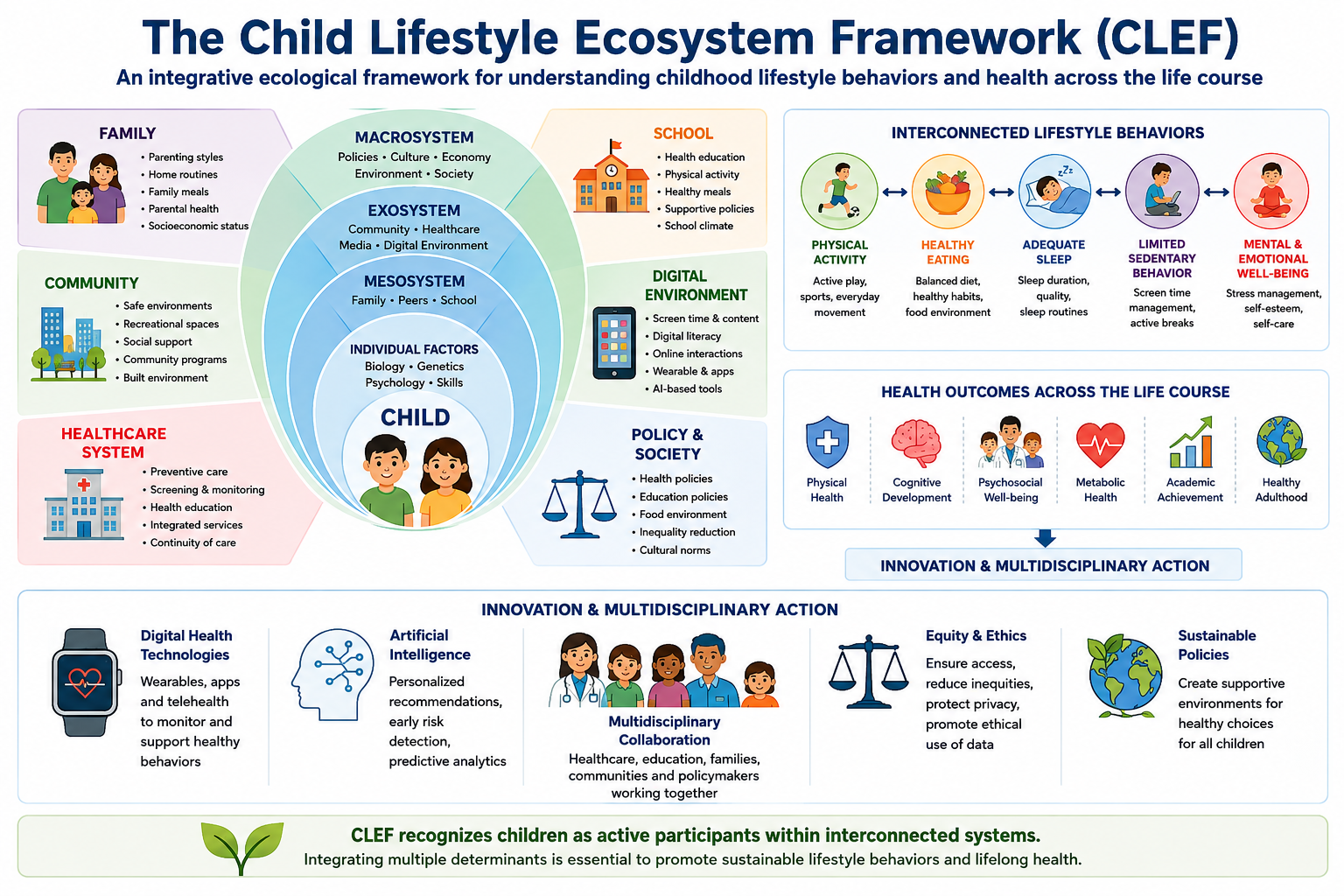
To address this gap, we propose the Child Lifestyle Ecosystem Framework (CLEF), an ecological and systems-oriented conceptual model that places children at the center of multiple interacting environments, including biological, family, school, community, policy, and digital ecosystems. Rather than viewing lifestyle behaviors as isolated outcomes, CLEF conceptualizes physical activity, nutrition, sleep, sedentary behavior, and mental well-being as mutually reinforcing components of a dynamic adaptive system. This framework aims to support interdisciplinary research, multilevel interventions, and evidence-informed public policies designed to improve child health in an equitable and sustainable manner [35,36,37,38,39,40].
The objective of this review is to propose the Child Lifestyle Ecosystem Framework (CLEF), an integrative conceptual model that explains how multiple determinants interact to shape lifestyle behaviors and lifelong health trajectories.
Moving Beyond Individual Behaviors: An Ecological Perspective on Childhood Lifestyle Promotion
For decades, childhood health promotion has largely focused on modifying individual behaviors through health education, counseling, and information campaigns. Although these strategies have contributed to greater awareness of healthy eating, physical activity, and sleep hygiene, their long-term effectiveness has generally been modest because knowledge alone is insufficient to sustain behavioral change in complex social environments [41,42,43,44].
Children do not make health-related decisions independently. Their opportunities to engage in physical activity, consume healthy foods, obtain sufficient sleep, and regulate recreational screen time are strongly influenced by the environments in which they are born, grow, learn, and play. Consequently, lifestyle behaviors should be understood as the product of continuous interactions among biological characteristics, family relationships, educational settings, neighborhood conditions, healthcare systems, socioeconomic circumstances, and public policies [45,46,47,48,49].
The family constitutes the primary ecological context for the establishment of healthy routines. Parenting practices influence children’s dietary behaviors, sleep schedules, physical activity participation, emotional regulation, and media use through role modeling, rule setting, emotional support, and resource availability. Family cohesion and parental health literacy consistently predict healthier behavioral patterns throughout childhood [50,51,52].
Schools represent the second major ecosystem influencing children’s health. Beyond academic education, schools provide opportunities for physical activity, nutrition education, social inclusion, mental health promotion, and health literacy. Comprehensive whole-school approaches that actively involve teachers, families, healthcare professionals, and local communities have demonstrated greater effectiveness than interventions limited to classroom-based education [].
Community environments also play a decisive role. Access to safe neighborhoods, parks, active transportation infrastructure, sports facilities, healthy food retailers, and primary healthcare services facilitates healthy behaviors. Conversely, socioeconomic disadvantage, food insecurity, neighborhood violence, environmental pollution, and limited recreational opportunities create structural barriers that contribute to persistent health inequalities [53].
At the societal level, public policies shape the conditions under which families and communities function. Policies addressing school nutrition standards, food marketing directed at children, urban planning, taxation of sugar-sweetened beverages, active transport, healthcare accessibility, and social protection influence children’s opportunities to adopt healthy lifestyles. These structural determinants demonstrate that childhood health promotion cannot rely solely on individual responsibility but requires coordinated multisectoral action [54,55,56,57].
An increasingly influential component of childhood development is the digital ecosystem. Mobile technologies, social media, wearable devices, telemedicine, educational platforms, and artificial intelligence have transformed children’s daily experiences. Digital innovations offer opportunities for personalized health promotion, behavioral monitoring, and improved access to health information. At the same time, they introduce new challenges, including excessive recreational screen time, exposure to unhealthy food marketing, misinformation, cyberbullying, privacy concerns, and widening digital inequalities [58,59,60,61,62].
Taken together, these interconnected influences indicate that childhood lifestyle behaviors emerge from complex adaptive systems rather than isolated individual choices. Therefore, interventions targeting a single behavior without considering the surrounding ecological context are unlikely to produce sustained improvements. Future health promotion strategies should embrace systems thinking and ecological approaches that integrate family, school, community, healthcare, policy, and digital environments into coordinated multilevel interventions. This ecological perspective provides the conceptual foundation for the Child Lifestyle Ecosystem Framework (CLEF) proposed in the following section [63,64,65,66].
2. Methodology
2.1. Study Design
This study presents the Child Lifestyle Ecosystem Framework (CLEF), a conceptual ecological model developed through an integrative narrative review and thematic synthesis of the multidisciplinary literature. This methodological approach was selected because the primary objective was not to evaluate intervention effectiveness, but rather to integrate existing theoretical and empirical evidence into a comprehensive framework capable of explaining the complex determinants of childhood lifestyle behaviors and health across the life course.
2.2. Literature Search Strategy
A structured literature search was conducted in the electronic databases PubMed/MEDLINE, Scopus, and Web of Science to identify publications addressing childhood health promotion, lifestyle behaviors, ecological models, digital health, and social determinants of health. Searches were complemented by manual screening of the reference lists of key articles and seminal theoretical publications to identify additional relevant studies.
The search combined Medical Subject Headings (MeSH) and free-text terms, including: child health, healthy lifestyle, physical activity, nutrition, sleep, sedentary behavior, mental health, health promotion, ecological model, socioecological model, Bronfenbrenner, digital health, artificial intelligence, wearable technology, implementation science, systems thinking, life course, and health equity. Boolean operators (“AND” and “OR”) were used to optimize the search strategy.
2.3. Eligibility Criteria
Priority was given to peer-reviewed original studies, systematic reviews, meta-analyses, conceptual articles, international policy documents, and consensus statements published in English. Because the objective was conceptual integration, no strict publication date restriction was applied. Seminal ecological theories were included alongside recent literature describing advances in digital health, artificial intelligence, implementation science, and precision public health.
Studies focusing exclusively on isolated lifestyle behaviors without ecological or systems perspectives were considered only when they contributed evidence supporting interactions among biological, family, school, community, policy, or digital determinants.
2.4. Conceptual Synthesis and Framework Development
The selected literature was examined using an iterative thematic synthesis. Relevant concepts describing determinants of childhood lifestyle behaviors were identified, compared, and grouped into recurrent ecological domains. Existing ecological theories—particularly Bronfenbrenner’s Bioecological Model and contemporary socioecological frameworks—provided the theoretical foundation for organizing the evidence.
The synthesis identified six major interacting domains influencing childhood lifestyle behaviors: Biological and Developmental Factors, Family Environment, School Environment, Community and Built Environment, Digital Ecosystem, and Policy and Society. These domains were subsequently integrated into the Child Lifestyle Ecosystem Framework (CLEF), which conceptualizes the child as an active participant within a dynamic system characterized by reciprocal interactions among biological, social, environmental, technological, and policy determinants.
Particular emphasis was placed on incorporating the digital ecosystem as a core ecological domain, reflecting the growing influence of artificial intelligence, mobile health technologies, wearable devices, telemedicine, and digital platforms on children’s health behaviors and healthcare delivery. In addition, principles of health equity, implementation science, and the life-course perspective were integrated as cross-cutting components of the framework.
2.5. Methodological Considerations
Because this was an integrative narrative review, the selection and synthesis of literature were iterative and concept-driven rather than governed by a prespecified systematic-review protocol. This approach supports conceptual integration but limits reproducibility compared with a systematic review, particularly because exact search dates and record counts were not prospectively documented.
2.6. Generative Artificial Intelligence Disclosure
During preparation of this manuscript, OpenAI ChatGPT (GPT-5.5) was used for language editing, improvement of scientific writing, and refinement of conceptual figures. The authors critically reviewed and edited the output and take full responsibility for the accuracy, integrity, and final content of the manuscript. No original data, analyses, or scientific conclusions were generated by the tool.
As a conceptual study based exclusively on previously published literature, this work did not involve human participants, patient data, or experimental procedures; therefore, ethical approval and informed consent were not required.
The purpose of the CLEF is to provide an updated conceptual framework that extends existing ecological perspectives by integrating contemporary evidence from public health, pediatrics, behavioral sciences, digital health, and systems thinking. Rather than replacing established ecological models, CLEF complements and expands them by explicitly incorporating digital determinants and emphasizing the dynamic interactions among ecological domains that shape children’s lifestyle behaviors and health trajectories.
3. The Child
Contemporary childhood health is shaped by complex and dynamic interactions among biological, behavioral, social, environmental, technological, and political determinants. Although ecological frameworks—particularly Bronfenbrenner’s Bioecological Model and socioecological approaches—have substantially advanced understanding of child development, they were conceived before the widespread integration of digital technologies into children’s daily lives. Consequently, current frameworks only partially capture the growing influence of digital environments, artificial intelligence (AI), wearable technologies, telehealth, and data-driven health systems on childhood lifestyle behaviors.
CLEF differs from established ecological and socioecological frameworks not by replacing their multilevel logic, but by combining four explicit extensions within one child-centered model: (1) a distinct digital ecosystem alongside biological, family, school, community, and policy domains; (2) lifestyle behaviors conceptualized as an interconnected behavioral system rather than independent outcomes; (3) implementation science as a cross-cutting translational component; and (4) health equity explicitly embedded across ecological levels. This combination is intended as the principal conceptual contribution of CLEF.
The Child Lifestyle Ecosystem Framework (CLEF) was developed to address this conceptual gap. Rather than replacing existing ecological theories, CLEF builds upon their foundational principles while extending them to reflect contemporary childhood. Specifically, the framework introduces the digital ecosystem as a distinct ecological domain, conceptualizes lifestyle behaviors as an integrated adaptive system, incorporates implementation science to facilitate translation into practice, and explicitly embeds health equity across all ecosystem levels.
Unlike approaches that examine physical activity, nutrition, sleep, sedentary behavior, or mental health independently, CLEF recognizes these behaviors as mutually reinforcing components of a dynamic system in which changes in one domain influence the others through reciprocal feedback mechanisms. This systems perspective provides a more comprehensive foundation for designing multidisciplinary interventions capable of producing sustainable improvements in child health.
The framework also emphasizes that children are active participants within their environments. Their biological characteristics, developmental stage, cognitive abilities, emotional regulation, and previous experiences influence how they interact with family members, schools, communities, healthcare systems, and digital technologies. At the same time, these environments continuously shape children’s behaviors and developmental trajectories. This reciprocal relationship represents a central principle of CLEF and reinforces the need for multilevel interventions that simultaneously address individual, social, environmental, and structural determinants.
Accordingly, CLEF provides a translational conceptual framework that integrates pediatric medicine, public health, behavioral sciences, education, digital health, implementation science, and systems thinking. By combining these disciplines, the framework offers a common language for researchers, clinicians, educators, and policymakers seeking to promote healthier childhood environments and reduce health inequalities across the life course.
3.1. The Child at the Centre of the Ecosystem
At the centre of the Child Lifestyle Ecosystem Framework is the child, regarded as an active agent of development rather than a passive recipient of environmental influences. Lifestyle behaviours emerge through continuous interactions between biological maturation, cognitive development, emotional regulation, personal experiences, and surrounding ecological contexts.
Children’s responses to health promotion strategies vary according to age, developmental stage, temperament, health status, cultural background, and family circumstances. Consequently, interventions should be adapted to developmental needs while promoting autonomy, health literacy, self-efficacy, and shared decision-making with parents, caregivers, educators, and healthcare professionals.
Recognising children as active participants also aligns CLEF with contemporary child-centred approaches to health promotion, in which children’s perspectives and lived experiences contribute to the design and implementation of interventions.
3.2. Six Interacting Ecological Domains
The Child Lifestyle Ecosystem Framework comprises six interconnected domains that continuously influence one another.
Biological and Developmental Domain
This domain encompasses genetic predisposition, growth, neurodevelopment, motor competence, sleep physiology, metabolic regulation, and emotional maturation. Biological factors create the foundation upon which lifestyle behaviours develop but interact continuously with environmental exposures throughout childhood.
Family Domain
Families represent the primary environment in which healthy routines are established. Parenting practices, emotional support, communication, health literacy, socioeconomic resources, and household routines influence nutrition, physical activity, sleep, screen use, and psychological well-being.
Educational Domain
Schools provide an essential context for health promotion through physical education, nutrition programmes, mental health support, health literacy, and social inclusion. Whole-school approaches integrating teachers, families, healthcare providers, and community organisations offer greater potential for sustainable behavioural change than isolated educational interventions.
Community and Built Environment
Neighbourhood safety, green spaces, walkability, recreational facilities, healthy food availability, transportation systems, healthcare accessibility, and social cohesion collectively shape opportunities for healthy living. Conversely, socioeconomic disadvantage and environmental inequalities create structural barriers that limit healthy choices.
Digital Ecosystem
The Digital Ecosystem constitutes the principal innovation of CLEF. Digital technologies—including mobile applications, wearable sensors, telemedicine, social media, educational platforms, conversational AI, and predictive analytics—have become integral components of children’s everyday lives.
Digital environments create opportunities for personalised prevention, behavioural monitoring, remote healthcare, and health education while simultaneously introducing challenges such as excessive screen exposure, cyberbullying, misinformation, commercial marketing, algorithmic bias, privacy concerns, and digital inequities.
Rather than viewing digital technologies solely as risks or opportunities, CLEF conceptualises them as ecological determinants interacting continuously with all other ecosystem levels.
Policy and Societal Domain
Public policies influence every ecological level by shaping educational systems, healthcare access, food environments, urban planning, transportation, social protection, and digital governance. Policies promoting equity create supportive environments that enable healthy choices, whereas structural inequalities constrain opportunities for healthy development.
4. Artificial Intelligence, Digital Health, and Precision Public Health: Opportunities and Challenges for Childhood Lifestyle Promotion
The rapid expansion of digital technologies is reshaping the landscape of childhood health promotion. Mobile health applications, wearable devices, remote monitoring systems, telemedicine, and artificial intelligence (AI) are increasingly integrated into children’s daily lives and healthcare delivery. These innovations create opportunities to personalize health promotion strategies, improve early detection of unhealthy behaviors, and strengthen preventive interventions across multiple settings.
AI has particular potential to support childhood lifestyle promotion by integrating data from diverse sources, including physical activity trackers, sleep monitors, dietary records, electronic health records, and environmental indicators. Machine learning algorithms may identify behavioral patterns associated with obesity, poor sleep, sedentary lifestyles, or mental health difficulties before they become clinically apparent. Such predictive capabilities could enable earlier, more individualized interventions while supporting clinicians and families in decision-making.
Wearable technologies further extend these possibilities by providing continuous and objective measures of physical activity, sedentary behavior, sleep duration, heart rate, and other health indicators. Combined with AI-driven feedback systems, these tools may increase motivation, facilitate goal setting, and promote self-monitoring among children and adolescents. Importantly, however, digital interventions should complement—not replace—human relationships within families, schools, and healthcare systems.
The concept of Precision Public Health offers an additional opportunity to strengthen childhood health promotion. By integrating epidemiological, behavioral, environmental, and digital data, precision public health aims to deliver the right intervention to the right population at the right time. Within the CLEF framework, this approach recognizes that children’s needs vary according to developmental stage, socioeconomic context, cultural background, health status, and environmental exposures. Consequently, interventions should be adapted to local realities rather than relying on universal strategies.
Despite these promising developments, digital innovation also presents important ethical and practical challenges. Children’s health data require robust protections to ensure privacy, confidentiality, and informed consent. AI algorithms trained on non-representative datasets may reinforce existing health inequities if they perform less accurately in disadvantaged populations. Furthermore, unequal access to digital technologies and internet connectivity may widen disparities between children from different socioeconomic backgrounds, limiting the reach of digital health interventions.
Commercial influences also deserve careful consideration. Many digital platforms expose children to targeted advertising of energy-dense foods, sugar-sweetened beverages, and other unhealthy products. Algorithm-driven content may encourage prolonged screen time, reduce sleep quality, and influence dietary preferences. Accordingly, regulatory frameworks should evolve alongside technological innovation to protect children’s health while promoting responsible digital environments.
Future research should move beyond evaluating isolated digital tools and instead examine how AI and digital health can be integrated into comprehensive, multilevel interventions consistent with the CLEF framework. Randomized controlled trials, implementation studies, and longitudinal cohort studies are needed to determine which combinations of digital technologies, family engagement, school-based programs, and community interventions produce sustained improvements in lifestyle behaviors and health outcomes.
Ultimately, AI should be viewed not as an end in itself but as an enabling technology that enhances the capacity of families, educators, healthcare professionals, and policymakers to support healthier childhood environments. Sustainable health promotion will depend on balancing technological innovation with human-centered care, equity, transparency, and ethical governance.
5. Lifestyle Behaviors Should Be Treated as an Integrated System
Lifestyle behaviors rarely occur independently. Instead, they form interconnected behavioral clusters that influence one another through multiple physiological, psychological, and environmental pathways.
For example, inadequate sleep increases appetite-regulating hormones, leading to greater consumption of energy-dense foods. Fatigue reduces participation in physical activity while simultaneously increasing recreational screen use. Excessive screen exposure delays bedtime, reduces sleep quality, and exposes children to digital marketing promoting unhealthy dietary choices. Poor dietary quality may impair cognitive performance, emotional regulation, and physical fitness, further limiting participation in healthy activities.
These reciprocal relationships suggest that interventions targeting only one behavior may have limited effects because compensatory mechanisms may sustain unhealthy behavioral patterns elsewhere in the system.
From a systems perspective, promoting physical activity may simultaneously improve sleep quality, emotional well-being, academic performance, and social participation. Likewise, improving family meal routines may reduce screen exposure, enhance parent-child communication, and strengthen psychological resilience.
Future intervention studies should therefore evaluate behavior clusters alongside individual outcomes.
6. Conclusions
Promoting healthy lifestyles in children requires moving beyond isolated behavioral recommendations toward integrated ecological strategies that simultaneously address family dynamics, educational settings, social inequalities, mental health, and digital innovation. Sustainable improvements in child health will depend on multidisciplinary collaboration and evidence-informed policies that empower children within supportive environments.
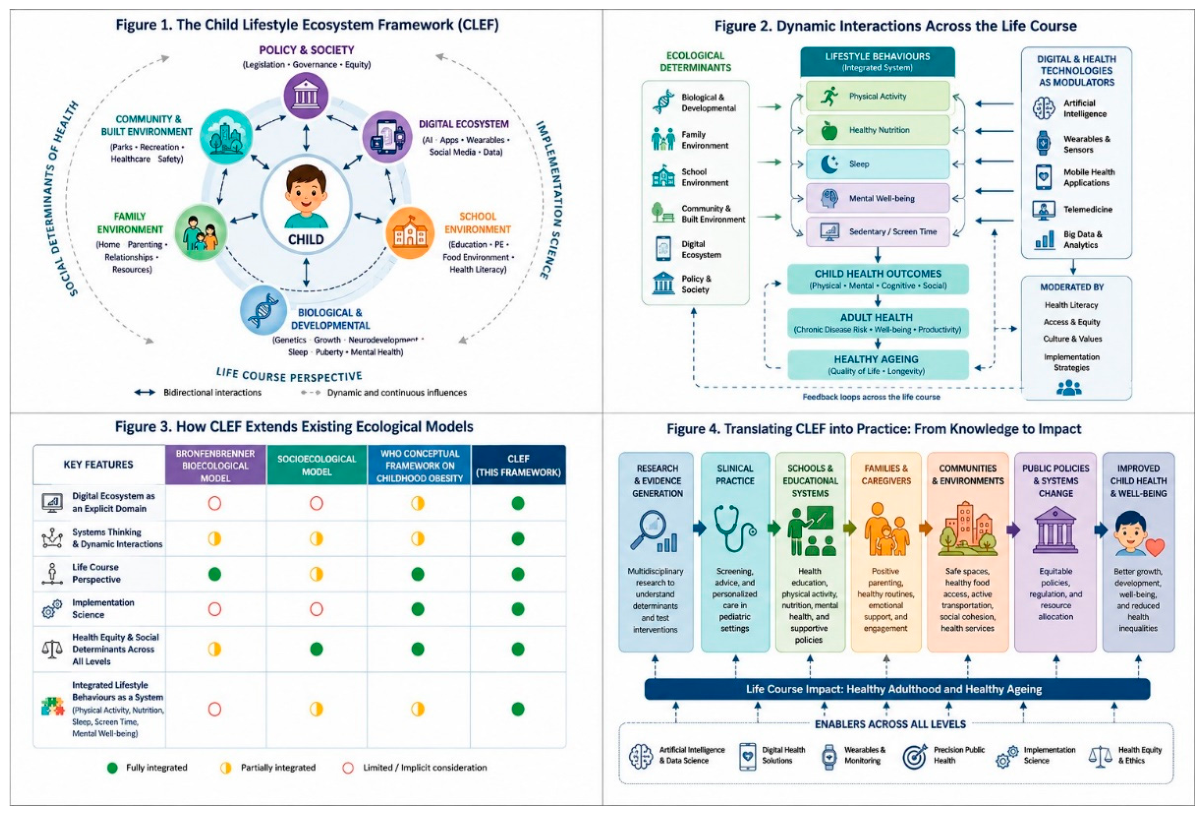
Figure 1 illustrates the conceptual structure of the Child Lifestyle Ecosystem Framework (CLEF), which positions the child at the center of a dynamic and interconnected ecological system. Unlike traditional approaches that focus on isolated lifestyle behaviors, CLEF conceptualizes children’s health as the result of continuous interactions among multiple biological, social, environmental, technological, and policy determinants operating simultaneously across the life course.
At the center of the framework is the child, representing an active participant whose biological characteristics, developmental stage, cognitive abilities, emotional regulation, and lived experiences both influence and are influenced by surrounding ecological environments. This child-centered perspective recognizes that healthy lifestyle behaviors emerge through reciprocal interactions rather than through unidirectional environmental effects.
Surrounding the child are six interconnected ecological domains. The Biological and Developmental domain includes genetic predisposition, growth, neurodevelopment, sleep physiology, and mental health, which provide the biological foundation for lifestyle behaviors. The Family Environment encompasses parenting practices, household routines, emotional support, socioeconomic resources, and health literacy that shape children’s daily habits. The School Environment represents educational settings where health literacy, physical education, nutrition, and social inclusion promote healthy behaviors. The Community and Built Environment includes neighborhood safety, recreational spaces, healthcare services, transportation systems, and access to healthy foods that facilitate or constrain healthy lifestyle choices. The Digital Ecosystem, a distinguishing feature of CLEF, incorporates artificial intelligence, mobile health applications, wearable devices, social media, and digital health platforms, recognizing their growing influence on children’s behaviors, health information, and healthcare access. Finally, the Policy and Society domain reflects the broader structural context, including legislation, governance, health equity, and social policies that shape opportunities for healthy development.
Bidirectional arrows between the child and each ecological domain emphasize that these relationships are dynamic and reciprocal, indicating that children both influence and are influenced by their environments. Likewise, interactions among the six domains highlight that determinants do not operate independently but continuously interact, creating feedback mechanisms that affect childhood lifestyle behaviors over time.
The outer ring represents four cross-cutting principles that underpin the framework. Social Determinants of Health acknowledge the influence of socioeconomic and cultural conditions on all ecological levels. The Life Course Perspective recognizes that experiences during childhood have lasting effects on health trajectories into adolescence and adulthood. Implementation Science emphasizes translating scientific evidence into sustainable interventions across multiple settings. Finally, Health Equity serves as an overarching principle, ensuring that strategies derived from CLEF address disparities in access, opportunities, and health outcomes.
Overall, Figure 1 demonstrates that the Child Lifestyle Ecosystem Framework extends existing ecological models by integrating biological, social, environmental, policy, and digital determinants into a unified conceptual model capable of guiding multidisciplinary research, clinical practice, education, and public health policies aimed at improving child health throughout the life course.

Table 1.
Components of the Child Lifestyle Ecosystem Framework (CLEF).
| Ecosystem | Primary Determinants | Examples of Interventions |
|---|---|---|
| Biological and Developmental | Growth, genetic predisposition, neurodevelopment, and physiological maturation | Personalized prevention and early-life interventions |
| Family | Parenting practices, family routines, home environment, and caregiver support | Parent education and family-based lifestyle interventions |
| School | Physical education, healthy nutrition, mental health promotion, and health literacy | Comprehensive whole-school health promotion programs |
| Community and Built Environment | Parks and green spaces, walkability, recreational facilities, healthy food access, and healthcare services | Healthy Cities initiatives and community-based health promotion |
| Digital Ecosystem | Artificial intelligence, wearable technologies, mobile health applications, social media, and digital platforms | Digital health promotion, personalized health interventions, and remote monitoring |
| Policy and Society | Public policies, legislation, education, urban planning, healthcare systems, and social protection | Population health strategies, multisectoral policies, and health equity initiatives |
Author Contributions
Conceptualization, R. Alba.; methodology, R. Alba. and P. Crespín.; formal analysis, investigation, and resources, writing—original draft preparation, R. Alba; writing—review and editing.; visualization; supervision.; project administration, R. Alba. and P. Crespín; All authors have read and agreed to the published version of the manuscript.
Funding
This research received no external funding.
Institutional Review Board Statement
Ethical review and approval were waived for this study because it is a conceptual paper based exclusively on previously published literature and did not involve human participants, animals, or identifiable personal data.
Informed Consent Statement
Not applicable.
Data Availability Statement
No new data were created or analyzed in this study. All information supporting the proposed conceptual framework was obtained from previously published literature cited in the reference list.
Acknowledgments
During the preparation of this manuscript, the authors used OpenAI ChatGPT (GPT-5.5) to assist with language editing, improvement of scientific writing, and refinement of conceptual figures. The authors critically reviewed, edited, and validated all generated content and take full responsibility for the accuracy and integrity of this publication.
Conflicts of Interest
The authors declare no conflicts of interest.
References
- World Health Organization. Guidelines on physical activity and sedentary behaviour. Geneva: World Health Organization; 2020.
- Bull FC, Al-Ansari SS, Biddle S, Borodulin K, Buman MP, Cardon G, et al. World Health Organization 2020 guidelines on physical activity and sedentary behaviour. Br J Sports Med. 2020;54(24):1451–1462. [CrossRef]
- van der Ploeg HP, Bull FC. Invest in physical activity to protect and promote health: the 2020 WHO guidelines on physical activity and sedentary behaviour. Int J Behav Nutr Phys Act. 2020; 17:145.
- World Health Organization. Guidelines on Physical Activity, Sedentary Behaviour and Sleep for Children under 5 Years of Age. Geneva: WHO; 2019.
- Bronfenbrenner U. The Ecology of Human Development: Experiments by Nature and Design. Cambridge (MA): Harvard University Press; 1979.
- Bronfenbrenner U, Morris PA. The bioecological model of human development. In: Damon W, Lerner RM, editors. Handbook of Child Psychology. 6th ed. Hoboken: Wiley; 2006.
- Sallis JF, Owen N, Fisher EB. Ecological models of health behavior. In: Glanz K, Rimer BK, Viswanath K, editors. Health Behavior and Health Education. 5th ed. San Francisco: Jossey-Bass; 2015.
- McLeroy KR, Bibeau D, Steckler A, Glanz K. An ecological perspective on health promotion programs. Health Educ Q. 1988;15(4):351–377. [CrossRef]
- Golden SD, Earp JAL. Social ecological approaches to individuals and their contexts. Health Educ Behav. 2012;39(3):364–372. doi:10.1177/1090198111418634.
- Marmot M, Allen J, Boyce T, Goldblatt P, Morrison J. Health Equity in England: The Marmot Review 10 Years On. London: Institute of Health Equity; 2020.
- Solar O, Irwin A. A Conceptual Framework for Action on the Social Determinants of Health. Geneva: World Health Organization; 2010.
- Commission on Social Determinants of Health. Closing the Gap in a Generation. Geneva: World Health Organization; 2008.
- World Health Organization. World Mental Health Report: Transforming Mental Health for All. Geneva: WHO; 2022.
- UNICEF. The State of the World’s Children 2021: On My Mind. New York: UNICEF; 2021.
- UNICEF. The State of the World’s Children 2024. New York: UNICEF; 2024.
- Topol EJ. Deep Medicine: How Artificial Intelligence Can Make Healthcare Human Again. New York: Basic Books; 2019.
- World Health Organization. Ethics and Governance of Artificial Intelligence for Health. Geneva: WHO; 2021.
- World Health Organization. Global Strategy on Digital Health 2020–2025. Geneva: WHO; 2021.
- UNICEF. Policy Guidance on AI for Children. New York: UNICEF; 2021.
- Bandura A. Self-Efficacy: The Exercise of Control. New York: Freeman; 1997.
- Deci EL, Ryan RM. Self-determination theory: A macrotheory of human motivation, development, and health. Can Psychol. 2008;49(3):182–185. [CrossRef]
- Nutbeam D. Health literacy as a public health goal. Health Promot Int. 2000;15(3):259–267. [CrossRef]
- Hawe P, Shiell A, Riley T. Complex interventions: how “out of control” can a randomised controlled trial be? BMJ. 2004; 328:1561–1563. [CrossRef]
- Peters DH. The application of systems thinking in health: why use systems thinking? Health Res Policy Syst. 2014; 12:51. [CrossRef]
- Meadows DH. Thinking in Systems: A Primer. White River Junction (VT): Chelsea Green Publishing; 2008.
- Langford R, Bonell CP, Jones HE, Pouliou T, Murphy SM, Waters E, et al. The WHO Health Promoting School framework for improving the health and well-being of students and staff. Cochrane Database Syst Rev. 2014;(4):CD008958.
- World Health Organization, UNESCO. Making Every School a Health-Promoting School: Global Standards and Indicators. Geneva: WHO; 2021.
- Centers for Disease Control and Prevention. Whole School, Whole Community, Whole Child (WSCC) Model. Atlanta (GA): CDC; 2021.
- Patrick H, Nicklas TA. A review of family and social determinants of children’s eating patterns and diet quality. J Am Coll Nutr. 2005;24(2):83–92. [CrossRef]
- Golan M, Crow S. Parents are key players in the prevention and treatment of childhood obesity. Nutr Rev. 2004;62(1):39–50.
- Birch LL, Ventura AK. Preventing childhood obesity: What works? Int J Obes (Lond). 2009;33(Suppl 1):S74–S81. [CrossRef]
- Davison KK, Birch LL. Childhood overweight: A contextual model and recommendations for future research. Obes Rev. 2001;2(3):159–171. [CrossRef]
- Story M, Kaphingst KM, Robinson-O’Brien R, Glanz K. Creating healthy food and eating environments: Policy and environmental approaches. Annu Rev Public Health. 2008;29:253–272. [CrossRef]
- Swinburn BA, Egger G, Raza F. Dissecting obesogenic environments: The development and application of a framework. Prev Med. 1999;29(6 Pt 1):563–570. doi:10.1006/pmed.1999.0585.
- Sallis JF, Cerin E, Conway TL, Adams MA, Frank LD, Pratt M, et al. Physical activity in relation to urban environments in 14 cities worldwide. Lancet. 2016;387(10034):2207–2217. doi:10.1016/s0140-6736(15)01284-2.
- Ding D, Sallis JF, Kerr J, Lee S, Rosenberg DE. Neighborhood environment and physical activity among youth: A review. Am J Prev Med. 2011;41(4):442–455. [CrossRef]
- World Health Organization. Healthy Cities Network. Geneva: WHO; 2022.
- World Health Organization. Report of the Commission on Ending Childhood Obesity. Geneva: WHO; 2016.
- NCD Risk Factor Collaboration (NCD-RisC). Worldwide trends in body mass index and obesity from 1990 to 2022. Lancet. 2024.
- World Obesity Federation. World Obesity Atlas 2024. London: World Obesity Federation; 2024.
- American Academy of Pediatrics. Media use in school-aged children and adolescents. Pediatrics. 2016;138(5):e20162592.
- American Academy of Pediatrics. Media and young minds. Pediatrics. 2016;138(5): 20162591.
- Odgers CL, Jensen MR. Annual Research Review: Adolescent mental health in the digital age. J Child Psychol Psychiatry. 2020;61(3):336–348. [CrossRef]
- Rideout V, Robb MB. The Common Sense Census: Media Use by Tweens and Teens. San Francisco: Common Sense Media; 2021.
- Viner RM, Davie M, Firth A. The Health Impacts of Screen Time. London: Royal College of Paediatrics and Child Health; 2019.
- Moreno MA, Whitehill JM. Influence of social media on adolescent health. Pediatr Clin North Am. 2014;61(3):589–602.
- Rutter H, Savona N, Glonti K, Bibby J, Cummins S, Finegood DT, et al. The need for a complex systems model of evidence for public health. Lancet. 2017;390(10112):2602–2604. [CrossRef]
- Leischow SJ, Best A, Trochim WMK, Clark PI, Gallagher RS, Marcus SE, et al. Systems thinking to improve the public’s health. Am J Prev Med. 2008;35(2 Suppl):S196–S203. [CrossRef]
- Sterman JD. Learning from evidence in a complex world. Am J Public Health. 2006;96(3):505–514. [CrossRef]
- Finegood DT. The importance of systems thinking to address obesity. Nestle Nutr Inst Workshop Ser. 2017;87:123–137.
- World Health Organization. Health Promotion Glossary. Geneva: WHO.
- Marmot M, Allen J, Goldblatt P, et al. Build Back Fairer. Institute of Health Equity; 2020.
- European Commission. Ethics Guidelines for Trustworthy Artificial Intelligence. Brussels: European Commission; 2019.
- Mesko B, Görög M. A short guide for medical professionals in the era of artificial intelligence. NPJ Digit Med. 2020;3:126. [CrossRef]
- Rajkomar A, Dean J, Kohane I. Machine learning in medicine. N Engl J Med. 2019;380(14):1347–1358.
- Beam AL, Kohane IS. Big data and machine learning in health care. JAMA. 2018;319(13):1317–1318. [CrossRef]
- Esteva A, Robicquet A, Ramsundar B, et al. A guide to deep learning in healthcare. Nat Med. 2019;25(1):24–29.
- Jiang F, Jiang Y, Zhi H, et al. Artificial intelligence in healthcare: Past, present and future. Stroke Vasc Neurol. 2017;2:230–243. [CrossRef]
- Bibault JE, Chaix B, Nectoux P, et al. Healthcare ex machina: Are conversational agents ready for prime time in oncology? Clin Transl Radiat Oncol. 2019;16:55–59. [CrossRef]
- Bickmore TW, Trinh H, Olafsson S, et al. Patient and consumer safety risks when using conversational assistants for medical information. NPJ Digit Med. 2018;1:47.
- Torous J, Bucci S, Bell IH, et al. The growing field of digital psychiatry: Current evidence and the future of apps, wearables and AI. World Psychiatry. 2021;20(3):318–335. [CrossRef]
- Fatehi F, Samadbeik M, Kazemi A. What is digital health? Review of definitions. BMJ Health Care Inform. 2020;27:e100206.
- Kickbusch I, Piselli D, Agrawal A, et al. The Lancet and Financial Times Commission on governing health futures 2030. Lancet. 2021;398:1727–1776. [CrossRef]
- Wahl B, Cossy-Gantner A, Germann S, Schwalbe NR. Artificial intelligence (AI) and global health. Int J Med Inform. 2018;129:517–524. [CrossRef]
- World Health Organization. Recommendations on Digital Interventions for Health System Strengthening. Geneva: WHO; 2019.
- Glasgow RE, Harden SM, Gaglio B, et al. RE-AIM planning and evaluation framework: Adapting to new science and practice. Front Public Health. 2019;7:64. [CrossRef]
- Proctor EK, Powell BJ, McMillen JC. Implementation strategies: Recommendations for specifying and reporting. Implement Sci. 2013;8:139. [CrossRef]
- Nilsen P. Making sense of implementation theories. Implement Sci. 2015;10:53. [CrossRef]
- Peters DH, Adam T, Alonge O, Agyepong IA, Tran N. Republished research: Implementation research. BMJ. 2014;347:f6753.
- Curran GM, Bauer M, Mittman B, Pyne JM, Stetler C. Effectiveness–implementation hybrid designs. Med Care. 2012;50(3):217–226.
- Greenhalgh T, Papoutsi C. Studying complexity in health services research. BMC Med. 2018;16:95. [CrossRef]
- Hawe P. Lessons from complex interventions. Annu Rev Public Health. 2015;36:307–323.
- Craig P, Dieppe P, Macintyre S, et al. Developing and evaluating complex interventions. BMJ. 2008;337:a1655.
Figure 1.
The Child Lifestyle Ecosystem Framework (CLEF). The child is positioned at the center of six interacting ecological domains—Biological and Developmental, Family, School, Community and Built Environment, Digital Ecosystem, and Policy and Society. Four cross-cutting principles—Social Determinants of Health, Life Course Perspective, Implementation Science, and Health Equity—operate across all domains. Bidirectional relationships indicate reciprocal influence between the child and the surrounding domains.
Figure 1.
The Child Lifestyle Ecosystem Framework (CLEF). The child is positioned at the center of six interacting ecological domains—Biological and Developmental, Family, School, Community and Built Environment, Digital Ecosystem, and Policy and Society. Four cross-cutting principles—Social Determinants of Health, Life Course Perspective, Implementation Science, and Health Equity—operate across all domains. Bidirectional relationships indicate reciprocal influence between the child and the surrounding domains.
Disclaimer/Publisher’s Note: The statements, opinions and data contained in all publications are solely those of the individual author(s) and contributor(s) and not of MDPI and/or the editor(s). MDPI and/or the editor(s) disclaim responsibility for any injury to people or property resulting from any ideas, methods, instructions or products referred to in the content. |
© 2026 by the authors. Licensee MDPI, Basel, Switzerland. This article is an open access article distributed under the terms and conditions of the Creative Commons Attribution (CC BY) license (http://creativecommons.org/licenses/by/4.0/).
Copyright: This open access article is published under a Creative Commons CC BY 4.0 license, which permit the free download, distribution, and reuse, provided that the author and preprint are cited in any reuse.