

Submitted:
20 August 2026
Posted:
20 August 2026
You are already at the latest version
Abstract
Under conditions of gradual depletion of gas-condensate field reserves and declining well production rates, one of the key challenges in operating offshore production facilities is improving the energy efficiency and reliability of process equipment, particularly compressor stations used for gas gathering, treatment, and transportation. Resource conservation and the adaptation of operating modes to changing production conditions require flexible compression systems capable of operating efficiently over a wide range of inlet flow rates and pressures. This article examines examples from three key regions where compressor stations have been adapted to declining production rates and reservoir pressures, and analyses the challenges encountered under actual operating conditions. A compressor model is proposed for the late stage of field development, during which the production rate of gas-condensate wells decreases from 5.0 million m³/day to 0.5 million m³/day over a ten-year period. The wellhead pressure and compressor suction pressure decline from 5.0 MPa to 0.1 MPa, while the discharge pressure remains at 5.5 MPa. Calculations were performed for the principal operating parameters, including gas production rate, wellhead and compressor suction pressures, the capacity of a single compressor under different configurations, the required number of compressors, and the total annual capacity of all operating compressors. The proposed compressor-unit reconfiguration scheme makes it possible to compress natural gas for at least nine years without requiring major upgrading or the construction of a new compressor facility. Unlike centrifugal compressors, which become inefficient when operating below 50% of their design capacity, the proposed configuration maintains effective operation at loads as low as 10% of the design capacity.
Keywords:
gas-condensate well
; declining production
; centrifugal compressor
; reciprocating compressor
; model
; operating efficiency range
1. Introduction
At the late stage of gas-condensate field development, reservoir pressure naturally declines, well production rates decrease, and the proportion of liquid phases, including condensate and water, as well as sand production, increases. These changes lead to unstable operation of conventional centrifugal compressors and a reduction in their efficiency. Centrifugal compressors, which are widely used on offshore platforms, have a limited operating range in terms of flow rate and pressure. When the production rate falls below 1.0 million m³/day, they operate outside their optimal performance range, resulting in lower efficiency, frequent shutdowns, the need to activate bypass lines, increased specific energy consumption, and higher operating costs.
One promising solution is the application of reciprocating gas-engine-driven compressors, which can maintain stable operation under variable flow rates ranging from 0.5 to 5.0 million m³/day, allow smooth adjustment of suction pressure within the range of 0.1–5.0 MPa, provide high efficiency of up to 0.85 over a broad load range, exhibit low sensitivity to gas composition and thermobaric conditions, and require lower capital investment when existing offshore platforms are upgraded.
Under current conditions, where energy efficiency and resource conservation are becoming key priorities for the sustainable development of the oil and gas industry, the development of a resource-efficient compressor station model adapted to declining production conditions on offshore platforms is of considerable practical and scientific importance.
Such a solution makes it possible to extend the operating life of existing infrastructure without substantial investment, reduce energy consumption and greenhouse gas emissions, increase the hydrocarbon recovery factor, and ensure the reliability of the gas transportation system during the final stage of field development.
The aim of this study is to develop and substantiate a resource-efficient model of an offshore platform compressor station that ensures energy-efficient operation under declining production conditions in a gas-condensate field. The model is based on the use of reciprocating gas-engine-driven compressors with adaptive suction-pressure control and is intended to improve the efficiency of energy and material resource utilisation, extend the service life of equipment and infrastructure, and reduce the specific cost of gas compression under changing production conditions.
To achieve this aim, the following objectives must be addressed:
- Analyse the current state of compressor-station operation on offshore platforms: determine the operating characteristics of conventional centrifugal compressors at the late stage of field development and identify the principal limitations and energy-efficiency problems associated with declining production rates and pressures.
- Investigate the feasibility of using reciprocating gas-engine-driven compressors under declining production conditions: conduct a comparative analysis of the technical characteristics of compressor units manufactured by AJAX, Dresser-Rand, Ariel, and other companies, and substantiate the advantages of reciprocating systems within a flow-rate range of 0.5–5.0 million m³/day and a suction-pressure range of 0.1–5.0 MPa.
- Develop a conceptual model of compressor-station operation with adaptive control: establish the relationship between compressor suction pressure and the current gas production rate and determine the optimal control parameters required to minimise energy consumption.
- Develop a calculation model for evaluating the energy efficiency of the compressor station: determine changes in energy consumption under different production-decline scenarios and calculate the economic effect, including fuel savings, emission reductions, and lower operating costs.
- Compare the obtained results with conventional gas-compression schemes: assess the differences in energy consumption, efficiency, and operating costs and confirm the advantages of the proposed model according to resource-efficiency criteria.
- Develop recommendations for implementing the resource-efficient compressor-station model on offshore platforms: define the requirements for automation and control systems and propose the main stages for upgrading existing compressor stations.
2. Materials and Methods
Compressor stations installed on offshore production platforms are key components of the technological system used for gathering and processing gas-condensate production. Their primary function is to provide the pressure required for transporting gas through subsea pipelines, while also stabilising production rates and maintaining optimal well operating conditions. During the early stages of field development, when reservoir pressure considerably exceeds the pressure required for gas transportation, compressor stations are either not used or operate at partial load. However, as the reservoir becomes depleted and system pressure declines, compression must be introduced gradually to maintain production rates and ensure the required discharge pressure, which is typically 5.0–6.0 MPa for offshore trunk pipelines.
A typical offshore compressor station includes one to three centrifugal compressor units operating in duty and standby modes; gas-turbine or electric drives; separation equipment for removing condensate and moisture from the gas stream before compression; cooling and lubrication systems; and automated control and protection systems. Centrifugal compressors are used in most projects because of their high capacity, compact design, and reliability under stable-flow conditions. They are particularly efficient at high gas flow rates exceeding 2–3 million m³/day and within a relatively limited operating range, typically 70–100% of the rated capacity.
Offshore equipment is subject to stringent requirements, including limitations on weight and dimensions, high reliability and operational autonomy due to maintenance difficulties, resistance to vibration and corrosion, and minimal personnel involvement through remote operation.
Centrifugal compressors used on offshore platforms are designed with these requirements in mind. Nevertheless, they have several significant operational limitations when process conditions change.
During the declining-production stage, when the gas flow rate decreases several times below its initial level, centrifugal compressors begin operating outside their optimal performance range. The main problems include unstable compression at low flow rates, potentially leading to surge; the need for throttling and flow recycling through bypass lines, which reduces efficiency; increased specific energy consumption; unstable suction pressure; higher loads on bearings and seals; and reduced intervals between maintenance operations.
In addition, centrifugal compressors are sensitive to gas composition, particularly the presence of condensate and moisture, and require relatively stable flow conditions. Such stability is difficult to maintain when wells operate unevenly.
The operating range of centrifugal compressors is generally limited to approximately ±20–25% of their rated capacity. When the gas flow rate declines further, it becomes necessary either to shut down some compressor units or to install additional compression stages. Under offshore-platform conditions, such measures are often technically difficult and economically unjustified.
Consequently, the operation of conventional compressor stations during the late stage of field development leads to reduced energy efficiency, excessive fuel consumption by compressor drives, increased operating costs, and accelerated equipment wear.
Thus, conventional centrifugal compressor stations have demonstrated reliable performance during the early and intermediate stages of field development but become inefficient when operating under low-flow and low-pressure conditions. This creates an objective need for new resource-efficient solutions capable of providing operational flexibility and adapting compression conditions to changes in field performance.
When a field enters the declining-production stage, centrifugal compressors exhibit several limitations, including a narrow stable operating range, a sharp decrease in efficiency at low flow rates, the need for continuous gas recycling through bypass lines, and increased specific energy consumption. These factors make centrifugal compressors economically unattractive for long-term operation at flow rates significantly below their rated capacity.
The graph in Figure 1 shows the typical relationship between adiabatic efficiency and relative flow rate over the range of 20–120% of the rated capacity. The shaded region corresponding to flow rates below 60% represents the surge-risk zone. Operation within this region may result in reverse flow, severe vibration, and damage to the compressor impeller.
From a practical perspective, centrifugal compressors generally maintain stable operation at flow rates above approximately 60% of their rated capacity. At lower flow rates, costly modifications or a transition to alternative compression technologies may be required.
Figure 2 compares the adiabatic efficiencies of centrifugal and reciprocating compressors using modelled performance curves. The efficiency of the centrifugal compressor decreases sharply as the relative flow rate declines, reaching approximately 0.35–0.45 under low-flow conditions. In contrast, the reciprocating compressor maintains a relatively stable efficiency of approximately 0.72–0.78 over the same operating range.
These results indicate that reciprocating gas-engine-driven compressors retain high efficiency under declining production conditions, whereas centrifugal compressors experience a substantial loss of efficiency, leading to increased specific energy consumption.
Figure 3 presents the modelled specific energy consumption, expressed as normalised kWh per 1,000 m³, as a function of relative flow rate. For the centrifugal compressor, specific energy consumption increases substantially as the flow rate declines, rising in the illustrated case from approximately 1.0 at 100% capacity to more than 3.0 at 20% capacity. The reciprocating compressor exhibits a considerably smoother relationship, with only a limited increase in specific energy consumption. Therefore, under declining production conditions, the use of centrifugal compressor units may result in substantial energy losses and reduced economic efficiency.
The practical implications and recommendations are as follows. When designing or upgrading compressor stations for mature offshore fields, it should be recognised that centrifugal compressors are most effective at high and stable flow rates, generally above 60–70% of their rated capacity. For periods involving prolonged operation at low gas flow rates of 0.5–2.0 million m³/day, reciprocating gas-engine-driven compressors or hybrid configurations, combining a centrifugal compressor with a reciprocating unit operating as a booster, should be considered.
Under offshore-platform conditions characterised by limited available power and high inspection and maintenance costs, reciprocating compressors frequently provide a more favourable balance between service life and economic performance.
In international practice, the development of offshore gas-condensate fields during their late production stage increasingly focuses on adapting compressor stations to declining gas flow rates and reservoir pressures. Examples from three major regions—the North Sea, the Caspian Sea, and the Gulf of Mexico—are considered below.
2.1. North Sea: Norway and the United Kingdom
Troll Project, Equinor, Norway. The field has been in operation since 1996. As reservoir pressure declined, projects were implemented to install additional compressor modules on the Troll A and Troll C platforms. Centrifugal compressors are used, together with the gradual reduction of suction pressure from approximately 12 MPa to 5–6 MPa and the upgrading of compression stages. At the late stage of field development, modular reciprocating booster compressors are introduced to compress low-rate tail-end gas production.
Asgard Field Compression Project. This was one of the world’s first subsea compression projects. However, the project demonstrated that, under conditions of substantial production decline, the efficiency of centrifugal compression systems decreases and sophisticated control systems with high energy requirements are needed.
Reports indicate that when the gas flow rate falls below 30% of rated capacity, the transition to reciprocating compressors or hybrid compression configurations may become appropriate.
In the North Sea, preference is generally given to centrifugal compressors combined with staged upgrading. However, modernisation costs are high, and efficiency decreases sharply under low-flow operating conditions. Hybrid systems and modular reciprocating solutions are therefore considered alternatives for extending the operating life of offshore facilities.
2.2. Caspian Sea: Kazakhstan and Azerbaijan
Kashagan Project, North Caspian Operating Company. At the late production stage, when gas flow rates decline from approximately 7–8 million m³/day to less than 2 million m³/day per well cluster, centrifugal compressor stations experience operating problems, including a limited control range, increased specific energy consumption, and frequent shutdowns.
The application of reciprocating gas-engine-driven compressors for low-flow well clusters is currently being investigated.
Azeri–Chirag–Gunashli Project, BP and SOCAR. Compressor stations installed on the offshore platforms use Dresser-Rand centrifugal compressor units designed for gas flow rates ranging from 3 to 10 million m³/day. During the late production stage, compressor efficiency decreases to approximately 45–50%, accompanied by increased fuel consumption. Options involving the compression of tail-end gas streams using reciprocating modules are being considered.
Conclusions. The Caspian region demonstrates the typical problem associated with the narrow operating range of centrifugal compressors. To ensure stable operation under declining production conditions, reciprocating compressors, including AJAX units, are considered an effective alternative.
2.3. Gulf of Mexico: United States and Mexico
Thunder Horse and Atlantis Projects. These facilities were initially designed with high-capacity centrifugal compressors capable of handling gas flow rates of up to 10–12 million m³/day.
During the late production stage, surge-related problems and declining compressor efficiency were observed. Additional compression stages and adjustable bypass systems were introduced. In some projects, auxiliary reciprocating compressors were used during the tail-end production phase.
On Gulf of Mexico platforms, the principal focus is placed on modularity and the adaptation of compressor-station configurations. Reciprocating booster compressors are used to extend the productive life of wells and reduce energy consumption.
The principal trends and conclusions are summarised in Table 1.
Operational experience with compressor stations at the late stage of field development shows that centrifugal compressors provide high efficiency at or near their rated flow rates but become inefficient when operating below 50% of their design capacity. Under late-life production conditions, the following effects are commonly observed: a 30–60% increase in energy consumption, frequent flow recycling through bypass lines, a reduction in overall system efficiency to 35–45%, and an increased frequency of shutdowns and maintenance interventions.
Reciprocating gas-engine-driven compressors, such as AJAX, Dresser-Rand, and Ariel units, offer several advantages under these conditions. They can operate stably over a gas flow-rate range of 0.5–5.0 million m³/day, provide a wider control range in terms of suction pressure and flow rate, and offer high maintainability and modularity.
The following section presents a complete conceptual model of a compressor station with adaptive, or dynamic, control developed for the conditions considered in this study.
3. Results
Brief Problem Statement (Input Data).
High-rate condition: flow rate million m³/day .
Low-rate condition (late stage): million m³/day.
Target suction pressure: at , MPa; at , the pressure is gradually reduced to MPa.
Required minimum discharge pressure: MPa.
Equipment: reciprocating gas-engine-driven compressors in a modular configuration, with several identical modules arranged in parallel and/or in series.
3.1. General Concept of the Model
- The control unit continuously measures the current total flow rate and calculates the target suction pressure:
- 2.
- The compressor or compressors operate to maintain:
- 3.
- Control is achieved through a combination of the following methods: starting and stopping compressor modules or cylinder blocks, controlling the driver speed or operating mode where technically possible, changing the number of active cylinders or valves, and using intercoolers and bypass lines.
- 4.
- The main objective of the control system is to minimise energy consumption over the operating period and/or minimise total equipment wear while maintaining the specified technological constraints.
3.2. Basic Mathematical Blocks (Equations)
- Density and Mass Flow Rate
The mass flow rate is determined from the total volumetric flow rate :
where
is the gas density at the compressor suction for a real gas; is the universal gas constant, is the molar mass, and is the compressibility factor.
The suction volumetric flow rate , expressed in m³/s, is calculated from the total flow rate , expressed in m³/day:
- 2.
- Specific Work of Polytropic Compression
For a polytropic process with exponent :
where
is the specific gas constant, J/(kg·K), and is the specific compression work, J/kg. For a real gas, the compressibility factor and appropriate corrections to should be taken into account.
The useful compression power is:
The required electrical power or equivalent fuel input is:
where is the compressor efficiency, representing the conversion from indicated to useful power, and is the mechanical efficiency of the driver.
- 3.
- Multistage Compression
The total pressure ratio is:
For compression stages with ideal intercooling, the optimum pressure ratio per stage is A practical estimate of the required number of stages is:
where is the optimum pressure ratio per stage. For reciprocating compressor units with intercooling, it is generally At and the total pressure ratio is For approximately four compression stages are required according to the logarithmic estimate.
The compressor model was selected based on the following operating conditions: during the late stage of field development, the production rate of gas-condensate wells decreases from 5.0 million m³/day to 0.5 million m³/day over a period of 10 years. The wellhead pressure and the compressor suction pressure decrease from 5.0 MPa to 0.1 MPa. The required discharge pressure is 5.5 MPa.
The compressor design is intended to operate in three different modes and configurations. Therefore, an Ariel-type horizontally opposed compressor with six cylinders of different diameters was selected:
- 2 first-stage cylinders with a diameter of 381 mm (15.0 in);
- 2 second-stage cylinders with a diameter of 228.6 mm (9.0 in);
- 2 third-stage cylinders with a diameter of 114.3 mm (4.5 in).
The main feature of this configuration is that different combinations of cylinders can be brought into operation, allowing the system to operate over a wide range of flow rates and suction pressures. The cylinder arrangement for each operating mode, the reasons for the selected configuration, and its effectiveness are described below.
3.3. Single-Stage Operation — High Suction Pressure
Configuration: All six cylinders operate in parallel (2L + 2M + 2S). All cylinders have suction connections opening into the same suction manifold and discharge connections opening into the same discharge manifold.
Effect: This configuration provides the maximum total working-cylinder displacement.
Operating limitation: This mode is applicable only when the suction pressure is approximately: Pwc ≥ 1.571 MPa
This limitation is based on a maximum allowable single-stage pressure ratio of approximately 3.5.
3.4. Two-Stage Operation — Balanced Configuration
Configuration: Two 381 mm cylinders and two 228.6 mm cylinders operate as the first stage, while two 114.3 mm cylinders operate as the second stage. For this purpose, the cylinders are separated by valves installed in the manifold system.
Operating range: This configuration is suitable for suction pressures ranging from: 1.571 MPa to 0.449 MPa
3.5. Three-Stage Operation — Low Suction Pressure
Configuration: Two 381 mm cylinders operate as the first stage, two 228.6 mm cylinders operate as the second stage, and two 114.3 mm cylinders operate as the third stage.
Capacity: The gas flow rate through all three stages is the lowest among the three configurations; however, this arrangement provides the high overall compression ratio required under low-suction-pressure conditions.
Operating range: Three-stage operation is required when the suction pressure is: Pwc < 0.449 MPa
With a properly designed valve and piping arrangement, the compressor can operate in any of the required single-stage, two-stage, or three-stage modes without physically replacing the cylinders.
The principal engineering requirement is to maintain an appropriate volumetric balance between the compression stages in each operating mode. The cylinder groupings described above are intended to optimise this balance.
Table 2 below presents the calculated values of the following parameters:
- Daily and annual gas production rates by year, million m³/day and million m³/year;
- Wellhead pressure, corresponding to the compressor suction pressure, by year, MPa;
- Capacity of one compressor under different operating configurations by year, million m³/day;
- Required number of compressors by year;
- Total capacity of all operating compressors by year, million m³/day.
Changes in the natural gas compression parameters of the gas-condensate field over a 10-year period are presented in Figure 4.
4. Discussion
Based on the analysis of the calculation results presented in Table 2 and the graph shown in Figure 4, the following conclusions can be drawn:
- The proposed compressor-unit reconfiguration scheme enables the compression of natural gas produced from gas-condensate wells during the late stage of field development for at least nine years without requiring major upgrading or the construction of new compression facilities.
- The proposed configuration of horizontally opposed reciprocating compressors maintains efficient operation at flow rates as low as 10% of the design capacity.
- After the ninth year of operation, the substantial decline in wellhead pressure creates a need for the installation of booster compressors.
At the same time, several practical considerations must be taken into account:
- Valve losses and pulsations. Pressure losses and flow pulsations increase when multiple cross-connection valves are used. Pulsation dampers and silencers should therefore be incorporated into the system.
- Increased compression work. Multistage operating modes may require interstage cooling. Interstage temperatures must be continuously monitored and maintained within the allowable limits.
- Uniform load distribution. The load should be distributed evenly among all compressor cylinders. Uneven loading may cause dynamic imbalance, accelerated wear, and reduced equipment life. Balanced flow distribution is therefore essential when designing the manifold system.
- Safety standards. The design must comply with the applicable safety standards and requirements governing valve selection, pressure-relief devices, instrumentation, and control systems.
- Maximum allowable working pressure. All compressor cylinders and associated components must be designed for the maximum operating pressure specified for the system, which is 5.5 MPa in the present study.
5. Conclusions
- A model and configuration of a horizontally opposed reciprocating compressor were developed to adapt the compression process to declining gas production.
- The proposed model improves equipment service life and energy efficiency while reducing the capital expenditure required for compressor-station upgrading.
- Unlike centrifugal compressors, which become inefficient when operating below 50% of their design capacity, the proposed configuration maintains efficient operation at flow rates as low as 10% of the design capacity.
- The proposed configuration has the potential to be implemented at existing offshore production facilities.
Author Contributions
Project administration, outline, structure, guidance, E.I.; supervision, expertise, data curation, visualization, writing—original draft preparation, E.I., M.H., and E.A.; experiments, E.A. All authors have read and agreed to the published version of the manuscript.
Funding
This research received no external funding.
Data Availability Statement
The original contributions presented in the study are included in the article; further inquiries can be directed to the corresponding author.
Conflicts of Interest
The authors declare no conflicts of interest.
References
- Iskandarov, E.K.; Baghirov, A.N.; Bagirov, Sh.A.; Ismayilova, P.Sh. Development of new technological processes based on supersonic flow of natural gas. SOCAR Proc. 2022, 4, 117–123. [Google Scholar] [CrossRef]
- Iskandarov, E.K.; Baghirov, Sh.A. Analytical and wave-depression methods of elimination of the onset of hydration in subsea gas pipelines. News Natl. Acad. Sci. Repub. Kazakhstan Ser. Geol. Tech. Sci. 2022, 4, 96–108. [Google Scholar] [CrossRef]
- Wang, X.; Ismayilov, G.; Iskandarov, E.; Alizade, E.; Ismayilova, F. Study of Specific Problems Arising in the Blending Processes of Crude Oils (Based on the Examples of Azerbaijan Oils). Processes 2025, 13, 1500. [Google Scholar] [CrossRef]
- Ohia, N.; Egelle, E.; Onyewuenyi, S. Subsea gas compression review and its application in oil and gas reservoir productivity. Niger. Soc. Chem. Eng. 2014. Available online: https://www.researchgate.net/publication/363613866_SUBSEA_GAS_COMPRESSION_REVIEW_AND_ITS_APPLICATION_IN_OIL_AND_GAS_RESERVOIR_PRODUCTIVITY (accessed on 6 August 2026).
- Hurtado, A. Subsea gas compression projects offshore Norway, Australia on track. Offshore 2023. Available online: https://www.offshore-mag.com/subsea/article/14288058/subsea-gas-compression-projects-offshore-norway-australia-on-track (accessed on 6 August 2026).
- OneSubsea. Ormen Lange Subsea Compression Project. Available online: https://www.onesubsea.slb.com/products-and-services/subsea-field-development/subsea-processing-systems/subsea-compression/ormen-lange-project (accessed on 6 August 2026).
- Adomaitis, N. Shell and partners boost gas production from Norway’s Ormen Lange field. Reuters. 27 June 2025. Available online: https://www.reuters.com/business/energy/shell-partners-boost-gas-production-norways-ormen-lange-field-2025-06-27/ (accessed on 6 August 2026).
- MAN Energy Solutions. World’s First Subsea Compressor Units Reach 100,000 Operational Hours. Available online: https://www.man-es.com/docs/default-source/press-releases-new/man-es_press-release_subsea-compression-100322.pdf (accessed on 6 August 2026).
- Hughes, Baker. AJAX Integral Engine-Compressors. Available online: https://www.bakerhughes.com/reciprocating-compression/ajax-integral-engine-compressors (accessed on 6 August 2026).
- Corvaro, F.; Giacchetta, G.; Marchetti, B.; Recanati, M. Reliability, availability and maintainability study of reciprocating compressors operating under API 618 conditions. Petroleum 2017, 3, 266–272. [Google Scholar] [CrossRef]
- ICF. Impact of Electrifying Natural Gas Transmission Compression; INGAA Foundation: Washington, DC, USA, 2024; Available online: https://ingaa.org/wp-content/uploads/2024/01/Assessment-of-Electric-Drive-Compressor-Conversion1.pdf (accessed on 6 August 2026).
- Ahmed, S.; Waqas, G.M.; Mustafa, H.; et al. Uplifting the productivity of a mature gas giant in Pakistan using integrated asset modelling. In Proceedings of the International Petroleum Technology Conference, Bangkok, Thailand, 1–3 March 2023; p. IPTC-22966-MS. [Google Scholar]
- Horn, A.M.; et al. Committee V.8: Subsea Technology. In Proceedings of the 21st International Ship and Offshore Structures Congress—ISSC 2022, Vancouver, BC, Canada, 11–15 September 2022; The Society of Naval Architects and Marine Engineers: Alexandria, VA, USA, 2022; Volume 2. [Google Scholar]
- SLB. Subsea Multiphase Compression System Estimated to Increase Ormen Lange Recovery Factor by 10%. Available online: https://www.slb.com/resource-library/case-study-with-navigation/subps/subsea-multiphase-compression-ormen-lange-cs (accessed on 6 August 2026).
- OneSubsea. SLB OneSubsea Solution Boosts Recovery from Ormen Lange Field. Available online: https://www.onesubsea.slb.com/resources/news/2025/slb-onesubsea-solution-boosts-recovery-from-ormen-lange-field (accessed on 6 August 2026).
Figure 1.
Relationship between the adiabatic efficiency of a centrifugal compressor and the relative flow rate.
Figure 1.
Relationship between the adiabatic efficiency of a centrifugal compressor and the relative flow rate.
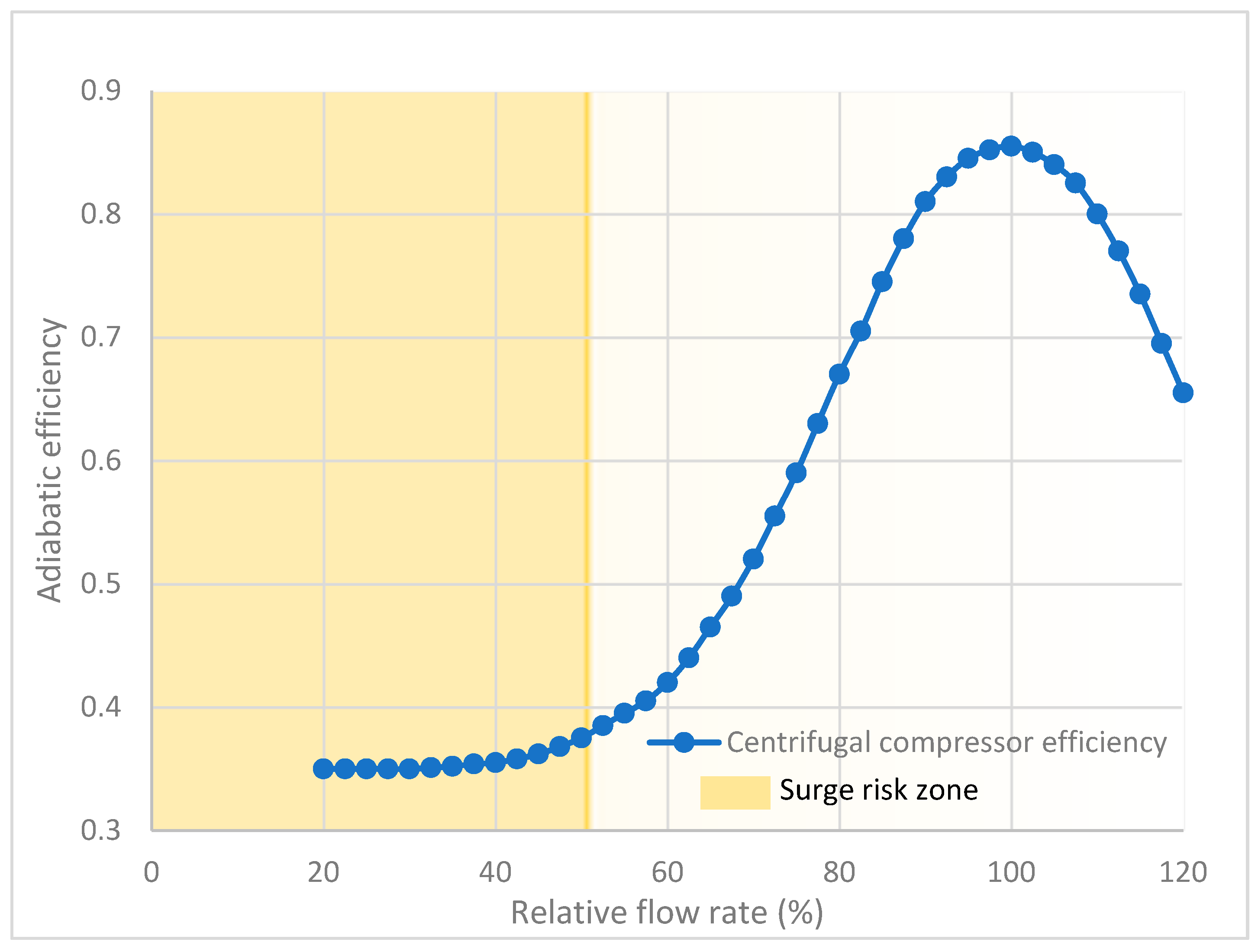
Figure 2.
Comparison of the relationships between adiabatic efficiency and relative flow rate for centrifugal and reciprocating compressors.
Figure 2.
Comparison of the relationships between adiabatic efficiency and relative flow rate for centrifugal and reciprocating compressors.
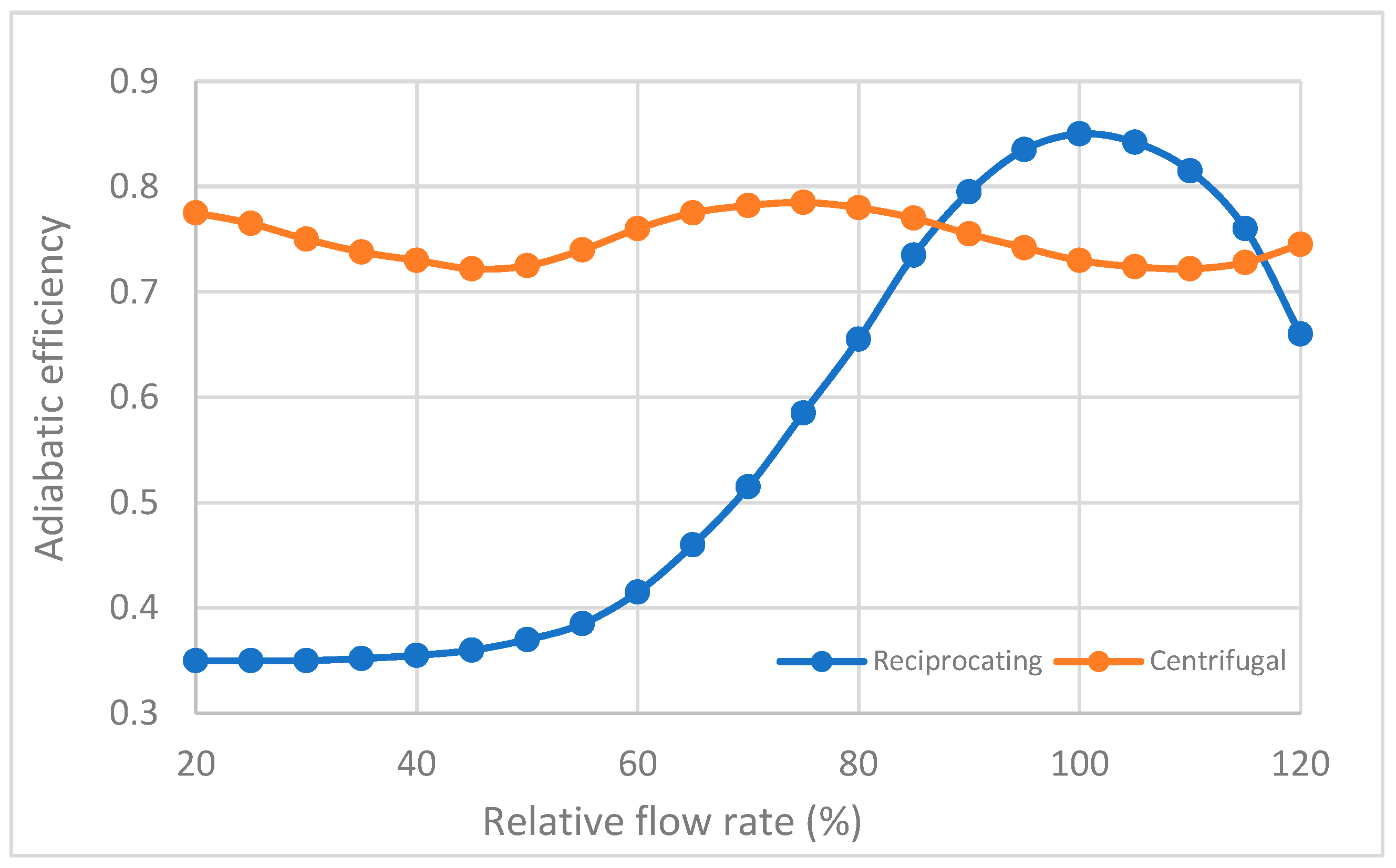
Figure 3.
Modelled specific energy consumption as a function of relative flow rate.
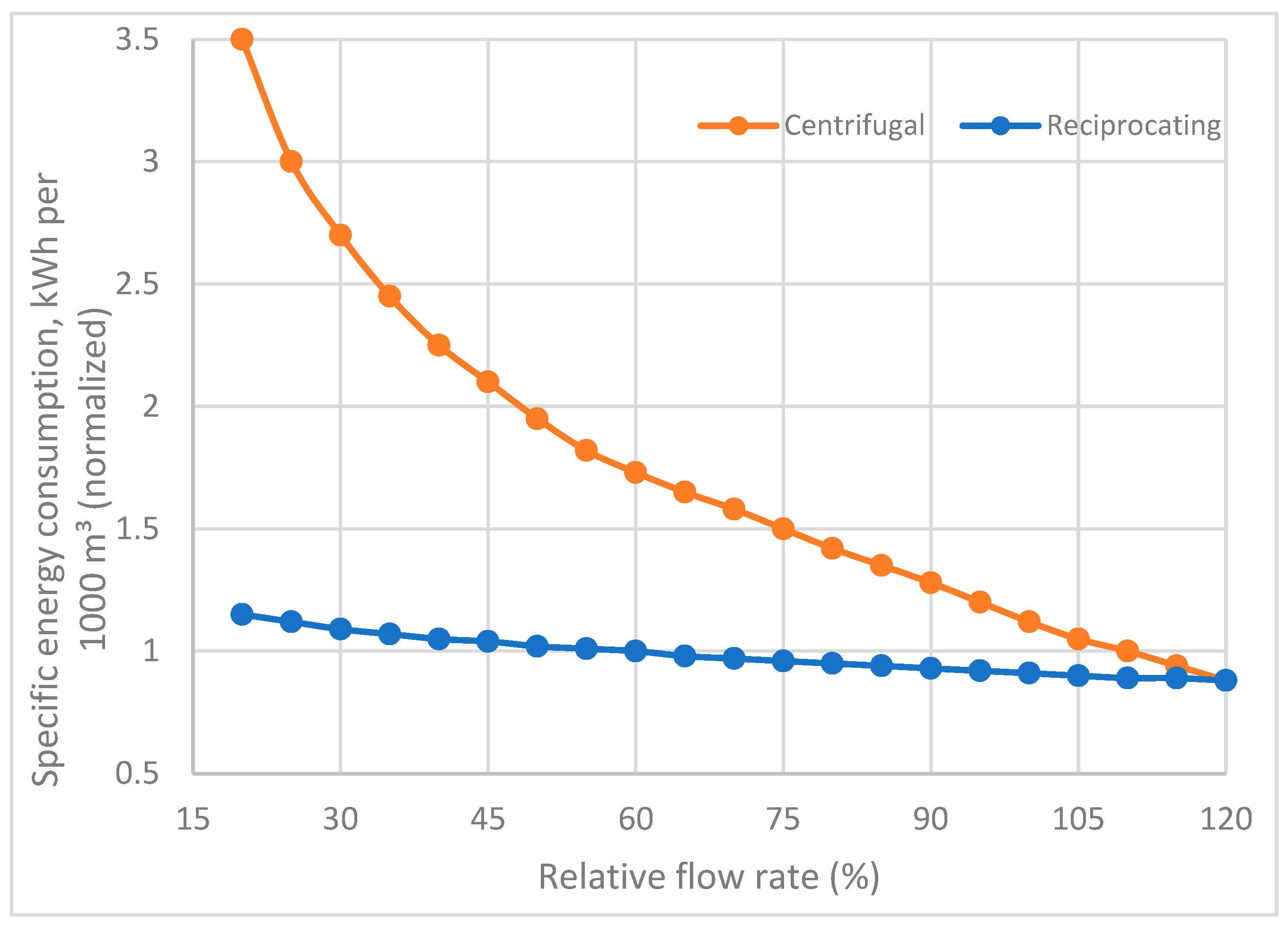
Figure 4.
Changes in the natural gas compression parameters of the gas-condensate field over a 10-year period.
Figure 4.
Changes in the natural gas compression parameters of the gas-condensate field over a 10-year period.
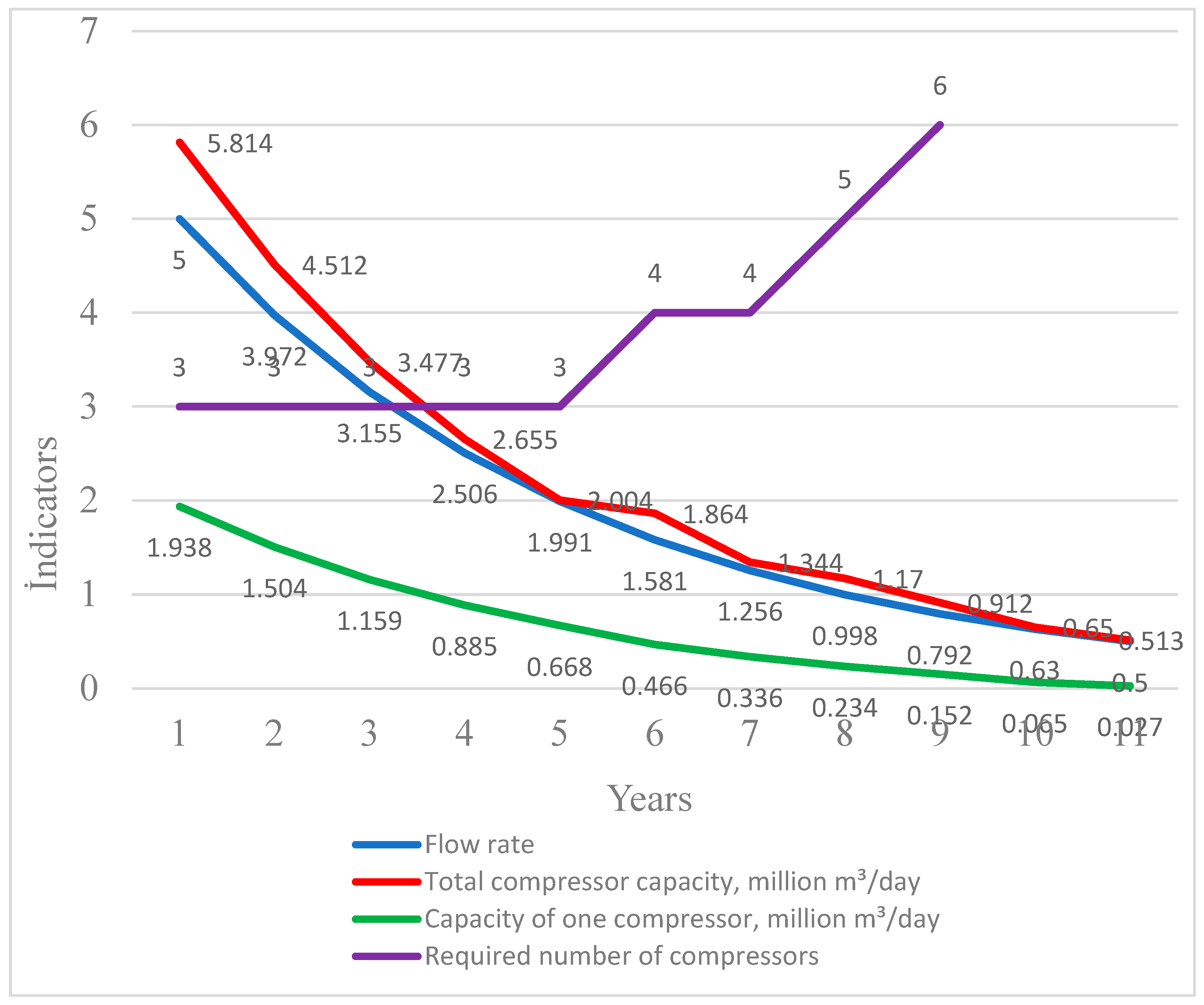

Table 1.
General trends and conclusions from international compressor applications.
| Region | Compressor type | Challenges under declining production | Solutions |
|---|---|---|---|
| North Sea | Centrifugal compressors | Limited operating range and increased energy consumption | Upgrading and installation of modular booster compressors |
| Caspian Sea | Centrifugal compressors | Efficiency loss and frequent shutdowns | Transition to reciprocating gas-engine-driven compressors |
| Gulf of Mexico | Centrifugal compressors | Surge and increased energy intensity | Auxiliary reciprocating compressors |
Table 2.
Calculation Results for Natural Gas Compression Parameters.
| Year | Gas Flow Rate, million m³/day | Gas Production, million m³/year | Wellhead / Compressor Suction Pressure, MPa | Capacity of One Compressor, million m³/day | Required Number of Compressors | Total Capacity of All Compressors, million m³/day |
|---|---|---|---|---|---|---|
| 1 | 5.000 | 1,825.00 | 5.000 | 1.938 | 2.58 (3) | 5.814 |
| 2 | 3.972 | 1,449.65 | 3.880 | 1.504 | 2.64 (3) | 4.512 |
| 3 | 3.155 | 1,151.50 | 2.991 | 1.159 | 2.72 (3) | 3.477 |
| 4 | 2.506 | 914.67 | 2.284 | 0.885 | 2.83 (3) | 2.655 |
| 5 | 1.991 | 726.55 | 1.723 | 0.668 | 2.98 (3) | 2.004 |
| 6 | 1.581 | 577.12 | 1.277 | 0.466 | 3.39 (4) | 1.864 |
| 7 | 1.256 | 458.42 | 0.923 | 0.336 | 3.73 (4) | 1.344 |
| 8 | 0.998 | 364.14 | 0.642 | 0.234 | 4.26 (5) | 1.170 |
| 9 | 0.792 | 289.24 | 0.418 | 0.152 | 5.21 (6) | 0.912 |
| 10 | 0.630 | 229.75 | 0.241 | 0.065 | 9.68 (10) | 0.650 |
| 11 | 0.500 | 182.50 | 0.100 | 0.027 | 18.52 (19) | 0.513 |
Disclaimer/Publisher’s Note: The statements, opinions and data contained in all publications are solely those of the individual author(s) and contributor(s) and not of MDPI and/or the editor(s). MDPI and/or the editor(s) disclaim responsibility for any injury to people or property resulting from any ideas, methods, instructions or products referred to in the content. |
© 2026 by the authors. Licensee MDPI, Basel, Switzerland. This article is an open access article distributed under the terms and conditions of the Creative Commons Attribution (CC BY) license (http://creativecommons.org/licenses/by/4.0/).
Copyright: This open access article is published under a Creative Commons CC BY 4.0 license, which permit the free download, distribution, and reuse, provided that the author and preprint are cited in any reuse.