

Submitted:
19 August 2026
Posted:
20 August 2026
You are already at the latest version
Abstract
We introduce and study the separation axiom h-RT , designed to provide a pointwise measure of the discrepancy between the h-closure and the h-kernel of a singleton in the associated topology τh. Using the specialization preorder of (X, τh), we obtain structural characterizations of h-R0, h-T0, and h-RT . We prove that every h-RT space satisfies a conditional singleton-derivedset property and an h-RH closure-intersection condition, while the conjunction of h-T0 and h-RT implies the global h-RD condition. Explicit finite examples separate h-RT from h-R0, h-T0, and h-RD. We establish preservation results for compatible subspaces and finite products, characterize locally h-indiscrete spaces through the associated topology, and introduce the weakly h-R0 axiom inspired by Di Maio’s weakly R0 condition. For weakly h-R0 spaces, we obtain a kernel characterization, a preservation theorem for injective always h-closed maps, and a product theorem under an explicit compatibility condition on the associated topologies.
Keywords:
h-open set
; associated topology
; specialization preorder
; h-closure
; h-kernel
; h-R0
; h-RT
; h-RD
; h-RH
; locally h-indiscrete space
; weakly h-R0
; always h-closed map
MSC: 54D10; 54A05; 54B05; 54B10
1. Introduction and Preliminaries
The theory of h-open sets was initiated by Abbas [1]. Recall that a topological space is called if every singleton is either open or closed [4]. Sharma, Saproo, Billawria and Digra subsequently proved that the family of all h-open subsets of an arbitrary topological space forms a topology without requiring the assumption [10]. This result makes the associated topology the natural setting for the subject.
The closure–kernel, specialization-preorder, and h- framework used below is developed in the companion paper [6], whereas h- was first defined in [7]. Applications to h-regularity are considered in [5], while h-difference separation axioms and the global h- condition are studied in [7]. Related investigations of h-topological groups and h-irresolute topological vector spaces appeared in [8,9]. The present paper forms part of this coordinated series of companion studies and focuses primarily on the pointwise axiom h-, which controls the discrepancy between the h-closure and the h-kernel of a singleton.
Two further themes are developed in the associated topology. First, we characterize locally h-indiscrete spaces in terms of h- and the closure of the family of h-open sets under arbitrary intersections. Second, following Di Maio’s weakly axiom [3], we introduce weakly h- spaces, characterize them by singleton h-kernels, and study their behaviour under always h-closed injections and compatible products.
Throughout the paper, and denote topological spaces, with no separation assumptions unless explicitly stated.
Definition 1
(Classical closure and kernel). Let be a topological space and let . The closure and the kernel of A with respect to μ are
and
respectively. Equivalently, if every μ-open neighbourhood of z meets A. When the topology is clear, we write and .
Definition 2
(Classical separation axioms). Let be a topological space.
- (1)
- The space is if, for every pair of distinct points, an open set contains one of them and not the other.
- (2)
- The space is if every singleton is closed; equivalently, for every pair of distinct points, each point has an open neighbourhood missing the other.
- (3)
- The space is if every singleton is either open or closed [4].
- (4)
-
Following Davis [2], the space is ifEquivalently,
Definition 3
(h-open sets and associated topology). Let be a topological space. A subset is called h-open with respect to μ if
for every nonempty proper set . We denote the family of all such sets by and the family of their complements by . Sets belonging to both families are called h-clopen. The associated family is denoted by
Theorem 1
(Sharma et al. [10]). For every topological space , the family is a topology on Z, and .
For the spaces and , we write
When the underlying topology is clear, we abbreviate these as and , and we write and . Thus the original topology enters the definition of h-openness through , whereas all closure, kernel and separation constructions carrying the prefix h are the corresponding ordinary constructions in the associated space .
For , set
The h-closure of is
Equivalently,
Lemma 1.
For all and every family of subsets of X, the following assertions hold.
- (1)
- If every is h-closed, then is h-closed.
- (2)
- If every is h-open, then is h-open.
- (3)
- A is h-closed if and only if .
- (4)
- .
- (5)
- If , then .
- (6)
- .
Proof.
By Theorem 1, these are the ordinary closure properties of the topological space . □
Definition 4.
For , the space is called an h- space [7] if the associated space satisfies the classical axiom of Definition 2.
2. The h-Kernel and the Specialization Preorder
The terminology and basic facts in this section follow the closure–kernel framework of [6].
Definition 5.
For , the h-kernel of A is
Lemma 2.
Let and . Then:
- (1)
- if and only if ;
- (2)
- ;
- (3)
- if and only if .
Proof.
For (1), the condition means that some h-open set contains x and omits y. This is equivalent to .
For (2), suppose first that and . Then is an h-open set containing A but not x, contradicting the definition of . Conversely, choose . Every h-open set containing A contains a and, because , must also contain x. Hence .
For (3), assume . Then and . If , item (1) gives . By Lemma 1(5)–(6),
so and item (1) gives . The reverse inclusion is symmetric. Conversely, equality of the kernels gives and ; item (1) yields mutual singleton closure membership. Lemma 1(5)–(6) then gives equality of the singleton closures. □
Definition 6.
Recall that a preorder is a reflexive and transitive relation. Theh-specialization preorderon X is defined by
We write when both and , and denote the corresponding equivalence class by . This is the ordinary specialization preorder of ; compare [11].
Proposition 1.
For all , the following statements hold.
- (1)
- The relation is a preorder.
- (2)
- (3)
- If , then . Consequently,
- (4)
- (5)
- is h- if and only if for every .
- (6)
- is h- if and only if
Proof.
Reflexivity follows from . If and , then
by Lemma 1(5)–(6), so . This proves (1), and (2) follows from Definition 6 and Lemma 2(1).
If , then , and Lemma 1(5)–(6) gives , proving (3). Mutual membership gives both inclusions. Statement (4) is immediate from (2). Finally, (5) and (6) are exactly the classical and characterizations of the associated space, using Definitions 2 and 4. □
Definition 7.
A space is called h- [7] if every h-open set contains the h-closure of each of its points. Equivalently,
Equivalently again, is an ordinary space in the sense of Definition 2; see also [6].
Proposition 2.
For a topological space , the following conditions are equivalent:
- (1)
- is h-;
- (2)
- for every ;
- (3)
- for every ;
- (4)
- for every .
Proof.
By Definition 7, condition (1) is equivalent to symmetry of singleton closure membership. Using Lemma 2(1), condition (2) says that
for all , and is therefore equivalent to (1). Similarly, condition (3) says that
and is also equivalent to (1). Conditions (2) and (3) together are equivalent to the equality in (4). □
Remark 1.
Proposition 2 gives an entirely set-theoretic characterization: is h- precisely when, for every , the intersection of all h-open sets containing x coincides with the intersection of all h-closed sets containing x.
3. h- Spaces
We shall use the following terminology. The global h- condition is the one adopted in the companion study [7]; the conditional notation h- is introduced here to distinguish it from that global condition. To avoid terminological ambiguity across the companion papers, we reserve the symbol h- exclusively for the closure-intersection property in Definition 8(1), while the term h-semisimple is used exclusively for the openness of singleton h-closures in Definition 8(2).
Definition 8.
A topological space is called
The global condition h- implies h-, whereas the converse need not hold.
Definition 9.
A set is called degenerate if it contains at most one point.
Definition 10.
A topological space is called an h- space if, for every , both sets
are degenerate in the sense of Definition 9.
Proposition 3
(Order-theoretic characterization). For , set
Then
Consequently, is h- if and only if
Proof.
The identities follow directly from Proposition 1(2). The final assertion is exactly Definition 10 expressed in the h-specialization preorder. □
Every h- space is h-, since both differences in Definition 10 are then empty. The converse fails.
Example 1 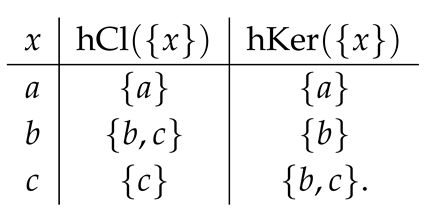
(h- does not imply h-). Let
A direct computation gives
The singleton h-closures and h-kernels are
Thus the only nonempty differences in Definition 10 are
Hence the space is h-. It is not h-, because .
Example 2
(h- does not imply h-). Let
Here . The associated space is , hence is h-. On the other hand,
and therefore
which is not degenerate. Thus the space is not h-.
Moreover, this space is h-, since
so every singleton h-derived set is either or ⌀, and both are h-closed. Hence h- does not imply h-.
Example 3.
Let
Then
Consequently,
and the corresponding h-kernels coincide with these closures. Hence the space is h-, and therefore h-. It is also h-. Moreover,
so every singleton h-closure is h-open and the space is h-semisimple.
However, it is not h-. Indeed,
and is not h-closed because its complement is not h-open. The space nevertheless satisfies h-: for a and c the antecedent in Definition 8(4) fails, while for b the derived set is empty. The original topology is not , since .
Remark 2.
Example 3 shows that three singleton conditions considered in this paper describe genuinely different features. Every singleton h-closure is h-open, so the space is h-semisimple. It is also h-, and hence h-, because the singleton h-closures and h-kernels coincide. Nevertheless,
is not h-closed. Thus openness of singleton closures, control of the closure–kernel discrepancy, and closedness of punctured singleton closures concern different aspects of the local specialization structure. In particular, neither h-semisimplicity alone nor even its conjunction with h- guarantees the global h- condition.
Theorem 2.
Every h- space is h-.
Proof.
Let and assume
Set
By Definition 10, the set D is degenerate in the sense of Definition 9; hence it is either empty or a singleton. The displayed intersection gives
If , it is h-closed. Suppose . Since , there exists an h-open set V such that and . As ,
Both sets on the right are h-closed; hence D is h-closed. □
Corollary 1.
Every h-, h- space is h-.
Proof.
By Proposition 1(4)–(5), the h- condition gives
Theorem 2 therefore applies to every point, which is exactly the global h- condition. □
Theorem 3.
Every h- space is h-.
Proof.
Let satisfy
Then . Suppose, toward a contradiction, that there exists with . Lemma 2(1) gives
Set
By Definition 10, is degenerate in the sense of Definition 9. Since , at least one of lies in . Without loss of generality, let . Then
so Proposition 1(3) yields .
If , the same proposition gives , a contradiction. Thus , so . Since is h-closed, its complement is an h-open neighbourhood of x, and hence
On the other hand, implies, by Proposition 1(3), that
Since , we obtain
contradicting the h- condition. Therefore
□
Remark 3.
The axiom h- lies between exact specialization symmetry and weaker singleton conditions. The h- property forces , whereas h- permits at most one strict predecessor and at most one strict successor of each point outside its indistinguishability class. This controlled defect is sufficient for h- and h-, and, under h-, for the global h- property.
Corollary 2.
The following implications hold:
and
The implication h-- is not reversible; h- does not imply h-; and the global conditions h- and h- are incomparable.
4. Subspaces and Finite Products
For a subset , let
be the original subspace topology. We write
for the associated topology constructed from , whereas
denotes the trace on Y of the associated topology of X. The operators and are computed in , while and are computed in .
The equality is not automatic. Under this compatibility condition, however, the singleton closure–kernel structure restricts correctly.
Proposition 4.
Let be an h- space and let . If
then the subspace is h-.
Figure 1.
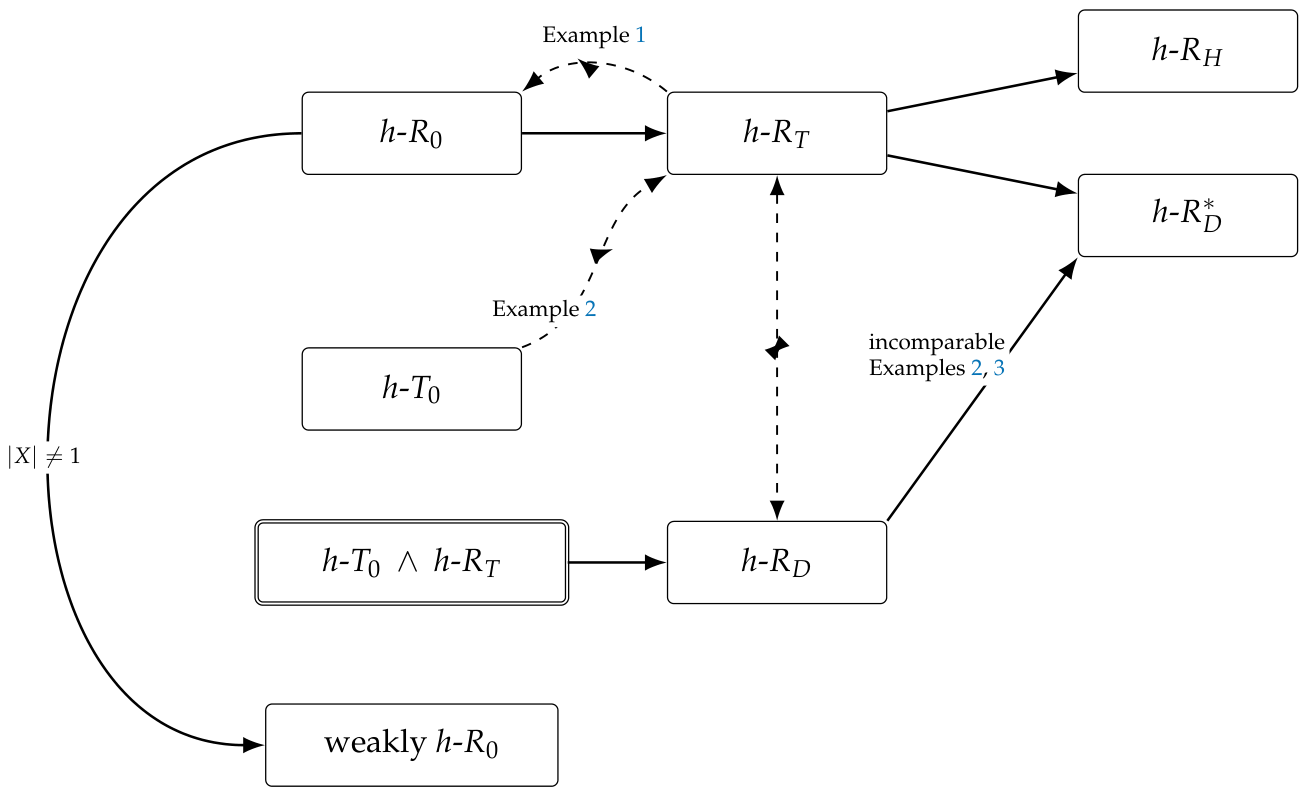
Logical relations among the principal h-separation properties considered here. Solid arrows denote valid implications. The arrow from h- to weakly h- requires ; its converse fails by Example 1. Dashed slashed arrows denote implications that fail in general, and the dashed two-headed slashed segment records incomparability. The double-bordered node emphasizes the joint hypothesis in Corollary 1. Local h-indiscreteness is characterized separately in Theorem 4.
Figure 1.
Logical relations among the principal h-separation properties considered here. Solid arrows denote valid implications. The arrow from h- to weakly h- requires ; its converse fails by Example 1. Dashed slashed arrows denote implications that fail in general, and the dashed two-headed slashed segment records incomparability. The double-bordered node emphasizes the joint hypothesis in Corollary 1. Local h-indiscreteness is characterized separately in Theorem 4.
Proof.
Under the compatibility assumption, ordinary subspace closure and kernel in the associated topology give, for every ,
Hence
and similarly
Each set is a subset of a degenerate set and is therefore degenerate. □
Remark 4.
Proposition 4 shows that h- is hereditary under compatible subspaces. The compatibility hypothesis is essential because the associated topology constructed from the original subspace topology need not equal the trace of the associated topology of the ambient space.
Example 4
(The compatibility condition is not automatic). Let
Then
The original subspace topology is indiscrete. Since it has no nonempty proper open set, every subset of Y is h-open, and hence
Proposition 5.
Let be a finite family of nonempty topological spaces. Let
be endowed with the product topology τ generated by the original topologies , and set
Assume that the associated topology coincides with the product topology on X generated by the factor topologies . Then:
- (1)
- if every is h-, then is h-, and hence h-;
- (2)
- if one factor is h- and every factor with is h-, then is h-.
Proof.
Let and denote closure and kernel in the associated factor space . Under the stated compatibility condition, for one has
If every factor is h-, the corresponding closure and kernel agree in each coordinate, proving (1).
For (2), Proposition 1(6), applied to each associated factor space, gives
Therefore the two set differences in the product are naturally in bijection with
respectively. Each contains at most one point because the j-th factor is h-. □
Remark 5.
The product compatibility condition in Proposition 5 must be verified; it does not follow merely from the hypotheses on the factor spaces. No unconditional preservation theorem for arbitrary finite or infinite products is claimed.
5. Locally h-Indiscrete Spaces
Definition 11.
A topological space is calledlocally h-indiscreteif, for every , there exists a set such that and the subspace
is indiscrete.
Theorem 4.
A topological space is locally h-indiscrete if and only if the following conditions hold:
- (1)
- is h-;
- (2)
- the intersection of every family of h-open subsets of X is h-open.
Proof.
Assume first that is locally h-indiscrete. Let and let . Choose an h-open neighbourhood of y whose induced topology is indiscrete. Since , every h-open neighbourhood of y contains x, and hence . The set is a nonempty open subset of the indiscrete subspace , so . Thus , and consequently . This proves that is h-.
Let be a family of h-open subsets of X, and put . If , then A is h-open. Otherwise, for each , choose an h-open indiscrete neighbourhood . For every , the set is a nonempty open subset of , and hence equals . Therefore , and
is h-open. This proves condition (2).
Conversely, assume conditions (1) and (2). For , define
By condition (2), is h-open, and Proposition 2 gives
Let and suppose that . Choose . Since and the space is h-, one has and hence, by Proposition 1(3),
The h- property and imply , so . Thus every nonempty open subset of the subspace is all of , and is indiscrete. Therefore is locally h-indiscrete. □
6. Weakly h- Spaces
Di Maio introduced the notion of weakly in 1985 [3]. In that paper, the topologies under consideration are assumed to be strictly finer than the trivial topology. A topological space is weakly if
The associated-topology analogue is the following.
Definition 12.
A topological space is calledweakly h-if
Remark 6.
Since , one has for every . Hence every weakly space is weakly h-.
Except for the one-point space, every h- space is weakly h-. Indeed, if , then is not indiscrete: either τ contains a nonempty proper open set, which also belongs to , or τ is indiscrete, in which case the defining condition of h-openness is vacuous and . In an space the closures of singletons are the equivalence classes of topological indistinguishability. Since is not indiscrete, there are at least two such classes, and their total intersection is empty. For a one-point space, by contrast, the unique singleton h-closure is X, so the space is h- but not weakly h-.
The converses fail. In Example 1,
and hence the intersection of the singleton h-closures is empty. Thus the space is weakly h-, although it is not h-. With respect to the original topology,
so their intersection is ; consequently, the space is not weakly .
Theorem 5.
A topological space is weakly h- if and only if
Proof.
For every , Lemma 2(1) gives
Therefore
if and only if no point satisfies . □
Definition 13.
A function is calledalways h-closedif is h-closed in whenever F is h-closed in .
Theorem 6.
Let X be nonempty. If is an injective always h-closed function and is weakly h-, then is weakly h-.
Proof.
Write and for the h-closure operators in the source and target spaces. For every , the set is h-closed in Y and contains . Hence
Consequently,
The equality in the third line uses the injectivity of f. □
Theorem 7
(Compatible product preservation). Let and be nonempty topological spaces, and endow with the product topology . Assume that
where the right-hand side denotes the product of the associated topologies. If is weakly h-, then is weakly h-.
Proof.
Under the compatibility hypothesis,
Therefore
□
Remark 7
(The compatibility hypothesis is essential). Theorem 7 is false without the compatibility assumption. Let
Since τ has no nonempty proper open set, , and hence is weakly h-. Let
The product topology on is
and a direct computation shows that it coincides with its associated topology. For ,
Thus
so is not weakly h-. In this example,
7. Concluding Remarks
The associated topology is the natural framework for the axioms studied in this paper. The h- property is precisely the classical condition of , whereas h- controls, point by point, the strict lower and upper specialization sets outside the indistinguishability class .
The main results establish
and show that the additional h- hypothesis yields the global h- condition. The finite examples prove that h- does not imply h-, that h- does not imply h-, and that the global conditions h- and h- are incomparable.
The local structure of the associated topology is further clarified by Theorem 4: local h-indiscreteness is equivalent to the conjunction of h- and the Alexandrov-type condition that arbitrary intersections of h-open sets remain h-open. This identifies the singleton h-kernel as an h-open indiscrete neighbourhood of each point.
Following Di Maio, we introduced the weakly h- condition. Theorem 5 characterizes it by the absence of a point whose singleton h-kernel is all of X. The property is preserved by injective always h-closed maps from a nonempty domain and by products satisfying the compatibility condition of Theorem 7. Remark 7 shows that this compatibility cannot be omitted. Example 1 also demonstrates that weakly h- is strictly weaker than both h- and the classical weakly condition.
The present paper forms part of a coordinated series of companion studies based on the associated topology. The preservation results identify the compatibility assumptions needed for subspaces and products, while the specialization-preorder and singleton-kernel formulations supply a reusable framework for further work on mappings and algebraic topological structures; see also [8,9].
References
- F. Abbas, On h-open sets and h-continuous functions, Bol. Soc. Paran. Mat. 41 (2023), 1–9, . [CrossRef]
- A. S. Davis, Indexed systems of neighborhoods for general topological spaces, Amer. Math. Monthly 68 (1961), no. 9, 886–894.
- G. Di Maio, A separation axiom weaker than R0, Indian J. Pure Appl. Math. 16 (1985), no. 4, 373–375.
- W. Dunham, T1/2-spaces, Kyungpook Math. J. 17 (1977), 161–169.
- S. Jafari, L. Affé, T. Noiri and G. Nordo, On regularity and normality via h-open sets, (submitted).
- S. Jafari, T. Noiri, L. Affé and G. Nordo, More on h-open sets, (submitted).
- S. Jafari, T. Noiri, G. Nordo and L. Affé, On h-D1 topological spaces, (submitted).
- P. Saproo, N. Digra, S. Billawria and S. Sharma, On h-topological groups, Asia Pac. J. Math. 11 (2024), Article 40, . [CrossRef]
- S. Sharma, N. Digra, P. Saproo and S. Billawria, On h-irresolute topological vector spaces, J. Adv. Math. Stud. 16 (2023), no. 3, 304–319.
- S. Sharma, P. Saproo, S. Billawria and N. Digra, Corrigendum and addendum to “h-open sets in topological spaces”, Bol. Soc. Paran. Mat. 43 (2025), 1–6, . [CrossRef]
- S. Willard, General Topology, Dover Publications, Mineola, NY, 2004.
Disclaimer/Publisher’s Note: The statements, opinions and data contained in all publications are solely those of the individual author(s) and contributor(s) and not of MDPI and/or the editor(s). MDPI and/or the editor(s) disclaim responsibility for any injury to people or property resulting from any ideas, methods, instructions or products referred to in the content. |
© 2026 by the authors. Licensee MDPI, Basel, Switzerland. This article is an open access article distributed under the terms and conditions of the Creative Commons Attribution (CC BY) license (http://creativecommons.org/licenses/by/4.0/).
Copyright: This open access article is published under a Creative Commons CC BY 4.0 license, which permit the free download, distribution, and reuse, provided that the author and preprint are cited in any reuse.