

Submitted:
29 August 2026
Posted:
31 August 2026
You are already at the latest version
Abstract
Introduction: Published scientific articles present the final products of research but often conceal or compress the intellectual, documentary, bibliographic, and methodological processes that produced them. This opacity limits the use of articles as research artifacts, hinders the auditing of their logical genesis, and makes it difficult to transform identified gaps into new lines of inquiry. Objective: To define and develop the Universal Research System with Reverse Itinerary (SUII, the Spanish acronym for Sistema Universal de Investigación con Itinerario Inverso), describe its conceptual foundations, assess its originality in medical literature research, and propose an operational architecture with dual reconstructive and generative outputs. Methods: An original methodological development and conceptual synthesis study was conducted through theoretical formalization and critical integration of previously developed SUII materials and related methodological traditions, including document analysis, process tracing, reverse engineering, provenance, protocol-publication comparison, RIAT, scoping reviews, PRISMA, literature-based discovery, and abductive reasoning. Results: The SUII is defined as a method of documentary, conceptual, and methodological analysis that starts from a finished scientific product and retrospectively reconstructs the foundational question, decisions, concepts, sources, bibliography, transformations, and genesis hypotheses that probably led to the article. Its generative extension transforms these traces into new research questions and hypotheses, rival hypotheses, a preliminary research agenda, and requirements for external validation. Discussion: No single medical precedent equivalent to the full scope of the SUII was identified. Its originality lies in integrating retrospective reconstruction, inferential traceability, and traceable hypothesis generation. Conclusion: The SUII may support metascience, teaching, methodological auditing, medical literature research, and the design of future studies, provided that it clearly distinguishes explicit evidence, reasoned inference, and controlled speculation.
Keywords:
reverse investigation
; medical bibliographic research
; generation of hypotheses
; documentary analysis
; metascience
; artificial intelligence
; traceability
; SUII
Introduction
SUII Executive Summary
The Universal Research System with Reverse Itinerary (SUII, the Spanish acronym for Sistema Universal de Investigación con Itinerario Inverso) is a second-order cross-sectional methodology that analyzes finished scientific products as sets of documentary, methodological, conceptual, and bibliographic traces. Its purpose is to reconstruct, retrospectively and traceably, the probable pathway from the foundational question to the final product and to generate new researchable questions and hypotheses from the identified gaps, tensions, and bifurcations. The system distinguishes explicit evidence, reasoned inference, and controlled speculation; requires triangulation, rival hypotheses, parsimony, confidence grading, and external validation; and may be applied focally, in combination, or comprehensively to methodological auditing, bibliographic analysis, teaching, metascience, and research design. Artificial intelligence constitutes its reference operational infrastructure, always under mandatory human supervision. The SUII does not replace primary research methodologies or reporting and appraisal guidelines; rather, it complements them through critical, reconstructive, and generative analysis. Its usefulness, reproducibility, transferability, and performance require empirical validation.
The Documentary Anatomy of the Scientific Article as an Entry Surface for the SUII
The scientific article has a conventional documentary anatomy that organizes the communication of research in functional regions. Its core corresponds to the IMRD structure —Introduction, Methods, Results, and Discussion—, whose adoption was consolidated during the second half of the twentieth century to become the dominant pattern of original biomedical articles (Sollaci & Pereira, 2004). This organization does not constitute an arbitrary sequence: it reflects in a condensed form the logic of scientific discovery, from the formulation of the problem and the description of the procedures to the presentation and interpretation of the findings (ICMJE, 2026).
Preliminary elements (title, authorship, abstract, and keywords) and final elements (conclusions, references, statements, tables, figures, appendices, and supplementary materials) complement the IMRD core and facilitate retrieval, evaluation, and reuse (Gastel & Day, 2024). This general anatomy is adaptable: systematic reviews, observational studies, clinical trials, diagnostic studies, and qualitative research require specific elements defined by reporting guidelines such as PRISMA, STROBE, CONSORT, STARD, CARE, COREQ, and SRQR. These guidelines transform manuscript organization into an architecture of transparency by enabling readers to determine what was done, how it was done, and what was found in sufficient detail for critical appraisal and potential replication (Simera et al., 2010; ICMJE, 2026).
From the SUII perspective, this anatomy forms the observable surface of the finished scientific product. Each region contains distinct traces. The title and abstract condense the study’s promise; the introduction defines the problem, background, and gap; the methods document decisions about design, population or corpus, variables, instruments, and analyses; the results stabilize the evidence; and the discussion converts findings into interpretation, comparison, and implications. References, tables, figures, appendices, and supplementary materials extend intellectual and methodological traceability. Reverse analysis therefore begins by decomposing the article into functional regions and determining which information is explicit, which relationships can reasonably be inferred, and which components remain compressed, absent, or non-determinable.
This distinction establishes a conceptual link between conventional scientific communication and the SUII. IMRD and reporting guidelines primarily describe how an investigation should be communicated; the SUII uses this documentary architecture as an exploration map to retrospectively reconstruct the probable itinerary that led to the final product. Consequently, the visible anatomy of the article does not replace the SUII, but provides its entry surface: an ordered set of regions from which to locate traces, check for coherence and discrepancies, formulate rival hypotheses, and delimit the frontier of knowledge.

Table 1.
Documentary anatomy of the scientific article as an entry surface for the SUII.
| Documentary region | Main components | Communicative function | Usefulness for the SUII |
| Preliminary Matter | Title, authorship, abstract and keywords | It condenses the identity, promise, scope and recoverability of the item. | Identify core concepts, population or corpus, declared design and main message. |
| Introduction and background | Context, problem, previous literature, gap, objective, question or hypothesis | The introduction and background justify the need for the study and situate it within a scientific tradition. | Reconstruct the stated problem, the explicit question and the possible foundational question. |
| Methods | Design, population or corpus, sample, variables, interventions, instruments, sources and analysis | Describe how the evidence was produced and analyzed. | Locate methodological decisions, unchosen alternatives, assumptions and conditions of reproducibility. |
| Results | Data, estimates, tables, figures, analysis and findings | It presents the evidence obtained without substituting its interpretation for it. | Contrast objectives, methods and findings; detect omissions, discrepancies and latent results. |
| Discussion | Interpretation, comparison, mechanisms, strengths, limitations and implications | Integrates the results into the previous knowledge and delimits their meaning. | Reconstruct interpretative transformations, rival hypotheses, tensions and unexplored bifurcations. |
| Conclusions | Synthesis, Answer to the Question, and Final Implications | It stabilizes the message that the article intends to convey. | Evaluate the continuity between evidence, inference, and final assertion, and derive future questions. |
| Final and supplementary material | References, statements, appendices, data, tools and supplementary materials | The final and supplementary material documents the responsibilities and resources that expand on the main report. | Reconstruct functional bibliography, genealogies, provenance, additional decisions, and external validation needs. |
Note. The table represents a general and adaptable documentary anatomy, not a rigid universal sequence. The location and naming of its components depend on the layout, article type, and journal instructions. The synthesis is based on the historical evolution of IMRD, biomedical editorial recommendations, and design-specific reporting guidelines (Sollaci & Pereira, 2004; Simera et al., 2010; Gastel & Day, 2024; ICMJE, 2026).
The Problem: The Article Published as an Opaque Product
The scientific article is a highly condensed form of communication. Its conventional structure allows us to know what question is declared, what methods were used, what results were obtained and how they were interpreted. However, the published paper rarely shows in detail the actual or probable chain of decisions that produced it: how the question was reached, what alternatives were discarded, what bibliography acted as a conceptual hinge, what transformations occurred between the initial problem and the final contribution, or what hypotheses remained latent after publication. This distance between process and product is especially visible in medical literature research, where a methodological review, guide, or article can condense hundreds of search, selection, classification, synthesis, writing, and justification decisions into a necessarily brief final report.
Conceptual Origin of the SUII
The concept of SUII was progressively built on the basis of a practical need: to recover the intellectual and methodological itinerary that is compressed into a finished scientific product. The first exercise consisted of retrospectively reconstructing a manuscript on the S0-S3 system for systematic reviews. Experience showed that the initial question, the methodological decisions, the structuring concepts, the transformations of the project and the function of the references leave recognizable traces in the final text. From this observation, the exercise was generalized and organized into layers that advance from directly observable evidence to the reconstruction of the foundational question and genesis hypotheses. Finally, rules of triangulation, traceability, parsimony, contrast of rival hypotheses and grading of confidence were incorporated, along with a generative module that transforms gaps and bifurcations into new questions and researchable hypotheses (Pardal Refoyo, 2026a, 2026c, 2026d).
General Definition
The Universal Research System with Reverse Itinerary (SUII) is defined as a method of documentary, conceptual and methodological analysis that starts from a finished scientific product and retrospectively reconstructs the probable process that led from an initial question to that product. To this end, it uses as evidence the structure, content, methods, results, discussion, bibliography, annexes, versions, documentary traces and internal relationships of the document analysed (Pardal Refoyo, 2026a, 2026b). Its objective is not to determine what the authors really thought, but to formulate the most coherent, parsimonious and traceable reconstruction that can be justified from the available evidence.
The name Universal Research System with Reverse Itinerary (SUII) reflects five essential characteristics of the method:
System indicates that the SUII is not an isolated observation or a form of simple critical reading, but an organized set of principles, layers, operations, and products.
Universal: its logic can be applied to different scientific products – original articles, reviews, theses, guides, protocols or reports – as long as they contain sufficient documentary traces. It does not mean that all reconstructions have the same depth or certainty.
Research: analyzes how scientific knowledge was constructed and, in addition, uses what is reconstructed to formulate new questions and researchable hypotheses.
Itinerary: seeks to recover the probable sequence of questions, decisions, concepts, sources, methods and transformations that led to the final product.
Reverse: the analysis begins with the finished scientific product and proceeds retrospectively toward its possible foundational question, following the usual research pathway in the opposite direction.
Partial History
The SUII is not born in a vacuum, but from the convergence of traditions that allow documents to be read as data, to reconstruct inferential sequences and to recover conceptual architectures. Documentary and content analysis provides criteria for selection, credibility, coding and interpretation of traces (Bowen, 2009). Grounded theory and qualitative analysis reinforce constant comparison, category construction, reflexivity, and negative case evaluation. Process tracing and case studies provide diagnostic tests, mechanisms, sequences, comparison of explanations, and rival hypotheses (Collier, 2011; Mahoney, 2012; Beach & Pedersen, 2019; Bennett & Checkel, 2015). The conceptual genealogy and the history of science allow us to reconstruct provenances, transformations, paradigms, epistemic objects and frontier objects. Finally, reverse engineering and design recovery offer the technical analogy for reconstructing components, relationships, and levels of abstraction from an existing product (Chikofsky & Cross, 1990).
The Article’s Central Hypothesis
The conceptual hypothesis of this manuscript is that the SUII constitutes an original methodological synthesis because it integrates three operations that usually appear separate: retrospectively reconstructing the genesis itinerary of an article, grading the strength of the inferences used in that reconstruction and converting the traces of the published article into hypotheses and questions for future research. That third operation, the generative module, shifts the SUII from a reconstructive-only tool to a future research design tool.
Against this background, the research question was: which methodological traditions can support a reverse research system that retrospectively reconstructs the documentary, conceptual, methodological, and bibliographic itinerary of a scientific product while ensuring traceability and auditability and facilitating the generation of new hypotheses?
Methods
Manuscript Design
This study presents an original methodological development and conceptual synthesis structured in IMRD format. Its main contribution is the development, substantiation, and illustration of a conceptual and operational metaresearch framework based on the inferential reconstruction of scientific products and the traceable generation of hypotheses. The study integrates theoretical formalization, critical synthesis of relevant traditions, development of a reproducible procedure, modular extensions, and illustrative applications. It is neither a systematic or scoping review nor a conventional narrative review, because the literature is used to substantiate, compare, and delimit an original methodological proposal rather than constituting the study outcome itself. The manuscript also does not present a formal empirical validation of reproducibility, reconstructive accuracy, or generative performance; it should therefore be interpreted as an initial methodological development rather than a validated method.
Materials Analyzed
The principal internal materials comprised the theoretical document describing the Universal Research System with Reverse Itinerary, the universal prompt for applying the SUII to scientific articles, its generative extension, and the comparative report on potential antecedents (Pardal Refoyo, 2026a, 2026b, 2026c, 2026d). The bibliographic update began with a master CSV file containing 100 references classified by genealogical hierarchy, SUII family, reading priority, relevance, validation status, and verification identifiers. Figure 1 shows the distribution of this corpus by genealogical family. The corpus included 20 references in the foundational nucleus, 25 direct antecedents, 25 structuring antecedents, and 30 complementary or analogous sources; 30 were classified as essential, 51 as recommended, and 19 as contextual (Pardal Refoyo, 2026e). External literature covered documentary analysis, process tracing, conceptual genealogy, reverse engineering and design recovery, provenance, forensic reconstruction, explainability, scoping reviews, PRISMA and PRISMA-ScR, and literature-based discovery.
Updating the Literature Search
The update was carried out by conceptual families and not as a single linear query. In S0, titles, DOI, PMID, ISBN or other identifiers were checked and descriptors in Spanish and English were grouped. In S1, priority was given to primary sources, norms and core methodological work; in S2, the genealogical function of each reference was classified; and in S3, the necessary citations were selected to support definition, architecture, comparison, traceability and validation agenda. The choice between systematic review, scoping review, realistic synthesis, or qualitative synthesis was contextualized through their methodological and reporting frameworks (Arksey & O’Malley, 2005; Grant & Booth, 2009). Protocol registration, synthesis without meta-analysis, and methodological audit were also considered transparency components.
Targeted Search for Conceptual and Methodological Antecedents
A structured, targeted literature search was conducted to identify the conceptual and methodological foundations of SUII and to assess its configurational originality. This was not designed as a systematic review or as an exhaustive synthesis of effectiveness evidence. Searches were organized by methodological family across Google Scholar, PubMed, Web of Science, Scopus, and Embase. Records were retained when they contributed a concept, inferential principle, documentary technique, traceability mechanism, or generative function relevant to SUII. Duplicate records were consolidated, and potentially relevant articles were assessed by title and abstract to identify a theoretical core for direct comparison. The complete search strategies, database-specific results, selection decisions, methodological-family classifications, and PRISMA flow diagram are provided in the supplementary Excel workbook.
Methodological Development of the SUII and Reproducible Procedure
The SUII was developed through an iterative process of conceptual formalization and applied testing. First, the methodological problem was defined—the loss or compression of the intellectual and documentary itinerary in the published scientific product—and the starting unit was established: a finished scientific product. Second, the reconstruction was broken down into observable and reproducible components: question, decisions, concepts, sources, bibliography, transformations, inconsistencies, genesis hypotheses, and research opportunities. Third, these components were organized into progressive layers, from directly observable evidence to inferences and generative proposals. Fourth, the procedure was applied in an exploratory way to articles of different design and the categories were refined when they did not allow a conclusion to be traced to a specific trace. These applications informed the development of the method, but did not constitute formal validation. The resulting version is considered provisional and should be tested for reproducibility, reconstructive accuracy, transferability and usefulness.
Unit of Analysis and Documentary Corpus
The primary unit of analysis is the complete scientific product. Secondary units are considered to be their identifiable elements: title, abstract, introduction, methods, results, discussion, conclusions, tables, figures, legends, annexes, supplementary material and references. When available, protocol, registration, preprint, versions, repositories, data, code, peer review reports, and editorial correspondence are incorporated as sources of corroboration. Before analysis, an immutable copy of each source is archived and the title, DOI or other identifier, version, date of consultation, provenance, and availability are recorded. External sources are not used to complete silences as if they were facts of the article, but to corroborate or refute inferences and explain validation needs.
Codebook and Analytical Categories
All evaluators use a prespecified codebook containing a definition, inclusion criteria, exclusion criteria, and an example for each category: final product; problem or need; objective; explicit question; reconstructed foundational question; secondary question; methodological decision; structuring concept; functional bibliographic reference; transformation; inconsistency; limitation; genesis hypothesis; rival hypothesis; gap; unexplored bifurcation; new hypothesis; suggested design; and external validation. The minimum codable unit is a traceable item—a sentence, paragraph, table cell, figure, cross-sectional relationship, or bibliographic pattern. Each code retains the exact location of the trace and a brief transcription or faithful paraphrase.
Standardized Sequence of Application
- Preparation: identify and version the sources; state the purpose, scope, and date of the analysis.
- Direct reading: read the entire article without yet reconstructing the genesis and prepare a descriptive sheet of design, population or corpus, intervention or exhibition, comparators, outcomes and conclusion.
- Trace extraction: systematically review each section and record the codable units in an extraction matrix.
- Internal verification: contrast objective, methods, results and conclusion; compare figures, denominations, tables, figures, annexes and citations to detect convergences, omissions and inconsistencies.
- Layered reconstruction: sort the evidence backward from the final product: final result or contribution → analytical and methodological decisions → selection of data or sources → concepts and bibliography → problem → probable foundational question.
- Triangulation: accept a substantive inference only when it is supported by an unambiguous explicit trace or by at least two independent, concordant traces.
- Contrast of alternatives: formulate at least one rival explanation for any central inference and specify what evidence would allow them to be discriminated.
- Application of parsimony: choose the reconstruction that explains the most features of the product with fewer unobserved assumptions; preserve alternative reconstructions when they are equally plausible.
- Prospective generation: transform each gap, tension, or bifurcation into an explicit chain: trace → inference → new hypothesis → researchable question → suggested design → required external evidence.
- Synthesis: Produce the reconstructive output and the generative output separately.
Inference Rules and Confidence Scale
Before a confidence level is assigned, the epistemic status of each statement is classified. Explicit evidence comprises information stated or displayed directly in the analyzed product. Reasoned inference comprises an unstated conclusion derived from convergent traces through an explicit and explainable rule. Controlled speculation comprises a plausible hypothesis for which documentary support remains insufficient and external validation is therefore required. Confidence is classified as high when an unambiguous statement or strong convergence is present without relevant contradiction; medium-high when several concordant traces support the statement and alternative explanations are less plausible; medium when support is partial and competing alternatives remain similarly plausible; low when the conclusion depends on a single indirect indication or several assumptions; and non-determinable when the information is insufficient or contradictory. The confidence level represents the degree of documentary support for an inference, not the overall quality of the study or a statistical probability.
Traceability Matrix and Audit Trail
The master matrix contains, at a minimum: article identifier; trace location; extract or description; code; derived claim; inferential rule; epistemological classification; confidence level; corroborating traces; contradictory evidence; rival hypothesis; discriminating evidence; evaluator decision; date; and version. The analyzed article, complementary sources, codebook, instructions or prompts, raw outputs, corrections, disagreements, and synthesis versions are also preserved. This record allows another researcher to repeat the sequence and determine the origin of each conclusion.
Traceability is based on provenance models that distinguish entities, activities, agents, referrals and consultations (Moreau & Missier, 2013; Simmhan et al., 2005). The preservation, reuse, and verifiability of the corpus are further aligned with the FAIR principles and with the practices of open research and reproducible computation.
Quality Control and Reproducibility Between Testers
For formal evaluation, it is recommended that two researchers work independently with the same version of the corpus and the codebook. Calibration, documentation of negative cases, and transparent resolution of disagreements are supported by principles of qualitative credibility, reproducible coding, and constant comparison. When evaluating reviews or synthesis products, quality control should distinguish methodological quality, risk of bias, and agreement between protocol and publication using specific tools (Chan et al., 2004; Doshi et al., 2013). The final analysis must preserve the initial judgment, the resolution and the contradictory evidence, not just the favorable footprints.
Use of Artificial Intelligence
Artificial intelligence constitutes the reference operational infrastructure of the SUII. The system was developed through the iterative application of AI tools to the reverse reconstruction of scientific products and was formalized using structured instructions, matrices, trace comparison, and hypothesis generation. Although its epistemological principles—traceability, triangulation, rival hypotheses, confidence grading, and provenance—can be understood and applied manually, AI facilitates the systematic processing of large volumes of text, relationships, and verification tasks within a reasonable timeframe. Without this assistance, the procedure would remain possible but would be slower, more costly, and more difficult to scale and replicate. AI can locate, organize, compare, and relate distributed traces; prepopulate matrices; apply rules consistently; propose reconstructions, alternative explanations, and hypotheses; and document transformations. This operational role does not confer epistemological autonomy: at every stage, the researcher defines the corpus and rules, verifies sources and traces, reviews contradictions, adjudicates between rival hypotheses, assigns confidence levels, and approves the final output. The SUII therefore adopts a collaborative model in which AI supports the researcher under mandatory and continuous human supervision rather than replacing human judgment.
The first function is document scalability. An AI system can quickly traverse large articles, supplements, tables, annexes, versions, and bibliographic corpora, locate candidate fragments, and relate distributed information. This capacity allows the volume of analyzable documents to be expanded without modifying the epistemological rules of the SUII and reserving human review for decisions of greater complexity.
The second function is the automation of repetitive tasks. AI can assist with article segmentation, terminology normalization, entity identification, citation extraction, preliminary classification, cross-checks, and pre-completion of structured matrices. These operations should be limited to defined and verifiable tasks: their results are candidates for review and not definitive methodological decisions.
The third function is operational consistency. Applied with a stable prompt, a codebook and a fixed template, the AI can repeat the same sequence over multiple documents, maintain homogeneous names, point out missing fields and reduce variations derived from fatigue or memory. It also facilitates a first double reading: a descriptive passage focused on explicit traces and a reconstructive one oriented to relationships, contradictions and alternative hypotheses. This standardized repetition does not eliminate research disagreement, but it does make it more visible where it appears and facilitates comparison between evaluators, versions, models or configurations.
The fourth function is analytical sensitivity. AI can detect distributed patterns that a linear reading might miss: discrepancies between the abstract and full text, terminological changes, incompatible figures, objectives not reflected in the results, outcomes announced but not developed, references cited for different functions, and connections between distant sections. In SUII-B, AI can group references by function, chronology, or conceptual family; suggest bridge articles; compare citation contexts; and prioritize the bibliographic black boxes that should be opened. These outputs should be treated as candidates for verification, not as confirmed findings.
The fifth function is abductive support. An AI can propose alternative itineraries and rival explanations, identify which tracks favor or weaken each alternative, make discriminant evidence explicit, and transform gaps into new questions and hypotheses that can be investigated. Its usefulness lies in expanding the space of possibilities and reducing the anchorage in the first plausible narrative, without presenting the proposals as confirmed. The researcher retains the responsibility of discarding trivial, impossible or unsupported alternatives, assigning priority and strictly separating generation from confirmation; AI acts as an abductive interlocutor and not as an epistemological arbiter.
The sixth function is traceability and reproducibility. If input, system, date, version, prompt, parameters, raw outputs, corrections, and human decisions are preserved, each transformation can be incorporated into the audit trail. Provenance documentation promotes explainability, transparency, and trust by showing which input originated an output and where the researcher intervened (Kale et al., 2023). In addition, AI can produce provenance tables, lists of untracked claims, differences between iterations, and comparable versions of the analysis. Reproducibility remains conditional because models can change, but logging allows the process to be audited and repeated with alternative tools.
As an additional pedagogical and collaborative resource, AI can pose Socratic questions, present alternative pathways, turn an article into a reverse-design case, and adapt the depth of the exercise to the learner’s level. In team settings, it can provide a common layer among clinical specialists, methodologists, information specialists, and data scientists by translating vocabularies and structuring contributions without replacing disciplinary expertise. It can also support selective use of focal SUII modules—auditing, reconstruction, bibliographic analysis, or generation—before a comprehensive application is undertaken. This pedagogical and collaborative role derives from the six main functions and is not presented as a seventh operational function in Figure 7.
These six complementary functions explain why AI constitutes the operational infrastructure of the SUII and are summarized in Figure 2. Available evidence indicates substantial reductions in time and workload when automation is applied to clearly delimited evidence-synthesis tasks (Abogunrin et al., 2025). These findings support the view that an intensive documentary analysis such as the SUII would be disproportionately slow if conducted entirely manually. However, the operational importance of AI does not justify autonomous use: available evidence documents omissions and errors in searching, screening, extraction, and risk-of-bias assessment, and the main evidence-synthesis organizations recommend human oversight and transparent reporting of all AI-assisted decisions (Flemyng et al., 2025). In the SUII, the system, date, accessible version, complete prompt, relevant parameters, documents supplied, and unedited output must be archived. Each claim must be linked to a verifiable trace, uncertainty must be declared, and missing data must not be inferred. The sole valid operational modality is AI-assisted SUII with human oversight at every stage. Fully manual implementation remains a theoretical or partial testing option, whereas autonomous automation does not satisfy the system’s epistemological requirements.
SUII Universal Prompt
Before the prompts are presented, readers should note that a complementary user manual is available: Universal Research System with Reverse Itinerary (SUII): Prompts User Manual—Complementary Documentation of the Conceptual Manuscript. The manual reproduces the universal and modular prompts verbatim and provides practical guidance for their selection, preparation, execution, documentation, human verification, and comprehensive or modular application. It is intended to support consistent and reproducible use of the prompts alongside the conceptual and methodological framework described in this manuscript.
To standardize the AI-assisted modality, a universal SUII prompt was defined, understood as a methodological template that can be reproduced and adaptable to different scientific products (Pardal Refoyo, 2026b, 2026c). Before executing it, the researcher must specify: focal product and version; objective of the analysis; selected module or modules —auditing, reconstruction, teaching, SUII-B, hypothesis generation or comprehensive application—; available documentary corpus; discipline and design; language; depth; and expected format. The prompt does not replace the codebook or the rules of inference: it incorporates them as explicit constraints so that all output retains trace location, epistemological classification, inferential rule, confidence, contradictions, rival hypotheses, and limits. Its mandatory components, functions and products are summarized in Table 2.
The operational sequence of the universal prompt—from the anatomical reading of the article and the layered analysis to the evidence-inference-confidence matrix and the reconstructive double output—is represented in Figure 3.
Use this prompt when you want to apply the SUII broadly or comprehensively. Before executing, declare focal product, version, objective, modules, corpus, discipline, design, language, depth, and expected format.
Verbatim Transcription of the SUII Universal Prompt
| Act as a methodological assistant for the Universal Research System with Reverse Itinerary. Analyze only the scientific product and the sources provided; do not attribute undocumented intentions, facts, or decisions. First, state the scope, the SUII modules applied, and the available sources. Perform a descriptive reading before making inferences. Extract traces from the title, abstract, introduction, methods, results, discussion, conclusions, tables, figures, appendices, bibliography, and external materials. For each statement, record: trace and location; code; derived claim; inferential rule; status—explicit evidence, reasoned inference, speculative hypothesis, or indeterminable—; confidence; corroboration; contradiction; rival hypothesis; and discriminating evidence. Reconstruct parsimoniously the itinerary final product → decisions → sources and methods → concepts and bibliography → problem → probable foundational question. Separate reconstructive output from generative output. For generative output, use the sequence trace → inference → gap or bifurcation → new hypothesis → researchable question → suggested design → external validation → confidence → risk of overinterpretation. In SUII-B, verify the references, analyze each citation in context, classify its function, and do not infer influence from mere presence. Actively seek contradictory evidence and formulate alternatives. If the traces do not permit discrimination, answer “not determinable.” Do not fill gaps, fabricate quotations, or present verbal plausibility as evidence. End with outputs, limitations, pending decisions, and mandatory human checks. |
Expected Minimum Outputs from the Universal Prompt
- Descriptive sheet.
- Evidence-inference-confidence matrix.
- Probable foundational question.
- Reverse itinerary.
- Decisions and transformations.
- Conceptual and bibliographic map.
- Main hypothesis and rivals.
- Contradictions and indeterminable elements.
- Generative table.
- Validation agenda.
- Audit trail.
SUII Modular Prompt Family
Modular prompts are used when the researcher’s question requires a bounded function. Each modular application must start with the common core and then add the specific block of the selected module.
Mandatory Common Core for Modular Prompts
| Analyze only the scientific product and the sources provided. State the objective, module, corpus, version, language, depth, and limitations. Perform a descriptive reading first. For every statement, record the trace and its location, code, inferential rule, status (explicit evidence, reasoned inference, speculative hypothesis, or indeterminable), confidence, corroboration, contradiction, rival hypothesis, and discriminating evidence. Do not attribute undocumented intentions, fill gaps, invent quotations, or confuse generation with confirmation. Preserve the input, prompt, system, version, parameters, raw output, sources of human corrections, and final synthesis. End with mandatory human checks. |
Modular Prompt 1. Methodological Audit
| Examine the internal coherence of the scientific product. Identify the question or objective, design, population or corpus, intervention or exposure, comparators, outcomes, analysis, and conclusion. Compare the title, abstract, introduction, methods, results, tables, figures, appendices, discussion, and conclusions. Detect incompatible figures, terminological shifts, prespecified but unreported outcomes, unplanned analyses, conclusions that exceed the results, omitted harms, inconsistencies in eligibility criteria, and references that do not support the corresponding claims. If a protocol, registry entry, or statistical analysis plan is available, compare the planned and published methods. Produce: a design summary; a question–methods–results–conclusion matrix; a table of discrepancies with severity and confidence ratings; rival explanations; the evidence required to resolve them; and verifiable recommendations. Do not treat missing information as confirmed non-compliance. |
Modular Prompt 2. Reverse Reconstruction of the Research Itinerary
| Retrospectively reconstruct the likely itinerary that led to the final product. Extract the stated problem, objective, explicit and implicit questions, methodological decisions, selection of data or sources, structuring concepts, functional bibliography, transformations, intermediate products, inconsistencies, and limitations. Organize the reconstruction as follows: final product → results or contribution → analytical decisions → methods and sources → concepts and bibliography → problem → probable foundational question. Formulate one main genesis hypothesis and at least two alternatives; for each, indicate supporting traces, contradictions, assumptions, and discriminating evidence. Apply parsimony and retain equally plausible alternatives. Produce: the foundational question; secondary questions; a narrative and tabular itinerary; an evidence–inference–confidence matrix; a table of decisions and transformations; the main genesis hypothesis and rival hypotheses; the knowledge frontier; and the external sources required. Do not present the reconstruction as the authors’ actual psychological history. |
Modular Prompt 3. Critical Reading, Training and Teaching
| Turn the product into a teaching case on reverse research design. Adapt the depth to the target audience: bachelor’s, master’s, doctoral, residency, or reviewer training. First, present a structured description of the article without interpretation. Formulate Socratic questions about the problem, design, decisions, alternatives, biases, bibliography, and limitations. Ask readers to anticipate the decision they would make before showing the observed decision. Distinguish explicit, inferable, and indeterminable answers. Include exercises on reconstructing the foundational question, mapping decisions, functionally classifying five key references, formulating a rival hypothesis, and transforming a gap into a researchable question. Produce: learning objectives; a teaching sequence; questions with reasoned answers; common errors; an assessment rubric; and a final activity that transfers the method to another article. Do not oversimplify uncertainty or present a single route as inevitable. |
Modular Prompt 4. Bibliographic Analysis SUII-B
| Analyze the cited bibliography as a set of functional traces. Normalize and verify authors, publication year, title, DOI, PMID, ISBN, and duplicate records. For each reference, identify the citation context and classify its function as foundational, conceptual, methodological, normative, primary evidence, synthesis, critical, contextual, technical, or ritual. Identify thematic clusters, schools of thought, bridging references, self-citations, relevant omissions, and the temporal sequence. If sufficient data are available, explore co-citation, bibliographic coupling, and continuity pathways without equating centrality with causal influence. Treat each reference as a secondary black box, and examine the full text only when the reference is central or discriminating. Produce: a reference–context–function–confidence table; a genealogical map; a chronology; foundational and bridging references; hypotheses about influences and the foundational question; alternatives; citation biases; saturation criteria; and a verification agenda. Do not infer that a source was read, had temporal priority, or exerted influence merely because it is present in the bibliography. |
Modular Prompt 5. Conceptual Genealogy
| Reconstruct the origin and transformation of the concept [CONCEPT] within the article and the sources provided. Extract explicit definitions, synonyms, precursor terms, shifts in meaning, relevant authors or schools, methodological uses, controversies, and operational consequences. Distinguish the history of the term, the history of the phenomenon, and the article’s specific use of the concept. Arrange the milestones chronologically and, for each transition, record the trace, type of change—expansion, restriction, disciplinary translation, operationalization, rupture, or synthesis—and confidence level. Identify neighboring concepts, oppositions, and bridging references. Produce: the current definition; a timeline; a table of transformations; a map of schools; the main genealogical hypothesis and its rivals; discontinuities; and questions for historical validation. Do not assume continuity merely because two authors use similar terms. |
Modular Prompt 6. Protocol-Registration-Publication Comparison
| Compare the protocol, registry entry, statistical analysis plan, preprint, supplementary materials, and final publication using a version-controlled approach. Extract dates and versions; the question or objective; eligibility criteria; intervention or exposure; comparators; primary and secondary outcomes; assessment time points; sample size; analyses; subgroups; data management procedures; stopping criteria; and conclusions. Classify each difference as an addition, omission, modification, clarification, or indeterminable change. Establish whether each change was documented, dated, and justified before or after the results became known. Produce: a documentary chronology; a field–version–change–justification–impact table; an outcome map; potentially relevant deviations; rival explanations; and questions for the authors. Do not attribute intentional bias; distinguish between a protocol deviation, incomplete reporting, and a legitimate update. |
Modular Prompt 7. Disciplined Hypothesis Generation
| Generate future research questions only from verified traces in the product. Identify explicit gaps, contradictions, unexplained results, heterogeneity, assumptions, methodological bifurcations, cited references that remain undeveloped, unmeasured mechanisms, unrepresented populations, and omitted outcomes. For each opportunity, construct the following sequence: trace and location → SUII inference → gap or bifurcation → new hypothesis → rival hypothesis → researchable question → population or corpus → exposure or intervention → comparator → outcome → suggested design → data and analysis → external validation → confidence → priority → risk of overinterpretation. Distinguish descriptive, causal, predictive, methodological, and conceptual hypotheses. Prioritize them according to relevance, novelty, plausibility, feasibility, impact, and traceability. Produce a generative table and a tiered agenda comprising immediate, intermediate, and exploratory priorities. Do not present a generated hypothesis as confirmed evidence. |
Modular Prompt 8. Peer Review and Editorial Evaluation
| Evaluate the manuscript as a methodological reviewer without assessing the authors. Summarize the contribution, design, and stated novelty. Examine internal coherence, methodological sufficiency, reproducibility, transparency, the quality of tables and figures, correspondence between citations and claims, balance in the discussion, limitations, and conclusions. Separate major, minor, and editorial issues; for each, provide the supporting trace, its consequence, and a verifiable correction. Identify excessive claims, missing references, duplication, undefined concepts, and necessary supplementary materials. Distinguish demonstrated defects from indeterminable issues. Produce: a confidential summary for the editor; structured comments for the authors; a table of findings; review priorities; and conditions for re-evaluation. Do not judge the authors’ competence, intentions, or conduct. |
Modular Prompt 9. Algorithmic Bias Audit
| Audit the use of AI at each stage: question formulation; search and retrieval; corpus construction; prioritization or screening; extraction; classification; reconstruction; generation; validation; and reporting. For each stage, identify the input data, model, version, prompt, parameters, human decision, potential linguistic, geographical, temporal, disciplinary, accessibility, citation, selection, confirmation, and automation biases, as well as false-positive and false-negative errors. Explain how early-stage bias may propagate to matrices, confidence assessments, and hypotheses. When possible, compare results across languages, sources, models, runs, or evaluators. Produce: a bias flow map; a stage–source–mechanism–impact–indicator–mitigation–residual risk table; a list of claims lacking traceable support; an assessment of representativeness; and a set of human checks. The “indeterminable” outcome is mandatory when records are missing. |
Modular Prompt 10. External Validation and Reproducibility
| Design and, if data are provided, conduct the validation of an SUII reconstruction. Define which reconstructive and generative statements will be evaluated, what external reference standard will be used, and what constitutes concordance. Compare the reconstruction with protocols, registry records, document versions, notebooks, data, code, peer-review reports, correspondence, or documented interviews. For two or more evaluators, compare trace extraction, codes, inferential status, confidence, foundational question, and hypotheses. Record agreements, disagreements, their causes, and their resolution; do not reduce all findings to a single coefficient. Evaluate reconstructive accuracy, completeness, inferential false positives, pedagogical utility, and the performance of generated hypotheses. Produce: a validation protocol; a case set; a data dictionary; a reconstruction–reference matrix; metrics; a discrepancy analysis; sensitivity analyses across corpora and versions; and recommendations for refinement. Distinguish validation of the process, product, and utility. |
Combined Use of Modules
When the analysis question requires more than one function, the modules can be combined. The manuscript indicates the following rule of combined use:
| For a combined application, concatenate only the necessary modular blocks after the common kernel and declare their order. The recommended sequence is: audit → reconstruction → SUII-B or genealogy → generation → validation. All modules must share the same versioned corpus, codebook, traceability matrix, and decision log. If a contradiction appears between modular products, preserve it and resolve it using discriminating evidence; do not force an artificial synthesis. |
Algorithmic Biases in AI-Assisted SUII
In the AI-assisted SUII, the algorithm does not act as a neutral observer: it can affect which traces are retrieved, how they are classified, which relationships appear plausible, which hypotheses are generated, and what confidence they appear to warrant. These biases may arise from the training data, model design and configuration, retrieval system, prompt, supplied corpus, and interaction with the researcher’s expectations. Language models can learn, perpetuate, and amplify biases present in their corpora, including social, cultural, linguistic, geographic, and representational biases; therefore, explainability requires methods capable of justifying local predictions, attributing contributions, and documenting provenance (Arrieta et al., 2020; Kale et al., 2023; Gallegos et al., 2024; Manvi et al., 2024; World Health Organization, 2021).
This concern has a direct antecedent in the authors’ previous work on automated screening for systematic reviews in the health sciences (Pardal-Refoyo & Pardal-Peláez, 2025). That structured review proposed analyzing algorithmic bias at each stage of the review process and relating it to established biases in evidence synthesis. Its central contribution was to show that risk does not reside solely in the final model: it can be introduced or amplified during question formulation, searching, construction of the training or prioritization corpus, screening, extraction, synthesis, evaluation, and reporting. The review also noted that mature taxonomies and mitigation strategies exist for clinical AI, together with transparency initiatives such as CONSORT-AI and SPIRIT-AI, but that their application to automated review-screening workflows remains insufficient and empirical evidence on interactions between algorithmic and conventional review biases remains scarce. It further identified visual resources—bias heat maps and flow diagrams—that have not yet been consistently adapted to these processes.
In the search and selection of documents, AI can favor literature in English, recent, accessible, indexed in dominant databases or from highly cited journals and authors, and relegate negative studies, gray literature, local, non-English-speaking or interdisciplinary sources. This pattern can intensify the Mateo effect and deform the bibliographic genealogy of the SUII-B; it has been observed that linguistic models reproduce human citation patterns with an even greater bias towards highly cited references (Algaba et al., 2025). In extraction, they may privilege explicit and well-written statements over contradictions, silences, tables, annexes or null results. In classification, they may assign a foundational, methodological, or critical function based on superficial associations rather than the actual context of citation. In reconstruction, they can anchor themselves in the first suggested explanation, select confirmatory traces, and fill in gaps with an overly coherent retrospective narrative. In generative output, they can propose frequent or close hypotheses to their training patterns and reduce the diversity of alternatives.
Bias can spread cumulatively: an initial omission in the search alters the corpus; the biased corpus conditions the classification; classification conditions the reconstruction; and this determines the hypotheses generated and their apparent priority. In networks of nested bibliographic black boxes, a weak interpretation of a reference can unduly become a strong foundation for the focal article. Verbal fluency and the detail of the output also favor automation bias, whereby the researcher accepts convincing results without verifying the footprint. Variability between models, versions, dates, and configurations adds a problem of reproducibility. As a result, assisted systems can reduce workload and achieve good performance in specific screening or extraction tasks, but they retain errors, omissions, and discrepancies that require expert validation.
Applied to the SUII, a stage-wise model makes it possible to anticipate specific interactions among sources of bias. Retrieval bias can reduce the diversity of traces at the outset; learning from prior human decisions can reproduce selection biases; automated prioritization can increase the effect of false negatives and exclude unconventional records or passages; extraction can privilege explicit or positive findings; and generative reconstruction can compound these errors through confirmation, automation, and citation biases. Bias control should therefore not be limited to a global evaluation of the system. Each stage requires its own bias sources, indicators, safeguards, and reporting procedures. The work of Pardal-Refoyo and Pardal-Peláez (2025) supports a stage-specific SUII audit and the inclusion of a checklist and visualizations showing where algorithmic risk originates, changes, and accumulates.
Algorithmic bias control should be integrated throughout the SUII cycle. Before the analysis, a closed and versioned corpus will be defined, the consulted databases, languages, dates, inclusion criteria and possible absences will be documented, and a conventional literature search independent of AI will be carried out. During the analysis, predefined code books and templates will be used; extraction, classification, reconstruction and generation will be separated; every exit shall be required to cite an exact fingerprint; contradictory evidence and rival hypotheses will be systematically requested; and human evaluators, models or executions will be compared, where relevant. After the analysis, omissions and differences will be audited by language, date, country, discipline, accessibility and citation level; all references will be checked; prompts, versions, parameters, outputs and corrections will be preserved; and the researcher will assign the final confidence. Where there is insufficient evidence, the mandatory departure will be ‘not determinable’. These safeguards respond to the principles of autonomy, transparency, accountability, inclusion, equity, and human oversight recommended for AI in health (World Health Organization, 2021).
Mandatory Products and Closing Criteria
The analysis is considered complete when all available sections and materials have been reviewed; each reconstructive claim is linked to a trace and an inferential rule; contradictions and limitations have been recorded; the foundational question parsimoniously explains the architecture of the product; rival hypotheses have been formulated for the central inferences; and each new hypothesis includes a researchable question, a proposed design, and external validation requirements. The minimum outputs are a reconstructive narrative report, an evidence–inference–confidence matrix, a decision table, a conceptual and bibliographic map, a genesis hypothesis and its rivals, a generative table, a research agenda, and an audit trail. The output documents the reasoning supported by the available traces; it does not claim to recover definitively the authors’ actual psychological history.
Conceptual Comparison Strategy
The comparison with antecedents was organized into three levels: partial direct precedents, structuring methodological antecedents, and functional analogies. A partial direct precedent was considered to be one that shares the gesture of reading a finished product backwards, such as reverse research design. A structuring precedent was considered to be one that provides a necessary methodological piece, even if it does not formulate the complete SUII: documentary analysis, process tracing, provenance or PRISMA. Functional analogy was considered to be a framework that shares reverse or reconstructive logic, but in another domain, such as reverse engineering or forensic reconstruction of events.
Forensic reconstruction offers an additional analogy for inferring chronologies and chains of events from partial evidence. Their frameworks distinguish acquisition, preservation, analysis, and reconstruction, and show how timelines should retain uncertainty, targets, and traceability. The SUII transfers this logic to the intellectual and documentary domain without equating a methodological inference with a forensic test. Similarly, software reverse engineering has developed taxonomies and procedures for retrieving architecture, design, and dependencies from finished systems, reinforcing the plausibility of a layered reconstruction applied to scientific products.
Criteria for Interpretation
The interpretation was governed by six SUII principles: the product as a trace; documentary triangulation, understood as comparison of the same claim or inference across several sections or independent documentary sources to determine whether they converge or conflict; graded inference; comparison with alternatives; reverse traceability; and parsimony, defined as selection of the simplest explanation that adequately accounts for the evidence without adding unnecessary assumptions, stages, or causes. The generative extension added three rules: do not confuse generation with confirmation, do not attribute hidden intentions to the authors, and always distinguish explicit evidence, reasoned inference, and controlled speculation (Pardal Refoyo, 2026c).
Summary Format
The results are presented as: formal definition of the SUII, layered architecture, comparison with antecedents, utilities, dual-output generative module and application through instructions for AI. The discussion values originality, strengths, limitations, epistemological risks and future validation agenda.
Results
Search and Selection Results
The searches retrieved 13,593 records, of which 384 were identified as potentially relevant methodological candidates. After the removal of 10 duplicates, 374 unique records underwent title-and-abstract assessment. A further 280 records were excluded because they offered insufficient theoretical or methodological relevance to the construction of SUII, leaving 94 studies in the theoretical core. The selected literature identified established antecedents for the principal components of SUII, including document analysis, process tracing, reverse engineering, provenance, bibliometrics, science mapping, and literature-based discovery. However, within the literature examined, no single previous framework was identified that integrated these functions into the same ordered architecture of retrospective reconstruction, graded inference, traceability, rival explanations, and separate prospective hypothesis generation. This finding supports the configurational differentiation of SUII within the corpus examined, but does not establish absolute uniqueness or historical priority. Detailed results and the reconstructed PRISMA flow are reported in the supplementary Excel workbook.
Result 1. Formal Definition and Scope of the SUII
The SUII is proposed as an inferential reconstruction methodology applied to finished scientific products. Its starting unit can be an article, thesis, review, guide, report, protocol, patent, repository or technical document already produced. Its unit of arrival is a reconstructed itinerary that includes foundational question, derived questions, methodological decisions, structuring concepts, functional bibliography, transformations, probable intermediate products and genesis hypotheses. The term “universal” formulates a transferability hypothesis: the logic of the system can be applied to different scientific products when there are sufficient documentary traces, although the completeness and reliability of the reconstruction will depend on the type of product and the traces available.
Result 2. Epistemological Principles
The first principle is the product as a trace: every final product retains traces of previous decisions. The second is retrospective coherence: the reconstructed question must explain the final architecture of the document. The third is documentary triangulation: the relevant inferences must be supported by convergences between introduction, methods, results, discussion, tables, figures, annexes and bibliography. The fourth is epistemological gradation: each claim must be classified as explicit evidence, reasoned inference, or controlled speculation, and accompanied by the corresponding level of confidence. The fifth is the contrast with alternatives: rival hypotheses must be formulated when there is more than one plausible explanation. The sixth is reverse traceability: each claim must be traceable back to a specific footprint. The seventh, incorporated as a rule of economy, is parsimony: hypothetical steps that do not better explain the final product should not be added.
Result 3. Layered Architecture
The architecture of the SUII advances from the directly observable to the inferential and generative. Layer 0 corresponds to the final scientific product. Layer 1 gathers the explicit traces of the document; layer 2 examines its structure and methodological decisions; layer 3 reconstructs the concepts and the theoretical framework; layer 4 analyzes bibliographic genealogy; layer 5 identifies the transformations produced during the research itinerary; and layer 6 reconstructs the genesis of the product, including the foundational question and the original hypotheses. From this reconstruction, the generative module transforms explicit gaps, methodological bifurcations, and conceptual assumptions into rival hypotheses, alternative designs, bibliographic opportunities, and new research questions. The seed literature organizes this nucleus into four priority families—document analysis, process tracing, conceptual genealogy, and reverse engineering and design recovery—supported by reporting, provenance, auditing, explainability, and forensic reconstruction frameworks (Bowen, 2009; Collier, 2011; Chikofsky & Cross, 1990; Simmhan et al., 2005; Page et al., 2021; Kale et al., 2023). This architecture is summarized in Figure 4.
Result 4. Background in the Literature
Within the medical literature examined, no precedent was identified that encompassed the full scope of the SUII: beginning with a finished article, reconstructing its logical and documentary itinerary, and simultaneously generating future hypotheses with inferential traceability. Several strong partial antecedents were identified. Documentary analysis supports the evaluation, coding, and interpretation of documents as data (Bowen, 2009; Elo & Kyngäs, 2008). Process tracing contributes diagnostic evidence, sequential inference, and the comparison of rival mechanisms and hypotheses (Collier, 2011; Mahoney, 2012; Beach & Pedersen, 2019; Bennett & Checkel, 2015). Reverse engineering and design recovery formalize the reconstruction of components, relationships, and abstractions from existing systems (Chikofsky & Cross, 1990). Provenance models record entities, activities, agents, and transformations (Simmhan et al., 2005; Moreau & Missier, 2013), and their integration with explainable AI illustrates how process documentation can support explainability and trust (Arrieta et al., 2020; Kale et al., 2023). Scoping reviews and their reporting standards support transparent mapping and priority setting, but do not themselves reconstruct the genesis of a scientific product (Tricco et al., 2018; Page et al., 2021; Khalil et al., 2025). Figure 5 summarizes the SUII core and its relationship with these partial precedents in medicine.
Result 5. Originality in Medical Literature Research
Literature-based discovery does share the aim of generating hypotheses from the literature, as illustrated by Swanson’s proposed link between Raynaud’s phenomenon and fish oil (Swanson, 1986), but its logic focuses on connecting separate literatures through A–B–C relationships rather than reconstructing an article’s internal methodological history or classifying evidence and inferences derived from the product itself.
Result 6. SUII Utilities
The SUII has at least six utilities. First, a formative utility: it teaches researchers to read articles as the result of accumulated decisions, and not just as sets of results. Secondly, a methodological utility: it allows the coherence between the question, the methods, the results and the discussion to be audited. Thirdly, a bibliographic utility: it facilitates the classification of references according to their function and identifies foundational, normative, technical, contextual or critical bibliography. Fourth, an editorial utility: it can support peer review, manuscript evaluation, and the detection of reporting gaps. Fifthly, a metascientific utility: it allows us to study how models, guidelines, reviews and consensus are produced. Finally, a generative utility: it facilitates the design of future research based on the traces of a published article.
Table 3.
Practical utilities of the SUII applicable independently or combined according to the needs of the researcher.
Table 3.
Practical utilities of the SUII applicable independently or combined according to the needs of the researcher.
| Practical utility | Operational question | Expected product | Preferred use context |
| Reconstruction of the foundational question | Which initial question best explains the final product architecture? | Reconstructed question, documentary justification and level of confidence. | Critical reading, teaching, project history and conceptual analysis. |
| Reconstruction of the research itinerary | What decisions and transformations likely led to the final product? | Retrospective sequence, genesis hypotheses and alternatives. | Metascience, thesis, program analysis and methodological training. |
| Methodological audit | Are the questions, methods, results, tables, discussion, and conclusions coherent? | Matrix of coherence, discrepancies, omissions, and necessary evidence. | Critical review, peer review, editorial control and synthesis evaluation. |
| Advanced critical reading | What decisions, assumptions, silences and alternatives does the article contain? | Structured analytical sheet and decision map. | Reading clubs, resident training and methodology courses. |
| Functional classification of the literature | What epistemological function does each reference fulfill? | Foundational, conceptual, methodological, normative, critical, technical and contextual references. | Reviews, theoretical frameworks and annotated bibliographies. |
| Reverse bibliographic reconstruction (SUII-B) | What intellectual and methodological genealogy do the references and their citation contexts suggest? | Map of influences, bridge references, genealogical hypotheses and citation gaps. | History of concepts, bibliographic reviews and advanced bibliometric studies. |
| Conceptual genealogy | How does a concept appear, change and be used within a tradition? | Sequence of transformations, schools, milestones and changes of meaning. | History of science, terminology and construction of conceptual frameworks. |
| Identification of gaps | What questions, populations, mechanisms, comparisons, or outcomes remain open? | Prioritized inventory of gaps and evidence needs. | TFG, TFM, thesis, protocols and research calls. |
| Traceable hypothesis generation | What new hypotheses derive traceably from traces, tensions or bifurcations? | Hypothesis, rivals, researchable question, design and external validation. | Prospective design and literature-assisted discovery. |
| Design of research agendas | How to turn the opportunities detected into a prioritized program? | Time schedule, priorities, dependencies and validation criteria. | Research groups, doctoral planning and competitive projects. |
| Teaching tool | How to teach research design from real products? | Cases, reconstructive exercises, decision maps and discussion of alternatives. | Bachelor’s, master’s, doctorate and reviewer training. |
| Metascience | How are scientific products produced, transformed and communicated? | Comparative models of knowledge production and traceability. | Science of science, publication and evaluation of research systems. |
| Peer review and editing support | What inconsistencies, bibliographic absences or excessive inferences require correction? | Structured report with findings, confidence, and verifiable recommendations. | Journals, editorial committees, and pre-submission review. |
| Protocol-publication comparison | What changed between planning, recording, execution, and publishing? | Map of modifications, changed outcomes and deviations justified or not. | Transparency, reporting bias, and auditing of trials or reviews. |
| AI-assisted application | What tasks can be accelerated without losing traceability or supervision? | Extraction, classification, and drafts of matrices linked to verifiable footprints. | Extensive corpora, documentary screening and reproducible analytical support. |
Note. Utilities can be selected individually or combined. A focal application should not be presented as a complete reconstruction; You must declare your operational question, corpus, scope, products, confidence level, and limits. The comprehensive application links auditing, reconstruction, bibliographic analysis, teaching and prospective generation through a common audit trail.
Result 7. Main Utility: Generation of New Hypotheses
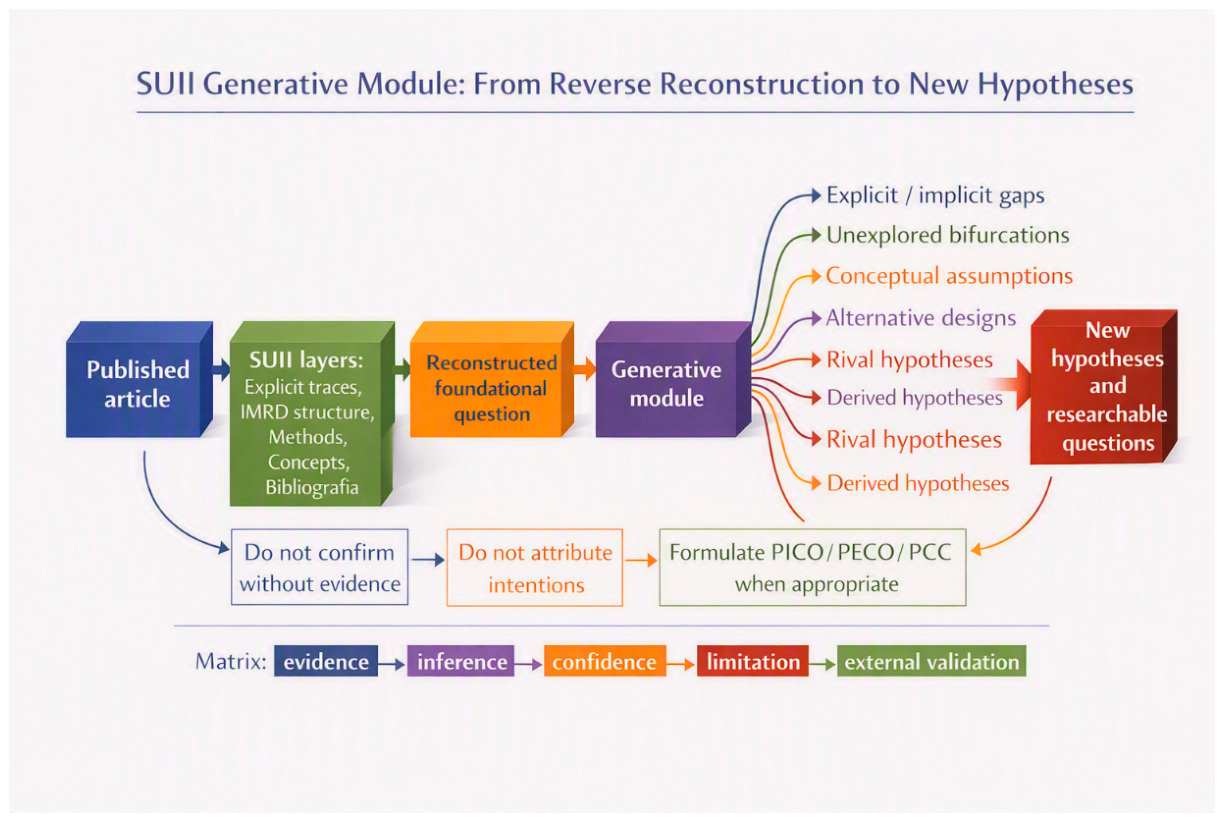
The main utility of the extended SUII is the traceable generation of new hypotheses and research questions. This usefulness arises because reverse reconstruction not only identifies how an article could have been born, but also what it did not study, what methodological bifurcations it left open, what assumptions it accepted, what bibliography it cited without developing, what internal tensions it retains and what rival hypotheses could explain the same results. The published article thus becomes a methodological quarry: its explicit limitations, silences, decisions and bibliography are not only defects or endnotes, but starting points for new designs. This transition from the critical reading of the published product to the discovery of traceable questions and hypotheses is summarized in Figure 6.
Result 8. Traceable Hypothesis Generation
The SUII allows new hypotheses to be generated in a traceable way because it does not produce free or merely plausible ideas, but rather testable and auditable proposals derived from verifiable traces of the article, accompanied by rival hypotheses, discriminant predictions, test designs and external validation needs.
The traceable generation of hypotheses is the procedure by which the SUII transforms a documentary trace into a new proposition without confusing discovery with confirmation. Its traceable nature derives from six obligations: starting from a traceable footprint; to make explicit the inference that connects the footprint with the lagoon or fork detected; formulate a testable hypothesis and, where appropriate, a rival hypothesis; turning it into a researchable question; propose the design and external evidence necessary to evaluate it; and declare confidence, priority and risk of overinterpretation. The resulting hypothesis does not acquire probative value because it is novel, coherent or plausible: it retains the status of a proposal until it is independently verified.
The process begins after completing the reconstructive exit, because the foundational question, the decisions, the concepts, the functional bibliography, the transformations and the hypotheses of genesis delimit the space of legitimate opportunities. Generative sources include explicit gaps, internal contradictions, unexplained heterogeneity, unexpected or no outcomes, untested assumptions, missing populations and outcomes, unmeasured mechanisms, alternative methodological decisions, and cited references whose implication was not developed. Each opportunity must be expressed through the chain: footprint and location → SUII inference → gap, tension or bifurcation → new hypothesis → rival hypothesis → researchable question → population or corpus → exposure or intervention → comparator → outcome → suggested design → data and analyses required → external validation → confidence → priority → risk of overinterpretation.
Hypotheses are classified as descriptive, causal, predictive, methodological, or conceptual. Descriptive ones anticipate distributions or patterns; the causal propose mechanisms or effects; predictive ones estimate future results; methodological ones compare design, measurement, search or analysis decisions; and conceptual reformulates definitions, relationships or explanatory frameworks. This classification avoids comparing incommensurable proposals and guides the choice of validation design. Prioritization must jointly consider clinical or scientific relevance, novelty, plausibility, traceability, feasibility, potential impact, cost, ethical acceptability, and discriminating capacity. A hypothesis with great novelty but poor traceability should not occupy the same position as one derived from several converging traces.
Generative discipline demands negative controls. Traces that contradict the hypothesis, alternative explanations, and conditions under which the proposal would cease to be valid must be actively sought. If several hypotheses explain the same traces in a similar way, they must be preserved as rivals and the observations that would allow them to be discriminated must be specified. When the article does not provide sufficient support, the correct output is “not determinable” or “low-confidence exploratory hypothesis.” In AI-assisted applications, generation must be done in a separate phase of extraction and reconstruction; All proposals must be verified by human researchers, contrasted with external bibliographic search, and recorded along with the system, version, prompt, sources, and corrections. This separation protects against verbal fluency, confirmation bias, and the false appearance of evidence.
The minimum product is a generative table in which each hypothesis maintains its link to the source footprint, the intermediate reasoning, the rival alternative, the proposed design and the need for validation. The closure of the module does not depend on the number of ideas produced, but on each proposal being traceable, verifiable and proportionate to the available evidence. In this way, the SUII transforms scientific creativity into an auditable operation: it expands the space of possible questions, but restricts the force of the affirmations to what the traces allow to sustain. This logic links abduction and discovery-based literature to the SUII principles of triangulation, rival hypotheses, parsimony, and provenance (Swanson, 1986; Weeber et al., 2001; Moreau & Missier, 2013; Pardal Refoyo, 2026c).
Result 9. Dual Reconstructive and Generative Output
The expanded SUII produces two distinct outputs. The reconstructive output comprises the foundational question, reverse itinerary, decisions, concepts, bibliography, transformations, and genesis hypotheses. The generative output comprises new hypotheses, research questions, rival hypotheses, a preliminary research agenda, and external validation requirements. The reconstructive output is retrospective, whereas the generative output is prospective. As shown in Figure 7, the generative module is activated after the foundational question and genesis hypotheses have been reconstructed and before the limits of the reconstruction are defined. It thus transforms traces, gaps, and bifurcations into researchable hypotheses and questions while retaining the provenance of each proposal.
Figure 7.
The generative module is inserted after reconstructing the foundational question and genesis hypotheses, and before closing the boundaries of reconstruction; it transforms traces, gaps, and bifurcations into hypotheses and questions that can be investigated with traceability.
Figure 7.
The generative module is inserted after reconstructing the foundational question and genesis hypotheses, and before closing the boundaries of reconstruction; it transforms traces, gaps, and bifurcations into hypotheses and questions that can be investigated with traceability.
Result 10. Modular Architecture and Comprehensive Application of the SUII
The SUII can be used in a modular or integral way. Modularity implies that the researcher does not need to run the entire system when his question requires only a limited function: auditing the coherence of an article, reconstructing its probable itinerary, teaching research design, analyzing the function of its bibliography or generating new hypotheses. Each module retains the common epistemological rules—traceable, traceability, distinction between evidence and inference, rival hypotheses, and grading of confidence—but produces a specific output. This architecture avoids turning the SUII into a rigid and disproportionate procedure, facilitates its adoption according to the objective and the available resources, and allows its components to be validated separately. The modules, their input questions, and their minimum outputs are summarized in Table 4.
The integral application should not be understood as the mechanical sum of independent tasks, but as a chained architecture in which the audit improves the quality of the footprints, the reconstruction explains their organization, the bibliographic analysis identifies their supports and genealogies, the teaching function makes the decisions explicit and the generative module transforms the remaining uncertainties into future research. Therefore, the scope must be declared before the analysis by means of a level of application proportional to the objective, the corpus and the availability of traces. Table 5 distinguishes three operational levels—focal, combined, and integral—and shows when it is reasonable to stop the procedure.
Result 11. Application Using AI Instructions
The application by AI is the operational modality of the SUII. The system originated and developed through structured instructions applied to AI tools, because reverse investigation requires repeatedly going through sections, tables, figures, annexes, references and versions; extract and relate traces; compare hypotheses; completing matrices; and to maintain a record of origin. These operations can be reproduced manually as a conceptual check, but their execution by human researchers alone substantially increases the time and workload and limits the comprehensive, modular, comparative and reproducible application. Instructions should specify role, primary source, objectives, levels of evidence, confidence scale, analytical procedure, mandatory departure, and rules of caution. The AI analyzes the article by sections, extracts explicit fingerprints, classifies bibliography, prepares matrices, and proposes reconstruction drafts and alternative hypotheses. At each stage, the researcher verifies sources, corrects extractions, resolves discrepancies, contrasts alternatives, assigns confidence, and approves the exit. In the generative module, the evidence chain of the SUII inference article → → gap, bifurcation or assumption → hypothesis derived from → researchable question → suggested design → external evidence necessary → confidence → risk of overinterpretation (Pardal Refoyo, 2026c) must be preserved. The valid modality is, therefore, AI-assisted SUII with continuous human supervision; Autonomous automation does not meet the requirements of the system.
Result 12. SUII Integrative Model
The integration of the above results allows us to represent the SUII as a second-order conceptual ecosystem. The finished scientific product is the starting point and the core of the system combines two complementary operations: retrospective reconstruction and traceable hypothesis generation. Around this nucleus are organized the epistemological principles, the layered architecture, the reconstructive and generative outputs, the modular applicability and the main utilities of the system. Artificial intelligence acts as a transversal operational infrastructure to make its focal, combined or integral application viable, scalable and reproducible, while mandatory human supervision preserves the verification of fingerprints, the contrast of alternatives, the grading of trust and epistemological responsibility. Figure 8 synthesizes these relationships and provides a global representation of the SUII model.
Discussion
Central Contribution
The SUII is more than a literature review, a critical-reading guide, or a prompting technique. Its central contribution is to treat the scientific article as a composite trace comprising textual, structural, methodological, bibliographic, conceptual, and rhetorical evidence. On this basis, the method supports a graded reverse reconstruction and the generation of traceable hypotheses. Its value lies not in claiming certainty about the actual history of a study, but in producing a controlled and explicitly bounded reconstruction that can support learning, auditing, and the design of future research.
Relationship with Document Analysis and Process Tracing
Documentary analysis gives the SUII the legitimacy of treating documents as data. Bowen (2009) insists that documents must be selected, evaluated, and interpreted, and that they can provide context, generate questions, track changes, and verify findings. The SUII adopts this principle, but directs it to a specific purpose: to reconstruct the production itinerary of the article. Process tracing provides the idea that inferences should be evaluated against rival hypotheses and diagnostic evidence (Beach & Pedersen, 2019; Bennett & Checkel, 2015). The SUII adapts this logic to scientific products: it does not necessarily reconstruct causal mechanisms of the social or clinical world, but rather intellectual and documentary mechanisms for the production of a scientific text.
Relationship with Medical Literature Research
Medical literature research comprises a heterogeneous set of methods aimed at locating, selecting, evaluating, integrating, and using published knowledge. Systematic reviews answer questions delimited by explicit and reproducible procedures; scoping reviews map concepts, types of evidence, research practices, and gaps; and other forms of synthesis are selected according to the nature of the question and the corpus (Grant & Booth, 2009; Tricco et al., 2018). In this ecosystem, PRISMA 2020 improves reporting transparency (Page et al., 2021). These frameworks are complementary and essential, but their primary purpose is to document, conduct, or evaluate a synthesis, not to retrospectively reconstruct the intellectual and documentary itinerary that produced a finished article.
The SUII is related to medical literature research at three levels. At the descriptive level, it treats the article, its bibliography and its associated materials as a documentary corpus and classifies the references according to their function: foundational, conceptual, methodological, normative, empirical, critical, contextual or technical. At the reconstructive level, it uses the position and context of citations, temporal sequence, convergences between sections, and relationships with protocols or records to formulate a bibliographic genealogy and a hypothesis about the foundational question, decisions, and transformations of the work. At the generative level, it converts gaps, contradictions, bridging references, and undeveloped connections into new traceable questions and hypotheses. Thus, the SUII does not compete with a systematic or scope review: it can be applied to an already published review, to an original article or to a corpus selected to explain how knowledge was organized and what future research can be derived from that organization.
The medical literature offers partial antecedents of this reverse logic. Comparison between protocols, registries, and publications retrospectively reconstructs decisions to detect changes in outcomes, analyses, or eligibility criteria and has shown that the published report may differ from the prospective plan (Chan et al., 2004). RIAT extends reconstruction by retrieving invisible or abandoned assays from available regulatory reports, data, and documents (Doshi et al., 2013). Scoping reviews can identify gaps, clarify concepts, and examine how research is conducted, but they don’t typically reconstruct the internal genesis of each product. Review automation and text mining speed up study identification, classification, and extraction, but require monitoring, documentation, and error evaluation. The SUII integrates these partial operations within a common matrix of fingerprint, inference, trust, rival hypothesis and external validation.
The closest relationship to the generative output is found in literature-based discovery. Swanson’s classical model connects literatures that remain separate through an A–B–C relationship and enables the formulation of previously unstated biomedical associations; subsequent developments have incorporated text mining, machine learning, and semantic resources to generate and prioritize hypotheses (Swanson, 1986; Weeber et al., 2001). The SUII shares the goal of discovering new knowledge from publications but differs in its starting point and analytical direction: literature-based discovery explores relationships distributed across large corpora, whereas the SUII begins with a focal product, reconstructs its internal and bibliographic architecture, and only then generates questions from its gaps, bifurcations, assumptions, or tensions. The two approaches can be combined: the SUII identifies a traceable opportunity within the article, and literature-based discovery explores external connections and evidence that may support its development.
The specific contribution of the SUII to medical literature research is therefore not a new review type, but an additional metaresearch layer applicable to existing products and corpora. This layer can support audits of coherence among the research question, search, selection, synthesis, and conclusions; reconstruction of the bibliography’s functional role and the probable itinerary of the work; comparison of the article with external documentary traces; distinction among explicit evidence, inference, and non-determinable elements; and translation of critical reading into a prospective research agenda. Its usefulness is expected to increase with the richness of the documentary ecosystem—including complete search strategies, protocols, registrations, versions, data, and peer-review materials—and to decrease when only a bibliographic record or the final text is available. Reconstruction neither replaces primary evidence nor demonstrates authorial intentions; it yields a probable and auditable model that remains open to empirical comparison.
The Article as a Black Box and the Bibliography as a System of Linked BlackBoxes
The metaphor of the black box is compatible with the SUII if it is used in an epistemologically restricted way. The published article can be considered a documentary black box because it shows stabilized inputs and outputs – declared problem, summarized methods, results, interpretation and conclusions – while compressing or making invisible a large part of its internal operations: successive decisions, discarded alternatives, negotiations, versions, corrections, unpublished data and process contingencies. “Opening” the box means returning to its conditions of production and recovering associations, actors, instruments and transformations. The SUII makes a partial analytical opening: it breaks down the article into traces and proposes plausible internal models, but it does not confuse this reconstruction with direct access to the real process.
This approach has a direct parallel with the medical literature on the evaluation of complex interventions. In this setting, trials focusing solely on intervention and outcome can function as ‘black box’ assessments, because the magnitude of the effect alone does not explain how the intervention was implemented, what mechanisms were activated, how participants responded, or what contextual factors changed the results. Process evaluations and realistic evaluation attempt to open that box by systematically examining implementation, mechanisms, and context, and asking what works, for whom, and under what circumstances. The parallelism with the SUII lies in the fact that both reject a linear reading limited to inputs and outputs and seek to recover internal processes through multiple traces. The main difference is the object of analysis: the evaluation of medical processes studies prospectively or retrospectively how an intervention operates in real participants, organizations and contexts, while the SUII analyzes an already published scientific product and reconstructs its intellectual, methodological, documentary and bibliographic process. Therefore, evaluations of complex interventions can directly observe implementation and context data planned for the study; the SUII works with frequently incomplete documentary traces and must express its conclusions as probable reconstructions, graduated and open to external validation.
The box is not simply filled with recoverable “hidden information.” It is worth distinguishing three strata. First, compressed but accessible information: relationships that can be reconstructed by convergence between sections, tables, figures, citations, annexes, and internal patterns. Second, latent or probabilistic information: undeclared decisions or influences that can only be formulated as graded inferences and rival hypotheses. Third, missing or potentially inaccessible information: conversations, uncited readings, discarded data, private motivations, or unrecorded editorial decisions. The SUII can increase its capacity by incorporating protocols, registries, preprints, versions, repositories, peer review and correspondence, but it must retain the “non-determinable” category when the footprints do not allow discriminating alternatives. Table 6 summarizes the scope and limits of this metaphor.
In SUII-B, each cited article can be treated as a secondary black box, and the set of references as a network of linked black boxes. The focal article does not import from each source all its content or history, but a specific statement, definition, method, data or authority, observable in the context of citation. In turn, each cited source condenses its own research process and refers to other references, generating a potentially undefined nested structure. This conception allows for the reconstruction of genealogies, conceptual transfers, methodological dependencies and bridges between traditions, but it introduces the propagation of uncertainty: a weak interpretation of a reference should not become a strong foundation for the reconstruction of the focal article. Therefore, SUII-B must decide which boxes to open according to relevance and discriminating power, verify primary sources when the statement is central, and stop recursion when new openings no longer modify the main hypothesis or reduce relevant uncertainty.
Bibliographic Extension of the SUII: Reverse Reconstruction from the References (SUII-B)
In a bibliographic review using the SUII, the references cited in an article can serve as a starting point for partially reconstructing its intellectual and methodological development. This extension, provisionally termed SUII-B (Bibliographic SUII), treats each reference as a functional trace rather than a merely formal element. The analysis identifies the sources that define the problem, provide concepts, justify methods, establish standards, supply primary evidence, introduce controversies, or support the final interpretation. The temporal, thematic, and relational distribution of these sources can then inform hypotheses about conceptual genealogy, methodological influences, bridge references, direct antecedents, and the probable foundational question. This approach is compatible with citation-context analysis, which examines how ideas from influential works are used, tested, or criticized, and with bibliometric methods that identify historical roots, documentary similarity, and knowledge trajectories through cited references, bibliographic coupling, and main-path analysis.
The SUII-B procedure would follow an explicit sequence: normalize and verify the references; classify them by epistemological function; locate, where the full text is available, the exact context of each quotation; to group them into conceptual and methodological nuclei; chronologically ordering the milestones; represent relations of co-citation, coupling or continuity; and formulate a parsimonious reconstruction of the probable itinerary. The output would include a bibliographic genealogy map, a main genesis hypothesis, at least one rival hypothesis, a confidence scale, and the external evidence needed to discriminate alternatives. The phases, products and limits are summarized in Table 7.
SUII-B has real utility but limited reconstructive capacity when applied exclusively to the reference list. The published bibliography is selected by the authors, conditioned by editorial limits and citation biases, and does not inform by itself about the real order of reading, the sources consulted but not cited, the discarded alternatives or the intentions of the team. A reference can be ritual, negative, methodological, or merely contextual, and that function can only be attributed with sufficient confidence by examining the context of citation and its relationship to other sections. Therefore, with isolated bibliography, reconstruction usually reaches low or medium confidence; it increases by triangulating it with introduction, methods, discussion, protocol, record, versions, supplementary materials or editorial correspondence. SUII-B does not retrieve the actual history of research, but instead produces a probable, auditable, and useful intellectual genealogy for formulating validation questions.
Relationship of the SUII with Research Methodologies
The SUII should be understood as a second-order cross-sectional methodology: it does not replace the clinical trial, the observational study, the qualitative method, the systematic review or the case study, but rather retrospectively analyzes how one of these designs materialized in a scientific product. Its immediate object is not the patient, the population, the social phenomenon or the technical system, but the article and its traces; It can therefore be applied after any primary methodology, provided that the document contains sufficient information on the question, decisions, methods, data, bibliography and transformations of the project. This position coincides with the internal formulation of the SUII as an audited reconstruction of the probable itinerary and with its distinction between explicit evidence, reasoned inference, and controlled speculation (Pardal Refoyo, 2026a, 2026b). The relationship of the SUII with the main research methodologies, its partial applications in medicine and its analogous use in other disciplines is summarized in Table 8.
Its relationship with quantitative methodologies is reconstructive and critical: it allows us to check the continuity between question, variables, population, comparators, outcomes, analysis and conclusion, and to identify unjustified decisions, post hoc analyses, changes in outcomes or rival explanations. In qualitative methodology, it is close to documentary analysis because it codes traces, compares categories and constructs interpretations; it differs in that its specific product is a genesis itinerary and a traceability matrix (Bowen, 2009). In case studies and process tracing, it adopts sequencing, diagnostic tests, and rival hypotheses, but shifts the focus from causal mechanisms of the world to documentary and intellectual mechanisms of scientific production (Collier, 2011; Mahoney, 2012; Beach & Pedersen, 2019). In systematic and scope reviews, it acts as a metascientific layer: PRISMA and PRISMA-ScR indicate how to report, while SUII reconstructs why the final product adopted a certain architecture and what new questions emerge from it (Page et al., 2021; Tricco et al., 2018).
The relationship with historical, conceptual and engineering research is equally constitutive. The genealogy and history of science allow us to reconstruct the origin and transformation of concepts, paradigms and epistemic objects. Reverse engineering provides the gesture of starting from an existing artifact to recover components, interrelationships and higher-level representations (Chikofsky & Cross, 1990). The reverse research design described in political science asks students to reconstruct the project that could produce a published work; it constitutes, therefore, a partial direct pedagogical precedent, although it does not incorporate the evidence-inference-trust matrix or the generative module of the SUII (Ayoub, 2022). Provenance reinforces the obligation to record sources, activities, derivations, chronologies, contradictions, and degrees of uncertainty (Moreau & Missier, 2013).
In medical research, the SUII can occupy a space that is not fully covered by reporting, recording and critical evaluation guidelines. These frameworks are indispensable for methodological transparency, but they do not constitute in themselves a method for reconstructing the logical-documentary itinerary of a published article. Automation and text mining can speed up study identification, although they require monitoring and documentation of their decisions. The protocol-publication comparison and RIAT address specific problems of transparency (Chan et al., 2004; Doshi et al., 2013), while the SUII aims to reconstruct the intellectual and bibliographic architecture of heterogeneous scientific products.
The medical literature does contain partial applications of reverse logic, although it does not usually call them SUII or bring them together in a single procedure. Comparison between protocols, registries, and publications reconstructs previous decisions to detect changes in eligibility criteria, outcomes, and analyses (Chan et al., 2004). RIAT reconstructs invisible or abandoned trials from regulatory documents and available data (Doshi et al., 2013); discovery-based literature generates hypotheses by connecting published biomedical knowledge (Swanson, 1986; Weeber et al., 2001); and automated or text mining-assisted systematic review adds exploratory capacity, but does not by itself reconstruct the internal genealogy of an article. Therefore, in medicine there are clear components of the SUII – protocol-publication audit, document restoration, synthesis, traceability and hypothesis generation – but a consolidated methodology that systematically integrates all these operations with a double reconstructive and generative output was not identified.
Outside of medicine, the constitutive logic of the SUII is widely distributed. In political science, reverse research design has been used to teach research design by reconstructing the process of published authors (Ayoub, 2022). In social sciences, process tracing, case studies, documentary analysis, and conceptual genealogy reconstruct sequences, mechanisms, contexts, and transformations. In computer science and software engineering, reverse engineering and architecture recovery start from existing systems to infer design and abstractions (Chikofsky & Cross, 1990). In forensic sciences, events and chronologies are inferred from partial traces, and in data science and e-science, provenance is documented to make transformations auditable (Simmhan et al., 2005). These applications demonstrate that the reverse principle is not unique to one discipline. What is specifically new about the SUII is to transfer and combine these logics to analyze scientific products such as documentary artifacts and convert the reconstruction into new researchable hypotheses.
The reasoned conclusion is twofold. First, the SUII has methodological plausibility because each of its components has mature antecedents and real applications in different disciplines. Second, it cannot yet be affirmed that the complete SUII is validated or in established use: the current evidence supports partial antecedents and analogies, not equivalence. Its universality must be formulated as a hypothesis of transferability conditioned by the richness of the documentary traces, the type of design, the availability of protocols or versions, and the reproducibility between evaluators. The validation agenda should compare SUII reconstructions with protocols, notebooks, records, versions and testimonies of teams; measure inter-rater agreement; and separately evaluate reconstructive accuracy, pedagogical utility, ability to detect inconsistencies and performance of the hypotheses generated.
Table 8 places the SUII as a second-order cross-sectional methodology: it integrates resources from quantitative, qualitative, documentary, historical, reconstructive, and computational methods, but does not replace any of them. Its relationship with these traditions is functional and selective. From documentary analysis and qualitative methods, he adopts the coding and interpretation of fingerprints; case study and process tracing, sequencing, rival hypotheses, and discriminant evidence; systematic reviews and evaluation tools, transparency and methodological control; conceptual genealogy, the reconstruction of traditions and changes of meaning; reverse engineering and forensic reconstruction, the recovery of architectures and chronologies from finished products; and provenance, FAIR, XAI and discovery-based literature, traceability, explainability and hypothesis generation. In medicine, these components partially appear in protocol-publication auditing, RIAT, evidence reviews, text mining, and the generation of biomedical hypotheses. In other disciplines, similar applications are observed in social sciences, computer science, engineering, data science, and forensic sciences. The differential contribution of the SUII consists in articulating these resources in a single procedure that reconstructs the probable itinerary of a scientific product, grades the confidence of the inferences and transforms their gaps and bifurcations into new researchable questions.
Hypothesis Generation as the Main Function
The generation of hypotheses is the most fertile function of the SUII because it transforms critical reading into prospective design. Here the SUII approaches discovery-based literature, which connects published knowledge to formulate non-explicit hypotheses (Swanson, 1986; Weeber et al., 2001). However, their difference is decisive: discovery-based literature generates new relationships between concepts distributed in bibliographic corpora; the SUII generates hypotheses from the internal and bibliographic traces of a specific article. It can detect, for example, that an article cites a methodological tradition but does not apply it; that uses an outcome but not a mediator; that recognizes heterogeneity but does not explore subgroups; that accepts a definition without contrasting it; or that their discussion suggests an unmeasured mechanism. Each of these fingerprints can become an investigationable question if its source, inference, level of confidence, and need for external validation are documented.
Hypothesis generation also benefits from conceiving concepts, methods, and registers as frontier objects capable of connecting different communities and vocabularies. Discovery-based literature provides the classic antecedent for linking knowledge that is not explicitly connected (Swanson, 1986; Weeber et al., 2001), while the principles of open and reproducible science warn that novelty and plausibility must be accompanied by verifiable data, protocols, and traces.
Strengths
The strengths of the SUII are fivefold. First, it is potentially transferable across empirical articles, reviews, guidelines, theses, reports, and methodological documents. Second, it has pedagogical value because it teaches readers to decompose published research into decisions and transformations. Third, it promotes inferential transparency by requiring explicit distinctions among evidence, inference, and speculation. Fourth, it has generative potential because it converts gaps and bifurcations into new hypotheses. Fifth, it is designed for AI-assisted implementation: AI-based text processing, comparison, consistency checking, abductive support, and provenance recording can make comprehensive or modular reverse analysis feasible within practical time constraints. This operational role is balanced by mandatory human oversight at every stage, with researchers retaining responsibility for source verification, inferential judgments, confidence grading, and final approval.
Epistemological Limitations and Risks
The SUII has five principal limitations. First, overinterpretation is possible because an article does not preserve the entire history of its production. Second, narrative bias may lead analysts to construct an excessively coherent and retrospectively persuasive account. Third, misattribution may occur because inferring a trajectory is not equivalent to knowing the authors’ intentions. Fourth, documentary bias may arise because published content can reflect editorial conventions rather than the actual research process. Fifth, AI-assisted applications introduce algorithmic risks: AI may bias searching, selection, extraction, classification, reconstruction, and generation; amplify linguistic, geographical, and citation inequalities; privilege confirmatory evidence; and fill documentary gaps through plausible but unsupported language. Such errors can propagate across stages and interact with established review biases, so that early distortions in the corpus affect screening, extraction, synthesis, and generative outputs (Pardal-Refoyo & Pardal-Peláez, 2025). The SUII should therefore be presented as a probabilistic and auditable reconstruction rather than a definitive historical recovery. Any use of AI should include independent searching, source verification, analysis of contradictory evidence, formulation of rival hypotheses, assessment of representativeness, and final human judgment (World Health Organization, 2021; Gallegos et al., 2024; Algaba et al., 2025).
Future Validation Agenda
The validation of the SUII is proposed in two progressive stages. First, internal reproducibility will be evaluated through two independent applications of the integral SUII and nuclear modules to a heterogeneous sample of published articles. Before the analysis, the corpus, the code book, the templates, the inferential rules and the minimum products will be established. Each researcher will separately preserve the extracted fingerprints, the decisions, the human corrections and the final exit. The location and classification of fingerprints, the inferential status, the trust, the foundational question, the decisions reconstructed, the discrepancies detected and the hypotheses generated will be compared. To distinguish the agreement attributable to the method from that induced by the same artificial intelligence tool, the model, the session or the operational formulation of the prompt will be varied in a planned way, keeping the methodological core constant. Second, transferability will be studied with external researchers trained through a short manual, a code book and a solved case. As a subsequent validation of accuracy, the reconstructions will be contrasted with real traces – protocols, records, preprints, versions and peer review – and the audit, teaching usefulness and the quality and traceability of the hypotheses generated will be evaluated separately.
Conclusion of the Discussion
The SUII must position itself as a conceptual and operational methodology in development: original enough to deserve its own formulation, but sufficiently connected to previous traditions to avoid the false idea of invention ex nihilo. Its value lies in integration: to reconstruct the logical-documentary past and design the future that can be researched from the traces of the published article.
Operational Synthesis Tables
The operational synthesis of the SUII is organized in four complementary tables: Table 9 summarizes its fundamental components and products; Table 10 compares the main methodological antecedents; Table 11 distinguishes the reconstructive and generative outputs; and Table 12 grades the status of affirmations and their rules of use. Figure 9 integrates these pieces into a joint view of the epistemological layers, outputs, and controls of the system.
The main methodological antecedents, their coincidences with the SUII and the differences that delimit the specific contribution of the system are compared in Table 10.
The double output of the system differentiates the products that retrospectively reconstruct the research itinerary from those that project new questions, hypotheses and validation needs, as summarized in Table 11.
The classification of claims distinguishes explicit evidence, reasoned inference, and controlled speculation, and establishes for each level a specific rule of use, as summarized in Table 12.
Conclusions
The SUII is proposed as a second-order cross-sectional methodology for logically, documentarily, methodologically, and bibliographically reconstructing the probable pathways of scientific products that retain sufficient traces, and for transforming their gaps, tensions, and bifurcations into new researchable hypotheses. Its distinctive contribution lies in integrating document analysis, process tracing, reverse engineering, provenance, bibliographic analysis, and traceable hypothesis generation into dual reconstructive and generative outputs that may be applied focally, in combination, or comprehensively. Artificial intelligence is its primary operational infrastructure for scalability, consistency, and traceability, but it does not provide autonomous evidence and requires continuous human oversight to verify sources and traces, test rival hypotheses, grade confidence, and approve the final synthesis. The SUII complements rather than replaces primary research methodologies, reporting guidelines, and appraisal tools. Its reproducibility, reconstructive accuracy, transferability, pedagogical utility, and generative performance remain to be established through empirical validation and comparison with documented research records.
Terms and Abbreviations
This glossary brings together, in alphabetical order, methodological, bibliometric, computer and open science terms and abbreviations used in the manuscript that may not be part of the usual medical vocabulary.
Bibliographic linkage. Relationship between two documents that share one or more references. The more common sources they cite, the greater their bibliographic proximity, although this does not demonstrate causal influence.
Analysis of the context of citation. Examination of the phrase, paragraph, and section where a quotation appears to determine whether the reference is used as conceptual support, method, norm, evidence, contrast, criticism, or context.
Functional bibliography. Classification of references according to the role they play in the scientific product – foundational, conceptual, methodological, normative, empirical, critical, contextual or technical – and not only according to their bibliographic data.
Blackboxing or “black box”. The process by which a scientific or technical product is used as a stable unit, mainly attending to its inputs and outputs, while the decisions, actors, instruments and transformations that produced it become less visible.
Co-citation. Relationship between two documents when they are cited together by a subsequent publication. It is used to identify conceptual affinities, schools or nuclei of knowledge.
CSV (comma-separated values). A tabular file format in which each row represents a record and the columns are separated by delimiters; in this work it is used to manage the seed bibliography.
DOI (Digital Object Identifier). Persistent alphanumeric identifier assigned to publications and other digital objects to facilitate their location and stable citation.
FAIR. Principles for data to be findable, accessible, interoperable and reusable.
Bibliographic genealogy. Reconstruction of the lines of provenance, continuity, transformation and connection between the references that support a concept, method or scientific product.
Genesis hypothesis. A probable explanation of how a scientific product could have originated and evolved, formulated from documentary traces and always differentiated from the real history of the authors.
Rival hypothesis. An alternative explanation capable of justifying the same traces or results; it forces us to identify what evidence would allow us to discriminate between interpretations.
AI. Artificial intelligence. In the SUII, AI constitutes the essential operational infrastructure for applying the extraction, comparison, reconstruction, generation, and traceability modules in a viable, scalable, and reproducible manner. Its outputs must undergo mandatory human supervision at each stage and are never considered autonomous evidence.
IMRD. Conventional structure of a scientific article: Introduction, Methods, Results and Discussion.
ISBN (International Standard Book Number). International Standardised Identifier for Books and Monographic Editions.
LBD (literature-based discovery). Literature-based discovery: A method that connects published knowledge, often from separate corpora, to propose previously unexpressed relationships or hypotheses.
Metascience. Scientific study of how research itself is designed, executed, communicated, evaluated, and reproduced.
Ontology. Formal representation of entities, properties and relationships of a domain, useful for organizing concepts and allowing their computational analysis.
Parsimony. A principle that favors the reconstruction capable of explaining more features of the product with fewer unobserved assumptions, without oversimplifying the evidence.
PMID (PubMed Identifier). Unique number assigned to each record included in the PubMed database.
Preprint. A public version of a scientific manuscript disseminated before the completion of peer review or formal publication.
PRISMA. Guidance to improve the transparency and completeness of the reporting of systematic reviews and meta-analyses.
PRISMA-P. Extension of PRISMA for reporting systematic review protocols and meta-analyses.
PRISMA-ScR. PRISMA extension for the reporting of scope reviews.
PRISMA-S. Extension of PRISMA to describe bibliographic searches in a complete and reproducible way.
Process tracing. A family of methods that reconstructs sequences and mechanisms through diagnostic evidence, comparison of explanations and rival hypotheses.
Prompt. Instruction or structured set of instructions provided to an artificial intelligence system to guide a task and its output format.
PROSPERO. International prospective register of systematic review protocols, particularly in health and social care.
Provenance or provenance. Information on the origin of data or objects, the agents and activities involved, and the transformations or derivations produced.
PROV-DM. World Wide Web Consortium data model to represent provenance through entities, activities, agents, and relationships.
PROV-O. An ontology of the World Wide Web Consortium that expresses the PROV model in a format suitable for the semantic Web.
RIAT (Restoring Invisible and Abandoned Trials). Initiative to restore and publish abandoned or incompletely reported trials based on available documents and data.
ROBIS. A tool for assessing the risk of bias of a systematic review.
Main path analysis. Citation network technique that identifies particularly relevant development trajectories within a scientific field.
SUII. Universal Research System with Reverse Itinerary (SUII, the Spanish acronym for Sistema Universal de Investigación con Itinerario Inverso): a methodology that starts from a finished scientific product to reconstruct its probable research pathway in a traceable manner and generate directions for future research.
SUII-B. Bibliographic extension of the SUII that analyzes the cited references and their contexts as traces to reconstruct genealogies, influences, methodological decisions and probable foundational questions.
SWiM (Synthesis Without Meta-analysis). Reporting guide for quantitative syntheses of effects when meta-analysis is not performed.
Traceability. Ability to link each statement, decision, or inference to the documentary trace, the rule used, the version, and the evaluator who produced it.
Documentary triangulation. Contrast of the same statement or inference through several sections or independent documentary sources to check if they converge or contradict each other.
XAI (Explainable Artificial Intelligence). Explainable artificial intelligence: methods aimed at making predictions or outputs from automatic systems understandable, attributable and auditable.
Author Contributions
JLPR: conceptualization, methodology, literature searching, data curation, formal analysis, visualization, writing—original draft, and writing—review and editing. BPP: validation, methodology, critical analysis, literature review, and writing—review and editing. Both authors approved the final version and accept responsibility for the integrity of the work.
Funding
This work received no specific funding from public, commercial, or not-for-profit funding agencies.
Ethicsapproval and consent to participate
Not applicable. This conceptual and methodological study is based exclusively on published documents and literature and includes no human participants, animals, or individual-level clinical data.
Data and materials availability
The methodological framework, application rules, templates, and SUII prompts are provided in the manuscript. A user manual containing practical instructions and the prompts required for comprehensive or modular application is provided as supplementary material.
Acknowledgments
The authors have no additional acknowledgements.
Conflicts of Interest
The authors declare no conflicts of interest related to this work.
Use of generative artificial intelligence
Microsoft Copilot was used to support the methodological development of the SUII, the organization and analysis of information, and language editing of the manuscript. The authors reviewed, verified, and corrected all outputs; retained full responsibility for the content; and did not treat the tool as an author or a source of evidence.
References
- Abogunrin, S.; Muir, J. M.; Zerbini, C. Z.; Sarri, G. How much can we save by applying artificial intelligence in evidence synthesis? Results from a pragmatic review to quantify workload efficiencies and cost savings. Frontiers in Pharmacology 16 2025, 1454245. [Google Scholar] [CrossRef] [PubMed]
- Algaba, A.; Mazijn, C.; Holst, V.; Tori, F.; Wenmackers, S.; Ginis, V. Large language models reflect human citation patterns with a heightened citation bias. In Findings of the Association for Computational Linguistics: NAACL 2025; 2025. [Google Scholar] [CrossRef]
- Arksey, H.; O’Malley, L. Scoping studies: Towards a methodological framework. International Journal of Social Research Methodology 2005, 8(1), 19–32. [Google Scholar] [CrossRef]
- Arrieta, A. B.; Díaz-Rodríguez, N.; Del Ser, J.; Bennetot, A.; Tabik, S.; Barbado, A.; García, S.; Gil-López, S.; Molina, D.; Benjamins, R.; Chatila, R.; Herrera, F. Explainable artificial intelligence (XAI): Concepts, taxonomies, opportunities and challenges toward responsible AI. Information Fusion 2020, 58, 82–115. [Google Scholar] [CrossRef]
- Ayoub, P. M. Reverse research design: Research design in the undergraduate classroom. PS: Political Science & Politics 2022, 55(2), 424–428. [Google Scholar] [CrossRef]
- Beach, D.; Pedersen, R. B. Process-tracing methods: Foundations and guidelines, 2nd ed.; University of Michigan Press, 2019. [Google Scholar] [CrossRef]
- Bennett, A.; Checkel, J. T. (Eds.) Process tracing: From metaphor to analytic tool; Cambridge University Press, 2015. [Google Scholar]
- Bowen, G. A. Document analysis as a qualitative research method. Qualitative Research Journal 2009, 9(2), 27–40. [Google Scholar] [CrossRef]
- Chan, A.-W.; Hróbjartsson, A.; Haahr, M. T.; Gøtzsche, P. C.; Altman, D. G. Empirical evidence for selective reporting of outcomes in randomized trials: Comparison of protocols to published articles. JAMA 2004, 291(20), 2457–2465. [Google Scholar] [CrossRef] [PubMed]
- Chikofsky, E. J.; Cross, J. H., II. Reverse engineering and design recovery: A taxonomy. IEEE Software 1990, 7(1), 13–17. [Google Scholar] [CrossRef]
- Collier, D. Understanding process tracing. PS: Political Science & Politics 2011, 44(4), 823–830. [Google Scholar] [CrossRef]
- Doshi, P.; Dickersin, K.; Healy, D.; Vedula, S. S.; Jefferson, T. Restoring invisible and abandoned trials: A call for people to publish the findings. BMJ 2013, 346, f2865. [Google Scholar] [CrossRef] [PubMed]
- Elo, S.; Kyngäs, H. The qualitative content analysis process. Journal of Advanced Nursing 2008, 62(1), 107–115. [Google Scholar] [CrossRef] [PubMed]
- Flemyng, E.; Noel-Storr, A.; Macura, B.; Gartlehner, G.; Thomas, J.; Meerpohl, J. J.; Jordan, Z.; Minx, J.; Eisele-Metzger, A.; Hamel, C.; Jemioło, P.; Porritt, K.; Grainger, M. Position statement on artificial intelligence (AI) use in evidence synthesis across Cochrane, the Campbell Collaboration, JBI and the Collaboration for Environmental Evidence 2025. Cochrane Database of Systematic Reviews 2025, ED000178. [Google Scholar] [CrossRef]
- Gallegos, I. O.; Rossi, R. A.; Barrow, J.; Tanjim, M. M.; Kim, S.; Dernoncourt, F.; Yu, T.; Zhang, R.; Ahmed, N. K. Bias and fairness in large language models: A survey. Computational Linguistics 2024, 50(3), 1097–1179. [Google Scholar] [CrossRef]
- Gastel, B.; Day, R. A. How to write and publish a scientific paper, 9th ed.; Cambridge University Press, 2024. [Google Scholar]
- Grant, M. J.; Booth, A. A typology of reviews: An analysis of 14 review types and associated methodologies. Health Information & Libraries Journal 2009, 26(2), 91–108. [Google Scholar] [CrossRef] [PubMed]
- International Committee of Medical Journal Editors. Recommendations for the conduct, reporting, editing, and publication of scholarly work in medical journals: Preparing a manuscript for submission to a medical journal. January 2026. Available online: https://www.icmje.org/recommendations/browse/manuscript-preparation/preparing-for-submission.html.
- Kale, A.; Nguyen, T.; Harris, F. C., Jr.; Li, C.; Zhang, J.; Ma, X. Provenance documentation to enable explainable and trustworthy AI: A literature review. Data Intelligence 2023, 5(1), 139–162. [Google Scholar] [CrossRef]
- Khalil, H.; Jia, R.; Moraes, E. B.; Munn, Z.; Alexander, L.; Peters, M. D. J.; Asran, A.; Godfrey, C. M.; Tricco, A. C.; Pollock, D.; Evans, C. Scoping reviews and their role in identifying research priorities. Journal of Clinical Epidemiology 2025, 181, 111712. [Google Scholar] [CrossRef] [PubMed]
- Mahoney, J. The logic of process tracing tests in the social sciences. Sociological Methods & Research 2012, 41(4), 570–597. [Google Scholar] [CrossRef]
- Manvi, R.; Khanna, S.; Burke, M.; Lobell, D.; Ermon, S. Large language models are geographically biased. arXiv 2024. [Google Scholar] [CrossRef]
- Moreau, L.; Missier, P. (Eds.) PROV-DM: The PROV data model; World Wide Web Consortium, 2013; Available online: https://www.w3.org/TR/prov-dm/.
- Page, M. J.; McKenzie, J. E.; Bossuyt, P. M.; Boutron, I.; Hoffmann, T. C.; Mulrow, C. D.; Shamseer, L.; Tetzlaff, J. M.; Akl, E. A.; Brennan, S. E.; Chou, R.; Glanville, J.; Grimshaw, J. M.; Hrobjartsson, A.; Lalu, M. M.; Li, T.; Loder, E. W.; Mayo-Wilson, E.; McDonald, S.; McGuinness, L. A.; Stewart, L. A.; Thomas, J.; Tricco, A. C.; Welch, V. A.; Whiting, P.; Moher, D. The PRISMA 2020 statement: An updated guideline for reporting systematic reviews. BMJ 2021, 372, n71. [Google Scholar] [CrossRef] [PubMed]
- Pardal Refoyo, J. L. Universal Research System with Reverse Itinerary: General theoretical proposal to reconstruct a research from its final product. Unpublished manuscript. 2026a. [Google Scholar]
- Pardal Refoyo, J. L. Universal Prompt for Copilot: Application of the SUII to any scientific article. Unpublished manuscript. 2026b. [Google Scholar]
- Pardal Refoyo, J. L. Extension of the SUII general prompt: Module for generating new hypotheses and questions. Unpublished manuscript. 2026c. [Google Scholar]
- Pardal Refoyo, J. L. Comparative Report: Potential Antecedents of the Universal Research System with Reverse Itinerary. Unpublished manuscript. 2026d. [Google Scholar]
- Pardal Refoyo, J. L. SUII doctoral seed bibliography: Master CSV of 100 references [Unpublished database] 2026e.
- Pardal-Refoyo, J. L.; Pardal-Peláez, B. Stage-wise algorithmic bias, its reporting, and relation to classical systematic review biases in AI-based automated screening in health sciences: A structured literature review. medRxiv 2025. [Google Scholar] [CrossRef]
- Simera, I.; Moher, D.; Hirst, A.; Hoey, J.; Schulz, K. F.; Altman, D. G. Transparent and accurate reporting increases reliability, utility, and impact of your research: Reporting guidelines and the EQUATOR Network. BMC Medicine 8 2010, 24. [Google Scholar] [CrossRef] [PubMed]
- Simmhan, Y. L.; Plale, B.; Gannon, D. A survey of data provenance in e-science. SIGMOD Record 2005, 34(3), 31–36. [Google Scholar] [CrossRef]
- Sollaci, L. B.; Pereira, M. G. The introduction, methods, results, and discussion (IMRAD) structure: A fifty-year survey. Journal of the Medical Library Association 2004, 92(3), 364–367. [Google Scholar] [PubMed]
- Swanson, D. R. Fish oil, Raynaud’s syndrome, and undiscovered public knowledge. Perspectives in Biology and Medicine 1986, 30(1), 7–18. [Google Scholar] [CrossRef] [PubMed]
- Tricco, A. C.; Lillie, E.; Zarin, W.; O’Brien, K. K.; Colquhoun, H.; Levac, D.; Moher, D.; Peters, M. D. J.; Horsley, T.; Weeks, L.; Hempel, S.; Akl, E. A.; Chang, C.; McGowan, J.; Stewart, L.; Hartling, L.; Aldcroft, A.; Wilson, M. G.; Garritty, C.; Straus, S. E. PRISMA extension for scoping reviews (PRISMA-ScR): Checklist and explanation. Annals of Internal Medicine 2018, 169(7), 467–473. [Google Scholar] [CrossRef] [PubMed]
- Vasu, R.; Basu, C.; Dalvi Mishra, B.; Sarasua, C.; Clark, P.; Bernstein, A. HypER: Literature-grounded hypothesis generation and distillation with provenance. In Proceedings of the 2025 Conference on Empirical Methods in Natural Language Processing; Christodoulopoulos, C., Chakraborty, T., Rose, C., Peng, V., Eds.; Association for Computational Linguistics, 2025; pp. 25413–25438. [Google Scholar] [CrossRef]
- Weeber, M.; Klein, H.; de Jong-van den Berg, L. T. W.; Vos, R. Using concepts in literature-based discovery: Simulating Swanson’s Raynaud–fish oil and migraine–magnesium discoveries. Journal of the American Society for Information Science and Technology 2001, 52(7), 548–557. [Google Scholar] [CrossRef]
- World Health Organization. Ethics and governance of artificial intelligence for health: WHO guidance; 2021. [Google Scholar]
Figure 1.
Distribution of the SUII seed bibliography by genealogical family, calculated from the generated master CSV.
Figure 1.
Distribution of the SUII seed bibliography by genealogical family, calculated from the generated master CSV.
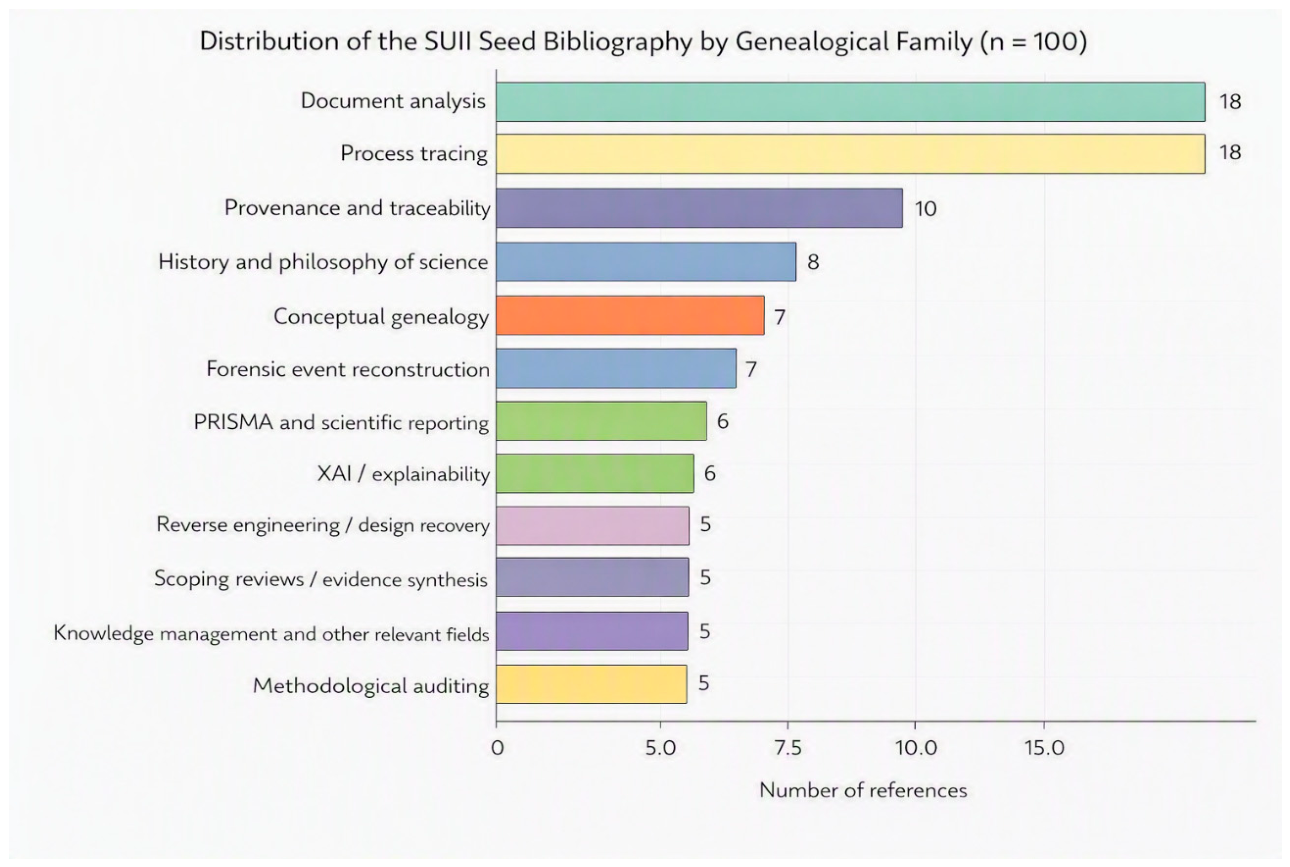
Figure 2.
Functions of artificial intelligence as an operational infrastructure of the SUII. AI makes reverse investigation viable and scalable through six complementary functions: document scalability, automation of repetitive tasks, operational consistency, analytical sensitivity, abductive support, and traceability and reproducibility. Without these functions, comprehensive or modular application would theoretically be possible, but considerably slower, more expensive, and difficult to replicate. All stages require mandatory human supervision: definition of the corpus and rules, verification of sources and fingerprints, testing of rival hypotheses, assignment of trust, and final approval. AI is essential for the operation of the SUII, but it does not constitute an autonomous source of evidence nor does it replace the epistemological responsibility of the researcher.
Figure 2.
Functions of artificial intelligence as an operational infrastructure of the SUII. AI makes reverse investigation viable and scalable through six complementary functions: document scalability, automation of repetitive tasks, operational consistency, analytical sensitivity, abductive support, and traceability and reproducibility. Without these functions, comprehensive or modular application would theoretically be possible, but considerably slower, more expensive, and difficult to replicate. All stages require mandatory human supervision: definition of the corpus and rules, verification of sources and fingerprints, testing of rival hypotheses, assignment of trust, and final approval. AI is essential for the operation of the SUII, but it does not constitute an autonomous source of evidence nor does it replace the epistemological responsibility of the researcher.
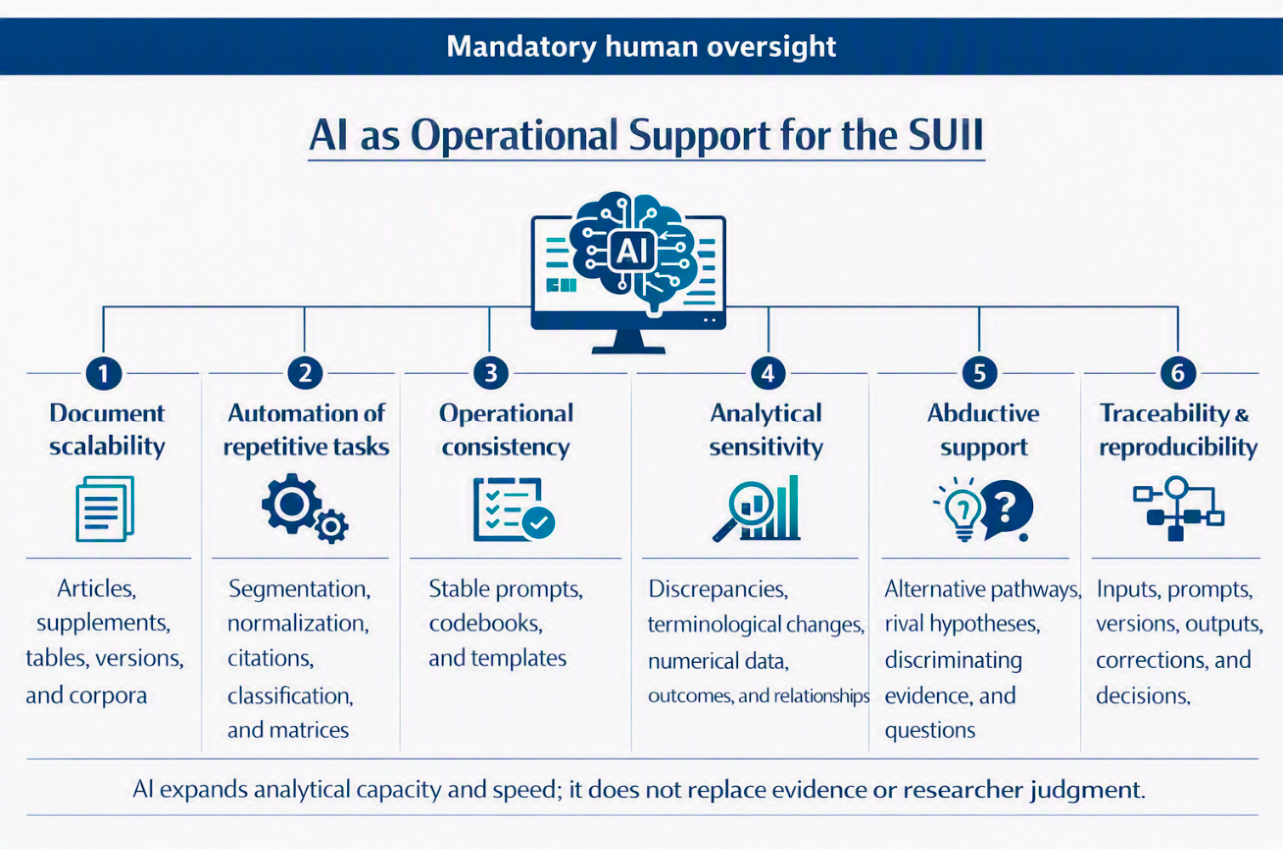
Figure 3.
Operational architecture of the SUII universal prompt: the scientific article is analyzed in layers, translated into an evidence-inference-confidence matrix and produces a narrative and tabular reconstruction of the inverse itinerary.
Figure 3.
Operational architecture of the SUII universal prompt: the scientific article is analyzed in layers, translated into an evidence-inference-confidence matrix and produces a narrative and tabular reconstruction of the inverse itinerary.
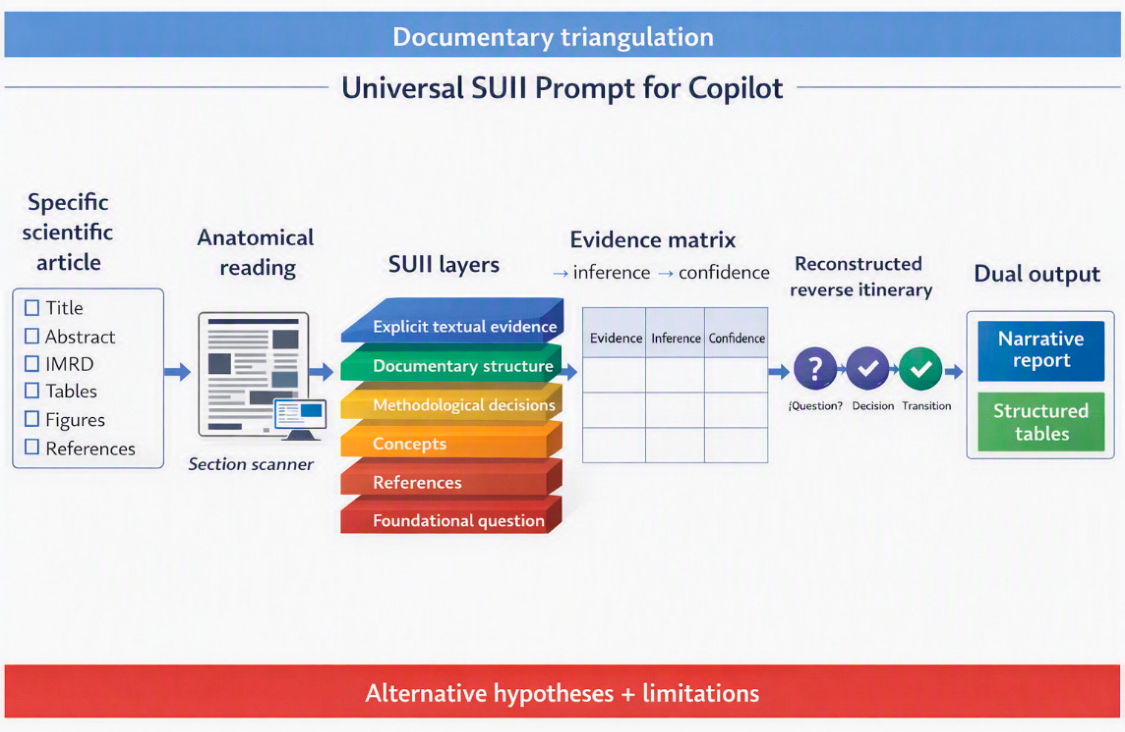
Figure 4.
Conceptual architecture of the SUII seed literature: four top-priority families support the core and connect with layers of reporting, traceability, auditing, explainability, and forensic reconstruction.
Figure 4.
Conceptual architecture of the SUII seed literature: four top-priority families support the core and connect with layers of reporting, traceability, auditing, explainability, and forensic reconstruction.
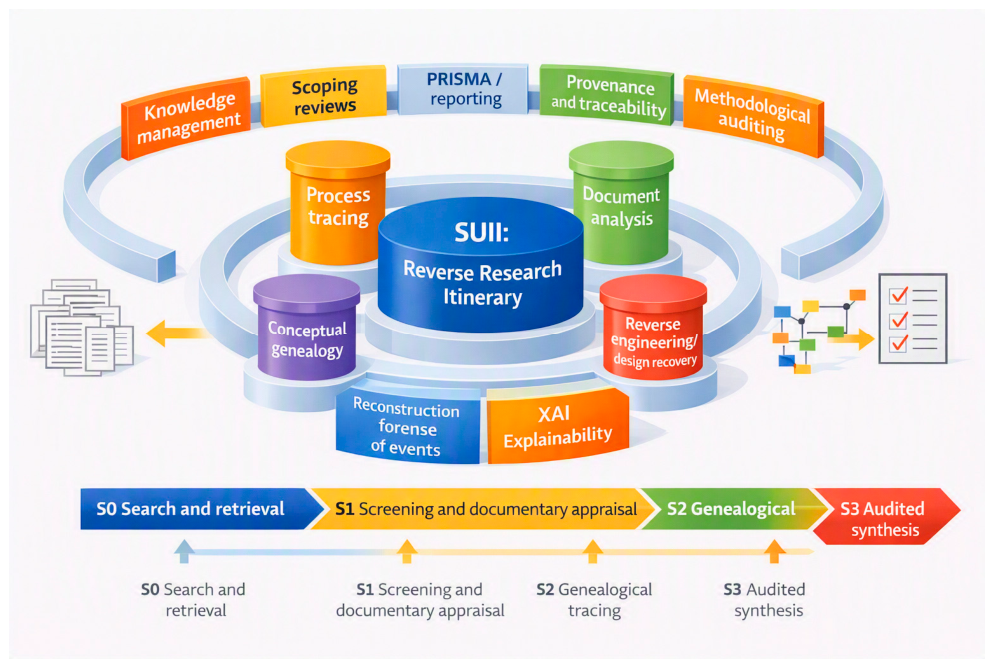
Figure 5.
Conceptual map of the SUII nucleus and its partial precedents in medicine: the published article acts as a starting point and the documentary traces allow retrospectively inferring decisions, hypotheses and original questions.
Figure 5.
Conceptual map of the SUII nucleus and its partial precedents in medicine: the published article acts as a starting point and the documentary traces allow retrospectively inferring decisions, hypotheses and original questions.
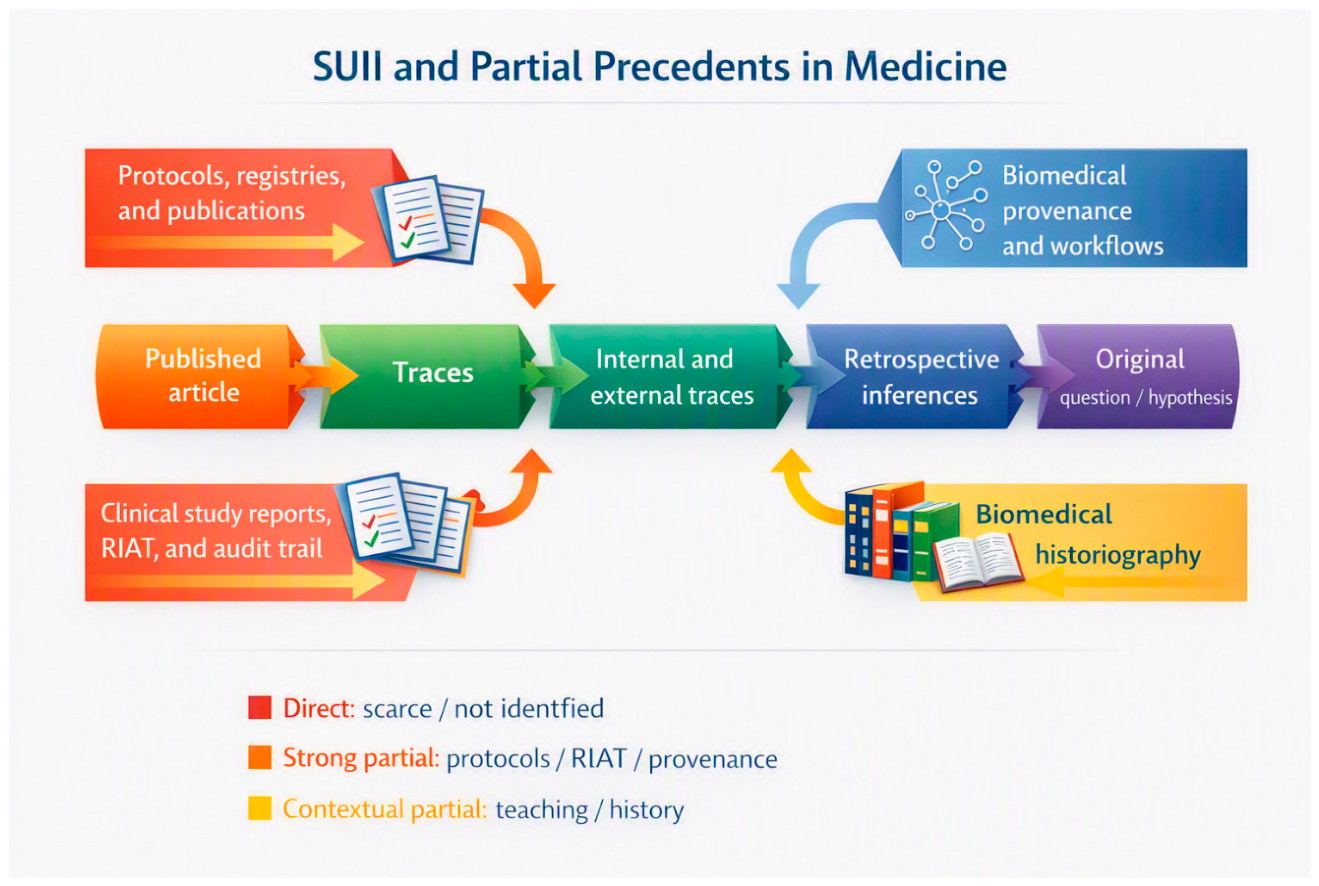
Figure 6.
The SUII can function as a bridge between critical reading and discovery: it reconstructs the itinerary that produced the article and converts the zones of uncertainty, decision or absence into new questions that can be investigated.
Figure 6.
The SUII can function as a bridge between critical reading and discovery: it reconstructs the itinerary that produced the article and converts the zones of uncertainty, decision or absence into new questions that can be investigated.
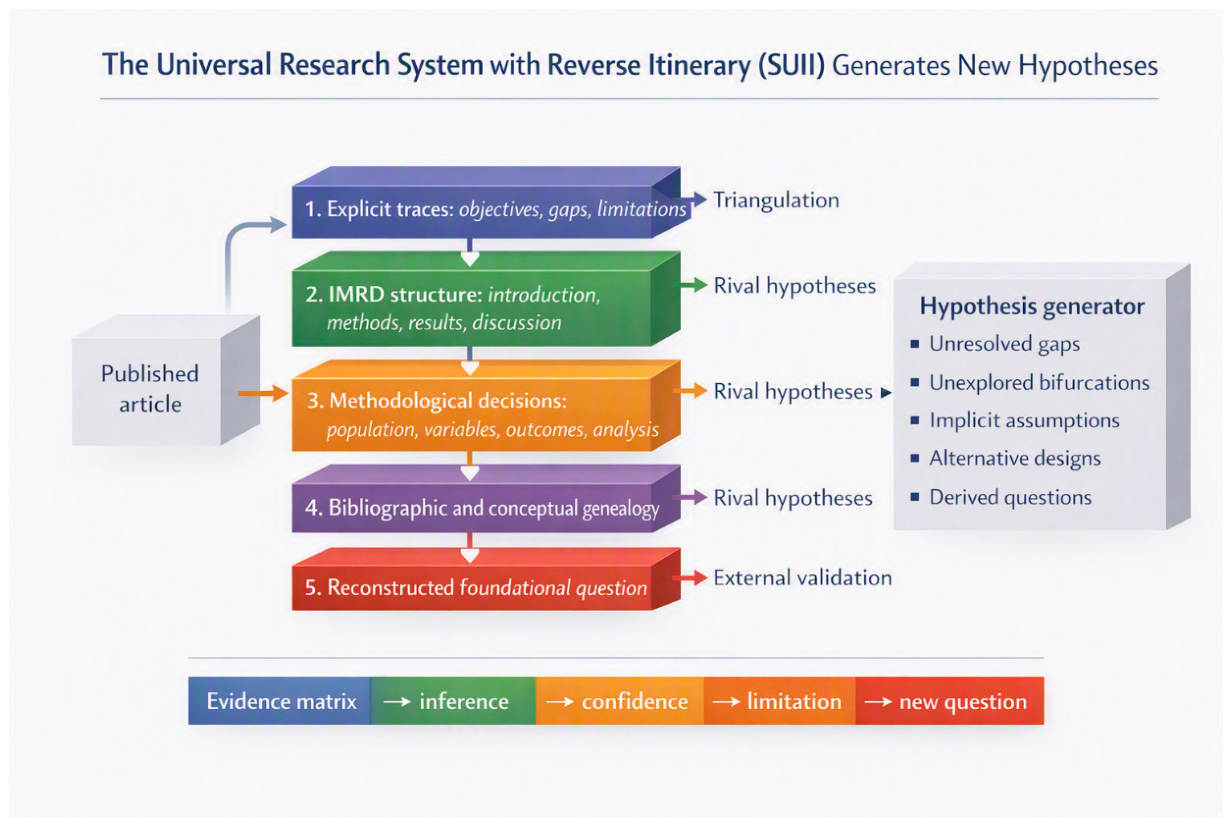
Figure 8.
Integrative model of the Universal Research System with Reverse Itinerary (SUII). The SUII is a second-order cross-sectional methodology that analyzes finished scientific products as sets of documentary, methodological, conceptual, and bibliographic traces. From these traces, it retrospectively reconstructs the foundational question, decisions, transformations, and intellectual genealogy that probably led to the final product (reconstructive output), and transforms gaps, tensions, and bifurcations into new hypotheses, researchable questions, suggested designs, and external validation needs (generative output). The system may be applied focally, in combination, or comprehensively. Artificial intelligence constitutes its operational infrastructure for scalability, automation, consistency, analytical sensitivity, abductive support, and traceability, always under mandatory human supervision at each stage and without replacing source validation or the researcher’s epistemological responsibility.
Figure 8.
Integrative model of the Universal Research System with Reverse Itinerary (SUII). The SUII is a second-order cross-sectional methodology that analyzes finished scientific products as sets of documentary, methodological, conceptual, and bibliographic traces. From these traces, it retrospectively reconstructs the foundational question, decisions, transformations, and intellectual genealogy that probably led to the final product (reconstructive output), and transforms gaps, tensions, and bifurcations into new hypotheses, researchable questions, suggested designs, and external validation needs (generative output). The system may be applied focally, in combination, or comprehensively. Artificial intelligence constitutes its operational infrastructure for scalability, automation, consistency, analytical sensitivity, abductive support, and traceability, always under mandatory human supervision at each stage and without replacing source validation or the researcher’s epistemological responsibility.
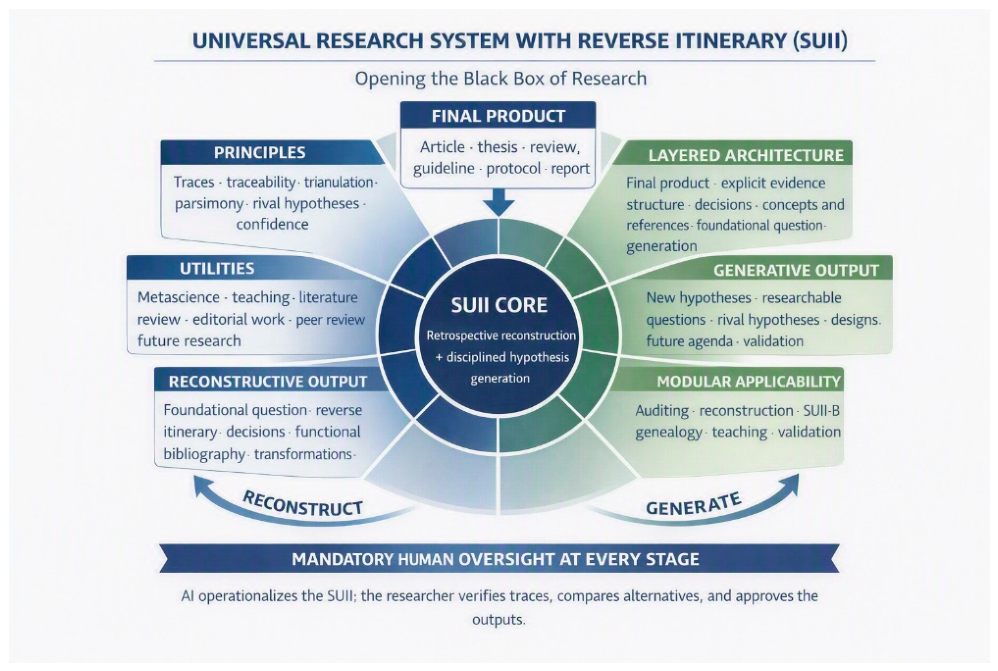
Figure 9.
Operational synthesis of the Universal Research System with Reverse Itinerary (SUII). The figure integrates the retrospective pathway from the finished scientific product to the foundational question, the layers of documentary, methodological, conceptual, and bibliographic analysis, the dual reconstructive and generative outputs, and epistemological control based on explicit evidence, reasoned inference, controlled speculation, confidence level, and external validation.
Figure 9.
Operational synthesis of the Universal Research System with Reverse Itinerary (SUII). The figure integrates the retrospective pathway from the finished scientific product to the foundational question, the layers of documentary, methodological, conceptual, and bibliographic analysis, the dual reconstructive and generative outputs, and epistemological control based on explicit evidence, reasoned inference, controlled speculation, confidence level, and external validation.
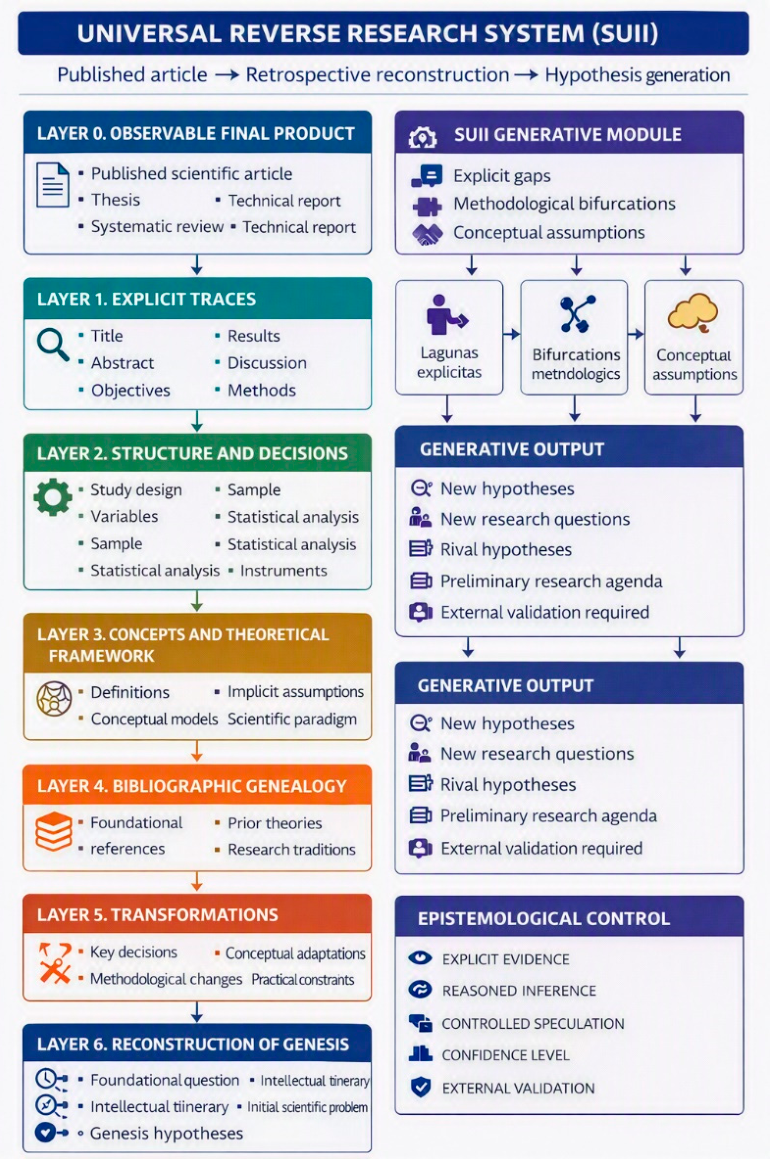
Table 2.
Mandatory components of the SUII universal prompt, methodological function and expected verifiable product.
Table 2.
Mandatory components of the SUII universal prompt, methodological function and expected verifiable product.
| Component | Required content | Methodological function | Verifiable product |
| Initial setup | Focal product, version, objective, module, corpus, discipline, design, language, depth, and format. | Narrow down the question and prevent the system from silently expanding the scope. | Scope sheet and available sources. |
| Descriptive reading beforehand | Review of title, abstract, sections, tables, figures, annexes, bibliography and external sources before inferring. | Separate observation from interpretation and reduce narrative anchoring. | Anatomical data sheet of the product. |
| Fingerprint extraction | Exact footprint or faithful paraphrase, location and analytical code. | Link each claim to inspectable evidence. | Matrix of traces that can be located. |
| Epistemological classification | Explicit evidence, reasoned inference, speculative or undeterminable hypothesis. | Prevent plausible possibilities from being presented as facts. | Status declared for each statement. |
| Inferential rule and trust | Rule used, corroborating traces, contradictions and level of confidence. | Make the transition from footprint to completion auditable. | Evidence-inference-confidence matrix. |
| Rival hypotheses | Plausible alternatives and required discriminating evidence. | Reduce confirmation, overinterpretation, and single retrospective narrative. | Table of main hypotheses, rivals and discriminant tests. |
| Reverse reconstruction | Final product → decisions → sources and methods → concepts and bibliography → problem → foundational question. | Recover the probable itinerary in a parsimonious way. | Narrative and tabular itinerary of genesis. |
| SUII-B Module | Checking references, citation context, function, genealogy, biases, and criteria for opening sub-boxes. | To rebuild support and influence without inferring causality by mere presence. | Bibliographic map and probable genealogy. |
| Generative output | Imprint → inference → gap or bifurcation → hypothesis → question → design → validation → confidence → risk. | Transform documented uncertainties into future research. | Generative table and research agenda. |
| Limits and closure | Contradictions, undeterminable elements, pending decisions and necessary external evidence. | Define the frontier of knowledge and avoid false conclusions of completeness. | Report on limits and validation needs. |
| AI traceability | System, date, version, parameters, exact prompt, fonts, gross output and corrections. | Allow auditing, comparison and conditional repetition. | Record of provenance of the execution. |
| Human supervision | Citation and fingerprint verification, discrepancy resolution, final trust, and final approval. | Maintain epistemological responsibility in the researcher. | Synthesis validated and signed by the evaluator. |
Note. The components can be adapted to the chosen module and depth, but the common safeguards should not be eliminated: traceable, separation between observation and inference, rival hypotheses, trust, limits, registration of execution and final human decision.
Table 4.
Modular architecture of the SUII: selectable modules according to the purpose of the researcher and minimum products of each application.
Table 4.
Modular architecture of the SUII: selectable modules according to the purpose of the researcher and minimum products of each application.
| SUII Module | Operational question | Main operations | Minimum Product | Preferential use |
| Methodological audit | Is there coherence between question, methods, results, tables, discussion and conclusion? | Internal checking, detection of omissions and inconsistencies, contrast with protocol or registration when available. | Consistency matrix, list of discrepancies, trust, and evidence needed to resolve them. | Critical review, peer review, editorial control and review evaluation. |
| Reverse reconstruction | What likely itinerary led from the initial problem to the final product? | Extraction of traces, retrospective ordering, decisions, transformations, foundational question and rival hypotheses. | Genesis itinerary, evidence-inference-trust matrix and limits. | Metascience, methodological history, project analysis and comparison with real traces. |
| Training and teaching | What can a researcher learn from the implicit design and decisions accumulated in the article? | Decomposition of the product, identification of alternatives, simulation of decisions and discussion of rival hypotheses. | Learning guide, teaching case, decision map and reconstructive exercise. | TFG, TFM, doctorate, critical reading and teaching of methodology. |
| Bibliographic analysis SUII-B | What function do references play and what conceptual or methodological genealogy do they suggest? | Normalization, functional classification, citation context, conceptual grouping, chronology and bibliometric relationships. | Bibliographic map, foundational and bridge references, genealogical hypotheses and citation gaps. | Revisions, theoretical frameworks, history of concepts and corpus updating. |
| Hypothesis generation | What new questions emerge from gaps, bifurcations, tensions, assumptions, or unexplained outcomes? | Chain fingerprint → inference → gap → hypothesis → question → design → validation. | Traceable hypotheses, rival hypotheses, suggested designs, priority and risk of overinterpretation. | Prospective design, research agendas, and literature-assisted discovery. |
| Full integration | How to reconstruct, audit, interpret the literature, teach and generate future research in a single study? | Sequential and connected application of all modules with a common audit trail. | Complete reconstructive and generative report, matrices, bibliographic map, future agenda and reproducible record. | Methodological research, thesis, formal validation of the SUII and in-depth analysis of scientific products. |
Note. The modules can be applied independently, but they must all maintain the common epistemological core of the SUII: location of fingerprints, traceability of each statement, classification of the inferential status, contrast with alternatives, grading of confidence and declaration of limits.
Table 5.
Levels of application of the SUII and criteria for selecting between focal use, combination of modules and integral application.
Table 5.
Levels of application of the SUII and criteria for selecting between focal use, combination of modules and integral application.
| Level | Scope | Indication | Closing criteria | Main Advantage and Risk |
| Focal | A single selected module. | Specific question, limited time, reduced corpus or immediate applied need. | The operative question is answered and each conclusion has a trace, inferential rule and confidence. | Advantage: efficiency and ease of adoption. Risk: interpreting a partial exit as a complete explanation of the product. |
| Combined | Two or more connected modules. | The question requires, for example, audit plus reconstruction, bibliography plus teaching, or reconstruction plus generation. | Partial products converge, contradictions are registered, and integration provides additional relevant information. | Advantage: balance between depth and resources. Risk: Duplication or inconsistency if modules do not share matrix and criteria. |
| Integral | All modules in a common sequence. | Methodological validation, thesis, exhaustive analysis, comparison with protocols/versions or formulation of a complete agenda. | Reconstructive and generative output, bibliographic map, auditing, teaching products and reproducible record are completed; the limits are explicit. | Advantage: Integrated second-order vision. Risk: high analytical load and false sense of completeness if external traces are missing. |
Note. The selection of the level must be justified before starting the analysis. Applying more modules does not guarantee greater validity: quality depends on relevance to the question, documentary richness, reproducibility and control of overinterpretation.
Table 6.
Black box model applied to the SUII: focal article, cited articles, recoverable information and limits of reconstruction.
Table 6.
Black box model applied to the SUII: focal article, cited articles, recoverable information and limits of reconstruction.
| Level | What works as a black box | What the SUII observes | What you can rebuild | What may remain inaccessible | Methodological rule |
| Focal article | The finished and stabilized scientific product. | Title, abstract, sections, methods, results, discussion, tables, figures, annexes and bibliography. | Probable foundational question, decisions, transformations, conceptual architecture and genesis hypothesis. | Real order of decisions, private motivations, conversations and unrecorded alternatives. | Do not confuse retrospective coherence with real history; to graduate confidence and formulate rivals. |
| Extended document layer | The documentary ecosystem associated with the article. | Protocol, registration, preprint, versions, data, code, peer review, and correspondence. | Changes between planning, execution, analysis and publication; Chronology and Derivations. | Undocumented interactions, lost or inaccessible materials. | Use external sources to corroborate or refute, not to fill silences as facts. |
| Individual cited reference | Each article, book, standard, or dataset cited. | Bibliographic reference, citation context and, where applicable, full text. | Conceptual, methodological, normative, critical, contextual or empirical function in the focal article. | Why it was read, when it influenced, what parts were discarded, or whether the quote was indirect. | Verify the primary source when holding a central inference; not to attribute influence by mere presence. |
| Bibliographic network | Multiple black boxes connected by quotations, co-citation, coupling, and historical continuity. | Temporal, thematic, relational patterns and contexts of use. | Genealogies, schools, bridge references, methodological dependencies and knowledge trajectories. | Uncited literature, selection biases, informal relationships, and undocumented connections. | Treat the network as structural evidence, not as causal evidence of influence. |
| Nested black box | The references of each cited work and their own production processes. | Background sources selected according to the SUII question. | Deeper layers of conceptual or methodological genealogy. | Potentially infinite regression and progressive loss of context. | Open only relevant boxes; apply saturation criteria and stop when the hypotheses do not change. |
| Frontier of knowledge | Information that is absent or cannot be discriminated with the available traces. | Silences, contradictions and absence of documentation. | Only validation needs and future questions. | Unrecorded facts and mental states of the authors. | Classify as non-determinable; not complete for narrative plausibility or AI. |
Note. “Black box” is used as an analytical metaphor and does not imply that all internal information exists in retrievable form. The SUII partially opens documentary boxes by triangulation; Uncertainty increases when moving from the focal article to secondary references and nested boxes. The depth of the analysis must be justified by relevance, availability of traces and ability to modify or discriminate hypotheses.
Table 7.
Operational proposal of the SUII-B to reconstruct the intellectual and methodological process of an article from its cited bibliography.
Table 7.
Operational proposal of the SUII-B to reconstruct the intellectual and methodological process of an article from its cited bibliography.
| SUII-B Phase | Operation on references | Inference or possible product | Main limitation | Guiding confidence |
| 1. Preparation and standardization | Check authors, titles, years, DOI, PMID, ISBN, duplicates and variants. | Reproducible and traceable bibliographic corpus. | Errors, omissions, and incomplete references in the article. | Registration for identification; It does not yet apply to Genesis. |
| 2. Functional classification | Assign functions: foundational, conceptual, methodological, normative, primary evidence, synthesis, critical, contextual or technical. | Preliminary intellectual and methodological architecture. | The isolated list does not always reveal how each source was used. | Media; medium-high if the context of the citation is analyzed. |
| 3. Analysis of the citation context | Locate the phrase and section where each quote appears; Identify support, contrast, criticism, method or definition. | Effective function of the reference and strength of its influence. | A quote does not demonstrate deep reading or temporal priority. | Medium-high when the context is unambiguous. |
| 4. Conceptual and methodological grouping | To form thematic nuclei, schools, techniques, standards and bridge references. | Conceptual genealogy, disciplinary convergences and hinge sources. | Groups depend on analytical decisions and can overlap. | Median if there is triangulation between several references. |
| 5. Temporal and historical planning | Examine publication years, milestones, accruals, and citation sequences. | Historical roots and probable trajectory of the problem or method. | Date of publication does not equate to actual order of reading or adoption. | Media for field genealogy; Out of the team’s chronology. |
| 6. Relational analysis | Explore co-citation, bibliographic coupling, networks and main routes. | Structure of communities, bridges and trajectories of knowledge. | Bibliometric centrality does not equate to causal importance in the article. | Mean for corpus structure. |
| 7. Reverse reconstruction | Integrate functions, contexts, nuclei and sequences in a parsimonious explanation. | Previous problem, probable foundational question, influences and methodological decisions. | Risk of constructing a retrospective narrative that is too coherent. | Low-medium with isolated bibliography; medium-high with full text. |
| 8. Rival hypotheses | Propose alternative explanations for the selection and organization of references. | Main reconstruction, alternatives and discriminant evidence. | Uncited sources and editorial decisions remain invisible. | It depends on the richness and convergence of the footprints. |
| 9. External validation | Contrast with protocol, registration, preprint, versions, supplements, peer review or authors. | Confirmation, correction or rejection of the reconstructed genealogy. | External traces may not exist or may not be available. | High when several independent sources converge. |
| 10. Generative Output | Turning absences, weak bridges, controversies and forks into new questions. | Hypothesis, search agenda, suggested designs and validation priorities. | Generation does not equate to confirmation and demands future evidence. | Variable; it must be declared for each proposal. |
Note. Guiding confidence refers to the documentary support of the inference and not to the overall quality of the article. SUII-B must differentiate observable bibliographic data, functional interpretation of citations and hypotheses about genesis. The isolated bibliography allows for partial reconstruction; The incorporation of the context of citation and external sources increases the reconstructive capacity.
Table 8.
Comparative synthesis of the relationship of the Universal Research System with Reverse Itinerary (SUII) with the main research methodologies, their partial applications in the medical literature and their analogous uses in other scientific disciplines.
Table 8.
Comparative synthesis of the relationship of the Universal Research System with Reverse Itinerary (SUII) with the main research methodologies, their partial applications in the medical literature and their analogous uses in other scientific disciplines.
| Methodology or tradition | Relationship with the SUII | Application in medical literature | Use in other disciplines | Difference or specific contribution of the SUII |
| Quantitative methodologies | It reconstructs the continuity between question, variables, population, comparators, outcomes, analysis and conclusion. | Auditing of trials and observational studies; Detection of post-hoc analysis, outcome changes, and discrepancies between protocol, registration, and publication. | Retrospective evaluation of experimental and observational designs. | It converts the methodological coherence of the final product into a documented itinerary graded by confidence. |
| Documentary, content and thematic analysis | Treats the article and its associated materials as data; extracts, codes, compares and interprets fingerprints. | Analysis of guidelines, medical records, health policies, reviews and scientific documents. | Social Sciences, Education, History, Communication, and Organizational Studies. | It does not limit itself to describing categories: it reconstructs the probable genesis of the product and generates new hypotheses. |
| Grounded theory and qualitative methods | It provides constant comparison, construction of categories, negative cases and analytical reflexivity. | Qualitative synthesis, research of experiences and analysis of clinical processes. | Sociology, anthropology, education and organizational studies. | The specific product is an evidence-inference-trust matrix and a genesis itinerary, not a substantive theory derived from participants. |
| Case study and process tracing | It provides sequencing, diagnostic tests, mechanisms, rival hypotheses and discriminant evidence. | Reconstruction of clinical, health, regulatory or editorial decisions. | Political Science, International Relations, Historical Sociology, and Policy Evaluation. | It shifts the focus from causal mechanisms of the world to intellectual, bibliographic and documentary mechanisms of scientific production. |
| Systematic and Scope Reviews | It functions as a metascientific layer that reconstructs why a review adopted a certain architecture and what gaps it leaves open. | PRISMA, PRISMA-S, PRISMA-ScR, AMSTAR 2, ROBIS, PROSPERO and SWiM offer reporting, search, registration and evaluation. | Synthesis of evidence in social, environmental, educational and engineering sciences. | It does not replace these guides; It adds retrospective decision reconstruction and a generative output. |
| Conceptual genealogy and history of science | It reconstructs provenance, changes of meaning, paradigms, traditions, and epistemic objects. | History of diagnostic concepts, classifications, diseases, technologies and medical practices. | Philosophy, history, sociology of knowledge and science and technology studies. | It integrates conceptual genealogy with methodological decisions, functional bibliography and inferential traceability. |
| Reverse engineering and design recovery | It starts from a finished artifact to recover components, relationships, levels of abstraction and architecture. | Analogy applicable to articles, protocols, guidelines, and clinical systems as finished products. | Software, hardware, mechanical engineering, manufacturing and system architecture. | It transfers the reverse logic from technical artifacts to scientific, documentary, and intellectual products. |
| Provenance, FAIR, and Reproducibility | Records entities, activities, agents, derivations, versions, and transformations. | Traceability of biomedical AI data, protocols, analytics, reviews, and tools. | E-science, data science, computer science, repositories and computational flows. | It also reconstructs when traces are incomplete, but it forces us to distinguish facts, inferences, and speculation. |
| Forensic reconstruction | It provides preservation of evidence, chronologies, chains of events, contradictions and uncertainty. | Analogy to reconstruct sequences of decisions and changes between protocol, execution and publication. | Computer forensics, criminalistics and incident analysis. | It applies forensic logic to the intellectual domain without equating methodological inference with expert evidence. |
| XAI and artificial intelligence | It requires local explanations, attribution of contributions, recording of prompts, inputs, outputs, and degrees of uncertainty. | Support for screening, extraction, synthesis and analysis of medical literature. | Machine learning, decision systems, and data science. | AI acts as a tool; Each statement must be linked to a verifiable trace and not to verbal plausibility. |
| Literature-based discovery | Share the generation of hypotheses from published knowledge. | Connection of separate biomedical literatures and formulation of mechanistic or therapeutic hypotheses. | Bibliometrics, information retrieval and assisted scientific discovery. | The LBD connects distributed concepts; the SUII generates hypotheses from the internal and bibliographic traces of a specific product. |
| Reverse Research Design | Partial direct pedagogical precedent: reconstructs the project that could have produced a published work. | Potential to teach critical reading, design, and auditing of medical articles. | Teaching methodology in political science and social sciences. | The SUII adds layered formalization, traceability matrix, rival hypotheses, degrees of confidence and generative module. |
Note. The SUII is interpreted as a second-order cross-sectional methodology: it integrates components from consolidated traditions, but its complete application – retrospective reconstruction, inferential grading and traceable generation of hypotheses – remains pending empirical validation.
Table 9.
Synthesis of the fundamental elements of the SUII, its methodological function and the expected product of each component.
Table 9.
Synthesis of the fundamental elements of the SUII, its methodological function and the expected product of each component.
| SUII Element | Function | Expected product |
| Foundational question | Reconstruct the question that best explains the final form of the article. | Explicit or implicit formulation, justification and level of confidence. |
| Reverse itinerary | Ordering decisions and transformations from the final product to its genesis. | Narrative sequence and observation-inference-confidence matrix. |
| Bibliographic genealogy | Classify references by epistemological function. | Foundational, methodological, normative, technical and critical nuclei. |
| Genesis hypothesis | Propose alternative explanations for how the article could have been born. | Main hypothesis, rival hypothesis and discriminant evidence. |
| Generative module | Transforming footprints, gaps, and forks into future research. | New hypotheses, questions, suggested designs, and external validation. |
Table 10.
Comparison of the main methodological antecedents of the SUII, their conceptual coincidences and their specific differences with respect to the system.
Table 10.
Comparison of the main methodological antecedents of the SUII, their conceptual coincidences and their specific differences with respect to the system.
| Background | Match with SUII | Key Difference |
| Document analysis | Treats documents as assessable and interpretable data. | It does not necessarily reconstruct the complete genesis itinerary of an article. |
| Process tracing | It uses sequential evidence, rival hypotheses, and diagnostic inference. | It is mainly oriented to causal mechanisms, not to scientific products such as fingerprints. |
| Reverse engineering | Part of an existing system to recover components and relationships. | It comes from software/hardware; the SUII transfers it to intellectual and bibliographic objects. |
| Provenance | Records entities, activities, agents, and referrals. | It documents existing traces; the SUII also reconstructs when the traces are partial. |
| LBD | Generate hypotheses from published knowledge. | It connects literatures; the SUII reconstructs and exploits the internal traces of a specific article. |
| PRISMA/PRISMA-ScR | They favor transparency, traceability and reporting. | They are not methods of retrospective reconstruction of research genesis. |
Table 11.
Comparison between the reconstructive and generative outputs of the SUII and its main products.
Table 11.
Comparison between the reconstructive and generative outputs of the SUII and its main products.
| Reconstructive output | Generative output |
| A reconstructed foundational question. | New researchable questions. |
| Reverse itinerary of decisions. | New derived hypotheses. |
| Structuring concepts and transformations. | Rival hypotheses and discriminant evidence. |
| Functional bibliography and conceptual genealogy. | Preliminary research agenda. |
| Hypothesis of genesis and limits. | External validation needs. |
Table 12.
Levels of evidence of the SUII, description and rules of use to graduate the strength of the statements.
Table 12.
Levels of evidence of the SUII, description and rules of use to graduate the strength of the statements.
| Level | Description | Usage Rule |
| Explicit evidence | The article states this directly. | You can sustain high confidence if the citation is clear and contextualized. |
| Reasoned inference | It is deduced from structure, method, bibliography or concepts. | It must be triangulated and expressed as probable, not as fact. |
| Controlled speculation | Plausible hypothesis with limited support. | It should be marked as low confidence and require external validation. |
Disclaimer/Publisher’s Note: The statements, opinions and data contained in all publications are solely those of the individual author(s) and contributor(s) and not of MDPI and/or the editor(s). MDPI and/or the editor(s) disclaim responsibility for any injury to people or property resulting from any ideas, methods, instructions or products referred to in the content. |
© 2026 by the authors. Licensee MDPI, Basel, Switzerland. This article is an open access article distributed under the terms and conditions of the Creative Commons Attribution (CC BY) license (http://creativecommons.org/licenses/by/4.0/).
Copyright: This open access article is published under a Creative Commons CC BY 4.0 license, which permit the free download, distribution, and reuse, provided that the author and preprint are cited in any reuse.