
Submitted:
18 August 2026
Posted:
20 August 2026
You are already at the latest version
Abstract
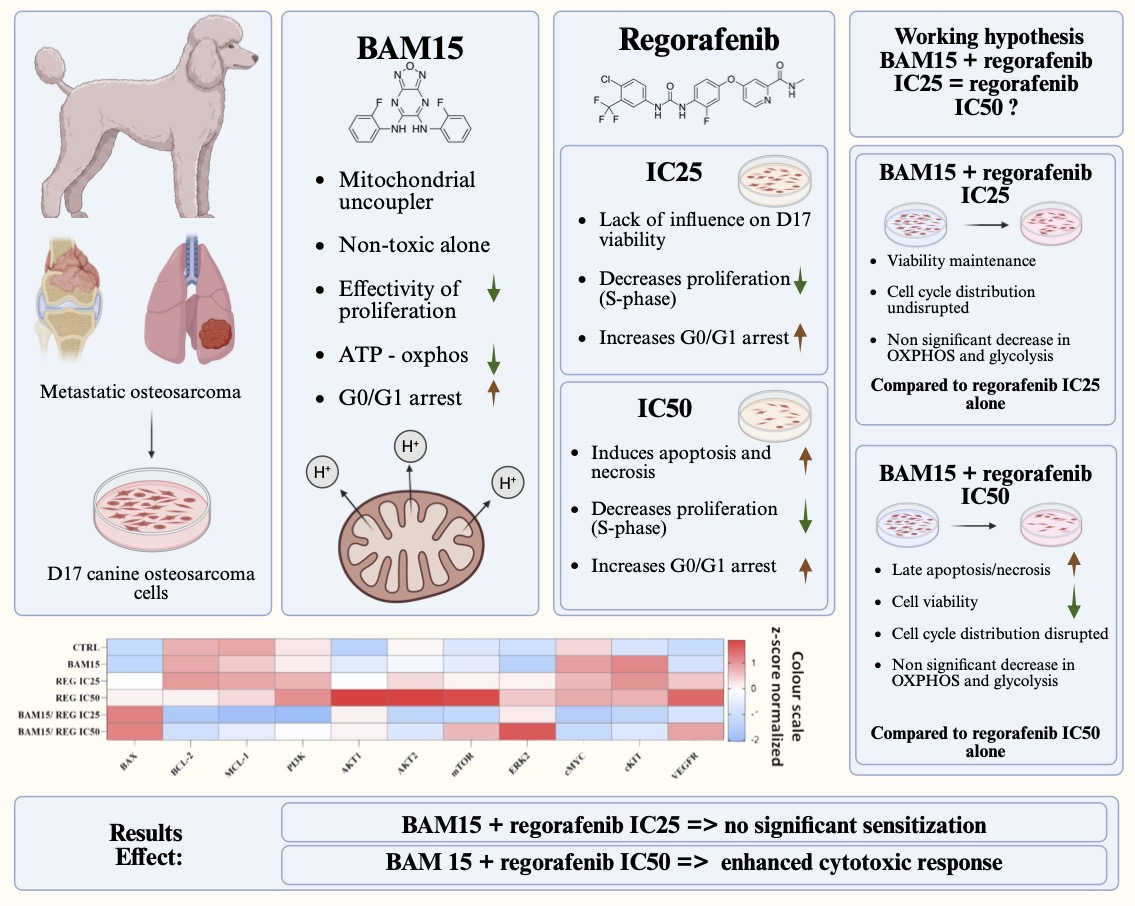
Osteosarcoma is an aggressive primary bone malignancy affecting both humans and dogs, and canine osteosarcoma represents a valuable comparative model for investigating novel therapeutic strategies. Targeting tumour metabolism may enhance the efficacy of existing anticancer treatments. This study investigated whether the mitochondrial uncoupler BAM15 sensitises canine D17 osteosarcoma cells to regorafenib. Cells were treated with BAM15 (20 µM) or regorafenib (REG; IC25, 8 µM; IC50, 16 µM) alone or pretreated with BAM15 before regorafenib exposure. Treatment effects were assessed using viability assays, Annexin V/propidium iodide staining, cell-cycle analysis, Seahorse XF bioenergetic profiling, quantitative PCR, and Western blotting. BAM15 alone was not cytotoxic but significantly enhanced the regorafenib-induced reduction in cell viability at IC50, whereas no significant sensitising effect occurred at IC25. Combined treatment at IC50 increased late apoptotic and necrotic populations and disrupted cell-cycle distribution. BAM15 reduced oxidative phosphorylation-derived ATP production without detectable glycolytic compensation but did not further suppress mitochondrial ATP production beyond regorafenib alone. Combined treatment also induced transcriptional changes in stress-adaptation-related genes, while protein analysis revealed reduced BAX and BAX/BCL-2 ratio. These findings provide preliminary evidence that mitochondrial uncoupling may modify osteosarcoma responses to regorafenib and warrant further mechanistic validation.
Keywords:
canine osteosarcoma
; regorafenib
; BAM15
; mitochondrial uncoupling
; metabolic plasticity
; comparative oncology
Copyright: This open access article is published under a Creative Commons CC BY 4.0 license, which permit the free download, distribution, and reuse, provided that the author and preprint are cited in any reuse.