

Submitted:
19 August 2026
Posted:
19 August 2026
You are already at the latest version
Abstract
Snowmaking systems are increasingly used to serve winter tourism in mountain regions, yet their role in the environmental dissemination of antimicrobial resistance (AMR) remains poorly understood. Here, we investigated how snowmaking infrastructure affects the transport, retention and reduction of antibiotic residues, antibiotic resistance genes (ARGs) and phenotypically resistant bacteria along two interconnected water chains feeding technical snow production in mountain catchments. Over two winter seasons (2023/24 and 2024/25), we quantified a panel of clinically relevant antibiotics, ARGs and resistance phenotypes in wastewater effluent, intake water, reservoirs, technical snow, aged snow, meltwater, receiving streams and reservoir sediments. Wastewater and intake water exhibited the highest antibiotic loads and ARG richness, dominated by fluoroquinolones, macrolides and β-lactam resistance determinants. Reservoirs accumulated substantial amount of antibiotics but their reduction occurred further along the snowmaking chain. Fresh technical snow still contained multiple antibiotics and ARGs, and harbored resistant Enterobacteriaceae and Aeromonas, indicating that snowmaking systems can redistribute AMR determinants into the snowpack. Aged snow, meltwater and receiving streams showed nearly complete loss of antibiotic residues and reduced ARG richness, due to processes of snow transformation and downstream transport. By integrating chemical, molecular and phenotypic data with the technical layout of the infrastructure, we identify specific components as AMR retention hotspots and clarify where barrier functions are most effective. Our findings demonstrate that snowmaking infrastructure can both concentrate and distribute antibiotic residues and resistance determinants in mountain catchments, highlighting the need to consider snowmaking systems in environmental AMR risk assessments and One Health frameworks.
Keywords:
alpine catchments
; antibiotics
; antibiotic resistance genes (ARGs)
; antibiotic resistant bacteria (ARB)
; next generation sequencing
; one health
; technical snowmaking
1. Introduction
Antimicrobial resistance (AMR) is one of the most urgent threats to global public health, projected to cause 10 million deaths annually by 2050 if not dealt with [1]. Although antibiotic resistance originated as a natural phenomenon, it has become the most significant threat in clinical settings. From there, resistant bacteria escaped and became evenly important environmental issue. It has been confirmed that aquatic environments are among the most significant reservoirs and transmission routes for antibiotic residues, antibiotic resistance genes (ARGs) and resistant bacteria (ARB) [2,3,4]. Wastewater treatment plants (WWTPs) are the central element of this process. After receiving mixtures of pharmaceutical agents, microorganisms (including antibiotic resistant ones) and genetic determinants of antibiotic resistance from human and veterinary sources, they release these incompletely removed contaminants into receiving water bodies [5,6]. From these point sources, antibiotics and AMR determinants enter the aquatic environment, where they interact with environmental microbial communities, undergo dilution, sorption, transformation and selective enrichment, and ultimately reach ecosystems and human populations through multiple exposure pathways [7,8].
Mountain and alpine water systems are unique elements of the water network, but they have received very little attention compared to the importance of their role. Mountain catchments are generally subjected to low anthropogenic pressure, characterized by low temperatures, high UV irradiance and short hydraulic residence times and for this reason they have long been considered pristine, self-purifying environments, with negligible AMR loads [9,10]. However, this assumption has been questioned by a number of studies conducted in the Alps and the Carpathians, in which antibiotic residues, ARGs and ARB have been detected in high altitude streams, lakes or even mountain springs [9,11,12]. Nevertheless, mountain environments remain substantially underrepresented in the global AMR literature relative to lowland agricultural and urban systems [6,13,14], and thus the specific pathways through which resistance determinants enter, move through and exit these catchments remain poorly characterized.
Within mountain catchments, artificial snowmaking represents a rapidly expanding but entirely overlooked potential pathway for AMR dissemination. Snowmaking systems are now implemented across the majority of ski resorts not only in Europe or North America but also in a variety of countries where global winter competitions take place. As of 2024, more than 75% of Alpine ski resorts (75% in Italy and 90% in Austria) rely on technical snow to compensate for climate change-driven decline in natural snowfall [15]. The process relies on large volumes of water being pumped from water sources, pressurized, atomized and sprayed onto ski slopes to form the snowpack, while the critical element of the system is the source water for snowmaking. It is frequently drawn from watercourses affected by or directly receiving WWTP effluents [16,17], meaning that snowmaking chains (from intakes through storage reservoirs, water filtration, atomization and snow deposition) may function as previously unrecognized routes through which wastewater-derived antibiotic residues, ARGs and ARB are concentrated, transformed and ultimately released into mountain catchments via meltwater. Despite the scale of snowmaking operations across mountain regions, no study has systematically investigated the fate of AMR determinants across the complete snowmaking infrastructure.
There are elements of snowmaking infrastructure the role of which in the context of AMR can be ambiguous. Storage reservoirs may act as concentration points through evaporation, sedimentation and differential sorption, but their certain elements such as aeration, filtration or UV light-mediated disinfection can contribute to elimination or decrease of antimicrobial agents, ARB and ARGs. Mechanical filtration components on one hand prevent the spread of contaminants, but on the other may accumulate biofilms harboring ARB and ARGs. The snowmaking process in the snow cannons, involving freeze-atomization subjects the contaminants to rapid temperature change, shear stress and aeration, the selective effects of which are unknown. Once deposited, the technical snow undergoes transformation over several weeks/months during which UV light exposure, freeze-thaw cycling and microbial succession may further attenuate or transform contaminants. Finally, snowmelt constitutes a seasonal rapid input to receiving streams, the AMR burden of which has never been quantified in a snowmaking context. Whether snowmaking infrastructure ultimately acts as an AMR barrier or its vector is an open question with direct implications for alpine catchment management.
In this study, we address this gap through a two-season investigation of AMR fate across a snowmaking system of a ski resort located in the Carpathian region. Based on our previous studies, we extend the analysis to identify AMR retention hotspots and attenuation stages within the infrastructure. Our study comprises: (i) quantification of 21 clinically and veterinary relevant antibiotic compounds across the complete snowmaking chain using UHPLC-MS/MS; (ii) assessment of ARG richness by targeted PCR-based screening of 36 resistance genes; (iii) phenotypic resistance profiling of 240 bacterial isolates across nine system compartments; (iv) 16S rRNA amplicon sequencing to characterize microbial community diversity independently of cultivation; and (v) multivariate integration of all data.
By tracking AMR determinants simultaneously at the chemical, molecular, phenotypic and community levels across two snowmaking seasons, this study provides the first integrated evidence base for understanding how snowmaking infrastructure modulates AMR fate in mountain catchments, with implications for environmental risk assessment and One Health management of mountain water systems.
2. Results
2.1. Bacterial Indicators of Contamination
Escherichia coli and Enterococcus faecalis counts along both snowmaking chains followed a pattern of reduction from wastewater effluent to receiving waters (Figure 1, Supplementary Table S1). WWTP effluent contained 22,422 CFU/100 mL of E. coli and 2,050 CFU/100 ml of E. faecalis, declining to 967 and 57 at water intake, then dropped further in the reservoir. Snow cannon filters retained bacteria (increased E. coli and E. faecalis numbers), resulting in further drop in fresh and aged technical snow. The number of E. coli was reduced from 967 CFU/100 mL in water intake for technical snowmaking to 1 CFU/100 mL in aged snow and the number of E. faecalis dropped from 57 CFU/100 mL in intake water to none in technical snow. As indicated on the graph, the number of culturable E. coli increases in snowmelt. In addition, relatively higher numbers of E. coli have been detected in technical snowing-related residues (i.e. snow cannon filter material and reservoir sediments). As residue samples are not unexpected, as they result from the concentration of the material suspended in water, the increased amount of E. coli in snowmelt must result from external sources, not associated with snowmaking.
2.2. Microbial Community Diversity Along the Snowmaking Chains
Species richness and Shannon diversity were the highest at WWTP effluent (SR = 296, H = 1.753) and water intake (SR = 321, H = 1.833) (Supplementary Table S1), consistent with these compartments receiving highly complex, mixed microbial inputs from municipal wastewater. Dominance was correspondingly low at both sites (λ < 0.04), indicating structurally even communities. Reservoir water showed reduced species richness compared to the intake waters (Reservoir A: SR = 148, H = 1.402; Reservoir B: SR = 111, H = 1.211), accompanied by a moderate increase in dominance (λ = 0.073-0.149).
Snow cannon filters differed clearly between chains. Chain A filters (A1: H = 1.415, SR = 179; A2: H = 1.288, SR = 141) showed reduced diversity in comparison to the intake water, with elevated dominance (λ = 0.113–0.117), consistent with selective bacterial retention on filter surfaces. In contrast, microbial diversity of Filter B was similar to the intake (H = 1.831, SR = 205, λ = 0.026) and the highest evenness values among any infrastructure component. This divergence in community structure is consistent with the ARG data: the more diverse and even filter B community corresponded to lower ARG retention, while the more dominated filter A was associated with elevated ARG richness (Section 3.5). Fresh technical snow showed clear chain-specific patterns. In Chain A, fresh snow exhibited the lowest species richness of all sampled compartments (SR = 63, H = 1.086, λ = 0.196). Fresh snow of Chain B presented an apparent anomaly: species richness was comparatively high (SR = 159) yet Shannon index was the lowest recorded in the entire study (H = 0.878) and dominance was extreme (λ = 0.402). Snow ageing further increased the community evenness relative to fresh snow. Shannon diversity rose from H = 1.086 in fresh snow A to H = 1.367 in aged snow A, and from H = 0.878 in fresh snow B to H = 1.368 in aged snow B, despite both aged snow sites retaining low species richness (SR = 96 and 93, respectively).
Snowmelt and receiving stream samples showed intermediate diversity (H = 1.200-1.403, SR = 145-151). Finally, reservoir sediments demonstrated nearly highest species richness among the compartments (Reservoir A sediment: SR = 169, H = 1.688; Reservoir B sediment: SR = 243, H = 1.592), with low dominance values (λ = 0.041-0.066) comparable to the WWTP and intake sites.
2.3. Antibiotic Residues Along the Snowmaking Chain
Eleven antibiotic compounds of seven pharmacological classes, i.e. β-lactams (cefoxitin, FOX), macrolides (erythromycin, ERY; tylosin, TYL), lincosamides (clindamycin, CLIND), fluoroquinolones (ofloxacin, OFX; ciprofloxacin, CIP; enrofloxacin, ENR), diaminopyrimidines/sulfonamides (trimethoprim, TRIM; trimethoprim/sulfamethoxazole, SXT), oxazolidinones (linezolid, LIN) and glycopeptides (vancomycin, VAN), were detected in all sampling sites and both seasons. Normalized peak intensities and compound richness are presented in Figure 2 and Figure 3, respectively.
Antibiotic richness was the highest at WWTP effluent (up to 8 compounds detected in 2024/25) and water intake (Figure 2 and Figure 3). Cefoxitin reached its maximum normalized intensity at water intake (1.0) in the 2023/24 season, consistent with direct input of β-lactam antibiotics in treated wastewater entering the catchment stream. WWTP effluent showed the highest concentrations of erythromycin (1.0 in 2023/24), clindamycin (1.0 in 2023/24), sulfamethoxazole (1.0 in 2023/24, 1.0 in 2024/25), trimethoprim (0.92 in 2023/24) and linezolid (0.47 in 2023/24), confirming that the wastewater treatment plant is a multi-class antibiotic source for the snowmaking water supply.
Reservoirs, on the other hand, showed an antibiotic accumulation pattern. In the 2023/24 season, in Reservoir A there was the maximum normalized concentration of tylosin (1.0), linezolid (1.0) and almost maximum concentrations of fluoroquinolones (OFX 0.51, CIP 0.71, ENR 0.93) and erythromycin (0.86), values that exceeded those recorded in WWTP effluent for these compounds (Figure 2). Reservoir B in the same season showed maximum concentrations of ofloxacin (1.0), ciprofloxacin (1.0), enrofloxacin (1.0) and vancomycin (1.0). In the 2024/25 season, the concentrations of some antimicrobials were lower than in the input water, while those of erythromycin, ofloxacin, and enrofloxacin remained higher than the ones recorded for the WWTP.
Fresh technical snow still contained multiple antibiotic compounds in both chains and both seasons. In Chain A (2023/24), tylosin (0.95), linezolid (0.92), enrofloxacin (0.63) and erythromycin (0.59) were detected at moderate/high normalized concentrations, indicating that the atomization and freezing process during snowmaking does not fully eliminate antibiotic residues. Chain B fresh snow showed a comparable antibiotic profile (tylosin 0.93, linezolid 0.88, enrofloxacin 0.68). In the 2024/25 season, intensities in fresh snow were lower for all compounds, consistent with the reduced input concentrations observed in that season's reservoir water, though enrofloxacin, erythromycin and cefoxitin remained detectable above background.
Aged snow constituted a significant reduction stage for antibiotic residues. In both seasons and both chains, the vast majority of targeted compounds dropped to non-detectable levels (Figure 2 and Figure 3). The exceptions were: a trace erythromycin signal in aged snow A (2024/25; normalized intensity 0.004) and ofloxacin in aged snow A (2023/24; 0.076). Snowmelt and receiving stream samples were nearly free of antibiotics in both seasons, with the exception of a low enrofloxacin signal in Chain A snowmelt (2023/24; 0.30) and trimethoprim in Chain B snowmelt (2024/25; 0.017).
The overall pattern of compound richness (Figure 3) reflected the intensity data: richness peaked at WWTP and Reservoir A (up to 10–11 compounds), declined in fresh snow (6–9 compounds), then dropped to 1–2 in aged snow and reached zero in snowmelt and receiving streams in most cases. The two seasons showed consistent richness profiles, though the 2023/24 season exhibited higher richness and intensity at reservoir and fresh snow stages, likely reflecting inter-annual variation in wastewater effluent composition and in the upstream sites
2.4. Phenotypic Resistance of Isolated Bacteria
A total of 240 bacterial isolates were obtained from all system compartments, two seasons and both chains, and these comprised primarily Enterobacteriaceae, Aeromonas spp., Acinetobacter spp. and Pseudomonas spp., with few isolates of environmental cocci and bacilli (Table 1).
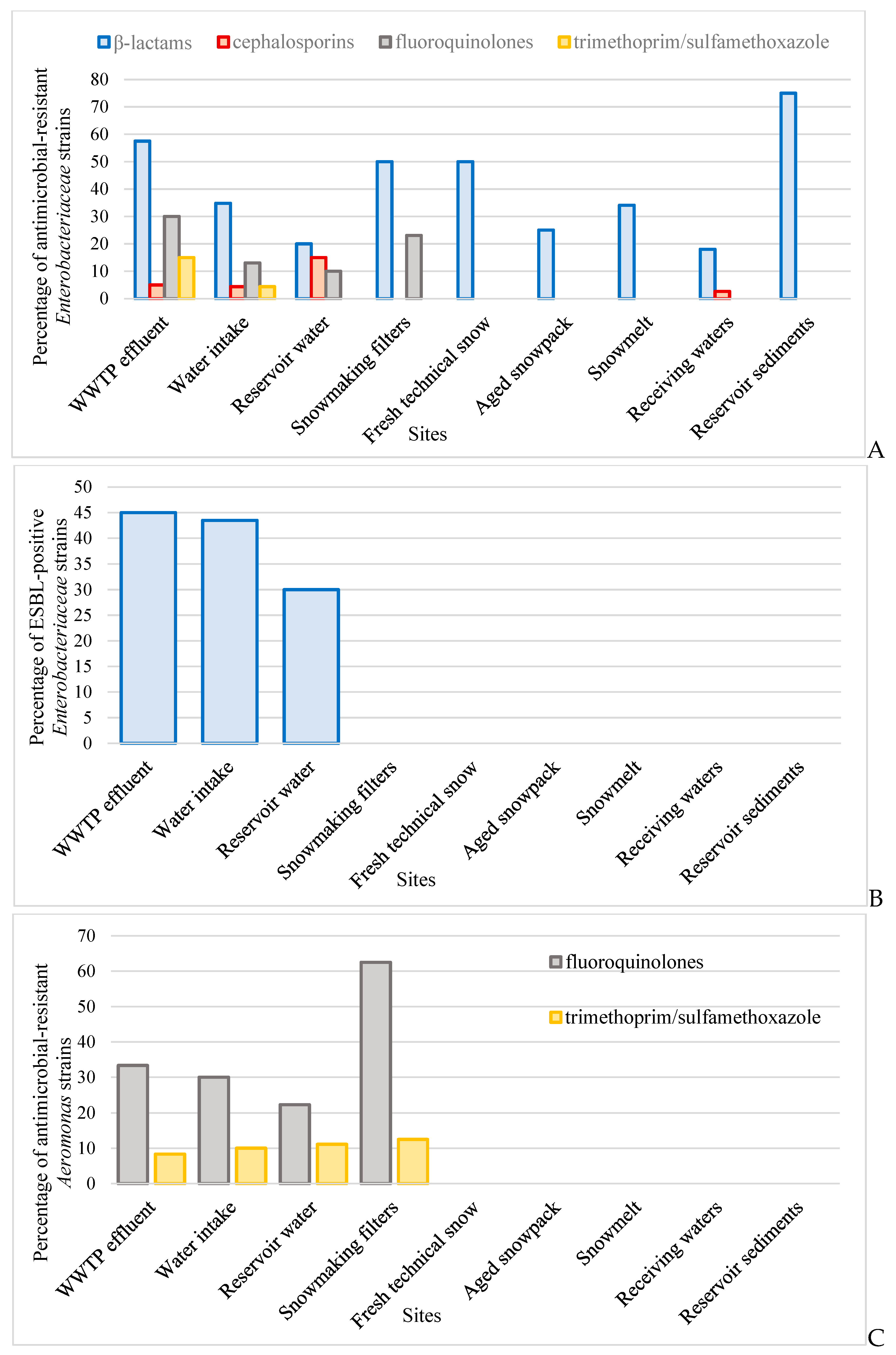
The proportions of phenotypically resistant strains and the variety of resistance phenotypes declined progressively along the snowmaking chain (Figure 4).
WWTP effluent contained the most complex resistance phenotype profile, with 58% of Enterobacteriaceae isolates showing β-lactam resistance and 5% cephalosporin resistance. Fluoroquinolone and trimethoprim/sulfamethoxazole (SXT) resistance types were the second and third most frequent in both Enterobacteriaceae and Aeromonas strains (~30% fluoroquinolone resistance in both bacterial groups, 15% and 8.3% of SXT resistance for Enterobacteriaceae and Aeromonas, respectively). High shares of ESBL-producing Enterobacteriaceae were detected at both WWTP and water intake (45 and 43.3%, respectively), which then dropped to 30% in reservoirs and then disappeared. Water intake showed a similarly rich resistance profile, but slightly reduced shares (35% β-lactam, 4% cephalosporins, ~13% fluoroquinolone, ~4% trimethoprim/sulfamethoxazole in Enterobacteriaceae; 30% fluoroquinolone and 10% trimethoprim/sulfamethoxazole in Aeromonas).
Aeromonas spp. became the dominant genus in reservoir water (27 of 46 isolates), instead of Enterobacteriaceae, but the β-lactam resistance remained predominant (20% of strains). Snow cannon filters retained many resistant isolates (50% β-lactam and ~23% fluoroquinolone resistant Enterobacteriaceae; 62.5% fluoroquinolone resistant and 12.5% SXT-resistant Aeromonas), with the community composition changing to include Acinetobacter spp. and environmental cocci and bacilli.
Fresh and aged technical snow showed less complex resistance profile (dominated exclusively by β-lactam resistance) and less numerous bacterial community, shifting towards Acinetobacter spp., Pseudomonas spp. and environmental cocci and bacilli. Snowmelt and receiving water-derived isolates comprised mostly Enterobacteriaceae (with β-lactam resistance only). Importantly, no fluoroquinolone or trimethoprim/sulfamethoxazole resistance was detected at these sites, indicating effective elimination of the broad resistance spectrum during snow ageing and melting. Bacterial community of reservoir sediments was dominated by environmental cocci and bacilli and Aeromonas spp., with β-lactam resistance as the sole detected phenotype (75% of isolates)
2.5. ARG Richness of the Snowmaking System
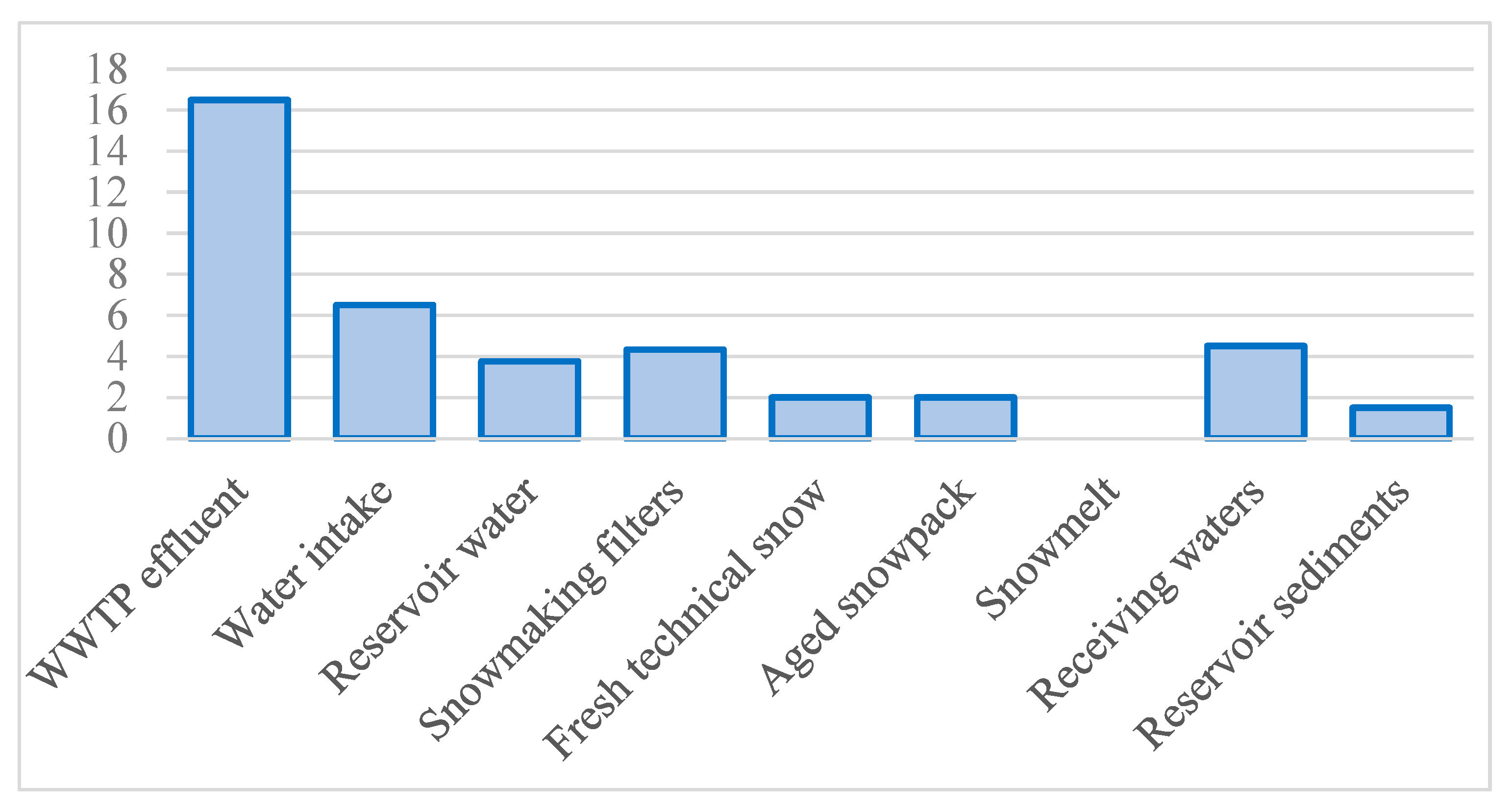
Antibiotic resistance gene (ARG) richness varied substantially between the snowmaking system compartments, with a clear reduction gradient from wastewater effluent to snowmelt and receiving waters (Figure 6).
WWTP effluent exhibited the highest mean ARG richness of all sampled compartments (mean = 16.5 genes per sample, Figure 5), harboring up to 19 target genes in the 2023/24 season. Water intake showed a clear dilution relative to WWTP effluent (mean 6.5; 9 genes in 2023/24 and 4 genes in 2024/25), retaining predominantly sul1, sul2, strA and qnrS. These two sites thus together represent the major source of ARGs in the snowmaking chain.
The ARG richness declined significantly along the technical snowmaking infrastructure. Reservoir waters showed intermediate richness values (from 2 to 5, mean 3.75 genes in reservoirs), retaining primarily sulfonamide (sul1, sul2) determinants in both seasons. Snow cannon filter samples in Chain A yielded 7 and 5 ARGs, exceeding the supplying reservoir water. This reflects the snow cannon filter role, in blocking particulate matter. In this way at least a fraction of ARG and ARB is retained, reducing their spread in the wider environment (Figure 6). In Chain B, filter ARG richness (mean = 1) remained lower than in the Chain A filters, consistent with the coarser pore size and smaller hydraulic pressure of the Chain B filter system.
Fresh technical snow was characterized by low but still detectable ARG richness in both seasons and both chains (mean = 2 genes), indicating that the snowmaking process does not fully eliminate resistance determinants present therein. The genes persisting in fresh snow were a reduced subset of those present in reservoir water, principally sul1, strA, and ermB, suggesting selective retention during snowmaking process. The sul1 gene persisted in all fresh snow samples. Aged snowpack and meltwater represented the most effective reduction stages in the system. In both compartments ARG richness was zero in the majority of samples, indicating that snow transformation processes eliminate detectable ARG loads.
Figure 5.
Presence of antibiotic resistance genes (ARGs) across environmental samples collected during two snowmaking seasons (2023/24 and 2024/25). Samples include WWTP effluent, snow cannon filters, fresh and aged snow, snowmelt, and reservoir sediments from chains A and B. Shaded cells indicate detected ARGs; total ARG counts per sample are visualized alongside.
Figure 5.
Presence of antibiotic resistance genes (ARGs) across environmental samples collected during two snowmaking seasons (2023/24 and 2024/25). Samples include WWTP effluent, snow cannon filters, fresh and aged snow, snowmelt, and reservoir sediments from chains A and B. Shaded cells indicate detected ARGs; total ARG counts per sample are visualized alongside.
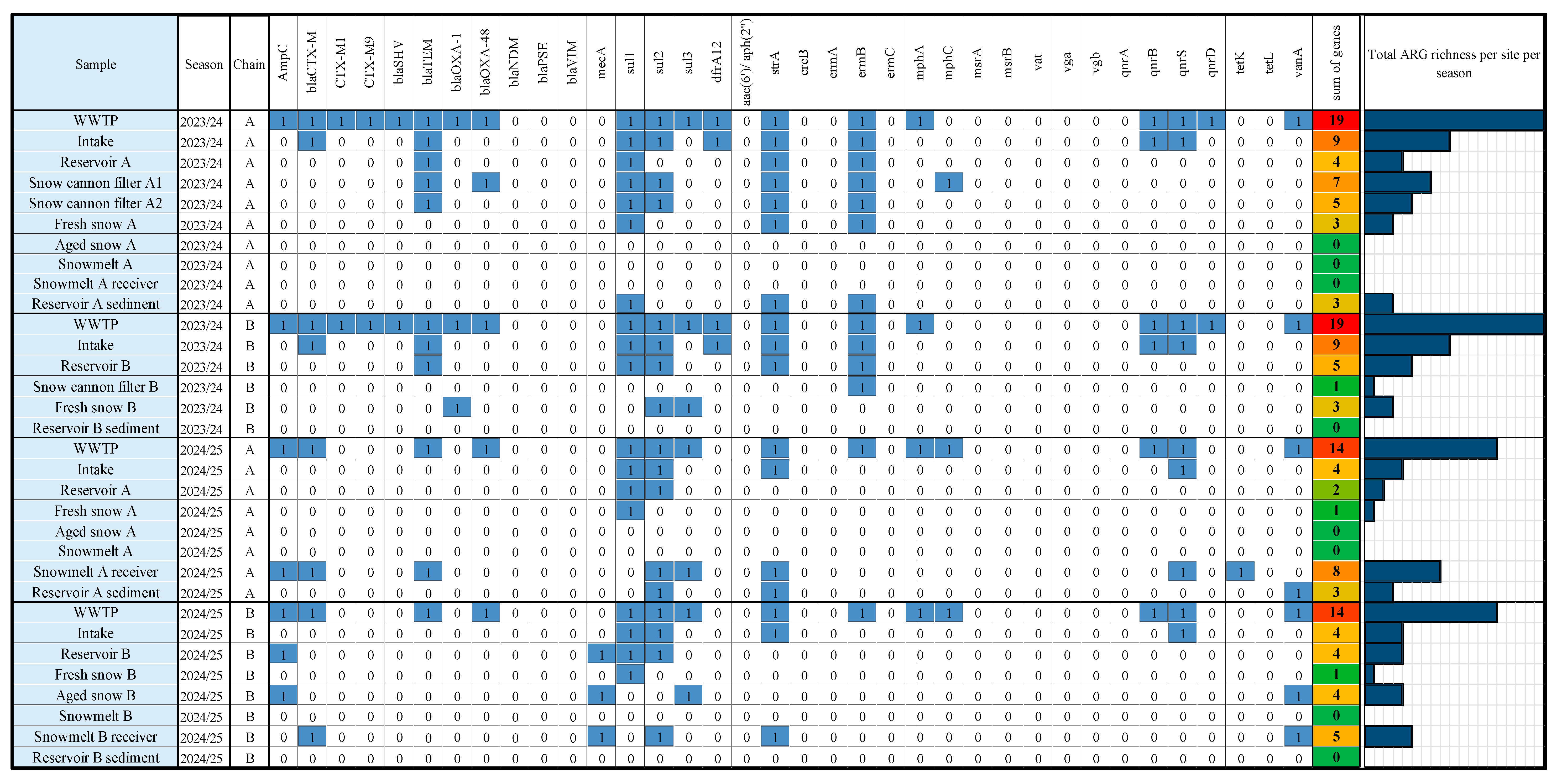
An interesting exception was observed in the snowmelt receiving waters in the 2024/25 season, when in Chain A, the ARG richness reached 8, while in Chain B it was 5. The value observed in Chain A was the highest value recorded at any downstream site across the study sites. This clearly differed from the situation observed in 2023/24 (ARG richness = 0). The genes detected in this sample (AmpC, blaCTX-M, blaTEM, sul2, sul3, qnrS, tetK) included several not detected in the corresponding snowmelt, suggesting a possible runoff input or other processes rather than a direct technical snow-related source.
Finally, reservoir sediments in Chain B were ARG-free, while in Chain A in both seasons the ARG richness was 3. These genes comprised sulfonamide resistance determinants (sul1 and sul2), streptomycin resistance determining strA, erythromycin resistance determinant ermB and vanA, encoding the resistance to vancomycin.
Figure 6.
Mean ARG richness in the system compartments, averaged across both chains and seasons.
2.6. Multivariate Integration: Identification of AMR Functional Zones
The PCA results of the simplified dataset revealed three principal components, explaining 85.9% of total variance (PC1 = 48.4%, PC2 = 26.1%, PC3 = 11.4%) (Figure 8).
PC 1 was defined by 11 variables (with factor loadings exceeding 0.70), mainly wastewater and AMR-associated: ARG richness (-0.989), Enterobacteriaceae SXT resistance (-0.950), E. coli counts (-0.922), clindamycin (-0.914), trimethoprim (-0.914), sulfamethoxazole (-0.913), Enterobacteriaceae fluoroquinolone resistance (-0.875), ESBL prevalence (-0.833), erythromycin (-0.801), Margalef’s diversity Dm (-0.735) and E. faecalis counts (-0.725). All loadings were negative, meaning PC1 represents a gradient from highly wastewater-affected samples (WW = wastewater effluent, IN = intake water, RW = reservoir water) to clean downstream compartments (SM = snowmelt water, AS = aged snow and OW = outflow water). PC1 can therefore be related to wastewater-derived and AMR-associated contamination axis.
PC 2 was defined by seven antibiotic resistance and antibiotic-associated variables, i.e.: ciprofloxacin (+0.997), enrofloxacin (+0.984), tylosin (+0.902), vancomycin (+0.887), Enterobacteriaceae cephalosporin resistance (+0.753), linezolid (+0.744) and ofloxacin (+0.729). The listed antimicrobials were determined as accumulated in reservoirs in the antibiotic analysis (Section 3.2.). Shannon diversity H loaded negatively on PC2 (-0.525), indicating that compartments located highly on PC2 (i.e. reservoirs, with elevated antibiotic concentrations), also had lower microbial diversity. PC2 can therefore be interpreted as associated with reservoir antibiotic enrichment.
PC3 mainly separated Aeromonas-associated resistance phenotypes (SXT and FQ) and microbial diversity indices (primarily Shannon diversity H), from antibiotic markers, indicating the change in predominant resistant bacteria in snow-cannon source waters.
The location of study sites on PC1 and PC2 designated four functional zones within the snowmaking infrastructure (Figure 8). WWTP effluent was strongly isolated at the negative extreme of PC1. Intake water, followed by reservoir water and snowmaking filters formed a transitional cluster between the positive-most sites, i.e. aged snow, snowmelt and outflow water. Reservoir water was the sole outlier on PC2, positioned orthogonally to other sites.
Cluster analysis of the nine compartments corroborated the four-zone structure identified by PCA (Figure 7C). Two primary clusters were distinguished: the first grouped WWTP effluent with intake water, snowmaking filters and reservoir water, and the second comprised aged snow, snowmelt and receiving stream. Fresh snow and reservoir sediments formed separate sub-clusters, reflecting their intermediate or distinct AMR profiles relative to the main groupings.
Figure 7.
Multivariate analysis results: (A) PC1 vs PC2 and (B) PC1 vs PC3 PCA biplots; (C) Cluster analysis of the snowmaking system compartments. Sites coded: WW = WWTP, IN = intake, RW = reservoir water, SF = snowmaking filters, FS = fresh snow, AS = aged snow, SM = snowmelt, OW = outflow/receiving stream, RS = reservoir sediments.
Figure 7.
Multivariate analysis results: (A) PC1 vs PC2 and (B) PC1 vs PC3 PCA biplots; (C) Cluster analysis of the snowmaking system compartments. Sites coded: WW = WWTP, IN = intake, RW = reservoir water, SF = snowmaking filters, FS = fresh snow, AS = aged snow, SM = snowmelt, OW = outflow/receiving stream, RS = reservoir sediments.
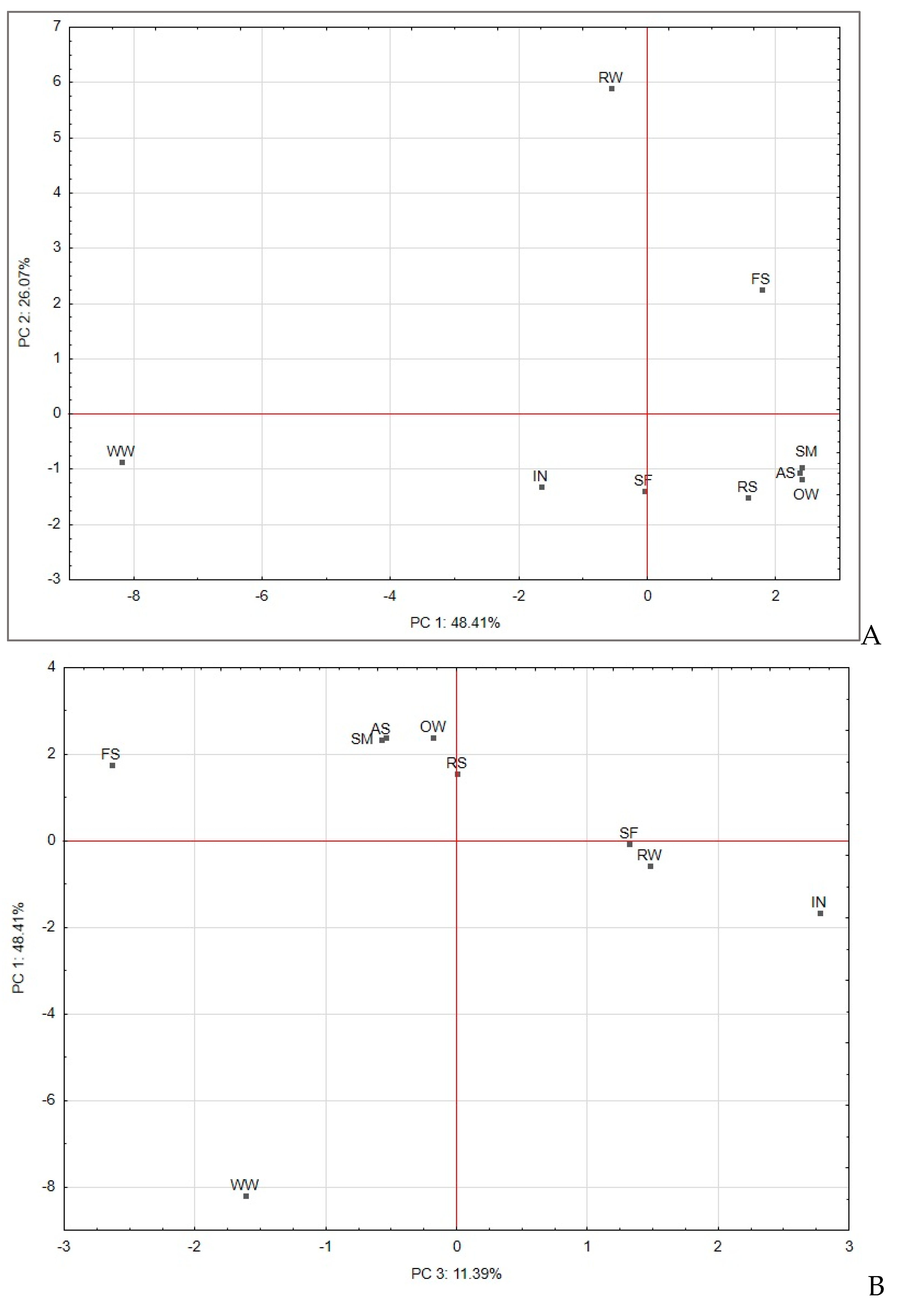
Figure 8.
Layout of the sampling points.
3. Discussion
3.1. Wastewater Effluent as the Primary AMR Source
The WWTP effluent represented the major source of antibiotic residues, ARB and ARGs in the snowmaking system, consistent with its known role as a principal point source of AMR determinants in aquatic environments [3,23,24]. Apart from the highest counts of bacterial indicators of water quality, this site was characterized by the presence of antibiotics from 6-7 classes, high prevalence of ARB, ESBL-positive Enterobacteriaceae strains (45%) and high ARG richness (up to 19 genes). Co-occurrence of these micropollutants confirms that the conventional mechanical-biological treatment is insufficient to eliminate pharmaceutical compounds. On one hand, this situation creates the selection pressure (sub-lethal antibiotic concentrations) on the environmental bacterial community and on the other - readily available material for this drug resistance to be developed from (ARG carried by discharged bacteria), as has been reported in WWTPs throughout Europe [3,23,25].
The approximately 23-fold reduction in E. coli between WWTP effluent and intake water (22,422 to 967 CFU/100 mL) suggests effective dilution and natural attenuation during river flow. However, this was not reflected by proportional ARG reduction (61% decrease from mean 16.5 to 6.5 genes) or antibiotic concentration decrease. Such divergence between biological and chemical/molecular contaminant reduction rates suggests that intake water that enters the snowmaking infrastructure cannot be assumed to be devoid of AMR, even when fecal indicator counts are relatively low.
3.2. The Reservoir Paradox in AMR Determinants: Simultaneous Decline in ARB/ARGs and Accumulation of Antimicrobials
The most scientifically novel finding of this study is the diverse fate of various categories of AMR determinants within storage reservoirs. While bacterial indicators and ARG richness declined from intake to reservoir water, concentrations of several antibiotic compounds substantially exceeded intake levels and in some cases surpassed even the WWTP effluent concentrations. This pattern was followed by fluoroquinolones (ciprofloxacin, enrofloxacin and ofloxacin all reaching normalized intensity 1.0 in Reservoir B in 2023/24), tylosin and even vancomycin.
Such observation may be explained by a few co-existing mechanisms. Fluoroquinolones and macrolides (i.e. tylosin and erythromycin also detected through the cycle) can adsorb onto solid particles which makes it difficult to understand their fate in the environment, but it can also explain their increased concentration in the reservoirs [26]. In flowing river water this fraction is transported downstream, but in a static reservoir it accumulates and can be resuspended cyclically, which is reflected in the still detectable concentrations of these antimicrobials in aged snow, snowmelt water and reservoir outflow. The hydraulic residence time of the reservoirs, ranging from days to weeks during the snowmaking season, allows for the accumulation of more stable compounds, such as fluoroquinolone and macrolide antibiotics [10,27]. The detection of tylosin, which reached the maximum normalized concentration in Reservoir A and close to maximum in Reservoir B is particularly noteworthy. Tylosin is a macrolide antibiotic used only in veterinary medicine and its high concentration in reservoirs, without being detected in WWTP effluent suggests its non-point sources, e.g. agricultural runoff or atmospheric deposition from surrounding farmed areas [28,29]. Similarly, vancomycin detection in both reservoirs in 2023/24 season most likely reflects its environmental persistence [30] resulting in its accumulation over time in the reservoir from trace inputs. These findings indicate that water storage in retention reservoirs may accumulate antibiotics of various classes from point and non-point sources and that this process may completely avoid standard monitoring.
The shift in dominant bacterial composition from Enterobacteriaceae at the intake to Aeromonas spp. in reservoir water (27 of 46 isolates; 59%) is another observation that demonstrates the specific conditions of reservoirs. Aeromonas spp. are well-adapted to oligotrophic, cold, static conditions, which gives them advantage over mesophilic Enterobacteriaceae under longer residence times of stored water [31,32]. The simultaneous reduction of ESBL-positive Enterobacteriaceae from 43% at intake water to 30% in reservoirs and their further disappearance downstream suggests that the conditions prevailing in reservoirs promote the selection of environmental taxa and at the expense of clinically important ones.
3.3. Snow Cannon Filters as Infrastructure Elements That Affect the Fate of AMR
The diverse results observed for the snow cannon filters between Chain A and Chain B are mostly operational findings. ARG richness in Chain A filters (7 and 5 genes) exceeded the one observed in its supplying reservoir (3-5 genes) and harbored the highest share of fluoroquinolone-resistant bacteria out of the examined infrastructure component (62.5% in Aeromonas, 23% in Enterobacteriaceae). Microbial community diversity was reduced compared to the reservoir (H = 1.415/1.288 vs. 1.402) with elevated dominance (λ= 0.113-0.117 vs. 0.073), suggesting selective retention of some bacterial groups in filter mesh/surfaces under chronic hydraulic stress. Material collected from Chain B filter harbored only 1 ARG, no culturable bacteria and the community diversity as well as dominance remained similar as at the intake (H=1.831 vs. 1.833; λ=0.026 vs. 0.033).
These observations result mainly from the pore size differences, as Chain A filter pores are much finer with higher hydraulic pressure than the Chain B filters. Such conditions favor biofilm formation and selective retention as the smaller pores efficiently trap particles on which the bacteria further accumulate [33,34]. The elevated ARG richness in the material collected from the Chain A filter compared to the reservoir water may reflect either concentration of ARG-bearing bacteria or even the in situ horizontal gene transfer within the biofilm. Coarser pore sizes in Chain B filters and lower pressure limits ARG accumulation and/or biofilm formation. The detection of blaOXA-48 carbapenemase gene in Chain A filter material in 2023/24 underscores the relevance of filters in ARG trapping, including genes determining the resistance to last-resort carbapenem antibiotics [35]. Also, the prevalence of fluoroquinolone and trimethoprim/sulfamethoxazole-resistant Aeromonas indicates that snow cannon filters may retain and accumulate bacterial resistant phenotypes relevant to aquatic ecosystem and the One Health considerations, given the emerging environmental and clinical significance of Aeromonas as opportunistic pathogens [24,36]. Filter design, operational pressure, maintenance frequency and methods (including employee safety procedures) are critical variables determining whether a filtration unit functions as an AMR barrier or hotspot.
3.4. Technical Snow as an AMR Reducing Environment
Technical snow and its ageing process appeared to be the most effective AMR reduction pathway in the system. Snow ageing was associated with nearly complete antibiotic removal, ARG elimination and ARB community limitation to β-lactam resistant environmental taxa. The overall reduction of E. coli counts from WWTP to receiving stream, with major contribution to this reduction by technical snowmaking, confirms this process as a critical step in pollutant and micropollutant attenuation.
The observed micropollutant reduction is driven by a few mechanisms. First, elimination of antimicrobials is mainly caused by their photodegradation and hydrolysis, which are major pathways of antibiotic degradation in aquatic and semi-aquatic environments [10]. As for microorganisms, including the resistant ones, phase transition from liquid to ice causes severe physical stress, i.e. crystal ice formation, osmotic disruption or mechanical damage, explaining the decrease in their numbers or complete elimination [37].
However, enrofloxacin and trimethoprim partially escaped the elimination processes during snow ageing and snowmelt, as both these compounds were detected in snowmelt water in low but quantifiable concentrations. Enrofloxacin is a very widely used veterinary fluoroquinolone antibiotic, the persistence of which in aqueous environment is very high [38]. Also, trimethoprim in combination with sulfamethoxazole is one of the most frequently prescribed antimicrobial in human medicine and is also largely stable in aquatic conditions [39].
The sul1 gene was detected in all fresh snow samples, consistent with its environmental persistence. It encodes a chromosomally associated resistance mechanism and is among the most ubiquitous ARGs in natural aquatic environments globally, and suggested as an indicator gene (along with blaTEM and intl1) of contamination to assess the state of antimicrobial resistance in the environment [40,41]. Its presence in the fresh snow does not necessarily indicate viable sul1-bearing bacteria, but still their extracellular DNA can be present in snow and can be transferred horizontally to other bacteria.
3.5. Reservoir Sediments as ARG/Biodiversity Accumulation Niches
Reservoir sediments were characterized by increased diversity (H=1.592-1.688; Species richness 169-243), culturable indicators presence (E. coli counts of 160 CFU/g and E. faecalis 1330 CFU/g) and ARG presence in Chain A (sul1, sul2, strA, ermB, vanA), as well as the highest proportion of β-lactam-resistant Enterobacteriaceae in all compartments. High biodiversity indices coupled with ARG detection exceeding the one observed in upstream sites is consistent with the role of reservoir sediments as long-term sources of ARB and ARGs (even in the absence of antimicrobial compounds), due to favorable conditions prevailing therein [29,42,43]. Accumulated organic matter, anoxic microenvironments, protection from UV-light, prolonged residence time – these factors promote biofilm formation on solid particle surfaces and as such provide protective conditions for ARB [29]. With these factors, sediments provide extremely favorable environments for horizontal gene transfer for microbial populations within reservoirs. Human-mediated activities, such as sediment removal during reservoir cleaning/desilting contributes to further dissemination of ARB and ARGs [42].
The detection of vanA gene, one of the most frequently found of the van family, in the reservoir sediment (apart from WWTP, aged snow and snowmelt receiver) is one of the most clinically important observations of this study. Coupled with blaOXA-48, encoding carbapeneme resistance in WWTP and snow cannon filter material, suggests that snowmaking systems can catch, harbor and disseminate genetic determinants of resistance to last resort antibiotics, if they enter the system. Such observations suggests that mountain tourism infrastructure should not be neglected by the One Health risk frameworks.
3.6. Four Functional Zones and Their Roles as Barriers and Vectors
Multivariate analyses (PCA and CA) were conducted to extract the major patterns that dominated the examined system. Taken together, these analyses divided the snowmaking system into four zones of different characteristics: (I) sites contaminated with wastewater-associated AMR determinants (WWTP effluent, intake water, snowmaking filters), (II) reservoir water characterized with elevated concentrations of antibiotics and reduced biological AMR indicators, (III) contaminant transition and attenuation zone (fresh and aged snow, snowmelt, outflow/receiving stream), where chemical, molecular and phenotypic AMR pollutants decline and (IV) reservoir sediments, that contain the remnants of contamination like indicator bacteria, including resistant strains (Fig. 8).
The clustering of snowmaking filters with the intake water in the PCA ordination indicates that filters do not constitute an independent AMR transformation step between the reservoir and technical snow. In terms of their overall AMR characteristics, they can serve as an extension of the wastewater-contaminated input zone. The practical implication of this finding is that filters should not be relied on as an AMR barrier and should be treated with caution by the ski station workers.
The answer to the question of whether snowmaking infrastructure acts as an AMR barrier or a vector is that it can act both ways. This depends on the individual AMR category, infrastructure component and the way it is operated. Importantly, the system achieves four-log reduction in fecal contamination indicators, nearly complete antibiotic elimination and gradual ARG reduction during snow production and ageing. On the other hand, the reservoirs accumulate some antibiotic classes above their input levels, fine-pore filters accumulate ARGs, while fresh snow deposits viable resistant bacteria and multiple antibiotic residues onto ski slopes used by hundreds of thousands of people, reservoir sediments accumulate resistance determinants that can be transported further during reservoir dredging.
3.7. One Health Implications and Management Recommendations
From a One Health perspective, ski resorts represent unique AMR risk environments that combine seasonally changing numbers of tourists, water reuse via snowmaking, direct recreational contact of people with technically produced snow and post-season snowmelt distribution of accumulated contaminants further downstream. The current study is, to our knowledge, the first to document the full AMR burden of this exposure pathway and to identify the specific infrastructure components through which it operates. The detection of resistance genes against last-resort antibiotics (vanA in sediments; blaOXA-48 in filter material) within the infrastructure of a recreational facility suggests the need to include the snowmaking systems in environmental AMR risk assessments. This is particularly important as technical snowmaking becomes indispensable element of most ski resorts in the northern hemisphere and this process often uses water from rivers and streams affected by WWTP effluents [15,17].
Several management recommendations follow directly from our findings. AMR risk assessment is a strongly recommended step when designing new technical snowmaking infrastructure and locations where access to AMR-free water is not available, water quality monitoring should incorporate ARG screening and antibiotic residue analysis as a routine measure, particularly for intake and reservoir water. Snow cannon filters require regular decontamination during the snowmaking season to prevent biofilm accumulation and these procedures should include appropriate personal protective measures for the maintenance personnel, who may be directly exposed to AMR determinants during filter servicing. Reservoir sediments should be handled during dredging and disposal operations with protocols consistent with those applied to WWTP biosolids. Finally, consideration should be given to advanced pre-treatment of snowmaking source water at resorts drawing directly from WWTP-impacted streams, since the UV disinfection systems in this study, even though effectively removed biological contaminants, did not prevent antibiotic accumulation in reservoir water.
3.8. Limitations
Several limitations should be acknowledged. The single-resort design limits direct generalization and comparative studies in different resort types (with and without storage reservoirs, with different filter designs and at different altitudes) are needed to establish the general patterns described in this study. The targeted 36-gene PCR panel cannot capture the full resistome, and future work should complement qualitative screening with quantitative PCR for gene copy number and with metagenomic approaches, particularly for sediment and filter biofilm compartments.
4. Materials and Methods
4.1. Study Area and Sampling Design
The study was conducted over two consecutive winter seasons (2023/24 and 2024/25) at a major, high-capacity ski resort located in Sothern Poland (Western Carpathians), situated at an altitude of approximately 650–910 m a.s.l. The selected facility is one of the largest and most intensively operated ski complexes in Poland, characterized by high tourist traffic during the winter season. The resort features an extensive infrastructure, including over a dozen chairlifts and ski lifts, and relies heavily on an advanced, intensive artificial snowmaking system supplied by local surface water resources. The mountain stream supplying intake water for snowmaking receives treated effluent from a municipal wastewater treatment plant (WWTP), which serves the local community, operates with a designed capacity of c.a. 800 population equivalents and employs mechanical-biological treatment. The distance between the WWTP effluent receiver and the water intake point for snowmaking is approx. 2.5 km.
The resort operates two independent snowmaking chains (Chain A and Chain B), each consisting of: (i) a water intake point on the mountain stream; (ii) a storage reservoirs equipped with aeration and UV light-based disinfection; (iii) snow cannon filters; (iv) snow cannons producing technical snow deposited on designated ski slopes; and (v) a receiving stream collecting meltwater outflow. The two chains differ primarily in their snow cannon filter design: Chain A employs finer-pore filtration at higher pressure, while Chain B operates coarser-pore filtration at lower pressure. Sampling points included each transformation stage along both chains: WWTP effluent (shared source), water intake (shared), water of Reservoir A and Reservoir B, snow cannon filters (Filter A1, Filter A2, Filter B), freshly produced technical snow (Fresh snow A and B), aged snow after approximately 8 weeks of deposition (Aged snow A and B), snowmelt (Snowmelt A and B), meltwater-receiving stream (Receiver A and B), post-season reservoir outflow (Outflow A), and post-season reservoir sediments (Sediment A and B). The spatial layout of sampling points is shown in Figure 1.
In each season, three independent replicate samples were collected at each sampling point during campaigns coinciding with peak snowmaking operation (December-February)..
4.2. Sample Collection and Preservation
All samples were collected under sterile conditions using autoclaved or single-use equipment. Water samples (WWTP effluent, intake, reservoir water, snowmelt, receiving stream water) were collected in 1000 mL sterile wide-neck polypropylene bottles pre-rinsed three times with sample water. Snow samples were collected by first removing the top 2 cm layer, then extracting a core using a 1.0 m × 10 cm sterile polycarbonate snow corer; snow cores were placed in sterile polypropylene string bags and melted. Sediment samples (~50 g wet weight) were collected from the deepest accessible point of each reservoir using a sterile stainless steel scoop into sterile 100 mL polypropylene containers. Snow cannon filter material was sampled by swabbing internal filter surfaces with sterile swabs. After being transported to the laboratory, the samples were processed immediately. Aliquots for molecular and chemical analyses were stored at -20 °C for a maximum of four weeks.
4.3. Chemical Analysis of Antimicrobial Agents
Twenty-one antimicrobial agents from 14 pharmacological classes were targeted: aminopenicillins (amoxicillin, ampicillin); 2nd generation cephalosporins (cefoxitin); 3rd generation cephalosporins (ceftazidime); fluoroquinolones (ciprofloxacin, enrofloxacin, ofloxacin); lincosamides (clindamycin); tetracyclines (doxycycline, oxytetracycline, tetracycline); macrolides (erythromycin, tylosin); aminoglycosides (gentamicin, netilmicin); oxazolidinones (linezolid); carbapenems (meropenem); semi-synthetic penicillins (piperacillin); sulfonamides (sulfamethoxazole); dihydrofolate reductase inhibitors (trimethoprim); and glycopeptides (vancomycin).
Antimicrobial agents were extracted by solid-phase extraction (SPE) using Oasis HLB cartridges (500 mg sorbent, 6 cc; Waters, Milford, CT, USA) following the procedure described by Stankiewicz et al. [16]. Briefly, 500 mL water or snowmelt samples were passed through conditioned HLB cartridges, eluted with methanol, evaporated to dryness under an air stream, and reconstituted in 1 mL of 10% methanol in ultrapure water.
Concentrations of antimicrobials were quantified by UHPLC-MS/MS using an Agilent 1290 Infinity system coupled with an Agilent 6460 Triple Quad mass spectrometer (Santa Clara, CA, USA) in positive and negative electrospray ionization mode. Two diagnostic precursor-to-product ion transitions were monitored per compound, as described by Lenart-Boroń et al. [12]. Limits of detection (LOD) ranged from 0.083 to 83.3 ng/L and limits of quantification (LOQ) from 0.25 to 250 ng/L; SPE recovery ranged from 9.94% to approximately 100% depending on the compound [18]..
4.4. Microbiological Analyses
General microbiological quality was assessed by standard culture-based methods. Water and snowmelt were analyzed by pour-plate (1 mL) and membrane filtration (100 mL) methods. Sediments were serially diluted (1 g in 9 mL sterile physiological saline) before plating. Selective media were used: TBX agar for Escherichia coli (turquoise colonies; 44 °C, 24 h); Slanetz-Bartley agar for Enterococcus faecalis/E. faecium (36 ± 1 °C, 72 h); Baird-Parker agar for coagulase-positive staphylococci (36 ± 1 °C, 48 h); and SS agar for Salmonella spp. (36 ± 1 °C, 24 h). All media were obtained from Biomaxima (Lublin, Poland). Results are expressed as CFU/100 mL or CFU/g wet weight. For isolation and identification of clinically relevant organisms, Brilliance UTI Clarity Agar (Thermo Fisher Scientific, Waltham, MA, USA) was used (culture at 36 ± 1 °C, 24 h). Characteristic colonies were subcultured and identified to species level by MALDI-TOF MS (Bruker Daltonics, Bremen, Germany; MBT Compass library v. 4.1).
Antimicrobial susceptibility testing was performed by disc diffusion on Mueller-Hinton II agar (Biomaxima), following current EUCAST guidelines [19]. Twenty-one antimicrobial agents from eight classes were tested: aminoglycosides (amikacin 30 µg, gentamicin 10 µg, tobramycin 10 µg); beta-lactams including penicillins (ampicillin 10 µg, amoxicillin/clavulanic acid 20/10 µg, piperacillin/tazobactam 100/10 µg), cephalosporins (ceftazidime 30 µg, cefotaxime 30 µg, cefoxitin 30 µg, cefepime 30 µg), monobactams (aztreonam 30 µg), carbapenems (meropenem 10 µg); fluoroquinolones (ciprofloxacin 5 µg, enrofloxacin 5 µg, levofloxacin 5 µg); macrolides (erythromycin 15 µg, tylosin 15 µg); lincosamides (clindamycin 2 µg); folate pathway inhibitors (trimethoprim/sulfamethoxazole 1.25/23.75 µg); tetracyclines (tetracycline 30 µg); glycopeptides (vancomycin 30 µg). The discs were obtained from Oxoid (Basingstoke, UK). Growth inhibition zone diameters were measured after 18-24 h of culture at 36 ± 1 °C and interpreted according to the EUCAST breakpoint values [19]. ESBL production in Enterobacterales and Pseudomonas was confirmed by double-disc synergy test [20]. Inducible clindamycin resistance in staphylococci was assessed by the D-zone test [21]. Quality control strains E. coli ATCC 25922, P. aeruginosa ATCC 27853 and S. aureus ATCC 29213 were used as controls.
4.5. Molecular Analyses
Total environmental DNA was extracted from water (500 mL), snowmelt water (500 mL), snow cannon filter swabs and sediment (0.5 g wet weight). Water and snowmelt water samples were filtered through 0.22 µm sterile cellulose nitrate filters (BioSpace, Warsaw, Poland). Filters were placed in 60 mm Petri dishes, covered with 1 mL sterile 0.85% NaCl and shaken at 120 rpm overnight. The resulting suspension combined with filter-surface swab eluates was centrifuged at 10,000 × g for 10 min; the pellet was resuspended in 200 µL Tris buffer. DNA was extracted from all sample types using the Genomic Mini AX Bacteria + Spin kit (A&A Biotechnology, Gdansk, Poland) according to the manufacturer's instructions.
Thirty-six genetic determinants of antimicrobial resistance were screened by conventional PCR, targeting genes conferring resistance to: aminoglycosides (aac(6')-Ib, aph(3')-Ia, aadA1); extended-spectrum beta-lactamases (blaTEM, blaSHV, blaCTX-M-1, blaCTX-M-9, blaCTX-M-2); carbapenemases (blaKPC, blaNDM, blaOXA-48, blaVIM, blaIMP); macrolide-lincosamide-streptogramin B (MLSb) resistance (ermA, ermB, ermC, mphA); methicillin resistance (mecA); sulfonamide resistance (sul1, sul2, sul3); tetracycline resistance (tetA, tetB, tetC, tetM); and trimethoprim resistance (dfrA1, dfrA12, dfrA17). Primer sequences, annealing temperatures and amplicon sizes are provided in Supplementary table S2. PCR reactions were performed in 25 µL volumes containing 50 ng template DNA, 12.5 pmol of each primer, 2.0 mM dNTPs, 1x PCR buffer and 2.4 U Taq polymerase (PCR Mix Plus Green; A&A Biotechnology, Gdansk, Poland) in a T100 thermal cycler (Bio-Rad, Hercules, CA, USA). The PCR products were electrophoresed in 1% agarose gels in 1 × TBE buffer, stained with SimplySafe (EurX, Gdansk, Poland) and visualized under UV light.
For 16S rRNA amplicon sequencing, DNA extracts were submitted to Macrogen Europe (Amsterdam, The Netherlands) for library preparation targeting the V3-V4 hypervariable region using primers 341F/806R, followed by paired-end sequencing on an Illumina MiSeq platform (2 x 300 bp). Raw sequences were quality-filtered, trimmed, denoised and clustered into operational taxonomic units (OTUs) in QIIME2 (v2023.5). Taxonomic assignment was performed using the SILVA database using a naive Bayes classifier trained on the V3-V4 region. Alpha-diversity indices (observed species richness, Shannon entropy H, Simpson dominance lambda, Pielou evenness J, and Margalef’s richness Dm) were calculated from rarefied OTU tables. A full description of the pipeline, quality metrics and rarefaction curves is provided in [22], based on which the processed sequence tables were provided for the diversity calculations in this study.
4.6. Statistical and Bioinformatic Analyses
Statistical analyses were performed in Statistica (v. 13.3, TIBCO Software, Inc., USA). Data normality was assessed by the Shapiro-Wilk test. As the majority of variables were close to normal distribution, parametric tests were applied. Differences in bacterial counts, antibiotic concentrations and ARG richness among sampling sites and between seasons were evaluated by one-way ANOVA with LSD post-hoc test for pairwise comparisons. Pearson correlation coefficients were used to examine associations between continuous variables. A significance threshold of p < 0.05 was applied for the tests.
Principal component analysis (PCA) was performed on a simplified dataset of nine system compartments (averaged across chains and seasons) described by 23 variables: ARG richness, ESBL prevalence, Enterobacteriaceae and Aeromonas resistance phenotype frequencies (beta-lactams, fluoroquinolones, trimethoprim/sulfamethoxazole), normalized intensities of eleven antibiotic compounds (cefoxitin, erythromycin, tylosin, clindamycin, ofloxacin, ciprofloxacin, enrofloxacin, trimethoprim, sulfamethoxazole, linezolid, vancomycin), E. coli counts, E. faecalis counts, Shannon diversity index H and Margalef’s richness Dm. All variables were z-score standardized prior to PCA. Antibiotic intensities were normalized to the maximum observed value per compound across all sites and seasons before standardization, placing them on a dimensionless 0-1 scale comparable to proportional resistance data.
5. Conclusions
This study provides the first comprehensive analysis of fate of AMR components, such as antibiotic residues, ARB and ARGs, throughout a complete snowmaking infrastructure, demonstrating that such systems can simultaneously act as barriers and/or vectors for the resistance determinants. The delicate balance between these roles depends on individual indicators, infrastructure elements and the way of their handling.
Wastewater-affected source water introduces a complex AMR-related factors into the snowmaking systems, such as antibiotics, ESBL-producing Enterobacteriaceae, fluoroquinolone-resistant Aeromonas and ARGs that conventional biological treatment does not fully eliminate. Storage reservoirs emerge as dual nature infrastructure elements, where biological AMR indicators are reduced while antimicrobials are concentrated above the water intake or WWTP levels. Such increase is attributed to solid particle adsorption, long hydraulic residence, protection from photodegradation or oxidation in anoxic niches and refers to a variety of antimicrobials, including these of veterinary origin, entering the system through diffuse sources. Filtration infrastructure can function either as an AMR hotspot or as a passive barrier depending on its physical design, demonstrating that engineering decisions in snowmaking systems affect the AMR fate therein. Technical snow and its ageing process most effectively contribute to the AMR reduction, with nearly complete antibiotic elimination and loss of resistance genes, due to UV light exposure, freeze-thaw cell membrane disruption and ecological succession. Finally, reservoir sediments function as long-term ARG accumulation niches, retaining a variety of genes that can be further transferred horizontally. As such, they require specific consideration in terms of management and sediment disposal protocols.
Overall, this study demonstrates that snowmaking infrastructure can simultaneously act as an AMR barrier and/or its vector. The four zones proposed here, i.e. the contamination input zone, reservoir enrichment, transformation and reduction in technical snow, and sediment AMR accumulation, provides a base that should be validated in broader range of ski resorts with various source water types, climate conditions and altitude. Nevertheless, snowmaking systems should be incorporated into environmental AMR monitoring frameworks, One Health risk assessments and winter tourism management strategies, particularly given the direct recreational and occupational exposure of large numbers of people to technical snow at sites where wastewater-impacted water is the snowmaking source.
Finally, our findings demonstrate that the entire problem stems from insufficiently treated wastewater contaminating snowmaking input points. As such, it can be only partially mitigated without addressing its root cause, namely deficient wastewater treatment capacity in touristic areas.
Supplementary Materials
The following supporting information can be downloaded at: Preprints.org, Table S1: PCR primers for antimicrobial resistance genes with primer annealing temperature and product length.
Author Contributions
Conceptualization, P.B. and A.L-B.; methodology, K.B., J.P, and A.L-B.; software, K.S. and J.P.; validation, K.S. and P.B.; formal analysis, N.C.-B and A.L-B.; investigation, N.C.-B., K.S., K.B., J.P., A.K., Z.S. and A.L-B.; resources, K.S., P.B. and A.L-B.; data curation, N.C.-B., K.S. and K.B..; writing—original draft preparation, A.L.-B.; writing—review and editing, K.S., P.B., J.P. and A.L.-B..; visualization, P.B. and A.L-B..; supervision, A.L.-B.; project administration, A.L.-B.; funding acquisition, J.P. and A.L.-B. All authors have read and agreed to the published version of the manuscript.
Funding
This research was funded by the statutory measures of the University of Agriculture in Krakow.
Institutional Review Board Statement
Not applicable.
Informed Consent Statement
Not applicable.
Data Availability Statement
original contributions presented in this study are included in the article. Further inquiries can be directed to the corresponding author.
Conflicts of Interest
The authors declare no conflicts of interest.
References
- Sodhi, K.K.; Singh, D.K. Insight into the Fluoroquinolone Resistance, Sources, Ecotoxicity, and Degradation with Special Emphasis on Ciprofloxacin. J. Water Process Eng. 2021, 43, 102218. [Google Scholar] [CrossRef]
- Sánchez-Baena, A.M.; Caicedo-Bejarano, L.D.; Chávez-Vivas, M. Structure of Bacterial Community with Resistance to Antibiotics in Aquatic Environments. A Systematic Review. Int. J. Environ. Res. Public Health 2021, 18. [Google Scholar] [CrossRef] [PubMed]
- Waśko, I.; Kozińska, A.; Kotlarska, E.; Baraniak, A. Clinically Relevant β-Lactam Resistance Genes in Wastewater Treatment Plants. Int. J. Environ. Res. Public Health 2022, 19, 13829. [Google Scholar] [CrossRef] [PubMed]
- Skandalis, N.; Maeusli, M.; Papafotis, D.; Miller, S.; Lee, B.; Theologidis, I.; Luna, B. Environmental Spread of Antibiotic Resistance. Antibiotics 2021, 10. [Google Scholar] [CrossRef] [PubMed]
- Zuccolotto, T.; Delamare, A.P.L.; Costa, S.O.P.; Echeverrigaray, S. Aeromonas Growth under Low Temperatures. In Modern Multidisciplinary Applied Microbiology; 2006; pp. 275–279. ISBN 9783527611904. [Google Scholar]
- Michael, I.; Rizzo, L.; McArdell, C.S.; Manaia, C.M.; Merlin, C.; Schwartz, T.; Dagot, C.; Fatta-Kassinos, D. Urban Wastewater Treatment Plants as Hotspots for the Release of Antibiotics in the Environment: A Review. Water Res. 2013, 47, 957–995. [Google Scholar] [CrossRef] [PubMed]
- Inês, L.; Leron, K.; Nicolas, G.; Ivone, V.-M.; Uli, K.; Daniel, Y.; Shaked, P.; Lotan, D.; U., B.T.; Christophe, M.; et al. Microbiome and Resistome Profiles along a Sewage-Effluent-Reservoir Trajectory Underline the Role of Natural Attenuation in Wastewater Stabilization Reservoirs. Appl. Environ. Microbiol. 2023, 89, e00170-23. [Google Scholar] [CrossRef] [PubMed]
- Talat, A.; Bashir, Y.; Khalil, N.; Brown, C.L.; Gupta, D.; Khan, A.U. Antimicrobial Resistance Transmission in the Environmental Settings through Traditional and UV-Enabled Advanced Wastewater Treatment Plants: A Metagenomic Insight. Environ. Microbiome 2025, 20, 27. [Google Scholar] [CrossRef] [PubMed]
- Wolf-Baca, M.; Siedlecka, A. Seasonal and Spatial Variations of Antibiotic Resistance Genes and Bacterial Biodiversity in Biofilms Covering the Equipment at Successive Stages of Drinking Water Purification. J. Hazard. Mater. 2023, 456, 131660. [Google Scholar] [CrossRef] [PubMed]
- Stankiewicz, K.; Boroń, P.; Prajsnar, J.; Żelazny, M.; Heliasz, M.; Hunter, W.; Lenart-Boroń, A. Second Life of Water and Wastewater in the Context of Circular Economy - Do the Membrane Bioreactor Technology and Storage Reservoirs Make the Recycled Water Safe for Further Use? Sci. Total Environ. 2024, 921, 170995. [Google Scholar] [CrossRef] [PubMed]
- Pei, R.; Cha, J.; Carlson, K.H.; Pruden, A. Response of Antibiotic Resistance Genes (ARG) to Biological Treatment in Dairy Lagoon Water. Environ. Sci. Technol. 2007, 41, 5108–5113. [Google Scholar] [CrossRef] [PubMed]
- Lenart-Boroń, A.; Boroń, P.; Grad, B.; Bulanda, K.; Czernecka-Borchowiec, N.; Ratajewicz, A.; Stankiewicz, K. Microbial Selection and Functional Adaptation in Technical Snow: A Molecular Perspective from 16S RRNA Profiling. Int. J. Mol. Sci. 2025, 26. [Google Scholar] [CrossRef] [PubMed]
- Baloh, P.; Els, N.; David, R.O.; Larose, C.; Whitmore, K.; Sattler, B.; Grothe, H. Assessment of Artificial and Natural Transport Mechanisms of Ice Nucleating Particles in an Alpine Ski Resort in Obergurgl, Austria. Front. Microbiol. 2019, 10, 2278. [Google Scholar] [CrossRef] [PubMed]
- Xu, L.; Kasprzyk-Hordern, B. Assessment of the Stability of Antimicrobials and Resistance Genes during Short- and Long-Term Storage Condition: Accounting for Uncertainties in Bioanalytical Workflows. Anal. Bioanal. Chem. 2023, 415, 6027–6038. [Google Scholar] [CrossRef] [PubMed]
- Wilson, G.J.L.; Perez-Zabaleta, M.; Owusu-Agyeman, I.; Kumar, A.; Ghosh, A.; Polya, D.A.; Gooddy, D.C.; Cetecioglu, Z.; Richards, L.A. Discovery of Sulfonamide Resistance Genes in Deep Groundwater below Patna, India. Environ. Pollut. 2024, 356, 124205. [Google Scholar] [CrossRef] [PubMed]
- Rossi, F.; Péguilhan, R.; Turgeon, N.; Veillette, M.; Baray, J.-L.; Deguillaume, L.; Amato, P.; Duchaine, C. Quantification of Antibiotic Resistance Genes (ARGs) in Clouds at a Mountain Site (Puy de Dôme, Central France). Sci. Total Environ. 2023, 865, 161264. [Google Scholar] [CrossRef] [PubMed]
- Stankiewicz, K.; Bulanda, K.; Prajsnar, J.; Lenart-Boroń, A. Impact of the Technical Snow Production Process on Bacterial Community Composition, Antibacterial Resistance Genes, and Antibiotic Input—A Dual Effect of the Inevitable. Int. J. Mol. Sci. 2025, 26. [Google Scholar] [CrossRef] [PubMed]
- Lenart-Boroń, A.; Prajsnar, J.; Guzik, M.; Boroń, P.; Chmiel, M. How Much of Antibiotics Can Enter Surface Water with Treated Wastewater and How It Affects the Resistance of Waterborne Bacteria: A Case Study of the Białka River Sewage Treatment Plant. Environ. Res. 2020, 191, 110037. [Google Scholar] [CrossRef] [PubMed]
- Lenart-Boroń, A.M.; Boroń, P.M.; Prajsnar, J.A.; Guzik, M.W.; Żelazny, M.S.; Pufelska, M.D.; Chmiel, M.J. COVID-19 Lockdown Shows How Much Natural Mountain Regions Are Affected by Heavy Tourism. Sci. Total Environ. 2022, 806, 151355. [Google Scholar] [CrossRef] [PubMed]
- The European Committee on Antimicrobial Susceptibility Testing; (EUCAST) European Committee on Antimicrobial Susceptibility Testing Breakpoint Tables for Interpretation of MICs and Zone Diameters. 2025. [CrossRef] [PubMed]
- Drieux, L.; Brossier, F.; Sougakoff, W.; Jarlier, V. Phenotypic Detection of Extended-Spectrum β-Lactamase Production in Enterobacteriaceae: Review and Bench Guide. Clin. Microbiol. Infect. 2008, 14, 90–103. [Google Scholar] [CrossRef] [PubMed]
- Fiebelkorn, K.R.; Crawford, S.A.; McElmeel, M.L.; Jorgensen, J.H. Practical Disk Diffusion Method for Detection of Inducible Clindamycin Resistance in Staphylococcus Aureus and Coagulase-Negative Staphylococci. J. Clin. Microbiol. 2003, 41, 4740–4744. [Google Scholar] [CrossRef] [PubMed]
Figure 1.
log-10 transformed counts of E. coli (blue) and E. faecalis (red) along the snowmaking chains (CFU/100 mL of water and CFU/ 1g of sediment, values averaged for all assessments).
Figure 1.
log-10 transformed counts of E. coli (blue) and E. faecalis (red) along the snowmaking chains (CFU/100 mL of water and CFU/ 1g of sediment, values averaged for all assessments).
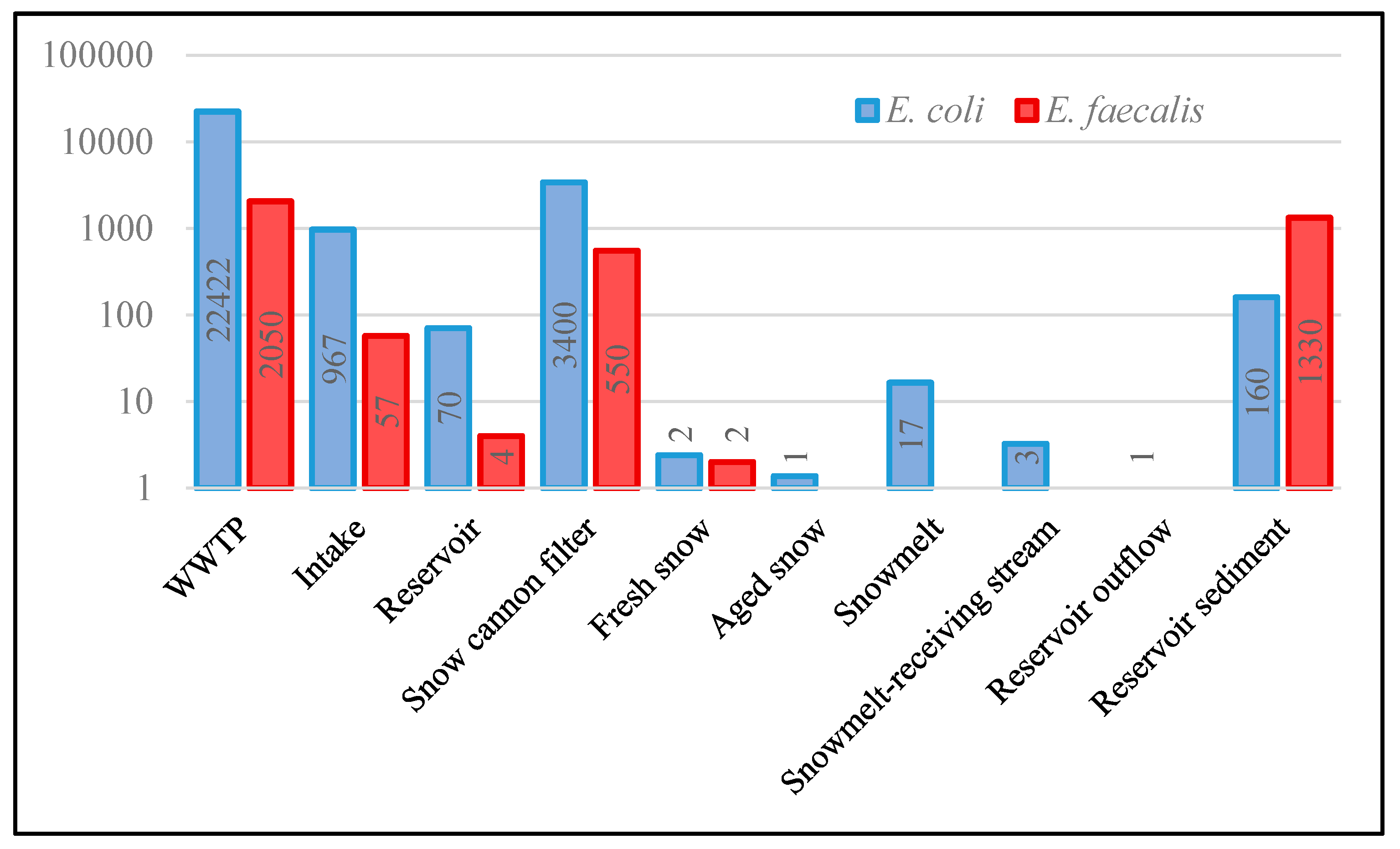
Figure 2.
Heatmap of normalized peak antibiotic concentrations across the snowmaking system in two winter seasons (2023/24 and 2024/25). Values represent relative intensities (0–1) normalized to the maximum concentration detected for each antibiotic. The system shows strong reduction of antibiotic residues from wastewater and intake water through reservoirs and technical snow, with nearly complete disappearance in aged snow and meltwater.
Figure 2.
Heatmap of normalized peak antibiotic concentrations across the snowmaking system in two winter seasons (2023/24 and 2024/25). Values represent relative intensities (0–1) normalized to the maximum concentration detected for each antibiotic. The system shows strong reduction of antibiotic residues from wastewater and intake water through reservoirs and technical snow, with nearly complete disappearance in aged snow and meltwater.
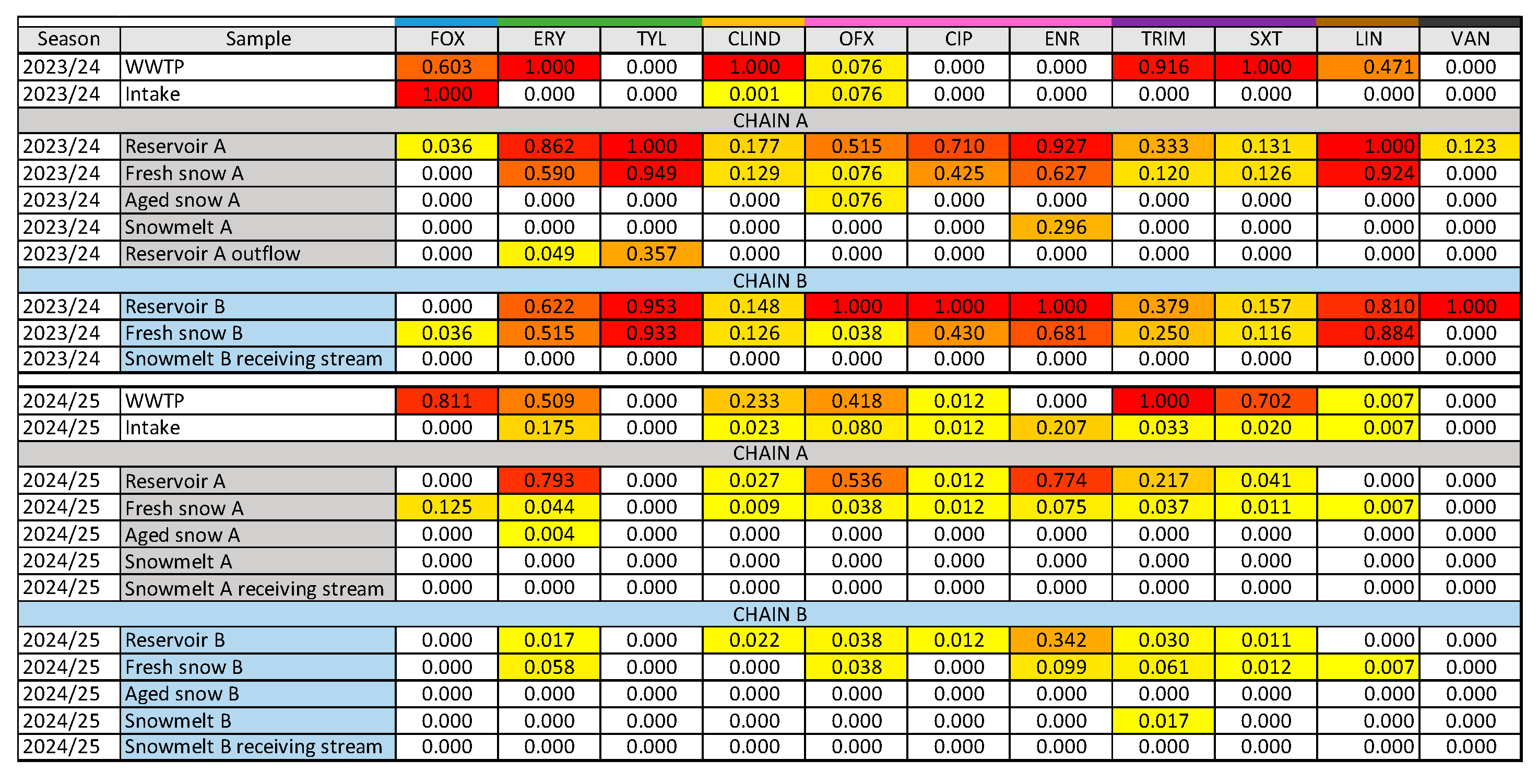
Figure 3.
Antibiotic richness across the snowmaking system in two winter seasons (2023/24 and 2024/25). Richness was defined as the number of individual antibiotics detected at each sampling point (0–11). Wastewater and intake water showed the highest richness, followed by reservoirs and fresh technical snow..
Figure 3.
Antibiotic richness across the snowmaking system in two winter seasons (2023/24 and 2024/25). Richness was defined as the number of individual antibiotics detected at each sampling point (0–11). Wastewater and intake water showed the highest richness, followed by reservoirs and fresh technical snow..
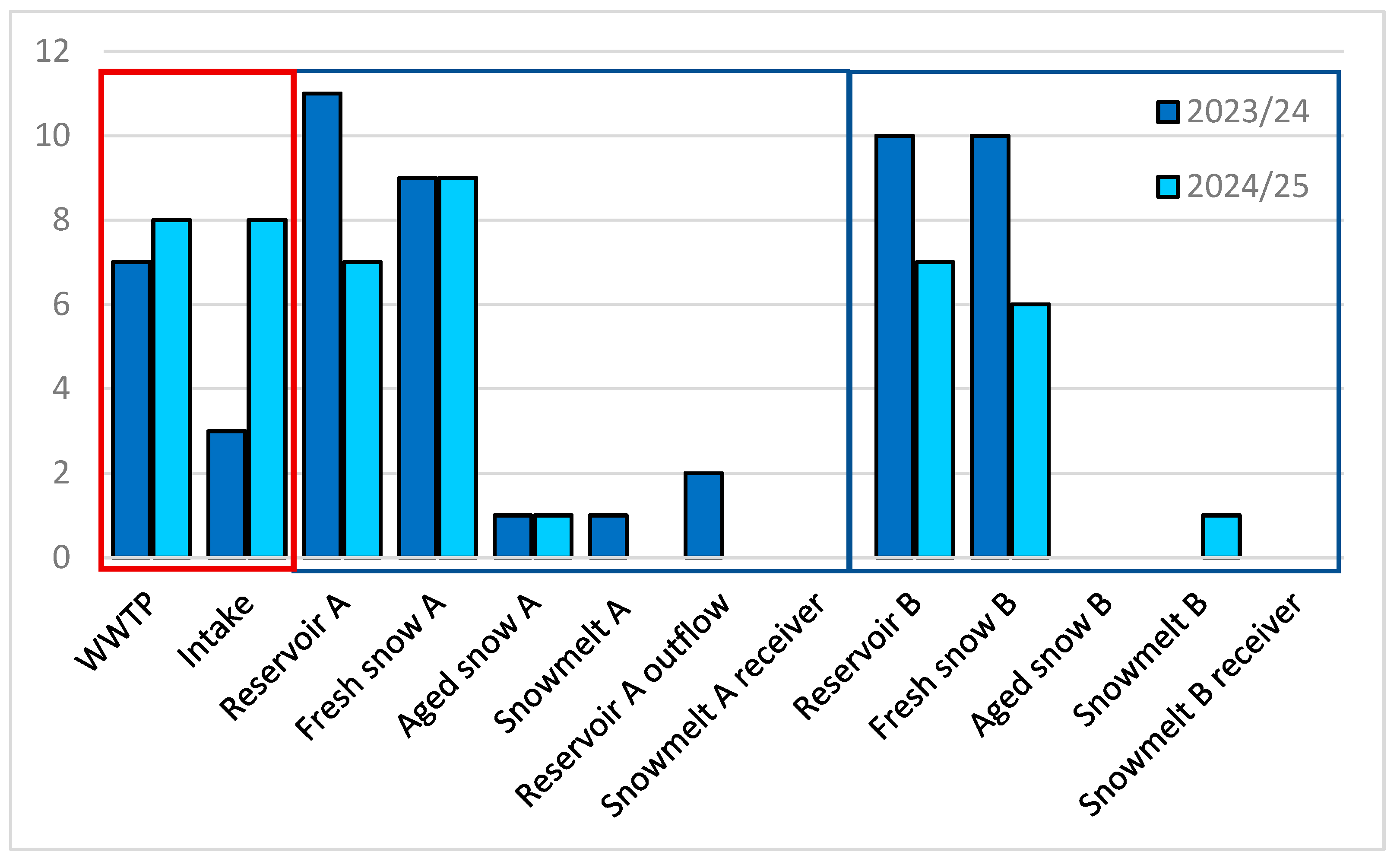
Figure 4.
Percentage of antibiotic resistant Enterobacteriaceae (A) and Aeromonas (C) as well as ESBL-positive Enterobacteriaceae (B) isolated along the snowmaking chain.
Figure 4.
Percentage of antibiotic resistant Enterobacteriaceae (A) and Aeromonas (C) as well as ESBL-positive Enterobacteriaceae (B) isolated along the snowmaking chain.
| System stage | No. of isolates | Dominant bacterial groups | Predominant resistance phenotypes |
| WWTP effluent | 32 |
Enterobacteriaceae (20) Aeromonas (12) |
β-lactams (penicillins) fluoroquinolones sulfonamides ESBL |
| Water intake | 43 |
Enterobacteriaceae (23) Aeromonas (20) |
β-lactams (penicillins) fluoroquinolones ESBL |
| Reservoir water | 46 |
Aeromonas (27) Enterobacteriaceae (10) Acinetobacter (4) Pseudomonas (4) Environmental cocci (1) |
fluoroquinolones β-lactams (penicillins, monobactams, 3rd gen. cephalosporins) |
| Snow cannon filters | 32 |
Enterobacteriaceae (13) Aeromonas (8) Acinetobacter (4) Environmental cocci and bacilli (7) |
β-lactams (penicillins) fluoroquinolones |
| Fresh technical snow | 9 |
Enterobacteriaceae (3) Acinetobacter (3) Aeromonas (1) Pseudomonas (1) Environmental cocci and bacilli (1) |
β-lactams (penicillins) |
| Aged snowpack | 11 |
Enterobacteriaceae (4) Acinetobacter (1) Pseudomonas (3) Environmental cocci and bacilli (3) |
β-lactams (penicillins) |
| Snowmelt | 28 |
Enterobacteriaceae (22) Aeromonas (1) Pseudomonas (3) Environmental cocci and bacilli (2) |
β-lactams (penicillins; 3rd gen. cephalosporins) |
| Snowmelt receiver | 18 | Enterobacteriaceae (18) | β-lactams (penicillins) |
| Reservoir sediment | 21 |
Enterobacteriaceae (2) Acinetobacter (1) Aeromonas (7) Environmental cocci and bacilli (11) |
β-lactams (penicillins) |

Table 1.
Predominant antibiotic resistance types detected in the bacterial strains isolated along the snowmaking chain.
Table 1.
Predominant antibiotic resistance types detected in the bacterial strains isolated along the snowmaking chain.
| System stage | No. of isolates | Dominant bacterial groups | Predominant resistance phenotypes |
| WWTP effluent | 32 |
Enterobacteriaceae (20) Aeromonas (12) |
β-lactams (penicillins) fluoroquinolones sulfonamides ESBL |
| Water intake | 43 |
Enterobacteriaceae (23) Aeromonas (20) |
β-lactams (penicillins) fluoroquinolones ESBL |
| Reservoir water | 46 |
Aeromonas (27) Enterobacteriaceae (10) Acinetobacter (4) Pseudomonas (4) Environmental cocci (1) |
fluoroquinolones β-lactams (penicillins, monobactams, 3rd gen. cephalosporins) |
| Snow cannon filters | 32 |
Enterobacteriaceae (13) Aeromonas (8) Acinetobacter (4) Environmental cocci and bacilli (7) |
β-lactams (penicillins) fluoroquinolones |
| Fresh technical snow | 9 |
Enterobacteriaceae (3) Acinetobacter (3) Aeromonas (1) Pseudomonas (1) Environmental cocci and bacilli (1) |
β-lactams (penicillins) |
| Aged snowpack | 11 |
Enterobacteriaceae (4) Acinetobacter (1) Pseudomonas (3) Environmental cocci and bacilli (3) |
β-lactams (penicillins) |
| Snowmelt | 28 |
Enterobacteriaceae (22) Aeromonas (1) Pseudomonas (3) Environmental cocci and bacilli (2) |
β-lactams (penicillins; 3rd gen. cephalosporins) |
| Snowmelt receiver | 18 | Enterobacteriaceae (18) | β-lactams (penicillins) |
| Reservoir sediment | 21 |
Enterobacteriaceae (2) Acinetobacter (1) Aeromonas (7) Environmental cocci and bacilli (11) |
β-lactams (penicillins) |
Disclaimer/Publisher’s Note: The statements, opinions and data contained in all publications are solely those of the individual author(s) and contributor(s) and not of MDPI and/or the editor(s). MDPI and/or the editor(s) disclaim responsibility for any injury to people or property resulting from any ideas, methods, instructions or products referred to in the content. |
© 2026 by the authors. Licensee MDPI, Basel, Switzerland. This article is an open access article distributed under the terms and conditions of the Creative Commons Attribution (CC BY) license (http://creativecommons.org/licenses/by/4.0/).
Copyright: This open access article is published under a Creative Commons CC BY 4.0 license, which permit the free download, distribution, and reuse, provided that the author and preprint are cited in any reuse.