

Submitted:
18 August 2026
Posted:
19 August 2026
You are already at the latest version
Abstract
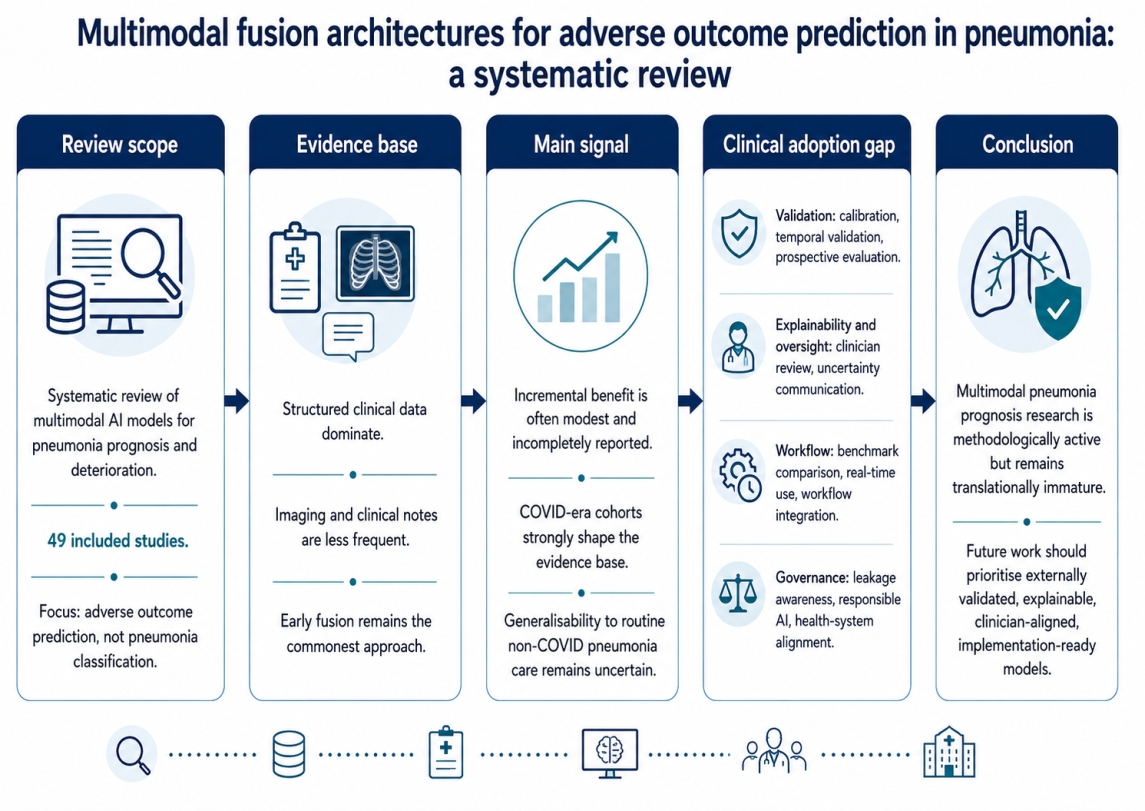
Objective: To review multimodal artificial intelligence (AI) models for predicting adverse outcomes in pneumonia, with emphasis on prognosis, validation, benchmarking, explainability, and clinical implementation readiness. Materials and Methods: We conducted a PROSPERO-registered systematic review. PubMed, Scopus, IEEE Xplore, and supplementary register/citation-search sources were searched between 01 January 2000 and 27 February 2026. Eligible studies integrated at least two heterogeneous clinical data modalities within one predictive framework for pneumonia-related deterioration, mortality, escalation of care, ventilation, or related adverse outcomes. We extracted modality composition, fusion architecture, outcome alignment, validation, performance metrics, clinical benchmarking, explainability, predictive uncertainty, workflow integration, governance reporting, and risk of bias. Results: Of 10,460 identified records, 49 studies were included. The evidence base was dominated by COVID-era studies. Structured electronic health record data, laboratories, and vital signs were more common than imaging or clinical notes. Early fusion was the predominant strategy, while attention-based and graph-based fusion were rare. External validation was reported in 19/49 studies, calibration in 9/49, temporal validation in 5/49, decision curve analysis in 3/49, and prospective evaluation in 3/49. Incremental AUROC over the best unimodal baseline was computable in 19 studies and was usually modest. Discussion: The literature emphasised retrospective discrimination more than clinical utility, with limited reporting of added value, workflow, predictive uncertainty, and governance. Conclusion: Multimodal pneumonia prognosis research is active but not yet implementation-ready. Future studies should prioritise externally validated, calibrated, explainable, clinician-aligned, and workflow-aware models.
Keywords:
pneumonia
; artificial intelligence
; machine learning
; prognosis
; clinical deterioration
Copyright: This open access article is published under a Creative Commons CC BY 4.0 license, which permit the free download, distribution, and reuse, provided that the author and preprint are cited in any reuse.