
Submitted:
18 August 2026
Posted:
19 August 2026
You are already at the latest version
Abstract
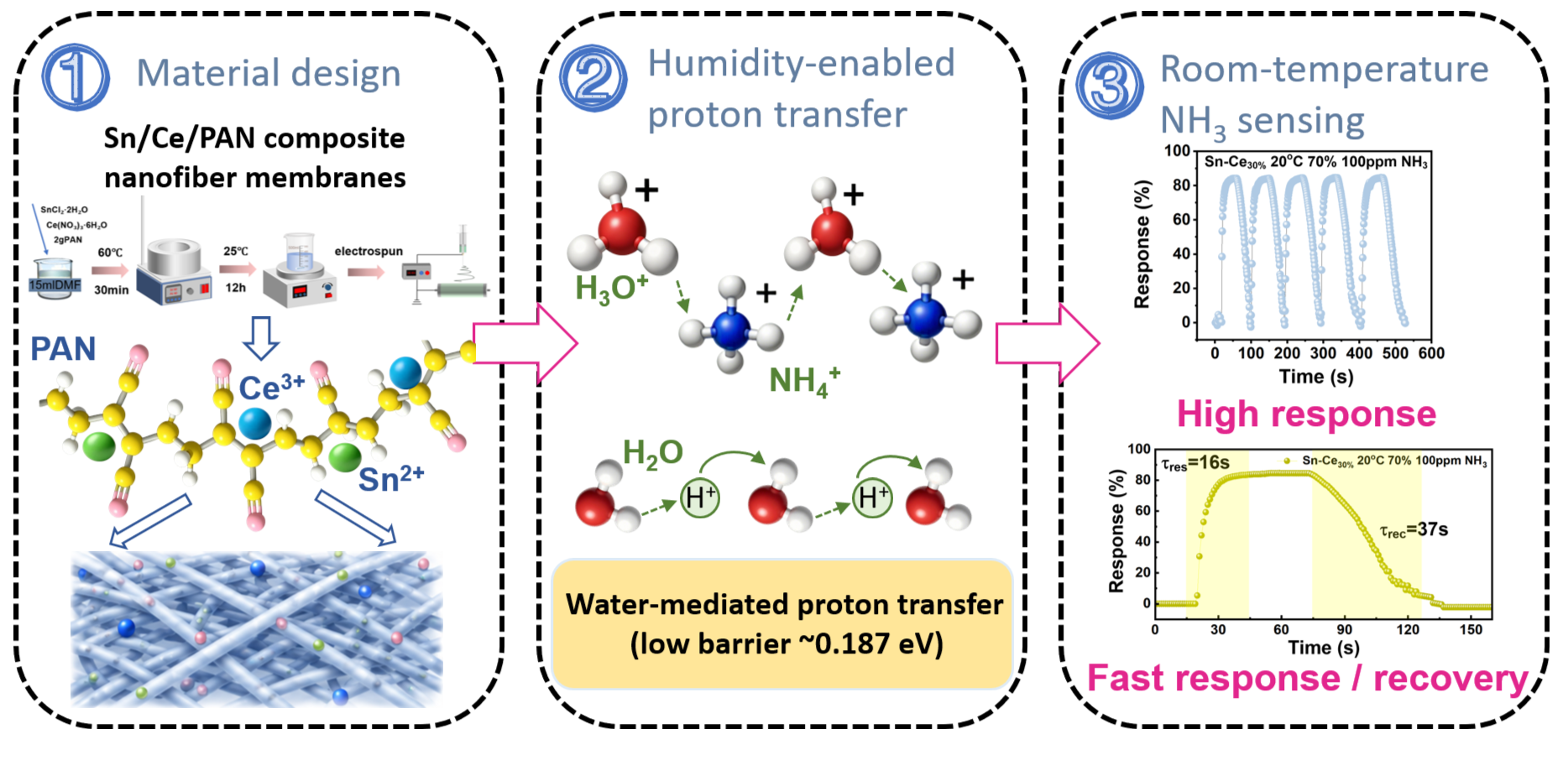
Precise monitoring of ammonia (NH3) in humid agricultural environments is essential for livestock management and environmental protection. However, conventional metal oxide semiconductor sensors often suffer from signal attenuation and baseline instability because of competitive water adsorption under room-temperature, high-humidity conditions. Here, a non-annealed Sn/Ce-containing polyacrylonitrile (PAN) nanofiber membrane was fabricated by electrospinning for room-temperature NH3 sensing. The resulting Sn/Ce/PAN membrane exhibits an amorphous hybrid structure formed through interactions between the metal species and the PAN matrix. The Sn/Ce/PAN membrane-based sensor delivers a response of 90% toward 100 ppm NH3 at 80% RH, with a response time of 16 s and a recovery time of 37 s. The sensing response increases with relative humidity and reaches its maximum at 80% RH, demonstrating excellent sensing performance under high-humidity conditions. Combined experimental and theoretical investigations reveal that the outstanding sensing performance originates from humidity-mediated proton conduction enabled by enhanced water adsorption and the formation of a continuous hydrogen-bond network, whereas excessive water accumulation suppresses charge transport under excessively humid conditions. This work provides mechanistic insights into room-temperature NH₃ sensing under high humidity and offers a promising strategy for developing high-performance gas sensors for practical humid environments.
Keywords:
NH3 sensing
; electrospun nanofibers
; amorphous hybrid structure
; high-humidity sensing
; proton conduction
Copyright: This open access article is published under a Creative Commons CC BY 4.0 license, which permit the free download, distribution, and reuse, provided that the author and preprint are cited in any reuse.