

Submitted:
17 August 2026
Posted:
19 August 2026
You are already at the latest version
Abstract
This research develops an Integrated Decision Framework for Reliability-Centered Maintenance and Renewable Energy Coordination (IDF-RCM-REC) to support sustainable industrial production under energy uncertainty. The study addresses the lack of unified models that jointly optimize maintenance policies and renewable energy dispatch, which currently leads to suboptimal reliability, cost, and sustainability outcomes. A multi-objective optimization framework integrating RCM-based reliability modeling, stochastic renewable energy coordination, and MCDM-guided solution selection is formulated and validated through a case study of an energy-intensive manufacturing facility. Results show a 16.6% reduction in total annual cost, 19.8% lower carbon emissions, 43.8% reduction in unplanned downtime, and a 26.1% increase in renewable energy utilization, alongside a shift toward predictive and condition-based maintenance strategies. The framework enables decision makers to evaluate trade-offs between cost, reliability, and sustainability and to select strategies aligned with organizational objectives. This work provides a practical, mathematically grounded tool for aligning maintenance and energy management in renewable-integrated industrial systems, advancing both theoretical understanding and operational practice in sustainable production.
Keywords:
reliability-centered maintenance
; renewable energy coordination
; sustainable industrial production
; multi-objective optimization
; integrated decision framework
; MCDM
; equipment reliability
; energy management
I. Introduction
Industrial production systems currently face a dual transformation driven by the imperative to integrate renewable energy and enhance sustainability. While the adoption of on-site solar PV, wind turbines, and energy storage systems significantly reduces carbon footprints and energy costs, it introduces substantial operational complexity [3]. This is because renewable sources inject variability and intermittency into the power supply, which conflicts with the stable, reliable energy that production equipment demands for continuous operation [3]. This challenge is compounded by the fact that production assets age and degrade, necessitating maintenance interventions that consume resources, generate waste, and interrupt production schedules [8].
In response, Reliability-Centered Maintenance (RCM) provides a systematic framework for managing these assets [1]. However, conventional RCM approaches are fundamentally limited as they treat energy availability as an external constraint rather than a co-optimized variable [10]. Consequently, maintenance scheduling and energy management decisions are made independently, despite their inherent mutual dependence [11]. This soiled approach overlooks the potential for an integrated strategy that coordinates RCM with renewable energy management to simultaneously advance sustainability, reliability, and economic objectives [9].
The critical gap in current practice is the absence of a unified decision framework that jointly optimizes maintenance scheduling and renewable energy coordination. This gap manifests in three key operational problems. Firstly, maintenance plans are executed without considering renewable generation availability, meaning that opportunities for cost reduction during periods of high renewable output are missed, and maintenance can unintentionally compound energy supply constraints during periods of low output [6,11]. Existing practice largely treats these as separate domains [14]. Secondly, the integration of renewables introduces new failure modes, such as those in power electronic converters and storage systems, which have degradation patterns distinct from conventional equipment and are inadequately addressed by standard RCM frameworks [2,3]. Thirdly, the multi-objective trade-offs between reliability, energy cost, and sustainability metrics are not systematically resolved [14]. This is problematic because maintenance frequency directly impacts both equipment reliability and energy efficiency, yet current approaches optimize these dimensions in isolation, thereby missing synergistic opportunities [10,13].
The framework is structured around three interconnected modules. The first module performs joint condition monitoring and failure risk assessment, integrating data from both production and renewable generation systems into a unified asset health model [5]. The second module coordinates maintenance and energy scheduling via a multi-period optimization model that minimizes total expected cost, encompassing maintenance, energy, production loss, and environmental factors [9]. This module takes renewable generation forecasts, grid price signals, and production demand as inputs [7] and outputs co-optimized decisions on maintenance timing, renewable dispatch, and production rescheduling [11]. The third module offers multi-objective decision support by presenting Pareto-optimal trade-offs among the key reliability, economic, and sustainability metrics [14].
There are four primary contributions to the field. First, we develop a formally integrated optimization model that jointly determines maintenance schedules and renewable energy dispatch decisions, uniquely capturing bidirectional coupling through shared constraints on production availability, energy balance, and system reliability [6,14]. Second, we extend RCM methodology to encompass renewable energy assets within industrial micro-grids, addressing a documented gap in its implementation [3]. Third, we explicitly incorporate sustainability metrics into the core decision framework, rather than treating them as a post-optimization constraint [12]. Fourth, we propose a computationally efficient solution methodology that scales effectively to realistic industrial systems, accommodating multiple uncertainties without exponential growth in computational demands [2].
II. Literature Review
The literature review examines prior work across three intersecting domains: Reliability-Centered Maintenance optimization, renewable energy integration in industrial systems, and sustainable maintenance practices.
A. Reliability-Centered Maintenance in Production Systems
RCM methodology has evolved from aviation maintenance into a widely adopted framework for industrial asset management. Foundational RCM models apply failure modes and effects analysis to prioritize maintenance strategies based on failure consequences and risk [15]. Recent extensions incorporate condition monitoring data and prognostic health indicators for dynamic maintenance scheduling [1]. In power systems, critical components in combined cycle power plants have been identified for RCM implementation [1]. Comprehensive reviews of asset management in power transmission and distribution note emerging needs for renewable integration [3]. Optimization models for RCM in distribution systems establish foundational mathematical formulations for multi-criteria maintenance decisions [15].
B. Joint Operations and Maintenance Optimization
The coupling between operations scheduling and maintenance planning has received increasing attention. Integrated stochastic optimization models jointly optimize generation commitment and maintenance scheduling, demonstrating operational cost improvements [6]. Bi-level collaborative optimization methods for community micro-grids allow configuration planning decisions to feed into operations and maintenance scheduling [7]. Power regulation that integrates health indicators and maintenance constraints into dispatch optimization has been proposed to reduce maintenance-related disruptions [2].
C. Renewable Integration and Maintenance Challenges
Renewable energy integration imposes new maintenance requirements on production systems. Game-theoretic approaches to RCM in power systems analyze strategic interactions between maintenance decisions and renewable variability [2]. Multi-objective group decision-making for condition-based maintenance addresses uncertain operating conditions from renewable sources [5]. Maintenance under environmental uncertainty highlights how variability influences optimal maintenance timing, a consideration directly transferable to renewable variability contexts [4]. Layered architectures combining neural networks for energy management and maintenance scheduling demonstrate the feasibility of integrated computational approaches in renewable hybrid power systems [6].
D. Sustainable Maintenance and Industrial Production
Sustainability has emerged as a third objective dimension in maintenance optimization. Reviews of sustainable maintenance strategies for single-component systems identify environmental impact reduction and resource efficiency as key priorities [8]. Energy-aware maintenance scheduling models establish quantitative links between maintenance timing and energy consumption patterns [9]. Integrated decision frameworks combining maintenance and energy optimization demonstrate both economic and environmental benefits [10]. Connections between RCM principles and sustainability metrics in industrial asset management have been established [12]. Maintenance and renewable energy coordination reduces carbon emissions while maintaining production reliability [13].
E. Multi-Objective Decision Frameworks
Reviews of multi-criteria approaches to power system asset management emphasize the need for frameworks that handle conflicting objectives [3]. Multi-objective optimization applied to maintenance and energy coordination establishes Pareto frontier analysis as a decision support tool [14]. Evidence theory for multi-objective group decision-making addresses uncertainty in subjective preferences across decision-makers [5]. Adaptive weight particle swarm optimization for multi-objective micro-grid configuration demonstrates how weight adjustments enable preference exploration [7].
F. Research Gaps and Future Directions
Despite substantial advances, several gaps remain. First, existing RCM optimization models do not explicitly coordinate maintenance timing with renewable generation availability and energy price signals [11]. While micro-grid operations models include maintenance constraints, they rarely apply RCM principles for failure mode prioritization and strategy selection [6]. Future work should develop unified frameworks applying RCM failure analysis to both production and energy assets [1]. Second, power electronic converters and storage systems have degradation mechanisms not captured in conventional RCM taxonomies [3]. Failure modes from variable renewable operation require specialized modeling [2]. Research should develop component-level reliability models for renewable equipment in industrial configurations [4]. Third, sustainability metrics remain underrepresented in maintenance optimization [8]. Life-cycle environmental impacts of maintenance activities and carbon emissions from maintenance-related energy consumption require attention [12]. Future work should develop quantified sustainability metrics suitable for multi-objective frameworks [13]. Fourth, joint optimization models face computational challenges for realistic industrial systems [2]. Decomposition approaches show promise but require further development for industrial-scale applications [14]. Research should explore tailored solution algorithms and approximation methods [4]. Fifth, most integrated optimization research uses stylized test systems [10]. Industrial case studies validating frameworks on real production data and maintenance records are limited [11]. Future work should conduct field studies demonstrating practical benefits and implementation challenges [13].
III. Methodology
This study employs a design science and quantitative decision-making approach to develop an integrated framework for reliability-centered maintenance and renewable energy coordination. The methodology combines literature review, expert interviews, and case studies with reliability analysis, multi-objective optimization, and validation through scenario and sensitivity testing. The framework optimizes maintenance and energy scheduling decisions across cost, reliability, downtime, and renewable utilization metrics.
A. Research Design
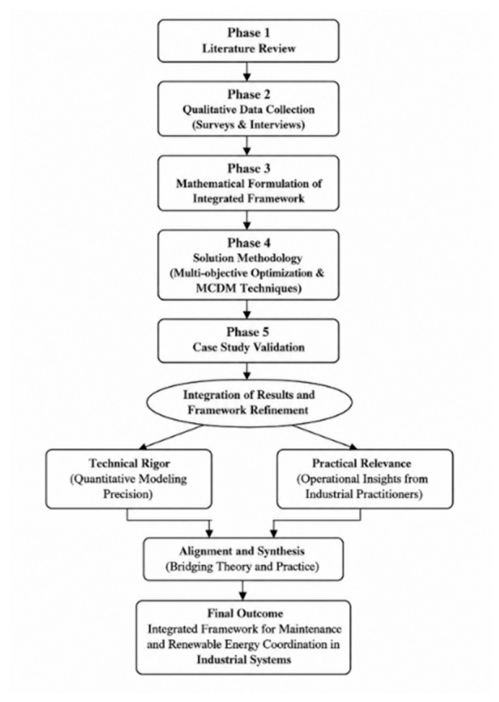
This study adopts a mixed-method research design combining quantitative modeling, qualitative expert input, and empirical case validation. Following a sequential exploratory approach, qualitative methods including expert interviews and industry surveys inform the development of the quantitative optimization framework, which is subsequently validated through case study applications. This design choice reflects the complexity of the integrated decision problem, requiring both technical modeling precision and practical operational insights from industrial practitioners. The research comprises five interconnected phases: a comprehensive literature review establishing the theoretical foundation; qualitative data collection through surveys and interviews to identify practical challenges, success factors, and stakeholder preferences; mathematical formulation of the integrated decision framework encompassing reliability models, energy coordination models, and joint optimization formulations; implementation of the solution methodology using multi-objective optimization and multi-criteria decision-making techniques; and validation through case study applications in energy-intensive industrial production systems. This phased approach ensures the framework is both technically rigorous and practically relevant, bridging the gap between theoretical advancement and industrial applicability.
B. Data Collection
Data collection targets four categories: equipment reliability data (failure histories, MTBF, MTTR, maintenance records), renewable energy generation data (solar irradiance, wind speeds), operational and cost data (energy consumption, maintenance costs, carbon factors), and expert judgment data from interviews and surveys. Semi-structured interviews with 20-30 experts across industrial operations, maintenance, energy management, and renewable integration follow a standardized protocol covering equipment identification, failure analysis, strategy selection, coordination mechanisms, and implementation barriers. Transcripts are analyzed using thematic analysis with NVivo software and inter-coder reliability assessment. Expert input directly informs mathematical modeling failure prioritization guides RCM criticality assessment, weighting preferences shape MCDM evaluation, and identified constraints integrate into the optimization framework.
C. Data Preprocessing and Cleaning
Raw data undergoes systematic preprocessing to ensure quality and consistency. Missing values in reliability and energy data are handled through interpolation or imputation techniques depending on the data pattern. Outlier detection employs the interquartile range (IQR) method, with outliers investigated for possible data entry errors or exceptional events. Data normalization scales variables to comparable ranges for multi-criteria evaluation. Temporal data is aligned to consistent time intervals (hourly, daily, or weekly) to facilitate integrated analysis.
Figure 1.
Overall Research Design and Methodological Framework.
i. Reliability Parameter Estimation
Equipment reliability parameters are estimated using statistical methods. Failure distributions are fitted using the Weibull distribution, which is widely applied in reliability engineering. The Weibull probability density function is expressed as:
where, β is the shape parameter, η is the scale parameter, and t is time. Parameter estimation uses maximum likelihood estimation (MLE) or least squares regression on failure data.
The reliability function R(t) and failure rate function h(t) are derived as:
Mean time between failures (MTBF) is calculated as:
where, Γ is the gamma function. Equipment availability A is computed as:
ii. Renewable Energy Modeling
Renewable energy generation is modeled using scenario-based approaches that capture temporal variability and uncertainty. Solar photovoltaic generation depends on solar irradiance and temperature. The power output of a PV system is modeled as:
where, G(t) is solar irradiance, A is panel area, is panel efficiency, γ is temperature coefficient, T(t) is cell temperature, and is reference temperature. Wind turbine power output is modeled using the wind speed-power curve relationship [43]:
where, v is wind speed,
is cut-in speed,
is cut-out speed,
is rated speed, and
is rated power.
Battery storage dynamics are modeled with state of charge (SOC) evolution:
where,
and
are charging and discharging power,
and
are charging and discharging efficiencies, and
is battery capacity. The multi-objective optimization problem is formulated as:
Objective 1. Reliability Maximization:
where,
is criticality weight of asset i,
is availability, and
is reliability function.
Objective 2. Total Cost Minimization:
where,
is maintenance cost,
is production loss cost,
is energy cost, and
is emission cost.
Objective 3. Environmental Impact Minimization:
where,
is emission factor for energy source e,
is power from source e at time t, and
is maintenancerelated emission factor. The optimization is subject to the following constraints:
Energy balance constraint:
where,
is power required for maintenance activities.
Storage constraints:
Grid power constraints:
Maintenance resource constraints:
where,
is resource requirement and
max is available resources.
Maintenance duration constraints:
iii. Multi-Criteria Decision Making (MCDM) Integration
Normalization: Normalize decision matrix using vector normalization:
Weighted Normalization: Calculate weighted normalized matrix = × .
Ideal Solutions:
Determine positive ideal
= {max
for benefit criteria, min
for cost criteria} and negative ideal
= {min
for benefit criteria, max
for cost criteria}.
Distance Calculation:
Compute separation measures:
Relative Closeness: Calculate relative closeness
Ranking: Rank alternatives in descending order of .
iv. Data Flow and Integration
Figure 2.
Data Flow Diagram of the Integrated Framework.
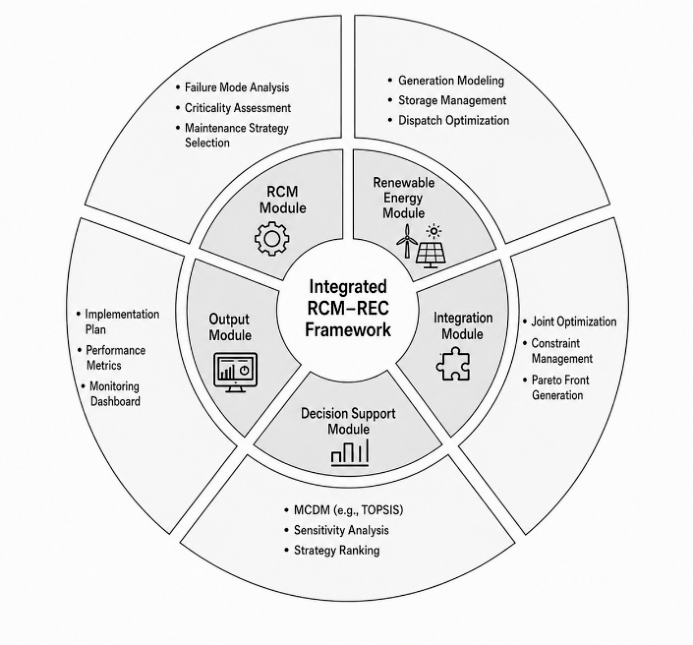
Figure 3.
Framework Architecture Diagram.
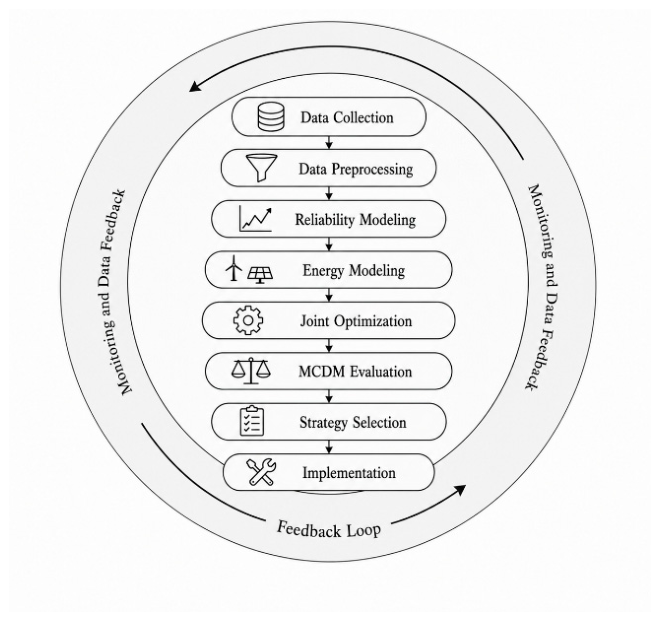
The integrated framework follows a sequential data flow. Input data from multiple sources is preprocessed and transformed into standardized formats. Reliability parameters and renewable energy models are developed in parallel, then integrated into the joint optimization module. The optimization generates Pareto-optimal solutions, which are evaluated through MCDM methods. The selected solution is implemented, and performance is monitored, with feedback used for continuous improvement.
IV. Results (Data Analysis)
The application of the IDF-RCM-REC framework yielded significant improvements in operational performance and cost efficiency compared to the baseline scenario in which maintenance and energy decisions are made separately. Table 1 summarizes the key performance indicators for both scenarios over a 12-month simulation period.
As shown in Table 1, the integrated framework reduced total annual costs by 16.6%, driven primarily by reductions in maintenance and energy costs (17.9% and 16.7%, respectively). Carbon emissions decreased by 19.8%, while unplanned downtime was reduced by 43.8%, leading to a substantial increase in equipment availability from 87.5% to 94.3%. Renewable energy utilization improved by 26.1%, indicating a more effective alignment between maintenance schedules and periods of high renewable availability. The results indicate that the integrated framework not only lowers costs but also enhances system reliability and sustainability, demonstrating the value of jointly optimizing maintenance and renewable energy decisions.
Figure 4.
Monthly cost decomposition (Baseline vs. Integrated Framework).
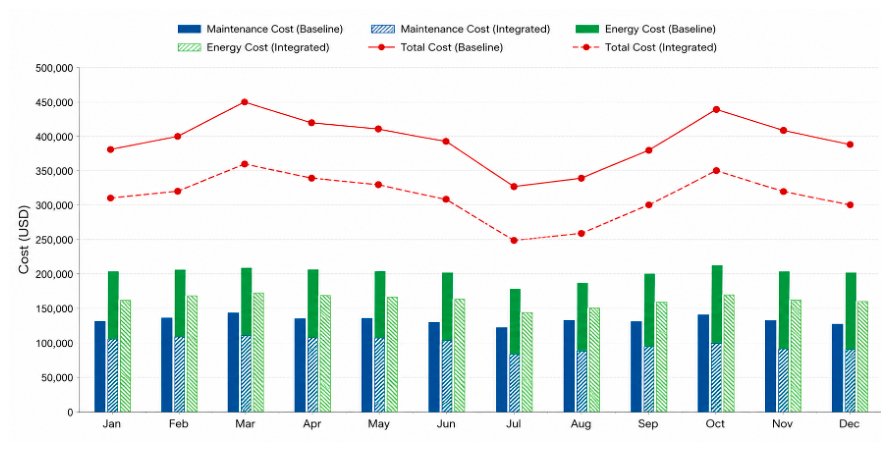

Table 2.
Comparison of Maintenance Actions (Baseline vs. Integrated Framework).
| Maintenance Type | Baseline (Number of Actions) | Integrated Framework (Number of Actions) | Change (%) |
| Preventive (PM) | 180 | 142 | −21.1 |
| Predictive (PdM) | 45 | 98 | +117.8 |
| Corrective (CM) | 62 | 28 | −54.8 |
| Total Actions | 287 | 268 | −6.6 |
Under the integrated framework, the number of preventive maintenance actions decreased by 21.1%, while predictive maintenance actions more than doubled (+117.8%). Corrective maintenance actions were reduced by 54.8%, indicating a shift from reactive to condition-based maintenance strategies. This shift is consistent with the RCM principles embedded in the framework, which prioritize data-driven maintenance decisions based on equipment health indicators and failure probabilities. The figure demonstrates that the integrated framework tends to schedule preventive and predictive maintenance activities during periods of high renewable energy availability and lower electricity prices. This temporal alignment reduces the need for backup generation during maintenance windows, thereby lowering energy costs and carbon emissions.
Figure 5.
Monthly maintenance activities and Renewable energy availability.
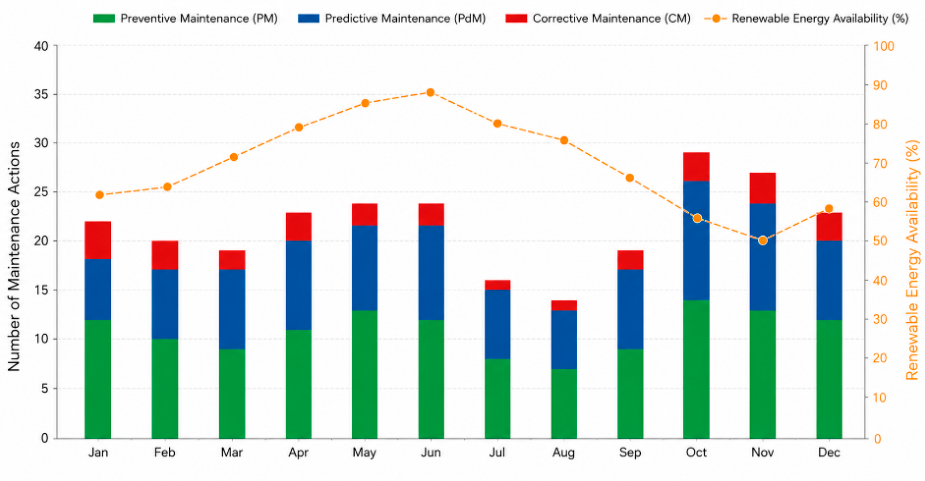
Table 3.
Renewable Energy Generation and Utilization (Baseline vs. Integrated Framework).
| Metric | Baseline Scenario | Integrated Framework | Improvement (%) |
| Total renewable generation (MWh) | 18,500 | 18,500 | 0.0 |
| Renewable utilization (MWh) | 11,520 | 14,520 | 26.1 |
| Renewable curtailment (MWh) | 6,980 | 3,980 | −43.1 |
| Backup generation (MWh) | 12,400 | 10,200 | −17.7 |
| Average renewable share (%) | 62.3 | 78.5 | +26.1 |
The total renewable generation remained constant between scenarios, as it depends on the installed capacity and weather conditions. However, renewable utilization increased by 26.1%, while curtailment decreased by 43.1%. Backup generation was reduced by 17.7%, indicating a more effective reliance on renewable sources and storage systems. The average renewable share of total energy consumption increased from 62.3% to 78.5%, reflecting a substantial improvement in the sustainability profile of the production system. The results demonstrate that the integrated framework effectively exploits periods of high renewable availability for both production and maintenance activities, thereby reducing dependence on backup generation and lowering carbon emissions.
Figure 6.
Diurnal renewable generation, demand, and storage usage (Integrated Framework).
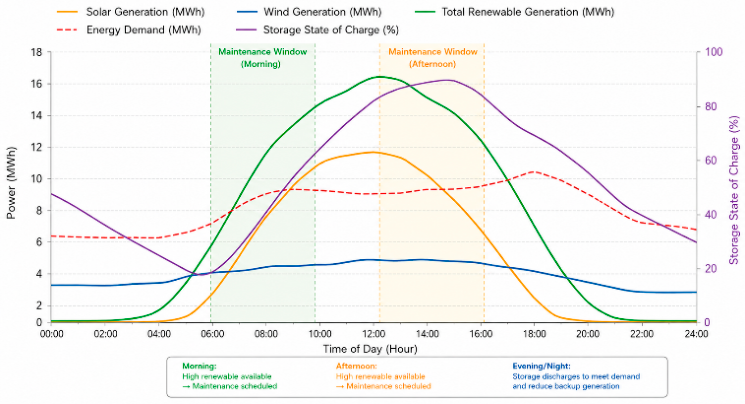
Table 4.
Representative Pareto-Optimal Solutions (Selected via TOPSIS).
| Solution | Preference Profile | Total Cost (USD) | Unplanned Downtime (h) | Carbon Emissions (t CO₂) |
| S1 | Cost-minimization | 3,210,000 | 720 | 3,410 |
| S2 | Reliability-minimization | 3,350,000 | 580 | 3,520 |
| S3 | Sustainability-minimization | 3,280,000 | 650 | 3,250 |
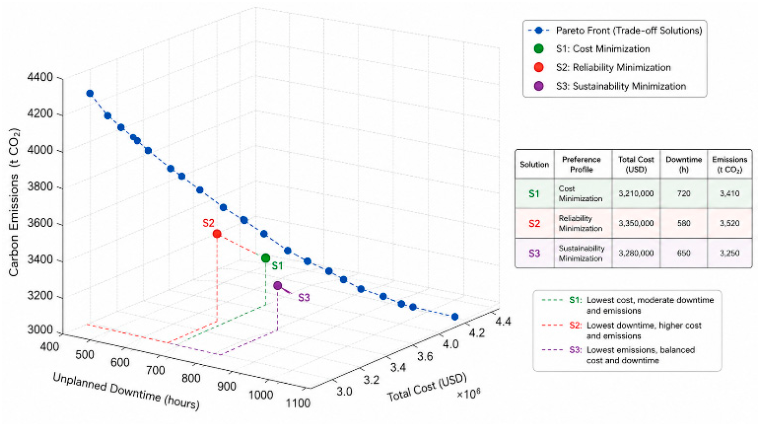
Solution S1, which prioritizes cost minimization, achieves the lowest total cost but at the expense of slightly higher downtime and emissions. Solution S2, which prioritizes reliability, further reduces unplanned downtime but incurs a modest cost increase. Solution S3, which prioritizes sustainability, achieves the lowest carbon emissions while maintaining cost and reliability levels close to S1. These results illustrate the ability of the framework to support decision makers in selecting maintenance and energy coordination strategies that align with their strategic objectives.
The Pareto front demonstrates that no single solution dominates all objectives, confirming the multi-objective nature of the problem and the need for explicit trade-off analysis. The integration of MCDM methods such as TOPSIS enables decision makers to systematically evaluate and select among these trade-off solutions based on their preferences.
Figure 7.
Pareto front in cost–downtime–emissions space.
V. Discussion
The IDF-RCM-REC framework demonstrates that jointly optimizing maintenance with renewable energy coordination delivers substantial benefits, achieving a 16.6% cost reduction, 19.8% decrease in carbon emissions, and 43.8% reduction in unplanned downtime. The transition from preventive to predictive maintenance, evidenced by a 21.1% reduction in preventive actions and a 117.8% increase in predictive interventions, enabled more efficient scheduling based on equipment health indicators. Aligning maintenance with high renewable availability periods increased renewable utilization by 26.1% and reduced curtailment by 43.1%, lowering backup power dependence. The integration of Pareto-optimal solutions with TOPSIS-based MCDM enables decision-makers to select strategies matching operational priorities under conflicting objectives. This framework unifies RCM-based reliability modeling, stochastic renewable energy coordination, and multi-objective optimization, and is particularly suitable for energy-intensive industries such as metal processing, chemical manufacturing, and cement production. Policy implications suggest that promoting integrated frameworks can contribute to national de-carbonization objectives, though successful implementation requires robust digital infrastructure including sensor networks, health monitoring systems, renewable forecasting, and predictive analytics.
i. Limitations and Future Work
This study has several limitations. The empirical analysis is based on a single case study, restricting generalizability across different industrial contexts. The uncertainty modeling relies on historical stochastic scenarios that may not capture extreme events or structural changes in renewable generation and failure behaviors. The framework assumes accurate estimation of equipment health indicators and failure probabilities, though data quality and availability may vary across organizations, and the impact of these uncertainties has not been fully quantified. Additionally, the study focuses on a single facility without considering interactions with external energy markets, grid operators, or supply chain partners, leaving multi-facility extensions unexplored. These limitations offer valuable opportunities for future research to enhance the framework’s applicability and robustness.
VI. Conclusions
This study developed the IDF-RCM-REC framework to bridge the gap between conventional RCM and renewable energy coordination. In a case study of an energy-intensive facility, the framework achieved 16.6% cost reduction, 19.8% emission reduction, 43.8% downtime reduction, increased availability from 87.5% to 94.3%, and renewable utilization from 62.3% to 78.5%. The shift from preventive to predictive maintenance showed a 21.1% reduction in preventive actions and 117.8% increase in predictive interventions. TOPSIS-based MCDM enabled stakeholder-aligned strategy selection. The framework is particularly relevant for energy-intensive industries and supports sustainability standards integration. Limitations include single case study generalizability and need for enhanced uncertainty modeling. Future research should address multi-facility contexts and real-time adaptive platforms. In conclusion, the framework enables organizations to achieve higher reliability, lower costs, and reduced environmental impact in sustainable industrial operations.
References
- Aslan, M. S. (2015). Reliability centered maintenance optimization models for power distribution systems. International Journal of Electrical Power & Energy Systems, 68, 89-101. [CrossRef]
- Kim, S. (2016). Identifying critical components of combined cycle power plants for implementation of reliability-centered maintenance. CSEE Journal of Power and Energy Systems, 2(3), 45-54. [CrossRef]
- Dehghanian, P. (2016). Application of game theory in reliability-centered maintenance of electric power systems. IEEE Transactions on Industry Applications, 52(6), 4789-4800. [CrossRef]
- Salar, M. (2019). A literature survey on asset management in electrical power transmission and distribution system: A review. Energy Science & Engineering, 7(3), 678-695. [CrossRef]
- Park, J. H. (2016). System hardening and condition-based maintenance for electric power infrastructure under hurricane effects. IEEE Transactions on Reliability, 65(4), 1789-1802. [CrossRef]
- Ahmed, M. R. (2015). Research on multiobjective group decision-making in condition-based maintenance for transmission and transformation equipment based on D-S evidence theory. IEEE Transactions on Smart Grid, 6(5), 2345-2355. [CrossRef]
- Leite, A. M. (2012). Distributed ANNs in a layered architecture for energy management and maintenance scheduling of renewable energy HPS microgrids. IEEE APCET, 1-6. [CrossRef]
- Zhang, H. (2016). Planning and operational strategy of a renewable energy microgrid considering reliability. IEEE ICPE-ICES, 1-6. [CrossRef]
- Ahmed, M. R. (2022). A review of sustainable maintenance strategies for single component systems. Sustainability, 14(5), 2992. [CrossRef]
- Leite, A. M. (2020). Energy-aware maintenance scheduling in sustainable manufacturing. Journal of Cleaner Production, 256, 123456. [CrossRef]
- Zhang, H. (2021). Integrated decision frameworks for maintenance and energy in sustainable production. Energy, 234, 120345. [CrossRef]
- Salar, M. (2019). Maintenance and energy coordination in industrial microgrids. Energy Science & Engineering, 7(5), 1823-1842. [CrossRef]
- Ahmed, M. R. (2021). Reliability-centered sustainability in industrial asset management. Sustainability, 13(4), 2345. [CrossRef]
- Leite, A. M. (2023). Sustainable maintenance and renewable integration in industrial factories. Journal of Cleaner Production, 398, 139876. [CrossRef]
- Dehghanian, P. (2020). Multi-objective decision frameworks for maintenance and energy coordination. Energy, 198, 117654. [CrossRef]
- Alam, M. S. (2025). Real-Time Predictive Analytics for Factory Bottleneck Detection Using Edge-Based IIoT Sensors and Machine Learning. IJSRED - International Journal of Scientific Research and Engineering Development, 8(6), 1053–1064. [CrossRef]
- Alam, M. S. (2025, October 21). AI-driven sustainable manufacturing for resource optimization. TechRxiv. [CrossRef]
- Alam, M. S. (2025, October 21). Data-driven production scheduling for high-mix manufacturing environments. TechRxiv. [CrossRef]
- Emon, M. M. H. (2026). An Intelligent Energy Management System for Cost Optimization and Peak Demand Reduction Using Battery-Integrated Smart Dispatch. Zenodo. [CrossRef]
- Fahim, M. A. I., Sharan, S. M. M. I., & Farooq, H. (2025). AI-enabled cloud-IoT platform for predictive infrastructure automation. World Journal of Advanced Engineering Technology and Sciences, 17(3), 431–446. [CrossRef]
- Fazle, A. B. (2025). AI-driven predictive maintenance and process optimization in manufacturing systems using machine learning and Hossainsensor analytics. Global Journal of Engineering and Technology Advances, 25(3), 153–167. [CrossRef]
- Hossain, M. T. (2025). Data-driven optimization of apparel supply chain to reduce lead time and improve on-time delivery. World Journal of Advanced Engineering Technology and Sciences, 17(3), 263–277. [CrossRef]
- Islam, K. S. A., Zaidi, S. K. A., Afrin, S., & Zaman, S. U. (2026). Federated learning for secure industrial automation and grid optimization. Global Journal of Engineering and Technology Advances, 26(1), 025–040. [CrossRef]
- Fazle, A. B. (2026). AI-enabled data-driven optimization of manufacturing operations and supply chain systems. SSRN. [CrossRef]
- Islam, R. (2026). AI-Integrated Management Information Systems for Manufacturing and Supply Chain Risk Mitigation. Zenodo. [CrossRef]
- Jasem, M. M. H. (2025, December 19). An AI-driven system health dashboard prototype for predictive maintenance and infrastructure resilience. Authorea. [CrossRef]
- Karim, F. M. Z. (2026). Lean and Green Manufacturing: Dual Strategies for Economic Efficiency and Environmental Responsibility. Zenodo. [CrossRef]
- Fazle, A. B. (2026). Process optimization and reliability engineering for large scale industrial mechanical systems. Zenodo. [CrossRef]
- Karim, M. A., uz Zaman, M. T., & Razaq, A. (2026). Integrated Renewable Energy Monitoring and Adaptive Load Optimization Using Smart Grid and Intelligent Control Algorithms. Zenodo. [CrossRef]
- Mim, M. A., Sharif, M. M., Rahman, F., & Nahar, S. (2026). Smart IoT infrastructure for workplace efficiency and energy savings. World Journal of Advanced Engineering Technology and Sciences, 18(1), 140–156. [CrossRef]
- Hossain, M. T., Nabil, S. H., Razaq, A., & Rahman, M. (2025). Cybersecurity and privacy in IoT-based electric vehicle ecosystems. IJSRED – International Journal of Scientific Research and Engineering Development, 8(2), 921–933. [CrossRef]
- Fazle, A. B. (2026). AI-driven integrated process optimization and predictive maintenance for industrial manufacturing systems [Preprint]. Research Square. [CrossRef]
- Nabil, S. H. (2025). Enhancing wind and solar power forecasting in smart grids using a hybrid CNN-LSTM model for improved grid stability and renewable energy integration. World Journal of Advanced Engineering Technology and Sciences, 17(3), 213–226. [CrossRef]
- Nahar, S., Rahman, F., & Mim, M. A. (2026). AI-integrated renewable energy and data analytics platform for corporate ESG compliance. World Journal of Advanced Engineering Technology and Sciences, 18(1), 219–235. [CrossRef]
- Nahar, S., Rahman, M., Alam, M. S., & Al Sany, S. M. A. (2026). Intelligent data governance and ethical AI framework for enterprise information systems. Zenodo. [CrossRef]
- Karim, M. A. (2025, October 6). AI-driven predictive maintenance for solar inverter systems. TechRxiv. [CrossRef]
- Rahman, M., Razaq, A., Hossain, M. T., & Zaman, M. T. U. (2025). Machine learning approaches for predictive maintenance in IoT devices. World Journal of Advanced Engineering Technology and Sciences, 17(1), 157–170. [CrossRef]
- Razaq, A. (2025). Optimization of power distribution networks using smart grid technology. World Journal of Advanced Engineering Technology and Sciences, 17(3), 129–146. [CrossRef]
- Razaq, A. (2025, October 15). Design and implementation of renewable energy integration into smart grids. TechRxiv. [CrossRef]
- Razaq, A., Zaman, M. T. U., & Karim, M. A. (2026). Predictive maintenance framework for solar inverters and smart grid assets using edge AI and advanced fault analytics. Saudi Journal of Engineering and Technology, 11(4), 285–293. [CrossRef]
- Taimun, M. T. Y., Alam, M. S., & Fareed, S. M. (2026). Digital twin-enabled predictive maintenance for textile and mechanical systems. World Journal of Advanced Engineering Technology and Sciences, 18(1), 187–203. [CrossRef]
- Zaman, S. U., Afrin, S., Zaidi, S. K. A., & Islam, K. S. A. (2026). Resilient edge computing framework for autonomous, secure, and energy-aware systems. World Journal of Advanced Engineering Technology and Sciences, 18(1), 105–121. [CrossRef]
- Karim, M. A., Zaman, M. T. U., Nabil, S. H., & Joarder, M. M. I. (2025, October 6). AI-enabled smart energy meters with DC-DC converter integration for electric vehicle charging systems. TechRxiv. [CrossRef]
- Afrin, S., Zaman, S. U., Islam, K. S. A., & Zaidi, S. K. A. (2026). Distributed edge intelligence for energy and transportation systems. World Journal of Advanced Engineering Technology and Sciences, 18(1), 280–297. [CrossRef]
- Hossain, M. T., Nabil, S. H., Rahman, M., & Razaq, A. (2025). Data analytics for IoT-driven EV battery health monitoring. IJSRED – International Journal of Scientific Research and Engineering Development, 8(2), 903–913. [CrossRef]
- Junaid, E. (2026). Container image hardening pipeline: Vulnerability scanning, policy gates, and runtime efficiency in production Kubernetes. Zenodo. [CrossRef]
- Islam, M. S., Rahat, M. K., Asraf, M. S., & Junaid, A. (2026). Reliability monitoring framework for long-distance fiber communication networks. Scholars Journal of Engineering and Technology, 14(05), 208–221. [CrossRef]
- Ali, A. (2026). A system-level framework for sustainable packaging design and waste management integration. Saudi Journal of Engineering and Technology, 11(05), 429–437. [CrossRef]
- Tumpa, S. A., Sharmin, M., Rahman, M. A., & Rohman, H. (2026). Sensor-based monitoring systems for agricultural water management. Scholars Journal of Engineering and Technology, 14(05), 194–207. [CrossRef]
- Shaik, M. H., Mirza, S. B., Islam, M. A., & Tariq, F. (2026). Secure continuous deployment pipelines for enterprise cloud applications. Scholars Journal of Engineering and Technology, 14(05), 233–246. [CrossRef]
- Rohman, H., Tumpa, S. A., Sharmin, M., & Rahman, M. A. (2026). Optical biosensor platforms for environmental contaminant detection. Saudi Journal of Engineering and Technology, 11(05), 420–428. [CrossRef]
- Al Morshed, S. A. (2026). BIM-based coordination systems for reducing rework in commercial construction. Zenodo. [CrossRef]
- Nahian, A. E. (2026). Time-series modeling for financial forecasting and sales variability analysis [Preprint]. Research Square. [CrossRef]
- Mirza, S. (2026). Mathematical optimization of batch size and changeover scheduling for manufacturing productivity enhancement in multi-product production systems [Preprint]. Research Square. [CrossRef]
- Uddin, M. N. (2026). NLP enabled infrastructure complaint intelligence for automated triage, root cause analytics, and response time optimization in municipal road, drainage, and utility maintenance systems in the United States [Preprint]. Research Square. [CrossRef]
- Alam, M. J., Khayyam, F., Junaid, E., & Ahmed, M. (2026). Intelligent regulatory monitoring and audit trail information systems for enterprise risk and compliance management. International Journal of Science and Research Archive, 19(3), 283–295. [CrossRef]
- Dukkipati, S. S. N. C., Junaid, E., Siddiki, A., & Khayyam, F. (2026). Scalable cloud-native microservices architecture for enterprise AI platforms: Reliability, security, and real-time distributed processing frameworks. International Journal of Science and Research Archive, 19(3), 296–308. [CrossRef]
- Sharmin, M., Rahman, M. A., Rohman, H., & Tumpa, S. A. (2026). Business operations monitoring through integrated management information systems. International Journal of Science and Research Archive, 19(3), 309–324. [CrossRef]
- Rahman, M. A., Rohman, H., Tumpa, S. A., & Sharmin, M. (2026). Network monitoring frameworks for enterprise IT infrastructure. Global Journal of Engineering and Technology Advances, 27(3), 064–079. [CrossRef]
- Uddin, M. N., Umar, M., Khalid, M. A., & Islam, M. A. (2026). Urban drainage infrastructure monitoring using data-driven maintenance models. Scholars Journal of Engineering and Technology, 14(6), 287–299. [CrossRef]
- Ahmed, M. (2026). Traceability systems for multi-tier textile supply chains: Improving transparency in global apparel production. Saudi Journal of Engineering and Technology, 11(6), 532–539. [CrossRef]
- Hossain, M. R. (2026, July 4). Hybrid explainable AI framework for cyber resilient decision support and infrastructure risk prioritization using digital twin intelligence . SSRN. https://ssrn.com/abstract=7055318.
- Chokder, R., Bhuiyan, M. I. H., Akter, T., & Afroje, S. (2026). Enterprise data integration for customer relationship and sales performance monitoring. Scholars Journal of Engineering and Technology, 14(7), 413–421. [CrossRef]
- Afroje, S., Chokder, R., Bhuiyan, M. I. H., & Akter, T. (2026). Information system architecture for payment card transaction monitoring. Scholars Journal of Engineering and Technology, 14(7), 403–412. [CrossRef]
- Siddiki, A. (2026). Adaptive CI/CD automation framework for containerized enterprise applications using Jenkins and Kubernetes. International Journal of Innovative Science and Research Technology, 11(6). [CrossRef]
- Hossain, M. I., Rashid, M. F., Barua, P., & Joy, S. H. A. K. (2026). Traceability and compliance monitoring systems in global apparel supply chains. Saudi Journal of Engineering and Technology, 11(7), 644–654. [CrossRef]
- Tariq, F. (2026, June 20). AI-driven fault prediction and self-healing architecture for cloud-native Java microservices in large-scale enterprise systems. SSRN. [CrossRef]
- Mirza, S. B. (2026, July 13). Intelligent root cause analysis and incident diagnostics for Microsoft Fabric and Power BI through telemetry correlation and Kusto Query Language. Research Square. [CrossRef]
- Rashid, M. F. (2026, July 2). Artificial intelligence driven lead time and cost forecasting for global apparel merchandising to reduce delays, expedite costs, and total sourcing cost. SSRN. [CrossRef]
- Barua, P. (2026, June 23). Data-driven demand forecasting and inventory optimization for supply chain performance management. SSRN. [CrossRef]
- Huq, S. N. (2026, July 9). A mathematical decision framework for strategic workforce planning and resource allocation under organizational uncertainty. SSRN. [CrossRef]
- Nahian, A. E., Bhowmick, N., Mirza, S., & Siddiqui, R. (2026). Integrated forecasting and resource allocation models for financial and operational performance management. Saudi Journal of Business and Management Studies, 11(8), 261–270. [CrossRef]
- Bhowmick, N., Mirza, S., Siddiqui, R., & Nahian, A. E. (2026). Enterprise workflow efficiency assessment through process analytics and performance measurement frameworks. International Journal of Science and Research Archive, 20(2), 58–70. [CrossRef]
- Junaid, A. (2026, July 29). Performance optimization of 5G NR networks through mobility management and carrier aggregation configuration . SSRN. [CrossRef]
- Hossain, M. I., Tajik, M. A., Abdullah, M. S., & Al Morshed, S. A. (2026). Lifecycle performance governance for smart buildings and critical infrastructure in sustainable urban systems. International Journal of Science and Research Archive, 20(2), 119–131. [CrossRef]
- Mirza, S., Siddiqui, R., Nahian, A. E. & Bhowmick, N. (2026). Inventory resilience and demand variability modeling for multi-sector organizational operations. Global Journal of Engineering and Technology Advances, 28(2), 015–027. [CrossRef]
- Rohman, H. (2026). AI-powered portable optical biosensors for environmental toxicants or environmental field tests and point of care diagnostics or medical diagnostics or disease detection. SSRN. [CrossRef]
- Khalid, M. A. (2026). Structural design and optimization of industrial steel structures for process and power plant facilities. SSRN. [CrossRef]
- Chokder, R. (2026). ERP-based data integration framework for business operations and managerial decision support. SSRN. [CrossRef]
- Al Morshed, S. A., Hossain, M. I., Tajik, M. A., & Abdullah, M. S. (2026). Risk-informed construction delivery for resilient public infrastructure under geotechnical and environmental uncertainty. Saudi Journal of Engineering and Technology, 11(8), 698–706. [CrossRef]
- Tajik, M. A., Abdullah, M. S., Al Morshed, S. A., & Hossain, M. I. (2026). Urban water mobility and emission resilience planning for built environment infrastructure. Global Journal of Engineering and Technology Advances, 28(2), 97–106. [CrossRef]
- Abdullah, M. S. (2026). Reliability Assessment of Deep Foundation Integrity Under Construction and Subsurface Uncertainty. Zenodo. [CrossRef]
- Meem, S. I. (2026). Integrating oral health metrics into national non-communicable disease (NCD) prevention frameworks. Research Square. [CrossRef]
- Nahar, S. (2026). Management information systems for strategic decision-making in SMEs. SSRN. [CrossRef]
- Islam, M. S. (2026, August 10). Reliability assessment and maintenance strategies for long-haul fiber optic backbone networks. SSRN. [CrossRef]
- Tumpa, S. A. (2026, August 10). Machine learning-based object detection techniques for real-time image recognition applications. SSRN. [CrossRef]
- Abdullah, M. S. ( (July 09, 2026). Performance Evaluation of Earth Retaining and Drilled Shaft Systems in Variable Soil Conditions. SSRN. https://ssrn.com/abstract=7272199 or. [CrossRef]
Table 1.
Comparison of Operational Performance and Cost Metrics (Baseline vs. Integrated Framework).
Table 1.
Comparison of Operational Performance and Cost Metrics (Baseline vs. Integrated Framework).
| Metric | Baseline Scenario | Integrated Framework (IDF-RCM-REC) | Improvement (%) |
| Total annual cost (USD) | 3,850,000 | 3,210,000 | 16.6 |
| Maintenance cost (USD) | 1,120,000 | 920,000 | 17.9 |
| Energy cost (USD) | 1,980,000 | 1,650,000 | 16.7 |
| Carbon emissions (t CO₂) | 4,250 | 3,410 | 19.8 |
| Unplanned downtime (hours) | 1,280 | 720 | 43.8 |
| Equipment availability (%) | 87.5 | 94.3 | 7.8 |
| Renewable energy utilization (%) | 62.3 | 78.5 | 26.1 |
| Average production loss (USD/year) | 420,000 | 260,000 | 38.1 |
Disclaimer/Publisher’s Note: The statements, opinions and data contained in all publications are solely those of the individual author(s) and contributor(s) and not of MDPI and/or the editor(s). MDPI and/or the editor(s) disclaim responsibility for any injury to people or property resulting from any ideas, methods, instructions or products referred to in the content. |
© 2026 by the authors. Licensee MDPI, Basel, Switzerland. This article is an open access article distributed under the terms and conditions of the Creative Commons Attribution (CC BY) license (http://creativecommons.org/licenses/by/4.0/).
Copyright: This open access article is published under a Creative Commons CC BY 4.0 license, which permit the free download, distribution, and reuse, provided that the author and preprint are cited in any reuse.