
Submitted:
17 August 2026
Posted:
19 August 2026
You are already at the latest version
Abstract
Background and Objectives: Hyponatremia and renal dysfunction can accompany cardiac tamponade and may improve after pericardial drainage. We quantified paired changes in serum sodium, hyponatremia status, and serum creatinine in an expanded cohort and tested whether sodium and creatinine responses were associated at the patient level. Materials and Methods: This single-center retrospective cohort included 48 adults who underwent percutaneous drainage for clinically diagnosed cardiac tamponade from 2010 to 2023. Sodium and creatinine were recorded within 2 days before and 5 days after drainage. Paired changes were assessed using Wilcoxon signed-rank tests and Hodges–Lehmann estimates, hyponatremia transitions using exact McNemar testing, and the association between continuous changes using Spearman correlation. Results: Thirty-four patients (70.8%) had malignant effusions. Median sodium rose from 136.0 to 138.5 mmol/L; the estimated paired shift was +3.5 mmol/L (95% CI +2.0 to +5.5; p < 0.001). Hyponatremia decreased from 18/48 (37.5%) to 6/48 (12.5%), an absolute paired reduction of 25.0 percentage points (95% CI 10.4–39.6; p = 0.004). Median creatinine fell from 76.0 to 70.5 µmol/L; the estimated paired shift was −9.0 µmol/L (95% CI −15.5 to −3.0; p = 0.004). Sodium and creatinine changes were not associated (Spearman ρ = 0.066, 95% CI −0.264 to +0.393; p = 0.656). Conclusions: Pericardial drainage was followed by a robust rise in serum sodium, fewer patients with hyponatremia, and a modest fall in serum creatinine. The two changes did not covary across patients and should be interpreted as parallel, heterogeneous postdrainage responses rather than evidence of a shared mechanism or reversal of formally defined acute kidney injury.
Keywords:
cardiac tamponade
; pericardial drainage
; hyponatremia
; serum sodium
; serum creatinine
; retrospective cohort
1. Introduction
Cardiac tamponade is a hemodynamic syndrome in which rising pericardial pressure impairs cardiac filling; its clinical expression depends on the rate of fluid accumulation and pericardial compliance as well as effusion volume [1,2]. Hyponatremia has been reported in 54%–65% of patients in two single-center cohorts and often improves after drainage, particularly when present at baseline [3,4]. Case reports describe the same phenomenon [5,6]. Proposed mechanisms include non-osmotic vasopressin release in response to low effective arterial filling and impaired free-water excretion.
Renal dysfunction can also occur in tamponade. In a recent 95-patient series, estimated glomerular filtration rate improved in 58.9% after pericardiocentesis, and the response was related to preprocedural hemodynamics [8]. Earlier evidence consisted largely of case reports [9]. However, cohort-level improvement in both sodium and creatinine does not establish that the responses covary within individual patients.
The two laboratory responses are physiologically plausible but need not share the same magnitude or time course. Low effective arterial filling may promote vasopressin-mediated water retention, whereas venous congestion and impaired renal perfusion can influence creatinine. Pericardial decompression also changes atrial pressure, sympathetic activity, and natriuretic peptide signaling [10,11,12,13]. A patient-level analysis is therefore required to distinguish concurrent cohort trends from a true coupled response.
Our group previously reported 23 patients treated from 2010 to 2016 and suggested an association between the direction of sodium and creatinine changes [7]. The present database extends observation through 2023 and includes patients from the earlier institutional series; it is therefore an expanded reanalysis rather than an independent replication. We aimed to estimate paired changes in serum sodium, hyponatremia status, and serum creatinine after drainage and to test their patient-level association using appropriate paired and correlation methods.
2. Materials and Methods
2.1. Study Design and Participants
We conducted a retrospective cohort study in a tertiary referral center. Records from 2010 through 2023 were identified using ICD-10-AM version 6 codes I30, I31, and I32 and the institutional cytology database for pericardial fluid samples. The report follows STROBE guidance [15].
Eligible adults had a clinical diagnosis of cardiac tamponade and underwent ultrasonography-guided percutaneous pericardial drainage. Diagnosis was based on the integrated clinical, radiographic, and echocardiographic record. Source descriptions of right atrial or right ventricular compression were classified as definite, equivocal (including “suspected”), or absent/not documented. The primary analysis retained the clinically diagnosed cohort; a post hoc sensitivity analysis was restricted to definite chamber compression.
One predrainage sodium and creatinine measurement within 2 days before the procedure and one postdrainage measurement within 5 days were required. The source protocol specified exclusion for incomplete paired laboratory data, drainage of <100 mL, and treatment directed at hyponatremia, including diuretics. Benign etiologies required at least 2 years of follow-up.
The final analytic file contained one row per participant and no missing values for the four primary laboratory measurements. Age, sex, paired sodium and creatinine values, and evacuated volume were reconciled against the source workbook. Eligibility, outcome derivations, and echocardiographic classification were checked at participant level before the analytic file was frozen.
2.2. Outcomes
The primary outcome was within-patient change in serum sodium after drainage. Key secondary outcomes were transition in hyponatremia status, defined as serum sodium <135 mmol/L, and within-patient change in serum creatinine. The association analysis tested the relationship between continuous sodium and creatinine changes, each calculated as postdrainage minus predrainage. Historical baseline creatinine and urine-output data were not consistently available; because these are required for formal KDIGO acute kidney injury classification [14], outcomes are described as serum creatinine changes rather than acute kidney injury or acute renal failure.
2.3. Statistical Analysis
Continuous variables are summarized as medians with Tukey-hinge interquartile ranges (IQRs), and categorical variables as counts and percentages. Paired continuous outcomes were compared using two-sided Wilcoxon signed-rank tests. We report the median within-patient change, paired Hodges–Lehmann shift, and a 95% percentile confidence interval (CI) from 20,000 paired nonparametric bootstrap resamples. Hyponatremia transitions were assessed using the exact McNemar test; the paired absolute reduction and bootstrap 95% CI are reported. The association between sodium and creatinine changes was quantified using Spearman correlation with a bootstrap 95% CI. As a secondary directional check, nonzero changes were cross-tabulated and assessed using Fisher’s exact test. Exploratory etiology analyses used Mann–Whitney testing and robust HC3 linear regression of the postdrainage value on its baseline value and benign versus malignant etiology. Associations with evacuated volume used Spearman correlation with Holm correction for the two outcomes. Leave-one-out and definite-compression analyses evaluated robustness. All tests were two-sided; exploratory analyses were not used for confirmatory claims. Analyses used Python 3.12, pandas 2.2.3, and SciPy 1.17.
2.4. Ethics
The institutional review board of the University Clinic of Respiratory and Allergic Diseases Golnik approved the study (3/2025) and waived written informed consent because of the retrospective design and anonymized analysis. The study was conducted in accordance with the Declaration of Helsinki.
3. Results
3.1. Cohort and Paired Outcomes
Fifty-nine records were identified, and 11 did not meet the source-protocol criteria, leaving 48 participants with complete paired sodium and creatinine measurements. Median age was 64.0 years (IQR 57.0–70.5), 24 participants (50.0%) were men, and 34 (70.8%) had malignant effusions. Median evacuated volume was 1100 mL (IQR 775–1525). Chamber compression was definite in 37, equivocal in 10, and absent or undocumented in 1 participant (Table 1).
Median serum sodium increased from 136.0 mmol/L (IQR 131.5–138.5) before drainage to 138.5 mmol/L (IQR 135.5–142.0) after drainage. The median within-patient change was +3.0 mmol/L (IQR +1.0 to +6.0), and the paired Hodges–Lehmann shift was +3.5 mmol/L (95% CI +2.0 to +5.5; p < 0.001; Figure 1A). Sodium increased in 37 patients, was unchanged in 2, and decreased in 9.
Hyponatremia was present in 18/48 (37.5%) before drainage and 6/48 (12.5%) after drainage. Fourteen participants changed from hyponatremia to normal sodium, 4 remained hyponatremic, 28 remained normonatremic, and 2 newly developed hyponatremia. The paired absolute reduction was 25.0 percentage points (95% CI 10.4–39.6; exact McNemar p = 0.004).
Median serum creatinine decreased from 76.0 µmol/L (IQR 64.5–98.5) to 70.5 µmol/L (IQR 59.5–87.5). The median within-patient change was −7.5 µmol/L (IQR −22.5 to +3.5), and the paired Hodges–Lehmann shift was −9.0 µmol/L (95% CI −15.5 to −3.0; p = 0.004; Figure 1B). Creatinine decreased in 33 patients, was unchanged in 2, and increased in 13.
3.2. Association and Sensitivity Analyses
Continuous sodium and creatinine changes were not associated (Spearman ρ = 0.066, 95% CI −0.264 to +0.393; p = 0.656; Figure 1C). Among 44 participants with nonzero changes in both variables, 24 had a sodium increase with a creatinine decrease, 11 had increases in both, 7 had decreases in both, and 2 had a sodium decrease with a creatinine increase. Change directions were not associated (Fisher p = 0.703). Thus, the common direction of the cohort medians did not translate into patient-level coupling.
Exploratorily, the sodium increase was larger in benign than malignant effusions (median +5.5 versus +2.0 mmol/L; unadjusted p = 0.006). After adjustment for baseline sodium, benign etiology was associated with a 3.1 mmol/L higher postdrainage sodium concentration (95% CI +0.8 to +5.5; p = 0.010). There was no evidence of an etiology difference in creatinine change (unadjusted p = 0.865; baseline-adjusted difference +14.3 µmol/L, 95% CI −3.2 to +31.7; p = 0.107). Evacuated volume was not associated with sodium change (ρ = 0.138; Holm-adjusted p = 0.700) or creatinine change (ρ = 0.008; Holm-adjusted p = 0.954). These analyses were hypothesis-generating.
In the 37 participants with definite chamber compression, the paired sodium shift was +3.0 mmol/L (95% CI +1.5 to +5.5; p < 0.001), and the creatinine shift was −9.5 µmol/L (95% CI −17.5 to −2.5; p = 0.014). Hyponatremia decreased from 13/37 (35.1%) to 6/37 (16.2%); the exact McNemar p value was 0.065. Leave-one-out analyses retained statistically significant sodium and creatinine findings after removal of any single participant.
4. Discussion
This expanded 48-patient cohort yielded three principal findings. First, pericardial drainage was followed by a clear rise in serum sodium and a 25-percentage-point paired reduction in hyponatremia. Second, serum creatinine fell modestly but consistently. Third, the sodium and creatinine changes were not associated across individuals. The data therefore support two parallel, heterogeneous postdrainage responses, not a shared patient-level response.
Baseline hyponatremia prevalence (37.5%) was lower than the 54.2% reported by Chang et al. and the 65% reported by Jong et al. [3,4]. Differences in case mix, malignancy prevalence, laboratory timing, and tamponade definitions may contribute. Our paired transition analysis adds information that unpaired proportions do not provide: 14 patients normalized their sodium concentration, whereas 2 newly developed hyponatremia. This heterogeneity argues against assuming spontaneous correction in every patient.
The sodium finding was not limited to a small shift in a summary statistic: 14 of 18 initially hyponatremic participants crossed the prespecified 135 mmol/L threshold, while only 2 participants crossed in the opposite direction. Nevertheless, threshold crossing is sensitive to baseline proximity to the cutoff and regression to the mean. The result supports postdrainage electrolyte monitoring but, without a control group and complete treatment records, cannot establish drainage as the sole reason for normalization.
The creatinine result is consistent with the larger series by Shmueli et al., in which 58.9% of patients improved estimated glomerular filtration rate after pericardiocentesis [8]. Our data cannot determine acute kidney injury incidence because a reliable historical baseline and urine output were unavailable. Postprocedure creatinine may reflect changes in renal perfusion, venous congestion, fluid balance, creatinine production, and dilution; it should not be equated with reversal of formally defined acute kidney injury.
The null association analysis materially changes the interpretation of the earlier institutional report [7]. That report compared one of four directional categories with an assumed binomial probability of 0.25, which does not test association between two paired continuous changes. In the expanded cohort, both continuous correlation and categorical direction analyses were null. A rise in the cohort median sodium and a fall in median creatinine can therefore be described as concurrent responses, but not as evidence that patients with the largest sodium correction also have the largest creatinine improvement.
Several physiological pathways could produce incompletely coupled responses. Reduced effective arterial filling can stimulate non-osmotic vasopressin release and water retention [10]. Experimental tamponade activates renal sympathetic antinatriuresis [11], whereas decompression alters transmural atrial pressure and natriuretic peptide signaling [12,13]. Renal perfusion and venous pressure may affect creatinine independently. The wide confidence interval around the correlation means that modest positive or negative relationships remain compatible with these data, but a strong monotonic association is unsupported.
The larger sodium response in benign effusions is also hypothesis-generating. Malignancy may introduce persistent drivers of hyponatremia, including tumor-related vasopressin secretion, medication effects, nausea, and reduced solute intake. Conversely, the benign subgroup contained only 14 patients, multiple exploratory comparisons were performed, and residual confounding is likely. This result should not guide treatment or prognostication without external confirmation. The absence of a volume–response relationship is compatible with tamponade physiology, which depends on the rate of accumulation and the pericardial pressure–volume relation rather than drained volume alone.
The current cohort includes patients from the 2018 institutional series and must be interpreted as an expanded reanalysis, not an independent replication. Its added contribution is the longer observation period, more than doubled sample size, paired effect estimates with confidence intervals, formal patient-level hyponatremia transitions, sensitivity analysis using a stricter echocardiographic definition, and correction of the previous association claim.
Methodological strengths include complete paired primary laboratory data, source-row reconciliation, effect estimates with confidence intervals, a patient-level transition analysis for hyponatremia, direct testing of the continuous association, and sensitivity analyses addressing uncertain echocardiographic classification and individual influential observations. These measures improve inference from a small retrospective dataset but do not remove the underlying design limitations.
Limitations include the retrospective, uncontrolled, single-center design; selection and referral bias; and broad laboratory windows. Only 37 of 48 participants had definite chamber compression in the recorded echocardiographic description. Historical creatinine, urine output, estimated glomerular filtration rate, hemodynamics, and neurohormones were not available. The cohort was predominantly malignant, and the sample was too small for reliable etiologic or mechanistic subgroup inference. These limitations preclude causal attribution to drainage.
A prospective multicenter study should prespecify blood-sampling times; record intravenous fluids, diuretics, urine output, and other cointerventions; obtain a reliable historical creatinine baseline; and pair laboratory changes with hemodynamic and neurohormonal measurements. Such a design could determine the time course of sodium and creatinine responses, distinguish decompression from concurrent treatment effects, and test whether clinically defined subgroups show reproducible differences.
5. Conclusions
Pericardial drainage for clinically diagnosed cardiac tamponade was followed by a robust increase in serum sodium, fewer patients with hyponatremia, and a modest decrease in serum creatinine. Sodium and creatinine changes did not covary across patients. These observations support parallel but heterogeneous postdrainage responses and do not establish a shared mechanism, causality, or reversal of formally defined acute kidney injury.
Author Contributions
Conceptualization, A.R.; methodology, A.R. and B.R.; formal analysis, A.R.; investigation, A.R. and V.D.; data curation, A.R. and V.D.; writing—original draft preparation, A.R.; writing—review and editing, A.R., V.D., and B.R.; visualization, A.R.; supervision, B.R.; project administration, A.R. All authors have read and agreed to the published version of the manuscript.
Funding
This research received no external funding.
Institutional Review Board Statement
The study was conducted in accordance with the Declaration of Helsinki and approved by the institutional review board of the University Clinic of Respiratory and Allergic Diseases Golnik (protocol 3/2025).
Informed Consent Statement
Patient consent was waived because of the retrospective design and anonymized analysis.
Data Availability Statement
A pseudonymized analytic dataset sufficient to reproduce the reported analyses may be made available by the corresponding author on reasonable request and subject to institutional and ethical restrictions.
Artificial Intelligence Statement
Generative artificial intelligence tools developed by OpenAI (ChatGPT and Codex, accessed in July 2026) were used for language editing and to assist with drafting reproducible statistical code. The authors reviewed the source data, verified all analyses and references, revised the text, and take full responsibility for the manuscript.
Conflicts of Interest
The authors declare no conflicts of interest.
References
- Schulz-Menger, J.; Collini, V.; Gröschel, J.; Adler, Y.; Brucato, A.; Christian, V.; et al. 2025 ESC Guidelines for the management of myocarditis and pericarditis. Eur. Heart J. 2025, 46, 3952–4041. [CrossRef]
- Spodick, D.H. Acute cardiac tamponade. N. Engl. J. Med. 2003, 349, 684–690. [CrossRef]
- Chang, F.K.; Lee, Y.C.; Chiu, C.H. Hyponatremia in patients with symptomatic pericardial effusion. J. Chin. Med. Assoc. 2012, 75, 509–512. [CrossRef]
- Jong, B.H.; Wei, C.C.; Shyu, K.G. Improved hyponatremia after pericardial drainage in patients suffering from cardiac tamponade. BMC Cardiovasc. Disord. 2016, 16, 135. [CrossRef]
- Shafique, R.; Sarwar, S.; Wall, B.M.; Cooke, C.R. Reversible hyponatremia related to pericardial tamponade. Am. J. Kidney Dis. 2007, 50, 336–341. [CrossRef]
- Hanfy, A.A.; Manasewitsch, N.T.; Beutler, B.D.; Antwi-Amoabeng, D.; Elnaggar, M.; Awad, M.; et al. Pericardial effusion-associated hyponatremia. Case Rep. Cardiol. 2020, 2020, 8847666. [CrossRef]
- Rozman, A.; Dimitric, V.; Adamic, K.; Marc Malovrh, M.; Selb, J. Reversible hyponatremia and acute renal failure in cardiac tamponade. Clin. Surg. 2018, 3, 2101. [CrossRef]
- Shmueli, H.; Shah, M.; Patel, Y.; Nguyen, L.C.; Hardy, H.; Rader, F.; et al. Effects of pericardiocentesis on renal function and cardiac hemodynamics. Echocardiography 2024, 41, e15764. [CrossRef]
- Phadke, G.; Whaley-Connell, A.; Dalal, P.; Markley, J.; Rich, A. Acute cardiac tamponade: An unusual cause of acute renal failure. Cardiorenal Med. 2012, 2, 83–86. [CrossRef]
- Groves, P.H.; Shah, A.M.; Hutchison, S.J. Hyponatraemia secondary to an inappropriately high release of antidiuretic hormone in cardiac tamponade. Br. Heart J. 1990, 64, 206–207. [CrossRef]
- Osborn, J.L.; Lawton, M.T. Neurogenic antinatriuresis during development of acute cardiac tamponade. Am. J. Physiol. 1986, 250, H195–H201. [CrossRef]
- Stokhof, A.A.; Overduin, L.M.; Mol, J.A.; Rijnberk, A. Effect of pericardiocentesis on circulating concentrations of atrial natriuretic hormone and arginine vasopressin in dogs with spontaneous pericardial effusion. Eur. J. Endocrinol. 1994, 130, 357–360. [CrossRef]
- de Groote, P.; Millaire, A.; Vantyghem, M.C.; Dalmas, S.; Racadot, A.; Wurtz, A.; et al. Response of atrial natriuretic factor to surgical pericardial drainage in patients with chronic pericardial effusion. Int. J. Cardiol. 1994, 46, 15–22. [CrossRef]
- Kidney Disease: Improving Global Outcomes (KDIGO) Acute Kidney Injury Work Group. KDIGO clinical practice guideline for acute kidney injury. Kidney Int. Suppl. 2012, 2, 1–138.
- von Elm, E.; Altman, D.G.; Egger, M.; Pocock, S.J.; Gøtzsche, P.C.; Vandenbroucke, J.P.; STROBE Initiative. The Strengthening the Reporting of Observational Studies in Epidemiology (STROBE) statement: Guidelines for reporting observational studies. Lancet 2007, 370, 1453–1457. [CrossRef]
Figure 1.
Paired serum sodium (A) and serum creatinine (B) concentrations before and after pericardial drainage, and the association between within-patient changes (C). In A and B, each line represents one participant and thick vertical bars show the median and interquartile range. Change was defined as the postdrainage minus predrainage value. P values in A and B are from two-sided Wilcoxon signed-rank tests; panel C reports Spearman rank correlation.
Figure 1.
Paired serum sodium (A) and serum creatinine (B) concentrations before and after pericardial drainage, and the association between within-patient changes (C). In A and B, each line represents one participant and thick vertical bars show the median and interquartile range. Change was defined as the postdrainage minus predrainage value. P values in A and B are from two-sided Wilcoxon signed-rank tests; panel C reports Spearman rank correlation.
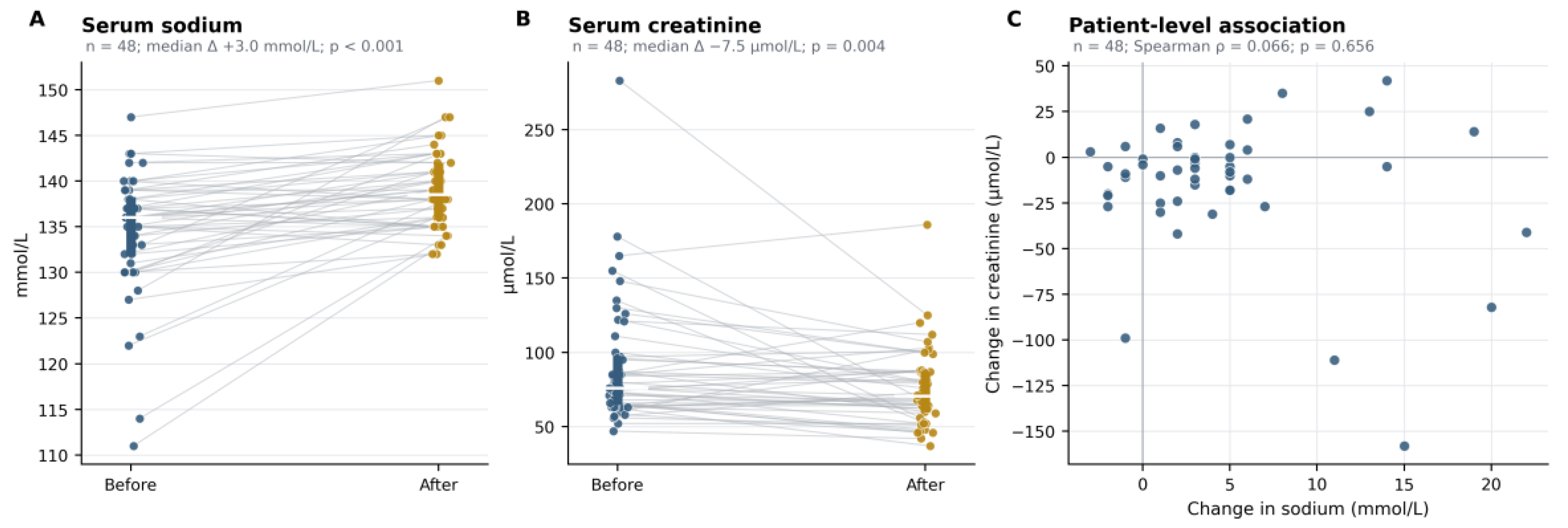

Table 1.
Cohort characteristics and paired laboratory outcomes after pericardial drainage.
| Characteristic or outcome | Cohort value | Before drainage | After drainage | Paired effect (95% CI); p value |
| Age, years | 64.0 (57.0–70.5) | |||
| Male sex | 24 (50.0%) | |||
| Malignant effusion | 34 (70.8%) | |||
| Evacuated volume, mL | 1100 (775–1525) | |||
| Chamber compression: definite/equivocal/absent or undocumented | 37/10/1 | |||
| Serum sodium, mmol/L | 136.0 (131.5–138.5) | 138.5 (135.5–142.0) | HL shift +3.5 (+2.0 to +5.5); p < 0.001 | |
| Hyponatremia, n (%) | 18 (37.5%) | 6 (12.5%) | Absolute reduction 25.0 pp (10.4–39.6); p = 0.004 | |
| Serum creatinine, µmol/L | 76.0 (64.5–98.5) | 70.5 (59.5–87.5) | HL shift −9.0 (−15.5 to −3.0); p = 0.004 |
Values are median (IQR) unless stated otherwise. CI, confidence interval; HL, Hodges–Lehmann; IQR, interquartile range; pp, percentage points. Wilcoxon signed-rank tests were used for continuous outcomes and the exact McNemar test for hyponatremia.
Disclaimer/Publisher’s Note: The statements, opinions and data contained in all publications are solely those of the individual author(s) and contributor(s) and not of MDPI and/or the editor(s). MDPI and/or the editor(s) disclaim responsibility for any injury to people or property resulting from any ideas, methods, instructions or products referred to in the content. |
© 2026 by the authors. Licensee MDPI, Basel, Switzerland. This article is an open access article distributed under the terms and conditions of the Creative Commons Attribution (CC BY) license (http://creativecommons.org/licenses/by/4.0/).
Copyright: This open access article is published under a Creative Commons CC BY 4.0 license, which permit the free download, distribution, and reuse, provided that the author and preprint are cited in any reuse.