

Submitted:
17 August 2026
Posted:
19 August 2026
You are already at the latest version
Abstract
University students’ adoption of generative artificial intelligence has become nearly universal, yet institutional guidance has not kept pace, leaving responsible use dependent on students’ own self-regulation. Drawing on social cognitive theory, this study tested whether self-regulated learning mediates the effect of AI literacy on the responsible use of generative AI, and how technostress influences that process. A cross-sectional survey of 820 Peruvian undergraduates from public and private universities was analyzed using covariance-based structural equation modeling; a two-stage moderated mediation model with latent interactions was estimated using latent moderated structural equations. Measurement invariance held across gender and university type, and common method variance was negligible. AI literacy predicted self-regulated learning (β = .626) and responsible use (β = .243), and self-regulated learning predicted responsible use (β = .445). The indirect effect was significant, β = .278, 95% CI [.226, .337], accounting for 53.4% of the total effect. Technostress did not moderate either the first stage or the direct path, but it significantly attenuated the second stage (b₂ = −.211, p < .001): the conditional indirect effect fell from .344 to .111 across moderator levels and ceased to differ from zero above 1.40 SD. Technostress does not prevent students from acquiring self-regulation; it prevents them from putting it into practice.
Keywords:
AI literacy
; responsible use of generative AI
; self-regulated learning
; technostress
; moderated mediation
; higher education
; Peru
1. Introduction
The adoption of generative artificial intelligence among college students went from being used by a minority to nearly universal in three years. The Higher Education Policy Institute’s annual series reports that the proportion of British students using it in graded assignments rose from 53% in 2024 to 88% in 2025 and to 94% in 2026, based on samples of over 1,000 cases in each measurement (Freeman, 2025; Stephenson and Armstrong, 2026). In Latin America, the scale is comparable: a survey of 22,941 students from 29 institutions in twelve countries, including Peru, found that 92 % actively use these tools, and 67% do so daily or weekly (Digital Education Council, 2026). What failed to keep pace with this trend was the institutional framework. In the same 2026 British survey, only 36% of students feel encouraged by their university to use generative AI, and just 38% report that their institution provides it to them. The relevant question for university policy is no longer whether students will use it, but what ensures they use it responsibly when no one has explained how to them.
This gap is particularly evident in Peru. In 2021, approximately 1.3 million students attended 92 accredited universities in Peru. As of the third quarter of 2025, 95.8% of Peruvians aged 19 to 24 were internet users, the highest rate among all age groups (Sunedu, 2021; National Institute of Statistics and Informatics, 2025). Although they had internet access, no specific guidelines were provided. Montoya-Cantoral et al. (2023) noted a lack of Peruvian university regulations regarding the use of intellectual property and artificial intelligence (AI). At a public university in Peru’s Andean region, Oré Gálvez et al. (2026) demonstrated how a lack of regulation leads to a discrepancy between the use of AI that students acknowledge privately and the use of AI that they are permitted to engage in. Thus, students control their own visibility regarding AI use, as they are unsure of what constitutes acceptable AI use in the eyes of faculty. In the absence of regulation, the responsible use of AI is no longer an obligation, but rather something students can control.
This study examines this shift toward self-regulation. Social cognitive theory holds that behavior does not automatically follow from competence: self-observation, evaluation against personal standards, and subsequent adjustment mediate the gap between knowing and acting (Bandura, 1986, 1991), processes that, in the academic domain, are organized within Zimmerman’s (2000) cycle of anticipation, execution, and self-reflection. Applied to this case, artificial intelligence literacy, understood as the ability to recognize, use, evaluate, and ethically assess these systems (B. Wang et al., 2023), would be the enabling competency; self-regulated learning is the mechanism that transforms this into responsible use that is, adherence to academic rules, verification of generated content, and transparent attribution of authorship (Chan, 2023; UNESCO, 2023). There is evidence at both ends of this continuum. A three-level meta-analysis of 95 effect sizes from 28 studies confirms that AI interventions improve self-regulation (J. Wu et al., 2026), and a quasi-experiment showed that explicit metacognitive support enhances task strategy and self-assessment in generative environments, while its absence impairs them (Xu et al., 2025). The intermediate link is missing. No one has verified that self-regulation effectively translates competence into behavior.
Nor does the chain operate in an emotional vacuum. Technostress, defined within the theory of person-environment mismatch as the tension that arises when technological demands exceed available capacities or when the resources provided do not meet the user’s needs (Edwards et al., 1998; Ragu-Nathan et al., 2008), consumes the very cognitive resources that self-regulation needs to sustain itself. Resource conservation theory predicts that, when faced with the threat of loss, people protect their reserves and cut back on investment in costly activities (Hobfoll, 1989). Generating an output and declaring its use are costly activities. The available evidence on technostress and AI in higher education is scarce and inconsistent: among 649 Chinese students, techno stressors related to generative AI affected learning performance through self-efficacy, with varying patterns depending on the stressor (Yang, and Tang, 2026); among 876 pre-service teachers at twelve Peruvian universities, stress mediated the relationship between academic overload and the use of AI models (Acosta-Enriquez et al., 2025b).
The gap addressed by this study is best understood by examining what Peruvian research has accomplished and what remains to be done. The available studies establish bivariate associations or single-path models: academic self-efficacy is inversely correlated with AI dependence among 186 students (Estrada-Araoz et al., 2025); self-efficacy and anxiety predict that dependence among 528 students (Morales-García et al., 2025); attitudes toward AI influence academic ethics among 406 students at six universities (Espinoza Vidaurre et al., 2025); digital competencies and AI use predict engagement among 372 university students in Lima, with a negative correlation for AI use (Flores Huamancuri and Jaimes Marcacuzco, 2026). Two studies go so far as to name the mechanism of interest here without modeling it. Vereau Amaya et al. (2025) concludes, based on a sample of 200 first-year students in Trujillo, that unmediated use of AI could displace the self-regulatory processes of new students. García Castro et al. (2026) describe, based on 265 interviews in Tacna, a shift from instrumental efficiency toward cognitive delegation and a decline in critical autonomy. None of them examine self-regulation as a mediator.
The case of technostress is more telling. Marquez-Yauri et al. (2026) tested among 340 Peruvian college students whether technostress moderates the relationship between self-efficacy in AI and critical thinking and found no support: the direct effect of technostress was null (β = −.06, p = .50), and the moderation did not survive a strict bootstrap test. The authors concluded that technostress is, at most, a distal correlate. Their design, however, did not allow for ruling out an alternative interpretation: that the moderator was well chosen but misplaced. If technostress does not prevent students from acquiring competence or reasoning better but does make it more burdensome to pause to verify information and claim authorship, its effect should not be sought in the first stage of the chain but in the last, where self-regulation would have to translate into observable behavior. That hypothesis, which relocates the moderator to the second stage of a mediated process, remains untested. Added to the gaps is one related to measurement, because the responsible use of generative AI lacks a validated scale: the closest Peruvian instrument covers regulatory compliance and writing support, without addressing content verification or authorship transparency (Garro-Aburto et al., 2026). There is also a methodological gap, as the cited studies estimate models based on observed scores, using samples ranging from 150 to 876 cases, without correcting for measurement error or specifying interactions among latent variables.
The present study aims to determine the extent to which artificial intelligence literacy predicts the responsible use of generative AI among Peruvian college students, to establish whether self-regulated learning mediates this relationship, and to specify at what stage of the process technostress influences its magnitude. Three research questions guide this study. Does self-regulated learning mediate the effect of AI literacy on responsible use, and to what extent? Does technostress moderate the development of self-regulation, its translation into responsible behavior, or neither? At what level of technostress does the mechanism cease to operate? To answer these questions, a two-stage moderated mediation model with latent variables was estimated using data from 820 students at public and private universities in Lima and other regions of the country.
This study contributes on three fronts. It shifts the discussion on AI literacy from describing levels to explaining a mechanism, by testing the social-cognitive premise that competence requires self-regulatory agency to translate into behavior. It provides an empirical response to the ambiguity left open by Peruvian evidence on technostress, pinpointing the stage of the process at which technological stress intervenes, rather the ly treating it as an undifferentiated primary effect. It also offers a three-dimensional operationalization of the responsible use of generative AI, distinguishing between normative integrity, content verification, and authorship, all subjected to the reliability, validity, and invariance tests required by the psychometric literature. All of this takes place in a context where the absence of institutional norms makes student self-regulation the primary resource available.
The article begins with a literature review and the development of hypotheses, continues with the methodology, presents the results of the measurement model and the structural model, and concludes with a discussion of the findings, their theoretical and practical implications, the limitations of the design, and the avenues for future research it opens.
1.1. Theoretical Framework and Hypothesis Development
1.1.1. Social Cognitive Theory as an Integrative Framework
Research on artificial intelligence in higher education has largely been built on models of technology acceptance, which effectively explain why a student adopts a tool and how intensively they use it, but say nothing about the normative quality of that use. A student may adopt a generative tool with high behavioral intention and use it to avoid the intellectual work required by the task. Explaining responsible use requires a framework that distinguishes between possessing a capacity and exercising it, and that framework is social cognitive theory.
Bandura (1986) argues that behavior, personal factors, and the environment are mutually determined, and that knowledge does not automatically translate into action. Operating between these two is self-regulatory agency, a system comprising three subfunctions: self-observation of behavior, evaluation of that behavior against personal standards, and an adjustment response (Bandura, 1991). Zimmerman (2000, 2002) applied this system to academic learning and organized it into a cycle of anticipation, execution, and self-reflection. The implication is clear: knowing how a generative system works, what its limits are, and what academic integrity requires is a necessary but not sufficient condition for responsible behavior. Students must also activate the processes that translate that knowledge into concrete decisions when faced with a time-bound task.
The framework assigns a role to each construct in the model. Artificial intelligence literacy functions as the personal competence factor the structured knowledge that enables action. Self-regulated learning functions as the agency mechanism that translates that competence into behavior. The responsible use of generative AI is the observable behavior. And technostress functions as the environmental condition that restricts the exercise of agency. For this last role, social cognitive theory requires a complement. Resource conservation theory holds that people seek to obtain and protect the resources they value, and that, when faced with the threat of loss, they reduce their investment in costly activities to preserve what they still have (Hobfoll, 1989). The demands-and-resources model adds that environmental demands deplete available energy, while resources replenish (Bakker and Demerouti, 2017) a logic that has been extended to the student context with evidence on burnout and academic engagement (Salmela-Aro and Upadyaya, 2014). It should be noted that the argument does not rely on the limited-resource hypothesis in its original formulation, which has been called into question by successive replication failures, but rather on the mechanistic revision that explains the decline in self-control through shifts in motivation and attention under sustained demand (Inzlicht and Schmeichel, 2012).
1.1.2. Artificial Intelligence Literacy
Artificial intelligence literacy refers limitations and potencies that enable a person to recognize the technology operating within the applications they use, employ it effectively, critically evaluate its capabilities and limitations, and assess the ethical implications of its use (B. Wang et al., 2023). These four dimensions (awareness, use, evaluation, and ethics) have been consistently identified in recent reviews. A systematic review of 51 empirical studies identified five generative AI literacy competencies that overlap with these almost point by point and concluded that students demonstrate a moderate understanding of the concepts but encounter persistent difficulties in engineering instructions and critically evaluating the generated outputs (Park, 2025). Another exploratory review proposed a three-dimensional framework (technical competence, ethical responsibility, and social awareness) across five progressive cognitive stages (Zainal et al., 2026), and a third review, focused on frameworks available in higher education, found convergence toward interdisciplinary approaches that combine technical knowledge, ethical considerations, and critical thinking (Rojas-Contreras et al., 2025).
Measurement of the construct has advanced in parallel. Tremblay et al. (2025) validated a five-dimensional questionnaire incorporating human agency among 768 students in Quebec, and Hershkovitz et al. (2025) measured generative AI literacy among 1,667 students, finding medium and high levels of proficiency and 82% support for the formal teaching of these competencies. A finding from the same body of literature foreshadows the tension addressed in this study: among 91 economics and business students, 92.3% regularly used AI tools, but only 40.0% understood their applications, and barely 19.0% recognized the core risks (Čolakovac et al., 2026). Operational proficiency is advancing faster than ethical understanding.
1.1.3. Responsible Use of Generative Artificial Intelligence
The responsible use of generative AI is defined here as the pattern of academic conduct that respects institutional rules regarding the use of these tools, subjects the content they produce to verification, and transparently discloses their contribution to the submitted work. These three dimensions are drawn from Chan’s (2023) AI policy framework for higher education, which places the prevention of academic misconduct and the requirement to explicitly attribute AI’s contribution, with the same status as a bibliographic reference, at the core of its governance framework, and from UNESCO’s (2023) guidance, which emphasizes that the outputs of these systems cannot be used without prior critical evaluation because the model does not understand the text it generates.
The available evidence in the Peruvian context confirms that all three dimensions are problematic, though to varying degrees. Reina Marín et al. (2025) surveyed 890 students and 162 faculty members from 21 Peruvian institutions and found that 53.5% of students believe that AI systems lack transparency, and 47.5% express concern about data privacy. Garro-Aburto et al. (2026) validated an academic integrity questionnaire among 419 Peruvian university students; the final structure of the questionnaire retained a factor related to normative integrity in the use of AI, which confirms the relevance of that dimension but excludes verification of content and authorship. Larios Soldevilla et al. (2025) documented at a Peruvian business school that students report improvements in citation management and writing clarity and identify ethical use as an explicit concern. The dimension of authorship appears to be the most fragile: Oré Gálvez et al. (2026) found at a public Andean university a persistent discrepancy between the use students acknowledges and the use they report to the institution, with selective disclosure practices shaped by fear of judgment.
1.1.4. Self-Regulated Learning
Self-regulated learning encompasses the processes through which students set goals, select strategies, manage their time, and evaluate their own progress (Zimmerman, 2000), processes that Barnard et al. (2009) operationalized for technology-mediated environments. The relationship between these processes and generative systems allows for two opposing interpretations, both of which are supported by empirical evidence.
The optimistic interpretation is supported by accumulated evidence. A three-level meta-analysis of 95 effect sizes from 28 studies concluded that interventions using artificial intelligence significantly improve self-regulation (J. Wu et al., 2026). At the experimental level, explicit metacognitive support in generative environments enhanced task strategy and self-assessment (Xu et al., 2025), metacognitive instructions delivered via a customized ChatGPT improved problem-solving processes (Joo et al., 2026), and interactive scaffolding based on generative AI outperformed alternatives in skill development (Ngu et al., 2025). In Peru, metacognitive strategies correlate moderately with autonomous learning (rho = .594) among university students in Lima, although 56.6% of the sample exhibited deficient levels (Rojas-Ortega et al., 2025), and a heuristic intervention increased self-regulation among 343 students at a national university (Oseda Gago et al., 2020).
The pessimistic view is no less solid and is more specific. Cognitive offloading is the use of external resources to reduce the demand on one’s own processing (Risko and Gilbert, 2016) becomes problematic when what is offloaded is not execution but regulation. Fan et al. (2025) found that students who worked with ChatGPT produced better outcomes but did not improve their metacognitive processes a pattern they termed “metacognitive laziness.” The same tension appears in the Peruvian evidence: dependence on AI is negatively associated with critical thinking, particularly in inference and evaluation, leading Vereau Amaya et al. (2025) to argue that unmediated use can displace self-regulatory processes in novice students; and the qualitative analysis of 265 interviews described a shift from instrumental efficiency toward cognitive delegation and a decline in critical autonomy (García Castro et al., 2026). What both perspectives share is that the outcome depends on whether the student regulates the use or whether the use replaces regulation.
1.1.5. Technostress and Person-Environment Mismatch
Technostress is conceptualized here based on person-environment fit theory, which locates the tension not in the person or the environment separately but in the mismatch between the two, either because demands exceed the individual’s capabilities or because the resources provided do not meet their needs (Edwards et al., 1998). Applied to technology, this logic led to the identification of a stable set of sources of technostress and their consequences for satisfaction and engagement (Ragu-Nathan et al., 2008). In the educational setting, X. Wang and Li (2019) developed a multidimensional measure of this mismatch, and X. Wang et al. (2020) adapted it to the student context, with subsequent validation among Peruvian college students that retained three factors (Verde-Avalos et al., 2025).
The evidence on technostress and generative artificial intelligence is recent and inconsistent. Yang and Tang (2026) found among 649 Chinese students that techno stressors related to generative AI affect learning performance through self-efficacy, with effects varying depending on the stressor. Acosta-Enriquez et al. (2025b) demonstrated, among 876 pre-service teachers at twelve Peruvian universities, that stress mediates the relationship between academic overload and the use of AI models. An experimental design involving Peruvian instructors reduced digital fatigue by approximately 22% through a brief content-curation workflow using ChatGPT, within the demands-and-resources framework (Cajas Bravo et al., 2025), and among 258 engineering students, perceived risk predicted resistance to use (Vargas-Bejarano et al., 2025). The most informative finding for this study is negative: Marquez-Yauri et al. (2026) found no direct effect of technostress on critical thinking among 340 Peruvian college students (β = −.06, p = .50) nor any support for its moderating role in the relationship between self-efficacy in AI and critical thinking. This result narrows down where the effect should not be sought and motivates the stratification of moderators.
1.2. Hypothesis Development
1.2.1. Direct Effects
The ethical dimension is an integral part of the construct of artificial intelligence literacy and is not an afterthought: the reference scale includes vigilance against technological abuse and adherence to ethical principles among its indicators (B. Wang et al., 2023), and reviews of frameworks agree on incorporating ethical responsibility as a central component (Park, 2025; Zainal et al., 2026). On the empirical side, attitudes toward artificial intelligence have a direct impact on academic ethics among 406 students at six Peruvian universities (β = 0.33), with additional indirect effects attributable to moderating factors (Espinoza Vidaurre et al., 2025), and recognition of the risks associated with its use distinguishes between student profiles (Čolakovac et al., 2026). A student who knows how to assess the reliability of a generative output possesses the necessary judgment to decide whether to verify it before incorporating it. On this basis, we propose:
Hypothesis 1 (H1).Artificial intelligence literacy positively influences the responsible use of generative artificial intelligence.
The anticipation phase of the self-regulatory cycle requires students to anticipate the demands of the task and select appropriate strategies, which is only possible if they understand the environment in which they will be working (Zimmerman, 2000). The meta-analysis by J. Wu et al. (2026) confirms that structured exposure to artificial intelligence tools improves self-regulation, and Peruvian evidence points in the same direction from the competency perspective: self-efficacy in AI learning was the strongest predictor of technology adoption among 482 college students (β = 0.431; Acosta-Enriquez et al., 2025a), and digital competencies correlate strongly with academic self-efficacy among students in Peru’s central jungle region (González-Prida et al., 2024). Those who understand what a generative system can and cannot do are better equipped to set realistic goals and manage their study time. Consequently:
Hypothesis 2 (H2).Artificial intelligence literacy positively influences self-regulated learning.
Self-observation and judgment against personal standards are precisely the processes required for the academically responsible use of a generative tool (Bandura, 1991). Experimental evidence confirms this in two ways: explicit metacognitive support improved task strategy and self-assessment in generative environments (Xu et al., 2025), and metacognitive instructions aimed at the responsible use of AI reduced learning anxiety and increased academic self-efficacy in a classroom experiment with 148 participants (Jiang and Xu, 2026). Peruvian evidence confirms this by contrast: where self-regulation is absent, AI use leads to dependence and a deterioration in inference and evaluation (Vereau Amaya et al., 2025) or to overt cognitive delegation (García Castro et al., 2026). Therefore, we propose:
Hypothesis 3 (H3).Self-regulated learning positively influences the responsible use of generative artificial intelligence.
1.2.2. The Mediating Role of Self-Regulated Learning
The central premise of social cognitive theory is that personal factors influence behavior through agency-based processes rather than directly and comprehensively (Bandura, 1986, 1991). Applied to the problem at hand, this premise implies that proficiency in artificial intelligence should lead to responsible use to the extent that it activates processes of goal setting, strategy selection, time management, and self-evaluation. The finding regarding metacognitive laziness reinforces this interpretation from a negative perspective, showing that product improvement can occur without any improvement in the regulatory process (Fan et al., 2025). Peruvian literature has mentioned this mechanism on two occasions without modeling it: Vereau Amaya et al. (2025) describe it as a displacement of self-regulatory processes, and García Castro et al. (2026) as a reduction in critical autonomy. On this basis, we propose:
Hypothesis 4 (H4).Self-regulated learning positively mediates the relationship between artificial intelligence literacy and the responsible use of generative artificial intelligence.
1.2.3. Technostress as a Moderating Condition
The following three hypotheses specify where technostress intervenes within the mediated process. Resource conservation theory predicts that, when faced with the threat of loss, people cut back on investment in costly activities to protect what they have (Hobfoll, 1989), and the mechanistic view of self-control holds that under sustained demand, regulatory effort declines due to shifts in motivation and attention (Inzlicht and Schmeichel, 2012). The critical point is that the three pathways of the model do not impose the same burden.
Acquiring and applying technical competence is an activity that technostress could make more difficult, as the mismatch between technological demands and available capabilities reduces the willingness to explore the tool (Edwards et al., 1998). Generative AI techno stressors impair learning performance through the self-efficacy pathway (Yang and Tang, 2026), and perceived risk predicts resistance to using these tools (Vargas-Bejarano et al., 2025). It should be noted, however, that the only Peruvian study examining a similar moderation effect found no support for it (Marquez-Yauri et al., 2026); thus, the hypothesis is proposed based on theoretical expectations but also with an empirical caveat:
Hypothesis 5 (H5).Technostress negatively moderates the relationship between artificial intelligence literacy and self-regulated learning, such that the relationship weakens as technostress increases.
The second stage imposes a different burden. Verifying a generative output against independent sources and documenting the tool’s contribution to a deliverable are deliberate, time-consuming acts carried out under tight deadlines exactly the kind of investment that the resource conservation logic predicts will be cut first when stress increases (Bakker and Demerouti, 2017; Hobfoll, 1989). The evidence regarding students is consistent: digital fatigue and overload are associated with usage patterns aimed at immediate relief from demand (Acosta-Enriquez et al., 2025b; Cajas Bravo et al., 2025), and AI-related learning anxiety reduces academic self-efficacy, which is the resource that sustains regulatory effort (Jiang and Xu, 2026). Consequently:
Hypothesis 6 (H6).Technostress negatively moderates the relationship between self-regulated learning and the responsible use of generative artificial intelligence, such that the relationship weakens as technostress increases.
The direct path captures the effect of competence that does not involve self-regulation that is, rule-following operates through knowledge of the rule rather than strategic deliberation. If technostress reduces the capacity to sustain deliberate behavior, it should also attenuate this pathway (Inzlicht and Schmeichel, 2012), although the absence of a direct effect of technostress on cognitive outcomes in the Peruvian population (Marquez-Yauri et al., 2026) suggests that the attenuation might be less than in the previous pathways. On this basis, we propose:
Hypothesis 7 (H7).Technostress negatively moderates the direct relationship between artificial intelligence literacy and the responsible use of generative artificial intelligence, such that the relationship weakens as technostress increases.
1.2.4. Moderated Mediation
When a moderator acts on any of the stages of a mediated process, the magnitude of the indirect effect is no longer constant and becomes dependent on the level of the moderator, which requires explicitly testing for moderated mediation rather than inferring it from the significance of the interaction terms separately (Hayes, 2022). The theoretical argument developed in the previous hypotheses leads to this prediction: if technostress makes any of the stages through which competence is translated into behavior more difficult, the indirect effect of AI literacy on responsible use should be greater among students with low technostress and lower among those who experience it intensely. None of the reviewed studies have tested this prediction. Therefore, we propose:
Hypothesis 8 (H8).The indirect effect of artificial intelligence literacy on the responsible use of generative artificial intelligence, mediated by self-regulated learning, is conditional on the level of technostress and decreases as technostress increases.
1.8. Research Model
Table 1 summarizes the empirical evidence supporting each segment of the model and highlights the two relationships that the literature has not tested. Figure 1 depicts the complete network: three direct effects, one indirect effect, and three latent interaction terms that condition the first stage, the second stage, and the direct path.
Figure 1 translates this evidence into the model to be tested. It brings together the four constructs, the path that runs from literacy to responsible use through self-regulated learning, and the two points at which technostress is expected to alter the strength of that sequence.
2. Materials and Methods
2.1. Research Design
The study adopted a quantitative approach with a non-experimental, cross-sectional design aimed at explanatory analysis. The research question driving this study is not descriptive. The aim was not to determine the level of artificial intelligence literacy among Peruvian students, but rather to estimate the magnitude and direction of a mechanism linking that literacy to the responsible use of generative AI through self-regulated learning, and to determine under what conditions that mechanism is weakened. A question formulated in terms of process and conditions requires a model that estimates several equations simultaneously and separates true variance from measurement error. A series of independent regressions does not achieve this.
The eight hypotheses were therefore tested using covariance-based structural equation modeling, employing the two-stage strategy of Anderson and Gerbing (1988): first, the measurement model was evaluated, and only afterward once the psychometric quality of the four constructs had been established was the structural model estimated. The covariance-based approach was preferred over the variance-based approach for three reasons. The objective was to test a pre-formulated theory rather than to maximize the prediction of the dependent variable. The four constructs are reflective and have previously validated scales. Furthermore, only covariance-based estimation provides absolute fit indices and formal tests of measurement invariance (Bollen, 1989; Kline, 2023). The structural specification corresponds to a two-stage moderated mediation model with additional moderation of the direct path that is, the latent analog of Hayes’s (2022) Model 59 with the difference that here the four variables were modeled as latent variables rather than observed scores.
2.2. Population, Sample, and Sampling
The target population consisted of undergraduate students currently enrolled in Peruvian universities. The latest available official figure estimates this population at around 1.3 million people, with 66% in private institutions and 34% in public ones (Sunedu, 2021). Three eligibility criteria were established: at least 18 years of age a requirement verified on the consent form as a prerequisite for accessing the questionnaire; current enrollment in an undergraduate program during the survey period; and prior experience with at least one generative AI tool, verified through a screening question at the beginning of the questionnaire. Cases with incomplete responses were excluded.
Sampling was non-probabilistic, based on convenience with chain propagation. This decision was driven by the absence of an accessible sampling framework: Peru lacks a public, up-to-date registry of undergraduate students that would allow for a random draw on a national scale, and institutional directories are protected by personal data regulations. Rather than presenting this as an unavoidable shortcoming, it is important to clarify what kind of inferences it enables. Jager et al. (2017) show that a convenience sample ceases to be a questionable shortcut when the specific population it represents is precisely defined and its composition is documented, because controlled homogeneity enhances the internal validity of the theoretical test. That is the purpose here: to test a mechanism, not to estimate population parameters. The limitation on generalizability is also explicitly acknowledged (Andrade, 2021) and is addressed in the section on limitations.
To counteract excessive homogeneity, deliberate variation was sought in the dimensions identified as relevant in literature. The sample was distributed across public and private universities, between Metropolitan Lima and other regions, across the five major fields of study, and across the ten academic cycles. Table 2 documents the results.
The final sample consisted of 820 students. Its adequacy was justified through four converging approaches rather than relying on a single rule.
The first is the priori statistical power for the most demanding test in the model, which is not a main effect but rather the latent interaction term. An analysis using G*Power 3.1 (Faul et al., 2009) for the increase in R² associated with an additional predictor in a model with five predictors with a small effect size (f² = .02), α = .05, and power of .80 indicated a requirement of 395 cases. The second is the sensitivity analysis, which is more informative than a priori power because it is based on the actual sample size obtained: with 820 cases, α = .05, and a power of .80, the study detects interaction effects as small as f² = .0096 half the conventional threshold for a small effect (Cohen, 1988). The third is power based on RMSEA for the non-adjacent fit contrast (H₀: RMSEA = .05 versus H₁: RMSEA = .08) according to the procedure by MacCallum et al. (1996): for the aggregate measure model, with 71 degrees of freedom, 167 cases would suffice to achieve a power of .80, so that with 820 cases, the power is practically complete.
The fourth measure is the ratio of cases to free parameters, which in the main structural model with 51 parameters reaches 16.1 to 1, exceeding the minimum of 10 to 1 and approaching the ideal ratio of 20 to 1 recommended by Kline (2023). The ratio of cases per item is 17.4 to 1. Wolf et al. (2013) demonstrate through simulation that models with mediation and multiple indicators per factor require between 300 and 500 cases for unbiased estimates and eigenvalues; the 820 available cases comfortably exceed that range.
2.3. Measurement Instrument
The questionnaire was organized into three sections. The first section presented information about the study, the informed consent form, and the eligibility screening question. The second section collected the eleven sociodemographic and context-of-use variables listed in Table 2, including the eight that later served as control covariates. The third block contained 47 items across the four constructs, presented in separate blocks by scale, with the order of items randomized within each block. All items were rated on a five-point Likert scale, ranging from 1 (strongly disagree) to 5 (strongly agree).
Artificial intelligence literacy was measured using the twelve items from the Artificial Intelligence Literacy Scale by B. Wang et al. (2023), which allocates three items to each of its four dimensions: awareness, use, evaluation, and ethics. The original scale uses a seven-point response scale. Here, it was reduced to five points to standardize the format with the other blocks and to lighten the cognitive load of a lengthy instrument. The two items that were reverse scored in the original version were recoded prior to analysis.
Self-regulated learning was measured using twelve items adapted from the Online Self-Regulated Learning Questionnaire by Barnard et al. (2009), with Zimmerman’s (2002) three-phase cyclical model as the conceptual framework and the Spanish version validated by Pinto Santubera et al. (2020) as the linguistic framework. The original questionnaire contains 24 items across six subscales. Four of these were retained, with three items each: goal setting, learning strategies, time management, and self-assessment. The two discarded subscales environmental structuring and help-seeking relate to the regulation of the physical and social conditions of study, whereas the theoretical rationale of this study concerns the regulation that students themselves exert over their cognitive process when they delegate tasks to a generative system. The reduction was therefore based on conceptual relevance, and its impact on the factor structure was tested during the measurement phase.
Technostress was measured using eleven items organized into three dimensions based on the type of person-environment mismatch captured by each block: mismatch between skills and demands (four items), mismatch between needs and resources (four items), and mismatch between the individual and others (three items). The source instrument is the scale by X. Wang and Li (2019), developed based on the multidimensional theory of person-environment mismatch, along with its adaptation to the student context by X. Wang et al. (2020). The version used draws on the Peruvian validation by Verde-Avalos et al. (2025), which tested 22-, 20-, and 19-item versions and retained an 11-item structure across three factors with the same distribution of four, four, and three items as used here. This background is relevant for a specific reason: successive adaptations in Spain (Penado Abilleira et al., 2020) and Chile (Vega-Muñoz et al., 2022) show that the original factor structure does not hold up without adjustment in Spanish-speaking contexts. Starting with a version already calibrated for the Peruvian university population reduces that risk.
At the time of the study’s design, there was no validated scale for the responsible use of generative AI; therefore, a custom instrument was developed consisting of twelve items across three dimensions, each with four items: regulatory integrity, content verification, and authorship and transparency. The three dimensions were derived from Chan’s (2023) AI policy framework for higher education, which places both the prevention of academic misconduct and the requirement to explicitly attribute AI’s contribution at the core of its governance framework, and from UNESCO’s (2023) guidance, which emphasizes that the outputs of generative systems cannot be used without prior critical evaluation. The items were drafted using the functional procedure outlined by Haynes et al. (1995): prior definition of the domain, generation of an initial pool of items per dimension, and refinement through expert judgment. The normative integrity dimension aligns with the factor of the same name that Garro-Aburto et al. (2026) subsequently validated among 419 Peruvian university students, providing independent support for the construct’s relevance in this context.
The three adapted instruments were translated from English into Spanish using Brislin’s (1970) translation and back-translation procedure, following the five-stage sequence systematized by Beaton et al. (2000) and in accordance with the guidelines of the International Test Commission (2018). Two independent bilingual translators produced Spanish versions; a committee consolidated them into a draft version; two different translators, who were not involved in the original translations, back translated it into English; and the committee compared both versions to resolve semantic and conceptual equivalence discrepancies.
The content validity of the resulting version, including the self-developed items, was examined through expert judgment by five judges specializing in educational technology, psychometrics, and research ethics. Each judge rated the adequacy, clarity, coherence, and relevance of each item. L. R. Aiken’s V (1985) was calculated along with its 95% confidence interval, as well as the content validity index per item and per scale (Lawshe, 1975; Polit & Beck, 2006), using the application protocol developed by Escobar-Pérez and Cuervo-Martínez (2008). Items with a V ≥ .80 and a lower limit of the interval greater than .70 were retained; the set of items achieved an average V of .87. The refined version was administered in a pilot test to 80 students with characteristics equivalent to those of the target sample who were not included in the final analysis, to verify comprehension of the items, estimate response time, and obtain preliminary reliability by scale, which proved satisfactory (α = .82).

Table 3.
Operationalization of the Constructs.
| Construct | Dimension | Code | k | Anchor item (adapted example) | Source of adaptation |
| AI Literacy (AIL, independent variable) | Awareness | AILCON | 3 | I identify the AI technology used by the apps and products I use. | B. Wang et al. (2023) |
| Use | AILUSO | 3 | I use AI applications with ease to support my daily academic tasks. | B. Wang et al. (2023) | |
| Evaluation | AILEVA | 3 | I can assess the capabilities and limitations of an AI application after using it for a while. | B. Wang et al. (2023) | |
| Ethics | AILETI | 3 | I remain vigilant against the misuse of AI technology. | B. Wang et al. (2023) | |
| Self-Regulated Learning (SRL, mediator) | Goal setting | SRLMET | 3 | I set short- and long-term goals for my courses. | Barnard et al. (2009); Pinto Santubera et al. (2020) |
| Learning Strategies | SRLEST | 3 | I prepare my questions before consulting a reference source. | Barnard et al. (2009); Zimmerman (2002) | |
| Time Management | SRLTIE | 3 | I try to study at a set time and stick to it. | Barnard et al. (2009) | |
| Self-Assessment | SRLAUT | 3 | I summarize what I’ve learned to check how much I’ve understood. | Barnard et al. (2009) | |
| Technostress (TSS, moderator) | Skill-demand mismatch | TSSHAB | 4 | I find it difficult to meet the technological demands of my courses with the skills I have. | X. Wang and Li (2019); Verde-Avalos et al. (2025) |
| Needs-Resources Mismatch | TSSNEC | 4 | I am uncomfortable with the constant presence of technology in all aspects of my studies. | X. Wang et al. (2020); Verde-Avalos et al. (2025) | |
| Person-to-person mismatch | TSSPER | 3 | I don’t receive the support I need from my peers to use these technologies. | X. Wang and Li (2019); Verde-Avalos et al. (2025) | |
| Responsible use of generative AI (RAI, dependent variable) | Normative integrity | RAIINT | 4 | I follow my university’s rules regarding the use of AI in graded assignments. | Original work based on Chan (2023) and UNESCO (2023) |
| Content verification | RAIVER | 4 | I cross-check the information provided by an AI tool with other sources before using it. | Compiled by the author based on UNESCO (2023) | |
| Authorship and transparency | RAIAUT | 4 | I disclose which part of my work was supported by an AI tool. | Adapted from Chan (2023) |
Note. k = number of items. All items were answered on a five-point Likert scale. The statements in the anchor column are representative examples; the complete instrument is provided in the supplementary material (Table S4).
2.4. Data Collection Procedure and Ethical Considerations
Data collection was conducted using a mixed-methods approach between May and June 2026. A portion of the questionnaires was administered in person and under supervision in classrooms at the participating institutions, following prior coordination with the responsible instructors. The remainder was administered via an online form distributed through institutional email, virtual classrooms, and student groups, using a chain-mailing approach. The combination of both methods expanded geographic coverage without sacrificing control over the administration conditions for a portion of the sample. The online form prevented submission with unanswered items and allowed only one response per device, which explains why the final matrix contains no missing values. The average response time was 10 minutes.
All participants read an information sheet explaining the study’s purpose, the intended use of the data, the voluntary nature of participation, and the option to withdraw at any time without any consequences, and they provided their informed consent before accessing the questionnaire. No financial or academic incentives were offered. No data that could identify the participants or their institutions were collected, and the matrix was analyzed anonymously and in aggregate form. The study was conducted in accordance with the principles of the Declaration of Helsinki (World Medical Association, 2025) and the National Code of Scientific Integrity in force in Peru (National Council for Science, Technology, and Technological Innovation [Concytec], 2024) and was approved by the Ethics Committee 2026-IIICyT-ITCA under approval code 0178-2026-GM-IIICyT, dated April 18, 2026.
2.5. Data Analysis Strategy
The analysis was performed using Mplus 8 (L. K. Muthén and Muthén, 1998–2017), and power calculations were conducted using G*Power 3.1 (Faul et al., 2009). The procedure was organized into two phases; this division is not for presentation purposes but rather due to an estimator restriction that should be noted before describing the steps. The XWITH operator the only native Mplus procedure for estimating interactions between latent variables requires numerical integration and maximum likelihood estimation and is not available under WLSMV. Furthermore, WLSMV based on polychoric correlations is the appropriate estimator for five-category ordinal items and the only one that produces absolute fit indices and defensible tests of measurement invariance (B. Muthén, 1984; Rhemtulla et al., 2012; Li, 2016). Rather than sacrificing one of the two requirements, each question was assigned its corresponding estimator.
2.5.1. Measurement Phase
The 47 items were treated as ordinal and estimated using WLSMV on polychoric correlations with delta parameterization. Four specifications were compared: the first-order model with the fourteen correlated dimensions, the second-order model that nests those dimensions under the four theoretical constructs, a rival four-factor model at the item level, and a unifactorial model. Model fit was assessed using CFI and TLI ≥ .95 as acceptable criteria and ≥ .90 as a minimum, RMSEA ≤ .06 and ≤ .08, respectively, and SRMR ≤ .08 (Hu and Bentler, 1999), interpreted with the caution recommended by Marsh et al. (2004) regarding rigid cutoff points and with the caveat that the indices are not directly comparable across estimators (Xia and Yang, 2019). Standardized loadings of ≥ .70 were required, with .50 as the minimum acceptable value (Hair, Black, et al., 2019).
Reliability was estimated using Cronbach’s alpha (1951), McDonald’s omega (1999), and Jöreskog’s composite reliability (1971), with a threshold of .70. Convergent validity was assessed using r the average extracted variance, with a threshold of .50 (Fornell and Larcker, 1981). For discriminant validity, two complementary criteria were used: the Fornell-Larcker criterion, which requires that the square root of the average extracted variance of each construct exceed its correlation with any other construct, and the heterotrait-monotrait ratio with a strict threshold of .85 (Henseler et al., 2015), which Voorhees et al. (2016) show to be more sensitive than the former. Composite reliability and mean extracted variance were derived from the fully standardized loadings of the WLSMV model rather than from the alpha coefficient on raw scores, because this approach accounts for the ordinal nature of the items and does not assume equal loadings across indicators.
Measurement invariance was tested by gender and by type of university using the four-factor model at the item level, through the configural, metric, and scalar sequence with theta parameterization, which corresponds to categorical indicators (Vandenberg and Lance, 2000). The ten cases that did not report gender were excluded from the first comparison. Since, with samples of this size, the chi-square difference test rejects discrepancies without substantive consequences, the decision was based on fit indices, with thresholds of ΔCFI ≤ .010 and ΔRMSEA ≤ .015 (Cheung and Rensvold, 2002; Chen, 2007; Meade et al., 2008).
Common-method bias was first addressed procedurally, in the instrument’s design itself: visual separation of scale blocks, randomization of item order within each block, guaranteed anonymity, and omission of items with evident social desirability (Podsakoff et al., 2003, 2012). Statistical control was performed through three redundant approaches: the unifactorial model as a confirmatory version of the single-factor test, an unmeasured latent method factor loading on the 47 items, and its equivalent loading on the fourteen dimension scores according to the procedure of Liang et al. (2007). The threshold for concern was set such that the method factor explained more than 25% of the variance (Fuller et al., 2016).
2.5.2. Structural Phase
The structural phase was estimated based on fourteen dimension scores, calculated as the average of the items in each theoretical dimension. This domain-based rather than random aggregation makes it possible to perform the numerical integration required by latent interaction and is justified because the preliminary phase documents that each dimension is unidimensional and reliable. Order matters: without the measurement phase, aggregation would be an arbitrary decision.
Three models were estimated. The first verified, using robust maximum likelihood, that the four-construct structure is replicated in the aggregated scores, and this is the source of the absolute fit indices attributed to the structural model. The second model estimated simple mediation without interaction terms, using maximum likelihood and 10,000 bootstrap resamples with bias correction, which is the standard benchmark for the indirect effect (Preacher and Hayes, 2008; MacKinnon, 2008; Hayes, 2022); this analysis yielded the fully standardized coefficients for H1 through H3 and the one-sided confidence interval for the indirect effect of H4. Mediation was characterized based on the joint significance of the indirect and direct effects, rather than using the stepwise procedure proposed by Baron and Kenny (1986), whose lower power for detecting indirect effects is well documented. Following the cautionary advice of Rucker et al. (2011), the distinction between partial and full mediation is used to describe the distribution of the effect and not as a decision criterion, which is based on the bootstrap interval of the indirect effect.
The third is the main model. It introduces the two latent interaction terms, AIL × TSS and SRL × TSS, using the XWITH operator, which implements the moderated latent structural equation method of Klein and Moosbrugger (2000), with 5,000-point Monte Carlo integration and following the application protocol of Maslowsky et al. (2015) and Cheung et al. (2021). The latent variance of the two exogenous variables was fixed at 1, with all their loadings set to free, so that the coefficients are expressed in units of latent standard deviation, and the conditional effects evaluated at −1, 0, and +1 are interpreted directly as one standard deviation below the mean, the mean, and one standard deviation above the mean (L. S. Aiken and West, 1991; Dawson, 2014). The mediator and the dependent variable retained the marker-indicator scaling, because fixing the variance of an endogenous variable would fix the residual variance rather than the total variance.
Since numerical integration does not produce absolute fit indices, the contribution of the interaction terms was assessed using the scaled log-likelihood difference test (Satorra and Bentler, 2010) and by comparing the AIC and BIC with those of the model without interactions (Béland et al., 2022). The indirect, direct, and conditional total effects were calculated at the three conventional levels of the moderator and on a sixteen-point grid between −2 and +2 standard deviations; the moderated mediation contrast (Δ ind) is the difference between the indirect effect at the extreme levels of the moderator. The region of significance was determined using the Johnson-Neyman procedure (Preacher et al., 2006), reconstructed from the parameter covariance matrix to allow for finer gridding than that of the standard output. The confidence intervals for the conditional effects are symmetric and derived from the delta method, because bootstrap resampling is not compatible with numerical integration. This limitation is noted in the corresponding table footnote and is addressed by also reporting the unconditional indirect effect with a bias-corrected bootstrap interval.
Robustness was examined using two additional specifications, both with 2,000-point Monte Carlo integration, which incorporate the following covariates: gender, age, academic cycle, type of university, employment status, frequency of generative AI use, training received, and the existence of an institutional policy. The categorical covariates were recoded into dummy variables, with male gender, public university, full-time student status, and the absence of an institutional policy as reference categories. In the first specification, the covariates predict the mediator and the dependent variable. In the second, more rigorous specification, they also predict the two exogenous variables, thereby defining the latent interaction in terms of the components of digital literacy and technostress that are independent of the sample’s sociodemographic composition; as both become endogenous, fixing them at 1 affects their residual variance, and the moderator is measured in terms of residual standard deviations. The magnitude of the effects was interpreted using Cohen’s (1992) guidelines and with the caveat provided by Funder and Ozer (2019) regarding their literal interpretation in applied research.
3. Results
3.1. Preliminary Analysis
The data matrix was complete: all 820 cases responded to the 47 items with no missing values, and all responses fell within the range of scale. The univariate distribution remained within limits that do not compromise the estimation, with skewness between −0.41 and 0.32 and kurtosis between −0.73 and 0.44 values well below the thresholds of |skewness| < 2 and |kurtosis| < 7, beyond which the estimation is compromised (Kline, 2023), and no response category was empty or sparsely populated: the least frequent cell contained 12 cases, clearly above the minimum required for a stable estimation of polychoric correlations (B. Muthén, 1984; Olsson, 1979). The sample of 820 cases comfortably exceeds the recommended minimums for models with robust estimation and a high number of parameters (Kline, 2023) and the sample size derived from the a priori power calculation (Faul et al., 2009). The mean scores paint a picture consistent with the literature on the adoption of generative AI in higher education: AI literacy falls above the midpoint of the scale (M = 3.46, SD = 0.82), as do responsible use (M = 3.45, SD = 0.80) and self-regulated learning (M = 3.26, SD = 0.84), while technostress falls below the midpoint (M = 2.77, SD = 0.83). The descriptive statistics and factor loadings for the 47 items are presented in Table S2 in the supplementary material.
3.2. Measurement Model
Following the two-stage strategy of Anderson and Gerbing (1988), the measurement model was evaluated and refined before estimating any structural paths, and all models were estimated in Mplus 8 (L. K. Muthén and Muthén, 1998–2017). The first-order model with the 14 correlated dimensions fit the data excellently, χ² (943) = 896.61, p = .858, CFI = 1.000, TLI = 1.001, RMSEA = .000, 90% CI [.000, .006], SRMR = .018; the values w ly meet the criteria of CFI and TLI ≥ .95, RMSEA ≤ .06, and SRMR ≤ .08 (Hu and Bentler, 1999), interpreted collectively rather than as rigid thresholds (Marsh et al., 2004), and the RMSEA range further supports the close-fit hypothesis (Browne and Cudeck, 1993). The second-order model, which nestles these dimensions under the four theoretical constructs and serves as the reference measurement model, yielded an equivalent fit: χ² (1014) = 928.65, p = .974, CFI = 1.000, TLI = 1.002, RMSEA = .000, SRMR = .020. The fact that imposing the second-order structure does not impair the fit supports the interpretation of the four constructs as entities with distinct facets rather than as undifferentiated aggregates of items.
The two rival models confirmed this interpretation (Table 5). The unifactorial model, the confirmatory version of Harman’s test, deteriorated drastically, CFI = .549, TLI = .529, RMSEA = .146, SRMR = .151, ruling out the possibility that a single general factor explains the observed covariance. The four-first order-factor model at the item level showed reasonable fit, CFI = .991, RMSEA = .021, SRMR = .026, although it was inferior to the second-order model, indicating that the intermediate dimensional structure provides information and is not a superfluous refinement. No post hoc modifications guided by modification indices were introduced, given the risk of capitalizing on chance and compromising the model’s replicability (MacCallum et al., 1992), and the specification was maintained as derived from the theoretical foundations of the construct (Bollen, 1989; Brown, 2015).
The standardized loadings of the items on their dimensions ranged from .758 to .860 (M = .815), meaning that all exceed by a wide margin the .70 threshold recommended for reflective indicators (Hair, Black, et al., 2019; Hair, Risher, et al., 2019). The loadings of the dimensions on the second-order constructs ranged from .893 to .959, confirming that the facets share a substantial common core within each construct (Table 6).
Reliability was high at all three levels of aggregation. The 14 dimensions achieved composite reliabilities ranging from .836 to .894 and average variances extracted ranging from .630 to .704. At the construct level, composite reliability ranged from .933 to .946, and average variance extracted ranged from .561 to .592. All indicators exceed the conventional thresholds of CR ≥ .70 and AVE ≥ .50 (Bagozzi and Yi, 1988; Fornell and Larcker, 1981; Hair, Risher, et al., 2019), thus establishing convergent validity. Composite reliability is reported alongside alpha because the latter assumes tau-equivalence and underestimates internal consistency in congenic scales such as those used here (Cronbach, 1951; Jöreskog, 1971; McDonald, 1999; Sijtsma, 2009); the convergence between the two coefficients, and their distance from the minimum threshold of .70 set for basic research (Nunnally and Bernstein, 1994), indicates that the choice of reliability estimator does not affect the conclusion (Revelle and Zinbarg, 2009).
3.3. Discriminant Validity
Discriminant validity was examined using the Fornell-Larcker criterion (Fornell and Larcker, 1981) and the heterotrait-monotrait ratio (HTMT; Henseler et al., 2015), a procedure recommended for combined use because the first criterion loses sensitivity when loadings are homogeneous, as is the case with these data (Voorhees et al., 2016); both criteria were met without exception (Table 7). The root of the mean square error extracted from each construct, ranging from .749 to .769, exceeded any correlation with the other constructs, the maximum magnitude of which was .625 between AI literacy and self-regulated learning. The heterotrait-monotrait ratio reached a maximum of .608 for that same pair, well below the strict threshold of .85 proposed for conceptually closely related constructs (Henseler et al., 2015). It should be noted that the ratio between dimensions of the same construct does exceed this threshold, with values as high as .913; these are facets of the same higher-order factor, and the discriminant criterion applies between constructs, not between facets.
3.4. Measurement Invariance
The configural-metric-scalar sequence was tested according to the protocol established by Vandenberg and Lance (2000), and decisions were based on the CFI differential using the criterion ΔCFI ≤ .010 (Cheung and Rensvold, 2002), which is more appropriate than the chi-square test when the sample is large (Meade et al., 2008). By gender, the measurement structure was found to be fully invariant (Table 8). None of the successive restrictions significantly worsened the fit: the comparison between the metric and configural models yielded Δχ² (43) = 39.30, p = .632, and the comparison between the scalar model and the metric model yielded Δχ² (137) = 110.83, p = .951, with CFI differentials of equal to or less than .001. The comparisons between men and women regarding the metrics of the constructs are therefore interpretable.
By type of university, metric invariance was comfortably supported, Δχ² (43) = 50.96, p = .189. The scalar restriction resulted in a statistically significant deterioration, Δχ² (137) = 172.95, p = .020, but of negligible practical significance: the CFI did not change, and the RMSEA remained at .020. With 820 cases and 2,236 degrees of freedom, the chi-square test detects discrepancies without substantive consequences a sensitivity to sample size noted in early work on incremental indices (Bentler and Bonett, 1980) and confirmed in simulation studies on invariance (Cheung and Rensvold, 2002; Meade et al., 2008). Therefore, scalar invariance is assumed in a practical sense, and this qualification should be noted when interpreting comparisons of means between the two types of institutions.
3.5. Common-Method Bias
Common-method bias was examined in three ways, following the diagnostic and control recommendations of Podsakoff et al. (2003, 2012). The unifactorial model, a confirmatory version of Harman’s (1967) test, showed poor fit (CFI = .549, RMSEA = .146), which rules out a general factor accounting for the covariance; it is nevertheless reported as preliminary evidence, given its low sensitivity for detecting bias when it is moderate (Fuller et al., 2016). The model with an unmeasured latent method factor, a procedure proposed by Liang et al. (2007) in line with the uncorrelated markers approach (Lindell and Whitney, 2001), loading on the 47 categorical items, did not achieve convergence within the iteration limit, a predictable result given the computational demands of estimating 47 additional loadings on ordinal indicators using WLSMV. Its equivalent model based on the 14 dimension scores did converge and provides conclusive evidence: the mean variance attributable to the method factor was 3.6%, compared to the 70.5% explained by the substantive factors, well below the 25% threshold for concern established in the literature on method variance (Podsakoff et al., 2003, 2012). Incorporating the method factor also did not improve the model’s fit according to information, with AIC = 22,566.2 compared to 22,554.0 for the model without it. Overall, common method bias does not pose a threat to the interpretation of the results.
3.6. Structural Model and Testing of Mediation
The mediation model without interaction terms reproduced the expected pattern (Table 9 and Table 10). AI literacy substantially predicted self-regulated learning, b = .510, SE = .029, β = .626, p < .001, and both literacy, β = .243, and self-regulated learning, β = .445, predicted the responsible use of generative AI. Technostress showed a negative main effect on responsible use, β = −.195, p < .001, but no effect on self-regulated learning, β = .031, p = .370. The model explained 38.5% of the variance in self-regulated learning, R² = .385, and 46.6% of the variance in responsible use, R² = .466, proportions that fall within the moderate-to-substantial range of the scales available for structural equation models in the behavioral sciences (Chin, 1998; Cohen, 1988).
The indirect effect of AI literacy on responsible use via self-regulated learning was significant, b = .217, EE = .023, β = .278, 95% CI [.175, .265] for the unstandardized coefficient and 95% CI [.226, .337] for the standardized coefficient; both intervals, corrected for bias and obtained from 10,000 resamples, exclude zero a procedure preferable to the Sobel test because it does not assume normality of the coefficient product distribution (Hayes, 2022; Preacher & Hayes, 2008). The direct effect remained significant, b = .189, β = .243, 95% CI [.123, .258]: the indirect path accounts for 53.4% of the total effect, b = .406, β = .522. The pattern therefore corresponds to partial mediation, a label that here describes the distribution of the effect and does not constitute a substantive conclusion, given its dependence on sample size (Rucker et al., 2011); the inference relies on the bootstrap interval of the indirect effect rather than on the sequence of causal steps in the classical approach (Baron and Kenny, 1986), which has been superseded by resampling procedures (MacKinnon, 2008; Preacher and Hayes, 2008). The hypothesis regarding the mediating role of self-regulated learning is supported, and the magnitude of the standardized indirect effect, β = .278, corresponds to a medium effect size according to conventional standards (Cohen, 1988, 1992) and is of considerable practical relevance in applied research (Funder and Ozer, 2019).
The coefficients behind these correlations are reported separately. Table 10 breaks down each path of the mediation model with its unstandardized and standardized estimate, its standard error, and its bootstrap confidence interval.
3.7. Moderated Mediation
The inclusion of latent interaction terms, specified on centered variables to preserve the interpretability of conditional effects (L. S. Aiken and West, 1991; Cohen et al., 2003), significantly improved the fit. The scaled log-likelihood difference test compared to the model without interactions yielded TRd = 41.11, gl = 3, p < .001, and both information criteria favored the model with interactions: AIC = 22,521.5 versus 22,554.0, and BIC = 22,761.7 versus 22,780.1. Technostress therefore moderates some of the model’s pathways.
Of the three pathways subjected to moderation, only one proved significant (Table 11 and Figure 2). The interaction on the first stage was null, a₃ = −.020, SE = .026, p = .440, as was the interaction on the direct pathway, c′₃ = .046, p = .182. The interaction on the second stage, however, was significant and negative, b₂ = −.211, SE = .040, p < .001. Technostress does not prevent AI literacy from leading to self-regulation; rather, it weakens the transition from that self-regulation to responsible use. The effect of self-regulated learning on responsible use ranges from b = .646 when technostress is one standard deviation below the mean to b = .224 when it is one standard deviation above, representing a reduction of nearly two-thirds (Figure 3). Simple slopes were estimated and plotted at the mean and at ±1 standard deviation of the moderator, in accordance with the conventional procedure for testing interactions (L. S. Aiken and West, 1991; Dawson, 2014).
The values next to the measurement arrows are fully standardized loadings; those next to the structural paths are unstandardized coefficients. AIL and TSS were scaled by fixing their latent variance at 1. The thick dashed line indicates significant interaction, and the thin dotted line indicates the two nonsignificant interactions.
The size of this attenuation is easier to read graphically. Figure 3 plots the slope of self-regulated learning on responsible use at three levels of technostress, which makes clear the flattening described above.
The parameters underlying both figures are reported below. Table 11 brings together the structural coefficients, the three interaction terms, and the conditional effects evaluated at the levels of the moderator.
The conditional indirect effects accurately reflect this dynamic. When technostress is one standard deviation below the mean, the indirect effect of AI literacy on responsible use reaches .344, EE = .036; at the mean, it drops to .223; and when it is one standard deviation above the mean, it falls to .111. The difference between the extreme levels is significant, −.233, EE = .048, p < .001, confirming moderate mediation. The Johnson-Neyman region of significance analysis, which avoids the arbitrariness of testing the moderator only at discrete values (Hayes, 2022; Spiller et al., 2013), places the transition point at W = +1.40 standard deviations (Figure 4): above that level of technostress, the indirect effect is no longer distinguishable from zero. Among students with markedly high technostress, AI literacy no longer translates into responsible use through self-regulation.
The direct effect followed the opposite pattern, although its interaction term was not significant: it increased from .137 to .228 between the extreme levels of the moderator, with a difference that did not reach significance, .092, p = .182. This trend suggests, though does not allow us to affirm, that under high technostress, AI literacy might influence responsible use through mechanisms other than self-regulation; testing this possibility would require a specific study design.
3.8. Robustness Analysis
The pattern is held in both specifications with covariates (Table S3 in the supplementary material). With controls for the mediator and the outcome, the second-stage interaction barely changed, b2 = −.212, p < .001, and the first stage and direct-path interactions continued to fail to reach significance. With full control, which also residualizes the exogenous variables, the coefficients were attenuated, as expected, but retained their sign and significance: the second-order interaction remained at −.205, p < .001, and the difference between extreme indirect effects at −.185, p < .001. In this more stringent specification, the indirect effect under high technostress ceased to be significant, .062, p = .065, which reinforces rather than weakens the substantive conclusion. In summary, the results do not depend on the sociodemographic composition of the sample. The stability of the sign, significance, and order of magnitude of the coefficients across three nested specifications constitutes the evidence of robustness expected from an interpretable structural model (Kline, 2023), and the attenuation observed under full control should be interpreted in terms of effect size rather than a mere significant-nonsignificant dichotomy (Funder and Ozer, 2019; Lakens, 2013).
3.9. Summary of Hypothesis Testing
Six of the eight hypotheses were supported (Table 12). The two that were not supported share a common feature: both attributed a moderating role to technostress on pathways originating from AI literacy. The data indicates that technostress does not interfere with the conversion of AI literacy into self-regulation or with the direct path toward responsible use, but rather with the final stage of the process, where self-regulation should translate into responsible behavior.
4. Discussion
4.1. Summary and Conclusions of the Model
Prior to this study, Peruvian evidence on generative artificial intelligence in higher education relied on bivariate associations and single-stage models linking technological competence to cognitive outcomes, without specifying the process by which competence translates into behavior or the conditions under which that process is disrupted. This study tested a two-stage moderated mediation model with latent variables on 820 students, and the overall verdict is mixed in an informative sense: the proposed mechanism held, but the moderator did not operate where the theory initially predicted it would. Six of the eight hypotheses were supported. The two that were not supported share a feature that underpins the entire discussion, as both attributed to technostress a conditioning role in pathways stemming from digital literacy.
4.2. Self-Regulation as a Pathway of Translation
Artificial intelligence literacy predicted self-regulated learning with the highest coefficient in the model (β = .626), a result that aligns with the direction established by the three-level meta-analysis of 95 effect sizes by J. Wu et al. (2026) and with Peruvian evidence that self-efficacy in AI learning is the strongest predictor of technology adoption (Acosta-Enriquez et al., 2025a). This convergence is noteworthy for its nuance: those studies measured interventions or efficacy beliefs, whereas here we measured a self-reported multidimensional competence, and the relationship held. Understanding what a generative system can and cannot do appears to facilitate one’s own study planning, not replace it.
Self-regulated learning, in turn, predicted responsible use (β = .445), and literacy retained its own direct effect (β = .243). The indirect effect was significant with a bias-corrected bootstrap interval and accounted for 53.4% of the total effect, while the direct effect remained significant. This distribution of the effect deserves full discussion rather than a footnote. Bandura (1991) does not argue that all behavior involves self-regulatory deliberation, and the responsible use of generative AI includes components of normative compliance that a student may carry out based on knowledge of the rule, without any strategic process whatsoever. The fact that approximately half of the effect is mediated by self-regulation and the other half is not consistent with a dependent construct that combines low-cost acts such as adhering to a known norm with deliberate and costly acts, such as verifying a generative output or declaring one’s contribution.
This result qualifies two previous Peruvian findings without contradicting them. Vereau Amaya et al. (2025) concluded, based on a sample of 200 first-year students, that unmediated use of AI could displace self-regulatory processes, and García Castro et al. (2026) described a shift toward cognitive delegation based on 265 interviews. Both observed the reverse of the mechanism documented here: when self-regulation does not intervene, use leads to dependence. The evidence thus converges on the idea that self-regulation is the critical link, and this study provides an estimate of the missing piece. The pattern is also consistent with the metacognitive laziness described by Fan et al. (2025), who found that working with ChatGPT improves the output without improving the process: if the process is the pathway through which competition becomes responsible behavior, a use that does not activate it will not produce that behavior, no matter how much it raises the quality of the work delivered.
4.3. Where Technostress Comes into Play
The distinctive finding of the study is asymmetrical. Technostress did not moderate the formation of self-regulation (a₃ = −.020, p = .440) or the direct path (c′₃ = .046, p = .182), but it did moderate, substantially and negatively, the conversion of self-regulation into responsible behavior (b₂ = −.211, p < .001). The slope of self-regulated learning regarding responsible use fell by nearly two-thirds between the extreme levels of the moderator. This contrast between stages, formalized in the moderated path analysis by Edwards and Lambert (2007), is what gives meaning to a body of evidence that until now had seemed inconsistent.
The null result from the first stage replicates, using a different model and latent estimation, what Marquez-Yauri et al. (2026) found among 340 Peruvian college students: no direct effect of technostress on the cognitive outcome and no support for its moderating role in the relationship between self-efficacy in AI and critical thinking. Those authors interpreted this null result as evidence that technostress is a distal correlate. The data from this study allow for a more precise interpretation: technostress is not distal; it is localized. -specific null results of this type are common in the technostress literature and are not anomalous. H. Wu et al. (2026) found that the interaction between AI anxiety and literacy predicted self-efficacy but not dependence via the direct path; Di Stefano et al. (2025) observed significant moderation on the X→M path that did not extend to the moderated mediation index; and Wirth et al. (2024) found that employer support moderated only one of the five technostress indicators assessed. Partial moderation appears to be the rule in this domain, not the exception.
It is advisable not to present the null result as definitive, because two recent studies did find moderating effects that were not observed here. Türk et al. (2025) found among 356 Turkish college students that anxiety about learning AI attenuates the direct path between attitude toward AI and acceptance of generative systems, and Duong et al. (2025) documented among 2,602 users that technology anxiety moderates both the direct and indirect paths in a technostress model. Three differences explain this divergence without invoking chance. The first is construct-related: both studies measured technology anxiety, an anticipatory and reactive state associated with the act of using the tool, while this study measured technostress as cumulative person-environment mismatch (Edwards et al., 1998), a more stable condition. The second is related to the outcome: those studies examined technology acceptance and life satisfaction, not norm-referenced academic behavior, and there is no reason to expect a moderator to act the same way on outcomes of such different natures. The third is related to aggregation: Yang and Tang (2026) demonstrated in a sample of 649 students that techno stressors associated with generative AI produce effects of opposite signs depending on the stressor, and the distinction between challenge and obstacle stressors precisely predicts this divergence (Cavanaugh et al., 2000; LePine et al., 2005), with recent confirmation in online learning environments (Lallmahomed, 2025). An aggregated measure such as the one used here can cancel out mutually offsetting effects in the first stage and reveal only the net effect in the stage where the obstacle component predominates.
The theoretical interpretation of the second-stage effect follows the logic of resource conservation. Verifying a generative output against independent sources and declaring its contribution in a deliverable are deliberate, time-consuming acts carried out under time pressure precisely the type of investment that is cut back first when a person perceives a threat to their reserves (Hobfoll, 1989) and when sustained demand displaces the motivation and attention that sustain regulatory effort (Inzlicht and Schmeichel, 2012). Setting goals and planning the study, on the other hand, are operations that precede the task and compete less with immediate urgency. The asymmetry found is not a sampling artifact: it is what would be expected if technostress increases the cost of performing the behavior without affecting the ability to form it.
The direct effect followed the opposite pattern and increased from .137 to .228 between the extreme levels of the moderator, although the difference did not reach significance (p = .182). The trend suggests though does not allow us to affirm retreat toward normative compliance when deliberation becomes more costly. The distinction between deliberative and heuristic processing offers a plausible framework for this interpretation (Evans and Stanovich, 2013), and Deng et al. (2026) documented a compensatory use of AI precisely under obstacle stressors. Testing this possibility would require a design specifically tailored for that purpose, and here it can only be noted as a derived hypothesis.
4.4. The Conditional Nature of the Mechanism
The formal test of moderated mediation which assesses whether the indirect effect varies with the level of the moderator rather than inferring it from the significance of the interaction terms separately (Preacher et al., 2007) proved significant. The indirect effect decreased from .344 for low technostress to .111 for high technostress, a reduction of two-thirds, and the region of significance placed the transition point at 1.40 standard deviations above the mean. If the latent moderator is normally distributed, about 8% of students would fall above that threshold, that is, approximately one in twelve. For that subgroup, AI literacy no longer translates into responsible use through self-regulation.
The robustness specification reinforces this conclusion rather than weakening it. Under full control, which also accounts for exogenous variables, the indirect effect on high technostress ceased to be significant (.062, p = .065), while the second-stage interaction remained significant (−.205, p < .001). The fact that the mechanism ceases to operate earlier when the sociodemographic composition is controlled indicates that the tipping point does not depend on the sample profile. This pattern contrasts with that of Di Stefano et al. (2025), where the moderation of a path failed to produce a significant moderated mediation index, and aligns with that of Kong et al. (2026), who specified and found moderation exclusively in the second stage of a mediated chain regarding problematic use of generative AI.
4.5. Theoretical Implications
The first implication refines social cognitive theory in a specific regard. Bandura (1986) argues that personal factors influence behavior through agency processes and that the environment restricts this influence but does not specify at what point in the cycle the restriction occurs. The results suggest that adverse environmental conditions do not prevent the formation of self-regulatory agency, but rather its behavioral execution. This distinction between forming and exercising is not a semantic nuance: it implies that interventions seeking to promote responsible behavior in the face of technological stress should target the conditions of execution, not the teaching of regulatory strategies, which stress does not appear to block.
The second implication concerns the literature on technostress. Treating technostress as an undifferentiated main effect has produced contradictory results that this study helps to clarify. Here, technostress showed a negative main effect on responsible use (β = −.195) and no effect on self-regulated learning (β = .031, p = .370), a pattern that is consistent only if interpreted as an execution condition. This leads to a recommendation for the design of future models: specify the stage prior to estimation, using the moderated path framework of Edwards and Lambert (2007), and do not introduce the moderator globally.
The third implication concerns artificial intelligence literacy. Recent reviews agree on incorporating ethical responsibility as a component of the construct (Park, 2025; Zainal et al., 2026), and the data support that this competency is associated with responsible behavior. However, the behavioral performance of literacy proved to be conditional, and this conditionality is not reflected in the available frameworks, which treat it as a capacity whose effect is assumed to be constant. High literacy yields significant results under favorable conditions but considerably less under sustained stress, suggesting that frameworks should incorporate conditions of application alongside competencies.
4.6. Practical Implications
The most direct implication is aimed at universities and follows from the second stage finding. If technological pressure makes verification and authorship declaration more costly, institutional policy should reduce the cost of these behaviors rather than multiply the rules that require them. In operational terms, this means incorporating the AI usage disclosure field directly into the submission platform itself, rather than leaving it as an attachment that students must remember to include and draft, and providing brief checklists integrated into the assignment instructions. Evidence on barriers to disclosure supports this approach: in a sample of students, only 9% always disclosed their use of generative AI, and the predominant reasons were fear of peer judgment and faculty sanctions, along with the belief that disclosure is equivalent to admitting wrongdoing (Adnin et al., 2025). A standardized, low-effort disclosure procedure addresses all three barriers at once.
The second implication concerns the design of training. Artificial intelligence literacy programs are necessary, given that competence predicted both self-regulation and responsible behavior, but they alone will not suffice for the subgroup with high technostress, in which the mechanism ceases to function. For this segment, the available evidence points to task-integrated metacognitive scaffolding, which improved strategy and self-assessment in generative environments (Xu et al., 2025) and increased self-efficacy by reducing learning anxiety (Jiang and Xu, 2026). Skills training and process scaffolding serve distinct functions and are not interchangeable.
The third implication concerns institutional support as a buffer. Instructor support and institutional support significantly mitigate the effect of technostress on the quality of online learning (Saleem et al., 2024), and the framework of technostress inhibitors suggests that stress is partly a design issue and not solely a matter of individual disposition (Tarafdar et al., 2019). The contextual data from this sample points to an urgent recommendation: 37.3% of students reported that their university has no policy on the use of AI, and another 45.6% are unaware of whether such a policy exists, which aligns with the policy vacuum documented in Peruvian universities (Montoya-Cantoral et al., 2023). In this context, formulating and communicating the policy is a measure to reduce technostress rather than an act of control.
4.7. Limitations and Future Directions
The cross-sectional design precludes making causal claims; in particular, estimating mediation based on data from a single time point may skew the coefficients compared to those that would be obtained with longitudinal data, in directions and magnitudes that are not always predictable (Maxwell and Cole, 2007; Maxwell et al., 2011). The reported relationships should be interpreted as structural associations consistent with the model, not as established temporal sequences. A relevant future line of research would be a repeated-measures design that estimates mediation with a time lag between literacy, self-regulation, and behavior.
All constructs are self-reported, which introduces a risk of common-method bias and, in the case of responsible use, social desirability bias. Statistical control was satisfactory, with 3.6% of the variance attributable to the method factor compared to 70.5% explained by substantive factors; however, direct self-report tends to underestimate academically questionable behavior compared to protected response techniques (Scheers and Dayton, 1987; Tourangeau and Yan, 2007), and the discrepancy between acknowledged use and self-reported use has already been documented among Peruvian college students (Oré Gálvez et al., 2026). The future agenda involves behavioral measures: effective inclusion of usage disclosures in submitted papers, verification traces in the writing process, or randomized response designs.
Technostress was measured as a general person-environment mismatch rather than as stress specific to generative systems. Given that techno stressors associated with generative AI produce effects of varying nature depending on their specific characteristics (Lallmahomed, 2025; Yang and Tang, 2026), a disaggregated measure by stressor type could reveal, in the initial stage, effects that the ag sion obscures. Replication using specific instruments for technostress related to generative AI and specifying challenge and obstacle stressors is a natural extension of this study.
The sampling was non-probabilistic and limited to Peruvian undergraduate students; therefore, generalization to other populations requires caution, even though the measurement structure proved to be invariant across gender and, in practical terms, across university types. Comparative studies between countries with different levels of institutional regulatory maturity would help determine whether the tipping point of the mechanism shifts when regulations exist and are known. Finally, the scale for the responsible use of generative AI was developed for this study, and despite its satisfactory psychometric performance, it requires external validation with independent samples before its scores can be compared across contexts.
Table 13.
Comparison of the Findings with Previous Literature.
| Hypothesis | Converges or diverges with | Explanation provided |
| H1 | Converges with Espinoza Vidaurre et al. (2025) | The ethical dimension is part of the construct of literacy |
| H2 | Consistent with J. Wu et al. (2026) and Acosta-Enriquez et al. (2025a) | Competence enables planning rather than replacing it |
| H3 | Consistent with Xu et al. (2025) and Jiang and Xu (2026) | Self-observation and judgment against standards are the operations required by responsible use |
| H4 | Original contribution; consistent with Fan et al. (2025) | Dependent behavior combines low-cost acts and deliberate acts |
| H5 | Consistent with Marquez-Yauri et al. (2026), H. Wu et al. (2026), and Di Stefano et al. (2025) | Cancellation due to the aggregation of challenge and obstacle stressors |
| H6 | Consistent with Kong et al. (2026) and Lallmahomed (2025) | Verification and declaration are costly actions that resource conservation predicts will be cut first |
| H7 | Consistent with Marquez-Yauri et al. (2026); inconsistent with Türk et al. (2025) and Duong et al. (2025) | The direct path accounts for low-cost regulatory compliance; the divergences measured technological anxiety regarding acceptance and well-being outcomes, not regarding regulated behavior |
| H8 | Original contribution; contrasts with Di Stefano et al. (2025) | Second-stage moderation extends to the indirect effect and defines a threshold of inoperability |
Note. J-N = Johnson-Neyman. The decisions are based on the models reported in Section 3.
5. Conclusions
This study addressed a gap that the Peruvian literature on artificial intelligence in higher education had left open on three fronts. The process by which proficiency in artificial intelligence translates into responsible use had not been modeled; the role of technostress had been examined as a main effect or as a moderator of cognitive pathways without empirical support; and responsible use lacked an operationalization that distinguished its components. The moderated mediation model estimated across 820 students addresses all three: identifies self-regulated learning as the pathway that mediates approximately half of the effect of literacy on behavior, pinpoints the stage of the process where technostress intervenes, and provides a three-dimensional measure of responsible use with evidence of reliability, validity, and invariance.
The central finding can be stated without resorting to statistics. Technostress does not prevent students with greater proficiency in artificial intelligence from developing self-regulation habits, nor does it significantly alter their compliance with rules they already know. What erodes is the final stage the one in which self-regulation should be translated into verifying what the tool produces and declaring their participation in the work. Under sustained stress, these two behaviors which are the most demanding in the repertoire of responsible behavior are the first to be abandoned. There is also a level of technostress beyond which the mechanism ceases to function entirely, and above that threshold, skills training alone is insufficient to produce responsible behavior through this mechanism.
Hence the practical takeaway. Literacy is necessary, and this study confirms it, but its effectiveness varies depending on the conditions under which students must apply it. In a university system where most students report that there are no institutional guidelines on the use of AI or that they are unaware of them, the most effective intervention involves making compliance more accessible rather than adding requirements, by integrating authorship declarations and content verification into the submission workflow itself, and by supplementing skills training with process scaffolding for the subgroup under the greatest stress.
The conclusions must be interpreted within the limits of the study design. The data are cross-sectional and self-reported; the sample is non-probabilistic; and technostress was measured in aggregate form. Consequently, the temporal order of the process remains to be established; reported behavior may differ from observed behavior; and the absence of moderation in the first stage may reflect the cancellation of effects between types of stressors rather than their absence. Each of these limitations opens a specific line of research: longitudinal designs with time-lagged measurements, behavioral indicators involving self-reporting and verification, generative AI-specific technostress instruments with disaggregated stressors, and comparative replications across contexts with varying levels of regulatory maturity.
There is a broader lesson that transcends the Peruvian case. Public discourse on artificial intelligence in universities is often framed as a matter of knowing versus not knowing, and the typical institutional response consists of teaching and regulating. The results suggest that the breaking point lies neither in knowledge nor in the willingness to comply, but rather in the cost of doing so when technology has already become a source of tension. Designing academic environments where responsible behavior is low-cost may yield better results than insisting on explaining why it is advisable.
Supplementary Materials
The following supporting information can be downloaded at the website of this paper posted on Preprints.org, Table S1: Assessment criteria and decision thresholds; Table S2: Descriptive statistics and standardized factor loadings of the items; Table S3: Robustness of the moderated mediation model with respect to control covariates; Table S4: Full instrument: statements for the 47 items by dimension.
Author Contributions
Conceptualization, S.L.L.L., C.D.C.O., and M.D.R.-P.; methodology, H.Y.M.-Y. and C.A.G.V.; software, C.P.A.-A. and M.A.A.B.; validation, C.D.C.O., L.A.O.G., and M.A.A.B.; formal analysis, H.Y.M.-Y. and C.A.G.V.; investigation, S.L.L.L., S.J.A.M., and M.M.F.C.; resources, S.J.A.M. and M.M.F.C.; data curation, C.P.A.-A., L.A.O.G., and M.A.A.B.; writing—original draft preparation, S.L.L.L. and H.Y.M.-Y.; writing—review and editing, C.D.C.O., S.J.A.M., and M.D.R.-P.; visualization, C.P.A.-A. and L.A.O.G.; supervision, M.D.R.-P.; project administration, M.M.F.C. and C.A.G.V. All authors have read and agreed to the published version of the manuscript.
Funding
This research received no external funding.
Institutional Review Board Statement
The study was conducted in accordance with the Declaration of Helsinki and approved by the Ethics Committee 2026-IIICyT-ITCA (approval code 0178-2026-GM-IIICyT, April 18, 2026).
Informed Consent Statement
Informed consent was obtained from all participants involved in the study.
Data Availability Statement
The data presented in this study are available upon request from the corresponding author. The data are not publicly available because participants consented only to anonymous and aggregated analysis.
Conflicts of Interest
The authors declare no conflicts of interest.
References
- Acosta-Enriquez, B. G.; Guzmán Valle, M. de los Á.; Arbulú Ballesteros, M.; Arbulú Castillo, J. C.; Arbulu Perez Vargas, C. G.; Saavedra Torres, I.; Silva León, P. M.; Saavedra Tirado, K. What is the influence of psychosocial factors on the adoption of artificial intelligence among college students? BMC Psychol. 2025a, 13(1), 7. [Google Scholar] [CrossRef] [PubMed]
- Acosta-Enriquez, B. G.; Huamaní-Jordan, O.; Morales-Angaspilco, J. E.; Heredia-Pérez, O.; Ruiz-Carrillo, J. R.; Blanco-García, L. E.; Veliz Palacios de Villalobos, S. M. The mediating role of work stress and performance expectations in the effect of academic overload on the use of AI models among pre-service teachers: A cross-sectional study. BMC Psychol. 13 2025b, 1026. [Google Scholar] [CrossRef] [PubMed]
- Adnin, R.; Pandkar, A.; Yao, B.; Wang, D.; Das, M. Examining student and teacher perspectives on undisclosed use of generative AI in academic work. In Proceedings of the 2025 CHI Conference on Human Factors in Computing Systems (Article 1042), 2025; ACM. [Google Scholar] [CrossRef]
- Aiken, L. R. Three coefficients for analyzing the reliability and validity of ratings. Educ. Psychol. Meas. 1985, 45(1), 131–142. [Google Scholar] [CrossRef]
- Aiken, L. S.; West, S. G. Multiple regression: Testing and interpreting interactions; Sage, 1991. [Google Scholar]
- Anderson, J. C.; Gerbing, D. W. Structural equation modeling in practice: A review and recommended two-step approach. Psychol. Bull. 1988, 103(3), 411–423. [Google Scholar] [CrossRef]
- Andrade, C. The inconvenient truth about convenience and purposive samples. Indian J. Psychol. Med. 2021, 43(1), 86–88. [Google Scholar] [CrossRef] [PubMed]
- Bagozzi, R. P.; Yi, Y. On the evaluation of structural equation models. J. Acad. Mark. Sci. 1988, 16(1), 74–94. [Google Scholar] [CrossRef]
- Bakker, A. B.; Demerouti, E. Job demands-resources theory: Taking stock and looking forward. J. Occup. Health Psychol. 2017, 22(3), 273–285. [Google Scholar] [CrossRef] [PubMed]
- Bandura, A. Social foundations of thought and action: A social cognitive theory; Prentice-Hall, 1986. [Google Scholar]
- Bandura, A. Social cognitive theory of self-regulation. Organ. Behav. Hum. Decis. Process. 1991, 50(2), 248–287. [Google Scholar] [CrossRef]
- Barnard, L.; Lan, W. Y.; To, Y. M.; Paton, V. O.; Lai, S.-L. Measuring self-regulation in online and blended learning environments. Internet High. Educ. 2009, 12(1), 1–6. [Google Scholar] [CrossRef]
- Baron, R. M.; Kenny, D. A. The moderator-mediator variable distinction in social psychological research: Conceptual, strategic, and statistical considerations. J. Personal. Soc. Psychol. 1986, 51(6), 1173–1182. [Google Scholar] [CrossRef] [PubMed]
- Beaton, D. E.; Bombardier, C.; Guillemin, F.; Ferraz, M. B. Guidelines for the process of cross-cultural adaptation of self-report measures. Spine 2000, 25(24), 3186–3191. [Google Scholar] [CrossRef] [PubMed]
- Béland, S.; Girard, S.; de Guise, A.-A. A scoping review of latent moderated structural equations and recommendations. Quant. Methods Psychol. 2022, 18(2), 152–167. [Google Scholar] [CrossRef]
- Bentler, P. M.; Bonett, D. G. Significance tests and goodness of fit in the analysis of covariance structures. Psychol. Bull. 1980, 88(3), 588–606. [Google Scholar] [CrossRef]
- Bollen, K. A. Structural Equations with Latent Variables; Wiley, 1989. [Google Scholar] [CrossRef]
- Brislin, R. W. Back-translation for cross-cultural research. J. Cross-Cult. Psychol. 1970, 1(3), 185–216. [Google Scholar] [CrossRef]
- Brown, T. A. Confirmatory factor analysis for applied research, 2nd ed.; Guilford Press, 2015. [Google Scholar]
- Browne, M. W.; Cudeck, R. Alternative ways of assessing model fit. In Testing structural equation models; Bollen, K. A., Long, J. S., Eds.; Sage, 1993; pp. 136–162. [Google Scholar]
- Cajas Bravo, V. T.; Huanca Rojas, L. M.; Arias Lizares, A.; Ramírez Cajamarca, J. C.; Vasquez Perdomo, F.; De la Cruz Cruz, M. A.; Romero Girón, H.; Guerrero Millones, A. M.; Dávila-Morán, R. C. Can ChatGPT Ease Digital Fatigue? Short-Cycle Content Curation for University Instructors. *Educ. Sci.* 2025, 15(9), 1223. [Google Scholar] [CrossRef]
- Cavanaugh, M. A.; Boswell, W. R.; Roehling, M. V.; Boudreau, J. W. An empirical examination of self-reported work stress among U.S. managers. J. Appl. Psychol. 2000, 85(1), 65–74. [Google Scholar] [CrossRef] [PubMed]
- Chan, C. K. Y. A comprehensive AI policy education framework for university teaching and learning. Int. J. Educ. Technol. High. Educ. 2023, 20(1), 38. [Google Scholar] [CrossRef]
- Chen, F. F. Sensitivity of goodness-of-fit indices to lack of measurement invariance. Struct. Equ. Model. A Multidiscip. J. 2007, 14(3), 464–504. [Google Scholar] [CrossRef]
- Cheung, G. W.; Cooper-Thomas, H. D.; Lau, R. S.; Wang, L. C. Testing moderation in business and psychological studies with latent moderated structural equations. J. Bus. Psychol. 2021, 36(6), 1009–1033. [Google Scholar] [CrossRef]
- Cheung, G. W.; Rensvold, R. B. Evaluating goodness-of-fit indexes for testing measurement invariance. Struct. Equ. Model. A Multidiscip. J. 2002, 9(2), 233–255. [Google Scholar] [CrossRef] [PubMed]
- Chin, W. W. The partial least squares approach to structural equation modeling. In Modern methods for business research; Marcoulides, G. A., Ed.; Lawrence Erlbaum Associates, 1998; pp. 295–336. [Google Scholar]
- Cohen, J. Statistical power analysis for the behavioral sciences, 2nd ed.; Lawrence Erlbaum Associates, 1988. [Google Scholar]
- Cohen, J. A power primer. Psychol. Bull. 1992, 112(1), 155–159. [Google Scholar] [CrossRef] [PubMed]
- Cohen, J.; Cohen, P.; West, S. G.; Aiken, L. S. Applied multiple regression/correlation analysis for the behavioral sciences, 3rd ed.; Lawrence Erlbaum Associates, 2003. [Google Scholar]
- Čolakovac, I.; Barković, I.; Vlajčić, D. Generative AI literacy among economics students: Experiences, attitudes, and academic librarian support. In Information literacy in an AI-driven world (Communications in Computer and Information Science; Kurbanoğlu, S., Boustany, J., Špiranec, S., Ünal, Y., Şencan, İ., Kos, D., Grassian, E., Roy, L., Mizrachi, D., Eds.; Springer, 2026; Vol. 2864, pp. 125–140. [Google Scholar] [CrossRef] [PubMed]
- National Council for Science; Technology; and Technological Innovation. National Code of Scientific Integrity; Concytec., 2024; Available online: https://hdl.handle.net/20.500.12390/3691.
- Cronbach, L. J. Coefficient alpha and the internal structure of tests. Psychometrika 1951, 16(3), 297–334. [Google Scholar] [CrossRef]
- Dawson, J. F. Moderation in management research: What, why, when, and how. J. Bus. Psychol. 2014, 29(1), 1–19. [Google Scholar] [CrossRef]
- Deng, Y.; Wong, K. P.; Tsou, J. Y.; Zhang, Y. Challenge and hindrance stressors, artificial intelligence use, and interpersonal interaction in university students’ perceptions of a decent education. Educ. Sci. 2026, 16(5), 705. [Google Scholar] [CrossRef]
- Di Stefano, G.; Salerno, S.; Matranga, D.; Lodico, M.; Monzani, D.; Seidita, V.; Cannella, R.; Maniscalco, L.; Miceli, S. Perceptions of artificial intelligence and technostress among radiologists: The mediating role of acceptance of artificial intelligence and the moderating role of self-efficacy. Behav. Sci. 2025, 15(9), 1276. [Google Scholar] [CrossRef] [PubMed]
- Digital Education Council. AI in Higher Education: Latin America Survey 2026 . 2026. Available online: https://www.digitaleducationcouncil.com/post/ai-in-higher-education-latam-survey-2026.
- Duong, C. D.; Ngo, T. V. N.; Khuc, T. A.; Tran, N. M.; Nguyen, T. P. T. Unraveling the dark side of ChatGPT: A moderated mediation model of technology anxiety and technostress. Inf. Technol. People 2025, 38(4), 2015–2040. [Google Scholar] [CrossRef]
- Edwards, J. R.; Caplan, R. D.; Van Harrison, R. Person-environment fit theory: Conceptual foundations, empirical evidence, and directions for future research. In Theories of organizational stress; Cooper, C. L., Ed.; Oxford University Press, 1998; pp. 28–67. [Google Scholar] [CrossRef]
- Edwards, J. R.; Lambert, L. S. Methods for integrating moderation and mediation: A general analytical framework using moderated path analysis. Psychol. Methods 2007, 12(1), 1–22. [Google Scholar] [CrossRef] [PubMed]
- Escobar-Pérez, J.; Cuervo-Martínez, Á. Content validity and expert judgment: An approach to their use. Adv. Meas. 2008, 6(1), 27–36. [Google Scholar]
- Espinoza Vidaurre, S. M.; Gambetta Quelopana, R. L.; Martinez Valdivia, A. N.; Nolasco-Mamani, M. A.; Laura De La Cruz, K. M.; Leo Rossi, E. A.; Atencio-Iturry, I. E.; Velásquez Rodríguez, N. C. Key Factors in the Relationship Between Artificial Intelligence and Academic Ethics Among Peruvian College Students. Interciencia 2025, 50(8), 431–440. [Google Scholar]
- Estrada-Araoz, E. G.; Mamani-Roque, M.; Quispe-Aquise, J.; Manrique-Jaramillo, Y. V.; Cruz-Laricano, E. O. Academic self-efficacy and dependence on artificial intelligence in a sample of university students. Sapienza Int. J. Interdiscip. Stud. 2025, 6(1), e25008. [Google Scholar] [CrossRef]
- Evans, J. St. B. T.; Stanovich, K. E. Dual-process theories of higher cognition: Advancing the debate. Perspect. Psychol. Sci. 2013, 8(3), 223–241. [Google Scholar] [CrossRef] [PubMed]
- Fan, Y.; Tang, L.; Le, H.; Shen, K.; Tan, S.; Zhao, Y.; Shen, Y.; Li, X.; Gašević, D. Beware of metacognitive laziness: Effects of generative artificial intelligence on learning motivation, processes, and performance. Br. J. Educ. Technol. 2025, 56(2), 489–530. [Google Scholar] [CrossRef]
- Faul, F.; Erdfelder, E.; Buchner, A.; Lang, A.-G. Statistical power analyses using. G*Power 3.1 Tests Correl. Regres. Anal. Behavior Res. Methods 2009, 41(4), 1149–1160. [Google Scholar] [CrossRef] [PubMed]
- Flores Huamancuri, Y. H.; Jaimes Marcacuzco, P. M. Digital competencies and the use of AI as predictors of academic engagement among Peruvian college students. Sociol. Technoscience 2026, 16(2), 116–130. [Google Scholar] [CrossRef]
- Fornell, C.; Larcker, D. F. Evaluating structural equation models with unobservable variables and measurement error. J. Mark. Res. 1981, 18(1), 39–50. [Google Scholar] [CrossRef]
- Freeman, J. Student Generative AI Survey 2025 (HEPI Policy Note 61). Higher Education Policy Institute. 2025. Available online: https://www.hepi.ac.uk/reports/student-generative-ai-survey-2025/.
- Fuller, C. M.; Simmering, M. J.; Atinc, G.; Atinc, Y.; Babin, B. J. Common methods variance detection in business research. J. Bus. Res. 2016, 69(8), 3192–3198. [Google Scholar] [CrossRef]
- Funder, D. C.; Ozer, D. J. Evaluating effect size in psychological research: Sense and nonsense. Adv. Methods Pract. Psychol. Sci. 2019, 2(2), 156–168. [Google Scholar] [CrossRef]
- García Castro, R. A.; Apaza Romero, M.; Mariñas Dill-Erva, R. E.; Zapana Ancota, N. D. Functional dependence on artificial intelligence in higher education: A perspective from cognitive disruption. RIED-Ibero-Am. J. Distance Educ. 2026, 29(2), 81–103. [Google Scholar] [CrossRef]
- Garro-Aburto, L. L.; Chávez-Díaz, J. M.; Hinojosa Salazar, C. A.; Llerena Espinoza, E. M.; Sánchez Sandoval, S. P. Academic integrity and generative artificial intelligence in higher education: Psychometric validation of a short questionnaire. Educ. Sci. 2026, 16(7), 1125. [Google Scholar] [CrossRef]
- González-Prida, V.; Chuquin-Berrios, J. G.; Moreno-Menéndez, F. M.; Sandoval-Trigos, J. C.; Pariona-Amaya, D.; Gómez-Bernaola, K. O. Digital competencies as predictors of academic self-efficacy: Correlations and implications for educational development. Societies 2024, 14(11), 226. [Google Scholar] [CrossRef]
- Hair, J. F.; Black, W. C.; Babin, B. J.; Anderson, R. E. Multivariate data analysis, 8th ed.; Cengage Learning, 2019. [Google Scholar]
- Hair, J. F.; Risher, J. J.; Sarstedt, M.; Ringle, C. M. When to use and how to report the results of PLS-SEM. Eur. Bus. Rev. 2019, 31(1), 2–24. [Google Scholar] [CrossRef]
- Harman, H. H. Modern factor analysis, 2nd ed.; University of Chicago Press, 1967. [Google Scholar]
- Hayes, A. F. Introduction to mediation, moderation, and conditional process analysis: A regression-based approach, 3rd ed.; Guilford Press, 2022. [Google Scholar]
- Haynes, S. N.; Richard, D. C. S.; Kubany, E. S. Content validity in psychological assessment: A functional approach to concepts and methods. Psychol. Assess. 1995, 7(3), 238–247. [Google Scholar] [CrossRef]
- Henseler, J.; Ringle, C. M.; Sarstedt, M. A new criterion for assessing discriminant validity in variance-based structural equation modeling. J. Acad. Mark. Sci. 2015, 43(1), 115–135. [Google Scholar] [CrossRef]
- Hershkovitz, A.; Tabach, M.; Reich, Y.; Lurie, L.; Cholcman, T. Framing and evaluating task-centered generative artificial intelligence literacy for higher education students. Systems 2025, 13(7), 518. [Google Scholar] [CrossRef]
- Hobfoll, S. E. Conservation of resources: A new attempt at conceptualizing stress. Am. Psychol. 1989, 44(3), 513–524. [Google Scholar] [CrossRef] [PubMed]
- Hu, L.; Bentler, P. M. Cutoff criteria for fit indexes in covariance structure analysis: Conventional criteria versus new alternatives. Struct. Equ. Model. A Multidiscip. J. 1999, 6(1), 1–55. [Google Scholar] [CrossRef]
- National Institute of Statistics and Informatics. 2025. Statistics on Information and Communication Technologies in Households: Third Quarter 2025 (Technical Report No. 4). INEI. Available online: https://www.inei.gob.pe/media/MenuRecursivo/boletines/tic-iii-trimestre_2025_1.pdf.
- International Test Commission. ITC Guidelines for Translating and Adapting Tests (Second Edition). Int. J. Test. 2018, 18(2), 101–134. [Google Scholar] [CrossRef]
- Inzlicht, M.; Schmeichel, B. J. What is ego depletion? Toward a mechanistic revision of the resource model of self-control. Perspect. Psychol. Sci. 2012, 7(5), 450–463. [Google Scholar] [CrossRef] [PubMed]
- Jager, J.; Putnick, D. L.; Bornstein, M. H. II. More than just convenient: The scientific merits of homogeneous convenience samples. Monogr. Soc. Res. Child Dev. 2017, 82(2), 13–30. [Google Scholar] [CrossRef] [PubMed]
- Jiang, T.; Xu, Y. I'm not as good as AI": The impact of generative AI use on learning anxiety and self-efficacy. Sustainability 2026, 18(8), 3869. [Google Scholar] [CrossRef]
- Joo, S.; Han, I.; Park, I. The effect of metacognitive prompts using generative AI on cognitive load, task performance, and self-efficacy in online self-regulated learning. In Educational Psychology; Published online ahead of print; 2026. [Google Scholar] [CrossRef]
- Jöreskog, K. G. Statistical analysis of sets of congeneric tests. Psychometrika 1971, 36(2), 109–133. [Google Scholar] [CrossRef]
- Klein, A.; Moosbrugger, H. Maximum likelihood estimation of latent interaction effects with the LMS method. Psychometrika 2000, 65(4), 457–474. [Google Scholar] [CrossRef]
- Kline, R. B. Principles and practice of structural equation modeling, 5th ed.; Guilford Press, 2023. [Google Scholar]
- Kong, Y.; Dong, T.; Yang, Z.; Fang, Y.; Chen, N. From cognitive need to problematic use: A chained mediation path moderated by academic stress and AI literacy. Front. Psychol. 17 2026, 1767454. [Google Scholar] [CrossRef] [PubMed]
- Lakens, D. Calculating and reporting effect sizes to facilitate cumulative science: A practical primer for t-tests and ANOVAs. Front. Psychol. 4 2013, 863. [Google Scholar] [CrossRef] [PubMed]
- Lallmahomed, M. Z. I. Investigating the impact of challenge and hindrance techno-stressors on academic performance in online learning environments. Discov. Educ. 2025, 4(1), 231. [Google Scholar] [CrossRef]
- Larios Soldevilla, O. A.; Mendoza Ibarra, V.; Urdanegui Sibina, R.; Zilberman, J.; Lizola-Margolis, P. E.; Flores Peraltilla, A. V.; Herz Ghersi, J.; Valencia Brenis, M.; Aviles Valdez, J. R. Adoption of AI tools and their impact on the academic research output of business school students. Cogent Educ. 2025, 12(1), 2556892. [Google Scholar] [CrossRef]
- Lawshe, C. H. A quantitative approach to content validity. Pers. Psychol. 1975, 28(4), 563–575. [Google Scholar] [CrossRef]
- LePine, J. A.; Podsakoff, N. P.; LePine, M. A. A meta-analytic test of the challenge stressor-hindrance stressor framework: An explanation for inconsistent relationships among stressors and performance. Acad. Manag. J. 2005, 48(5), 764–775. [Google Scholar] [CrossRef]
- Li, C.-H. Confirmatory factor analysis with ordinal data: Comparing robust maximum likelihood and diagonally weighted least squares. Behav. Res. Methods 2016, 48(3), 936–949. [Google Scholar] [CrossRef] [PubMed]
- Liang, H.; Saraf, N.; Hu, Q.; Xue, Y. Assimilation of enterprise systems: The effect of institutional pressures and the mediating role of top management. MIS Q. 2007, 31(1), 59–87. [Google Scholar] [CrossRef]
- Lindell, M. K.; Whitney, D. J. Accounting for common method variance in cross-sectional research designs. J. Appl. Psychol. 2001, 86(1), 114–121. [Google Scholar] [CrossRef] [PubMed]
- MacCallum, R. C.; Browne, M. W.; Sugawara, H. M. Power analysis and determination of sample size for covariance structure modeling. Psychol. Methods 1996, 1(2), 130–149. [Google Scholar] [CrossRef]
- MacCallum, R. C.; Roznowski, M.; Necowitz, L. B. Model modifications in covariance structure analysis: The problem of capitalization on chance. Psychol. Bull. 1992, 111(3), 490–504. [Google Scholar] [CrossRef] [PubMed]
- MacKinnon, D. P. Introduction to statistical mediation analysis; Lawrence Erlbaum Associates, 2008. [Google Scholar]
- Marquez-Yauri, H. Y.; León Luyo, S. L.; Reyes-Perez, M. D.; Arévalo-Aranda, C. P.; Orejuela Guerrero, L. A.; Sandoval Reyes, C. J.; Minchola Vásquez, A. M.; Arbulú Ballesteros, M. A.; Alarcón García, R. E. Artificial intelligence self-efficacy, technostress, and critical thinking: Evidence from Peruvian university students. Eur. J. Investig. Health Psychol. Educ. 2026, 16(7), 105. [Google Scholar] [CrossRef] [PubMed]
- Marsh, H. W.; Hau, K.-T.; Wen, Z. In search of golden rules: Comment on hypothesis-testing approaches to setting cutoff values for fit indexes and dangers in overgeneralizing Hu and Bentler’s (1999) findings. Struct. Equ. Model. A Multidiscip. J. 2004, 11(3), 320–341. [Google Scholar] [CrossRef] [PubMed]
- Maslowsky, J.; Jager, J.; Hemken, D. Estimating and interpreting latent variable interactions: A tutorial for applying the latent moderated structural equations method. Int. J. Behav. Dev. 2015, 39(1), 87–96. [Google Scholar] [CrossRef] [PubMed]
- Maxwell, S. E.; Cole, D. A. Bias in cross-sectional analyses of longitudinal mediation. Psychol. Methods 2007, 12(1), 23–44. [Google Scholar] [CrossRef] [PubMed]
- Maxwell, S. E.; Cole, D. A.; Mitchell, M. A. Bias in cross-sectional analyses of longitudinal mediation: Partial and complete mediation under an autoregressive model. Multivar. Behav. Res. 2011, 46(5), 816–841. [Google Scholar] [CrossRef] [PubMed]
- McDonald, R. P. Test theory: A unified treatment; Lawrence Erlbaum Associates, 1999. [Google Scholar]
- Meade, A. W.; Johnson, E. C.; Braddy, P. W. Power and sensitivity of alternative fit indices in tests of measurement invariance. J. Appl. Psychol. 2008, 93(3), 568–592. [Google Scholar] [CrossRef] [PubMed]
- Montoya-Cantoral, E.; Espinoza-Suarez, S. M.; Acra-Despradel, C.; Mamani-Calcina, J.; Ponce-Aranibar, M. P.; Villalba-Condori, K. O.; Cardona-Reyes, H. Analysis of institutional policies on the use of ChatGPT in Peruvian universities. In 2023 XIII International Conference on Virtual Campus (JICV); IEEE, 2023; pp. 1–4. [Google Scholar] [CrossRef]
- Morales-García, W. C.; Sairitupa-Sanchez, L. Z.; Flores-Paredes, A.; Pascual-Mariño, J.; Morales-García, M. Influence of self-efficacy in the use of artificial intelligence (AI) and anxiety toward AI use on AI dependence among Peruvian university students. Data Metadata 4 2025, 210. [Google Scholar] [CrossRef]
- Muthén, B. A general structural equation model with dichotomous, ordered categorical, and continuous latent variable indicators. Psychometrika 1984, 49(1), 115–132. [Google Scholar] [CrossRef]
- Muthén, L. K.; Muthén, B. O. Mplus User’s Guide, 8th ed.; Muthén & Muthén, 1998–2017. [Google Scholar]
- Ngu, P.-C.; Chien, C.-C.; Ho, Y.-T.; Hou, H.-T. A generative AI educational game framework with multi-scaffolding supports workplace competency development. Comput. Educ. 239 2025, 105421. [Google Scholar] [CrossRef]
- Nunnally, J. C.; Bernstein, I. H. Psychometric theory, 3rd ed.; McGraw-Hill, 1994. [Google Scholar]
- Olsson, U. Maximum likelihood estimation of the polychoric correlation coefficient. Psychometrika 1979, 44(4), 443–460. [Google Scholar] [CrossRef]
- Oré Gálvez, S. F.; Choque Pomasunco, C.; Molina Linares, A. F.; Castro Aponte, W. V.; Carhuallanqui Ibarra, S. D.; Ñaupari Molina, R.; Terres León, J. C.; Durand De La O, O. K.; Barnes, C. H. W.; De Los Santos Valladares, L. The AI use gap: Visibility management of generative AI use in higher education in the Peruvian Andes. Sustainability 2026, 18(12), 5923. [Google Scholar] [CrossRef]
- Oseda Gago, D.; Mendivel Geronimo, R. K.; Flores Arocutipa, J. P.; Lujan Minaya, J. C. Heuristic strategies for self-regulated learning among college students. Utopía Y Prax. Latinoam. 2020, 25(Special(Issue 11), 386–397. [Google Scholar] [CrossRef]
- Park, J. A systematic literature review of generative artificial intelligence (GenAI) literacy in schools. Comput. Educ. Artif. Intell. 9 2025, 100487. [Google Scholar] [CrossRef]
- Penado Abilleira, M.; Rodicio-García, M. L.; Ríos-de-Deus, M. P.; Mosquera-González, M. J. Technostress in Spanish university students: Validation of a measurement scale. Front. Psychol. 11 2020, 582317. [Google Scholar] [CrossRef] [PubMed]
- Pinto Santubera, C.; Ortiz Salgado, R.; Muñoz Mendoza, C. L.; Yáñez Alvarado, M.; Letelier Sanza, P. Online Self-Regulated Learning Questionnaire (OSLQ): A study of the validity and reliability of the Spanish version. Estud. Pedagógicos 2020, 46(2), 251–266. [Google Scholar] [CrossRef]
- Podsakoff, P. M.; MacKenzie, S. B.; Lee, J.-Y.; Podsakoff, N. P. Common method biases in behavioral research: A critical review of the literature and recommended remedies. J. Appl. Psychol. 2003, 88(5), 879–903. [Google Scholar] [CrossRef] [PubMed]
- Podsakoff, P. M.; MacKenzie, S. B.; Podsakoff, N. P. Sources of method bias in social science research and recommendations on how to control it. Annu. Rev. Psychol. 2012, 63(1), 539–569. [Google Scholar] [CrossRef] [PubMed]
- Polit, D. F.; Beck, C. T. The content validity index: Are you sure you know what’s being reported? Critique and recommendations. Res. Nurs. Health 2006, 29(5), 489–497. [Google Scholar] [CrossRef] [PubMed]
- Preacher, K. J.; Curran, P. J.; Bauer, D. J. Computational tools for probing interactions in multiple linear regression, multilevel modeling, and latent curve analysis. J. Educ. Behav. Stat. 2006, 31(4), 437–448. [Google Scholar] [CrossRef]
- Preacher, K. J.; Hayes, A. F. Asymptotic and resampling strategies for assessing and comparing indirect effects in multiple mediator models. Behav. Res. Methods 2008, 40(3), 879–891. [Google Scholar] [CrossRef] [PubMed]
- Preacher, K. J.; Rucker, D. D.; Hayes, A. F. Addressing moderated mediation hypotheses: Theory, methods, and prescriptions. Multivar. Behav. Res. 2007, 42(1), 185–227. [Google Scholar] [CrossRef] [PubMed]
- Ragu-Nathan, T. S.; Tarafdar, M.; Ragu-Nathan, B. S.; Tu, Q. The consequences of technostress for end users in organizations: Conceptual development and empirical validation. Inf. Syst. Res. 2008, 19(4), 417–433. [Google Scholar] [CrossRef]
- Reina Marín, Y.; Cruz Caro, O.; Carrasco Rituay, A. M.; Guimac Llanos, K. A.; Tarrillo Perez, D.; Sánchez Bardales, E.; Alva Tuesta, J. N.; Chávez Santos, R. Ethical challenges associated with the use of artificial intelligence in university education. J. Acad. Ethics 2025, 23(4), 2443–2467. [Google Scholar] [CrossRef]
- Revelle, W.; Zinbarg, R. E. Coefficients alpha, beta, omega, and the GLB: Comments on Sijtsma. Psychometrika 2009, 74(1), 145–154. [Google Scholar] [CrossRef]
- Rhemtulla, M.; Brosseau-Liard, P. É.; Savalei, V. When can categorical variables be treated as continuous? A comparison of robust continuous and categorical SEM estimation methods under suboptimal conditions. Psychol. Methods 2012, 17(3), 354–373. [Google Scholar] [CrossRef] [PubMed]
- Risko, E. F.; Gilbert, S. J. Cognitive offloading. Trends Cogn. Sci. 2016, 20(9), 676–688. [Google Scholar] [CrossRef] [PubMed]
- Rojas-Contreras, M.; Quintana, L. C.; Villamizar, O. A.; Mendoza Bejarano, J. L.; Villamizar Carrillo, L. Frameworks for artificial intelligence literacy in higher education. In Proceedings of the 23rd LACCEI International Multi-Conference for Engineering, Education, and Technology, 2025; Latin American and Caribbean Consortium of Engineering Institutions. [Google Scholar] [CrossRef]
- Rojas-Ortega, R. A.; Alca-Gómez, J.; Alegría-Bernal, C. M.; Nina-Cuchillo, E. E. The relationship between metacognitive strategies and autonomous learning among university students in Lima (Peru). Form. Univ. 2025, 18(5), 149–158. [Google Scholar] [CrossRef]
- Rucker, D. D.; Preacher, K. J.; Tormala, Z. L.; Petty, R. E. Mediation analysis in social psychology: Current practices and new recommendations. Soc. Personal. Psychol. Compass 2011, 5(6), 359–371. [Google Scholar] [CrossRef]
- Saleem, F.; Chikhaoui, E.; Malik, M. I. Technostress in students and quality of online learning: Role of instructor and university support. Front. Educ. 9 2024, 1309642. [Google Scholar] [CrossRef]
- Salmela-Aro, K.; Upadyaya, K. School burnout and engagement in the context of the demands-resources model. Br. J. Educ. Psychol. 2014, 84(1), 137–151. [Google Scholar] [CrossRef] [PubMed]
- Satorra, A.; Bentler, P. M. Ensuring the positivity of the scaled difference chi-square test statistic. Psychometrika 2010, 75(2), 243–248. [Google Scholar] [CrossRef] [PubMed]
- Scheers, N. J.; Dayton, C. M. Improved estimation of academic cheating behavior using the randomized response technique. Res. High. Educ. 1987, 26(1), 61–69. [Google Scholar] [CrossRef]
- Sijtsma, K. On the use, the misuse, and the very limited usefulness of Cronbach's alpha. Psychometrika 2009, 74(1), 107–120. [Google Scholar] [CrossRef] [PubMed]
- Spiller, S. A.; Fitzsimons, G. J.; Lynch, J. G.; McClelland, G. H. Spotlights, floodlights, and the magic number zero: Simple effects tests in moderated regression. J. Mark. Res. 2013, 50(2), 277–288. [Google Scholar] [CrossRef]
- Stephenson, R.; Armstrong, C. 2026. Student Generative Artificial Intelligence Survey 2026 (HEPI Report 199). Higher Education Policy Institute. Available online: https://www.hepi.ac.uk/reports/student-generative-ai-survey-2026/.
- National Superintendency of Higher Education. Third Biennial Report on the State of Higher Education in Peru . SUNEDU. 2021. Available online: https://cdn.www.gob.pe/uploads/document/file/3018068/III%20Informe%20Bienal.pdf.
- Tarafdar, M.; Cooper, C. L.; Stich, J.-F. The technostress trifecta: Techno eustress, techno distress, and design. Theoretical directions and an agenda for research. Inf. Syst. J. 2019, 29(1), 6–42. [Google Scholar] [CrossRef]
- Tourangeau, R.; Yan, T. Sensitive questions in surveys. Psychol. Bull. 2007, 133(5), 859–883. [Google Scholar] [CrossRef] [PubMed]
- Tremblay, C.; Poellhuber, B.; Sénécal, A.-M.; Roy, N. Design and validation of the psychometric properties of a questionnaire measuring AI literacy among university students: Preliminary results. In Artificial intelligence in education. Posters and late-breaking results, workshops and tutorials, industry and innovation tracks, practitioners, doctoral consortium, blue sky, and WideAIED (Communications in Computer and Information Science; Cristea, A. I., Walker, E., Lu, Y., Santos, O. C., Isotani, S., Eds.; Springer, 2025; Vol. 2591, pp. 210–217. [Google Scholar] [CrossRef]
- Türk, N.; Batuk, B.; Kaya, A.; Yıldırım, O. What makes university students accept generative artificial intelligence? A moderated mediation model. BMC Psychol. 13 2025, 1257. [Google Scholar] [CrossRef] [PubMed]
- UNESCO. Guidance for generative AI in education and research; UNESCO, 2023; Available online: https://unesdoc.unesco.org/ark:/48223/pf0000386693.
- Vandenberg, R. J.; Lance, C. E. A review and synthesis of the measurement invariance literature: Suggestions, practices, and recommendations for organizational research. Organ. Res. Methods 2000, 3(1), 4–70. [Google Scholar] [CrossRef]
- Vargas-Bejarano, M. N.; Castillo, D. A.; Crisostomo, R. A.; Nunez, N. A. Impact of perceived risks on resistance to generative AI in engineering education. In 2025 IEEE International Conference on Emerging Trends in Engineering and Computing (ETECOM); IEEE, 2025; pp. 1–7. [Google Scholar] [CrossRef]
- Vega-Muñoz, A.; Estrada-Muñoz, C.; Andreucci-Annunziata, P.; Contreras-Barraza, N.; Bilbao-Cotal, H. Validation of a measurement scale on technostress for university students in Chile. Int. J. Environ. Res. Public Health 2022, 19(21), 14493. [Google Scholar] [CrossRef] [PubMed]
- Verde-Avalos, E.; Turpo-Chaparro, J. E.; Palomino-Ccasa, J.; Requena-Cabral, G.; Malca-Peralta, S. S. Validation of a measurement scale for technostress in Peruvian university students. Front. Psychol. 16 2025, 1503442. [Google Scholar] [CrossRef] [PubMed]
- Vereau Amaya, E. A.; Soto Zavaleta, A. R.; Vásquez Luján, I. G.; González López, E.; Tomanguilla Reyna, J.; Ríos Gonzales, J. D. Between assistance and dependence: Artificial intelligence and critical thinking. A study on first-year university students. Int. J. Learn. Teach. Educ. Res. 2025, 24(12), 118–134. [Google Scholar] [CrossRef]
- Voorhees, C. M.; Brady, M. K.; Calantone, R.; Ramirez, E. Discriminant validity testing in marketing: An analysis, causes for concern, and proposed remedies. J. Acad. Mark. Sci. 2016, 44(1), 119–134. [Google Scholar] [CrossRef]
- Wang, B.; Rau, P.-L. P.; Yuan, T. Measuring user competence in using artificial intelligence: Validity and reliability of the artificial intelligence literacy scale. Behav. Inf. Technol. 2023, 42(9), 1324–1337. [Google Scholar] [CrossRef]
- Wang, X.; Li, B. Technostress among university teachers in higher education: A study using multidimensional person-environment misfit theory. Front. Psychol. 10 2019, 1791. [Google Scholar] [CrossRef] [PubMed]
- Wang, X.; Tan, S. C.; Li, L. Measuring university students’ technostress in technology-enhanced learning: Scale development and validation. Australas. J. Educ. Technol. 2020, 36(4), 96–112. [Google Scholar] [CrossRef]
- Wirth, T.; Kräft, J.; Marquardt, B.; Harth, V.; Mache, S. Indicators of technostress, their association with burnout, and the moderating role of support services among nurses in German hospitals: A cross-sectional study. BMJ Open 2024, 14(7), e085705. [Google Scholar] [CrossRef] [PubMed]
- Wolf, E. J.; Harrington, K. M.; Clark, S. L.; Miller, M. W. Sample size requirements for structural equation models: An evaluation of power, bias, and solution propriety. Educ. Psychol. Meas. 2013, 73(6), 913–934. [Google Scholar] [CrossRef] [PubMed]
- World Medical Association. World Medical Association Declaration of Helsinki: Ethical principles for medical research involving human participants. JAMA 2025, 333(1), 71–74. [Google Scholar] [CrossRef] [PubMed]
- Wu, H.; Ni, H.; He, J.; Wee, E. H. AI anxiety and AI dependence among undergraduates: A moderated mediation model of AI self-efficacy and AI literacy. Front. Psychol. 17 2026, 1884382. [Google Scholar] [CrossRef] [PubMed]
- Wu, J.; Gu, J.; Sun, D.; Xiong, Y.; He, H.; Zhang, P.; Yan, Z. The potential of artificial intelligence to enhance self-regulated learning: A three-level meta-analysis. J. Res. Technol. Educ. Published online ahead of print. 2026. [Google Scholar] [CrossRef]
- Xia, Y.; Yang, Y. RMSEA, CFI, and TLI in structural equation modeling with ordered categorical data: The story they tell depends on the estimation methods. Behav. Res. Methods 2019, 51(1), 409–428. [Google Scholar] [CrossRef] [PubMed]
- Xu, X.; Qiao, L.; Cheng, N.; Liu, H.; Zhao, W. Enhancing self-regulated learning and learning experience in generative AI environments: The critical role of metacognitive support. Br. J. Educ. Technol. 2025, 56(5), 1842–1863. [Google Scholar] [CrossRef]
- Yang, F.; Tang, Y. Impacts of GenAI technostress on university students’ learning performance: The mediating role of self-efficacy. In 2026 15th International Conference on Educational and Information Technology (ICEIT); IEEE, 2026; pp. 622–627. [Google Scholar] [CrossRef]
- Zainal, M. A.; Mohd Matore, M. E. E.; Maat, S. M. An exploratory review on conceptualizing generative artificial intelligence literacy. IAES Int. J. Artif. Intell. 2026, 15(2), 1023–1035. [Google Scholar] [CrossRef]
- Zimmerman, B. J. Attaining self-regulation: A social cognitive perspective. In Handbook of self-regulation; Boekaerts, M., Pintrich, P. R., Zeidner, M., Eds.; Academic Press, 2000; pp. 13–39. [Google Scholar] [CrossRef]
- Zimmerman, B. J. Becoming a self-regulated learner: An overview. Theory Into Pract. 2002, 41(2), 64–70. [Google Scholar] [CrossRef] [PubMed]
Figure 1.
Proposed research model. Note. The solid lines represent the hypothesized direct effects, and the dashed lines represent the interaction effects. H4 refers to the indirect effect of artificial intelligence literacy on responsible use through self-regulated learning, and H8 refers to the conditionality of that indirect effect on the level of technostress.
Figure 1.
Proposed research model. Note. The solid lines represent the hypothesized direct effects, and the dashed lines represent the interaction effects. H4 refers to the indirect effect of artificial intelligence literacy on responsible use through self-regulated learning, and H8 refers to the conditionality of that indirect effect on the level of technostress.
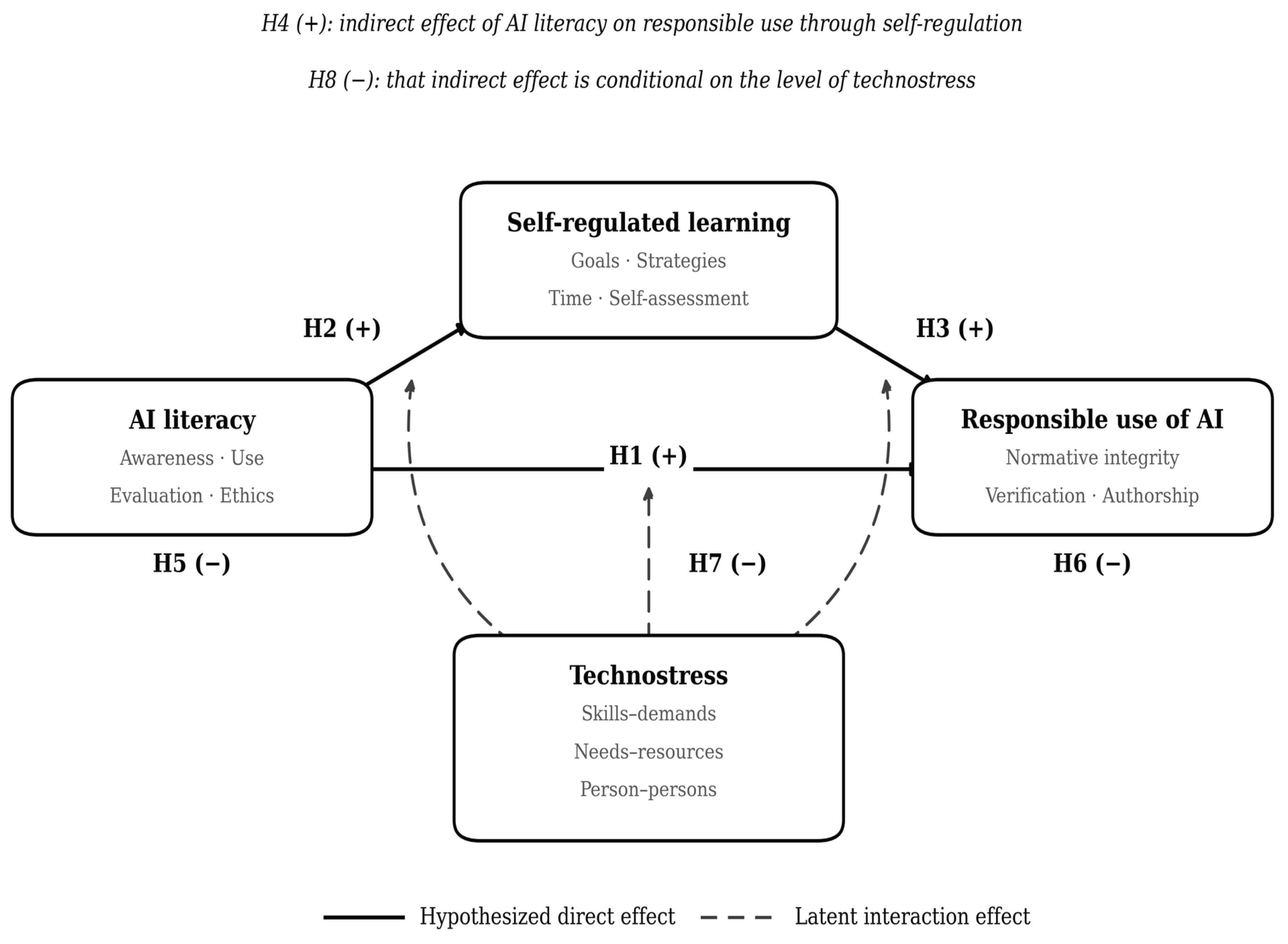
Figure 2.
Two-stage moderated mediation with moderation of the direct effect. Note. N = 820. AIL = artificial intelligence literacy; SRL = self-regulated learning; TSS = technostress; RAI = responsible use of generative AI. The ellipses represent latent variables, and the rectangles represent the observed indicators, which correspond to the 14 dimension scores described in Table 6. The double-headed curved arrow indicates the covariance between the two exogenous variables.
Figure 2.
Two-stage moderated mediation with moderation of the direct effect. Note. N = 820. AIL = artificial intelligence literacy; SRL = self-regulated learning; TSS = technostress; RAI = responsible use of generative AI. The ellipses represent latent variables, and the rectangles represent the observed indicators, which correspond to the 14 dimension scores described in Table 6. The double-headed curved arrow indicates the covariance between the two exogenous variables.
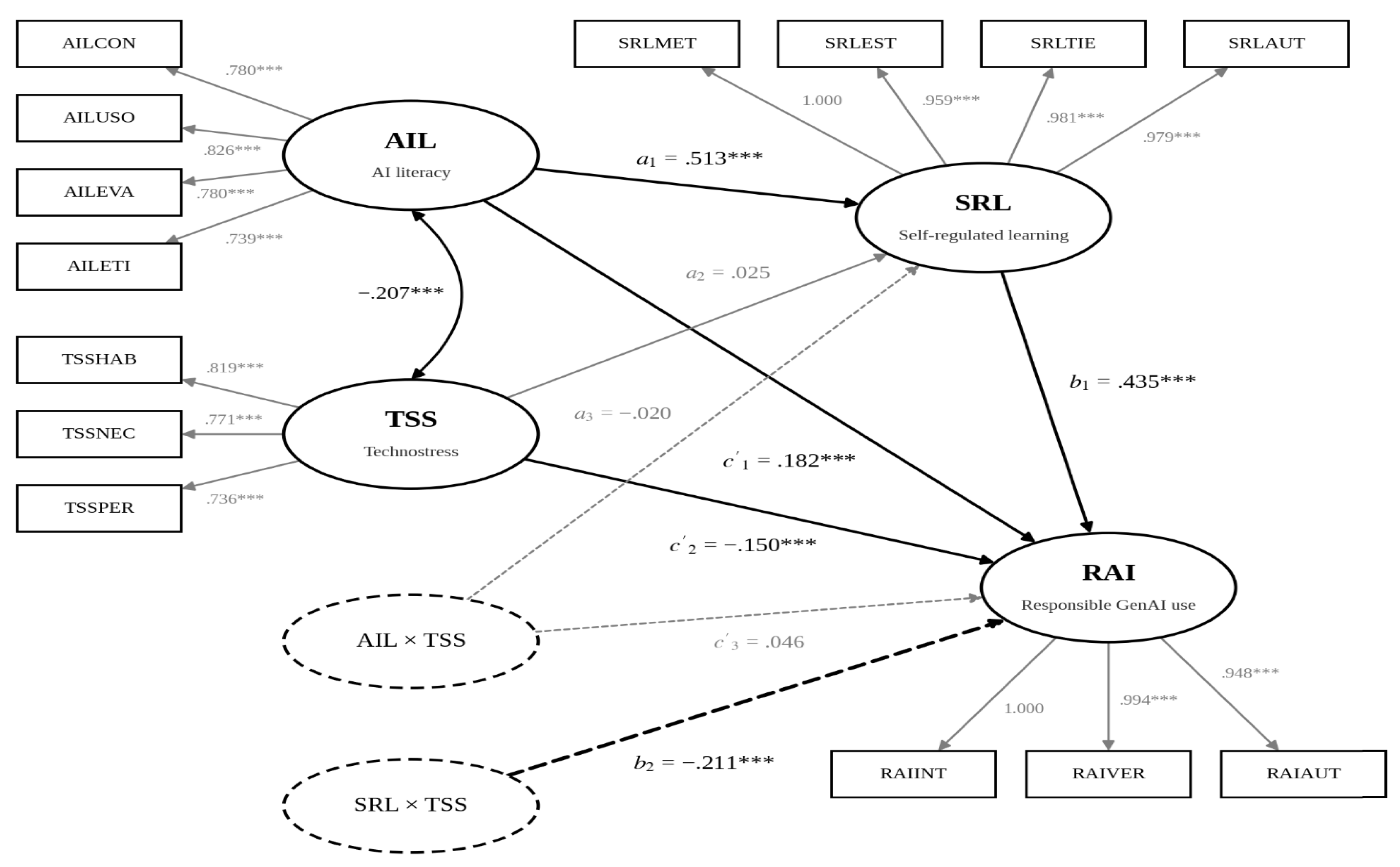
Figure 3.
Simple Slopes of Self-Regulated Learning Regarding the Responsible Use of Generative AI According to the Level of Technostress. Note. N = 820. The slopes were estimated at −1 standard deviation, the mean, and +1 standard deviation of latent technostress. Responsible use of generative AI is expressed as deviations from its latent mean.
Figure 3.
Simple Slopes of Self-Regulated Learning Regarding the Responsible Use of Generative AI According to the Level of Technostress. Note. N = 820. The slopes were estimated at −1 standard deviation, the mean, and +1 standard deviation of latent technostress. Responsible use of generative AI is expressed as deviations from its latent mean.
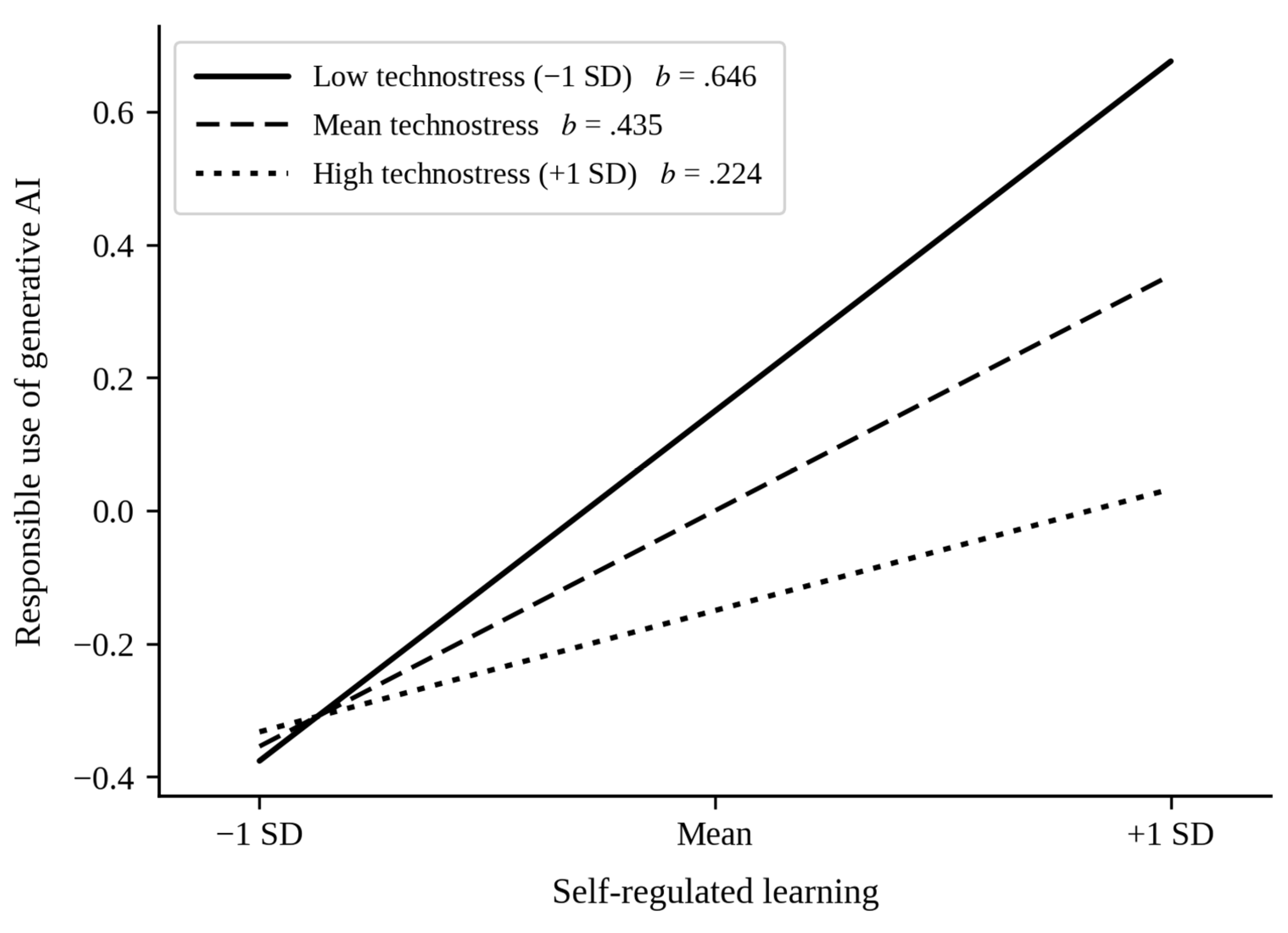
Figure 4.
Conditional effects of AI literacy on responsible use along the technostress continuum. Note. N = 820. Panel A shows the indirect effect via self-regulated learning, and Panel B shows the direct effect. The gray band is the 95% confidence interval obtained using the delta method; the shaded area indicates the range of the moderator within which the effect ceases to be significant, bounded by the Johnson-Neyman point. W = latent technostress in standard deviations.
Figure 4.
Conditional effects of AI literacy on responsible use along the technostress continuum. Note. N = 820. Panel A shows the indirect effect via self-regulated learning, and Panel B shows the direct effect. The gray band is the 95% confidence interval obtained using the delta method; the shaded area indicates the range of the moderator within which the effect ceases to be significant, bounded by the Johnson-Neyman point. W = latent technostress in standard deviations.
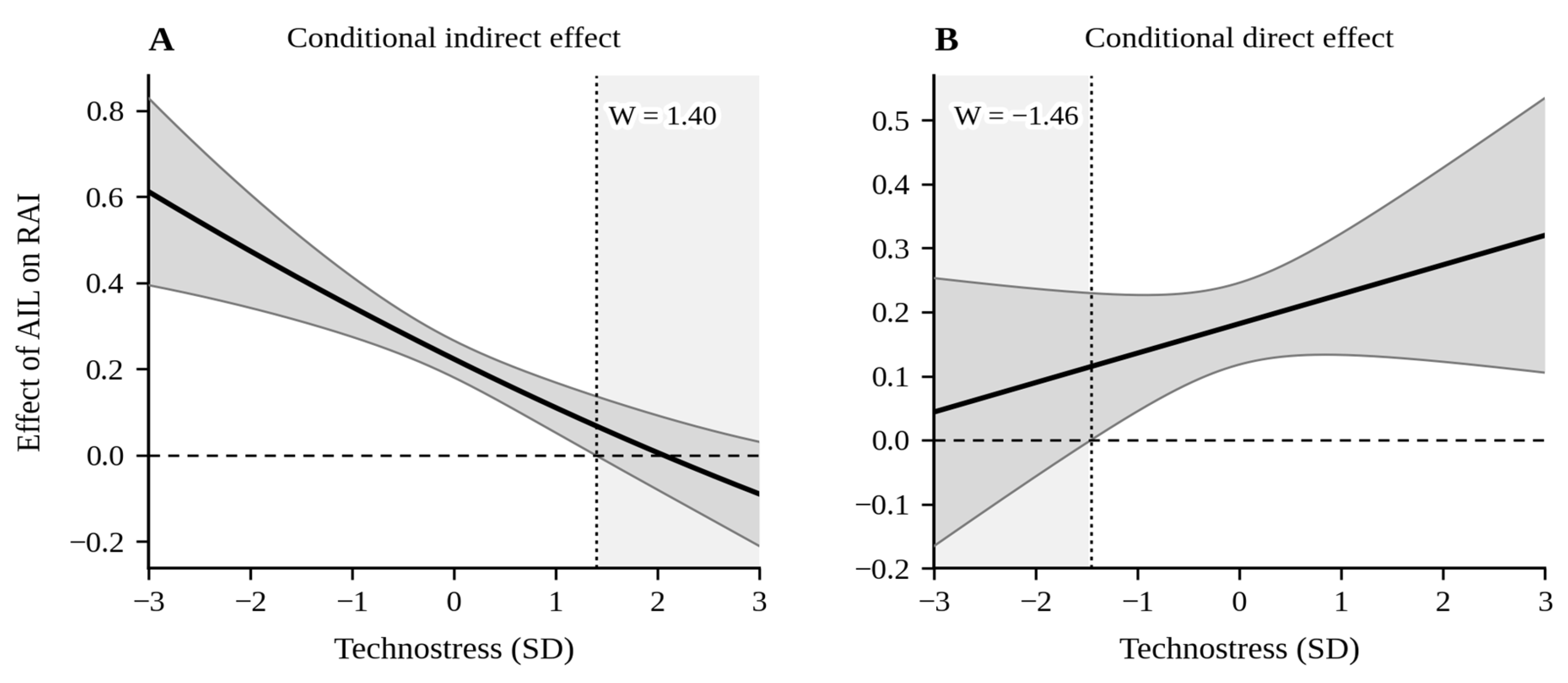
Table 1.
Summary of the Empirical Evidence by Model Segment.
| Segment | Previous Evidence | Design and sample | Limitation addressed by this study |
| AIL → RAI (H1) | Espinoza Vidaurre et al. (2025); Čolakovac et al. (2026); Park (2025) | SEM, n = 406, Peru; survey, n = 91; review of 51 studies | Measures attitudes or self-reported competence, not actual responsible behavior, with distinct dimensions |
| AIL → SRL (H2) | J. Wu et al. (2026); Acosta-Enriquez et al. (2025a); González-Prida et al. (2024) | Meta-analysis of 28 studies; PLS-SEM, n = 482, Peru; correlational, n = 84, Peru | Evaluates interventions or self-efficacy, not literacy as a multidimensional construct |
| SRL → RAI (H3) | Xu et al. (2025); Jiang and Xu (2026); Vereau Amaya et al. (2025) | Quasi-experiment, n = 68; experiment, n = 148; correlational, n = 200, Peru | Measures cognitive or affective outcomes, not responsible behavior |
| AIL → SRL → RAI (H4) | No prior comparison | Not applicable | Mediation has been identified (Vereau Amaya et al., 2025; García Castro et al., 2026) but not modeled |
| TSS × first stage (H5) | Marquez-Yauri et al. (2026); Yang and Tang (2026) | PLS-SEM, n = 340, Peru; PLS-SEM, n = 649, China | Analogous moderation not supported; interaction terms on observed scores |
| TSS × second stage (H6) | Cajas Bravo et al. (2025); Acosta-Enriquez et al. (2025b) | Multiple baseline design, n = 8, Peru; PLS-SEM, n = 876, Peru | Technostress is modeled as a antecedent or mediator, not as a condition of the behavior |
| TSS × direct path (H7) | Marquez-Yauri et al. (2026); Vargas-Bejarano et al. (2025) | PLS-SEM, n = 340, Peru; ordinal regression, n = 258, Peru | Resistance to use is examined, not normative quality of use |
| Moderated mediation (H8) | No prior comparison | Not applicable | No study estimates conditional indirect effects with latent variables |
Note. AIL = artificial intelligence literacy; SRL = self-regulated learning; TSS = technostress; RAI = responsible use of generative artificial intelligence.
Table 2.
Sample Composition (N = 820).
| Characteristic | Category | n | % |
| Gender | Female | 460 | 56.1 |
| Male | 350 | 42.7 | |
| Prefers not to say | 10 | 1.2 | |
| Age | M = 22.72, SD = 2.92, range 18 to 34 | ||
| Academic cycle | I–II | 128 | 15.6 |
| III–IV | 188 | 22.9 | |
| V–VI | 197 | 24.0 | |
| VII–VIII | 179 | 21.8 | |
| IX–X | 128 | 15.6 | |
| Field of Study | Engineering | 180 | 22.0 |
| Business | 227 | 27.7 | |
| Health Sciences | 154 | 18.8 | |
| Social Sciences | 165 | 20.1 | |
| Education | 94 | 11.5 | |
| Type of university | Public | 365 | 44.5 |
| Private | 455 | 55.5 | |
| Region | Metropolitan Lima | 482 | 58.8 |
| Other regions | 338 | 41.2 | |
| Employment status | Full-time student | 355 | 43.3 |
| Works part-time | 301 | 36.7 | |
| Works full-time | 164 | 20.0 | |
| Frequency of generative AI use | Does not use it | 81 | 9.9 |
| Rarely | 194 | 23.7 | |
| Occasionally or monthly | 234 | 28.5 | |
| Weekly | 204 | 24.9 | |
| Daily | 107 | 13.0 | |
| Primary tool | ChatGPT | 419 | 51.1 |
| Gemini | 140 | 17.1 | |
| Claude | 90 | 11.0 | |
| Copilot | 76 | 9.3 | |
| DeepSeek | 53 | 6.5 | |
| Other | 42 | 5.1 | |
| Training received on AI | None | 249 | 30.4 |
| Self-taught | 260 | 31.7 | |
| One-time workshop | 231 | 28.2 | |
| Institutional program | 80 | 9.8 | |
| Institutional Policy on AI | None | 306 | 37.3 |
| Not aware of it | 374 | 45.6 | |
| It does exist | 140 | 17.1 |
Note. Percentages are calculated based on the total sample size and may not add up to 100 due to rounding.
Table 4.
Correspondence between Hypotheses and Statistical Tests.
| Hypothesis | Parameter | Test to Test It |
| H1 | c′₁ | Direct structural coefficient in the mediation model using bootstrap and in the LMS model |
| H2 | a₁ | Structural coefficient in the mediation model with bootstrap and in the LMS model |
| H3 | b₁ | Structural coefficient in the mediation model with bootstrap and in the LMS model |
| H4 | a₁·b₁ | Indirect effect with bias-corrected bootstrap CI (10,000 resamples) |
| H5 | a₃ | Latent interaction AIL × TSS on the mediator (XWITH) |
| H6 | b₂ | Latent interaction SRL × TSS on the dependent variable (XWITH) |
| H7 | c′₃ | Latent interaction between AIL and TSS on the dependent variable (XWITH) |
| H8 | Δ ind | Difference between conditional indirect effects and the Johnson-Neyman region of significance |
Note. AIL = artificial intelligence literacy; SRL = self-regulated learning; TSS = technostress; RAI = responsible use of generative AI. c′ = direct effect; a·b = indirect effect; Δ ind = difference between conditional indirect effects. LMS = latent moderated structural equations; XWITH = Mplus operator for latent interaction terms; CI = confidence interval. Bootstrap confidence intervals are bias-corrected and based on 10,000 resamples; the conditional effects of the LMS model use delta-method intervals, as resampling is not compatible with numerical integration.
Table 5.
Comparison of Measurement Models.
| Model | par. | χ² | df | CFI | TLI | RMSEA | SRMR |
| Fourteen correlated dimensions | 326 | 896.61 | 943 | 1.000 | 1.001 | .000 | .018 |
| Second order (reference) | 255 | 928.65 | 1014 | 1.000 | 1.002 | .000 | .020 |
| Four factors at the item level | 241 | 1395.11 | 1028 | .991 | 0.990 | .021 | .026 |
| One-way | 235 | 19,105.26 | 1034 | .549 | 0.529 | .146 | .151 |
| Four constructs regarding dimensions | 48 | 49.27 | 71 | 1.000 | 1.004 | .000 | .010 |
Note: N = 820. par. = number of free parameters. The first four models were estimated to use WLSMV on the 47 items treated as ordinal; the last model was estimated to use robust maximum likelihood on the 14 dimension scores. The χ² statistics for WLSMV and MLR cannot be compared directly; therefore, the comparison is based on incremental and absolute indices. All p-values for the chi-square contrast are < .001 except for the first two models and the last one, where they exceed .85.
Table 6.
Reliability and Convergent Validity by Dimension and by Construct.
| Scale | Dimension | k | α | CR | AVE | Range of λ | γ |
| AIL. AI Literacy | |||||||
| AILCON | AI Awareness | 3 | .820 | .854 | .661 | .777–.858 | .956 |
| AILUSO | Use of AI | 3 | .846 | .877 | .704 | .819–.857 | .944 |
| AILEVA | AI Evaluation | 3 | .830 | .861 | .674 | .770–.858 | .925 |
| AILETI | Ethics of AI | 3 | .817 | .850 | .654 | .778–.835 | .925 |
| Total AIL | Second-order construct | 12 | .937 | .946 | .592 | √AVE = .769 | - |
| SRL. Self-Regulated Learning | |||||||
| SRLMET | Goal Setting | 3 | .834 | .864 | .679 | .790–.855 | .947 |
| SRLEST | Learning Strategies | 3 | .832 | .863 | .678 | .808–.850 | .945 |
| SRLTIE | Time Management | 3 | .806 | .836 | .630 | .758–.818 | .951 |
| SRLAUT | Self-Assessment | 3 | .836 | .866 | .682 | .790–.855 | .912 |
| Total SRL | Second-order construct | 12 | .937 | .945 | .588 | √AVE = .767 | - |
| TSS. Technostress | |||||||
| TSSHAB | Skill-Demand Mismatch | 4 | .869 | .894 | .679 | .785–.858 | .944 |
| TSSNEC | Mismatch between needs and resources | 4 | .858 | .884 | .655 | .780–.860 | .916 |
| TSSPER | Person-to-person mismatch | 3 | .813 | .845 | .646 | .774–.820 | .893 |
| Total TSS | Second-order construct | 11 | .927 | .933 | .561 | √AVE = .749 | - |
| RAI. Responsible Use of Generative AI | |||||||
| RAIINT | Regulatory Integrity | 4 | .857 | .885 | .658 | .788–.827 | .959 |
| RAIVER | Content Verification | 4 | .860 | .886 | .661 | .770–.846 | .929 |
| RAIAUT | Authorship and Transparency | 4 | .856 | .886 | .660 | .781–.844 | .921 |
| Total RAI | Second-order construct | 12 | .935 | .943 | .579 | √AVE = .761 | - |
Note. k = number of items; α = Cronbach’s alpha; CR = composite reliability; AVE = average variance extracted; λ = standardized factor loading of the item; γ = loading of the dimension on the second-order construct. CR and AVE were calculated based on the fully standardized loadings of the WLSMV model. Criteria: CR ≥ .70 and AVE ≥ .50.
Table 7.
Discriminant validity: Fornell-Larcker criterion and heterotrait-monotrait ratio.
| Construct | 1. AIL | 2. SRL | 3. TSS | 4. RAI |
| Latent correlations and AVE root on the diagonal | ||||
| AIL | .769 | |||
| SRL | .625 | .767 | ||
| TSS | −.207 | −.099 | .749 | |
| RAI | .565 | .616 | −.296 | .761 |
| Heterotrait-monotrait ratio | ||||
| AIL | - | |||
| SRL | .608 | - | ||
| TSS | .201 | .096 | - | |
| RAI | .547 | .597 | .284 | - |
Note. N = 820. AIL = artificial intelligence literacy; SRL = self-regulated learning; TSS = technostress; RAI = responsible use of generative AI. The latent correlations are derived from the second-order model; the heterotrait-monotrait ratio was calculated based on the polychoric correlations of the 47 items. Criteria: The square root of the AVE must exceed any correlation of the construct with the others, and the heterotrait-monotrait ratio must be below .85. All correlations are significant, p < .001, except for SRL-TSS, p = .014.
Table 8.
Test of Measure Invariance by Gender and University Type.
| Model | par. | χ² | df | CFI | RMSEA | SRMR | ΔCFI | Δχ² (gl), p |
| Gender | ||||||||
| Configural | 482 | 2433.06 | 2056 | .990 | .021 | .035 | - | - |
| Metric | 439 | 2467.85 | 2099 | .991 | .021 | .036 | .001 | 39.30 (43), .632 |
| Scale | 302 | 2584.20 | 2236 | .991 | .020 | .036 | .000 | 110.83 (137), .951 |
| Type of university | ||||||||
| Configural | 482 | 2414.24 | 2056 | .991 | .021 | .035 | - | - |
| Metric | 439 | 2458.02 | 2099 | .991 | .020 | .035 | .000 | 50.96 (43), .189 |
| Scale | 302 | 2610.23 | 2236 | .991 | .020 | .035 | .000 | 172.95 (137), .020 |
Note. Model estimated using the Mplus command MODEL = CONFIGURAL METRIC SCALAR, with the WLSMV estimator and theta parameterization. Δχ² corresponds to the adjusted difference test compared to the immediately preceding model. Practical criterion: ΔCFI ≤ .010 and ΔRMSEA ≤ .015. Cases that did not report gender (n = 10) were excluded from the comparison by gender.
Table 9.
Descriptive statistics and correlations among latent constructs.
| Construct | M | SD | 1 | 2 | 3 | 4 |
| 1. AI Literacy | 3.46 | 0.82 | - | |||
| 2. Self-Regulated Learning | 3.26 | 0.84 | .625 | - | ||
| 3. Technostress | 2.77 | 0.83 | −.207 | −.099 | - | |
| 4. Responsible Use of Generative AI | 3.45 | 0.80 | .565 | .616 | −.296 | - |
Note. N = 820. M and SD correspond to the observed composite scores on a scale of 1 to 5. The correlations are between latent constructs and are derived from the second-order model. All are significant, p < .001, except for the correlation between self-regulated learning and technostress, p = .014.
Table 10.
Coefficients of the mediation model.
| Path | b | EE | β | p | 95% CI |
| SRL ← AIL | .510 | .029 | .626 | < .001 | [.454, .567] |
| SRL ← TSS | .025 | .028 | .031 | .370 | [−.029, .081] |
| RAI ← AIL | .189 | .034 | .243 | < .001 | [.123, .258] |
| RAI ← SRL | .425 | .042 | .445 | < .001 | [.346, .509] |
| RAI ← TSS | −.152 | .026 | −.195 | < .001 | [−.203, −.101] |
| Decomposition of the effect of AIL on RAI | |||||
| Total effect | .406 | .028 | .522 | < .001 | [.351, .461] |
| Indirect effect via SRL | .217 | .023 | .278 | < .001 | [.175, .265] |
| Direct effect | .189 | .034 | .243 | < .001 | [.123, .258] |
Note. N = 820. Maximum likelihood estimation. b = unstandardized coefficient; SE = standard error; β = fully standardized coefficient. Confidence intervals are bias-corrected bootstrap intervals based on 10,000 resamples and correspond in all cases to the unstandardized metric, i.e., they bound b and not β. AIL = artificial intelligence literacy; SRL = self-regulated learning; TSS = technostress; RAI = responsible use of generative AI. R² = .385 for SRL and .466 for RAI.
Table 11.
Structural coefficients and conditional effects of the moderated mediation model.
| Parameter | Estimate | SE | z | p | 95% CI |
| Structural coefficients | |||||
| a₁ SRL ← AIL | .513 | .028 | 18.12 | < .001 | [.458, .568] |
| a₂ SRL ← TSS | .025 | .028 | 0.89 | .373 | [−.030, .080] |
| a₃ SRL ← AIL × TSS | −.020 | .026 | −0.77 | .440 | [−.071, .031] |
| c′₁ RAI ← AIL | .182 | .033 | 5.59 | < .001 | [.117, .247] |
| b₁ RAI ← SRL | .435 | .038 | 11.36 | < .001 | [.361, .509] |
| c′₂ RAI ← TSS | −.150 | .024 | −6.18 | < .001 | [−.197, −.103] |
| c′₃ RAI ← AIL × TSS | .046 | .034 | 1.34 | .182 | [−.021, .113] |
| b₂ RAI ← SRL × TSS | −.211 | .040 | −5.24 | < .001 | [−.289, −.133] |
| Conditional indirect effect of AIL on RAI through SRL | |||||
| Low technostress (−1 SD) | .344 | .036 | 9.67 | < .001 | [.273, .415] |
| Mean technostress | .223 | .022 | 10.23 | < .001 | [.180, .266] |
| High technostress (+1 SD) | .111 | .030 | 3.73 | < .001 | [.052, .170] |
| Difference (high − low) | −.233 | .048 | −4.88 | < .001 | [−.327, −.139] |
| Conditional direct effect of AIL on RAI | |||||
| Low technostress (−1 SD) | .137 | .046 | 2.95 | .003 | [.047, .227] |
| Average technostress | .182 | .033 | 5.59 | < .001 | [.117, .247] |
| High technostress (+1 SD) | .228 | .048 | 4.72 | < .001 | [.134, .322] |
| Difference (high − low) | .092 | .069 | 1.34 | .182 | [−.043, .227] |
Note. N = 820. Robust maximum likelihood estimation with Monte Carlo integration (5,000 points). AIL and TSS were scaled by fixing their latent variance at 1, so that moderator levels are expressed in standard deviations. The confidence intervals are symmetric and derived from the delta method, since Mplus does not support bootstrapping with numerical integration. SD = standard deviation.
Table 12.
Results of the Hypothesis Testing.
| Hypothesis | Statement | Result | Evidence |
| H1 | AI literacy positively predicts the responsible use of generative AI | Supported | β = .243, p < .001 |
| H2 | AI literacy positively predicts self-regulated learning | Supported | β = .626, p < .001 |
| H3 | Self-regulated learning positively predicts responsible use | Supported | β = .445, p < .001 |
| H4 | Self-regulated learning mediates the relationship between digital literacy and responsible use | Supported | β = .278, 95% CI [.226, .337] |
| H5 | Technostress moderates the effect of literacy on self-regulated learning | Not supported | a3 = −.020, p = .440 |
| H6 | Technostress moderates the effect of self-regulated learning on responsible use | Supported | b2 = −.211, p < .001 |
| H7 | Technostress moderates the direct effect of digital literacy on responsible use | Not supported | c'3 = .046, p = .182 |
| H8 | The indirect effect is conditional on the level of technostress | Supported | Δ = −.233, p < .001 |
Note. Hypotheses H1 through H4 were tested in the mediation model using bootstrap, and hypotheses H5 through H8 were tested in the moderated mediation model with latent interaction. Δ = difference between the indirect effect at high technostress and at low technostress.
Disclaimer/Publisher’s Note: The statements, opinions and data contained in all publications are solely those of the individual author(s) and contributor(s) and not of MDPI and/or the editor(s). MDPI and/or the editor(s) disclaim responsibility for any injury to people or property resulting from any ideas, methods, instructions or products referred to in the content. |
© 2026 by the authors. Licensee MDPI, Basel, Switzerland. This article is an open access article distributed under the terms and conditions of the Creative Commons Attribution (CC BY) license (http://creativecommons.org/licenses/by/4.0/).
Copyright: This open access article is published under a Creative Commons CC BY 4.0 license, which permit the free download, distribution, and reuse, provided that the author and preprint are cited in any reuse.