

Submitted:
17 August 2026
Posted:
19 August 2026
You are already at the latest version
Abstract
Hidradenitis suppurativa (HS) is a systemic inflammatory skin disease associated with obesity, insulin resistance, and visceral adiposity. Chronic metainflammation may contribute to cutaneous disease activity, while metabolic dysregulation potentially occurs independently of body mass index (BMI). Additionally, emerging metabolic pharmacotherapies may provide weight-dependent and weight-independent immunomodulatory benefits in HS. This narrative review synthesizes clinical and mechanistic evidence for glucagon-like peptide-1 receptor agonists (GLP-1RAs), GLP-1RA multi-agonists, metformin, sodium–glucose cotransporter 2 inhibitors (SGLT-2is), and peroxisome proliferator-activated receptor-gamma (PPAR-γ) agonists, in HS management. A structured PubMed and Embase search (28 March 2026) identified key metabolic-inflammatory targets. Proposed mechanisms include adipokine axis modulation (increased adiponectin; reduced leptin, retinol-binding protein 4, and haptoglobin); inhibition of nuclear factor kappa B (NF-κB) and NOD-, LRR- and pyrin domain-containing protein 3 (NLRP3) inflammasome signaling; restoration of cutaneous antimicrobial peptides; and improved gut barrier function. Early screening for metabolic syndrome (MetS) enables dermatologists to initiate targeted metabolic pharmacotherapy before irreversible cutaneous scarring occurs. Integrating metabolic therapies into HS treatment algorithms using metabolic and inflammatory biomarkers supports phenotype-driven care, offering a synergistic strategy to optimize cutaneous control, extend biologic drug survival, and improve cardiometabolic health in selected patients with HS.
Keywords:
hidradenitis suppurativa
; metainflammation
; glucagon-like peptide-1 receptor agonists
; immunometabolism
; adipokines
; obesity
; metabolic syndrome
; metformin
1. Background
Hidradenitis suppurativa (HS) is a chronic immunometabolic skin disease with systemic manifestations that extend well beyond the cutaneous lesions [70]. Patients with HS frequently present with key metabolic and cardiovascular comorbidities, including type 2 diabetes, metabolic syndrome (MetS), metabolic dysfunction-associated steatotic liver disease, and polycystic ovary syndrome [68,87]. While the primary etiology of HS remains incompletely understood, initial lesion development is widely recognized to center on the pilosebaceous unit, driven by infundibular hyperkeratosis, follicular occlusion, and subsequent follicular rupture [93]. Rupture of the hair follicle releases damage-associated molecular patterns and pathogen-associated molecular patterns into the dermis, initiating the activation of Toll-like receptors (TLRs), particularly TLR2 and TLR4, on dermal dendritic cells and macrophages [49,109]. In vitro and lesional tissue studies have demonstrated that Toll-like receptor activation triggers nuclear factor kappa B (NF-κB)-mediated transcription and recruits the factor kappa B (NF-κB) and NOD-, LRR- and pyrin domain-containing protein 3 (NLRP3) inflammasome; promoting the release of pro-inflammatory cytokines, including tumor necrosis factor-alpha (TNF-α), interleukin-1 beta (IL-1β), and interleukin-6 (IL-6) [4,75]. Furthermore, high local glucose availability and insulin resistance are mechanistically hypothesized to suppress keratinocyte antimicrobial peptide (AMP) expression, with dysregulated human beta-defensin 2 (hBD-2) and cathelicidin (LL-37) levels being associated with follicular bacterial overgrowth and wall destabilization in HS [84,102].
Following this initial innate immune activation and bacterial overgrowth, rapid neutrophil recruitment drives cellular breakdown, tissue destruction, and purulence, contributing to the generation of painful nodules and abscesses [12]. Downstream adaptive immune responses involve T-helper 17 (Th17) cell polarization, with hypersecretion of interleukin-17A (IL-17A) and interleukin-17F (IL-17F) being associated with matrix metalloproteinase induction (MMP-2, MMP-8, and MMP-9), structural tissue destruction, and tunnel formation in HS [72]. Universal pathogenic pathways across patients with HS have not been established, while substantial immunological heterogeneity and the resulting variability in treatment response are widely recognized [31]. Furthermore, follicular occlusion and downstream cutaneous inflammation are increasingly recognized as processes that are potentially amplified by systemic metabolic dysregulation and meta-inflammation [20]. Cross-sectional population studies demonstrate that the elevated prevalence of MetS in patients with HS remains statistically significant even among patients with a normal BMI, with an odds ratio (OR) of 1.45 (compared with an OR of 1.60 in patients with HS and severe obesity) [87]. Notably, normal-weight patients with HS display higher visceral adiposity, elevated triglycerides, and increased Homeostatic Model Assessment for Insulin Resistance (HOMA-IR) compared with matched controls, supporting a distinct metabolically unhealthy normal-weight phenotype [69]. Mechanistically, hyperinsulinemia is further suggested to activate the mammalian target of rapamycin complex 1 (mTORC1) and suppress the nuclear transcription factor forkhead box protein O1 (FoxO1) in keratinocytes, promoting infundibular hyperplasia and epidermal thickening [74,107].
Figure 1.
Pathogenic Continuum of Follicular Occlusion, Rupture, and Metainflammatory Adipokine Crosstalk in Hidradenitis Suppurativa. Schematic representation of the multi-stage immunometabolic pathogenesis of hidradenitis suppurativa. Normal Hair Follicle and Hyperkeratosis/Plugging: Baseline infundibular architecture progresses to hyperkeratosis and follicular plugging, driven by hyperinsulinemia, mTORC1 activation, FoxO1 suppression, and continuous upward secretion of pro-inflammatory adipocytokines from underlying subcutaneous fat. Follicular Rupture and Innate Sensing: Follicular occlusion leads to luminal distension and rupture, releasing microbial pathogen-associated molecular patterns (PAMPs) and tissue-derived damage-associated molecular patterns (DAMPs) into the dermis, engaging Toll-like receptors (TLRs) and triggering NF-κB activation. Inflammation Stage and Clinical Features: Downstream NF-κB and inflammasome activation drives the secretion of TNF-α, IL-1β, IL-23, and IL-17, recruiting neutrophils, macrophages, Th1/Th17 lymphocytes, and B-cells to promote intense dermal inflammation, culminating in painful nodule and deep abscess formation.
Figure 1.
Pathogenic Continuum of Follicular Occlusion, Rupture, and Metainflammatory Adipokine Crosstalk in Hidradenitis Suppurativa. Schematic representation of the multi-stage immunometabolic pathogenesis of hidradenitis suppurativa. Normal Hair Follicle and Hyperkeratosis/Plugging: Baseline infundibular architecture progresses to hyperkeratosis and follicular plugging, driven by hyperinsulinemia, mTORC1 activation, FoxO1 suppression, and continuous upward secretion of pro-inflammatory adipocytokines from underlying subcutaneous fat. Follicular Rupture and Innate Sensing: Follicular occlusion leads to luminal distension and rupture, releasing microbial pathogen-associated molecular patterns (PAMPs) and tissue-derived damage-associated molecular patterns (DAMPs) into the dermis, engaging Toll-like receptors (TLRs) and triggering NF-κB activation. Inflammation Stage and Clinical Features: Downstream NF-κB and inflammasome activation drives the secretion of TNF-α, IL-1β, IL-23, and IL-17, recruiting neutrophils, macrophages, Th1/Th17 lymphocytes, and B-cells to promote intense dermal inflammation, culminating in painful nodule and deep abscess formation.
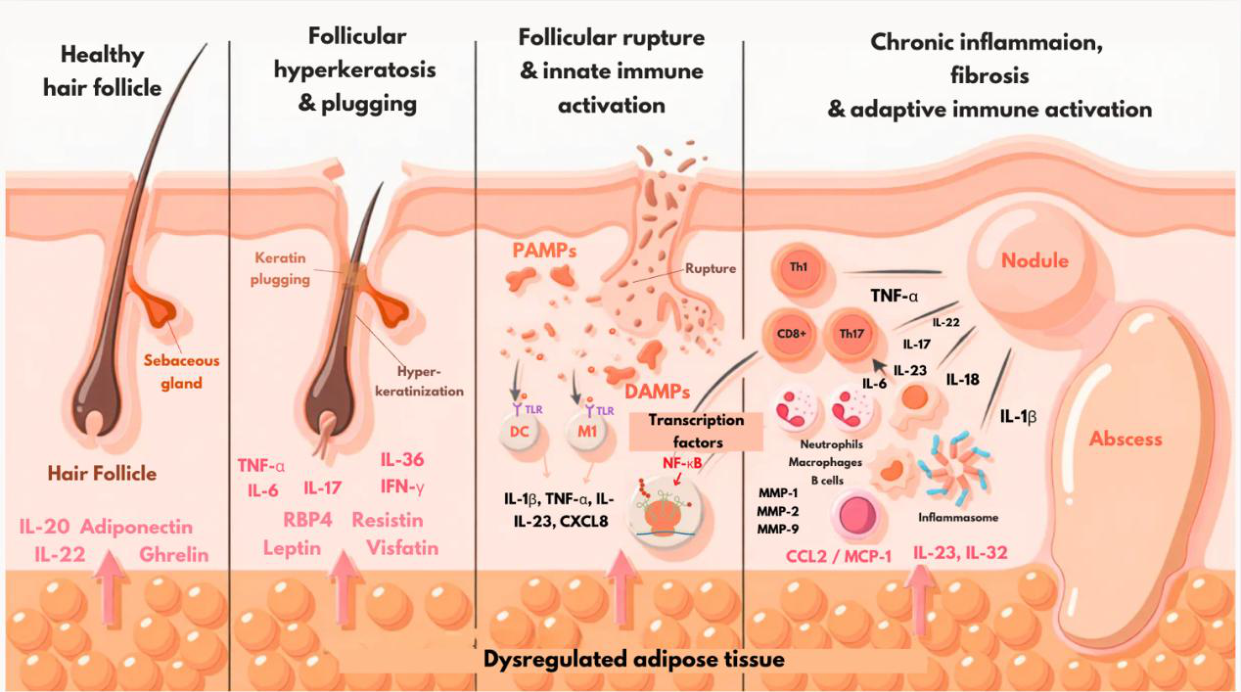
In parallel, emerging insights into the role of adipose tissue have expanded beyond its function as a simple energy storage depot, with adipose tissue now recognized as an active endocrine organ that secretes bioactive signaling peptides termed adipokines and cytokines, which serve as key mediators of systemic inflammation and metabolic crosstalk [30,103]. In healthy subcutaneous fat, anti-inflammatory M2 macrophages predominate to maintain tissue tolerance. In obesity and, potentially, in HS, adipose tissue undergoes immunological remodeling, in which accumulating pro-inflammatory M1 macrophages and CD8+ cytotoxic T cells drive the release of pro-inflammatory mediators (TNF-α, IL-6, and interferon-gamma) that promote the pathogenic IL-23/Th17 axis and exacerbate cutaneous disease activity [57,65]. Importantly, cross-sectional cohort studies in patients with HS confirm that several alterations in adipokine profiles remain statistically significant after adjustment for BMI, indicating that adipokine dysregulation might be linked to HS pathophysiology independently of increased BMI [65]. Currently, guidelines for moderate-to-severe HS recommend a stepped therapeutic approach that combines topical treatments, systemic antibiotics, and targeted biologics. However, clinical responses remain insufficient for many patients [116]. While guidelines acknowledge lifestyle modifications, weight management, and metformin as general adjuvant measures, detailed guidance on how to integrate and differentiate between distinct metabolic pharmacotherapies remains limited [11,116]. Further synthesis is needed to determine how individual metabolic agents, such as glucagon-like peptide-1 receptor agonists (GLP-1RAs), GLP-1RA multi-agonists, metformin, sodium–glucose cotransporter 2 inhibitors (SGLT-2is), and peroxisome proliferator-activated receptor-gamma (PPAR-γ) agonists, can be selected according to patient phenotypes and combined with conventional therapies. This narrative review synthesizes clinical and mechanistic evidence supporting the positioning of these distinct metabolic pharmacotherapies in the management of HS.
2. Methods
This narrative review was prepared in accordance with the Scale for the Assessment of Narrative Review Articles (SANRA) [6]. PubMed and Embase were searched on 28 March 2026 using key terms related to hidradenitis suppurativa ("hidradenitis suppurativa", "acne inversa", "follicular occlusion", "hurley*"); obesity, adipokines, and metabolic dysfunction ("obesity", "adiposity", "body mass index", "metabolic syndrome", "insulin resistance", "type 2 diabetes mellitus", "leptin", "adiponectin", "retinol-binding protein 4", "haptoglobin"); and metabolic pharmacotherapies (GLP-1 receptor agonists and individual agents, dual GLP-1/GIP agonists, tirzepatide, retatrutide, SGLT-2 inhibitors, metformin, pioglitazone). The search yielded 1,140 records; after deduplication, 985 records were screened by title and abstract, 148 underwent full-text assessment, and 42 were included. Studies reporting original HS-specific outcomes following metabolic interventions or investigating relevant metabolic-inflammatory mechanisms were eligible for inclusion. An additional 75 articles were identified through reference checking, Google Scholar, and targeted database searches, bringing the total number of articles included in the narrative synthesis to 117. Preclinical, in vitro, and non-HS clinical studies were explicitly identified as such in the text. (Supplementary 1)
3. Metabolic Dysfunction and Systemic Markers
3.1. Dysfunctional Adipose Tissue and Adipokines
Adipose tissue is increasingly recognized as an active endocrine and immunological organ rather than a passive energy storage depot [29,48]. HS, obesity and MetS are associated with structural remodeling of visceral and subcutaneous adipose tissue and a shift in its secretory profile, characterized by dysregulated release of bioactive peptides, adipokines, and pro-inflammatory cytokines that potentially support local and systemic inflammatory feedback loops [20,57]. The pathological alterations in adipose tissue architecture, immune cell infiltration, and secretory output are schematically illustrated in Figure 2.
Multiple adipokines have been demonstrated in clinical case-control studies to be dysregulated in HS, with each fulfilling a distinct pathophysiological role, as summarized in Table 1. Notably, circulating leptin levels correlate strongly with BMI (r = 0.83) and activate Janus kinase 2/signal transducer and activator of transcription 3 (JAK2/STAT3)-driven Th17 polarization, whereas adiponectin depletion occurs independently of BMI, removing a critical 5′-AMP-activated protein kinase (AMPK)-mediated brake on NF-κB signaling [36,65]. Both resistin and visfatin have been identified as independent risk factors for HS development independently of BMI, age, and sex, although neither correlates with Hurley HS severity stage [3,36]. Omentin-1 is paradoxically elevated in HS despite being anti-inflammatory in non-HS populations; potentially attributed to omentin-1’s enhancement of cutaneous IL-1β signaling, thereby amplifying neutrophil recruitment and tunnel formation [34]. Circulating chemerin levels are elevated in HS and act as a potent chemoattractant, recruiting plasmacytoid dendritic cells and neutrophils to lesional skin via Chemokine-like receptor 1 (CMKLR1). [57] Finally, Retinol-binding protein 4 represents a distinctive link between cutaneous severity and metabolic dysfunction, as it correlates with both Hurley stage and HOMA-IR independently of BMI [35].
Beyond adipokines, expanding adipose tissue in HS undergoes immunometabolic remodeling characterized by infiltration by M1 macrophages and elevated secretion of TNF-α, IL-6, IL-1β, and Monocyte chemoattractant protein-1 [48,57]. In obesity and type 2 diabetes studies, adipose-derived TNF-α has been shown to impair peripheral insulin receptor substrate-1 signaling via JNK-mediated serine phosphorylation, a mechanism that is hypothesized to contribute to the systemic insulin resistance observed in HS [48,107]. Furthermore, saturated free fatty acids released from adipocytes function as endogenous damage-associated molecular patterns (DAMPs) that initiate TLR4 signaling, amplifying IL-1β release [57,96].
3.2. Systemic Metabolites, Acute-Phase Reactants, and Gut-Derived Mediators
Moving from adipokines and cytokines, HS is additionally characterized by dysregulation of systemic metabolites, including acute-phase reactants, and gut microbiome-derived mediators that have been associated with both cutaneous inflammation and systemic metabolic comorbidities (summarized in Table 2). Among acute-phase markers, Abu Rached et al. [89,90] demonstrated that serum haptoglobin serves as a strong independent serological predictor of Hurley stage III disease and metabolic complications, with elevated levels being associated with reduced pancreatic β-cell compensation and elevated HbA1c. The pan-immune-inflammation value (PIV), calculated as increases progressively across Hurley stages and is independently associated with comorbid metabolic syndrome (OR 1.41) [45]. Likewise, the heparin-binding growth factor midkine correlates positively with waist circumference, triglycerides, and diastolic blood pressure [15]. The systemic involvement in HS is further supported by altered circulating amino acid profiles (e.g., branched-chain amino acids, phenylalanine, and tyrosine) and markedly elevated levels of trimethylamine N-oxide (TMAO), a gut microbiota-derived hepatic metabolite that has been shown to correlate strongly with Sartorius severity scores (r = 0.570) in HS [8,108].
Genomic sequencing studies in HS cohorts demonstrate shifts in the gut microbiome, characterized by a relative depletion of anti-inflammatory members of the Firmicutes, a major bacterial group that constitutes a substantial part of the human gut flora and includes short-chain fatty acid-producing bacteria [60]. The resulting depletion of short-chain fatty acids (SCFAs) is proposed to compromise epithelial tight junction integrity [60], facilitating the translocation of gut-derived lipopolysaccharide (LPS) into the bloodstream [72]. Circulating LPS subsequently engages Toll-like receptor complexes on immune cells, triggering NF-κB activation and amplifying systemic TNF-α, IL-1β, and IL-17 signaling [72]. Interestingly, adalimumab (anti-TNF-α) has also been shown to modulate gut microbiome composition and restore fecal SCFA levels in treated patients, independently of the cutaneous clinical response [101].
Additionally, a link has been proposed between host-microbiota catabolism of tryptophan, an essential amino acid, and HS pathophysiology. Guenin-Macé et al. (2020) mapped the biochemical and microbiological roles of tryptophan in HS, demonstrating that localized overactivation of the kynurenine pathway in lesional skin is accompanied by significantly reduced plasma tryptophan levels in patients with HS [38]. In the cutaneous microenvironment, inflammatory cytokines induce local overactivation of the enzymes Indoleamine 2,3-dioxygenase 1 and tryptophan 2,3-dioxygenase, shunting tryptophan down the kynurenine pathway and reducing protective indole metabolites (such as indole-3-acetic acid) produced by resident skin bacteria, thereby directly compromising epidermal barrier integrity and immune homeostasis [38,98]. Collectively, these systemic metabolic, acute-phase, and microbiome-associated alterations underscore the broad immunometabolic involvement in HS, reinforcing the rationale for integrating metabolic interventions and biomarker monitoring (Table 2).
4. Metabolic Pharmacotherapies Relevant for HS
4.1. Glucagon-Like Peptide-1 Receptor Agonists
GLP-1RAs exert pleiotropic effects through multi-organ pathways, with emerging evidence suggesting additional direct immunomodulatory effects [25,46,50]. Centrally, GLP-1RAs activate pro-opiomelanocortin/cocaine- and amphetamine-regulated transcript (POMC/CART) neurons within hypothalamic satiety centers while suppressing neuropeptide Y/agouti-related peptide (NPY/AgRP) signaling to regulate appetite and enhance satiety [25,71]. Modulating central reward circuits might be of particular therapeutic interest in HS, as chronic pain, systemic inflammation, and psychological distress frequently drive reward-driven and emotional eating behaviors, disordered eating patterns (such as binge eating disorder), and severely impaired health-related quality of life [22,77,92].
Systemically and peripherally, GLP-1 receptor activation enhances glucose-dependent pancreatic β-cell insulin secretion and improves peripheral insulin sensitivity, supporting the attenuation of systemic metainflammation [39,46]. High-dose, obesity-targeted GLP-1RAs induce substantial body weight reduction (e.g., 10–15% mean weight loss with semaglutide 2.4 mg weekly in the STEP 1 trial [112]. In patients with HS, weight loss potentially helps reduce mechanical skin-on-skin friction, maceration, and follicular shear stress in intertriginous skin areas [10,50,99]. Crucially, reducing visceral adiposity is proposed to favorably modulate the dysregulated adipokine profile in HS by decreasing pro-inflammatory adipose tissue, immune cell infiltration, and suppressing circulating levels of pro-inflammatory adipokines, while elevating anti-inflammatory adiponectin [57,73]. These metabolic changes, accompanied by a reduction in systemic acute-phase reactants [78,90], is hypothesized to reduce the systemic metabolic drivers promoting cutaneous follicular hyperkeratosis, follicular occlusion, and subsequent lesion rupture. The multi-organ physiological actions of GLP-1RA therapy are presented in Figure 3.
Direct cutaneous GLP-1 receptor expression on human dermal keratinocytes and sebocytes remains controversial. While preliminary in vitro models suggested direct GLP-1 receptor signaling, human tissue studies in psoriasis plaque biopsies suggest that GLP-1 receptor gene expression is localized primarily to infiltrating immune cells (such as Invariant natural killer T cells) rather than resident epidermal keratinocytes [28,44]. Thus, direct weight-independent cutaneous immunomodulation in human HS skin remains uncertain. Regarding the gut-skin axis, GLP-1 receptor signaling on intestinal intraepithelial lymphocytes represents a physiologically plausible translational model to support mucosal barrier function and potentially reduce systemic translocation of gut-derived LPS [7,100] , though direct measurements of intestinal permeability following GLP-1RA therapy in human HS cohorts remain lacking.
The clinical evidence base for GLP-1RAs in HS has expanded recently. A comprehensive systematic review by Visan et al. [106] encompassing 19 studies and over 67,000 patients with HS demonstrated clinical improvements in Hurley stage, International Hidradenitis Suppurativa Severity Score System (IHS4), pain scores, and Dermatology Life Quality Index (DLQI), complemented by nationwide retrospective cohort analyses by Jastrząb-Miśkiewicz et al. [53] and other large-scale TriNetX registry studies showing significant reductions in all-cause mortality, major adverse cardiovascular events, emergency department visits, surgical interventions, and systemic antibiotic prescriptions [40,53,63]. Smaller prospective and observational cohorts (e.g., Gouvrion et al., 2025 [n=66]; Lyons et al., 2024 [n=30]; Nicolau et al., 2024 [n=14]) further confirm meaningful dermatological improvements [37,62,78]. Nevertheless, under the Oxford Centre for Evidence-Based Medicine (OCEBM) framework, the overall evidence remains Level 4 due to the complete lack of published randomized controlled trials (RCTs) [5,106]. Gastrointestinal adverse events (nausea, vomiting, diarrhea) represent the primary tolerability challenge, requiring gradual dose escalation [76,85], while financial cost, financial coverage barriers, and potential rebound weight regain upon treatment cessation represent notable real-world clinical challenges [71,106]. Consequently, so far, clinical studies suggest positioning GLP-1RAs as an adjuvant metabolic therapy alongside established biologics and surgical interventions to optimize drug bioavailability and long-term disease control, rather than as a standalone HS monotherapy [5,106].
4.2. Next-Generation Multi-Receptor Agonists
Multi-receptor agonists extend beyond selective GLP-1 mono-agonism by co-targeting complementary metabolic pathways to achieve broader immunometabolic effects [52,53]. Dual GLP-1/ Glucose-dependent insulinotropic polypeptide (GIP) agonists, such as tirzepatide, activate both GLP-1 and GIP receptors [50]. In addition to GIP's native incretin function of stimulating pancreatic insulin secretion [46], GIP signaling in subcutaneous adipose tissue is proposed to enhance lipid storage capacity, thereby helping to prevent ectopic lipid accumulation while synergizing with GLP-1 to achieve superior weight loss compared with mono-agonists [94]. By more effectively reducing visceral adiposity, dual agonists are hypothesized to suppress M1 macrophage infiltration and reduce circulating pro-inflammatory adipokines (leptin, resistin) that may otherwise fuel cutaneous inflammation, while superior weight loss directly alleviates mechanical intertriginous friction [10,114].
Clinical evidence for multi-receptor agonism in HS is still emerging and remains at Level 4 (OCEBM) [106]. In a landmark report by Chan et al. (2024), weekly tirzepatide treatment in a patient with severe, biologic-refractory HS, type 2 diabetes, and obesity induced rapid clinical improvement (Hidradenitis Suppurativa Physician’s Global Assessment from severe to mild, reduced abscesses, and improved DLQI), alongside normalization of hemoglobin A1c (HbA1c) and triglyceride levels over 3 months [16]. Data from the completed open-label pilot study (NCT06301256) evaluating tirzepatide for moderate-to-severe HS showed a 80% HiSCR rate after 24 weeks [1]. Additionally, the triple agonist retatrutide (GIP/GLP-1/glucagon) co-targets glucagon receptors to stimulate hepatic lipid clearance and thermogenesis, achieving >24% weight loss and marked reductions in hepatic fat and fibrosis in Phase 2 trials [52,95]. While promising for severe, refractory phenotypes, long-term dermatological trials evaluating structural tunnel outcomes remain limited, supporting the role of these agents a Level 4 to 5 OCEBM investigational adjuncts [106].
4.3. Biguanide Therapy: Metformin
Metformin is hypothesized to exert multifaceted immunometabolic effects relevant to HS pathogenesis [18,54].
- AMPK Activation and mTORC1 Suppression: Metformin reversibly inhibits mitochondrial respiratory complex I, elevating intracellular Adenosine monophosphate/adenosine triphosphate (AMP/ATP) ratios to activate AMPK [83]. AMPK directly inhibits hyperactive mTORC1 and sterol regulatory element-binding protein 1c signaling, suppressing infundibular keratinocyte proliferation, follicular hyperkeratosis, and sebaceous lipogenesis [18,107].
- NLRP3 Inflammasome Blockade: AMPK activation promotes mitochondrial autophagy and reduces mitochondrial reactive oxygen species production, blunting NLRP3 inflammasome assembly and pro-IL-1β cleavage [86].
- Androgen and Hyperinsulinemia Reduction: By suppressing hepatic gluconeogenesis and enhancing muscle glucose uptake, metformin lowers circulating insulin, reducing ovarian and adrenal androgen production (testosterone, Dehydroepiandrosterone sulfate) in female patients with HS and comorbid PCOS [22,43].
- Metabolic Reprogramming (Warburg Shift): Metformin inhibits dysregulated aerobic glycolysis (Warburg effect) in lesional peripheral blood mononuclear cells and dermal macrophages, restoring cellular bioenergy and reducing inflammatory chemokines in HS tunnels and inflammatory nodules [86].
- Pharmacomicrobiomics and AMP Restoration: Metformin may alter the composition of the gut microbiome (e.g., enriching intestinal Akkermansia muciniphila) and reduce circulating endotoxins [83]. Furthermore, by improving local epidermal glucose handling and reducing systemic meta-inflammation, metformin is hypothesized to support the restoration of endogenous antimicrobial peptide secretion by keratinocytes (LL-37, hBD-2) [59,84].
Metformin has the longest-established observational clinical evidence base among metabolic therapies in HS. Verdolini et al. [105] documented significant clinical improvement in 72% of 25 patients receiving metformin (500–1500 mg/day), with a mean reduction in Sartorius score of 12.7 points, while Jennings et al. [55] reported a 68% subjective clinical response rate in a cohort of 53 patients (with 19% achieving complete disease remission on monotherapy). A comprehensive systematic review by Almukhadeb et al. [5] confirmed an overall clinical response rate of 68-75% across observational cohorts, with optimal efficacy observed in female patients presenting with insulin resistance, elevated HOMA-IR, or comorbid PCOS. Importantly, metformin is approved for pediatric metabolic dysfunction from the age of 10 years, supporting early intervention in adolescent HS [83].
The primary limitation of metformin is gastrointestinal intolerance (diarrhea, abdominal cramps, flatulence) during treatment initiation [55,105]. Metformin produces only modest weight loss (2–5%) [5]. During long-term use, periodic monitoring of vitamin B12 levels is recommended [19]. While observational prospective series and retrospective cohorts (OCEBM Level 4) support metformin as a low-cost intervention [5,105], recent Phase III randomized controlled trial data indicate that metformin combined with doxycycline was not clinically superior to doxycycline monotherapy in terms of primary cutaneous outcomes, highlighting the need for cautious interpretation [81].
4.4. Sodium–Glucose Cotransporter 2 Inhibitors
SGLT-2is (e.g., empagliflozin, dapagliflozin) lower blood glucose by selectively inhibiting renal tubular glucose reabsorption in the proximal convoluted tubule, independent of insulin secretion [115]. The resulting glucosuria causes a modest caloric loss (typically leading to a 2–3 kg weight reduction) and a metabolic shift toward ketogenesis [82]. At the cellular level, SGLT-2is may suppress NLRP3 inflammasome activation, reduce serum uric acid, and attenuate oxidative stress in vascular endothelial cells [111]. Additionally, SGLT-2i therapy has been proposed to reduce key markers of systemic vascular inflammation and tissue fibrosis, including circulating TNF-α and IL-6 [42]. This cardiorenal and anti-inflammatory profile is particularly relevant to patients with HS, as studies demonstrate a significantly elevated baseline risk of cardiovascular morbidity, heart failure, and chronic kidney disease [88,91]. SGLT-2is provide guideline-supported cardiorenal protection in high-risk cardiometabolic cohorts, reducing heart failure hospitalizations and slowing renal disease progression [66]. In the only large-scale HS-specific study to date, Cheng et al. [17] conducted a population-based cohort study of 3,394 patients with HS and concomitant type 2 diabetes and found that SGLT-2i treatment, over a mean follow-up of six years, was associated with a significantly decreased risk of obesity, all-cause mortality, emergency department visits, and major cardiorenal complications compared with propensity score-matched GLP-1RA users.
However, clinical implementation requires careful patient selection. SGLT-2i therapy is associated with a well-documented 5–10% increased risk of genital mycotic infections (e.g., vulvovaginal candidiasis, balanitis) due to drug-induced glucosuria [111]. This warrants careful evaluation in patients with HS who have active perineal, inguinal, or gluteal lesions because local maceration and bacterial and fungal coinfections may exacerbate disease burden. Furthermore, clinicians should also consider rare but life-threatening risks, including euglycemic diabetic ketoacidosis and perineal necrotizing fasciitis (Fournier’s gangrene), as well as a potential registry-associated risk of paradoxical psoriasis flares [9,21,64,111].
Consequently, while SGLT-2is possess OCEBM Level 4 evidence for reducing systemic and cardiorenal risk in patients with HS and concomitant T2DM [17], prospective randomized controlled trials evaluating HS-specific cutaneous primary endpoints are lacking, leaving evidence for their direct dermatological efficacy at Level 5 [5,111].
4.5. Peroxisome Proliferator-Activated Receptor-γ Agonists: Pioglitazone
Pioglitazone is a thiazolidinedione that acts as a potent agonist of the nuclear receptor PPAR-γ [23]. In preclinical models, PPAR-γ activation in subcutaneous adipocytes and dermal macrophages promotes adipocyte differentiation, enhances fatty acid storage, and markedly upregulates serum adiponectin [57,70]. Elevated adiponectin is mechanistically plausible as an activator of cutaneous AMPK, suppressing NF-κB transcription and downregulating TNF-α, IL-1β, and IL-6 release from dermal dendritic cells and macrophages in vitro [57,70]. Therapeutically, pioglitazone is hypothesized to be a potential investigational adjunct in HS patients presenting with comorbid metabolic dysfunction-associated steatotic liver disease or severe peripheral insulin resistance without marked obesity [70]. However, clinical translation is constrained by significant safety considerations. Pioglitazone is known to induce renal sodium reabsorption in the collecting duct via PPAR-γ-mediated activation of epithelial sodium channels, leading to fluid retention and peripheral edema [23]. This fluid accumulation leads to a secondary increase in total body weight; however, this fluid-driven weight gain must be clearly distinguished from adipose mass accumulation, as plasma volume expansion poses distinct hemodynamic risks. Because fluid overload increases cardiac preload, pioglitazone is contraindicated in patients with heart failure, a crucial safety consideration given the elevated baseline risks of cardiovascular disease and heart failure observed in HS cohorts [23,26]. Additionally, long-term PPAR-γ activation is associated with bone loss, hypothesized to stem from a shift in mesenchymal stem cell differentiation away from osteoblasts toward adipocytes, thereby accelerating bone turnover and increasing fracture risk [23]. Currently, no published human clinical trials or prospective case series have evaluated pioglitazone in HS cohorts; its evidence base remains restricted to Level 5 (preclinical hypotheses and pathophysiological alignment) [70].
5. Discussion
5.1. Metainflammation as a Driver and Structural Integration
HS has traditionally been conceptualized as a primary inflammatory disorder. However, accumulating translational and epidemiological evidence supports an emerging paradigm shift: metabolic dysregulation, visceral adipose tissue dysregulation, and systemic metainflammation potentially function as active drivers of disease pathogenesis [32,57]. Visceral adipose tissue dysregulation is proposed to impact dermal inflammation and scar formation through alterations in the adipokine axis, characterized by elevated leptin, resistin, visfatin, and Retinol-binding protein 4 alongside suppressed adiponectin (Summarized in Table 1). These adipokine alterations occur alongside alterations in haptoglobin, high-sensitivity C-reactive protein, PIV, TMAO, and short-chain fatty acid profiles (Summarized in Table 2). Crucially, these metabolic elements appear to contribute to HS, at least partially, independently of BMI, as metabolically unhealthy normal-weight phenotypes have been described [69]. This conceptual reframing establishes a rationale for integrating metabolic pharmacotherapies into HS therapeutic regimens. Cytokine-targeted biologics (e.g., adalimumab, secukinumab, bimekizumab) suppress specific pathways, whereas metabolic pharmacotherapies target underlying metabolic contributors or initiators [5]. Table 3 contextualizes these distinct pharmacological classes, establishing their potential and suggested roles in terms of levels of evidence and weight dependence and in relation to specific HS phenotypes and comorbidities.
5.2. The Epidermal Barrier-Mitochondrial-Microbiota Axis and Local Immunometabolic Mechanisms
Additionally, recent translational studies reframe HS as a disorder of impaired local innate immunosurveillance, establishing a link between microbial invasion, autoinflammation, and humoral autoimmunity [2,13,14]. Agbogan et al. [2] demonstrated that Porphyromonas uenonis, an anaerobic bacterium selectively enriched in active skin lesions from patients with HS, actively penetrates an intact epidermal barrier, infects primary keratinocytes, and triggers pro-inflammatory cytokine cascades. Additionally, P. uenonis invasion is associated with local epidermal IgA deposits, while patient-derived anti-P. uenonis IgG antibodies cross-react with self-antigens (such as lysozyme) expressed by healthy keratinocytes, linking localized dysbiosis to systemic humoral autoimmunity [2]. In parallel, Carmona-Rivera et al. [14] established that lesional IgA and IgG autoantibodies in HS skin form immune complexes that engage macrophage Fc receptors, promoting dermal inflammation, matrix degradation (MMP-2, MMP-9), and fibrotic scarring. Mitochondrial dysfunction has also been suggested as a potential bioenergetic factor contributing to this epidermal barrier vulnerability, thereby providing a possible link between these bacterial and immunological mechanisms and metabolic dysfunction. Transcriptomic profiling via gene set enrichment analysis reveals that mitochondrial oxidative phosphorylation is among the most downregulated biochemical pathways across both lesional and clinically uninvolved HS skin [47,80,98]. Systemic hyperinsulinemia and local glucose excess are hypothesized to exacerbate this defect by suppressing keratinocyte secretion of endogenous antimicrobial peptides (such as hBD-2), thereby weakening the chemical barrier shield [47,84]. Interestingly, GLP-1RAs (e.g., semaglutide) have been proposed as potential modulators of mitochondrial stress [47]. As suggested in the conceptual framework of Delage et al. [24], HS is best understood as a heterogeneous spectrum spanning autoinflammatory hyper-reactivity, localized autoinfection, and partial innate immunodeficiency [24,109].
5.3. Endocrine-Metabolic Crosstalk, Anti-Androgen Synergy, and Pharmacokinetic Rescue
Observations in female HS cohorts contribute to the understanding that metabolic dysregulation is not exclusively driven by obesity. PCOS affects up to 22.3% of female patients with HS, and insulin resistance is present in 43.4–77% of patients across cohorts, regardless of BMI [5,110]. Metformin is suggested to modulate this neuroendocrine axis in HS by lowering circulating IGF-1, elevating IGFBP-1, activating FoxO1, and inhibiting key steroidogenic enzymes (CYP17A1, HSD3B2), thereby suppressing mTORC1 hyperactivation and keratinocyte infundibular hyperkeratosis [5,116].
Because hyperinsulinemia directly stimulates ovarian and adrenal androgen synthesis, co-prescribing metformin or GLP-1RAs alongside anti-androgenic agents (e.g., spironolactone, finasteride) creates a potential dual-target synergy: metabolic agents target the upstream endocrine driver (hyperinsulinemia), while anti-androgens block downstream end-organ receptor sensitivity in the relevant HS patient phenotype [56,110,116].
Furthermore, metabolic interventions may address potential pharmacokinetic challenges in the treatment of patients with obesity and HS. Studies in HS suggest that higher BMI is associated with increased monoclonal antibody clearance and lower concentrations of biologics, whereas weight loss may improve drug exposure by reducing the volume of distribution and clearance, potentially supporting treatment efficacy and biologic persistence [61,79]. Additionally, differences between diabetes-targeted and obesity-targeted dosing regimens have been discussed in the literature: higher obesity-targeted doses appear to yield greater cutaneous responses, although clinical improvements have also been reported with lower diabetes-targeted doses [5,33]. Exact comparative dosing trials and standardized clinical dosing guidelines in HS are currently lacking.
5.4. The Three-Pillar Multimodal Model
To integrate these immunometabolic insights into routine practice, a structured three-pillar multimodal treatment model can be considered:
- Antimicrobial Modulation: Systemic antibiotics (clindamycin/rifampicin, tetracyclines) are proposed to address active follicular dysbiosis and suppress anaerobic pathogens (P. uenonis); certain agents also possess anti-inflammatory properties [116].
- Cytokine Blockade: Targeted biologics (adalimumab, secukinumab, bimekizumab) aim to rapidly suppress inflammatory cytokines, thereby targeting immune responses and inflammation involved in HS pathogenesis [116].
A critical evaluation of the evidence hierarchy reveals key methodological limitations across the field (Table 3). Metformin possesses an established observational record [41,105], yet a Phase III RCT (n=135) demonstrated that metformin combined with doxycycline was not superior to doxycycline monotherapy for primary cutaneous outcomes, underscoring the need for controlled validation [81]. GLP-1RA evidence encompasses pooled systematic reviews [106] and nationwide cohorts [53,97], but remains limited by retrospective designs and selection bias. Furthermore, reliance on static Hurley staging rather than dynamic IHS4/HiSCR metrics represents a recurring methodological limitation across metabolic intervention studies in HS. Evidence for dual agonists (Level 4), triple agonists (Level 5), SGLT-2 inhibitors (Level 4-5), and pioglitazone (Level 5) currently remains restricted to case series and translational extrapolation. Finally, clinical timing and interdisciplinary collaboration are essential. Initiating systemic metabolic therapies early in the disease course may be valuable before rescue surgery for fixed, scar-dominated lesions becomes necessary [58]. Crucially, dermatologists typically encounter patients with HS at an earlier age and disease stage, which provides an optimal window for implementing preventive metabolic interventions, whereas consultations in cardiology or endocrinology clinics often occur during later stages of cardiometabolic progression [32,116]. Utilizing composite metabolic and inflammatory biomarkers, such as HOMA-IR, high-sensitivity C-reactive protein, PIV, and adipokine profiles, provides a potential practical tool for future clinical screening, monitoring treatment response, and stratifying cardiovascular risk in patients with HS [32,117].
6. Conclusions
Current evidence demonstrates that metabolic dysregulation in HS functions as an active pathogenic driver rather than a passive comorbidity. Integrating validated clinical severity scores (IHS4) with systemic inflammatory markers (hs-CRP, haptoglobin, PIV and metabolic profiles (HOMA-IR, adiponectin/leptin ratio) provides a future potential framework for transitioning from empirical immunosuppression to phenotype-driven precision medicine. Combining targeted biologics with metabolic pharmacotherapies represents relevant future therapeutic strategies for achieving long-term disease modification in specific immunometabolic phenotypes in HS.
Author Contributions
Conceptualization, E.B. and S.F.T.; methodology, E.B. and S.F.T; investigation, E.B.; data curation, E.B.; writing-original draft preparation, E.B.; writing--review and editing, E.B. and S.F.T. All authors have read and agreed to the published version of the manuscript.
Funding
This research received no external funding.
Institutional Review Board Statement
Not applicable.
Informed Consent Statement
Not applicable.
Data Availability Statement
Data sharing is not applicable to this article as no datasets were generated or analyzed during the current study.
Acknowledgments
During the preparation of this manuscript, the authors used Google Antigravity (version Gemini 3.6 Flash) for the purposes of language editing, literature cross-referencing, and minor formatting assistance. The authors have reviewed and edited the output and take full responsibility for the content of this publication.
Conflicts of Interest
Emma Brogaard has no conflicts of interest to declare. Simon Francis Thomsen has received research support and/or served as a speaker/consultant for AbbVie, ALK-Abelló, Almirall, Boehringer Ingelheim, CSL Behring, Eli Lilly, Galderma, Incyte, Janssen, Johnson & Johnson, LEO Pharma, Novartis, Novo Nordisk, Pfizer, Sanofi, Servier, Symphogen, UCB, Union Therapeutics, and Zealand Pharma, all unrelated to the present manuscript.
Abbreviations
| AgRP | Agouti-Related Peptide |
| AHR | Aryl Hydrocarbon Receptor |
| AMP | Adenosine Monophosphate |
| AMPK | AMP-Activated Protein Kinase |
| BMI | Body Mass Index |
| CART | Cocaine- and Amphetamine-Regulated Transcript |
| CVD | Cardiovascular Disease |
| DLQI | Dermatology Life Quality Index |
| ESR | Erythrocyte Sedimentation Rate |
| FABP4 | Fatty Acid-Binding Protein 4 |
| FGF21 | Fibroblast Growth Factor 21 |
| GI | Gastrointestinal |
| GIP | Glucose-Dependent Insulinotropic Polypeptide |
| GLP-1 | Glucagon-Like Peptide-1 |
| GLP-1RA | Glucagon-Like Peptide-1 Receptor Agonist |
| GLP-1R | Glucagon-Like Peptide-1 Receptor |
| HiSCR | Hidradenitis Suppurativa Clinical Response |
| HOMA-IR | Homeostatic Model Assessment of Insulin Resistance |
| HS | Hidradenitis Suppurativa |
| hs-CRP | High-Sensitivity C-Reactive Protein |
| IDO1 | Indoleamine 2,3-Dioxygenase 1 |
| IFN-γ | Interferon-Gamma |
| IGF-1 | Insulin-like Growth Factor 1 |
| IHS4 | International Hidradenitis Suppurativa Severity Score System |
| IL | Interleukin (IL-1β, IL-6, IL-17A, IL-17F, IL-20, IL-22, IL-23, IL-32, IL-36) |
| iNKT | Invariant Natural Killer T (cell) |
| JAK2 | Janus Kinase 2 |
| JNK | c-Jun N-terminal Kinase |
| LPS | Lipopolysaccharide (Endotoxin) |
| MACE | Major Adverse Cardiovascular Events |
| MAPK | Mitogen-Activated Protein Kinase |
| MASLD | Metabolic Dysfunction-Associated Steatotic Liver Disease |
| MCP-1 | Monocyte Chemoattractant Protein-1 (CCL2) |
| MetS | Metabolic Syndrome |
| MMP | Matrix Metalloproteinase (MMP-2, MMP-8, MMP-9) |
| mTOR / mTORC1 | Mechanistic Target of Rapamycin (Complex 1) |
| NF-κB | Nuclear Factor Kappa B |
| NLRP3 | NOD-, LRR-, and Pyrin Domain-Containing Protein 3 (Inflammasome) |
| NPY | Neuropeptide Y |
| OCEBM | Oxford Centre for Evidence-Based Medicine |
| PCOS | Polycystic Ovary Syndrome |
| PI3K | Phosphoinositide 3-Kinase |
| POMC | Pro-Opiomelanocortin |
| PPAR-γ | Peroxisome Proliferator-Activated Receptor-Gamma |
| PRISMA | Preferred Reporting Items for Systematic Reviews and Meta-Analyses |
| RBP4 | Retinol-Binding Protein 4 |
| RCT | Randomized Controlled Trial |
| RWE | Real-World Evidence |
| SANRA | Scale for the Assessment of Narrative Review Articles |
| SCFA | Short-Chain Fatty Acid |
| SGLT-2 / SGLT-2i | Sodium–Glucose Cotransporter 2 (Inhibitor) |
| STAT3 | Signal Transducer and Activator of Transcription 3 |
| T2D / T2DM | Type 2 Diabetes Mellitus |
| TDO | Tryptophan 2,3-Dioxygenase |
| TLR | Toll-Like Receptor (TLR2, TLR4) |
| TMAO | Trimethylamine N-Oxide |
| TNF-α | Tumor Necrosis Factor-Alpha |
| VAS | Visual Analog Scale |
| VLCKD | Very Low-Calorie Ketogenic Diet |
References
- Acosta-Madiedo, Ana Sofia; Gutierrez, Marcela; Gutierrez, Martha; Villacampa, Alan; Kerdel, Francisco. An Open-Label, Single-Center Proof of Concept Study Evaluating the Efficacy and Safety of Tirzepatide for Moderate to Severe Hidradenitis Suppurativa - JDDonline - Journal of Drugs in Dermatology. J. Drugs Dermatol. 2025, 1246–1251. [Google Scholar] [CrossRef]
- Agbogan, Viviane A.; Bugault, Florence; Guenin-Macé, L.; Gribonika, I.; Planchais, C.; Morel, Jean-David; Delaleu, Jérémie; Perez-Chaparro, P. J.; Atlan, Michael; Delage, M.; Nassif, A.; Mouquet, H.; Belkaid, Yasmine; Join-Lambert, Olivier; Demangel, C.; Guenin-Macé, L. A skin colonizer disrupts inflammatory and humoral immune defenses in hidradenitis suppurativa. EMBO Mol. Med. 2026, 18, 1744–1770. [Google Scholar] [CrossRef]
- Akdogan, Neslihan; Alli, Nuran; Incel Uysal, Pinar; Topcuoglu, Canan; Candar, Tuba; Turhan, Turan. Visfatin and insulin levels and cigarette smoking are independent risk factors for hidradenitis suppurativa: a case–control study. Arch. Dermatol. Res. 2018, 310(10), 785–793. [Google Scholar] [CrossRef] [PubMed]
- Akdogan, Neslihan; Dogan, Sibel; Incel-Uysal, Pinar; Karabulut, Erdem; Topcuoglu, Canan; Yalcin, Basak; Atakan, Nilgun. Serum amyloid A and C-reactive protein levels and erythrocyte sedimentation rate are important indicators in hidradenitis suppurativa. Arch. Dermatol. Res. 2020, 312(4), 255–262. [Google Scholar] [CrossRef] [PubMed]
- Almukhadeb, E.; AlKanaan, R.; Alajlan, A.; Alqefari, Ahmed Nasser; Albawardi, Fahad Ahmed; Almarshoud, G.; Alsanad, L.; Almazrou, Rana K. Effectiveness and Safety of Antidiabetic Medications in Hidradenitis Suppurativa: A Systematic Review. Clin. Cosmet. Investig. Dermatol. 2026, 19(1), 1–13. [Google Scholar] [CrossRef] [PubMed]
- Baethge, Christopher; Goldbeck-Wood, Sandra; Mertens, Stephan. SANRA-a scale for the quality assessment of narrative review articles. Res. Integr. Peer Rev. 2019, 4, 1. [Google Scholar] [CrossRef] [PubMed]
- De Barra, Conor; Khalil, Mohammed; Mat, Arimin; O’Donnell, Cliona; Shaamile, Ferrah; Brennan, Kiva; O’Shea, Donal; Hogan, Andrew E. Glucagon-like peptide-1 therapy in people with obesity restores natural killer cell metabolism and effector function. Obes. Silver Spring Md. 2023, 31(7), 1787–1797. [Google Scholar] [CrossRef] [PubMed]
- Barrea, Luigi; Muscogiuri, Giovanna; Pugliese, Gabriella; de Alteriis, Giulia; Maisto, Maria; Donnarumma, Marianna; Tenore, Gian Carlo; Colao, Annamaria; Fabbrocini, Gabriella; Savastano, Silvia. Association of Trimethylamine N-Oxide (TMAO) with the Clinical Severity of Hidradenitis Suppurativa (Acne Inversa). Nutrients 2021, 13, 6. [Google Scholar] [CrossRef] [PubMed]
- Bersoff-Matcha, Susan J.; Chamberlain, Christine; Cao, Christian; Kortepeter, Cindy; Chong, William H. Fournier Gangrene Associated With Sodium-Glucose Cotransporter-2 Inhibitors: A Review of Spontaneous Postmarketing Cases. Ann. Intern. Med. 170 2019, 11, 764–769. [Google Scholar] [CrossRef] [PubMed]
- Boer, Jurr; Jemec, Gregor B. E. Mechanical forces and Hidradenitis Suppurativa. Exp. Dermatol. 2021, 30(2), 212–215. [Google Scholar] [CrossRef] [PubMed]
- Brogaard, Emma; Nielsen, Valdemar Wendelboe; Pedersen, Nadja Højgaard; Holgersen, Nikolaj; Thomsen, Simon Francis. Clinical and mechanistic effects of GLP-1 receptor agonists in hidradenitis suppurativa and comorbidities. Sci. Prog. 2026, 109, 3. [Google Scholar] [CrossRef] [PubMed]
- Byrd; Carmona-Rivera, C.; O’Neil, L.; Carlucci, P.; Cisar, C.; Rosenberg, Avi Z.; Kerns, M.; Caffrey, J.; Milner, S.; Sacks, J.; Aliu, O.; Broderick, K.; Reichner, J.; Miller, L.; Kang, Sewon; Robinson, W.; Okoye, G.; Kaplan, M. Neutrophil extracellular traps, B cells, and type 1 Interferons contribute to immune dysregulation in Hidradenitis Suppurativa. Sci. Transl. Med. Retrieved from. 2019, 11. [Google Scholar] [CrossRef] [PubMed]
- Carmona-Rivera, Liam J. O’Neil; Mallela, T.; Sayed, C.; Kaplan, Mariana J. Local IgG autoantibody profiles in hidradenitis suppurativa and their associations with disease features and anti-TNF therapy. JID Innov. 2026, 6. Available online: https://api.semanticscholar.org/CorpusId:286689931. [CrossRef] [PubMed]
- Carmona-Rivera; O’Neil, Liam J.; Patiño-Martínez, E.; Ambler, William G.; Mallela, T.; Hanata, Norio; Zadu, A.; Jiang, Kan; Okoye, G.; Byrd, Angel S.; Sayed, Christopher J.; Kaplan, Mariana J. IgA autoantibodies promote inflammation, Th17 polarization and fibrotic responses in hidradenitis suppurativa. Nat. Commun. 2026, 17. Available online: https://api.semanticscholar.org/CorpusId:286825976. [CrossRef] [PubMed]
- Hilal, Havva; Çelik, Ayvaz; Korkmaz, Selma. Evaluation of serum midkine levels and metabolic parameters in patients with hidradenitis suppurativa. Arch. Dermatol. Res. 2023, 315(7), 1909–1914. [Google Scholar] [CrossRef] [PubMed]
- Chan, Lina J.; Kaur, Manjit; Kaffenberger, Benjamin H. A case of recalcitrant hidradenitis suppurativa concomitantly treated with tirzepatide. JAAD Case Rep. 2024, 52, 101–102. [Google Scholar] [CrossRef] [PubMed]
- Cheng, Debby; Huang, Pin-Chia; Noe, Megan; Ma, Kevin. 2024. 50965 Effect of Sodium-glucose Co-transporter 2 Inhibitors on Clinical Outcomes in Patients with Hidradenitis Suppurativa and Concomitant Type 2 Diabetes Mellitus. J. Am. Acad. Dermatol. 2024, 91(3), AB191. [Google Scholar] [CrossRef]
- Cho, M.; Woo, Y.R.; Cho, S.H.; Lee, J.D.; Kim, H.S. Metformin: A Potential Treatment for Acne, Hidradenitis Suppurativa and Rosacea. Acta Derm. Venereol. 2023, 103, adv18392. [Google Scholar] [CrossRef] [PubMed]
- Badr, D.; Kurban, M.; Abbas, O. Metformin in dermatology: An overview. J. Eur. Acad. Dermatol. Venereol. 2013, 27(11), 1329–1335. [Google Scholar] [CrossRef]
- Mintoff, D.; Agius, R.; Benhadou, F.; Das, A.; Frew, J.W.; Pace, N.P. Obesity and hidradenitis suppurativa: targeting meta-inflammation for therapeutic gain. Clin. Exp. Dermatol. 2023, 48(9), 984–990. [Google Scholar] [CrossRef] [PubMed]
- Danne, Thomas; Garg, Satish; Peters, Anne L.; Buse, John B.; Mathieu, Chantal; Pettus, Jeremy H.; Alexander, Charles M.; Battelino, Tadej; Ampudia-Blasco, F. Javier; Bode, Bruce W.; Cariou, Bertrand; Close, Kelly L.; Dandona, Paresh; Dutta, Sanjoy; Ferrannini, Ele; Fourlanos, Spiros; Grunberger, George; Heller, Simon R.; Henry, Robert R.; Kurian, Martin J.; Kushner, Jake A.; Oron, Tal; Parkin, Christopher G.; Pieber, Thomas R.; Rodbard, Helena W.; Schatz, Desmond; Skyler, Jay S.; Tamborlane, William V.; Yokote, Koutaro; Phillip, Moshe. International Consensus on Risk Management of Diabetic Ketoacidosis in Patients With Type 1 Diabetes Treated With Sodium-Glucose Cotransporter (SGLT) Inhibitors. Diabetes Care 2019, 42(6), 1147–1154. [Google Scholar] [CrossRef] [PubMed]
- Dattolo, Anna; Torres, Monica; Frias-Toral, Evelyn; Paganelli, Alessia; Zhang, Mariana; Madonna, Stefania; Mercurio, Laura; Cucalón, Gabriela; Garbarino, Federico; Albanesi, Cristina; Scala, Emanuele. Beyond the skin: endocrine, psychological and nutritional aspects in women with hidradenitis suppurativa. J. Transl. Med. 2025, 23(1), 167–15. [Google Scholar] [CrossRef] [PubMed]
- Davies, Melanie J.; Aroda, Vanita R.; Collins, Billy S.; Gabbay, Robert A.; Green, Jennifer; Maruthur, Nisa M.; Rosas, Sylvia E.; Del Prato, Stefano; Mathieu, Chantal; Mingrone, Geltrude; Rossing, Peter; Tankova, Tsvetalina; Tsapas, Apostolos; Buse, John B. Management of Hyperglycemia in Type 2 Diabetes, 2022. A Consensus Report by the American Diabetes Association (ADA) and the European Association for the Study of Diabetes (EASD). Diabetes Care 2022, 45(11), 2753–2786. [Google Scholar] [CrossRef] [PubMed]
- Delage, Maïa; Join-Lambert, Olivier; Miskinyte, Snaigune; Hovnanian, Alain; Nassif, Aude. Is hidradenitis suppurativa more an autoinfection than pure autoinflammation? Front. Immunol. 2026, 17, 1836916. [Google Scholar] [CrossRef] [PubMed]
- Drucker, Daniel J. Mechanisms of Action and Therapeutic Application of Glucagon-like Peptide-1. Cell Metab. 2018, 27(4), 740–756. [Google Scholar] [CrossRef] [PubMed]
- Egeberg, Alexander; Gislason, Gunnar H.; Hansen, Peter R. Risk of Major Adverse Cardiovascular Events and All-Cause Mortality in Patients With Hidradenitis Suppurativa. JAMA Dermatol. 2016, 152(4), 429–434. [Google Scholar] [CrossRef] [PubMed]
- Eppinga, Hester; Weiland, Christa J. Sperna; Thio, H. Bing; van der Woude, C. Janneke; Nijsten, Tamar E. C.; Peppelenbosch, Maikel P.; Konstantinov, Sergey R. Similar Depletion of Protective Faecalibacterium prausnitzii in Psoriasis and Inflammatory Bowel Disease, but not in Hidradenitis Suppurativa. J. Crohns Colitis 2016, 10(9), 1067–1075. [Google Scholar] [CrossRef] [PubMed]
- Faurschou, Annesofie; Pedersen, Jens; Gyldenløve, Mette; Poulsen, Steen S.; Holst, Jens J.; Thyssen, Jacob P.; Zachariae, Claus; Vilsbøll, Tina; Skov, Lone; Knop, Filip K. Increased expression of glucagon-like peptide-1 receptors in psoriasis plaques. Exp. Dermatol. 2013, 22(2), 150–152. [Google Scholar] [CrossRef] [PubMed]
- Francisco, V.; Pino, J.; González-Gay, M.; Mera, A.; Lago, F.; Gómez, R.; Mobasheri, A.; Gualillo, O. Adipokines and inflammation: is it a question of weight? Br. J. Pharmacol. 2018, 175, 1569–1579. [Google Scholar] [CrossRef] [PubMed]
- Francisco, V.; Ruiz-Fernández, C.; Pino, J.; Mera, A.; González-Gay, M.; Gómez, R.; Lago, F.; Mobasheri, A.; Gualillo, O. Adipokines: Linking metabolic syndrome, the immune system, and arthritic diseases. Biochem. Pharmacol. 2019, 165, 196–206. [Google Scholar] [CrossRef] [PubMed]
- Frew, John W.; Hawkes, Jason E.; Krueger, James G. A systematic review and critical evaluation of inflammatory cytokine associations in hidradenitis suppurativa. F1000Research 2018, 7, 1930. [Google Scholar] [CrossRef] [PubMed]
- Garg, Amit; Malviya, Neeta; Strunk, Andrew; Wright, Shari; Alavi, Afsaneh; Alhusayen, Raed; Alikhan, Ali; Daveluy, Steven D.; Delorme, Isabelle; Goldfarb, Noah; Gulliver, Wayne; Hamzavi, Iltefat; Jaleel, Tarannum; Kimball, Alexa B.; Kirby, Joslyn S.; Kirchhof, Mark G.; Lester, Janice; Lev-Tov, Hadar; Lowes, Michelle A.; Micheletti, Robert; Orenstein, Lauren A.; Piguet, Vincent; Sayed, Christopher; Tan, Jerry; Naik, Haley B. Comorbidity screening in hidradenitis suppurativa: Evidence-based recommendations from the US and Canadian Hidradenitis Suppurativa Foundations. J. Am. Acad. Dermatol. 2022, 86(5), 1092–1101. [Google Scholar] [CrossRef] [PubMed]
- Gołąbek, Natalia; Szymański, Łukasz; Mordarska, Milena; Merc, Artur; Piątek, Przemysław; Kodura, Alicja; Piwowarczyk, Alicja; Łozowski, Jan; Paluchowska, Joanna; Białas, Julia. Semaglutide and the Skin: An Overview of Current Evidence. Qual. Sport 2026, 50, 67988–67988. [Google Scholar] [CrossRef]
- González-López, Marcos A.; Ocejo-Viñals, J. Gonzalo; Mata, Cristina; Díaz, Diego; Guiral, Sandra; Portilla, Virginia; Corrales, Alfonso; González-Vela, M. Carmen; González-Gay, Miguel A.; Blanco, Ricardo; Hernández, José L. Evaluation of serum omentin-1 and apelin concentrations in patients with hidradenitis suppurativa. Postep. Dermatol. Alergol. 2021, 38(3), 450–454. [Google Scholar] [CrossRef] [PubMed]
- González-López, Marcos A.; Ocejo-Viñals, J. Gonzalo; Mata, Cristina; Vilanova, Iosune; Guiral, Sandra; Portilla, Virginia; Blanco, Ricardo; Hernández, José L. Association of retinol binding protein4 (RBP4) and ghrelin plasma levels with insulin resistance and disease severity in non-diabetic patients with hidradenitis suppurativa. Exp. Dermatol. 2020, 29(9), 828–832. [Google Scholar] [CrossRef] [PubMed]
- González-López, Marcos A.; Vilanova, Iosune; Ocejo-Viñals, Gonzalo; Arlegui, Rubén; Navarro, Iñigo; Guiral, Sandra; Mata, Cristina; Pérez-Paredes, M. Genma; Portilla, Virginia; Corrales, Alfonso; González-Vela, M. Carmen; González-Gay, Miguel A.; Blanco, Ricardo; Hernández, José L. Circulating levels of adiponectin, leptin, resistin and visfatin in non-diabetics patients with hidradenitis suppurativa. Arch. Dermatol. Res. 2020, 312(8), 595–600. [Google Scholar] [CrossRef] [PubMed]
- Gouvrion, Louise; Delage, Maia; Villani, Axel P.; Le Naour, Sarah; Fite, Charlotte; Cassius, Charles; Misery, Laurent; Oulès, Bénédicte; Fayad, Alice; Brun, Aurore; Pruvost-Balland, Christelle; Safa, Gilles; Tardieu, Mathilde; Buche, Sébastien; Maruani, Annabel; Quéreux, Gaëlle; Nassif, Aude; Guenego, Agathe; Thibault, Ronan; Dupuy, Alain; Poizeau, Florence. Glucagon-Like Peptide-1 Receptor Agonists in Hidradenitis Suppurativa. JAMA Dermatol. 2025, 161(10), 1084–1086. [Google Scholar] [CrossRef] [PubMed]
- Guenin-Macé, Laure; Morel, Jean-David; Doisne, Jean-Marc; Schiavo, Angèle; Boulet, Lysiane; Mayau, Véronique; Goncalves, Pedro; Duchatelet, Sabine; Hovnanian, Alain; Bondet, Vincent; Duffy, Darragh; Ungeheuer, Marie-Noëlle; Delage, Maïa; Nassif, Aude; Di Santo, James P.; Demangel, Caroline. Dysregulation of tryptophan catabolism at the host-skin microbiota interface in hidradenitis suppurativa. JCI Insight 2020, 5(20 e140598), 140598. [Google Scholar] [CrossRef] [PubMed]
- Guo, C.; Huang, T.; Chen, A.; Chen, X.; Wang, L.; Shen, F.; Gu, X. Glucagon-like peptide 1 improves insulin resistance in vitro through anti-inflammation of macrophages. Braz. J. Med. Biol. Res. Rev. Bras. Pesqui. Medicas E Biol. 2016, 49, 12. [Google Scholar] [CrossRef] [PubMed]
- Gupta, Neal; Zafar, Kayla; Patel, Paras; Kabakova, Margaret; Collins, Alexia; Ray, Maile; Shayya, Ashley; McGinnis, Sandra; Kurtti, Alana; Cohen, Marc; Austin, Evan; Derrick, Kristina; Glick, Sharon; Jagdeo, Jared. Glucagon-Like Peptide-1 Receptor Agonists Reduce Surgeries and Hospitalizations in Hidradenitis Suppurativa: A Multicenter TriNetX Cohort Study. J. Drugs Dermatol. JDD 24 2025, 9, 869–874. [Google Scholar] [CrossRef] [PubMed]
- Hambly, Roisin; Kearney, Niamh; Hughes, Rosalind; Fletcher, Jean M.; Kirby, Brian. Metformin Treatment of Hidradenitis Suppurativa: Effect on Metabolic Parameters, Inflammation, Cardiovascular Risk Biomarkers, and Immune Mediators. Int. J. Mol. Sci. 2023, 24, 8. [Google Scholar] [CrossRef] [PubMed]
- Heerspink, Hiddo J. L.; Perco, Paul; Mulder, Skander; Leierer, Johannes; Hansen, Michael K.; Heinzel, Andreas; Mayer, Gert. Canagliflozin reduces inflammation and fibrosis biomarkers: a potential mechanism of action for beneficial effects of SGLT2 inhibitors in diabetic kidney disease. Diabetologia 2019, 62(7), 1154–1166. [Google Scholar] [CrossRef] [PubMed]
- Hirsch, Andrea; Hahn, Dagmar; Kempná, Petra; Hofer, Gaby; Nuoffer, Jean-Marc; Mullis, Primus E.; Flück, Christa E. Metformin inhibits human androgen production by regulating steroidogenic enzymes HSD3B2 and CYP17A1 and complex I activity of the respiratory chain. Endocrinology 2012, 153(9), 4354–4366. [Google Scholar] [CrossRef] [PubMed]
- Hogan, E.; Tobin, A. M.; Ahern, T.; Corrigan, M. A.; Gaoatswe, G.; Jackson, R.; O’Reilly, V.; Lynch, L.; Doherty, D. G.; Moynagh, P. N.; Kirby, B.; O’Connell, J.; O’Shea, D. Glucagon-like peptide-1 (GLP-1) and the regulation of human invariant natural killer T cells: lessons from obesity, diabetes and psoriasis. Diabetologia 2011, 54(11), 2745–2754. [Google Scholar] [CrossRef] [PubMed]
- Holgersen, Nikolaj; Nielsen, Valdemar Wendelboe; Rosenø, Nana Aviaaja Lippert; Thyssen, Jacob P.; Egeberg, Alexander; Nielsen, Signe Holm; Ring, Hans Christian; Thomsen, Simon Francis. Biomarkers of systemic inflammation are associated with disease severity and metabolic syndrome in patients with hidradenitis suppurativa. JAAD Int. 2024, 15, 170–178. [Google Scholar] [CrossRef] [PubMed]
- Holst, Jens Juul. The physiology of glucagon-like peptide 1. Physiol. Rev. 2007, 87(4), 1409–1439. [Google Scholar] [CrossRef] [PubMed]
- Hosseini, Aref; von Gunten, Stephan; Hunger, Robert E.; Zouboulis, Christos C.; Jafari, S. Morteza Seyed. Glucagon-Like Peptide-1 Receptor Agonists as a Potential Mitochondrial Modulation Therapy for Hidradenitis Suppurativa. Acta Derm. Venereol. 2026, 106, 2025–0093. [Google Scholar] [CrossRef] [PubMed]
- Hotamisligil, G. S. Inflammation and metabolic disorders. Nature 2006, 444(7121), 860–867. [Google Scholar] [CrossRef] [PubMed]
- Hunger, R. E.; Surovy, A. M.; Hassan, A. S.; Braathen, L. R.; Yawalkar, N. Toll-like receptor 2 is highly expressed in lesions of acne inversa and colocalizes with C-type lectin receptor. Br. J. Dermatol. 2008, 1951 158(4), 691–697. [Google Scholar] [CrossRef] [PubMed]
- Paschou, I.A.; Sali, E.; Paschou, S.A.; Psaltopoulou, T.; Nicolaidou, E.; Stratigos, A.J. The effects of GLP-1RA on inflammatory skin diseases: A comprehensive review. J. Eur. Acad. Dermatol. Venereol. JEADV 2025, 39(12), 2047–2055. [Google Scholar] [CrossRef] [PubMed]
- Jastreboff, Ania M.; Aronne, Louis J.; Ahmad, Nadia N.; Wharton, Sean; Connery, Lisa; Alves, Breno; Kiyosue, Arihiro; Zhang, Shuyu; Liu, Bing; Bunck, Mathijs C.; Stefanski, Adam; SURMOUNT-1 Investigators. Tirzepatide Once Weekly for the Treatment of Obesity. N. Engl. J. Med. 387 2022, 3, 205–216. [Google Scholar] [CrossRef] [PubMed]
- Jastreboff, Ania M.; Kaplan, Lee M.; Frías, Juan P.; Wu, Qiwei; Du, Yu; Gurbuz, Sirel; Coskun, Tamer; Haupt, Axel; Milicevic, Zvonko; Hartman, Mark L.; Retatrutide Phase 2 Obesity Trial Investigators. Triple-Hormone-Receptor Agonist Retatrutide for Obesity - A Phase 2 Trial. N. Engl. J. Med. 389 2023, 6, 514–526. [Google Scholar] [CrossRef] [PubMed]
- Jastrząb-Miśkiewicz, Beata; Szepietowski, Jacek C.; Krajewski, Piotr K. GLP-1 Receptor Agonist Use and Clinical Outcomes in Patients With Hidradenitis Suppurativa. JAMA Dermatol. 2026. [Google Scholar] [CrossRef] [PubMed]
- Chang, J.E.; Choi, M.S. A Molecular Perspective on the Potential Benefits of Metformin for the Treatment of Inflammatory Skin Disorders. Int. J. Mol. Sci. 2020, 21, 23. [Google Scholar] [CrossRef] [PubMed]
- Jennings, Lorraine; Hambly, Roisin; Hughes, Rosalind; Moriarty, Blaithin; Kirby, Brian. Metformin use in hidradenitis suppurativa. Br. J. Dermatol. 2020, 1(1), 261–263. [Google Scholar] [CrossRef] [PubMed]
- Khandalavala, Birgit N. A Disease-Modifying Approach for Advanced Hidradenitis Suppurativa (Regimen with Metformin, Liraglutide, Dapsone, and Finasteride): A Case Report. Case Rep. Dermatol. 2017, 9(2), 70–78. [Google Scholar] [CrossRef] [PubMed]
- Krajewski, Piotr K.; Matusiak, Łukasz; Szepietowski, Jacek C. Adipokines as an important link between hidradenitis suppurativa and obesity: a narrative review. Br. J. Dermatol. 2023, 1951 188(3), 320–327. [Google Scholar] [CrossRef] [PubMed]
- Krajewski, Piotr K.; Złotowska, Aleksandra; Szepietowski, Jacek C. The Therapeutic Potential of GLP-1 Receptor Agonists in the Management of Hidradenitis Suppurativa: A Systematic Review of Anti-Inflammatory and Metabolic Effects. J. Clin. Med. 2024, 13(21), 6292. [Google Scholar] [CrossRef] [PubMed]
- Kreouzi, Magdalini; Theodorakis, Nikolaos; Nikolaou, Maria; Feretzakis, Georgios; Anastasiou, Athanasios; Kalodanis, Konstantinos; Sakagianni, Aikaterini. Skin Microbiota: Mediator of Interactions Between Metabolic Disorders and Cutaneous Health and Disease. Microorganisms 2025, 13(1), 161. [Google Scholar] [CrossRef] [PubMed]
- Lelonek, Edyta; Szepietowski, Jacek C. Insights into Gut Microbiome Composition in Hidradenitis Suppurativa: A Comprehensive Examination of Dietary Habits and Environmental Influences. Nutrients 2024, 16, 11. [Google Scholar] [CrossRef] [PubMed]
- Lowe, Margaret M.; Naik, Haley B.; Clancy, Sean; Pauli, Mariela; Smith, Kathleen M.; Bi, Yingtao; Dunstan, Robert; Gudjonsson, Johann E.; Paul, Maia; Harris, Hobart; Kim, Esther; Shin, Uk Sok; Ahn, Richard; Liao, Wilson; Hansen, Scott L.; Rosenblum, Michael D. Immunopathogenesis of hidradenitis suppurativa and response to anti–TNF-α therapy. JCI Insight 2022, 7, 20. [Google Scholar] [CrossRef] [PubMed]
- Lyons, D.; Louly Nathan, A.; Pender, E.; Murray, G.; Smith, C.; Kirby, B.; Hughes, R. Semaglutide for weight loss in people with obesity as an adjunctive treatment for hidradenitis suppurativa: its impact on disease control and quality of life. Br. J. Dermatol. 191 2024, 631–633. [Google Scholar] [CrossRef] [PubMed]
- Hill, M.A.; Bordeaux, J.S. Semaglutide use for decreasing hidradenitis suppurativa resource utilization: A retrospective cohort study utilizing TriNetX. J. Am. Acad. Dermatol. 2025, 92(4), 896–897. [Google Scholar] [CrossRef] [PubMed]
- Ma, Kevin Sheng-Kai; Tsai, Serena Yun-Chen; Holt, Allison; Chen, Steven T. Effects of sodium-glucose cotransporter-2 inhibitors on inflammatory skin diseases in patients with type 2 diabetes. J. Am. Acad. Dermatol. 91 2024, 5, 934–936. [Google Scholar] [CrossRef] [PubMed]
- Malara, R. Hughes; Jennings, L.; Sweeney, C. M.; Lynch, M.; Awdeh, F.; Timoney, I.; Tobin, A. M.; Lynam-Loane, K.; Tobin, L.; Hogan, A.; O’Shea, D.; Kirby, B. Adipokines are dysregulated in patients with hidradenitis suppurativa. Br. J. Dermatol. 178 2018, 792–793. [Google Scholar] [CrossRef] [PubMed]
- Marx, Nikolaus; Federici, Massimo; Schütt, Katharina; Müller-Wieland, Dirk; Ajjan, Ramzi A.; Antunes, Manuel J.; Christodorescu, Ruxandra M.; Crawford, Carolyn; Di Angelantonio, Emanuele; Eliasson, Björn; Espinola-Klein, Christine; Fauchier, Laurent; Halle, Martin; Herrington, William G.; Kautzky-Willer, Alexandra; Lambrinou, Ekaterini; Lesiak, Maciej; Lettino, Maddalena; McGuire, Darren K.; Mullens, Wilfried; Rocca, Bianca; Sattar, Naveed; ESC Scientific Document Group. 2023 ESC Guidelines for the management of cardiovascular disease in patients with diabetes. Eur. Heart J. 2023, 44(39), 4043–4140. [Google Scholar] [CrossRef] [PubMed]
- McCann, Declan C.; Martinez, Ben; O’Brien, Nathalia G.; Mayrovitz, Harvey N. Sodium-Glucose Cotransporter-2 (SGLT2) Inhibitors as Therapy for Hidradenitis Suppurativa and Other Inflammatory Skin Diseases: A Narrative Review. Cureus 2026, 18, 6. [Google Scholar] [CrossRef] [PubMed]
- Miller, Iben Marie; Ellervik, Christina; Vinding, Gabrielle Randskov; Zarchi, Kian; Ibler, Kristina Sophie; Knudsen, Kim Mark; Jemec, Gregor B. E. Association of metabolic syndrome and hidradenitis suppurativa. JAMA Dermatol. 2014, 150(12), 1273–1280. [Google Scholar] [CrossRef] [PubMed]
- Mintoff, Dillon; Agius, Rachel; Fava, Stephen; Pace, Nikolai P. Investigating Adiposity-Related Metabolic Health Phenotypes in Patients with Hidradenitis Suppurativa: A Cross-Sectional Study. J. Clin. Med. 2023, 12(14), 4847. [Google Scholar] [CrossRef] [PubMed]
- Mintoff, Dillon; Benhadou, Farida; Pace, Nikolai P.; Frew, John W. Metabolic syndrome and hidradenitis suppurativa: epidemiological, molecular, and therapeutic aspects. Int. J. Dermatol. 61 2022, 1175–1186. [Google Scholar] [CrossRef] [PubMed]
- Moiz, Areesha; Filion, Kristian B.; Tsoukas, Michael A.; Yu, Oriana HY.; Peters, Tricia M.; Eisenberg, Mark J. Mechanisms of GLP-1 Receptor Agonist-Induced Weight Loss: A Review of Central and Peripheral Pathways in Appetite and Energy Regulation. Am. J. Med. 2025, 138(6), 934–940. [Google Scholar] [CrossRef] [PubMed]
- Molnar, Jack; Mallonee, Carissa Jo; Stanisic, Dragana; Homme, Rubens P.; George, Akash K.; Singh, Mahavir; Tyagi, Suresh C. Hidradenitis Suppurativa and 1-Carbon Metabolism: Role of Gut Microbiome, Matrix Metalloproteinases, and Hyperhomocysteinemia. Front. Immunol. 2020, 11. [Google Scholar] [CrossRef] [PubMed]
- Moltrasio, Chiara; Khan, Abbas; Ahmad, Namra; Malik, Muhammad Adil; Tricarico, Paola Maura; Crovella, Sergio; Agouni, Abdelali; Marzano, Angelo Valerio. Meta-inflammation in Hidradenitis suppurativa: from pathogenic evidence to therapeutic approaches. Front. Immunol. 2026, 17. [Google Scholar] [CrossRef] [PubMed]
- Monfrecola, G.; Balato, A.; Caiazzo, G.; De Vita, V.; Di Caprio, R.; Donnarumma, M.; Lembo, S.; Fabbrocini, G. Mammalian target of rapamycin, insulin resistance and hidradenitis suppurativa: a possible metabolic loop. J. Eur. Acad. Dermatol. Venereol. 2016, 30(9), 1631. [Google Scholar] [CrossRef] [PubMed]
- Moran, Barry; Smith, Conor M.; Zaborowski, Alexandra; Ryan, Mark; Karman, Jozsef; Dunstan, Robert W.; Smith, Kathleen M.; Hambly, Roisin; Musilova, Jana; Petrasca, Andreea; Fabre, Aurelie; O’Donnell, Margaret; Hokamp, Karsten; Mills, Kingston H. G.; Housley, William J.; Winter, Desmond C.; Kirby, Brian; Fletcher, Jean M. Targeting the NLRP3 inflammasome reduces inflammation in hidradenitis suppurativa skin. Br. J. Dermatol. 2023, 1951 189(4), 447–458. [Google Scholar] [CrossRef] [PubMed]
- Narla, Shanthi; Narla, Radhika R.; Corbett, John A. JAAD CME Part 1: Mechanism of Action of GLP-1 Receptor Agonists and Potential Pathways in Skin Health. J. Am. Acad. Dermatol. 2026. [Google Scholar] [CrossRef] [PubMed]
- Nicolau, J.; Sanchís, P.; Nadal, A.; Tamayo M, Isabel; Sfondrini, G.; Grimalt, M.; García, P.; Nadal, C.; Masmiquel, L. Semaglutide in patients with hidradenitis suppurativa and obesity. Med. Clin. (Barc.) 2026, 166(5), 107405. [Google Scholar] [CrossRef] [PubMed]
- Nicolau, Joana; Nadal, Antoni; Sanchís, Pilar; Pujol, Antelm; Masmiquel, Lluís; Nadal, Cristina. Liraglutide for the treatment of obesity among patients with hidradenitis suppurativa. Med. Clin. (Barc.) 2024, 162(3), 118–122. [Google Scholar] [CrossRef] [PubMed]
- Nosrati; Torpey, M.E.; Shokrian, N.; Ch’en, P.Y.; Andriano, T.M.; Benesh, G.; Heibel, H.D.; Hosgood, H.D.; Campton, K.L.; Cohen, S.R. Adalimumab efficacy is inversely correlated with body mass index (BMI) in hidradenitis suppurativa. Int. J. Dermatol. 2023, 62(6), 764–769. [Google Scholar] [CrossRef] [PubMed]
- de Oliveira, Ana Sofia Lima Estevao; Bloise, Giovanna; Moltrasio, Chiara; Coelho, Antonio; Agrelli, Almerinda; Moura, Ronald; Tricarico, Paola Maura; Jamain, Stéphane; Marzano, Angelo Valerio; Crovella, Sergio; Brandão, Lucas André Cavalcanti. Transcriptome Meta-Analysis Confirms the Hidradenitis Suppurativa Pathogenic Triad: Upregulated Inflammation, Altered Epithelial Organization, and Dysregulated Metabolic Signaling. Biomolecules 2022, 12(10), 1371. [Google Scholar] [CrossRef] [PubMed]
- Aarts, P.; Koerts, N.D.K.; Van Huijstee, J.C.; Van der Zee, H.H.; Driessen, R.J.B.; Horvath, B.; Van Straalen, K.R.; Prens, E.P. Metformin in conjunction with doxycycline is not superior to doxycycline monotherapy for hidradenitis suppurativa; results of a phase III double-blinded randomized placebo- controlled trial. Br. J. Dermatol. 2025, 193(6), 1262–1264. [Google Scholar] [CrossRef]
- Packer, Milton. Critical Reanalysis of the Mechanisms Underlying the Cardiorenal Benefits of SGLT2 Inhibitors and Reaffirmation of the Nutrient Deprivation Signaling/Autophagy Hypothesis. Circulation 146 2022, 18, 1383–1405. [Google Scholar] [CrossRef] [PubMed]
- Pantazopoulos, D.; Papachristou, S.; Gouveri, E.; Papi, M.; Papazoglou, D.; Papanas, N. Metformin: Old Drug, New Therapeutic Potential in the Skin? A Brief Narrative Review. Adv. Ther. 2025, 42(8), 3606–3620. [Google Scholar] [CrossRef] [PubMed]
- Park, Hwa-Young; Kim, Jae-Hong; Jung, Minyoung; Chung, Choon Hee; Hasham, Rosnani; Park, Chang Seo; Choi, Eung Ho. A long-standing hyperglycaemic condition impairs skin barrier by accelerating skin ageing process. Exp. Dermatol. 2011, 20(12), 969–974. [Google Scholar] [CrossRef] [PubMed]
- Persson, C.; Eaton, A.; Mayrovitz, Harvey N. A Closer Look at the Dermatological Profile of GLP-1 Agonists. Dis. Basel Switz. 2025, 13(5), 127. [Google Scholar] [CrossRef] [PubMed]
- Petrasca; Hambly, R.; Kearney, N.; Smith, C.M.; Pender, E.K.; Mac Mahon, J.; O’Rourke, A.M.; Ismaiel, M.; Boland, P.A.; Almeida, J.P.; Kennedy, C.; Zaborowski, A.; Murphy, S.; Winter, D.; Kirby, B.; Fletcher, J.M. Metformin has anti-inflammatory effects and induces immunometabolic reprogramming via multiple mechanisms in hidradenitis suppurativa. Br. J. Dermatol. 2023, 189(6), 730–740. [Google Scholar] [CrossRef] [PubMed]
- Phan, Kevin; Charlton, Olivia; Smith, Saxon D. Hidradenitis suppurativa and polycystic ovarian syndrome: Systematic review and meta-analysis. Australas. J. Dermatol. 2020, 61, 1–e33. [Google Scholar] [CrossRef] [PubMed]
- Chou, P.P.; Jeong, C.; Ma, E.; Roberts, A.M.; Katz, A.; Nong, Y.; Yan, M.J.; Johnsen, N.; Armstrong, A.W. GLP-1RAs and cardiovascular risk reduction in hidradenitis suppurativa: A real-world cohort study. J. Eur. Acad. Dermatol. Venereol. 2026, 40, 2–e142. [Google Scholar] [CrossRef] [PubMed]
- Abu Rached, N.; Gambichler, T.; Ocker, L.; Skrygan, M.; Seifert, C.; Scheel, C. H.; Stockfleth, E.; Bechara, F. G. Haptoglobin is an independent marker for disease severity and risk for metabolic complications in hidradenitis suppurativa: A prospective study. J. Eur. Acad. Dermatol. Venereol. 2024, 38(1), 205–213. [Google Scholar] [CrossRef] [PubMed]
- Abu Rached, Nessr; Dietrich, Johannes W.; Ocker, Lennart; Stockfleth, Eggert; Haven, Yannik; Myszkowski, Daniel; Bechara, Falk G. Endotyping Insulin-Glucose Homeostasis in Hidradenitis Suppurativa: The Impact of Diabetes Mellitus and Inflammation. J. Clin. Med. 2025, 14(7), 2145. [Google Scholar] [CrossRef] [PubMed]
- Reddy, Sarah; Strunk, Andrew; Jemec, Gregor B. E.; Garg, Amit. Incidence of Myocardial Infarction and Cerebrovascular Accident in Patients With Hidradenitis Suppurativa. JAMA Dermatol. 2020, 156(1), 65–71. [Google Scholar] [CrossRef] [PubMed]
- Sa, Brianna; Maristany, Anthony; Subramaniam, Ashwin; Guillen, Ryan; Buonocore, Brooke; Smith, Audrey; Oldak, Sean E.; Padilla, Vanessa. Psychiatric effects of GLP-1 receptor agonists: A systematic review of emerging evidence. Diabetes Obes. Metab. 2025, 28(1), 50–59. [Google Scholar] [CrossRef] [PubMed]
- Sabat, Robert; Alavi, Afsaneh; Wolk, Kerstin; Wortsman, Ximena; McGrath, Barry; Garg, Amit; Szepietowski, Jacek C. Hidradenitis suppurativa. The Lancet 2025, 405(10476), 420–438. [Google Scholar] [CrossRef] [PubMed]
- Sánchez-Feliciano, Abizairie; Currier, Jenna K.; Barbieri, John S.; Charrow, Alexandra. The Role of Glucagon-Like Peptide-1 Agonists in the Treatment of Hidradenitis Suppurativa: A Narrative Review. Curr. Dermatol. Rep. 2025, 14(1), 25. [Google Scholar] [CrossRef]
- Sanyal, Arun J.; Kaplan, Lee M.; Frias, Juan P.; Brouwers, Bram; Wu, Qiwei; Thomas, Melissa K.; Harris, Charles; Schloot, Nanette C.; Du, Yu; Mather, Kieren J.; Haupt, Axel; Hartman, Mark L. Triple hormone receptor agonist retatrutide for metabolic dysfunction-associated steatotic liver disease: a randomized phase 2a trial. Nat. Med. 2024, 30(7), 2037–2048. [Google Scholar] [CrossRef] [PubMed]
- Shi, Hang; Kokoeva, Maia V.; Inouye, Karen; Tzameli, Iphigenia; Yin, Huali; Flier, Jeffrey S. TLR4 links innate immunity and fatty acid-induced insulin resistance. J. Clin. Invest. 116 2006, 11, 3015–3025. [Google Scholar] [CrossRef] [PubMed]
- Shrestha, Raslina; Nguyen, Giang H.; McCoy, Rozalina G. Study of Metformin and GLP-1 Receptor Agonist Use in Hidradenitis Suppurativa Using the NIH All of Us Research Program. Diabetes Care 2026, 49, 8–e139. [Google Scholar] [CrossRef] [PubMed]
- Spiteri, Jasmine; Mintoff, Dillon; Grech, Laura; Pace, Nikolai P. Transcriptomic Signatures and Molecular Pathways in Hidradenitis Suppurativa—A Narrative Review. Int. J. Mol. Sci. 2025, 26(16), 7704. [Google Scholar] [CrossRef] [PubMed]
- Strong, Jennifer; Driscoll, Marcia S. Obesity in Hidradenitis Suppurativa: Are GLP-1 Receptor Agonists the New Frontier? Am. J. Clin. Dermatol. 2025, 26(2), 175–182. [Google Scholar] [CrossRef] [PubMed]
- Sun, Hanxiao; Shu, Jie; Tang, Jupei; Li, Yue; Qiu, Jinxin; Ding, Zhaoyun; Xuan, Binbin; Chen, Minghui; Gan, Chenxin; Lin, Jinpiao; Qiu, Ju; Sheng, Huiming; Wang, Chuanxin. GLP-1 receptor agonists alleviate colonic inflammation by modulating intestinal microbiota and the function of group 3 innate lymphoid cells. Immunology 2024, 172(3), 451–468. [Google Scholar] [CrossRef] [PubMed]
- Tatian, Artiene; Bordbar, Sara; Der Sarkissian, Samuel; Woods, Jane A.; Cains, Geoffrey D.; Chong, Chun Wie; Mariño, Eliana; Frew, John W. Adalimumab therapy is associated with increased faecal short chain fatty acids in hidradenitis suppurativa. Exp. Dermatol. 2022, 31(12), 1872–1880. [Google Scholar] [CrossRef] [PubMed]
- Thomi, Rahel; Schlapbach, Christoph; Yawalkar, Nikhil; Simon, Dagmar; Yerly, Daniel; Hunger, Robert E. Elevated levels of the antimicrobial peptide LL-37 in hidradenitis suppurativa are associated with a Th1/Th17 immune response. Exp. Dermatol. 2018, 27(2), 172–177. [Google Scholar] [CrossRef] [PubMed]
- Tilg, Herbert; Ianiro, G.; Gasbarrini, A.; Adolph, T. Adipokines: masterminds of metabolic inflammation. Nat. Rev. Immunol. 2024, 25, 250–265. [Google Scholar] [CrossRef] [PubMed]
- Verde, Ludovica; Cacciapuoti, Sara; Caiazzo, Giuseppina; Megna, Matteo; Martora, Fabrizio; Cavaliere, Annarita; Mattera, Maria; Maisto, Maria; Tenore, Gian Carlo; Colao, Annamaria; Savastano, Silvia; Muscogiuri, Giovanna; Barrea, Luigi. Very low-calorie ketogenic diet (VLCKD) in the management of hidradenitis suppurativa (Acne Inversa): an effective and safe tool for improvement of the clinical severity of disease. Results of a pilot study. J. Transl. Med. 2024, 22(1), 149–13. [Google Scholar] [CrossRef] [PubMed]
- Verdolini, R.; Clayton, N.; Smith, A.; Alwash, N.; Mannello, B. Metformin for the treatment of hidradenitis suppurativa: a little help along the way. J. Eur. Acad. Dermatol. Venereol. JEADV 2013, 27(9), 1101–1108. [Google Scholar] [CrossRef] [PubMed]
- Visan, Maria-Alexandra; Carroll, Emma; Ryan, Stephanie-Lynn; Pender, Emily; Costache, Daniel-Octavian; Caruntu, Constantin; Hughes, Rosalind; Kirby, Brian. A Systematic Review of the Clinical Impact of GLP-1 Receptor Agonists in Hidradenitis Suppurativa. Am. J. Clin. Dermatol. 2026. [Google Scholar] [CrossRef] [PubMed]
- De Vita, Valerio; Melnik, Bodo C. Activated mTORC1 signaling: The common driving force of type 2 diabetes and hidradenitis suppurativa. J. Am. Acad. Dermatol. 2018, 78, 5. [Google Scholar] [CrossRef] [PubMed]
- Vorcakova, Karolina; Gajdosova, Anna; Halasova, Erika; Cierny, Daniel; Bolek, Tomas; Neplechova, Terezia; Zingorova, Zlatica; Baranovicova, Eva. Hidradenitis suppurativa was associated with consistent metabolic shifts across moderate and severe disease. Arch. Dermatol. Res. 2026, 318(1), 68. [Google Scholar] [CrossRef]
- Vossen, Allard R. J. V.; van der Zee, Hessel H.; Prens, Errol P. Hidradenitis Suppurativa: A Systematic Review Integrating Inflammatory Pathways Into a Cohesive Pathogenic Model. Front. Immunol. 2018, 9, 2965. [Google Scholar] [CrossRef] [PubMed]
- Wang, L.; Gunduz, H.; Atak, M.F.; Ismail Mendi, B.; Farabi, B.; Marmon, S. Hidradenitis suppurativa: a review of hormonal and metabolic interventions. Ital. J. Dermatol. Venereol. 2026, 161(2), 143–152. [Google Scholar] [CrossRef] [PubMed]
- Wilcox, Tanya; De Block, Christophe; Schwartzbard, Arthur Z.; Newman, Jonathan D. Diabetic Agents, From Metformin to SGLT2 Inhibitors and GLP1 Receptor Agonists: JACC Focus Seminar. J. Am. Coll. Cardiol. 2020, 75(16), 1956–1974. [Google Scholar] [CrossRef] [PubMed]
- Wilding, John P. H.; Batterham, Rachel L.; Calanna, Salvatore; Davies, Melanie; Van Gaal, Luc F.; Lingvay, Ildiko; McGowan, Barbara M.; Rosenstock, Julio; Tran, Marie T. D.; Wadden, Thomas A.; Wharton, Sean; Yokote, Koutaro; Zeuthen, Niels; Kushner, Robert F.; STEP 1 Study Group. Once-Weekly Semaglutide in Adults with Overweight or Obesity. N. Engl. J. Med. 384 2021, 11, 989–1002. [Google Scholar] [CrossRef] [PubMed]
- Wolk, K.; Sabat, R. Adipokines in psoriasis: An important link between skin inflammation and metabolic alterations. Rev. Endocr. Metab. Disord. 2016, 17, 305–317. [Google Scholar] [CrossRef] [PubMed]
- Xia, Yin; Jin, Jing; Sun, Yaqin; Kong, Xiaocen; Shen, Ziyang; Yan, Rengna; Huang, Rong; Liu, Xiaomei; Xia, Wenqing; Ma, Jingjing; Zhu, Xudong; Li, Qian; Ma, Jianhua. Tirzepatide’s role in targeting adipose tissue macrophages to reduce obesity-related inflammation and improve insulin resistance. Int. Immunopharmacol. 2024, 143 Pt 2, 113499. [Google Scholar] [CrossRef] [PubMed]
- Zinman, Bernard; Wanner, Christoph; Lachin, John M.; Fitchett, David; Bluhmki, Erich; Hantel, Stefan; Mattheus, Michaela; Devins, Theresa; Johansen, Odd Erik; Woerle, Hans J.; Broedl, Uli C.; Inzucchi, Silvio E.; EMPA-REG OUTCOME Investigators. Empagliflozin, Cardiovascular Outcomes, and Mortality in Type 2 Diabetes. N. Engl. J. Med. 373 2015, 22, 2117–2128. [Google Scholar] [CrossRef] [PubMed]
- Zouboulis, C. C.; Bechara, F. G.; Benhadou, F.; Bettoli, V.; Bukvić Mokos, Z.; Del Marmol, V.; Dolenc-Voljč, M.; Giamarellos-Bourboulis, E. J.; Grimstad; Guillem, P.; Horváth, B.; Hunger, R. E.; Ingram, J. R.; Ioannidis, D.; Just, E.; Kemény, L.; Kirby, B.; Liakou, A. I.; McGrath, B. M.; Marzano, A. V.; Matusiak; Molina-Leyva, A.; Nassif, A.; Podda, M.; Prens, E. P.; Prignano, F.; Raynal, H.; Romanelli, M.; Saunte, D. M. L.; Szegedi, A.; Szepietowski, J. C.; Tzellos, T.; Valiukevičienė, S.; van der Zee, H. H.; van Straalen, K. R.; Villumsen, B.; Jemec, G. B. E. European S2k guidelines for hidradenitis suppurativa/acne inversa part 2: Treatment. J. Eur. Acad. Dermatol. Venereol. 2025, 39(5), 899–941. [Google Scholar] [CrossRef] [PubMed]
- Zouboulis, Christos C.; Kyrgidis, Athanassios; Alavi, Afsaneh; Jemec, Gregor B. E.; Martorell, Antonio; Marzano, Angelo V.; van der Zee, Hessel H.; Wozniak, Magdalena B.; Martinez, Angela Llobet; Kasparek, Torben; Bachhuber, Teresa; Ortmann, Christine-Elke; Lobach, Iryna; Thomas, Nicolas; Ravichandran, Shoba; Tzellos, Thrasyvoulos. Secukinumab efficacy in patients with hidradenitis suppurativa assessed by the International Hidradenitis Suppurativa Severity Score System (IHS4): A post hoc analysis of the SUNSHINE and SUNRISE trials. J. Eur. Acad. Dermatol. Venereol. JEADV 2025, 39(8), 1421–1430. [Google Scholar] [CrossRef] [PubMed]
Figure 2.
Immunometabolic Remodeling and Adipokine Dysregulation in Hidradenitis Suppurativa Adipose Tissue. Top panel: Downstream alterations in the secretory profile during HS progression, characterized by upregulation of pro-inflammatory adipokines (leptin, resistin, visfatin, Retinol-binding protein 4 (RBP4), chemerin, and omentin-1) and cytokines (TNF-α, IL-6, IL-17, IL-23, IL-32, IL-36, IFN-γ, and CCL2/MCP-1), alongside downregulation of protective anti-inflammatory mediators (adiponectin, ghrelin, IL-20, and IL-22). Middle panel: Immunological transition from healthy subcutaneous fat, dominated by anti-inflammatory M2 macrophages, CD4+ T cells, and regulatory T cells (Tregs), to a pro-inflammatory microenvironment characterized by necrotic adipocytes, M1 macrophage crown-like structures, CD8+ cytotoxic T cells, neutrophils, mast cells, and B cells. Bottom panel: Key histological hallmarks of adipose tissue (AT) dysfunction in HS, including visceral (ectopic) fat accumulation, AT hypertrophy, altered extracellular matrix (ECM) fibrosis, increased autophagy and apoptosis, and altered AT gene expression patterns.
Figure 2.
Immunometabolic Remodeling and Adipokine Dysregulation in Hidradenitis Suppurativa Adipose Tissue. Top panel: Downstream alterations in the secretory profile during HS progression, characterized by upregulation of pro-inflammatory adipokines (leptin, resistin, visfatin, Retinol-binding protein 4 (RBP4), chemerin, and omentin-1) and cytokines (TNF-α, IL-6, IL-17, IL-23, IL-32, IL-36, IFN-γ, and CCL2/MCP-1), alongside downregulation of protective anti-inflammatory mediators (adiponectin, ghrelin, IL-20, and IL-22). Middle panel: Immunological transition from healthy subcutaneous fat, dominated by anti-inflammatory M2 macrophages, CD4+ T cells, and regulatory T cells (Tregs), to a pro-inflammatory microenvironment characterized by necrotic adipocytes, M1 macrophage crown-like structures, CD8+ cytotoxic T cells, neutrophils, mast cells, and B cells. Bottom panel: Key histological hallmarks of adipose tissue (AT) dysfunction in HS, including visceral (ectopic) fat accumulation, AT hypertrophy, altered extracellular matrix (ECM) fibrosis, increased autophagy and apoptosis, and altered AT gene expression patterns.
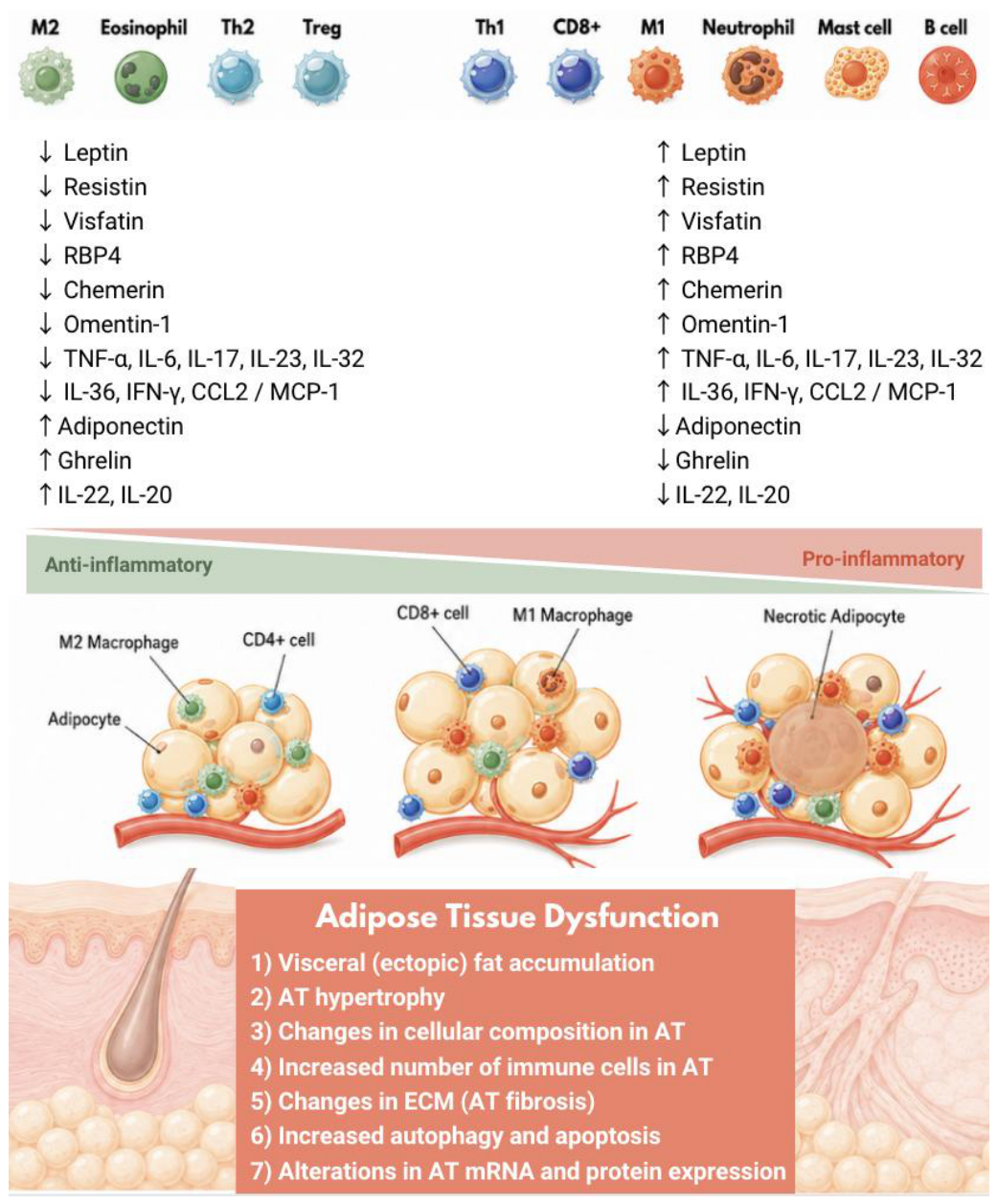
Figure 3.
Multi-Organ Pleiotropic Mechanisms and Target Organ Systems of GLP-1 Receptor Agonist Therapy in Hidradenitis Suppurativa. Schematic overview of the multisystem physiological actions mediated by glucagon-like peptide-1 receptor agonists (GLP-1RAs) across key organ axes relevant to systemic metainflammation and hidradenitis suppurativa pathogenesis. Brain: Activation of POMC/CART neurons in hypothalamic satiety centers reduces appetite, enhances satiety, suppresses reward-driven food cravings, and dampens central neuroinflammation. Heart: Cardioprotection is mediated through enhanced endothelial function, nitric oxide-dependent vasodilation, and myocardial contractility, leading to reductions in subclinical atherosclerosis and major adverse cardiovascular events (MACE). Pancreas: GLP-1RAs suppress glucagon secretion, enhance glucose-dependent insulin secretion, and promote pancreatic β-cell survival and proliferation. Muscles: GLP-1RAs attenuate peripheral insulin resistance, upregulate insulin receptor signaling, and enhance skeletal muscle glucose uptake. Adipose Tissue: GLP-1RAs suppress metainflammation, reduce crown-like M1 macrophage infiltration and pro-inflammatory cytokine/adipokine secretion (leptin, resistin, visfatin), upregulate anti-inflammatory adiponectin, and enhance lipolysis and energy expenditure. Kidney: GLP-1RAs reduce albuminuria, fibrotic progression, and renal oxidative stress while increasing renal perfusion, diuresis, and natriuresis. Gastrointestinal Tract: GLP-1RAs delay gastric emptying, inhibit peristaltic motility and acid secretion, upregulate vagal afferent signaling, enhance mucosal barrier tight-junction integrity, restore gut microbiome homeostasis, and enhance short-chain fatty acid (SCFA) and bile acid sensing. Liver: GLP-1RAs suppress hepatic gluconeogenesis, de novo lipogenesis, and steatosis-associated endoplasmic reticulum stress and increase hepatic FGF21 secretion.
Figure 3.
Multi-Organ Pleiotropic Mechanisms and Target Organ Systems of GLP-1 Receptor Agonist Therapy in Hidradenitis Suppurativa. Schematic overview of the multisystem physiological actions mediated by glucagon-like peptide-1 receptor agonists (GLP-1RAs) across key organ axes relevant to systemic metainflammation and hidradenitis suppurativa pathogenesis. Brain: Activation of POMC/CART neurons in hypothalamic satiety centers reduces appetite, enhances satiety, suppresses reward-driven food cravings, and dampens central neuroinflammation. Heart: Cardioprotection is mediated through enhanced endothelial function, nitric oxide-dependent vasodilation, and myocardial contractility, leading to reductions in subclinical atherosclerosis and major adverse cardiovascular events (MACE). Pancreas: GLP-1RAs suppress glucagon secretion, enhance glucose-dependent insulin secretion, and promote pancreatic β-cell survival and proliferation. Muscles: GLP-1RAs attenuate peripheral insulin resistance, upregulate insulin receptor signaling, and enhance skeletal muscle glucose uptake. Adipose Tissue: GLP-1RAs suppress metainflammation, reduce crown-like M1 macrophage infiltration and pro-inflammatory cytokine/adipokine secretion (leptin, resistin, visfatin), upregulate anti-inflammatory adiponectin, and enhance lipolysis and energy expenditure. Kidney: GLP-1RAs reduce albuminuria, fibrotic progression, and renal oxidative stress while increasing renal perfusion, diuresis, and natriuresis. Gastrointestinal Tract: GLP-1RAs delay gastric emptying, inhibit peristaltic motility and acid secretion, upregulate vagal afferent signaling, enhance mucosal barrier tight-junction integrity, restore gut microbiome homeostasis, and enhance short-chain fatty acid (SCFA) and bile acid sensing. Liver: GLP-1RAs suppress hepatic gluconeogenesis, de novo lipogenesis, and steatosis-associated endoplasmic reticulum stress and increase hepatic FGF21 secretion.
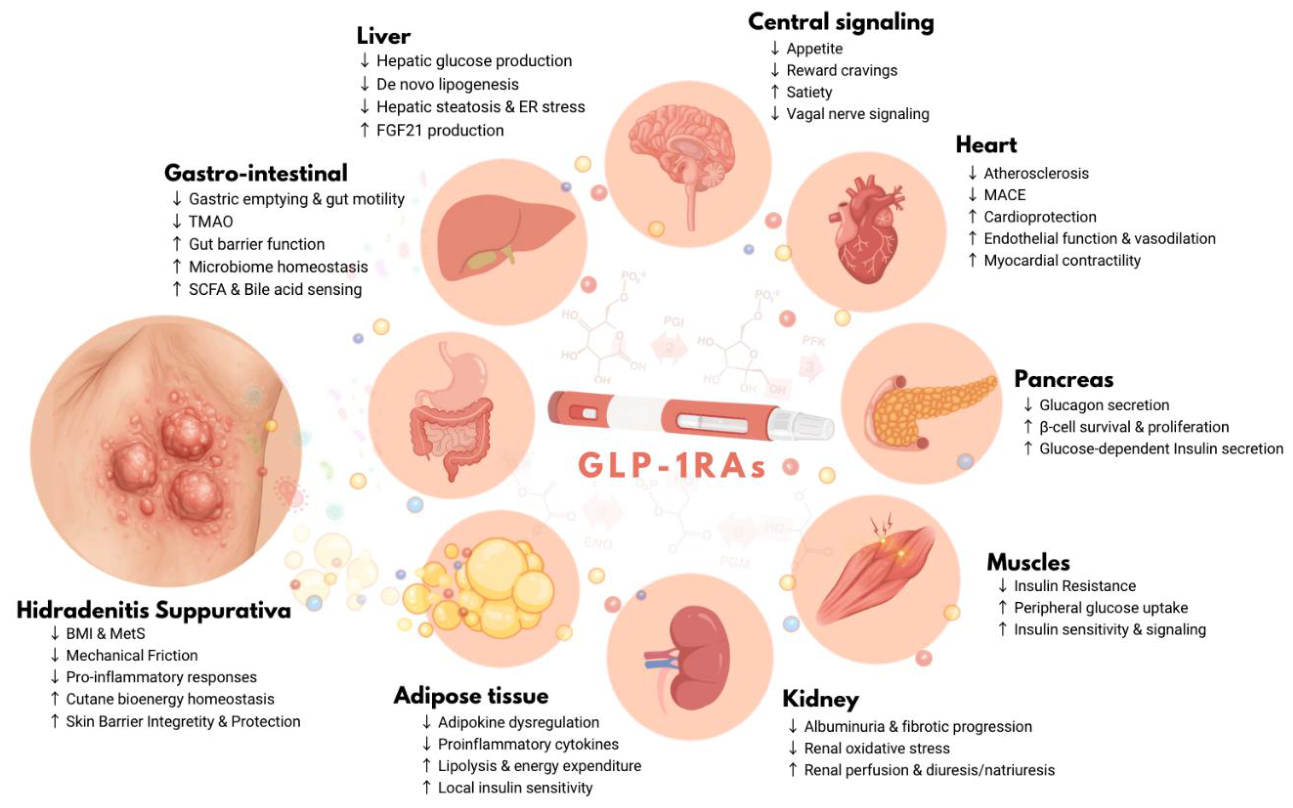

Table 1.
Adipokines and Biomarkers with Proposed Immunomodulatory Mechanisms in Hidradenitis Suppurativa.
Table 1.
Adipokines and Biomarkers with Proposed Immunomodulatory Mechanisms in Hidradenitis Suppurativa.
| Adipokine / Biomarker | Circulating Level in HS | Primary Target Pathway & Cutaneous Mechanism | Independence from BMI |
|---|---|---|---|
|
Leptin [36,65] |
Elevated |
Activates JAK2/STAT3, PI3K/Akt & MAPK/ERK; drives Th1/Th17 polarization and pro-inflammatory cytokine release. |
No, correlates with BMI |
| Adiponectin [36,65] |
Reduced |
Normally activates AMPK and suppresses NF-κB; loss disinhibits baseline restraint on TNF-α and IL-6. |
Yes, reduced independently of BMI |
|
Retinol-Binding Protein 4 [36] |
Elevated |
Inhibits adipocyte insulin signaling via macrophage inflammatory mediator release; significantly increases HS risk and acts as an independent risk factor for the development of HS. |
Yes, correlates independently with Hurley & HOMA-IR |
|
Resistin & Visfatin [3,36] |
Elevated |
Activates NF-κB in dermal macrophages & keratinocytes; amplifies TNF-α, IL-1β, and IL-6 release; independent risk factors for HS. |
Yes, independent risk factor regardless of BMI |
|
Chemerin [57,113] |
Elevated |
Acts via CMKLR1 to recruit plasmacytoid dendritic cells (pDCs), monocytes, and NK cells to inflamed tissue; upregulated in HS lesions. |
No, correlates with BMI |
|
Omentin-1 [3,57] |
Elevated |
Secreted by visceral stromal-vascular fraction; paradoxically elevated in HS; enhances IL-1β signaling, driving dermal neutrophil recruitment. |
No, elevated independently of BMI, age, sex & T2D |
Abbreviations: Akt, protein kinase B; AMPK, AMP-activated protein kinase; BMI, body mass index; CMKLR1, chemerin chemokine-like receptor 1; ERK, extracellular signal-regulated kinase; HOMA-IR, Homeostatic Model Assessment of Insulin Resistance; HS, hidradenitis suppurativa; IL, interleukin; JAK2, Janus kinase 2; MAPK, mitogen-activated protein kinase; NF-κB, nuclear factor kappa B; NK, natural killer; pDCs, plasmacytoid dendritic cells; PI3K, phosphoinositide 3-kinase; STAT3, signal transducer and activator of transcription 3; T2D, type 2 diabetes; Th1, T helper 1; Th17, T helper 17; TNF-α, tumor necrosis factor alpha.
Table 2.
Systemic Metabolites, Acute-Phase Reactants, and Gut-Derived Mediators in Hidradenitis Suppurativa.
Table 2.
Systemic Metabolites, Acute-Phase Reactants, and Gut-Derived Mediators in Hidradenitis Suppurativa.
| Biomarker / Metabolite | Physiological Classification | Alteration in HS | Pathophysiological Mechanism | Independence from BMI |
|---|---|---|---|---|
|
CRP [3,45,106] |
Hepatic Acute-Phase Reactant (IL-6 Driven) | Elevated | Secreted by hepatocytes upon IL-6, IL-1-beta, and TNF-alpha stimulation correlates with IHS4 severity, and cardiovascular risk. | Yes, elevated in HS across BMI categories, amplified by obesity |
| Haptoglobin [89,90] |
Adipocyte-Expressed Acute-Phase Glycoprotein | Elevated | Strongest independent marker for Hurley III; links metainflammation with reduced β-cell function & HbA1c. | Yes, strongest independent marker for Hurley III & MetS |
|
Midkine [15] |
Heparin-Binding Growth Factor | Elevated | Correlates with BMI, waist circumference, triglycerides, and MetS; no difference across Hurley stages. | No, positively correlates with BMI, waist & MetS parameters |
|
Pan-Immune-Inflammation Value [45,90] |
Composite Cellular Inflammatory Index | Elevated | Calculated as (neutrophils × platelets × monocytes) / lymphocytes; correlates with Hurley stages I–III & MetS. | Yes, associated with MetS risk |
|
Short-Chain Fatty Acids [27,101] |
Gut Microbiome-Derived Metabolites | Reduced | Depletion impairs gut mucosal barrier, predisposing to LPS endotoxemia & reduced GLP-1 secretion. | Yes, depleted independently of BMI |
|
TMAO [8,104] |
Hepatic-Microbial Metabolite | Elevated | Correlates strongly with Sartorius score (r = 0.570); reflects insulin resistance & endothelial stress. | Yes, elevated independently of BMI |
|
Tryptophan Catabolism & AHR Axis [38,98,108] |
Essential Amino Acid & Host-Microbiota Crosstalk Pathway | Reduced | Local IDO1/TDO overactivation in lesional skin shunts tryptophan down kynurenine pathway; reduces bacterial indoles (IAA), depriving AHR of ligands and compromising epidermal barrier integrity. | Yes, proven in plasma & tissue biopsies |
Abbreviations: AHR, aryl hydrocarbon receptor; BMI, body mass index; CRP, C-reactive protein; GLP-1, glucagon-like peptide-1; HbA1c, glycated hemoglobin A1c; HS, hidradenitis suppurativa; IAA, indole-3-acetic acid; IDO1, indoleamine 2,3-dioxygenase 1; IHS4, International Hidradenitis Suppurativa Severity Score System; IL-1β, interleukin-1 beta; IL-6, interleukin-6; LPS, lipopolysaccharide; MetS, metabolic syndrome; SCFAs; TDO, tryptophan 2,3-dioxygenase; TMAO, trimethylamine N-oxide; TNF-α, tumor necrosis factor alpha.
Table 3.
Overview and Proposed positioning of metabolic interventions in HS.
| Pharmacological Class | Agents | Potential Key Mechanisms | Proposed positioning | Clinical Effects | Key Considerations | Evidence Level |
|---|---|---|---|---|---|---|
| Biguanide [5,105] | Metformin | AMPK activation, mTORC1 inhibition, androgen reduction, Warburg shift inhibition. | First-Line Adjunct: Early/moderate HS, PCOS, adolescent onset, lean/normal weight. | Moderate CRP & TNF-α reduction. Moderate weight loss. | GI adverse effects. Periodic B12 monitoring required. High safety, low cost. |
OCEBM Level 4: Moderate observational evidence consisting of clinical cohorts and case-control studies. |
|
GLP-1 RA [53,77] |
Semaglutide, Liraglutide | GLP-1R activation, POMC satiety signaling, NF-κB suppression, friction relief. | Precision Adjunct: Moderate-severe HS with obesity (BMI ≥ 30) or T2DM. | Weight-loss. Reductions in leukocytes and ESR; variable impact on CRP. |
Dose-dependent GI adverse effects. Limited availability. |
OCEBM Level 4: Extensive observational data and small clinical cohorts, systematic review. |
|
Dual GLP-1/GIP RA [16,51] |
Tirzepatide | Dual GLP-1 & GIP receptor activation, lipid buffering, M1 macrophage suppression. | Severe HS/ Severe obesity: Refractory HS, biologic failure. | Profound weight loss. Suppresses systemic metainflammation. |
Dose-dependent GI adverse events. Limited availability. |
OCEBM Level 4: Very limited clinical data in HS literature. Primarily based on case reports |
|
Triple Agonist [52,95] |
Retatrutide | GLP-1 + GIP + Glucagon co-agonism, hepatic lipid clearance, thermogenesis. | Emerging 3rd-Gen Therapy: Complex MetS, MASLD, severe obesity & refractory HS. | Maximal weight loss. Clears hepatic fat & metainflammation. | Ongoing phase 3 trials. Requires heart rate & GI monitoring. |
OCEBM Level 5: Translational hypothesis and indirect clinical data from trials in obesity. No HS-specific clinical data available. |
|
PPAR-γ Agonist [70] |
Pioglitazone | PPAR-γ activation, adiponectin elevation, macrophage NF-κB inhibition. | Potential future Adjunct: HS with MASLD or severe insulin resistance without obesity (investigational). | Marked Adiponectin elevation. Suppresses pro-inflammatory cytokines in vitro. | Fluid retention & peripheral edema. Risk of heart failure exacerbation. Fracture risk. |
OCEBM Level 5: Translational preclinical and mechanistic hypothesis. No HS-specific clinical data available. |
|
SGLT-2 Inhibitor [17,67] |
Dapagliflozin, Empagliflozin | Selective renal SGLT-2 inhibition, glucosuria, NLRP3 inflammasome suppression. |
Precision Adjunct: HS with high CVD/ CKD risk. HS with type 2 diabetes, hypertension. |
Long-term cardiorenal protection & reduced all-cause mortality. Mild weight loss. |
Risk of mycotic genital infections. High cardiorenal safety. Requires caution in active perineal HS. |
OCEBM Level 4-5: Large retrospective registry study on favorable cardiometabolic outcomes. No HS-specific cutaneous outcomes. |
Abbreviations: AMPK, AMP-activated protein kinase; BMI, body mass index; CKD, chronic kidney disease; CRP, C-reactive protein; CVD, cardiovascular disease; ESR, erythrocyte sedimentation rate; GI, gastrointestinal; GIP, glucose-dependent insulinotropic polypeptide; GLP-1, glucagon-like peptide-1; GLP-1R, glucagon-like peptide-1 receptor; GLP-1 RA, glucagon-like peptide-1 receptor agonist; HS, hidradenitis suppurativa; MASLD, metabolic dysfunction-associated steatotic liver disease; MetS, metabolic syndrome; mTORC1, mechanistic target of rapamycin complex 1; NF-κB, nuclear factor kappa B; NLRP3, NOD-, LRR- and pyrin domain-containing protein 3; OCEBM, Oxford Centre for Evidence-Based Medicine; PCOS, polycystic ovary syndrome; POMC, pro-opiomelanocortin; PPAR-γ, peroxisome proliferator-activated receptor gamma; SGLT-2, sodium-glucose cotransporter 2; T2DM, type 2 diabetes mellitus; TNF-α, tumor necrosis factor alpha.
Disclaimer/Publisher’s Note: The statements, opinions and data contained in all publications are solely those of the individual author(s) and contributor(s) and not of MDPI and/or the editor(s). MDPI and/or the editor(s) disclaim responsibility for any injury to people or property resulting from any ideas, methods, instructions or products referred to in the content. |
© 2026 by the authors. Licensee MDPI, Basel, Switzerland. This article is an open access article distributed under the terms and conditions of the Creative Commons Attribution (CC BY) license (http://creativecommons.org/licenses/by/4.0/).
Copyright: This open access article is published under a Creative Commons CC BY 4.0 license, which permit the free download, distribution, and reuse, provided that the author and preprint are cited in any reuse.