

Submitted:
17 August 2026
Posted:
19 August 2026
You are already at the latest version
Abstract
Background/Objectives. Mobile phone-based vaccination interventions, including SMS reminders, voice calls and tracking applications, have repeatedly shown effectiveness in controlled settings across sub-Saharan Africa. Many nevertheless stop operating once project funding ends and do not become part of the routine health systems they were intended to strengthen. This study aimed to develop a preliminary evidence-informed conceptual framework explaining the multilevel conditions required to embed mobile vaccination interventions within routine immunization systems in sub-Saharan Africa. Methods. A systematic evidence synthesis was undertaken to inform framework development. Six scientific databases (PubMed/MEDLINE, CINAHL, EMBASE, Epistemonikos, Web of Science and Global Health) were searched for studies published between January 2014 and April 2024. Selection followed the PRISMA 2020 statement, methodological quality was appraised with the Mixed Methods Appraisal Tool (MMAT, 2018 version), and implementation conditions were synthesized thematically through an iterative framework-development process. Results. Eighteen of 913 identified records were included. Four interdependent domains formed the preliminary Mobile Vaccination Embedding (MOVE) framework: user readiness (acceptability, trust and digital literacy among caregivers and providers); technological reliability (network coverage, electricity access and device sustainability); organizational integration (staff training, workflow adaptation and health worker adherence); and system governance (policy frameworks, multisectoral partnerships, financing and integration into national Expanded Programme on Immunization structures). Together, these domains describe the conditions shaping progression from adoption to institutionalization. Conclusions. The primary contribution of this study is the preliminary evidence-informed MOVE framework, which shifts attention from whether mobile vaccination interventions are effective to whether health systems possess the capacity to embed and sustain them. The framework requires prospective refinement, empirical testing and validation across diverse health-system contexts.
Keywords:
childhood vaccination
; mobile health
; mHealth
; immunization
; sub-Saharan Africa
; implementation science
; institutionalization
; systematic review
1. Introduction
Childhood vaccination remains one of the most cost-effective public health interventions available for reducing avoidable morbidity and mortality in children [1,2]. In sub-Saharan Africa, however, decades of investment in immunization programs have not brought coverage to the levels set by the World Health Organization (WHO) [3]. Coverage for the third dose of diphtheria-tetanus-pertussis vaccine (DTP3) stood at approximately 70% in the African region in 2021, twenty percentage points below the 90% global target, and national averages conceal wide disparities between and within countries, including along household wealth lines [4].
Mobile technologies have been proposed as a way of strengthening coverage where access to health services is limited [5]. They allow health systems and caregivers to communicate in near real time, which makes it possible to send appointment reminders, trace defaulters and support the supervision of health workers. Randomized trials conducted in low-resource settings report gains in both the completeness and the timeliness of vaccination. In Ethiopia, infants whose caregivers received text message reminders completed the full schedule more often than those in the control arm [6]; the protocol for that trial had been published by the same team [6]. Comparable effects have been described in Kenya [7,8,9] and Burkina Faso [10], and a meta-analysis of trials conducted in low- and middle-income countries reports consistent gains in uptake, completeness and timeliness [11]. A protocol addressing the same question in Tanzania has also been published [12].
The systematic reviews published so far have mostly assembled barriers and facilitators of mobile vaccination interventions as discrete lists: technical constraints on one side, acceptability issues and enabling conditions on the other [13,14,15,16,17,18]. That approach generated useful early evidence, but it leaves a prior question unanswered: why do some mobile vaccination interventions become embedded in routine immunization systems while others remain pilot projects or stop operating once external funding ends?
The difference between adoption and institutionalization matters for implementation science and for practice alike. An intervention adopted within a controlled trial may produce significant outcomes under study conditions and remain structurally disconnected from the health system that hosted it. Institutionalization, understood here as the process by which an intervention becomes a stable and self-sustaining component of routine service delivery, depends on conditions that reach well beyond initial user acceptance or technical feasibility. It requires alignment across several system levels at the same time.
This study therefore aimed to develop a preliminary evidence-informed conceptual framework explaining the conditions under which mobile vaccination interventions can become embedded within routine immunization systems in sub-Saharan Africa. To inform framework development, we systematically identified and thematically synthesized empirical evidence on the user, technological, organizational and governance conditions associated with sustained implementation. The guiding question was: what multilevel implementation conditions must be aligned for mobile vaccination interventions to progress from short-term adoption to institutionalization within routine immunization systems?
The eligibility criteria were structured using the PICO framework:
- Population (P): children of vaccination age and their caregivers, together with healthcare providers, in sub-Saharan Africa;
- Intervention (I): use of mobile phones to improve vaccination coverage, including SMS reminders, voice call reminders, tracking applications and information campaigns;
- Comparison (C): absence of intervention, or conventional interventions without a mobile technology component;
- Outcome (O): conditions, at user, technological, organizational and governance levels, that determine uptake, sustained implementation and embedding in routine vaccination systems.
2. Materials and Methods
The study was designed as a framework-development project informed by a systematic evidence synthesis. The evidence-identification and selection stages followed the PRISMA 2020 statement[19] to ensure methodological rigor and transparency. A comprehensive search strategy was developed and applied to six scientific databases: PubMed/MEDLINE, CINAHL, EMBASE, Epistemonikos, Web of Science and Global Health. No prospective review registration was undertaken because the systematic search and synthesis were conducted to support development of the MOVE conceptual framework rather than as an effectiveness review.
2.1. Definition of Concepts
Vaccine. A biological preparation designed to stimulate the immune system to generate antigen-specific immunity against a pathogen and prevent the disease it causes [3].
Vaccination coverage. The proportion of individuals in a target population who have received a specified vaccine or vaccine series within a defined period [3]. Vaccination coverage is a key indicator used to monitor the performance of immunization programmes and population protection.
Barrier. In this study, a barrier was operationally defined as any individual, technological, organizational or system-level condition that hinders the adoption, sustained implementation or institutionalization of a mobile vaccination intervention. This operational definition was informed by implementation science approaches that conceptualize implementation determinants as multilevel influences on intervention delivery [20].
Facilitating factor. In this study, a facilitating factor was operationally defined as any condition that supports the adoption, continued delivery or integration of a mobile vaccination intervention into routine services. For the purposes of framework development, facilitating factors were interpreted as potential embedding conditions rather than merely determinants of initial uptake.
Institutionalization (embedding). Institutionalization was defined as the process through which a mobile vaccination intervention becomes integrated into routine structures, organizational practices, financing arrangements and governance mechanisms such that its continued delivery no longer depends primarily on temporary project funding or external technical support [21,22,23]. In this manuscript, the terms institutionalization and embedding are used interchangeably.
2.2. Inclusion and Exclusion Criteria
Selection was limited to empirical articles published in French or English that examined mobile phone-based interventions for childhood vaccination and reported implementation barriers, facilitating factors, or conditions relevant to their adoption, sustained implementation, or integration within health systems in sub-Saharan Africa.
2.3. Study Selection
Records were imported into Rayyan (https://www.rayyan.ai) for screening. Selection proceeded stepwise based on the research question and the eligibility criteria. Titles and abstracts were first screened independently by three reviewers. Records passing this stage were read in full. Disagreements over eligibility were settled by consensus among the reviewers. Eighteen studies were retained (Figure 1): fifteen quantitative and three qualitative.
2.4. Data Extraction and Analysis
Rayyan was also used to organize the corpus, remove duplicates and manage the selection process. Data extraction followed a structured grid covering study design, country, population, type of mobile intervention, implementation context, reported conditions (facilitators and barriers) and outcomes.
Thematic synthesis was used to identify patterns across studies. Implementation-related findings were first coded inductively without imposing predetermined categories. Conceptually similar findings were then grouped and compared across studies. The emerging categories were subsequently organized according to the level of the health system at which they operated and examined in relation to the distinction between initial adoption, sustained implementation and institutionalization.
2.5. Framework Development
Framework development proceeded iteratively. First, implementation-related findings extracted from each study were examined for recurrent concepts and mechanisms. Second, conceptually similar findings were consolidated into candidate domains. Third, the candidate domains were compared across studies and organized according to the health-system level at which they operated. Fourth, relationships among the domains were examined to identify the conditions distinguishing initial adoption from sustained implementation and institutionalization. This process generated four interdependent domains: user readiness, technological reliability, organizational integration and system governance. These domains are designated as levels (L1–L4) in the tables and figures that follow, reflecting the health-system level at which each operates. The preliminary framework was refined through repeated comparison with the included studies and discussion among the review team. It should be understood as an evidence-informed conceptual model requiring prospective testing rather than as a validated implementation theory.
2.6. Study Quality Assessment
Methodological quality was appraised with the 2018 version of the Mixed Methods Appraisal Tool (MMAT) [24], chosen because it accommodates qualitative, quantitative and mixed methods designs within a single review. Two reviewers appraised each study independently and resolved discrepancies by discussion. The MMAT yields a profile of methodological strengths and limitations rather than a numerical score. No study was excluded on quality grounds; quality information was instead used to calibrate confidence in individual findings.
3. Results
3.1. Study Selection
The database searches returned 913 records. After removal of duplicates, 814 titles and abstracts were screened, and 50 articles were read in full. Eighteen met all inclusion criteria and were retained for analysis (Figure 1).
3.2. Characteristics of the Included Studies
Ten of the eighteen studies were conducted in Nigeria [25,26,27,28,29,30,31,32,33,34] and four in Ethiopia [6,35,36,37]; Burkina Faso[10], Côte d’Ivoire[23], Zambia[38] and Ghana[39] contributed one each. Six were randomized controlled trials[6,23,26,30,32,39], four cross-sectional surveys[25,27,33,36], three observational studies[29,31,38], three qualitative studies[34,35,37] and two quasi-experimental evaluations[10,28]. SMS reminders were the dominant modality, either alone or combined with voice calls, financial incentives or supplementation services; the remaining interventions involved electronic immunization registries, routine immunization data management tools and group messaging platforms. Table 1 summarizes the characteristics of each study and the MOVE levels it informs.
3.3. Methodological Quality
Ten studies were rated good and eight satisfactory (Table 2). Reporting was consistently strong for the clarity of the research question and the adequacy of the data collected. The recurrent weakness across the cross-sectional and observational studies concerned the representativeness of samples and the handling of incomplete outcome data. No study was excluded on quality grounds.
3.4. Level 1: User Readiness
User readiness covers the individual-level conditions, among caregivers, parents and frontline health workers, that determine whether a mobile vaccination intervention is accepted, trusted and used consistently over time. Where it is lacking, the demand-side uptake required for institutionalization does not materialize.
3.4.1. Acceptability Among Caregivers
Five studies examined the acceptability of SMS or voice call reminders for childhood vaccination [10,26,28,32,35]. Acceptability was generally high in Nigeria, Ethiopia and Burkina Faso: most caregivers described reminder messages as useful, understandable and compatible with their existing practices. In Ondo State, Nigeria, caregivers attending immunization clinics widely reported being willing to receive SMS reminders for vaccination appointments [25], and in a multi-state survey of rural mothers 90.5% expressed the same willingness [27]. In Ethiopia, acceptability was closely associated with prior exposure to mobile phone-based health communication [35].
Acceptability was not evenly distributed. Differences appeared by education, age and previous experience with mobile phones. Women with limited literacy and older caregivers were more hesitant, less because they objected to the principle than because engaging with text-based content was difficult for them. The distinction between conceptual acceptability (agreeing that a service is useful) and operational readiness (being able to use it in practice) is therefore worth maintaining.
3.4.2. Trust and Perceived Value
Acceptability was bound up with trust, both in the technology and in the health system delivering it. In Côte d’Ivoire and Burkina Faso, caregivers who saw the messages as coming from a recognized health authority acted on them more often [10,23]. Concerns about data privacy and unsolicited messaging reduced engagement in some settings, particularly in urban areas where participants were more exposed to commercial spam [40].
3.4.3. Digital and Health Literacy
Literacy, digital as well as health-related, was identified in several studies as a decisive condition of user readiness. Illiteracy made text-based SMS interventions inaccessible to a substantial share of the target population in rural areas of Ethiopia [6,34,35]. Interventions that adapted messages to local languages, used voice formats or simplified visual content reached consistently wider audiences. Delivery in the caregiver’s mother tongue was among the most frequently reported enabling conditions across contexts, and caregivers with low literacy expressed a clear preference for audio formats [36].
Provider readiness mattered just as much. Whether health workers were comfortable with mobile tools, confident in explaining them to caregivers and motivated to use digital tracking systems shaped how far interventions realized their potential. Studies from Ethiopia and Nigeria found frontline workers supportive of reminder systems when these were seen as reducing administrative burden, and resistant when they were seen as adding tasks without corresponding support [34,35,37].
3.5. Level 2: Technological Reliability
Technological reliability covers the technical and infrastructural conditions that determine whether a mobile intervention functions consistently enough to be relied upon within routine service delivery.
3.5.1. Network Coverage and Connectivity
Four studies reported that limited mobile network coverage was a fundamental constraint on implementation [6,10,28,35]. In rural and peri-urban areas of Ethiopia, Nigeria and Burkina Faso, irregular signal meant that messages were often delayed or never delivered, which undermined caregivers’ confidence in the system. The consequence was most serious for time-sensitive reminders, where a failed delivery could translate directly into a missed appointment. Repeated unreliability also eroded health workers’ willingness to maintain the supporting infrastructure.
3.5.2. Electricity Access and Device Sustainability
Access to reliable electricity for charging emerged as a structural constraint, particularly in rural areas [35]. Caregivers with limited access to power described managing battery life around reminder schedules as an additional burden. Some rural facilities lacked the steady supply needed to charge the device banks used in health worker-managed systems. Interventions that included solar charging or worked with community charging points reached further in off-grid settings, although these arrangements added a continuing logistical requirement.
3.5.3. Phone Ownership and Access
Phone ownership has grown across sub-Saharan Africa but remains unevenly distributed. Studies in rural Ethiopia and Kenya found that an appreciable proportion of caregivers owned no mobile phone, shared a handset with other household members, or owned only a basic handset incompatible with smartphone applications [36,41]. Sharing raised practical questions, such as which number to register, and social ones, particularly for women in households where access to the phone was controlled by male relatives. Interventions that presupposed individual ownership reached fewer people than those drawing on community phone pools or on the handsets already used by community health workers.
3.5.4. Maintenance of Technical Systems
Beyond the deployment phase, the functioning of mobile vaccination systems depended on continuing maintenance: software updates, SIM card management, database upkeep and troubleshooting. Several studies observed that technical failures accumulated once interventions moved past the active project period and no mechanism for sustained technical support remained. In Nigeria and Zambia, the quality of health information system data, on which accurate targeting of reminders depends, deteriorated where data entry rested on health workers already carrying heavy workloads [29,38].
3.6. Level 3: Organizational Integration
Organizational integration covers the conditions within facilities and health systems that determine whether mobile vaccination interventions are absorbed into existing workflows, staffing structures and service delivery routines. Even where user readiness and technological reliability are adequate, interventions fail to embed when organizations lack the structures to carry them.
3.6.1. Staff Training and Capacity
The capacity of health workers to operate and troubleshoot mobile tools was among the most frequently cited organizational conditions. In Nigeria, Côte d’Ivoire and Ethiopia, the absence of training on mobile health platforms was reported as a leading institutional barrier [23,34]. Workers who received structured training covering platform use, explanation to caregivers and resolution of common problems were considerably more likely to sustain use. Interventions deployed without accompanying training were often discontinued soon after an initial period of enthusiasm, once staff met difficulties they had no means of resolving.
The quality of training mattered as much as its quantity. One-off training events produced competence that decayed quickly, especially where staff turnover was high. Training delivered within continuous supervision cycles, with peer coaching, monthly review meetings and refresher sessions linked to performance data, maintained competence better over time [34,35].
3.6.2. Workflow Integration and Task Burden
Health worker adherence depended largely on whether the intervention was experienced as an addition to an already heavy workload or as a tool that simplified routine tasks. In Ethiopia and Nigeria, workers sustained use of reminder systems when these reduced manual tracking, for instance by automating the identification of defaulters that had previously required lengthy register reviews [6]. Systems requiring double data entry, adding administrative steps, or failing to connect with existing paper registers generated friction that wore adherence down.
3.6.3. Supervision and Management Commitment
Active engagement by managers was repeatedly identified as an enabling condition. Facility managers who promoted the tools, attended training, reviewed usage data in team meetings and helped resolve problems created environments in which staff engagement lasted longer [23,34]. Supervisory arrangements that gave explicit attention to intervention performance, for example regular data review meetings where reminder delivery rates were discussed alongside coverage results, supported organizational learning [29].
3.6.4. Operational Multisectoral Collaboration
Collaboration at facility and district level, and particularly between health authorities and telecommunications operators, was emphasized in two studies [25,35]. Technical reliability improved where telecom partners took part in the early design of message delivery infrastructure. Adoption was faster and more durable where district health managers were partners in intervention governance rather than recipients of it.
3.7. Level 4: System Governance
System governance covers the macro-level conditions of policy frameworks, financing mechanisms, integration into national programs and cross-sectoral partnerships. Without them, successes achieved at user, technical and organizational level remain fragile and geographically confined.
3.7.1. Policy Frameworks and National Integration
The most durable interventions were those written into national Expanded Programme on Immunization (EPI) frameworks, with explicit policy recognition and standard operating procedures. Studies from Nigeria and Ethiopia identified the absence of national guidelines for mobile vaccination as a barrier to institutionalization: without policy anchoring, interventions depended on project-specific protocols that varied between facilities and districts and could be neither scaled nor monitored systematically [25,34].
Interventions formally incorporated into national EPI strategies, with defined roles, responsibilities and performance indicators, proved more resilient to staff turnover, leadership change and funding transitions. Policy integration also allowed alignment with national health information systems, so that reminder data contributed to routine program monitoring instead of remaining in project databases.
3.7.2. Financing and External Dependency
A recurring finding was the vulnerability of these interventions to the end of project funding. Programs financed by international organizations, research grants or time-limited donor schemes frequently ceased at closure, including several that had demonstrated effectiveness. Demonstrated effectiveness is therefore not sufficient for institutionalization, and financial sustainability must be planned from the outset. Studies pointed to three ways of reducing dependency on external financing: incorporation of intervention costs into routine national health budgets, agreements with telecommunications companies to obtain subsidized messaging, and inclusion in national digital health financing frameworks [30,39]. Cost analyses of national eHealth programmes provide the evidence needed for such budget negotiations [42].
3.7.3. Strategic Multisectoral Partnerships
National partnerships between health ministries and telecommunications operators were identified as a governance condition. They made possible preferential messaging rates, technical support agreements and coordinated planning that could not be negotiated at facility or district level. Early engagement of telecom partners in intervention design, so that delivery infrastructure was built for scale rather than retrofitted, and formal memoranda of understanding extending beyond individual project cycles, were both highlighted [25,31].
3.7.4. Data Governance and Health Information Systems
Integration of mobile vaccination data into national health information systems, particularly the District Health Information Software (DHIS2) or its equivalents, emerged as a governance condition with practical consequences. Reminder systems that remained separate from routine health information infrastructure generated parallel data streams, which added to health worker burden and could not feed national program monitoring. In Nigeria and Ethiopia, interventions integrated with DHIS2 showed better long-term data quality and were more readily recognized by national program managers as contributions to routine immunization monitoring [6,34,38].
3.8. Synthesis of Implementation Conditions
Table 3 maps the conditions identified at each level onto the studies that document them and states the implication of each level for embedding.
4. Discussion
The principal contribution of this study is the development of the preliminary Mobile Vaccination Embedding (MOVE) framework, an evidence-informed conceptual model explaining why some mobile vaccination interventions remain effective pilot projects while others become embedded within routine immunization systems. Rather than treating barriers and facilitators as separate lists, MOVE organizes the evidence into four interdependent domains that together shape institutionalization potential.
4.1. The MOVE Framework
The framework holds that the institutionalization of mobile vaccination interventions in sub-Saharan Africa is governed by conditions operating at four interdependent levels: user readiness, technological reliability, organizational integration and system governance (Figure 2). The levels are presented in sequence for clarity, but they function as mutually reinforcing requirements: a deficit at any one of them limits embedding potential regardless of what has been achieved at the others.
MOVE is not offered as a validated implementation theory. It should be regarded as a preliminary evidence-informed conceptual framework derived from the available empirical literature. Its current value lies in providing program designers, researchers and health-system managers with a structured way of assessing institutionalization potential before, during and after deployment. Prospective application is needed to test, refine and validate its domains and their relationships.
4.2. User Readiness as a Foundational Condition
The high acceptability reported across studies is necessary but not sufficient. Acceptability indicates whether caregivers and providers will engage with an intervention at the outset; it says nothing about whether that engagement will last or whether the intervention will be absorbed into routine practice. Programs that treat early acceptability rates as a measure of success are therefore liable to overestimate their embedding potential. Work on caregiver preferences points in the same direction: parents in northern Nigeria expressed clear priorities among alternative interventions to improve immunization uptake [43], and qualitative work with caregivers and health workers has shown that the perceived quality of vaccination communication depends on more than the channel through which it travels [44].
Constraints of digital and health literacy carry a design implication: interventions should be built for the least literate member of the target population rather than for the modal user. Voice-based reminders in local languages achieved wider and more equitable reach than text messages in several studies, a finding of direct relevance to settings with high rates of adult illiteracy. Building health literacy alongside technical delivery is a condition of sustained user readiness rather than an optional addition.
4.3. Technological Reliability as a Prerequisite for Institutionalization
Connectivity is a prerequisite for institutionalization because it determines whether providers and caregivers can treat the intervention as a predictable part of service delivery. An intervention whose messages arrive intermittently does more than fail to deliver reminders: it damages the trust on which embedding depends. Health workers who meet repeated technical failures maintain fidelity less well, and caregivers who receive unreliable reminders act on them less often. Feasibility work in low-resource settings has made the same point about the practical prerequisites of reminder and recall systems [44].
Assessment of technological infrastructure should therefore precede deployment. Interventions introduced where infrastructure is inadequate are better designed as bridging strategies pending improvement than as durable delivery mechanisms. Where infrastructure is improving quickly, as it is across much of sub-Saharan Africa, staged deployment reassessed against connectivity thresholds is a reasonable compromise.
4.4. Organizational Integration as the Point of Transition
The most consistent finding of this synthesis is that organizational integration, and within it staff training, workflow embedding and management commitment, marks the transition between adoption and institutionalization. Interventions rarely fail at the user level, where acceptability is generally high, or at the technical level, where problems can be addressed through investment. They fail at the organizational level, where the absence of sustained support allows initial adoption to decay into abandonment. Experience with digital tracking tools elsewhere is consistent with this: an application for monitoring immunization performance and retrieving defaulters proved operable and well received in a low-income setting, but its value depended on how it fitted the work of the staff using it [45]. Similar observations have been reported in hard-to-reach rural and urban settings outside the region [45], and in the coordination of immunization campaigns, where messaging platforms supported supervision only where reporting lines were already clear [31,46].
The implications for program design follow directly. Training belongs inside ongoing supervision cycles rather than in one-off events. Workflows should be co-designed with frontline staff so that mobile tools reduce rather than add to administrative work. Management commitment must be cultivated through leadership engagement and through performance measurement that makes use of the intervention visible. These organizational investments are not secondary to technical deployment; they determine whether it lasts.
4.5. System Governance as the Condition for Scale
Successes at individual, facility and district level remain fragile without governance arrangements that anchor them in national systems. The pattern of effective pilots ceasing at the end of project funding follows directly from the absence of such arrangements. Programs succeed within bounded conditions and fail to institutionalize because no policy, financing mechanism or information system carries them past the project boundary.
Governance conditions should accordingly be assessed and addressed when an intervention intended for scale is designed, not once effectiveness has been shown at small scale. Advocacy for policy recognition, negotiation of sustainable financing, formal partnership agreements with telecommunications operators and deliberate integration with DHIS2 or its equivalents belong to responsible intervention design in this context rather than to an optional enhancement package.
4.6. Implications for Practice and Research
For implementers, MOVE provides a pre-deployment checklist. What is the baseline level of user readiness in the target population? How reliable is the delivery infrastructure at present? Which organizational structures are already in place, and which can realistically be built? What governance mechanisms will carry the intervention beyond project funding? Addressing these questions before deployment, and monitoring each level during implementation, would improve the long-term performance of mobile vaccination programs.
For researchers, the clearest evidence gaps concern organizational integration and system governance. User readiness and technological reliability are documented in reasonable depth. Far less is known about which training models, supervision structures and workflow designs sustain health worker engagement over time, or about which policy and financing mechanisms have successfully anchored mobile vaccination within national immunization programs. Prospective studies with longer follow-up and explicit attention to institutionalization outcomes, rather than to short-term coverage effects, are needed; trials designed in the region offer a starting point [47]. Mobile interventions should also be examined alongside the supply-side and service-delivery strategies with which they interact, such as vaccine stock management [48] and mobile outreach services [49].
Comparative case studies would be particularly valuable. Systematic comparison of interventions that embedded successfully with those that did not, within comparable health systems, would generate the kind of knowledge practitioners need when deciding how to design and scale a program.
4.7. Limitations
Several limitations apply. First, the search covered publications from January 2014 onward. The boundary was deliberate. Mobile-cellular subscriptions in Africa exceeded 60 subscriptions per 100 inhabitants by 2013[50]; and mobile health applications across the region were expanding rapidly over the same period [50]; the literature treating mobile vaccination as a program strategy rather than as an isolated feasibility exercise dates largely from that point. The technological context of earlier interventions, built on GPRS networks, unidirectional SMS and feature phones without data connectivity, differs enough from present conditions to make synthesis across the two periods difficult to interpret. Earlier pioneering studies therefore warrant separate treatment.
Second, the small number of studies meeting the criteria, 18 out of 913 records, reflects the emerging state of the evidence and limits the generalizability of the synthesis. Third, the predominance of quantitative designs constrains the depth of the available information on implementation: randomized trials reporting coverage outcomes rarely document the organizational and governance conditions under which those outcomes were obtained or lost. Fourth, thematic synthesis involves interpretation, and the four-level structure of MOVE is one defensible reading of the evidence rather than the only one.
Given the limited number and uneven geographical distribution of included studies, MOVE remains a preliminary framework. Its domains and proposed relationships require prospective refinement, empirical testing and validation across diverse health-system contexts. Longitudinal application alongside established implementation science frameworks, such as the Consolidated Framework for Implementation Research (CFIR)[20] or the Reach, Effectiveness, Adoption, Implementation and Maintenance (RE-AIM) framework[51], would provide the evidence needed to assess its explanatory and practical value.
5. Conclusions
Mobile phone interventions have clear potential to improve childhood vaccination coverage in sub-Saharan Africa. The evidence synthesized in this study suggests that durable implementation depends on the simultaneous alignment of conditions across four health-system domains. These domains form the preliminary MOVE framework.
The preliminary MOVE framework brings user readiness, technological reliability, organizational integration and system governance together into a single evidence-informed lens for assessing and strengthening the institutionalization potential of mobile vaccination interventions. Its contribution is to shift the analytical question from what impedes adoption to what enables embedding, while providing a testable structure for future research.
Technology alone, or effectiveness demonstrated in bounded trials, will not be enough. Mobile vaccination interventions are more likely to fulfil their promise when they are designed from the outset for the health systems in which they must operate, with attention to the organizational capacity needed to sustain them and the policy and financing arrangements needed to anchor them. MOVE should therefore be considered a preliminary framework requiring prospective refinement and validation rather than a definitive model.
Author Contributions
Conceptualization; AB, GMK, PN.; methodology, A.B. and P.N.; formal analysis, P.N.; investigation, P.N., A.B. and G.M.K.; data curation, P.N.; writing—original draft preparation, P.N.; writing—review and editing, P.N., G.M.K, MY; supervision, P.N.; project administration, P.N. All authors have read and agreed to the published version of the manuscript.
Funding
This research received no external funding.
Data Availability Statement
All data analysed in this review are contained within the published articles listed in the reference list. The search strategy, screening records and data extraction grid are available from the corresponding author on reasonable request.
Acknowledgments
We would like to thank everyone who provided us with advice and technical support while we were writing this article.
Conflicts of Interest
The authors declare no conflicts of interest.:.
Abbreviations
The following abbreviations are used in this manuscript:
| Abbreviation | Definition |
| CFIR | Consolidated Framework for Implementation Research |
| CINAHL | Cumulative Index to Nursing and Allied Health Literature |
| DHIS2 | District Health Information Software 2 |
| DTP3 | Third dose of diphtheria-tetanus-pertussis vaccine |
| EPI | Expanded Programme on Immunization |
| HIS | Health information system |
| MCH | Maternal and child health |
| MMAT | Mixed Methods Appraisal Tool |
| MOVE | Mobile Vaccination Embedding |
| PICO | Population, Intervention, Comparison, Outcome |
| PRISMA | Preferred Reporting Items for Systematic Reviews and Meta-Analyses |
| RCT | Randomized controlled trial |
| RE-AIM | Reach, Effectiveness, Adoption, Implementation, Maintenance |
| SMS | Short message service |
| SSA | Sub-Saharan Africa |
| WHO | World Health Organization |
References
- Talbird, S.E.; Carrico, J.; La, E.M.; Carias, C.; Marshall, G.S.; Roberts, C.S.; Chen, Y.-T.; Nyaku, M.K. Impact of routine childhood immunization in reducing vaccine-preventable diseases and associated sequelae in the United States. Open Forum Infect. Dis. 2022, 9, ofab614. [Google Scholar] [CrossRef] [PubMed]
- Zhou, F.; Jatlaoui, T.C.; Leidner, A.J.; Carter, R.J.; Dong, X.; Santoli, J.M.; Stokley, S.; Daskalakis, D.C.; Peacock, G. Health and economic benefits of routine childhood immunizations in the era of the Vaccines for Children program: United States, 1994-2023. MMWR Morb. Mortal. Wkly. Rep. 2024, 73, 682–685. [Google Scholar] [CrossRef] [PubMed]
- World Health; O. Ending disease in Africa: status of immunization coverage in Africa as of the end of 2022; WHO Regional Office for Africa: Brazzaville, Republic of the Congo, 2023. [Google Scholar]
- Adebowale, A.; Obembe, T.; Bamgboye, E. Relationship between household wealth and childhood immunization in core-North Nigeria. Afr. Health Sci. 2019, 19, 1582–1593. [Google Scholar] [CrossRef] [PubMed]
- Simons, E.; Ferrari, M.; Fricks, J.; Wannemuehler, K.; Anand, A.; Burton, A.; Strebel, P. Assessment of the 2010 global measles mortality reduction goal: results from a model of surveillance data. Lancet 2012, 379, 2173–2178. [Google Scholar] [CrossRef] [PubMed]
- Mekonnen, Z.A.; Gelaye, K.A.; Were, M.; Tilahun, B. Effect of Mobile Phone Text Message Reminders on the Completion and Timely Receipt of Routine Childhood Vaccinations: Superiority Randomized Controlled Trial in Northwest Ethiopia. JMIR Mhealth Uhealth 2021, 9, e27603. [Google Scholar] [CrossRef] [PubMed]
- Gibson, D.G.; Ochieng, B.; Kagucia, E.W.; Were, J.; Hayford, K.; Moulton, L.H.; Levine, O.S.; Odhiambo, F.; O’Brien, K.L.; Feikin, D.R. Mobile phone-delivered reminders and incentives to improve childhood immunisation coverage and timeliness in Kenya (M-SIMU): a cluster randomised controlled trial. Lancet Glob. Health 2017, 5, e428–e438. [Google Scholar] [CrossRef] [PubMed]
- Kagucia, E.W.; Ochieng, B.; Were, J.; Hayford, K.; Obor, D.; O’Brien, K.L.; Gibson, D.G. Impact of mobile phone delivered reminders and unconditional incentives on measles-containing vaccine timeliness and coverage: a randomised controlled trial in western Kenya. BMJ Glob. Health 2021, 6. [Google Scholar] [CrossRef] [PubMed]
- Mokaya, E.; Mugoya, I.; Raburu, J.; Shimp, L. Use of cellular phone contacts to increase return rates for immunization services in Kenya. Pan Afr. Med. J. 2017, 28, 24. [Google Scholar] [CrossRef] [PubMed]
- Schlumberger, M.; Bamoko, A.; Yameogo, T.M.; Rouvet, F.; Ouedraogo, R.; Traore, B.; Tinto, M.; Bakyono, J.F.; Sombie, I.; Bazie, B.B.; et al. Positive impact on the Expanded Program on Immunization when sending call-back SMS through a Computerized Immunization Register, Bobo Dioulasso (Burkina Faso). Bull. Soc. Pathol. Exot. 2015, 108, 349–354. [Google Scholar] [CrossRef] [PubMed]
- Yunusa, U.; Garba, S.N.; Umar, A.B.; Idris, S.H.; Bello, U.L.; Abdulrashid, I.; Mohammed, J. Mobile phone reminders for enhancing uptake, completeness and timeliness of routine childhood immunization in low and middle income countries: a systematic review and meta-analysis. Vaccine 2021, 39, 209–221. [Google Scholar] [CrossRef] [PubMed]
- Ostermann, J.; Vasudevan, L.; Baumgartner, J.N.; Ngadaya, E.; Mfinanga, S.G. Do mobile phone-based reminders and conditional financial transfers improve the timeliness of childhood vaccinations in Tanzania? Study protocol for a quasi-randomized controlled trial. Trials 2019, 20, 397. [Google Scholar] [CrossRef] [PubMed]
- Davis, R. Impact on child vaccination completion rates of short message services (SMS) reminders in developing countries. Pan Afr. Med. J. 2020, 35, 12. [Google Scholar] [CrossRef] [PubMed]
- Eze, P.; Agu, S.A.; Agu, U.J.; Acharya, Y. Acceptability of mobile-phone reminders for routine childhood vaccination appointments in Nigeria: a systematic review and meta-analysis. BMC Health Serv. Res. 2021, 21, 1276. [Google Scholar] [CrossRef] [PubMed]
- Eze, P.; Lawani, L.O.; Acharya, Y. Short message service (SMS) reminders for childhood immunisation in low-income and middle-income countries: a systematic review and meta-analysis. BMJ Glob. Health 2021, 6, e005035. [Google Scholar] [CrossRef] [PubMed]
- Gilano, G.; Sako, S.; Molla, B.; Dekker, A.; Fijten, R. The effect of mHealth on childhood vaccination in Africa: a systematic review and meta-analysis. PLoS ONE 2024, 19, e0294442. [Google Scholar] [CrossRef] [PubMed]
- Louw, G.E.; Hohlfeld, A.S.-J.; Kalan, R.; Engel, M.E. Mobile phone text message reminders to improve vaccination uptake: a systematic review and meta-analysis. Vaccines 2024, 12, 1151. [Google Scholar] [CrossRef] [PubMed]
- Kalan, R.; Wiysonge, C.S.; Ramafuthole, T.; Allie, K.; Ebrahim, F.; Engel, M.E. Mobile phone text messaging for improving the uptake of vaccinations: a systematic review protocol. BMJ Open 2014, 4, e005130. [Google Scholar] [CrossRef] [PubMed]
- Page, M.J.; McKenzie, J.E.; Bossuyt, P.M.; Boutron, I.; Hoffmann, T.C.; Mulrow, C.D.; Shamseer, L.; Tetzlaff, J.M.; Akl, E.A.; Brennan, S.E.; et al. The PRISMA 2020 statement: an updated guideline for reporting systematic reviews. BMJ 2021, 372, n71. [Google Scholar] [CrossRef] [PubMed]
- Damschroder, L.J.; Aron, D.C.; Keith, R.E.; Kirsh, S.R.; Alexander, J.A.; Lowery, J.C. Fostering implementation of health services research findings into practice: a consolidated framework for advancing implementation science. Implement Sci. 2009, 4, 50. [Google Scholar] [CrossRef] [PubMed]
- Shediac-Rizkallah, M.C.; Bone, L.R. Planning for the sustainability of community-based health programs: conceptual frameworks and future directions for research, practice and policy. Health Educ. Res. 1998, 13, 87–108. [Google Scholar] [CrossRef] [PubMed]
- Iwelunmor, J.; Blackstone, S.; Veira, D.; Nwaozuru, U.; Airhihenbuwa, C.; Munodawafa, D.; Kalipeni, E.; Jutal, A.; Shelley, D.; Ogedegebe, G. Toward the sustainability of health interventions implemented in sub-Saharan Africa: a systematic review and conceptual framework. Implement Sci. 2016, 11, 43. [Google Scholar] [CrossRef] [PubMed]
- Dissieka, R.; Soohoo, M.; Janmohamed, A.; Doledec, D. Providing mothers with mobile phone message reminders increases childhood immunization and vitamin A supplementation coverage in Cote d’Ivoire: a randomized controlled trial. J. Public Health Afr. 2019, 10, 1032. [Google Scholar] [CrossRef] [PubMed]
- Hong, Q.N.; Fàbregues, S.; Bartlett, G.; Boardman, F.; Cargo, M.; Dagenais, P.; Gagnon, M.-P.; Griffiths, F.; Nicolau, B.; O’Cathain, A.; et al. The Mixed Methods Appraisal Tool (MMAT) version 2018 for information professionals and researchers. Educ. Inf. 2018, 34, 285–291. [Google Scholar] [CrossRef]
- Akinrinade, O.T.; Ajayi, I.O.; Fatiregun, A.A.; Isere, E.E.; Yusuf, B.O. Ownership of mobile phones and willingness to receive childhood immunisation reminder messages among caregivers of infants in Ondo State, south-western Nigeria. S Afr. J. Child Health 2018, 12, 111–116. [Google Scholar] [CrossRef]
- Ekhaguere, O.A.; Oluwafemi, R.O.; Badejoko, B.; Oyeneyin, L.O.; Butali, A.; Lowenthal, E.D.; Steenhoff, A.P. Automated phone call and text reminders for childhood immunisations (PRIMM) in Nigeria: a randomised controlled trial. PLoS ONE 2019, 14, e0226295. [Google Scholar] [CrossRef] [PubMed]
- Oladepo, O.; Dipeolu, I.O.; Oladunni, O. Nigerian rural mothers’ knowledge of routine childhood immunizations and attitudes about use of reminder text messages for promoting timely completion. J. Public Health Policy 2019, 40, 459–477. [Google Scholar] [CrossRef] [PubMed]
- Oladepo, O.; Dipeolu, I.O.; Oladunni, O. Outcome of reminder text messages intervention on completion of routine immunization in rural areas, Nigeria. Health Promot Int. 2021, 36, 765–773. [Google Scholar] [CrossRef] [PubMed]
- Akerele, A.; Obansa, R.; Adegoke, O.J.; Haladu, S.; Adeoye, O.B.; Usifoh, N.; Etamesor, S.; Uba, B.; Waziri, N.E. Determinants of improved data consistency across routine immunization data tools for health facilities in Kano State, Nigeria. Pan Afr. Med. J. 2020, 36, 148. [Google Scholar] [CrossRef] [PubMed]
- Kawakatsu, Y.; Oyeniyi Adesina, A.; Kadoi, N.; Aiga, H. Cost-effectiveness of SMS appointment reminders in increasing vaccination uptake in Lagos, Nigeria: A multi-centered randomized controlled trial. Vaccine 2020, 38, 6600–6608. [Google Scholar] [CrossRef] [PubMed]
- Masresha, B.; Nwankwo, O.; Bawa, S.; Igbu, T.; Oteri, J.; Tafida, H.; Braka, F. The use of WhatsApp group messaging in the coordination of measles supplemental immunization activity in Cross Rivers State, Nigeria, 2018. Pan Afr. Med. J. 2020, 35, 6. [Google Scholar] [CrossRef] [PubMed]
- Ibraheem, R.; Akintola, M.; Abdulkadir, M.; Ameen, H.; Bolarinwa, O.; Adeboye, M. Effects of call reminders, short message services (SMS) reminders, and SMS immunization facts on childhood routine vaccination timing and completion in Ilorin, Nigeria. Afr. Health Sci. 2021, 21, 951–959. [Google Scholar] [CrossRef] [PubMed]
- Ibraheem, R.M.; Bello, A.O.; Ibrahim, O.R.; Garba, B.I.; Aliu, R.; Abdulkadir, M.B.; Hashim, R.; Ibrahim, L.M.; Mohammed, S.S.; Sambo, A.H.; et al. Willingness of mothers to receive reminders for routine vaccination appointments in Northern Nigeria: a multi-centre cross-sectional study. J. Trop. Pediatr. 2021, 67, fmab085. [Google Scholar] [CrossRef] [PubMed]
- Obi-Jeff, C.; Garcia, C.; Adewumi, F.; Bamiduro, T.; David, W.; Labrique, A.; Wonodi, C. Implementing SMS reminders for routine immunization in Northern Nigeria: a qualitative evaluation using the RE-AIM framework. BMC Public Health 2022, 22, 2370. [Google Scholar] [CrossRef] [PubMed]
- Mekonnen, Z.A.; Gelaye, K.A.; Were, M.C.; Tilahun, B. Acceptability, barriers and facilitators of mobile text message reminder system implementation in improving child vaccination: a qualitative study in Northwest Ethiopia. J. Multidiscip. Healthc. 2021, 14, 605–616. [Google Scholar] [CrossRef] [PubMed]
- Mekonnen, Z.A.; Gelaye, K.A.; Were, M.C.; Tilahun, B. Mothers intention and preference to use mobile phone text message reminders for child vaccination in Northwest Ethiopia. BMJ Health Care Inf. 2021, 28, e100193. [Google Scholar] [CrossRef] [PubMed]
- Gilano, G.; Dekker, A.; Fijten, R. The role of mHealth intervention to improve maternal and child health: a provider-based qualitative study in Southern Ethiopia. PLoS ONE 2024, 19, e0295539. [Google Scholar] [CrossRef] [PubMed]
- Clarke, K.E.N.; Phiri Chibawe, C.; Essiet-Gibson, I.; Dien Mwansa, F.; Jacenko, S.; Rhee, C.; Kwendakwape, M.; Kashoka, A.; MacNeil, A. Strengths, pitfalls, and lessons learned in implementing electronic collection of childhood vaccination data in Zambia: the SmartCare experience. Int. J. Med. Inf. 2019, 129, 146–153. [Google Scholar] [CrossRef] [PubMed]
- Levine, G.; Salifu, A.; Mohammed, I.; Fink, G. Mobile nudges and financial incentives to improve coverage of timely neonatal vaccination in rural areas (GEVaP trial): a 3-armed cluster randomized controlled trial in Northern Ghana. PLoS ONE 2021, 16, e0248536. [Google Scholar] [CrossRef] [PubMed]
- Iwaya, L.H.; Fischer-Hubner, S.; Ahlfeldt, R.-M.; Martucci, L.A. Mobile health systems for community-based primary care: identifying controls and mitigating privacy threats. JMIR Mhealth Uhealth 2019, 7, e11642. [Google Scholar] [CrossRef] [PubMed]
- Wakadha, H.; Chandir, S.; Were, E.V.; Rubin, A.; Obor, D.; Levine, O.S.; Gibson, D.G.; Odhiambo, F.; Laserson, K.F.; Feikin, D.R. The feasibility of using mobile-phone based SMS reminders and conditional cash transfers to improve timely immunization in rural Kenya. Vaccine 2013, 31, 987–993. [Google Scholar] [CrossRef] [PubMed]
- Sato, R.; Metiboba, L.; Galadanchi, J.A.; Adeniran, M.-F.; Hassan, S.H.; Akpan, D.; Odogwu, J.; Fashoto, B. Cost analysis of an innovative eHealth program in Nigeria: a case study of the vaccine direct delivery system. BMC Public Health 2023, 23, 1691. [Google Scholar] [CrossRef] [PubMed]
- Ozawa, S.; Zhou, M.; Wonodi, C.; Chen, H.-H.; Bridges, J.F.P. Parents’ preferences for interventions to improve childhood immunization uptake in northern Nigeria. Vaccine 2018, 36, 2833–2839. [Google Scholar] [CrossRef] [PubMed]
- Oku, A.; Oyo-Ita, A.; Glenton, C.; Fretheim, A.; Ames, H.; Muloliwa, A.; Kaufman, J.; Hill, S.; Cliff, J.; Cartier, Y.; et al. Perceptions and experiences of childhood vaccination communication strategies among caregivers and health workers in Nigeria: a qualitative study. PLoS ONE 2017, 12, e0186733. [Google Scholar] [CrossRef] [PubMed]
- Zaidi, S.; Shaikh, S.A.; Sayani, S.; Kazi, A.M.; Khoja, A.; Hussain, S.S.; Najmi, R. Operability, acceptability, and usefulness of a mobile app to track routine immunization performance in rural Pakistan: interview study among vaccinators and key informants. JMIR Mhealth Uhealth 2020, 8, e16081. [Google Scholar] [CrossRef] [PubMed]
- Mbabazi, W.B.; Tabu, C.W.; Chemirmir, C.; Kisia, J.; Ali, N.; Corkum, M.G.; Bartley, G.L. Innovations in communication technologies for measles supplemental immunization activities: lessons from Kenya measles vaccination campaign, November 2012. Health Policy Plan 2015, 30, 638–644. [Google Scholar] [CrossRef] [PubMed]
- Rossing, E.; Ravn, H.; Batista, C.S.P.; Rodrigues, A. mHealth to improve measles immunization in Guinea-Bissau: study protocol for a randomized controlled trial. JMIR Res. Protoc. 2016, 5, e158. [Google Scholar] [CrossRef] [PubMed]
- Iwu, C.J.; Jaca, A.; Abdullahi, L.H.; Ngcobo, N.J.; Wiysonge, C.S. A scoping review of interventions for vaccine stock management in primary health-care facilities. Hum. Vaccin Immunother. 2019, 15, 2666–2672. [Google Scholar] [CrossRef] [PubMed]
- Rabiou, L.M.; Oumarou, B.; Mor, D.; Abdou, M.; Ibrahim, C.; Tamuzi, J.L.; Katoto, P.D.M.C.; Wiysonge, C.S.; Anya, B.-P.M.; Manengu, T.C. Mobile outreach clinics for improving health care services accessibility in vulnerable populations of the Diffa Region in Niger: a descriptive study. Int. J. Equity Health 2024, 23, 235. [Google Scholar] [CrossRef] [PubMed]
- Betjeman, T.J.; Soghoian, S.E.; Foran, M.P. mHealth in Sub-Saharan Africa. Int. J. Telemed. Appl. 2013, 2013, 482324. [Google Scholar] [CrossRef] [PubMed]
- Glasgow, R.E.; Vogt, T.M.; Boles, S.M. Evaluating the public health impact of health promotion interventions: the RE-AIM framework. Am. J. Public Health 1999, 89, 1322–1327. [Google Scholar] [CrossRef] [PubMed]
Figure 1.
PRISMA 2020 flow diagram of the study selection process.
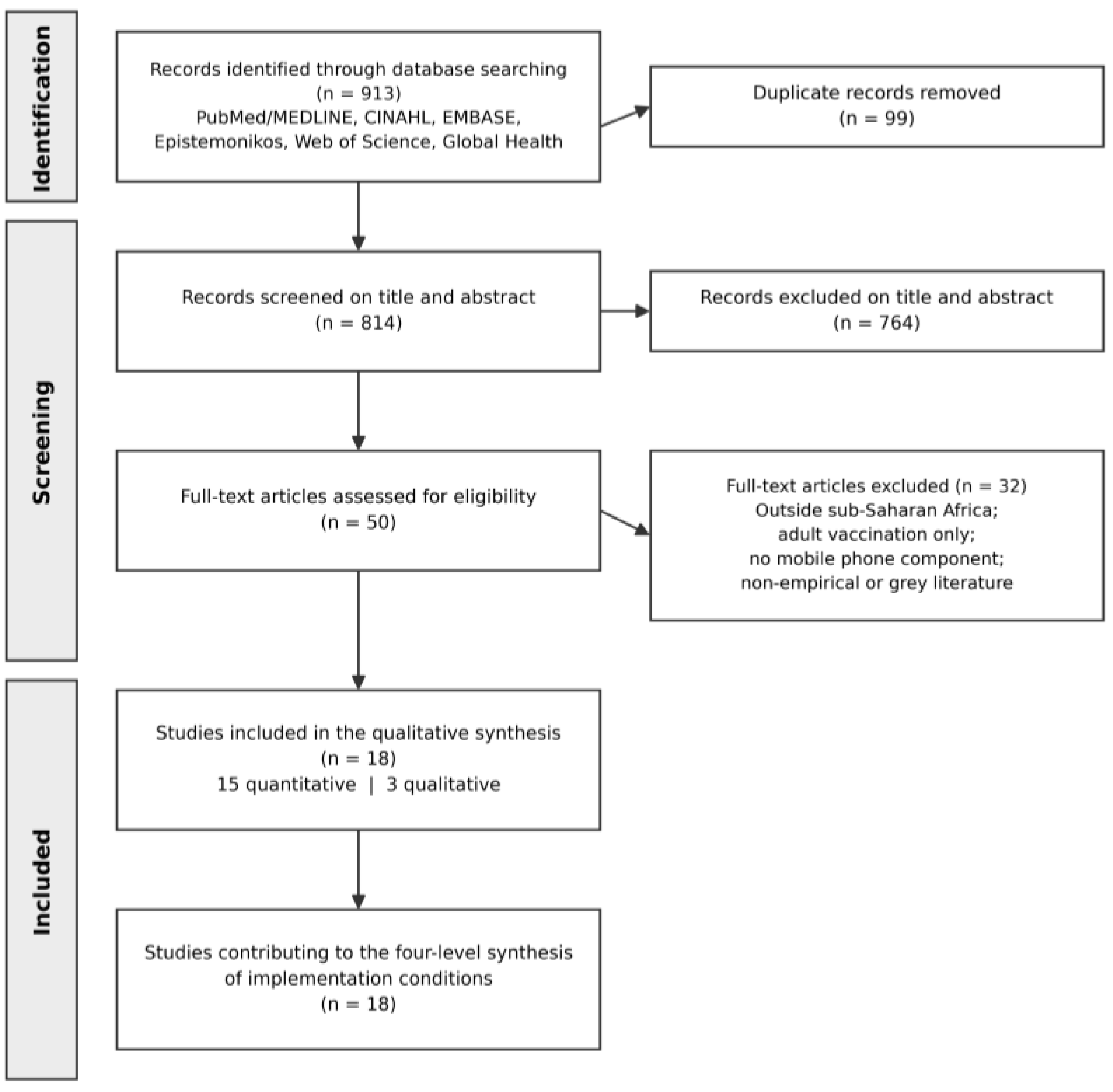
Figure 2.
The Mobile Vaccination Embedding (MOVE) framework.
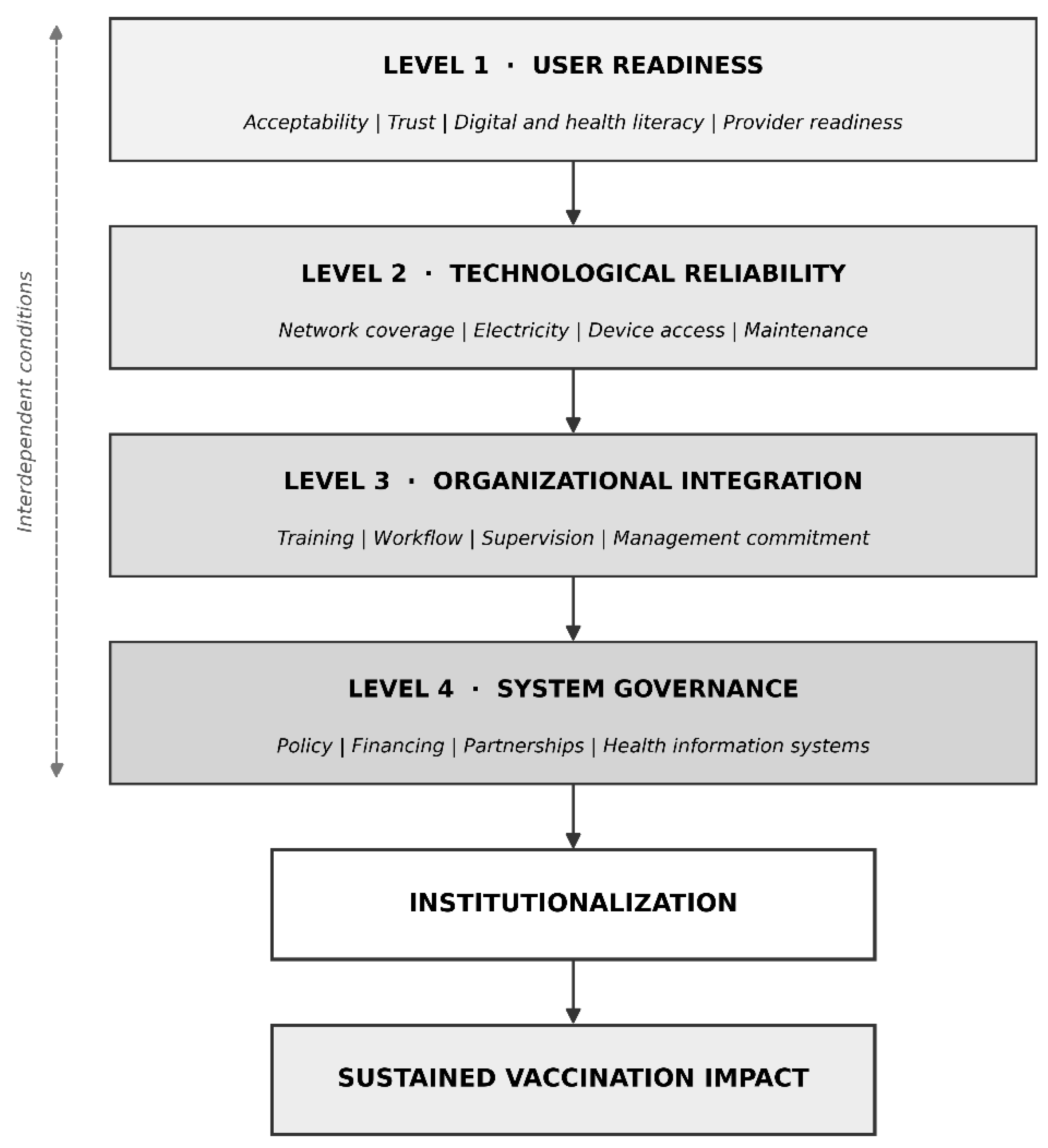

Table 1.
Characteristics of the 18 included studies. MOVE levels: L1 = user readiness; L2 = technological reliability; L3 = organizational integration; L4 = system governance. RCT = randomized controlled trial; SSA = sub-Saharan Africa; MCH = maternal and child health.
Table 1.
Characteristics of the 18 included studies. MOVE levels: L1 = user readiness; L2 = technological reliability; L3 = organizational integration; L4 = system governance. RCT = randomized controlled trial; SSA = sub-Saharan Africa; MCH = maternal and child health.
| Authors & Year | Country | Study Design | Mobile Intervention | MOVE Level(s) | Key Finding |
|---|---|---|---|---|---|
| Akinrinade et al., 2018 [25] | Nigeria | Cross-sectional | Phone ownership and willingness survey | L1 | Widespread willingness to receive SMS reminders among caregivers attending immunization clinics |
| Schlumberger et al., 2015 [10] | Burkina Faso | Quasi-experimental | SMS reminders | L1, L2 | Positive effect on vaccination coverage; network reliability a key constraint |
| Dissieka et al., 2019 [23] | Côte d’Ivoire | RCT | SMS reminders and vitamin A | L1, L3, L4 | Higher vaccination coverage; institutional barriers identified at facility level |
| Ekhaguere et al., 2019 [26] | Nigeria | RCT | Automated calls and SMS | L1, L2 | Higher immunization completion; high caregiver acceptability |
| Oladepo et al., 2019 [27] | Nigeria | Cross-sectional | SMS reminders (knowledge and attitudes) | L1 | Knowledge of routine immunization poor but attitudes positive; 90.5% willing to receive reminders |
| Oladepo et al., 2021 [28] | Nigeria | Quasi-experimental | SMS reminders | L1, L2 | Improved immunization completion in rural areas; network reliability a constraint |
| Clarke et al., 2019 [38] | Zambia | Observational | Electronic immunization registry | L3, L4 | Data quality challenges; continuing technical support essential for sustainability |
| Akerele et al., 2020 [29] | Nigeria | Observational | Routine immunization data management | L3, L4 | Staff training and supervision improved data consistency across tools |
| Kawakatsu et al., 2020 [30] | Nigeria | RCT | SMS appointment reminders | L2, L4 | Cost-effective; long-term financing and network infrastructure are prerequisites |
| Masresha et al., 2020 [31] | Nigeria | Observational | WhatsApp group messaging | L3 | Improved coordination; device management and connectivity difficulties noted |
| Ibraheem R. et al., 2021 [32] | Nigeria | RCT | Call, SMS and SMS-facts reminders | L1, L2 | Significant gains in compliance; multi-modal delivery outperformed SMS alone |
| Ibraheem R.M. et al., 2021 [33] | Nigeria | Cross-sectional | SMS willingness survey | L1 | High willingness to receive reminders, shaped by education and phone ownership |
| Mekonnen et al., 2021a [35] | Ethiopia | Qualitative | SMS reminder system | L1, L2, L3 | High acceptability; network, training and institutional support identified as conditions |
| Mekonnen et al., 2021b [36] | Ethiopia | Cross-sectional | SMS preference and intention | L1 | Positive intention; audio formats preferred by caregivers with low literacy |
| Mekonnen et al., 2021c [6] | Ethiopia | RCT | SMS reminders | L1, L2, L3 | Improved completeness and timeliness of vaccination; infrastructure difficulties persist |
| Levine et al., 2021 [39] | Ghana | RCT | SMS nudges and financial incentives | L1, L4 | Improved neonatal vaccination; financing mechanisms and incentive design decisive |
| Obi-Jeff et al., 2022 [34] | Nigeria | Qualitative | SMS reminder implementation | L3, L4 | Training, supervision and policy integration identified as embedding conditions |
| Gilano et al., 2024 [37] | Ethiopia | Qualitative | mHealth for MCH services | L1, L3 | Provider readiness and workflow integration critical for sustained engagement |
Table 2.
Quality assessment using the Mixed Methods Appraisal Tool (MMAT, 2018 version). C1–C5 = applicable MMAT criteria for the relevant study design. ✓ = criterion met; ✗ = criterion not met; ? = insufficient information to assess.
Table 2.
Quality assessment using the Mixed Methods Appraisal Tool (MMAT, 2018 version). C1–C5 = applicable MMAT criteria for the relevant study design. ✓ = criterion met; ✗ = criterion not met; ? = insufficient information to assess.
| Authors & Year | Study Type | C1 | C2 | C3 | C4 | C5 | Overall Quality |
|---|---|---|---|---|---|---|---|
| Akinrinade et al., 2018 [25] | Cross-sectional | ✓ | ✓ | ? | ✓ | ✓ | Satisfactory |
| Schlumberger et al., 2015 [10] | Quasi-experimental | ✓ | ? | ? | ✓ | ✓ | Satisfactory |
| Dissieka et al., 2019 [23] | RCT | ✓ | ✓ | ✓ | ✓ | ✓ | Good |
| Ekhaguere et al., 2019 [26] | RCT | ✓ | ✓ | ✓ | ✓ | ✓ | Good |
| Oladepo et al., 2019 [27] | Cross-sectional | ✓ | ✓ | ? | ✓ | ✓ | Satisfactory |
| Oladepo et al., 2021 [28] | Quasi-experimental | ✓ | ✓ | ✓ | ✓ | ✓ | Good |
| Clarke et al., 2019 [38] | Observational | ✓ | ✓ | ? | ? | ✓ | Satisfactory |
| Akerele et al., 2020 [29] | Observational | ✓ | ✓ | ? | ? | ✓ | Satisfactory |
| Kawakatsu et al., 2020 [30] | RCT | ✓ | ✓ | ✓ | ✓ | ✓ | Good |
| Masresha et al., 2020 [31] | Observational | ✓ | ✓ | ? | ✗ | ✓ | Satisfactory |
| Ibraheem R. et al., 2021 [32] | RCT | ✓ | ✓ | ? | ✓ | ✓ | Good |
| Ibraheem R.M. et al., 2021 [33] | Cross-sectional | ✓ | ✓ | ? | ✓ | ✓ | Satisfactory |
| Mekonnen et al., 2021a [35] | Qualitative | ✓ | ✓ | ✓ | ✓ | ✓ | Good |
| Mekonnen et al., 2021b [36] | Cross-sectional | ✓ | ✓ | ? | ✓ | ✓ | Satisfactory |
| Mekonnen et al., 2021c [6] | RCT | ✓ | ✓ | ✓ | ✓ | ✓ | Good |
| Levine et al., 2021 [39] | RCT | ✓ | ✓ | ✓ | ✓ | ✓ | Good |
| Obi-Jeff et al., 2022 [34] | Qualitative | ✓ | ✓ | ✓ | ✓ | ✓ | Good |
| Gilano et al., 2024 [37] | Qualitative | ✓ | ✓ | ✓ | ✓ | ✓ | Good |
Overall rating: Good = all five applicable criteria assessed as met; Satisfactory = three or four criteria met. No study was excluded on quality grounds alone. The synthesis generated four conceptually distinct but interdependent domains, which were integrated into the preliminary MOVE framework. The findings are therefore presented by framework domain rather than solely by intervention type or study design.
Table 3.
Implementation conditions mapped to the Mobile Vaccination Embedding (MOVE) framework. DHIS2 = District Health Information Software 2; EPI = Expanded Programme on Immunization; HIS = health information system.
Table 3.
Implementation conditions mapped to the Mobile Vaccination Embedding (MOVE) framework. DHIS2 = District Health Information Software 2; EPI = Expanded Programme on Immunization; HIS = health information system.
| MOVE Level | Key Conditions | Representative Studies | Embedding Implication |
|---|---|---|---|
| L1 — User readiness | Caregiver acceptability; trust in the system; digital and health literacy; provider readiness; language accessibility | [25,28,32,35,36,37] | High acceptability is necessary but not sufficient. Literacy constraints call for audio-based delivery in local languages. Provider readiness must be cultivated rather than assumed. |
| L2 — Technological reliability | Mobile network coverage; electricity access; phone ownership; device sharing; system maintenance | [6,26,28,30,35] | Connectivity is a prerequisite for institutionalization. Infrastructure assessment should precede deployment, and staged rollout is advisable where coverage is low. |
| L3 — Organizational integration | Quality of staff training; continuity of supervision; workflow co-design; management of task burden; management commitment | [6,23,29,31,34,35,37] | The point of transition. One-off training is insufficient; training embedded in supervision cycles and workflow co-design with frontline staff are the main determinants of long-term fidelity. |
| L4 — System governance | National EPI policy integration; sustainable financing; telecom partnerships; DHIS2/HIS integration; data governance | [29,30,34,38,39,42] | Without governance anchoring, local successes remain fragile. Financing sustainability and HIS integration must be addressed at the design stage rather than after effectiveness has been demonstrated. |
Disclaimer/Publisher’s Note: The statements, opinions and data contained in all publications are solely those of the individual author(s) and contributor(s) and not of MDPI and/or the editor(s). MDPI and/or the editor(s) disclaim responsibility for any injury to people or property resulting from any ideas, methods, instructions or products referred to in the content. |
© 2026 by the authors. Licensee MDPI, Basel, Switzerland. This article is an open access article distributed under the terms and conditions of the Creative Commons Attribution (CC BY) license (http://creativecommons.org/licenses/by/4.0/).
Copyright: This open access article is published under a Creative Commons CC BY 4.0 license, which permit the free download, distribution, and reuse, provided that the author and preprint are cited in any reuse.