

Submitted:
16 August 2026
Posted:
19 August 2026
You are already at the latest version
Abstract
Learning from prior experience is essential for autonomous robots, but directly reusing historical actions is often insufficient when the environment changes and previously successful behaviors are no longer applicable. This paper proposes an experience-to-thought learning framework that learns the underlying thinking activities behind historical robot materials rather than only their surface behaviors. An LLM analyzes accumulated experiences to extract diverse thoughts, including prediction, calculation, comparison, risk evaluation, causal analysis, reflection, planning, and verification. A model-agnostic temporal thought-learning mechanism then associates these thoughts with the evolving states and contextual conditions under which they are useful, allowing the same thought to guide different coordinated action sequences in different situations. The framework further supports open-ended growth of the thinking repertoire by detecting when existing thinking is insufficient, discovering candidate thoughts, and consolidating them into reusable new thinking activities. Experiments show that temporal thought learning substantially improves thought selection under temporally ambiguous situations and transfers more effectively than direct action-plan learning when the required behavior changes. The framework also successfully discovers, consolidates, and reuses a new thinking activity in previously unseen situations.
Keywords:
autonomous robots
; experience-to-thought learning
; temporal reasoning
; open-ended learning
1. Introduction
Autonomous robots are expected to continuously improve from their interactions with the environment rather than repeatedly solve similar problems from scratch. A robot may accumulate large amounts of historical material, including observations, actions, environmental changes, intermediate events, successes, and failures. Such experience provides an important basis for lifelong adaptation and knowledge transfer [1,2,3]. However, effective learning should not be limited to reproducing what happened in previous experience. A useful historical material often reflects an underlying process of thinking: an action may have been selected because a future consequence was predicted, a risk was evaluated, two alternatives were compared, a quantity was calculated, or a previous failure was reflected upon. Learning these underlying thoughts can potentially provide more generalizable knowledge than directly learning the surface form of the recorded material.
Recent LLM-based agents have begun to exploit information beyond raw trajectories. Reflection-based approaches transform previous feedback or failures into textual guidance for future decisions [4,5], while experiential learning methods extract reusable insights or higher-level knowledge from accumulated experience [6]. Related robot-learning approaches use causal information, self-reflection, or skill abstraction to improve transfer and adaptation [3,7,8]. These methods demonstrate that the meaning behind an experience can be more valuable than simply storing the experience itself.
Nevertheless, existing methods commonly assume a predefined way of processing experience. For example, some methods explicitly perform reflection, others perform abstraction, refinement, causal analysis, or skill induction. Such mechanisms are effective when the selected cognitive operation matches the learning problem, but autonomous robots may require many different forms of thinking. A material associated with an uncertain future may require prediction, one involving competing alternatives may require comparison, a safety-critical situation may require risk evaluation, and another material may reveal the need for calculation, causal analysis, abstraction, or a form of thinking that was not predefined in advance. Therefore, forcing historical materials through a single fixed cognitive operation can restrict what the robot is able to learn from its own experience.
A second problem is that learning the content of a thought alone does not explain when that thought should be generated again. For instance, extracting the principle that a change in surface condition may increase slipping risk is useful, but an autonomous robot should also learn under what temporal and contextual conditions prediction or risk analysis becomes necessary. This introduces a higher-level learning problem: the robot should learn not only what to think, but also when and why a particular thought should arise. Existing reasoning frameworks such as ReAct and Tree of Thoughts provide effective predefined reasoning structures [9,10], but they do not primarily learn the diverse forms of thinking underlying historical robot materials together with their temporal triggering conditions.
To address these limitations, this paper proposes an experience-to-thought learning framework for autonomous robots. The framework combines LLM-based thought extraction with a model-agnostic temporal thought-learning mechanism. Instead of directly using accumulated experience as the final learning material, the LLM analyzes historical materials and extracts their underlying thoughts. These thoughts are open-ended and may involve prediction, calculation, comparison, evaluation, risk reasoning, reflection, abstraction, planning, or other useful cognitive activities. Thus, the type of thinking itself becomes a learning target rather than being fixed beforehand.
The extracted thoughts are further associated with the temporal states and contextual conditions from which they arise. These experience–thought pairs are used to train a temporal thought learner that maps evolving observations and context to appropriate thoughts. The learner is not tied to a particular architecture and may be instantiated using machine-learning or deep-learning models that represent temporal information. During robot operation, it can therefore recognize a situation in which a particular form of thinking is useful and generate the corresponding thought target. In this way, the LLM is mainly responsible for discovering the deeper thinking contained in historical materials, whereas the temporal thought learner captures the regularities governing when such thinking should occur. The framework consequently moves beyond conventional mappings from states to actions and instead learns a complementary relationship from temporal situations to thoughts.
The main contributions of this paper are summarized as follows:
- We introduce an experience-to-thought learning framework in which historical robot materials are transformed into thought-level supervision rather than being learned only at the surface behavior or action-plan level.
- We introduce a model-agnostic temporal thought-learning mechanism that associates extracted thoughts with the evolving situations in which they are useful, enabling the robot to learn not only what can be thought from previous experience but also when and why particular forms of thinking should arise. The temporal learner can be instantiated using different machine-learning or deep-learning models.
- We support open-ended growth of the thinking repertoire instead of restricting experience processing to a predefined operation such as reflection or abstraction. The framework detects when existing thinking activities are insufficient, discovers open candidate thoughts, consolidates semantically related candidates, and incorporates the resulting new thinking activity into subsequent temporal learning.
The remainder of this paper is organized as follows. Section 2 reviews related studies on experience learning, reasoning and metacognition, and lifelong robot learning. Section 3 presents the proposed experience-to-thought learning model. The experimental setup and results are then presented and analyzed, followed by the conclusion.
2. Related Work
2.1. Learning from Experience and Reflection
Learning from previous experience has become an important mechanism for improving the behavior of LLM-based agents. Reflexion allows an agent to convert feedback from previous trials into verbal reflections and store them in episodic memory for subsequent decision making [4]. Self-Refine similarly lets an LLM evaluate and iteratively improve its own output through self-generated feedback [5]. These methods demonstrate that historical outcomes can provide information beyond the original state–action trajectory and that linguistic reasoning can make such information reusable without repeatedly updating model parameters. Their major advantage is therefore the ability to convert failures or imperfect outputs into explicit guidance for future attempts.
More general experience-learning methods further move from individual reflection toward reusable knowledge. ExpeL autonomously collects experiences across tasks and extracts natural-language insights that can subsequently be retrieved to guide new decisions [6]. More recently, Robo-Cortex transforms accumulated embodied experience into reusable navigation principles and heuristics through reflection and autonomous knowledge induction [11]. Compared with simply storing complete trajectories, such abstraction can remove task-specific details and facilitate transfer across situations. These studies support an important premise of our work: useful learning material may lie behind the surface form of an experience rather than in the recorded trajectory itself.
However, most such methods determine in advance how experience should be cognitively processed. For example, Reflexion explicitly performs reflection, Self-Refine follows a feedback-and-refinement cycle, and Robo-Cortex employs predefined reflection and heuristic-induction mechanisms. ExpeL extracts general insights, but does not explicitly learn which different forms of thinking should arise from temporal environmental conditions. Our work instead treats the underlying thought as a learning target itself. An LLM may extract prediction, calculation, comparison, risk assessment, reflection, abstraction, or another useful thought from historical materials, while a separate temporal thought learner associates these thoughts with the state evolution and contextual conditions under which they should be generated. The temporal learner is a replaceable component rather than the primary source of novelty. Thus, the objective is not only to learn a better conclusion from experience, but also to learn the diverse thinking processes behind experience and when they become useful.
2.2. Reasoning Strategies and Metacognitive Learning
A related line of research improves intelligent agents by explicitly structuring their reasoning processes. ReAct interleaves reasoning traces with actions, enabling reasoning to guide interaction while observations from actions update subsequent reasoning [9]. Tree of Thoughts extends linear reasoning by exploring multiple candidate thought paths and evaluating alternative intermediate decisions [10]. These approaches have substantially increased the flexibility of LLM reasoning by allowing reasoning, exploration, evaluation, and action to interact rather than relying on one-step generation. They also illustrate that different internal reasoning processes can have important effects on final decisions.
Nevertheless, reasoning architectures often specify the form of thinking before solving the task. ReAct defines a reason–act interaction pattern, Tree of Thoughts defines tree-structured exploration and evaluation, and reflection-based approaches explicitly invoke reflection. Recent work has begun to address meta-reasoning more directly. Metacognitive Consolidation, for example, separates reasoning, monitoring, and control and accumulates meta-level experience across reasoning episodes into reusable knowledge [12]. This is an important step from performing reasoning toward learning how reasoning itself can be improved over time. Its benefit is that previous reasoning failures can modify future meta-level behavior instead of requiring the same corrective reasoning repeatedly.
Our problem is related to metacognition but differs in both the source and target of learning. Rather than beginning with a fixed set of reasoning roles and improving their operation, we start from historical robot materials and ask what thinking activity can explain or support each material. The extracted thinking activity is therefore open: different materials may imply prediction, numerical calculation, evaluation, causal analysis, risk reasoning, or previously unrepresented forms of thinking. Furthermore, a temporal thought learner maps evolving states and contexts to these thoughts. In this sense, the framework learns not only the content of a thought but also a meta-level regularity: why and when that type of thought tends to become necessary. This avoids introducing an additional explicit meta-reasoning module while still allowing experience to modify how future thinking is triggered.
2.3. Lifelong Robot Learning and Knowledge Transfer
Lifelong robot learning aims to enable robots to accumulate and transfer knowledge while continuously encountering new tasks. LIBERO provides a systematic benchmark for studying the transfer of declarative and procedural knowledge in lifelong robot manipulation [1]. Voyager demonstrates open-ended embodied learning by continually acquiring and reusing an expanding library of executable skills [2]. Lifelong Robot Library Learning further allows an embodied agent to abstract recent experience into new composable robot skills and continuously enlarge its skill library [3]. These approaches provide strong mechanisms for retaining previously acquired capabilities and reusing them to solve increasingly complex tasks.
Recent robot-learning research has also started to investigate information behind observed actions. CIVIL argues that imitation from actions alone can be misleading because the learner observes what a human does without necessarily knowing which environmental features motivated the decision; it therefore augments demonstrations with human-provided information about task-relevant causal features [7]. Think, Act, Learn introduces an LLM-driven closed loop in which multimodal execution feedback is used for self-reflection, causal analysis of failures, and generation of corrective strategies [8]. These methods move robot learning beyond direct behavior imitation and show that explanations, causal factors, and reflection can improve adaptation and generalization.
The proposed method shares the goal of lifelong improvement but learns a different intermediate representation. Skill-learning methods mainly preserve what the robot can do, while causal imitation emphasizes which factors explain an observed action, and reflective robot agents mainly analyze why a previous attempt failed. Our approach asks a broader question: what thinking lies behind the accumulated material, and under what temporal conditions should such thinking arise again? The LLM is used offline or during learning to convert raw historical materials into thought-level supervision, rather than serving only as an online planner. A model-agnostic temporal thought learner then learns the relationship between temporal situations and these thoughts and can be instantiated using either machine-learning or deep-learning models. Consequently, historical experience can teach the robot not only reusable actions or skills but also reusable ways of thinking, providing a complementary direction to conventional lifelong behavior and skill learning.
3. Experience-to-Thought Learning Model
Autonomous robots continuously accumulate materials from their interaction with the environment, including observed states, actions, environmental changes, intermediate events, and final outcomes. Conventional learning methods usually use these materials directly to learn actions, policies, or state–action relationships. However, the same material may contain deeper information about why an action was taken, why an outcome occurred, or why a particular way of thinking was necessary.
We therefore propose an experience-to-thought learning framework consisting of two complementary components: an LLM-based thought extraction module and a model-agnostic temporal thought-learning mechanism. The LLM analyzes historical materials and extracts the underlying thoughts, while a temporal thought learner learns when these thoughts should arise from temporal observations and contextual conditions. The temporal learner is a replaceable component of the framework rather than a specific proposed network architecture. Once trained, it can generate an appropriate thought according to the current situation instead of relying on a fixed thinking operation such as reflection or abstraction.
The overall process is
3.1. Thought Extraction from Historical Materials
Let the material collected around an event i be represented as
where represents observed states, represents actions, represents contextual information, and represents subsequent observations or outcomes. The material may cover a temporal interval rather than a single state, since the reason behind an event may depend on what occurred before and after it.
Instead of directly using as the final learning target, an LLM analyzes the material and extracts the thought that may explain or support it:
where denotes additional historical information when required and denotes the extracted thought.
The extracted thought is not restricted to a predefined type. Depending on the material, it may involve prediction, calculation, comparison, evaluation, risk analysis, causal reasoning, reflection, abstraction, planning, or another form of thinking. Therefore, unlike approaches that always apply a fixed operation such as reflection, the proposed method allows different materials to reveal different underlying thoughts.
For example, suppose that historical material records that a robot detected a wet floor, reduced its speed, changed its route, and safely reached the target. Learning the material directly may result only in a relationship between a wet floor and a slower motion. The LLM can instead extract thoughts such as predicting a reduction in friction, evaluating the risk of slipping, or comparing the cost of detouring with the possible consequence of continuing along the original path.
More importantly, the LLM can analyze not only what was thought but also why such thinking was relevant. For example, a prediction may be useful because the current environmental change can affect a future outcome, while risk evaluation may be required because an uncertain event can cause a severe consequence. Thus, the extracted material contains information about both the thought itself and the conditions that motivate the thought.
We represent an extracted thought as
where denotes the content or type of the thought and describes the reason or condition associated with generating this thought. This representation enables the robot to learn not only a useful reasoning result but also the circumstances under which such reasoning becomes useful.
3.2. Temporal Learning of Thought Generation
The LLM is mainly used to obtain thought-level supervision from accumulated materials. The robot does not need to repeatedly analyze all historical materials with the LLM during normal operation. Instead, the extracted thoughts are used to train a temporal thought learner.
Let the temporal input at time t be
where L is the temporal observation length, represents the current context, and denotes the current goal when available. The temporal sequence is important because the need for a particular thought may be caused by a change or pattern that cannot be recognized from a single observation.
Using the thoughts extracted by the LLM as learning targets, a temporal thought learner is trained as
where is the thought predicted for the current temporal situation.
Here, denotes a general temporal learner rather than a specific network architecture. It may be implemented using recurrent neural networks, other sequence models, or machine-learning methods that encode temporal observations. The essential role of is therefore to learn the relationship between temporal situations and the thoughts extracted from previous materials. In our implementation, a GRU is used as the default temporal learner because it provides a compact representation of sequential state evolution. We additionally instantiate the same temporal thought-learning mechanism using a Random Forest in the experiments to examine whether the observed benefit depends on the particular learner architecture.
This learning process captures a higher-level relationship than conventional state–action learning:
Consequently, the framework learns why a certain thought tends to arise from a temporal pattern rather than merely associating one current observation with one thought. For instance, it may learn that rapidly changing observations associated with an uncertain future consequence tend to require prediction, whereas situations involving a low-probability but high-cost consequence tend to require risk evaluation. In this sense, learning when a thought should be generated constitutes a higher-level form of learning about thinking itself.
3.3. Thought Generation and Continual Learning
During robot operation, the current temporal observations and contextual information are continuously provided to the learned temporal thought learner:
The output specifies the thought that is appropriate for the current situation. A thought is not treated as a single action label. Instead, it provides a higher-level reasoning target that can guide subgoals, constraints, strategy selection, and multiple coordinated actions according to the current context. Let the subsequent action sequence be
A downstream reasoning or control component can use the selected thought to generate the context-dependent behavior:
Consequently, the same thought may guide different action sequences in different situations. For example, a prediction thought may cause the robot to yield and wait in one context, but to move to a safe pose and replan in another. This separation between thought and action is important because the framework aims to transfer a reusable way of thinking rather than memorize one historical action sequence.
This differs from a system in which reflection, prediction, or another thinking activity is manually invoked in advance. Here, the temporal thought learner learns from previous materials which thought should be generated under a particular temporal and contextual pattern.
The learning process is also continual. Let the currently available thinking repertoire be denoted by . When new materials are accumulated, especially materials associated with unfamiliar situations or unexpected outcomes, the LLM first determines whether an existing thinking activity adequately explains the required reasoning. If no existing activity is suitable, the material is marked as requiring new thinking and an open candidate thought is generated. For a set of such materials, the candidate set is
Different materials may produce different surface names even when they express the same reusable cognitive operation. Therefore, a lightweight LLM-based consolidation step analyzes the candidate thought descriptions and their triggering conditions:
where groups semantically related candidates and assigns a canonical name and definition to each genuinely new thinking activity. The output is not restricted to a predefined thought label. Accepted new activities expand the repertoire as
The resulting thought-level pairs
are added to the training data and used to update . Thus, a newly discovered and consolidated thinking activity can become a new output of the temporal thought learner without requiring the complete thinking repertoire to be predefined.
The proposed framework can consequently be summarized as
with an additional open-ended path
The key difference from direct experience learning is that historical materials are first transformed into thought-level learning targets. The LLM discovers what can be learned behind the observed materials, while the temporal thought-learning mechanism learns when these thoughts should be generated. Thus, the robot learns not only from what previously happened, but also from the thinking behind previous materials and from the temporal conditions under which such thinking becomes necessary.
4. Verification
The experiments evaluate whether the proposed experience-to-thought framework can (1) extract diverse thinking activities from historical materials, (2) learn when a particular thought should arise from temporal context, (3) transfer a learned thought to situations requiring different action sequences, and (4) discover, consolidate, and reuse a previously unavailable thinking activity. Rather than testing isolated one-step actions, the scenarios require a thought to guide multiple coordinated actions toward task completion.
4.1. Experimental Environment and Configuration
4.1.0.1. Robot task environment.
We construct a controlled scenario-based robot environment containing multi-stage manipulation, navigation, transportation, sensing, and recovery tasks. A typical task requires the robot to pick or transport an object, respond to environmental changes, select or modify a route, and eventually complete the delivery or manipulation objective. During task execution, the environment may change because of moving objects, route blockage, abnormal energy consumption, unstable payloads, repeated manipulation failures, or inconsistent sensory information.
Each temporal state is represented by 14 factors describing the current task and environment, including dynamic-object distance, approaching speed, battery level, battery-drop rate, surface slipperiness, payload fragility, deadline pressure, sensor conflict, repeated failure, route blockage, target occupancy, load instability, alternative-quality difference, and uncertainty. A temporal input contains eight consecutive states. Therefore, the temporal learner receives
where each contains the 14 task and environmental factors.
The scenarios cover eight representative but qualitatively different thinking activities:
These activities are intentionally selected so that the verification does not reduce thinking to reflection alone. For example, prediction is required when the future trajectory of a moving object becomes hazardous; calculation is required when route feasibility depends on explicit energy constraints; causal analysis is required when repeated grasp failures must be associated with an underlying factor; and verification is required when independent information sources provide inconsistent evidence.
4.1.0.2. Historical-material construction and LLM processing.
The training set contains 112 historical materials, with 14 materials for each of the eight thinking families. Each material contains a temporal situation, relevant context, the robot’s multi-step behavior, and the resulting outcome. The LLM analyzes each material and extracts both a semantic thinking family and a more specific open-ended thought description. The LLM is accessed through an OpenAI-compatible interface using deepseek-v4-flash, with temperature and a maximum response length of 750 tokens. The prompt and a shortened LLM response are printed during execution for manual inspection.
For the 112 controlled historical materials, the extracted semantic thinking family agrees with the scenario ground truth in all 112 cases. In particular, after making the calculation scenarios explicitly numerical, all 14 calculation materials are correctly identified as calculation rather than planning.
4.1.0.3. Temporal thought-learner implementations and comparison methods.
The temporal thought-learning mechanism is evaluated using two implementations. The default implementation, denoted Temporal Thought (GRU), uses a two-layer GRU with eight time steps and 14 features per step. Its hidden dimension is 96 and the dropout rate is 0.15. The network is optimized using AdamW with a learning rate of and weight decay of . The main models are trained for 55 epochs, while the updated model in the open-thought experiment is trained for 50 epochs. As an alternative implementation of the same temporal thought-learning mechanism, Temporal Thought (RF) uses a Random Forest with 300 trees and receives the flattened temporal sequence. Comparing these two implementations tests whether the observed benefit comes from temporal thought modeling itself or from a particular recurrent architecture.
The remaining methods serve as comparison baselines. Fixed-Reflection always applies reflection regardless of the material, while Fixed-Abstraction, used in Experiment 1, applies one predefined abstraction operation. Snapshot Thought (MLP) predicts the thought using only the latest state and therefore removes temporal history from thought selection. To avoid an artificially weak snapshot baseline, temporal-pair samples are balanced during its training. Finally, Direct Plan (GRU) uses the same type of temporal backbone as the default GRU thought learner, but directly predicts a previously learned multi-action plan instead of first predicting a thought.
4.1.0.4. Multi-action task evaluation.
A thought is not treated as an action label. Instead, the selected thought guides a context-dependent sequence of actions. For example, the same prediction thought can result in yielding to a forklift in one context but moving to a safe pose and waiting for a drone in another. Therefore, task success is evaluated over the complete action sequence.
Action coverage is calculated as
where is the required action set. Critical-action recall measures how many task-critical actions are correctly included:
A test round is counted as successful only when all of the following conditions hold:
where indicates that the required actions occur in the correct order and indicates a forbidden or unsafe action. This strict definition prevents a method from being counted as successful merely because an old action sequence overlaps with many actions required by a new task.
Thought-selection accuracy is
The principal reported metrics are thought accuracy, task success, action coverage, critical-action recall, action-order correctness, and safety violations.
4.2. Experimental Results
4.2.1. Experiment 1: Diverse Thinking in Complex Multi-Step Tasks
Experiment 1 evaluates whether different historical situations require different thinking activities and whether the selected thought can guide a complete multi-action strategy. Ten test instances are generated for each of the eight thinking families, resulting in 80 test scenarios. The test set includes moving-hazard prediction, fragile-object risk evaluation, explicit energy calculation, multi-criteria route comparison, repeated-grasp causal analysis, strategy reflection, dynamic subgoal planning, and cross-source verification.
Table 1 summarizes the results. Fixed-Reflection achieves only 12.5% thought accuracy and 12.5% task success. This value is exactly consistent with the fact that only one of the eight thinking families corresponds to reflection. Fixed-Abstraction achieves 0% task success. In contrast, Snapshot Thought (MLP), Temporal Thought (RF), and Temporal Thought (GRU) all achieve 100% thought accuracy and 100% task success. Direct Plan (GRU) also reaches 100% task success in these familiar scenarios, showing that directly reusing historical behavior is effective when the test conditions remain compatible with previously learned action plans.
These results demonstrate that reflection itself is useful when reflection is actually required, but using reflection as a universal processing operation cannot cover qualitatively different cognitive requirements. The result therefore supports learning diverse thoughts from experience rather than processing every material with one predefined cognitive operation.
4.2.2. Experiment 2: Temporal Thought Triggering and Unseen Transfer
Experiment 2 evaluates two related properties of the proposed framework. First, it examines whether the appropriate thought depends on the temporal evolution of a situation rather than only on the current observation. Second, it evaluates whether a learned thought can be reused when the surface situation and the required action sequence differ from those observed during training. The first property tests the necessity of temporal thought learning, whereas the second tests whether thought-level knowledge provides better transfer than directly learned action plans.
4.2.2.1. Temporal thought triggering.
To isolate the role of temporal information, four pairs of thinking activities are constructed:
For each pair, the two scenarios have exactly the same final state:
but different preceding histories:
They therefore require different thoughts even though a snapshot-based method receives the same final observation. Ten test rounds are used for each of the eight thinking families, resulting in 80 unseen temporal test scenarios. In addition, the surface situation and required action sequence differ from those used during learning. For example, a prediction learned from an approaching forklift may need to be reused for an unseen aerial hazard, while the resulting action sequence changes from yielding to entering a safe pose.
As shown in Figure 1, Snapshot Thought (MLP) reaches only 50.0% thought accuracy. This result is consistent with the deliberately ambiguous paired construction: the final snapshot alone cannot uniquely determine which member of a pair is present. In contrast, both temporal thought-learning implementations achieve 100.0% thought accuracy and 100.0% task success: Temporal Thought (RF) reaches 100.0%, and the default Temporal Thought (GRU) implementation also reaches 100.0%. The mean prediction confidence further increases from approximately 0.309 for Snapshot Thought (MLP) to 0.924 for Temporal Thought (RF) and 0.993 for Temporal Thought (GRU). The identical accuracy of the RF and GRU implementations is informative: the improvement does not originate from a particular recurrent architecture. Instead, it mainly results from representing the temporal evolution of the situation when learning which thought should arise. Thus, the result supports the temporal thought-learning mechanism itself rather than a specific learner implementation.
4.2.2.2. Thought-level transfer.
Experiment 2 also provides a direct comparison between thought-level learning and behavior-level learning. Direct Plan (GRU) obtains 75.4% action coverage and approximately 85.2% action precision, indicating that it does recover many actions that were useful in similar historical situations. However, its plan accuracy and strict task success are both 0%, and the required action order is correct in 0% of the test rounds. Thus, Direct Plan (GRU) does not simply produce random behavior; rather, it reuses old action structures that are no longer sufficient when the new environment requires a different organization of actions.
The proposed framework instead retains the transferable thought and uses the current context to organize a new multi-action strategy. With either temporal thought-learning implementation, the thought-level representation remains available even when the required surface action sequence changes; the default GRU implementation consequently obtains 100% action coverage, 100% critical-action recall, 100% order correctness, and 100% task success. This difference supports the main motivation of the framework: the underlying thought can remain reusable even when the surface action sequence should change.
4.2.3. Experiment 3: Open Discovery, Consolidation, and Reuse of a New Thought
Experiment 3 evaluates whether the thinking repertoire can expand instead of remaining restricted to a predefined set. The initial model intentionally excludes the thinking activity associated with cross-source evidence verification. Importantly, the withheld activity name is not supplied to the open-discovery LLM.
Eight new historical materials are then introduced, consisting of two instances from each of four different conflict types: camera–RFID identity disagreement, vision–weight disagreement, visual–force grasp disagreement, and inconsistent temperature sensors. Although these situations differ at the surface level, each requires the robot to suspend immediate commitment, obtain additional independent evidence, and cross-check the evidence before continuing.
For all eight new materials, the LLM determines that none of the existing thinking activities adequately explains the required reasoning and therefore declares that a new thinking activity is needed. The new-thought declaration rate is
This result shows that the framework can detect when the current thinking repertoire is insufficient. At this stage, however, it does not yet assume that all eight materials correspond to the same new thinking activity.
The independent extraction stage produces three different open thought names: evidence_conflict_resolution, evidence_corroboration, and evidence_cross_verification. A second lightweight LLM consolidation step then analyzes the newly discovered thought descriptions rather than the original action trajectories. All eight newly discovered thought instances are assigned to a single cluster, resulting in one consolidated cluster with 100% coverage. The LLM autonomously names the consolidated thinking activity sensor_conflict_resolution and characterizes it as suspending commitment under persistent disagreement, gathering independent observations, cross-checking the evidence, and resuming only after sufficient consistency is established.
The LLM-generated canonical thought is subsequently added directly to the output space of the temporal learner. It is not converted into a predefined verification label before training. Therefore, the experiment evaluates the complete process
Table 2 reports the transfer results. Before adding the newly consolidated thought, the fixed repertoire obtains 0% thought accuracy and 0% task success on ten unseen localization-conflict scenarios. After consolidation and temporal learning, the robot predicts sensor_conflict_resolution in all ten cases, increasing both thought accuracy and task success from 0% to 100%. The mean confidence of the updated model is approximately 0.997.
Figure 2 also reports a more difficult stress test. In this setting, the test changes not only the surface conflict type but also the temporal triggering pattern by using the same-final-state temporal-pair construction. Both the initial and updated systems obtain 0% task success. The result indicates that the newly learned thought generalizes across unseen semantic contexts, but does not immediately generalize to a substantially different temporal trigger with only eight new learning materials. This negative result is retained because it identifies an important boundary of the current method rather than an implementation failure.
4.3. Discussion
The three experiments support different aspects of the proposed framework. First, Experiment 1 shows that historical experience may imply qualitatively different thinking activities. A fixed reflection mechanism reaches only 12.5% thought accuracy, whereas the experience-to-thought learners identify all eight thinking families. This result supports treating the thinking operation itself as a learning target rather than assuming that all materials should be processed by a single predefined operation.
Second, Experiment 2 demonstrates why temporal thought learning is necessary. When the current state is deliberately made identical between two scenarios, Snapshot Thought (MLP) is limited to 50% accuracy, whereas both temporal thought learners reach 100%. The comparable performance of the RF and GRU implementations further shows that the proposed framework should not be interpreted as a GRU-specific method. Instead, the contribution lies in learning the mapping from temporal situations to thought-level representations. The temporal learner is therefore a replaceable component of the framework, and the results show that both machine-learning and deep-learning implementations can realize this function in the tested scenarios.
More importantly, the same experiment differentiates thought learning from direct behavior learning. Direct Plan (GRU) performs perfectly in the familiar scenarios of Experiment 1, but its task success decreases from 100% to 0% when the unseen environment requires a new action organization. The proposed thought-level framework remains at 100%. This result suggests that a high-level thought can provide a more reusable intermediate representation than a previously observed action sequence.
Finally, Experiment 3 shows that the thinking repertoire need not remain fixed. All eight unfamiliar materials are autonomously identified as requiring new thinking, three independently generated thought names are consolidated into one reusable canonical activity, and the newly created temporal output is successfully reused in an unseen semantic context, improving task success from 0% to 100%. However, failure on the hard temporal-pattern transfer test shows that discovering a new thinking activity does not by itself guarantee generalization to arbitrary temporal triggering patterns. Additional diverse temporal experience or continual updating is therefore an important direction for future work.
5. Conclusions
This paper presented an experience-to-thought learning framework for autonomous robots. Instead of directly reusing historical behaviors or processing all experience through a fixed cognitive operation, the proposed framework treats the underlying thought as a learnable intermediate representation. An LLM extracts diverse thinking activities from historical materials, while a model-agnostic temporal thought-learning mechanism learns under what evolving states and contextual conditions each thought should arise. The selected thought then guides context-dependent multi-action behavior rather than reproducing a previously observed action sequence.
The experimental results support the main design choices of the framework. Temporal thought learning clearly outperforms snapshot-based thought selection when the current observation alone is insufficient, while both RF- and GRU-based temporal implementations show comparable strong performance. This indicates that the benefit mainly comes from modeling temporal thought-triggering information rather than from a particular learning architecture. The experiments also show that thought-level knowledge transfers more effectively than direct action-plan learning when unseen situations require a different organization of actions. Furthermore, the framework can detect when the existing thinking repertoire is insufficient, discover and consolidate candidate new thoughts, and incorporate a newly formed thinking activity into subsequent learning and reuse.
The more difficult temporal-shift test also reveals a current limitation: a newly learned thinking activity does not necessarily generalize immediately to substantially different temporal triggering patterns. Future work will therefore investigate continual acquisition of more diverse temporal experience, adaptive updating and merging of thinking activities, and evaluation on physical robots with learned low-level behavior policies.
References
- Liu, B.; Zhu, Y.; Gao, C.; Feng, Y.; Liu, Q.; Zhu, Y.; Stone, P. Libero: Benchmarking knowledge transfer for lifelong robot learning. Adv. Neural Inf. Process. Syst. 2023, 36, 44776–44791. [Google Scholar] [CrossRef]
- Wang, G.; Xie, Y.; Jiang, Y.; Mandlekar, A.; Xiao, C.; Zhu, Y.; Fan, L.; Anandkumar, A. Voyager: An open-ended embodied agent with large language models. arXiv 2023, arXiv:2305.16291. [Google Scholar]
- Tziafas, G.; Kasaei, H. Lifelong robot library learning: Bootstrapping composable and generalizable skills for embodied control with language models. In Proceedings of the 2024 IEEE International Conference on Robotics and Automation (ICRA); IEEE, 2024; pp. 515–522. [Google Scholar]
- Shinn, N.; Cassano, F.; Gopinath, A.; Narasimhan, K.; Yao, S. Reflexion: Language agents with verbal reinforcement learning. Adv. Neural Inf. Process. Syst. 2023, 36, 8634–8652. [Google Scholar] [CrossRef]
- Madaan, A.; Tandon, N.; Gupta, P.; Hallinan, S.; Gao, L.; Wiegreffe, S.; Alon, U.; Dziri, N.; Prabhumoye, S.; Yang, Y.; et al. Self-refine: Iterative refinement with self-feedback. Adv. Neural Inf. Process. Syst. 2023, 36, 46534–46594. [Google Scholar] [CrossRef]
- Zhao, A.; Huang, D.; Xu, Q.; Lin, M.; Liu, Y.J.; Huang, G. Expel: Llm agents are experiential learners. Proc. Proc. AAAI Conf. Artif. Intell. 2024, Vol. 38, 19632–19642. [Google Scholar] [CrossRef]
- Dai, Y.; Sanchez, R.R.; Jeronimus, R.; Sagheb, S.; Nunez, C.M.; Nemlekar, H.; Losey, D.P. Civil: Causal and intuitive visual imitation learning. arXiv 2025, arXiv:2504.17959. [Google Scholar]
- Menon, A.R.; Sharma, R.K.; Singh, P.; Wang, C.; Ferreira, A.M.; Novak, M. Think, Act, Learn: A Framework for Autonomous Robotic Agents using Closed-Loop Large Language Models. arXiv 2025, arXiv:2507.19854. [Google Scholar]
- Yao, S.; Zhao, J.; Yu, D.; Du, N.; Shafran, I.; Narasimhan, K.; Cao, Y. React: Synergizing reasoning and acting in language models. arXiv 2022, arXiv:2210.03629. [Google Scholar]
- Yao, S.; Yu, D.; Zhao, J.; Shafran, I.; Griffiths, T.; Cao, Y.; Narasimhan, K. Tree of thoughts: Deliberate problem solving with large language models. Adv. Neural Inf. Process. Syst. 2023, 36, 11809–11822. [Google Scholar] [CrossRef]
- Chan, N.T.; Zhang, Y.; Liu, Y.; Cui, R.; Zeng, F.; Ding, Z.; Ren, X.; Zhang, Z.; Chen, Q.; Liu, J.; et al. Robo-Cortex: A Self-Evolving Embodied Agent via Dual-Grain Cognitive Memory and Autonomous Knowledge Induction. arXiv 2026, arXiv:2605.18729. [Google Scholar]
- Zhuang, Z.; Zhang, L.; Si, J.; Zhou, D.; He, Y. Beyond Meta-Reasoning: Metacognitive Consolidation for Self-Improving LLM Reasoning. Proceedings of the Proceedings of the 64th Annual Meeting of the Association for Computational Linguistics 2026, Volume 1, 23884–23913. [Google Scholar] [CrossRef]
Figure 1.
Thought-selection accuracy and strict task success in the temporal-pair experiment. The snapshot learner observes the same final state for the two members of each pair and reaches 50%, whereas both RF- and GRU-based temporal thought learners reach 100%. The comparable temporal results indicate that the benefit comes primarily from temporal thought modeling rather than from a specific learner architecture.
Figure 1.
Thought-selection accuracy and strict task success in the temporal-pair experiment. The snapshot learner observes the same final state for the two members of each pair and reaches 50%, whereas both RF- and GRU-based temporal thought learners reach 100%. The comparable temporal results indicate that the benefit comes primarily from temporal thought modeling rather than from a specific learner architecture.
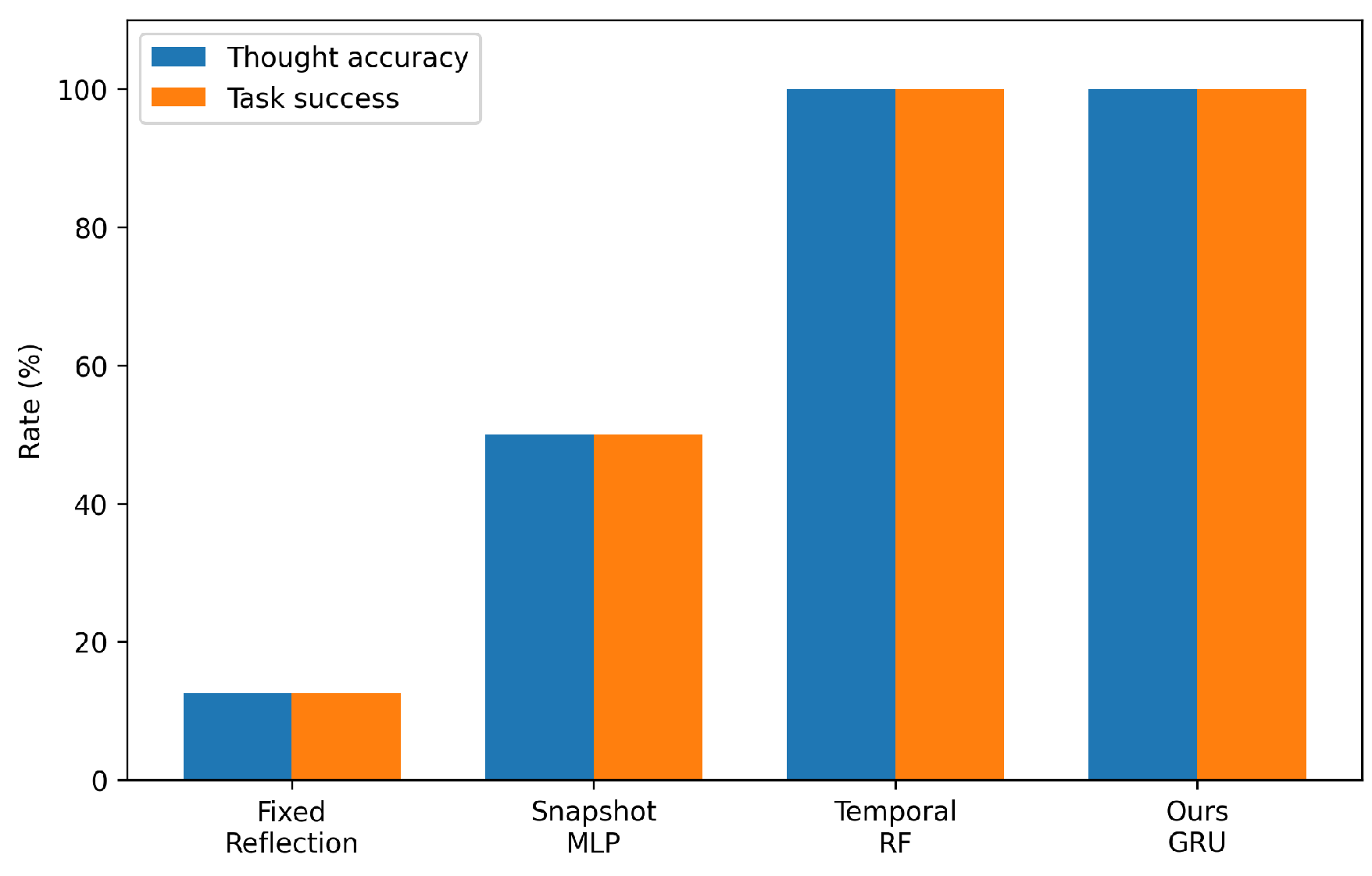
Figure 2.
Task success before and after learning the newly discovered and LLM-consolidated thinking activity. The new thought transfers successfully to an unseen surface situation, while the more difficult simultaneous semantic and temporal-pattern shift remains unsolved.
Figure 2.
Task success before and after learning the newly discovered and LLM-consolidated thinking activity. The new thought transfers successfully to an unseen surface situation, while the more difficult simultaneous semantic and temporal-pattern shift remains unsolved.
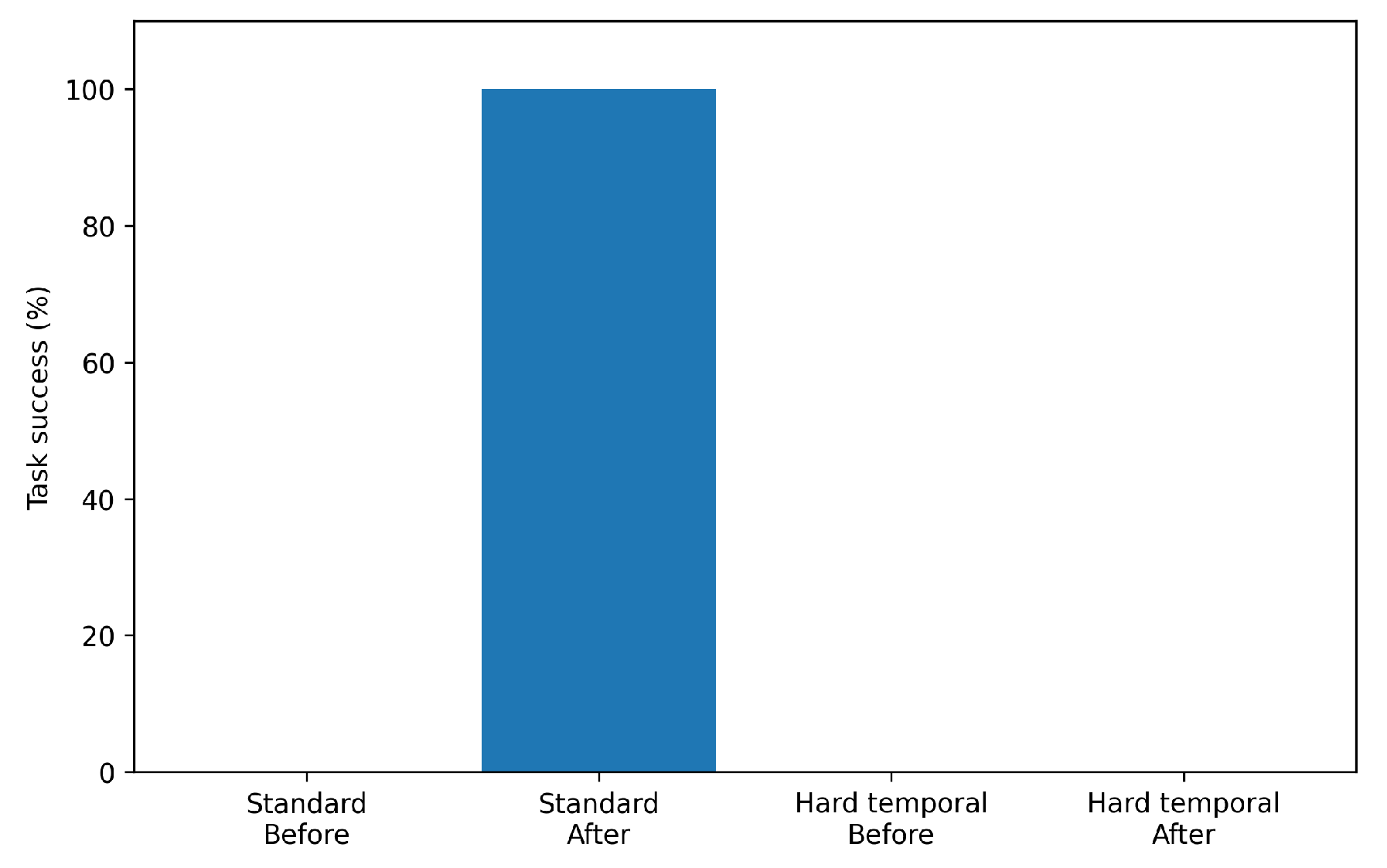

Table 1.
Results of Experiments 1 and 2. Thought Acc. denotes thought-selection accuracy, Task Succ. denotes strict multi-action task success, Coverage denotes action coverage, and Order denotes correct action ordering. “–” indicates that the metric is not applicable because Direct Plan (GRU) directly predicts an action plan rather than a thought.
Table 1.
Results of Experiments 1 and 2. Thought Acc. denotes thought-selection accuracy, Task Succ. denotes strict multi-action task success, Coverage denotes action coverage, and Order denotes correct action ordering. “–” indicates that the metric is not applicable because Direct Plan (GRU) directly predicts an action plan rather than a thought.
| Method | Experiment 1 | Experiment 2 | ||||
|---|---|---|---|---|---|---|
| Thought Acc. | Task Succ. | Thought Acc. | Task Succ. | Coverage | Order | |
| Fixed-Abstraction | 0.0% | 0.0% | – | – | – | – |
| Fixed-Reflection | 12.5% | 12.5% | 12.5% | 12.5% | 43.8% | 12.5% |
| Snapshot Thought (MLP) | 100.0% | 100.0% | 50.0% | 50.0% | 72.5% | 50.0% |
| Temporal Thought (RF) | 100.0% | 100.0% | 100.0% | 100.0% | 100.0% | 100.0% |
| Temporal Thought (GRU) | 100.0% | 100.0% | 100.0% | 100.0% | 100.0% | 100.0% |
| Direct Plan (GRU) | – | 100.0% | – | 0.0% | 75.4% | 0.0% |
Table 2.
Results of open-thought discovery, consolidation, and transfer.
| Evaluation | Before | After consolidation |
|---|---|---|
| New-thought declaration | – | 8/8 (100%) |
| Consolidation clusters | – | 1 |
| Consolidation coverage | – | 100% |
| Standard unseen thought accuracy | 0% | 100% |
| Standard unseen task success | 0% | 100% |
| Hard temporal-pair thought accuracy | 0% | 0% |
| Hard temporal-pair task success | 0% | 0% |
Disclaimer/Publisher’s Note: The statements, opinions and data contained in all publications are solely those of the individual author(s) and contributor(s) and not of MDPI and/or the editor(s). MDPI and/or the editor(s) disclaim responsibility for any injury to people or property resulting from any ideas, methods, instructions or products referred to in the content. |
© 2026 by the authors. Licensee MDPI, Basel, Switzerland. This article is an open access article distributed under the terms and conditions of the Creative Commons Attribution (CC BY) license (http://creativecommons.org/licenses/by/4.0/).
Copyright: This open access article is published under a Creative Commons CC BY 4.0 license, which permit the free download, distribution, and reuse, provided that the author and preprint are cited in any reuse.