

Submitted:
17 August 2026
Posted:
18 August 2026
You are already at the latest version
Abstract
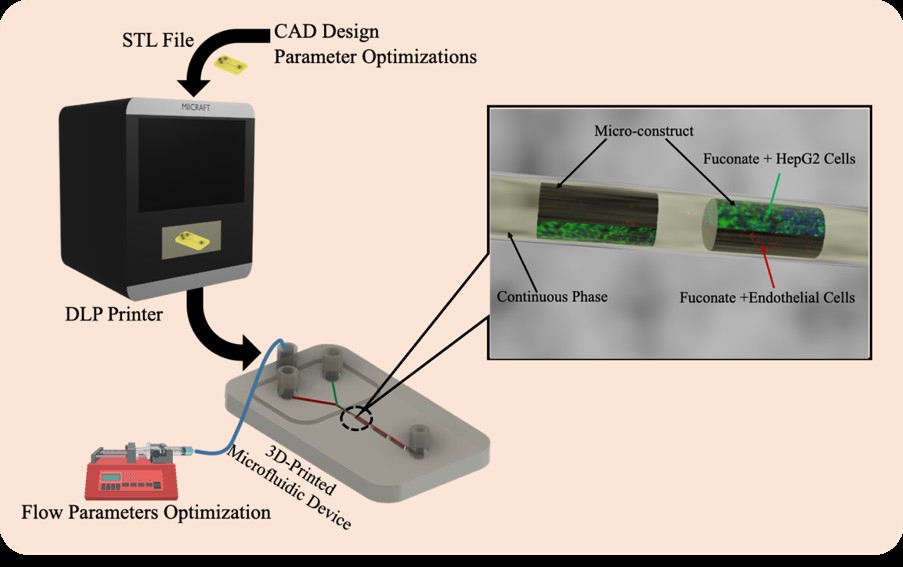
PDMS based microfluidic devices along with conventional hydrogels (such as alginate, collagen) were employed to reconstruct microphysiological models which limit scalability and accessibility due to complex device fabrication. On the other hand, Digital Light Processing (DLP) 3D printing provides a low-cost, rapid, and scalable alternative for fabricating microfluidic devices. Here, we employed a fucoidan-alginate blend for generating janus micro-constructs with segregated HepG2-HUVEC compartments for co-culture application using a DLP-printed, custom-designed microfluidic system as an initial engineering proof-of-concept. This flow focusing platform enables co-culture of hepatocytes (HepG2) and endothelial cells (HUVECs) inside the janus microgel. Various co-culture ratios (0:100, 100:0 and 50:50: (HepG2 cells: HUVEC cells) of hydrogels were generated by varying the flowrates and a few other possible ratios were confirmed from computational fluid dynamics (CFD) studies to support the concept. Viability of encapsulated cells within the microgels over 07 days of co-culture was ~ 95%, and strong expression of the hepatocyte and endothelial cell-specific markers (Albumin and CD31, respectively) ensured significant cytocompatibility and cellular functionality during the flow-focusing approach. Such DLP-based microfluidic system offers tremendous scope for low-cost, high-throughput production of janus micro-constructs for drug screening and hepatotoxicity testing applications, a potential alternative to animal testing.
Keywords:
3D-printed microfluidics
; Digital Light Processing (DLP)
; alginate-fucoidan complex
; HepG2-HUVEC co-culture
; janus hydrogel
Copyright: This open access article is published under a Creative Commons CC BY 4.0 license, which permit the free download, distribution, and reuse, provided that the author and preprint are cited in any reuse.