Submitted:
17 August 2026
Posted:
18 August 2026
You are already at the latest version
Abstract
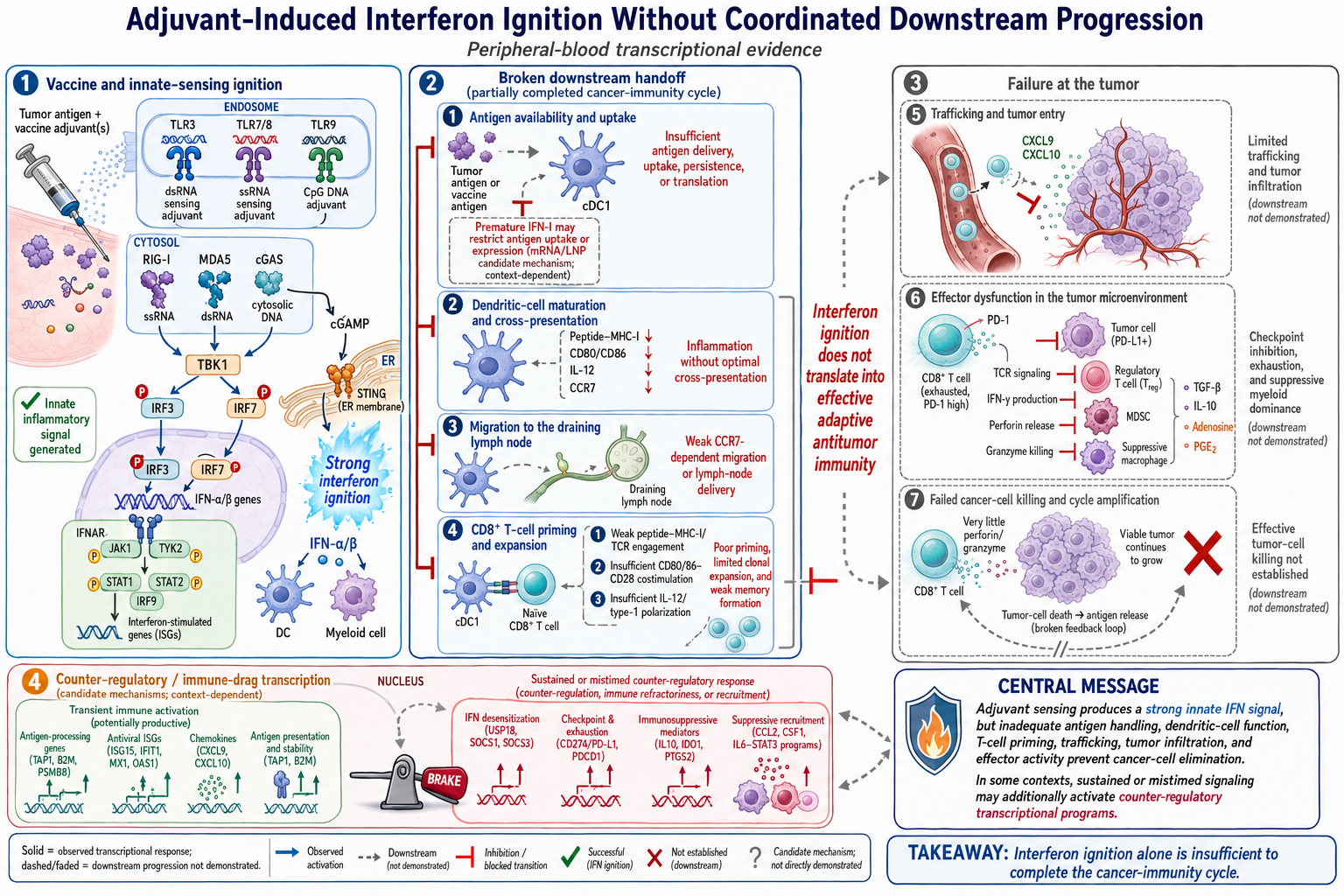
Background/Objectives: Therapeutic cancer vaccines can generate measurable immunity without tumor regression. Adjuvants initiate innate activation, but antitumor efficacy also requires antigen presentation, lymphoid priming, effector differentiation, tumor trafficking, cancer-cell recognition and killing, and persistence. We compared the magnitude, duration, and downstream breadth of clinically used adjuvant responses with live vaccination. Methods: We reanalyzed transcriptomic data from six randomized human vaccine studies and one controlled mouse experiment; one human study sequenced six sorted leukocyte populations. Twenty-three prespecified gene sets spanning innate ignition, antigen presentation, adaptive differentiation, trafficking, and effector programs were scored by participant-paired, baseline-adjusted comparisons with matched controls. One trial sampled placebo, adjuvanted, unadjuvanted, and live attenuated vaccines daily. Results: AS01B, AS01E, AS03, and MF59 increased type I interferon by 9.6, 8.6, 7.5, and 3.2 percentile points at 24 hours; AS04 and aluminum salt remained at control levels. Yellow fever 17D sustained interferon through day 7; MF59 resolved by day 3 and AS01/AS03 by day 7. Antigen-presenting-cell activation and MHC class I machinery rose with interferon. Apart from a small day-7 germinal-center/plasmablast signal in two AS03 trials, no reproducible sustained downstream program was detected in blood; acute cytotoxic and natural-killer-cell decreases mainly reflected blood-cell composition. Conclusions: Adjuvants produce robust ignition, but these blood datasets do not establish the later cellular functions required for tumor-cell killing. Duration is one candidate determinant of this transition. Cancer-vaccine trials should measure ignition together with compartment-appropriate priming, trafficking, cytotoxic function, and persistence across repeated doses.