
Submitted:
14 August 2026
Posted:
18 August 2026
You are already at the latest version
Abstract
Background Prehospital invasive ventilation is used across a range of critically ill adult patients, yet reported practices, monitoring approaches, and clinical outcomes vary considerably be-tween systems. Existing literature has focused largely on airway management, and the overall landscape of evidence regarding invasive ventilation strategies in the prehospital setting remains unclear. This scoping review aimed to map the extent and nature of the literature on prehospital invasive ventilation in adults, describe the clinical contexts in which it is applied, and identify knowledge gaps. Methods This scoping review was conducted according to Joanna Briggs Institute methodology and PRISMA-ScR guidelines. MEDLINE (via PubMed), Embase, and the Cochrane Library were searched from inception to the date of search. Studies were eligible if they included adult patients (≥18 years) receiving invasive ventilation in a prehospital setting. Random-ized and non-randomized controlled trials and observational studies were included. Two reviewers independently screened studies, charted data, and summarized findings de-scriptively. Results A total of 3,461 records were identified, of which 25 studies met inclusion criteria. Nine studies evaluated out-of-hospital cardiac arrest, ten focused on trauma, one examined sep-tic shock, and five included mixed populations. Across clinical contexts, deviations from recommended ventilation targets—particularly hyperventilation and inconsistent appli-cation of lung-protective tidal volumes—were common. Mechanical ventilation generally improved physiological parameters compared with manual ventilation, but consistent benefits in survival or neurological outcomes were not demonstrated. Capnogra-phy-guided ventilation and real-time feedback systems improved adherence to ventilation targets. Evidence was predominantly observational and heterogeneous in design and re-porting. Conclusion Prehospital invasive ventilation in adults is characterized by substantial variability in practice and limited high-quality comparative evidence. Ventilation quality and monitor-ing may be more important than ventilation modality alone. Prospective controlled studies and standardized reporting of prehospital ventilation practices are needed to create evi-dence-based recommendations.
Keywords:
emergency medicine
; invasive ventilation
; mechanical ventilation
; out-of-hospital
; prehospital care
1. Introduction
Evidence regarding management of critically ill patients undergoing invasive ventilation in the prehospital setting remains scarce. Practices vary widely due to differences in provider training, protocols, and equipment availability [1]. However, invasive mechanical ventilation (transport ventilator) offers multiple theoretical advantages over manual invasive ventilation (bag-valve with invasive airway) including consistent ventilation, reduced risk of barotrauma or inadequate tidal volume, and allowing the team to focus on other aspects of patient care [2]. The current literature focuses on airway management [3]. While no clear survival benefit has been demonstrated for advanced airway techniques compared with bag-valve-mask ventilation—and in some cases worse outcomes have been reported—these findings depend strongly on provider expertise and system factors [4,5,6]. However, prehospital invasive ventilation, regardless of modality, is a multifaceted intervention whose safety and effectiveness appear to depend more on provider expertise and ventilatory quality rather than the airway device itself [7]. Recent studies increasingly address ventilatory management and lung-protective strategies, but real-world implementation remains heterogeneous [8,9]. Likewise, the comparative effects of manual invasive ventilation versus mechanical invasive ventilation are still unclear and indications for starting prehospital invasive ventilation are poorly defined.
To our knowledge, no prior review has comprehensively mapped the evidence on prehospital invasive ventilation across ventilatory strategies. This scoping review therefore aimed to synthesize the available evidence, describe clinical contexts, and identify knowledge gaps. Given the heterogeneity of the literature and limited randomized evidence, a scoping approach was chosen
2. Materials and Methods
The current review is in line with the methodological guidance of the Joanna Briggs Institute and the guidelines established as the Preferred Reporting Items for Systemic Reviews and Meta-Analyses Extension for Scoping Reviews (PRISMA-ScR) [10,11]. No protocol was registered for this review.
This scoping review aimed to provide a literature overview on prehospital invasive ventilation in adults with a focus on clinical outcomes and population specific differences. We used the Population, Concept, Context (PCC) framework as a guiding structure. The PCC identified:
Population
Adult patients (18 years or older) undergoing prehospital invasive ventilation.
Concept
The use of invasive ventilation procedures, regardless of the airway device.
Context
Prehospital settings such as Emergency Medical Services (EMS), mobile emergency teams, Helicopter Emergency Medical Services (HEMS), interfacility transports
Research Questions
- How is prehospital invasive ventilation applied across different patient populations and clinical contexts, and which outcomes are reported?
- What evidence exists regarding the use of mechanical versus manual invasive ventilation in prehospital care?
- What ventilation modalities, targets, and monitoring strategies are described in the prehospital setting?
Search Strategy
A systematic search was conducted in the databases of MEDLINE (via. PubMed), EMBASE and The Cochrane Library in July 2025. Both free-text terms and controlled vocabulary (MeSH and EMTREE) were used. The full search strategy for each database is included in Appendix A.
Inclusion and Exclusion Criteria
Publications were included if they studied prehospital invasive ventilation in adults (≥18 years) evaluating clinical outcomes or specific patient populations. Any controlled clinical study design or observational study was included. Publications were excluded if they studied non-invasive ventilation, pediatric patients (<18 years) or non-prehospital settings (e.g., hospital-based care). Opinion articles, reviews, comments, and editorials were excluded. Publications written in languages other than English were also excluded.
Selection Process
Two independent reviewers (LC and KT) screened titles and abstracts independently based on the inclusion and exclusion criteria. Full-text studies were assessed, and in case of doubt, consensus was sought or a third reviewer (MS) consulted. Rayyan (Rayyan Systems Inc., Cambridge, MA, USA) was used for study selection and Mendeley (Elsevier, Amsterdam, The Netherlands) was used as a reference manager.
Data Charting and Synthesis
Data were charted by two independent reviewers (LC and KT) using a spreadsheet. Charted data included: bibliographic information (first author; year), study characteristics (country of origin; study design; EMS system type), population characteristics (demographics; underlying pathology), intervention details (type of invasive ventilation; technique; comparators, if applicable), and key findings relevant to the research by questions. Disagreements between reviewers were resolved by consensus consulting a third reviewer (MS). Results were summarized in tables and analyzed narratively. No formal critical appraisal of included studies was performed, as the aim of this scoping review was to map the available evidence rather than assess methodological quality
3. Results
Literature Search
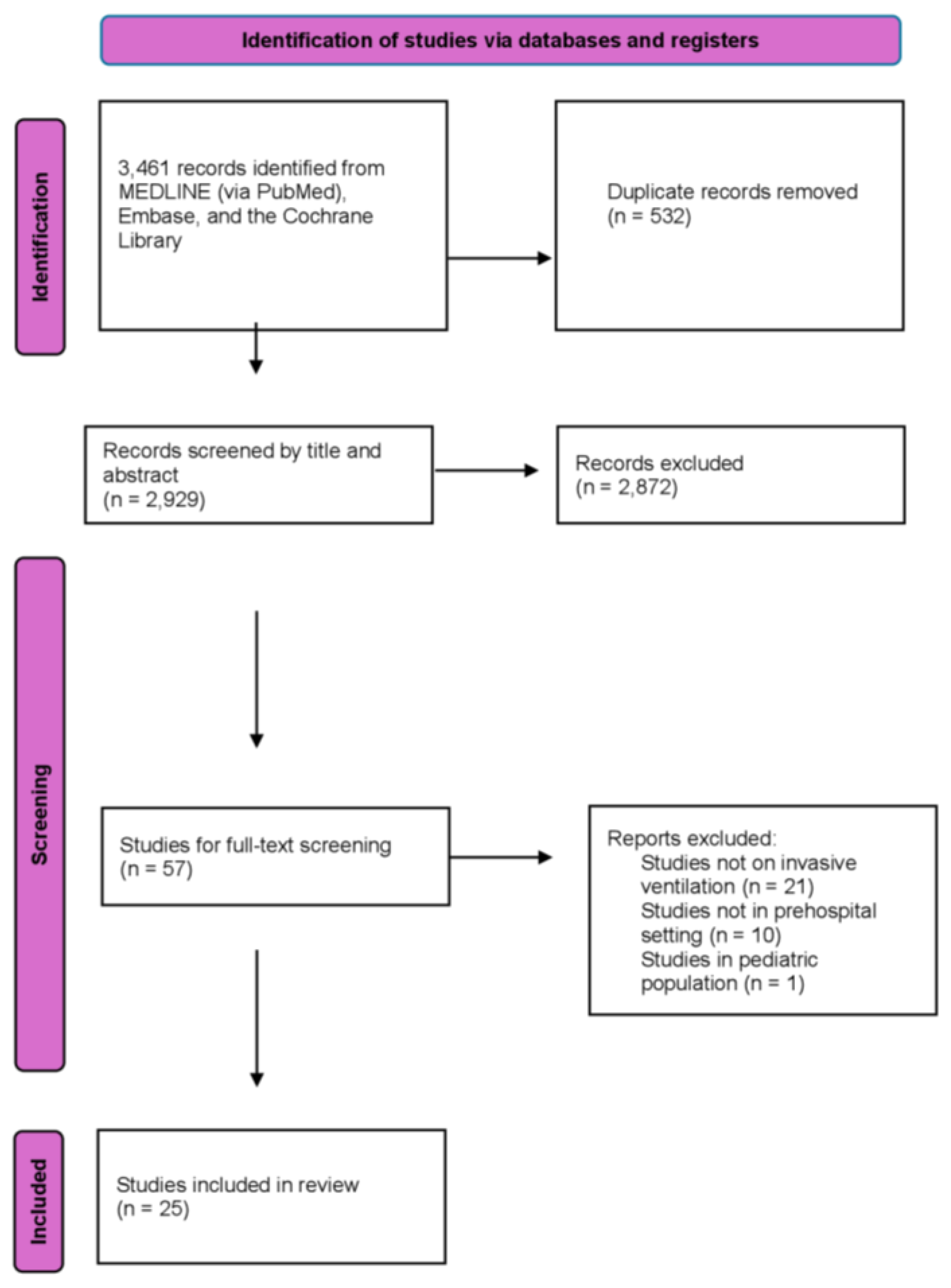
The search strategy identified 3461 citations, of which 532 were duplicates. After title and abstract screening, full texts were assessed according to the prespecified inclusion and exclusion criteria.
Using these criteria a total of 25 articles were included (Figure 1).
Characteristics of included studies
There were nine articles which evaluated the use of prehospital invasive ventilation in the setting of out-of-hospital cardiac arrest (OHCA), ten in trauma, one in sepsis and five in mixed pathologies. The characteristics and key findings of these studies are demonstrated in Table 1.
Table 1. Characteristics of included studies.
Out-of-hospital cardiac arrest (OHCA)
| First author (year) | Design | Sample size | Setting | Ventilation focus / comparison | Key findings |
| Benoit (2023) | Retrospective cohort | 314 | EMS | Capnography derived ventilation rate | Median rate often outside 8–10/min target, only 22% compliant with guidelines; no independent association with ROSC ; poor reliability of measurement through capnography |
| Drennan (2024) | Before–after | 412 | EMS | Real-time ventilation feedback | Significant improvement in compliance with target rate and volume; no clear survival effect |
| Hernández-Tejedor (2023) | Quasi-experimental | 150 | EMS | Mechanical IPPV vs bag ventilation | Mechanical ventilation improved pCO₂ and pH; no significant neurological survival difference: 15.6% versus 11.3% (p = 0.44%) |
| Hernández-Tejedor (2025) | Quasi-experimental | 521 | EMS | CCSV vs IPPV vs bag ventilation | Potential benefit of mechanical ventilation over bag ventilation; no clear superior ventilation mode |
| Kuisma (2006) | RCT | 28 | EMS | FiO₂ 30% vs 100% post ROSC | No significant difference in survival (p=0.5134) ; FiO₂ escalation required in 36% of patients |
| Langhelle (2000) | RCT | 17 | EMS | 500 vs 1000 mL tidal volume during CPR | Higher tidal volume improved CO₂ clearance but did not improve survival |
| Maertens (2013) | Prospective cohort | 98 | EMS | Ventilation rate during CPR | Frequent deviation from recommended ventilation rates; 90% in manually ventilated and 92% in mechanical ventilation; hyperventilation common with median rate 20/min |
| Prause (2023) | RCT | 46 | EMS | Ventilation rate of 10/min vs 20/min during CPR | No significant difference in survival, median pH or median pC02 |
| Snyder (2023) | Retrospective cohort | 1994 | EMS | Small vs standard adult BVM | Smaller bags associated with lower ROSC rates; OR 0.74, 95% [CI 0.61 – 0.91] |
Trauma
| First author (year) | Design | Sample size | Population | Setting | Ventilation focus / comparison | Key findings |
| McLachlan (2019) | Prospective cohort | 20 | Major trauma | HEMS | Effectiveness of manual ventilation | Adequate oxygenation in 83.6%, correct ETCO2 in 48.7% |
| Helm (2003) | RCT | 97 | Major trauma | HEMS | Capnography-guided vs blind ventilation | Higher incidence of normoventilation with use of ETCO2 monitoring |
| Warner (2007) | Prospective cohort | 492 | TBI | EMS + HEMS | Association of normocapnia with mortality | Normocapnia associated with lower mortality (adjusted OR 0.57) |
| Helm (2002) | Prospective observational | 122 | TBI | EMS | Quality of prehospital ventilation | Optimal oxygenation achieved in 85.2%, adequate ventilation in 42.6% |
| Curry (2020) | Retrospective cohort | 93 | TBI | HEMS | Incidence of eucapnia between manual and mechanical ventilation | Eucapnia in 36% of patients, no difference ventilation types |
| Davis (2005) | Prospective observational | 76 | TBI | EMS | Ventilation patterns after paramedic RSI | Inadvertent hyperventilation is common, despite ETCO2 monitoring |
| Knapp (2023) | Retrospective cohort | 308 | TBI | HEMS | Adherence to ventilation and SBP targets | 45% had PetCO2 in the normal range, only 33% were normocapnic |
| Bossers (2023) | Prospective observational | 1776 | TBI | HEMS | Association between prehospital ETCO₂ and 30-day mortality |
Increased mortality with ETCO₂ <35 mmHg. No significant association between hypercapnia (≥45 mmHg) and mortality |
| Herff (2023) | Retrospective cohort | 296 | Major trauma | HEMS | No/low vs moderate PEEP; association with SBP | No significant correlation between PEEP and mean difference of SBP |
| Maddry (2018) | Retrospective cohor | 650 | Major trauma | Air transport | Compliance to ARDSnet protocol | ARDSNet compliance associated with fewer ventilator days and ICU days, lower incidence of ARDS, and lower 30-day mortality |
Sepsis
| First author (year) | Design | Sample size | Setting | Ventilation focus / comparison | Key findings |
| Jouffroy (2019) | Retrospective cohort | 59 | EMS | Association between VTIBW and 28-day mortality | VTIBW <8 mL/kg associated with lower 28-day mortality |
Mixed pathologies
| First author (year) | Design | Sample size | Setting | Ventilation focus / comparison | Key findings |
| Moy (2022) | Retrospective cohort | 68365 | HEMS | Ventilation practices | Majority of subjects had TV set empirically without calculating VTIBW, unclear usage of LPV |
| Johannigman (1995) | Prospective cohort | 160 | Transport | Bag vs transport ventilator | No significant difference in arrival ABGs between methods |
| Singh (2009) | Retrospective cohort | 1735 | Critical care transport | Ventilation practices | Marked heterogeneity in ventilator settings, 35% of patients at risk ventilated with LPV |
| Stoltze (2015) | Retrospective cohort | 235 | HEMS | Influence of prehospital ventilation on inhospital ventilation and ARDS | Prehospital settings influenced ICU settings ; no association with ARDS incidence: P = 0.840 |
| Yang (2022) | Prospective cohort | 54 | EMS | Respiratory mechanics during manual ventilation | Ventilation 75% within lung-protective range. Most variation in VT and peak pressure during active resuscitation |
Studies are grouped according to the primary clinical context in which prehospital invasive ventilation was evaluated. Key outcomes are reported descriptively as presented in the original publications; no quantitative synthesis was performed given the heterogeneity of study designs, populations, ventilation strategies, and outcome definitions. ABG, arterial blood gas; ARDS, acute respiratory distress syndrome; BVM, bag-valve mask; CCSV, chest compression synchronized ventilation; EMS, emergency medical services; ETCO₂, end-tidal carbon dioxide; FiO₂, fraction of inspired oxygen; HEMS, helicopter emergency medical services; IPPV, intermittent positive-pressure ventilation; LPV, lung-protective ventilation; MICU, mobile intensive care unit; MV, mechanical ventilation; OHCA, out-of-hospital cardiac arrest; PBW, predicted body weight; PEEP, positive end-expiratory pressure; PetCO2, end-tidal partial pressure of CO2; ROSC, return of spontaneous circulation; RSI, rapid sequence intubation; TBI, traumatic brain injury; VT, tidal volume; VTIBW, tidal volume indexed to ideal body weight.
Due to the diverse settings and high variability in interventions and outcomes within the selected studies, the results were grouped to the specific pathologies and their key findings.
Out-of-hospital cardiac arrest
Nine studies evaluated invasive ventilation strategies during OHCA.
Ventilation rates
Across studies assessing ventilation rate, compliance with guideline-recommended ventilation rates was low, with most patients ventilated outside target ranges (8-22%). Studies using capnography or device-based measurements demonstrated frequent hyperventilation during resuscitation. Although real-time feedback improved adherence to predefined ventilation targets, no consistent association between ventilation rate and ROSC or survival was demonstrated [12,13,14,15].
Ventilation volumes
In a retrospective observational study, use of smaller adult ventilation bags was associated with lower odds of ROSC (OR 0.74, 95% CI 0.61 – 0.91) [16]. A randomized trial comparing higher versus lower tidal volumes during CPR did demonstrate a higher PaC02 and lower pH with comparing a tidal volume of 500 vs 1000ml; 7.48 kPa (SD 5.25-9.71) versus 3.70 kPa (SD 2.83-4.53) (P=0.002) at 5 minutes post mechanical ventilation and 7.45 kPa (SD 6.26-8.64) versus 3.98 kPa (SD 2.4-5.56) (P0.001) at 10-15 minutes post start of mechanical ventilation. The pH was significantly lower for 500 than 1000 ml at 10–15 min, 7.01 (SD 6.91-7.11) versus 7.20 (SD 7.03-7.37) (P=0.034) [17]. Another study showed that real-time feedback facilitated delivery of target tidal volumes of 6-8ml/kg [15].
Inspired oxygen fraction
One randomized study compared lower versus higher inspired oxygen fractions during OHCA and found no significant difference in clinical outcomes (p=0.5134). In a substantial proportion (36%) of patients initially allocated to lower FiO₂, escalation was required due to hypoxemia [18].
Manual versus mechanical ventilation:
Two papers of the same author were included, which were two phases of the same study [19].
The first paper solely compared IPPV vs bag-valve ventilation while the second added CSSV (Chest Compression Synchronized Ventilation) as a comparator. The data from the first phase was also utilized in the analysis of the second phase.
In phase 1, intermittent positive-pressure ventilation (IPPV) via a mechanical ventilator resulted in significantly improved blood gas parameters compared with bag ventilation, without a statistically significant difference in neurological survival; 15.6% versus 11.3% (p = 0.44%) [20]. Phase 2 introduced chest compression synchronized ventilation (CCSV) and reported differences in physiological and clinical outcomes between ventilation strategies; mechanical ventilation was associated with significantly more ROSC (58.8% versus 49.3% with p = 0.03) and survival (17.0% vs 10.9% with p = 0.03). In shockable rhythms, there was a strong association toward CPC 1 -2 in the mechanical ventilation group than in the manual ventilation group (34.1% versus 20.5% with p = 0.05) [19].
Trauma
Ten studies evaluated prehospital invasive ventilation in trauma patients, including cohorts with severe traumatic brain injury (TBI) and major trauma.
Ventilation patterns
Observational studies reported wide variability in ventilation quality during transport, with normocapnia achieved in only 33–49% of patients on hospital arrival [21,22,23,24]. Most studies found hypocapnia to be the most common, only one study reported the majority of patients (60.2%) to be hypercapnic on hospital admission [23]. In severe TBI, inadvertent hyperventilation remained common even when ETCO₂ monitoring and target ranges were used [25].
Incidence of optimal oxygenation
Two observational studies reported similar incidence of what was defined as optimal oxygenation upon hospital arrival in intubated trauma patients [21,22]. In the prospective HEMS cohort by McLachlan et al., 83.6% of cumulative transport time was reported as spent with adequate oxygen saturations, based on continuous pulse oximetry recordings during manual ventilation [21]. The study does not further specify the exact oxygen saturation threshold used to define adequacy in the published manuscript. In contrast, Helm et al. defined optimal oxygenation as a PaO₂ > 100 mmHg measured on arterial blood gas analysis immediately upon hospital arrival, reporting that this target was achieved in 85.2% of patients with severe head injury [22].
Although both studies report a similarly high proportion of patients meeting their respective oxygenation targets, the definitions and measurement modalities differed substantially, limiting direct comparability between cohorts.
Ventilation targets and mortality
Several studies on major trauma patients demonstrated an association between normocapnia or targeted ventilation and improved survival. In severe TBI cohorts, PaCO₂ on hospital arrival within recommended ranges was associated with lower mortality compared with hypo- or hypercapnia: reported OR of 0.57; ( 95% CI, 0.33-0.99); in another cohort mortality was associated with hypocapnia with OR of 1.89 (95% CI 1.53–2.34) [26,27]. Non-compliance with lung-protective ventilation strategies in major trauma was also associated with worse 30 day mortality in selected cohorts: OR 2.75 (1.17-7.54) [28].
Manual versus mechanical ventilation
Evidence comparing manual and mechanical ventilation in trauma patients was limited. In one HEMS cohort, no significant difference was observed between manual and mechanical ventilation in achieving normocapnia, which was attained in, respectively, 36% and 35% of patients (p = 1.00) [23]. However, interpretation of these findings is constrained by limited data availability due to short transport durations. Furthermore, all patients in whom mechanical ventilation was initiated underwent an initial period of manual ventilation, introducing potential confounding and limiting the ability to isolate the independent effect of ventilation mode.
Capnography-guided ventilation
One randomized controlled trial compared capnography-guided ventilation with ventilation based on estimated weight and age without capnographic monitoring [29]. The study reported a higher proportion of patients at hospital arrival within the normoventilation range (63.2% vs 20% with p<0.0001) and a lower proportion of hypoventilated patients (5.3% vs 37.5% with p<0.0001) in the capnography group.
PEEP and hemodynamics
One retrospective cohort study evaluated the association between prehospital PEEP levels and systolic arterial blood pressure in mechanically ventilated major trauma patients [30]. No significant correlation was found between the mean difference in systolic blood pressure from scene to hospital admission in patients ventilated with low or no PEEP (0-3 cmH₂O) versus moderate PEEP (4–10 cmH₂O) with P = 0.17. In the overall cohort, systolic blood pressure improved modestly in both groups during transport, without significant intergroup differences. However, the observational design precludes causal inference. The observed association may therefore reflect differences in overall resuscitation strategies rather than an independent effect of PEEP level.
Sepsis
One retrospective cohort study evaluated prehospital invasive mechanical ventilation in patients with septic shock [31]. After multivariable adjustment, a tidal volume indexed to ideal body weight (VTIBW) <8 mL/kg was independently associated with lower 28-day mortality (OR adjusted = 0.12 [0.03-0.43]), while VTIBW >8mL/kg was significantly associated with higher mortality (OR adjusted = 8.29 [2.35-34.98]).
Unspecified or mixed pathology
Five studies included heterogeneous adult populations or did not restrict inclusion to a single pathology.
Ventilation practices in HEMS
One retrospective trial reported that lung-protective ventilation was infrequently applied during air medical transport i.e. thirteen percent (13%) of included patients, and that prehospital tidal volume selection influenced subsequent emergency department and ICU ventilator settings. However, there was no clear association of pre-hospital tidal volumes with ARDS incidence with P = 0.840 [32].
Another retrospective trial looked solely at the existing practices of HEMS. It found that tidal volumes were set empirically in the overwhelming majority. Only a small subset (6.1%) of patients had a measured height and thus could have a set tidal volume indexed to predicted body weight [33].
Ventilation practices in EMS
One retrospective observational trial found that the majority (92%) of patients were ventilated with peak pressures of ≤35cmH20 and 22% with PEEP <5cmH20. In the subgroup of patients at risk for acute lung injury, 35% was ventilated according to the arbitrary protective ventilation defined as: PEEP ≥ 5 cmH2O, PIP ≤ 35 cmH2O and Vt ≤ 6.5 mL/kg actual body weight (ABW) [34].
One prospective observational trial evaluated the tidal volumes post intubation per breath and found a mean tidal volume per predicted body weight (PBW) of 7.0ml/kg. Moreover, 75% of breaths were within the 4-10ml/kg PBW range [9]. Both studies had limited reporting of patient-centered outcomes [9,34].
Impact of ventilation on blood gasses
One prospective cohort compared manual bag ventilation with mechanical ventilation in a mixed cohort during interhospital transports and found similar arterial blood gas values on arrival, though interpretation is limited by older technology and practice patterns, as the study was published in 1995 [35].
4. Discussion
This scoping review mapped the breadth of evidence regarding prehospital invasive ventilation in adults and identified substantial heterogeneity in ventilation practices, monitoring strategies, and reported outcomes across clinical contexts.
Interpretation of results
First, ventilation quality during prehospital care is frequently suboptimal, particularly during OHCA and severe trauma. Across multiple cohorts, both hyperventilation and failure to achieve lung-protective tidal volumes were common. Despite widespread recognition of the importance of controlled ventilation, consistent delivery of guideline-concordant ventilation remains challenging in the prehospital environment.
However, our results found no significant improvement in outcomes when ventilation rates were improved to meet the guidelines. This may suggest that the ideal ventilation rate may be different from the ones that are currently proposed in the guidelines.
Second, mechanical ventilation was generally associated with improved physiological control (e.g., pCO₂ and pH) compared with manual bag ventilation. However, the available evidence does not demonstrate a consistent improvement in patient-centered outcomes such as survival or neurological recovery. Most comparative studies were observational or quasi-experimental and therefore subject to confounding by selection bias, transport time, and provider expertise.
Third, observational trauma and septic shock studies suggest that achieving normocapnia and lung-protective tidal volumes may be associated with improved outcomes. These findings are biologically plausible and consistent with in-hospital ventilation literature but remain insufficient to establish causality in the prehospital setting.
Clinical implications
Taken together, the findings suggest that ventilation quality rather than ventilation modality alone may be the key determinant of outcome. Technologies that improve monitoring and feedback—such as continuous capnography and real-time ventilation feedback—consistently improved adherence to target parameters and may represent actionable system-level interventions, but the optimal ventilation strategy may yet have to be determined.
Research implications
This review highlights several important knowledge gaps:
- Few randomized studies comparing manual versus mechanical invasive ventilation
- Inconsistent definitions of adequate ventilation
- Limited reporting of PBW-indexed tidal volumes
- Strong confounding in observational trauma and OHCA cohorts
Future research should prioritize pragmatic, randomized, or well-controlled prospective studies focusing on patient-centered outcomes and standardized ventilation reporting.
Strengths and limitations
A major strength of this review is the comprehensive mapping of invasive ventilation practices across multiple prehospital systems and pathologies. The scoping methodology allowed inclusion of heterogeneous study designs reflective of real-world practice.
Limitations include reliance on predominantly observational data, heterogeneity in outcome definitions, and potential publication bias. No formal quality appraisal was conducted, which limits interpretation of the strength of evidence. Additionally, the inability to perform quantitative synthesis limits causal inference.
5. Conclusions
Prehospital invasive ventilation in adult patients is characterized by substantial heterogeneity in indications, techniques, and monitoring practices. Across OHCA and trauma populations, ventilation outside recommended targets is common, and while mechanical ventilation may improve physiological control, consistent benefits in patient-centered outcomes have not been demonstrated. Current evidence suggests that ventilation quality and monitoring may be more important than ventilation modality alone.
Supplementary Materials
The following supporting information can be downloaded at the website of this paper posted on Preprints.org.
Author Contributions
Conceptualization, L.C and K.T; methodology, L.C and K.T.; L.C and K.T.; investigation, L.C and K.T.; resources, L.C and K.T; data curation, L.C and K.T; writing—original draft preparation, L.C, K.T and M.S.; writing—review and editing, M.S.; supervision, M.S..; project administration, All authors have read and agreed to the published version of the manuscript.
Funding
This research received no external funding.
Institutional Review Board Statement
The study was conducted in accordance with the Declaration of Helsinki, and the protocol was approved by the Ethics Committee of KU Leuven Group Biomedical Sciences with reference number MP036543 on 06/05/2025.
Informed Consent Statement
Not applicable.
Data Availability Statement
The raw data supporting the conclusions of this article will be made available by the authors on request.
Conflicts of Interest
The authors declare no conflicts of interest.
Abbreviations
The following abbreviations are used in this manuscript:
| PRISMA-ScR | Preferred Reporting Items for Systemic Reviews and Meta-Analyses Extension for Scoping Reviews |
| PCC (framework) | Population, Concept, Context |
| EMS | Emergency Medical Services |
| HEMS | Helicopter Emergency Services |
| OHCA | Out-of-hospital cardiac arrest |
| ABG | Arterial blood gas |
| ARDS | Acute respiratory distress syndrome |
| BVM | Bag-valve mask |
| CCSV | Chest compression synchronized ventilation |
| ETCO₂ | End-tidal carbon dioxide |
| FiO₂ | Fraction of inspired oxygen |
| IPPV | Intermittent positive-pressure ventilation |
| LPV | Lung protective ventilation |
| MICU | Mobile intensive care unit |
| MV | Mechanical ventilation |
| PBW | Predicted body weight |
| PEEP | Positive end-expiratory pressure |
| PetCO₂ | End-tidal partial pressure of CO₂ |
| ROSC | Return of spontaneous circulation |
| RSI | Rapid sequence intubation |
| TBI | Traumatic brain injury |
| VT | Tidal volume |
| VTIBW | Tidal volume indexed to ideal body weight |
| OR | Odds ratio |
Appendix A. Search Strategies
MEDLINE search strategy
(“Respiration, Artificial”[Mesh] OR “Ventilators, Mechanical”[Mesh] OR “invasive ventilation”[tiab] OR “mechanical ventilation”[tiab])
AND
(“Emergency Medical Services”[Mesh] OR “Ambulances”[Mesh] OR “Prehospital”[tiab] OR “emergency medical service*”[tiab] OR EMS[tiab] OR HEMS[tiab])
NOT
(“Noninvasive Ventilation”[Mesh] OR “non-invasive ventilation”[tiab] OR “noninvasive ventilation”[tiab] OR NIV[tiab])
NOT
(“Pediatrics”[Mesh] OR pediatric*[tiab] OR child*[tiab] OR neonate*[tiab] OR infant*[tiab])
EMBASE search strategy
(‘artificial ventilation’/exp/mj OR ‘artificial ventilation’:ti,ab,kw OR ‘endotracheal intubation’:ti,ab,kw) AND (‘emergency care’/exp/mj OR ‘emergency care’:ti,ab,kw OR ‘rescue personnel’:ti,ab,kw OR ‘ambulance’/exp/mj OR ‘ambulance’:ti,ab,kw OR ‘helicopter emergency medical service’:ti,ab,kw OR ‘prehospital care’:ti,ab,kw OR ‘pre-hospital care’:ti,ab,kw) NOT (‘pediatrics’/exp OR ‘child’/exp OR ‘newborn’/exp) NOT (‘noninvasive ventilation’/exp OR ‘noninvasive ventilation’:ti,ab,kw)
COCHRANE search strategy
Concept 1: invasive ventilation
#1 MeSH descriptor: [Respiration, Artificial] explode all trees
#2 MeSH descriptor: [Ventilators, Mechanical] explode all trees
#3 “mechanical ventilation”:ti,ab,kw
#4 “invasive ventilation”:ti,ab,kw
#5 “transport ventilator”:ti,ab,kw
#6 “bag-valve mask”:ti,ab,kw
#7 “manual ventilation”:ti,ab,kw
#8 #1 OR #2 OR #3 OR #4 OR #5 OR #6 OR #7
Concept 2: Prehospital care
#9 MeSH descriptor: [Emergency Medical Services] explode all trees
#10 “prehospital”:ti,ab,kw
#11 “emergency medical service*”:ti,ab,kw
#12 EMS:ti,ab,kw
#13 “out-of-hospital”:ti,ab,kw
#14 ambulance:ti,ab,kw
#15 #9 OR #10 OR #11 OR #12 OR #13 OR #14
Exclusion of pediatrics and NIV
#16 MeSH descriptor: [Pediatrics] explode all trees
#17 MeSH descriptor: [Infant] explode all trees
#18 MeSH descriptor: [Child] explode all trees
#19 MeSH descriptor: [Adolescent] explode all trees
#20 MeSH descriptor: [Noninvasive Ventilation] explode all trees
#21 pediatric*:ti,ab,kw
#22 child*:ti,ab,kw
#23 infant*:ti,ab,kw
#24 adolescent*:ti,ab,kw
#25 neonat*:ti,ab,kw
#26 “noninvasive ventilation”:ti,ab,kw
#27 CPAP:ti,ab,kw
#28 BiPAP:ti,ab,kw
#29 #16 OR #17 OR #18 OR #19 OR #20 OR #21 OR #22 OR #23 OR #24 OR #25 OR #26 OR #27 OR #28
Combination
#30 #8 AND #15
#31 #30 NOT #29
References
- Taymour, R.K.; Abir, M.; Chamberlin, M.; Dunne, R.B.; Lowell, M.; Wahl, K.; et al. Policy, Practice, and Research Agenda for Emergency Medical Services Oversight: A Systematic Review and Environmental Scan. Prehosp Disaster Med.;PubMed 2018, 33(1), 89–97. [Google Scholar] [CrossRef] [PubMed]
- Baez, A.A.; Qasim, Z.; Wilcox, S.; Weir, W.B.; Loeffler, P.; Golden, B.M.; et al. Prehospital Mechanical Ventilation: An NAEMSP Position Statement and Resource Document. Prehospital Emerg. Care;PubMed 2022, 26(S1), 88–95. [Google Scholar] [CrossRef] [PubMed]
- Carney, N.; Totten, A.M.; Cheney, T.; Jungbauer, R.; Neth, M.R.; Weeks, C.; et al. Prehospital Airway Management: A Systematic Review. Prehospital Emerg. Care;PubMed 2021, 26(5), 716–27. [Google Scholar] [CrossRef] [PubMed]
- Lou, J.; Tian, S.; Kang, X.; Lian, H.; Liu, H.; Zhang, W.; et al. Airway management in out-of-hospital cardiac arrest: A systematic review and network meta-analysis. Am. J. Emerg. Med.;PubMed 2023, 65, 130–8. [Google Scholar] [CrossRef] [PubMed]
- Tang, Y.N.; Lui, C.T.; Fung, H.T.; Lee, L.Y.; Lau, C.L. Laryngeal mask airway in out-of-hospital cardiac arrest. Singap. Med. J.;PubMed 2021, 65(12), 703. [Google Scholar] [CrossRef] [PubMed]
- Pepe, P.E.; Roppolo, L.P.; Fowler, R.L. Prehospital endotracheal intubation: elemental or detrimental? Crit. Care;PubMed 2015, 19(1), 121. [Google Scholar] [CrossRef] [PubMed]
- Pinto-Villalba, R.S.; Leon-Rojas, J.E. Reported adverse events during out-of-hospital mechanical ventilation and ventilatory support in emergency medical services and critical care transport crews: a systematic review. Front Med.;PubMed 2023, 10. [Google Scholar] [CrossRef] [PubMed]
- Siegler, J.; Kroll, M.; Wojcik, S.; Moy, H.P. Can EMS Providers Provide Appropriate Tidal Volumes in a Simulated Adult-sized Patient with a Pediatric-sized Bag-Valve-Mask? Prehospital Emerg. Care;PubMed 2017, 21(1), 74–8. [Google Scholar] [CrossRef] [PubMed]
- Yang, B.Y.; Blackwood, J.E.; Shin, J.; Guan, S.; Gao, M.; Jorgenson, D.B.; et al. A pilot evaluation of respiratory mechanics during prehospital manual ventilation. Resuscitation.;PubMed 2022, 177, 55–62. [Google Scholar] [CrossRef] [PubMed]
- Peters, M.; Godfrey, C.; Mcinerney, P.; Trico, A.; Khalil, H. Chapter 11: Scoping Reviews. 2020. [Google Scholar] [CrossRef]
- Tricco, A.C.; Lillie, E.; Zarin, W.; O’Brien, K.K.; Colquhoun, H.; Levac, D.; et al. PRISMA Extension for Scoping Reviews (PRISMA-ScR): Checklist and Explanation. In Ann Intern Med.; PubMed, 2018; Volume 169, 7, pp. 467–73. [Google Scholar] [CrossRef] [PubMed]
- Maertens, V.L.; De Smedt, L.E.G.; Lemoyne, S.; Huybrechts, S.A.M.; Wouters, K.; Kalmar, A.F.; et al. Patients with cardiac arrest are ventilated two times faster than guidelines recommend: An observational prehospital study using tracheal pressure measurement. In Resuscitation; PubMed, 2013; Volume 84, 7, pp. 921–6. [Google Scholar] [CrossRef] [PubMed]
- Prause, G.; Zoidl, P.; Eichinger, M.; Eichlseder, M.; Orlob, S.; Ruhdorfer, F.; et al. Mechanical ventilation with ten versus twenty breaths per minute during cardio-pulmonary resuscitation for out-of-hospital cardiac arrest: A randomised controlled trial. Resuscitation;PubMed 2023, 187, 109765. [Google Scholar] [CrossRef] [PubMed]
- Benoit, J.L.; Lakshmanan, S.; Farmer, S.J.; Sun, Q.; Gray, J.J.; Sams, W.; et al. Ventilation rates measured by capnography during out-of-hospital cardiac arrest resuscitations and their association with return of spontaneous circulation. In Resuscitation; PubMed, 2023; p. 182. [Google Scholar] [CrossRef] [PubMed]
- Drennan, I.R.; Lee, M.; Héroux, J.P.; Lee, A.; Riches, J.; Peppler, J.; et al. The impact of real-time feedback on ventilation quality during out-of-hospital cardiac arrest: A before-and-after study. Resuscitation;PubMed 2024, 204, 110381. [Google Scholar] [CrossRef] [PubMed]
- Snyder, B.D.; Van Dyke, M.R.; Walker, R.G.; Latimer, A.J.; Grabman, B.C.; Maynard, C.; et al. Association of small adult ventilation bags with return of spontaneous circulation in out of hospital cardiac arrest. Resuscitation.;PubMed 2023, 193, 109991. [Google Scholar] [CrossRef] [PubMed]
- Langhelle, A.; Sunde, K.; Wik, L.; Steen, P.A. Arterial blood-gases with 500- versus 1000-ml tidal volumes during out- of-hospital CPR. Resuscitation.;PubMed 2000, 45(1), 27–33. [Google Scholar] [CrossRef] [PubMed]
- Kuisma, M.; Boyd, J.; Voipio, V.; Alaspää, A.; Roine, R.O.; Rosenberg, P. Comparison of 30 and the 100% inspired oxygen concentrations during early post-resuscitation period: a randomised controlled pilot study. Resuscitation.;PubMed 2006, 69(2), 199–206. [Google Scholar] [CrossRef] [PubMed]
- Hernández-Tejedor, A.; González Puebla, V.; Corral Torres, E.; Montero Hernández, S.I.; Caniego Rodrigo, C.; Vázquez García, M.I.; et al. Comparison of ventilation modes in non-traumatic out-of-hospital cardiac arrest: SYMEVECA phase 2. Resuscitation.;PubMed 2025, 213, 110655. [Google Scholar] [CrossRef] [PubMed]
- Hernández-Tejedor, A.; González Puebla, V.; Corral Torres, E.; Benito Sánchez, A.; Pinilla López, R.; Galán Calategui, M.D. Ventilatory improvement with mechanical ventilator versus bag in non-traumatic out-of-hospital cardiac arrest: SYMEVECA study, phase 1. Resuscitation;PubMed 2023, 192, 109965. [Google Scholar] [CrossRef] [PubMed]
- McLachlan, B.; Bilbrey, C.; Mausner, K.; Lenz, T.J. Effectiveness of Manual Ventilation in Intubated Helicopter Emergency Services–Transported Trauma Patients. Air Med. J.;PubMed 2019, 38(4), 273–5. [Google Scholar] [CrossRef] [PubMed]
- Helm, M.; Hauke, J.; Lampl, L. A prospective study of the quality of pre-hospital emergency ventilation in patients with severe head injury. In Br J Anaesth.; PubMed, 2002; Volume 88, 3, pp. 345–9. [Google Scholar] [CrossRef] [PubMed]
- Curry, B.W.; Ward, S.; Lindsell, C.J.; Hart, K.W.; McMullan, J.T. Mechanical Ventilation of Severe Traumatic Brain Injury Patients in the Prehospital Setting. Air Med. J.;PubMed 2020, 39(5), 410–3. [Google Scholar] [CrossRef] [PubMed]
- Knapp, J.; Doppmann, P.; Huber, M.; Meuli, L.; Albrecht, R.; Sollid, S.; et al. Pre-hospital endotracheal intubation in severe traumatic brain injury: ventilation targets and mortality—a retrospective analysis of 308 patients. Scand. J. Trauma Resusc. Emerg. Med.;PubMed 2023, 31(1). [Google Scholar] [CrossRef] [PubMed]
- Davis, D.P.; Heister, R.; Poste, J.C.; Hoyt, D.B.; Ochs, M.; Dunford, J. V. Ventilation patterns in patients with severe traumatic brain injury following paramedic rapid sequence intubation. Neurocrit Care 2005, 2(2), 165–71. [Google Scholar] [CrossRef] [PubMed]
- Warner, K.J.; Cuschieri, J.; Copass, M.K.; Jurkovich, G.J.; Bulger, E.M. The impact of prehospital ventilation on outcome after severe traumatic brain injury. J. Trauma-Inj. Infect. Crit. Care;PubMed 2007, 62(6), 1330–6. [Google Scholar] [CrossRef] [PubMed]
- Bossers, S.M.; Mansvelder, F.; Loer, S.A.; Boer, C.; Bloemers, F.W.; Van Lieshout, E.M.M.; et al. Association between prehospital end-tidal carbon dioxide levels and mortality in patients with suspected severe traumatic brain injury. Intensive Care Med.;PubMed 2023, 49(5), 491–504. [Google Scholar] [CrossRef] [PubMed]
- Maddry, J.K.; Mora, A.G.; Savell, S.C.; Perez, C.A.; Mason, P.E.; Aden, J.K.; et al. Impact of Critical Care Air Transport Team (CCATT) ventilator management on combat mortality. J. Trauma Acute Care Surgery.;PubMed 2018, 84(1), 157–64. [Google Scholar] [CrossRef] [PubMed]
- Helm, M.; Schuster, R.; Hauke, J.; Lampl, L. Tight control of prehospital ventilation by capnography in major trauma victims. In Br J Anaesth.; PubMed, 2003; Volume 90, 3, pp. 327–32. [Google Scholar] [CrossRef] [PubMed]
- Herff, H.; Krappinger, D.; Paal, P.; Voelckel, W.; Wenzel, V.G.; Trimmel, H. Influence of positive end-expiratory pressure on arterial blood pressure in mechanically ventilated trauma patients in the field: a retrospective cohort study. Med. Gas. Res.;PubMed 2023, 13(2), 49–52. [Google Scholar] [CrossRef] [PubMed]
- Jouffroy, R.; Saade, A.; Pegat-Toquet, A.; Philippe, P.; Carli, P.; Vivien, B. Pre-hospital mechanical ventilation in septic shock patients. Am. J. Emerg. Med.;PubMed 2019, 37(10), 1860–3. [Google Scholar] [CrossRef] [PubMed]
- Stoltze, A.J.; Wong, T.S.; Harland, K.K.; Ahmed, A.; Fuller, B.M.; Mohr, N.M. Prehospital tidal volume influences hospital tidal volume: A cohort study. J. Crit. Care;PubMed 2015, 30(3), 495. [Google Scholar] [CrossRef] [PubMed]
- Moy, H.P.; Nayman, B.D.; Olvera, D.; De Monnin, K.; Pappal, R.D.; Hayes, J.M.; et al. Mechanical Ventilation Practices and Low Tidal Volume Ventilation in Air Medical Transport Patients: The AIR-VENT Study. Respir. Care;PubMed 2022, 67(6), 647. [Google Scholar] [CrossRef] [PubMed]
- Singh, J.M.; Ferguson, N.D.; MacDonald, R.D.; Stewart, T.E.; Schull, M.J. Ventilation Practices and Critical Events during Transport of Ventilated Patients outside of Hospital: A Retrospective Cohort Study. Prehospital Emerg. Care;PubMed 2009, 13(3), 316–23. [Google Scholar] [CrossRef] [PubMed]
- Johannigman, J.A.; Branson, R.D.; Johnson, D.J.; Davis, K.; Hurst, J.M. Out-of-hospital Ventilation: Bag-Valve Device vs Transport Ventilator. In Academic Emergency Medicine; PubMed, 1995; Volume 2, 8, pp. 719–24. [Google Scholar] [CrossRef] [PubMed]
Figure 1.
PRISMA flow diagram of study identification and selection.
Disclaimer/Publisher’s Note: The statements, opinions and data contained in all publications are solely those of the individual author(s) and contributor(s) and not of MDPI and/or the editor(s). MDPI and/or the editor(s) disclaim responsibility for any injury to people or property resulting from any ideas, methods, instructions or products referred to in the content. |
© 2026 by the authors. Licensee MDPI, Basel, Switzerland. This article is an open access article distributed under the terms and conditions of the Creative Commons Attribution (CC BY) license (http://creativecommons.org/licenses/by/4.0/).
Copyright: This open access article is published under a Creative Commons CC BY 4.0 license, which permit the free download, distribution, and reuse, provided that the author and preprint are cited in any reuse.