
Submitted:
14 August 2026
Posted:
18 August 2026
You are already at the latest version
Abstract
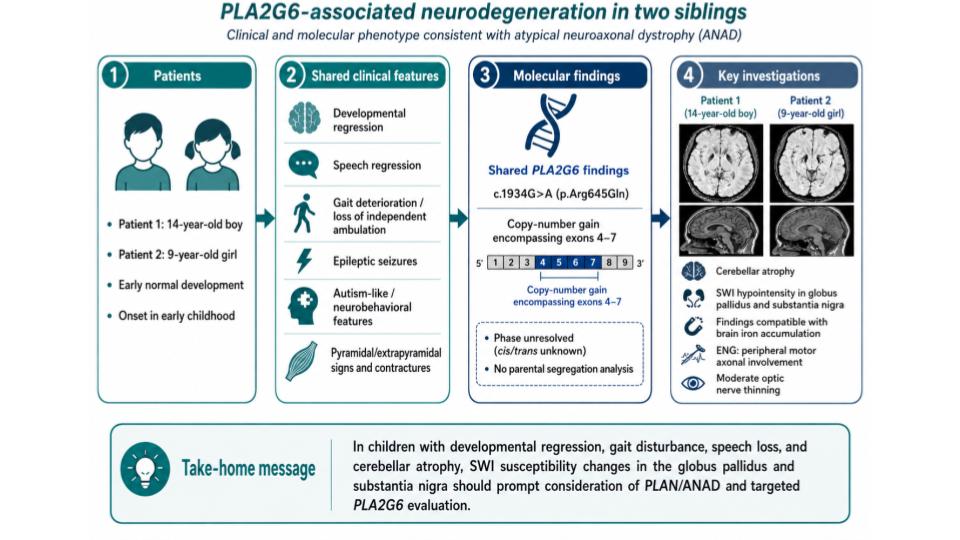
Background/Objectives: PLA2G6-associated neurodegeneration (PLAN) is an autosomal recessive neurodegenerative spectrum encompassing infantile, juvenile/atypical, and adult-onset phenotypes. Juvenile PLAN may initially resemble autism spectrum disorder or nonspecific developmental regression, delaying diagnosis. Case Presentation: We describe a 14-year-old boy and his 9-year-old sister, both with initially normal early development followed by progressive gait impairment, speech and cognitive regression, epilepsy, contractures, and loss of independent ambulation. Brain MRI in both siblings demonstrated marked symmetric cerebellar atrophy, susceptibility-weighted hypointensity of the globus pallidus and substantia nigra compatible with iron accumulation, and bilateral optic nerve thinning. Electroneurography showed selective motor axonal involvement. Molecular testing identified the same two heterozygous PLA2G6 findings in both children: c.1934G>A (p.Arg645Gln) and an exon 4–7 copy-number gain. Parental testing was unavailable; therefore, the phase of the findings could not be established, and it remains unknown whether they are in trans or in cis. Conclusions: The shared clinical, neuroimaging, and electrophysiological phenotype is strongly consistent with juvenile PLAN and provides additional phenotypic evidence regarding p.Arg645Gln. However, unresolved phase and incomplete structural characterization of the copy-number gain preclude definitive molecular attribution. These cases emphasize the diagnostic value of susceptibility-weighted MRI, deletion/duplication analysis, and family segregation studies in children with progressive neurodevelopmental regression.
Keywords:
PLA2G6
; PLAN
; juvenile PLAN
; atypical neuroaxonal dystrophy
; neurodegeneration with brain iron accumulation
; cerebellar atrophy
; copy-number variant
Copyright: This open access article is published under a Creative Commons CC BY 4.0 license, which permit the free download, distribution, and reuse, provided that the author and preprint are cited in any reuse.