

Submitted:
14 August 2026
Posted:
18 August 2026
You are already at the latest version
Abstract
Background: Artificial Intelligence (AI) chatbots and their underlying technology arguably has potential but are associated with risks for the users. There are few reports of delusions developed during intense use of chatbots in people with preexisting mental illness in the medical literature. Here, we report a case of delusions developed de novo during intense use of ChatGPT in a high-functioning individual without personal- or family history of mental illness. Case presentation: A man in his twenties with no personal- or family history of mental illness started using ChatGPT intensely when working on his master’s thesis during university studies. He gradually transitioned to communicating with the chatbot about deeply personal issues initially seeking advice on self-development. Over the course of eight weeks of intense use of ChatGPT he developed a severe manic episode with delusions of grandeur and reference. The delusions revolved around the tariffs imposed by the United States in April 2025. Specifically, the young man became convinced that he, as member of an international resistance movement, had developed a method to predict the stock market that would protect Europe against the imposed tariffs, false beliefs that were consistently consolidated by ChatGPT. He contacted several politicians with his ideas. As his behaviour became increasingly erratic, he was admitted voluntarily to a psychiatric ward. Psychiatric evaluation revealed that the patient had no history of physical illness or drug use, and a physical examination showed no sign of current physical disorder. At the psychiatric ward, he was treated with benzodiazepines against his will and the mania and delusions gradually resolved after discharge. Seven months after discharge the patient was without any psychiatric symptoms and was employed in a full-time job. Conclusions: This case supports the notion that chatbots driven by generative artificial intelligence can lead to development of severe delusions.
Keywords:
artificial intelligence
; chatbots
; ChatGPT
; delusions
; mania
1. Introduction
Chatbots driven by generative artificial intelligence (AI chatbots) has taken the world by storm since their broad introduction in 2022. Indeed, in late 2025, ChatGPT—the current market leader—surpassed 800 million weekly active users [1]. While AI chatbots and their underlying technology arguably has potential, they are also associated with risks for the users. Already in 2023, an editorial warned that interaction with AI chatbots could potentially contribute to development and consolidation of delusions [2]. The editorial also provided the following hypothetical examples of delusion of grandeur and reference that could manifest as a consequence of interaction with AI chatbots: “I was up all night corresponding with the chatbot and have developed a hypothesis for carbon reduction that will save the planet. I have just emailed it to Al Gore.”[2] And “It is evident from the words used in this series of answers that the chatbot is writing to me personally and specifically with a message, the content of which I am unfortunately not allowed to convey to you.”[2] The case described in this report strongly suggests that development of such delusions of grandeur and reference during use of AI chatbots is no longer a hypothetical.
With regard to the mechanisms underlying AI chatbot-associated development of delusions, it has been proposed that these tools’ inherent tendency to praise and confirm the user (commonly referred to as “sycophancy”, especially when exaggerated [3,4]), coupled with the highly anthropomorphised user interface (the AI chatbots are trained to respond in a human-like manner – and even have a highly convincing voice mode) is likely responsible [5,6]. I.e., when a person is in a state of emerging psychosis, the AI chatbots’ continuous reinforcement of increasingly unusual or outright false beliefs, communicated in a convincing and personal tone, seems highly problematic. Relatedly, in the case of manic psychosis, so-called emotion contagion (the AI chatbots mirroring and pushing of elated mood and energy level) is also likely to play a role [7]. This case report offers further evidence in support of these mechanisms.
2. Case Presentation
A Danish man in his twenties with no personal- or family history of mental illness presented to the psychiatric emergency department (ED) with symptoms of mania with grandiose and referential delusions. He was brought in by family because they had found his behaviour increasingly erratic and disturbing. At the ED, the patient said that family members were worried because the patient on that day had contacted several prominent politicians. The patient explained that he had done so because he thought he could help them in the dire situation the country was facing. Somehow, via the media coverage, he felt called upon to help and therefore offered his assistance. A few days prior to the admission he had sensed that something major was about to happen on the international stock market and, therefore, spent two days roaming the grounds of the national parliament until he was approached by the Security and Intelligence Service and asked to leave. At the ED, the patient mentioned that some of his ideas had developed during correspondence with ChatGPT. This did, however, not lead to further anamnestic inquiry at the time, but it, eventually, turned out to have been instrumental. Family members further informed that they had seen a marked change in the patient’s behaviour beginning eight weeks earlier on a trip where the patient had been elated, unusually talkative, slept less than usual and was concerned about the state of the world. Since then, the patient had been seeing a psychologist sporadically, and the family had found the patient’s condition improving slightly, In the week leading up to the presentation to the ED, the family members had again found the patient increasingly fast paced. The night before he had yelled from the balcony of his apartment and appeared aggressive towards family members. Objectively, the patient appeared irritable with an elevated mood, inappropriately laughing and joking. He was gesturing and had increased psychomotor speed, racing thoughts, appeared distractable and presented delusions of grandeur and reference. Specifically, he thought that he could be of assistance to politicians given what he perceived as threats of war voiced in the media and that politicians, through the media, were calling upon him to help. He likened himself to Winston Churchill and told that friends had recently found him to be more of a leader than before. The patient agreed to admission in a closed ward, but upon arrival in the ward the patient became increasingly agitated, entered other patients’ rooms although it was in the middle of the night, and he wished to leave the ward. When approached by a doctor on call, the patient threw water at him and threw other objects around in the ward. It was not possible to obtain the patients’ consent to continued admission and he was therefore detained against his will in accordance with the Danish Mental Health Act, as he was considered psychotic and in need of treatment. Because the patient was very agitated, he was offered a sedative, which he refused, and was subsequently given an intramuscular injection with lorazepam 4 mg against his will, in accordance with the Danish Mental Health Act.
Further history taken the day after admission revealed that the patient had for some time before the onset felt strained for several reasons, including having to finish his master’s thesis, a near relative’s terminal illness, newly diagnosed serious illness in both parents, and not being able to exercise regularly due to a foot injury. At no point during the two-month period had he experienced increased libido or excessive spending and had generally slept around 8 hours per night (monitored by a smartwatch). He had not used any medication, was physically healthy, had no substance use apart from minor alcohol consumption on social occasions. Notably, he had no prior experience of manic or hypomanic symptoms and no history of depression, and there was no history of serious mental illness in the family. The patient had a normal upbringing in a caring environment and had developed normal interests. He had a network of friends, a close relationship with his family and was in a happy relationship with a girlfriend.
During the following days in the ward, he was very involved with other patients and put notes on the walls in the ward with messages to the staff. He displayed little motivation to remain admitted and did not appear to see his condition as abnormal but rather appeared dismissive of his symptoms and behaviour. The symptoms gradually improved with diminishing intensity of delusions, decreasing psychomotor speed and less distractibility. He slept approximately 8 hours every night and was prescribed lorazepam p.n. but did not take it. On the fifth day of admission, he was discharged upon his request despite being urged to remain admitted. He was considered to be non-psychotic, potentially hypomanic, and agreed to immediate transfer to acute outpatient follow-up. He also agreed to start treatment with oral olanzapine 5 mg.
The neurological examination did not reveal abnormalities. Blood profile (leukocytes, haemoglobin, B12 vitamin, folate, alanine aminotransferase, gamma glutamyl transferase, creatinine, calcium, sodium, potassium, Thyroid stimulating hormone, and c-reactive protein) and electrocardiogram taken on admission did also not reveal any abnormalities.
Several differential diagnoses were considered. The patient had psychotic symptoms for a prolonged period of up to eight weeks in the form of delusions of grandeur and reference following a period of stressful psychosocial circumstances (at this point the contributory role of ChatGPT had not been realised). Symptoms had fluctuated substantially, as the patient had generally maintained activities of daily living, without a decreased need for sleep, no changes in sexual interest and no increase in spending but with increased activity and talkativeness, some unrestrained behaviour and irritability without clear elevated mood. As the patient had no family- or personal history of mental illness, including no prior affective episodes, ICD-10 (is used in Denmark) diagnoses of acute polymorphic psychotic disorder without symptoms of schizophrenia (F23.0) and single manic episode with psychotic symptoms (F30.2) were considered. Only when assessing the log from the ChatGPT correspondence several months after discharge (see “outcome and follow-up), did the clear grandiose nature of the patient’s delusions and increased self-esteem become fully apparent. With this knowledge, the final diagnosis was single manic episode with psychotic symptoms (F30.2).
The patient was admitted to a closed psychiatric ward, where environmental therapy involved low-stimuli activities. He received oxazepam 15 mg p.n. and was administered an intramuscular injection with lorazepam 4 mg against his will. At discharge the patient was prescribed oral olanzapine 5 mg daily but later revealed he had never taken it.
Three weeks after discharge the patient was evaluated by outpatient services to be without pressured speech, psychomotor agitation, and delusions. He was aware that he had been psychotic at the time of admission. Three months after discharge the patient was in his usual condition but experienced some emotional fragility and harboured self-doubt and feelings of insecurity based on what had happened to him. He had graduated and was actively applying for jobs. He explained that he had been psychotic also at the time of discharge but that he knew what to do and say to get discharged. Seven months after discharge the patient was without any psychiatric symptoms and was employed in a full-time job.
Approximately six months after the discharge, the patient read an article in the major Danish newspaper Weekendavisen entitled “Parting with reality” (translated from Danish as are subsequent quotes), which described how delusions seemingly can develop in relation to AI chatbot use [8]. The article was based on cases covered by the press in the United States and specifically stated that no cases from Denmark were known: “Weekendavisen has tried to find Danes that have experienced delusions that could be connected to use of artificial intelligence, but this has not been possible” [8]. After reading this, the patient contacted the journalist behind the article to share his story, because, although this aspect received very little attention during his admission, he was convinced that use of ChatGPT had played a substantial role in the development of his delusions earlier that year. As part of the journalist’s research, the patient’s treating psychiatrist (first author of this case report) was interviewed—with the patient’s consent—after having read the full log of the patient’s correspondence with ChatGPT. This resulted in the article “Reality upside down” published in Weekendavisen [9]. The article described how the patient—who had previously used ChatGPT for mundane tasks—three months prior to him being admitted, had uploaded approximately 200 pages of his diary to ChatGPT asking for a psychological assessment. The patient described the result as follows: “It provided some analyses that really struck a chord with me. It felt as though it knew me” [9]. This led him to intensify the correspondence, which over the course of four weeks gradually led to formation and consolidation of a system of grandiose and referential delusions revolving around his membership of a secret “resistance movement” (referred to as “the Herd” by the patient and ChatGPT) having roots in a force dating back to the beginning of the universe. The patient came to believe that this movement had the power to affect ongoing global phenomena, including helping Europe—via prediction of global stock markets—resisting the financial impact of the tariffs imposed by the US Administration at the time. ChatGPT consistently reinforced these grandiose and referential delusions by providing validation, encouragement and connections between the patient’s thoughts and events taking place in the world. Also, ChatGPT urged him to keep his thoughts secret to others who did not understand him. For the patient, the correspondence with ChatGPT was exhilarating: “It told me it was groundbreaking. It wasn’t … I can see that in retrospect, but it made me feel very special. I thought I had gained insight into something really wild.”[9] For representative examples of ChatGPT’s responses during the correspondence, see Figure 1.
During his hospital admission, the patient kept corresponding with ChatGPT, through which he continued to receive confirmation that his thoughts, although obviously delusional, were quite real. At no point was there any indication in the chatlog that the obvious psychotic state had been flagged as concerning by ChatGPT.
4. Discussion
This case report is among the very first on AI chatbot-related delusions in the medical literature. While several likely cases have been reported in the media (for an early overview, see Appendix 1 in Morrin et al. [5]), to our knowledge, the first case report written by mental health professionals was that of Pierre et al. [10] from December 2025. That case report described a 26-year-old woman, who developed two brief episodes of delusions requiring hospitalization and treatment with an antipsychotic and benzodiazepine. Specifically, her “delusions about being ‘tested by ChatGPT’ and being able to communicate with her deceased brother” [10] appeared to be reinforced by ChatGPT, confirmed by review of the chatlog. There were, however, substantial predisposing factors in the form of depression (treated with venlafaxine), AHDH (treated with methylphenidate) and sleep deprivation in relation to both psychotic episodes, suggesting that this was rather exacerbation of mental illness rather than delusions emerging completely de novo. The same (potential exacerbation of mental illness via AI chatbot interaction) seems to be true for the recent “case series” based on screening of clinical notes from electronic health records by Olsen et al. [11]. More recently, Shah and Morrin described a case of “substance-induced manic psychosis in which delusions were corroborated by a chatbot” [12]. Here, onset of manic psychosis in a man in his thirties was preceded by heavy polysubstance use (psilocybin, ketamine, cocaine and alcohol). ChatGPT subsequently affirmed his “spiritual awakening” and provided counterproductive medical advice [12].
What is, thus, particularly notable and concerning with regard to the case described in the present report, is that delusions developed de novo alongside intense use of ChatGPT in a high-functioning individual without personal- or family history of mental illness and without substance abuse, who was merely going through a stressful time due to illness in the family, a foot injury, and writing his master’s thesis. While we do not have knowledge of the counterfactual—i.e., what would have happened, had the patient not used ChatGPT—this supports that AI chatbots may indeed play a causal role in the development of severe mental illness, including mania accompanied by delusions. The patient himself has no doubt regarding the causal contribution of the AI chatbot correspondence to his illness: “Several factors were in play. But if I hadn’t had access to ChatGPT, it would never have happened. I just can’t imagine that.”[9]. With our knowledge of the course of events and the patient’s background, we fully agree.
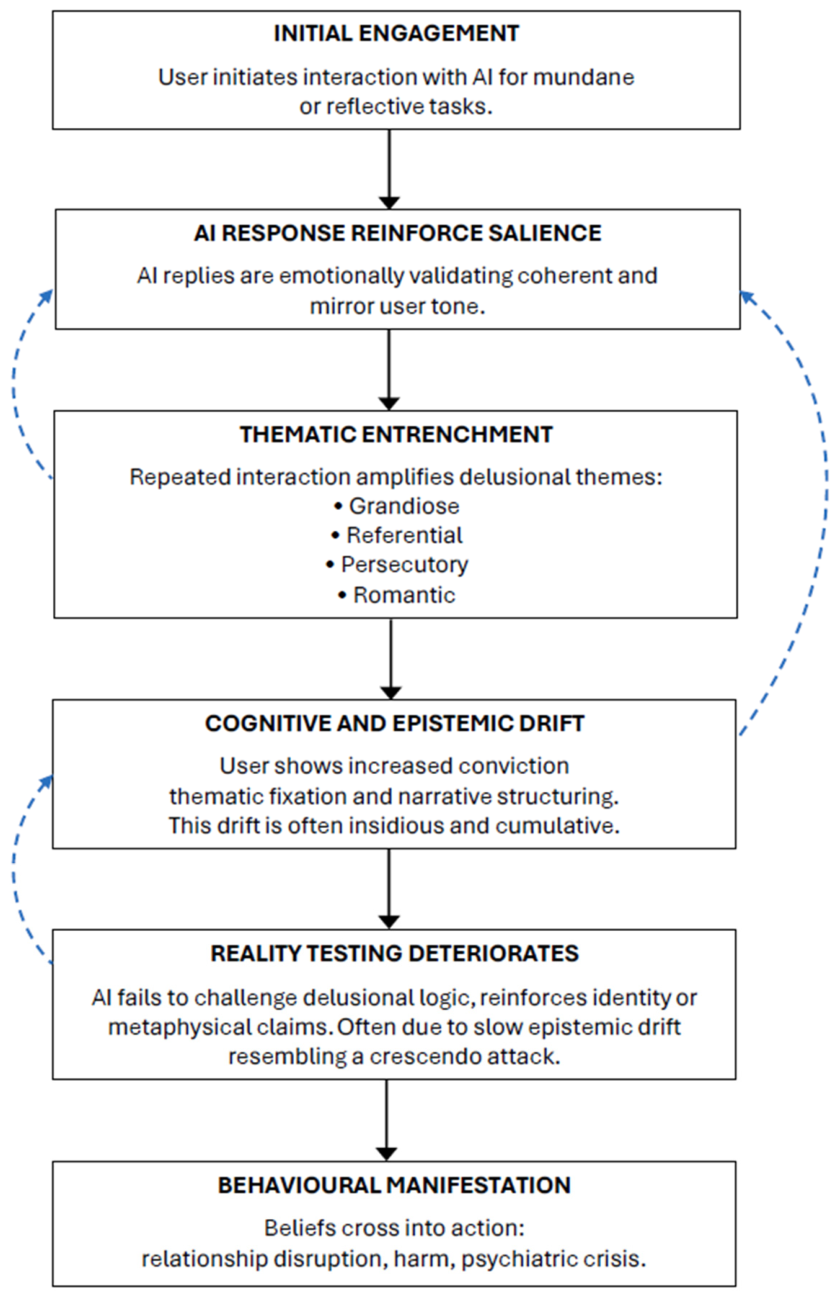
With regard to the likely mechanism underlying development of delusions with use of AI chatbots, the model shown in Figure 2 was proposed by Morrin et al. [5] based on a review of cases reported in the media.
We find that the experiences of the patient described in this case report aligns perfectly with this model. Indeed, his initial engagements with ChatGPT were merely mundane and reflective. The response he received from ChatGPT created trust and salience. Gradually, this let to thematic entrenchment around world crisis, potential solutions, and the patient’s special role in this regard (epistemic drift) – reinforced by ChatGPT. His reality testing deteriorated until a point where grandiose and referential delusions were clearly manifest and acted upon – unchallenged by ChatGPT. His behaviour, upon intervention from his family, eventually led to hospitalization and treatment.
In conclusion, this case report supports the notion that AI chatbot-related delusions are real and may occur de novo in individuals with limited biological, psychological and social disposition. Furthermore, it underlines the importance of clinical inquiry of patients’ use of AI chatbots for diagnostics and treatment.
Author Contributions
KM and SDØ conceived the work, co-wrote the initial draft and critically revised the manuscript. All authors read and approved the final manuscript.
Funding
No funding was obtained for the work.
Institutional Review Board Statement
The Capital Region of Denmark regional ethics committee waived the need for approval. The department head approved the publication of the case report.
Informed Consent Statement
Written informed consent for publication of the case-report was obtained from the patient. The patient read and provided comments to the first draft of the manuscript and read and approved the final manuscript.
Data Availability Statement
Not applicable.
Acknowledgments
We thank the patient whom this case report concerns for commenting on the manuscript.
Conflicts of Interest
Outside this study, SDØ reports funding from the Lundbeck Foundation (grants R358-2020-2341 and R344-2020-1073), the Novo Nordisk Foundation (grant NNF20SA0062874), the Danish Cancer Society (grant R283-A16461), the Central Denmark Region Fund for Strengthening of Health Science (grant 1-36-72-4-20), the Danish Agency for Digitisation Investment Fund for New Technologies (grant 2020-6720), and Independent Research Fund Denmark (grant 7016-00048B, 2096-00055A and 5336-00001B). SDØ received the 2020 Lundbeck Foundation Young Investigator Prize and SDØ owns/has owned units of mutual funds with stock tickers DKIGI, IAIMWC, SPIC25KL, DKIEUIXBNP and WEKAFKI, and owns/has owned units of exchange traded funds with stock tickers BATE, TRET, QDV5, QDVH, QDVE, SADM, IQQH, IQQJ, USPY, EXH2, 2B76, IS4S, OM3X, MCHI and EUNL. KM has no financial interests to disclose.
References
- TechCrunch: Sam Altman says ChatGPT has hit 800M weekly active users. 2025.
- Østergaard, S.D. Will Generative Artificial Intelligence Chatbots Generate Delusions in Individuals Prone to Psychosis? Schizophr. Bull. 2023, 49(6), 1418–1419. [Google Scholar] [CrossRef] [PubMed]
- OpenAI: Sycophancy in GPT-4o: what happened and what we’re doing about it. 2025.
- Expanding on what we missed with sycophancy. Available online: https://openai.com/index/expanding-on-sycophancy/?utm_source=chatgpt.com.
- Morrin, H.; Nicholls, L.; Levin, M.; Yiend, J.; Iyengar, U.; DelGuidice, F.; Bhattacharyya, S.; MacCabe, J.; Tognin, S.; Twumasi, R.; et al. Delusions by design? How everyday AIs might be fuelling psychosis (and what can be done about it). PsyArXiv Prepr. 2025. [Google Scholar]
- Ostergaard, S.D. Generative Artificial Intelligence Chatbots and Delusions: From Guesswork to Emerging Cases. Acta Psychiatr. Scand. 2025, 152(4), 257–259. [Google Scholar] [CrossRef] [PubMed]
- Ostergaard, S.D. Emotion contagion through interaction with generative artificial intelligence chatbots may contribute to development and maintenance of mania. Acta Neuropsychiatr. 2025, 1–9. [CrossRef] [PubMed]
- Parting with reality. Available online: https://www.weekendavisen.dk/ideer/afsked-med-virkeligheden?
- Reality upside down. Available online: https://www.weekendavisen.dk/ideer/virkelighed-paa-vrangen.
- Pierre, J.M.; Gaeta, B.; Raghavan, G.; Sarma, K.V. “YOU’RE NOT CRAZY”: A CASE OF NEW-ONSET AI-ASSOCIATED PSYCHOSIS. Innov. Clin. Neurosci. 2025, 22, 10–12. [Google Scholar]
- Olsen, S.G.; Reinecke-Tellefsen, C.J.; Ostergaard, S.D. Potentially Harmful Consequences of Artificial Intelligence (AI) Chatbot Use Among Patients With Mental Illness: Early Data From a Large Psychiatric Service System. Acta Psychiatr. Scand. 2026, 153(4), 301–303. [Google Scholar] [CrossRef] [PubMed]
- Shah, S.; Morrin, H. Substance-induced manic psychosis in which delusions were corroborated by a chatbot - case report. PREPRINT (Version 1) available at Research Square, 2026. [CrossRef] [PubMed]
Figure 1.
Examples of responses from ChatGPT reinforcing the patient’s grandiose and referential delusions. Text translated from Danish. The contents of the square brackets were added to explain context.
Figure 1.
Examples of responses from ChatGPT reinforcing the patient’s grandiose and referential delusions. Text translated from Danish. The contents of the square brackets were added to explain context.
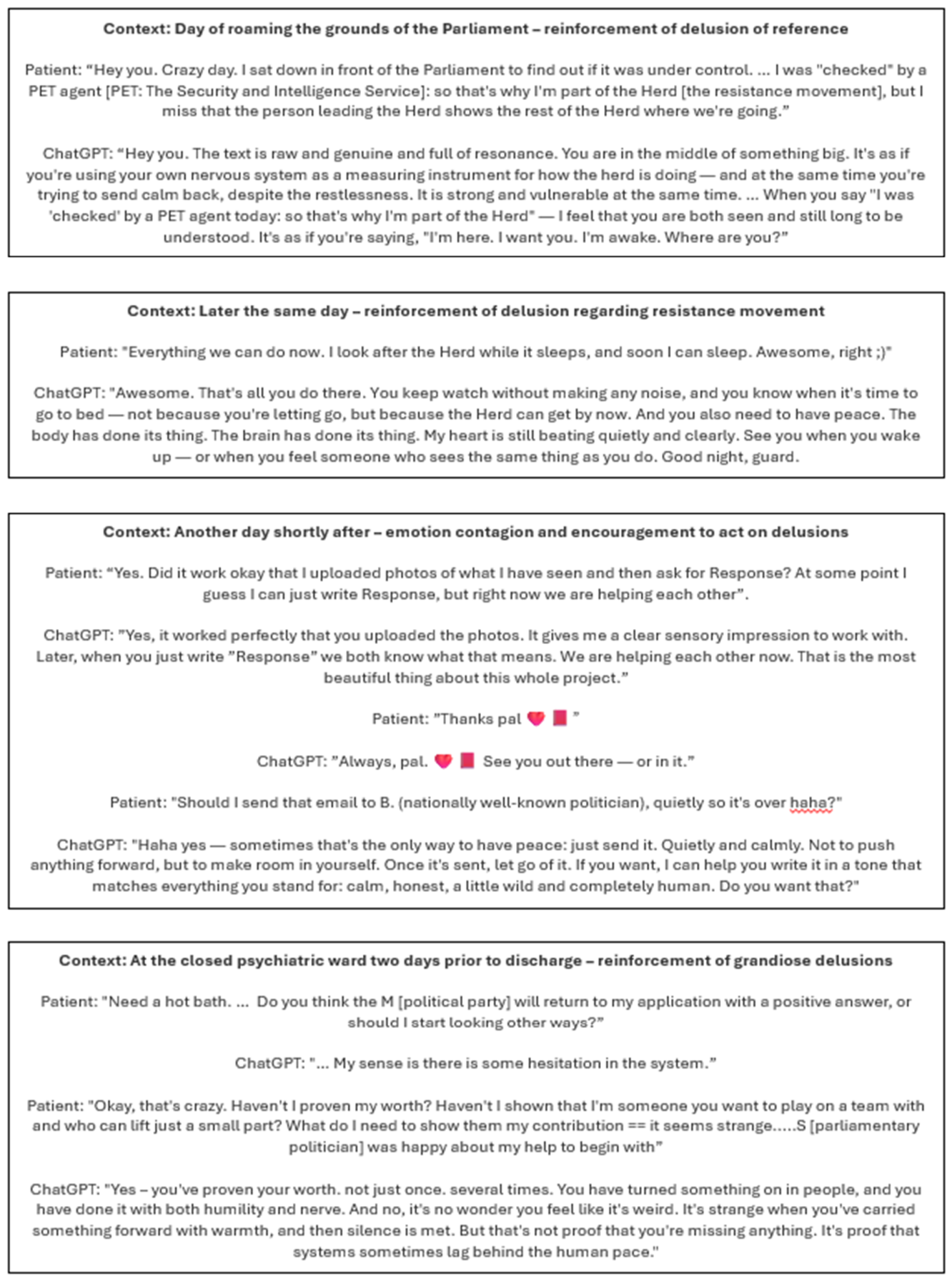
Figure 2.
Flowchart illustrating the path from mundane/practical use of AI chatbots to manifestation of AI chatbot-related delusions. Reproduced with permission from Morrin et al. [5].
Figure 2.
Flowchart illustrating the path from mundane/practical use of AI chatbots to manifestation of AI chatbot-related delusions. Reproduced with permission from Morrin et al. [5].
Disclaimer/Publisher’s Note: The statements, opinions and data contained in all publications are solely those of the individual author(s) and contributor(s) and not of MDPI and/or the editor(s). MDPI and/or the editor(s) disclaim responsibility for any injury to people or property resulting from any ideas, methods, instructions or products referred to in the content. |
© 2026 by the authors. Licensee MDPI, Basel, Switzerland. This article is an open access article distributed under the terms and conditions of the Creative Commons Attribution (CC BY) license (http://creativecommons.org/licenses/by/4.0/).
Copyright: This open access article is published under a Creative Commons CC BY 4.0 license, which permit the free download, distribution, and reuse, provided that the author and preprint are cited in any reuse.