
Submitted:
16 August 2026
Posted:
18 August 2026
You are already at the latest version
Abstract
Background/Objectives: This study aimed to explore parents’ response processes and information-seeking patterns regarding early childhood sexuality education by integrating semantic network analysis of digital discourse with in-depth interviews. Methods: A qualitative multimethod design was employed. Semantic network analysis was conducted on 124 online posts from Korean parenting communities and Q&A platforms, while in-depth interviews were conducted with 18 parents of young children. Online data were analyzed using semantic network analysis, and interview data were analyzed using inductive thematic analysis. Results: Four phases of the parental response process were identified: (1) recognizing sexuality in everyday contexts, (2) adopting initial coping strategies, (3) struggling with the role–action gap, and (4) seeking structured and collaborative support. Although parents recognized their role as primary sexuality educators, they experienced substantial uncertainty about how to respond and relied heavily on mediated resources, particularly storybooks and online information. Conclusions: Parents need practical, developmentally appropriate guidance to respond confidently to children’s sexuality-related questions and everyday situations. Family-centered support systems and accessible, evidence-based resources should be developed to strengthen parents’ capacity and bridge the gap between recognizing their educational responsibility and implementing sexuality education in daily life.
Keywords:
sex education
; parents
; child
; preschool
; information seeking behavior
; qualitative research
1. Introduction
Along with recent shifts in social values regarding sexuality, the onset of secondary sexual characteristics is occurring earlier [1]. Furthermore, the proliferation of smart devices has accelerated the timing at which young children are exposed to sexual information through media [2]. These changes have created an environment where children encounter sexual stimuli at an increasingly early age, leading to a consistent emphasis on the importance of initiating sexuality education during early childhood [3]. Early childhood is a period of rapid cognitive development and heightened curiosity, characterized by various exploratory behaviors [4]. In particular, questions and interests regarding one’s own body and the bodies of others naturally increase, through which children gradually form an understanding of sexual concepts [5].
However, this understanding is often constructed unintentionally and is highly context-dependent, shaped not only by systematic education in kindergartens or childcare centers but also through daily experiences and interactions with surrounding individuals [6]. Consequently, such information is not always appropriate or consistent. Therefore, educational intervention is necessary to guide and adjust the understanding that is already being formed in an appropriate direction [7]. Such interventions should not be confined to specific times or places but must occur continuously across diverse situations in daily life. Accordingly, this study adopts a qualitative research design combining online post analysis and one-on-one in-depth interviews to identify the problematic situations and response patterns parents experience.
As primary caregivers [8], parents are the pivotal agents for home-based sexuality education [9,10]. However, many lack the requisite knowledge and preparation to address children’s sex-related inquiries appropriately [11]. Insufficient understanding of developmentally suitable methods often leads to parental embarrassment and perceived burden [9,12]. This "role–performance gap" risks conveying distorted information, potentially hindering the formation of healthy sexual self-concepts in children [9]. Consequently, support systems must shift from merely emphasizing necessity to empowering parents for consistent, daily educational practice.
Understanding parental response patterns from multiple perspectives is essential to bridge this gap. However, direct observation is challenging due to the private nature of home-based education [10]. Traditional surveys also face limitations in capturing the nuanced, contextual decision-making of parents [13]. Alternatively, online posts provide voluntary insights into problematic situations and information-seeking processes [14,15], reflecting experiences often missed by quantitative methods. To deeply explore how parents interpret these situations and construct responses [16], one-on-one in-depth interviews are particularly effective for revealing both shared perceptions and diverse lived experiences [17]. The aim of this study was to explore the response patterns and information-seeking processes of parents regarding early childhood sexuality education and to develop a comprehensive process model of their experiences within the digital information landscape. Specifically, by integrating online discourse analysis with in-depth individual narratives, this study sought to bridge the gap between parental awareness and actual educational practice.
2. Materials and Methods
2.1. Design
This study employed a qualitative multimethod design, in which text network analysis and one-on-one in-depth interviews were conducted in parallel. Online textual data were analyzed to identify patterns of co-occurrence among key terms. Qualitative data from interviews were analyzed using an inductive thematic analysis approach following Braun and Clarke [18] to explore participants’ interpretations and meaning-making processes. The findings from both strands were integrated during the interpretation phase to provide a comprehensive understanding of the phenomenon.
2.2. Theoretical Framework
This study is grounded in the Information-Motivation-Behavioral Skills (IMB) model, which conceptualizes health-related behavior change as a result of three primary constructs: information, motivation, and behavioral skills [19]. In this study, the Information construct is explored through text network analysis, identifying the digital information landscape and resources (e.g., storybooks) parents utilize. The Motivation and Behavioral Skills constructs are examined through in-depth interviews, capturing parents’ internal drive, perceived barriers, and the specific communication skills required for sexuality education. By applying the IMB model, this study systematically analyzes the "role–action gap" and identifies the essential elements needed to empower parents as effective sexuality educators within the family system [20,21].
2.3. Study Setting and Recruitment
This study utilized a dual-method qualitative approach, combining the analysis of online posts with one-on-one in-depth interviews to capture a comprehensive landscape of parental experiences.
For the digital component, data were collected from major domestic parenting communities and Q&A platforms in South Korea, specifically focusing on Naver's parenting communities and its Q&A service, which are among the most widely used online platforms in Korea [22]. One specific online community ("cafe") was purposively selected based on its large user base and high level of active interaction. Data collection targeted posts published between 2020 and February 2026.
For the individual component, one-on-one in-depth interviews were conducted with parents to explore lived experiences in depth. Participants were recruited through purposive sampling to include a broad spectrum of perceptions, ranging from those with little interest or no prior experience in sexuality education to those who were highly engaged and actively teaching their children. This inclusive strategy aimed to capture the wide variety of parental lived experiences through individualized interactions.
2.4. Inclusion and/or Exclusion Criteria
The research participants were defined based on their role as primary caregivers and the developmental stage of their children. The inclusion criteria for this study were parents or primary caregivers holding the main responsibility for a child's daily care and upbringing, caregivers raising children between the ages of 4 and 6, and caregivers capable of communicating fluently in Korean to ensure the depth of qualitative data. The age range of 4 to 6 years was established with reference to the developmental stages defined by the World Health Organization (WHO) Regional Office for Europe and the Federal Centre for Health Education (BZgA) [23], as well as the International Technical Guidance on Sexuality Education led by United Nations Educational, Scientific and Cultural Organization (UNESCO) [24], representing an interval characterized by an increase in children's sex-related inquiries where parent-led education is most active. Conversely, the exclusion criteria included parents of children who had already entered formal primary schooling (over age 6), as the research specifically focuses on the paramount role of parents in the home setting prior to institutionalized education, and caregivers who were not the primary person responsible for the child's daily upbringing, such as occasional sitters or extended family members without primary custody.
2.5. Data Collection
Online textual data were collected from parenting communities and question-and-answer platforms hosted on Naver [22]. Using the search keyword “sex education,” posts were retrieved through a web crawling program implemented in Python. Data collection was conducted between 2020 and February 2026, yielding 318 posts from parenting communities and 1,001 posts from question-and-answer platforms.
A two-stage screening process was applied. In the first stage, posts were excluded if they were advertisements, promotional content, or not related to preschool-aged children, resulting in the removal of 751 posts. This process yielded 568 posts for further screening. In the second stage, manual screening was conducted to ensure content relevance. Posts were excluded if they did not contain meaningful content related to sexuality education (e.g., general daily narratives, simple book reviews, or purchase confirmations), targeted non-preschool populations, or had unclear target groups. After manual screening, a total of 124 posts were retained for analysis. Only publicly accessible posts were included, and no identifiable personal information was collected (Figure 1).
Participants for interviews were recruited through online communities for parents and were provided with information about the study. Informed consent was obtained online prior to participation. Data were collected through one-on-one semi-structured in-depth interviews. Following consent, interviews were conducted either face-to-face or via video conferencing (e.g., Zoom), depending on participant preference. Each interview lasted approximately 60–90 minutes. All interviews were audio-recorded with participants’ consent and transcribed verbatim for analysis. Data collection continued until data saturation was reached, defined as the point at which no new themes or insights emerged. A total of 18 participants were included in the final analysis.
2.6. Data Analysis
The collected online text data were preprocessed using KoNLPy, a Python-based open-source library for Korean natural language processing [25]. The text was tokenized using a unigram approach, focusing on the extraction of nouns, verbs, and adjectives. Additionally, stop-words with low semantic value were removed to refine the dataset. Following the preprocessing, a frequency analysis was conducted to derive the key terms consistently appearing in the data.
To identify the relationships between these keywords, co-occurrence was defined based on words appearing together within the same document. A co-occurrence matrix was then constructed to build a text network. This co-occurrence network is a representative method used to structurally understand the relationships between concepts within a text [26]. Social Network Analysis (SNA) techniques were applied to the constructed network to perform centrality analysis. Specifically, degree centrality, betweenness centrality, and closeness centrality were calculated to determine the importance of key terms and their structural roles within the network [27].
In this study, the top 25 keywords were selected based on their frequency of occurrence. The number of keywords was determined by considering the data scale and the interpretability of the network. This threshold was established to minimize complexity in the network structure caused by excessive keywords and to ensure a clear understanding of the relationships between the core concepts.
Interview data were analyzed using an inductive thematic analysis approach following the framework proposed by Braun and Clarke [18]. All interviews were transcribed verbatim, and the researchers repeatedly reviewed the transcripts to achieve data familiarization. Initial codes were generated inductively from the data and subsequently grouped into categories based on conceptual similarities. These categories were then developed into themes through an iterative process of reviewing and refining the data. Multiple researchers independently conducted coding and theme development, and discrepancies were resolved through discussion until consensus was reached. The analysis involved continuous movement between the data and emerging themes to ensure that the findings accurately reflected participants’ experiences. In addition, the identified themes were organized into sequential phases to illustrate the process underlying participants’ experiences.
2.7. Ethical Considerations
The study was conducted in accordance with the Declaration of Helsinki and was approved by the Institutional Review Board of Dongguk university (IRB No: DGU IRB 20250043 on November 27, 2025.
For the one-on-one in-depth interviews, all participants were provided with verbal and written explanations regarding the study's purpose, the voluntary nature of participation, and the right to withdraw at any time without penalty. Written informed consent was obtained from all interviewees prior to data collection. To ensure anonymity, all personal identifiers were replaced with pseudonyms (e.g., Participant A).
Regarding the online data, only publicly accessible posts were collected from parenting communities and Q&A platforms. All collected data were strictly anonymized by removing usernames, IDs, and specific location information to prevent the identification of authors. No private or password-protected data were accessed, adhering to ethical guidelines for internet-based research. All digital and interview data were stored on a password-protected drive and will be permanently deleted after the mandatory retention period.
2.8. Rigor and Reflexivity
To ensure trustworthiness, the criteria of credibility, transferability, dependability, and confirmability were applied [28]. Credibility and dependability were established via investigator triangulation; two researchers with expertise in social network analysis and qualitative nursing research independently coded the data. Member checking was conducted to verify transcript accuracy, and discrepancies were resolved through 100% consensus. Data collection continued until theoretical saturation was reached.
Confirmability and reflexivity were maintained using a reflexive journal to bracket researchers' biases. Regular peer debriefing ensured findings remained grounded in participant narratives and online data. Transferability was addressed through thick descriptions of participant characteristics, digital contexts, and the sociocultural background of the study setting.
3. Results
3.1. Online Text Analysis Results
3.1.1. The Frequencies of Keywords Related to Sex Education
In the analysis of online posts, keywords such as “storybook,” “recommendation,” “boy,” “questions,” and “kindergarten” appeared with high frequency. This indicates a tendency among parents to search for information focused on educational materials for sexuality education, while simultaneously addressing inquiries regarding their child’s gender, developmental stage, and specific situations. Meanwhile, compared to parenting communities, Q&A platforms showed a higher prevalence of body-related keywords such as “genitalia” and “breast,” suggesting that questions about more personal and sensitive topics are primarily raised on these platforms. Such differences between platforms demonstrate that parents' information-seeking methods are not uniform; Q&A platforms tend to host problem-solving-oriented questions, whereas communities facilitate interactions centered on sharing experiences and exchanging information (Table 1).
3.1.2. Keyword Centrality Analysis
Centrality analysis identified the structural core of parents’ online discourse (Table 2). “Storybook” exhibited the highest degree (Cd), betweenness (Cb), and closeness (Cc) centrality, marking it as the most pivotal resource in the network. Following “storybook,” keywords such as “boy,” “kindergarten,” “recommendation,” and “mother/father” showed high Cd, indicating that information-seeking is primarily structured around the child’s gender, developmental stage, and parental roles.
High Cb values for “storybook,” “boy,” “kindergarten,” and “education” suggest these terms serve as critical bridges connecting disparate concerns and strategies. Furthermore, the high Cc of “storybook,” “recommendation,” and “questions” underscores their high accessibility and proximity to other concepts within the network. Conversely, situational keywords like “genitalia,” “bathing,” and “timing” showed lower centrality, functioning as context-specific sub-concepts. Overall, the results indicate that parental information-seeking originates from mediated materials and expands toward specific situational experiences (Table 2).
3.1.3. Co-Occurrence Network of Keywords
The co-occurrence network revealed three distinct semantic clusters representing the structure of parental discourse (Figure 2).
- Storybook-based education methods: This cluster, centered on “storybook” and “recommendation,” highlights storybooks as the primary medium for education. Connections with “kindergarten” and “starting point” indicate that parents determine the timing of education based on developmental stages. Furthermore, the inclusion of “concern,” “burden,” and “explanation” suggests that parents utilize indirect media to alleviate the difficulty of direct verbal explanation.
- Parent–child interaction: Focused on “mother” and “father” in connection with “boy” and “girl,” this cluster reflects gender-specific interaction scenarios. The distinct categorization of parents, rather than a unified “parents” node, underscores gender-contingent concerns, particularly during routine activities like “bathing.” Keywords such as “genitalia” and “timing” reflect situational curiosity encountered in daily life, driving parents to seek immediate, context-appropriate responses.
- Perception of educational necessity: While “education” and “parents” were connected, this cluster was positioned at the periphery with limited connectivity. This indicates that online discourse is heavily skewed toward practical strategies and materials rather than theoretical principles or the conceptual necessity of sexuality education.
3.2. One-on-One in-Depth Interviews
3.2.1. Characteristics of Participants and Their Children
A total of 18 participants were included in the study. Most participants were female (n = 16, 88.9%) and in their 30s, with the largest proportion aged 30–34 years. The majority had a college-level education and were employed either full-time or part-time. Most participants had one child, and the target children were aged between 3 and 8 years, with a relatively even distribution across age groups. All participants reported having experience with sex education, while fewer had provided sex education to their children or reported that their children had received it (Table 3).
3.2.2. Process of Sexuality Education Among Parents of Young Children
The findings indicated that parental sexuality education unfolds as an unplanned and evolving process shaped by everyday situations. Parents responded to situational demands while navigating uncertainty and seeking support. This process was organized into four phases: (1) recognizing sexuality in everyday contexts, (2) adopting initial coping strategies, (3) struggling with the role–action gap, and (4) seeking structured and collaborative support (Table 4).
Phase 1. Recognizing Sexuality in Everyday Contexts
Parents’ experiences with sexuality education emerged not as planned instruction but as situational events triggered by daily life. Most participants reported that their awareness formed reactively rather than through intentional preparation.
Children’s Curiosity as a Catalyst for Interaction: Children’s natural curiosity about the body served as the primary catalyst. These moments were often experienced as fleeting instances of minor embarrassment rather than deep reflection. Inquiries about physical differences between peers or parents’ bodies were perceived as developmental milestones. One participant noted:
"While bathing, my child asked why she didn't have a penis; that was the first time I wondered how to explain this" (P3).
Another mentioned being flustered because they "still thought of (the child) as just a baby" (P11). These experiences typically remained at the level of temporary recognition without leading to systematic action.
Gendered Dynamics Shaping Early Boundaries: Interactions were significantly influenced by the child’s gender, with increased sensitivity observed in opposite-gender parent–child relationships. As children recognized physical differences, parents established boundaries, such as ensuring children remained clothed after bathing or limiting physical contact. Discontinuing shared bathing between opposite-gender parents and children was a common "first decision" regarding sexuality education.
"As my daughter grew older, my husband and I discussed when he should stop bathing with her. That was our first conversation as a couple about sexuality education" (P6).
Another participant reflected that from a certain point, they "felt the need to maintain boundaries" (P8).
In Phase 1, sexuality education naturally "occurs" in an unplanned state. These routine interactions initiate parental recognition and subsequent reactions but rarely lead to systematic pedagogical preparation at this stage.
Phase 2. Adopting Initial Coping Strategies
Parents at this stage prioritized immediate responses to resolve specific incidents rather than systematic planning. The focus remained on reactive problem-solving triggered by situational needs.
Use of Mediated Resources for Immediate Response: To address inquiries promptly, parents relied on mediating tools rather than direct instruction. Storybooks served as the primary resource, valued for their child-friendly accessibility and perceived expert-verified content. One participant explained:
"I lacked the confidence to answer properly. I felt storybooks were likely written by experts, so I substituted [direct education] by reading those books" (P5).
Another noted it was "more comfortable to show a book first" (P9), indicating that these tools functioned as a psychological buffer for parents.
Active Information-Seeking for Situational Strategies: Parents sought strategies by searching for similar experiences via online and offline networks. Online platforms provided a sense of relief through shared concerns, while offline conversations with acquaintances offered practical directions.
"I searched to see if we were the only ones; I felt relieved seeing that other parents had similar concerns" (P1).
Another participant mentioned listening to other mothers' responses and "following their lead" (P13). This process provided essential reference points for immediate situational management.
In Phase 2, parents resolve immediate challenges through external resources. While they utilize various tools and social networks, their approach remains situation-centered and reactive, rather than proactive or planned.
Phase 3. Struggling with the Role–Action Gap
As children’s inquiries persisted, parents began to redefine their roles. This stage is characterized by the tension between a heightened sense of responsibility and significant psychological hurdles in execution.
Perceived Responsibility Amidst Low Execution Priority: Parents generally acknowledged their role as primary educators. However, amidst the broader burdens of child-rearing, sexuality education was often relegated to a low-priority task—perceived as "important but difficult to implement." One participant noted:
"I think it's right for parents to provide sexuality education, but I really don't know what to do" (P4).
Another admitted it "keeps getting pushed down the priority list" (P10). This sense of responsibility was thus accompanied by a continuous delay in actual practice.
Uncertainty Regarding Explanatory Scope and Methods: Despite their perceived role, parents faced persistent uncertainty over terminology and the depth of explanation. This led to hesitation or the use of overly euphemistic, factually inaccurate narratives, often resulting in parental guilt.
"I didn't know how much to explain, so I... ended up explaining it like a fantasy story" (P7).
Another worried whether they "told them the wrong thing" (P12). These narratives underscore that determining the "scope and method" remains the most daunting challenge for parents.
Partial Reliance on External Agents as a Compensatory Strategy: Faced with such uncertainty, parents exhibited a tendency to delegate educational roles to experts or institutions. While maintaining that parents should educate, they simultaneously wished for professional intervention to alleviate their burden.
"I thought it would be better if a school or an expert did this. How great would it be if someone said they’d do it for me?" (P2).
Others felt that because they were "not good at it" (P6), institutional teaching might be more effective. This reflects a complementary strategy used to compensate for a lack of confidence in their own implementation capacity.
In Phase 3, the recognition of responsibility does not automatically translate into action. Instead, parents remain in a cycle of hesitation, struggling with the "how-to" and increasingly seeking external validation or delegation.
Phase 4. Seeking Structured and Collaborative Support
Despite persistent uncertainties, parents maintained their sense of responsibility and sought structured external support to better fulfill their roles. Rather than delegating the task entirely, they aspired to become proactive educators through feasible support systems.
Desire for Parent–Child Joint Learning Opportunities: Parents perceived sexuality education as a joint learning process rather than a child-only activity. They viewed the family as a collective educational unit and anticipated that shared experiences would alleviate psychological burdens.
"If I learn while experiencing it together with my child, I think I’ll naturally figure out what to do" (P5).
This reflects a shift toward expanding sexuality education into a family-centered shared experience.
Institutional Support for Strengthening Parental Capacity: Recognizing the limits of individual responsibility, parents emphasized the need for institutional support. They believed public systems should empower parents to conduct education effectively rather than merely acting as substitutes.
"I don't think institutions should do everything; they should help parents do it well" (P2).
This perspective positions parents as primary agents while underscoring the necessity of a systematic support framework.
Demand for Concrete, Stage-Specific Guidelines: Parents highlighted the absence of clear criteria regarding the "when, what, and how" of sexuality education. Comparing this to the systematic nature of infant vaccinations, they called for accessible, developmental-stage-specific guidelines.
"I wish there were a sexuality education guideline for young children that specifies which topics should be taught at what age" (P6).
Another participant (P13) noted that while infant health examinations track physical growth, they provide no guidance on sexuality, leaving parents without verified resources.
In Phase 4, parents transition from situational coping to seeking a collaborative environment. They require a supportive system that enables them to act as empowered, proactive agents rather than relying on fragmented external information.
4. Discussion
This study was conducted to understand the response patterns and information-seeking processes of parents with young children regarding sexuality education. By integrating online post analysis and one-on-one in-depth interviews, this study examined the same phenomenon through a multi-layered approach. This allowed for a comprehensive validation of how parents' empirical narratives align with their actual information-seeking and coping behaviors.
First, this study demonstrated that parental sexuality education is triggered by specific situations occurring in daily life rather than being a pre-planned educational activity. In the interviews, parents reported initiating sexuality education in response to children’s questions or body-related incidents, which aligns with previous studies suggesting that sexuality education occurs naturally through developmental curiosity and interaction [29,30,31]. This characteristic was also confirmed in the network analysis, where keywords such as "bathing," "genitalia," and "kindergarten" appeared centrally, showing that sex-related discussions are closely linked to routine experiences rather than formal educational contexts. This consistently supports the finding that parental perceptions of sexuality education are constructed on an empirical basis rather than a knowledge-based one.
Second, parents tended to utilize immediate response strategies rather than systematic education when faced with their children's needs. The interviews revealed that parents prioritized situational responses when lacking confidence in explanation methods, a trend also reflected in the network analysis. Specifically, "storybook" emerged as the most central mediated resource, and keywords such as "recommendation," "method," "questions," and "help" indicate that parents actively seek information for problem-solving. This is consistent with previous research showing that parents tend to convey information indirectly through verified media or external resources rather than conducting direct education [29,30,31]. Conversely, it was confirmed that response patterns vary by platform: Q&A platforms focus on problem-solving information-seeking, while community-based spaces focus on sharing experiences and emotional support [32,33,34]. These results suggest that parental coping strategies are shaped by the structure of the information environment beyond individual choice.
Third, although parents recognized the necessity and responsibility of sexuality education, they experienced persistent uncertainty during the implementation process. In the interviews, parents commonly reported difficulties regarding "how much to explain" and "how to deliver the information," aligning with existing studies that show parents recognize sexuality education as a vital task but lack confidence in their own implementation capacity [35,36]. While words like "education," "method," and "timing" appeared in the network analysis, their low centrality suggests that concrete implementation guidelines have not been sufficiently formed compared to conceptual awareness. This indicates a gap between parental perception and the actual information structure, highlighting that sexuality education is closely related to implementation capacity rather than being a matter of mere awareness.
Fourth, parents did not limit sexuality education to an individual responsibility but recognized the need for a structural system to support it. The interviews emphasized demands for stage-specific guidelines, expert support, and parent education programs, linking back to existing discussions that sexuality education should occur within a family–institution collaborative framework [35,37,38]. In the network analysis, terms like "kindergarten," "expert," and "help" appeared but were positioned at the periphery compared to central nodes, showing that individual-centered coping strategies still dominate actual discourse. Consistent with previous research, this implies that while parents demand external support [11,35], they simultaneously maintain a complex attitude toward retaining their own roles. This evolving journey—from situational recognition and hesitant information-seeking to the ultimate pursuit of structural support—is synthesized into a sequential process model as shown in Figure 3.
In conclusion, this study confirmed that parental experiences in sexuality education are a continuous process—starting from situational responses, moving through mediated information strategies, and expanding into the experience of uncertainty and the demand for structural support. In particular, the interview analysis illustrated the empirical flow of this process, while the network analysis of online posts revealed the informational resources and structural connections utilized therein, confirming that both methods complementarily support the same phenomenon. These results suggest that parental experiences in sexuality education should be understood within the context of the social information environment and institutional support systems, rather than as an individual-level issue.
This study offers significant methodological strengths by integrating digital discourse analysis with individual narratives to establish an evidence-based framework for family nursing, while acknowledging limitations such as its specific cultural sample and reliance on self-reported data. Future research should expand demographic diversity, employ longitudinal designs to track developmental changes, and evaluate the effectiveness of proposed interventions.
Ultimately, these findings carry vital implications for nursing practice, educational policy, and structural support. Pediatric and family nurses should act as information navigators to help parents overcome performance gaps, while policies must shift from placing the sole burden on individual parents toward establishing integrated institutional frameworks and platform-tailored communication strategies.
5. Conclusions
This study demonstrates that parental sexuality education is not a pre-planned pedagogical activity but a continuous, context-based social practice triggered by daily interactions. The findings reveal a trajectory from recognizing sexuality in routine life to seeking structured support, heavily mediated by digital environments and storybooks. To empower parents as effective sexuality educators, it is essential to transition from an individual-focused approach to a systemic nursing-integrated support framework. By addressing the "role–action gap" through professional nursing interventions and verified educational resources, we can foster healthy sexual development in early childhood and promote long-term family well-being.
Supplementary Materials
The following supporting information can be downloaded at the website of this paper posted on Preprints.org, Figure 1: Flow diagram of online data collection and screening process; Figure 2. Co-occurrence network of keywords related to sex education; Figure 3. The sequential process of parental experiences in childhood sexuality education; Table 1. Frequencies of 20 keywords related to sex education in online; Table 2. Centralities of keywords related to sex education from online; Table 3. Characteristics of participants and their children; Table 4. Process of sexuality education among parents of young children.
Author Contributions
Conceptualization, S. Lee and K. Cheon; methodology, S. Lee and K. Cheon; software, K. Cheon; validation, S. Lee and K. Cheon; formal analysis, S. Lee and K. Cheon; investigation, S. Lee and K. Cheon; resources, S. Lee and K. Cheon; data curation, S. Lee; writing—original draft preparation, S. Lee and K. Cheon; writing—review and editing, S. Lee and K. Cheon; visualization, S. Lee; supervision, S. Lee; project administration, S. Lee; funding acquisition, S. Lee. All authors have read and agreed to the published version of the manuscript.
Funding
This research was funded by the Dongguk University Research Fund of 2025.
Institutional Review Board Statement
The study was conducted in accordance with the Declaration of Helsinki, and approved by the Institutional Review Board of Dongguk University-WISE (IRB No: DGI-IRB-20250043).
Informed Consent Statement
Informed consent was obtained from all individual participants (parents) included in the study. For online data, only publicly accessible posts were analyzed, and all identifiable personal information was anonymized or removed to ensure confidentiality.
Data Availability Statement
The data that support the findings of this study are available from the corresponding author, Sujin Lee, upon reasonable request. The online textual data are derived from public domain resources as specified in the manuscript. To protect the privacy of interview participants, qualitative transcripts are not publicly available.
Acknowledgments
The authors would like to express their sincere gratitude to the parents who participated in the interviews and shared their valuable experiences.
Conflicts of Interest
The authors declare no conflicts of interest. The funders had no role in the design of the study; in the collection, analyses, or interpretation of data; in the writing of the manuscript; or in the decision to publish the results.
Abbreviations
The following abbreviations are used in this manuscript:
| BZgA | Regional Office for Europe and the Federal Centre for Health Education |
| IMB | Information-Motivation-Behavioral Skills |
| SNA | Social Network Analysis |
| UNESCO | United Nations Educational, Scientific and Cultural Organization |
| WHO | World Health Organization |
References
- Measor, L.; Miller, K.; Tiffin, C. Young People's Views on Sex Education: Education, Attitudes and Behaviour; Routledge: London, UK, 2012.
- Kang, E.Y. Current Status and Characteristics of Digital Sex Crimes. In Korean Social Trends 2020; Statistics Korea: Daejeon, Republic of Korea, 2020.
- Jones, S.; Jones, B. How and When to Tell Your Kids about Sex: A Lifelong Approach to Shaping Your Child's Sexual Character; NavPress: Colorado Springs, CO, USA, 2019.
- Piaget, J.; Cook, M. The Origins of Intelligence in Children; International Universities Press: New York, NY, USA, 1969.
- Sandfort, T. Childhood Sexuality: Normal Sexual Behavior and Development; Routledge: New York, NY, USA, 2013.
- Wurtele, S.K.; Kenny, M.C. Normative sexuality development in childhood: Implications for developmental guidance and prevention of childhood sexual abuse. Couns. Hum. Dev. 2011, 43, 1–24.
- Robinson, K.H.; Davies, C. Sexuality education in early childhood. In The Palgrave Handbook of Sexuality Education; Springer: London, UK, 2016; pp. 217–242.
- Humphreys, K.L.; Garon-Bissonnette, J.; Hill, K.E.; Bailes, L.G.; Barnett, W.; Hare, M.M. Caregiving relationships are a cornerstone of developmental psychopathology. Dev. Psychopathol. 2024, 36, 2218–2231. [CrossRef]
- Lee, J.Y.; Mun, Y.E. The sexuality education for early children at home and parental perception on the sexuality education. J. Fam. Better Life 2024, 42, 13–31. [CrossRef]
- Nguyen Thi Ut, S.; Huynh Tan, H. Consequences of neglecting sex education in families and schools. In Proceedings of the 12th International Conference on Education Technology and Computers, Virtual Conference, 2020.
- Zhang, W.; Yuan, Y. Knowledge, attitudes, and practices of parents toward sexuality education for primary school children in China. Front. Psychol. 2023, 14, 1096516. [CrossRef]
- Zhou, K.Z.; et al. Revitalizing sex education for Chinese children: A formative study. arXiv 2024. [CrossRef]
- Wight, D.; Fullerton, D. A review of interventions with parents to promote the sexual health of their children. J. Adolesc. Health 2013, 52, 4–27. [CrossRef]
- Park, J.E.; Cho, J.W.; Jang, J.H. Keyword trends for mother–child oral health in Korea based on social media big data from Naver. Healthc. Inform. Res. 2020, 26, 212–219. [CrossRef]
- Jang, M.; Kim, S. Key traits of top answerers on Korean social Q&A platforms: Insights into user performance and entrepreneurial potential. Humanit. Soc. Sci. Commun. 2024, 11, 744. [CrossRef]
- Creswell, J.W.; Poth, C.N. Qualitative Inquiry and Research Design: Choosing Among Five Approaches, 4th ed.; SAGE: Thousand Oaks, CA, USA, 2018.
- Krueger, R.A.; Casey, M.A. Focus Groups: A Practical Guide for Applied Research, 3rd ed.; SAGE: Thousand Oaks, CA, USA, 2000.
- Braun, V.; Clarke, V. Using thematic analysis in psychology. Qual. Res. Psychol. 2006, 3, 77–101. [CrossRef]
- Fisher, J.D.; Fisher, W.A. Changing AIDS-risk behavior. Psychol. Bull. 1992, 111, 455–474. [CrossRef]
- Fisher, J.D.; Fisher, W.A.; Shuper, P.A. The information-motivation-behavioral skills model of HIV preventive behavior. In Emerging Theories in Health Promotion Practice and Research, 2nd ed.; DiClemente, R.J., Crosby, R.A., Kegler, M.C., Eds.; Jossey-Bass: San Francisco, CA, USA, 2009; pp. 21–63.
- Chang, S.J.; Choi, S.; Kim, S.A.; Song, M. Information-motivation-behavioral skills model for cancer information-seeking behaviors. J. Adv. Nurs. 2014, 70, 2530–2541. [CrossRef]
- Naver Portal. Available online: https://www.naver.com/ (accessed on 10 August 2026).
- World Health Organization Regional Office for Europe; Federal Centre for Health Education (BZgA). Standards for Sexuality Education in Europe: A Framework for Policy Makers, Educational and Health Authorities and Specialists; WHO Regional Office for Europe: Cologne, Germany, 2010.
- UNESCO; UNAIDS; UNFPA; UNICEF; UN Women; World Health Organization. International Technical Guidance on Sexuality Education: An Evidence-Informed Approach, 2nd ed.; UNESCO: Paris, France, 2018.
- Park, E.L.; Cho, S. KoNLPy: Korean natural language processing in Python. In Proceedings of the 26th Annual Conference on Human & Cognitive Language Technology, Chuncheon, Republic of Korea, October 2014.
- Leskovec, J.; Rajaraman, A.; Ullman, J.D. Mining of Massive Datasets, 3rd ed.; Cambridge University Press: Cambridge, UK, 2020.
- Freeman, L.C. Centrality in social networks conceptual clarification. Soc. Netw. 1978, 1, 215–239. [CrossRef]
- Lincoln, Y.S.; Guba, E.G. Naturalistic Inquiry; SAGE: Beverly Hills, CA, USA, 1985.
- Cacciatore, R.; et al. Verbal and behavioral expressions of child sexuality among 1–6-year-olds as observed by daycare professionals in Finland. Arch. Sex. Behav. 2020, 49, 2725–2734. [CrossRef]
- Torra-Merín, M.; Domínguez Ruiz, I.E. Scoping review of methodologies and topics in social science research on children’s sexuality 2000–2024. Sex. Cult. 2026, 30, 1186–1216. [CrossRef]
- Robinson, K.H.; Smith, E.; Davies, C. Responsibilities, tensions and ways forward: Parents’ perspectives on children's sexuality education. In Gender and Sexuality in Education and Health: Advocating for Equity and Social Justice; Routledge: Abingdon, UK, 2017; pp. 99–113. [CrossRef]
- Peng, R.X.; Wang, R.Y. Understanding information needs during COVID-19: A comparison study between an online health community and a Q&A platform. Health Inform. J. 2022, 28(4). [CrossRef]
- Shah, C.; Pomerantz, J. Evaluating and predicting answer quality in community QA. In Proceedings of the 33rd International ACM SIGIR Conference on Research and Development in Information Retrieval, Geneva, Switzerland, 2010. [CrossRef]
- Oh, S. The characteristics and motivations of health answerers for sharing information, knowledge, and experiences in online environments. J. Am. Soc. Inf. Sci. Technol. 2012, 63, 543–557. [CrossRef]
- Punjani, N.; Scott, S.D.; Hussain, A. Parents' information needs and their recommendations for effective sexuality education to children. Front. Public Health 2025, 13, 1653924. [CrossRef]
- Noorman, M.A.J.; den Daas, C.; de Wit, J.B.F. How parents’ ideals are offset by uncertainty and fears: A systematic review of the experiences of European parents regarding the sexual education of their children. J. Sex Res. 2023, 60, 1034–1044. [CrossRef]
- Goldfarb, E.S.; Lieberman, L.D. Three decades of research: The case for comprehensive sex education. J. Adolesc. Health 2021, 68, 13–27. [CrossRef]
- Lehn, E.W.; Chahboun, S. Breaking taboos! From silence to support: Understanding children’s sexuality in early childhood pedagogical practice. Front. Educ. 2025, 10, 1546431. [CrossRef]
Figure 1.
Flow diagram of online data collection and screening process.
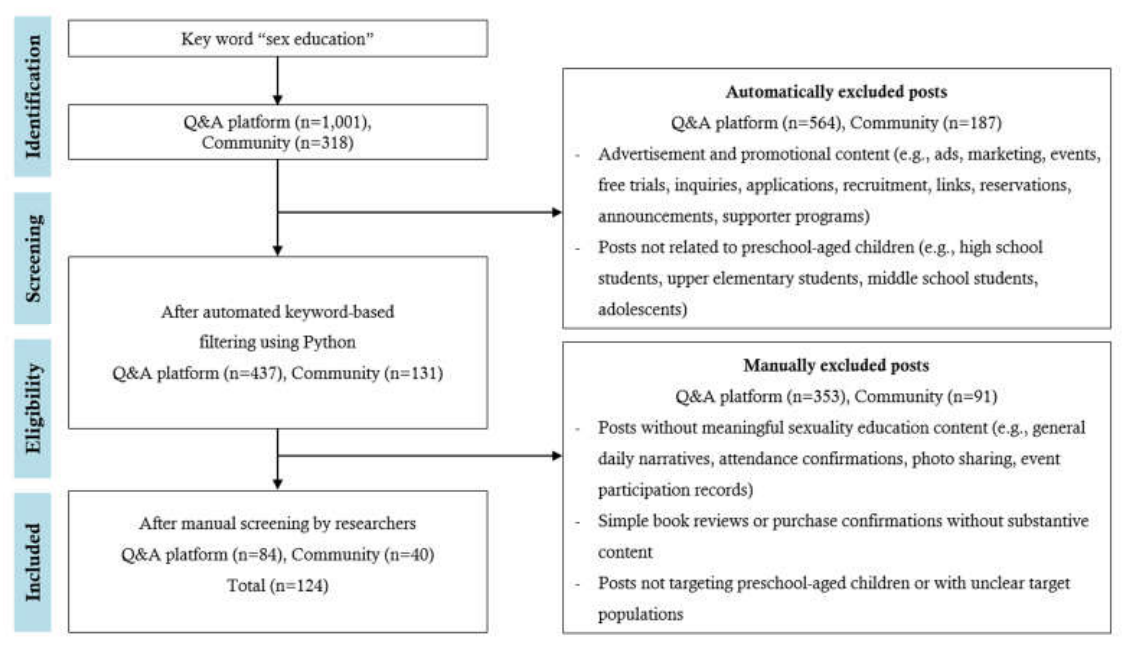
Figure 2.
Co-occurrence network of keywords related to sex education.
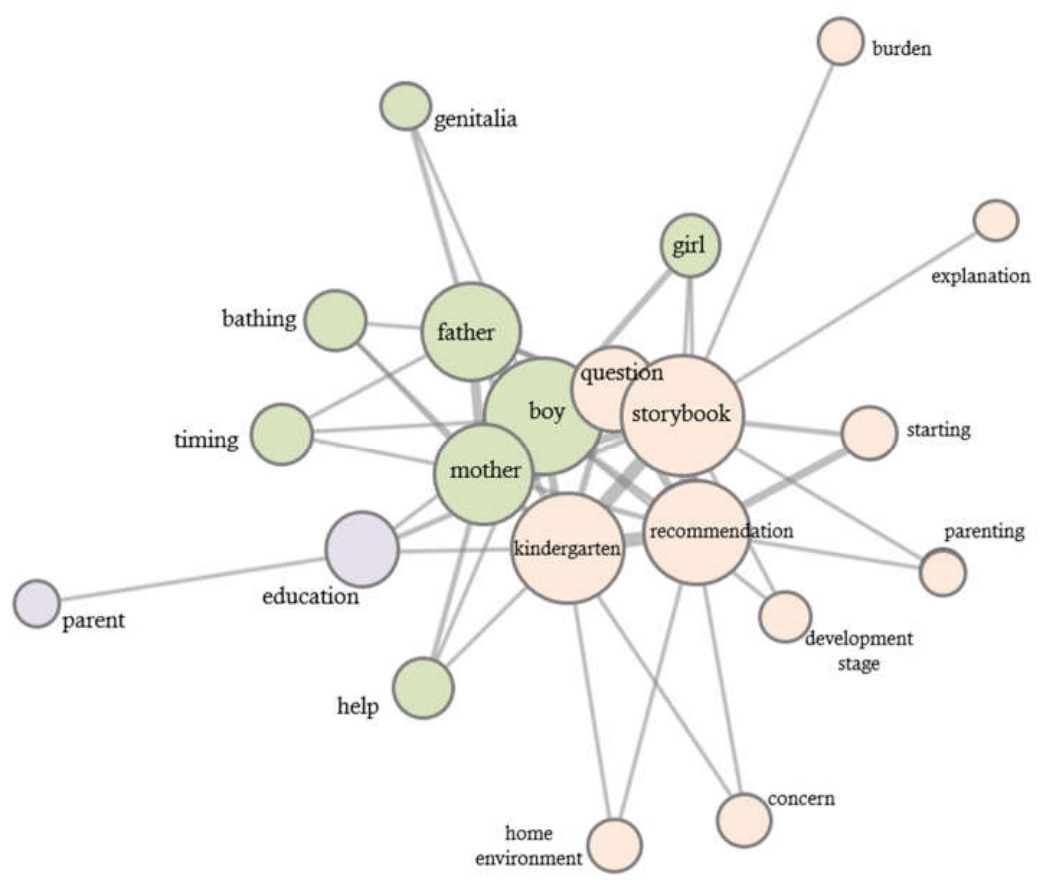
Figure 3.
The sequential process of parental experiences in childhood sexuality education.
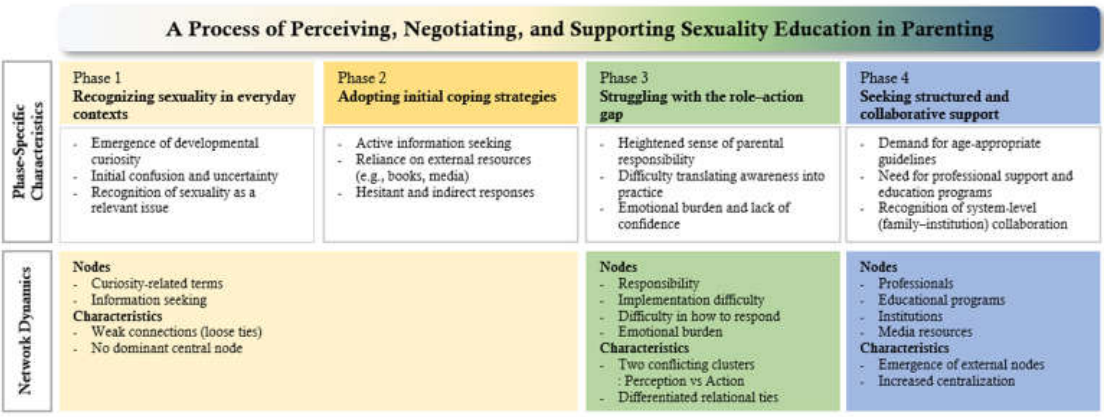

Table 1.
This is a table. Tables.
| Rank | Keyword (Total) |
Freq. | Keyword (Community) |
Freq. | Keyword (Q&A platform) |
Freq. |
|---|---|---|---|---|---|---|
| 1 | storybook | 129 | storybook | 15 | storybook | 107 |
| 2 | recommendation | 79 | recommendation | 14 | recommendation | 65 |
| 3 | boy | 46 | boy | 10 | boy | 36 |
| 4 | questions | 26 | education | 8 | kindergarten | 26 |
| 5 | kindergarten | 26 | media | 8 | questions | 21 |
| 6 | mother | 22 | starting | 6 | mother | 20 |
| 7 | education | 22 | thinking | 5 | father | 14 |
| 8 | father | 15 | girl | 5 | education | 14 |
| 9 | media | 13 | questions | 5 | girl | 9 |
| 10 | starting point | 12 | timing | 5 | genitalia | 9 |
| 11 | exposure | 10 | foreign countries | 4 | people | 8 |
| 12 | people | 10 | children | 4 | home environment | 7 |
| 13 | approach | 9 | early | 3 | starting point | 6 |
| 14 | help | 9 | concept | 3 | help | 6 |
| 15 | expert | 9 | exposure | 3 | behavior | 6 |
| 16 | genitalia | 9 | alone | 3 | approach | 6 |
| 17 | timing | 8 | toilet training | 3 | breast | 6 |
| 18 | parents | 8 | news | 3 | expert | 6 |
| 19 | concern | 7 | stimulation | 3 | developmental stage | 5 |
| 20 | behavior | 7 | approach | 3 | bathing | 5 |
* Freq.=Frequency.
Table 2.
Centralities of keywords related to sex education from online.
| Rank | Keyword (Total) |
Cd | Keyword (Community) |
Cb | Keyword (Q&A platform) |
Cc |
|---|---|---|---|---|---|---|
| 1 | storybook | 0.650 | storybook | 0.350 | storybook | 0.741 |
| 2 | boy | 0.600 | boy | 0.197 | boy | 0.714 |
| 3 | kindergarten | 0.550 | kindergarten | 0.172 | kindergarten | 0.690 |
| 4 | recommendation | 0.500 | recommendation | 0.131 | recommendation | 0.645 |
| 5 | mother | 0.450 | education | 0.100 | mother | 0.625 |
| 6 | father | 0.400 | mother | 0.062 | father | 0.606 |
| 7 | questions | 0.300 | father | 0.060 | questions | 0.571 |
| 8 | education | 0.200 | questions | 0.001 | education | 0.556 |
| 9 | bathing | 0.150 | bathing | 0.000 | girl | 0.513 |
| 10 | help | 0.150 | help | 0.000 | help | 0.476 |
| 11 | timing | 0.150 | timing | 0.000 | developmental stage | 0.476 |
| 12 | girl | 0.150 | girl | 0.000 | starting point | 0.465 |
| 13 | genitalia | 0.100 | genitalia | 0.000 | parenting | 0.465 |
| 14 | developmental stage | 0.100 | developmental stage | 0.000 | bathing | 0.455 |
| 15 | starting point | 0.100 | starting point | 0.000 | timing | 0.455 |
| 16 | concern | 0.100 | concern | 0.000 | concern | 0.455 |
| 17 | home environment | 0.100 | home environment | 0.000 | home environment | 0.455 |
| 18 | parenting | 0.100 | parenting | 0.000 | genitalia | 0.444 |
| 19 | parents | 0.050 | parents | 0.000 | burden | 0.435 |
| 20 | burden | 0.050 | burden | 0.000 | explanation | 0.435 |
* Cd=Degree Centrality; Cb=Betweenness Centrality; Cc=Closeness Centrality.
Table 3.
Characteristics of participants and their children (N=18).
| Demographic Category | N (%) | ||
|---|---|---|---|
| Gender | Female | 16(88.9) | |
| Male | 2(11.1) | ||
| Age(years) | ≤29 | 2(11.1) | (range: 28–42) |
| 30–34 | 7(38.9) | ||
| 35–39 | 6(33.3) | ||
| ≥40 | 3(16.7) | ||
| Educational level | High school | 4(22.2) | |
| College | 12(66.7) | ||
| Graduate school | 2(11.1) | ||
| Employment status | Full-time | 5(27.8) | |
| Part-time | 8(44.4) | ||
| Unemployed | 5(27.8) | ||
| Gender of child | Female | 12(66.7) | |
| Male | 6(33.3) | ||
| Age of target children (years) | 3 | 1(5.6) | |
| 4 | 4(22.2) | ||
| 5 | 6(33.3) | ||
| 6 | 3(16.7) | ||
| 7 | 2(11.1) | ||
| 8 | 2(11.1) | ||
| Number of children | 1 | 12(66.1) | |
| 2 | 5(27.8) | ||
| 3 | 1(5.5) | ||
| Parents’ experience of sex education |
Yes | 18(100) | |
| No | 0(0) | ||
| Children’s experience of sex education |
Yes | 7(38.9) | |
| No | 11(61.1) | ||
| Experience of providing sex education to children |
Yes | 1(5.5) | |
| No | 17(94.5) | ||
Table 4.
Process of sexuality education among parents of young children.
| Phase 1. Recognizing sexuality in everyday contexts | |
| 1-1. Children’s curiosity initiating sexuality-related interactions | |
| 1-2. Gendered parent–child dynamics shaping boundaries and discomfort | |
| Phase 2. Adopting initial coping strategies | |
| 2-1. Use of mediated resources to support immediate responses | |
| 2-2. Active information seeking in response to situations | |
| Phase 3. Struggling with the role–action gap | |
| 3-1. Acknowledging responsibility as primary educators | |
| 3-2. Uncertainty about how to explain | |
| 3-3. Partial reliance on external agents for guidance | |
| Phase 4. Seeking structured and collaborative support | |
| 4-1. Desire for parent–child joint learning opportunities | |
| 4-2. Institutional responsibility for strengthening parental capacity | |
| 4-3. Demand for concrete, stage-specific educational guidelines | |
Disclaimer/Publisher’s Note: The statements, opinions and data contained in all publications are solely those of the individual author(s) and contributor(s) and not of MDPI and/or the editor(s). MDPI and/or the editor(s) disclaim responsibility for any injury to people or property resulting from any ideas, methods, instructions or products referred to in the content. |
© 2026 by the authors. Licensee MDPI, Basel, Switzerland. This article is an open access article distributed under the terms and conditions of the Creative Commons Attribution (CC BY) license (http://creativecommons.org/licenses/by/4.0/).
Copyright: This open access article is published under a Creative Commons CC BY 4.0 license, which permit the free download, distribution, and reuse, provided that the author and preprint are cited in any reuse.