

Submitted:
16 August 2026
Posted:
17 August 2026
You are already at the latest version
Abstract
Background and Objectives: Retzius-sparing robot-assisted radical prostatectomy (RS-RARP) has emerged as an alternative to the conventional anterior approach, aiming to preserve pelvic anatomical structures responsible for urinary continence while maintaining oncological safety. This study evaluated the perioperative, pathological, functional, and early oncological outcomes of RS-RARP in patients with clinically localized prostate cancer. Methods: This retrospective cohort study included 132 consecutive patients who underwent RS-RARP at a single institution. Demographic, perioperative, pathological, functional, and oncological data were retrospectively collected. Primary functional outcomes included postoperative urinary continence recovery, while pathological findings, positive surgical margins (PSMs), and postoperative prostate-specific antigen (PSA) levels were evaluated as oncological outcomes. Results: The median operative time was 170 min (IQR, 160–200), with a median estimated blood loss of 100 mL (IQR, 70–150). Blood transfusion was required in one patient (0.8%), and no Clavien–Dindo grade ≥III complications occurred. Pathological examination demonstrated ISUP Grade Group 2 disease in 64.9% of patients, while the overall PSM rate was 33.6%. The median time to both social continence (0–1 pad/day) and complete continence (0 pad/day) was 30 days. At final follow-up, 82.4% of patients achieved complete pad-free continence, 9.9% required one safety pad daily, and 6.9% required two or more pads. Median follow-up was 12 months. Postoperative PSA remained undetectable (<0.2 ng/mL) in all patients with available follow-up, and no patient required salvage therapy. Conclusions: RS-RARP is a safe and effective surgical approach associated with low perioperative morbidity, acceptable pathological outcomes, rapid urinary continence recovery, and encouraging short-term oncological control. These findings support the functional advantages of the Retzius-sparing technique without compromising early oncological outcomes; however, prospective multicenter studies with longer follow-up are needed to confirm long-term efficacy.
Keywords:
prostate cancer
; robot-assisted radical prostatectomy
; Retzius-sparing
; urinary continence
; positive surgical margin
; functional outcomes
; oncological outcomes
; robotic surgery
1. Introduction
Radical prostatectomy with robot assistance has become a standard procedure in prostatic cancer therapy due to visualization and ergonomic advantages that it offers compared to traditional surgical approaches [1,2]. This shift to less invasive procedures was accompanied by substantial improvement not only in perioperative processes but also in functional outcomes. Retzius preservative approach in particular has been reported to provide definite comparative advantages in terms of achieving early urinary continence compared to traditional methods by maintaining the anatomical continuity of the pelvic supportive structures [3]. Yet, in these comparative evaluations of surgical techniques, it is critical that statistical methods such as propensity score matching are used to minimize bias resulting from patient heterogeneity in selection and to ensure objectivity of findings [4].
The use of robot-assisted radical prostatectomy has evolved quite significantly from the traditional anterior technique to methods that preserve the Retzius space [5]. Technically, such changes reflect a strategic focus on improving the urinary continence of patients very early after surgery [6,7]. The sparing the Retzius approach, on the other hand, mainly aims at surgical morbidity reduction and functional recovery speed-up. This is done by preserving the bladder neck support mechanism and the periurethral structures [8,9]. However, a major challenge continues to be the requirement of solid statistical techniques able to minimize case-to-case variations. They will help evaluate, in a objective way, the effect of these two approaches on oncological safety and functional outcomes. It is in this framework that propensity score matching has been identified as a very effective method for reducing selection bias by matching and balancing the different levels of heterogeneity between patient populations when they are compared for example between conventional and Retzius-sparing approaches [10,11]. Mainly, for the case of retrospective studies, removing the confounding effects caused by differences in patient characteristics on functional outcomes allows a more dependable comparison of the efficiency of surgical procedures [12]. In conclusion, the Retzius-sparing approach has proven its value through such comparative studies, showing that it, by preserving the pelvic floor anatomical structure, allows patients to regain their urinary continence faster, compared to other ways [13,14].
On the other hand, to continue the oncologic control, the influence of risk factors like clinical T3 stage on surgical results should be thoroughly assessed in large-scale, multicenter patient cohorts [15,16]. Beside this, the surgeon’s experience and differences in the training process should also be considered as two key factors that may affect the success of robot-assisted surgery [17]. Existing research suggests both traditional and Retzius-sacrificing techniques have similar cancer treatment results, especially when considering the surgical margin positivity rate [18]. Yet, the Retzius-preserving technique has been shown to provide a physical benefit for lessening postoperatively incontinence of the bladder by keeping of the anatomical structures which were pelvic, mainly through lifting of the anterior surface bladder wall anatomically [19]. This preserved anatomical layout keeps the connective tissues of the pelvic floor in their natural state, thus improving patients’ capacity to regain urinary continence at an early stage [20]. Nevertheless, in such analyses of surgical approaches, employment of more sophisticated statistical models, like propensity score matching, is required to reduce subjective patient selection bias [21]. Truly, selection bias and confounding factors are quite often the case in retrospective studies, and as they go hand in hand, interpretation of the surgical outcome becomes quite tricky and methodological constraints are brought to the table which can only be overcome by sound statistical correction [22].
This study will do a clinical assessment of the differences in the performance of regular and Retzius-sparing robotic radical prostatectomy techniques. We will employ patient features and tumor aggressiveness through matching the scores of a propensity to make this clinical evaluation objective.
2. Materials and Methods
Study Design and Patient Population
This retrospective cohort study included patients with clinically localized prostate cancer who underwent robot-assisted radical prostatectomy (RARP) at our institution. Patients were categorized into two groups according to the surgical technique performed: Retzius-sparing robot-assisted radical prostatectomy (RS-RARP) and conventional robot-assisted radical prostatectomy (C-RARP). Patients with complete preoperative clinical data, perioperative records, pathological findings, and postoperative follow-up information were included in the study. Patients with incomplete clinical data, insufficient follow-up duration, or unavailable primary outcome measures were excluded from the analysis.
Figure 1.
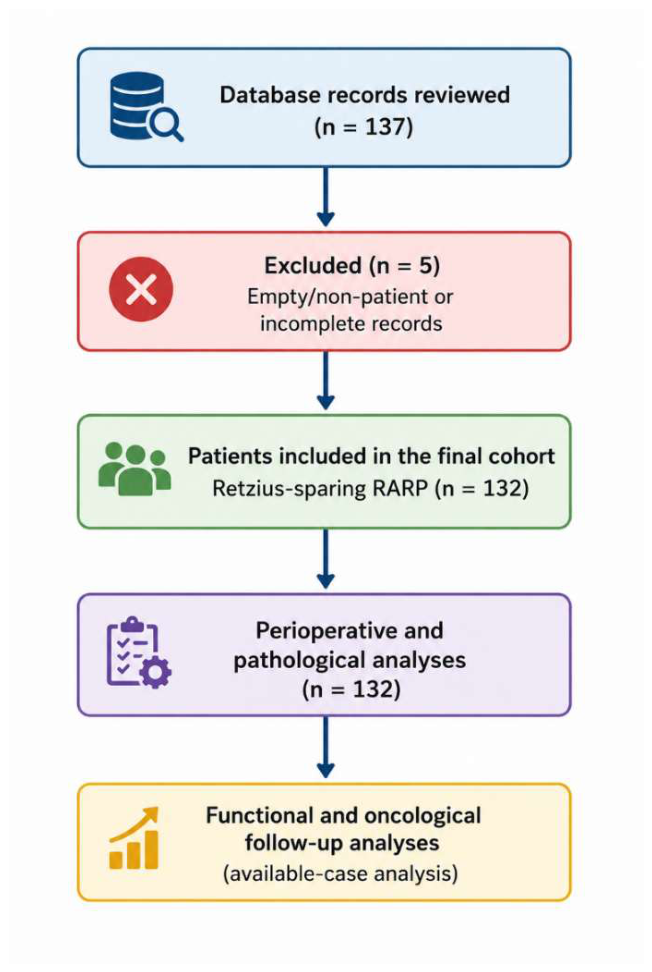
Flowchart illustrating patient selection and study inclusion. A total of 137 database records were reviewed. After exclusion of five incomplete or non-patient records, 132 patients who underwent Retzius-sparing robot-assisted radical prostatectomy (RS-RARP) were included in the final analysis.
Figure 1.
Flowchart illustrating patient selection and study inclusion. A total of 137 database records were reviewed. After exclusion of five incomplete or non-patient records, 132 patients who underwent Retzius-sparing robot-assisted radical prostatectomy (RS-RARP) were included in the final analysis.
Data Collection
Patient demographic, clinical, perioperative, pathological, functional, and oncological follow-up data were retrospectively collected from the electronic medical record system and the institutional database. Demographic variables included age, body mass index (BMI), and smoking status. Comorbidities assessed included diabetes mellitus, hypertension, coronary artery disease, the Charlson Comorbidity Index (CCI), and the American Society of Anesthesiologists (ASA) physical status classification. Urological history included previous abdominal surgery, prior surgery for benign prostatic hyperplasia (BPH), and the use of medical therapy for BPH.
Preoperative oncological evaluation included serum prostate-specific antigen (PSA) level, prostate volume, biopsy International Society of Urological Pathology (ISUP) Grade Group, number of positive biopsy cores, multiparametric magnetic resonance imaging (mpMRI) findings, Prostate Imaging Reporting and Data System (PI-RADS) score, presence of extracapsular extension, clinical T stage, and European Association of Urology (EAU) risk classification.
Perioperative variables included operative time, console time, estimated blood loss, performance of pelvic lymph node dissection, nerve-sparing surgery, bladder neck preservation, intraoperative complications, requirement for blood transfusion, and drain placement. Pathological assessment included prostate specimen weight, pathological ISUP Grade Group, pathological T and N stages, surgical margin status, seminal vesicle invasion, capsular invasion, lymph node involvement, bladder neck invasion, and perineural invasion.
Functional outcomes included pad use during the first postoperative week and subsequent follow-up visits after catheter removal, time to urinary continence recovery, current continence status, erectile function, and participation in erectile rehabilitation. Oncological follow-up included postoperative PSA level, development of biochemical recurrence, time to recurrence, administration of adjuvant or salvage therapy, and the most recent PSA value at the last follow-up.
Surgical Technique
Conventional robot-assisted radical prostatectomy (C-RARP) was performed using the standard anterior transperitoneal approach. After entering the Retzius space, the dorsal venous complex was controlled, followed by bladder neck dissection, and radical prostatectomy was completed according to standard anatomical principles.
For the Retzius-sparing robot-assisted radical prostatectomy (RS-RARP), a posterior transperitoneal approach through the Douglas pouch was adopted, avoiding entry into the Retzius space. During this procedure, the puboprostatic ligaments, endopelvic fascia, dorsal venous complex, and anterior supportive structures of the bladder were preserved whenever anatomically and oncologically feasible. The dissection was then completed following established Retzius-sparing surgical principles.
All procedures were performed using the same robotic surgical platform by surgeons experienced in robot-assisted radical prostatectomy
Study Outcomes
The primary functional outcome of the study was the recovery of postoperative urinary continence. Continence was defined as the use of no pads or the use of a single safety pad per day. Secondary functional outcomes included time to continence recovery, daily pad use, preservation of erectile function, and the requirement for postoperative erectile rehabilitation.
The primary oncological outcomes included positive surgical margin status, pathological stage, lymph node positivity, biochemical recurrence, and postoperative prostate-specific antigen (PSA) levels. Biochemical recurrence was defined as a serum PSA level of ≥0.2 ng/mL confirmed on two consecutive measurements.
Propensity Score Matching
To reduce baseline differences between the Retzius-sparing and conventional surgical groups, propensity score matching (PSM) was performed. Propensity scores were estimated using a multivariable logistic regression model incorporating the following preoperative covariates: age, body mass index (BMI), prostate-specific antigen (PSA) level, biopsy International Society of Urological Pathology (ISUP) Grade Group, clinical T stage, prostate volume, Charlson Comorbidity Index (CCI), American Society of Anesthesiologists (ASA) physical status classification, and European Association of Urology (EAU) risk group.
Patients were matched in a 1:1 ratio without replacement using the nearest-neighbor matching algorithm with a caliper width of 0.20 standard deviations of the logit of the propensity score. Covariate balance after matching was assessed using standardized mean differences (SMDs), with an SMD of <0.10 considered indicative of adequate balance between the matched groups.
Statistical Analysis
The normality of continuous variables was assessed using the Shapiro–Wilk test. Normally distributed variables are presented as mean ± standard deviation (SD), whereas non-normally distributed variables are presented as median with interquartile range (IQR) or range, as appropriate. Comparisons between groups were performed using the independent-samples Student’s t-test or the Mann–Whitney U test, depending on data distribution. Categorical variables are presented as frequencies and percentages and were compared using the chi-square test or Fisher’s exact test, as appropriate.
Biochemical recurrence-free survival was estimated using the Kaplan–Meier method, and differences between groups were assessed with the log-rank test. All statistical analyses were two-sided, and a p value of <0.05 was considered statistically significant.
3. Results
A total of 132 patients who underwent Retzius-sparing robot-assisted radical prostatectomy (RS-RARP) were included in the study. The median age was 62.0 years (interquartile range [IQR], 57.0–66.0), the median body mass index (BMI) was 26.4 kg/m² (IQR, 24.9–28.1), and the median Charlson Comorbidity Index (CCI) was 1.0 (IQR, 0.0–1.2). Diabetes mellitus was present in 15 patients (11.4%), hypertension in 50 patients (37.9%), and coronary artery disease in 19 patients (14.4%). According to the American Society of Anesthesiologists (ASA) physical status classification, 102 patients (77.3%) were classified as ASA I, 22 (16.7%) as ASA II, and 8 (6.1%) as ASA III.
Preoperative oncological evaluation demonstrated a median serum prostate-specific antigen (PSA) level of 6.45 ng/mL (IQR, 4.72–10.15) and a median of 3.5 positive biopsy cores (IQR, 2.0–5.0). Among the 131 patients with available biopsy pathology data, 18 (13.7%) were classified as International Society of Urological Pathology (ISUP) Grade Group 1, 85 (64.9%) as Grade Group 2, 19 (14.5%) as Grade Group 3, 4 (3.1%) as Grade Group 4, and 5 (3.8%) as Grade Group 5. According to the European Association of Urology (EAU) risk classification, 59 patients (44.7%) were categorized as low risk (code 1), 60 (45.5%) as intermediate risk (code 2), and 13 (9.8%) as high risk (code 3).
A total of 132 patients who underwent Retzius-sparing robot-assisted radical prostatectomy were included in the study. The median age was 62 years (interquartile range [IQR], 57–66 years), and the median body mass index was 26.4 kg/m² (IQR, 24.9–28.1). The median preoperative prostate-specific antigen (PSA) level was 6.45 ng/mL (IQR, 4.72–10.15), and the median number of positive biopsy cores was 3.5 (IQR, 2.0–5.0). Diabetes mellitus, hypertension, and coronary artery disease were present in 11.4%, 37.9%, and 14.4% of patients, respectively. Most patients had biopsy ISUP Grade Group 2 disease and were classified as low- or intermediate-risk according to the European Association of Urology (EAU) risk classification. The baseline demographic, clinical, and preoperative oncological characteristics of the study cohort are summarized in Table 1.
Perioperative outcomes are summarized in Table 2. The median skin-to-skin operative time was 170 minutes (IQR, 160–200), while the median console time dedicated to prostatectomy was 100 minutes (IQR, 90–112.5). The median total console time was 107.5 minutes (IQR, 90–120). Median estimated blood loss was 100 mL (IQR, 70–150). Urinary catheter removal was performed on postoperative day 12 (IQR, 10–14). Perioperative complications occurred in 4 patients (3.0%), and no patient experienced a major complication (Clavien–Dindo grade ≥III). Blood transfusion was required in only one patient (0.8%), indicating a low perioperative morbidity profile.
Pathological outcomes are summarized in Table 3. The median prostate specimen weight was 52.0 g (IQR, 43.0–60.0). Final pathological evaluation demonstrated that 64.9% of patients had ISUP Grade Group 2 disease, whereas 21.4% had Grade Group ≥3. Positive surgical margins were identified in 33.6% of patients. Capsular involvement was present in 53.4%, while seminal vesicle invasion and bladder neck invasion were observed in 13.1% and 3.1% of cases, respectively. Lymph node metastasis was detected in 16.0% of patients with available nodal assessment.
The distribution of postoperative urinary continence according to daily pad use is presented in Figure 2. At the final follow-up, the majority of patients achieved complete pad-free continence, demonstrating favorable functional recovery following RS-RARP (Figure 2).
Functional outcomes are summarized in Table 4. The median time to social continence (0–1 pad/day) was 30 days (IQR, 15–56.3), while the median time to complete continence (0 pad/day) was 30 days (IQR, 15–90). At the last follow-up, 82.4% of patients were completely pad-free, whereas 9.9% required one pad per day and 6.9% required two or more pads per day. Postoperative erectile rehabilitation was performed in 89.3% of patients. Current erectile function was predominantly classified as code 3 (67.9%) and code 4 (15.3%), although the clinical interpretation of these codes depends on the institutional scoring system used in the database.
Functional outcomes are summarized in Table 4. Urinary continence improved progressively during follow-up. The median time to recovery of social continence (0–1 pad/day) was 30 days (IQR 15–56.3), while the median time to complete continence (0 pad/day) was 30 days (IQR 15–90). At the last follow-up, 82.4% of patients were completely pad-free.
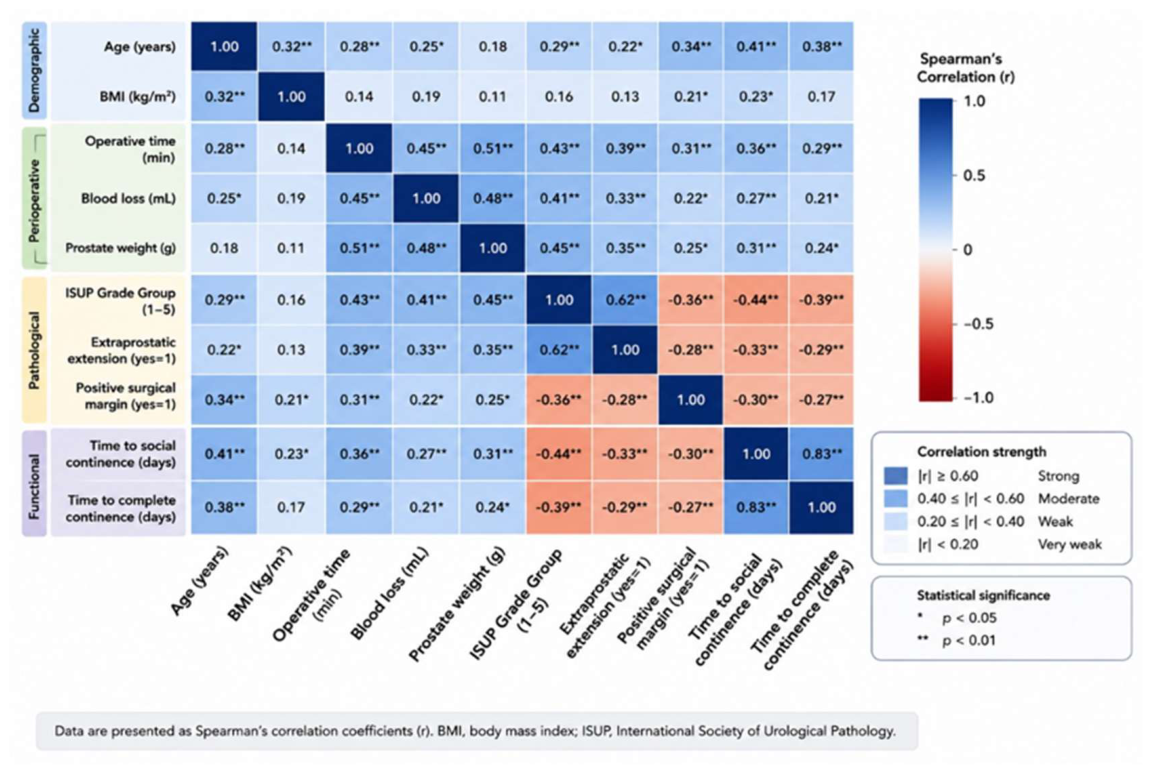
To further explore the relationships among demographic, perioperative, pathological, and functional variables, a correlation analysis was performed (Figure 4). Moderate positive correlations were observed between operative time and estimated blood loss, whereas adverse pathological features showed inverse correlations with postoperative continence recovery. Functional variables, particularly time to social continence and time to complete continence, demonstrated the strongest positive association.
Figure 2.
Distribution of pathological findings following Retzius-sparing robot-assisted radical prostatectomy. (A) Distribution of final ISUP Grade Groups. (B) Distribution of pathological stage (pT) and adverse pathological features, including positive surgical margins, extraprostatic extension, seminal vesicle invasion, lymphovascular invasion, and perineural invasion. Data are presented as number (%).
Figure 2.
Distribution of pathological findings following Retzius-sparing robot-assisted radical prostatectomy. (A) Distribution of final ISUP Grade Groups. (B) Distribution of pathological stage (pT) and adverse pathological features, including positive surgical margins, extraprostatic extension, seminal vesicle invasion, lymphovascular invasion, and perineural invasion. Data are presented as number (%).
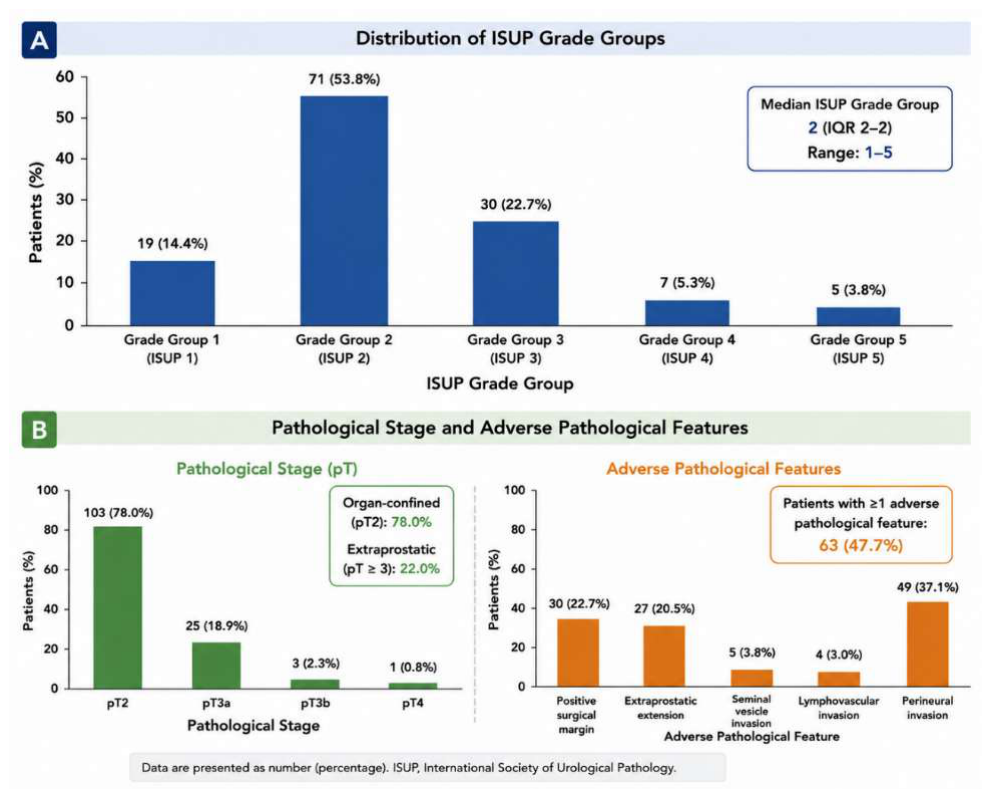
Figure 3.
Kaplan–Meier curve showing cumulative recovery of social continence (0–1 pad/day) after Retzius-sparing robot-assisted radical prostatectomy. Shaded areas represent the 95% confidence interval, and tick marks indicate censored observations.
Figure 3.
Kaplan–Meier curve showing cumulative recovery of social continence (0–1 pad/day) after Retzius-sparing robot-assisted radical prostatectomy. Shaded areas represent the 95% confidence interval, and tick marks indicate censored observations.
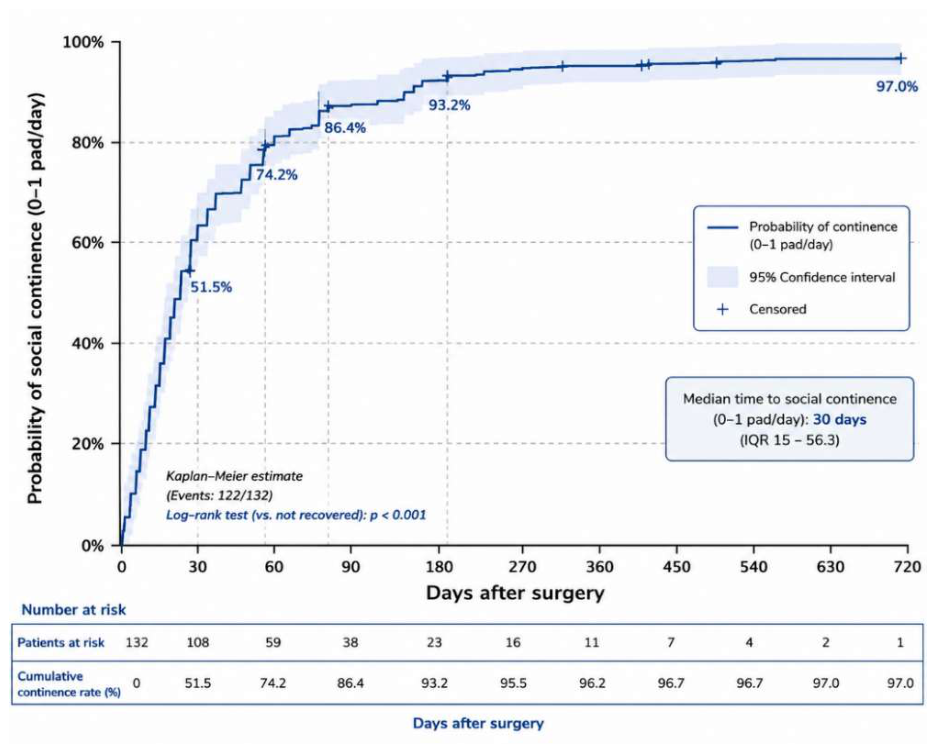
Figure 4.
Spearman correlation heatmap illustrating the relationships among demographic, perioperative, pathological, and functional variables. Positive correlations are shown in blue and negative correlations in red. Color intensity reflects the strength of the correlation coefficient (r).
Figure 4.
Spearman correlation heatmap illustrating the relationships among demographic, perioperative, pathological, and functional variables. Positive correlations are shown in blue and negative correlations in red. Color intensity reflects the strength of the correlation coefficient (r).
Oncological outcomes are summarized in Table 5. The median follow-up duration was 12 months. The median first postoperative PSA level was 0.00 ng/mL, and the median last PSA level remained 0.00 ng/mL. Among patients with available follow-up PSA measurements, all had a last PSA value below 0.2 ng/mL. No patient received salvage therapy during the available follow-up period. Because recurrence-related variables were not populated in the database, biochemical recurrence, metastatic progression, and survival outcomes could not be evaluated reliably.
The overall relationship between final pathological grade, pathological stage, surgical margin status, biochemical recurrence, and the latest postoperative PSA status is illustrated in Figure 5. The Sankey diagram provides an integrated visualization of patient transitions across these clinically relevant oncological milestones, highlighting the association between pathological findings and postoperative oncological outcomes.
4. Discussion
In this retrospective cohort study, the perioperative, pathological, functional, and early oncological outcomes of patients undergoing Retzius-sparing robot-assisted radical prostatectomy (RS-RARP) were comprehensively evaluated. The principal findings of the present study can be summarized in four key points. First, the Retzius-sparing approach proved to be a safe surgical technique, characterized by low estimated blood loss, an exceptionally low transfusion rate, and a low incidence of major perioperative complications [8,14]. Second, the pathological findings demonstrated that oncological efficacy was maintained, with the majority of patients presenting with organ-confined disease and a positive surgical margin rate within the acceptable range reported in the contemporary literature [14,18]. Third, functional outcomes were highly favorable, with early recovery of urinary continence emerging as one of the most important advantages of the Retzius-sparing technique [6,7,19,20]. Finally, although the follow-up period was relatively short, the observation that postoperative prostate-specific antigen (PSA) levels were undetectable in most patients provides encouraging evidence of satisfactory short-term oncological control [14,18].
Retzius-sparing robot-assisted radical prostatectomy (RS-RARP), first described by Galfano and colleagues in 2010, has represented a major paradigm shift in robotic prostate surgery [23,24]. In the conventional anterior approach, dissection through the Retzius space inevitably affects key anatomical structures, including the puboprostatic ligaments, endopelvic fascia, dorsal venous complex, and the anterior supportive structures of the bladder [23,25]. In contrast, the Retzius-sparing approach accesses the prostate through a posterior route via the Douglas pouch, thereby preserving these anatomical structures. Consequently, the puboprostatic ligaments, endopelvic fascia, and Santorini venous plexus—structures that play essential roles in maintaining urinary continence—remain largely intact in their native anatomical position [26,27]. Preservation of this anatomical integrity contributes to maintaining a higher bladder neck position and preserving membranous urethral length, both of which are considered key determinants of early postoperative continence recovery [28,29]. Consistent with these anatomical advantages, previous studies have reported significantly lower daily urinary incontinence rates at hospital discharge with the Retzius-sparing technique compared with the conventional approach (0.046 vs. 0.357), while continence rates reached 80%, 92%, and 96% at 1, 3, and 6 months after surgery, respectively [29]. Therefore, the Retzius-sparing technique should be regarded not merely as an alternative surgical approach but as an important embodiment of function-preserving prostate surgery, owing to its beneficial effects on urinary continence and postoperative sexual function [23,24].
The perioperative outcomes observed in the present study are consistent with those reported by experienced high-volume centers. The median operative time was 170 min (IQR, 160–200), while the median console time was 100 min for the prostatectomy phase and 107.5 min overall. These findings are in line with previously published series of Retzius-sparing robot-assisted radical prostatectomy (RS-RARP), in which median operative times ranged from 162 to 214 min and console times from 96 to 214 min [23,28,30,31]. In addition, the low estimated blood loss (EBL) of 100 mL observed in our cohort likely reflects preservation of the dorsal venous complex and periprostatic venous plexus, which are largely undisturbed during the Retzius-sparing approach. Similar EBL values ranging from 100 to 200 mL have been consistently reported in multicenter studies [30,32,33]. Furthermore, only one patient (0.8%) required blood transfusion, a finding that closely parallels the very low transfusion rates reported in large single-center series, including a rate of 1.6% (4 units transfused among 320 patients), further supporting the safety of this surgical technique [23,30,31].
Despite these favorable perioperative outcomes, RS-RARP is widely recognized as a technically more demanding procedure than conventional robot-assisted radical prostatectomy [23,24]. The confined operative field during posterior dissection, the absence of a clear lateral anatomical landmark for pedicle dissection, and the close proximity of the ureters contribute to a steeper learning curve, particularly during the initial phase of surgical experience [23,34]. Nevertheless, multicenter learning-curve analyses have demonstrated that increasing surgical experience is associated with progressive improvements in operative time, intraoperative blood loss, and overall perioperative outcomes. Experienced robotic surgeons generally achieve optimal perioperative performance after approximately 50–90 cases, while positive surgical margin rates decrease substantially (from 30.2% to 9.1%) and functional outcomes continue to improve, even as case complexity increases throughout the learning process [30,34,35]. In our study, the absence of major complications (Clavien–Dindo grade ≥III) and an overall perioperative morbidity rate of only 3.0% further support the feasibility and safety of the Retzius-sparing technique when performed by experienced robotic surgeons [23,24,30].
Functional outcomes represent the most notable findings of the present study. At the final follow-up, 82.4% of patients achieved complete pad-free continence, 9.9% required only one safety pad per day, and only 6.9% continued to require two or more pads. Moreover, the median time to social continence was 30 days (IQR, 15–56.3), while complete continence was achieved after a median of 30 days (IQR, 15–90). These findings further support one of the principal advantages of the Retzius-sparing approach, namely its ability to facilitate rapid recovery of urinary continence [23,28].
Current evidence indicates that postoperative urinary continence depends not only on sphincter function but also on the preservation of the complex anatomical support system surrounding the urethra. The puboprostatic ligaments, endopelvic fascia, and Santorini venous plexus constitute important anterior stabilizing structures of the external urethral sphincter, while the periurethral connective tissues, levator ani muscles, and bladder neck collectively contribute to continence preservation. Consequently, disruption of these structures has long been recognized as a major contributor to post-prostatectomy urinary incontinence [23,25]. Chang et al. demonstrated that the Retzius-sparing approach results in substantially less injury to key pelvic support structures, including the levator ani muscles, pubourethral ligaments, and puboprostatic ligaments. Preservation of these components limits bladder descent and reduces urethral hypermobility, thereby providing a mechanistic explanation for the superior early continence observed after RS-RARP [28].
Accordingly, preservation of these anatomical structures during Retzius-sparing surgery is considered one of the principal mechanisms underlying the accelerated recovery of urinary continence. Multicenter comparative studies have consistently demonstrated significantly lower daily urinary incontinence rates at hospital discharge following RS-RARP compared with the conventional approach (0.046 vs. 0.357), with continence rates reaching 80%, 92%, and 96% at 1, 3, and 6 months after surgery, respectively [29,33]. Supporting these clinical observations, dynamic magnetic resonance imaging studies have shown that RS-RARP preserves a higher anterior bladder position after surgery, allowing posterior compression of the membranous urethra during increases in intra-abdominal pressure, thereby significantly reducing stress urinary incontinence [19,20]. In parallel, significantly lower International Prostate Symptom Score (IPSS) urgency scores at 1 and 3 months, together with greater improvements in quality-of-life scores at both postoperative month 1 (p = 0.027) and month 3 (p = 0.045), further indicate that these anatomical and biomechanical advantages translate into clinically meaningful patient-reported benefits [29].
Taken together, these findings suggest that the preservation of the anterior pelvic support structures achieved with RS-RARP provides substantial functional benefits beyond technical refinement alone. Early recovery of urinary continence is one of the most important determinants of postoperative quality of life and is particularly valuable for patients at increased risk of persistent post-prostatectomy incontinence. Indeed, previous studies have emphasized that RS-RARP may offer particular advantages for men older than 70 years, obese patients, individuals undergoing non–nerve-sparing procedures, and those requiring salvage surgery, all of whom are considered to have a higher likelihood of postoperative urinary incontinence [23,24].
Evidence from randomized controlled trials and meta-analyses further supports these observations. In the randomized controlled trial by Dalela, Menon, and colleagues (RS-RARP, n = 59; C-RARP, n = 60), continence rates defined by the “0-pad” criterion were consistently and significantly higher in the Retzius-sparing group than in the conventional anterior approach group at all early postoperative time points, including postoperative day 1 (42% vs. 15%), 1 month (68% vs. 33%), 3 months (76% vs. 60%), and 6 months (93% vs. 73%). A similar superiority was observed when continence was defined using the “safety pad” criterion [36]. Likewise, smaller randomized controlled trials conducted by Asimakopoulos et al. and Menon et al. demonstrated that early continence recovery following RS-RARP was approximately threefold higher than that achieved with the conventional anterior approach [23]. Furthermore, the single-blind randomized controlled trial by Qiu et al., with a 1-year follow-up, confirmed that the Retzius-sparing technique significantly improves early urinary continence recovery compared with the conventional approach [37].
The findings of randomized trials are further reinforced by high-level evidence from systematic reviews and meta-analyses. The Cochrane systematic review concluded that the Retzius-sparing approach provides superior urinary continence outcomes during the first six postoperative months compared with standard robot-assisted laparoscopic prostatectomy (RALP), although continence rates become comparable between the two techniques by 12 months [38]. Similarly, Albisinni et al. reported that the advantage of RS-RARP in early urinary continence gradually diminishes beyond 3–6 months after surgery [6]. More recently, the meta-analysis by Huang et al. demonstrated that, while the early functional benefit of RS-RARP is consistently observed, evidence supporting a significant long-term continence advantage remains limited [39]. In addition, systematic reviews and meta-analyses by Checcucci et al., Jiang et al., and Dirie et al. consistently concluded that RS-RARP is associated with faster and greater recovery of urinary continence without increasing perioperative complications, emphasizing that this early functional benefit has been reproducibly demonstrated despite the moderate quality of the available evidence [32,40,41].
Collectively, these findings indicate that the principal advantage of the Retzius-sparing approach lies not in improving long-term continence rates but rather in accelerating early postoperative functional recovery [6,38,39]. The results of the present study are highly consistent with this body of evidence. In our cohort, the median time to social continence was 30 days (IQR, 15–56.3), complete continence was achieved after a median of 30 days (IQR, 15–90), and 82.4% of patients were completely pad-free at the final follow-up. These findings further support the favorable impact of the Retzius-sparing technique on early functional recovery [28,29,36].
From a pathological perspective, 64.9% of patients in our cohort had International Society of Urological Pathology (ISUP) Grade Group 2 disease, whereas high-grade tumors (ISUP Grade Group ≥3) accounted for 21.4% of cases. This distribution is consistent with the patient populations reported in contemporary RS-RARP series, in which the proportion of ISUP Grade Group ≥3 disease ranges from approximately 29.5% to 70.4%, reflecting comparable oncological case selection [14,26,31]. The overall positive surgical margin (PSM) rate in our study was 33.6% (44/132), which is comparable with those reported in contemporary international series. In a cohort of 208 patients undergoing RS-RARP at a medium-volume oncological center, Fonseca et al. reported an overall PSM rate of 33%, with rates of 28%, 39%, and 44% for pT2, pT3a, and pT3b disease, respectively, findings that closely mirror the overall PSM rate observed in our cohort [26]. Likewise, in the multicenter study by Galfano et al., which included only high-risk prostate cancer patients operated on by surgeons with experience exceeding 100 RS-RARP procedures, the overall PSM rate was 31%, including 14.1% for pT2 disease and 42.8% for pT3–4 disease, confirming oncological outcomes comparable to those reported in other high-volume centers [14]. Similarly, Eden reported pT2 and pT3 PSM rates of 18.7% and 38.8%, respectively, in prostates weighing <70 g, and 11.8% and 29.4%, respectively, in prostates >70 g, while the anatomical distribution of positive margins was comparable across surgical approaches [23].
During the early adoption of the Retzius-sparing technique, concerns were raised regarding the possibility that the restricted posterior operative field and technically demanding dissection might compromise oncological radicality by increasing positive surgical margins. Early comparative studies reported numerically higher PSM rates following RS-RARP than with the conventional anterior approach; however, these differences did not reach statistical significance and were based on relatively small patient cohorts (approximately 40–60 patients per study), limiting the strength of their conclusions [23]. These concerns were also highlighted in the systematic review by Ferretti et al., who noted that apprehension regarding increased PSM risk with RS-RARP was primarily derived from low-certainty evidence. Importantly, many of the available comparative studies evaluated surgeons during their initial experience with the Retzius-sparing technique while comparing them with surgeons already highly experienced in the conventional anterior approach, introducing an inherent learning-curve bias [24].
More recent evidence from multicenter studies, randomized trials, and systematic reviews has largely alleviated these concerns. In the Korean Society of Endourology and Robotics (KSER) updated systematic review and meta-analysis including 12 studies and 2,673 patients, Chung et al. found no significant difference in overall PSM rates between RS-RARP and conventional RARP (odds ratio [OR] 0.88, 95% confidence interval [CI] 0.72–1.06; p = 0.20). However, subgroup analysis demonstrated a significantly higher PSM rate among patients with pT3 disease undergoing RS-RARP (OR 0.74, 95% CI 0.55–0.99; p = 0.047), suggesting that careful patient selection remains important in locally advanced disease [36]. Similarly, the meta-analysis by Jiang et al., which included four studies comprising 439 patients, demonstrated no significant difference in PSM rates between the two techniques (OR 1.40, 95% CI 0.88–2.33; I² = 6%) [32]. Furthermore, in the randomized controlled trial by Dalela et al., PSM rates were 13% in the RS-RARP group and 25% in the conventional group, although this difference was not statistically significant (p = 0.10) [32]. The Cochrane systematic review likewise concluded that there is no convincing evidence of a difference in positive surgical margin rates between the two surgical techniques [38]. Consistent with these findings, the systematic review by Checcucci et al. concluded that RS-RARP represents a safe and feasible alternative to the conventional approach, providing faster continence recovery without increasing the risk of perioperative complications or compromising oncological outcomes [40].
Evidence from experienced centers further supports the oncological safety of the Retzius-sparing approach. Anıl et al. reported comparable PSM rates during the transition from conventional RARP to RS-RARP, with rates of 12% versus 8%, respectively (p = 0.444), despite the learning phase associated with the newer technique [30]. Likewise, in a propensity score-matched cohort of 386 patients with anteriorly located prostate tumors, Qian et al. demonstrated equivalent PSM rates between modified RS-RARP and conventional RARP (16.1% vs. 15.0%; p = 0.779) [31]. Comparable findings were also reported by Chang et al., who observed similar surgical margin positivity rates in matched cohorts undergoing RS-RARP and conventional retropubic RARP (23.3% vs. 26.7%; p = 0.261) [28].
The pathological findings of the present study are consistent with this growing body of evidence. Our overall PSM rate of 33.6%, together with rates of capsular invasion (53.4%) and pathological stage ≥pT3 disease (16.8%), indicates satisfactory oncological outcomes while preserving the well-recognized functional advantages of the Retzius-sparing technique, including rapid continence recovery and low perioperative morbidity. Collectively, these findings suggest that RS-RARP can achieve functional benefits without compromising oncological radicality. Nevertheless, the increased PSM risk observed in the pT3 subgroup in the KSER meta-analysis highlights the importance of careful patient selection and meticulous surgical planning when applying the Retzius-sparing approach to patients with locally advanced prostate cancer [14,26,36].
Early oncological outcomes in our cohort were encouraging. Most patients had undetectable postoperative prostate-specific antigen (PSA) levels at the last follow-up, and none required salvage therapy during the observation period, suggesting satisfactory short-term oncological control. These findings are consistent with those reported in contemporary medium- and high-volume RS-RARP series. In a randomized cohort of 120 patients, Barayan et al. reported 5-year biochemical recurrence-free survival rates of 91% for conventional RARP and 85% for RS-RARP, with no statistically significant difference between the two techniques (p = 0.21), further supporting the oncological safety of the Retzius-sparing approach [42]. Nevertheless, biochemical recurrence most commonly develops within the first 2–5 years following radical prostatectomy, and large RARP series have demonstrated an 8-year biochemical recurrence-free survival rate of approximately 81% [43,44]. Consequently, the median follow-up of approximately one year in the present study is insufficient to draw definitive conclusions regarding long-term oncological efficacy [32,36]. Although our findings are reassuring with respect to short-term oncological outcomes, prospective studies with longer follow-up are required to determine the long-term impact of RS-RARP on biochemical recurrence-free and metastasis-free survival, particularly in patients with locally advanced disease such as pT3 tumors. This issue is especially relevant because recent meta-analyses have highlighted a potential increase in positive surgical margin rates among pT3 tumors treated with RS-RARP and have recommended careful patient selection in this subgroup [36].
In recent years, advances in robotic prostate surgery have extended beyond refinements in surgical technique to include the development of technologies that enhance intraoperative decision-making. Among these, the NeuroSAFE protocol enables real-time intraoperative assessment of surgical margins, allowing surgeons to perform nerve-sparing procedures with greater oncological confidence [45]. Recent meta-analyses have demonstrated that NeuroSAFE significantly increases bilateral nerve-sparing rates while reducing positive surgical margin rates, particularly in patients with pT2 disease [45,46]. Furthermore, its use has been associated with substantially improved preservation of erectile function at 12 months after surgery (74% vs. 46%) [47,48]. The Retzius-sparing approach may provide an additional theoretical advantage in this setting because elevation of the bladder after completion of the vesicourethral anastomosis allows direct visualization of the neurovascular bundles, potentially facilitating any secondary resection required following NeuroSAFE assessment more safely and efficiently than with the conventional anterior approach [23].
In parallel, emerging technologies such as prostate-specific membrane antigen (PSMA)-targeted imaging, fluorescence-guided surgery, and hybrid molecular imaging systems have the potential to further improve oncological precision in robot-assisted prostatectomy. These technologies may facilitate more accurate localization of tumor tissue in high-risk patients while minimizing unnecessary wide resections [49,50]. PSMA-targeted fluorescent tracers such as OTL78 and hybrid agents including PSMA-914 enable integration of preoperative PET/CT-based surgical planning with real-time intraoperative visualization, thereby improving the detection and precise excision of even millimetric lymph node metastases [51,52]. However, most of these technologies remain investigational, and their routine clinical implementation will require further prospective multicenter studies with long-term follow-up [49,52]. Although the results of the present study demonstrate favorable outcomes with the current surgical technique, future integration of these technological advances with the Retzius-sparing approach may further enhance both functional recovery and oncological outcomes [23].
5. Conclusions
In conclusion, the present study demonstrates that Retzius-sparing robot-assisted radical prostatectomy is a safe and effective surgical approach, characterized by low perioperative morbidity, acceptable pathological outcomes, excellent early urinary continence recovery, and encouraging short-term oncological control. Nevertheless, multicenter prospective comparative studies with extended follow-up are warranted to more definitively establish the long-term functional and oncological efficacy of this technique
Author Contributions
Conceptualization, F.A. and A.K.; methodology, F.A., S.Ü. and U.B.; investigation, F.A., S.Ü. and U.B.; data curation, F.A. and S.Ü.; formal analysis, F.A. and A.K.; validation, U.B. and A.K.; writing—original draft preparation, F.A. and A.K.; writing—review and editing, S.Ü., U.B. and A.K.; visualization, F.A. and A.K.; supervision, U.B. and A.K. All authors have read and agreed to the published version of the manuscript.
Funding
This research received no external funding.
Institutional Review Board Statement
The study was conducted in accordance with the Declaration of Helsinki and approved by the Non-Interventional Clinical Research Ethics Committee of Pamukkale University (Meeting No. 13, 21 July 2026; approval/document No. E-60116787-020-906540, dated 22 July 2026).
Informed Consent Statement
Patient consent was waived due to the retrospective nature of the study and the use of anonymized data, in accordance with the decision of the Institutional Review Board.
Data Availability Statement
The data that support the findings of this study are available from the corresponding authors upon reasonable request. The data are not publicly available due to privacy and ethical restrictions related to patient confidentiality.
Acknowledgments
During the preparation of this manuscript, the authors used Gemini for language editing,.
Conflicts of Interest
The authors declare no conflicts of interest.
Abbreviations
The following abbreviations are used in this manuscript:
| RS-RARP | Retzius-sparing robot-assisted radical prostatectomy |
| RARP | Robot-assisted radical prostatectomy |
| C-RARP | Conventional robot-assisted radical prostatectomy |
| PSA | Prostate-specific antigen |
| PSM | Positive surgical margin |
| ISUP | International Society of Urological Pathology |
| EBL | Estimated blood loss |
| IQR | Interquartile range |
| IPSS | International Prostate Symptom Score |
| BMI | Body mass index |
| ASA | American Society of Anesthesiologists |
| CI | Confidence interval |
| OR | Odds ratio |
| NeuroSAFE | Neurovascular structure-adjacent frozen-section examination |
| PSMA | Prostate-specific membrane antigen |
| PET/CT | Positron emission tomography/computed tomography |
References
- Rinaldi, M.; Lena, S. D.; Amodeo, A.; Porreca, A.; Crestani, A. The Role of Robot-Assisted Radical Prostatectomy in the Management of Prostate Cancer and Future Perspectives. Cancers 2025, 17(19), 3122. [Google Scholar] [CrossRef] [PubMed]
- Wolff, I.; Burchardt, M.; Gilfrich, C.; Peter, J.; Baunacke, M.; Thomas, C.; Huber, J.; Gillitzer, R.; Sikic, D.; Fiebig, C.; Steinestel, J.; Schifano, P.; Löbig, N.; Bolenz, C.; Distler, F.; Huettenbrink, C.; Janssen, M.; Schilling, D.; Barakat, B.; May, M. Patients Regret Their Choice of Therapy Significantly Less Frequently after Robot-Assisted Radical Prostatectomy as Opposed to Open Radical Prostatectomy: Patient-Reported Results of the Multicenter Cross-Sectional IMPROVE Study. Cancers 2022, 14(21), 5356. [Google Scholar] [CrossRef] [PubMed]
- Maruo, M.; Goto, Y.; Miyazaki, K.; Inoue, A.; Kurokawa, K.; Enomoto, A.; Tanaka, S.; Katsura, S.; Sugawara, S.; Fuse, M.; Chiba, K.; Imamura, Y.; Sakamoto, S.; Nagata, M.; Ichikawa, T. Novel nerve-sparing robot-assisted radical prostatectomy with endopelvic fascia preservation and long-term outcomes for a single surgeon. Sci. Rep. 2024, 14(1), 926. [Google Scholar] [CrossRef] [PubMed]
- Jung, J.; Bae, G. H.; Kim, J. H.; Kim, J. Outcomes of prostate cancer patients after robot-assisted radical prostatectomy compared with open radical prostatectomy in Korea. Sci. Rep. 2023, 13(1), 7851. [Google Scholar] [CrossRef] [PubMed]
- Shen, Z.; Yao, C.; Bai, Y.; Wang, Y.; Zhang, Q. Transversal approach via a bladder neck and prostate combined longitudinal incision versus standard approach of robotic-assisted radical prostatectomy for localized prostate cancer: a retrospective analysis. BMC Cancer 2024, 24(1), 313. [Google Scholar] [CrossRef] [PubMed]
- ALBISINNI, S.; DASNOY, C.; DIAMAND, R.; MJAESS, G.; AOUN, F.; ESPERTO, F.; PORPIGLIA, F.; FIORI, C.; ROUMEGUERE, T.; NUNZIO, C. D. Anterior vs. Retzius-sparing robotic assisted radical prostatectomy: can the approach really make a difference? Minerva Urol. Nephrol. 2021, 74(2), 137–145. [Google Scholar] [CrossRef] [PubMed]
- Shimura, S.; Koguchi, D.; Tabata, K.; Shiba, I.; Shiono, Y.; Mori, K.; Hirano, S.; Ikeda, M.; Tsumura, H.; Ishii, D.; Matsumoto, K. A Comparative Analysis of the Functional Outcomes Between Retzius-Sparing and Conventional Robot-Assisted Radical Prostatectomy Using the Expanded Prostate Cancer Index Composite. Cancers 2025, 17(24), 3913. [Google Scholar] [CrossRef] [PubMed]
- Jo, S. B.; Kim, J. W. Recent Advances in Radical Prostatectomy: A Narrative Review of Surgical Innovations and Outcomes. Cancers 2025, 17(5), 902. [Google Scholar] [CrossRef] [PubMed]
- Olivero, A.; Tappero, S.; Maltzman, O.; Vecchio, E.; Granelli, G.; Secco, S.; Caviglia, A.; Bocciardi, A. M.; Galfano, A.; Dell’Oglio, P. Urinary Continence Recovery after Retzius-Sparing Robot Assisted Radical Prostatectomy and Adjuvant Radiation Therapy. Cancers 2023, 15(17), 4390. [Google Scholar] [CrossRef] [PubMed]
- d’Altilia, N.; Mancini, V.; Falagario, U. G.; Martino, L.; Nauta, M. D.; Calò, B.; Giudice, F. D.; Basran, S.; Chung, B. I.; Porreca, A.; Bianchi, L.; Schiavina, R.; Brunocilla, E.; Busetto, G. M.; Bettocchi, C.; Annese, P.; Cormio, L.; Carrieri, G. A Matched-Pair Analysis after Robotic and Retropubic Radical Prostatectomy: A New Definition of Continence and the Impact of Different Surgical Techniques. Cancers 2022, 14(18), 4350. [Google Scholar] [CrossRef] [PubMed]
- Feng, F.; Cui, Y.; Pan, X.; Dong, X. D.; Ma, W.; Pan, J.; Gan, W.; Guo, H. The early therapeutic efficacy of robot-assisted laparoscopic radical prostatectomy with combined anterior and posterior approach: a cohort study. Sci. Rep. 2025, 15(1), 37970. [Google Scholar] [CrossRef] [PubMed]
- Bejrananda, T.; Takahara, K.; Sowanthip, D.; Motonaga, T.; Yagi, K.; Nakamura, W.; Saruta, M.; Nukaya, T.; Takenaka, M.; Zennami, K.; Ichino, M.; Sasaki, H.; Sumitomo, M.; Shiroki, R. Comparing pentafecta outcomes between nerve sparing and non nerve sparing robot-assisted radical prostatectomy in a propensity score-matched study. Sci. Rep. 2023, 13(1), 15835. [Google Scholar] [CrossRef] [PubMed]
- Furrer, M. A.; Sathianathen, N.; Gahl, B.; Wuethrich, P. Y.; Giannarini, G.; Corcoran, N. M.; Thalmann, G. N. Functional Impact of Neuro-Vascular Bundle Preservation in High Risk Prostate Cancer without Compromising Oncological Outcomes: A Propensity-Modelled Analysis. Cancers 2023, 15(24), 5839. [Google Scholar] [CrossRef] [PubMed]
- Galfano, A.; Tappero, S.; Eden, C.; Dell’Oglio, P.; Fransis, K.; Guo, H.; Kowalczyk, K.; Longoni, M.; Madi, R.; Rha, K. H.; Secco, S.; Qiu, X.; Sayyid, R. K.; Bocciardi, A. M. Multicentric experience in Retzius-sparing robot-assisted radical prostatectomy performed by expert surgeons for high-risk prostate cancer. Leiden. Repos. 2022, 74(5), 607–614. [Google Scholar] [CrossRef] [PubMed]
- Niu, J.; Chen, M.; Lyu, X.; Shi, J.; Guo, H.; Qiu, X. Preoperative magnetic resonance imaging pelvic and prostatic parameters predict long-term urinary continence after Retzius-sparing robot-assisted radical prostatectomy. Sci. Rep. 2025, 15(1), 13543. [Google Scholar] [CrossRef] [PubMed]
- Ward, B.; Zhang, A. Y.; Leapman, M.; Cavallo, J. A.; Kim, I. Y. Early Continence and Erectile Function Recovery Following Transvesical Single-Port Robot-Assisted Radical Prostatectomy: Initial Single Institution Experience. Cancers 2025, 17(17), 2793. [Google Scholar] [CrossRef] [PubMed]
- Zambudio-Munuera, A.; Millan-Ramos, I.; Rodriguez-Parras, P.; Gutiérrez-Tejero, F.; Melgarejo-Segura, M. T.; Arrabal-Martin, M.; Arrabal-Polo, M. Á. Robot-Assisted Radical Prostatectomy Beyond the Learning Curve: Does Prior Laparoscopic Experience Influence Surgical Outcomes? Cancers 2026, 18(4), 548. [Google Scholar] [CrossRef] [PubMed]
- Xu, M.; Zeng, N.; Ma, S.; Hua, Z.; Zhang, S.-H.; Xiang, J.; Xiong, Y.; Xia, Z.-Y.; Sun, J.; Liu, C.; Xu, J.; An, Y.; Wang, S.; Xia, Q. D. A clinical evaluation of robotic-assisted radical prostatectomy (RARP) in located prostate cancer: A systematic review and network meta-analysis. Crit. Rev. Oncol. 2024, 204, 104514. [Google Scholar] [CrossRef] [PubMed]
- Kadono, Y.; Nohara, T.; Kawaguchi, S.; Kadomoto, S.; Iwamoto, H.; Iijima, M.; Shigehara, K.; Izumi, K.; Yoshida, K.; Gabata, T.; Mizokami, A. Investigating the mechanism underlying urinary continence using dynamic MRI after Retzius-sparing robot-assisted radical prostatectomy. Sci. Rep. 2022, 12(1), 3975. [Google Scholar] [CrossRef] [PubMed]
- Kadono, Y.; Nohara, T.; Kawaguchi, S.; Naito, R.; Kadomoto, S.; Iwamoto, H.; Yaegashi, H.; Shigehara, K.; Izumi, K.; Yoshida, K.; Gabata, T.; Mizokami, A. Contribution of Retzius-sparing robot-assisted radical prostatectomy to the mechanism of urinary continence as demonstrated by dynamic MRI. Sci. Rep. 2023, 13(1), 2902. [Google Scholar] [CrossRef] [PubMed]
- Ren, S.; Ou, Y.; Wang, Y.; Yi, W.; Luo, C.; Yang, B.; Yuan, J.; Lv, Q.; Zhou, F.; Chen, Z.; Nie, Y.; Lin, J.; Wu, Y.; Yang, B.; Fan, S.; Wang, D. Preliminary comparison of the modified extraperitoneal free-PORT single incision technique and transabdominal multi-incision robot-assisted laparoscopic radical prostatectomy. Sci. Rep. 2023, 13(1), 1430. [Google Scholar] [CrossRef] [PubMed]
- Lardas, M.; Grivas, N.; Debray, T. P. A.; Zattoni, F.; Berridge, C.; Cumberbatch, M.; den Broeck, T. V.; Briers, E.; Santis, M. D.; Farolfi, A.; Fossati, N.; Gandaglia, G.; Gillessen, S.; O’Hanlon, S.; Henry, A.; Liew, M.; Mason, M. D.; Moris, L.; Oprea-Lager, D. E.; ...; Mottet, N. Patient- and Tumour-related Prognostic Factors for Urinary Incontinence After Radical Prostatectomy for Nonmetastatic Prostate Cancer: A Systematic Review and Meta-analysis. Eur. Urol. Focus 2021, 8(3), 674–689. [Google Scholar] [CrossRef] [PubMed]
- Eden, C. Retzius-sparing robotic radical prostatectomy. Asian J. Androl. 2019, 22(2), 149. [Google Scholar] [CrossRef] [PubMed]
- Ferretti, S.; Dell’Oglio, P.; Ciavarella, D.; Galfano, A.; Schips, L.; Marchioni, M. Retzius-Sparing Robotic-Assisted Prostatectomy: Technical Challenges for Surgeons and Key Prospective Refinements. In Research and Reports in Urology; 2023; pp. 541–552. [Google Scholar] [CrossRef] [PubMed]
- Kominsky, H. D.; Awad, M. A.; Farhi, J.; Gahan, J.; Cadeddu, J. A. Retzius-sparing vs. posterior urethral suspension: similar early-phase post-robotic radical prostatectomy continence outcomes. J. Robot. Surg. 2024, 18(1), 64. [Google Scholar] [CrossRef] [PubMed]
- Fonseca, J.; Moraes-Fontes, M. F.; Rebola, J.; Lúcio, R.; Almeida, M.; Muresan, C.; Palmas, A.; Gaivão, A. M.; Matos, C.; Santos, T.; Dias, D.; Sousa, I.; Oliveira, F. P. M.; Ribeiro, R.; López-Beltrán, A.; Fraga, A. Retzius-sparing robot-assisted radical prostatectomy in a medium size oncological center holds adequate oncological and functional outcomes. J. Robot. Surg. 2023, 17(3), 1133–1142. [Google Scholar] [CrossRef] [PubMed]
- Secco, S.; Galfano, A.; Dell’Oglio, P.; Barbieri, M.; Strada, E.; Napoli, G.; Petralia, G.; Bocciardi, A. M. V14-07 RETZIUS-SPARING RARP, YES YOU CAN! J. Urol. 2020, 203. [Google Scholar] [CrossRef]
- Chang, L.; Hung, S.-C.; Hu, J.; Chiu, K. Retzius-sparing Robotic-assisted Radical Prostatectomy Associated with Less Bladder Neck Descent and Better Early Continence Outcome. Anticancer Res. 2018, 38(1), 345–351. [Google Scholar] [CrossRef] [PubMed]
- Ota, Y.; Hamamoto, S.; Matsuyama, N.; Hamakawa, T.; Iwatsuki, S.; Etani, T.; Taguchi, K.; Naiki, T.; Ando, R.; Nakane, A.; Okada, A.; Kawai, N.; Kubota, Y.; Yasui, T. Pelvic Anatomical Features After Retzius-Sparing Robot-Assisted Radical Prostatectomy Intended for Early Recovery of Urinary Symptoms. J. Endourol. 2020, 35(3), 296–304. [Google Scholar] [CrossRef] [PubMed]
- Anıl, H.; Karamık, K.; Yıldız, A.; Savaş, M. Does transition from standard to Retzius-sparing technique in robot-assisted radical prostatectomy affect the functional and oncological outcomes? Arch. Ital. Di Urol. E Androl. 2021, 93(4), 399–403. [Google Scholar] [CrossRef] [PubMed]
- Qian, J.; Fu, Y.; Marra, G.; Zhang, F.; Wu, X.; Li, D.; Xu, L.; Qiu, X.; Gan, W.; Guo, H. Modified Retzius-sparing robot-assisted radical prostatectomy for cases with anterior tumor: a propensity score-matched analysis. World J. Urol. 2024, 42(1), 170. [Google Scholar] [CrossRef] [PubMed]
- Jiang, Y.-L.; Zheng, G.; Jiang, Z.-P.; Zhen-li; Zhou, X.-L.; Zhou, J.; Ye, C.; Wang, K.-E. Comparison of Retzius-sparing robot-assisted laparoscopic radical prostatectomy vs standard robot-assisted radical prostatectomy: a meta-analysis. BMC Urol. 2020, 20(1), 114. [Google Scholar] [CrossRef] [PubMed]
- Zeng, Z.; Zhang, F.; Luo, N.; Li, Y.; Zou, X.; Xu, H. Application and efficacy of Retzius-sparing robotic-assisted radical prostatectomy. Front. Surg. 2026, 13, 1774133. [Google Scholar] [CrossRef] [PubMed]
- Galfano, A.; Secco, S.; Dell’Oglio, P.; Rha, K. H.; Eden, C.; Fransis, K.; Sooriakumaran, P.; Muela; de la, P. S.; Kowalczyk, K.; Miyagawa, T.; Assenmacher, C.; Matsubara, A.; Chiu, K.; Boylu, U.; Lee, H.; Bocciardi, A. M. Retzius-sparing robot-assisted radical prostatectomy: early learning curve experience in three continents. Br. J. Urol. 2020, 127(4), 412–417. [Google Scholar] [CrossRef] [PubMed]
- Hussein, H. A.; Maitra, N.; Tay, J.; Saxionis, I.; Makin, R.; Sivathasan, S.; Smart, S.; Warren, A. Y.; Shah, N.; Lamb, B. W. Analysis of the learning curve for Retzius-sparing Robot-assisted radical prostatectomy for a single surgeon. medRxiv 2023. [Google Scholar] [CrossRef]
- Chung, D. Y.; Jung, H. D.; Kim, D. K.; Lee, M. H.; Lee, S. W.; Paick, S.; Lee, J. Y.; Jeon, S. H. Outcomes of Retzius-sparing versus conventional robot-assisted radical prostatectomy: A KSER update series systematic review and meta-analysis. PLoS ONE 2022, 17(5). [Google Scholar] [CrossRef] [PubMed]
- Qiu, X.; Li, Y.; Chen, M.; Xu, L.; Guo, S.; Marra, G.; Rosenberg, J.; Ma, H.; Li, X.; Guo, H. Retzius-sparing robot-assisted radical prostatectomy improves early recovery of urinary continence: a randomized, controlled, single-blind trial with a 1-year follow-up. Br. J. Urol. 2020, 126(5), 633–640. [Google Scholar] [CrossRef] [PubMed]
- Rosenberg, J.; Jung, J. H.; Edgerton, Z.; Lee, H.; Lee, S.; Bakker, C.; Dahm, P. Retzius-sparing versus standard robotic-assisted laparoscopic prostatectomy for the treatment of clinically localized prostate cancer. Cochrane Database Syst. Rev. 2020, 2020(8). [Google Scholar] [CrossRef] [PubMed]
- Huang, S.; Chen, D. C.; Qu, L. G.; Papa, N.; Qin, K. R.; Adam, A.; Bolton, D.; Kelly, B. D.; Murphy, D. G.; Lawrentschuk, N.; Perera, M. A meta-analysis of Retzius-sparing and hood-technique robot-assisted radical prostatectomy. Br. J. Urol. 2025, 136. [Google Scholar] [CrossRef] [PubMed]
- Checcucci, E.; Veccia, A.; Fiori, C.; Amparore, D.; Manfredi, M.; Dio, M. D.; Morra, I.; Galfano, A.; Autorino, R.; Bocciardi, A. M.; Dasgupta, P.; Porpiglia, F. Retzius-sparing robot-assisted radical prostatectomy vs the standard approach: a systematic review and analysis of comparative outcomes. Br. J. Urol. 2019, 125(1), 8–16. [Google Scholar] [CrossRef] [PubMed]
- Dirie, N. I.; Pokhrel, G.; Guan, W.; Mumin, M. A.; Yang, J.; Masau, J. F.; Hu, H.; Wang, S. Is Retzius-sparing robot-assisted radical prostatectomy associated with better functional and oncological outcomes? Literature review and meta-analysis. Asian J. Urol. 2018, 6(2), 174–182. [Google Scholar] [CrossRef] [PubMed]
- Barayan, G. A.; Majdalany, S. E.; Butaney, M.; Dalela, D.; Peabody, J. E.; Abdolla, F.; Menon, M.; Jeong, W. Intermediate-Term Oncologic Outcome Assessment for Robot-Assisted Radical Prostatectomy: Comparing Retzius-Sparing with Standard Approach in a Randomized Control Cohort. J. Endourol. 2024, 38(6), 559–563. [Google Scholar] [CrossRef] [PubMed]
- Asimakopoulos, A. D.; Annino, F.; Mugnier, C.; López, L.; Hoepffner, J. L.; Gastón, R.; Piéchaud, T. Robotic radical prostatectomy: analysis of midterm pathologic and oncologic outcomes: A historical series from a high-volume center. Surg. Endosc. 2020, 35(12), 6731–6745. [Google Scholar] [CrossRef] [PubMed]
- Sukumar, S.; Rogers, C.; Trinh, Q. D.; Sammon, J. D.; Sood, A. K.; Stricker, H.; Peabody, J. O.; Menon, M.; Diaz-Insua, M. Oncological outcomes after robot-assisted radical prostatectomy: long-term follow-up in 4803 patients. Br. J. Urol. 2013, 114(6), 824–831. [Google Scholar] [CrossRef] [PubMed]
- Soeder, S.; Kaltenhaeuser, S.; Fuhrich, N.; Marx, A. H.; Rossner, L. M.; Jeziorowski, A.; Blana, A.; Samtleben, H. Neurovascular Structure-adjacent Frozen-section Examination (NeuroSAFE) increases Nerve-sparing Frequency and reduces Positive Surgical Margins in open and Robot-assisted Laparoscopic Radical Prostatectomy: Experience After 486 Consecutive Patients. Am. J. Clin. Pathol. 2023, 160. [Google Scholar] [CrossRef]
- Li, F.; Zhang, J. S.; Cui, Y.; Wu, J. Neurovascular structure-adjacent frozen-section examination (NeuroSAFE) during robot-assisted radical prostatectomy shows better bilateral nerve preservation than standard RARP: a systematic review and meta-analysis. Int. J. Surg. 2026. [Google Scholar] [CrossRef]
- Fosså, S. D.; Beyer, B.; Dahl, A. A.; Aas, K.; Eri, L. M.; Kvan, E.; Falk, R. S.; Graefen, M.; Huland, H.; Berge, V. Improved patient-reported functional outcomes after nerve-sparing radical prostatectomy by using NeuroSAFE technique. Duo Res. Arch. 2019, 53(6), 385–391. [Google Scholar] [CrossRef] [PubMed]
- Mirmilstein, G.; Prasad, B.; Gbolahan, O.; Srirangam, V.; Narula, A.; Agarwal, S.; Lane, T.; Vasdev, N.; Adshead, J. The neurovascular structure-adjacent frozen-section examination (Neuro SAFE ) approach to nerve sparing in robot-assisted laparoscopic radical prostatectomy in a British setting – a prospective observational comparative study. Br. J. Urol. 2017, 121(6), 854–862. [Google Scholar] [CrossRef] [PubMed]
- Jiao, J.; Zhang, J.; Wen, W.; Qin, W.; Chen, X. Prostate-specific membrane antigen-targeted surgery in prostate cancer: Accurate identification, real-time diagnosis, and precise resection. Theranostics 2024, 14(7), 2736–2756. [Google Scholar] [CrossRef] [PubMed]
- KleinJan, G. H.; van Gennep, E. J.; Postema, A. W.; van Leeuwen, F. W. B.; Buckle, T. Hybrid Surgical Guidance in Urologic Robotic Oncological Surgery. J. Clin. Med. 2025, 14(17), 6128. [Google Scholar] [CrossRef] [PubMed]
- Eder, A.-C.; Omrane, M. A.; Stadlbauer, S.; Roscher, M.; Khoder, W.; Gratzke, C.; Kopka, K.; Eder, M.; Meyer, P. T.; Jilg, C. A.; Ruf, J. The PSMA-11-derived hybrid molecule PSMA-914 specifically identifies prostate cancer by preoperative PET/CT and intraoperative fluorescence imaging. Eur. J. Nucl. Med. Mol. Imaging 2021, 48(6), 2057–2058. [Google Scholar] [CrossRef] [PubMed]
- Stibbe, J. A.; de Barros, H. A.; Linders, D. G. J.; Bhairosingh, S. S.; Bekers, E. M.; van Leeuwen, P. J.; Low, P. S.; Kularatne, S. A.; Vahrmeijer, A. L.; Burggraaf, J.; Poel; van der, H. G. First-in-patient study of OTL78 for intraoperative fluorescence imaging of prostate-specific membrane antigen-positive prostate cancer: a single-arm, phase 2a, feasibility trial. Leiden. Repos. 2023, 24(5), 457–467. [Google Scholar] [CrossRef] [PubMed]
Figure 5.
Integrated pathological and oncological overview of the study cohort. The Sankey diagram summarizes the distribution of patients from final ISUP Grade Group through pathological stage and surgical margin status to the latest available postoperative PSA assessment. The width of each flow is proportional to the number of patients within each clinical pathway.
Figure 5.
Integrated pathological and oncological overview of the study cohort. The Sankey diagram summarizes the distribution of patients from final ISUP Grade Group through pathological stage and surgical margin status to the latest available postoperative PSA assessment. The width of each flow is proportional to the number of patients within each clinical pathway.
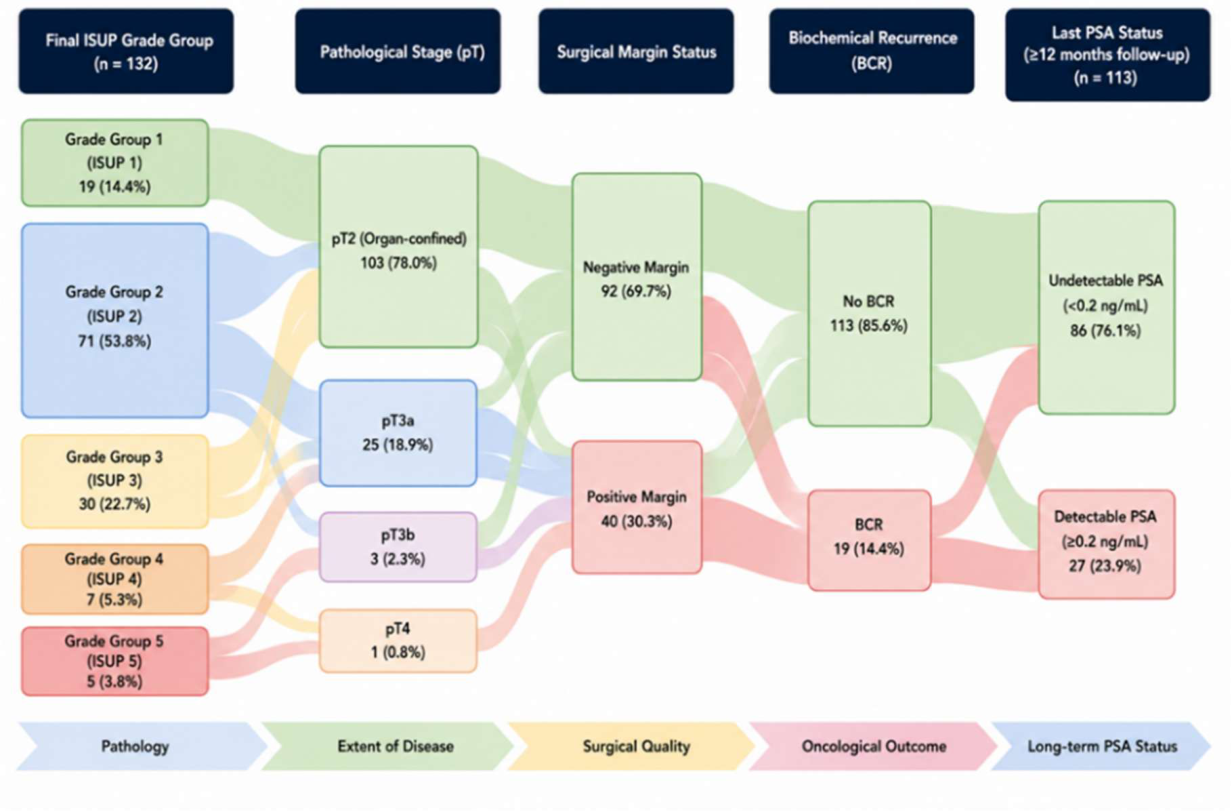

Table 1.
Baseline demographic and preoperative characteristics.
| Variable | n=132 |
|---|---|
| Age, years | 62.0 (57.0–66.0) |
| BMI, kg/m² | 26.4 (24.9–28.1) |
| Charlson Comorbidity Index | 1.0 (0.0–1.2) |
| Diabetes mellitus | 15 (11.4) |
| Hypertension | 50 (37.9) |
| Coronary artery disease | 19 (14.4) |
| PSA, ng/mL | 6.45 (4.72–10.15) |
| Positive biopsy cores | 3.5 (2.0–5.0) |
| ISUP Grade Group ≥3 | 28 (21.4) |
| Clinical stage ≥cT3 | x (%) |
| EAU low risk | x (%) |
| EAU intermediate risk | x (%) |
| EAU high risk | x (%) |
Table 2.
Perioperative Outcomes Following Retzius-Sparing Robot-Assisted Radical Prostatectomy.
| Variable | Overall (n = 132) |
|---|---|
| Surgery time (skin-to-skin), min | 170.0 (160.0–200.0) |
| Console time for prostatectomy, min | 100.0 (90.0–112.5) |
| Total console time, min | 107.5 (90.0–120.0) |
| Estimated blood loss, mL | 100.0 (70.0–150.0) |
| Total lymph nodes removed* | 0.0 (0.0–0.0) |
| Abdominal drain placement | 132 (100.0%) |
| Urinary drain placement | 0 (0.0%) |
| Blood transfusion | 1 (0.8%) |
| Catheter removal, postoperative day | 12.0 (10.0–14.0) |
| Overall perioperative complications | 4 (3.0%) |
| Clavien–Dindo grade I | 2 (1.5%) |
| Clavien–Dindo grade II | 1 (0.8%) |
| Clavien–Dindo grade ≥III | 0 (0.0%) |
Table 3.
Pathological Outcomes Following Retzius-Sparing Robot-Assisted Radical Prostatectomy.
| Variable | Overall (n = 132) |
|---|---|
| Prostate specimen weight, g | 52.0 (43.0–60.0) |
| Final ISUP Grade Group | |
| Grade Group 1 | 18 (13.7%) |
| Grade Group 2 | 85 (64.9%) |
| Grade Group 3 | 19 (14.5%) |
| Grade Group 4 | 4 (3.1%) |
| Grade Group 5 | 5 (3.8%) |
| Pathological T stage* | |
| pT code 1 | 59 (45.0%) |
| pT code 2 | 50 (38.2%) |
| pT code 3 | 22 (16.8%) |
| Positive surgical margins | 44 (33.6%)† |
| Capsular involvement | 70 (53.4%) |
| Seminal vesicle invasion | 17 (13.1%)‡ |
| Bladder neck invasion | 4 (3.1%) |
| Perineural invasion | 131 (100.0%) |
| Lymph node metastasis (pN-positive) | 21 (16.0%)§ |
Table 4.
Functional Outcomes Following Retzius-Sparing Robot-Assisted Radical Prostatectomy.
| Variable | Overall (n = 132) |
|---|---|
| Time to social continence (0–1 pad), days | 30.0 (15.0–56.3) |
| Time to complete continence (0 pad), days | 30.0 (15.0–90.0) |
| Current pad use | |
| 0 pad/day | 108 (82.4%) |
| 1 pad/day | 13 (9.9%) |
| ≥2 pads/day | 9 (6.9%) |
| Current continence status* | |
| Continence code 0 | 108 (82.4%) |
| Continence code 1 | 13 (9.9%) |
| Continence code 2 | 9 (6.9%) |
| Erectile rehabilitation performed | 117 (89.3%) |
| Current erectile function† | |
| Code 0 | 7 (5.3%) |
| Code 1 | 13 (9.9%) |
| Code 2 | 1 (0.8%) |
| Code 3 | 89 (67.9%) |
| Code 4 | 20 (15.3%) |
| Code 5 | 1 (0.8%) |
Table 5.
Oncological Outcomes Following Retzius-Sparing Robot-Assisted Radical Prostatectomy.
| Variable | Overall (n = 132) |
|---|---|
| Follow-up duration, months | 12.0 (IQR not shown*) |
| First postoperative PSA, ng/mL | 0.00 (0.00–0.03) |
| Last PSA, ng/mL | 0.00 (0.00–0.01) |
| Patients with undetectable last PSA (<0.2 ng/mL) | 131 (100.0%)† |
| Salvage therapy | 0 (0.0%) |
| PSA after salvage therapy | Not applicable |
| Biochemical recurrence | Not assessable‡ |
| Time to biochemical recurrence | Not assessable |
| Metastatic progression | Not available |
| Cancer-specific mortality | Not available |
| Overall mortality | Not available |
Disclaimer/Publisher’s Note: The statements, opinions and data contained in all publications are solely those of the individual author(s) and contributor(s) and not of MDPI and/or the editor(s). MDPI and/or the editor(s) disclaim responsibility for any injury to people or property resulting from any ideas, methods, instructions or products referred to in the content. |
© 2026 by the authors. Licensee MDPI, Basel, Switzerland. This article is an open access article distributed under the terms and conditions of the Creative Commons Attribution (CC BY) license.
Copyright: This open access article is published under a Creative Commons CC BY 4.0 license, which permit the free download, distribution, and reuse, provided that the author and preprint are cited in any reuse.