

Submitted:
13 August 2026
Posted:
17 August 2026
You are already at the latest version
Abstract
The extracellular signal-regulated kinase 1/2 (ERK1/2) cascade is a central effector of receptor tyrosine kinase-RAS-RAF-MEK signalling and a major therapeutic axis in oncology. Persistent ERK output supports cell-cycle progression, survival, invasion, angiogenesis and tumour-microenvironment remodelling, but pathway dependence is shaped by tumour lineage, driver class, co-mutations and feedback architecture. This narrative review uses a mechanism-first, lineage-specific framework to compare ERK-driven oncogenesis in melanoma, lung cancer and colorectal cancer and to explain why similar pathway alterations can produce different therapeutic responses. Resistance is organised into three interacting themes. Rapid adaptive resistance follows relief of negative feedback and receptor-RAS rebound. Acquired genetic resistance restores MAPK signalling through RAS activation, RAF dimerisation, BRAF amplification or splice variants, and MEK or ERK alterations. Tumours may also survive through parallel PI3K-AKT-mTOR signalling, lineage plasticity, drug-tolerant persister states and stromal support. The review further examines the context-dependent relationship between tumour-intrinsic ERK signalling, immune exclusion and T-cell function, which complicates combinations with immune checkpoint blockade. Clinical evidence supports BRAF-MEK combinations in molecularly selected cancers and combined BRAF-EGFR blockade in BRAF V600E colorectal cancer. RNA interference, CRISPR screening, single-cell and spatial profiling, and artificial-intelligence-assisted prediction are evaluated according to their translational maturity. The main conclusion is that durable ERK/MAPK control will require lineage-aware patient selection, longitudinal resistance monitoring, and mechanism-matched combination therapy rather than uniform pathway inhibition.
Keywords:
ERK/MAPK
; oncogenesis
; melanoma
; non-small-cell lung cancer
; colorectal cancer
; therapeutic resistance
; immunotherapy
; precision oncology
1. Introduction
The mitogen-activated protein kinase/extracellular signal-regulated kinase (MAPK/ERK) pathway converts extracellular growth signals into coordinated cytoplasmic and nuclear responses. In the canonical module, ligand-activated receptor tyrosine kinases (RTKs) recruit adaptor proteins and SOS, increase RAS-GTP loading, and activate RAF, MEK1/2 and ERK1/2. Activated ERK phosphorylates transcription factors, kinases and structural proteins that regulate proliferation, differentiation, survival, migration and stress responses. Pathway output is therefore determined not only by mutation status, but also by signal amplitude, duration, localisation and feedback regulation [1,2,3,4].
Aberrant ERK/MAPK signalling is frequent across human cancers. RAS mutations occur in approximately one fifth of cancers, BRAF alterations define clinically important molecular subsets, and amplified or ligand-driven RTKs may act as primary oncogenic inputs or routes of therapeutic escape [5,6]. However, the same nominal alteration can create different biological dependencies in different tissues. BRAF V600E, for example, produces strong ERK dependence in melanoma but triggers rapid EGFR-mediated pathway recovery in colorectal cancer. This context dependence limits the value of interpreting genotype or phospho-ERK expression in isolation [23,24,25].
Previous ERK/MAPK reviews have often emphasised canonical pathway biology, individual inhibitor classes or resistance mechanisms separately. The present review differs by integrating these areas through a mechanism-first and lineage-specific comparison. It links dynamic feedback control to tumour-cell state, immune regulation and clinically observed resistance, and evaluates emerging gene-based and computational strategies according to evidence maturity rather than technological novelty alone.
A central clinical challenge is achieving durable pathway control without unacceptable toxicity or rapid network adaptation. Tumours may restore ERK output through receptor rebound, RAS reactivation, RAF dimerisation and distal kinase alterations, or they may reduce their dependence on ERK through parallel survival pathways, lineage plasticity and microenvironmental support. This review therefore proceeds from canonical pathway regulation to general and lineage-specific oncogenesis, therapeutic positioning, resistance, immunotherapy interactions and emerging intervention strategies, with emphasis on how biological context should guide treatment selection.
2. Canonical Architecture and Dynamic Regulation of ERK Signalling
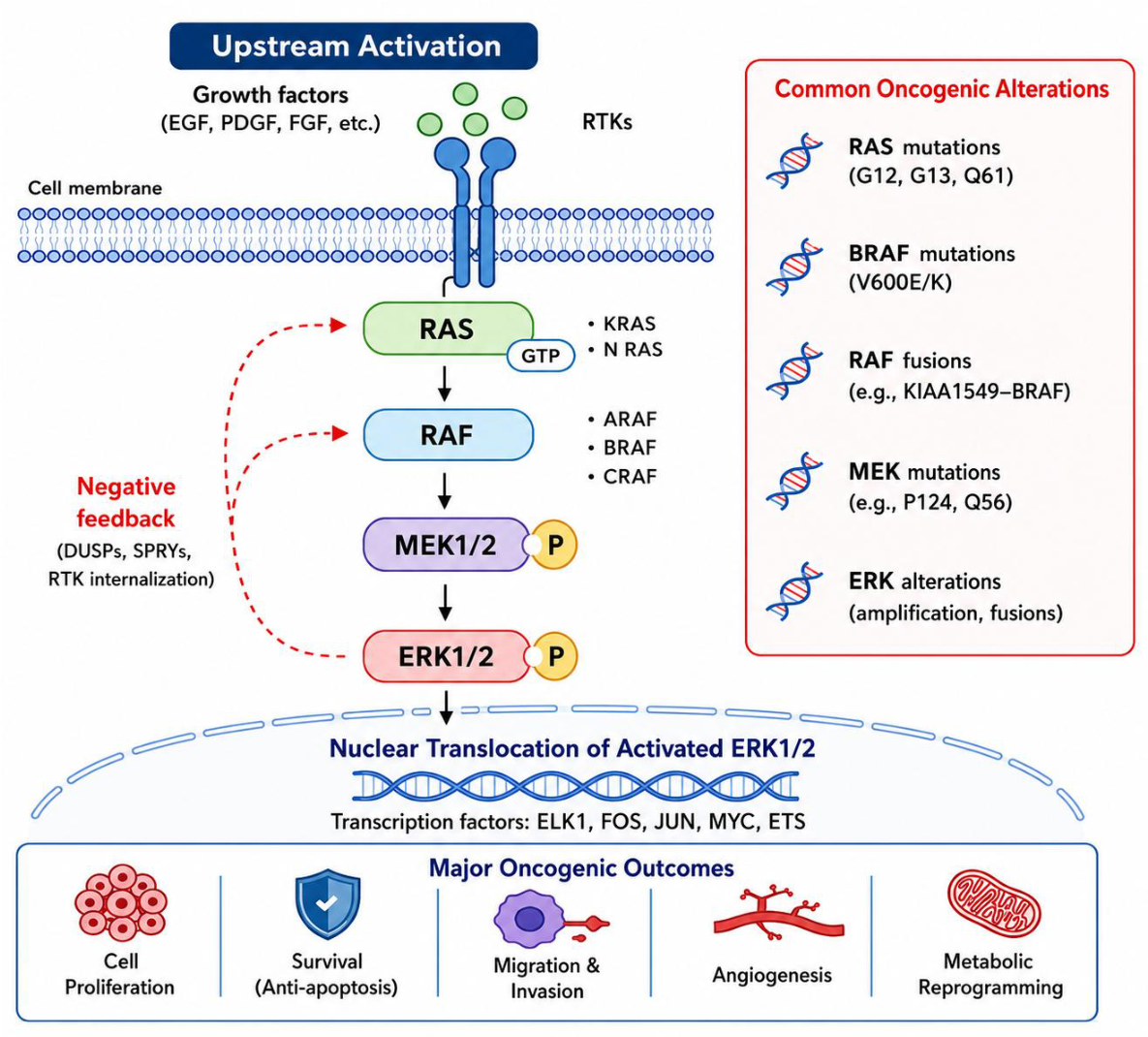
Canonical signalling begins at the plasma membrane. Activated RTKs create phosphotyrosine docking sites for GRB2 and associated adaptors, which recruit SOS and promote the exchange of GDP for GTP on RAS. RAS-GTP engages RAF proteins at the membrane and facilitates conformational activation and dimerisation. ARAF, BRAF and CRAF then phosphorylate MEK1/2; MEK1/2 are dual-specificity kinases that phosphorylate threonine and tyrosine residues within the ERK activation loop [2,4,9].
Pathway output depends on amplitude, duration, pulse frequency, subcellular localisation and scaffold composition. ERK-mediated negative feedback limits upstream signalling by phosphorylating receptors, SOS and RAF-associated components and by inducing dual-specificity phosphatases (DUSPs) and Sprouty proteins. These feedback loops improve homeostatic control in normal cells but also create a predictable vulnerability during treatment: when RAF, MEK or ERK activity falls, feedback is relieved and upstream signalling can rebound [3,10,11].
Figure 1.
The ERK/MAPK signalling cascade and major outputs in cancer. The figure summarises upstream growth-factor activation, RTK-mediated RAS-RAF-MEK-ERK signalling, representative oncogenic alterations, nuclear translocation of activated ERK1/2 and major downstream malignant phenotypes.
Figure 1.
The ERK/MAPK signalling cascade and major outputs in cancer. The figure summarises upstream growth-factor activation, RTK-mediated RAS-RAF-MEK-ERK signalling, representative oncogenic alterations, nuclear translocation of activated ERK1/2 and major downstream malignant phenotypes.
3. ERK Signalling in Oncogenesis
3.1. General Oncogenic Mechanisms
Oncogenic ERK signalling is best understood as a change in network behaviour rather than a simple increase in kinase activity. Activating RAS mutations impair GTP hydrolysis, BRAF V600E can signal as a RAS-independent active monomer, and class II or class III BRAF alterations differ in their dependence on RAF dimerisation and upstream RAS [5,6,9]. These distinctions are clinically important because similar phospho-ERK levels can arise from biologically different circuits and do not necessarily indicate equal dependence on MEK or ERK inhibition.
ERK coordinates transcription, cell-cycle progression and survival through overlapping substrate networks. Nuclear ERK activates ELK1, ETS and AP-1 programmes and supports MYC and cyclin D1-CDK4/6 activity, while cytoplasmic ERK-RSK signalling modifies apoptotic, translational and metabolic regulators. Recent phosphoproteomic work in KRAS-mutant models illustrates that ERK-dependent fitness is distributed across many substrates rather than controlled by a single output [57]. This creates a biomarker problem: phospho-ERK is a useful pathway snapshot, but substrate signatures, feedback-gene induction and functional dependence may better predict response. Prospective validation of such composite biomarkers remains limited.
Invasion, angiogenesis and microenvironmental remodelling are likewise coupled rather than independent outputs. ERK-regulated AP-1 and ETS programmes alter integrins, matrix metalloproteinases, cytoskeletal dynamics and secreted factors, while oncogenic BRAF can modify tumour-vascular crosstalk and pro-angiogenic signalling [7,10,69]. Nevertheless, these effects are not universal. Some tumours use vessel co-option, parallel PI3K-AKT signalling or stromal growth factors to maintain progression despite reduced ERK output. A critical question is therefore which phenotype is truly ERK-dependent in a given tumour, rather than whether ERK participates in that phenotype at all.
The proposed 'signalling window' adds a further layer of complexity: insufficient ERK output cannot sustain proliferation, whereas excessive or prolonged activation may trigger senescence, apoptosis or proteotoxic stress in selected contexts [12,13,14]. This concept supports interest in intermittent dosing and experimental ERK hyperactivation, but ERK agonism remains preclinical and should not be presented as an established therapeutic strategy. The clinically relevant issue is whether pathway depth, duration or scheduling can be optimised to suppress malignant fitness while limiting feedback recovery and normal-tissue toxicity.
3.2. ERK Activation in Melanoma
Cutaneous melanoma is one of the clearest examples of lineage-specific ERK dependence. Most tumours fall into BRAF-mutant, RAS-mutant, NF1-mutant or triple-wild-type genomic classes. BRAF V600 melanoma commonly signals through an active RAF monomer and can show marked initial sensitivity to BRAF-MEK inhibition, whereas NRAS-mutant and NF1-deficient melanomas rely more strongly on RAS-GTP and RAF dimers, creating additional routes for pathway restoration [6,9,16,17]. Driver class is therefore necessary but insufficient for predicting response because melanoma cells can alter their lineage state without changing the initiating mutation.
ERK signalling participates in a transcriptional and epigenetic circuit that regulates melanoma phenotype switching. MITF-high cells retain melanocytic differentiation and proliferative programmes, whereas MAPK inhibition or microenvironmental stress can activate c-JUN, extracellular-matrix, FAK/Src and inflammatory programmes that suppress melanocytic identity and favour neural-crest-like or undifferentiated states [18,19,62]. The reciprocal MITF-AXL relationship is not a single-switch mechanism: BRN2, NF-kappaB, AP-1 factors and microRNA-mediated regulation also shape AXL expression, and AXL-high cells may be low for both MITF and BRN2 [63]. Thus, ERK output interacts with lineage transcription factors and chromatin state rather than unidirectionally determining cell identity.
Clinically, phenotype switching provides a reservoir for persistence during BRAF-MEK therapy. Slowly cycling, dedifferentiated cells may survive the initial response, acquire additional genetic resistance and later repopulate recurrent disease. Drug withdrawal can reverse some adaptive states, whereas prolonged treatment may stabilise resistance through clonal selection, epigenetic remodelling or microenvironmental reinforcement [19,41,62]. This distinction matters because targeting a reversible persister state may require treatment during the minimal-residual-disease window, while established genetically resistant disease requires mechanism-matched pathway inhibition.
Single-cell studies have moved the field beyond a binary MITF-high/AXL-high model. Metastatic tumours contain melanocytic, transitory, neural-crest-like and undifferentiated populations within the same lesion, and recent single-cell analysis identified nonresponding cells across several states, with IL-6 and TNF-associated inflammatory signalling contributing to BRAF-MEK inhibitor resistance [18,19,64]. Important uncertainties remain: the degree to which state transitions are reversible in patients, whether treatment or pre-existing niches are the dominant driver, and which cell-state markers are stable enough for clinical selection. Longitudinal single-cell, spatial and circulating-DNA studies will be required before phenotype-directed combinations can be used routinely.
3.3. ERK Activation in Lung Cancer
Lung adenocarcinoma is heterogeneous at the pathway entry point. KRAS-mutant tumours generally signal through RAS-dependent RAF dimers and can maintain ERK output through multiple effector and feedback routes. EGFR-mutant tumours remain receptor-dependent and undergo rapid ERK suppression after effective EGFR inhibition, but MAPK1 amplification, loss of negative regulators, secondary RAS-RAF alterations or bypass RTKs can restore signalling [20,21,22,70]. BRAF V600E behaves as a class I monomeric driver, whereas non-V600 BRAF variants may be kinase-activating dimers, kinase-impaired RAS-dependent alleles or passenger events. These biological classes explain why a uniform 'MAPK-active NSCLC' category is not clinically useful.
Co-mutations further divide driver-defined disease into functionally distinct subgroups. In KRAS-mutant NSCLC, TP53, STK11 and KEAP1/NFE2L2 alterations are common and influence cell state, oxidative-stress adaptation, immune phenotype and treatment outcome. KEAP1/NFE2L2 co-alteration has been associated with shorter survival and reduced treatment benefit, while STK11 loss can identify an immune-cold subset; TP53 co-mutation may define a more inflamed but genomically unstable context [65]. These alterations do not simply add prognostic information. They can change whether ERK suppression induces apoptosis or merely shifts dependence toward metabolic and parallel survival pathways.
Intratumoral heterogeneity also limits durable control. Pre-existing MET-amplified, mesenchymal or hypoxic subclones can expand during EGFR-directed therapy, and differentiation state determines whether ERBB-family or FGFR signalling mediates rebound after MEK inhibition. ERK reactivation may therefore arise through genetically distinct mechanisms in different lesions of the same patient [70]. Single-site tissue sampling can miss this diversity, supporting combined use of tissue, circulating tumour DNA and, where feasible, longitudinal sampling.
Phospho-ERK is an imperfect predictive biomarker in NSCLC. In a large clinical cohort, higher phospho-ERK was associated with RAS activity and adverse outcome in univariate analysis, but it did not remain a strong independent prognostic factor after adjustment [66]. Its limitations include pre-analytical instability, spatial heterogeneity, transient feedback dynamics and failure to identify the upstream driver or parallel survival state. Patient selection should therefore integrate genotype, BRAF functional class, co-mutations and evidence of pathway suppression rather than relying on a single phospho-ERK measurement.
3.4. ERK Activation in Colorectal Cancer
Colorectal cancer commonly activates ERK through KRAS or NRAS mutations, BRAF V600E or receptor-driven RAS signalling, but the pathway operates within a network dominated by APC-WNT, TP53, TGF-beta and PI3K alterations. APC loss and beta-catenin activation maintain stem-like and crypt-proliferative programmes, while ERK supplies mitogenic transcription and cell-cycle progression. PI3K-AKT-mTOR signalling can preserve metabolism and survival when ERK is suppressed; TP53 loss reduces checkpoint and apoptotic responses; and TGF-beta signalling may restrain early epithelial growth but later promote stromal remodelling, invasion and immune suppression [23]. These interactions explain why ERK inhibition may reduce proliferation without producing durable tumour regression.
BRAF V600E colorectal cancer provides a clear example of lineage-specific feedback. In melanoma, low baseline EGFR expression permits strong suppression by BRAF inhibition. Colorectal epithelial cells retain substantial EGFR input, and BRAF inhibition relieves ERK-dependent feedback on EGFR, SOS, and RAS. The resulting RAS-GTP activates RAF dimers and restores MEK-ERK signalling despite continued inhibition of mutant BRAF [24,25]. Combined BRAF and EGFR blockade is therefore not simply an additive regimen; it is a mechanism-based strategy designed to prevent the dominant lineage-specific feedback response.
Resistance nevertheless develops because EGFR feedback is only the first layer of adaptation. Progression samples after BRAF-EGFR therapy have shown KRAS or NRAS mutations and amplification, BRAF amplification, MEK1 alterations, MET amplification, and PI3K-pathway changes [67,68]. Many of these lesions converge on renewed RAS-RAF dimer signalling, whereas MET or PI3K alterations provide bypass survival. Different resistant alterations may coexist across lesions, making a single post-progression biopsy an incomplete representation of the disease.
The therapeutic implication is that colorectal cancer requires vertical and adaptive pathway control. Baseline RAS/BRAF profiling identifies major primary resistance, while serial circulating tumour DNA may detect emergent RAS, BRAF or MEK alterations before radiological progression. However, the optimal response to each resistance pattern is not established, and broader combinations may be limited by toxicity. Future studies should prioritise mechanism-defined cohorts and pharmacodynamic evidence of sustained pathway suppression rather than adding inhibitors empirically.
Figure 2.
ERK signalling drives multiple oncogenic mechanisms. Sustained ERK1/2 activation promotes cell-cycle progression, survival, proliferative transcriptional programmes, invasion and metastasis, angiogenesis, and tumour-microenvironment remodelling and inflammation.
Figure 2.
ERK signalling drives multiple oncogenic mechanisms. Sustained ERK1/2 activation promotes cell-cycle progression, survival, proliferative transcriptional programmes, invasion and metastasis, angiogenesis, and tumour-microenvironment remodelling and inflammation.
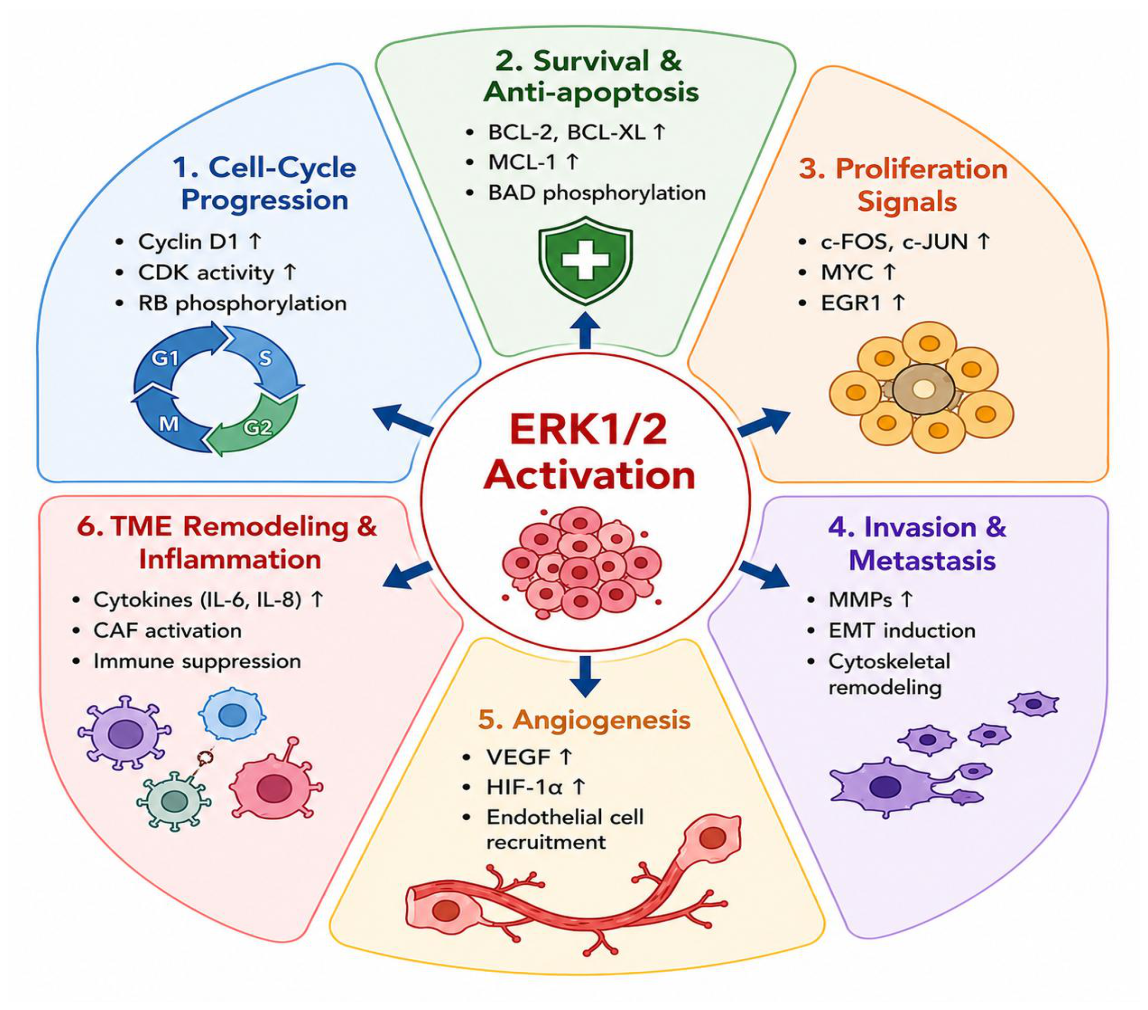

Table 1.
Mechanistic nodes linking ERK activation to oncogenic phenotypes.
| Node or process | Mechanistic event | Oncogenic consequence | Therapeutic implication | Reference (s) |
|---|---|---|---|---|
| RTK-GRB2-SOS-RAS | Ligand, receptor alteration or adaptor signalling increases RAS-GTP loading. | Persistent upstream input and reduced growth-factor dependence. | RTK, SHP2 or SOS1 inhibition may be relevant when signalling remains receptor-dependent. | [24,25,70] |
| RAF activation and dimerisation | RAS recruits RAF; BRAF V600E can signal as an active monomer, whereas other states depend on RAF dimers. | Sustained MEK and ERK phosphorylation. | Mutation class and dimer dependence should guide RAF-inhibitor selection. | [39,67] |
| MEK-ERK activation | MEK1/2 phosphorylate ERK1/2 on the TEY motif and generate a broad substrate programme. | Cytoplasmic and nuclear substrate phosphorylation. | MEK inhibitors are established in selected combinations; direct ERK inhibition remains investigational. | [42,57] |
| Transcription and cell cycle | ERK activates ETS, AP-1, ELK1 and MYC-linked programmes and supports cyclin D1-CDK4/6 activity. | G1-S progression, biosynthesis and reduced growth-factor dependence. | Composite ERK-output biomarkers may be more informative than phospho-ERK alone. | [57] |
| Survival and stress adaptation | ERK-RSK signalling modifies apoptotic regulators, translation and metabolic stress responses. | Higher apoptotic threshold and drug-tolerant survival. | Co-targeting requires a defined survival dependency and acceptable therapeutic index. | [57] |
| Invasion and microenvironment | ERK regulates matrix, cytoskeletal and secreted-factor programmes, including vascular and stromal signalling. | Motility, matrix remodelling, vascular support and non-cell-autonomous rescue. | Lineage- and microenvironment-specific combinations may be required. | [19,47,69] |
Abbreviations: RTK, receptor tyrosine kinase; GRB2, growth factor receptor-bound protein 2; SOS, Son of Sevenless; RAS, rat sarcoma small GTPase family; GTP, guanosine triphosphate; RAF, rapidly accelerated fibrosarcoma kinase family; BRAF, B-Raf proto-oncogene serine/threonine-protein kinase; MEK, mitogen-activated protein kinase kinase; ERK, extracellular signal-regulated kinase; TEY, threonine-glutamate-tyrosine; ETS, E26 transformation-specific; AP-1, activator protein 1; ELK1, ETS-like protein 1; MYC, MYC proto-oncogene; CDK4/6, cyclin-dependent kinases 4 and 6; RSK, ribosomal S6 kinase; SHP2, Src homology 2 domain-containing protein tyrosine phosphatase 2; SOS1, Son of Sevenless homolog 1.
Primary research evidence is listed in the Reference(s) column for each row. Table content is an author-created synthesis.
4. Therapeutic Targeting and Context-Specific Clinical Positioning
Robust clinical evidence for ERK/MAPK targeting comes from tumours with a validated pathway-dependent driver and a combination matched to lineage-specific biology. In BRAF V600-mutant melanoma, BRAF-MEK combinations improve response durability and overall survival compared with BRAF inhibitor monotherapy [28,29,30,31,32]. Their benefit reflects deeper pathway suppression and reduced paradoxical RAF activation, but they do not eliminate resistance.
Failure after BRAF-MEK therapy most often reflects renewed MAPK output or reduced dependence on the original driver. NRAS activation, BRAF amplification or splice variants, RAF dimerisation and MEK or ERK alterations can restore signalling, while dedifferentiated and drug-tolerant states may persist despite biochemical pathway suppression [39,40,41,42,62]. Clinically, this heterogeneity means that repeating a similar inhibitor combination after progression is unlikely to be durable unless molecular profiling identifies a targetable mechanism.
In BRAF V600E NSCLC, prospective studies support BRAF-MEK combinations, but the evidence base is smaller than in melanoma and treatment response is influenced by co-mutations, central nervous system disease and bypass signalling [20,21]. In BRAF V600E colorectal cancer, combined BRAF and EGFR inhibition is required because EGFR-RAS feedback rapidly restores MAPK signalling after BRAF inhibition. Randomised clinical data support this lineage-specific approach, including regimens that incorporate chemotherapy in the appropriate treatment setting [26,27,36].
Direct ERK inhibition is attractive because ERK lies downstream of many upstream reactivation events. Ulixertinib demonstrated pharmacodynamic inhibition and preliminary activity in MAPK-altered tumours, but normal-tissue toxicity, incomplete pathway suppression and ERK-level resistance limit the therapeutic index [38,42]. Direct ERK inhibitors should therefore remain framed as clinical-trial strategies rather than broadly applicable substitutes for established driver-matched therapy.
Patient selection remains a major weakness of current development programmes. Driver genotype alone does not capture BRAF class, RAF dimer dependence, dominant feedback receptor, co-mutations, tumour-cell state or parallel survival pathways. Phospho-ERK is dynamic and spatially heterogeneous, and its presence does not establish addiction. More informative selection strategies may combine genomic classification with circulating tumour DNA, ERK-regulated transcriptional or phosphoproteomic signatures and early on-treatment confirmation of pathway suppression [57,66]. These biomarkers require prospective validation and should be linked to predefined treatment decisions.
Regulatory status varies by jurisdiction and continues to change; current labels should be checked when translating evidence into practice [34,35,37]. Overall, optimal ERK-targeted therapy depends on tumour lineage, molecular context and the mechanism of resistance, not simply on the availability of a BRAF, MEK or ERK inhibitor.
Figure 3.
Tumour context determines ERK dependency and treatment selection. The schematic highlights how tumour lineage, co-occurring alterations and feedback wiring shape dependence on the ERK/MAPK pathway and influence inhibitor selection and combination strategies.
Figure 3.
Tumour context determines ERK dependency and treatment selection. The schematic highlights how tumour lineage, co-occurring alterations and feedback wiring shape dependence on the ERK/MAPK pathway and influence inhibitor selection and combination strategies.
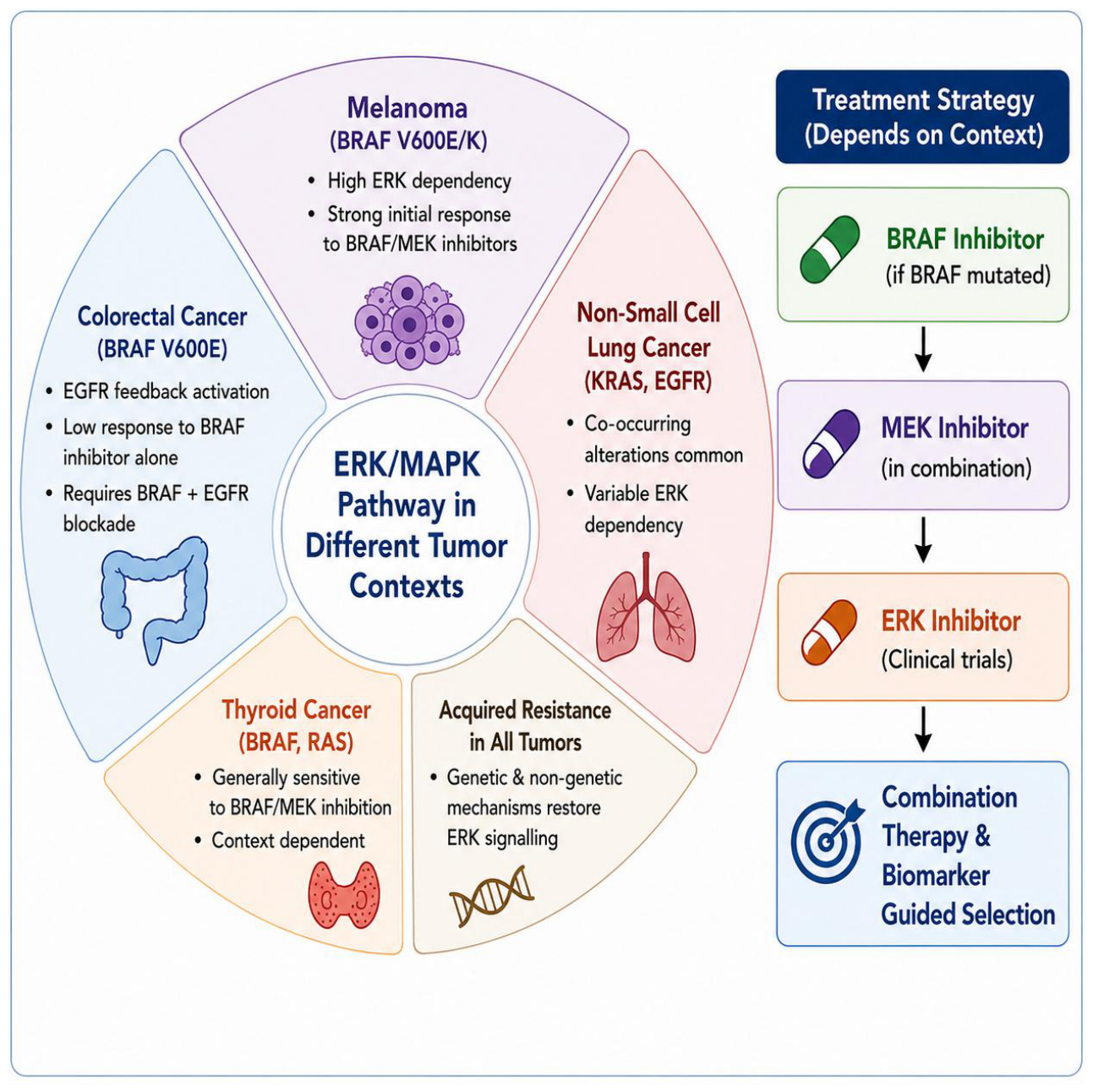
Table 2.
Clinical positioning of major ERK/MAPK-targeted strategies.
| Strategy | Representative regimen | Current position | Principal strengths | Principal limitations | Reference (s) |
|---|---|---|---|---|---|
| BRAF inhibitor monotherapy | Vemurafenib, dabrafenib or encorafenib alone | Largely superseded by combination therapy in BRAF V600-mutant melanoma. | Rapid initial pathway suppression in sensitive disease. | Early feedback recovery, acquired resistance and paradoxical MAPK activation. | [28,29] |
| BRAF plus MEK inhibition in melanoma | Dabrafenib-trametinib; encorafenib-binimetinib; vemurafenib-cobimetinib | Established option for BRAF V600-mutant advanced melanoma. | Improved efficacy and delayed resistance versus BRAF monotherapy. | Resistance remains common; toxicity and dosing differ among regimens. | [28,29,30,31,32] |
| BRAF V600E solid-tumour strategy | Dabrafenib-trametinib | Selected non-colorectal tumours may benefit when no satisfactory alternatives exist. | Driver-matched activity has been demonstrated across several tumour types. | Activity remains lineage-dependent, and evidence strength varies by tumour type. | [71,72] |
| BRAF V600E NSCLC | Dabrafenib-trametinib or encorafenib-binimetinib | Molecularly selected treatment option in metastatic disease. | Prospective activity in a rare driver-defined subgroup. | Single-arm evidence, co-mutations, CNS disease and acquired resistance. | [20,21] |
| BRAF V600E metastatic colorectal cancer | Encorafenib-cetuximab-based therapy, with context-appropriate chemotherapy | EGFR-containing regimens address dominant feedback reactivation. | Mechanistically aligned with colorectal lineage biology and supported by randomised trials. | MAPK reactivation, bypass signalling and aggressive disease biology remain limiting. | [26,27,36] |
| Direct ERK inhibition | Ulixertinib and other investigational ERK inhibitors | Clinical-trial strategy. | Targets the distal canonical kinase node downstream of several resistance routes. | Normal-tissue toxicity, incomplete pathway suppression and ERK-level resistance. | [38] |
Abbreviations: BRAF, B-Raf proto-oncogene serine/threonine-protein kinase; MEK, mitogen-activated protein kinase kinase; NSCLC, non-small-cell lung cancer; EGFR, epidermal growth factor receptor; MAPK, mitogen-activated protein kinase; ERK, extracellular signal-regulated kinase; CNS, central nervous system.
Primary clinical and mechanistic evidence is listed in the Reference(s) column for each row. Table content is an author-created synthesis.
5. Mechanisms of Resistance to ERK/MAPK-Targeted Therapy
Resistance is most useful clinically when organised by convergent mechanism rather than by an expanding list of individual alterations. Intrinsic resistance reflects pre-existing lineage, co-mutation, drug-exposure and microenvironmental features. Adaptive resistance develops rapidly after pathway inhibition, often without a new mutation. Acquired resistance emerges through selected genetic or stable cell-state changes. These categories overlap: an adaptive persister population can provide the substrate from which acquired resistance evolves [11,15].
The first major theme is restoration of upstream input and RAF dimer signalling. Suppression of ERK reduces DUSP and Sprouty feedback and releases inhibition of RTKs, SOS and RAS. The dominant receptor is lineage-specific: EGFR is central in BRAF V600E colorectal cancer, whereas PDGFR, IGF1R, MET, FGFR and HER-family receptors can operate in melanoma or lung cancer. Increased RAS-GTP promotes RAF dimers that are incompletely inhibited by first-generation BRAF inhibitors [16,24,25,67,70]. This theme explains why vertical combinations must target the relevant receptor or RAS-loading node rather than adding a second MAPK inhibitor empirically.
The second theme is genetic reactivation within the MAPK cascade. BRAF amplification, aberrant BRAF splicing, RAS mutations or amplification, MEK alterations, ERK mutations and ERK2 amplification can restore signalling at different levels [39,40,41,42,67,68]. Patient-derived progression samples show that MAPK reactivation is common, but no single lesion dominates across all tumour types. The practical implication is that repeat molecular profiling should distinguish monomeric BRAF dependence, RAS-RAF dimer signalling and distal kinase resistance because these states require different investigational strategies.
The third theme is survival without full ERK restoration. PI3K-AKT-mTOR, YAP/TAZ, JAK-STAT, WNT and AXL-associated programmes can maintain metabolism and apoptotic resistance, while dedifferentiation, epithelial-mesenchymal transition-like states and slowly cycling persisters reduce dependence on the original driver. Stromal HGF or FGF, inflammatory cytokines, hypoxia and inadequate drug penetration provide additional non-cell-autonomous rescue [15,19,62]. These mechanisms frequently coexist, so low phospho-ERK at progression does not prove effective therapy and does not identify the dominant survival pathway.
A central unresolved challenge is prioritisation. MAPK-reactivating alterations are among the most directly actionable resistance mechanisms, but broader co-targeting can narrow the therapeutic index. Cell-state and microenvironmental mechanisms are biologically important yet lack validated clinical biomarkers. Serial circulating tumour DNA can identify emerging genetic clones, but it may not capture epigenetic states or local stromal protection. Future trials should therefore pair longitudinal molecular sampling with pharmacodynamic measurements and prespecified mechanism-matched treatment arms. Figure 4 and Table 3 summarise this integrated framework.
Primary mechanistic evidence is listed in the Reference(s) column for each row. Table content is an author-created synthesis.
6. ERK Signalling and Cancer Immunotherapy
The ERK pathway has a dual and cell-type-specific relationship with antitumour immunity. Tumour-cell ERK activity can contribute to immune evasion, whereas ERK signalling is required within T cells for activation, proliferation and effector function. The net effect of pathway inhibition therefore depends on tumour genotype, inhibitor selectivity, dose, schedule and the immune-cell populations exposed [43,44,45,46].
6.1. Tumour-Intrinsic ERK Signalling and T-Cell Exclusion
Constitutive tumour-cell ERK signalling can reduce immune surveillance by lowering melanocytic-antigen and antigen-presentation programmes, increasing VEGF and inflammatory mediators, and supporting myeloid, fibroblast and vascular states that restrict T-cell access [43,44,47]. However, T-cell exclusion is multifactorial. WNT-beta-catenin signalling, interferon-response defects, myeloid recruitment, abnormal vasculature, stromal barriers and tumour-cell dedifferentiation may act independently of or together with ERK. ERK activation should therefore be described as one contributor to an immune-excluded ecosystem rather than a sufficient cause.
The clinical relevance is that effective tumour-selective MAPK suppression may transiently improve antigen expression and CD8-positive T-cell infiltration, creating a rationale for combination with immune checkpoint blockade. Serial melanoma biopsies and preclinical models support this early immune-sensitising effect [43,44]. Yet the benefit can be lost when MAPK signalling reactivates or when dedifferentiated persister states emerge, suggesting that timing and depth of tumour-cell pathway control may be as important as baseline mutation status.
6.2. Immune Consequences of ERK/MAPK Inhibition
BRAF, MEK and ERK inhibitors should not be assumed to have equivalent immune effects. BRAF V600 inhibitors are relatively selective for mutant tumour cells and may improve tumour antigenicity while sparing wild-type immune cells. MEK and ERK inhibitors act further downstream and can suppress T-cell proliferation, cytokine production and dendritic-cell function when exposure is sustained [45,46]. Conversely, some preclinical models show that carefully dosed MEK inhibition can reduce tumour-mediated suppression and cooperate with PD-L1 blockade. These apparently conflicting findings reflect differences in tumour type, inhibitor, schedule, exposure and immune context.
For clinical combination design, intermittent or lead-in schedules may offer a better balance than continuous maximal suppression, but this has not been established across cancers. The key translational question is not whether MAPK inhibition is immunostimulatory or immunosuppressive in general, but whether a specific regimen suppresses tumour-intrinsic ERK long enough to improve immune recognition while preserving systemic T-cell function.
6.3. Therapeutic Implications for Checkpoint Blockade
Clinical combinations face three linked challenges: patient selection, sequencing and toxicity. The IMspire150 trial provided proof of concept for adding atezolizumab to vemurafenib-cobimetinib in BRAF V600 melanoma, but triplet therapy increases treatment complexity and has not defined a universal strategy for all patients [48]. Patients needing rapid tumour control may benefit from targeted therapy, whereas those with durable immune responsiveness may not require continuous triplet treatment. Hepatic, cutaneous, gastrointestinal and systemic inflammatory toxicities can also make concurrent therapy difficult to sustain.
Biomarker studies should be designed to support specific decisions. Early circulating tumour DNA clearance and sustained suppression of ERK-output genes could identify effective tumour control; restoration of antigen-presentation programmes and spatial movement of CD8 T cells into tumour nests could support immune sensitisation; and interferon-gamma, myeloid and cell-state signatures could indicate whether checkpoint blockade is likely to add benefit. These markers should be measured longitudinally and linked to concurrent, lead-in or sequential strategies rather than listed as exploratory correlates without a decision framework.
7. Emerging Nucleic-Acid and Genome-Engineering Strategies
Gene-based approaches differ substantially in clinical readiness and should be evaluated by the problem they can realistically solve. Functional CRISPR screening is already a mature discovery tool; RNA interference provides reversible transcript suppression but remains delivery-limited; direct genome editing of disseminated solid tumours is substantially less mature. Treating these platforms as a single therapeutic category risks overstating their near-term clinical relevance [49,50,51].
The most credible near-term use is targeting discovery. Genome-scale CRISPR screens can identify resistance genes, synthetic-lethal partners and context-specific dependencies under BRAF, MEK or ERK inhibition. The GeCKO platform and melanoma-focused screens demonstrate this value, but screen hits require validation in patient-derived models, confirmation that the target is druggable and evidence that normal tissues can tolerate inhibition [49,52]. Thus, CRISPR screening is more likely to improve combination selection than to become a direct treatment for ERK-driven cancer in the immediate future.
RNA interference is closer to therapeutic translation because it is reversible and can be directed against mutant transcripts or adaptive signalling nodes. KRAS-directed siRNA studies in pancreatic cancer establish proof of principle for local or vesicle-mediated delivery, but they do not demonstrate broad systemic control of heterogeneous ERK/MAPK-driven tumours [53,54]. For melanoma, lung cancer or colorectal cancer, clinical relevance will depend on tumour-selective delivery, adequate intratumoural coverage, repeat dosing and the ability to suppress both dominant and emergent clones.
Direct CRISPR knockout, base editing and prime editing face a higher translational threshold. Editing must reach a large fraction of tumour cells, avoid normal tissues and minimise off-target changes, immune responses and DNA-damage effects. Incomplete editing may intensify selection for unedited resistant clones. These limitations are particularly important in metastatic disease, where anatomical distribution and intratumoural heterogeneity are major barriers. Direct editing of ERK/MAPK drivers should therefore be framed as a longer-term hypothesis rather than a near-term alternative to approved targeted therapy.
Targeted delivery remains a primary rate-limiting barrier across platforms. Viral vectors provide efficient transfer but have payload, immunogenicity and repeat-dosing constraints. Lipid and polymeric nanoparticles offer transient and modular delivery, and targeted lipid nanoparticles have achieved genome editing in preclinical tumour models [55,56]. The most realistic translational priorities are therefore: validated CRISPR screens for resistance dependencies; allele- or driver-directed RNA silencing in anatomically and genetically defined tumours; and nanoparticle co-delivery studies with clear pharmacokinetic, biodistribution and safety endpoints. Figure 5 and Table 4 summarise this maturity hierarchy.
Primary research evidence is listed in the Reference(s) column for each row. Table content is an author-created synthesis.
Table 5 is retained at the end of the emerging-strategies section because it integrates the clinical and translational evidence reviewed across the manuscript and provides a bridge to the future-priorities discussion.
Primary clinical and translational evidence is listed in the Reference(s) column for each row. Table content is an author-created synthesis.
8. Future Perspectives
The highest-priority near-term goal is not development of another broadly applied pathway inhibitor, but validation of biomarkers that identify the dominant ERK circuit and show whether it has been durably suppressed. Baseline profiling should define driver class, co-mutations and likely feedback receptors. Early on-treatment tissue or circulating tumour DNA should test target engagement and clonal response, and progression sampling should distinguish MAPK reactivation from bypass survival or cell-state change. Composite ERK-output signatures, rather than a single phospho-ERK stain, deserve prospective evaluation [3,10,57].
Single-cell, spatial and multi-omic methods can reveal persister populations and stromal niches hidden by bulk analysis, but their clinical value will depend on reproducible assays, sampling feasibility and predefined treatment decisions [18,19,64]. Artificial-intelligence models may help integrate genomic, pathology, imaging and longitudinal data, yet near-term use should remain decision support with external validation, calibration and transparent feature attribution [58,59]. Direct genome editing and fully autonomous treatment selection are longer-term hypotheses and should be clearly separated from realistic priorities such as resistance monitoring, RNA-delivery optimisation and mechanism-matched clinical trials.
Clinical implementation is the third priority. Precision ERK/MAPK therapy requires timely molecular testing, access to matched drugs and the capacity to repeat profiling at progression. These requirements may be difficult in resource-constrained settings and should be addressed within implementation studies rather than treated as a separate biological theme [60,61]. The field will advance most effectively through trials that integrate molecular selection, pharmacodynamic confirmation and longitudinal resistance analysis within the same protocol.
9. Conclusion
ERK/MAPK signalling is a central oncogenic driver, but pathway dependence is not defined by ERK activation alone. Melanoma, lung cancer and colorectal cancer demonstrate that driver class, lineage-specific receptor feedback, co-mutations, tumour-cell state and microenvironmental support determine whether pathway inhibition produces apoptosis, temporary arrest or rapid adaptive recovery.
The clinical success of BRAF-MEK combinations and BRAF-EGFR blockade shows the value of matching therapy to biological context. Their eventual failure also shows the limits of static treatment selection. Resistance commonly converges on restored RAS-RAF-MEK-ERK signalling, but parallel survival pathways, persister states and stromal rescue can sustain disease without complete pathway reactivation. Durable control will therefore require repeat molecular assessment and mechanism-matched combinations rather than uniform escalation of pathway inhibition.
Emerging CRISPR screens, RNA-based therapeutics, single-cell and spatial profiling, and computational prediction can strengthen target discovery and resistance monitoring, but their maturity differs substantially. The most defensible near-term strategy is lineage-aware patient selection, early confirmation of pathway suppression and longitudinal detection of resistance, supported by prospectively validated biomarkers. This mechanism-first approach offers the clearest route to improving the durability and precision of ERK/MAPK-targeted cancer therapy.
Author Contributions
IJ contributed to the conceptualization, literature review, data collection, analysis and interpretation, manuscript preparation, critical revision, and overall supervision of the work. MMA contributed to the literature review, data collection, manuscript writing, editing, and revision. Both authors reviewed and approved the final version of the manuscript and agreed to be accountable for the work.
Funding
No specific funding was received for this work.
Ethics approval and consent to participate
Not applicable.
Figure statement
Figures 1–5 are original author-created schematics developed for this review.
Conflicts of interest
The author declared that there is no conflict of interest related
Conflicts of interest
The author declared that there is no conflict of interest related to this study.
References
- Morrison, D.K. MAP kinase pathways. Cold Spring Harb. Perspect. Biol. 2012, 4(11), a011254. [Google Scholar] [CrossRef] [PubMed]
- McKay, M.M.; Morrison, D.K. Integrating signals from RTKs to ERK/MAPK. Oncogene 2007, 26(22), 3113–3121. [Google Scholar] [CrossRef] [PubMed]
- Shaul, Y.D.; Seger, R. The MEK/ERK cascade: from signaling specificity to diverse functions. Biochim Biophys. Acta 2007, 1773(8), 1213–1226. [Google Scholar] [CrossRef] [PubMed]
- Roskoski, R., Jr. ERK1/2 MAP kinases: structure, function, and regulation. Pharmacol. Res. 2012, 66(2), 105–143. [Google Scholar] [CrossRef] [PubMed]
- Prior, I.A.; Hood, F.E.; Hartley, J.L. The frequency of Ras mutations in cancer. Cancer Res. 2020, 80(14), 2969–2974. [Google Scholar] [CrossRef] [PubMed]
- Davies, H.; Bignell, G.R.; Cox, C.; et al. Mutations of the BRAF gene in human cancer. Nature 2002, 417(6892), 949–954. [Google Scholar] [CrossRef] [PubMed]
- Guo, Y.J.; Pan, W.W.; Liu, S.B.; Shen, Z.F.; Xu, Y.; Hu, L.L. ERK/MAPK signalling pathway and tumorigenesis. Exp. Ther. Med. 2020, 19(3), 1997–2007. [Google Scholar] [CrossRef] [PubMed]
- Jahan, I.; Karmakar, P.; Islam, G.T.; Rahman, M.S. The MAPK/ERK signaling axis in cancer development and pain modulation: a comprehensive review. TAJ J. 2026, 39(1), 312–320. [Google Scholar] [CrossRef]
- Lavoie, H.; Therrien, M. Regulation of RAF protein kinases in ERK signalling. Nat. Rev. Mol. Cell Biol. 2015, 16(5), 281–298. [Google Scholar] [CrossRef] [PubMed]
- Eblen, S.T. Extracellular-regulated kinases: signaling from Ras to ERK substrates to control biological outcomes. Adv. Cancer Res. 2018, 138, 99–142. [Google Scholar] [CrossRef] [PubMed]
- Lito, P.; Rosen, N.; Solit, D.B. Tumor adaptation and resistance to RAF inhibitors. Nat. Med. 2013, 19(11), 1401–1409. [Google Scholar] [CrossRef] [PubMed]
- Timofeev, O.; Giron, P.; Lawo, S.; Pichler, M.; Noeparast, M. ERK pathway agonism for cancer therapy: evidence, insights, and a target discovery framework. npj Precis Oncol. 2024, 8(1), 70. [Google Scholar] [CrossRef] [PubMed]
- Cagnol, S.; Chambard, J.C. ERK and cell death: mechanisms of ERK-induced cell death, apoptosis, autophagy and senescence. FEBS J. 2010, 277(1), 2–21. [Google Scholar] [CrossRef] [PubMed]
- Wu, P.K.; Becker, A.; Park, J.I. Growth inhibitory signaling of the Raf/MEK/ERK pathway. Int. J. Mol. Sci. 2020, 21(15), 5436. [Google Scholar] [CrossRef] [PubMed]
- Kakadia, S.; Yarlagadda, N.; Awad, R.; et al. Mechanisms of resistance to BRAF and MEK inhibitors and clinical update of US Food and Drug Administration-approved targeted therapy in advanced melanoma. Onco Targets Ther. 2018, 11, 7095–7107. [Google Scholar] [CrossRef] [PubMed]
- Nazarian, R.; Shi, H.; Wang, Q.; et al. Melanomas acquire resistance to B-RAF(V600E) inhibition by RTK or N-RAS upregulation. Nature 2010, 468(7326), 973–977. [Google Scholar] [CrossRef] [PubMed]
- Network, Cancer Genome Atlas. Genomic Classification of Cutaneous Melanoma. Cell 2015, 161(7), 1681–1696. [Google Scholar] [CrossRef] [PubMed]
- Tirosh, I.; Izar, B.; Prakadan, S.M.; et al. Dissecting the multicellular ecosystem of metastatic melanoma by single-cell RNA-seq. Science 2016, 352(6282), 189–196. [Google Scholar] [CrossRef] [PubMed]
- Rambow, F.; Rogiers, A.; Marin-Bejar, O.; et al. Toward minimal residual disease-directed therapy in melanoma. Cell 2018, 174(4), 843–855.e19. [Google Scholar] [CrossRef] [PubMed]
- Planchard, D.; Smit, E.F.; Groen, H.J.M.; et al. Dabrafenib plus trametinib in patients with previously untreated BRAF(V600E)-mutant metastatic non-small-cell lung cancer: an open-label, phase 2 trial. Lancet Oncol. 2017, 18(10), 1307–1316. [Google Scholar] [CrossRef] [PubMed]
- Riely, G.J.; Smit, E.F.; Ahn, M.J.; et al. Phase II, open-label study of encorafenib plus binimetinib in patients with BRAF V600-mutant metastatic non-small-cell lung cancer. J. Clin. Oncol. 2023, 41(21), 3700–3711. [Google Scholar] [CrossRef] [PubMed]
- Cancer Genome Atlas Research Network. Comprehensive molecular profiling of lung adenocarcinoma. Nature 2014, 511(7511), 543–550. [Google Scholar] [CrossRef] [PubMed]
- Cancer Genome Atlas Network. Comprehensive molecular characterization of human colon and rectal cancer. Nature 2012, 487(7407), 330–337. [Google Scholar] [CrossRef] [PubMed]
- Prahallad, A.; Sun, C.; Huang, S.; et al. Unresponsiveness of colon cancer to BRAF(V600E) inhibition through feedback activation of EGFR. Nature 2012, 483(7387), 100–103. [Google Scholar] [CrossRef] [PubMed]
- Corcoran, R.B.; Ebi, H.; Turke, A.B.; et al. EGFR-mediated re-activation of MAPK signaling contributes to insensitivity of BRAF-mutant colorectal cancers to RAF inhibition with vemurafenib. Cancer Discov. 2012, 2(3), 227–235. [Google Scholar] [CrossRef] [PubMed]
- Kopetz, S.; Grothey, A.; Yaeger, R.; et al. Encorafenib, binimetinib, and cetuximab in BRAF V600E-mutated colorectal cancer. N Engl. J. Med. 2019, 381(17), 1632–1643. [Google Scholar] [CrossRef] [PubMed]
- Tabernero, J.; Grothey, A.; Van Cutsem, E.; et al. Encorafenib plus cetuximab as a new standard of care for previously treated BRAF V600E-mutant metastatic colorectal cancer: updated survival results and subgroup analyses from the BEACON study. J. Clin. Oncol. 2021, 39(4), 273–284. [Google Scholar] [CrossRef] [PubMed]
- Robert, C.; Karaszewska, B.; Schachter, J.; et al. Improved overall survival in melanoma with combined dabrafenib and trametinib. N Engl. J. Med. 2015, 372(1), 30–39. [Google Scholar] [CrossRef] [PubMed]
- Robert, C.; Grob, J.J.; Stroyakovskiy, D.; et al. Five-year outcomes with dabrafenib plus trametinib in metastatic melanoma. N Engl. J. Med. 2019, 381(7), 626–636. [Google Scholar] [CrossRef] [PubMed]
- Dummer, R.; Ascierto, P.A.; Gogas, H.J.; et al. Encorafenib plus binimetinib versus vemurafenib or encorafenib in patients with BRAF-mutant melanoma (COLUMBUS): a multicentre, open-label, randomised phase 3 trial. Lancet Oncol. 2018, 19(5), 603–615. [Google Scholar] [CrossRef] [PubMed]
- Dummer, R.; Flaherty, K.T.; Robert, C.; et al. COLUMBUS 5-year update: a randomized, open-label, phase III trial of encorafenib plus binimetinib versus vemurafenib or encorafenib in patients with BRAF V600-mutant melanoma. J. Clin. Oncol. 2022, 40(36), 4178–4188. [Google Scholar] [CrossRef] [PubMed]
- Ascierto, P.A.; Dréno, B.; Larkin, J.; et al. 5-year outcomes with cobimetinib plus vemurafenib in BRAF V600 mutation-positive advanced melanoma: extended follow-up of the coBRIM study. Clin. Cancer Res. 2021, 27(19), 5225–5235. [Google Scholar] [CrossRef] [PubMed]
- Garutti, M.; Bergnach, M.; Polesel, J.; Palmero, L.; Pizzichetta, M.A.; Puglisi, F. BRAF and MEK inhibitors and their toxicities: a meta-analysis. Cancers 2023, 15(1), 141. [Google Scholar] [CrossRef] [PubMed]
- US Food and Drug Administration. FDA D.I.S.C.O. Burst Edition: FDA approval of Tafinlar (dabrafenib) in combination with Mekinist (trametinib) for BRAF V600E-positive solid tumors. Published July 25, 2022. Available online: https://www.fda.gov/drugs/resources-information-approved-drugs/fda-disco-burst-edition-fda-approval-tafinlar-dabrafenib-combination-mekinist-trametinib (accessed on 7 July 2026).
- US Food and Drug Administration. FDA approves encorafenib with binimetinib for metastatic non-small cell lung cancer with a BRAF V600E mutation. 11 October 2023. Available online: https://www.fda.gov/drugs/resources-information-approved-drugs/fda-approves-encorafenib-binimetinib-metastatic-non-small-cell-lung-cancer-braf-v600e-mutation (accessed on 7 July 2026).
- Kopetz, S.; Yoshino, T.; Van Cutsem, E.; et al. Encorafenib, cetuximab and chemotherapy in BRAF-mutant colorectal cancer: a randomized phase 3 trial. Nat. Med. 2025, 31(3), 901–908. [Google Scholar] [CrossRef] [PubMed]
- US Food and Drug Administration. FDA grants traditional approval to encorafenib for metastatic colorectal cancer with a BRAF V600E mutation. 24 February 2026. Available online: https://www.fda.gov/drugs/resources-information-approved-drugs/fda-grants-traditional-approval-encorafenib-metastatic-colorectal-cancer-braf-v600e-mutation (accessed on 7 July 2026).
- Sullivan, R.J.; Infante, J.R.; Janku, F.; et al. First-in-class ERK1/2 inhibitor ulixertinib (BVD-523) in patients with MAPK-mutant advanced solid tumors: results of a phase I dose-escalation and expansion study. Cancer Discov. 2018, 8(2), 184–195. [Google Scholar] [CrossRef] [PubMed]
- Poulikakos, P.I.; Persaud, Y.; Janakiraman, M.; et al. RAF inhibitor resistance is mediated by dimerization of aberrantly spliced BRAF(V600E). Nature 2011, 480(7377), 387–390. [Google Scholar] [CrossRef] [PubMed]
- Corcoran, R.B.; Dias-Santagata, D.; Bergethon, K.; et al. BRAF gene amplification can promote acquired resistance to MEK inhibitors in cancer cells harboring the BRAF V600E mutation. Sci. Signal. 2010, 3(149), ra84. [Google Scholar] [CrossRef] [PubMed]
- Shi, H.; Hugo, W.; Kong, X.; et al. Acquired resistance and clonal evolution in melanoma during BRAF inhibitor therapy. Cancer Discov. 2014, 4(1), 80–93. [Google Scholar] [CrossRef] [PubMed]
- Jaiswal, B.S.; Durinck, S.; Stawiski, E.W.; et al. ERK mutations and amplification confer resistance to mitogen-activated protein kinase pathway inhibitors. Clin. Cancer Res. 2018, 24(16), 4044–4055. [Google Scholar] [CrossRef] [PubMed]
- Frederick, D.T.; Piris, A.; Cogdill, A.P.; et al. BRAF inhibition is associated with enhanced melanoma antigen expression and a more favorable tumor microenvironment in patients with metastatic melanoma. Clin. Cancer Res. 2013, 19(5), 1225–1231. [Google Scholar] [CrossRef] [PubMed]
- Liu, C.; Peng, W.; Xu, C.; et al. BRAF inhibition increases tumor infiltration by T cells and enhances the antitumor activity of adoptive immunotherapy in mice. Clin. Cancer Res. 2013, 19(2), 393–403. [Google Scholar] [CrossRef] [PubMed]
- Ebert, P.J.R.; Cheung, J.; Yang, Y.; et al. MAP kinase inhibition promotes T cell and anti-tumor activity in combination with PD-L1 checkpoint blockade. Immunity 2016, 44(3), 609–621. [Google Scholar] [CrossRef] [PubMed]
- Vella, L.J.; Pasam, A.; Dimopoulos, N.; Andrews, M.; Knights, A.; Puaux, A.L.; et al. MEK inhibition, alone or in combination with BRAF inhibition, affects multiple functions of isolated normal human lymphocytes and dendritic cells. Cancer Immunol. Res. 2014, 2(4), 351–360. [Google Scholar] [CrossRef] [PubMed]
- Jerby-Arnon, L.; Shah, P.; Cuoco, M.S.; et al. A cancer cell program promotes T cell exclusion and resistance to checkpoint blockade. Cell 2018, 175(4), 984–997.e24. [Google Scholar] [CrossRef] [PubMed]
- Gutzmer, R.; Stroyakovskiy, D.; Gogas, H.; et al. Atezolizumab, vemurafenib, and cobimetinib as first-line treatment for unresectable advanced BRAF V600 mutation-positive melanoma (IMspire150): primary analysis of the randomised, double-blind, placebo-controlled, phase 3 trial. Lancet 2020, 395(10240), 1835–1844. [Google Scholar] [CrossRef] [PubMed]
- Shalem, O.; Sanjana, N.E.; Hartenian, E.; et al. Genome-scale CRISPR-Cas9 knockout screening in human cells. Science 2014, 343(6166), 84–87. [Google Scholar] [CrossRef] [PubMed]
- Pacesa, M.; Pelea, O.; Jinek, M. Past, present, and future of CRISPR genome editing technologies. Cell 2024, 187(5), 1076–1100. [Google Scholar] [CrossRef] [PubMed]
- Park, H.; Yu, S.; Koo, T. Gene editing in cancer therapy: overcoming drug resistance and enhancing precision medicine. Cancer Gene Ther. 2025, 32(12), 1293–1302. [Google Scholar] [CrossRef] [PubMed]
- Goh, C.J.H.; Wong, J.H.; El Farran, C.; et al. Identification of pathways modulating vemurafenib resistance in melanoma cells via a genome-wide CRISPR/Cas9 screen. G3 2021, 11(2), jkaa069. [Google Scholar] [CrossRef] [PubMed]
- Golan, T.; Khvalevsky, E.Z.; Hubert, A.; et al. RNAi therapy targeting KRAS in combination with chemotherapy for locally advanced pancreatic cancer patients. Oncotarget 2015, 6(27), 24560–24570. [Google Scholar] [CrossRef] [PubMed]
- Kamerkar, S.; LeBleu, V.S.; Sugimoto, H.; et al. Exosomes facilitate therapeutic targeting of oncogenic KRAS in pancreatic cancer. Nature 2017, 546(7659), 498–503. [Google Scholar] [CrossRef] [PubMed]
- Rosenblum, D.; Gutkin, A.; Kedmi, R.; et al. CRISPR-Cas9 genome editing using targeted lipid nanoparticles for cancer therapy. Sci. Adv. 2020, 6(47), eabc9450. [Google Scholar] [CrossRef] [PubMed]
- Xu, X.; Liu, C.; Wang, Y.; et al. Nanotechnology-based delivery of CRISPR/Cas9 for cancer treatment. Adv. Drug Deliv. Rev. 2021, 176, 113891. [Google Scholar] [CrossRef] [PubMed]
- Klomp, J.E.; Diehl, J.N.; Klomp, J.A.; et al. Determining the ERK-regulated phosphoproteome driving KRAS-mutant cancer. Science 2024, 384(6700), eadk0850. [Google Scholar] [CrossRef] [PubMed]
- Kuenzi, B.M.; Park, J.; Fong, S.H.; et al. Predicting drug response and synergy using a deep learning model of human cancer cells. Cancer Cell 2020, 38(5), 672–684.e6. [Google Scholar] [CrossRef] [PubMed]
- Sinha, S.; Vegesna, R.; Mukherjee, S.; et al. PERCEPTION predicts patient response and resistance to treatment using single-cell transcriptomics of their tumors. Nat. Cancer 2024, 5(6), 938–952. [Google Scholar] [CrossRef] [PubMed]
- Asaduzzaman, M.; Habib, M.A.; Hossain, R.; Hanya, U.; Rahman, U. Precision medicine for gastric cancer: current status and future directions. J. Cancer Tumor Int. 2025, 15(4), 44–70. [Google Scholar] [CrossRef]
- Shakila, A.Z.; Afroz, M.S.; Habib, M.A.; Pasha, N.; Ahmed, N.; Jahan, N.S.; Pervin, S.T.; Mou, A.N. Delay in diagnosis and treatment of breast cancer among the patients attending a public and private hospital. Vasc. Endovasc. Rev. 2026, 9(1), 308–315. [Google Scholar]
- Fallahi-Sichani, M.; Becker, V.; Izar, B.; Baker, G.J.; Lin, J.R.; Boswell, S.A.; et al. Adaptive resistance of melanoma cells to RAF inhibition via reversible induction of a slowly dividing de-differentiated state. Mol. Syst. Biol. 2017, 13(1), 905. [Google Scholar] [CrossRef] [PubMed]
- Simmons, J.L.; Neuendorf, H.M.; Boyle, G.M. BRN2 and MITF together impact AXL expression in melanoma. Exp. Dermatol. 2022, 31(1), 89–93. [Google Scholar] [CrossRef] [PubMed]
- Lim, S.Y.; Lin, Y.; Lee, J.H.; Pedersen, B.; Stewart, A.; Scolyer, R.A.; et al. Single-cell RNA sequencing reveals melanoma cell state-dependent heterogeneity of response to MAPK inhibitors. EBioMedicine 2024, 107, 105308. [Google Scholar] [CrossRef] [PubMed]
- Arbour, K.C.; Jordan, E.; Kim, H.R.; Dienstag, J.; Yu, H.A.; Sanchez-Vega, F.; et al. Effects of co-occurring genomic alterations on outcomes in patients with KRAS-mutant non-small cell lung cancer. Clin. Cancer Res. 2018, 24(2), 334–340. [Google Scholar] [CrossRef] [PubMed]
- Reissig, T.M.; Sara, L.; Ting, S.; Reis, H.; Metzenmacher, M.; Eberhardt, W.E.E.; et al. ERK phosphorylation as a marker of RAS activity and its prognostic value in non-small cell lung cancer. Lung Cancer 2020, 149, 10–16. [Google Scholar] [CrossRef] [PubMed]
- Yaeger, R.; Yao, Z.; Hyman, D.M.; Hechtman, J.F.; Vakiani, E.; Zhao, H.Y.; et al. Mechanisms of acquired resistance to BRAF V600E inhibition in colon cancers converge on RAF dimerization and are sensitive to its inhibition. Cancer Res. 2017, 77(23), 6513–6523. [Google Scholar] [CrossRef] [PubMed]
- Xu, T.; Wang, X.; Wang, Z.; Deng, T.; Qi, C.; Liu, D.; et al. Molecular mechanisms underlying the resistance of BRAF V600E-mutant metastatic colorectal cancer to EGFR/BRAF inhibitors. Ther. Adv. Med. Oncol. 2022, 14, 17588359221105022. [Google Scholar] [CrossRef] [PubMed]
- Bottos, A.; Martini, M.; Di Nicolantonio, F.; Comunanza, V.; Maione, F.; Minassi, A.; et al. Targeting oncogenic serine/threonine-protein kinase BRAF in cancer cells inhibits angiogenesis and abrogates hypoxia. Proc. Natl. Acad. Sci. U S A 2012, 109(6), E353–E359. [Google Scholar] [CrossRef] [PubMed]
- Ercan, D.; Xu, C.; Yanagita, M.; Monast, C.S.; Pratilas, C.A.; Montero, J.; et al. Reactivation of ERK signaling causes resistance to EGFR kinase inhibitors. Cancer Discov. 2012, 2(10), 934–947. [Google Scholar] [CrossRef] [PubMed]
- Salama, A.K.S.; Li, S.; Macrae, E.R.; et al. Dabrafenib and trametinib in patients with tumors with BRAF V600E mutations: results of the NCI-MATCH trial subprotocol H. J. Clin. Oncol. 2020, 38(33), 3895–3904. [Google Scholar] [CrossRef] [PubMed]
- Subbiah, V.; Kreitman, R.J.; Wainberg, Z.A.; et al. Dabrafenib plus trametinib in BRAF V600E-mutated rare cancers: the phase 2 ROAR trial. Nat. Med. 2023, 29(5), 1103–1112. [Google Scholar] [CrossRef] [PubMed]
Figure 4.
Mechanisms of resistance to ERK/MAPK-targeted therapy. Resistance may be intrinsic, adaptive or acquired and can reactivate the pathway, activate bypass signalling, remodel cell state or support tumour progression despite continued treatment.
Figure 4.
Mechanisms of resistance to ERK/MAPK-targeted therapy. Resistance may be intrinsic, adaptive or acquired and can reactivate the pathway, activate bypass signalling, remodel cell state or support tumour progression despite continued treatment.
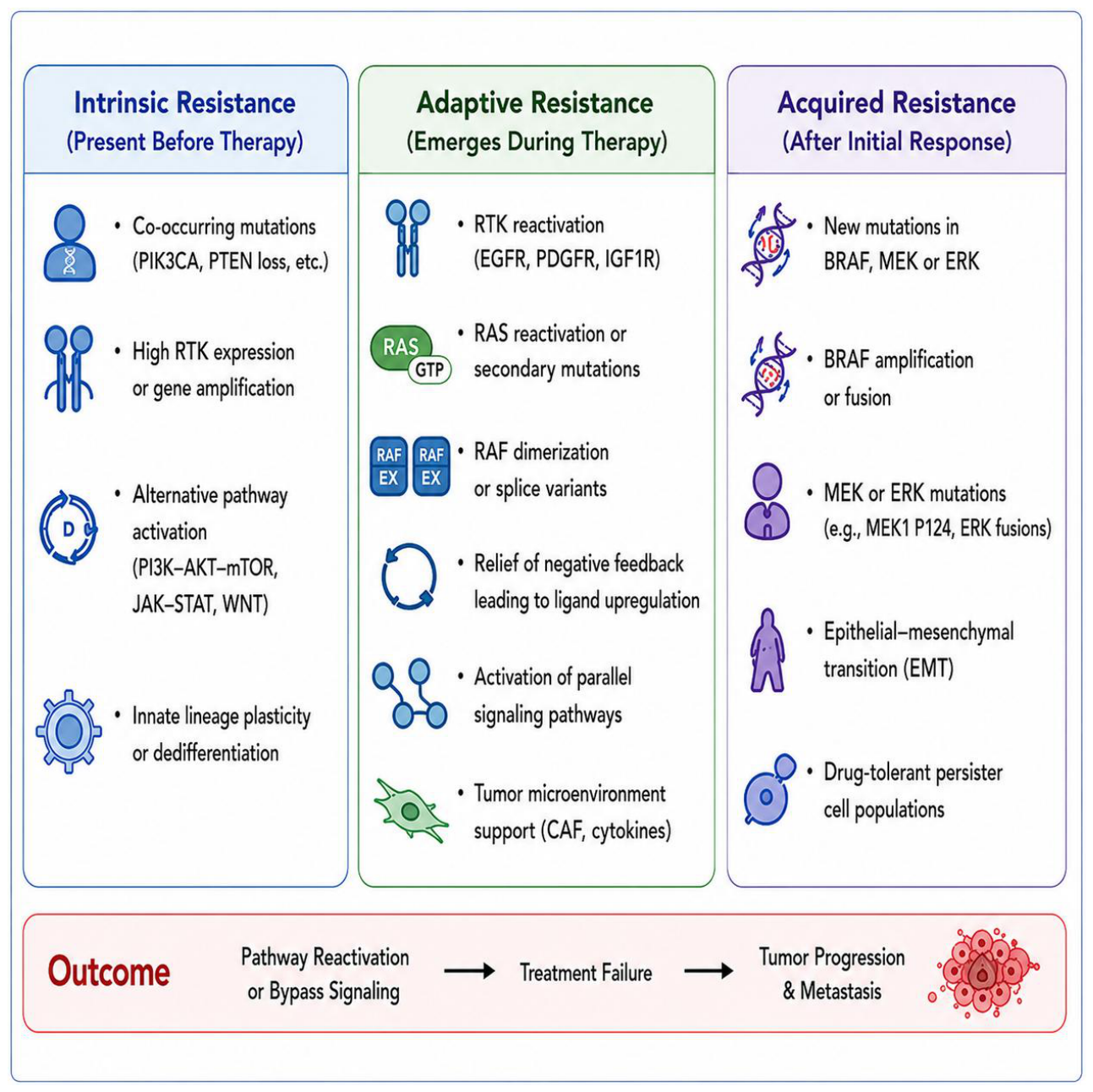
Figure 5.
Emerging gene-based strategies to target ERK/MAPK signalling and overcome resistance. The figure outlines RNA interference, functional CRISPR screening, genome editing and targeted delivery platforms as translational approaches for identifying or suppressing resistance nodes.
Figure 5.
Emerging gene-based strategies to target ERK/MAPK signalling and overcome resistance. The figure outlines RNA interference, functional CRISPR screening, genome editing and targeted delivery platforms as translational approaches for identifying or suppressing resistance nodes.
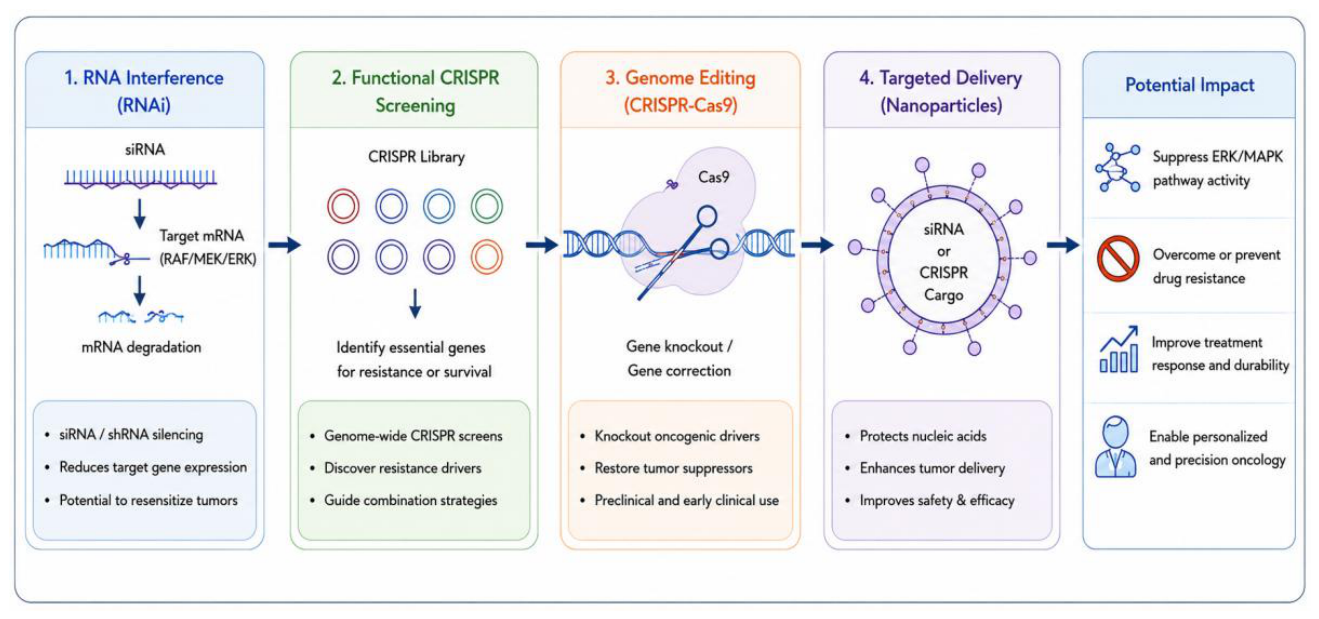
Table 3.
Resistance mechanisms and evidence-based counter-strategy logic.
| Resistance class | Representative mechanism | Biological effect | Potential response | Reference (s) |
|---|---|---|---|---|
| Adaptive feedback | Loss of DUSP/Sprouty feedback; RTK rebound; SHP2-SOS-mediated RAS loading. | Rapid restoration of upstream input and partial ERK rebound. | Identify the dominant receptor or RAS-loading node; evaluate vertical combinations in trials. | [24,25,70] |
| MAPK reactivation | BRAF amplification or splice variants; RAS alteration; RAF dimerisation; MEK alteration. | Restores ERK output despite continued RAF or MEK inhibition. | Repeat molecular profiling and use mechanism-matched receptor, RAF-dimer, MEK or ERK strategies. | [39,40,41,67,68] |
| ERK-level resistance | ERK mutation, ERK2 amplification or increased pathway input. | Reduces ERK-inhibitor sensitivity or restores substrate phosphorylation. | Next-generation ERK inhibitors or upstream co-targeting remain investigational. | [42] |
| Parallel survival | PI3K-AKT-mTOR, YAP/TAZ, JAK-STAT, WNT or AXL programmes. | Maintains metabolism and survival despite ERK suppression. | Dual-pathway inhibition requires a validated biomarker and acceptable safety rationale. | [15,68] |
| Cell-state plasticity | Dedifferentiation, EMT-like programmes and drug-tolerant persisters. | Creates reversible tolerance and a reservoir for later genetic resistance. | Longitudinal cell-state biomarkers and minimal-residual-disease intervention should be tested prospectively. | [19,62,63,64] |
| Microenvironmental or pharmacological escape | Stromal growth factors, hypoxia, sanctuary sites or inadequate tumour exposure. | Non-cell-autonomous rescue or subtherapeutic pathway inhibition. | Confirm exposure and address the dominant stromal or anatomical mechanism. | [15,70] |
Abbreviations: DUSP, dual-specificity phosphatase; RTK, receptor tyrosine kinase; SHP2, Src homology 2 domain-containing protein tyrosine phosphatase 2; SOS, Son of Sevenless; RAS, rat sarcoma small GTPase family; MAPK, mitogen-activated protein kinase; BRAF, B-Raf proto-oncogene serine/threonine-protein kinase; RAF, rapidly accelerated fibrosarcoma kinase family; MEK, mitogen-activated protein kinase kinase; ERK, extracellular signal-regulated kinase; PI3K, phosphoinositide 3-kinase; AKT, protein kinase B; mTOR, mechanistic target of rapamycin; YAP, yes-associated protein; TAZ, transcriptional co-activator with PDZ-binding motif; JAK, Janus kinase; STAT, signal transducer and activator of transcription; WNT, Wingless-related integration site; AXL, AXL receptor tyrosine kinase; EMT, epithelial-mesenchymal transition.
Table 4.
Evidence maturity of gene-based platforms relevant to ERK/MAPK resistance.
| Platform | Relevant use | Evidence-based advantage | Major barrier | Reference (s) |
|---|---|---|---|---|
| Genome-wide CRISPR screening | Identify resistance genes, synthetic-lethal partners and pathway dependencies. | Unbiased, scalable discovery of context-specific vulnerabilities. | Hits require independent validation, tractable targets and normal-tissue safety. | [49,52] |
| siRNA or shRNA | Reduce expression of a driver or adaptive signalling component. | Reversible and potentially allele-selective; compatible with local or nanoparticle delivery. | Transient activity, endosomal escape, immune sensing and heterogeneous delivery. | [53,54] |
| CRISPR knockout | Disrupt a driver or essential resistance dependency. | Potentially durable target loss. | Irreversible off-target effects, DNA-damage responses and selection of unedited clones. | [49,50] |
| CRISPRi or CRISPRa | Repress or activate transcription without cutting DNA. | Programmable and potentially reversible regulation of feedback or cell-state programmes. | Requires sustained tumour-selective delivery and reliable dose control. | [50,51] |
| Base or prime editing | Alter defined sequence variants without conventional double-strand breaks. | Potential precision for mutation-defined targets. | Editor size, bystander edits, delivery and tumour-wide coverage. | [50,51] |
| Nanoparticle delivery | Deliver siRNA, mRNA, guide RNA or ribonucleoprotein cargo. | Modular formulation, transient exposure and potential surface targeting. | Biodistribution, endosomal escape, repeated dosing and manufacturing consistency. | [55,56] |
Abbreviations: CRISPR, clustered regularly interspaced short palindromic repeats; siRNA, small interfering RNA; shRNA, short hairpin RNA; CRISPRi, CRISPR interference; CRISPRa, CRISPR activation; DNA, deoxyribonucleic acid; RNA, ribonucleic acid; mRNA, messenger RNA.
Table 5.
Context-specific interpretation and evidence maturity of ERK/MAPK-targeted strategies.
| Clinical or translational context | Most supportable interpretation | Rationale | Evidence maturity | Reference (s) |
|---|---|---|---|---|
| BRAF V600-mutant melanoma requiring rapid tumour control | Use a BRAF-MEK combination when targeted therapy is clinically selected. | Combination therapy improves efficacy versus BRAF inhibitor monotherapy; no pair is universally superior. | High: randomised phase III trials and long-term follow-up. | [28,29,30,31,32] |
| Previously treated, non-colorectal BRAF V600E solid tumour without satisfactory alternatives | Dabrafenib-trametinib may be considered in appropriately selected tumours supported by basket-trial evidence. | Responses across mixed histologies support driver matching, but activity remains lineage-dependent. | Moderate: phase II basket studies; response magnitude varies by tumour type. | [71,72] |
| BRAF V600E metastatic NSCLC | Use a BRAF-MEK combination selected according to local guidance, toxicity and access. | Prospective studies demonstrate clinically meaningful activity in a rare subgroup. | Moderate to high for a molecularly selected population. | [20,21] |
| BRAF V600E metastatic colorectal cancer | Use an EGFR-containing encorafenib regimen appropriate to treatment line. | EGFR feedback undermines BRAF inhibition alone. | High: randomised clinical evidence. | [26,27,36] |
| Progression after BRAF-MEK therapy | Obtain tissue or circulating-DNA profiling where feasible and match treatment to the resistance mechanism. | Escape routes are heterogeneous and may differ between lesions. | Moderate; many mechanism-matched combinations remain investigational. | [39,40,41,42,67,68] |
| Gene-based resistance intervention | Prioritise validated screening and delivery studies rather than assuming therapeutic readiness. | Clinical translation is limited mainly by delivery, heterogeneity and safety. | Discovery-stage to early clinical, depending on platform. | [49,52,53,54,55,56] |
Abbreviations: BRAF, B-Raf proto-oncogene serine/threonine-protein kinase; MEK, mitogen-activated protein kinase kinase; NSCLC, non-small-cell lung cancer; EGFR, epidermal growth factor receptor; DNA, deoxyribonucleic acid.
Disclaimer/Publisher’s Note: The statements, opinions and data contained in all publications are solely those of the individual author(s) and contributor(s) and not of MDPI and/or the editor(s). MDPI and/or the editor(s) disclaim responsibility for any injury to people or property resulting from any ideas, methods, instructions or products referred to in the content. |
© 2026 by the authors. Licensee MDPI, Basel, Switzerland. This article is an open access article distributed under the terms and conditions of the Creative Commons Attribution (CC BY) license (http://creativecommons.org/licenses/by/4.0/).
Copyright: This open access article is published under a Creative Commons CC BY 4.0 license, which permit the free download, distribution, and reuse, provided that the author and preprint are cited in any reuse.