
Submitted:
14 August 2026
Posted:
17 August 2026
You are already at the latest version
Abstract
Periodontal regeneration requires coordinated control of inflammation, tissue remodeling, vascular responses, and bone turnover. Conventional anti-inflammatory strategies can reduce inflammatory burden but may not restore the active biological programs that terminate inflammation and initiate repair. Specialized pro-resolving mediators (SPMs)—including lipoxins, resolvins, protectins, and maresins—are endogenous lipid mediators that actively promote resolution while preserving host defense. Increasing evidence indicates that macrophages are major cellular targets of SPM activity and that SPM signaling can alter macrophage efferocytosis, phagocytosis, inflammatory mediator production, metabolism, and tissue-remodeling functions. In experimental periodontitis, SPM treatment, particularly Resolvin E1 (RvE1) and lipoxins, has been associated with reduced inflammation and prevention or regeneration of alveolar bone loss. Human studies further suggest that RvE1 can restore impaired macrophage phagocytic activity in periodontal disease. Recent mechanistic work across inflammatory and regenerative models indicates that resolvins can reprogram macrophage metabolism toward oxidative phosphorylation and fatty-acid utilization, enhance efferocytosis, and support tissue repair. In this review, we integrate periodontal, macrophage, lipid-mediator, and regenerative biology to propose an SPM–macrophage framework for periodontal regeneration. We discuss receptor-dependent signaling, immunometabolic reprogramming, efferocytosis, inflammatory shutdown, extracellular-matrix remodeling, angiogenesis, and bone homeostasis as interconnected components of resolution-directed repair. We further evaluate translational opportunities, including local SPM delivery, receptor agonism, biomarker development, and combination with regenerative procedures. Important limitations remain, including the short half-life and analytical challenges of SPMs, heterogeneity among experimental models, and the need to establish causal relationships between macrophage reprogramming and periodontal regeneration. We propose that therapeutically enhancing macrophage resolution capacity may provide a strategy to couple inflammation control with functional periodontal tissue repair.
Keywords:
specialized pro‐resolving mediators
; SPMs
; macrophages
; resolvin E1
; resolvins
; maresins
; lipoxins
; periodontitis
; inflammation resolution
; periodontal regeneration
; immunometabolism
; tissue repair
1. Introduction
Periodontal regeneration is fundamentally an immunological as well as a structural problem. Periodontitis develops when a dysbiotic microbial community interacts with a susceptible host response, resulting in persistent inflammation and destruction of periodontal connective tissue and alveolar bone. Although antimicrobial and mechanical approaches are essential for controlling the initiating microbial stimulus, successful regeneration also requires restoration of a tissue environment capable of terminating inflammation and coordinating repair [1,2].
Figure 1.
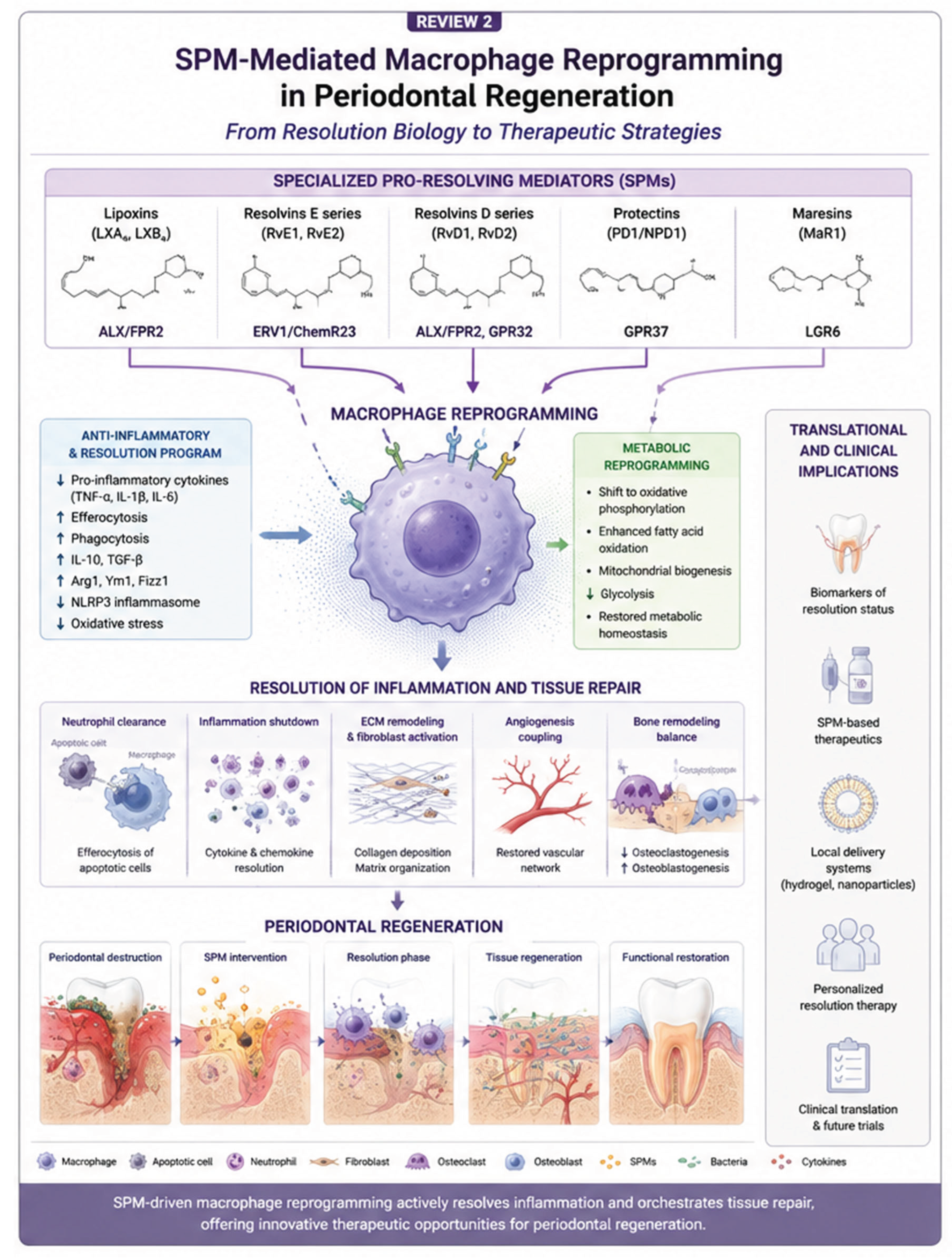
SPM-mediated macrophage reprogramming framework for periodontal regeneration. The figure integrates SPM families and receptors, macrophage anti-inflammatory and metabolic reprogramming, resolution-associated tissue processes, and potential translational strategies.
Figure 1.
SPM-mediated macrophage reprogramming framework for periodontal regeneration. The figure integrates SPM families and receptors, macrophage anti-inflammatory and metabolic reprogramming, resolution-associated tissue processes, and potential translational strategies.
The concept of inflammation resolution provides an alternative to the traditional view that successful treatment depends primarily on suppressing inflammatory mediators. Resolution is an active biological program involving mediator switching, leukocyte clearance, efferocytosis, restoration of tissue homeostasis, and transition toward repair [1,3]. SPMs are endogenous lipid mediators that orchestrate these processes and include lipoxins derived from arachidonic acid as well as E-series resolvins, D-series resolvins, protectins, and maresins derived from omega-3 polyunsaturated fatty acids [3,4].
Macrophages are particularly important targets of this biology because they can transition from inflammatory effector functions toward clearance, remodeling, and repair. A growing literature therefore supports a model in which SPMs do not simply reduce macrophage inflammation but actively reprogram macrophage function. This review develops that framework in the context of periodontal regeneration and considers how resolution-directed macrophage reprogramming could be translated into therapeutic strategies.
2. SPM Classes, Biosynthesis, and Receptor Signaling
SPMs comprise several structurally and biosynthetically distinct families. Lipoxins are generated from arachidonic acid, whereas E-series resolvins are derived primarily from eicosapentaenoic acid (EPA), and D-series resolvins, protectins, and maresins are derived from docosahexaenoic acid (DHA) through coordinated lipoxygenase pathways [3,4]. Their biological effects are mediated through specialized receptors and receptor interactions rather than through generalized suppression of inflammatory signaling.
RvE1 is among the best-characterized SPMs in periodontal disease. RvE1 can signal through ChemR23/ERV1 and interact with BLT1-dependent pathways, with downstream effects involving ERK, Akt, NF-κB-related signaling, and cellular trafficking [5]. In macrophages, RvE1–ChemR23 signaling has been associated with enhanced phagocytosis and altered inflammatory responses [5,6]. D-series resolvins, including RvD1, can signal through ALX/FPR2 and other receptors, while maresin 1 signals through LGR6 and related pathways in defined cellular contexts [3,4].
These receptor systems provide an important mechanistic basis for therapeutic development. Rather than administering a broad immunosuppressive agent, receptor-selective SPM agonism could potentially enhance specific resolution-associated functions while preserving antimicrobial defense. However, receptor expression varies across cell types and tissue states, and the contribution of individual receptors to periodontal macrophage reprogramming remains incompletely defined.
3. SPMs and Macrophage Reprogramming
Macrophage reprogramming during resolution involves coordinated changes in phenotype, function, metabolism, and intercellular communication. SPMs can reduce production of pro-inflammatory cytokines and chemokines while enhancing efferocytosis and phagocytic clearance. These effects are functionally important because removal of apoptotic cells and cellular debris prevents secondary inflammatory activation and provides signals that support tissue repair [6,7].
Human periodontal evidence provides a direct example. Fredman et al. reported impaired phagocytosis in macrophages generated from monocytes of patients with localized aggressive periodontitis, and RvE1 restored the impaired phagocytic activity over a concentration range of 0.1–100 nM [7]. The same study found evidence of an altered lipid mediator profile consistent with impaired resolution pathways, supporting the concept that defective macrophage clearance can be part of chronic periodontal inflammation.
The macrophage response to SPMs also extends beyond phagocytosis. Recent work synthesizing resolvin biology across inflammatory and regenerative systems indicates that D-series resolvins can reprogram macrophage metabolism toward fatty-acid oxidation and oxidative phosphorylation, enhance efferocytosis, and promote tissue repair [8]. Such metabolic reprogramming is potentially important because macrophage metabolic state is tightly coupled to inflammatory and repair-associated functions. The precise metabolic signature induced by individual SPMs in periodontal macrophages, however, remains an important area for investigation.
4. SPMs in Experimental Periodontitis
The strongest periodontal evidence for SPM therapy comes from experimental periodontitis models. In early work, topical RvE1 treatment in rabbit periodontitis protected against inflammation-associated tissue and bone loss and promoted restoration of pathologically lost periodontal tissues [9]. Subsequent studies demonstrated that RvE1 can reverse experimental periodontitis and alter the periodontal inflammatory environment and microbial dysbiosis [10].
A systematic review of six experimental periodontitis studies concluded that topical RvE1 and lipoxin treatment significantly prevented and, in some models, regenerated alveolar bone loss [11]. The review also noted favorable changes in microbial composition and inflammatory status in selected studies. These findings are important because they suggest that SPMs can influence multiple components of periodontal disease rather than acting exclusively on a single cytokine pathway.
RvE1 also has direct effects on bone biology. Experimental studies have shown that RvE1 can inhibit inflammatory osteoclastogenesis and preserve bone under inflammatory conditions, suggesting that the regenerative effects of SPMs may reflect both immune-mediated and direct effects on bone cells [12]. Thus, a complete model of SPM-driven periodontal regeneration should incorporate macrophage resolution, inflammatory shutdown, osteoclast regulation, and restoration of bone remodeling balance.
5. Macrophage Reprogramming as the Bridge Between Resolution and Regeneration
Periodontal tissue repair requires more than termination of inflammatory cytokine production. The tissue must clear apoptotic cells, remodel extracellular matrix, restore vascular support, and re-establish balanced bone turnover. Macrophages are strategically positioned to coordinate these processes because they interact with fibroblasts, endothelial cells, osteoclasts, osteoblasts, and other immune cells.
We therefore propose an SPM–macrophage–regeneration framework in which SPM signaling initiates a functional transition from inflammatory macrophage activity toward a pro-resolving state characterized by enhanced efferocytosis, phagocytosis, controlled cytokine production, and tissue-remodeling capacity. This transition can then influence downstream tissue compartments: reduced inflammatory signaling favors matrix organization and fibroblast repair; resolution of leukocyte recruitment supports vascular restoration; and altered osteoclast–osteoblast coupling favors recovery of alveolar bone homeostasis.
Importantly, this framework should not be reduced to an M1/M2 binary. Macrophage states are heterogeneous and spatially organized, and the relevant therapeutic endpoint is a functional program rather than expression of a single marker. Recent literature on macrophage immunotherapies in periodontitis similarly emphasizes reprogramming macrophage functions rather than relying solely on classical polarization terminology [13].
6. Resolution, Extracellular Matrix Remodeling, and Angiogenesis
Inflammation resolution creates the conditions under which tissue remodeling can proceed. Persistent inflammatory cytokines and chemokines can impair fibroblast function, alter extracellular-matrix turnover, and maintain proteolytic activity. By promoting inflammatory shutdown and clearance of damaged material, SPMs may indirectly support matrix restoration.
The same principle applies to vascular repair. Resolution-associated macrophages can influence endothelial-cell behavior and angiogenic programs, while excessive or prolonged inflammation can produce abnormal vascular responses. Although direct periodontal evidence linking a specific SPM to macrophage-driven angiogenesis remains limited, the broader resolution literature supports interactions among SPM signaling, macrophage state, and tissue repair [3,8].
This distinction highlights an important research opportunity. Rather than evaluating SPM treatment solely by reductions in TNF-α, IL-1β, or other inflammatory markers, future periodontal studies should assess matrix organization, fibroblast function, vascular architecture, and tissue integration. Such endpoints would more directly test whether SPM-mediated macrophage reprogramming results in regeneration rather than simply inflammation suppression.
7. Bone Remodeling and Periodontal Regeneration
Alveolar bone preservation is a central endpoint of periodontal therapy. Inflammatory periodontitis increases osteoclast activity and disrupts the balance between bone resorption and formation. RvE1 has been shown to protect against inflammatory bone loss and to influence osteoclast and osteoblast responses, providing a mechanistic link between resolution biology and skeletal remodeling [12].
The regenerative effects of RvE1 are particularly notable because experimental treatment can prevent or reverse bone loss rather than merely reduce inflammatory biomarkers [9,10,11]. This suggests that resolution-directed therapy may affect the tissue trajectory after inflammatory injury has already occurred. Nevertheless, the relative contribution of macrophage-mediated effects versus direct effects on bone cells remains unresolved.
A useful future strategy would therefore combine macrophage-specific functional analysis with bone-cell readouts. For example, studies could determine whether manipulation of macrophage SPM signaling changes osteoclastogenesis, osteoblast activity, and net bone regeneration. Such experiments would directly test whether macrophage reprogramming is a causal mediator of SPM-induced periodontal regeneration.
8. Therapeutic Strategies: Local Delivery and Receptor-Directed Approaches
The translational attractiveness of SPMs is accompanied by practical challenges. Endogenous SPMs are present at low concentrations and can have short biological half-lives, creating formulation and delivery challenges [4,8]. Local delivery is therefore particularly attractive for periodontal applications because periodontal tissues are anatomically accessible and local administration can potentially achieve higher tissue exposure while limiting systemic effects.
Potential delivery strategies include injectable hydrogels, biodegradable nanoparticles, lipid-based carriers, and incorporation into regenerative biomaterials. Local delivery could be combined with conventional periodontal debridement, guided tissue regeneration, or bone-regenerative procedures. The objective would be to create a local microenvironment that supports resolution during the early phase of repair.
An alternative approach is receptor-directed therapy. Selective activation of ChemR23/ERV1, ALX/FPR2, GPR32, or other relevant SPM receptors could potentially reproduce selected biological effects while improving pharmacokinetic stability. However, receptor biology is context dependent, and synthetic agonists must be evaluated carefully for target specificity and preservation of host defense. Recent evidence that ERV1 overexpression can protect against age- and diabetes-associated alveolar bone loss further supports receptor-directed strategies as a translational avenue [14].
9. Biomarkers and Precision Resolution Therapy
A major translational challenge is determining which patients are most likely to benefit from resolution-directed therapy. Conventional periodontal biomarkers largely quantify inflammatory burden, but therapeutic selection may require markers of resolution capacity. Potential biomarkers include local SPM concentrations, receptor expression, macrophage functional states, efferocytosis capacity, inflammatory mediator profiles, and tissue-repair signatures.
The concept of precision resolution therapy is particularly relevant because the inflammatory phenotype of periodontitis is heterogeneous. Some patients may primarily require microbial control, whereas others may exhibit persistent inflammation despite adequate mechanical treatment and may therefore benefit from restoration of resolution pathways. A macrophage-centered biomarker panel could potentially identify this subgroup.
Spatial and single-cell technologies may be particularly useful for this purpose. Mapping macrophage states together with SPM receptor expression and tissue compartments could identify cellular niches in which resolution is impaired. Integration with lipid mediator profiling could then connect cellular state to actual SPM availability and signaling.
10. Translational Limitations and Future Directions
Several limitations should temper interpretation of the current evidence. First, most periodontal SPM studies remain preclinical, and experimental models differ substantially in species, disease induction, treatment timing, dose, and route of administration [11]. Second, SPM concentrations are low and analytical measurements can be technically challenging, raising concerns about reproducibility and the interpretation of endogenous mediator profiles [8]. Third, macrophage reprogramming is context dependent, and changes in surface markers do not necessarily establish a functional resolution phenotype.
Future studies should therefore combine functional assays with spatial and molecular profiling. In periodontal macrophages, key endpoints should include efferocytosis, phagocytosis, inflammatory mediator production, SPM receptor expression, metabolic state, and interaction with fibroblasts and bone cells. Causal studies should determine whether selective disruption of macrophage SPM signaling abolishes the regenerative effects of SPM treatment.
The ultimate translational objective is not simply to create an anti-inflammatory periodontal therapy, but to develop a resolution-directed regenerative strategy that actively restores tissue homeostasis. Such an approach could complement existing mechanical and regenerative procedures and potentially improve the predictability of periodontal tissue restoration.
11. Conclusions
SPMs represent a biologically coherent class of endogenous mediators capable of linking inflammation resolution with tissue repair. In periodontal disease, RvE1 and other SPMs have demonstrated anti-inflammatory, pro-resolving, bone-protective, and regenerative effects in experimental models, while human macrophage studies indicate that RvE1 can restore impaired phagocytic function [7,9,10,11,12].
The emerging model is that SPMs act not simply as anti-inflammatory molecules but as macrophage-reprogramming signals that coordinate efferocytosis, metabolic adaptation, inflammatory shutdown, extracellular-matrix remodeling, vascular repair, and bone homeostasis. This framework provides a mechanistic bridge between resolution biology and periodontal regeneration.
The next phase of the field should establish which macrophage functions are causally required for SPM-mediated regeneration, how aging and metabolic disease modify SPM responsiveness, and how local delivery or receptor-selective agonism can be translated into clinically feasible therapies. If these questions are resolved, SPM-driven macrophage reprogramming could provide a precision host-modulation strategy for periodontal regeneration.
References
- Van Dyke, T.E.; Sima, C. Understanding resolution of inflammation in periodontal diseases: Is chronic inflammatory periodontitis a failure to resolve? Periodontol. 2000 2020, 82, 205–213. [Google Scholar] [CrossRef] [PubMed]
- Lee, C.-T.; Tribble, G.D. Roles of specialized pro-resolving mediators and omega-3 polyunsaturated fatty acids in periodontal inflammation and impact on oral microbiota. Front Oral Health 2023, 4, 1217088. [Google Scholar] [CrossRef] [PubMed]
- Serhan, C.N. Pro-resolving lipid mediators are leads for resolution physiology. Nature 2014, 510, 92–101. [Google Scholar] [CrossRef] [PubMed]
- Serhan, C.N.; Levy, B.D. Resolvins in inflammation: Emergence of the pro-resolving superfamily of mediators. J. Clin. Invest. 2018, 128, 2657–2669. [Google Scholar] [CrossRef] [PubMed]
- Arita, M.; Oh, S.F.; Chonan, T.; et al. Metabolic inactivation of resolvin E1 and D1 by inflammatory cells and their actions in inflammation. Relevant receptor and signaling studies are summarized in: Understanding resolvin signaling pathways to improve oral health. J. Dent. Res. 2013. [Google Scholar]
- Serhan, C.N.; Chiang, N.; Dalli, J.; Levy, B.D. Lipid mediators in the resolution of inflammation. Cold Spring Harb. Perspect. Biol. 2015, 7, a016311. [Google Scholar] [CrossRef] [PubMed]
- Fredman, G.; Oh, S.F.; Ayilavarapu, S.; Hasturk, H.; Serhan, C.N.; Van Dyke, T.E. Impaired phagocytosis in localized aggressive periodontitis: Rescue by Resolvin E1. PLoS ONE 2011, 6, e24422. [Google Scholar] [CrossRef] [PubMed]
- Buete, R.; Scherer, J.; Patsalos, A.; Nagy, L. From lipid switch to tissue repair: How resolvins reprogram macrophage polarization and function. Immunometabolism 2026. [Google Scholar] [CrossRef] [PubMed]
- Hasturk, H.; Kantarci, A.; Ohira, T.; et al. RvE1 protects from local inflammation and osteoclast-mediated bone destruction in periodontitis. J. Immunol. 2006, 176, 7210–7218. [Google Scholar]
- Woodruff, T.M.; et al. Resolvin E1 reverses experimental periodontitis and dysbiosis. J. Immunol. 2016. [Google Scholar] [CrossRef] [PubMed]
- Osorio Parra, M.M.; Elangovan, S.; Lee, C.-T. Specialized pro-resolving lipid mediators in experimental periodontitis: A systematic review. Oral Dis. 2019, 25, 1265–1276. [Google Scholar] [CrossRef] [PubMed]
- El Kholy, K.; Freire, M.; Chen, T.; Van Dyke, T.E. Resolvin E1 promotes bone preservation under inflammatory conditions. Front Immunol. 2018, 9, 1301. [Google Scholar] [CrossRef] [PubMed]
- Immunotherapies based on macrophage reprogramming in periodontitis and apical periodontitis. Clin. Oral Investig. 2026. [CrossRef] [PubMed]
- Suárez, L.J.; Hasturk, H.; Tubero Euzebio Alves, V.; et al. Overexpression of the receptor for resolvin E1 (ERV1) prevents early alveolar bone loss in leptin receptor deficiency-induced diabetes. J. Periodontol. 2024, 95, e120–e131. [Google Scholar] [CrossRef] [PubMed]
Disclaimer/Publisher’s Note: The statements, opinions and data contained in all publications are solely those of the individual author(s) and contributor(s) and not of MDPI and/or the editor(s). MDPI and/or the editor(s) disclaim responsibility for any injury to people or property resulting from any ideas, methods, instructions or products referred to in the content. |
© 2026 by the authors. Licensee MDPI, Basel, Switzerland. This article is an open access article distributed under the terms and conditions of the Creative Commons Attribution (CC BY) license (http://creativecommons.org/licenses/by/4.0/).
Copyright: This open access article is published under a Creative Commons CC BY 4.0 license, which permit the free download, distribution, and reuse, provided that the author and preprint are cited in any reuse.