

Submitted:
11 August 2026
Posted:
17 August 2026
You are already at the latest version
Abstract
Mental health among university students has become a priority concern due to the rising prevalence of anxiety, depression, sleep disturbances, and academic stress. This study aimed to map the available evidence on mental health interventions for university students evaluated through randomized controlled trials. A scoping review was conducted following the Joanna Briggs Institute (JBI) methodology and PRISMA-ScR recommendations, searching PubMed up to August 5, 2026. A total of 2,013 studies were identified, of which 606 were assessed for eligibility and 244 were included, mostly published between 2024 and 2026 and mainly from China, the United States, Australia, and the United Kingdom. Digital interventions were the most frequent, followed by mindfulness, psychological therapy, educational programs, physical activity, and cognitive-behavioral therapy. These findings show a wide diversity of intervention modalities, supporting a comprehensive approach to mental health in the university context.
Keywords:
health intervention
; mental health
; students (source: MeSH NLM)
1. Introduction
Mental health among university students has become a focus of attention because of the rising prevalence of anxiety disorders, depression, sleep disturbances, academic stress, and emotional exhaustion, which highlights the need for interventions that improve students' learning and overall functioning at university.
As García-Pérez et al. [1] report, evidence on physical activity, psychological interventions, cognitive-behavioral therapy, mindfulness, educational programs, digital interventions, mind-body therapy (yoga, tai chi, and qigong), and socioemotional skills training is associated with improvements in depression and anxiety outcomes, being highly effective in reducing symptoms and contributing to overall well-being. Effects on stress appear more variable and may reflect improvements in stress resilience, coping capacity, and stress-management skills [2]. In addition, evidence suggests that these interventions can effectively reduce common mental health difficulties among students [3].
More effective strategies for mental health interventions are needed, such as promoting digital interventions targeted at the university community [4]. Health literacy interventions with interactive and technological components were more effective [5]. These could serve as a low-intensity first line of care within stepped-care models, particularly for students with mild-to-moderate symptoms or barriers to in-person care [6].
Mental health interventions should be addressed comprehensively. Observational evidence from Solomou et al. [7] links a healthy diet with better mental health and lower levels of depression, anxiety, and stress in university students. Mindfulness-based interventions reduce symptoms of mental health disorders in university students [8], as do cognitive-behavioral therapy interventions, which reduce depression, anxiety, and stress, reinforcing a comprehensive approach [9].
These interventions could be an effective alternative to address the challenges and obstacles that university students currently face when seeking help for their mental health problems [10]. Human guidance can be beneficial for addressing the severity of depressive symptoms; however, fully automated interventions may be sufficient to achieve a reduction in symptom severity [11].
Multiple interventions are aimed at improving university students' mental health; however, the evidence is variable in its characteristics, modalities, and outcomes, which makes it difficult to understand the overall available landscape.
In mental health, interventions should integrate the active participation of the student, family, health professionals, and educators, as indicated by experience-based design [12]. The factors that influence students' mental health and well-being offer the possibility of identifying strategies that improve their capacity to face the challenges of higher education [13].
Based on the foregoing, the objective of this study was to map the available evidence on mental health interventions targeted at university students evaluated through randomized controlled trials.
2. Materials and Methods
A scoping review was conducted following the Joanna Briggs Institute (JBI) methodology and the PRISMA-ScR guideline recommendations. The literature search was performed in the PubMed database using the following strategy: ("Mental Health"[Mesh] OR "mental health"[Title/Abstract]) AND (universit*[Title/Abstract] OR "college student*"[Title/Abstract] OR "university student*"[Title/Abstract] OR undergraduate*[Title/Abstract]) AND (intervention*[Title/Abstract] OR program*[Title/Abstract] OR training[Title/Abstract] OR education[Title/Abstract]) AND (Randomized Controlled Trial[Publication Type] OR random*[Title/Abstract]), including studies published up to August 5, 2026, and restricted with the "Randomized Controlled Trial" filter.
Randomized controlled trials of mental health interventions were included, excluding reviews, observational studies, protocols, editorials, and conference abstracts. ESN performed study selection by reading titles and abstracts according to the established selection criteria.
The analysis was performed in Python (pandas, matplotlib, Biopython), automatically extracting abstracts from PubMed and applying descriptive statistics (frequencies and percentages) to characterize the intervention, design, country, and publication period of the studies.
As this was a review of previously published literature with no direct intervention in human subjects, approval by an institutional ethics committee was not required.
3. Results
The PubMed search retrieved 2,013 initial records. Of these, 606 reports were retrieved and assessed for eligibility. Of these, 362 were excluded, while 244 studies met the inclusion criteria and were incorporated into the review (see Figure 1).
Table 1 summarizes the characteristics of the 244 included studies. Most were published between 2024 and 2026 (41.8%). Geographically, the largest scientific output came from China (n = 64) and the United States (n = 57), followed by Australia (n = 25) and the United Kingdom (n = 20).
Figure 2 shows the distribution of the intervention types identified. Digital interventions (apps, web, or online platforms) were the most frequent (n = 72), followed by mindfulness-based interventions (n = 62) and psychological therapy/counseling (n = 49). Educational programs (n = 38), physical activity (n = 32), and cognitive-behavioral therapy (n = 25) were also identified, while the remaining modalities were less frequent.
The three studies with the largest sample sizes were Freeman et al. (2017, n = 3,755), Wu et al. (2026, n = 2,263), and Vereschagin et al. (2024, n = 1,489) (see Table 2).
4. Discussion
By mapping the available evidence on mental health interventions targeted at university students evaluated through randomized controlled trials, the findings revealed a wide diversity of strategies aimed at improving the psychological well-being of this population, highlighting mainly digital interventions, mindfulness-based interventions, psychological interventions, educational programs, and physical activity.
This study supports the findings of Zhan et al. [14] in their systematic review and meta-analysis, which found that digital health interventions are effective in reducing stress, anxiety, and depression, highlighting their potential to promote mental health among university students.
Digital interventions do not refer to the widespread use of electronic devices, but rather to structured technological tools designed to promote mental health through evidence-based psychological strategies. The Minder app was shown to be effective in reducing anxiety and depression symptoms [15].
This study also supports the findings of Roy et al. [2], who reported that mindfulness-based interventions are effective in improving university students' mental health, particularly with regard to depression and anxiety.
We also agree with Donnelly et al. [16] that interventions involving moderate-to-vigorous physical activity are the most effective, such as aerobics, dance, basketball, and running, which are among the five most frequent interventions. Other studies support that higher physical activity is associated with a lower likelihood of depressive symptoms among university students [17].
In contrast, other interventions suggest that integrating artistic and cognitive approaches appears to be a particularly effective strategy for the simultaneous management of both conditions [18].
Mental health service utilization increased considerably between 2007 and 2017 [19], and a similar increase in research interest in mental health interventions is observed for the 2024–2026 period.
To achieve effective implementation of these interventions, we recommend that universities in low- and middle-income countries gradually incorporate them into their curricula to ensure accessibility and sustainability, and integrate mental health interventions (MHIs) into their student support programs [20].
Among the limitations of this study is the use of a single database (PubMed), which may have limited the identification of relevant studies available in other databases. In addition, the exclusive inclusion of randomized controlled trials may have reduced the diversity of the evidence identified. Selection based mainly on titles and abstracts, together with the absence of a second independent reviewer, may have increased the risk of selection bias. As a strength, this review made it possible to map the wide variety of mental health interventions targeted at university students and to characterize their main modalities, as well as their temporal and geographic distribution.
5. Conclusion
Mental health interventions for university students encompass diverse modalities, with digital, mindfulness-based, psychological, educational, and physical-activity interventions standing out, supporting the importance of a comprehensive approach to mental health in the university context.
Funding
This study was self-funded by the author.
Acknowledgments
The author thanks Mg. Sonia Laura-Chauca, professor of the University Teaching course, for her academic rigor and for encouraging the development of this research as part of the course.
Conflicts of Interest
The author declares no conflicts of interest with respect to this study.
References
- García-Pérez, L.; Atencia-Rodriguez, M.E.; Cepero-González, M.; Padial-Ruz, R. Effectiveness of physical activity, mindfulness and mind-body therapies in improving mental health of university students: a systematic review of RCTs. J. Am. Coll. Health 2026, 74(4), 1085–1100. [Google Scholar] [CrossRef] [PubMed]
- Roy, S.; Kanekar, A.; Biswas, A.K.; Sharma, M. Digital and in-person mindfulness-based interventions for university students' mental health: a systematic review of randomized controlled trials. Healthcare 2026, 14(13), 1875. [Google Scholar] [CrossRef] [PubMed]
- Worsley, J.D.; Pennington, A.; Corcoran, R. Supporting mental health and wellbeing of university and college students: a systematic review of review-level evidence of interventions. PLoS ONE 2022, 17(7), e0266725. [Google Scholar] [CrossRef] [PubMed]
- Madrid-Cagigal, A.; Ryan, L.; Kealy, C.; Mcnulty, J.; Mulvenna, M.D.; Byrne, M.; et al. Factors influencing engagement with digital mental health interventions from the perspective of university students with existing mental health difficulties: a qualitative study. Behav. Inf. Technol. 2026, 0(0), 1–15. [Google Scholar] [CrossRef]
- Rosário, J.; Raposo, B.; Santos, E.; Dias, S.; Pedro, A.R. Efficacy of health literacy interventions aimed to improve health gains of higher education students—a systematic review. BMC Public Health 2024, 24(1), 882. [Google Scholar] [CrossRef] [PubMed]
- Jabs, M.; Thompson, M.; Linardon, J.; Messer, M.; Wade, T.D. Assessing the effectiveness, adherence and attrition of smartphone-based mental health interventions in university students: a systematic review and meta-analysis. Early Interv. Psychiatry 2026, 20(8), e70207. [Google Scholar] [CrossRef] [PubMed]
- Solomou, S.; Logue, J.; Reilly, S.; Perez-Algorta, G. A systematic review of the association of diet quality with the mental health of university students: implications in health education practice. Health Educ. Res. 2022, 38(1), 28–68. [Google Scholar] [CrossRef] [PubMed]
- Gallo, G.G.; Curado, D.F.; Machado, M.P.A.; Espíndola, M.I.; Scattone, V.V.; Noto, A.R. A randomized controlled trial of mindfulness: effects on university students' mental health. Int. J. Ment. Health Syst. 2023, 17, 32. [Google Scholar] [CrossRef] [PubMed]
- Ledur, B.; Schmitt, M.; Rossa, I.; Andretta, I. Internet-based cognitive-behavior interventions for university students: a systematic review. Trends Psychol. 2025, 33(3), 1062–1091. [Google Scholar] [CrossRef]
- Harith, S.; Backhaus, I.; Mohbin, N.; Ngo, H.T.; Khoo, S. Effectiveness of digital mental health interventions for university students: an umbrella review. PeerJ. 2022, 10, e13111. [Google Scholar] [CrossRef] [PubMed]
- Madrid-Cagigal, A.; Kealy, C.; Potts, C.; Mulvenna, M.D.; Byrne, M.; Barry, M.M.; et al. Digital mental health interventions for university students with mental health difficulties: a systematic review and meta-analysis. Early Interv. Psychiatry 2025, 19(3), e70017. [Google Scholar] [CrossRef] [PubMed]
- Hawke, L.D.; Sheikhan, N.Y.; Bastidas-Bilbao, H.; Rodak, T. Experience-based co-design of mental health services and interventions: a scoping review. SSM Ment. Health 2024, 5, 100309. [Google Scholar] [CrossRef]
- Campbell, F.; Blank, L.; Cantrell, A.; Baxter, S.; Blackmore, C.; Dixon, J.; et al. Factors that influence mental health of university and college students in the UK: a systematic review. BMC Public Health 2022, 22, 1778. [Google Scholar] [CrossRef] [PubMed]
- Zhan, X.; Zeng, J.; Zhu, D.; Chen, Y.; Zhang, J.; Li, S.; et al. Effectiveness of digital health interventions on stress, anxiety, and depression in university students: a systematic review and meta-analysis. J. Vis. Exp. 2026, (227). [Google Scholar] [CrossRef] [PubMed]
- Vereschagin, M.; Wang, A.Y.; Richardson, C.G.; Xie, H.; Munthali, R.J.; Hudec, K.L.; et al. Effectiveness of the Minder mobile mental health and substance use intervention for university students: randomized controlled trial. J. Med. Internet Res. 2024, 26, e54287. [Google Scholar] [CrossRef] [PubMed]
- Donnelly, S.; Penny, K.; Kynn, M. The effectiveness of physical activity interventions in improving higher education students' mental health: a systematic review. Health Promot Int. 2024, 39(2), daae027. [Google Scholar] [CrossRef] [PubMed]
- Waclawovsky, A.J.; de Oliveira, J.; de Carvalho, C.P.; Adornes, M.E.; Dos Santos, E.; Wolf, S.; et al. Higher physical activity is associated with reduced odds of depressive symptoms among university students: a meta-analysis of over 66,000 participants. J. Affect Disord. 2026, 401, 121319. [Google Scholar] [CrossRef] [PubMed]
- Chen, P.; Jia, S.; Deng, Y.; Cheng, J.; Tang, T.; Li, H.; et al. Different arts-based interventions for depression and anxiety in college students: a network meta-analysis of rigorous randomized controlled trials. BMC Psychol. 2026, 14, 443. [Google Scholar] [CrossRef] [PubMed]
- Lipson, S.K.; Lattie, E.G.; Eisenberg, D. Increased rates of mental health service utilization by U.S. college students: 10-year population-level trends (2007-2017). Psychiatr. Serv. 2019, 70(1), 60–63. [Google Scholar] [CrossRef] [PubMed]
- Juniar, D.; van Ballegooijen, W.; Kleygrewe, G.; van Schaik, A.; Passchier, J.; Riper, H. Stress management interventions for university students in low- and middle-income countries: a systematic review and meta-analysis. Front Digit Health 2025, 7, 1603389. [Google Scholar] [CrossRef] [PubMed]
Figure 1.
Flow diagram of participant inclusion.PRISMA 2020 flow diagram showing the identification, screening, and inclusion of studies.
Figure 1.
Flow diagram of participant inclusion.PRISMA 2020 flow diagram showing the identification, screening, and inclusion of studies.
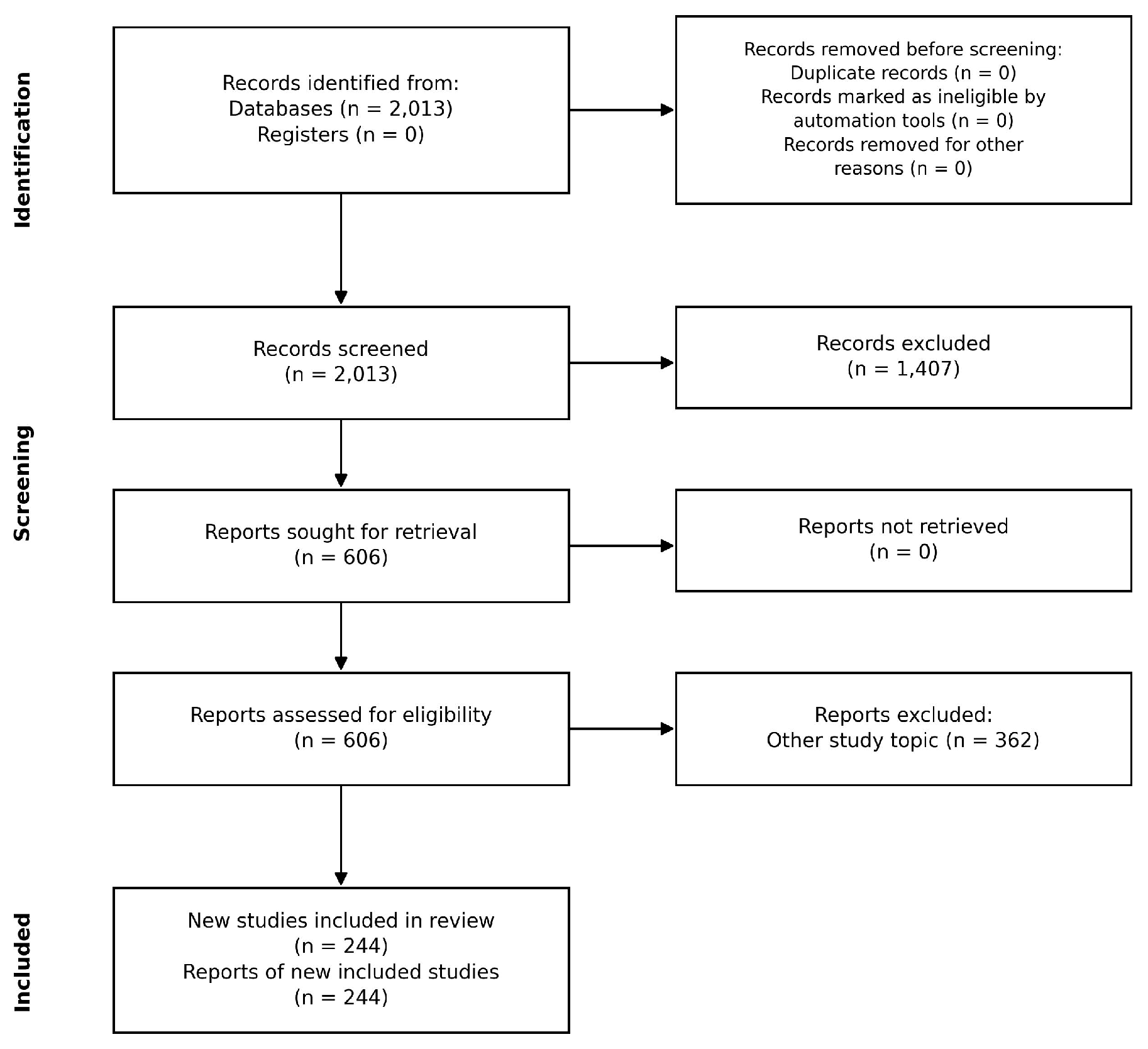
Figure 2.
Type of mental health intervention.Note: intervention categories are not mutually exclusive; a single study could be classified into more than one category, so the sum of n exceeds 244 and percentages do not add up to 100%. "Not specified in the abstract" accounts for 47 studies (19.3%).
Figure 2.
Type of mental health intervention.Note: intervention categories are not mutually exclusive; a single study could be classified into more than one category, so the sum of n exceeds 244 and percentages do not add up to 100%. "Not specified in the abstract" accounts for 47 studies (19.3%).
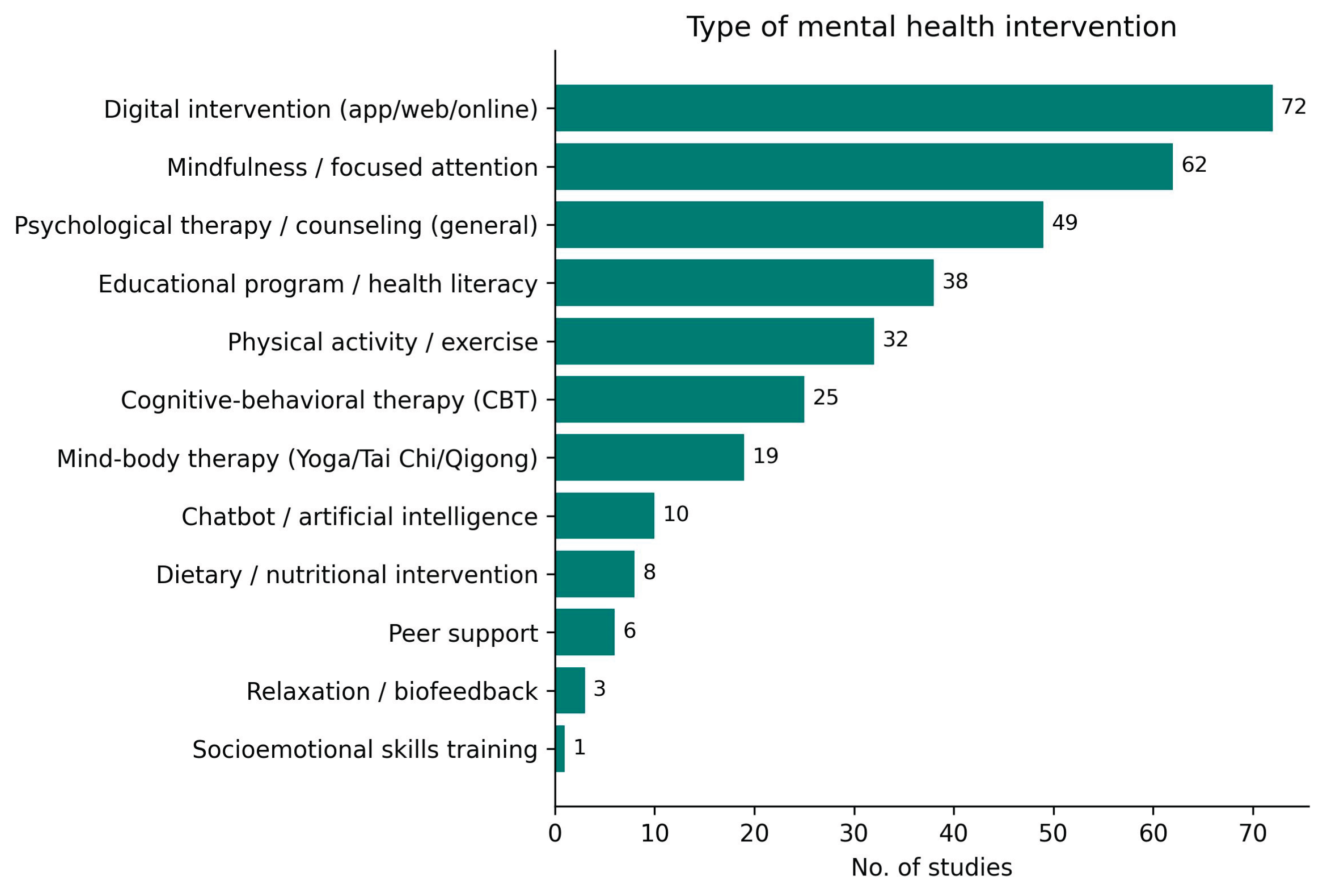

Table 1.
Characteristics of mental health interventions for university students (n = 244).
| Characteristics | n (%) |
| Publication period | |
| 2007–2015 | 29 (11.9) |
| 2016–2020 | 53 (21.7) |
| 2021–2023 | 60 (24.6) |
| 2024–2026 | 102 (41.8) |
| Study design | |
| Randomized controlled trial (RCT) | 150 (61.5) |
| Blinded trial (single/double/triple) | 17 (7.0) |
| Pilot/feasibility study | 12 (4.9) |
| Mixed methods | 10 (4.1) |
| Qualitative | 5 (2.0) |
| Quasi-experimental | 3 (1.2) |
| Not specified in the abstract | 82 (33.6) |
| Country | |
| China | 64 |
| United States | 57 |
| Australia | 25 |
| United Kingdom | 20 |
| New Zealand | 14 |
| China (Hong Kong) | 14 |
| Canada | 14 |
| Netherlands | 14 |
| Other countries (< 6 studies each) | 101 |
| Not specified in the abstract | 27 |
Note. RCT = randomized controlled trial. The design and country categories are not mutually exclusive; a single study could be classified into more than one category or report more than one country, so the sum of n exceeds 244 and percentages do not add up to 100%.
Table 2.
Top 10 studies by sample size.
| No. | Author (year) | Country | n | Intervention or phenomenon |
| 1 | Freeman et al. (2017) | United Kingdom | 3755 | Cognitive-behavioral therapy (CBT); psychological therapy / counseling (general) |
| 2 | Wu et al. (2026) | China | 2263 | Educational program / health literacy |
| 3 | Vereschagin et al. (2024) | United States; Canada | 1489 | Digital intervention (app/web/online); chatbot / artificial intelligence |
| 4 | Benjet et al. (2025) | United States; Mexico; Colombia; Netherlands; Singapore | 1319 | CBT; digital intervention (app/web/online) |
| 5 | So et al. (2026) | Japan | 1187 | CBT; educational program; digital intervention; chatbot / AI |
| 6 | Musiat et al. (2014) | United Kingdom; Canada | 1047 | Digital intervention (app/web/online) |
| 7 | Rith-Najarian et al. (2024) | United States | 804 | Digital intervention (app/web/online) |
| 8 | Koelen et al. (2024) | Australia; Germany; Netherlands | 801 | CBT; digital intervention (app/web/online) |
| 9 | Ebert et al. (2019) | United States; Germany; Spain; Netherlands; Belgium | 710 | Educational program; digital intervention; psychological therapy / counseling |
| 10 | Chang et al. (2022) | United States; Canada; Israel | 679 | Mind-body therapy (Yoga/Tai Chi/Qigong) |
Note. Country and intervention are not mutually exclusive categories; a study may report more than one when the design is multicenter or multicomponent.
Disclaimer/Publisher’s Note: The statements, opinions and data contained in all publications are solely those of the individual author(s) and contributor(s) and not of MDPI and/or the editor(s). MDPI and/or the editor(s) disclaim responsibility for any injury to people or property resulting from any ideas, methods, instructions or products referred to in the content. |
© 2026 by the author. Licensee MDPI, Basel, Switzerland. This article is an open access article distributed under the terms and conditions of the Creative Commons Attribution (CC BY) license.
Copyright: This open access article is published under a Creative Commons CC BY 4.0 license, which permit the free download, distribution, and reuse, provided that the author and preprint are cited in any reuse.