

Submitted:
14 August 2026
Posted:
14 August 2026
You are already at the latest version
Abstract
Background/Objectives: The main neurodegenerative diseases (NDs) - Alzheimer’s disease (AD), Parkinson’s disease (PD), multiple sclerosis (MS), and amyotrophic lateral sclerosis (ALS) - represent a growing global health burden with no available disease-modifying therapies. Curcumin, a polyphenol from Curcuma longa, is a promising candidate owing to its pleiotropic antioxidant, anti-inflammatory, and neuroprotective profile, but its oral bioavailability (<1%) and blood-brain barrier (BBB) penetration (<0.1%) severely limit its clinical application. The objective of this work was to critically examine the therapeutic potential of curcumin in NDs, focusing on advanced drug delivery systems (DDS) designed to overcome its pharmacokinetic barriers. Methods: Narrative, non-systematic review of PubMed/MEDLINE, Scopus, and Web of Science, structured around five areas: molecular mechanisms, pharmacokinetic barriers, evolution of DDS, disease-specific applications, and translational limitations. Results: Curcumin exhibits neuroprotective activity in preclinical models of the four NDs analysed, acting on six interconnected mechanisms and the gut-brain axis. Four generations of DDS have been developed, from phytosomes and clinically used lipid dispersions (Meriva®, BCM-95®, Longvida®, Theracurmin®) to fourth-generation systems (biomimetic nanoparticles, MOFs, microneedles, 3D scaffolds, hydrogels, carbon dots) that substantially increase bioavailability in preclinical studies. Combination strategies, such as curcumin with resveratrol and dutasteride, show preliminary clinical signals in ALS. However, clinical translation remains limited: over 80% of positive animal findings have not been replicated in humans, formulation characterization is frequently incomplete, and most trials lack CNS-exposure biomarkers. Conclusions: DDS are essential to unlock curcumin’s therapeutic potential in neurology, but its clinical translation requires phase II/III trials with well-characterized formulations, cerebrospinal fluid exposure biomarkers, and adaptive designs.
Keywords:
curcumin
; neurodegenerative disease
; blood-brain barrier
; bioavailability
; drug delivery systems
; nanoparticles
; liposomes
; exosomes
1. Introduction
Neurodegenerative diseases (NDs), including Alzheimer’s disease (AD), Parkinson’s disease (PD), multiple sclerosis (MS), and amyotrophic lateral sclerosis (ALS), comprise a heterogeneous group of disorders characterized by the progressive loss of specific neuronal populations, leading to devastating impairments in cognitive and motor function as well as loss of the patient’s autonomy [1]. The World Health Organization (WHO) estimates that more than 55 million people worldwide are currently living with dementia, a figure projected to nearly triple by 2050 due to population aging [2]. This therapeutic gap underscores the urgent need to develop novel treatment strategies capable of targeting multiple interconnected pathogenic mechanisms that contribute to neurodegenerative disease progression and remain insufficiently addressed by current therapies. [3]
From a pathophysiological perspective, NDs share several convergent molecular mechanisms that ultimately drive neuronal dysfunction. These include oxidative stress, to which neurons are particularly susceptible owing to their high metabolic demand and limited antioxidant defenses; mitochondrial dysfunction; chronic neuroinflammation driven by sustained activation of microglia and astrocytes; the accumulation of misfolded or aggregated proteins, including β-amyloid, hyperphosphorylated tau, α-synuclein, and TAR DNA-binding protein 43 (TDP-43); and excitotoxicity [1,4]. This remarkable convergence of pathogenetic pathways has fueled growing interest in pleiotropic natural compounds capable of simultaneously modulating multiple therapeutic targets, thereby offering a promising alternative to the traditional single-target pharmacological approach [5,6].
In this framework, curcumin, a hydrophobic polyphenol extracted from the rhizome of Curcuma longa, has emerged as a therapeutic candidate of particular interest, owing to its favorable safety profile, with single oral doses of up to 12 g demonstrating good short-term tolerability in healthy volunteers, and its broad spectrum of biological activities, including antioxidant, anti-inflammatory, anti-apoptotic, anti-amyloidogenic, and neuroprotective effects [6,7,8]. Preclinical studies have demonstrated that curcumin can attenuate oxidative damage, modulate the neuroinflammatory response through inhibition of nuclear factor kappa B (NF-kB) signaling, activate the nuclear factor erythroid 2-related factor 2 (Nrf2) pathway, improve mitochondrial function, and interfere with the aggregation of pathogenic proteins [6,9,10].
However, despite this encouraging pharmacodynamic profile, the clinical translation of curcumin is severely compromised by a set of well-characterized pharmacokinetic limitations. Curcumin exhibits extremely low aqueous solubility (~11 ng/mL) limited intestinal absorption, extensive first-pass metabolism (primarily through glucuronidation and sulfation), poor systemic bioavailability, and, most critically, minimal penetration across the blood-brain barrier (BBB) [11,12]. These limitations largely explain why clinical trials using native curcumin have consistently failed to reproduce the encouraging findings observed in preclinical studies and have driven the intensive development of advanced drug delivery systems (DDSs) specifically designed to overcome these barriers [6,9,11,12].
This narrative aims to provide a comprehensive and critical overview of the therapeutic potential of curcumin in neurodegenerative diseases, with particular emphasis on DDSs currently under investigation to overcome its pharmacokinetic limitations. The relevant molecular mechanisms of curcumin, as well as its limitations, are first described, followed by a detailed analysis of the alternative delivery strategies developed to overcome this lack of efficacy. Particular attention is given to lipid nanoparticle-based systems (liposomes, solid lipid nanoparticles, nanostructured lipid carriers, and nanoemulsions), polymeric systems (poly(lactic-co-glycolic acid) [PLGA], chitosan, and polymeric micelles), phospholipid complexes (phytosomes such as Meriva®), solid dispersions (Theracurmin®), active targeting systems (surface functionalization with transferrin, lactoferrin, and peptide ligands), and emerging technologies (exosomes, three-dimensional [3D] printing systems, and stimuli-responsive nanogels). In addition, disease-specific applications, clinical evidence supporting commercially available formulations, and the remaining translational challenges for bringing curcumin from the laboratory bench to the patient's bedside are discussed. Overall, the evidence reviewed here indicates that advanced DDS are essential to unlock curcumin's therapeutic potential in neurodegenerative disease, although its definitive clinical translation will require well-characterized formulations validated in phase II/III trials incorporating cerebrospinal fluid exposure biomarkers.
Search Strategy
A non-systematic literature search was conducted in PubMed/MEDLINE, Scopus, and Web of Science from January 2010 to April 2026, using combinations of the terms “curcumin”, “neurodegenerative disease”, “Alzheimer’s disease”, “Parkinson’s disease”, “multiple sclerosis”, “amyotrophic lateral sclerosis”, “blood-brain barrier”, “bioavailability”, “drug delivery system”, “nanoparticles”, “liposomes”, and “exosomes”. Original preclinical and clinical studies, systematic reviews, and meta-analyses published in English were considered; reference lists of relevant articles were manually screened to identify additional pertinent publications. Given the narrative, non-systematic nature of this review, no formal quality appraisal or risk-of-bias assessment was performed.
2. Molecular Mechanisms Underlying the Neuroprotective Effects of Curcumin
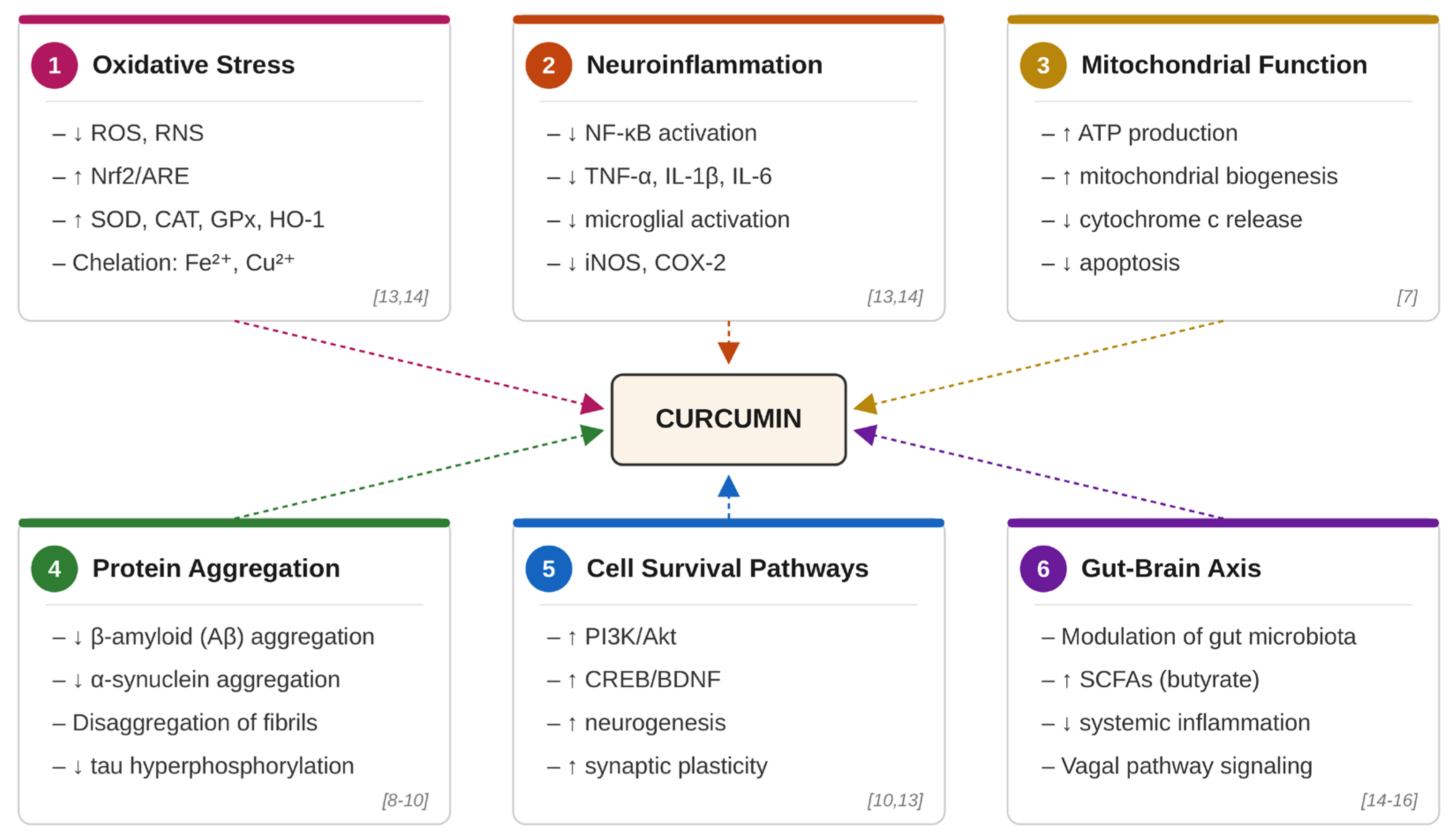
Following the introduction of the clinical relevance of neurodegenerative diseases and the therapeutic promise of curcumin, it is appropriate to briefly review the molecular mechanisms through which this polyphenol exerts its neuroprotective effects. This knowledge is essential for understanding why the pharmacokinetic limitations of curcumin (discussed in the following section) represent such a critical obstacle to its clinical translation, and why the development of DDSs (addressed in Section 4) has become the predominant strategy for unlocking its therapeutic potential. The principal mechanisms of action of curcumin for which consistent preclinical evidence is available are summarized below. These mechanistic axes are summarized in Figure 1.
2.1. Modulation of Signaling Pathways Involved in Neuronal Survival and Cell Death
Curcumin modulates several intracellular signaling pathways that are critical for neuronal survival and function. In the context of inflammation, curcumin inhibits the activation of nuclear factor kappa B (NF-κB), a master regulator of the inflammatory response, thereby reducing the production of pro-inflammatory cytokines (TNF-α, IL-1β, and IL-6) and microglial activation [13,14]. In terms of antioxidant defense, curcumin activates the Nrf2/ARE pathway, inducing the expression of endogenous antioxidant enzymes, including superoxide dismutase, catalase, and glutathione peroxidase, thereby conferring protection against oxidative stress [13,14]. Regarding neuronal survival, curcumin activates the PI3K/Akt and CREB/BDNF signaling pathways, promoting synaptic plasticity, neurogenesis, and cell survival [10,13]. Furthermore, curcumin directly inhibits the aggregation of β-amyloid and α-synuclein and modulates tau phosphorylation, making it a particularly attractive therapeutic candidate for Alzheimer's disease (AD) and Parkinson's disease (PD) [8,9,10].
2.2. Peripheral Actions and Modulation of the Gut-Brain Axis
Beyond its direct effects on the central nervous system (CNS), curcumin exerts peripheral actions that may contribute significantly to its neuroprotective effects. Chronic low-grade systemic inflammation, a hallmark of aging and many NDs, is a well-recognized driver of neurodegenerative progression. When administered orally, curcumin reduces systemic inflammatory markers, including C-reactive protein (CRP), tumor necrosis factor-alpha (TNF-α), and interleukin-6 (IL-6), in numerous clinical studies, suggesting a systemic anti-inflammatory effect that may indirectly benefit neuronal function [14,15]. Moreover, curcumin modulates the composition of the gut microbiota by increasing the abundance of short-chain fatty acid (SCFA)-producing bacteria (butyrate and propionate) while reducing the abundance of pro-inflammatory bacterial species. These changes, in turn, influence intestinal barrier integrity, systemic inflammation, and brain function through the gut-brain axis [16]. These peripheral actions are particularly relevant for interpreting the biological effects of oral curcumin formulations, which, despite their limited systemic bioavailability, may exert pharmacological activity through indirect mechanisms involving peripheral signaling pathways and metabolite-mediated effects [12,14].
Figure 1.
Multitarget Mechanisms of Curcumin in Neurodegeneration. Curcumin exerts neuroprotective effects through six interconnected molecular mechanisms: (1) reduction of oxidative stress through activation of the Nrf2/ARE pathway and enhancement of endogenous antioxidant defenses; (2) inhibition of neuroinflammation through suppression of the NF-κB pathway and microglial activation; (3) improvement of mitochondrial function and cellular bioenergetics; (4) interference with the aggregation of pathological proteins (β-amyloid, α-synuclein, and tau); (5) activation of cell survival pathways (PI3K/Akt and CREB/BDNF) and promotion of neurogenesis; and (6) modulation of the gut-brain axis and gut microbiota. Abbreviations: ARE, antioxidant response element; BDNF, brain-derived neurotrophic factor; CREB, cAMP response element-binding protein; NF-κB, nuclear factor kappa B; Nrf2, nuclear factor erythroid 2-related factor 2; PI3K/Akt, phosphoinositide 3-kinase/protein kinase B; SCFAs, short-chain fatty acids; ATP, adenosine triphosphate; COX-2, cyclooxygenase-2; GPx, glutathione peroxidase; HO-1, heme oxygenase-1; IL-1β, interleukin-1 beta; IL-6, interleukin-6; iNOS, inducible nitric oxide synthase; RNS, reactive nitrogen species; ROS, reactive oxygen species; SOD, superoxide dismutase; TNF-α, tumor necrosis factor-alpha; CAT, catalase.
Figure 1.
Multitarget Mechanisms of Curcumin in Neurodegeneration. Curcumin exerts neuroprotective effects through six interconnected molecular mechanisms: (1) reduction of oxidative stress through activation of the Nrf2/ARE pathway and enhancement of endogenous antioxidant defenses; (2) inhibition of neuroinflammation through suppression of the NF-κB pathway and microglial activation; (3) improvement of mitochondrial function and cellular bioenergetics; (4) interference with the aggregation of pathological proteins (β-amyloid, α-synuclein, and tau); (5) activation of cell survival pathways (PI3K/Akt and CREB/BDNF) and promotion of neurogenesis; and (6) modulation of the gut-brain axis and gut microbiota. Abbreviations: ARE, antioxidant response element; BDNF, brain-derived neurotrophic factor; CREB, cAMP response element-binding protein; NF-κB, nuclear factor kappa B; Nrf2, nuclear factor erythroid 2-related factor 2; PI3K/Akt, phosphoinositide 3-kinase/protein kinase B; SCFAs, short-chain fatty acids; ATP, adenosine triphosphate; COX-2, cyclooxygenase-2; GPx, glutathione peroxidase; HO-1, heme oxygenase-1; IL-1β, interleukin-1 beta; IL-6, interleukin-6; iNOS, inducible nitric oxide synthase; RNS, reactive nitrogen species; ROS, reactive oxygen species; SOD, superoxide dismutase; TNF-α, tumor necrosis factor-alpha; CAT, catalase.
3. Pharmacokinetic Limitations of Native Curcumin
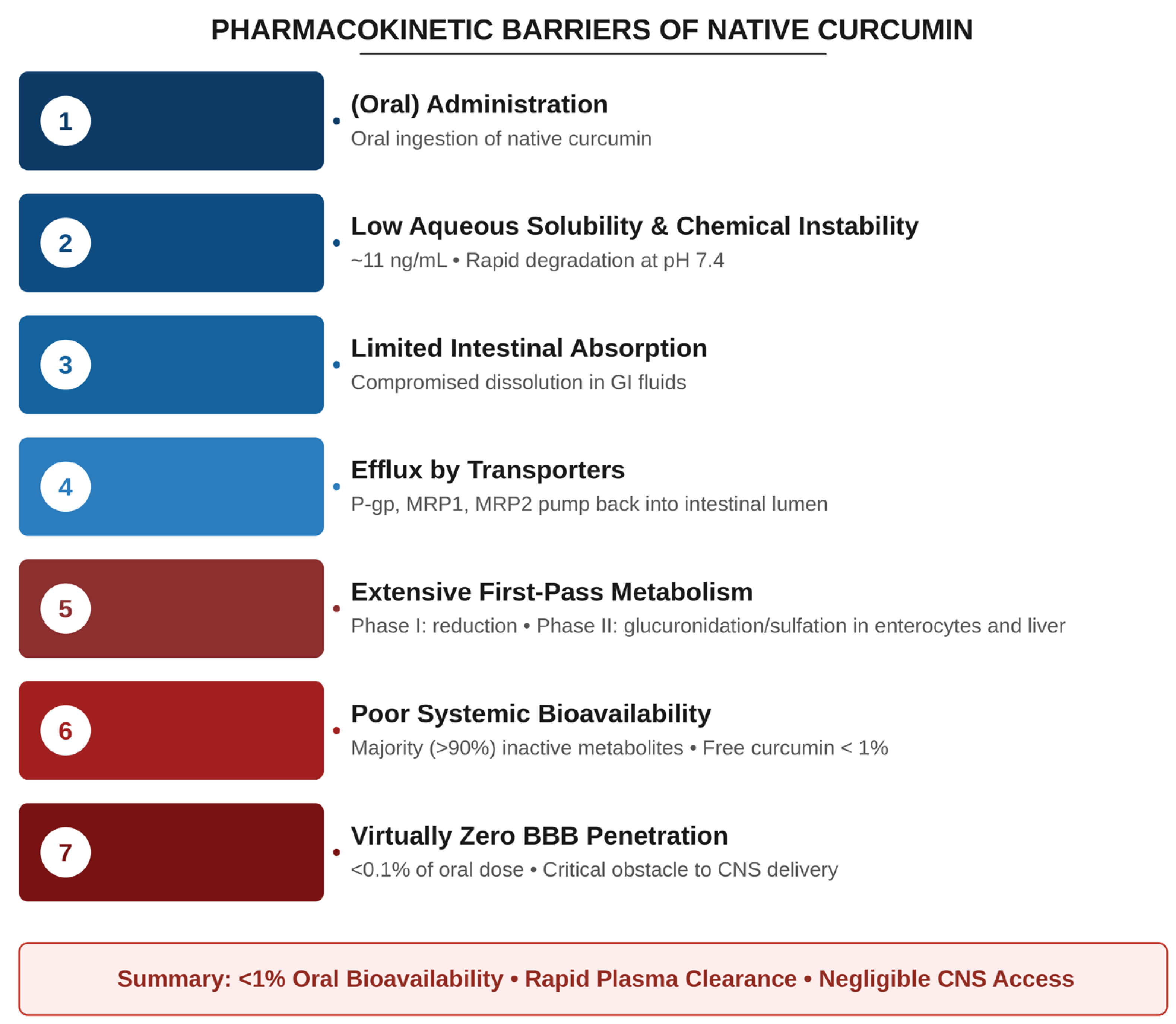
The pharmacokinetic profile of orally administered curcumin is determined by a series of intrinsic physicochemical properties that collectively limit its systemic exposure and, potentially, its access to the CNS. These limitations have been extensively described in preclinical and clinical pharmacokinetic studies and represent a major challenge that DDSs must overcome to enhance the therapeutic potential of curcumin in neurological disorders [11,12]. These barriers are summarized in Figure 2.
3.1. Poor aqueous Solubility and Physicochemical Properties
Curcumin is a highly hydrophobic molecule with an octanol/water partition coefficient (log P) of approximately 3.2, resulting in an estimated aqueous solubility of only 11 ng/mL (~30 nM) under physiological conditions. This pronounced hydrophobicity limits its dissolution in gastrointestinal fluids and, consequently, its passive absorption across the intestinal epithelium. In addition, curcumin is highly susceptible to degradation under alkaline conditions, exhibiting a half-life of approximately 10 minutes in phosphate buffer at pH 7.4 [17]. These physicochemical properties represent the first bottleneck that any formulation must address, since, without adequate solubilization and protection against degradation, subsequent processes (absorption and distribution) are inevitably compromised [12,18].
3.2. Limited Intestinal Absorption and Efflux Transporters
Even when solubilized, curcumin exhibits poor intestinal absorption, partly due to its recognition by intestinal efflux transporters such as P-glycoprotein (P-gp) and multidrug resistance-associated proteins (MRP1 and MRP2) [8]. Animal studies have shown that oral administration of curcumin at a dose of 2 g/kg in rats improves the systemic bioavailability of curcumin by as much as 154% and produces a maximum serum concentration (Cmax) of only 1.35 ± 0.23 μg/mL [19]. In a separate pharmacokinetic study, intravenous administration of 10 mg/kg produced a Cmax of 0.36 ± 0.05 μg/mL and an estimated absolute oral bioavailability of approximately 1%, highlighting the poor systemic availability of native curcumin after oral administration [20]. In humans who ingested 2 g of pure curcumin powder after fasting, plasma curcumin was less than 10 ng/mL 1 h post-dose [21]. In the same study, co-ingestion of curcumin with 20 mg of piperine appeared to increase curcumin bioavailability by 2000%. In a study of oral curcumin, patients with preinvasive malignant or high-risk premalignant conditions of the bladder, skin, cervix, stomach, or oral mucosa received 0.5-8 g curcumin by mouth daily for 3 months. [18] Plasma curcumin concentrations were found to peak 1-2 h after intake and gradually declined within 12 hours. The 8-g/day dose resulted in a peak serum concentration of 1.75 ± 0.80 M. When micronized curcumin was administered orally with orange juice at doses of 50-200 mg to 18 healthy volunteers, it was not detected in plasma at or above the limit of quantitation (approximately 0.63 ng/mL). To summarize, it appears that low systemic bioavailability following oral dosing is consistent with the findings in preclinical models; efficient first-pass and some degree of intestinal metabolism of curcumin, particularly glucuronidation and sulfation, might explain its poor systemic availability when administered via the oral route. These findings explain why most of the ingested curcumin (>90%) does not reach the systemic circulation in its active form but is instead excreted in the feces or converted into inactive conjugated metabolites [12,18,22].
3.3. Extensive First-Pass Metabolism
Curcumin undergoes particularly extensive first-pass metabolism involving intestinal, hepatic, and renal enzymes. During Phase I metabolism, NADPH-dependent reductases present in enterocytes and hepatocytes reduce the double bonds of curcumin, generating a series of reduced metabolites, including dihydrocurcumin, tetrahydrocurcumin, hexahydrocurcumin, and octahydrocurcumin [12,18]. These metabolites partially retain the biological activity of the parent compound. During Phase II metabolism, curcumin and its Phase I metabolites undergo extensive conjugation by sulfotransferases (SULT1A1 and SULT1A3 in the cytosol) and microsomal uridine 5′-diphospho-glucuronosyltransferases (UGTs), generating highly polar glucuronide and sulfate conjugates that are virtually devoid of biological activity and are rapidly eliminated via the bile and urine [12,22]. Intestinal microbiota-mediated metabolism adds a further layer of complexity, as commensal bacteria can transform curcumin into metabolites such as dihydroferulic acid and ferulic acid, which exhibit biological activity and bioavailability profiles distinct from those of the parent compound [16]. Collectively, this extensive metabolism drastically reduces the amount of free curcumin available to exert pharmacological effects. Furthermore, a recent pharmacokinetic study has indicated that most claims regarding the bioavailability of commercial formulations are based on measurements of inactive conjugates, which may have led to an overestimation of the actual improvement in exposure to the active compound [12,22].
3.4. Limited Penetration Across the Blood-Brain Barrier (BBB)
The BBB represents the most critical obstacle to curcumin delivery to the CNS. The BBB is a highly selective interface composed of tightly connected endothelial cells, pericytes, astrocytes, and a basement membrane, which strictly limits the passage of substances from the bloodstream into the brain parenchyma [1]. Owing to its hydrophobicity and relatively high molecular weight (~368 g/mol), curcumin exhibits a very limited capacity for passive diffusion across the BBB, and its concentration in brain tissue following systemic administration at standard doses is virtually undetectable, as demonstrated in preclinical studies using radiolabeled curcumin [11,12]. This limitation has been recognized as the principal bottleneck in the development of effective treatments for NDs based on natural compounds and has driven the development of active targeting strategies and DDSs specifically designed to cross or modulate the BBB [9,14]. Recent studies have demonstrated that even curcumin formulations with high systemic bioavailability do not guarantee significant brain accumulation unless they incorporate explicit BBB-crossing strategies, highlighting the need to integrate both improved bioavailability and brain-targeting capability into the design of DDSs [9,11].
Figure 2.
Pharmacokinetic barriers of native curcumin. Native curcumin exhibits very low aqueous solubility (~11 ng/mL), limited intestinal absorption with P-gp and MRP efflux, extensive first-pass hepatic metabolism (glucuronidation and sulfation), and virtually zero blood-brain barrier (BBB) penetration (<0.1% of the oral dose), resulting in <1% oral bioavailability, rapid plasma clearance, and negligible CNS access. BBB: blood-brain barrier; GI: gastrointestinal; MRP: multidrug resistance-associated protein; P-gp: P-glycoprotein.
Figure 2.
Pharmacokinetic barriers of native curcumin. Native curcumin exhibits very low aqueous solubility (~11 ng/mL), limited intestinal absorption with P-gp and MRP efflux, extensive first-pass hepatic metabolism (glucuronidation and sulfation), and virtually zero blood-brain barrier (BBB) penetration (<0.1% of the oral dose), resulting in <1% oral bioavailability, rapid plasma clearance, and negligible CNS access. BBB: blood-brain barrier; GI: gastrointestinal; MRP: multidrug resistance-associated protein; P-gp: P-glycoprotein.
4. Advanced Curcumin-Based Drug Delivery Systems (DDS)
The recognition of the pharmacokinetic limitations described in the previous section has driven, in the last two decades, a substantial research effort aimed at the design of DDS capable of solubilizing, protecting, delivering, and releasing curcumin in a controlled and, when possible, specific manner at the site of action. These systems, ranging from classic lipid vehicles to state-of-the-art nanotechnology platforms, share a common goal: to improve the bioavailability of curcumin and, in the context of NDs, to facilitate its access to the CNS. The main DDS families are systematically examined below, with an emphasis on their mechanisms of action, preclinical evidence and, where available, clinical evidence in the field of NDs.
4.1. Lipid-Based Systems
Lipid-based systems represent one of the most mature and thoroughly characterized strategies for curcumin delivery. Their primary advantage lies in their ability to solubilize highly hydrophobic compounds within a biocompatible lipid matrix, thereby enhancing intestinal absorption and protecting curcumin from degradation in the gastrointestinal environment. Within this family, several subclasses with distinct characteristics can be distinguished.
4.1.1. Liposomes
Liposomes are spherical vesicles composed of one or more phospholipid bilayers that enclose an aqueous core, allowing them to deliver drugs as well as proteins, nucleotides, or plasmids [23]. In the case of curcumin, which is highly lipophilic, it is incorporated into the lipid bilayer, which markedly improves its apparent solubility. Preclinical studies have shown that curcumin-loaded liposomes are capable of crossing the BBB and accumulating in brain tissue, where they exert neuroprotective effects in animal models of AD. For example, in a mouse model of AD, curcumin liposomes reduced angiotensin-converting enzyme activity in specific brain regions and improved spatial memory compared to free curcumin [24]. More recently, mucoadhesive liposomal formulations for intranasal administration have demonstrated greater cerebral absorption, opening an encouraging avenue for bypassing the BBB via the nasal route [23]. The main limitation of classical liposomes is their limited physicochemical stability (susceptibility to lipid oxidation, aggregation in plasma) and their rapid clearance by the reticuloendothelial system - factors that have driven the development of second-generation formulations with pegylated lipids (“stealth liposomes”) and active targeting ligands [23].
4.1.2. Solid Lipid Nanoparticles and Nanostructured Lipid Carriers
Solid lipid nanoparticles (SLNs) are colloidal systems composed of a lipid matrix that is solid at body temperature and stabilized by a surfactant, which allows for the incorporation of lipophilic drugs. SLNs offer advantages over liposomes in terms of physicochemical stability, production scalability, and protection against degradation, although their loading capacity is limited by the tendency of the active ingredient to be expelled during the cooling and solidification of the matrix. To overcome this limitation, nanostructured lipid carriers (NLCs) were developed, which combine a solid lipid matrix with a liquid lipid component (usually a triglyceride), thereby increasing the loading capacity and reducing drug expulsion [11,25]. In a pivotal preclinical study conducted by Malvajerd et al., curcumin was encapsulated in SLNs and NLCs, and cerebral accumulation was evaluated following intravenous administration in rats (4 mg/kg). The results demonstrated that curcumin-loaded NLCs achieved a cerebral AUC0-t of 505.76 ng/g· h, markedly higher than that of SLNs (116.31 ng/g·h) and, above all, that of free curcumin (0.00 ng/g·h), underscoring the potential of these systems to deliver curcumin to the CNS [25]. Subsequent studies have confirmed that curcumin NLCs improve brain bioavailability, attenuate β-amyloid aggregation in AD models, and exert antioxidant and anti-inflammatory effects in cellular models of oxidative stress [26].
4.1.3. Nanoemulsions and Self-Emulsifying Systems
Nanoemulsions are colloidal dispersions of oil in water, stabilized by surfactants, with a droplet size typically ranging from 20 to 200 nm. Self-emulsifying systems (SNEDD) are a preconcentrated variant that, upon contact with gastrointestinal fluids under gentle agitation, spontaneously form a nanoemulsion. Both formats exhibit an excellent ability to solubilize curcumin and have demonstrated substantial improvements in oral bioavailability [9,11,27]. Curcumin nanoemulsions have also shown neuroprotective activity in animal models of cerebral ischemia and AD, with significant reductions in markers of oxidative stress and microglial inflammation [9,14,27]. Their appeal from a translational perspective lies in the scalability of the manufacturing process (high homogenization or microfluidization pressures) and in the possibility of incorporating targeting ligands into the interfacial phase.
4.2. Polymer-Based Systems
Polymeric systems constitute another broad and versatile class of DDS, characterized by high chemical diversity, high loading capacity, and tuneable drug release governed by the selection of the polymer and its architecture.
4.2.1. PLGA nanoparticles
Poly (lactic-co-glycolic acid) (PLGA) is one of the most widely used biodegradable polymers in nanoparticle formulation, supported by a safety profile endorsed by its approval by major regulatory agencies (FDA, EMA) for use in sustained-release parenteral products. Curcumin-loaded PLGA nanoparticles are typically obtained via solvent emulsion-evaporation or nanoprecipitation techniques, exhibiting particle sizes ranging from 76 to 264 nm, encapsulation efficiencies exceeding 78%, and sustained drug release over days to weeks [9,28,29]. In the context of NDs, curcumin-loaded PLGA nanoparticles have demonstrated several beneficial effects in preclinical models: inhibition of β-amyloid aggregation and tau phosphorylation in cellular and animal models of AD; attenuation of oxidative stress and mitochondrial dysfunction in PD models; and improvement of cognitive function and memory in APP/PS1 transgenic rodents [9,13,28,29]. Recent studies have explored surface functionalization of these nanoparticles with targeting ligands or peptides (transferrin, TET-1) to increase their brain accumulation, yielding promising results in terms of specificity and the magnitude of the neuroprotective effect [9,14,28,29].
4.2.2. Other Biodegradable Polymers and Polymeric Micelles
In addition to PLGA, other biodegradable polymers have been evaluated for curcumin delivery, most notably chitosan (a naturally derived cationic polysaccharide with mucoadhesive properties and the ability to transiently open epithelial tight junctions), hyaluronic acid, cyclodextrin, and alginate. Chitosan has generated particular interest owing to its capacity to enhance the paracellular transport of curcumin across the nasal mucosa-facilitating entry into the CNS via the olfactory pathway-as well as its additive effect on the inhibition of amyloid aggregation [9,28]. Polymeric micelles, formed by the self-assembly of amphiphilic copolymers in aqueous solution, feature a hydrophobic core that solubilizes curcumin and a hydrophilic shell that confers steric stability and prolongs blood circulation time. Micelles composed of Pluronic®, PEG-PLA, PEG-PCL, and mPEG-PLGA are the most extensively studied in the context of curcumin delivery, with documented increases in oral bioavailability, half-life, and brain distribution of curcumin compared to the native compound in animal models [9,28].
4.3. Phospholipid Complexes and Phytosomes
Phospholipid complexes, also known as phytosomes when involving botanical extracts, are stoichiometric associations between an active pharmaceutical ingredient and a phospholipid (typically soybean or sunflower phosphatidylcholine) that form a supramolecular entity with enhanced bioavailability relative to the free active compound [30]. In the case of curcumin, complexation with phosphatidylcholine modulates its interaction with biological membranes and enhances intestinal absorption, presumably via a phospholipid-mediated facilitated diffusion mechanism. The commercial product Meriva® (Indena S.p.A., Italy), a curcumin phytosome formulated with soybean phosphatidylcholine at an approximate 1:2 ratio, represents one of the most extensively studied curcumin DDS in clinical settings [25]. Pharmacokinetic studies have demonstrated that Meriva® increases the oral absorption of curcuminoids by a factor of >20 relative to unformulated curcumin [25]. In the context of NDs, a randomized clinical trial evaluating Meriva® in osteoarthritis patients reported improvements in systemic inflammatory biomarkers, suggesting potentially relevant effects for modulating ND-associated chronic inflammation, although specific clinical trials in AD, PD, or ALS have not been conducted to date [31].
4.4. Solid Dispersions and Nanocrystals
Solid dispersions are systems in which the active pharmaceutical ingredient is dispersed at the molecular level within a polymeric or hydrophilic matrix, thereby markedly increasing its dissolution rate and, consequently, its bioavailability. Nanocrystals-composed exclusively of the active drug without requiring excipients-represent a particularly attractive variant owing to their high drug loading and formulation versatility [32]. Theracurmin® (Theravalues Corporation, Japan) is a submicron colloidal dispersion of curcumin within a hydrophilic matrix, consisting of 10 w/w% of curcumin, 2% of other curcuminoids such as demethoxycurcumin and bisdemethoxycurcumin, 46% of glycerin, 4% of gum ghatti, and 38% of water. Pharmacokinetic studies in humans have demonstrated that Theracurmin® increases the curcumin AUC by approximately 27-fold relative to unformulated curcumin powder, exhibiting a favorable safety profile and adequate tolerability at doses up to 400 mg/day [33,34]. In the neurological domain, a recent clinical trial evaluating Theracurmin® in patients with mild-to-moderate AD reported beneficial effects on cognitive function, although the small sample size and limited study duration preclude drawing definitive conclusions. Longvida® (Verdure Sciences, USA) represents another notable example of an optimized curcumin formulation, with documented improvements in bioavailability compared with native curcumin, alongside encouraging results from a randomized clinical trial assessing cognition in healthy older adults [34,35].
4.5. Active Targeting Systems and Surface Functionalization
The concept of active targeting relies on modifying the surface of nanoparticles with ligands recognized by receptors or transporters preferentially expressed on target cells, thereby enhancing drug accumulation at the site of action and minimizing distribution to non-target tissues. In the context of NDs and CNS access, transferrin receptors (TfR) and lactoferrin receptors (LfR)-abundantly expressed on BBB endothelial cells-are the most widely exploited targets [4,10]. Functionalization of PLGA nanoparticles or liposomes with transferrin or anti-TfR monoclonal antibodies has demonstrated significant increases in brain uptake of curcumin in animal models, achieving 5- to 10-fold enhancements relative to non-functionalized nanoparticles [9,36]. Similarly, cell-penetrating peptides (CPPs, such as TAT and penetratin), specific brain endothelium-targeting peptides (TET-1), and folate or LDL receptor ligands have been employed to enhance the neuronal uptake of encapsulated curcumin [9,13,14]. A particularly compelling aspect is the development of stimuli-responsive delivery systems that release curcumin in response to intrinsic cues from the pathological microenvironment (acidic pH, elevated reactive oxygen species levels, presence of matrix metalloproteinases), enabling selective drug release within damaged tissue while mitigating systemic toxicity [9,12,28].
4.6. Emerging Technologies: Exosomes, 3D printing Systems, and Intranasal Administration
Among the most recent technologies with high potential for CNS curcumin delivery are exosomes-extracellular vesicles of cellular origin, 30-150 nm in diameter, possessing intrinsic biocompatibility and an innate ability to cross biological barriers, including the BBB [37]. Exosomes can be loaded with curcumin using various strategies (drug incubation, sonication, parental cell transfection) and surface-modified to enhance their target specificity. Recent studies have demonstrated that curcumin-loaded exosomes decorated with specific ligands, such as anti-DAT scFv antibody fragments, selectively accumulate in dopaminergic brain regions and exert neuroprotective effects in animal models of Parkinson’s disease [37,38]. Complementarily, stimuli-responsive nanogels (pH, temperature, ROS) enable controlled curcumin release within the neuroinflammatory microenvironment; copper- or zinc-based metal-organic frameworks (MOFs) offer hybrid platforms capable of co-delivering curcumin with other therapeutic agents alongside sustained release [39]; microneedle patches incorporating curcumin encapsulated in mucoadhesive hydrogels have shown efficacy in topical and transdermal applications targeting the CNS [40]; and curcumin-functionalized carbon quantum dots (carbon dots) combine imaging and therapeutic capabilities (theranostics) within a single platform [41]. These technologies, along with 3D-printed scaffolds loaded with curcumin [42] and injectable long-acting hydrogels [43], represent the most active translational frontier in the field and should be prioritized in future research.
To provide a comprehensive overview of the strategies currently available for curcumin delivery across the blood-brain barrier (BBB), Figure 3 summarizes the six main transport routes: passive diffusion, carrier-mediated transport (CMT), receptor-mediated transcytosis (RMT), adsorptive-mediated transcytosis (AMT), the intranasal route, and exosome-mediated transport. Among these, the intranasal route, exosome-mediated transport, and 3D printing systems represent the most clinically promising emerging approaches, which are addressed in detail in the following subsections.
4.7. Synergistic Combination Strategies and Multi-Target Approaches: The Logic of Polytherapy with Curcumin
4.7.1. Mechanistic Justification of Polytherapy in Neurodegenerative Diseases
Neurodegenerative diseases share a multifactorial pathogenic architecture in which at least six processes converge, with varying relative importance depending on the disease and its stage: oxidative stress, chronic neuroinflammation, mitochondrial dysfunction, pathogenic protein aggregation, disruption of neuronal survival pathways, and dysbiosis of the gut-brain axis (see section 2). This convergence is responsible for the fact that the monotherapy approach, even with pleiotropic molecules such as curcumin, only partially covers the range of pathogenic targets. Curcumin robustly modulates mainly three principal axes -the Nrf2/ARE pathway, the NF-κB pathway, and the aggregation of misfolded proteins (β-amyloid, α-synuclein, TDP-43)- but it does not directly cover equally relevant processes such as the dysregulation of neuroprotective hormonal pathways, SIRT-1-mediated synaptic dysfunction, or glutamatergic excitotoxicity. This mechanistic gap constitutes the rationale for exploring synergistic combinations in which curcumin is associated with other agents that address the gaps not reached by its pharmacological profile.
A second justification, of a pharmacokinetic nature, arises from the limitations described in section 3. Shoba et al. [19] already demonstrated in 1998 that coadministration of curcumin with 20 mg of piperine increases its bioavailability by 2000% in healthy volunteers, through inhibition of UDP-glucuronosyltransferase and hepatic and intestinal sulfation.
From a technological standpoint, the fourth-generation platforms described in Section 4 (liposomes, NLCs, polymeric nanoparticles, nanogels, exosomes) are particularly suitable for the co-encapsulation of multiple active compounds with different solubility profiles within a single particle with shared release kinetics. This approach, which Huang M, et al. have technically demonstrated to be feasible for curcumin and resveratrol in liposomes, transforms the liposomal DDS from a mere carrier of a single active compound into a targeted combination platform, simplifying the dosing regimen and reducing interindividual variability.
4.7.2. Combinations with Preclinical Evidence
Among the combinations that have been proposed, the following stand out for their potential in terms of bioavailability and efficacy:
Curcumin + piperine. The pharmacokinetic synergism described by Shoba et al. (1998) represents the best-characterized combination in terms of bioavailability. Beyond the effect on absorption, both compounds share anti-inflammatory mechanisms (inhibition of NF-κB, COX-2) and antioxidant mechanisms (Nrf2 activation, ROS scavenging), suggesting a potential pharmacodynamic synergy that has not been explored in depth in neurodegenerative disease models. The required piperine dose (5-20 mg) is much lower than that of curcumin (0.5-8 g), which facilitates formulation in a single dosage unit [15].
Curcumin + resveratrol. Both polyphenols act on complementary targets: curcumin on the NF-κB/Nrf2 pathway and protein aggregation; resveratrol on SIRT-1, the AMPK/mTOR pathway, and microglial modulation [44]. Co-encapsulation in liposomes, demonstrated by Huang et al. (2019), achieves sustained-release profiles and improved stability compared with free compounds, with documented synergistic effects in cancer models and, more recently, in neurodegeneration models. In the context of ALS, both polyphenols have shown neuroprotective effects in TDP-43 cellular models (curcumin) and in lateral sclerosis models (resveratrol), although the specific combination has been little explored until recently [45].
Curcumin + EGCG (epigallocatechin gallate). Zhou DH et al. [46] demonstrated that the combination of low concentrations of EGCG and curcumin synergistically suppresses the growth of lung cancer cell lines through cell cycle arrest, an effect that has been replicated in other tumor models. In the neurodegenerative field, both compounds share antioxidant and anti-inflammatory mechanisms, but with distinct affinity profiles: EGCG shows greater affinity for modulating amyloid aggregation and inhibiting NADPH oxidase, whereas curcumin acts preferentially on the Nrf2 pathway. This complementarity supports their interest as a combination, although preclinical evidence in ND models is still limited.
Curcumin + dutasteride. Proaño et al. [47] proposed dutasteride (which is a dual inhibitor of 5α-reductase isoforms 1 and 2, approved for the treatment of benign prostatic hyperplasia and androgenetic alopecia) as a candidate for the treatment of ALS, based on: 1) neuroprotective, antioxidant, and anti-inflammatory effects demonstrated in preclinical models; 2) documented efficacy against glutamate toxicity; 3) restoration of altered dopaminergic activity; and 4) direct effects on TDP-43 folding, mediated both by hormonal mechanisms (modulation of testosterone, progesterone, and 17β-estradiol) and by non-hormonal mechanisms. The combination with curcumin complements the target profile, as dutasteride provides the hormonal and glutamatergic modulation dimension absent from curcumin’s pharmacological profile.
5. Applications by Disease: Status of Preclinical and Clinical Evidence
5.1. Alzheimer’s Disease (AD)
AD is, by far, the field of neurodegeneration in which curcumin has accumulated the most preclinical evidence, due both to the long history of research and the availability of well-characterized animal models. The molecular mechanisms through which curcumin has demonstrated effects on AD are convergent and can be grouped into four main categories. Firstly, curcumin directly inhibits the aggregation of the β-amyloid peptide, blocks the formation and elongation of Aβ fibrils, and promotes the destabilization of preformed fibrils. Ono et al. demonstrated that curcumin exhibits potent anti-amyloidogenic activity against Aβ fibril formation in vitro [26]; Lim et al. observed in the APPsw model that curcumin reduced both the amyloid plaque burden and cerebral oxidative damage [48], a finding confirmed and quantified by Yang et al., who demonstrated that curcumin binds directly to Aβ amyloid species and senile plaques, inhibits the formation of Aβ oligomers and fibrils, and reduces cerebral amyloid burden in vivo [49]; these observations were expanded upon by Garcia-Alloza et al., who demonstrated through in vivo fluorescence imaging that curcumin not only labels preexisting amyloid plaques but is also capable of disrupting their structure and partially restoring distorted neurites in an animal model of AD [50], and by Ahmed et al., who observed that curcuminoids improve spatial memory in a rat model with β-amyloid infusion [51]. Moreover, curcumin modulates tau-associated pathology by reducing soluble tau species and hyperphosphorylation of this protein, promotes mechanisms involved in its clearance, and attenuates neuronal and synaptic dysfunction in experimental models [52,53,54]. In addition, it inhibits the microglia-mediated neuroinflammatory response via the NF-κB/NLRP3 pathway, reducing glial activation and the sustained production of proinflammatory cytokines [55,56]. Curcumin also chelates redox-active metals (Cu²⁺, Zn²⁺ and Fe²⁺) involved in amyloid aggregation and oxidative damage [57]. Finally, curcumin activates the PI3K/Akt signaling pathway and enhances Nrf2-mediated antioxidant responses, increasing the expression of cytoprotective enzymes such as HO-1 and reducing neuronal oxidative stress [58].
From a clinical perspective, the translation of curcumin research into clinical practice for AD has been more protracted and complex than for other neurodegenerative diseases. The first randomized, double-blind, placebo-controlled clinical trial, conducted by Baum et al. (2008) using native curcumin (1-4 g/day for 6 months), showed no significant differences compared to placebo in the primary cognitive outcomes, although tolerability was good [59]. The observed lack of clinical efficacy has been attributed, at least in part, to the low bioavailability of native curcumin, which spurred the development of new formulations with greater systemic absorption. Among these, the Longvida® solid lipid formulation has shown promising results in studies conducted in healthy older adults. In an initial randomized clinical trial, Cox et al. observed that administration of Longvida® significantly improved various cognitive domains, including working memory and sustained attention, in addition to reducing fatigue and improving mood both following acute administration and after four weeks of treatment [35]. These findings were subsequently corroborated by a second clinical trial conducted by the same group, in which 12 weeks of supplementation produced further improvements in working memory, learning, and fatigue, accompanied by a reduction in circulating triglyceride levels, although there were no significant changes in most of the other systemic biomarkers assessed [60]. However, these results come from individuals without dementia, so their extrapolation to patients with Alzheimer’s disease should be interpreted with caution; Small et al. (2018) reported beneficial effects on memory and brain amyloid accumulation as measured by PET in non-demented adults using a bioavailable curcumin formulation [61]; and Cox et al. (2015) demonstrated improvements in cognition and mood in healthy older adults using Longvida® [35]. The systematic review by Voulgaropoulou et al. (2019) on the effect of curcumin on cognition, which included 32 preclinical studies and 5 clinical trials in patients with AD or healthy aging, concluded that, although the preclinical evidence is robust, clinical trials remain limited and show inconsistent results due to their high methodological heterogeneity, differences in the formulations used, and pharmacokinetic limitations, highlighting the need for more standardized clinical trials with formulations that offer greater bioavailability [62]. The review by Chainoglou and Hadjipavlou-Litina (2020) highlighted several curcumin analogues, derivatives, and hybrids with enhanced biological activity and potential therapeutic relevance for Alzheimer’s disease [8].
Overall, AD represents the field in which the discrepancy between consistent preclinical evidence and clinical findings remains particularly evident, largely due to the pharmacokinetic limitations of native curcumin. To overcome these barriers, emerging delivery strategies-including curcumin-conjugated magnetic nanoparticles for amyloid plaque imaging [63], multifunctional nanoliposomes with brain-targeting properties [64], polymeric nanoparticles, intranasal delivery systems, and ligand-functionalized nanocarriers designed to improve blood-brain barrier transport-are being investigated as potential approaches to bridge this translational gap [9]. Furthermore, recent studies have expanded the therapeutic arsenal with curcumin derivatives designed for in vivo imaging of amyloid plaques, as well as CNS delivery systems thoroughly reviewed by Ege [11]; a review summarizing the protective effects of curcumin against amyloid-β toxicity, oxidative stress, and mitochondrial dysfunction in Alzheimer’s disease models [65], and an integrative perspective on curcumin as a compound for cerebral anti-aging [66], consolidating curcumin and its analogs as one of the most consistent lines of preclinical and translational research in AD. Phase II/III clinical trials are urgently needed, using DDS specifically optimized for AD, with a duration of ≥18 months, CSF exposure biomarkers (free curcumin), and combined clinical-biological endpoints (cognition + amyloid PET + plasma tau) to establish the true clinical efficacy of curcumin in this disease.
5.2. Parkinson's Disease (PD)
PD is the second most studied area of application for curcumin in neurodegeneration, with a particularly large body of preclinical evidence in well-established animal models (MPTP, 6-OHDA, rotenone) but, as noted, still very limited clinical evidence. The molecular mechanisms through which curcumin has demonstrated effects in PD can be summarized into four main pathways. To begin with, curcumin reduces the accumulation of α-synuclein and protects against dopaminergic neurodegeneration. Sharma and Nehru demonstrated that curcumin reduces α-synuclein aggregation and dopaminergic neurodegeneration in a lipopolysaccharide-induced PD model, and that these effects correlate with a sustained reduction in the striatal inflammatory response [67]. Secondly, curcumin protects mitochondrial function and attenuates mitochondria-dependent apoptosis. Pan et al. demonstrated that curcumin prevents dopaminergic neuronal loss in the MPTP model by inhibiting JNK signaling, thereby attenuating mitochondrial dysfunction and apoptosis [68], and He et al. observed that dietary supplementation with curcumin attenuates MPTP-induced neurotoxicity, reduces the activation of microglia and astrocytes, and enhances the expression of neurotrophic and neuroprotective factors, including GDNF and TGF-β1, thereby contributing to the protection of the nigrostriatal dopaminergic system [69]. Furthermore, curcumin inhibits the neuroinflammatory response by modulating microglial activation and inhibiting the NF-κB pathway, thereby reducing the sustained production of proinflammatory cytokines and promoting neuronal preservation [70]. Finally, curcumin protects against p53-mediated dopaminergic apoptosis, as demonstrated by Jaisin et al. in SH-SY5Y cells treated with 6-OHDA, showing that curcumin reduces p53 phosphorylation, decreases the Bax/Bcl-2 ratio, and significantly attenuates neuronal apoptosis [71], and Qualls et al., who observed protective effects of curcumin against toxicity induced by rotenone and salsolinol- two experimental neurotoxic insults widely used to model dopaminergic degeneration in Parkinson’s disease research [72].
From a clinical perspective, the translation of curcumin in Parkinson’s disease is, to date, the most limited of all the neurodegenerative diseases analyzed in this review. A pilot randomized, triple-blind, placebo-controlled clinical trial conducted by Ghodsi et al. (2022) evaluated nanomicellar curcumin (80 mg/day) as an adjunctive therapy to standard dopaminergic treatment in patients with idiopathic PD over nine months. Although curcumin supplementation did not significantly improve overall MDS-UPDRS or PDQ-39 scores compared with placebo, a significant difference was observed in the overall trend of MDS-UPDRS part III scores between groups, although this was not confirmed at individual follow-up time points. The intervention was generally well tolerated, with gastrointestinal symptoms being the most frequently reported adverse effects [73]. Unlike in Alzheimer’s disease, the clinical evidence for curcumin formulations in PD remains very preliminary. Recently, Cai et al. and Zhu et al. have documented in MPTP animal models that curcumin exerts a neuroprotective effect in PD associated with the modulation of the gut microbiota, reinforcing the translational research on the gut-brain axis in this disease. In particular, Cai et al. show that this effect is accompanied by a restoration of short-chain fatty acid profiles, while Zhu et al. describe a dose-dependent regulation of microbiota composition and its predicted metabolic pathways [16,74].
Jayaraj et al. demonstrated that the curcumin derivative CNB-001 protects dopaminergic neurons in the MPTP model of Parkinson's disease, supporting the development of structurally optimized curcumin derivatives [79], and Wang et al. have shown that human umbilical cord-derived mesenchymal stem cells, activated with curcumin, significantly improve motor symptoms and the survival of dopaminergic neurons in animal models of PD, suggesting a combined strategy of cell therapy and nutraceuticals [80]. Phase II/III clinical trials using exosomes or nanoliposomes functionalized with DAT ligands or structural derivatives of curcumin are urgently needed. These trials should have a duration of ≥12 months and include CSF exposure biomarkers and validated motor scales (UPDRS-III, MDS-UPDRS) as primary outcomes to establish the true clinical efficacy of curcumin in this disease.Overall, current research in PD is increasingly focused on the development of brain-targeted drug delivery systems, including exosome-based carriers, functionalized nanoparticles, and intranasal delivery approaches, to overcome the pharmacokinetic limitations of curcumin [75,76,77], and where the combination of curcumin with other strategies (mesenchymal stem cells, structural derivatives of curcumin such as CNB-001, and gene therapy with GDNF) represents the most active frontier of research [78,79,80].
5.3. Multiple Sclerosis (MS)
Multiple sclerosis (MS) is an inflammatory demyelinating disease of the CNS in which curcumin has shown well-documented immunomodulatory and neuroprotective effects in animal models (primarily EAE), although clinical evidence in patients is still very preliminary. The molecular mechanisms through which curcumin has demonstrated effects in MS can be organized into four main pathways. First of all, curcumin modulates the Th17/Treg balance, reducing the pro-inflammatory Th17 response (IL-17, IL-6, RORγt) while simultaneously inducing regulatory T cells (Treg, FoxP3, IL-10). In a pilot clinical trial with oral nanocurcumin (80 mg/day for 6 months) in patients with relapsing-remitting MS, Dolati et al. demonstrated that the treatment significantly reduced the frequency of IL-17-producing Th17 cells and showed a favorable trend compared with placebo [81,82]. Secondly, curcumin inhibits neuroinflammatory processes in the CNS by reducing inflammatory signaling pathways, including NF-κB activation, and by limiting microglial and astroglial activation. In the EAE model, polymerized nano-curcumin attenuated neurological symptoms, reduced inflammatory and oxidative processes, and stabilized myelin integrity [83]. These effects have been associated with the regulation of multiple inflammatory and remyelination-related pathways in experimental models of MS [84]. Moreover, curcumin promotes processes associated with myelin preservation and repair by stabilizing the myelin structure and reducing inflammatory and oxidative processes in the EAE model [83]. Lastly, curcumin attenuates cuprizone-induced demyelination in the corpus callosum, preserving myelin content and reducing astroglial inflammation by regulating the AXL pathway [85]. Data from Koo et al. (2019) in non-human primates treated with curcumin for 14-18 months confirm this impact of the polyphenol at the central level, in addition to highlighting its safety, as they demonstrated that chronic supplementation is safe and well tolerated at the brain level and achieves significant reductions in neuroinflammation and oxidative stress markers associated with changes in brain microstructure (decreased microscopic diffusivity and increased gray matter density) in the hippocampus and basal forebrain, which the authors interpreted as consistent with potential neuroprotective effects [86].
Clinically, the translation of curcumin into MS treatment remains at a very preliminary stage. The pilot clinical trial by Dolati et al. (2018), which evaluated oral nanocurcumin in patients with MS [81], and the randomized, placebo-controlled CONTAIN trial by Petracca et al. (2022), which investigated BCM-95® curcumin supplementation as an adjunct to subcutaneous interferon β-1a therapy in patients with relapsing-remitting MS [87], represent the main clinical approaches reported to date. The first provided preliminary evidence of immunomodulatory activity, while the second showed a transient radiological signal suggestive of a possible anti-inflammatory effect, in addition to a favorable tolerability profile. However, limited sample sizes, losses to follow-up, and the absence of consistent effects on hard clinical endpoints prevent definitive conclusions from being drawn regarding therapeutic efficacy. The experimental findings of ELBini-Dhouib et al. (2022) support a dual mechanism for curcumin in MS: on the one hand, the modulation of the innate and adaptive immune response in the periphery, and on the other, the promotion of tissue repair in the CNS through direct effects on oligodendrocytes, astrocytes, and microglia, which could simultaneously contribute to the control of inflammation and the recovery of demyelinated tissue [84]. A line of translational research that has been particularly active in recent years is the study of the gut-brain axis in MS, where curcumin could modulate the intestinal dysbiosis associated with EAE, as suggested by studies in animal models [88] and recent reviews of the immunoregulatory effect of curcumin in EAE [89].
Overall, MS is among the diseases for which the preclinical evidence regarding curcumin is particularly consistent, but where the transition to clinical application remains the most uncertain, largely due to the same pharmacokinetic limitations of native curcumin and the lack of properly designed clinical trials. New generations of formulations-nanoparticle-polymerized curcumin [83], liposome-encapsulated nanocurcumin, curcumin derivatives such as β-D-glucuronide [88], and intranasal delivery systems designed to bypass the blood-brain barrier [75,77]-are beginning to overcome some of the pharmacokinetic limitations that have hindered the clinical translation of curcumin. Phase II/III clinical trials using these optimized formulations, lasting ≥12 months, in homogeneous cohorts of patients with relapsing-remitting MS, with biomarkers of systemic inflammation (IL-17, Tregs), plasma neurofilament light chains (NfL), and MRI measurements of active lesions and cerebral atrophy, to establish the true clinical efficacy of curcumin in this disease.
5.4. Amyotrophic Lateral Sclerosis (ALS)
ALS is the neurodegenerative disease for which evidence on curcumin has advanced most intensively in recent years, driven by both mechanistic preclinical studies and pilot clinical trials. The molecular mechanisms on which curcumin has shown effects in ALS models are grouped into three main axes. First, curcumin modulates the aggregation of SOD1. Bhatia et al. demonstrated that curcumin binds to the pre-fibrillar aggregates of SOD1 and modifies its amyloidogenic pathway, favoring the formation of less toxic aggregate species [90]; a finding recently corroborated with structural analogs such as bisdemethoxycurcumin, which effectively inhibits the formation of SOD1 amyloid fibrils in vitro [91]. Second, structural derivatives of curcumin may counteract TDP-43-associated neuronal dysfunction. Dong et al. showed that dimethoxycurcumin (DMC), a curcumin analog, reverses TDP-43-induced neuronal hyperexcitability in a motor neuron-like cellular model, highlighting its potential to target a key pathological mechanism implicated in both sporadic and familial ALS [92]. Third, curcumin activates the Nrf2 pathway with induction of phase II antioxidant enzymes, whose mechanisms and evidence in ALS have been exhaustively reviewed by Carrera-Juliá et al. [93]. In our experience, the pilot clinical trial with liposomal curcumin in patients with ALS that we have recently conducted has shown good tolerability and encouraging signs regarding biomarkers of oxidative stress and mitochondrial function, findings that will be the subject of future publications by our group. Finally, curcumin derivatives such as dimethoxycurcumin normalize neuronal hyperexcitability induced by mutant TDP-43, restoring alterations in motor neuron excitability and action potential properties in a motor neuron-like cell model [92].
From a clinical point of view, the evidence with curcumin formulations in ALS is still limited but includes encouraging signs. Chico et al. conducted a double-blind clinical trial in ALS patients who received Brainoil (oral curcumin 600 mg/day for 6 months) and observed a favorable trend in functional progression (ALSFRS-R), along with improvements in markers of oxidative stress and aerobic metabolism [94]. More recently, Ahmadi et al. published the first randomized, double-blind, placebo-controlled pilot clinical trial of nanocurcumin (80 mg/day) as an adjunct therapy to riluzole, in which nanocurcumin was associated with a reduced risk of the combined outcome of mortality or need for mechanical ventilation compared to placebo, with an apparently greater benefit in patients with bulbar involvement, although the small sample size requires these findings to be confirmed in larger-scale trials [95]. An ongoing clinical trial with Theracurmin (NCT04499963) at Duke University is further evaluating the safety, tolerability, and potential effects of this bioavailable formulation on ALS progression markers in a 6-month open-label study in 100 patients who are taking one capsule (90 mg) twice daily [96].
The combination of curcumin with other molecules is also an aspect that, as described in section 4.7.2, could increase efficacy. To illustrate the feasibility of this multi-target approach, our group's IMCRELA project provides initial clinical evidence in ALS. Specifically, an oral combination of liposomal curcumin (200 mg/day) + resveratrol (75 mg/day) + dutasteride was evaluated in a randomized, placebo-controlled, double-blind trial in 74 patients with bulbar or spinal ALS. After 2 months of treatment, the combination significantly increased baseline muscle electrical activity (p = 0.05 right; p = 0.004 left) and improved the fasciculation pattern in proximal muscles (p = 0.017), with good tolerability [44]. Although these results are preliminary, they constitute the first clinical evidence in ALS that a combined intervention targeting multiple pathogenic mechanisms can produce detectable neuromuscular effects, and they support the transferability of the synergistic combination strategy to other neurodegenerative diseases with multifactorial architecture.
Overall, the available evidence indicates that curcumin, either alone or in combination with other neuroprotective agents, represents a promising emerging strategy in ALS research. Advanced delivery approaches—particularly liposomal and nanoparticle-based formulations [9,25], as well as experimental cell-based delivery platforms using mesenchymal stromal cells loaded with curcumin [97]—may help overcome the pharmacokinetic limitations of native curcumin and enhance its therapeutic potential in neurodegenerative diseases, including ALS.Phase II/III clinical trials with biomarkers of CNS exposure, extended duration (≥12 months), and validated clinical endpoints (ALSFRS-R, survival, respiratory function) are urgently needed to establish the true clinical efficacy of these interventions.
6. Clinical Translation: Commercial Formulations, Human Evidence, and Regulatory Considerations
The translation of curcumin-based advanced DDS from bench to bedside requires not only demonstrating clinical efficacy and long-term safety in neurodegenerative diseases, but also overcoming challenges related to formulation standardization, large-scale manufacturing, regulatory approval, and quality control before their widespread clinical implementation [98]. Table 1 summarizes the primary commercial curcumin formulations that have reached clinical development or are under advanced clinical investigation, along with their bioavailability profiles and available evidence. Overall, clinical evidence regarding curcumin formulations in neurodegenerative diseases remains limited, with human studies generally involving relatively small cohorts and reporting heterogeneous findings, thereby precluding definitive conclusions regarding efficacy and safety [99,100]. Despite these limitations, recent systematic reviews indicate that clinical trials evaluating curcumin in cognitive decline and neurodegenerative contexts have increasingly incorporated standardized cognitive assessments and, in selected cases, disease-related biomarkers and neuroimaging measures, although substantial heterogeneity in formulations, dosing regimens, treatment duration, and outcome measures continues to limit the comparability and interpretation of the available evidence [62,100]. Immediate priorities to advance the clinical translation of curcumin include physicochemical standardization of formulations, adequately powered Phase II/III randomized clinical trials, and the incorporation of validated CSF and imaging biomarkers to improve patient selection and demonstrate target engagement, in line with current standards for neurodegenerative drug development [101,102].
7. Conclusions and Future Perspective
Curcumin represents a therapeutic candidate of major interest for the treatment of NDs, owing to its pleiotropic pharmacological profile and favorable safety profile. However, its pharmacokinetic limitations, namely low aqueous solubility, extensive metabolism, and restricted BBB penetration - remain critical barriers that have hindered its effective clinical translation to date. The advanced DDS analyzed in this review, ranging from lipidic, polymeric, and phytosomal systems to active targeting strategies and emerging technologies such as exosomes, offer partial solutions to these limitations. Accumulated preclinical evidence strongly suggests that these platforms are essential to unlocking the therapeutic potential of curcumin within the CNS.
Regarding future perspectives, as argued throughout this review, the clinical translation of curcumin in neurodegenerative diseases requires the integration of a three-pronged strategy: (1) fourth-generation DDS with demonstrated ability to cross the BBB and release the active compound in target brain regions (including liposomes, exosomes, nanogels, and 3D scaffolds); (2) exposure biomarkers in CSF and biomarkers of inflammation/oxidative stress in peripheral blood or CSF to identify responder patients; and (3) synergistic combinations that complementarily target the broad spectrum of pathogenic mechanisms. The IMCRELA model (liposomal curcumin plus resveratrol and dutasteride for the treatment of ALS) provides an initial clinical proof of concept for this three-pronged strategy. However, phase II/III trials with larger sample sizes, longer follow-up, and exposure biomarkers are needed to confirm the transferability of these findings to other neurodegenerative diseases.
8. Methodological Limitations and Translational Challenges
Despite significant advances in understanding the molecular mechanisms and in the development of new curcumin formulations for NDs, substantial methodological limitations remain that must be acknowledged in order to correctly interpret the current evidence and guide future research. One major limitation is the pronounced methodological heterogeneity of preclinical studies. The different experimental models used - such as the APP/PS1 and 5xFAD models for Alzheimer's disease, the MPTP- and 6-OHDA-induced models for Parkinson's disease, or the various active and passive variants of experimental autoimmune encephalomyelitis (EAE) in multiple sclerosis - reproduce specific aspects of the pathophysiology of each disease but do not fully reflect the biological complexity and clinical progression of human neurodegenerative diseases. In addition, there is considerable variability in the curcumin formulations employed, the administered doses, treatment duration, routes of administration, and outcome measures evaluated, making direct comparisons between studies difficult and limiting the ability to draw robust quantitative conclusions regarding the therapeutic efficacy of curcumin. These methodological differences also contribute to the limited reproducibility across studies and hinder the translation of preclinical findings into clinical practice [112,113,114].
The second critical limitation is the difficulty of translating the results obtained in preclinical models into clinical practice. Although most experimental studies describe beneficial effects of curcumin on oxidative stress, neuroinflammation, and cognitive performance, these findings have not been consistently reproduced in clinical trials. In this regard, the systematic review by Kehinde et al. (2025) highlights that, despite the robustness of the preclinical evidence, the considerable heterogeneity in experimental designs, the formulations used, the doses administered, and the outcome measures evaluated complicates comparisons across studies and limits the extrapolation of the results to clinical practice. The authors conclude that more standardized protocols and methodologically rigorous studies are needed to facilitate the clinical translation of curcumin [115].
Thirdly, the lack of standardization in the composition, characterization, and pharmacokinetic evaluation of curcumin formulations constitutes a major obstacle to comparisons across studies. Over the past two decades, numerous formulations have been developed to improve the bioavailability of curcumin, including Longvida®, Theracurmin®, and NovaSOL®, which have demonstrated substantial increases in systemic exposure compared with conventional curcumin. However, the magnitude of these improvements varies considerably across studies due to differences in formulation technologies, administered doses, pharmacokinetic study designs, and the analytical methods used to quantify curcuminoids, making it difficult to establish direct comparisons between products [116]. Furthermore, the critical reassessment conducted by Kroon et al. indicates that many claims regarding the superior bioavailability of certain formulations should be interpreted with caution, as they are often based on heterogeneous analytical methodologies and on the quantification of conjugated metabolites rather than free, pharmacologically active curcuminoids, which can lead to an overestimation of true systemic exposure [105]. This methodological heterogeneity is illustrated by the variability of bioavailability outcomes reported across pharmacokinetic studies of different formulations: Schiborr et al. demonstrated a significant increase in the oral bioavailability of curcumin from micronized powder and liquid micelle formulations relative to native curcumin, with pharmacokinetic profiles differing between sexes [104]; Purpura et al. compared several innovative curcumin formulations and found substantial differences in relative oral bioavailability depending on the delivery technology employed [110]; and Antony et al. reported increased bioavailability with the BCM-95CG (Biocurcumax®) formulation relative to standard curcumin in a pilot cross-over pharmacokinetic study [111]. Similarly, Kumar et al. showed that co-administration with fenugreek dietary fibre increased the bioavailability of free, unconjugated curcuminoids specifically, underscoring the importance of distinguishing free from conjugated curcuminoid fractions when comparing formulations [106]. Taken together, this heterogeneity in analytical approach, target metabolite, and reference comparator limits the ability to establish a reliable bioavailability ranking across commercially available curcumin formulations.
Moreover, the long-term safety aspects require further investigation. Although clinical trials conducted in neurodegenerative diseases, with follow-up periods of up to approximately 12 months, indicate that curcumin has a generally favourable safety profile, with a low incidence of adverse effects, primarily gastrointestinal, the safety of its administration over longer periods remains insufficiently characterized [6,95,117]. In addition, there are specific concerns that should be highlighted: the possibility of pharmacokinetic and pharmacodynamic interactions with standard treatments (for example, potential interactions with anticoagulants such as warfarin and with other drugs metabolized by the CYP450 system); the effects on iron absorption in patients with anaemia; and the existence of reported cases of hepatotoxicity associated with the consumption of curcumin supplements, generally involving high-bioavailability formulations or patients with predisposing factors, without a dose-dependent relationship with native curcumin (clinical trials using doses of up to 8 g/day have not shown significant hepatotoxicity) [118,119,120].
In our opinion, genuine progress in the field requires implementing measures across four simultaneous fronts. Firstly, the development of curcumin formulations capable of improving brain exposure and demonstrating adequate distribution within the central nervous system. To achieve this, it will be necessary to advance both strategies aimed at optimizing cerebral bioavailability and emerging localized delivery platforms, including 3D-printed biodegradable scaffolds for intracranial administration, which are currently in preclinical stages [121]. Also, the conduct of phase II/III clinical trials incorporating cerebrospinal fluid exposure biomarkers and validated clinical endpoints, rather than the surrogate outcomes commonly used. Thirdly, the integration of biomarkers of inflammation and oxidative stress measurable in peripheral blood or cerebrospinal fluid (CSF) would make it possible to identify patients with the greatest likelihood of responding and move toward personalized medicine. And finally, the exploration of synergistic combination strategies (curcumin + piperine to improve bioavailability; curcumin + complementary polyphenols such as resveratrol or EGCG; curcumin + dutasteride because of their synergistic effects on the Nrf2 pathway) may allow effective doses to be reduced while improving the tolerability profile. We believe that, without this type of coordinated approach, the risk of continuing to accumulate encouraging preclinical evidence without meaningful clinical impact will remain high.
In conclusion, curcumin remains a therapeutic candidate of enormous interest for NDs, but the maturity of the field demands a paradigm shift: fewer descriptive studies with generic formulations, and more rigorous pivotal trials with well-characterized formulations, consistent biomarkers, and adaptive designs that allow acceleration of clinical translation. The next decade will likely be decisive in establishing whether curcumin can become a real therapeutic option for patients with NDs, or whether it will remain a complementary nutraceutical of marginal utility.
Author Contributions
Conceptualization, A.C.G. and J.C.L.; Investigation (literature search and analysis), A.C.G., M.G., M.J.V.B. and C.A.; Writing - original draft preparation, A.C.G. and J.C.L.; Writing - review and editing, J.C.L. and J.E.R.O.; Supervision, J.E.R.O.; Project administration, J.E.R.O. and J.C.L. All authors have read and agreed to the published version of the manuscript.
Funding
This research received no external funding.
Institutional Review Board Statement
Not applicable. This is a narrative review that did not involve new studies with humans or animals.
Informed Consent Statement
Not applicable.
Data Availability Statement
No new data were created or analyzed in this study. Data sharing is not applicable to this article.
Acknowledgments
During the preparation of this manuscript, the authors used Claude (Anthropic) Claude Sonnet 4.5 for the purposes of language translation. The authors have reviewed and edited the output and take full responsibility for the content of this publication.
Conflicts of Interest
J.C.L. and co-authors are members of a research group led by J.E.R.O., which has previously conducted two clinical studies evaluating antioxidant compounds in patients with amyotrophic lateral sclerosis, and which is currently involved in the design and clinical development of the IMCRELA formulation (liposomal curcumin, resveratrol, and dutasteride) discussed in Section 7 as an example of translational proof-of-concept in this disease. The authors declare that this involvement did not influence the selection or interpretation of the evidence presented in this review, and that no commercial funding, patents, or financial interests are associated with the IMCRELA formulation or with the preparation of this manuscript.
References
- Hou, Y.; Dan, X.; Babbar, M.; Wei, Y.; Hasselbalch, S.G.; Croteau, D.L.; Bohr, V.A. Ageing as a risk factor for neurodegenerative disease. Nat. Rev. Neurol. 2019, 15, 565–581. [Google Scholar] [CrossRef] [PubMed]
- World Health Organization. Dementia. Available online: https://www.who.int/news-room/fact-sheets/detail/dementia (accessed on 31 July 2026).
- Mallucci, G.R.; Klenerman, D.; Rubinsztein, D.C. Developing therapies for neurodegenerative disorders: Insights from protein aggregation and cellular stress responses. Annu. Rev. Cell Dev. Biol. 2020, 36, 165–189. [Google Scholar] [CrossRef] [PubMed]
- Dugger, B.N.; Dickson, D.W. Pathology of neurodegenerative diseases. Cold Spring Harb. Perspect. Biol. 2017, 9, a028035. [Google Scholar] [CrossRef] [PubMed]
- Maramai, S.; Benchekroun, M.; Shioi, J.; Ghiron, C.; Renzi, G.; Bolognesi, M.L. Multitarget therapeutic strategies for Alzheimer’s disease: Review on emerging target combinations. Biomed. Res. Int. 2020, 2020, 5120230. [Google Scholar] [CrossRef] [PubMed]
- Hewlings, S.J.; Kalman, D.S. Curcumin: A review of its effects on human health. Foods 2017, 6, 92. [Google Scholar] [CrossRef] [PubMed]
- Lao, C.D.; Ruffin, M.T.; Normolle, D.; Heath, D.D.; Murray, S.I.; Bailey, J.M.; Boggs, M.E.; Crowell, J.; Rock, C.L.; Brenner, D.E. Dose escalation of a curcuminoid formulation. BMC Complement. Altern. Med. 2006, 6, 10. [Google Scholar] [CrossRef] [PubMed]
- Chainoglou, E.; Hadjipavlou-Litina, D. Curcumin in Health and Diseases: Alzheimer's Disease and Curcumin Analogues, Derivatives, and Hybrids. Int. J. Mol. Sci. 2020, 21, 1975. [Google Scholar] [CrossRef] [PubMed]
- Askarizadeh, A.; Barreto, G.E.; Henney, N.C.; Majeed, M.; Sahebkar, A. Neuroprotection by curcumin: A review on brain delivery strategies. Int. J. Pharm. 2020, 585, 119476. [Google Scholar] [CrossRef] [PubMed]
- Cole, G.M.; Teter, B.; Frautschy, S.A. Neuroprotective effects of curcumin. In The Molecular Targets and Therapeutic Uses of Curcumin in Health and Disease; Aggarwal, B.B., Surh, Y.J., Shishodia, S., Eds.; Adv Exp Med Biol, 2007; Volume 595, pp. 197–212. [Google Scholar] [CrossRef] [PubMed]
- Ege, D. Action Mechanisms of Curcumin in Alzheimer's Disease and Its Brain Targeted Delivery Approaches. Materials 2021, 14, 3332. [Google Scholar] [CrossRef] [PubMed]
- Sharma, R.A.; Steward, W.P.; Gescher, A.J. Pharmacokinetics and pharmacodynamics of curcumin. In The Molecular Targets and Therapeutic Uses of Curcumin in Health and Disease. Adv Exp Med Biol; Aggarwal, B.B., Surh, Y.J., Shishodia, S., Eds.; 2007; Volume 595, pp. 453–470. [Google Scholar] [CrossRef] [PubMed]
- Lehoczki, A.; Perales-Salinas, V.; Garcia-Bonete, M.J.; Juhasz, G.; Busija, D.W.; Ducza, E.; Csiszar, A.; Toth, Z.E.; Bari, F.; Halleskog, C.; Purushotham, S.S.; Buskila, Y. The Neuroprotective Role of Curcumin: From Molecular Pathways to Clinical Translation-A Narrative Review. Nutrients 2025, 17, 2884. [Google Scholar] [CrossRef] [PubMed]
- Genchi, G.; Lauria, G.; Catalano, A.; Carocci, A.; Sinicropi, M.S. Neuroprotective Effects of Curcumin in Neurodegenerative Diseases. Foods 2024, 13, 1774. [Google Scholar] [CrossRef] [PubMed]
- Sahebkar, A.; Cicero, A.F.G.; Simental-Mendía, L.E.; Aggarwal, B.B.; Gupta, S.C. Curcumin downregulates human tumor necrosis factor-α levels: A systematic review and meta-analysis of randomized controlled trials. Pharmacol. Res. 2016, 107, 234–242. [Google Scholar] [CrossRef] [PubMed]
- Cai, B.; Zhong, L.; Wang, Q.; Xu, W.; Li, X.; Chen, T. Curcumin alleviates 1-methyl-4-phenyl-1,2,3,6-tetrahydropyridine-induced Parkinson’s disease in mice via modulating gut microbiota and short-chain fatty acids. Front Pharmacol. 2023, 14, 1198335. [Google Scholar] [CrossRef] [PubMed]
- Kharat, M.; Du, Z.; Zhang, G.; McClements, D.J. Physical and chemical stability of curcumin in aqueous solutions and emulsions: Impact of pH, temperature, and molecular environment. J. Agric. Food Chem. 2017, 65, 1525–1532. [Google Scholar] [CrossRef] [PubMed]
- Priyadarsini, K.I. The chemistry of curcumin: From extraction to therapeutic agent. Molecules 2014, 19, 20091–20112. [Google Scholar] [CrossRef] [PubMed]
- Shoba, G.; Joy, D.; Joseph, T.; Majeed, M.; Rajendran, R.; Srinivas, P.S.R. Influence of piperine on the pharmacokinetics of curcumin in animals and human volunteers. Planta Med. 1998, 64, 353–356. [Google Scholar] [CrossRef] [PubMed]
- Yang, K.Y.; Lin, L.C.; Tseng, T.Y.; Wang, S.C.; Tsai, T.H. Oral bioavailability of curcumin in rat and the herbal analysis from Curcuma longa by LC-MS/MS. J. Chromatogr. B Anal. Technol. BioMed Life Sci. 2007, 853, 183–189. [Google Scholar] [CrossRef] [PubMed]
- Marczylo, T.; Verschoyle, R.; Cooke, D.; Morazzoni, P.; Steward, W.; Gescher, A. Comparison of systemic availability of curcumin with that of curcumin formulated with phosphatidylcholine. Cancer Chemother. Pharmacol. 2007, 60, 171–177. [Google Scholar] [CrossRef] [PubMed]
- Esatbeyoglu, T.; Huebbe, P.; Ernst, I.; Chin, D.; Wagner, A.; Rimbach, G. Curcumin-from molecule to biological function. Angew. Chem. Int. Ed. Engl. 2012, 51, 5308–5332. [Google Scholar] [CrossRef] [PubMed]
- Javed, A.; Mandal, P.; Khan, I.; Singh, A.; Akhtar, J.; Maheshwari, S.; Prajapati, B.G. Liposomal Drug Delivery for Neurological Disorders: Advances and Challenges. Cent. Nerv. Syst. Agents Med. Chem. 2025, 25, 245–260. [Google Scholar] [CrossRef] [PubMed]
- Sokolik, V.V. Effect of curcumin liposomal form on angiotensin converting activity, cytokines and cognitive characteristics of the rats with Alzheimer's disease model. Biotechnol. Acta 2015, 8, 48–55. [Google Scholar] [CrossRef]
- Sadegh Malvajerd, S.; Azadi, A.; Izadi, Z.; Kurd, M.; Dara, T.; Nasoohi, S.; Sharifzadeh, M.; Akbari Javar, H. Brain Delivery of Curcumin Using Solid Lipid Nanoparticles and Nanostructured Lipid Carriers: Preparation, Optimization, and Pharmacokinetic Evaluation. ACS Chem. Neurosci. 2019, 10, 728–739. [Google Scholar] [CrossRef] [PubMed]
- Ono, K.; Hasegawa, K.; Naiki, H.; Yamada, M. Curcumin has potent anti-amyloidogenic effects for Alzheimer's beta-amyloid fibrils in vitro. J. Neurosci. Res. 2004, 75, 742–750. [Google Scholar] [CrossRef] [PubMed]
- Ciuca, M.D.; Racovita, R.C. Curcumin: Overview of extraction methods, health benefits, and encapsulation and delivery using microemulsions and nanoemulsions. Int. J. Mol. Sci. 2023, 24, 8874. [Google Scholar] [CrossRef] [PubMed]
- Benameur, T.; Giacomucci, G.; Panaro, M.A.; Ruggiero, M.; Trotta, T.; Monda, V.; Pizzolorusso, I.; Lofrumento, D.; Porro, C.; Messina, G. New Promising Therapeutic Avenues of Curcumin in Brain Diseases. Molecules 2022, 27, 236. [Google Scholar] [CrossRef] [PubMed]
- Naksuriya, O.; Okonogi, S.; Schiffelers, R.M.; Hennink, W.E. Curcumin nanoformulations: A review of pharmaceutical properties and preclinical studies and clinical data related to cancer treatment. Biomaterials 2014, 35, 3365–3383. [Google Scholar] [CrossRef] [PubMed]
- Lu, M.; Qiu, Q.; Luo, X.; Liu, X.; Sun, J.; Wang, C.; et al. Phyto-phospholipid complexes (phytosomes): A novel strategy to improve the bioavailability of active constituents. Asian J. Pharm. Sci. 2019, 14, 265–274. [Google Scholar] [CrossRef] [PubMed]
- Belcaro, G.; Cesarone, M.R.; Dugall, M.; Pellegrini, L.; Ledda, A.; Grossi, M.G.; et al. Efficacy and safety of Meriva®, a curcumin-phosphatidylcholine complex, during extended administration in osteoarthritis patients. Altern. Med. Rev. 2010, 15, 337–344. [Google Scholar] [PubMed]
- Aldeeb, M.M.E.; Wilar, G.; Suhandi, C.; Elamin, K.M.; Wathoni, N. Nanosuspension-based drug delivery systems for topical applications. Int. J. Nanomed. 2024, 19, 825–844. [Google Scholar] [CrossRef] [PubMed]
- Imaizumi, A. Highly bioavailable curcumin (Theracurmin): Its development and clinical application. PharmaNutrition 2016, 4, 1–8. [Google Scholar] [CrossRef]
- Sasaki, H.; Sunagawa, Y.; Takahashi, K.; Imaizumi, A.; Fukuda, H.; Hashimoto, T.; et al. Innovative preparation of curcumin for improved oral bioavailability. Biol. Pharm. Bull. 2011, 34, 660–665. [Google Scholar] [CrossRef] [PubMed]
- Cox, K.H.; Pipingas, A.; Scholey, A.B. Investigation of the effects of solid lipid curcumin on cognition and mood in a healthy older population. J. Psychopharmacol. 2015, 29, 642–651. [Google Scholar] [CrossRef] [PubMed]
- Verma, D.; Upadhyaya, K. Formulation and characterisation of curcumin loaded PLGA-Tf nanoparticle for increasing the availability of drug in the brain for the management of Parkinson's disease. J. Res. Pharm. 2025, 29, 52–64. [Google Scholar] [CrossRef]
- Bashirrohelleh, M.A.; Shabani, S.; Modarresi Chahardehi, A.; Ijteid, H.A.; Asadi, F.; Moradi, F. Curcumin-enhanced stem cell exosomes: A novel approach to modulating neuroinflammation and improving cognitive function in a rat model of Alzheimer's disease. Eur. J. Pharmacol. 2025, 999, 177695. [Google Scholar] [CrossRef] [PubMed]
- Shie, M.Y.; Chen, M.C.; Chen, Y.; Huang, S.W.; Lin, Y.H.; Yu, M.H.; et al. Engineered extracellular vesicles-mediated curcumin delivery in brain microenvironment modulating lysosomes, mitochondria, and microglia reprogram for Parkinson's disease therapy. J. Nanobiotechnol 2025, 24, 46. [Google Scholar] [CrossRef] [PubMed]
- Guo, D.; Lin, Q.; Liu, N.; Jin, Q.; Liu, C.; Wang, Y.; Zhu, X.; et al. Copper-based metal-organic framework co-loaded doxorubicin and curcumin for anti-cancer with synergistic apoptosis and ferroptosis therapy. Int. J. Pharm. 2024, 666, 124744. [Google Scholar] [CrossRef] [PubMed]
- Yang, Y.; Wang, P.; Gong, Y.; Yu, Z.; Gan, Y.; Li, P.; et al. Curcumin-zinc framework encapsulated microneedle patch for promoting hair growth. Theranostics 2023, 13, 3675–3688. [Google Scholar] [CrossRef] [PubMed]
- Tang, X.; Yu, H.; Bui, B.; Wang, L.; Xing, C.; Wang, S.; et al. Nitrogen-doped fluorescence carbon dots as multi-mechanism detection. Bioact. Mater. 2021, 6, 1541–1554. [Google Scholar] [CrossRef] [PubMed]
- Basile, S.; Mathew, E.; Genta, I.; Conti, B.; Dorati, R.; Lamprou, D.A. Optimization of FDM 3D printing process parameters to produce haemodialysis curcumin-loaded membranes. Drug Deliv. Transl. Res. 2023, 13, 2058–2071. [Google Scholar] [CrossRef] [PubMed]
- Szczęsna, W.; Tsirigotis-Maniecka, M.; Lamch, Ł.; Szyk-Warzyńska, E.; Zboińska-Grzybowska, J.; Warszyński, P. Multilayered Curcumin-Loaded Hydrogel Microcarriers with Antimicrobial Function. Molecules 2022, 27, 1415. [Google Scholar] [CrossRef] [PubMed]
- Martín-Ruiz, J.; Maset-Roig, R.; Caplliure-Llopis, J.; Villarón-Casales, C.; Alarcón-Jiménez, J.; de Bernardo, N.; Proaño, B.; Menargues-Ramírez, R.; Selvi-Sabater, P.; de la Rubia-Ortí, J.E. Enhanced acute muscle activation in ALS patients following liposomal curcumin, resveratrol, and dutasteride administration. Pharmaceuticals 2025, 18, 497. [Google Scholar] [CrossRef] [PubMed]
- Huang, M.; Liang, C.; Tan, C.; Huang, S.; et al. Liposome co-encapsulation as a strategy for the delivery of curcumin and resveratrol. Food Funct. 2019, 10, 6754–6764. [Google Scholar] [CrossRef] [PubMed]
- Zhou, D.H.; Wang, X.; Yang, M.; Shi, X.; et al. Combination of low concentration of (−)-epigallocatechin gallate (EGCG) and curcumin strongly suppresses the growth of non-small cell lung cancer in vitro and in vivo through causing cell cycle arrest. Int. J. Mol. Sci. 2013, 14, 12023–12036. [Google Scholar] [CrossRef] [PubMed]
- Proaño, B.; Casani-Cubel, J.; Benlloch, M.; Rodriguez-Mateos, A.; Navarro-Illana, E.; Lajara-Romance, J.M.; de la Rubia-Ortí, J.E. Is dutasteride a therapeutic alternative for amyotrophic lateral sclerosis? Biomedicines 2022, 10, 2084. [Google Scholar] [CrossRef] [PubMed]
- Lim, G.P.; Chu, T.; Yang, F.; Beech, W.; Frautschy, S.A.; Cole, G.M. The curry spice curcumin reduces oxidative damage and amyloid pathology in an Alzheimer transgenic mouse. J. Neurosci. 2001, 21, 8370–8377. [Google Scholar] [CrossRef] [PubMed]
- Yang, F.; Lim, G.P.; Begum, A.N.; Ubeda, O.J.; Simmons, M.R.; Ambegaokar, S.S.; Chen, P.P.; Kayed, R.; Glabe, C.G.; Frautschy, S.A.; Cole, G.M. Curcumin inhibits formation of amyloid beta oligomers and fibrils, binds plaques, and reduces amyloid in vivo. J. Biol. Chem. 2005, 280, 5892–5901. [Google Scholar] [CrossRef] [PubMed]
- Garcia-Alloza, M.; Borrelli, L.A.; Rozkalne, A.; Hyman, B.T.; Bacskai, B.J. Curcumin labels amyloid pathology in vivo, disrupts existing plaques, and partially restores distorted neurites in an Alzheimer mouse model. J. Neurochem 2007, 102, 1095–1104. [Google Scholar] [CrossRef] [PubMed]
- Ahmed, T.; Enam, S.A.; Gilani, A.H. Curcuminoids enhance memory in an amyloid-infused rat model of Alzheimer's disease. Neuroscience 2010, 169, 1296–1306. [Google Scholar] [CrossRef] [PubMed]
- Ma, Q.L.; Zuo, X.; Yang, F.; Ubeda, O.J.; Begum, A.N.; Pasinetti, G.M.; Frautschy, S.A.; Cole, G.M. Curcumin suppresses soluble tau dimers and hyperphosphorylated tau in transgenic mice. J. Biol. Chem. 2013, 288, 8055–8066. [Google Scholar] [CrossRef]
- Miyasaka, T.; Xie, C.; Yoshimura, S.; Shimonaka, S.; Vogelsberg-Ragaglia, V.; Saito, Y.; et al. Curcumin improves tau-induced neuronal dysfunction in Drosophila model of Alzheimer's disease. Neurobiol. Aging 2009, 30, 2006–2012. [Google Scholar] [CrossRef] [PubMed]
- Ma, Q.L.; Yang, F.; Rosario, E.R.; Ubeda, O.J.; Beech, W.; Gant, D.J.; et al. Beta-amyloid oligomers induce phosphorylation of tau and inactivation of insulin receptor substrate via c-Jun N-terminal kinase signaling: suppression by omega-3 fatty acids and curcumin. J. Neurosci. 2009, 29, 9078–9089. [Google Scholar] [CrossRef] [PubMed]
- Ruan, Y.; Xiong, Y.; Fang, W.; Yu, Q.; Mai, Y.; Cao, Z.; et al. Highly sensitive Curcumin-conjugated nanotheranostic platform for detecting amyloid-beta plaques by magnetic resonance imaging and reversing cognitive deficits of Alzheimer's disease via NLRP3-inhibition. J. Nanobiotechnol 2022, 20, 328. [Google Scholar] [CrossRef] [PubMed]
- Liu, Z.J.; Li, Z.H.; Liu, L.; Tang, W.X.; Wang, Y.; Dong, M.R.; Xiao, C. Curcumin attenuates beta-amyloid-induced neuroinflammation via activation of peroxisome proliferator-activated receptor-gamma function in a rat model of Alzheimer's disease. Front Pharmacol. 2016, 7, 261. [Google Scholar] [CrossRef] [PubMed]
- Baum, L.; Ng, A. Curcumin interaction with copper and iron suggests one possible mechanism of action in Alzheimer's disease animal models. J. Alzheimers Dis. 2004, 6, 367–377. [Google Scholar] [CrossRef] [PubMed]
- Yin, W.; Zhang, X.; Li, Y. Protective effects of curcumin in APPswe transfected SH-SY5Y cells. Neural Regen. Res. 2015, 10, 404–410. [Google Scholar] [CrossRef] [PubMed]
- Baum, L.; Lam, C.W.K.; Cheung, S.K.K.; Kwok, T.; Lui, V.; Tsoh, J.; Lam, L.; Leung, V.; Hui, E.; Ng, C.; Woo, J.; Chiu, H.F.K.; Goggins, W.B.; Zee, B.C.Y.; Cheng, K.F.; Fong, C.Y.Y.; Wong, A.; Mok, H.; Chow, M.S.S.; Ho, P.C.; Ip, S.P.; Ho, C.K.N.; Cheung, T.K.W.; Tan, G.; Luk, M.H.; Wong, L.P.; Tsang, M.K.; Yan, E.W.C.; Yung, C.Y.; Kwok, J.S.I.; Chan, I.H.S.; Chow, T.S. Six-month randomized, placebo-controlled, double-blind, pilot clinical trial of curcumin in patients with Alzheimer disease. J. Clin. Psychopharmacol. 2008, 28, 110–113. [Google Scholar] [CrossRef] [PubMed]
- Cox, K.H.M.; Pipingas, A.; Scholey, A.B. Curcumin as a therapeutic for cognitive decline: A double-blind, placebo-controlled 12-week trial of Longvida® in older adults. Nutrients 2020, 12, 3619. [Google Scholar] [CrossRef] [PubMed]
- Small, G.W.; Siddarth, P.; Li, Z.; Miller, K.J.; Ercoli, L.; Emerson, N.D.; Martinez, J.; Wong, K.P.; Liu, J.; Merrill, D.A.; Chen, S.T.; Henning, S.M.; Satyamurthy, N.; Huang, S.C.; Barrio, J.R. Memory and Brain Amyloid and Tau Effects of a Bioavailable Form of Curcumin in Non-Demented Adults: A Double-Blind, Placebo-Controlled 18-Month Trial. Am. J. Geriatr. Psychiatry 2018, 26, 266–277. [Google Scholar] [CrossRef] [PubMed]
- Voulgaropoulou, S.D.; van Amelsvoort, T.; Prickaerts, J.; Vingerhoets, C. The effect of curcumin on cognition in Alzheimer’s disease and healthy aging: A systematic review of pre-clinical and clinical studies. Brain Res. 2019, 1725, 146476. [Google Scholar] [CrossRef] [PubMed]
- Cheng, K.K.; Chan, P.S.; Fan, S.; Kwan, S.M.; Yeung, K.L.; Wáng, Y.X.; et al. Curcumin conjugated magnetic nanoparticles for detecting amyloid plaques in Alzheimer's disease mice using magnetic resonance imaging (MRI). Biomaterials 2015, 44, 155–172. [Google Scholar] [CrossRef] [PubMed]
- Mourtas, S.; Lazar, A.N.; Markoutsa, E.; Duyckaerts, C.; Antimisiaris, S.G. Multifunctional nanoliposomes with curcumin-lipid derivative and brain targeting functionality with potential applications for Alzheimer disease. Eur. J. Med. Chem. 2014, 80, 175–183. [Google Scholar] [CrossRef] [PubMed]
- Reddy, P.H.; Manczak, M.; Yin, X.; Grady, M.C.; Mitchell, A.; Tonk, S.; Kuruva, C.S.; Bhatti, J.S.; Kandimalla, R.; Vijayan, M.; Kumar, S.; Wang, R.; Pradeepkiran, J.A.; Ogunmokun, G.; Thamarai, K.; Quesada, K.; Boles, A.; Reddy, A.P. Protective Effects of Indian Spice Curcumin Against Amyloid-β in Alzheimer's Disease. J. Alzheimers Dis. 2018, 61, 843–866. [Google Scholar] [CrossRef] [PubMed]
- Benameur, T.; Soleti, R.; Porro, C. Curcumin as Prospective Anti-Aging Natural Compound: Focus on Brain. Molecules 2021, 26, 4794. [Google Scholar] [CrossRef] [PubMed]
- Sharma, N.; Nehru, B. Curcumin affords neuroprotection and inhibits α-synuclein aggregation in lipopolysaccharide-induced Parkinson disease model. Inflammopharmacology 2018, 26, 349–360. [Google Scholar] [CrossRef] [PubMed]
- Pan, J.; Li, H.; Ma, J.; Tan, Y.; Xiao, Q.; Ding, J.; et al. Curcumin inhibition of JNKs prevents dopaminergic neuronal loss in a mouse model of Parkinson's disease through suppressing mitochondria dysfunction. Transl. Neurodegener. 2012, 1, 16. [Google Scholar] [CrossRef] [PubMed]
- He, X.; Uchida, K.; Megumi, C.; Tsuge, N.; Nakayama, H. Dietary curcumin supplementation attenuates 1-methyl-4-phenyl-1,2,3,6-tetrahydropyridine (MPTP) neurotoxicity and α-synuclein aggregation in aged mice with high-fat diet-induced obesity. J. Toxicol. Pathol. 2015, 28, 197–206. [Google Scholar] [CrossRef] [PubMed]
- Zhang, J.; Zheng, Y.; Luo, Y.; Du, Y.; Zhang, X.; Fu, J. Curcumin inhibits LPS-induced neuroinflammation by promoting microglial M2 polarization via TREM2/TLR4/NF-κB pathways in BV2 cells. Mol. Immunol. 2019, 116, 29–37. [Google Scholar] [CrossRef] [PubMed]
- Jaisin, Y.; Thampithak, A.; Meesarapee, B.; Ratanachamnong, P.; Suksamrarn, A.; Phivthong-Ngam, L.; et al. Curcumin I protects the dopaminergic cell line SH-SY5Y from 6-hydroxydopamine-induced neurotoxicity through attenuation of p53-mediated apoptosis. Neurosci. Lett. 2011, 489, 192–196. [Google Scholar] [CrossRef] [PubMed]
- Qualls, Z.; Brown, D.; Ramlochansingh, C.; Hurley, L.; Tizabi, Y. Protective effects of curcumin against rotenone and salsolinol-induced toxicity: Implications for Parkinson's disease. Neurotox. Res. 2014, 25, 81–89. [Google Scholar] [CrossRef] [PubMed]
- Ghodsi, H.; Rahimi, H.; Aghili, S.; Saberi, A.; Shoeibi, A. Evaluation of curcumin as add-on therapy in patients with Parkinson's disease: A pilot randomized, triple-blind, placebo-controlled trial. Clin. Neurol. Neurosurg. 2022, 218, 107300. [Google Scholar] [CrossRef] [PubMed]
- Zhu, H.; Zhang, H.; Hou, B.; Xu, B.; Ji, L.; Wu, Y. Curcumin regulates gut microbiota and exerts a neuroprotective effect in the MPTP model of Parkinson's disease. Evid. Based Complement Altern. Med. 2022, 2022, 9110560. [Google Scholar] [CrossRef] [PubMed]
- Saraiva, C.; Praça, C.; Ferreira, R.; Santos, T.; Ferreira, L.; Bernardino, L. Nanoparticle-mediated brain drug delivery: Overcoming blood-brain barrier to treat neurodegenerative diseases. J. Control Release 2016, 235, 34–47. [Google Scholar] [CrossRef] [PubMed]
- Ha, D.; Yang, N.; Nadithe, V. Exosomes as therapeutic drug carriers and delivery vehicles across biological membranes: Current perspectives and future challenges. Acta Pharm. Sin. B 2016, 6, 287–296. [Google Scholar] [CrossRef] [PubMed]
- Lochhead, J.J.; Thorne, R.G. Intranasal delivery of biologics to the central nervous system. Adv. Drug Deliv. Rev. 2012, 64, 614–628. [Google Scholar] [CrossRef] [PubMed]
- Kordower, J.H.; Björklund, A. Trophic factors and Parkinson's disease. Mov. Disord. 2012, 27, 698–706. [Google Scholar] [CrossRef] [PubMed]
- Jayaraj, R.; Elangovan, N.; Manigandan, K.; Singh, S.; Shukla, S. CNB-001, a novel curcumin derivative, guards dopamine neurons in MPTP model of Parkinson's disease. BioMed Res. Int. 2014, 2014, 236182. [Google Scholar] [CrossRef] [PubMed]
- Wang, Y.; Liu, X.; Wang, S.; Xue, P.; Zeng, Z.; Yang, X.; et al. Curcumin-Activated Mesenchymal Stem Cells Derived from Human Umbilical Cord and Their Improvements in the Treatment of Parkinson's Disease. Stem Cells Int. 2020, 2020, 4636397. [Google Scholar] [CrossRef] [PubMed]
- Dolati, S.; Ahmadi, M.; Rikhtegar, R.; Babaloo, Z.; Ayromlou, H.; Aghebati-Maleki, L.; et al. Changes in Th17 cells function after nanocurcumin use to treat multiple sclerosis. Int. Immunopharmacol. 2018, 61, 74–81. [Google Scholar] [CrossRef] [PubMed]
- Dolati, S.; Babaloo, Z.; Ayromlou, H.; Ahmadi, M.; Rikhtegar, R.; Rostamzadeh, D.; et al. Nanocurcumin improves regulatory T-cell frequency and function in patients with multiple sclerosis. J. Cell Physiol. 2019, 234, 13973–13981. [Google Scholar] [CrossRef] [PubMed]
- Mohajeri, M.; Sadeghizadeh, M.; Najafi, F.; Javan, M. Polymerized nano-curcumin attenuates neurological symptoms in EAE model of multiple sclerosis through down regulation of inflammatory and oxidative processes and stabilizing of myelin. Neuropharmacology 2015, 99, 156–167. [Google Scholar] [CrossRef] [PubMed]
- ElBini-Dhouib, I.; Manai, M.; Neili, N.; Marzouki, S.; Sahraoui, G.; Ben Achour, W.; et al. Dual Mechanism of Action of Curcumin in Experimental Models of Multiple Sclerosis. Int. J. Mol. Sci. 2022, 23, 8658. [Google Scholar] [CrossRef] [PubMed]
- Zhang, W.; Sun, M.; Liu, N.; Li, X.; Sun, J.; Wang, M. Curcumin ameliorates astrocyte inflammation through AXL in cuprizone-induced mice. Toxicol. Appl. Pharmacol. 2025, 494, 117170. [Google Scholar] [CrossRef] [PubMed]
- Koo, B.B.; Calderazzo, S.; Bowley, B.G.E.; Kolli, A.; Moss, M.B.; Rosene, D.L.; Moore, T.L. Long-term effects of curcumin in the non-human primate brain. Brain Res. Bull. 2019, 142, 88–95. [Google Scholar] [CrossRef] [PubMed]
- Petracca, M.; Quarantelli, M.; Moccia, M.; Vacca, G.; Satelliti, B.; D'Ambrosio, G.; et al. Prospective study to evaluate efficacy, safety and tolerability of dietary supplement of Curcumin (BCM95) in subjects with Active relapsing Multiple Sclerosis treated with subcutaneous Interferon beta 1a 44 mcg TIW (CONTAIN): A randomized, controlled trial. Mult. Scler. Relat. Disord. 2021, 56, 103274. [Google Scholar] [CrossRef] [PubMed]
- Khadka, S.; Omura, S.; Sato, F.; Nishio, K.; Kakeya, H.; Tsunoda, I. Curcumin β-D-Glucuronide Modulates an Autoimmune Model of Multiple Sclerosis with Altered Gut Microbiota in the Ileum and Feces. Front Cell Infect. Microbiol. 2021, 11, 772962. [Google Scholar] [CrossRef] [PubMed]
- Ghafelehbashiha, M.; Robat-Jazi, B.; Zand Miralvand, N.; Abedini, F.; Khalvandi, A.; Saboor-Yaraghi, A. Immunoregulatory Effect of Curcumin on Experimental Autoimmune Encephalomyelitis: A Comprehensive Review. CNS Neurol. Disord. Drug Targets 2026. [Google Scholar] [CrossRef] [PubMed]
- Bhatia, N.K.; Srivastava, A.; Katyal, N.; Jain, N.; Khan, M.A.; Kundu, B.; Deep, S. Curcumin binds to the pre-fibrillar aggregates of Cu/Zn superoxide dismutase (SOD1) and alters its amyloidogenic pathway resulting in reduced cytotoxicity. Biochim Biophys. Acta 2015, 1854, 426–436. [Google Scholar] [CrossRef] [PubMed]
- Kouhi, Z.; Khodarahmi, R.; Karimzadeh, G.; Hassani, L. Bisdemethoxycurcumin, a novel potent polyphenolic compound, effectively inhibits the formation of SOD1 amyloid fibrils. Int. J. Biol. Macromol. 2024, 282, 136701. [Google Scholar] [CrossRef] [PubMed]
- Dong, H.; Xu, L.; Wu, L.; Wang, X.; Duan, W.; Han, H.; et al. Curcumin abolishes mutant TDP-43 induced excitability in a motoneuron-like cellular model. Neuroscience 2014, 272, 341–348. [Google Scholar] [CrossRef] [PubMed]
- Carrera-Juliá, S.; Moreno, M.L.; Barrios, C.; de la Rubia Ortí, J.E.; Drehmer, E. Antioxidant Alternatives in the Treatment of Amyotrophic Lateral Sclerosis: A Comprehensive Review. Front Physiol. 2020, 11, 63. [Google Scholar] [CrossRef] [PubMed]
- Chico, L.; Ienco, E.C.; Bisordi, C.; Lo Gerfo, A.; Petrozzi, L.; Schirinzi, E.; Novelli, G.; Longone, P.; Mancuso, M. Amyotrophic Lateral Sclerosis and Oxidative Stress: A Double-Blind Therapeutic Trial After Curcumin Supplementation. CNS Neurol. Disord. Drug Targets 2018, 17, 767–779. [Google Scholar] [CrossRef] [PubMed]
- Ahmadi, M.; Agah, E.; Nafissi, S.; Jaafari, M.R.; Harirchian, M.H.; Sarraf, P.; Faghihi-Kashani, S.; Hosseini, S.J.; Ghoreishi, A.; Aghamollaii, V.; Hosseini, M.; Tafakhori, A. Safety and Efficacy of Nanocurcumin as Add-On Therapy to Riluzole in Patients With Amyotrophic Lateral Sclerosis: A Pilot Randomized Clinical Trial. Neurotherapeutics 2018, 15, 430–438. [Google Scholar] [CrossRef] [PubMed]
- Bedlack, R.S. An open-label, single-center, 6-month trial of Theracurmin for patients with amyotrophic lateral sclerosis (ALS). In ClinicalTrials.gov [Internet].; National Library of Medicine (US): Bethesda (MD), updated 28 September 2023; Available online: https://clinicaltrials.gov/study/NCT04499963 (accessed on 27 July 2026).
- Tripodo, G.; Chlapanidas, T.; Perotti, C.; Lazzari, L.; Galuzzi, M.; Magatti, M.; Maccario, O.; Vigano, M.; Morandini, A.; Caruso, A.; Zocchi, M.R.; Klersy, C.; Farronato, G.; Lisini, D.; Parolini, O.; Maccario, M. Mesenchymal stromal cells loading curcumin-INVITE-micelles: A drug delivery system for neurodegenerative diseases. Colloids Surf. B Biointerfaces 2015, 125, 300–308. [Google Scholar] [CrossRef] [PubMed]
- Wang, G.; Zhou, X.; Pang, X.; Ma, K.; Li, L.; Song, Y.; et al. Pharmacological effects, molecular mechanisms and strategies to improve bioavailability of curcumin in the treatment of neurodegenerative diseases. Pharmacol. Res. 2025, 222, 108620. [Google Scholar] [CrossRef]
- Gupta, S.; Patchva, S.; Aggarwal, B. Therapeutic roles of curcumin: Lessons learned from clinical trials. AAPS J. 2013, 15, 195–218. [Google Scholar] [CrossRef] [PubMed]
- Yu, L.; Li, N.; Li, B.; Ye, K.; Guo, J.; Shan, J.; et al. Targeting cognitive aging with curcumin supplementation: A systematic review and meta-analysis. J. Prev. Alzheimers Dis. 2025, 12, 100248. [Google Scholar] [CrossRef] [PubMed]
- Parnetti, L.; Eusebi, P. Cerebrospinal fluid biomarkers in Alzheimer's disease: An invaluable tool for clinical diagnosis and trial enrichment. J. Alzheimers Dis. 2018, 62, 1419–1440. [Google Scholar] [CrossRef] [PubMed]
- Osse, A.M.L.; Zhou, Y.; Kinney, J.W.; Hooyman, A.; Sengupta, A.; Fonseca, J.; et al. Biomarkers in Alzheimer's disease clinical trials: 2025. Alzheimers Dement 2025, 21, e70017. [Google Scholar] [CrossRef] [PubMed]
- Chiu, S.; Terpstra, K.J.; Bureau, Y.; Hou, J.; Raheb, H.; Cernovsky, Z.; et al. Liposomal formulation of curcumin [Lipocurc™] targeting histone deacetylase prevents apoptosis and improves motor deficits in the Park7 (DJ-1) knockout rat model of Parkinson's disease: Implications for an epigenetic-based pharmaceutical platform. J. Complement Integr. Med. 2014, 11, 1–10. [Google Scholar] [CrossRef] [PubMed]
- Schiborr, C.; Kocher, A.; Behnam, D.; Jandasek, J.; Toelstede, S.; Frank, J. The oral bioavailability of curcumin from micronized powder and liquid micelles is significantly increased in healthy humans and differs between sexes. Mol. Nutr. Food Res. 2014, 58, 516–527. [Google Scholar] [CrossRef] [PubMed]
- Kroon, M.A.G.M.; van Laarhoven, H.W.M.; Swart, E.L.; van Tellingen, O.; Kemper, E.M. A pharmacokinetic study and critical reappraisal of curcumin formulations enhancing bioavailability. iScience 2025, 28, 112575. [Google Scholar] [CrossRef] [PubMed]
- Kumar, D.; Jacob, D.; Subash, P.S.; Maliakkal, A.; Johannah, N.M.; Kuttan, R.; et al. Enhanced bioavailability and relative distribution of free (unconjugated) curcuminoids following the oral administration of a food-grade formulation with fenugreek dietary fibre: A randomised double-blind crossover study. J. Funct. Foods 2016, 22, 578–587. [Google Scholar] [CrossRef]
- Ahmad, A.; Akhtar, J.; Ahmad, M.; Islam, A.; Khan, M.; Siddiqui, S. Curcumin Nanogel Preparations: A Promising Alternative for Psoriasis Treatment. Curr. Drug Metab. 2024, 25, 179–187. [Google Scholar] [CrossRef] [PubMed]
- Xu, X.; Zhang, X.; Li, R.; et al. Platelet membrane-coated curcumin-PLGA nanoparticles promote astrocyte-neuron transdifferentiation for intracerebral hemorrhage treatment. Small 2024, 20, e2311128. [Google Scholar] [CrossRef] [PubMed]
- DaeiRezaei, L.; Parandavar, E.; Javan, M.; Nikkhah, M. Anti-inflammatory effects of curcumin carbon dots in an animal model of demyelination induced by lysolecithin. Nanoscale Adv. 2026, 8, 1888–1898. [Google Scholar] [CrossRef] [PubMed]
- Purpura, M.; Lowery, R.P.; Wilson, J.M.; Mannan, H.; Münch, G.; Razmovski-Naumovski, V. Analysis of different innovative formulations of curcumin for improved relative oral bioavailability in human subjects. Eur. J. Nutr. 2018, 57, 929–938. [Google Scholar] [CrossRef] [PubMed]
- Antony, B.; Merina, B.; Iyer, V.S.; Judy, N.; Lennertz, K.; Joyal, S. A pilot cross-over study to evaluate human oral bioavailability of BCM-95CG (Biocurcumax), a novel bioenhanced preparation of curcumin. Indian J. Pharm. Sci. 2008, 70, 445–449. [Google Scholar] [CrossRef] [PubMed]
- Drummond, E.; Wisniewski, T. Alzheimer's disease: Experimental models and reality. Acta Neuropathol. 2017, 133, 155–175. [Google Scholar] [CrossRef] [PubMed]
- Schober, A. Classic toxin-induced animal models of Parkinson's disease: 6-OHDA and MPTP. Cell Tissue Res. 2004, 318, 215–224. [Google Scholar] [CrossRef] [PubMed]
- Robinson, A.P.; Harp, C.T.; Noronha, A.; Miller, S.D. The experimental autoimmune encephalomyelitis (EAE) model of MS: Utility for understanding disease pathophysiology and treatment. In Handbook of Clinical Neurology; Goodin, D.S., Ed.; Elsevier: Amsterdam, 2014; Vol. 122, pp. 173–189. [Google Scholar] [CrossRef] [PubMed]
- Kehinde, S.A.; Lin, W.; Lay, B.; Phyo, K.; San, M.; Pattanayaiying, R.; et al. Curcumin and dementia: A systematic review of its effects on oxidative stress, neuroinflammation, and cognitive function. Int. J. Mol. Sci. 2025, 26, 7026. [Google Scholar] [CrossRef] [PubMed]
- Jamwal, R. Bioavailable curcumin formulations: A review of pharmacokinetic studies in healthy volunteers. J. Integr. Med. 2018, 16, 367–374. [Google Scholar] [CrossRef] [PubMed]
- Ringman, J.M.; Frautschy, S.A.; Teng, E.; Begum, A.N.; Bardens, J.; Beigi, M.; et al. Oral curcumin for Alzheimer's disease: Tolerability and efficacy in a 24-week randomized, double blind, placebo-controlled study. Alzheimers Res. Ther. 2012, 4, 43. [Google Scholar] [CrossRef] [PubMed]
- Kim, D.C.; Ku, S.K.; Bae, J.S. Anticoagulant activities of curcumin and its derivative. BMB Rep. 2012, 45, 221–226. [Google Scholar] [CrossRef] [PubMed]
- Smith, T.J.; Ashar, B.H. Iron Deficiency Anemia Due to High-dose Turmeric. Cureus 2019, 11, e3858. [Google Scholar] [CrossRef] [PubMed]
- Akhtar, N.; Barnes, J.; Gardiner, P.; Gurley, B.J.; Ko, R.; Koturbash, I.; Patel, D.; van Breemen, R.B.; Roe, A.L. Rarely reported cases of hepatotoxicity associated with turmeric- and curcuminoid-containing dietary supplements: A comprehensive review by USP. Pharm. Biol. 2026, 64, 866–901. [Google Scholar] [CrossRef] [PubMed]
- Li, R.; Song, Y.; Fouladian, P.; Arafat, M.; Chung, R.; Kohlhagen, J.; Garg, S. Three-Dimensional Printing of Curcumin-Loaded Biodegradable and Flexible Scaffold for Intracranial Therapy of Glioblastoma Multiforme. Pharmaceutics 2021, 13, 471. [Google Scholar] [CrossRef] [PubMed]
Figure 3.
Strategies for crossing the blood-brain barrier (BBB) in curcumin delivery to the central nervous system. Schematic representation of the primary transport mechanisms across the BBB and the advanced drug delivery systems (DDS) that exploit them: (1) passive diffusion (limited for native curcumin due to P-glycoprotein efflux recognition); (2) carrier-mediated transport (CMT) via endogenous transporters, such as GLUT1 and LAT1, capable of shuttling curcumin conjugates; (3) receptor-mediated transcytosis (RMT) through functionalization of nanoparticles with transferrin, lactoferrin, or specific peptide ligands (TET-1, B6), currently the most widely utilized strategy; (4) adsorptive-mediated transcytosis (AMT) or cell-penetrating peptides (TAT, penetratin, cationic chitosan); (5) intranasal route, completely bypassing the BBB via the olfactory and trigeminal nerves; and (6) exosome-mediated transport, leveraging the innate ability of these extracellular vesicles to cross the BBB. The choice of strategy depends on the target brain region, the specific disease, and the required level of specificity, with RMT and exosomes representing the most promising approaches at present. Abbreviations: AMT, adsorptive-mediated transcytosis; BBB, blood-brain barrier; CMT, carrier-mediated transport; CPP, cell-penetrating peptide; CUR, curcumin; DAT, dopamine transporter; GLUT1, glucose transporter 1; IR, insulin receptor; LAT1, L-type amino acid transporter 1; LfR, lactoferrin receptor; MSC, mesenchymal stem cell; NPs, nanoparticles; PD, Parkinson’s disease; PLGA, poly(lactic-co-glycolic acid); RMT, receptor-mediated transcytosis; scFv, single-chain variable fragment; SLN, solid lipid nanoparticles; TfR, transferrin receptor; TJs, tight junctions.
Figure 3.
Strategies for crossing the blood-brain barrier (BBB) in curcumin delivery to the central nervous system. Schematic representation of the primary transport mechanisms across the BBB and the advanced drug delivery systems (DDS) that exploit them: (1) passive diffusion (limited for native curcumin due to P-glycoprotein efflux recognition); (2) carrier-mediated transport (CMT) via endogenous transporters, such as GLUT1 and LAT1, capable of shuttling curcumin conjugates; (3) receptor-mediated transcytosis (RMT) through functionalization of nanoparticles with transferrin, lactoferrin, or specific peptide ligands (TET-1, B6), currently the most widely utilized strategy; (4) adsorptive-mediated transcytosis (AMT) or cell-penetrating peptides (TAT, penetratin, cationic chitosan); (5) intranasal route, completely bypassing the BBB via the olfactory and trigeminal nerves; and (6) exosome-mediated transport, leveraging the innate ability of these extracellular vesicles to cross the BBB. The choice of strategy depends on the target brain region, the specific disease, and the required level of specificity, with RMT and exosomes representing the most promising approaches at present. Abbreviations: AMT, adsorptive-mediated transcytosis; BBB, blood-brain barrier; CMT, carrier-mediated transport; CPP, cell-penetrating peptide; CUR, curcumin; DAT, dopamine transporter; GLUT1, glucose transporter 1; IR, insulin receptor; LAT1, L-type amino acid transporter 1; LfR, lactoferrin receptor; MSC, mesenchymal stem cell; NPs, nanoparticles; PD, Parkinson’s disease; PLGA, poly(lactic-co-glycolic acid); RMT, receptor-mediated transcytosis; scFv, single-chain variable fragment; SLN, solid lipid nanoparticles; TfR, transferrin receptor; TJs, tight junctions.
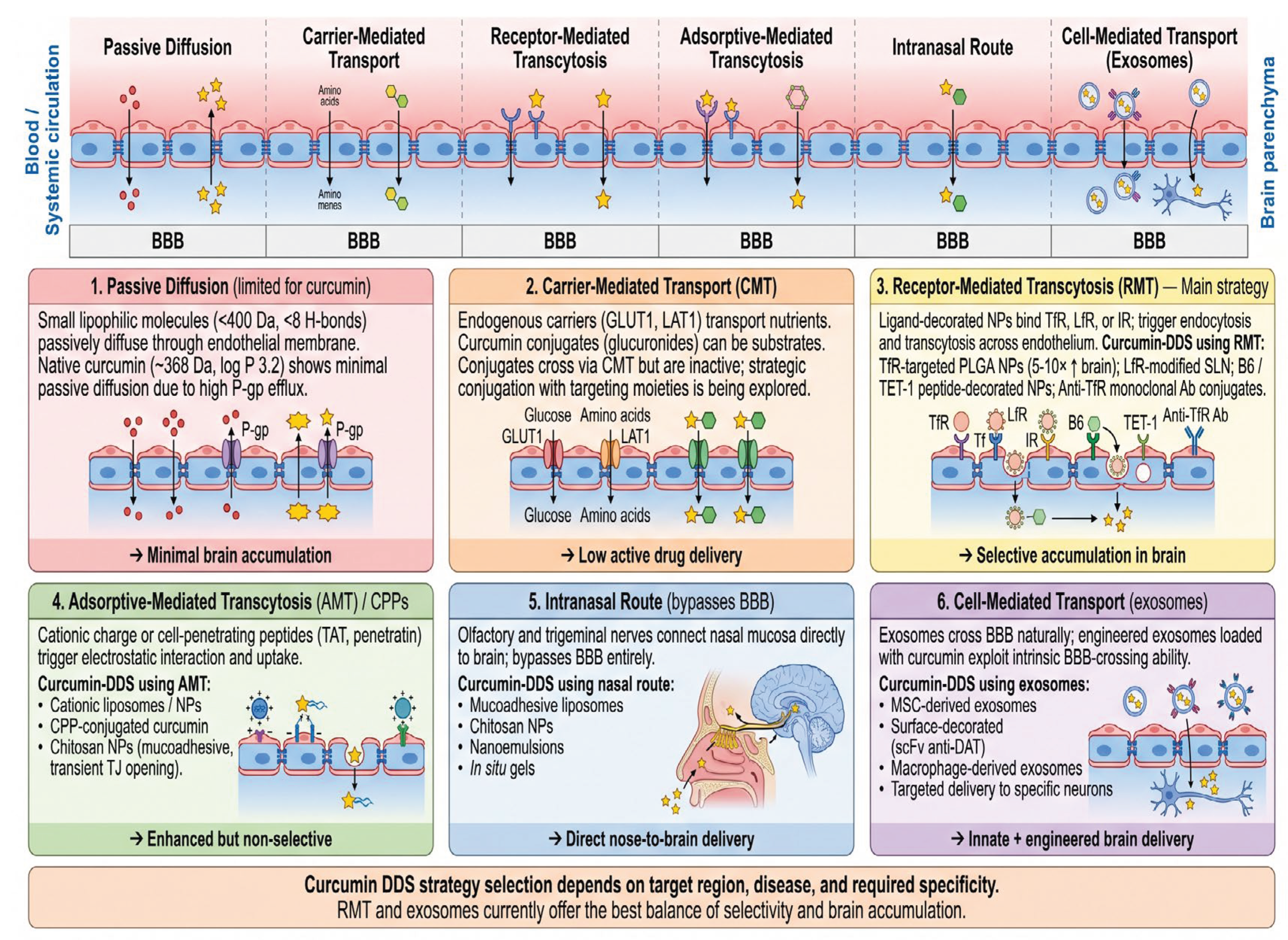

Table 1.
Commercial formulations and advanced DDS of curcumin for neurological applications. The table includes 1st-3rd generation formulations (marketed as supplements) and 4th generation DDS (preclinical/translational research). AUC: area under the curve; SLCP: solid lipid curcumin particle; SLN: solid lipid nanoparticles; NLC: nanostructured lipid nanoparticles; EAE: experimental autoimmune encephalomyelitis; ALS: amyotrophic lateral sclerosis; DDS: drug delivery systems; ND: neurodegenerative diseases; MOF: metal-organic framework; 3D: three-dimensional printing; AD: Alzheimer’s disease; PD: Parkinson’s disease.
Table 1.
Commercial formulations and advanced DDS of curcumin for neurological applications. The table includes 1st-3rd generation formulations (marketed as supplements) and 4th generation DDS (preclinical/translational research). AUC: area under the curve; SLCP: solid lipid curcumin particle; SLN: solid lipid nanoparticles; NLC: nanostructured lipid nanoparticles; EAE: experimental autoimmune encephalomyelitis; ALS: amyotrophic lateral sclerosis; DDS: drug delivery systems; ND: neurodegenerative diseases; MOF: metal-organic framework; 3D: three-dimensional printing; AD: Alzheimer’s disease; PD: Parkinson’s disease.
| Commercial formulation | Composition/Type of system | Bioavailability enhancement | Clinical status | Reference |
|---|---|---|---|---|
| Lipid nanoparticle systems (NLC, SLN) | Colloidal systems with solid/liquid lipid matrix | Cerebral AUC 505 ng/g·h in rat for NLC vs 0 for free curcumin |
Preclinical pharmacokinetic study in rats | [25] |
| Meriva® (Indena) | Curcumin-phosphatidylcholine (1:2) | Enhanced absorption compared with native curcumin; increased systemic exposure demonstrated in pharmacokinetic studies | Food supplement; multiple clinical trials in osteoarthritis, NAFLD, inflammation |
[31] |
| Theracurmin® (Theravalues) | Submicron colloidal dispersion (<200 nm) in hydrophilic matrix | ~27× AUC vs powder; Submicron colloidal dispersion (<200 nm) in a hydrophilic matrix | Dietary supplement; clinical trials in osteoarthritis, cognitive function, and cardiovascular safety |
[34] |
| Longvida® (Verdure) | Solid dispersion of curcumin in a lipid matrix (solid lipid curcumin formulation, SD-SLN) | Enhanced oral bioavailability and increased systemic exposure compared with standard curcumin formulations | Randomized clinical trials showing improvements in cognitive performance, mood, and fatigue in healthy older adults | [35] |
| MOF-Curcumin (Cu-MOF) | Metal-organic framework (Cu/Zn) loading curcumin into nanometer-sized pores | pH-dependent release; high drug loading; improved stability | Preclinical antitumor research; potential for brain tumors | [39] |
| Microneedles with curcumin | Microneedle transdermal patches (Zn-framework) loaded with curcumin | Sustained transdermal release; potential improvement of local bioavailability by avoiding gastrointestinal degradation and first-pass metabolism | Preclinical research (hair growth); potential application for EN under study | [40] |
| Scaffolds 3D of curcumin | 3D-printed polymeric scaffolds (FDM) loaded with curcumin | Controlled and sustained local release; protection of curcumin within a polymeric matrix | Preclinical biomaterial application in haemodialysis membranes | [42] |
| Curcumin hydrogels | Multilayer hydrogels (alginate, gelatin) with encapsulated curcumin | Sustained release; injectable or implantable application | Preclinical research; potential for local administration in CNS | [43] |
| Nanocurcumin (Sinapis Pharma, etc.) | Curcumin nanoparticles designed to enhance solubility, stability and oral absorption | Improved bioavailability and systemic exposure compared with conventional curcumin formulation | Preclinical evidence in neurodegenerative models; clinical studies in multiple sclerosis showing immunomodulatory effects | [81,82] |
| Polymerized curcumin (PCur) | Polymerized curcumin nanoparticles based on dendrosomes, a biodegradable nanomaterial designed to increase the solubility and stability of curcumin | Improves the solubility and bioavailability of curcumin compared with the conventional form, enabling greater therapeutic efficacy in preclinical models | Preclinical evidence. In an EAE model of multiple sclerosis, it reduced neurological symptoms, inflammation, and demyelination, and promoted remyelination | [83] |
| Liposomal curcumin (Lipocurc™, etc.) | Curcumin encapsulated in a liposomal delivery system designed to improve solubility, stability and systemic delivery | Improvement of bioavailability and systemic administration; potential neuroprotective effect mediated by antioxidant, antiapoptotic and epigenetic effects | Preclinical evidence in a Park7/DJ-1 knockout rat model of Parkinson’s disease showing improved motor deficits, reduced neuronal apoptosis and preservation of dopaminergic neurons through antioxidant and HDAC-related mechanisms | [103] |
| NovaSOL® (AOV) | Micellar formulation (polymeric micelles) | AUC up to 185× vs. native curcumin; low concentrations of free curcumin and predominance of conjugates | Pharmacokinetic studies; limited evidence in neurodegenerative diseases | [104,105] |
| CurQfen® (Akay) | Non-covalent curcumin-fenugreek galactomannan complex | Enhanced oral bioavailability of free curcuminoids (>45-fold increase compared with standard curcumin) and increased systemic exposure to unconjugated curcuminoids | Pharmacokinetic studies and preliminary clinical trials; specific evidence in neurodegenerative diseases remains limited | [106] |
| Curcumin nanogels | Nanoscale polymeric hydrogel systems (e.g., chitosan-, Pluronic- or other polymer-based nanogels) encapsulating curcumin | Enhanced aqueous solubility, protection of curcumin from degradation, and sustained/controlled release; some systems show mucoadhesive properties suitable for mucosal delivery approaches | Preclinical research mainly in inflammatory disorders; potential applications in CNS delivery remain under investigation | [107] |
| Biomimetic nanoparticles | PLGA nanoparticles loaded with curcumin and coated with platelet membranes | Greater stability and sustained release; preferential accumulation in the brain lesion after intravenous administration | Preclinical research in an intracerebral hemorrhage model; inhibition of inflammation, suppression of astrogliosis, and promotion of neurogenesis | [108] |
| Curcumin-derived carbon dots (CurP-CDs) | Carbon nanodots synthesized from curcumin with antioxidant, anti-inflammatory, and fluorescent properties | Biocompatibility, neuroprotective activity and potential imaging follow-up | Murine model of demyelination: reduction of myelin loss, microglial and astrocytic activation; neuroprotective potential in MS | [109] |
| Cavacurmin® (CW8) |
γ-cyclodextrin complex | Improvement in absorption compared to native, variable depending on the study | Food supplement; under investigation | [110] |
| BCM-95® (Biocurcumax) | Mixture of curcuminoids + volatile oils of turmeric | Enhanced oral bioavailability compared with standard curcumin | Food supplements; studies in depression, osteoarthritis | [111] |
Disclaimer/Publisher’s Note: The statements, opinions and data contained in all publications are solely those of the individual author(s) and contributor(s) and not of MDPI and/or the editor(s). MDPI and/or the editor(s) disclaim responsibility for any injury to people or property resulting from any ideas, methods, instructions or products referred to in the content. |
© 2026 by the authors. Licensee MDPI, Basel, Switzerland. This article is an open access article distributed under the terms and conditions of the Creative Commons Attribution (CC BY) license (http://creativecommons.org/licenses/by/4.0/).
Copyright: This open access article is published under a Creative Commons CC BY 4.0 license, which permit the free download, distribution, and reuse, provided that the author and preprint are cited in any reuse.