
Submitted:
14 August 2026
Posted:
14 August 2026
You are already at the latest version
Abstract
Minimal genome design, reducing a system to its smallest functional part set, is a core synthetic-biology strategy. Bacteriophages are attractive but underused chassis, yet wild-type phages are difficult to engineer. We present a comparative genomics-guided framework for synthetic minimal phage genome design, demonstrated on Streptococcus mutans, the primary agent of dental caries. Three S. mutans phages (M102AD, φAPCM01, SMHBZ8) were compared by synteny analysis, and their 123 proteins an-notated with InterProScan, EggNOG-mapper and HHpred. Conserved essential genes were selected by HHpred score, assembled as standardized transcriptional units, codon-optimized for E. coli K-12, and cloned in silico into the broad-host-range vector pBBR1MCS-2. Multi-host codon adaptation index (CAI) analysis assessed chassis flexibility. As a result, seventeen genes were assembled into a 15,792 bp synthetic insert; the final 20,948 bp construct raised mean CAI from 38.7% to 46.9% and cut rare-codon usage to 0.7%. Prokka confirmed 21 intact coding sequences, and CAI analysis predicted strong expression in Klebsiella pneumoniae (60.7%) and Pseudomonas aeruginosa (53.1%). This framework yields a validated, broad-host-range synthetic multi-gene phage-expression construct ready for experimental testing. One part (calcium-binding protein, CAI 34.4%) remains under-optimized, and Gibson Assembly, not restriction cloning, is recommended. The design logic is transferable to other phage-host systems.
Keywords:
synthetic biology
; minimal genome design
; genetic parts and chassis
; bacteriophage engineering
; Streptococcus mutans
; comparative genomics
; codon optimization
; Escherichia coli expression
; broad-host-range vector
1. Introduction
A central goal of synthetic biology is to make biological engineering predictable: to decompose genetic systems into well-characterized, reusable parts (promoters, ribosome-binding sites, terminators, coding sequences) and recombine them into standardized devices with defined function [1]. Minimal genome design, reducing a biological system to the smallest gene set that still performs a target function, is one of the field’s clearest expressions of this logic, and has been demonstrated experimentally in free-living cells from JCVI-syn1.0, the first cell built from a chemically synthesized genome [2], to the further streamlined JCVI-syn3.0, comprising just 473 genes, about a third of them of unknown function [3]. Minimal systems are easier to manipulate genetically, more genomically stable, faster to replicate and simpler to characterize, and genome reduction has, for example, increased secondary metabolite yields in engineered Streptomyces avermitilis [4]. Bacteriophages are an attractive but comparatively underused chassis for this strategy: their genomes are naturally small, their gene content is organized into discrete functional modules (DNA packaging, head assembly, tail, lysis, replication), and their well-defined lytic function provides an unambiguous design target, all properties well suited to rational, parts-based reconstruction.
In practice, however, engineering a minimal phage genome directly from a single wild-type isolate is difficult: phage genomes are compact and gene-dense, many of their genes have no experimentally characterized function, and mutating or deleting genes in the native context can be technically demanding and difficult to interpret. A computational, comparative-genomics-guided design strategy offers an alternative: instead of reducing one genome by trial and error, essential functions can be identified from patterns of conservation across multiple related phages, the best-annotated version of each function selected on structural and orthology evidence, and the resulting parts reassembled de novo as independent, standardized transcriptional units, each with its own promoter, ribosome-binding site and terminator, in a chassis-independent expression vector. This reframes minimal phage genome design as a design-build-test problem amenable to the same computational tools used elsewhere in synthetic biology (comparative genomics, functional annotation, codon optimization, host-range prediction), and is the approach developed and demonstrated in this work.
A complementary, more recently emerged strategy for computational phage design bypasses comparative annotation altogether by using genome-scale generative language models. King et al. fine-tuned the Evo 1 and Evo 2 genome language models on ~15,000 Microviridae genomes and used them to generate complete, novel ΦX174-like genomes de novo, filtering outputs with tropism and diversification constraints before experimental synthesis [5]. Of 285 synthesized candidates, 16 proved viable in E. coli C, several with higher fitness or faster lysis kinetics than wild-type ΦX174, and a cocktail of the generated phages rapidly overcame phage-resistant bacterial strains where wild-type ΦX174 alone could not. This work establishes, for the first time, that AI-based generative design can produce functional, viable bacteriophage genomes from scratch, rather than by recombining natural parts as in the framework presented here. The two approaches are complementary: comparative-genomics-guided, part-based design (as used in this study) offers interpretability and direct traceability of each gene to a known, annotated function, which is valuable for uncharacterized phage systems such as those infecting S. mutans with few sequenced relatives; generative genome language modeling, by contrast, requires larger training corpora of related genomes but can access far greater sequence novelty and has already demonstrated end-to-end experimental viability. Future work combining conservation-guided part selection with generative infilling or scoring by genome language models may offer the best of both strategies.
We selected the Streptococcus mutans phage system as a test case for this framework because it combines a clear application need with a technically demanding engineering starting point. S. mutans is the primary etiological agent of dental caries, one of the most common diseases in humans, in which the organism’s biofilm shields it from chemical and antibiotic intervention and drives increasing antibiotic resistance [6,7,8,9]. Phage-based approaches are attractive against such biofilms: phages are highly host-specific, self-amplifying, and able to penetrate biofilm matrices that are otherwise antibiotic-resistant [10,11]. A recent study showed that phages can reduce S. mutans colony-forming units and both prevent and reduce existing biofilms but also underscores how difficult it is to isolate and directly engineer wild-type S. mutans phages [12], illustrating precisely the bottleneck that a computational, chassis-independent design framework is intended to bypass. Only four S. mutans-specific phages have been isolated to date (M102, M102AD, φAPCM01 and SMHBZ8), reflecting the broader difficulty of isolating phages from the complex oral microbiome [12]; three of these, M102AD, φAPCM01 and SMHBZ8, share a common ancestry and sufficient genomic similarity to support a comparative design approach, with genome lengths of 30,664 bp (M102AD, DQ386162), 31,075 bp (φAPCM01, NC_029030) and 32,460 bp (SMHBZ8, MT430910).
Realizing this framework computationally required combining several complementary bioinformatic layers. Multi-tool functional annotation (InterProScan, EggNOG-mapper, HHpred) was used to assign confidence-scored functions to phage proteins that are often poorly represented in reference databases, providing the evidence base for essentiality classification and part selection. Standardized regulatory elements (promoter, ribosome-binding site, terminator) were then used to make each selected gene an independent expression unit, decoupled from its native genomic context. Codon optimization (JCat) and multi-host codon adaptation index analysis were used to tune and then evaluate expression potential across a chassis vector documented to replicate in multiple Gram-negative hosts, treating host range itself as a design variable rather than a fixed constraint [13,14,15,16,17,18]. Together, these tools make it possible to carry out essentially the whole design cycle for a synthetic minimal phage genome in silico, before committing to DNA synthesis and experimental build-and-test.
The aim of this work was therefore twofold: to develop a generalizable, comparative-genomics-guided framework for designing a synthetic minimal bacteriophage genome from multiple related source phages, and to demonstrate and validate that framework in full on the S. mutans phage system, identifying the essential genes conserved across three source phages, assembling them into a codon-optimized, expression-ready plasmid for E. coli and other Gram-negative hosts, and validating the resulting design through multiple complementary computational approaches.
2. Results
2.1. Phage Genome Comparison and Protein Annotation
A Clinker synteny analysis [14] comparing M102AD, phiAPCM01 and SMHBZ8 confirmed high genomic conservation, with pairwise sequence identity of 85-98% for connected gene pairs and a shared canonical phage-genome architecture, with conserved gene order across the DNA-packaging, head-assembly, tail and lysis modules (Figure 1). This result validated the use of cross-phage gene conservation as a criterion for identifying core essential genes.
A total of 123 protein-coding sequences were identified across the three genomes (42 from M102AD, 37 from phiAPCM01 and 44 from SMHBZ8) and processed through a three-tool annotation pipeline. HHpred gave the broadest coverage, annotating 121/123 proteins (98.4%) by structural homology; InterProScan annotated 90/123 proteins (73.2%); and EggNOG-mapper annotated 73/123 proteins (59.3%). Only 49 proteins (39.8%) were annotated by all three tools simultaneously, confirming that a multi-tool strategy was necessary to maximize functional coverage of this poorly characterized phage proteome.
Each protein was then classified into one of four essentiality categories using keyword- and COG-based rules (Table 1). Forty-four proteins (35.8%) were classified as essential based on core structural/functional keywords (e.g., terminase, capsid, tail, holin, endolysin); six (4.9%) were classified as likely essential based on COG category L (replication, recombination and repair); 27 (21.9%) were classified as non-essential accessory or mobile-element genes; and 46 (37.4%) remained of unknown function, consistent with the generally poor functional characterization of phage proteomes.
2.2. Core Gene Selection
Of the 123 proteins, 50 were classified as essential or likely essential (Table 1). Conservation analysis across all three phages identified 58 conserved gene copies, that is, instances of a given functional label present in all three genomes simultaneously (33 essential, 6 likely essential and 19 conserved genes of unknown function); this figure counts gene copies rather than unique functions, since each conserved function is represented once per phage, and not all 50 essential/likely-essential proteins were conserved across all three phages. Genes of unknown function that were nonetheless conserved across all three independently isolated phages were retained, on the reasoning that such conservation is itself strong evidence of functional importance, a position also supported by the JCVI-syn3.0 precedent, in which roughly one third of essential genes had unknown function [3].
For each conserved function, the best-scoring gene version (by HHpred probability, with EggNOG score as fallback) was retained, yielding a final set of 17 core genes, comprising 10 essential, 2 likely-essential and 5 previously-unknown-function representatives: 7 from M102AD, 5 from phiAPCM01 and 5 from SMHBZ8 (Table 2). The selection funnel is therefore 123 proteins → 50 essential/likely-essential → 58 conserved gene copies → 17 unique functions, each selected as the single best-scoring representative of its function. Not every unique conserved function present among the 58 gene copies was carried forward into the final 17: some were excluded because their PDB-based structural annotation was redundant with a better-scoring representative of an equivalent function that was already retained. One such excluded function was a conserved endolysin, which is why the final gene set retains a holin but no dedicated endolysin (Section 3.4). The majority of genes with HHpred scores at or above 97% belong to essential structural categories (terminase, portal, capsid, tail, single-strand binding protein), confirming reliable annotation of the most critical phage components; six genes showed lower HHpred confidence (20.7-40.4%), reflecting the limited structural characterization of these proteins in current databases, but were retained based on their cross-phage conservation.
2.3. Synthetic Genome Assembly
The 17 selected genes were assembled in canonical biological module order, DNA packaging, head assembly, tail, lysis and replication modules, followed by conserved genes of unknown function, into a synthetic genome of 15,792 bp. Each gene was flanked by its own sigma70 promoter, Shine-Dalgarno ribosome-binding site with a 6-bp spacer, and a rho-independent terminator (Table 3), ensuring independent transcription and translation of each coding unit and avoiding read-through between adjacent genes.
The assembled synthetic genome was visualized as a color-coded linear map (Figure 2), confirming the correct biological ordering of genes from DNA-packaging functions at the left end to conserved genes of unknown function at the right end, consistent with canonical phage genome architecture.
2.4. Codon Optimization
All 17 genes were codon-optimized with JCat for E. coli K-12 expression (Table 4, Figure 3). Optimization increased mean CAI from 38.7% to 46.9% (+8.2 percentage points), increased mean GC content from 39.4% to 47.6% (bringing all genes into the 40-55% range considered optimal for E. coli), and reduced mean rare-codon usage from 4.8% to 0.7%. Five genes reached a post-optimization CAI of 50% or higher (major capsid, holin, IstB-like ATP-binding protein, single-strand binding protein, and the DNA-metabolic-process protein), and the holin gene showed the largest CAI gain (+21.1 points). Eleven further genes fell in the 40-50% range considered acceptable for heterologous expression. One gene, the calcium-ion-binding protein (183 bp, the shortest gene in the set), improved only modestly to a post-optimization CAI of 34.4%, likely reflecting its limited codon space.
2.5. Plasmid Design
The 17-gene codon-optimized synthetic insert was cloned in silico into the broad-host-range vector pBBR1MCS-2 (5,144 bp) at the lacZ multiple-cloning site, flanked by EcoRI and XhoI linkers. pBBR1MCS-2 was chosen because it accommodates inserts up to 20 kb, replicates in a wide range of Gram-negative hosts including E. coli, Pseudomonas aeruginosa, Klebsiella pneumoniae, Salmonella enterica, Bordetella spp. and Brucella spp. [16], and carries a kanamycin-resistance marker, a BBR1 origin and a mobilization gene. The final plasmid, final_plasmid_optimized, measured 20,948 bp: 5,144 bp backbone (24.6%), 15,792 bp synthetic insert (75.3%) and 12 bp of restriction-site linkers (0.1%) (Table 5, Figure 4).
A double-digest simulation with EcoRI and XhoI (Figure 5) produced four fragments rather than the expected two. Mapping the four cut sites showed that EcoRI cuts at position 3,269 (the native site within the pBBR1MCS-2 lacZ multiple-cloning site) and at position 5,145 (the EcoRI linker introduced at the left flank of the insert), while XhoI cuts at position 3,302 (the native lacZ MCS site) and at position 20,943 (the XhoI linker introduced at the right flank of the insert). The four fragments therefore correspond to the two pre-existing native MCS sites plus the two flanking linkers added during insert cloning, not a hidden additional site elsewhere in the backbone; this distinction is now indicated explicitly on the SnapGene map (Figure 4) and site list rather than left for the reader to infer from the gel simulation alone. Restriction-based diagnostic digestion nonetheless remains unreliable for distinguishing insert from backbone at these overlapping sites, so Gibson Assembly, rather than conventional restriction-enzyme cloning, is the appropriate experimental strategy.
2.6. Computational Validation
2.6.1. ORF Validity and GC Content
All 21 coding sequences in the final plasmid (17 phage genes plus the backbone genes mob, rep, lacZ and KanR) contained valid ATG start codons and valid stop codons (TAA for all phage genes; TAA, TAG or TGA for backbone genes), with no frameshifted or truncated ORFs detected (Table 6). GC content of the 17 phage genes ranged from 42.1% to 51.3% (mean 47.6%) after optimization, within the 40-55% range considered optimal for E. coli expression; backbone genes retained a higher native GC content of 56-66%.
2.6.2. Independent Re-Annotation and Synteny
Independent re-annotation with Prokka v1.13 [19] confirmed exactly 21 coding sequences on the single 20,948 bp circular contig, matching the expected composition and confirming that codon optimization did not disrupt any reading frame or introduce premature stop codons. A second Clinker synteny analysis comparing the optimized plasmid against all three source phage genomes (Figure 6) confirmed that the synthetic genes retained at least 85% identity to their source-phage counterparts following codon optimization.
2.6.3. Multi-Host Codon Adaptation Index Analysis
To assess broad-host-range expression potential, CAI was calculated for all 17 genes across five pBBR1MCS-2-compatible Gram-negative hosts (E. coli K12, P. aeruginosa, K. pneumoniae, S. enterica, Bacillus subtilis) plus two AT-rich reference organisms not intended as expression hosts (S. mutans, Lactococcus lactis) (Table 7, Figure 7). K. pneumoniae showed the highest predicted mean CAI (60.7%), followed by P. aeruginosa (53.1%); E. coli K12 and S. enterica were identical (46.9%). B. subtilis showed a small decrease (-3.6 points), and both reference organisms showed the expected substantial decrease (S. mutans, -11.1 points; L. lactis, -15.3 points), confirming that E. coli K12 optimization shifted codon usage away from the AT-rich source organisms and towards high-GC Gram-negative hosts.
At the individual-gene level, K. pneumoniae showed the highest CAI for nearly all 17 genes (55.7-65.4%), while the calcium-ion-binding protein showed the lowest CAI across all hosts, consistent with its limited optimization (Section 2.4).
3. Discussion
This work had two aims: to develop a generalizable, comparative-genomics-guided framework for designing a synthetic minimal bacteriophage genome and demonstrate that framework in full on a technically challenging case, the S. mutans phage system, culminating in a codon-optimized 20,948 bp expression-ready plasmid for E. coli and other Gram-negative hosts. The subsections below consider the framework’s individual design choices (annotation strategy, gene selection, part standardization, codon optimization, chassis/host-range design), the case-study result itself, the limitations of a purely computational build, and what the framework implies for minimal-genome design in synthetic biology more broadly.
3.1. Annotation Strategy
The use of three complementary annotation tools was a deliberate choice made necessary by the sequence diversity, rapid evolution and general database under-representation of bacteriophage proteins. InterProScan provided domain- and family-level annotation (73.2% coverage); EggNOG-mapper provided orthology-based assignments (59.3%); and HHpred, which detects structural homology even at low sequence identity, achieved the highest coverage (98.4%). Because only 39.8% of proteins were annotated by all three tools, each contributed unique information for most proteins, and merging their outputs substantially reduced the risk of misclassification. One gene, phage3_unknown38, illustrates both the value and the limits of relying on any single annotation tool: the source SEED annotation called it a DNA packaging protein, EggNOG-mapper labelled it a Clp protease, and HHpred matched it to a major capsid protein (PDB 3JB5_D, 99.5% probability). Because the encoded protein is only 77 amino acids, far short of the 300-500+ residues typical of a functional HK97-fold major capsid protein, the HHpred hit almost certainly reflects a partial structural/domain match rather than true functional identity; the annotation was therefore corrected to DNA packaging protein, consistent with the original SEED call, and Table 2, Table 4 and Table 6 were updated accordingly (Section 2.2). The genuine full-length major capsid protein (379 aa; phage1_unknown6, M102AD) is a separate gene already present in the selected set, so the head-assembly module remains complete despite this relabeling. The high proportion of proteins of unknown function (37.4%) is consistent with published phage-annotation studies, which typically report 30-50% uncharacterized proteins; conservation across all three independently isolated phages was treated as evidence of biological importance regardless of annotation status.
Essentiality classification itself is a computational prediction, not an experimentally validated assignment. Genes were classified as essential by matching functional keywords (e.g., terminase, capsid, holin) to their combined annotations, and as likely essential by membership in broad COG categories (J, K, L, D, O, F) that also contain many non-essential accessory genes; neither criterion was cross-checked against experimental essentiality data such as transposon mutagenesis in a related phage, and the “likely essential” category in particular should be read as a conservation- and annotation-supported hypothesis rather than a definitive assignment. Essentiality classification and annotation confidence are also separate criteria in this pipeline and are not always aligned: the holin (HHpred 31.3%) and the HK97-gp10 tail component (40.4%) were both classified as essential because their functional keyword matches reflect the conserved biological role of these gene families, even though the HHpred score, which reflects structural-homology confidence for that specific sequence, is low for both. These genes were retained despite limited structural characterization precisely because their functional role is conserved across all three source phages; this reasoning, and its limits, is made explicit here rather than left implicit in the confidence scores reported in Table 2.
3.2. Scope of the Construct: Multi-Gene Expression System versus Self-Assembling Phage Genome
The construct designed here should be understood precisely for what it is: a multi-gene expression system for phage structural and functional genes, not a self-assembling phage genome. The 17 core genes are cloned onto the broad-host-range plasmid pBBR1MCS-2, replicate via the plasmid’s own BBR1 origin, and are each driven by an individual E. coli sigma70 promoter; the construct does not carry a phage origin of replication, and no packaging signal (cos/pac site) recognizable by a terminase/portal system was included. Consequently, even under perfect expression of all 17 genes, the construct as designed produces 17 separate recombinant proteins in the Gram-negative cytoplasm; it does not, by itself, direct the replication, packaging or assembly of a DNA-filled, infectious phage particle, which in nature requires the genome to be present in cis as a replicating, packageable unit recognized by its own terminase and portal machinery.
A second, independent gap concerns host specificity. S. mutans is Gram-positive and lacks an outer membrane, and phage infectivity against it depends on tail-fiber/receptor-binding proteins that have evolved to dock with Gram-positive cell-wall receptors. Producing these proteins inside a Gram-negative host (E. coli, K. pneumoniae or P. aeruginosa) demonstrates only that they can be expressed there; it says nothing about whether a functional virion capable of infecting S. mutans could ever emerge from this pipeline. For the same reason, the multi-host CAI analysis (Section 2.6.3) should be read as a measure of expression compatibility across Gram-negative chassis organisms, not as evidence of broadened therapeutic host range against S. mutans, which remains Gram-positive regardless of which Gram-negative host expresses the construct best. We therefore describe this work, in line with its title, as a synthetic minimal genome design framework and an E. coli expression system for S. mutans phage genes, and not as a claim to have produced, or to be close to producing, an infectious phage particle.
Bridging the gap identified here, from plasmid-borne gene expression to an assembled, S. mutans-infective phage, would require at minimum: (i) a phage origin of replication and a cognate packaging signal recognized by the terminase/portal proteins already present in this design, so that the genome itself, rather than only its gene products, is replicated and packaged; and (ii) an assembly and infectivity test performed in a host and context relevant to the natural biology of S. mutans phage infection. Neither is addressed by the present computational design, and both are necessary before any claim of phage infectivity, as opposed to gene expression, is warranted.
3.3. The Minimal Genome Concept in Context
The 17-gene minimal phage genome designed here is conceptually aligned with the JCVI-syn3.0 minimal-genome effort, in which the genome was reduced to 473 genes, a third of unknown function [1,2,3]. The 17 genes selected in this study span all five essential functional modules: DNA packaging (terminase, DNA-packaging protein), head assembly (portal protein, major capsid protein), tail (four tail-related proteins, including a distal-tail protein with a peptidoglycan-hydrolase domain), lysis (holin only) and replication/DNA metabolism (single-strand binding protein, endonuclease, ATP-binding protein, DNA-metabolic-process protein). Because the conserved endolysin function identified during annotation was excluded at the gene-selection step as a redundant PDB-based duplicate (Section 2.2), the lysis module here comprises a holin without a paired endolysin; a complete lysis cassette would require re-adding a validated endolysin in a future iteration. The resulting 17-gene set is therefore a near-complete, rather than fully complete, minimal functional set, with five additional conserved genes of unknown function retained on the same precedent as JCVI-syn3.0.
3.4. Chimeric Design: Opportunities and Limitations
The most significant conceptual limitation of this design is its chimeric nature: each conserved gene was drawn from whichever source phage gave the most structurally reliable annotation, rather than from a single phage. This choice is justified by the high genomic conservation between the three phages (85-98% pairwise identity for conserved genes), which makes near-identical three-dimensional structure and biochemical function likely for the corresponding proteins. Protein-protein compatibility cannot, however, be guaranteed computationally: phage assembly requires precise geometric complementarity between structural proteins (for example, the portal protein must physically fit the capsid, and the tail must attach with correct dimensions), and even small structural differences could disrupt these interactions. This is the principal experimental question raised by the design, and electron microscopy is the most direct way to determine whether phage-like particles assemble correctly.
3.5. Codon Optimization in Context
Codon optimization improved mean CAI from 38.7% to 46.9% and reduced rare-codon usage from 4.8% to 0.7%, in line with published reports of 5-15 percentage-point CAI improvements for heterologous E. coli expression [18]. Genes with a higher pre-optimization GC content (already partially compatible with E. coli codon preferences) showed the largest absolute CAI gains, whereas genes originating from the most AT-rich regions of the source phage genomes improved more modestly. One gene, the calcium-ion-binding protein, remained below the acceptable expression threshold (CAI 34.4%); at only 183 bp it has limited codon space for optimization, and its function is unknown, so a second optimization round, or its exclusion from a future genome iteration, may be warranted if experimental expression proves inadequate. It should also be stressed that CAI is a proxy for translational efficiency, not a direct predictor of protein yield: mRNA secondary structure, codon-context effects, folding kinetics and host toxicity will all influence real expression outcomes and can only be assessed experimentally.
JCat itself is a CAI-only optimizer: it substitutes each codon for the most frequent synonym in the target host without evaluating mRNA secondary structure, ribosome-binding-site occlusion, or codon-context effects, so a strong 5′ hairpin can block translation initiation even when CAI is high. Modern multi-objective codon optimizers (e.g., DNA Chisel, IDT/GeneArt algorithms) optimize CAI and mRNA folding jointly and would likely yield a more robust design; using a CAI-only tool is accordingly a limitation of the present design, not merely an interpretive caveat, and the CAI values reported here should be read as a measure of codon compatibility with the host translation machinery rather than a guarantee of expression. Finally, the CAI, GC-content and rare-codon values reported in Table 4 and Figure 3 are deterministic outputs of a single codon-substitution algorithm applied once to each gene, rather than estimates subject to sampling variation, so confidence intervals or replicate runs are not applicable here; the complete per-gene distribution before and after optimization, rather than only the summary means discussed above, is already reported in full in Table 4 and Figure 3.
3.6. Multi-Host Expression Compatibility
The multi-host CAI analysis indicates that the E. coli-optimized synthetic genes are also well suited to other high-GC, pBBR1MCS-2-compatible Gram-negative hosts, with the strongest predicted expression in K. pneumoniae (60.7%) and P. aeruginosa (53.1%), reflecting the alignment between these organisms’ high genomic GC content and the GC-enriched codon usage introduced by optimization. The corresponding decrease in CAI for the AT-rich reference organisms (B. subtilis, S. mutans, L. lactis) reflects an expected trade-off of single-host codon optimization; because S. mutans is the therapeutic target rather than an intended expression host, this trade-off is acceptable. The broad host range is enabled specifically by the pBBR1MCS-2 backbone [13], meaning the same construct could in principle be used across several Gram-negative species without redesigning the vector, although host-specific codon re-optimization could further improve expression if the therapeutic scope were extended beyond E. coli. This analysis characterizes expression compatibility across Gram-negative chassis organisms only; because S. mutans is Gram-positive, it does not by itself expand the therapeutic host range of the S. mutans-targeting construct (Section 3.2).
3.7. Plasmid Design Considerations
pBBR1MCS-2 was selected primarily for its capacity to accommodate the 15,792 bp insert, alongside its broad-host-range origin of replication, kanamycin-selection marker and lacZ-based multiple cloning site [16,17]. The in silico restriction analysis showed that both EcoRI and XhoI cut twice each rather than once: at the pre-existing native site within the pBBR1MCS-2 lacZ multiple-cloning site, and at the flanking linker introduced on the corresponding side of the insert during cloning (Section 2.5). This generates four rather than two fragments on a diagnostic digest and makes restriction-based cloning verification unreliable, even though no additional site is hidden elsewhere in the backbone. Gibson Assembly, a sequence-independent ligation method, is therefore the recommended experimental cloning strategy [2]; alternatively, restriction enzymes without internal cut sites in the backbone could be substituted. At 20,948 bp, the final plasmid is at the upper end of the practical size range for this vector; if transformation efficiency proves limiting, electroporation or specialized large-plasmid-competent E. coli strains may help.
3.8. Validation and Its Limits
ORF validity, independent Prokka re-annotation, and Clinker synteny analysis together provide multiple independent lines of evidence that the plasmid sequence is correctly assembled, with intact gene boundaries and preserved similarity to the source phage genes. These analyses validate the in silico design, confirming correct sequence assembly, gene orientation and codon compatibility with the intended host; they cannot establish whether the encoded proteins fold correctly in E. coli, whether the chimeric proteins interact to form functional phage-like structures, whether any expressed protein is toxic to the host, or whether the construct ultimately produces phage particles active against S. mutans. These questions require experimental investigation.
3.9. Future Directions
For the S. mutans case study itself, the immediate next step is experimental synthesis of the codon-optimized sequence by a commercial provider (e.g., Twist Bioscience or Integrated DNA Technologies), followed by Gibson Assembly cloning into pBBR1MCS-2 to avoid the internal restriction-site issue identified here. Following transformation into E. coli and kanamycin selection, expression of individual phage proteins could be confirmed by SDS-PAGE and Western blotting against specific structural proteins (e.g., major capsid, terminase), with electron microscopy as the ultimate test of whether phage-like particles self-assemble.
3.10. Implications for Synthetic Biology Practice
More broadly, the framework itself, multi-tool, confidence-scored functional annotation; conservation-guided essentiality classification; representation of each selected gene as an independent, standardized transcriptional unit; codon optimization; and multi-host expression prediction, is not specific to S. mutans phages. It requires only that two or more related source genomes be available for comparison and could equally be applied to phages targeting other pathogens under active investigation for phage therapy, such as Staphylococcus aureus, P. aeruginosa and K. pneumoniae, or, in principle, to other virus families and non-viral minimal-genome design problems built around a comparable modular architecture. Treating host range as an explicit, tunable design variable, rather than a fixed property of a single wild-type isolate, is itself a generalizable idea: the same multi-host CAI approach used here to characterize the S. mutans-derived construct could be used prospectively, early in any minimal-genome design cycle, to select or rule out chassis organisms before committing to synthesis. In this sense the S. mutans construct reported here functions as a worked example of a broader design pattern for synthetic minimal viral genomes, rather than as an end.
Importantly, the feasibility of AI-guided phage genome design is no longer purely theoretical. King et al. recently demonstrated that genome language models (Evo 1/Evo 2) can generate complete, synthesizable bacteriophage genomes that are experimentally viable, including genomes with substantial evolutionary novelty relative to their ΦX174 template, some of which outcompeted the wild-type phage in growth and lysis assays [5]. This provides direct proof-of-concept, at the whole-genome scale, that AI-based design pipelines — whether generative, as in that work, or annotation- and conservation-driven, as in the present study — can yield functional synthetic phage genomes ready for experimental testing. It further suggests a natural extension of the present framework: once the 17-gene S. mutans-derived construct is experimentally validated, genome language models could be applied either to further diversify individual parts (e.g., to rescue the under-optimized calcium-binding protein) or to score whole-construct viability computationally before DNA synthesis, adding a further layer of in silico validation to the design-build-test cycle described here.
4. Materials and Methods
4.1. Phage Genome Sources
Three S. mutans bacteriophages were used as genomic sources: SMHBZ8 (MT430910, 32,460 bp), phiAPCM01 (NC_029030, 31,075 bp) and M102AD (DQ386162, 30,664 bp), all confirmed complete circular sequences. All three were retrieved from NCBI GenBank in FASTA format (for sequence analysis) and GenBank format (for feature annotation and ORF extraction).
4.2. Phage Genome Comparison
Synteny between the three phages was assessed with Clinker [14] (https://github.com/gamcil/clinker), which performs pairwise protein-sequence alignment and reports sequence identity between gene clusters: `clinker phage1.gbk phage2.gbk phage3.gbk -p phage_comparison.html --identity 0.85`. An identity threshold of 0.85 (85%) was applied so that only gene pairs sharing at least this identity were connected in the visualization.
4.3. Protein Annotation Pipeline
Coding sequences from the three GenBank files were extracted with BioPython and combined into a single multi-FASTA file (all_proteins.faa), each sequence labelled with a phage-source prefix (phage1/phage2/phage3) and its gene identifier. Annotation was performed with three complementary tools. InterProScan v5.77-108.0 (`interproscan.sh -i all_proteins.faa -f TSV -o all_proteins_interpro -goterms -pa -cpu 4`) integrated Pfam, TIGRFAM, Gene3D, SUPERFAMILY, Hamap, ProSiteProfiles and CDD signatures [13]. HHpred/HHsearch (`hhsearch -i all_proteins.faa -d pdb70/pdb70 -o hhpred_results.hhr -cpu 4`) performed hidden Markov model profile-profile comparison against PDB70, with hits above 70% probability considered reliable. EggNOG-mapper v2, run in diamond mode against the EggNOG 5.0 database via the Galaxy platform (https://usegalaxy.org), provided COG categories, KEGG pathways, GO terms, EC numbers and preferred gene names [15]. The three outputs were merged by an outer joint on protein identifier with a custom Python script (merge_annotations.py); InterProScan’s multiple per-protein domain hits collapsed to one row per protein with pipe-separated fields. The merged table contained 123 proteins across 22 columns and served as the master annotation reference.
4.4. Gene Classification
Each gene was classified as essential, likely essential, non-essential or unknown with a custom script (classify_essentiality.py) applied to the combined functional descriptions. Essential: keyword matches to core structural/functional roles (terminase, portal, capsid, tail, baseplate, tape measure, tail fiber/spike, lysin, holin, endolysin, spanin, integrase, replisome, primase, helicase, DNA polymerase, prohead, scaffolding, connector, neck, whisker, injection). Likely essential: membership in COG categories J, K, L, D, O or F. Non-essential: accessory/mobile-element keywords (toxin, antitoxin, superinfection immunity, anti-restriction, methyltransferase, transposase, recombinase, anti-CRISPR, virulence). Unknown: hypothetical protein or no meaningful annotation from any tool. Unknown genes conserved across all three phages were retained for further analysis rather than discarded. This classification is a computational prediction based on functional keywords and COG category membership, and is not a substitute for experimentally derived essentiality data such as transposon mutagenesis; it is intended as a tractable, reproducible first-pass filter rather than a definitive assignment of gene essentiality.
4.5. Core Gene Selection
Conservation was detected computationally (filter_core_genes.py) by extracting the phage-source prefix and grouping proteins by functional label; a function was retained only if represented in all three phages simultaneously. Two conserved sets were produced: essential/likely-essential genes, and unknown genes supported by the Clinker synteny analysis. For each conserved function, the gene version with the highest HHpred probability (EggNOG score as fallback) was selected as the single representative (select_best_genes.py), yielding 17 core genes.
4.6. ORF Extraction
Nucleotide sequences of the 17 core genes were extracted from the source GenBank files with a phage-specific matching strategy (extract_core_orfs.py) reflecting each file’s annotation format: M102AD identifiers were matched via sequential ORF numbers in the note field (e.g., orf3); phiAPCM01 via locus tags (e.g., AVT41_gp03); and SMHBZ8 via db_xref peg numbers, which are non-sequential (e.g., peg.4). Sequences were extracted with BioPython SeqIO and feature.extract(), which automatically reverse-complements minus-strand genes, and saved as core_gene_sequences.fna.
4.7. In silico Genome Assembly
The 17 genes were assembled (assemble_synthetic_genome.py) in canonical module order: DNA packaging (terminase, portal), head assembly (prohead, scaffolding, major/minor capsid, neck/connector), tail (tail tube, baseplate, tape measure, tail fiber/spike), lysis (holin, endolysin/lysin, spanin) and replication (primase, helicase, DNA polymerase/replisome); genes without a module match were placed at the end. Each gene was flanked upstream by a sigma70 promoter (TTGACAAATAATTATAAT), a Shine-Dalgarno RBS (AGGAGG) and a 6-bp spacer (AAAAAA), and downstream by an 18 bp rho-independent terminator comprising an 11 bp GC-rich hairpin motif followed by a 7-nt poly-U tail (GCCCGCGGGGCTTTTTTT), ensuring independent transcription/translation of each unit. The genome was assembled with BioPython SeqRecord/SeqFeature and saved in GenBank and FASTA format, then visualized with pyGenomeViz (visualize_genome.py), color-coding genes by functional module.
4.8. Codon Optimization
Because the source phages have a genomic GC content of approximately 35-47% versus the 50-55% optimum for E. coli K12, all 17 genes were codon-optimized with JCat (http://www.jcat.de) [18], targeting E. coli K12 usage, with additional settings to avoid rho-independent terminators, internal ribosome-binding sites, and EcoRI/XhoI sites within the coding sequence. Each gene was exported individually (export_genes_for_optimization.py), submitted to JCat, and the optimized sequences saved as all_genes_for_optimization.fasta.
4.9. Plasmid Design
The optimized synthetic genome was cloned in silico (reassemble_optimized_plasmid.py) into pBBR1MCS-2 (NCBI U23751, 5,144 bp), chosen for its 20-kb insert capacity, broad Gram-negative host range [16,17], kanamycin-resistance marker, BBR1 origin and mob gene. The backbone was retrieved from NCBI GenBank via BioPython Entrez, and the insert was placed at the lacZ site, flanked by EcoRI (GAATTC) and XhoI (CTCGAG) linkers; backbone and insert feature coordinates were recalculated for the offset insertion. The plasmid was saved in GenBank and FASTA format (final_plasmid.gbk/.fasta), and its restriction profile was assessed by in silico double digestion with EcoRI and XhoI in SnapGene.
4.10. Computational Validation
ORF validity (validate_optimized_plasmid.py, BioPython SeqIO) checked every CDS for a valid start codon (ATG, GTG or TTG) and stop codon (TAA, TAG or TGA). GC content was computed per gene with the BioPython SeqUtils gc_fraction function. Codon Adaptation Index was calculated by comparing codon usage of each gene to the E. coli K12 codon-usage table from the Kazusa Codon Usage Database [20], alongside the percentage of rare codons (frequency < 5 per thousand), for both the original and JCat-optimized sequences. Independent re-annotation was performed with Prokka v1.13 [19] (`prokka final_plasmid_optimized.fasta --outdir prokka_optimized --prefix SynPhage_opt --kingdom Viruses --metagenome --fast --force --cpus 4`). A second Clinker synteny run compared the optimized plasmid to the three source phage genomes at the same 0.85 identity threshold. Restriction-digest simulation (EcoRI + XhoI) was performed in SnapGene. Finally, multi-host CAI analysis (multi_host_cai.py) was performed across E. coli K12, P. aeruginosa, K. pneumoniae, S. enterica and B. subtilis (all pBBR1MCS-2-compatible), plus S. mutans and L. lactis as AT-rich reference organisms, using Kazusa codon-usage tables for both original and optimized sequences.
5. Conclusions
This work presents a generalizable, comparative-genomics-guided framework for computational minimal bacteriophage genome design and validates it in full on the S. mutans phage system as a demonstration case. A multi-tool annotation pipeline (InterProScan, EggNOG-mapper, HHpred) characterized 123 phage proteins with 98.4% combined coverage, and comparative genomics and evidence-based gene prioritization identified 17 core genes conserved across three source phages, assembled as standardized transcriptional units into a 15,792 bp synthetic genome in canonical biological order. Cloned in silico into the broad-host-range vector pBBR1MCS-2, the final 20,948 bp plasmid was codon-optimized for E. coli K12, raising mean CAI from 38.7% to 46.9% and lowering rare-codon usage from 4.8% to 0.7%. Comprehensive computational validation, ORF integrity, independent Prokka re-annotation, and Clinker synteny analysis, confirmed the structural integrity of the design, and multi-host CAI analysis indicated strong expression potential across several Gram-negative hosts, most notably K. pneumoniae (60.7%), supporting host range as a tunable design variable rather than a fixed constraint. The construct is a codon-optimized, multi-gene expression system for phage structural and regulatory genes, not a self-assembling, packaged phage genome; it lacks a phage origin of replication and a packaging signal, and expression in Gram-negative hosts does not by itself establish infectivity against Gram-positive S. mutans (Section 3.2). The principal remaining limitations are the untested inter-protein compatibility of the chimeric genome and one under-optimized part (calcium-binding protein, CAI 34.4%). Overall, this study demonstrates that a rational, computationally driven framework can produce a complete and validated synthetic minimal phage genome design for a technically challenging source system, and that the same design logic is directly transferable to minimal-genome engineering for other phage-host systems and, more broadly, to other modular viral chassis. Experimental synthesis, Gibson Assembly cloning, transformation, and expression validation by SDS-PAGE and electron microscopy will determine the biological viability of the S. mutans construct reported here.
Supplementary Materials
The following supporting information can be downloaded at the website of this paper posted on Preprints.org. The complete annotated 20,948 bp nucleotide sequence of final_plasmid_optimized in FASTA/GenBank format is available as Supplementary File S1.
Author Contributions
Conceptualization, D.C. and A.Z.; methodology, A.Z.; software, A.Z.; validation, A.Z.; formal analysis, A.Z.; investigation, A.Z.; resources, D.C.; data curation, A.Z.; writing—original draft preparation, A.Z.; writing—review and editing, D.C. and A.Z.; visualization, A.Z.; supervision, D.C.; project administration, D.C. All authors have read and agreed to the published version of the manuscript.
Funding
This research received no external funding.
Use of Artificial Intelligence
Latest versions of Claude Sonnet 5 were used for Word formatting, language check and initial review. We have carefully reviewed and edited the output and take full responsibility for the content of this publication.
Institutional Review Board Statement
Not applicable. This study was a purely computational, in silico design exercise and did not involve human participants, animals, or wet-laboratory experimentation.
Informed Consent Statement
Not applicable.
Data Availability Statement
The source phage genome sequences are publicly available in NCBI GenBank under accession numbers MT430910 (SMHBZ8), NC_029030 (phiAPCM01) and DQ386162 (M102AD). The designed synthetic genome and final plasmid sequence are provided in the Supplementary Materials.
Acknowledgments
The authors thank the Department of Health Sciences, Università del Piemonte Orientale, for institutional support. This manuscript reports the results of a Master’s thesis in Medical Biotechnology and is presented here in journal-article format for submission.
Conflicts of Interest
The authors declare no conflicts of interest.
Abbreviations
The following abbreviations are used in this manuscript:
| CAI | Codon Adaptation Index |
| ORF | Open Reading Frame |
| CDS | Coding Sequence |
| RBS | Ribosome Binding Site |
| GC | Guanine-Cytosine (content) |
| COG | Clusters of Orthologous Groups |
| PDB | Protein Data Bank |
| bp | base pair(s) |
References
- Glass, J.I.; Merryman, C.; Wise, K.S.; Hutchison, C.A.; Smith, H.O. Minimal Cells—Real and Imagined. Cold Spring Harb. Perspect. Biol. 2017, 9, a023861. [Google Scholar] [CrossRef] [PubMed]
- Gibson, D.G.; Glass, J.I.; Lartigue, C.; Noskov, V.N.; Chuang, R.Y.; Algire, M.A.; Benders, G.A.; Montague, M.G.; Ma, L.; Moodie, M.M.; et al. Creation of a Bacterial Cell Controlled by a Chemically Synthesized Genome. Science 2010, 329, 52–56. [Google Scholar] [CrossRef] [PubMed]
- Hutchison, C.A., 3rd; Chuang, R.Y.; Noskov, V.N.; Assad-Garcia, N.; Deerinck, T.J.; Ellisman, M.H.; Gill, J.; Kannan, K.; Karas, B.J.; Ma, L.; et al. Design and Synthesis of a Minimal Bacterial Genome. Science 2016, 351, aad6253, Erratum in: ACS Chem Biol. 2016, 11, 1463. [Google Scholar] [CrossRef] [PubMed]
- Choe, D.; Cho, S.; Kim, S.C.; Cho, B.-K. Minimal Genome: Worthwhile or Worthless Efforts toward Being Smaller? Biotechnol. J. 2016, 11, 199–211. [Google Scholar] [CrossRef] [PubMed]
- King, S.H.; Driscoll, C.L.; Li, D.B.; Guo, D.; Merchant, A.T.; Brixi, G.; Wilkinson, M.E.; Hie, B.L. Generative Design of Bacteriophages with Genome Language Models. Science 2026, 393, eaec2657. [Google Scholar] [CrossRef] [PubMed]
- Eckert, R.; Sullivan, R.; Shi, W. Targeted Antimicrobial Treatment to Re-Establish a Healthy Microbial Flora for Long-Term Protection. Adv. Dent. Res. 2012, 24, 94–97. [Google Scholar] [CrossRef] [PubMed]
- Loesche, W.J. Role of Streptococcus Mutans in Human Dental Decay. Microbiol. Rev. 1986, 50, 353–380. [Google Scholar] [CrossRef] [PubMed]
- Bowen, W.H.; Burne, R.A.; Wu, H.; Koo, H. Oral Biofilms: Pathogens, Matrix, and Polymicrobial Interactions in Microenvironments. Trends Microbiol. 2018, 26, 229–242. [Google Scholar] [CrossRef] [PubMed]
- Kulis, E.; Cvitkovic, I.; Pavlovic, N.; Kumric, M.; Rusic, D.; Bozic, J. A Comprehensive Review of Antibiotic Resistance in the Oral Microbiota: Mechanisms, Drivers, and Emerging Therapeutic Strategies. Antibiotics 2025, 14, 828. [Google Scholar] [CrossRef] [PubMed]
- Summers, W.C. The Strange History of Phage Therapy. Bacteriophage 2012, 2, 130–133. [Google Scholar] [CrossRef] [PubMed]
- Loc-Carrillo, C.; Abedon, S.T. Pros and Cons of Phage Therapy. Bacteriophage 2011, 1, 111–114. [Google Scholar] [CrossRef] [PubMed]
- Ben-Zaken, H.; Kraitman, R.; Coppenhagen-Glazer, S.; Khalifa, L.; Alkalay-Oren, S.; Gelman, D.; Ben-Gal, G.; Beyth, N.; Hazan, R. Isolation and Characterization of Streptococcus Mutans Phage as a Possible Treatment Agent for Caries. Viruses 2021, 13, 825. [Google Scholar] [CrossRef] [PubMed]
- Jones, P.; Binns, D.; Chang, H.-Y.; Fraser, M.; Li, W.; McAnulla, C.; McWilliam, H.; Maslen, J.; Mitchell, A.; Nuka, G.; et al. InterProScan 5: Genome-Scale Protein Function Classification. Bioinformatics 2014, 30, 1236–1240. [Google Scholar] [CrossRef] [PubMed]
- Gilchrist, C.L.M.; Chooi, Y.-H. Clinker & Clustermap.Js: Automatic Generation of Gene Cluster Comparison Figures. Bioinformatics 2021, 37, 2473–2475. [Google Scholar] [CrossRef] [PubMed]
- Cantalapiedra, C.P.; Hernández-Plaza, A.; Letunic, I.; Bork, P.; Huerta-Cepas, J. eggNOG-Mapper v2: Functional Annotation, Orthology Assignments, and Domain Prediction at the Metagenomic Scale. Mol. Biol. Evol. 2021, 38, 5825–5829. [Google Scholar] [CrossRef] [PubMed]
- Kovach, M.E.; Elzer, P.H.; Hill, D.S.; Robertson, G.T.; Farris, M.A.; Roop, R.M.; Peterson, K.M. Four New Derivatives of the Broad-Host-Range Cloning Vector pBBR1MCS, Carrying Different Antibiotic-Resistance Cassettes. Gene 1995, 166, 175–176. [Google Scholar] [CrossRef] [PubMed]
- Sargent, F.; Davidson, F.A.; Kelly, C.L.; Binny, R.; Christodoulides, N.; Gibson, D.; Johansson, E.; Kozyrska, K.; Lado, L.L.; MacCallum, J.; et al. A Synthetic System for Expression of Components of a Bacterial Microcompartment. Microbiology (Reading) 2013, 159, 2427–2436. [Google Scholar] [CrossRef] [PubMed]
- Grote, A.; Hiller, K.; Scheer, M.; Munch, R.; Nortemann, B.; Hempel, D.C.; Jahn, D. JCat: A Novel Tool to Adapt Codon Usage of a Target Gene to Its Potential Expression Host. Nucleic Acids Res. 2005, 33, W526–31. [Google Scholar] [CrossRef] [PubMed]
- Seemann, T. Prokka: Rapid Prokaryotic Genome Annotation. Bioinformatics 2014, 30, 2068–2069. [Google Scholar] [CrossRef] [PubMed]
- Nakamura, Y.; Gojobori, T.; Ikemura, T. Codon Usage Tabulated from International DNA Sequence Databases: Status for the Year 2000. Nucleic Acids Res. 2000, 28, 292. [Google Scholar] [CrossRef]
Figure 1.
Clinker synteny map comparing the three S. mutans bacteriophage genomes M102AD, phiAPCM01 and SMHBZ8.
Figure 1.
Clinker synteny map comparing the three S. mutans bacteriophage genomes M102AD, phiAPCM01 and SMHBZ8.
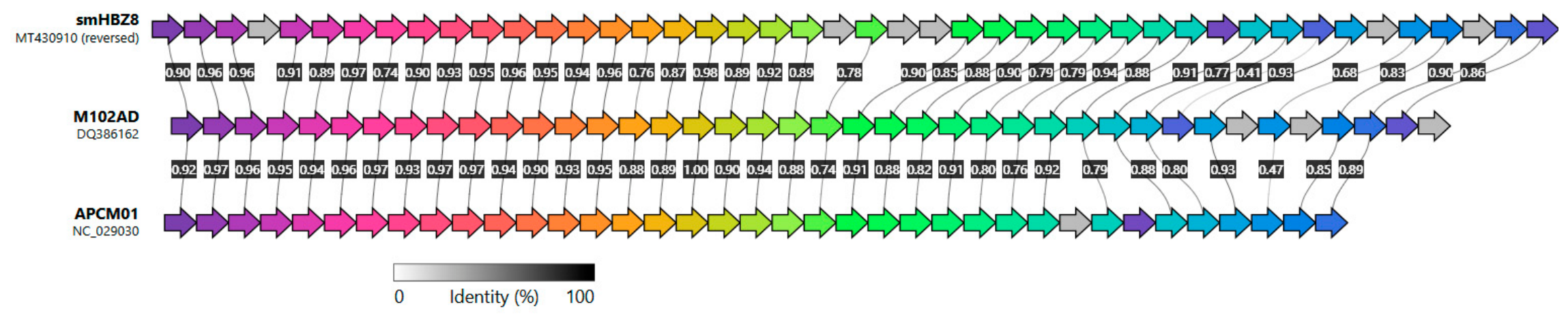
Figure 2.
Color-coded linear map of the 17-gene synthetic minimal phage genome.
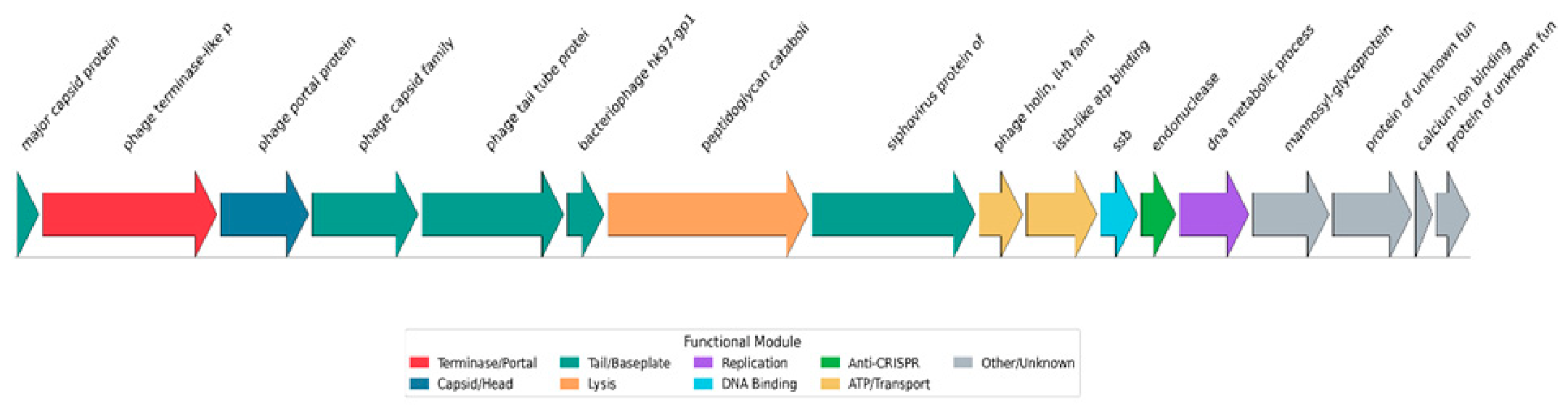
Figure 3.
GC content (A), Codon Adaptation Index (B), and rare-codon usage (C) before (red) and after (teal) JCat codon optimization for each of the 17 phage genes.
Figure 3.
GC content (A), Codon Adaptation Index (B), and rare-codon usage (C) before (red) and after (teal) JCat codon optimization for each of the 17 phage genes.
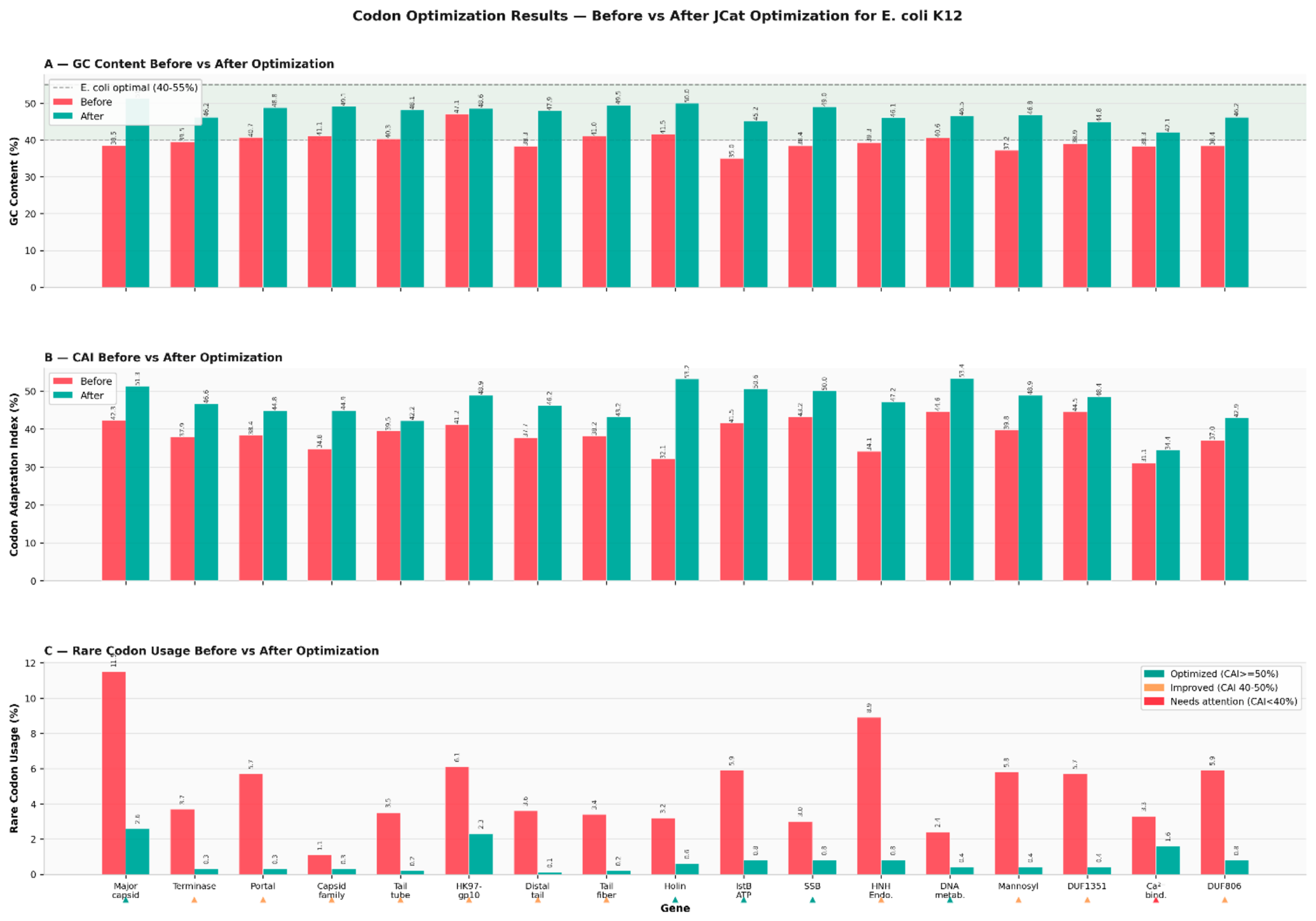
Figure 4.
Circular map of final_plasmid_optimized (20,948 bp) visualized in SnapGene, with the four EcoRI/XhoI cut sites (two native lacZ MCS sites and two flanking cloning linkers) indicated explicitly.
Figure 4.
Circular map of final_plasmid_optimized (20,948 bp) visualized in SnapGene, with the four EcoRI/XhoI cut sites (two native lacZ MCS sites and two flanking cloning linkers) indicated explicitly.
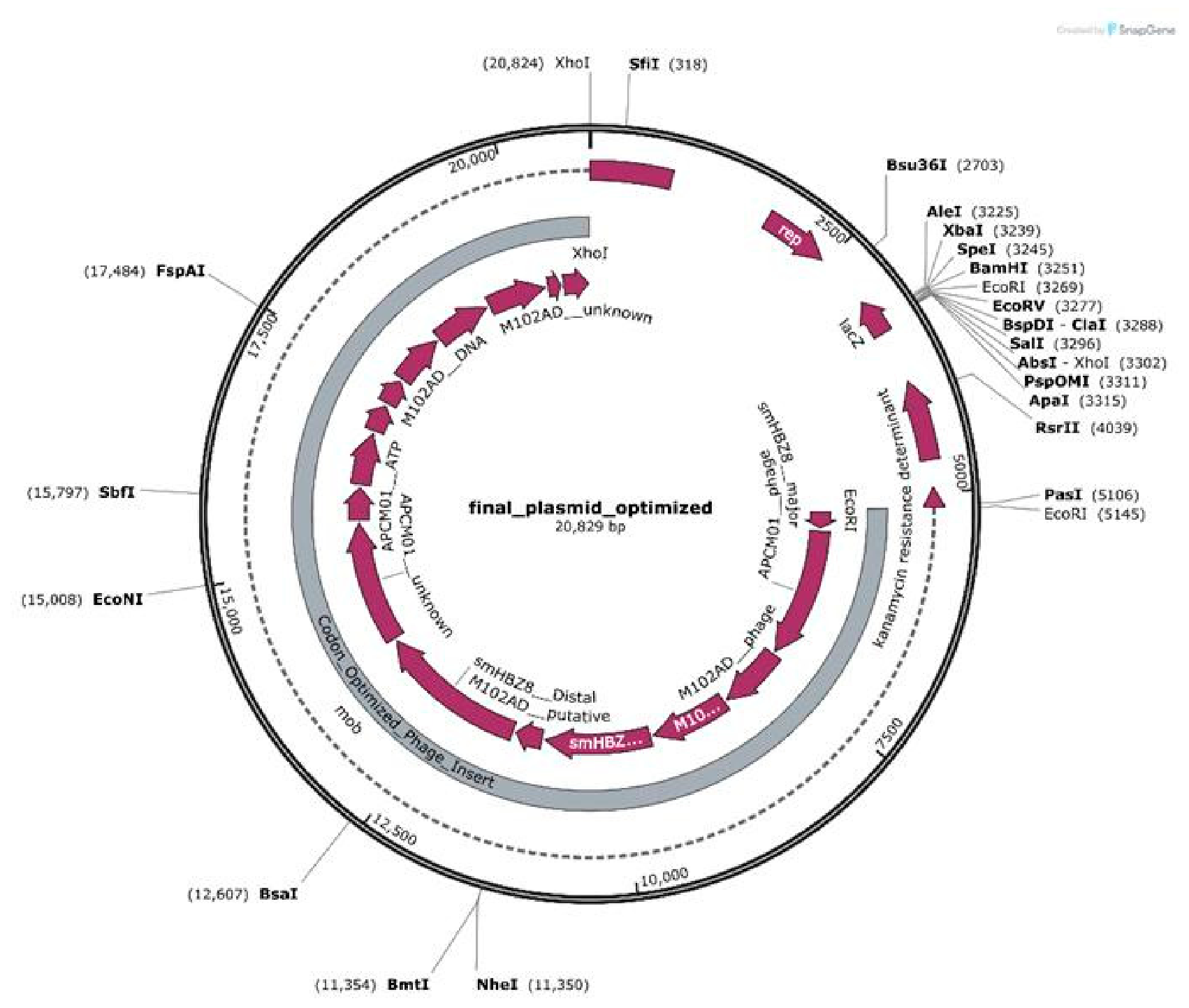
Figure 5.
Simulated agarose gel electrophoresis of final_plasmid_optimized following double digestion with EcoRI and XhoI.
Figure 5.
Simulated agarose gel electrophoresis of final_plasmid_optimized following double digestion with EcoRI and XhoI.
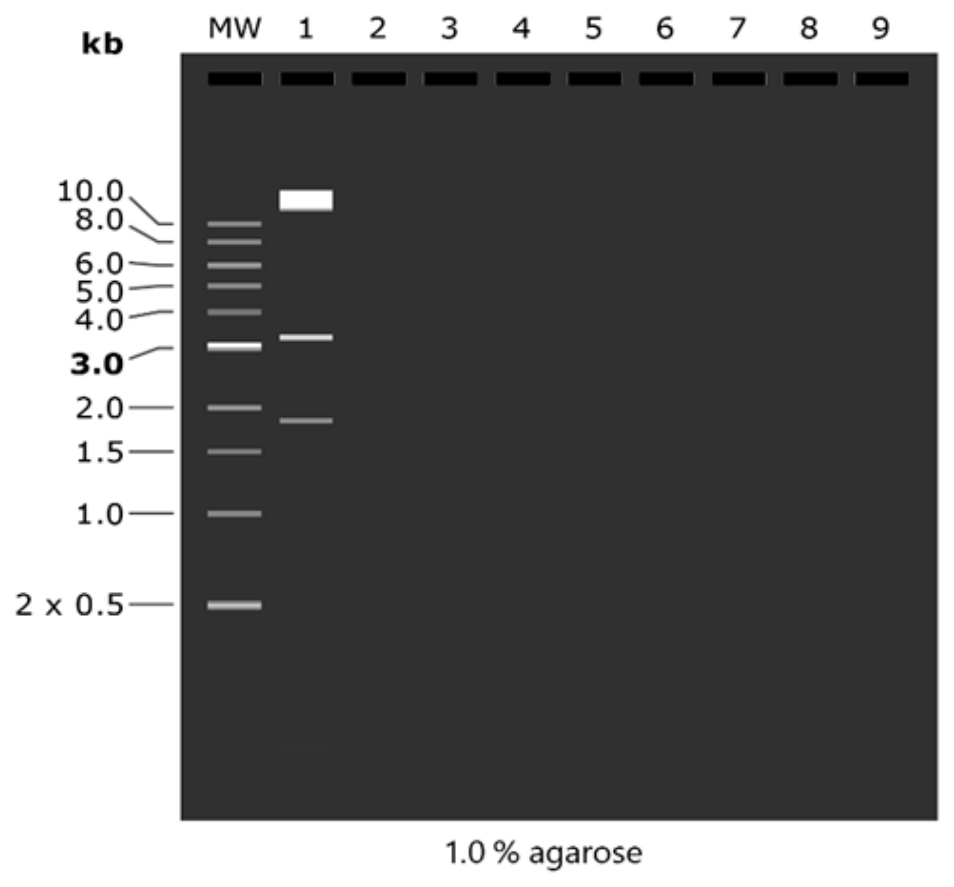
Figure 6.
Clinker synteny map comparing the final codon-optimized synthetic minimal phage plasmid against the three S. mutans source phage genomes.
Figure 6.
Clinker synteny map comparing the final codon-optimized synthetic minimal phage plasmid against the three S. mutans source phage genomes.
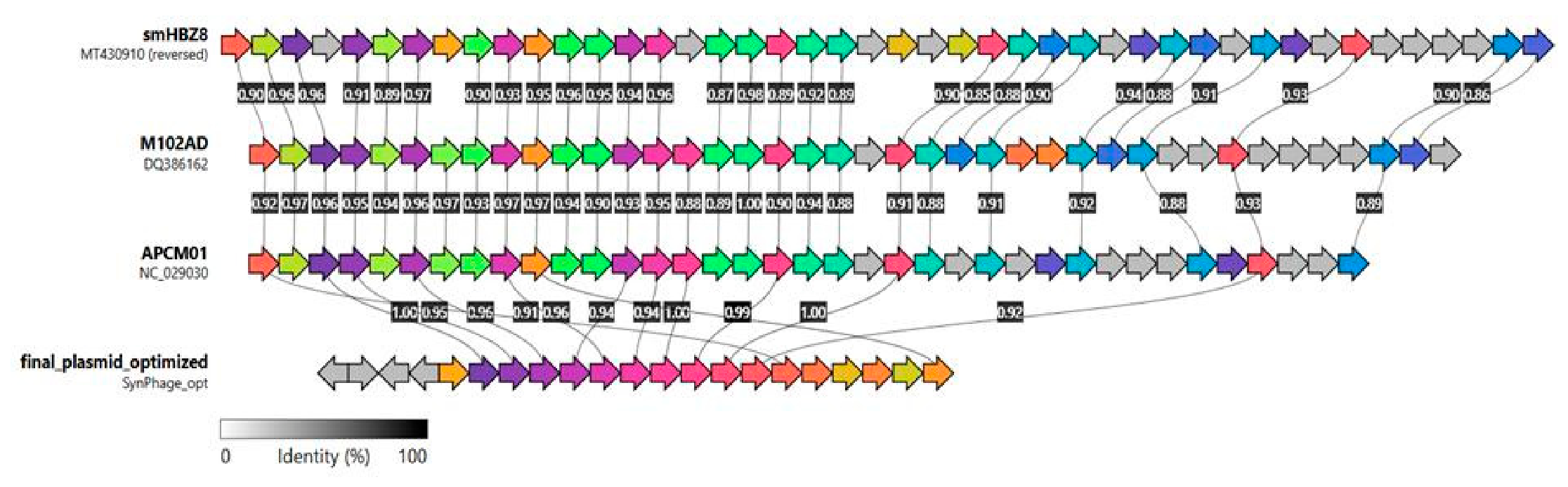
Figure 7.
Heatmap of Codon Adaptation Index (CAI, %) for each of the 17 optimized synthetic phage genes across seven bacterial hosts.
Figure 7.
Heatmap of Codon Adaptation Index (CAI, %) for each of the 17 optimized synthetic phage genes across seven bacterial hosts.
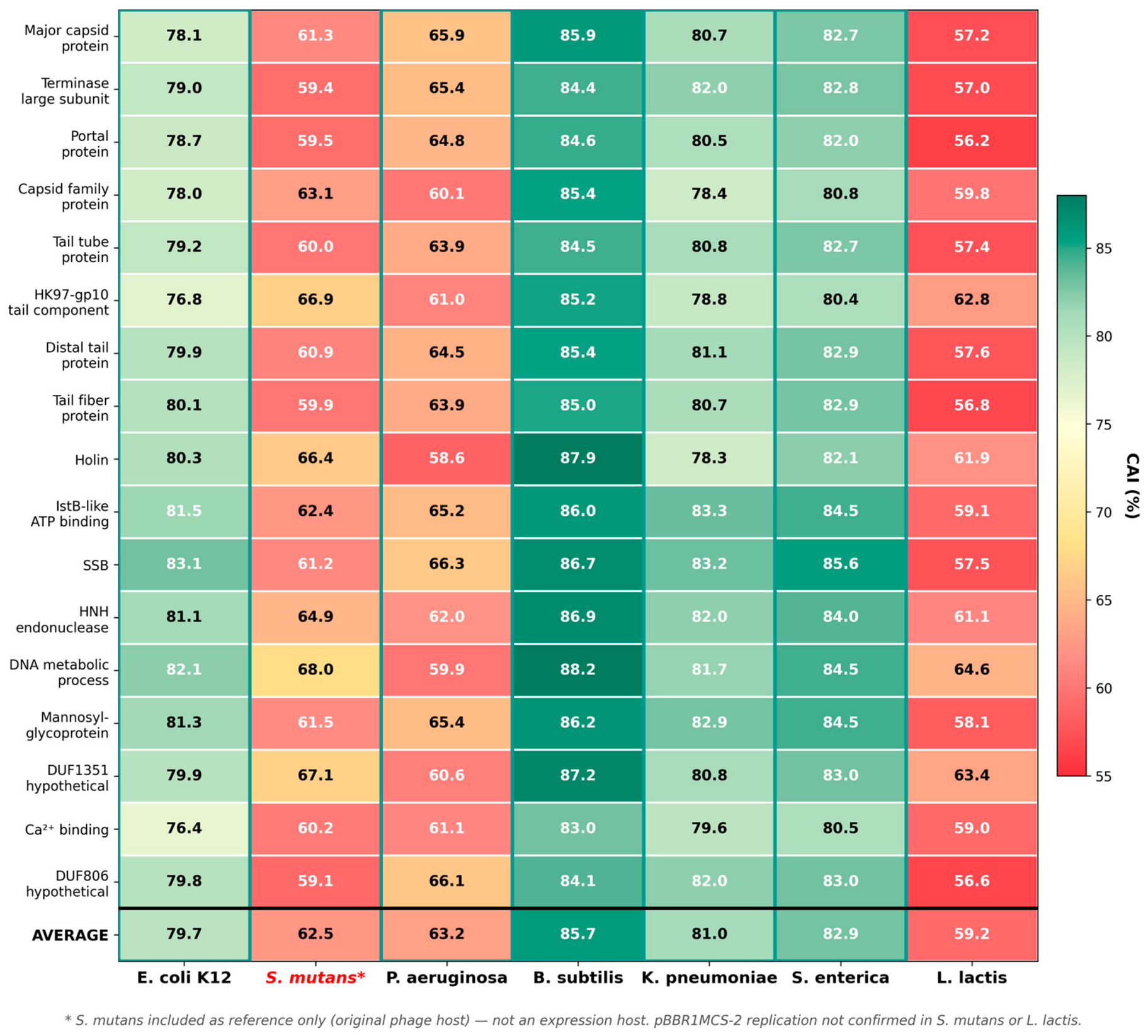

Table 1.
Distribution of essentiality classifications across 123 proteins from three phages (M102AD, phiAPCM01 and SMHBZ8).
Table 1.
Distribution of essentiality classifications across 123 proteins from three phages (M102AD, phiAPCM01 and SMHBZ8).
| Essentiality Category | Number of Proteins | Percentage |
|---|---|---|
| Essential | 44 | 35.8% |
| Likely essential | 6 | 4.9% |
| Non-essential | 27 | 21.9% |
| Unknown | 46 | 37.4% |
| Total | 123 | 100% |
Table 2.
The 17 core essential genes selected for the synthetic minimal phage genome, ordered by biological module position.
Table 2.
The 17 core essential genes selected for the synthetic minimal phage genome, ordered by biological module position.
| # | Gene ID | Source Phage | Function | Module | HHpred Score | Essentiality |
|---|---|---|---|---|---|---|
| 1 | phage2_AVT41_gp03 | phiAPCM01 | Terminase large subunit | DNA packaging | 100.0 | Essential |
| 2 | phage3_unknown38 | SMHBZ8 | DNA packaging protein | DNA packaging | 99.5 | Essential |
| 3 | phage1_unknown4 | M102AD | Portal protein | Head assembly | 99.8 | Essential |
| 4 | phage1_unknown6 | M102AD | Major capsid protein | Head assembly | 99.5 | Essential |
| 5 | phage3_unknown32 | SMHBZ8 | Tail tube protein | Tail | 97.7 | Essential |
| 6 | phage1_unknown9 | M102AD | HK97-gp10 tail component | Tail | 40.4 | Essential |
| 7 | phage3_unknown31 | SMHBZ8 | Distal tail (peptidoglycan hydrolase domain) | Tail | 99.9 | Essential |
| 8 | phage2_AVT41_gp15 | phiAPCM01 | Siphovirus protein (DUF859) | Tail | 82.4 | Essential |
| 9 | phage2_AVT41_gp18 | phiAPCM01 | Holin (LL-H family) | Lysis | 31.3 | Essential |
| 10 | phage2_AVT41_gp22 | phiAPCM01 | IstB-like ATP-binding protein | Replication | 98.6 | Essential |
| 11 | phage1_unknown33 | M102AD | Single-strand binding protein | Replication | 99.8 | Likely essential |
| 12 | phage1_unknown1 | M102AD | HNH endonuclease | Replication | 97.5 | Likely essential |
| 13 | phage1_unknown26 | M102AD | DNA metabolic process | Replication | 28.0 | Unknown |
| 14 | phage2_AVT41_gp10 | phiAPCM01 | Unknown (DUF806) | Conserved unknown | 35.6 | Unknown |
| 15 | phage1_unknown27 | M102AD | Unknown (DUF1351) | Conserved unknown | 22.2 | Unknown |
| 16 | phage3_unknown21 | SMHBZ8 | Calcium ion binding protein | Conserved unknown | 26.0 | Unknown |
| 17 | phage3_unknown23 | SMHBZ8 | Mannosylglycoprotein endase | Conserved unknown | 20.7 | Unknown |
Table 3.
Regulatory elements inserted upstream and downstream of each gene in the synthetic genome.
| Element | Sequence (5′->3′) | Function |
|---|---|---|
| sigma70 promoter | TTGACAAATAATTATAAT | Drives transcription in E. coli |
| Shine-Dalgarno RBS | AGGAGG | Ribosome binding for translation initiation |
| RBS spacer | AAAAAA | Optimal spacing between RBS and start codon |
| Rho-independent terminator | GCCCGCGGGGCTTTTTTT | Transcription termination signal (GC-rich hairpin + 7-nt poly-U tail) |
Table 4.
Codon optimization results for all 17 phage genes before and after JCat optimization targeting E. coli K12.
Table 4.
Codon optimization results for all 17 phage genes before and after JCat optimization targeting E. coli K12.
| Gene | CAI% Before | CAI% After | GC% Before | GC% After | Rare% Before | Rare% After | Status |
|---|---|---|---|---|---|---|---|
| DNA packaging protein (ph3_38) | 42.3 | 51.3 | 38.5 | 51.3 | 11.5 | 2.6 | Optimized |
| Terminase (ph2_gp03) | 37.9 | 46.6 | 39.5 | 46.2 | 3.7 | 0.3 | Improved |
| Portal (ph1_4) | 38.4 | 44.8 | 40.7 | 48.8 | 5.7 | 0.3 | Improved |
| Major capsid (ph1_6) | 34.8 | 44.9 | 41.1 | 49.1 | 1.1 | 0.3 | Improved |
| Tail tube (ph3_32) | 39.5 | 42.2 | 40.3 | 48.1 | 3.5 | 0.2 | Improved |
| HK97-gp10 (ph1_9) | 41.2 | 48.9 | 47.1 | 48.6 | 6.1 | 2.3 | Improved |
| Distal tail (ph3_31) | 37.7 | 46.2 | 38.3 | 47.9 | 3.6 | 0.1 | Improved |
| Tail fiber (ph2_gp15) | 38.2 | 43.2 | 41.0 | 49.5 | 3.4 | 0.2 | Improved |
| Holin (ph2_gp18) | 32.1 | 53.2 | 41.5 | 50.0 | 3.2 | 0.6 | Optimized |
| IstB ATP-binding (ph2_gp22) | 41.5 | 50.6 | 35.0 | 45.2 | 5.9 | 0.8 | Optimized |
| SSB (ph1_33) | 43.2 | 50.0 | 38.4 | 49.0 | 3.0 | 0.8 | Optimized |
| HNH endonuclease (ph1_1) | 34.1 | 47.2 | 39.3 | 46.1 | 8.9 | 0.8 | Improved |
| DNA metabolic process (ph1_26) | 44.6 | 53.4 | 40.6 | 46.5 | 2.4 | 0.4 | Optimized |
| Mannosyl-glycoprotein (ph3_23) | 39.8 | 48.9 | 37.2 | 46.8 | 5.8 | 0.4 | Improved |
| DUF1351 (ph1_27) | 44.5 | 48.4 | 38.9 | 44.8 | 5.7 | 0.4 | Improved |
| Ca2+ binding (ph3_21) | 31.1 | 34.4 | 38.3 | 42.1 | 3.3 | 1.6 | Needs attention |
| DUF806 (ph2_gp10) | 37.0 | 42.9 | 38.4 | 46.2 | 5.9 | 0.8 | Improved |
| Average | 38.7 | 46.9 | 39.4 | 47.6 | 4.8 | 0.7 | — |
Table 5.
Size composition of the final synthetic plasmid final_plasmid_optimized.
| Component | Size (bp) | Percentage |
|---|---|---|
| pBBR1MCS-2 backbone | 5,144 | 24.6% |
| Synthetic phage insert | 15,792 | 75.3% |
| EcoRI + XhoI linkers | 12 | 0.1% |
| Total plasmid | 20,948 | 100% |
Table 6.
ORF validity check for all 21 coding sequences in final_plasmid_optimized (representative entries).
Table 6.
ORF validity check for all 21 coding sequences in final_plasmid_optimized (representative entries).
| Gene | Type | Length (bp) | Start codon | Stop codon | Valid |
|---|---|---|---|---|---|
| Mob | Backbone | 999 | ATG | TGA | yes |
| Rep | Backbone | 663 | ATG | TAG | yes |
| lacZ | Backbone | 366 | ATG | TAA | yes |
| KanR | Backbone | 795 | ATG | TGA | yes |
| Terminase (ph2_gp03) | Phage | 1,875 | ATG | TAA | yes |
| DNA packaging protein (ph3_38) | Phage | 234 | ATG | TAA | yes |
| Portal (ph1_4) | Phage | 945 | ATG | TAA | yes |
| Ca2+ binding (ph3_21) | Phage | 183 | ATG | TAA | yes |
| (13 further phage genes) | Phage | 357-2,157 | ATG | TAA | yes |
Table 7.
Average CAI of the 17 optimized phage genes across seven organisms.
| Host | Genome GC% | pBBR1MCS-2 Compatible | Avg CAI% (original) | Avg CAI% (optimized) | Change |
|---|---|---|---|---|---|
| E. coliK12 | ~50% | Yes | 38.7% | 46.9% | +8.2% |
| P. aeruginosa | ~67% | Yes | 28.8% | 53.1% | +24.3% |
| K. pneumoniae | ~57% | Yes | 35.1% | 60.7% | +25.6% |
| S. enterica | ~52% | Yes | 38.7% | 46.9% | +8.2% |
| B. subtilis | ~43% | Yes | 40.9% | 37.3% | -3.6% |
| S. mutans | ~36% | Reference only | 48.3% | 37.2% | -11.1% |
| L. lactis | ~35% | Reference only | 48.4% | 33.1% | -15.3% |
Disclaimer/Publisher’s Note: The statements, opinions and data contained in all publications are solely those of the individual author(s) and contributor(s) and not of MDPI and/or the editor(s). MDPI and/or the editor(s) disclaim responsibility for any injury to people or property resulting from any ideas, methods, instructions or products referred to in the content. |
© 2026 by the authors. Licensee MDPI, Basel, Switzerland. This article is an open access article distributed under the terms and conditions of the Creative Commons Attribution (CC BY) license.
Copyright: This open access article is published under a Creative Commons CC BY 4.0 license, which permit the free download, distribution, and reuse, provided that the author and preprint are cited in any reuse.