

Submitted:
13 August 2026
Posted:
14 August 2026
You are already at the latest version
Abstract
Introduction: The S0–S3 workflow arose from a recurring teaching question: how to help students and authors transform PRISMA selection into a work process that is understandable, traceable, and connected to the final writing of the article. This article reconstructs the conceptual development of the model based on previous methodological literature and experience gained while supervising final bachelor's and master's degree projects undertaken by students of Medicine, Dentistry, Nursing and Speech Therapy.Methods: A methodological and conceptual overview was conducted, informed by the PCC framework and reported in accordance with PRISMA-ScR. Guidelines, manuals, methodological articles and documents on reproducibility, traceability, risk of bias, certainty of evidence, automation and artificial intelligence were examined. The initial corpus comprised 38 references; 16 were considered essential and underwent full-text assessment, and 9 were included in the final synthesis.Results: The research culminated in a teaching and operational architecture comprising a preliminary phase and four stations: S0, identification; S1, screening; S2, eligibility; and S3, inclusion and synthesis. The workflow enables students to relate each selection stage to the PRISMA flow, document which references advance or are excluded, and determine which sources correspond to the Introduction, Methods, Results, Discussion and Conclusions of the final project in IMRDC format.Conclusions: The S0–S3 workflow is the result of conceptual research supported by methodological literature and teaching experience. It does not replace PRISMA or IMRDC; rather, it converts the selection flow into a documented work sequence and facilitates the transfer of selected evidence to the academic manuscript. The workflow requires prospective evaluation across different academic programmes, teams, and review types.
Keywords:
S0–S3 workflow
; systematic review
; scoping review
; PRISMA
; evidence synthesis
; traceability
; reproducibility
; scientific writing
1. Introduction
Systematic reviews are secondary investigations that employ explicit methods to identify, select, evaluate, and synthesise sources of evidence (Brignardello-Petersen et al., 2025; Higgins et al., 2024). The development of PRISMA 2020 reinforced reporting transparency and incorporated updated recommendations on the identification, selection, evaluation and synthesis of studies (Page et al., 2021a, 2021b). For scoping reviews, PRISMA-ScR provides a specific reporting checklist and recognises their usefulness for mapping concepts, types of evidence, and knowledge gaps (Tricco et al., 2018).
Regulatory progress did not eliminate practical difficulties. These difficulties were repeatedly observed during the supervision of final degree and master’s degree projects undertaken by students of Medicine, Dentistry, Nursing and Speech Therapy. Although they understood the research question, the PRISMA diagram and the IMRDC structure separately, they encountered problems in relating them: they did not always distinguish between records, reports and studies; they confused exclusion based on title and abstract with exclusion after full-text assessment; and they were uncertain about which references should be used to justify the Introduction, describe the Methods or support the Results and Discussion. These observations highlighted the need for an intermediate structure linking selection, documentation, and writing (Pardal-Refoyo & Pardal-Peláez, 2020).
In parallel, PRISMA-S highlighted that literature searches are often reported in insufficient detail and proposed 16 items to improve their clarity and reproducibility (Rethlefsen et al., 2021). The Cochrane handbooks, specific risk-of-bias tools and GRADE introduced additional requirements for distinguishing study selection, methodological appraisal and assessment of certainty in the body of evidence (Higgins et al., 2024; Schünemann et al., 2013). Automation and artificial intelligence introduced a further requirement: documenting tools, instructions, inputs, outputs and human validation (Flemyng et al., 2025; Holst et al., 2025).
The initial question was: “How can researchers and authors effectively structure a systematic review?” Experience with students undertaking final degree and master’s degree projects allowed us to translate this into an operational problem: “How can PRISMA selection, stage-specific review activities, and final reporting within an IMRDC structure be effectively linked?”
1.1. Objectives
Main objective. To reconstruct the conceptual and teaching development that led to the S0–S3 workflow as an operational architecture for systematic reviews.
Specific objectives. To identify the methodological and teaching difficulties that motivated the S0–S3 workflow; define its phases, decisions and traceable products; explain its use; establish its relationship with PRISMA and IMRDC; and analyse its usefulness for conducting and supervising final degree projects, master’s degree projects and systematic reviews.
To address these objectives, a scoping review of the methodological corpus was combined with a reflexive systematisation of teaching experience; the results were organised using the same sequence: source selection, genesis of the problem, definition of the model, application, relationship with PRISMA and IMRDC, and applicability.
2. Methods
2.1. Design and Framework of the Review
A methodological and conceptual overview was conducted and integrated with a reflexive systematisation of teaching experience. The purpose was not to estimate effects or compare interventions, but to map the background, problems and solutions that converged in S0–S3 and to explain how difficulties observed during the supervision of final degree and master’s degree projects contributed to formalising the workflow. The review was guided by the JBI methodology for scoping reviews and reported in accordance with PRISMA-ScR (Peters et al., 2020; Tricco et al., 2018).
2.2. PCC Question and Framework
The review question, derived from the teaching problem formulated in the Introduction, was: “What methodological, organisational and teaching problems hinder the connection between PRISMA selection, the work carried out at each stage, and final writing in IMRDC, and which elements allow these components to be integrated into an operational architecture such as S0–S3?” The PCC framework was defined as follows: population, comprising students, researchers, authors and evidence-synthesis teams; concept, comprising review methodology, workflow, reproducibility, traceability, documentation and connection with IMRDC; and context, comprising university teaching and evidence synthesis in the health sciences. This structure was adopted because PCC is suitable for defining population, concept and context in scoping reviews (Peters et al., 2020), while the explicit formulation of the question and inclusion criteria determines the design and coherence of any review (Stern et al., 2014).
2.3. Sources and Conceptual Strategy
An initial corpus of 38 references was assembled through directed conceptual searching, cross-reference review, and targeted retrieval of sentinel documents. The terms were organised into five blocks: systematic review as a method; organisation and structuring; reproducibility and traceability; methodological standards and critical appraisal; and automation and artificial intelligence. The distribution of the corpus by conceptual block and selection stage is presented in Table S1; the complete conceptual combination, in Table S2; and the individual decision matrix, in Table S3. For future replications, updates or external validation, Supplementary Appendix S4 proposes search strategies adapted to the main databases and platforms. These strategies were not retrospectively executed to obtain the current corpus and must be validated, dated and documented in accordance with PRISMA-S (Rethlefsen et al., 2021).
2.4. Inclusion Criteria
- International guidelines, methodological manuals, consensus statements, reporting standards and methodological articles on systematic or scoping reviews.
- Documents with contributions to the formulation of questions, protocolization, search, selection, eligibility, extraction, risk of bias, certainty, synthesis, reproducibility, document management or auditing.
- Publications on automation or artificial intelligence applied to evidence synthesis when describing transparency, human oversight or documentation of the process.
- Sources in Spanish, English or Portuguese with direct relevance to reconstructing the conceptual development of the S0–S3 workflow.
- Documents classifiable in at least one analytical category: teaching background, methodological standardization, search and selection, critical evaluation, traceability, flow architecture, artificial intelligence or connection with IMRD.
2.5. Exclusion Criteria
- Primary clinical studies, reviews or meta-analyses focused exclusively on clinical outcomes and without methodological input.
- Editorials, letters, conference abstracts or narrative reviews without verifiable conceptual contribution.
- Documents dedicated solely to statistical techniques with no implications for the organisation or documentation of a review.
- Duplicates, pre-release versions replaced by a more complete final version, and outdated publications with no historical value.
- Foreign uses of the term S0–S3 and documents not directly related to the transition between selection, synthesis and scientific writing.
2.6. Selection, Extraction and Synthesis
References were screened by title, abstract, and conceptual relevance. The selected documents underwent full-text assessment and were recorded in a matrix containing the following variables: problem identified, proposed solution, affected phase, relationship with PRISMA, traceability, reproducibility, artificial intelligence and contribution to the workflow. Decisions were documented with a primary reason for exclusion. The included texts were grouped according to their role in the genesis of the model and synthesised through thematic and comparative analysis; no meta-analysis was performed.
2.7. Integration of Teaching Experience
Teaching experience was used as a source of contextualisation and hypothesis generation, not as a formal study of educational outcomes. Recurrent difficulties observed during the supervision of final degree and master’s degree projects in Medicine, Dentistry, Nursing and Speech Therapy were systematised: confusion between documentary units; loss of traceability between search, screening and full-text assessment; late reconstruction of the PRISMA diagram; and inadequate selection of references for the IMRDC sections. These observations were compared with the methodological literature and guided the definition of the model’s functional requirements: one station per type of decision, one documentary product per station and an explicit correspondence between PRISMA, S0–S3 and IMRDC.
3. Results
The results are presented according to the study objectives: first, the corpus that supported the reconstruction; second, the difficulties that motivated the model; third, the definition and use of S0–S3; and finally, its correspondence with PRISMA and IMRDC and its applicability.
3.1. Selection Flow
Conceptual searching, cross-reference review, and targeted retrieval of sentinel documents produced an initial corpus of 38 references. After screening by title, abstract and conceptual relevance, 22 references were excluded and 16 were selected for full-text assessment: Pardal-Refoyo and Pardal-Peláez (2020, 2026), Page et al. (2021a), Rethlefsen et al. (2021), Higgins et al. (2024), Stern et al. (2014), Booth et al. (2012), Bramer et al. (2018), McGowan et al. (2016), Sterne et al. (2016, 2019), Whiting et al. (2011), Schünemann et al. (2013), Campbell et al. (2020), Flemyng et al. (2025), and Holst et al. (2025). Following full-text assessment, 7 documents were excluded because their contribution to the operational development of the model was indirect or non-essential: Campbell et al. (2020), Flemyng et al. (2025), Holst et al. (2025), Sterne et al. (2016, 2019), Whiting et al. (2011) and Schünemann et al. (2013). Nine sources were included in the final historical-conceptual synthesis: Pardal-Refoyo and Pardal-Peláez (2020, 2026), Page et al. (2021a), Rethlefsen et al. (2021), Higgins et al. (2024), Stern et al. (2014), Booth et al. (2012), Bramer et al. (2018) and McGowan et al. (2016). Concordance between the review stages and document-level decisions is presented in Figure 1 and Table S3.
3.2. From the Teaching Problem to a Decision Architecture
Analysis of the corpus and systematisation of teaching experience identified the same central problem: methodological stages were understood in a fragmented manner and were not easily translated into decisions, documents and sections of final degree or master’s degree projects. The immediate antecedent was an educational proposal to organise a systematic review around a clear question, reproducible search, selection, extraction, evaluation, and writing (Pardal-Refoyo & Pardal-Peláez, 2020). Comparison of these needs with PRISMA 2020, PRISMA-S, Cochrane, PROSPERO and search guidelines showed that the standards described the necessary components but did not provide a single teaching sequence linking selection and writing (Booth et al., 2012; Bramer et al., 2018; Higgins et al., 2024; McGowan et al., 2016; Page et al., 2021a; Rethlefsen et al., 2021). The outcome of this conceptual analysis was the replacement of a simple sequence of steps with an architecture of documented decisions, later formalised as the S0–S3 workflow (Pardal-Refoyo & Pardal-Peláez, 2026).
3.3. Concept and Components of the S0–S3 Workflow
The S0–S3 workflow is a methodological, documentary, and teaching architecture that organises the review as a progressive selection of records, reports, and studies. The letter S refers to sequential selection, documentary support and reproducible synthesis. Numbering starts at zero because identification establishes the document corpus before screening begins. The workflow does not add new stages to PRISMA; rather, it transforms selection stages into documented workstations with verifiable inputs, decisions, outputs, and products. Its formalisation updates the 2020 educational proposal and explicitly links it to the PRISMA flow, traceability and IMRDC drafting (Pardal-Refoyo & Pardal-Peláez, 2020, 2026). The operational architecture, central decision, and traceable product for each phase are summarised in Table 1.
3.4. How to Use the S0–S3 Workflow
Application of the workflow begins in the preliminary phase, during which the problem is narrowed, the question formulated, terms and sources tested, criteria defined, and the protocol written. In S0, the document corpus is assembled, record provenance is preserved, and the search and deduplication processes are documented. In S1, title and abstract criteria are applied. In S2, full texts are assessed and a primary reason for exclusion is recorded. In S3, data from included studies are extracted and evaluated, and the synthesis is performed. Each phase generates the matrix and counts required to maintain traceability.
The operational questions associated with the stations are: S0, “What has been identified, and from which sources?”; S1, “Which records appear relevant?”; S2, “Which reports meet the eligibility criteria, and why are the others excluded?”; and S3, “Which studies contribute to the synthesis?” This sequence allows PRISMA counts to be generated directly from the working files and avoids retrospective reconstruction.
The workflow also differentiates the function of references within IMRDC: contextual sources justify the Introduction; methodological sources support the Methods; and studies included in S3 form the basis of the Results, Discussion, and Conclusions. This correspondence prevents a source that did not pass the selection process from being presented as a review finding.
3.5. Relationship with PRISMA
PRISMA 2020 is a reporting guideline: it specifies what information should be communicated so that readers understand why the review was conducted, what was done, and what was found (Page et al., 2021a, 2021b). S0–S3 does not change that standard. It operationalises it by associating each part of the flow with files, decisions, responsible parties and counts. PRISMA-S especially reinforces S0 by requiring sufficient information on sources, strategies, dates, limits, and record management (Rethlefsen et al., 2021), while PRISMA-P and PROSPERO underpin protocol development and prospective registration before definitive identification (Booth et al., 2012; Moher et al., 2015).
The correspondence is not exact. In PRISMA 2020, identification includes records identified and records removed before screening; screening reports the records screened and excluded; eligibility includes reports sought for retrieval, not retrieved and assessed for eligibility; and inclusion distinguishes included studies from their reports (Page et al., 2021a, 2021b). S0–S3 preserves these units and prevents multiple reports of the same study from being incorrectly counted as separate studies. In diagnostic reviews, this structure can be complemented by PRISMA-DTA (McInnes et al., 2018).
3.6. Relationship with IMRDC
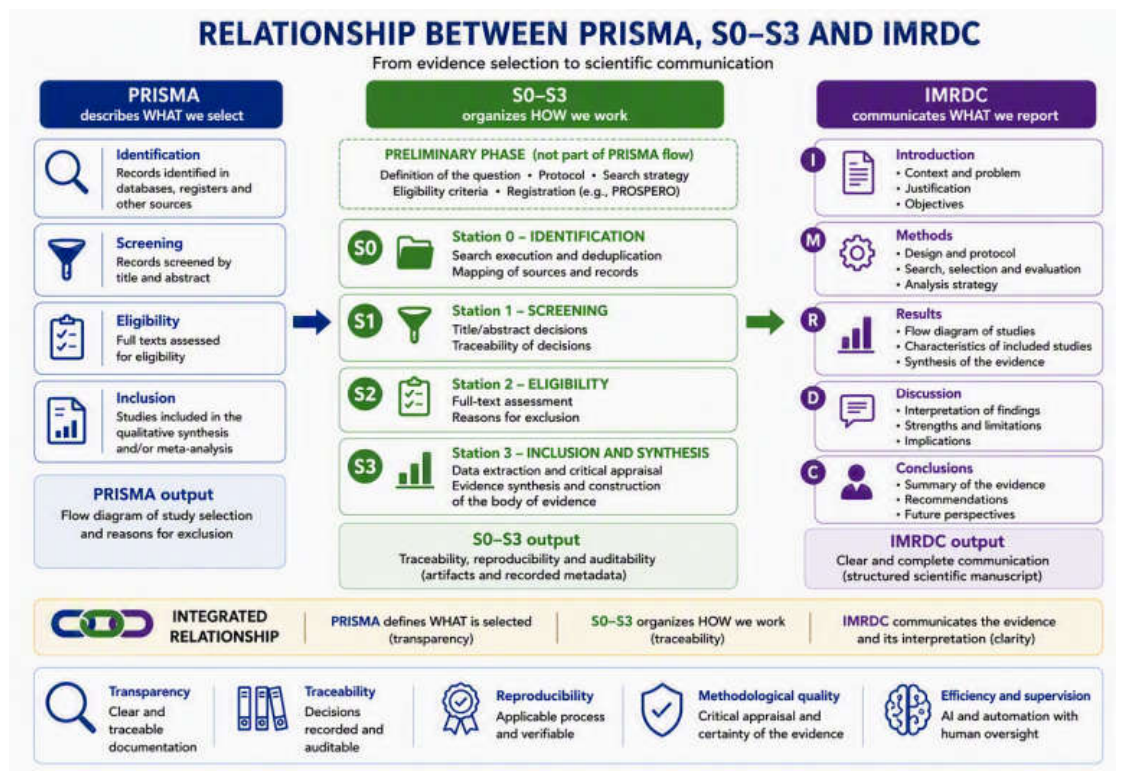
The functional correspondence between the S0–S3 stations, PRISMA selection stages, IMRDC reporting sections, and the documentary outputs or reported content is summarised in Table 2.
Figure 2.
Relationship between PRISMA, S0–S3 and IMRDC. Conceptual architecture linking evidence selection (PRISMA), workflow organisation (S0–S3), and scientific communication (IMRDC: Introduction, Methods, Results, Discussion and Conclusions), thereby supporting transparency, traceability, reproducibility and auditability throughout the review process. Note. IMRDC = Introduction, Methods, Results, Discussion and Conclusions. The preliminary phase is not part of the PRISMA flow diagram and refers to review planning, protocol development and registration before study identification.
Figure 2.
Relationship between PRISMA, S0–S3 and IMRDC. Conceptual architecture linking evidence selection (PRISMA), workflow organisation (S0–S3), and scientific communication (IMRDC: Introduction, Methods, Results, Discussion and Conclusions), thereby supporting transparency, traceability, reproducibility and auditability throughout the review process. Note. IMRDC = Introduction, Methods, Results, Discussion and Conclusions. The preliminary phase is not part of the PRISMA flow diagram and refers to review planning, protocol development and registration before study identification.
3.7. Applicability of the Workflow
- Methodological: separates decisions that are often confused and links question, protocol, selection, evaluation and synthesis.
- Documentary: preserves identifiers and maintains a dedicated matrix for each phase, allowing the progression of each record through the workflow to be reconstructed and facilitating updates.
- Reporting: Generates PRISMA counts from job files instead of reconstructing them retrospectively.
- Teaching: offers a visible sequence for students, residents, PhD students and teams with unequal experience.
- Editorial: makes it easier to check the coherence between protocol, methods, results, annexes and diagram.
- Technological: integrates bibliographic managers, CSV, RIS/BibTeX, screening platforms, reproducible analysis and supervised AI.
In educational settings, S0–S3 provides tutors and students with a common language: it identifies the phase reached by each reference, the outstanding decision and the part of the manuscript supported by the resulting product. In methodological and editorial settings, it facilitates auditing of consistency among the protocol, decisions, PRISMA counts, appendices and final manuscript.
4. Discussion
The findings address the research question and the stated objectives. The literature and teaching experience converged on a common problem: the absence of an architecture linking PRISMA selection categories, operational decisions within the review, and the role of references in IMRDC. S0–S3 is the proposed conceptual response: it does not replace existing standards but integrates them into workstations with traceable decisions and products. Thus, the objective of reconstructing the genesis of the model was addressed through the corpus and teaching experience; the objective of defining the model and explaining its use was developed through phases S0–S3; and the objective of establishing its relationship with PRISMA and IMRDC was operationalised through the functional correspondence presented in the Results (Higgins et al., 2024; Page et al., 2021a; Pardal-Refoyo & Pardal-Peláez, 2020, 2026; Rethlefsen et al., 2021).
The workflow should be used as a flexible documentation architecture rather than as a nominal classification. Its value lies in associating each station with a decision and a verifiable product: S0 preserves the document corpus and source provenance; S1 records preliminary screening; S2 justifies full-text eligibility; and S3 builds the evidence base. This sequence improves traceability, facilitates updating, and allows work to be monitored without relying on retrospective reconstruction. Comprehensive documentation and peer review of search strategies provide a direct methodological basis for this requirement of reproducibility (Bramer et al., 2018; McGowan et al., 2016; Rethlefsen et al., 2021).
The connection with IMRDC enhances the educational value of the model because it requires differentiation of the epistemological functions of the sources. Contextual material defines the problem; guidelines and instruments justify the method; and included studies support the findings and their interpretation. This separation can reduce overly long introductions, incomplete methods, and discussions supported by references outside the selected corpus.
Artificial intelligence should be governed by the same principle. It can support normalisation, deduplication, prioritisation, preliminary extraction and consistency checking, but its use does not in itself validate a decision. To maintain accountability and auditability, authors should document the tool, version, date, task, input data, instructions, outputs and human validation (Flemyng et al., 2025; Holst et al., 2025).
4.1. Limitations
This review reconstructs the conceptual development of the S0–S3 workflow through methodological documents and reflexive systematisation of teaching experience. It does not constitute a formal evaluation of an educational intervention, nor does it reproduce an exhaustive search of all publications on review workflows. The difficulties observed among students were not collected using a prospective protocol, validated instruments, or comparisons between cohorts; they should therefore be interpreted as the context that generated the model. The PRISMA counts represent the selection of the historical-conceptual corpus. S0–S3 will need to be evaluated prospectively in final degree projects, master’s degree projects and real-world reviews, using outcomes such as understanding of the stages, inter-reviewer agreement, counting errors, supervision time, reporting completeness and manuscript quality.
4.2. Implications for Research and Teaching
Future research should compare S0–S3 with conventional teaching procedures among medical, dental, nursing and speech therapy students, as well as residents, doctoral students and evidence-synthesis teams. The transferability of the model across different questions, disciplines and software should also be explored. Future studies should prospectively define educational and methodological outcomes, document implementation fidelity, and analyse not only efficiency but also understanding, reproducibility and reporting quality.
5. Conclusions
The S0–S3 workflow is the result of conceptual research grounded in previous methodological literature and recurrent difficulties observed during the supervision of final degree and master’s degree projects. Its contribution is not to create new stages but to transform identification, screening, eligibility and inclusion into understandable, documented workstations linked to specific products. The preliminary phase stabilises the question and protocol; S0 establishes the document corpus; S1 screens potentially relevant records; S2 determines eligibility; and S3 extracts, evaluates, and synthesises the evidence.
In response to the research question, the model’s central contribution is to connect three dimensions that students and authors commonly perceive as separate: PRISMA shows what is selected; the S0–S3 workflow organises how the work is conducted and traceability preserved; and IMRDC determines how each group of references is reported in the manuscript and which function it fulfils. This addresses the objectives of reconstructing the genesis of the workflow, defining its components, explaining its use, and establishing its relationship with PRISMA and IMRDC. Its educational and methodological applicability is plausible but must be confirmed through prospective evaluation across different academic programmes, teams and review types.
Authorship contributions
José Luis Pardal-Refoyo and Beatriz Pardal-Peláez participated in the conceptualization, methodological design, interpretation, writing and critical review of the manuscript.
Ethics
approval was not required because the study was based exclusively on published literature and methodological documents and did not involve human participants or identifiable personal data.
Funding
No specific funding was received.
Use of artificial intelligence
AI-assisted tools were used to organise the corpus, assess methodological coherence, support manuscript preparation and generate preliminary visual concepts. The authors independently reviewed and verified all citations, decisions, counts and wording and take full responsibility for the content.
Conflicts of interest
the authors declare no conflicts related to this work.
References
- Atkinson, L. Z.; Cipriani, A. How to carry out a literature search for a systematic review: A practical guide. BJPsych Advances 2018, 24(2), 74–82. [Google Scholar] [CrossRef]
- Booth, A., Clarke, M., Dooley, G., Ghersi, D., Moher, D., Petticrew, M., & Stewart, L. (2012). The nuts and bolts of PROSPERO: An international prospective register of systematic reviews. Systematic Reviews, 1, Article 2. https://doi.org/10.1186/2046-4053-1-2.
- Bramer, W. M.; de Jonge, G. B.; Rethlefsen, M. L.; Mast, F.; Kleijnen, J. A systematic approach to searching: An efficient and complete method to develop literature searches. Journal of the Medical Library Association 2018, 106(4), 531–541. [Google Scholar] [CrossRef] [PubMed]
- Brignardello-Petersen, R.; Santesso, N.; Guyatt, G. H. Systematic reviews of the literature: An introduction to current methods. American Journal of Epidemiology 2025, 194(2), 536–542. [Google Scholar] [CrossRef] [PubMed]
- Calderón Martínez, E.; Flores Valdés, J. R.; Castillo, J. L.; Castillo, J. V.; Blanco Montecino, R. M.; Morín Jiménez, J. E.; Arriaga Escamilla, D.; Diarte, E. Ten steps to conduct a systematic review. Cureus 2023, 15(12), e51422. [Google Scholar] [CrossRef] [PubMed]
- Campbell, M., McKenzie, J. E., Sowden, A., Katikireddi, S. V., Brennan, S. E., Ellis, S., Hartmann-Boyce, J., Ryan, R., Shepperd, S., Thomas, J., Welch, V., & Thomson, H. (2020). Synthesis without meta-analysis (SWiM) in systematic reviews: Reporting guideline. BMJ, 368, l6890. https://doi.org/10.1136/bmj.l6890.
- Covidence. A practical guide: Protocol development for systematic reviews. In Veritas Health Innovation; 2024; Available online: https://www.covidence.org/wp-content/uploads/2024/10/A_practical_guide_Protocol_Development_for_Systematic_Reviews.pdf.
- Deeks, J. J.; Bossuyt, P. M.; Leeflang, M. M.; Takwoingi, Y. (Eds.) Cochrane handbook for systematic reviews of diagnostic test accuracy (Version 2.0, updated July 2023).; Cochrane., 2023; Available online: https://www.cochrane.org/authors/handbooks-and-manuals/handbook-systematic-reviews-diagnostic-test-accuracy.
- Flemyng, E.; Noel-Storr, A.; Macura, B.; Gartlehner, G.; Thomas, J.; Meerpohl, J. J.; Jordan, Z.; Minx, J. C.; Eisele-Metzger, A.; Hamel, C.; Jemioło, P.; Porritt, K.; Grainger, M. Position statement on artificial intelligence use in evidence synthesis across Cochrane, the Campbell Collaboration, JBI and the Collaboration for Environmental Evidence. Cochrane Database of Systematic Reviews 2025, ED000178. [Google Scholar] [CrossRef]
- Higgins, J. P. T.; Thomas, J.; Chandler, J.; Cumpston, M.; Li, T.; Page, M. J.; Welch, V. A. (Eds.) Cochrane handbook for systematic reviews of interventions (Version 6.5, updated August 2024); Cochrane., 2024). Cochrane handbook for systematic reviews of interventions (Version 6.5, updated August 2024; Available online: https://www.cochrane.org/authors/handbooks-and-manuals/handbook/current.
- Holst, D., Moenck, K., Koch, J., Schmedemann, O., & Schüppstuhl, T. (2025). Transparent reporting of AI in systematic literature reviews: Development of the PRISMA-trAIce checklist. JMIR AI, 4, e80247. https://doi.org/10.2196/8024.
- McGowan, J.; Sampson, M.; Salzwedel, D. M.; Cogo, E.; Foerster, V.; Lefebvre, C. PRESS peer review of electronic search strategies: 2015 guideline statement. Journal of Clinical Epidemiology 75 2016, 40–46. [Google Scholar] [CrossRef] [PubMed]
- McInnes, M. D. F.; Moher, D.; Thombs, B. D.; McGrath, T. A.; Bossuyt, P. M.; Clifford, T.; Cohen, J. F.; Deeks, J. J.; Gatsonis, C.; Hooft, L.; Hunt, H. A.; Hyde, C. J.; Korevaar, D. A.; Leeflang, M. M. G.; Macaskill, P.; Reitsma, J. B.; Rodin, R.; Rutjes, A. W. S.; Salameh, J.-P.; Willis, B. H. Preferred reporting items for a systematic review and meta-analysis of diagnostic test accuracy studies: The PRISMA-DTA statement. JAMA 2018, 319(4), 388–396. [Google Scholar] [CrossRef] [PubMed]
- McKenzie, J. E.; Brennan, S. E.; Ryan, R. E.; Thomson, H. J.; Johnston, R. V. Summarizing study characteristics and preparing for synthesis. In Cochrane handbook for systematic reviews of interventions (Version 6.5, Chapter 9).; Higgins, J. P. T., Thomas, J., Chandler, J., Cumpston, M., Li, T., Page, M. J., Welch, V. A., Eds.; Cochrane., 2024; Available online: https://www.cochrane.org/authors/handbooks-and-manuals/handbook/current/chapter-09.
- Moher, D., Shamseer, L., Clarke, M., Ghersi, D., Liberati, A., Petticrew, M., Shekelle, P., Stewart, L. A., & Prisma-P Group. (2015). Preferred reporting items for systematic review and meta-analysis protocols (PRISMA-P) 2015 statement. Systematic Reviews, 4, Article 1. https://doi.org/10.1186/2046-4053-4-1.
- Page, M. J., McKenzie, J. E., Bossuyt, P. M., Boutron, I., Hoffmann, T. C., Mulrow, C. D., Shamseer, L., Tetzlaff, J. M., Akl, E. A., Brennan, S. E., Chou, R., Glanville, J., Grimshaw, J. M., Hróbjartsson, A., Lalu, M. M., Li, T., Loder, E. W., Mayo-Wilson, E., McDonald, S.,... Moher, D. (2021a). The PRISMA 2020 statement: An updated guideline for reporting systematic reviews. BMJ, 372, n71. https://doi.org/10.1136/bmj.n71.
- Page, M. J., Moher, D., Bossuyt, P. M., Boutron, I., Hoffmann, T. C., Mulrow, C. D., Shamseer, L., Tetzlaff, J. M., Akl, E. A., Brennan, S. E., Chou, R., Glanville, J., Grimshaw, J. M., Hróbjartsson, A., Lalu, M. M., Li, T., Loder, E. W., Mayo-Wilson, E., McDonald, S.,... McKenzie, J. E. (2021b). PRISMA 2020 explanation and elaboration: Updated guidance and exemplars for reporting systematic reviews. BMJ, 372, n160. https://doi.org/10.1136/bmj.n160.
- Pardal-Refoyo, J. L., & Pardal-Peláez, B. (2020). Annotations to structure a systematic review. ENT Journal, 11(2), 155–160. https://doi.org/10.14201/orl.22882.
- Pardal-Refoyo, J. L.; Pardal-Peláez, B. Annotations to structure a systematic review: Methodological update and key principles using the S0–S3 flow [Preprint]; Preprints.org., 2026. [Google Scholar] [CrossRef]
- Pardal-Refoyo, J. L.; Soto Varela, A.; López Poveda, E.; Caballero Borrego, M. Artificial intelligence strategies and tools to improve bibliographic research in otorhinolaryngology. In White Paper SEORL-CCC 2025; International Marketing & Communication, S.A, 2025; Available online: https://seorl.net/buscador/libros-blancos/.
- Pardal-Refoyo, J. L., Soto Varela, A., López Poveda, E. A., & Caballero Borrego, M. (2026). Methodology for conducting a bibliographic review. In SEORL 2026 Update (Chapter 110). Spanish Society of Otorhinolaryngology and Head and Neck Surgery. https://www.actualizacion.seorl.net/login.
- Peters, M. D. J., Marnie, C., Tricco, A. C., Pollock, D., Munn, Z., Alexander, L., McInerney, P., Godfrey, C. M., & Khalil, H. (2020). Updated methodological guidance for the conduct of scoping reviews. JBI Evidence Synthesis, 18(10), 2119–2126. https://doi.org/10.11124/JBIES-20-00167.
- PRISMA Statement. (n.d.). PRISMA 2020 statement. Retrieved August 13, 2026, from https://www.prisma-statement.org/prisma-2020-statement.
- Rethlefsen, M. L.; Kirtley, S.; Waffenschmidt, S.; Ayala, A. P.; Moher, D.; Page, M. J.; Koffel, J. B.; PRISMA-S Group. PRISMA-S: An extension to the PRISMA statement for reporting literature searches in systematic reviews. Systematic Reviews 10 2021, 39. [Google Scholar] [CrossRef] [PubMed]
- Reitsma, J. B.; Glas, A. S.; Rutjes, A. W. S.; Scholten, R. J. P. M.; Bossuyt, P. M.; Zwinderman, A. H. Bivariate analysis of sensitivity and specificity produces informative summary measures in diagnostic reviews. Journal of Clinical Epidemiology 2005, 58(10), 982–990. [Google Scholar] [CrossRef] [PubMed]
- Ringsten, M.; Styrmisdottir, L.; Naesström, M.; Johansson, M.; Bruschettini, M.; Wallerstedt, S. M. Systematic reviews as part of doctoral theses and for the promotion to associate professor: A descriptive study of university policies in Sweden. Cochrane Evidence Synthesis and Methods 2026, 4(1), e70069. [Google Scholar] [CrossRef] [PubMed]
- Tools, Risk of Bias. ROBINS-I V2 tool: Risk of bias in non-randomized studies of interventions [Draft version, November 2025; University of Bristol, 2025; Available online: https://www.riskofbias.info/welcome/robins-i-v2.
- Rutter, C. M.; Gatsonis, C. A. A hierarchical regression approach to meta-analysis of diagnostic test accuracy evaluations. Statistics in Medicine 2001, 20(19), 2865–2884. [Google Scholar] [CrossRef] [PubMed]
- Schünemann, H.; Brożek, J.; Guyatt, G.; Oxman, A. (Eds.) GRADE handbook for grading quality of evidence and strength of recommendations; GRADE Working Group, 2013; Available online: https://gdt.gradepro.org/app/handbook/handbook.html.
- Stern, C.; Jordan, Z.; McArthur, A. Developing the review question and inclusion criteria. American Journal of Nursing 2014, 114(4), 53–56. [Google Scholar] [CrossRef] [PubMed]
- Sterne, J. A. C., Hernán, M. A., Reeves, B. C., Savović, J., Berkman, N. D., Viswanathan, M., Henry, D., Altman, D. G., Ansari, M. T., Boutron, I., Carpenter, J. R., Chan, A.-W., Churchill, R., Deeks, J. J., Hróbjartsson, A., Kirkham, J., Jüni, P., Loke, Y. K., Pigott, T. D.,... Higgins, J. P. T. (2016). ROBINS-I: A tool for assessing risk of bias in non-randomised studies of interventions. BMJ, 355, i4919. https://doi.org/10.1136/bmj.i4919.
- Sterne, J. A. C., Savović, J., Page, M. J., Elbers, R. G., Blencowe, N. S., Boutron, I., Cates, C. J., Cheng, H.-Y., Corbett, M. S., Eldridge, S. M., Emberson, J. R., Hernán, M. A., Hopewell, S., Hróbjartsson, A., Junqueira, D. R., Jüni, P., Kirkham, J. J., Lasserson, T., Li, T.,... Higgins, J. P. T. (2019). RoB 2: A revised tool for assessing risk of bias in randomised trials. BMJ, 366, l4898. https://doi.org/10.1136/bmj.l4898.
- Tricco, A. C., Lillie, E., Zarin, W., O’Brien, K. K., Colquhoun, H., Levac, D., Moher, D., Peters, M. D. J., Horsley, T., Weeks, L., Hempel, S., Akl, E. A., Chang, C., McGowan, J., Stewart, L., Hartling, L., Aldcroft, A., Wilson, M. G., Garritty, C.,... Straus, S. E. (2018). PRISMA extension for scoping reviews (PRISMA-ScR): Checklist and explanation. Annals of Internal Medicine, 169(7), 467–473. https://doi.org/10.7326/M18-0850.
- von Pressentin, K. B., Shabani, J. S., & Young, T. (2025). Integrating evidence synthesis into doctoral research: A guide for family medicine and primary care. African Journal of Primary Health Care & Family Medicine, 17(2), a5198. https://doi.org/10.4102/phcfm.v17i2.5198.
- Wells, G. A.; Shea, B.; O’Connell, D.; Peterson, J.; Welch, V.; Losos, M.; Tugwell, P. The Newcastle–Ottawa Scale (NOS) for assessing the quality of nonrandomised studies in meta-analyses. In Ottawa Hospital Research Institute; n.d.; Available online: https://ohri.ca/en/who-we-are/core-facilities-and-platforms/ottawa-methods-centre/newcastle-ottawa-scale.
- Whaley, P., Garside, R., & Eales, J. F. (2020). A general protocol for pilot-testing the screening stage of a systematic review. protocols.io. https://doi.org/10.17504/protocols.io.bkc9ksz6. [CrossRef]
- Whiting, P. F., Rutjes, A. W. S., Westwood, M. E., Mallett, S., Deeks, J. J., Reitsma, J. B., Leeflang, M. M. G., Sterne, J. A. C., Bossuyt, P. M. M., & QUADAS-2 Group. (2011). QUADAS-2: A revised tool for the quality assessment of diagnostic accuracy studies. Annals of Internal Medicine, 155(8), 529–536. https://doi.org/10.7326/0003-4819-155-8-201110180-00009.
- Whiting, P. F., Tomlinson, E., Rutjes, A. W. S., Davenport, C. F., Yang, B., Westwood, M. E., Takwoingi, Y., Reitsma, J. B., Hyde, C. J., Bossuyt, P. N. M., Deeks, J. J., Leeflang, M. M. G., & Mallett, S. (2026). QUADAS-3: A revised tool for the quality assessment of diagnostic test accuracy studies. Annals of Internal Medicine, 179(4), 548–555. https://doi.org/10.7326/ANNALS-25-02104.
Figure 1.
PRISMA flow diagram of the selection of the historical-conceptual corpus. 38 references were identified through directed conceptual search, reference review, and sentinel document retrieval; 22 were excluded during screening; 16 were evaluated in full text; 7 were excluded after evaluation; and 9 sources were included in the final synthesis. Diagram adapted from PRISMA 2020 and PRISMA-ScR (Page et al., 2021a; Tricco et al., 2018).
Figure 1.
PRISMA flow diagram of the selection of the historical-conceptual corpus. 38 references were identified through directed conceptual search, reference review, and sentinel document retrieval; 22 were excluded during screening; 16 were evaluated in full text; 7 were excluded after evaluation; and 9 sources were included in the final synthesis. Diagram adapted from PRISMA 2020 and PRISMA-ScR (Page et al., 2021a; Tricco et al., 2018).
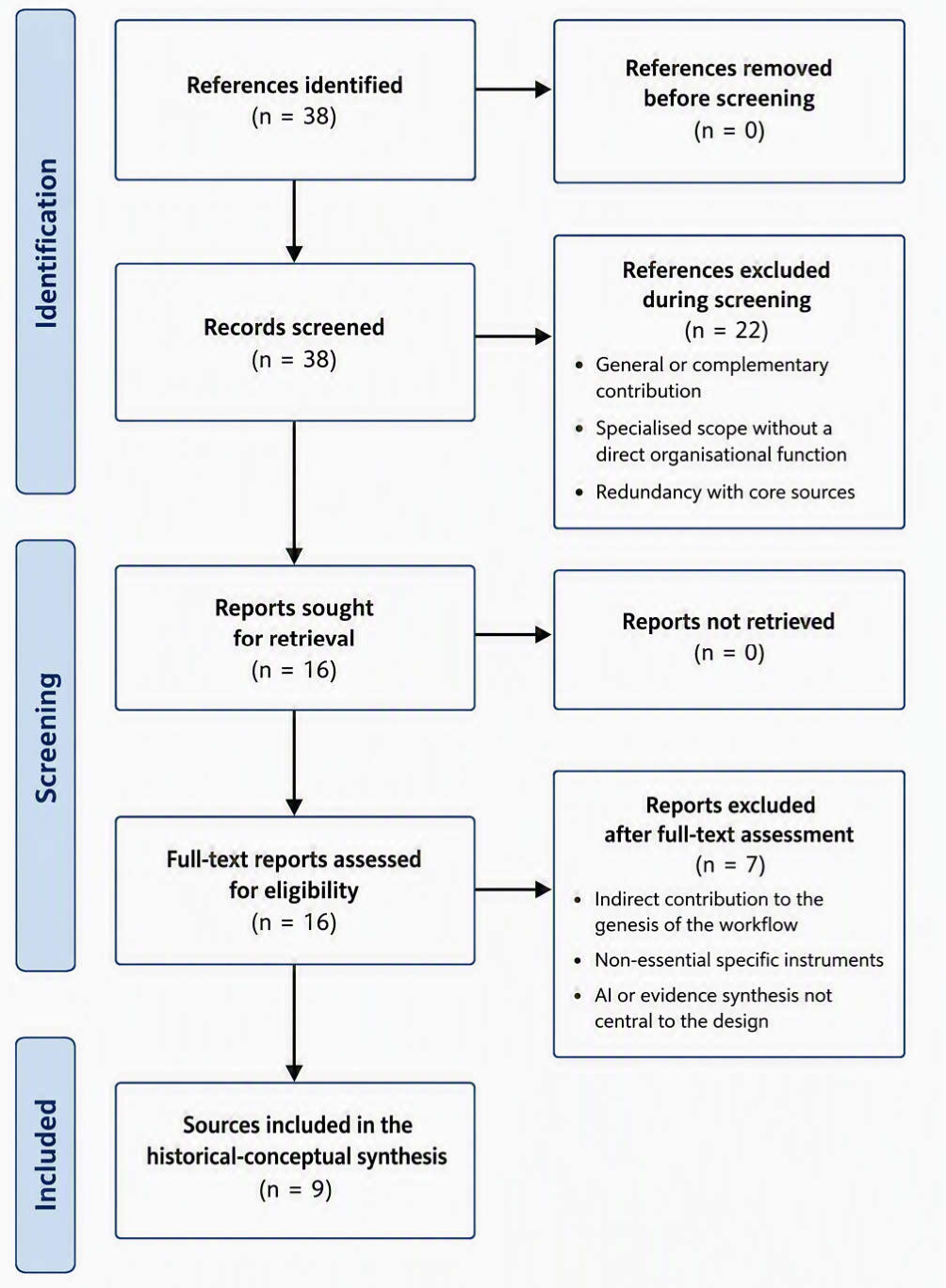

Table 1.
Operational architecture of the S0–S3 workflow: goals, decisions, and traceable products.
| Phase | Operational Objective | Central decision | Traceable product |
| Preliminary phase | Design and stabilize the review. | Define the question, eligibility criteria, sources, and analysis plan. | Structured question, pilot search, protocol and prospective registration. |
| S0. Identification | To establish the document corpus. | Determine which records come from each source and which are duplicates. | Complete strategies, original exports, master file, and deduplication logging. |
| S1. Screening | Select potentially relevant records. | Include, exclude, or retain each record as uncertain based on the title and abstract. | Screening matrix, discrepancies, consensus decision and counts. |
| S2. Eligibility | Determine which reports meet the criteria. | Include or exclude each entire text and assign a primary reason for exclusion. | Archive of full texts, table of exclusions and documented reasons. |
| S3. Inclusion and synthesis | Build the evidence base. | Determine which studies contribute to each synthesis. | Extraction matrix, risk of bias and certainty assessment, synthesis, tables and figures. |
Table 2.
Functional correspondence between S0–S3, PRISMA and IMRDC.
| S0–S3 | PRISMA | IMRDC | Documentary result or content communicated |
| Preliminary phase | Protocol and justification | Introduction and Methods | Question, objectives, criteria and protocol |
| S0 | Identification | Methods | Strategies, Sources, Logs, and Deduplication |
| S1 | Screening | Methods and Results | Selection by title/abstract, reviewers, and counts |
| S2 | Eligibility | Methods and Results | Full texts and reasons for exclusion |
| S3 | Inclusion | Results, Discussion and Conclusions | Extraction, critical evaluation, synthesis and interpretation |
Note. The preliminary phase is not a stage of the PRISMA flowchart. It comprises the rationale, the formulation of the question and the development of the protocol, which are mainly communicated in the Introduction and the Methods and determine the subsequent identification and selection decisions.
Disclaimer/Publisher’s Note: The statements, opinions and data contained in all publications are solely those of the individual author(s) and contributor(s) and not of MDPI and/or the editor(s). MDPI and/or the editor(s) disclaim responsibility for any injury to people or property resulting from any ideas, methods, instructions or products referred to in the content. |
© 2026 by the authors. Licensee MDPI, Basel, Switzerland. This article is an open access article distributed under the terms and conditions of the Creative Commons Attribution (CC BY) license (http://creativecommons.org/licenses/by/4.0/).
Copyright: This open access article is published under a Creative Commons CC BY 4.0 license, which permit the free download, distribution, and reuse, provided that the author and preprint are cited in any reuse.