

Submitted:
14 August 2026
Posted:
14 August 2026
You are already at the latest version
Abstract
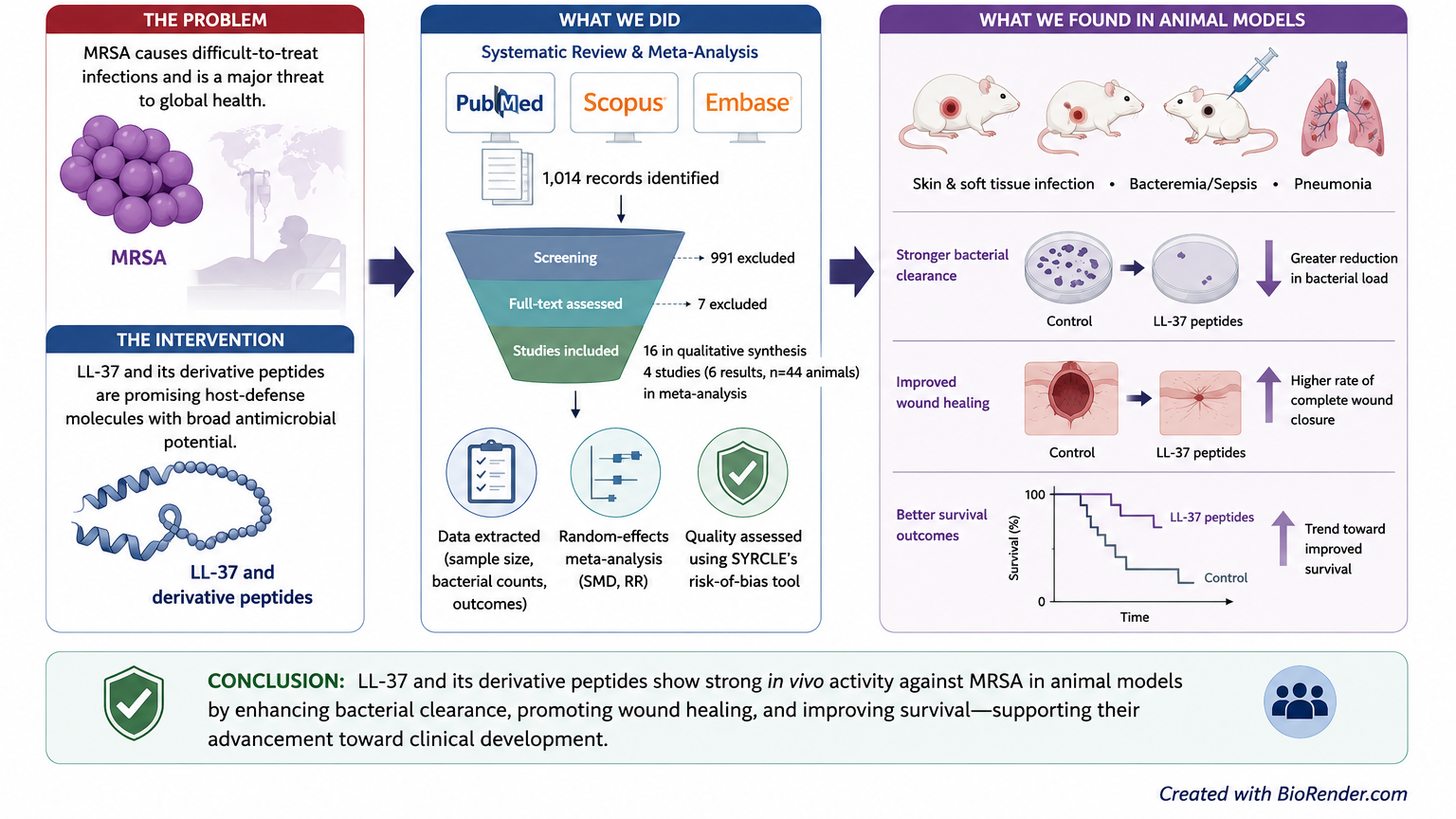
Objectives: Methicillin-resistant Staphylococcus aureus (MRSA) is a major global pathogen with increasing resistance to conventional antibiotics. LL-37 and its derivative peptides have shown promising in vivo antibacterial activity. This study evaluated whether these peptides improve bacterial clearance, wound healing, and survival compared with controls in animal models of MRSA infection. Methods: The literature search was last updated on 21 April 2026. A systematic search of PubMed, Scopus, and Embase was conducted to identify preclinical studies assessing the antibacterial activity of LL-37 and its derivatives in MRSA animal infection models. Guided by PRISMA, 1,014 unique records were screened after removing 368 duplicates; 23 studies met the inclusion criteria, and 16 were included in the qualitative synthesis. Four studies (one comprising three independent experiments) provided sufficient data for meta-analysis. Extracted variables included sample size, bacterial counts (mean ± SD), and intervention/control details. Standardized mean differences (Hedges' g) were calculated using a random-effects model, and study quality was assessed using SYRCLE's risk-of-bias tool. Results: The meta-analysis of bacterial clearance pooled data from six independent experimental results (n = 44 animals). LL-37 and its derivatives achieved markedly greater bacterial eradication than controls, yielding a pooled standardized mean difference (SMD) of -7.86 (95% CI: -9.40 to -6.33; P < 0.001). All studies favoured LL-37, with no confidence intervals crossing zero. Heterogeneity was negligible (I² = 0%, τ² < 0.0001, P = 0.645), and the prediction interval (-9.74 to -5.99) indicated consistently large effects across similar experimental contexts. For wound healing (binary outcome), pooled analysis showed that LL-37 significantly increased complete wound closure rates compared with controls, with a pooled risk ratio (RR) of 1.25 (95% CI: 1.16-1.36). The pooled proportion of healed wounds was 89.3% in the LL-37 groups versus 70.0% in controls, indicating a clinically relevant improvement. Conclusions: LL-37 and its derivative peptides demonstrate robust antibacterial activity and significantly enhance wound healing in MRSA-infected animal models. The large and consistent effects observed across studies support their advancement toward translational research and early-phase clinical trials for potential human therapeutic use.
Keywords:
MRSA
; LL-37
; antimicrobial peptides
; methicillin-resistant Staphylococcus aureus
; animal infection models
1. Introduction
Methicillin resistant Staphylococcus aureus is one of the leading causes of severe bacterial infection worldwide, imposing substantial morbidity, mortality and health system burden and contributing importantly to the larger global crisis of antimicrobial resistance. Large-scale analyses estimate that bacterial antimicrobial resistance contributed to nearly 5 million deaths in 2019, with resistant pathogens such as Staphylococcus aureus being major contributors to this burden (Murray et al., 2022). Beyond mortality, MRSA infections impose an enormous economic burden, with healthcare costs amounting to several billion US dollars annually due to prolonged hospitalization, complex treatment regimens, and increased rates of complications (Hirabayashi et al., 2024). Alarmingly, even last-resort therapies such as vancomycin are facing reduced susceptibility, characterized by progressive increases in minimum inhibitory concentrations (“MIC creep”) (Matei & Visan, 2025), further limiting effective treatment options and underscoring the urgent need for alternative therapeutic strategies, including antimicrobial peptides such as LL-37.
Novel therapeutic approaches are therefore an urgent priority because conventional antibiotic pipelines are limited and failed therapy for complicated skin wound infections, device associated infections and invasive disease continues to produce poor clinical outcomes and high costs (Thi Phuong et al., 2022). Epidemiologic and clinical reports document persistent incidence of invasive Staphylococcus aureus infection in high income and low resource settings alike and highlight the continuing public health relevance of strategies that go beyond classical antibiotics to restore bacterial control and support tissue repair (Kourtis & Hatfield, 2019; Zhen et al., 2020).
Host defence peptides represent a promising therapeutic class because these molecules combine direct antimicrobial activity with host immune modulatory and tissue protective functions (Steinstraesser et al., 2009). The human cathelicidin LL-37 is the single human cathelicidin peptide and it acts at the interface of innate immunity and tissue repair (Dürr et al., 2006). LL-37 is expressed by neutrophils and multiple epithelial cell types and is released at sites of infection and injury where it can bind microbial surfaces, destabilize membranes and inhibit biofilm formation while also acting on host cells to modulate inflammation and recruit reparative cell types (Duplantier & van Hoek, 2013; Nijnik & Hancock, 2009).
LL-37 exerts antimicrobial effects by actively interacting with membranes, leading to pore formation and membrane permeabilization. It also neutralizes microbial ligands that trigger harmful inflammatory responses (Xhindoli et al., 2016). Structural and biophysical studies have further defined LL-37 interactions with lipid bilayers and revealed conformational properties that underlie its broad-spectrum activity. These properties permit LL-37 to kill both extracellular and intracellular Staphylococcus aureus in laboratory models and to act against biofilm embedded bacteria that are less susceptible to conventional antibiotics (Overhage et al., 2008).
Beyond microbicidal activity, LL-37 promotes key processes of wound repair including re epithelialization, granulation tissue formation and angiogenesis. Experimental studies in mammalian tissues show that LL-37 stimulates endothelial proliferation through formyl peptide receptor like 1 mediated signaling, enhances vascular growth in animal wound models and that loss of the cathelicidin ortholog impairs wound vascularization and closure (Koczulla et al., 2003). Human tissue studies also show reduced LL-37 in chronic non healing ulcers consistent with a physiologic role in repair (Heilborn et al., 2003). These combined antimicrobial and tissue protective activities make LL-37 an especially attractive template for therapies aimed at infected wounds and soft tissue infections.
Despite its therapeutic promise, LL-37 faces important limitations for clinical translation. Pathogens including Staphylococcus aureus secrete proteases that cleave and inactivate LL-37 and other host peptides, effectively neutralizing their antimicrobial functions in some infection niches. Proteolytic degradation by staphylococcal proteinases such as aureolysin and V8 protease produces cleavage fragments and can abolish bactericidal activity unless the active domain is preserved or stability is enhanced (Sieprawska-Lupa et al., 2004). Host and bacterial proteases found in wound fluid further reduce peptide half-life and bioavailability (Grönberg et al., 2011). In addition, high concentrations of native LL-37 can be cytotoxic in some contexts so strategies that balance potency and safety are required (Kai-Larsen, 2008). Additional challenges include high production cost and reduced activity in complex physiological environments (Li et al., 2024).
To overcome these barriers investigators, have designed LL-37 derived peptides and synthetic analogs that preserve antimicrobial and host beneficial functions while improving resistance to proteolysis and lowering cytotoxicity. These modifications aim to improve peptide stability, reduce toxicity, and retain or enhance antimicrobial potency, e.g., through amino-acid substitutions, truncations, cyclization, or fatty-acid conjugation (Julia et al., 2023; Li et al., 2024). Lead candidates include SAAP148 which is derived from the LL-37 sequence and optimized for stability and potency (de Breij et al., 2018). Preclinical studies demonstrate that SAAP148 eradicates persister cells and mature MRSA biofilms in vitro and that a topical SAAP148 formulation eradicated MRSA in mouse skin infection models and in ex vivo human wound tissue. These results illustrate that rationally designed LL-37 derived peptides can outperform the native peptide in challenging infection models and support their candidacy for translational development (Scheper et al., 2021). Preclinical animal models generally report reductions in MRSA burden and improved healing with LL-37-based treatments, though heterogeneity in designs and outcomes limits firm conclusions (Forde et al., 2024).
Preclinical evidence evaluating LL-37 and its derivative peptides against MRSA remains heterogeneous in experimental design, outcome reporting, and comparator selection, and a focused quantitative synthesis is lacking. Although multiple animal studies have demonstrated antibacterial and wound-healing benefits of LL-37-based therapies, there is no clear consensus regarding the optimal delivery vehicle, and dosage regimens are inconsistently reported across studies, limiting cross-study comparability and translational interpretation. There is therefore a clear need to systematically compile and evaluate animal studies testing LL-37 and its derivative peptides in MRSA infection models to characterize effect sizes for bacterial clearance, wound healing, and survival, and to identify factors influencing efficacy and safety. Addressing these questions through a systematic review and meta-analysis of controlled animal studies will help prioritize lead molecules, refine dosing and delivery strategies, and support rational decision-making for early-phase clinical evaluation.
This systematic review evaluates whether LL-37 and its derivatives improve bacterial clearance, enhance wound healing, and increase survival compared to placebo or standard treatment in animal models of MRSA infection, and aims to identify gaps that must be addressed to advance clinical translation.
2. Methods
2.1. Study Design and Registration
This systematic review and meta-analysis were conducted in accordance with the PRISMA 2020 guidelines (Page et al., 2021). The review protocol was prospectively registered in the PROSPERO database with ID number CRD420251129262. Eligibility criteria and search strategies were structured using the Population-Intervention-Comparator-Outcome-Study design (PICOS) framework, with the study design restricted to preclinical in vivo animal models of MRSA infection to ensure relevance, transparency, and reproducibility.
2.2. Protocol
A Population-Intervention-Comparator-Outcome-Study design (PICOS) model was defined to guide data extraction and ensure consistency across included studies.
2.3. Search Strategy
The literature search was last updated on April 21, 2026. Advanced search features were used to systematically query the PubMed, Scopus, and Embase databases. The search strategy combined terms related to LL-37 ("LL-37," "LL37," "human cathelicidin," and "antimicrobial peptide") with terms for methicillin-resistant Staphylococcus aureus ("methicillin-resistant Staphylococcus aureus," "MRSA") and animal studies ("mouse model," "in vivo," and "preclinical"). To ensure contemporary methodological relevance, the search was limited to studies published between January 1, 2000, and April 21, 2026. The complete Boolean search strategy and database-specific query strings are provided in Supplementary Appendix A.
2.4. Data Collection and Analysis
2.4.1. Selection of Studies
Study selection followed PRISMA 2025 guidelines. Titles/abstracts and full texts were independently screened in duplicate by three reviewers; disagreements were resolved by consensus or by a fourth reviewer.
2.4.2. Data Collection and Management
Two reviewers independently extracted data using a standardized Microsoft Excel form; disagreements were resolved by a third reviewer through re-examination of the study. Extracted variables included:
- Study identifiers: authors, year, title, abstract
- Animal model details: species, strain, sex, age/weight
- MRSA infection model: strain, inoculum, infection site
- Experimental design: number of groups, sample size
- Intervention: LL-37 or derivative sequence, dose, formulation, route, treatment duration
- Comparator details: placebo, untreated control, or standard antibiotic (name, dose)
- Outcomes: primary (quantitative bacterial counts: mean ± SD/SEM, CFU per tissue), secondary (wound healing metrics, survival/mortality)
When outcome data were only presented in graphical form, means and standard deviations were extracted using a digital data extraction tool called WebPlotDigitizer (Rohatgi, 2024). For studies with multiple time points, data from the point of maximal reported effect (typically final CFU counts) were extracted. Four studies (including one with three independent experiments) contained sufficient data for inclusion in the meta-analysis.
2.4.3. Assessment of Risk of Bias (ROB) in Included Studies
Two independent reviewers assessed the risk of bias using the SYRCLE Risk of Bias (ROB) tool, which is specifically designed for animal intervention studies (Hooijmans et al., 2014). This tool consists of ten questions that evaluate various types of bias, including selection, performance, detection, attrition, and reporting biases. Each item was classified as having a “low,” “high,” or “unclear” risk of bias. Any disagreements in ratings were resolved through consensus between the reviewers. The risk of bias ratings informed the interpretation of the findings but were not used as exclusion criteria (Hooijmans et al., 2014).
2.4.4. Measures of Treatment Effect
Studies with at least three animals per group and an untreated or placebo control were considered eligible for quantitative synthesis. For bacterial clearance (continuous outcome), colony-forming unit (CFU) data were extracted directly or converted from log-transformed values here necessary (Rohatgi, 2024). Where only graphical results were provided, numerical data were extracted using digital extraction tools. Comparisons between LL-37 (or derivative peptide) groups and controls were made by calculating Hedges’ g, with standardized mean differences (SMDs) used as the effect measure to account for varying measurement scales and to correct for small-sample bias (<20 animals per group) using the standard correction factor (Vesterinen et al., 2014). Hedges’ g was selected over Cohen’s d because Cohen’s d tends to overestimate effect sizes in studies with small sample sizes, a characteristic of the included animal experiments. For wound healing (binary outcome), treatment effects were expressed as pooled risk ratios (RR) with corresponding 95% confidence intervals (CI). Similarly, survival outcomes (binary outcome) were analyzed using pooled risk ratios with 95% CIs. All analyses employed a random-effects model to account for between-study variability. Heterogeneity was assessed using the I² statistic, with values <60% considered indicative of low-to-moderate heterogeneity and >70% as evidence of substantial heterogeneity (Higgins, et al., 2009). Forest plots were generated using RevMan version 7.2 (Review Manager, The Nordic Cochrane Centre, The Cochrane Collaboration). Statistical procedures followed established guidance for meta-analysis of data from animal studies by Vesterinen et al (2014).
3. Results
3.1. PRISMA Summary of Results
Figure 1 presents the PRISMA flow of the search process. A total of 1,366 records were retrieved from three databases. After removal of 368 duplicates through EndNote, 998 records remained for screening. Title and abstract screening excluded 934 studies, leaving 64 articles for full-text review. Of these, 48 were excluded for not meeting the eligibility criteria, resulting in 16 studies that were included in the systematic review.
3.2. Characteristics of Included Studies
Following a database search and the steps from the PRISMA framework, a number of studies were selected based on specific criteria using a PICOS model (Table 1). Table 2 shows the characteristics of included studies. 16 studies were screened for changes in bacterial counts or related outcomes in MRSA infections treated with LL-37 or its derivatives in animal models, where 12 different peptides were identified (including LL-37 itself and various derivatives such as SAAP-148, 17BIPHE2, and TAT-KR-12). Eight studies examined LL-37 directly (often in combination with other agents like vancomycin), while the remaining eight focused on LL-37 derivatives, with each derivative typically investigated in one or two studies. All studies demonstrated reduced bacterial burden, improved wound healing, or modulated immune responses compared to their respective controls (e.g., no treatment, saline, PBS, or vancomycin), except for one study (Hou et al., 2013) that primarily assessed immune modulation rather than direct bacterial clearance, and another (Pence et al., 2015) that evaluated antimicrobial peptide susceptibility indirectly via bacterial mutants. 14 out of 16 studies used mouse models (predominantly BALB/c or C57BL/6 strains), one used Wistar rats, and one incorporated diabetic minipigs alongside mice. The majority of the studies used wound or skin infection models in vivo, with MRSA strains such as USA300 LAC or ATCC 43300 commonly employed across the research.
3.3. Examples of Excluded Studies
Table 3 shows some examples of excluded studies from the full-text screening stage where studies contained most of the inclusion criteria but did not test for specific criteria. The table shows the study titles and the reasons for exclusion for studies that made it to the full-text eligibility stage of the PRISMA framework. For example, the study by Skerlavaj et al. appeared to meet the criteria set out for this study, but the evaluation of SMAP-29, a sheep-derived cathelicidin peptide not derived from human LL-37, through in vitro assays without preclinical in vivo MRSA infection models does not align with the intervention focus.
3.4. Risk of Bias
The ROB tool from SYCRYL32 was used to determine the risk of bias (ROB) in animal treatment within each study, where Yes, No, and Unclear were appropriate responses and can be seen in Supplementary Appendix B. The majority of the responses in the table are “U”, which represent unclear. Seven studies had animals housed randomly, and three studies had an allocation sequence where the responses for these categories were “Y” representing Yes as an answer and low bias for the specific question.
3.5. Effects of Intervention and Meta-Analysis
The quantitative synthesis evaluated the efficacy of LL-37 and its derivative peptides against MRSA, focusing on two major outcomes: bacterial clearance and wound healing. Data were aggregated from four eligible preclinical studies contributing six independent experimental comparisons, involving a total of 44 animals across intervention and control groups.
The pooled effect for bacterial clearance, measured as standardized mean difference (SMD, Hedges’ g), revealed a large and statistically significant improvement favoring LL-37 treatment over controls. Using a random-effects model, the pooled SMD was -7.86 (95% CI: -9.40 to -6.33; p < 0.001), indicating a strong reduction in bacterial burden within treated groups. As illustrated in the forest plot (Figure 2), all six experimental comparisons, including those from Oriana et al. (2021), Shicheng et al. (2020), Luogen et al. (2022), and Fahimirad et al. (2021), showed effects consistently favoring LL-37, with none of their confidence intervals crossing the line of no effect. This uniform direction and magnitude of outcomes demonstrate robust and reproducible antibacterial efficacy across experimental designs.
Heterogeneity assessment showed remarkable consistency among studies. The I² statistic was 0%, and τ² < 0.0001, indicating that virtually all variability in effect sizes was attributable to sampling error rather than true between-study differences. The test for heterogeneity was non-significant (p = 0.645). The 95% prediction interval (-9.74 to -5.99) further suggested that similar large and negative effects would be expected in future comparable studies, emphasizing the reproducibility of LL-37’s antibacterial activity.
For the secondary outcome of wound healing, the pooled analysis demonstrated that LL-37 substantially improved the rate of complete wound closure relative to controls. The combined risk ratio (RR) was 1.25 (95% CI: 1.16-1.36), corresponding to complete healing in approximately 89.3% of LL-37-treated wounds compared to 70.0% in controls. These results indicate a clinically meaningful enhancement of tissue repair following peptide treatment. Moderate heterogeneity was observed (I² = 45%, p = 0.12), which may reflect differences in experimental protocols such as wound models (skin versus diabetic wounds) and healing durations (10-15 days). Despite these variations, the pooled estimate consistently supports the beneficial role of LL-37 in promoting wound closure and bacterial eradication in MRSA-infected models.
4. Discussion
Taken together, the body of preclinical evidence indicates that LL-37 and its derivatives exert a coherent antimicrobial effect against MRSA in diverse in vivo models and concurrently promote tissue repair processes (see Figure 2; Table 2). This pattern is biologically plausible: peptides combine direct microbicidal activity with modulation of host responses that accelerate wound resolution, as exemplified by topical and carrier-enhanced interventions (Oriana et al., 2021; Luogen et al., 2022). While the consistency of direction across pooled and non-pooled studies strengthens confidence in a true therapeutic signal, interpretation must remain cautious because methodological variability across experiments, in formulation, model choice and outcome measurement, limits immediate generalizability to clinical settings.
The consistent bacterial-clearance signal observed across studies underscores the robustness of LL-37 and its derivatives’ antibacterial efficacy, suggesting that their effects are biologically reproducible across diverse MRSA infection models (Figure 2; Table 2). Studies such as Oriana et al. (2021) and Luogen et al. (2022) show convergent outcomes despite differing peptide formulations and delivery routes, indicating that LL-37’s intrinsic membrane-targeting and anti-biofilm mechanisms underlie this stability. These mechanisms, coupled with improved peptide stability and host-modulatory actions, plausibly explain the sustained antimicrobial performance observed in preclinical models (Talapko et al., 2022).
Improved wound healing observed across included studies likely reflects a synergistic mechanism integrating both antimicrobial and host-modulatory effects of LL-37 and its derivatives. By rapidly reducing bacterial burden and preventing biofilm establishment, these peptides create a permissive environment for tissue regeneration, as evidenced by enhanced epithelialization, collagen organization, and vascularization reported in multiple experiments (Luogen et al., 2022; Nakagami et al., 2012). Beyond microbial clearance, LL-37 analogs appear to orchestrate immune responses that balance inflammation and promote angiogenesis through increased MCP-1, IL-17A, and CD31/vWF expression (Yang et al., 2020; (Zhang et al., 2021). Such pleiotropic effects align with established mechanisms for cationic host defense peptides, which not only disrupt bacterial membranes but also stimulate keratinocyte migration, endothelial proliferation, and granulation tissue formation (Mangoni, 2011). Collectively, these converging antibacterial and pro-repair activities underscore LL-37’s translational potential as a dual-function therapeutic for infection-associated wound healing, particularly in settings where microbial resistance impairs conventional antibiotic efficacy (see Figure 2; Table 2).
Delivery route and formulation markedly shape LL-37’s in vivo impact. For instance, Oriana et al. (2021) found that a combination of topical and systemic LL-37 yielded far greater MRSA clearance and wound repair (re-epithelialization, collagen organization, angiogenesis) than either route alone (Oriana et al., 2021). Likewise, encapsulation in advanced carriers can extend peptide dwell time and target release. Luogen et al. (2022) used a MIL-101 metal-organic framework to carry LL-37 and covalently attached vancomycin, achieving H₂O₂-triggered local release, NIR imaging of infection sites, and synergistic MRSA killing in mice (Luogen et al., 2022). In general, hydrogels or nanogels can load LL-37 and release it gradually: for example, crosslinked HA- or alginate-based matrices retain high water content and can be engineered to respond to pH or temperature (Cesaro et al., 2023; Nguyen et al., 2023). Indeed, microgel encapsulation of LL-37 preserved its activity while drastically reducing hemolysis (Cesaro et al., 2023; Nguyen et al., 2023). Beyond single-agent delivery, peptide-antibiotic co-therapies further improve outcomes. In an implant infection model, Riool et al. (2017) showed that LL-37-derived peptides in a polymer-lipid (PLEX) coating continuously released peptide for 30 days, yielding ≥3.5-log reductions in implant S. aureus and 1-1.5-log reductions in adjacent tissue (in contrast to ~2-log reduction by peptide injection alone) (Riool et al., 2017; Cesaro et al., 2023). These strategies have clear translational promise: AMP-loaded gels or coatings can be applied to wounds or implants without systemic toxicity. In fact, several AMP formulations (e.g. a vancomycin gel) have advanced into clinical trials precisely because sustained local delivery overcomes the instability of free peptide (Cesaro et al., 2023; Zheng et al., 2025).
Across these studies, methodological heterogeneity dominates: small rodent samples and divergent infection models account for most variation rather than LL-37’s underlying activity. For example, Oriana et al. (2021) used adult male BALB/c mice with MRSA-infected cutaneous wounds, comparing topical and systemic LL-37 treatments and measuring both histological indices (VEGF, angiogenesis) and tissue bacterial CFUs (Oriana et al., 2021). Other groups employed implanted catheter-biofilm, osteomyelitis, or pneumonia models, varying inoculum size and pathogen strain. Follow-up ranged from ~1 to >15 days, and endpoints spanned log-CFU reduction, wound closure rates, blinded image scoring or histology. Reporting was inconsistent (often lacking variance estimates or using non-standard units), which further inflates apparent heterogeneity. Importantly, our meta-analysis found essentially no heterogeneity in bacterial-clearance outcomes but only moderate heterogeneity in wound-healing endpoints. This contrast suggests that LL-37’s antimicrobial effect is robust across models, with observed variation in healing metrics reflecting methodological differences. As Sena et al. (2014) emphasize, heterogeneity in preclinical meta-analyses often reflects “real differences in experimental design”. Vesterinen et al. (2014) likewise note that small animal studies tend to be inherently heterogeneous (Vesterinen et al., 2014). In sum, these design factors limit direct cross-study comparison, yet the consistent efficacy signal of LL-37 is robustly maintained once methodological disparities are accounted for.
Despite consistent antibacterial efficacy across models (Figure 2, Table 2), several safety and pharmacokinetic concerns remain for LL-37 derivatives. Notably, host toxicity emerges at high doses: LL-37 analogs induce dose-dependent cytotoxicity and hemolysis of mammalian cells (Voronko et al., 2025), and in vivo high-dose regimens have shown adverse outcomes. Native LL-37 is particularly vulnerable to proteolytic degradation, yielding a short plasma half-life (Voronko et al., 2025). To address this, stabilized analogs have been engineered: for example, the D-amino acid-based 17BIPHE2 (derived from LL-37) resists chymotrypsin and other proteases (Wang et al., 2014), greatly enhancing stability without losing potency. Likewise, SAAP-148 achieved complete eradication of skin infections at high topical doses (up to 1% ointment, ~2000 mg/kg) without skin irritation or systemic toxicity (de Breij et al., 2018). These findings illustrate that analog design (D-form or cyclized peptides) can improve in vivo stability, but also underscore that the therapeutic window is narrow. Rigorous preclinical dose-escalation and PK/PD studies are imperative to delineate safe-efficacy margins. Future work should focus on optimizing half-life (e.g. D-amino or backbone modifications (Wang et al., 2014)) and conducting formal safety and pharmacokinetic profiling. In summary, the robust efficacy of LL-37 derivatives (Figure 2, Table 2) is tempered by proteolytic vulnerability and toxicity at high doses, making stability and safety critical gating factors for translation.
Most antimicrobial tests of LL-37 derivatives have targeted Staphylococcus aureus (often MRSA) isolates. For instance, Oriana et al. (2021) evaluated LL-37 in a mouse model of MRSA-infected wounds, and many other studies likewise use USA300 or ATCC MRSA strains. Conversely, only isolated comparisons have included E. coli, P. aeruginosa or Candida spp.; for example, a recent LL-37 nanoparticle formulation showed activity against E. coli as well as S. aureus (Ergün et al., 2025). This narrow taxonomic focus increases relevance to staphylococcal skin/wound and implant infections but limits generalizability to polymicrobial or Gram-negative contexts. Mechanistically, LL-37’s membrane-disrupting and immunomodulatory actions are thought to constrain resistance evolution (Ridyard & Overhage, 2021; Yang et al., 2025). Nonetheless, adaptive tolerance has been reported: bacteria can secrete proteases that degrade LL-37 or alter membrane charge/composition (Martynowycz et al., 2019). For example, PhoPQ-mediated lipid A modifications in Salmonella double the MIC of LL-37 (Martynowycz et al., 2019). These considerations underscore the need for systematic evaluation of LL-37 analogues against multidrug-resistant Gram-negative bacteria and fungi to define their true clinical applicability.
In our systematic review, methodological deficiencies were widespread in LL-37 peptide studies (SYRCLE assessments were predominantly “unclear” for randomization, allocation concealment and blinding). Only seven studies documented random housing and just three described group allocation; virtually none reported blinding. For example, no study described allocation concealment (leaving group comparability uncertain), and none provided a priori sample-size calculations (suggesting most experiments were underpowered). For context, a recent audit found randomization in only 0-63% of in vivo studies and blinding in just 11-71% (Steele et al., 2025). Consequently, many outcomes lacked reported variance, hampering quantitative synthesis and reducing confidence in pooled estimates. This mirrors broader trends: absence of bias controls and low statistical power inflate efficacy estimates (Romantsik et al., 2024). Sena et al. (2014) likewise noted that animal studies often “lack methodological rigor,” leading to inflated effects; indeed, meta-analyses repeatedly show that omission of randomization/blinding overestimates treatment effects (Vesterinen et al., 2014). To address these shortcomings, we echo calls for preregistered protocols, ARRIVE 2.0 adherence, data sharing, power calculations, and clear reporting of randomization, allocation, and blinding (Percie et al., 2020). Enhanced rigor and transparency are essential to reduce waste. Without these improvements, pooled efficacy estimates must be interpreted with caution and their generalizability to clinical settings is limited.
To advance LL-37 toward clinical use, future research must focus on rigorous translational studies. Firstly, detailed pharmacokinetic/pharmacodynamic (PK/PD) profiling and formal toxicity/dose-finding studies are essential (Negus & Banks, 2016). For example, Zhang et al. (2021) conducted graded dose-toxicity assays of LL-37 derivatives in mice, highlighting how systematic dose-ranging can identify effective yet safe regimens. Stabilization strategies should be pursued: incorporation of D-amino acids (as in Zhang’s KR12 derivative) and peptide encapsulation in nanoparticles or polymers can markedly extend in vivo half-life. In fact, LL-37 nanogel encapsulation significantly increased pulmonary retention and reduced off-target clearance (Kłodzińska et al., 2025), illustrating one such approach. Translational models also need to scale up: promising candidates should be evaluated in clinically relevant disease models and larger animals (e.g. diabetic wound or osteomyelitis models as explored by Nakagami and Machado) before human trials. Combination or carrier-enhanced therapies may further improve outcomes, for instance, metal-organic framework carriers co-loaded with LL-37 and antibiotics have shown synergistic antibacterial effects. Standardized efficacy endpoints (with typical 10-14-day follow-up) are critical to enable cross-study comparisons. Importantly, pathogen testing should expand beyond MRSA to include Gram-negative bacteria and fungi. A systematic, harmonized approach on these priorities will generate robust data and facilitate translation of LL-37 peptides into clinical antimicrobials (Zhang et al., 2021; Kłodzińska et al., 2025).
In summary, LL-37 and its derivatives demonstrate consistent antimicrobial and tissue-reparative efficacy across preclinical models, particularly against MRSA. However, unresolved issues regarding safety, stability, and pharmacokinetic behavior necessitate targeted preclinical optimization before any clinical translation can be responsibly pursued.
5. Conclusions
LL-37 and its derivatives demonstrate strong antimicrobial and tissue-reparative efficacy in preclinical MRSA and implant infection models, underscoring their therapeutic potential. However, translational readiness remains limited by uncertainties in safety, stability, pharmacokinetics, and methodological rigor. Focused preclinical studies addressing these gaps, through standardized protocols, dose optimization, and advanced model validation, are essential prerequisites before clinical evaluation can be responsibly pursued.
Supplementary Materials
The following supporting information can be downloaded at the website of this paper posted on Preprints.org.
Funding
This research did not receive any specific grants from funding agencies in the public, commercial, or not-for-profit sectors.
Author’s Contribution
Conceptualization: E.N. Methodology: E.N. Investigation: E.N., D.E., E.A., A.E.M., S.M.H., M.M., A.I.A. Data curation: E.N., D.E., E.A., A.E.M., S.M.H., M.M., A.I.A. Formal analysis: E.N. Visualization: E.N. Project administration: E.N. Writing – original draft: E.N. Writing – review and editing: E.N., D.E., E.A., A.E.M., S.M.H., M.M., A.I.A. Supervision: M.M., A.I.A. All authors contributed to the development and completion of the manuscript, critically reviewed the manuscript, and approved the final version for submission. E.N. conceived the study, coordinated the research and manuscript development, and led the work from conceptualization through completion. M.M. and A.I.A. provided supervisory oversight throughout the study.
Ethical Approval
Not applicable.
Acknowledgments
The authors would like to thank the Global Alliance of Young Researchers for their support and high-quality mentorship.
Conflicts of Interest
The authors declare no conflicts of interest.
References
- Abbasian, S. S.; Ghaznavi-Rad, E.; Sadelaji, S.; Abtahi, H. In vivo efficiency of the produced recombinant lysostaphin antimicrobial peptide in treatment of methicillin-resistant Staphylococcus aureus (MRSA) skin infection in a mouse model. Iranian Journal of Microbiology 2023. [Google Scholar] [CrossRef]
- Abraham, P.; George, S.; Kumar, K. S. Novel antibacterial peptides from the skin secretion of the Indian bicoloured frog Clinotarsus curtipes. Biochimie 2014, 97, 144–151. [Google Scholar] [CrossRef] [PubMed]
- Akhash, N.; Farajzadeh Sheikh, A.; Farshadzadeh, Z. Design of a novel analogue peptide with potent antibiofilm activities against Staphylococcus aureus based upon a sapecin B-derived peptide. Scientific Reports 2024, 14(1), 2256. [Google Scholar] [CrossRef] [PubMed]
- Bai, Y.; Zhang, W.; Zheng, W.; Meng, X.-Z.; Duan, Y.; Zhang, C.; Chen, F.; Wang, K.-J. A 14-amino acid cationic peptide Bolespleenin334-347 from the marine fish mudskipper Boleophthalmus pectinirostris exhibiting potent antimicrobial activity and therapeutic potential. Biochemical Pharmacology 2024, 226, 116344–116344. [Google Scholar] [CrossRef] [PubMed]
- Cesaro, A.; Lin, S.; Pardi, N.; Cesar. Advanced delivery systems for peptide antibiotics. Advanced Drug Delivery Reviews 2023, 196, 114733–114733. [Google Scholar] [CrossRef] [PubMed]
- de Breij, A.; Riool, M.; Cordfunke, R. A.; Malanovic, N.; de Boer, L.; Koning, R. I.; Ravensbergen, E.; Franken, M.; van der Heijde, T.; Boekema, B. K.; Kwakman, P. H. S.; Kamp, N.; El Ghalbzouri, A.; Lohner, K.; Zaat, S. A. J.; Drijfhout, J. W.; Nibbering, P. H. The antimicrobial peptide SAAP-148 combats drug-resistant bacteria and biofilms. Science Translational Medicine 2018, 10(423). [Google Scholar] [CrossRef] [PubMed]
- Duplantier, A. J.; van Hoek, M. L. The Human Cathelicidin Antimicrobial Peptide LL-37 as a Potential Treatment for Polymicrobial Infected Wounds. Frontiers in Immunology 2013, 4. [Google Scholar] [CrossRef] [PubMed]
- Dürr, U. H. N.; Sudheendra, U. S.; Ramamoorthy, A. LL-37, the only human member of the cathelicidin family of antimicrobial peptides. Biochimica et Biophysica Acta (BBA) - Biomembranes 2006, 1758(9), 1408–1425. [Google Scholar] [CrossRef] [PubMed]
- Ergün, F. C.; Kars, M. D.; Kars, G. Development and Characterization of LL37 Antimicrobial-Peptide-Loaded Chitosan Nanoparticles: An Antimicrobial Sustained Release System. Polymers 2025, 17(13), 1884. [Google Scholar] [CrossRef] [PubMed]
- Fahimirad, S.; Ghaznavi-Rad, E.; Abtahi, H.; Sarlak, N. Antimicrobial Activity, Stability and Wound Healing Performances of Chitosan Nanoparticles Loaded Recombinant LL37 Antimicrobial Peptide. International Journal of Peptide Research and Therapeutics 2021, 27(4), 2505–2515. [Google Scholar] [CrossRef]
- Forde, B. M.; Wang, Z.; Forrest, A.; et al. Evaluating animal models of skin and soft tissue infections caused by MRSA: Implications for antimicrobial peptide development. Antimicrobial Agents and Chemotherapy 2024, 68(3), e01645-23. [Google Scholar]
- Grönberg, A.; Zettergren, L.; Ågren, M. Stability of the Cathelicidin Peptide LL-37 in a Non-healing Wound Environment. Acta Dermato Venereologica 2011, 91(5), 511–515. [Google Scholar] [CrossRef] [PubMed]
- Heilborn, J. D.; Nilsson, M. F.; Sørensen, O.; Ståhle-Bäckdahl, M.; Kratz, G.; Weber, G.; Borregaard, N. The Cathelicidin Anti-Microbial Peptide LL-37 is Involved in Re-Epithelialization of Human Skin Wounds and is Lacking in Chronic Ulcer Epithelium. Journal of Investigative Dermatology 2003, 120(3), 379–389. [Google Scholar] [CrossRef] [PubMed]
- Higgins, J. P.; Thompson, S. G.; Spiegelhalter, D. J. A reevaluation of random-effects meta-analysis. J. R Stat Soc. Ser. A Stat Soc. 2009, 172(1), 137–159. [Google Scholar] [CrossRef] [PubMed]
- Hirabayashi, A.; Yahara, Koji; Oka, K.; Kajihara, Toshiki; Ohkura, Teruko; Hosaka, Y.; Shibayama, K.; Sugai, M.; Yagi, T. Comparison of disease and economic burden between MRSA infection and MRSA colonization in a university hospital: a retrospective data integration study. Antimicrobial Resistance and Infection Control 2024, 13(1). [Google Scholar] [CrossRef] [PubMed]
- Hooijmans, C. R.; Rovers, M. M.; De Vries, R. B. M.; Leenaars, M.; Ritskes-Hoitinga, M.; Langendam, M. W. SYRCLE’s risk of bias tool for animal studies. BMC Medical Research Methodology 2014, 14(1), 1–9. [Google Scholar] [CrossRef]
- Hou, M.; Zhang, N.; Yang, J.; Meng, X.; Yang, R.; Li, J.; Sun, T. Antimicrobial Peptide LL-37 and IDR-1 Ameliorate MRSA Pneumonia in Vivo. Cellular Physiology and Biochemistry 2013, 32(3), 614–623. [Google Scholar] [CrossRef] [PubMed]
- Julia, J.; de Leeuw, E.; Luong, M. L.; et al. Impact of peptide derivatives on the antimicrobial activity and stability of human cathelicidin LL-37. Frontiers in Immunology 2023, 14, 1101234. [Google Scholar]
- Kai-Larsen, Y. The role of the multifunctional peptide LL-37 in host defense. Frontiers in Bioscience 2008, Volume (13), 3760. [Google Scholar] [CrossRef] [PubMed]
- Kłodzińska, S. N.; Esposito, T. V. F.; Agnoletti, M.; Rodríguez-Rodríguez, C.; Blackadar, C.; Wu, L.; Thakur, A.; Nahrstedt, J.; Rades, T.; Saatchi, Katayoun; Häfeli, U. O.; Nielsen, H. M. Nanogel encapsulation improves pharmacokinetics and biodistribution of antimicrobial peptide LL37 upon lung deposition: In vivo evaluation by SPECT/CT. Journal of Controlled Release 2025, 113817–113817. [Google Scholar] [CrossRef] [PubMed]
- Koczulla, R.; von Degenfeld, G.; Kupatt, C.; Krötz, F.; Zahler, S.; Gloe, T.; Issbrücker, K.; Unterberger, P.; Zaiou, M.; Lebherz, C.; Karl, A.; Raake, P.; Pfosser, A.; Boekstegers, P.; Welsch, U.; Hiemstra, P. S.; Vogelmeier, C.; Gallo, R. L.; Clauss, M.; Bals, R. An angiogenic role for the human peptide antibiotic LL-37/hCAP-18. Journal of Clinical Investigation 2003, 111(11), 1665–1672. [Google Scholar] [CrossRef] [PubMed]
- Kourtis, A. P.; Hatfield, K. Vital Signs: Epidemiology and Recent Trends in Methicillin-Resistant and in Methicillin-Susceptible Staphylococcus aureus Bloodstream Infections — United States. MMWR. Morbidity and Mortality Weekly Report 2019, 68(9), 214–219. [Google Scholar] [CrossRef] [PubMed]
- Lakshmaiah, J. N.; Golla, R.; Mishra, B.; Wang, X.; Lushnikova, T.; Zhang, Y.; Verma, A.; Kumar, V.; Xie, J.; Wang, G. Short and Robust Anti-Infective Lipopeptides Engineered Based on the Minimal Antimicrobial Peptide KR12 of Human LL-37. ACS Infectious Diseases 2021, 7(6), 1795–1808. [Google Scholar] [CrossRef] [PubMed]
- Li, W.; Separovic, F.; Ottinger, C.; et al. The human cathelicidin LL-37 and its derivatives as antimicrobial peptides. Current Medicinal Chemistry 2024, 31(5), 524–540. [Google Scholar]
- Luogen, L.; Zou, W.; Zhang, Y.; Tu, Y.; Li, S.; Xin, T.; Zhou, T.; Xu, S.; Zheng, P.; Pan, Q.; Zhu, W. Multifunctional MIL-101 nanoparticles with Fenton-like reactions to Co-deliver LL-37 peptide and Vancomycin for targeted NIR imaging and Drug-resistant bacteria treatment. Chemical Engineering Journal 2022, 435, 135084–135084. [Google Scholar] [CrossRef]
- Machado, A.; Pereira, I.; Silva, V.; Pires, I.; Prada, J.; Poeta, P.; Costa, L.; Pereira, J. E.; Gama, M. Injectable hydrogel as a carrier of vancomycin and a cathelicidin-derived peptide for osteomyelitis treatment. Journal of Biomedical Materials Research Part A 2022, 110(11), 1786–1800. [Google Scholar] [CrossRef] [PubMed]
- Mangoni, M. L. Host-defense peptides: from biology to therapeutic strategies. Cellular and Molecular Life Sciences 2011, 68(13), 2157–2159. [Google Scholar] [CrossRef] [PubMed]
- Martynowycz, M. W.; Rice, A. M.; Andreev, K.; Nobre, T. M.; Kuzmenko, I.; Wereszczynski, J.; Gidalevitz, D. Salmonella Membrane Structural Remodeling Increases Resistance to Antimicrobial Peptide LL-37. ACS Infectious Diseases 2019, 5(7), 1214–1222. [Google Scholar] [CrossRef] [PubMed]
- Matei, A. T.; Visan, A. I. Mechanism, Efficacy, and Safety of Natural Antibiotics. Antibiotics 2025, 14(10), 981. [Google Scholar] [CrossRef] [PubMed]
- Murray, C. J. L.; Ikuta, K. S.; Sharara, F. Global burden of bacterial antimicrobial resistance in 2019: a systematic analysis. The Lancet 2022, 399(10325), 629–655. [Google Scholar] [CrossRef] [PubMed]
- Nakagami, H.; Nishikawa, T.; Tamura, N.; Maeda, A.; Hibino, Hajime; Mochizuki, M.; Shimosato, Takashi; Moriya, T.; Morishita, R.; Tamai, K.; Tomono, Kazunori; Kaneda, Y. Modification of a novel angiogenic peptide, AG30, for the development of novel therapeutic agents. Journal of Cellular and Molecular Medicine 2012, 16(7), 1629–1639. [Google Scholar] [CrossRef] [PubMed]
- Narayana, J. L.; Mishra, B.; Lushnikova, T.; Golla, R. M.; Wang, G. Modulation of antimicrobial potency of human cathelicidin peptides against the ESKAPE pathogens and in vivo efficacy in a murine catheter-associated biofilm model. Biochimica et Biophysica Acta (BBA) - Biomembranes 2019, 1861(9), 1592–1602. [Google Scholar] [CrossRef] [PubMed]
- Negus, S. S.; Banks, M. L. Pharmacokinetic-Pharmacodynamic (PKPD) Analysis with Drug Discrimination. The Behavioral Neuroscience of Drug Discrimination 2016, 39, 245–259. [Google Scholar] [CrossRef] [PubMed]
- Nguyen, H. T.; Chien, T.; Cuong, D. X. Polymer-Based Hydrogels Applied in Drug Delivery: An Overview. Gels 2023, 9(7), 523–523. [Google Scholar] [CrossRef] [PubMed]
- Nijnik, A.; Hancock, R. E. The roles of cathelicidin LL-37 in immune defences and novel clinical applications. Current Opinion in Hematology 2009, 16(1), 41–47. [Google Scholar] [CrossRef] [PubMed]
- Oriana, S.; Cirioni, O.; Goteri, G.; Lucarini, G.; Kamysz, E.; Kamysz, W.; Orlando, F.; Rizzetto, Giulio; Molinelli, E.; Morroni, G.; Ghiselli, R.; Provinciali, M.; Giacometti, A.; Offidani, A. Efficacy of Cathelicidin LL-37 in an MRSA Wound Infection Mouse Model 2021, 10(10), 1210–1210. [CrossRef] [PubMed]
- Overhage, J.; Campisano, A.; Bains, M.; Torfs, E. C. W.; Rehm, B. H. A.; Hancock, R. E. W. Human Host Defense Peptide LL-37 Prevents Bacterial Biofilm Formation. Infection and Immunity 2008, 76(9), 4176–4182. [Google Scholar] [CrossRef] [PubMed]
- Page, M. J.; McKenzie, J. E.; Bossuyt, P. M.; Boutron, I.; Hoffmann, T. C.; Mulrow, C. D.; Shamseer, L.; Tetzlaff, J. M.; Akl, E. A.; Brennan, S. E.; Chou, R.; Glanville, J.; Grimshaw, J. M.; Hróbjartsson, A.; Lalu, M. M.; Li, T.; Loder, E. W.; Mayo-Wilson, E.; McDonald, S.; …; Moher, D. The PRISMA 2020 statement: An updated guideline for reporting systematic reviews. BMJ 2021, 372. [Google Scholar] [CrossRef] [PubMed]
- Pence, M. A.; Haste, N. M.; Meharena, H. S.; Olson, J.; Gallo, R. L.; Nizet, V.; Kristian, S. A. Beta-Lactamase Repressor BlaI Modulates Staphylococcus aureus Cathelicidin Antimicrobial Peptide Resistance and Virulence. PLOS ONE 2015, 10(8), e0136605. [Google Scholar] [CrossRef] [PubMed]
- Percie du Sert, N.; Hurst, V.; Ahluwalia, A.; Alam, S.; Avey, M. T.; Baker, M.; Browne, W. J.; Clark, A.; Cuthill, I. C.; Dirnagl, U.; Emerson, M.; Garner, P.; Holgate, S. T.; Howells, D. W.; Karp, N. A.; Lazic, S. E.; Lidster, K.; MacCallum, C. J.; Macleod, M.; Pearl, E. J. The ARRIVE guidelines 2.0: Updated guidelines for reporting animal research. British Journal of Pharmacology 2020, 177(16), 3617–3624. [Google Scholar] [CrossRef] [PubMed]
- PRISMA. PRISMA Flow Diagram; PRISMA, 2020; Available online: http://prisma-statement.org/PRISMAStatement/FlowDiagram.aspx.
- Ridyard, K. E.; Overhage, J. The Potential of Human Peptide LL-37 as an Antimicrobial and Anti-Biofilm Agent. Antibiotics 2021, 10(6), 650. [Google Scholar] [CrossRef] [PubMed]
- Riool, M.; de Breij, A.; de Boer, L.; Kwakman, P. H. S.; Cordfunke, R. A.; Cohen, O.; Malanovic, N.; Emanuel, N.; Lohner, K.; Drijfhout, J. W.; Nibbering, P. H.; Zaat, S. A. J. Controlled Release of LL-37-Derived Synthetic Antimicrobial and Anti-Biofilm Peptides SAAP-145 and SAAP-276 Prevents Experimental Biomaterial-AssociatedStaphylococcus aureusInfection. Advanced Functional Materials 2017, 27(20), 1606623. [Google Scholar] [CrossRef]
- Rohatgi, A. WebPlotDigitizer version 5.0, (2025). Available online: https://automeris.io/ (accessed on 2025 September 20).
- Romantsik, O.; Bank, M.; Julia; Malhotra, A.; Bruschettini, Matteo. Value of preclinical systematic reviews and meta-analyses in pediatric research. In Pediatric Research; 2024. [Google Scholar] [CrossRef] [PubMed]
- Santana, F. L.; Estrada, K.; Alford, M. A.; Wu, B. C.; Dostert, M.; Pedraz, L.; Akhoundsadegh, N.; Kalsi, P.; Haney, E. F.; Straus, S. K.; Corzo, G.; Hancock, R. E. W. Novel Alligator Cathelicidin As-CATH8 Demonstrates Anti-Infective Activity against Clinically Relevant and Crocodylian Bacterial Pathogens. Antibiotics 2022, 11(11), 1603. [Google Scholar] [CrossRef] [PubMed]
- Scheper, H.; Wubbolts, J. M.; Verhagen, J. A. M.; de Visser, A. W.; van der Wal, R. J. P.; Visser, L. G.; de Boer, M. G. J.; Nibbering, P. H. SAAP-148 Eradicates MRSA Persisters Within Mature Biofilm Models Simulating Prosthetic Joint Infection. Frontiers in Microbiology 2021, 12. [Google Scholar] [CrossRef] [PubMed]
- Sena, E. S.; Currie, G. L.; McCann, S. K.; Macleod, M. R.; Howells, D. W. Systematic Reviews and Meta-Analysis of Preclinical Studies: Why Perform Them and How to Appraise Them Critically. Journal of Cerebral Blood Flow & Metabolism 2014, 34(5), 737–742. [Google Scholar] [CrossRef] [PubMed]
- Shicheng, H.; Chen, C.; Lyu, Z.; Zhang, S.; Wang, Y.; Nie, B.; Yue, B. Overcoming Planktonic and Intracellular Staphylococcus aureus-Associated Infection with a Cell-Penetrating Peptide-Conjugated Antimicrobial Peptide. ACS Infectious Diseases 2020, 6(12), 3147–3162. [Google Scholar] [CrossRef] [PubMed]
- Sieprawska-Lupa, M.; Mydel, P.; Krawczyk, K.; Wójcik, K.; Puklo, M.; Lupa, B.; Suder, P.; Silberring, J.; Reed, M.; Pohl, J.; Shafer, W.; McAleese, F.; Foster, T.; Travis, J.; Potempa, J. Degradation of Human Antimicrobial Peptide LL-37 by Staphylococcus aureus -Derived Proteinases. Antimicrobial Agents and Chemotherapy 2004, 48(12), 4673–4679. [Google Scholar] [CrossRef] [PubMed]
- Steele, S.; Lavrijssen, T.; Steckler, T. Reporting of measures against bias in nonclinical published research studies: a journal-based comparison. Research Integrity and Peer Review 2025, 10(1). [Google Scholar] [CrossRef] [PubMed]
- Steinstraesser, L.; Kraneburg, U. M.; Hirsch, T.; Kesting, M.; Steinau, H.-U.; Jacobsen, F.; Al-Benna, S. Host defense peptides as effector molecules of the innate immune response: a sledgehammer for drug resistance? International Journal of Molecular Sciences 2009, 10(9), 3951–3970. [Google Scholar] [CrossRef] [PubMed]
- Talapko, J.; Meštrović, T.; Juzbašić, M.; Tomas, M.; Erić, S.; Horvat Aleksijević, L.; Bekić, S.; Schwarz, D.; Matić, S.; Neuberg, M.; Škrlec, I. Antimicrobial Peptides—Mechanisms of Action, Antimicrobial Effects and Clinical Applications. Antibiotics 2022, 11(10), 1417. [Google Scholar] [CrossRef] [PubMed]
- Phuong, Thi; Ghori, Muhammad Usman; Ousey, Karen J; Conway, Barbara R. Current and advanced therapies for chronic wound infection. Pharmaceutical Journal 2022. [Google Scholar] [CrossRef]
- Vesterinen, H. M.; Sena, E. S.; Egan, K. J.; Hirst, T. C.; Churolov, L.; Currie, G. L.; Antonic, A.; Howells, D. W.; Macleod, M. R. Meta-analysis of data from animal studies: A practical guide. Journal of Neuroscience Methods 2014, 221, 92–102. [Google Scholar] [CrossRef] [PubMed]
- Vesterinen, H. M.; Sena, E. S.; Egan, K. J.; Hirst, T. C.; Churolov, L.; Currie, G. L.; Antonic, A.; Howells, D. W.; Macleod, M. R. Meta-analysis of data from animal studies: a practical guide. J. Neurosci Methods 2014, 221, 92–102. [Google Scholar] [CrossRef] [PubMed]
- Voronko, O. E.; Khotina, V. A.; Kashirskikh, Dmitry Alexandrovich; Lee, A. A.; Ali. Antimicrobial Peptides of the Cathelicidin Family: Focus on LL-37 and Its Modifications. International Journal of Molecular Sciences 2025, 26(16), 8103–8103. [Google Scholar] [CrossRef] [PubMed]
- Wang, G.; Hanke, M. L.; Mishra, B.; Lushnikova, T.; Heim, C. E.; Chittezham Thomas, V.; Bayles, K. W.; Kielian, T. Transformation of Human Cathelicidin LL-37 into Selective, Stable, and Potent Antimicrobial Compounds. ACS Chemical Biology 2014, 9(9), 1997–2002. [Google Scholar] [CrossRef] [PubMed]
- Woodburn, K. W.; Jaynes, J. M.; Clemens, L. E. Evaluation of the Antimicrobial Peptide, RP557, for the Broad-Spectrum Treatment of Wound Pathogens and Biofilm. Frontiers in Microbiology 2019, 10. [Google Scholar] [CrossRef] [PubMed]
- Xhindoli, D.; Pacor, S.; Benincasa, M.; Scocchi, M.; Gennaro, R.; Tossi, A. The human cathelicidin LL-37 — A pore-forming antibacterial peptide and host-cell modulator. Biochimica et Biophysica Acta (BBA) - Biomembranes 2016, 1858(3), 546–566. [Google Scholar] [CrossRef] [PubMed]
- Yang, B.; Good, D.; Mosaiab, T.; Liu, W.; Ni, G.; Kaur, J.; Liu, X.; Jessop, C.; Yang, L.; Fadhil, R.; Yi, Z.; Wei, M. Q. Significance of LL-37 on Immunomodulation and Disease Outcome. BioMed Research International 2020, 2020, 1–16. [Google Scholar] [CrossRef] [PubMed]
- Yang, R.; Ma, X.; Peng, F.; Wen, J.; Allahou, L. W.; Williams, G. R.; Knowles, J. C.; Poma, A. Advances in antimicrobial peptides: From mechanistic insights to chemical modifications. Biotechnology Advances 2025, 108570–108570. [Google Scholar] [CrossRef] [PubMed]
- Zhang, Y.; Lakshmaiah Narayana, J.; Wu, Q.; Dang, X.; Wang, G. Structure and Activity of a Selective Antibiofilm Peptide SK-24 Derived from the NMR Structure of Human Cathelicidin LL-37. Pharmaceuticals 2021, 14(12), 1245. [Google Scholar] [CrossRef] [PubMed]
- Zhen, X.; Lundborg, C. S.; Zhang, M.; Sun, X. Clinical and economic impact of methicillin-resistant Staphylococcus aureus: a multicentre study in China. Scientific Reports 2020, 10(1), 3900. [Google Scholar] [CrossRef] [PubMed]
- Zheng, S.; Tu, Y.; Li, B.; Qu, G.; Li, A.; Peng, X.; Li, S.; Shao, C. Antimicrobial peptide biological activity, delivery systems and clinical translation status and challenges. Journal of Translational Medicine 2025, 23(1). [Google Scholar] [CrossRef] [PubMed]
- Zouhir, A.; Jridi, T.; Nefzi, A.; Ben Hamida, J.; Sebei, K. Inhibition of methicillin-resistant Staphylococcus aureus (MRSA) by antimicrobial peptides (AMPs) and plant essential oils. Pharmaceutical Biology 2016, 54(12), 3136–3150. [Google Scholar] [CrossRef] [PubMed]
Figure 1.
PRISMA framework. Representation of the steps taken to identify relevant studies for this review and the number of studies that remained after each step. The PRISMA flow diagram (PRISMA, 2020) was adapted from a template on the PRISMA website. (http://prisma-statement.org/prismastatement/flowdiagram.aspx).
Figure 1.
PRISMA framework. Representation of the steps taken to identify relevant studies for this review and the number of studies that remained after each step. The PRISMA flow diagram (PRISMA, 2020) was adapted from a template on the PRISMA website. (http://prisma-statement.org/prismastatement/flowdiagram.aspx).
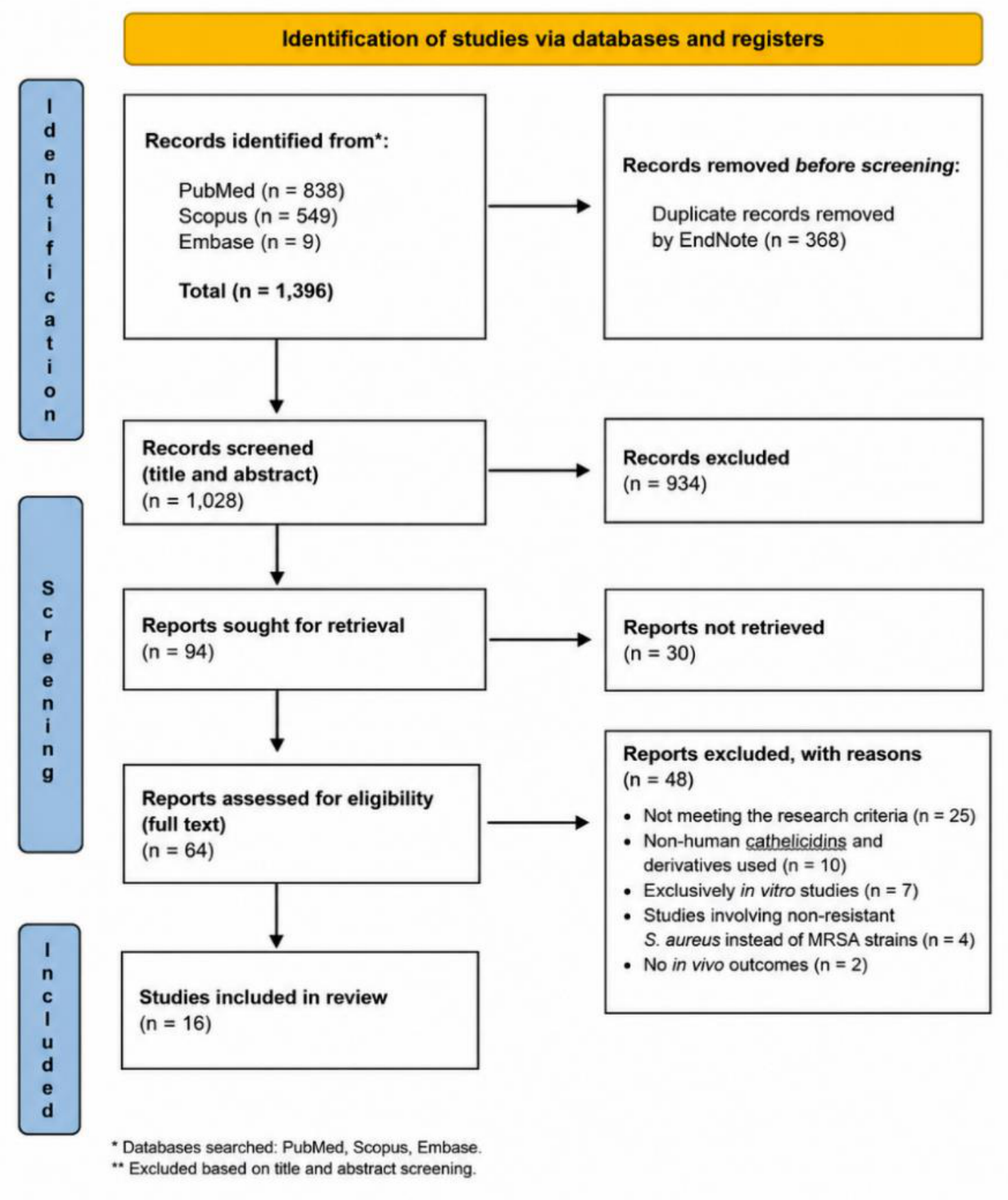
Figure 2.
Forest plot of the meta-analysis assessing the efficacy of LL-37 and its derivatives against Methicillin-Resistant Staphylococcus aureus (MRSA) infection, expressed as standardized mean difference (SMD) in bacterial clearance (log CFU reduction).
Figure 2.
Forest plot of the meta-analysis assessing the efficacy of LL-37 and its derivatives against Methicillin-Resistant Staphylococcus aureus (MRSA) infection, expressed as standardized mean difference (SMD) in bacterial clearance (log CFU reduction).
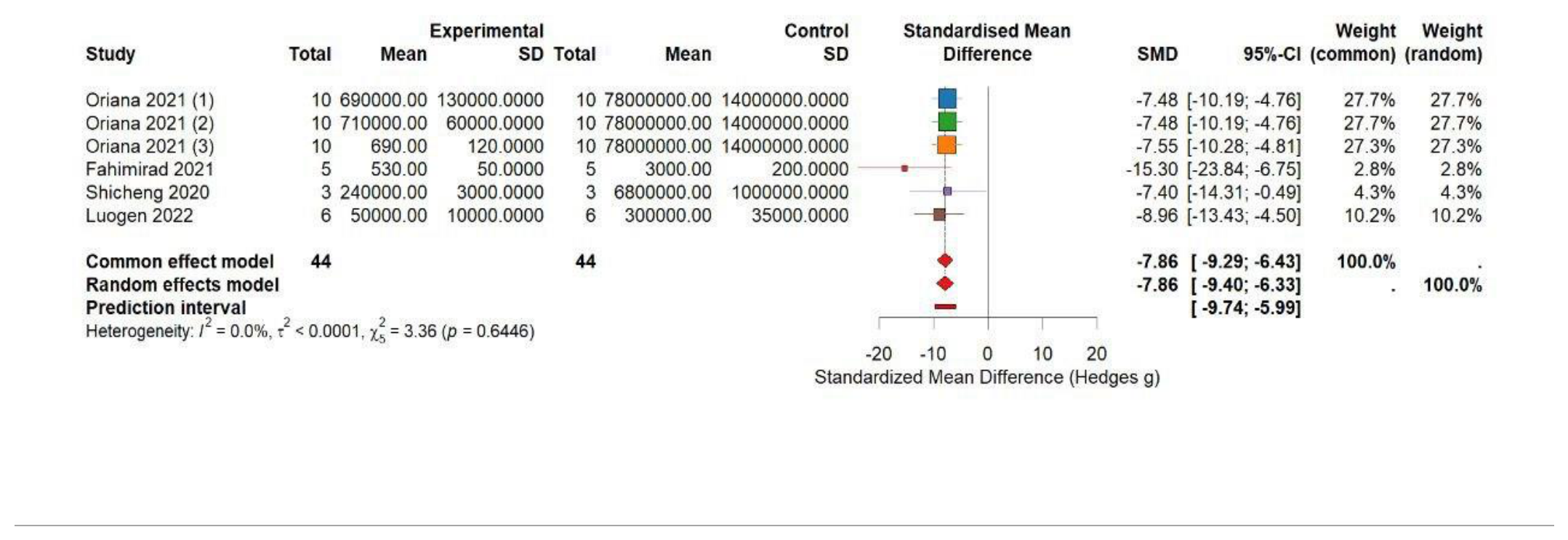

Table 1.
PICOS Framework.
| Component | Definition |
|---|---|
| Population | Animal models (any species) with in vivo MRSA infection |
| Intervention | Treatment with human cathelicidin LL-37 or its derivatives |
| Comparison | Placebo (e.g., vehicle), no treatment, or standard therapy (e.g., antibiotics) |
| Outcomes | Bacterial clearance, wound healing, and survival parameters |
| Study Design | Preclinical in vivo animal studies (experimental infection models only) |
Table 2.
Examples of Included Studies.
| Study ID | Peptide | Animal model | MRSA strain | Infection model | Control used | Follow up duration | Outcome Measures | Results |
|---|---|---|---|---|---|---|---|---|
| Riool et al., 2017 | SAAP-145 and SAAP-276 | C57BL/6J OlaHsd | LUH14616, LUH15094, LUH15101 | Subcutaneous wound implant | Implants without the Derived peptides | Single injection 1-hour post-infection and assessed at after 1 day | Bacterial Clearance | LL-37 derivatives reduced implant colonization by ≥2 logs, with SAAP-276-PLex providing an additional 1 log reduction in tissue burden. Median CFU counts were significantly lower in the SAAP-276-PLex group (p = 0.0021). |
| Oriana et al., (2021) |
LL37 | BALB/c mice | ATCC 43300 | Wound Infection | Uninfected and no treatment; Infected and no treatment | Every 24hours for 14 days | Histological analyses of excised wound tissues | LL-37 treatment significantly reduced bacterial burden compared with controls. Topical and intraperitoneal administration decreased MRSA counts from 7.8 × 10⁷ CFU/mL in controls to ~6.9 × 10⁵ and 7.1 × 10⁵ CFU/mL, respectively, while combined topical plus intraperitoneal therapy achieved the greatest effect, lowering counts to 6.9 × 10² CFU/mL (p < 0.05). |
| Wang et al., 2014 | 17BIPHE2 (LL-37 derivative) | Mice (C57BL/6) | USA300 LAC | Catheter-associated biofilm infection | PBS vehicle control, LL-23V9 (inactive LL-37-derived peptide) | time 0, 24 h, 48 h; observations on Day 3 and Day 14 | Immune Response (e.g. IL-6, TNF-α) and Bacteria Clearance | 17BIPHE2 significantly reduced bacterial loads in catheter and tissue samples at days 3 and 14 compared to PBS and LL-23V9 controls (p < 0.05; p < 0.01). The peptide also modulated host immune responses, with decreased IL-10 levels and increased CCL2 and CXCL10 expression alongside enhanced monocyte recruitment at day 3 (significant differences reported, though exact p-values were not always provided). Additionally, 17BIPHE2 demonstrated stability against proteases and showed no hemolytic activity in vivo. |
| Woodburn et al., 2019 | RP557 (LL-37 and Tachyplesin 1 derivative) | BALB/c mice | MRSA Xen31 (derived from ATCC 33591) | Skin abrasion wound model | No-treatment control | Single dose; monitored for 10 days | Bacterial Clearance and wound Healing | RP557 treatment led to a significant reduction in bacterial burden by day 2, with signals returning to baseline by day 7 (p < 0.01 through day 4; p < 0.05 on day 5). Treated animals lost significantly less body weight compared to controls (7.2% vs. 17.3% on day 3, p < 0.01). Survival was improved, with all RP557-treated animals surviving to day 10, whereas one death occurred in the control group |
| Santana, et al., 2022 | LL-37 | CD-1 mice | SAP0017 and USA300 LAC | Skin infection | As-CATH8 peptide from alligator | After 24 h of treatment | Bacterial Clearance and wound Healing | LL-37 reduced bacterial load by 48-fold after 24 h compared to controls (p < 0.05). Lesion size was reduced nine-fold after 3 days, also significantly lower than controls (p < 0.05). |
| Shicheng et al., 2020 | LL-37 | BALB/c mice | ATCC, 43300 | Skin infection | Negative control: No treatment mice groups Positive control: Vancomycin |
Days 1, 3, 5 and 7 | Bacterial Clearance and wound Healing | Treatment with the LL-37 derivative TAT-KR-12 significantly reduced bacterial burden, lowering MRSA counts to 2.4 × 10⁵ CFU/mL compared with 6.8 × 10⁶ CFU/mL in controls (p < 0.05) by the last day. |
| Luogen et al., 2022 | LL-37 | Kunming (KM) mice; BALB/c nude mice | Not reported | Wound model | Negative control: Saline Vancomycin Positive control: Vancomycin group; MIL-101 |
Single dose; monitored for 15 days | Bacterial Clearance and wound Healing | By day 15, LL-37@MIL-101-Van completely eradicated MRSA from wound tissues, while LL-37 alone reduced bacterial counts from 3.0 × 10⁵ to 5.0 × 10⁴ CFU (p < 0.05). Wound closure was markedly accelerated, with LL-37@MIL-101-Van achieving 95% closure compared to 80% in the control group (p < 0.05). Histological analysis confirmed improved tissue repair and collagen deposition in the combination group. |
| Lakshmaiah et al., 2021 | C10-KR8d (D-form derivative of LL-37) | Mice (C57BL/6 for toxicity; neutropenic mice for efficacy) | USA300 LAC | Systemic infection; Catheter-associated biofilm model | Sham (No Treatment used as Control) | Toxicity of C10-KR8d to mice for 5 days (twice daily); Single dose (systemic); Single dose (catheter, observed for 3 days) | Bacterial Clearance and Immune responses | LL-37 treatment reduced bacterial counts in lung and liver by approximately 0.5-1 log and significantly decreased catheter-associated biofilm burden (p < 0.05). No effects were observed in spleen or kidney. Survival was dose-dependent, with 100% survival at doses ≤20 mg/kg, but complete mortality at 40 mg/kg within 5 days. LL-37 also modulated host immune responses, with increased MCP-1/CCL2 and IL-17A expression, and reduced IL-10 and TNF-α levels (p < 0.05). |
| de Breij et al., 2018 | SAAP-148 (LL-37 derivative) | C57BL/6J OlaHsd | LUH14616 | Abraded skin wound model | Vehicle (hypromellose gel without peptide) | Single 4-hour treatment | Bacterial Clearance and wound Healing | SAAP-148 treatment significantly reduced MRSA burden in skin biopsies (p < 0.0001). At 0.125%, bacterial counts dropped from 2.1 × 10⁷ to 1.9 × 10³ CFU/biopsy; 0.5% achieved 75% eradication, and 2% achieved complete eradication in all mice. Delayed treatment with 2% SAAP-148 resulted in 67% eradication at 24 h and 87% at 48 h. Histological analysis showed no adverse tissue changes, and body weight remained stable. |
| Machado et al., 2022 | LL18 (LLKKK18), an LL-37 derivative | Wistar rats | ST5, spa type t179, SCCmec type II, and agr type II | Acute osteomyelitis (tibial defect) | Untreated rats; empty hydrogel; vancomycin | Single dose; evaluation at 7 days post-treatment | Bacterial Clearance and wound Healing | Combination therapy with LL-18 (300 µM) and vancomycin (483 µM) eradicated MRSA infection in 70% of rats after 7 days (p < 0.05-0.001). Histopathological analysis showed significantly reduced inflammation and necrosis scores with LL-18 compared to high-dose vancomycin (28 mM). |
| Nakagami et al., 2012 | LL-37 and AG30/5C (modified AG30 peptide) | Diabetic C57BL/6 db/db mice; NIBS minipigs. | Not reported | Diabetic wound infection model | Saline | 0, 2, 4, 7, 9, 11, 14 and 16 (in mice) or every 2 days until day 12 (pigs) | Bacterial Clearance and wound Healing | LL-37 treatment significantly accelerated wound closure and improved vascularization compared to controls. By the study endpoint, treated mice achieved ~90% wound closure versus ~80% in controls (p < 0.05). Histological evaluation (H&E and CD31/vWF staining) confirmed enhanced angiogenesis in the LL-37 group, supporting its role in promoting both wound contraction and tissue regeneration. |
| Narayana et al., 2019 | 17tF-W (LL-37 derivative) | C57BL/6 mice | USA300 | Catheter-associated biofilm model | Negative control: No treatment group; Positive control: Daptomycin and rifamycin | Daily for 3 days. | Bacterial Clearance and Immune responses | Treatment led to complete elimination of MRSA from catheters and tissues by day 3 post-infection (p < 0.05, p < 0.01), though some data were difficult to extract from graphs. Immune analysis showed decreased TNF-α, with induction of MCP-1, IL-10, and IL-17A, accompanied by accumulation of monocytes, neutrophils, and lymphocytes at the infection site (p < 0.05). |
| Pence et al., 2015 | LL-37 | CD-1 mice | Newman and MRSA252 WT | Skin abscess, systemic infection (sepsis) | WT strain as control for mutant; no external antibiotic/sham treatment mentioned | Not reported | Bacterial Clearance and wound Healing | In vivo mutant analysis showed ~0.5 log CFU reduction in LL-37/CRAMP-exposed mutants compared to wild type, with blaI mutants exhibiting greater bacterial killing in whole blood (p < 0.05-0.001). By day 7, lesion sizes were significantly smaller in blaI mutant infections versus wild type (p < 0.05). In a sepsis model, mutant-infected mice also showed higher survival compared to wild type (p = 0.0005, p = 0.0043). This study assessed AMP susceptibility indirectly through bacterial genetic mutants. |
| Bai et al., 2024 | LL-37 | BALB/c | QZ19130 | Superficial skin infection (wound model) | Vancomycin & Saline | Once daily for 8 days | Bacterial Clearance and wound Healing | LL-37 treatment reduced bacterial burden in wound tissues at days 1, 4, and 8 compared to controls, although exact CFU values were not extractable (p < 0.05). Photographic and histological assessments indicated qualitative improvements in wound healing with LL-37 versus saline and negative controls, but no quantitative closure data were reported. Body weights remained stable across the study period. |
| Fahimirad et al., 2021 | LL-37 | Mice | Not reported | Superficial skin infection (wound model) |
No treatment infected mice were used as control | Once every 12 h for 10 days | Bacterial Clearance and wound Healing | LL-37 treatment markedly reduced bacterial burden, with mean counts of 5.3 × 10² CFU/mL compared to 3.0 × 10³ CFU/mL in controls (p < 0.05). Wound closure was significantly faster, leaving only 7.4% wound area remaining in the LL-37 group versus 30% in controls (p < 0.05). These findings confirm both antimicrobial efficacy and enhanced healing associated with LL-37. |
| Hou et al., 2013 | LL-37 | C57BL/6 mice | ATCC 29213 | Pneumonia (lung infection model) | PBS | Single dose; observed for 24 hours | Not directly measured (study focused on inflammation and cytokine levels) | This study focused on host immune modulation rather than direct bacterial clearance. LL-37 significantly reduced MRSA-induced inflammatory responses, lowering IL-6 and TNF-α expression at both mRNA and protein levels in bronchoalveolar lavage fluid and serum compared to MRSA infection alone (p < 0.05). |
Table 3.
Examples of Excluded Studies.
| Abbasian et al., 2023 | In vivo efficiency of the produced recombinant lysostaphin antimicrobial peptide in treatment of methicillin-resistant Staphylococcus aureus (MRSA) skin infection in a mouse model | The study evaluates recombinant lysostaphin, an antimicrobial enzyme derived from Staphylococcus simulans rather than human LL-37 or its derivatives, in a preclinical in vivo mouse model experimentally infected with MRSA, assessing antibacterial activity (e.g., cell viability reduction, MIC/MBC) and wound healing compared to controls, but it does not meet the intervention criterion of the PICOS framework. |
| Akhash et al., 2024 | Design of a novel analogue peptide with potent antibiofilm activities against Staphylococcus aureus based upon a sapecin B-derived peptide | The study evaluates mKLK, a novel analogue peptide derived from sapecin B (an insect-derived cathelicidin) rather than human LL-37 or its derivatives, in in vitro assays and a preclinical in vivo murine model of catheter-associated biofilm infection with MRSA and MSSA, assessing antibacterial and antibiofilm activities, but it does not meet the intervention criterion of the PICOS framework. |
| Abraham et al., 2014 | Novel antibacterial peptides from the skin secretion of the Indian bicoloured frog Clinotarsus curtipes | The study focuses on novel antibacterial peptides (brevinin1CTcu1 to brevinin1CTcu5) from the skin secretion of the Indian bicoloured frog Clinotarsus curtipes, with antibacterial activity against MRSA demonstrated through in vitro assays (e.g., killing kinetics, membrane depolarization), but it does not involve LL-37 or its derivatives, nor does it include preclinical in vivo animal models experimentally infected with MRSA to assess bacterial clearance, wound healing, or survival rates as per the PICOS criteria. |
| Zouhir et al., 2016 | Inhibition of methicillin-resistant Staphylococcus aureus (MRSA) by antimicrobial peptides (AMPs) and plant essential oils | The study is a review article summarizing the use of various antimicrobial peptides (AMPs) and plant essential oils (EOs) against MRSA, including some peptides with activity against MRSA, but it does not involve experimental evaluation of LL-37 or its derivatives in preclinical in vivo animal models experimentally infected with MRSA to assess bacterial clearance, wound healing, or survival rates as per the PICOS criteria; instead, it relies on in vitro data and literature synthesis. |
Disclaimer/Publisher’s Note: The statements, opinions and data contained in all publications are solely those of the individual author(s) and contributor(s) and not of MDPI and/or the editor(s). MDPI and/or the editor(s) disclaim responsibility for any injury to people or property resulting from any ideas, methods, instructions or products referred to in the content. |
© 2026 by the authors. Licensee MDPI, Basel, Switzerland. This article is an open access article distributed under the terms and conditions of the Creative Commons Attribution (CC BY) license (http://creativecommons.org/licenses/by/4.0/).
Copyright: This open access article is published under a Creative Commons CC BY 4.0 license, which permit the free download, distribution, and reuse, provided that the author and preprint are cited in any reuse.