
Submitted:
10 August 2026
Posted:
14 August 2026
You are already at the latest version
Abstract
Introduction and Clinical Significance: Older, frail patients with relapsed diffuse large B-cell lymphoma (DLBCL) face limited treatment options due to poor tolerance for standard cytotoxic chemotherapy. While novel chemotherapy-free regimens like polatuzumab vedotin plus rituximab (Pola-R) have emerged, optimizing their use requires careful evaluation of patient vulnerability via geriatric assessment (GA) and shared decision-making (SDM). Case presentation: We present the case of a male in his late 70s with multiply relapsed DLBCL who was classified as frail by a comprehensive geriatric assessment, complicated by cognitive impairment and functional decline. Due to his frailty and previous intolerance to cytotoxic chemotherapy, a safety-prioritized, chemotherapy-free Pola-R regimen was selected through an SDM process involving his family as surrogate decision-makers. The patient achieved a complete metabolic response without severe adverse events and has remained progression-free for 15 months. Conclusion: This case highlights the efficacy and safety of the chemotherapy-free Pola-R regimen for frail older patients with DLBCL, underscoring the critical role of integrating GA and SDM to individualize therapy and honor patient goals.
Keywords:
diffuse large B-cell lymphoma
; frailty assessment
; geriatric assessment
; chemotherapy-free regimens
; polatuzumab vedotin
Introduction and Clinical Significance
Older, frail patients with diffuse large B-cell lymphoma (DLBCL) face inferior clinical outcomes compared to younger, fit cohorts. Standard cytotoxic chemotherapy is often poorly tolerated, and optimal treatment strategies remain poorly defined, largely due to the underrepresentation of this population in clinical trials. In this context, the advent of novel agents, such as antibody–drug conjugates (ADCs) and bispecific antibodies (BsAbs), has enabled chemotherapy-free approaches, significantly expanding treatment possibilities for vulnerable older adults [1,2,3].
Because older adults represent a highly heterogeneous population, simply expanding treatment options is insufficient; clinical decisions must account for individual vulnerability and physiologic reserve. Relying solely on chronological age risks either increasing adverse events through over-treatment or inappropriately depriving patients of viable therapeutic opportunities. Therefore, comprehensive evaluation via a geriatric assessment (GA)—which systematically evaluates essential domains including physical and cognitive function, emotional health, comorbidities, polypharmacy, nutrition, and social support—is highly recommended [4,5,6]. While the simplified geriatric assessment (sGA) is a validated prognostic tool in malignant lymphoma [7,8,9], its routine clinical implementation and direct application to treatment optimization remain scarce. Combining GA-based individualized evaluation with novel chemotherapy-free agents holds great potential to optimize treatment for older patients.
Alongside evolving therapies, shared decision-making (SDM) has become critical in geriatric oncology, particularly when evidence-based recommendations must be individualized according to patient frailty, cognitive function, autonomy and personal values [10,11]. Here, we report the case of a multiply relapsed DLBCL patient identified as frail by GA, who safely achieved a complete remission using a chemotherapy-free polatuzumab vedotin plus rituximab (Pola-R) following an SDM process.
Case Presentation
A male patient in his late 70s with a history of primary central nervous system DLBCL (PCNSL)—in remission for 7 years after high-dose methotrexate and whole-brain radiotherapy—presented with a bulky retroperitoneal mass causing right hydronephrosis (Figure 1A-B). Biopsy confirmed DLBCL with positivity for CD20, BCL2, BCL6 and MUM1, and weak positivity for CD10, which was consistent with an extra-CNS relapse of PCNSL. The patient had bulky stage II disease and an International Prognostic Index (IPI) score of 3 (age > 60 years, performance status (PS) of 2, and elevated LDH), indicating high-intermediate risk.
On admission, a comprehensive geriatric assessment (CGA) was performed. Key findings included a G8 score of 14/17, with deductions primarily for cognitive impairment and mobility, while his body mass index (≥23) and nutritional status were well preserved (Table 1). He exhibited mild-to-moderate cognitive impairment, with a positive Mini-Cog result (clock drawing test score, 0; delayed recall score, 1; total score, 1/5) and a Mini-Mental State Examination (MMSE) score of 22/30, likely secondary to prior brain irradiation and hydrocephalus. He also showed moderate functional decline in activities of daily living. He was able to ambulate independently but exhibited unsteadiness—presumed to be due to impaired balance—and had a history of falls. He had a Katz ADL score of 2/6 (independent only in feeding and continence), and a Lawton IADL score of 2/8. While his Charlson Comorbidity Index was 1 (accounting for cognitive impairment), the CIRS-G identified scores ≥2 across five organ domains. He lived with his family and had adequate social support. Based on these findings, the simplified geriatric assessment (sGA) classified him as frail. Combined with an IPI score of 3, the Elderly Prognostic Index (EPI) categorized him as high risk.
Standard cytotoxic chemotherapy was deemed excessively risky due to his frailty. He was initiated on dose-reduced Pola-R-CHP (cyclophosphamide and doxorubicin at 70%). Supported by G-CSF, neutropenia was limited to grade 1/2, with no grade ≥3 adverse events observed. Despite achieving an interim response, he developed Pneumocystis jirovecii pneumonia (PJP) after four cycles. The PJP resolved with appropriate therapy, but cytotoxic chemotherapy was discontinued due to tolerability concerns. Radiotherapy was administered to the residual lesions, resulting in a complete metabolic response (CMR) on 18F-fluorodeoxyglucose positron emission tomography/computed tomography (FDG-PET/CT) (Figure 1C).
One year after the initiation of Pola-R-CHP, an intra-abdominal relapse with multiple nodal lesions occurred (Figure 2A-C). A repeat CGA revealed a one-point decline in his G8 score to 13/17, with other domains remaining stable. Given his frailty and prior history of PJP, the clinical team proposed best supportive care; however, the patient expressed a strong desire for active treatment. To accommodate his cognitive impairment, family members were engaged as surrogate decision-makers. Through an SDM process that transparently weighed the prohibitive risks of conventional cytotoxic chemotherapy against the patient’s goals, a safety-prioritized, chemotherapy-free Pola-R regimen (polatuzumab vedotin 1.8 mg/kg and rituximab 375 mg/m² every 3 weeks) was selected.
The treatment was well tolerated, yielding no grade ≥3 hematologic toxicity or peripheral neuropathy. After six cycles, he achieved CMR on PET-CT (Figure 2D) and has remained progression-free for 15 months.
Discussion
This case demonstrates the safe and effective use of a chemotherapy-free regimen (polatuzumab vedotin plus rituximab) to achieve durable complete remission in a multiply relapsed, frail patient with DLBCL.
Therapeutic options for frail older patients with relapsed/refractory (R/R) DLBCL who cannot tolerate standard salvage chemotherapy are severely limited. While polatuzumab vedotin plus bendamustine and rituximab (Pola-BR) is established for transplant-ineligible disease [12], bendamustine-associated immunosuppression and infectious complications pose significant risks in frail individuals. Historically, rituximab monotherapy (R-mono) has been used in this setting, but its efficacy is insufficient. Achieving durable disease control remains challenging, yielding an overall response rate of 31–37% and a median progression-free survival (mPFS) of 1.7 months [13,14].
Polatuzumab vedotin provides a targeted, chemotherapy-free alternative. In a phase II R/R DLBCL study, Pola-R demonstrated an ORR of 50%, a CR of 35%, and an mPFS of 6.4 months (with a median duration of response of 11.3 months), suggesting superior durability compared to R-mono [15]. Polatuzumab vedotin is notably effective against the activated B-cell–like (ABC) subtype, which is biologically enriched in older adult DLBCL [1,16]. Because most PCNSL belong to the ABC subtype and frequently feature the MCD genetic signature [17,18], our patient’s systemic relapse was clinically presumed to harbor these characteristics. The efficacy of Pola-R in this case is likely driven by this presumed ABC (MCD) biology, as well as the fact that his prior Pola-R-CHP was discontinued due to intolerance rather than disease refractoriness.
Looking forward, bispecific antibodies are further expanding chemotherapy-free options. The CD20/CD3 bispecific mosunetuzumab combined with polatuzumab vedotin (Mosun-Pola) demonstrated exceptional efficacy in phase III SUNMO trials (ORR 70.3%, CR 51.4%, mPFS 11.5 months) for transplant-ineligible R/R DLBCL [19]. Crucially, Mosun-Pola showed favorable safety in SUNMO, with low treatment discontinuation (2.2%) and manageable, low-grade cytokine release syndrome [19]. While formal GA was not utilized in SUNMO, this tolerability profile suggests Mosun-Pola could be highly relevant for frail older patients, warranting targeted clinical trials and real-world studies in this specific demographic.
Finally, this case underscores the necessity of SDM. Despite cognitive impairment, the patient articulated a consistent desire for active treatment. Recognizing that processing complex risk-benefit profiles was challenging for him, his family was integrated as surrogate decision-makers. This collaborative approach respected his autonomy and values while aligning the treatment plan with medical realities, exemplifying best practices in geriatric oncology [10,11,20].
Conclusions
Chemotherapy-free regimens, such as Pola-R, provide a critical therapeutic avenue for vulnerable older patients with DLBCL who are unsuitable for standard cytotoxic therapies. Because clinical evidence in this frail population remains limited, objectively evaluating physiologic reserve through GA is essential. Coupling GA with SDM allows clinicians to safely deploy individualized, chemotherapy-free regimens like Pola-R, maximizing clinical benefit while honoring patient goals and autonomy.
Author Contributions
Conceptualization, R.H. and S.K.; Methodology, R.H. and S.K.; Data Curation, R.H., K.O., and T.M.; Writing – Original Draft Preparation, S.K.; Writing – Review & Editing, S.K.; Supervision, K.O., T.M. and T.S.; Project Administration, S.K. and T.S. All authors have read and agreed to the published version of the manuscript.
Funding
This research received no external funding.
Institutional Review Board Statement
This study was conducted in accordance with the ethical principles of the Declaration of Helsinki. Ethical review and approval of this study were not required by institutional review board of Toyama University Hospital because case reports are not considered research. The patient's information has been de-identified.
Informed Consent Statement
Written informed consent has been obtained from the patient to publish this case report.
Data Availability Statement
The authors confirm that data supporting the findings of this study are available within the article.
Conflicts of Interest
The authors declare no conflict of interest.
References
- Ayers, E.C.; Smith, S.M. Diffuse Large B-Cell Lymphoma in the Older and Frail Patient. Cancers 2025, 17, 885. [Google Scholar] [CrossRef] [PubMed]
- Iyengar, V.; Hamlin, P.; Torka, P. SOHO State of the Art Updates and Next Questions | Diffuse Large B-Cell Lymphoma in Older Adults: A Comprehensive Review. Clin. Lymphoma Myeloma Leuk. 2025, 25, 395–409. [Google Scholar] [CrossRef] [PubMed]
- Lugtenburg, P.J.; Mutsaers. PGNJ: How I treat older patients with DLBCL in the frontline setting. Blood 2023, 141, 2566–2575. [Google Scholar] [CrossRef]
- Dotan, E.; Chapman, A.; Kamath, C.G. NCCN Clinical Practice Guidelines in Oncology: Older Adult Oncology. J. Natl. Compr. Cancer Netw. 2021. [Google Scholar] [CrossRef] [PubMed]
- Loh, K.P.; Liposits, G.; Arora, S.P.; et al. Adequate assessment yields appropriate care-the role of geriatric assessment and management in older adults with cancer: a position paper from the ESMO/SIOG Cancer in the Elderly Working Group. ESMO Open 2024, 9, 103657. [Google Scholar] [CrossRef] [PubMed]
- Dale, W.; Klepin, H.D.; Williams, G.R.; et al. Practical Assessment and Management of Vulnerabilities in Older Patients Receiving Systemic Cancer Therapy: ASCO Guideline Update. J. Clin. Oncol. 2023, 41, 4293–4312. [Google Scholar] [CrossRef] [PubMed]
- Tucci, A.; Martelli, M.; Rigacci, L.; et al. Comprehensive geriatric assessment is an essential tool to support treatment decisions in elderly patients with diffuse large B-cell lymphoma: a prospective multicenter evaluation in 173 patients by the Lymphoma Italian Foundation (FIL). Leuk. Lymphoma 2015, 56, 921–926. [Google Scholar] [CrossRef] [PubMed]
- Merli, F.; Luminari, S.; Tucci, A.; et al. Simplified Geriatric Assessment in Older Patients With Diffuse Large B-Cell Lymphoma: The Prospective Elderly Project of the Fondazione Italiana Linfomi. J. Clin. Oncol. 2021, 39, 1214–1222. [Google Scholar] [CrossRef] [PubMed]
- Yun, X.; Bai, J.; Feng, R.; et al. Validation and modification of simplified Geriatric Assessment and Elderly Prognostic Index: Effective tools for older patients with diffuse large B-cell lymphoma. Cancer Med. 2024, 13, e6856. [Google Scholar] [CrossRef] [PubMed]
- Rostoft, S.; van den Bos, F.; Pedersen, R.; Hamaker, M.E. Shared decision-making in older patients with cancer - What does the patient want? J. Geriatr. Oncol. 2021, 12, 339–342. [Google Scholar] [CrossRef] [PubMed]
- Gans, E.A.; Pieterse, A.H.; Klapwijk, M.S.; et al. Shared decision-making with older adults with cancer: Adaptation of a model through literature review and expert opinion. Psychooncology 2024, 33, e6291. [Google Scholar] [CrossRef] [PubMed]
- Sehn, L.H.; Herrera, A.F.; Flowers, C.R.; et al. Polatuzumab Vedotin in Relapsed or Refractory Diffuse Large B-Cell Lymphoma. J. Clin. Oncol. 2020, 38, 155–165. [Google Scholar] [CrossRef] [PubMed]
- Coiffier, B.; Haioun, C.; Ketterer, N.; et al. Rituximab (anti-CD20 monoclonal antibody) for the treatment of patients with relapsing or refractory aggressive lymphoma: a multicenter phase II study. Blood 1998, 92, 1927–1932. [Google Scholar] [PubMed]
- Tobinai, K.; Igarashi, T.; Itoh, K.; et al. Japanese multicenter phase II and pharmacokinetic study of rituximab in relapsed or refractory patients with aggressive B-cell lymphoma. Ann. Oncol. 2004, 15, 821–830. [Google Scholar] [CrossRef] [PubMed]
- Chavez, J.C.; Bastos-Oreiro, M.; Diefenbach, C.; et al. A Randomized Phase II Study of Subcutaneous Mosunetuzumab in Combination With Polatuzumab Vedotin Compared With Rituximab Plus Polatuzumab Vedotin in Patients With Relapsed or Refractory Large B-Cell Lymphoma. Am. J. Hematol. 2026, 101, 2177–2189. [Google Scholar] [CrossRef] [PubMed]
- Lu, D. Cell-of-origin effect of polatuzumab vedotin in diffuse large B-cell lymphoma. Blood 2023, 142, 2216–2227. [Google Scholar] [CrossRef] [PubMed]
- Schmitz, R.; Wright, G.W.; Huang, D.W.; et al. Genetics and Pathogenesis of Diffuse Large B-Cell Lymphoma. N Engl. J. Med. 2018, 378, 1396–1407. [Google Scholar] [CrossRef] [PubMed]
- Bertoni, F. Primary diffuse large B-cell lymphoma of the central nervous system: molecular and biological features of neoplastic cells. Ann. Lymphoma 2022, 8. [Google Scholar] [CrossRef]
- Budde, L.E.; Zhang, H.; Kim, W.S.; et al. Mosunetuzumab Plus Polatuzumab Vedotin in Transplant-Ineligible Refractory/Relapsed Large B-Cell Lymphoma: Primary Results of the Phase III SUNMO Trial. J. Clin. Oncol. 2025, 43, 3799–3811. [Google Scholar] [CrossRef] [PubMed]
- Appelbaum, P.S. Clinical practice. Assessment of patients’ competence to consent to treatment. N Engl. J. Med. 2007, 357, 1834–1840. [Google Scholar] [CrossRef] [PubMed]
Figure 1.
Axial non-contrast computed tomography (CT) imaging reveals a bulky psoas muscle tumor at the time of first relapse (A). 18F-fluorodeoxyglucose positron emission tomography (18F-FDG-PET) demonstrates intense FDG uptake (SUVmax: 34.63) within the lesion (B). Following four cycles of dose-reduced Pola-R-CHP, maximum intensity projection (MIP) imaging of FDG-PET shows complete resolution of the FDG-avid mass, indicating a complete metabolic response (C).
Figure 1.
Axial non-contrast computed tomography (CT) imaging reveals a bulky psoas muscle tumor at the time of first relapse (A). 18F-fluorodeoxyglucose positron emission tomography (18F-FDG-PET) demonstrates intense FDG uptake (SUVmax: 34.63) within the lesion (B). Following four cycles of dose-reduced Pola-R-CHP, maximum intensity projection (MIP) imaging of FDG-PET shows complete resolution of the FDG-avid mass, indicating a complete metabolic response (C).
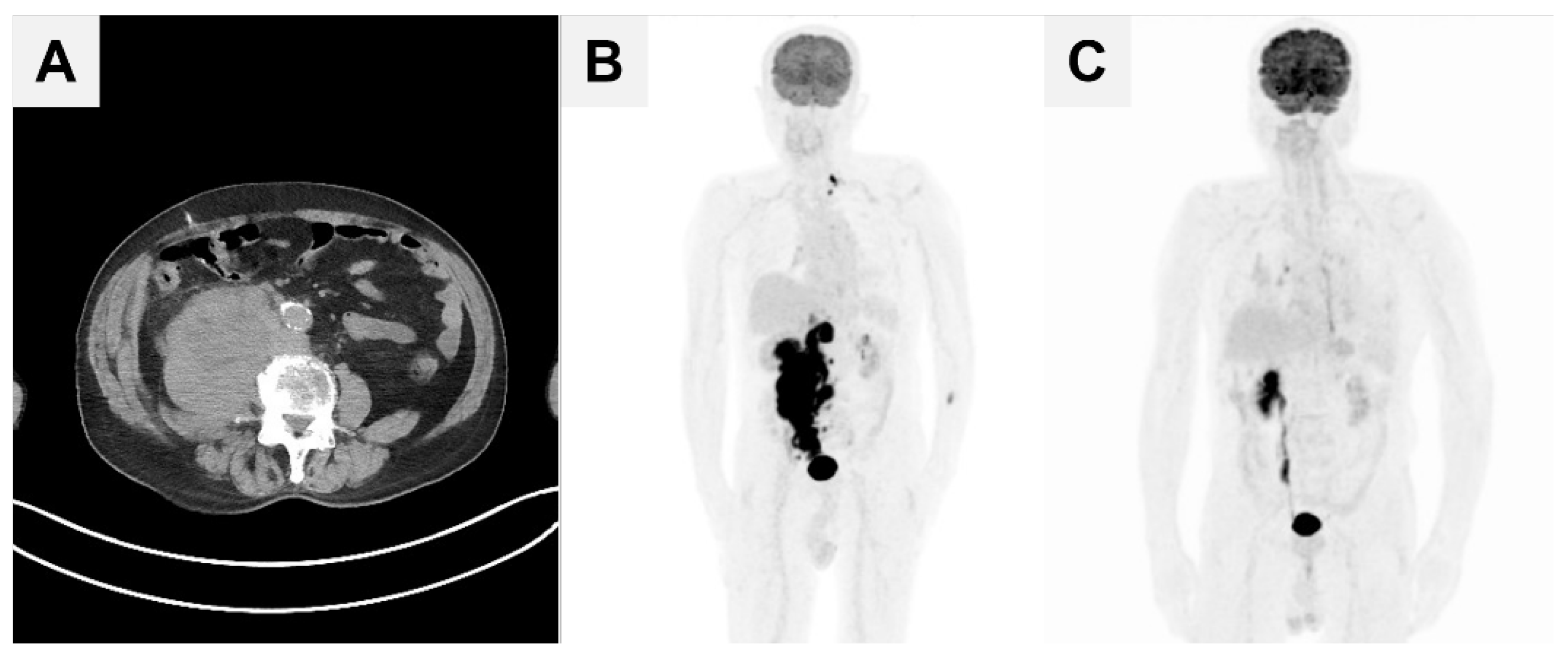
Figure 2.
Multiple intra-abdominal masses are identified on CT imaging (yellow arrow, A) and FDG-PET/CT (SUVmax: 21.76 in the superior lesion and 22.31 in the posterior lesion; white arrows, B). MIP imaging highlights multiple FDG-avid lesions at the time of second relapse (red arrows, C), which completely resolved after six cycles of Pola-R therapy (D).
Figure 2.
Multiple intra-abdominal masses are identified on CT imaging (yellow arrow, A) and FDG-PET/CT (SUVmax: 21.76 in the superior lesion and 22.31 in the posterior lesion; white arrows, B). MIP imaging highlights multiple FDG-avid lesions at the time of second relapse (red arrows, C), which completely resolved after six cycles of Pola-R therapy (D).
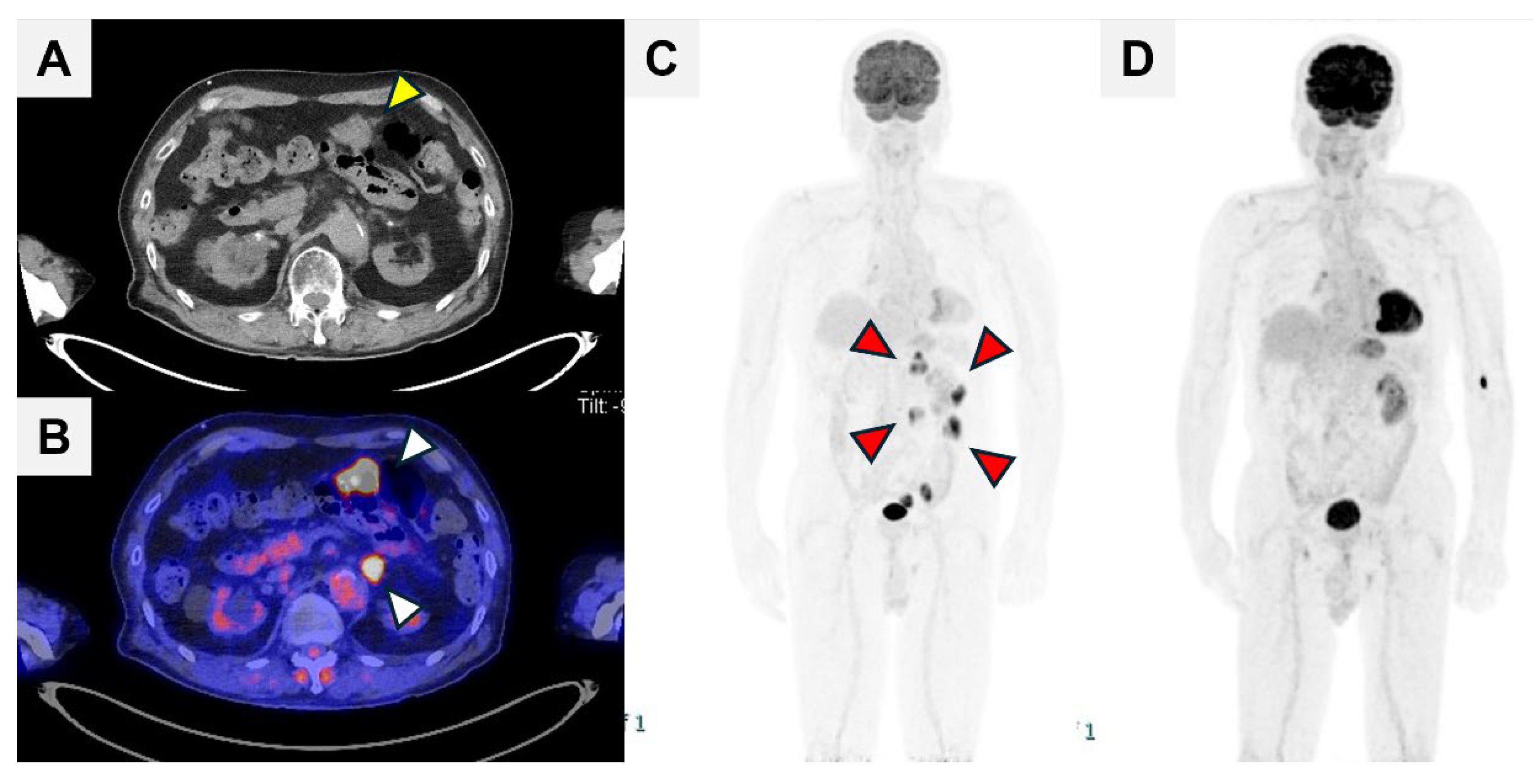

Table 1.
Comprehensive Geriatric Assessment Findings.
| Domain | Assessment Tool | Score / Finding | Clinical Interpretation | ||
|---|---|---|---|---|---|
| Screening | G8 Score | 14/17 (on first admission), 13/17 (at Re-Relapse) |
Deductions primarily due to cognitive impairment and reduced mobility | ||
| Cognition | Mini-Cog | 1/5 (Clock drawing: 0/2, Recall: 1/3) |
Mild-to-moderate cognitive impairment, likely related to prior brain irradiation and hydrocephalus | ||
| Cognition | MMSE | 22/30 | |||
| Function | Katz ADL | 2/6 | Independent only in feeding and continence | ||
| Function | Lawton IADL | 2/8 | Independent only in telephone use and transportation | ||
| Comorbidity | CCI | 1 | Score attributed to dementia/cognitive impairment | ||
| Comorbidity | CIRS-G | ≥2 in five organ domains | Moderate impairment across multiple organ systems | ||
| Note: ADL, activities of daily living; IADL, instrumental activities of daily living; MMSE, Mini-Mental State Examination; CCI, Charlson Comorbidity Index; CIRS-G, Cumulative Illness Rating Scale for Geriatrics. | |||||
Disclaimer/Publisher’s Note: The statements, opinions and data contained in all publications are solely those of the individual author(s) and contributor(s) and not of MDPI and/or the editor(s). MDPI and/or the editor(s) disclaim responsibility for any injury to people or property resulting from any ideas, methods, instructions or products referred to in the content. |
© 2026 by the authors. Licensee MDPI, Basel, Switzerland. This article is an open access article distributed under the terms and conditions of the Creative Commons Attribution (CC BY) license (http://creativecommons.org/licenses/by/4.0/).
Copyright: This open access article is published under a Creative Commons CC BY 4.0 license, which permit the free download, distribution, and reuse, provided that the author and preprint are cited in any reuse.