
Submitted:
13 August 2026
Posted:
13 August 2026
You are already at the latest version
Abstract
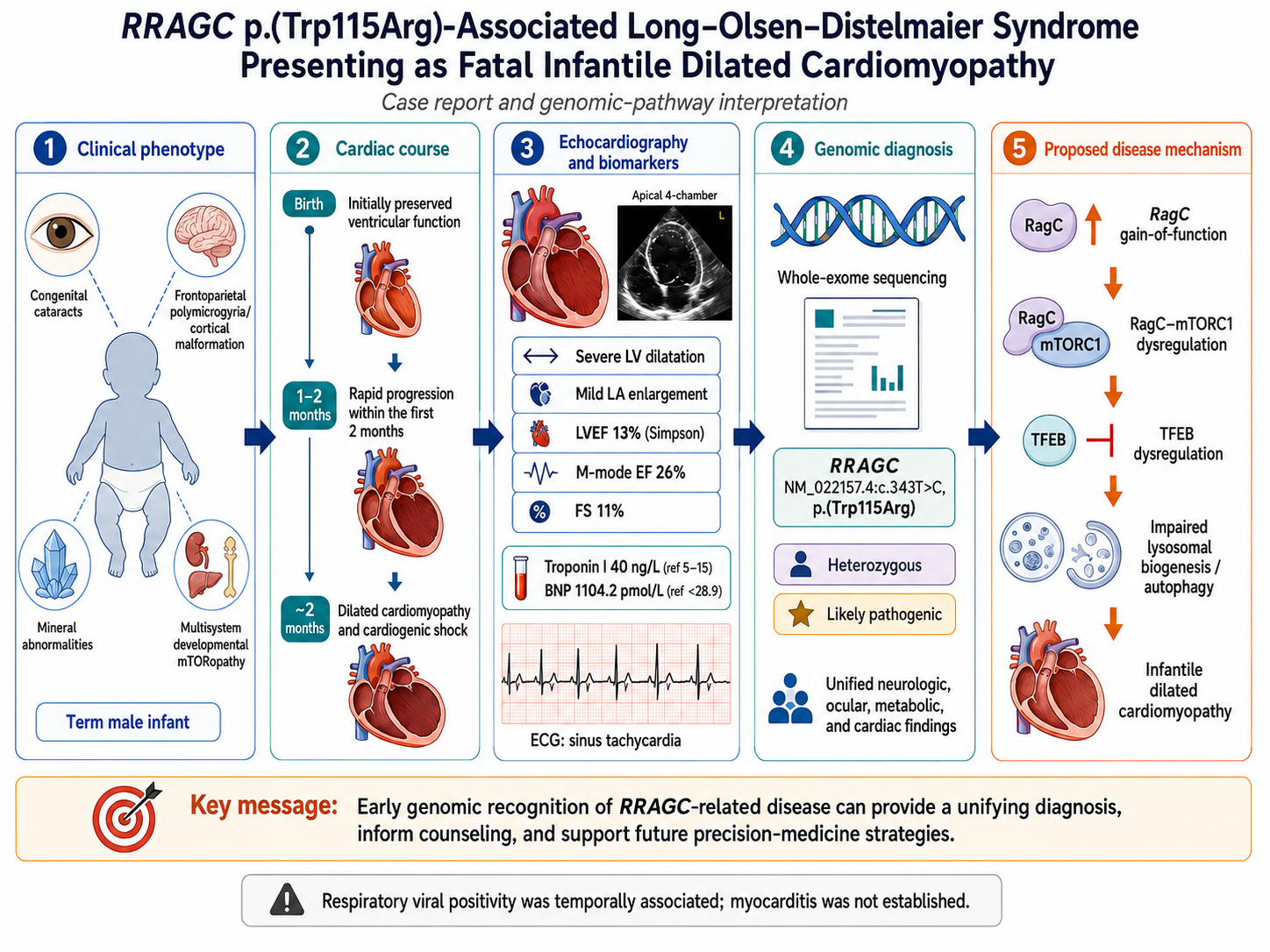
Background: Infantile dilated cardiomyopathy (DCM) is uncommon but carries substantial mortality, particularly when accompanied by neurological, ocular, or metabolic abnormalities. Long-Olsen-Distelmaier syndrome is a rare mTORopathy caused by heterozygous gain-of-function variants in RRAGC and may include cortical malformations, congenital cataracts, mineral disturbances, and early-onset DCM. Case Summary: We describe a term male infant born to consanguineous parents who developed hypocalcemia with hyperphosphatemia, bilateral frontoparietal polymicrogyria, bilateral congenital lamellar cataracts, and small patent ductus arteriosus and ventricular septal defect with initially preserved biventricular function. Consequently, clinical whole-exome sequencing was requested. At 53 days of age, he presented with poor feeding, lethargy, cardiogenic shock, severe lactic acidosis, and hyperkalemia during a rhinovirus/enterovirus-positive respiratory illness. Echocardiography demonstrated newly developed severe DCM, marked left ventricular dilatation, and an ejection fraction of 27%. Despite multi-agent inotropic support and intensive care, ventricular function did not recover, and he died at approximately two months of age. Whole-exome sequencing identified a heterozygous RRAGC NM_022157.4:c.343T>C, p.(Trp115Arg) variant. The diagnostic laboratory classified the variant as likely pathogenic, and an independent manuscript-level ACMG/AMP reassessment was concordant. The multisystem phenotype was also highly consistent with the reported syndrome. Conclusion: This case broadens the clinical and geographic spectrum of RRAGC-related Long-Olsen-Distelmaier syndrome and documents rapid progression from preserved neonatal ventricular function to fatal infantile DCM. Moreover, respiratory viral detection should be interpreted cautiously because myocardial infection or myocarditis was not established. Early exome-based testing should be considered in infants with cardiomyopathy and multi-system abnormalities.
Keywords:
cardiomyopathy
; dilated
; infant
; newborn
; genetic diseases
; inborn
; exome sequencing
; TOR Serine-Threonine Kinases
; GTP-Binding Proteins
; polymicrogyria
Copyright: This open access article is published under a Creative Commons CC BY 4.0 license, which permit the free download, distribution, and reuse, provided that the author and preprint are cited in any reuse.


