
Submitted:
12 August 2026
Posted:
13 August 2026
You are already at the latest version
Abstract
Background/Objectives: psoriasis is a chronic immune-mediated inflammatory dis-ease associated with a high systemic burden. Inhibition of the IL-23/IL-17 axis is the cornerstone of therapy; however, in the assessment of psoriatic disease-associated comorbidities, an equally crucial topic concerns the study of immune-nutritional sta-tus. The aim of the study was to document the efficacy, safety and systemic impact of Bimekizumab and Tildrakizumab in patients with chronic plaque psoriasis by analyz-ing clinimetric and indices, atherogenic risk, and innovatively the immune-nutritional markers.
Methods: this is a real world clinical study, including 52 psoriasis patients, treated with Bimekizumab or Tildrakizumab, followed for 52 weeks. In particular, we analized clinimetric (evaluated by PASI and DLQI) and inflammatory (CRP, ESR, NLR, PLR, and LMR ratios, SII) indices, atherogenic risk (by evaluating lipid profile), and im-munonutritional markers (HALP score, and CONUT score). Assessments were per-formed at baseline and after 52 weeks.
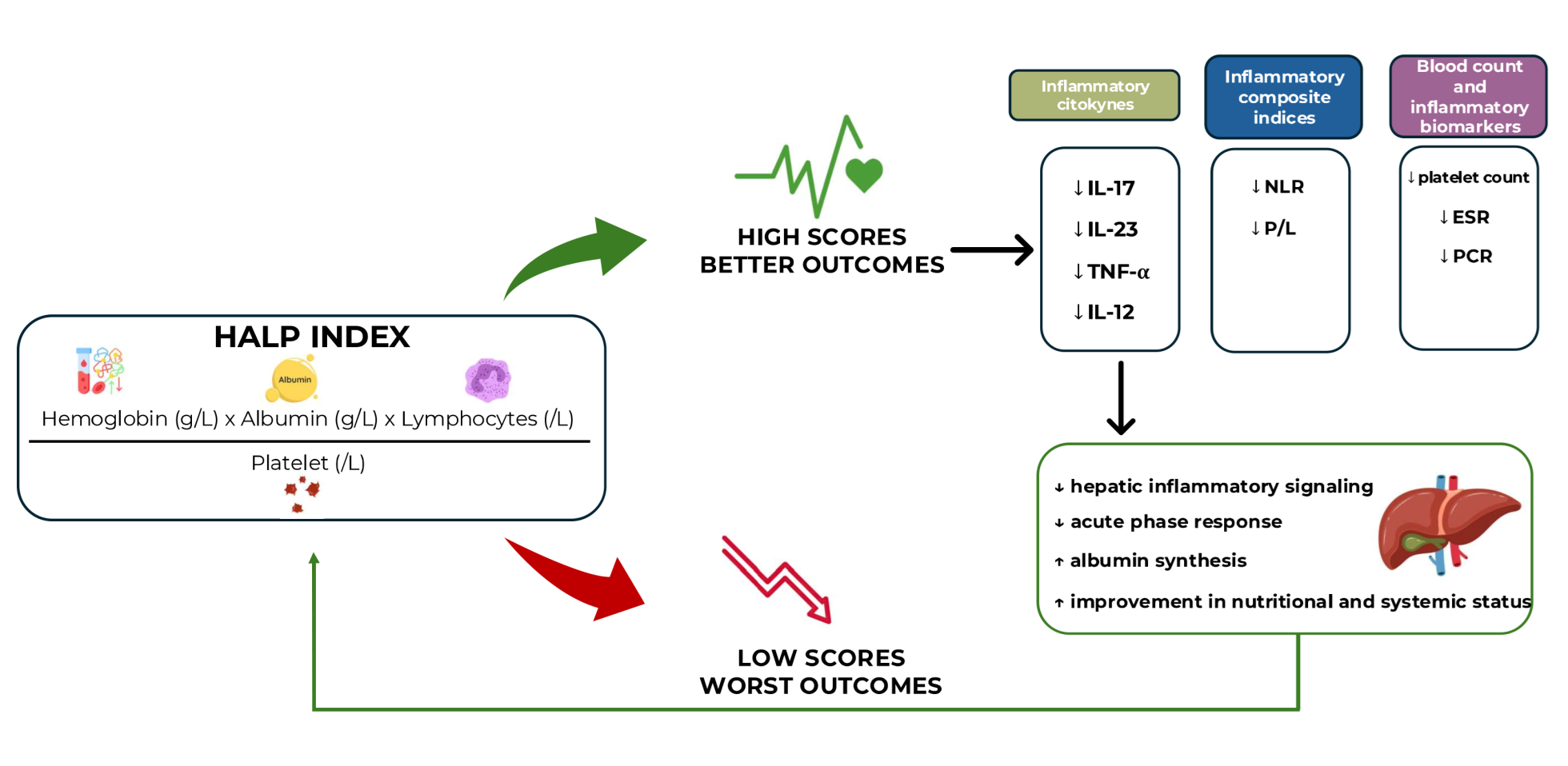
Results: both treatments resulted in a significant reduction in PASI at week 52. The systemic inflammatory marker CRP decreased in both groups. A trend of reduction from baseline to week 52 was reported for both the NLR, and the PLR. Conversely, a trend of increase were reported for the LMR. The HALP index was significant increase in Bimekizumab group compared to Tildrakizumab group while the CONUT score was significantly lower, suggesting an improvement in the immune-nutritional status.
Conclusion: In conclusion, the integrated assessment of hematological ratios, inflam-matory indices and immune-nutritional markers provides clinically useful information for a more complete and personalized management of the psoriatic patients.
Keywords:
HALP score
; CONUT score
; PASI
; DLQI
Copyright: This open access article is published under a Creative Commons CC BY 4.0 license, which permit the free download, distribution, and reuse, provided that the author and preprint are cited in any reuse.


