

Submitted:
06 August 2026
Posted:
13 August 2026
You are already at the latest version
Abstract
Background: During the geographically dispersed 2026 Bundibugyo virus disease (BVD) outbreak in the Democratic Republic of the Congo (DRC), 21 days without a newly attributed confirmed case may inform health-zone surveillance and resource-allocation decisions while transmission continues elsewhere. However, the frequency and timing of renewed confirmed-case reporting after this interval have not been quantified. Methods: A retrospective cohort study was conducted among health zones affected by the 2026 BVD outbreak in the DRC. The primary data source was the national situation-report series, triangulated with World Health Organization weekly reports. Health zones that completed 21 days without a newly attributed confirmed case by 2 August 2026 entered the cohort. The observed recurrence proportion, incidence per 100 zone-days and Kaplan-Meier time to recurrence were estimated. Spatial adjacency to zones with reported confirmed-case activity during the 21 days before each focal health zone completed the interval was described. Results: Seventeen of 51 affected health zones completed the 21-day interval. Ten subsequently reported recurrence and seven were right-censored, giving an observed recurrence proportion of 58.8% (95% exact confidence interval 32.9% to 81.6%). The incidence was 2.83 recurrences per 100 zone-days (95% confidence interval 1.36 to 5.21). The estimated cumulative probability of recurrence was 20.0% by day 7, 41.3% by day 14, 48.7% by day 21 and 56.0% by day 28; median recurrence-free time was 22 days. All recurrent health zones and five of seven censored zones shared a boundary with a zone that had reported confirmed-case activity during the 21 days before threshold crossing. Aggregate reports could not distinguish persistent undetected transmission, reintroduction, delayed confirmation or retrospective attribution. Conclusions: Completion of 21 days without a newly attributed confirmed case was frequently followed by reported recurrence. The interval should not be used as a stand-alone trigger for substantial surveillance de-escalation. Decisions should also consider subsequent observation time, nearby case activity, surveillance performance and unresolved laboratory or reporting constraints.
Keywords:
Ebola disease
; Bundibugyo ebolavirus
; disease surveillance
; outbreak response
; health zones
; Democratic Republic of the Congo
Background
Bundibugyo ebolavirus was first identified during the 2007-2008 Ebola outbreak in Bundibugyo District, western Uganda [1]. The virus was genetically distinct from Zaire and Sudan ebolaviruses, and 56 laboratory-confirmed cases were reported in the first recognised outbreak [1]. The proportion of deaths among confirmed cases was approximately 40%, although estimates differed according to case definition and clinical series [1,2]. A second documented outbreak occurred in Isiro, Democratic Republic of the Congo (DRC), in 2012 [3]. The outbreak declared by the DRC on 15 May 2026 was the third known Bundibugyo virus disease (BVD) outbreak and the country's 17th recorded Ebola outbreak [4]. By late July 2026, it had expanded across five provinces and had become the largest documented BVD outbreak [5].
The World Health Organization (WHO) recommends declaring an Ebola outbreak over only after 42 days, twice the maximum 21-day incubation period, have elapsed after the last possible exposure to a confirmed case [6]. During the 2026 outbreak, WHO described health zones as active when confirmed cases had been reported during the previous 21 days [7]. The 42-day criterion applies to declaring the end of an outbreak at national level, whereas the shorter health-zone interval is an operational measure of recent reported activity.
The operational meaning of a 21-day interval depends on surveillance sensitivity and reporting timeliness. Modelling has shown that even the longer 42-day end-of-outbreak criterion provides high confidence only when case detection is sufficiently sensitive [8]. Early analyses of the 2026 outbreak suggested substantial under-ascertainment and uncertainty in the reported burden [9]. National situation reports also contained changing table formats, delayed laboratory results, revisions to cumulative totals and retrospective case attribution [10]. These observation processes can make an apparent period without reported cases differ from a true interruption of transmission.
Several hypotheses could account for a confirmed case reported after an apparent silent interval. Transmission may have continued but remained undetected; infection may have been introduced from another area; confirmation or geographic attribution may have been delayed; or, less commonly, survivor-associated viral persistence may have contributed. Previous genomic investigations have documented Ebola events linked to prolonged viral persistence [11,12,13]. These mechanisms could not be distinguished using aggregate health-zone reports; recurrence was therefore analysed as an operational surveillance outcome rather than evidence of a specific transmission mechanism.
This study aimed to estimate the frequency and timing of renewed confirmed-case reporting after health zones completed 21 days without a newly attributed confirmed case and to describe the spatial context of threshold crossing in relation to recent confirmed-case activity. To the author's knowledge, this is the first quantified analysis of recurrence after a 21-day health-zone interval in a Bundibugyo virus disease outbreak.
Methods
Study design and setting
This retrospective cohort study included health zones affected by the 2026 BVD outbreak in the DRC. The outbreak occurred in a conflict-affected setting characterised by population displacement, insecurity, mining-related mobility and cross-border movement [5,14]. The epidemiological data lock was 2 August 2026.
Data sources
The primary source was the national situation-report series produced by the Centre d'Opérations d'Urgence de Santé Publique and the Institut National de Santé Publique (CCOUSP/INSP) [10]. These reports provided longitudinal health-zone case information throughout the study period. WHO weekly external situation reports and disease outbreak updates were used to verify dates, investigate discrepancies and identify omissions in the national series [5,7,15]. Health-zone boundaries were obtained from the GRID3 Democratic Republic of the Congo health-zone dataset [16].
Reporting-format-aware data reconstruction
The national reports did not use a stable health-zone table throughout the outbreak. Five recurring structures were identified: early cumulative tables; early tables of cases newly reported that day; cumulative confirmed cases, deaths and case fatality; later cumulative tables with explicit 24-hour new confirmed cases and deaths; and final status tables reporting confirmed cases, recoveries, hospitalisations and deaths. Tables relating to points of entry or points of control were excluded from the health-zone case series after checking their meaning against the original report.
For each health zone and report date, separate fields were retained for cumulative confirmed cases, explicitly reported new confirmed cases, narrative case attribution and newly attributed cases derived from cumulative differences. A directly reported health-zone increment had priority. When no direct increment was available, a positive difference between consecutive usable cumulative totals was used. Negative changes were treated as revisions rather than negative incidence. After a downward revision, the next cumulative total was compared with the last validated pre-revision total to avoid classifying restoration of the earlier baseline as new incidence. Narrative and WHO evidence were used to investigate discordance. All candidate threshold and recurrence dates were manually checked against the source reports.
Cohort and outcome definitions
An affected health zone was a zone with at least one officially reported confirmed case by the data lock. The last pre-threshold activity date was the most recent date on which a new confirmed case was attributed to that zone. The threshold date was 21 calendar days later. A health zone entered the cohort when it completed this interval without another case attribution. Reported recurrence was the first newly attributed confirmed case after threshold crossing. A zone without recurrence by 2 August 2026 was administratively right-censored on that date. Each of the 17 eligible zones contributed one episode.
Episode validity, the last pre-threshold activity date and the recurrence date were assigned separate confidence classifications. A classification was high confidence when the national and WHO reports were concordant or when a discrepancy could be resolved through an explicit health-zone attribution. A recurrence date was classified as moderate confidence when recurrence was confirmed but the exact date differed between sources. All episode-validity classifications were high confidence. For Masereka, recurrence was confirmed, but the national report identified 3 July and the WHO table identified 5 July.
Statistical analysis
The observed recurrence proportion was calculated as the number of recurrent zones divided by all threshold-crossing zones, with an exact Clopper-Pearson 95% confidence interval. Recurrence incidence was estimated per 100 zone-days, with an exact Poisson confidence interval. Time from threshold crossing to recurrence or administrative censoring was analysed using the Kaplan-Meier method. The median recurrence-free time and cumulative recurrence probability at 7, 14, 21 and 28 days were reported. Fixed-time estimates were presented only when at least five zones remained at risk.
Observed event or censoring time was distinguished from potential administrative follow-up, defined as the number of days from threshold crossing to the data lock regardless of whether recurrence occurred earlier. Sensitivity analyses restricted the cohort to zones with at least 7, 14 and 21 days of potential observation. The Masereka recurrence date was varied from 3 July to 5 July. Unique-zone and all-episode analyses were identical because no zone contributed a repeat episode. Exclusion of lower-confidence episodes was not required because all episodes met the high-confidence validity criterion.
Spatial analysis
For each threshold-crossing zone, other health zones were classified as active when at least one reported case-attribution event occurred during the 21 days before that zone completed the interval. Spatial exposure was date-indexed and did not represent a single simultaneous outbreak snapshot. Shared-boundary adjacency and minimum boundary-to-boundary distance were calculated from the GRID3 health-zone boundaries. The primary adjacency definition was compared with a 1 km topology tolerance, centroid-distance thresholds and an equal-area reprojection in sensitivity analyses. Spatial comparisons were descriptive because of the small cohort, the high frequency of adjacency and the absence of mobility, epidemiological-linkage or genomic data.
Data quality, reproducibility and missing data
The reconstruction retained the report number, reporting date, source table, signal type, revision flags, direct-versus-derived discordance and manual adjudication decision. Missing operational covariates were not imputed. Zone-specific contact follow-up, alert investigation and laboratory disruption indicators were not reported consistently across all 17 episodes and were not compared. A version-controlled Python package contains the frozen analytic data, adjudication table, scripts, figures and checksums.
Ethical considerations and reporting
Only aggregate, de-identified, publicly reported surveillance data were used. No individual records or contact lists were accessed. Formal research ethics review was not required for this secondary analysis of public aggregate data. Patients and the public were not involved in the design or conduct of the study. Reporting followed the Strengthening the Reporting of Observational Studies in Epidemiology statement [17]; the completed checklist is provided as Additional file 1.
Results
Cohort reconstruction
By the end of the study period, 2 August 2026, 51 health zones had reported at least one confirmed case. Seventeen completed the 21-day interval without a newly attributed confirmed case and entered the cohort; 34 had not completed the interval. Ten of the 17 zones subsequently reported recurrence and seven were right-censored (Figure 1). Each zone contributed one episode. Lubunga and Mangobo crossed the threshold on 1 August and each contributed one day of potential post-threshold observation.
Frequency and timing of recurrence
The observed recurrence proportion was 58.8% (10/17; 95% exact confidence interval 32.9% to 81.6%). The cohort contributed 353 zone-days at risk, corresponding to an incidence of 2.83 recurrences per 100 zone-days (95% confidence interval 1.36 to 5.21). Among the 10 health zones that recurred, the observed median interval from threshold crossing to recurrence was 13.5 days. After accounting for right-censoring, the Kaplan–Meier analysis estimated a median recurrence-free time of 22 days, meaning that the estimated cumulative probability of recurrence reached 50% at approximately 22 days after threshold crossing. Figure 2 shows the decline in recurrence-free probability over time and the censored observations included in this estimate (Table 1 and Figure 2).
Timing of recurrence and follow-up by health zone
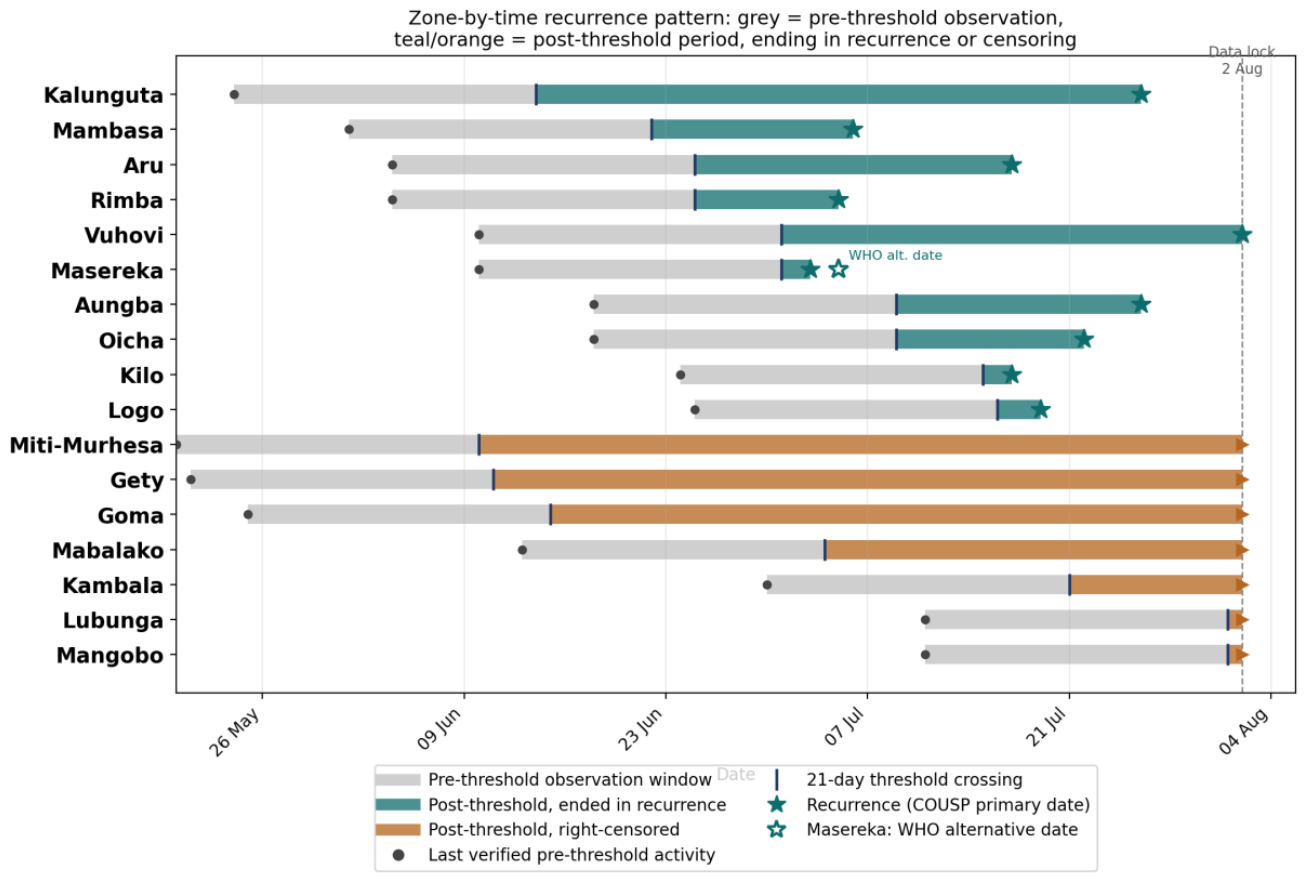
The interval from threshold crossing to recurrence ranged from 2 to 42 days. Kilo, Logo and Masereka reported recurrence within 7 days, whereas Kalunguta reported recurrence after 42 days. Among health zones without recurrence by the end of the study period, follow-up ranged from 1 to 53 days (Table 2 and Figure 4). For Masereka, using the alternative WHO date changed the recurrence interval from 2 to 4 days but did not alter its classification or materially affect the time-to-event estimates.
Spatial adjacency to recent confirmed-case activity
All 10 health zones that reported recurrence and five of the seven censored health zones shared a boundary with at least one zone that had reported confirmed-case activity during the 21 days before threshold crossing (Table 3 and Figure 3). Goma and Miti-Murhesa were the only health zones without an adjacent zone with recent confirmed-case activity, and neither had reported recurrence by the end of the study period. Because the cohort was small, adjacency was common in both outcome groups, and no mobility, case-linkage or genomic data were available, the spatial findings were interpreted descriptively rather than evaluated as causal predictors.
Robustness of recurrence and spatial findings
The recurrence estimate remained similar when the analysis was restricted to health zones with longer potential follow-up. Recurrence occurred in 10 of 15 zones observed for at least 7 days (66.7%), 10 of 14 observed for at least 14 days (71.4%) and 8 of 12 observed for at least 21 days (66.7%). Using 5 July instead of 3 July as the recurrence date for Masereka did not materially change the Kaplan–Meier estimates. The shared-boundary classification was unchanged when a 1 km topology tolerance or equal-area reprojection was applied. Under the 100 km centroid-distance definition, Goma was classified as close to recent activity, whereas Mambasa was classified as distant despite sharing a boundary with an active health zone. This inconsistency supported retaining shared-boundary adjacency as the primary spatial measure.

Table 4.
Sensitivity analyses of follow-up duration, recurrence-date uncertainty and spatial classification.
Table 4.
Sensitivity analyses of follow-up duration, recurrence-date uncertainty and spatial classification.
| Sensitivity family | Status | Result or decision |
|---|---|---|
| Calculated versus source-reported threshold date | Not feasible | Zone-specific threshold-completion dates were not reported consistently. The prespecified calculated date was retained. |
| National versus World Health Organization recurrence date | Completed | Masereka: 3 July versus 5 July; no material effect on conclusions. |
| All episodes versus first episode per zone | Structurally identical | Each zone contributed one episode; no repeat episodes were verified. |
| Exclusion below high episode-validity confidence | Not applicable | All 17 episodes had high episode-validity confidence. |
| Administrative follow-up restriction | Completed | Recurrence proportions were 66.7%, 71.4% and 66.7% at ≥7, ≥14 and ≥21 days of potential observation. |
| Alternative spatial definitions | Completed | Primary adjacency was unchanged by 1 km tolerance and equal-area reprojection; centroid definitions were less coherent for large zones. |
| Exclusion for laboratory or reporting disruption | Not feasible | Indicators were not reported consistently across all episodes; no selective post hoc exclusion was applied. |
Figure 4.
Health-zone timelines from completion of the 21-day interval to recurrence or the end of follow-up. The hollow symbol for Masereka shows the alternative World Health Organization recurrence date of 5 July; the national report date of 3 July was used in the primary analysis.
Figure 4.
Health-zone timelines from completion of the 21-day interval to recurrence or the end of follow-up. The hollow symbol for Masereka shows the alternative World Health Organization recurrence date of 5 July; the national report date of 3 July was used in the primary analysis.
Discussion
This analysis covered the study period through 2 August 2026 and should be interpreted in light of heterogeneous aggregate reporting, the absence of symptom-onset and genomic-linkage data, and unequal follow-up across health zones. Within these constraints, completion of 21 days without a newly attributed confirmed case marked an operational transition rather than a reliable indication that further confirmed-case reporting would not occur. Renewed confirmed-case reporting remained common after this interval and occurred both shortly after threshold crossing and several weeks later. Health-zone status should therefore be interpreted alongside surveillance performance and the surrounding outbreak geography.
The finding is important for public health practice because the 21-day health-zone interval is shorter and serves a different purpose from WHO's formal 42-day criterion for declaring the end of an outbreak at national level [6]. Previous modelling has shown that elapsed time alone does not provide high confidence that Ebola transmission has ended when case detection is incomplete [8]. Investigations of late Ebola clusters have similarly supported maintaining surveillance and rapid-response capacity during periods of apparent epidemiological silence [18]. A health zone completing one incubation period may move from acute response to a lower-intensity phase, but the findings do not support an automatic transition to minimal surveillance. Estimates restricted to zones with longer potential follow-up were similar to the full-cohort estimate.
The study does not establish that an observed recurrence represented renewed local transmission. National and international reports documented data harmonisation, sample backlog and retrospective reconciliation during the outbreak [6,7,9]. Possible explanations include continuing undetected transmission, movement from another health zone, delayed confirmation or reassignment of an earlier case. Survivor-associated viral persistence is another biologically plausible hypothesis because later Ebola transmission events have been documented [11,12,13], but no case-level epidemiological or genomic evidence was available to assess this mechanism. The mechanism of recurrence therefore remained indeterminate.
The spatial findings support interpreting the 21-day interval within the surrounding outbreak geography. All recurrent health zones shared a boundary with a zone that had recent confirmed-case activity, although five of seven censored zones did as well. Previous analyses have shown that local Ebola epidemics can be connected through population movement and introductions from active districts [18,19]. Adjacency may therefore mark an opportunity for case importation, but it does not establish transmission linkage. A health zone completing the 21-day interval while neighbouring zones remain active should retain rapid investigation, laboratory access and community surveillance.
Strengths and novelty
To the author's knowledge, this is the first study to quantify renewed confirmed-case reporting after a 21-day health-zone interval during a Bundibugyo virus disease outbreak. The analysis accounted for changing reporting formats, data revisions, discordant source signals and unequal follow-up. Kaplan-Meier methods accounted for right-censoring, and the analytic workflow was preserved in a reproducible Python package. The approach may be useful in other outbreaks where operational decisions rely on changing aggregate reports.
Limitations
The cohort was small, confidence intervals were wide and the estimates are specific to this outbreak. Official case-attribution dates were used rather than symptom-onset or transmission-chain data; the 21-day interval therefore reflects reported activity, not confirmed interruption of transmission. Two censored zones had only one day of follow-up, although analyses restricted to longer observation produced similar estimates. Health-zone information on contact follow-up, alert investigation and laboratory disruption was incomplete. Spatial analysis measured shared boundaries rather than mobility or epidemiological linkage, and some discordant events required manual adjudication.
Implications for public health practice
Health-zone de-escalation should be gradual and reversible. Ministries of health and WHO could use estimates of the probability and timing of recurrence, together with surveillance-performance indicators, to inform surveillance intensity after a health zone completes the 21-day interval. Response intensity may be reduced when surveillance remains sensitive, alerts are investigated promptly, contacts have completed follow-up, diagnostic access is timely, outstanding samples are resolved and nearby transmission is limited. Zones adjacent to recent case activity should retain community surveillance, rapid investigation and response capacity beyond day 21. Recurrence probability estimates should complement, rather than replace, assessment of surveillance quality, diagnostic and reporting performance, and the wider outbreak context.
Conclusions
During the 2026 Bundibugyo virus disease outbreak in the Democratic Republic of the Congo, renewed confirmed-case reporting occurred in 10 of 17 health zones after they completed 21 days without a newly attributed case. The median recurrence-free time was 22 days, and recurrence occurred up to 42 days after threshold crossing. The 21-day interval should therefore be used as an operational surveillance milestone, not as evidence that transmission has ended. Surveillance intensity should be guided by recurrence probability, follow-up duration, surveillance sensitivity, diagnostic and reporting performance, and recent confirmed-case activity in neighbouring health zones.
List of Abbreviations
BVD: Bundibugyo virus disease; CCOUSP: Centre d'Opérations d'Urgence de Santé Publique; DRC: Democratic Republic of the Congo; INSP: Institut National de Santé Publique; WHO: World Health Organization.
Author Contributions
TEA conceived and designed the study; developed the extraction, adjudication, statistical and spatial methods; curated and verified the data; conducted the analyses; prepared the figures; and wrote and revised the manuscript. The author read and approved the final manuscript.
Funding
This research received no specific grant from any funding agency in the public, commercial or not-for-profit sectors.
Ethics Approval and Consent to Participate
Not applicable. This study used only aggregate, de-identified information published in official public situation reports. No individual-level data or contact lists were accessed.
Consent for Publication
Not applicable.
Availability of Data and Materials
The primary data were obtained from the national situation-report series produced by the CCOUSP and INSP [10] and were triangulated with weekly reports from the World Health Organization Regional Office for Africa [15]. Health-zone boundaries were obtained from GRID3 [16]. The derived health-zone dataset, adjudication log and analysis scripts are available from the author on reasonable request.
Acknowledgments
The author acknowledges the people and communities affected by the outbreak and the health workers, laboratory teams, surveillance staff, community responders, and public health authorities involved in the response. The author also acknowledges DRC INSP and INRB for making public outbreak updates available for analysis.
Competing Interests
The author declares that he has no competing interests.
References
- Towner, J.S.; Sealy, T.K.; Khristova, M.L.; Albariño, C.G.; Conlan, S.; Reeder, S.A.; et al. Newly Discovered Ebola Virus Associated with Hemorrhagic Fever Outbreak in Uganda. PLoS Pathog.;PubMed 2008, 4(11), e1000212. [Google Scholar] [CrossRef] [PubMed]
- MacNeil, A.; Farnon, E.C.; Wamala, J.; Okware, S.; Cannon, D.L.; Reed, Z.; et al. Proportion of Deaths and Clinical Features in Bundibugyo Ebola Virus Infection, Uganda. Emerg. Infect. Dis.;PubMed 2010, 16(12), 1969–72. [Google Scholar] [CrossRef] [PubMed]
- Kratz, T.; Roddy, P.; Oloma, A.T.; Jeffs, B.; Ciruelo, D.P.; De La Rosa, O.; et al. Ebola Virus Disease Outbreak in Isiro, Democratic Republic of the Congo, 2012: Signs and Symptoms, Management and Outcomes. PLoS ONE;PubMed 2015, 10(6), e0129333. [Google Scholar] [CrossRef] [PubMed]
- Ministère de la Santé Publique H et PS. Déclaration de la 17e épidémie de la maladie à virus Ebola dans les zones de santé de Rwampara, Mongbwalu et Bunia dans la province de l’Ituri, République Démocratique du Congo; Kinshasa, May 2026. [Google Scholar]
- World Health Organization. Ebola disease caused by Bundibugyo virus - Democratic Republic of the Congo [Internet]. 2026. Available online: https://www.who.int/emergencies/disease-outbreak-news/item/2026-DON614.
- World Health Organization. WHO recommended criteria for declaring the end of the Ebola virus disease outbreak [Internet]. Geneva, Mar 2020. Available online: https://www.who.int/publications/m/item/who-recommended-criteria-for-declaring-the-end-of-the-ebola-virus-disease-outbreak.
- World Health Organization. Ebola disease caused by Bundibugyo virus, Democratic Republic of the Congo & Uganda [Internet]. 2026. Available online: https://www.who.int/emergencies/disease-outbreak-news/item/2026-DON613.
- Thompson, R.N.; Morgan, O.W.; Jalava, K. Rigorous surveillance is necessary for high confidence in end-of-outbreak declarations for Ebola and other infectious diseases. Philos. Trans. R. Soc. B Biol. Sci.;PubMed 2019, 374(1776), 20180431. [Google Scholar] [CrossRef] [PubMed]
- Mccabe, R.; Ebbarnezh, L.; Okware, S.; Fotsing, R.; Koua, E.; Mbaka, P.; et al. Estimation of the size of the outbreak of Ebola disease caused by Bundibugyo virus in the Democratic Republic of the Congo; Imperial College London, 18 May 2026. [Google Scholar] [CrossRef] [PubMed]
- Centre des Operations d Urgences de Sante Publique RDC. Rapport de situation de la 17eme epidemie de la maladie a virus Ebola RDC [Internet]. 2026. Available online: https://insp.cd/sitrep-mve-n-013-2026/.
- Keita, A.K.; Koundouno, F.R.; Faye, M.; Düx, A.; Hinzmann, J.; Diallo, H.; et al. Resurgence of Ebola virus in 2021 in Guinea suggests a new paradigm for outbreaks. Nature;PubMed 2021, 597(7877), 539–43. [Google Scholar] [CrossRef] [PubMed]
- Mbala-Kingebeni, P.; Pratt, C.; Mutafali-Ruffin, M.; Pauthner, M.G.; Bile, F.; Nkuba-Ndaye, A.; et al. Ebola Virus Transmission Initiated by Relapse of Systemic Ebola Virus Disease. N. Engl. J. Med.;PubMed 2021, 384(13), 1240–7. [Google Scholar] [CrossRef] [PubMed]
- Diallo, B.; Sissoko, D.; Loman, N.J.; Bah, H.A.; Bah, H.; Worrell, M.C.; et al. Resurgence of Ebola Virus Disease in Guinea Linked to a Survivor With Virus Persistence in Seminal Fluid for More Than 500 Days. Clin. Infect. Dis.;PubMed 2016, 63(10), 1353–6. [Google Scholar] [CrossRef] [PubMed]
- Merci Amuda, D.; Araali, B.; Agenonga Chober, A.; Bedford, J.; Boone, D.; Duclos, D.; et al. Note contextuelle sur l’épidémie d’Ebola Bundibugyo en Ituri (2026). HAL Open Sci. 2026, (1), 255. [Google Scholar] [CrossRef]
- World Health Organization. EBOLA BUNDIBUGYO VIRUS DISEASE OUTBREAK Democratic Republic of the Congo | Uganda Weekly External Situation Report 05, Data as of 14 June 2026 | WHO | Regional Office for Africa [Internet]. 2026. Available online: https://www.afro.who.int/countries/uganda/publication/ebola-bundibugyo-virus-disease-outbreak-democratic-republic-congo-1.
- GRID3. Geospatial data DRC - GRID3 [Internet]. 28 Jul 2026. Available online: https://grid3.org/geospatial-data-drc.
- Von Elm, E.; Altman, D.G.; Egger, M.; Pocock, S.J.; Gøtzsche, P.C.; Vandenbroucke, J.P. The Strengthening the Reporting of Observational Studies in Epidemiology (STROBE) Statement: Guidelines for Reporting Observational Studies. PLoS Med.;PubMed 2007, 4(10), e296. [Google Scholar] [CrossRef] [PubMed]
- Keita, M.; Polonsky, J.; Finci, I.; Mbala-Kingebeni, P.; Ilumbulumbu, M.K.; Dakissaga, A.; et al. Investigation of and Strategies to Control the Final Cluster of the 2018-2020 Ebola Virus Disease Outbreak in the Eastern Democratic Republic of Congo. Open Forum Infect. Dis. 2022, 9(9). [Google Scholar] [CrossRef] [PubMed]
- Backer, J.A.; Wallinga, J.; Lessler, J.; Hopkins Bloomberg, J. Spatiotemporal Analysis of the 2014 Ebola Epidemic in West Africa. PLoS Comput Biol. 2016, 12(12), e1005210. [Google Scholar] [CrossRef] [PubMed]
Figure 1.
Flow of health zones into the recurrence cohort. The lower boxes distinguish recurrence within 7 days from less than 7 days of potential observation; these are different concepts. End of study period: 2 August 2026.
Figure 1.
Flow of health zones into the recurrence cohort. The lower boxes distinguish recurrence within 7 days from less than 7 days of potential observation; these are different concepts. End of study period: 2 August 2026.
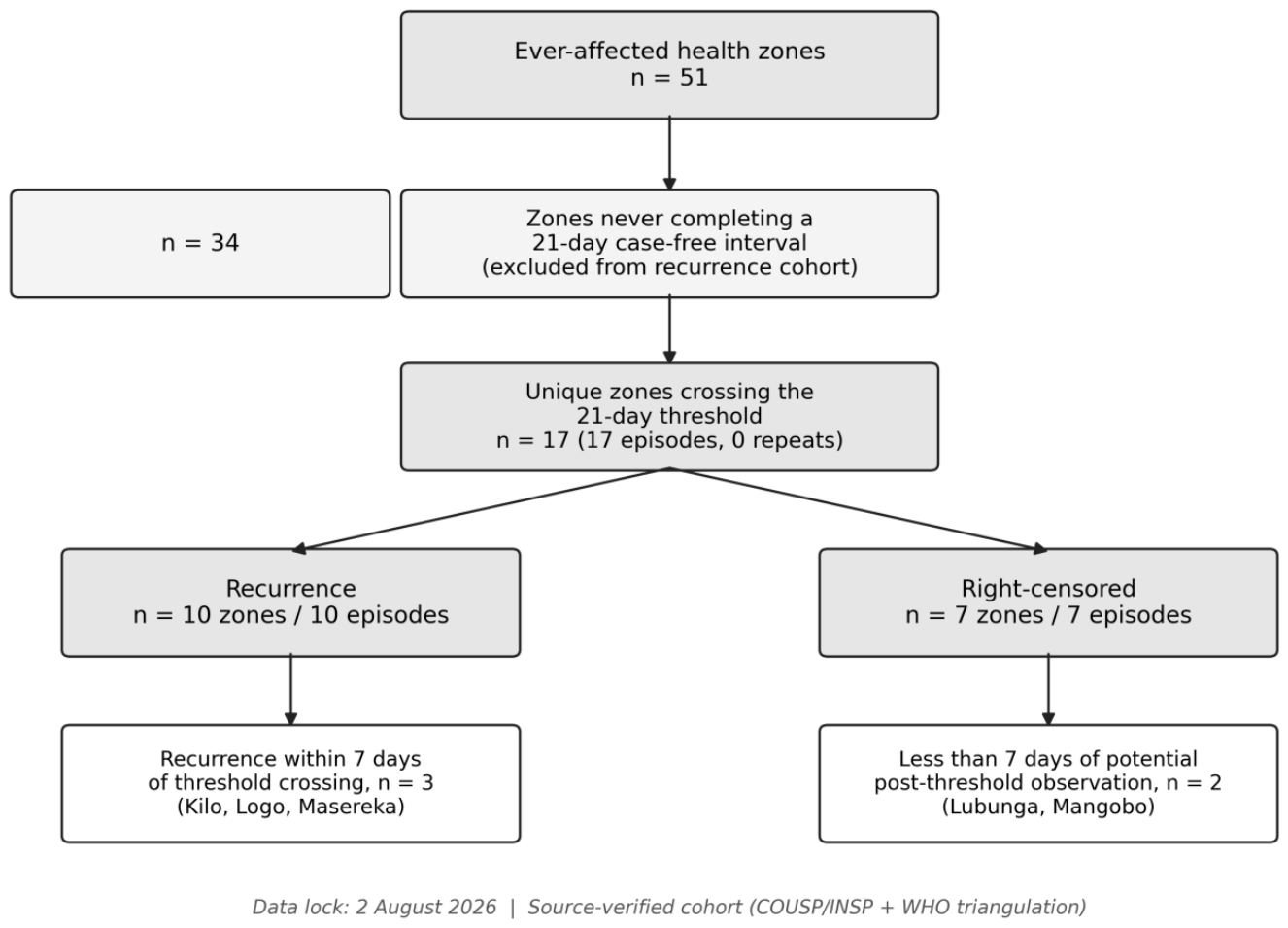
Figure 2.
Kaplan-Meier probability of remaining without a newly attributed confirmed case after completing the 21-day interval. The estimated probability fell to 50% at 22 days after threshold crossing. Tick marks indicate right-censoring, the shaded area represents the 95% confidence interval, and the risk table shows the number of health zones still under observation and recurrence-free at each time point.
Figure 2.
Kaplan-Meier probability of remaining without a newly attributed confirmed case after completing the 21-day interval. The estimated probability fell to 50% at 22 days after threshold crossing. Tick marks indicate right-censoring, the shaded area represents the 95% confidence interval, and the risk table shows the number of health zones still under observation and recurrence-free at each time point.
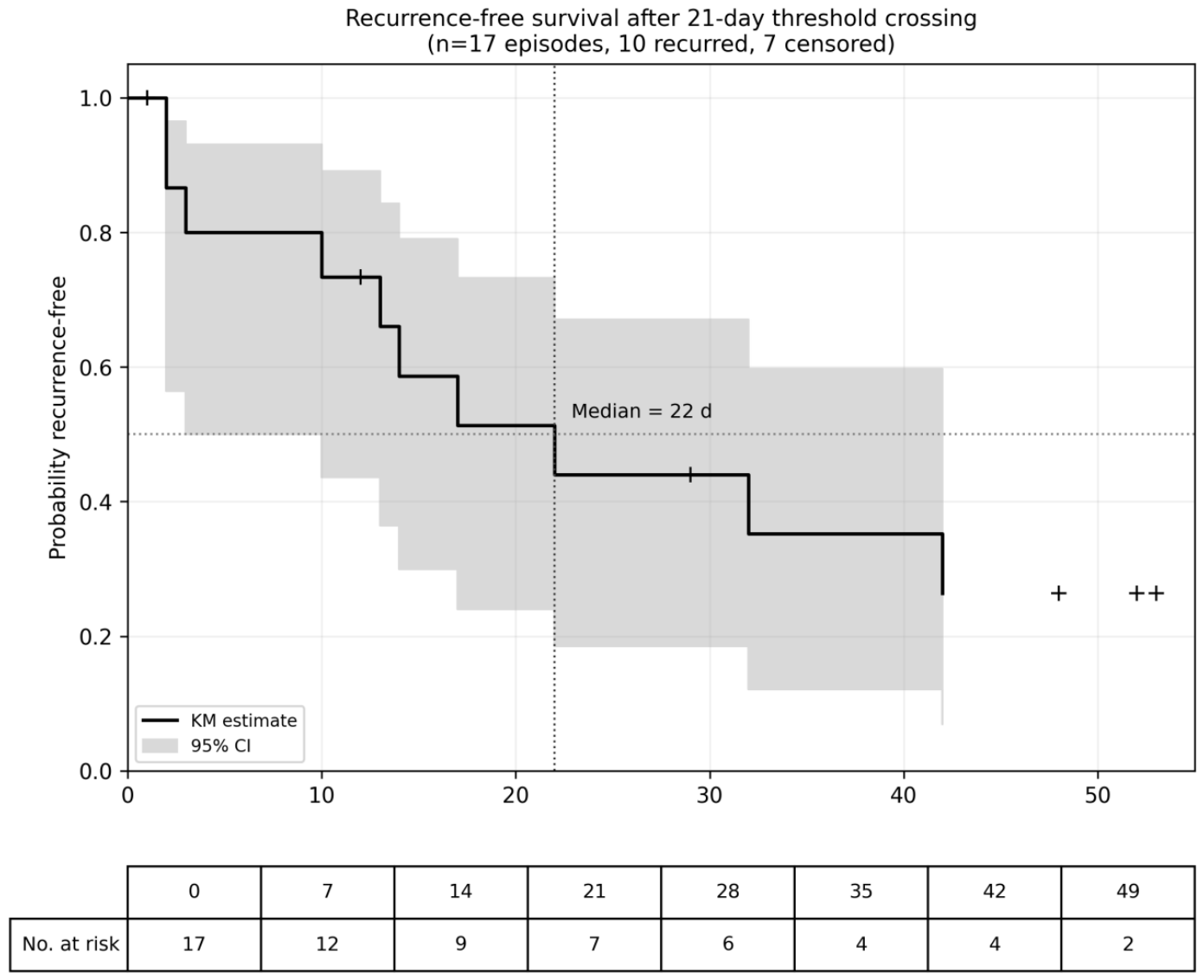
Figure 3.
Health zones completing 21 days without a newly attributed confirmed case and neighbouring recent confirmed-case activity. Panel A classifies these health zones as recurrent or censored. Panel B also shows zones that reported confirmed-case activity during the 21 days before at least one focal zone completed the interval. Because the activity windows differed by focal zone, Panel B does not represent transmission at a single point in time.
Figure 3.
Health zones completing 21 days without a newly attributed confirmed case and neighbouring recent confirmed-case activity. Panel A classifies these health zones as recurrent or censored. Panel B also shows zones that reported confirmed-case activity during the 21 days before at least one focal zone completed the interval. Because the activity windows differed by focal zone, Panel B does not represent transmission at a single point in time.
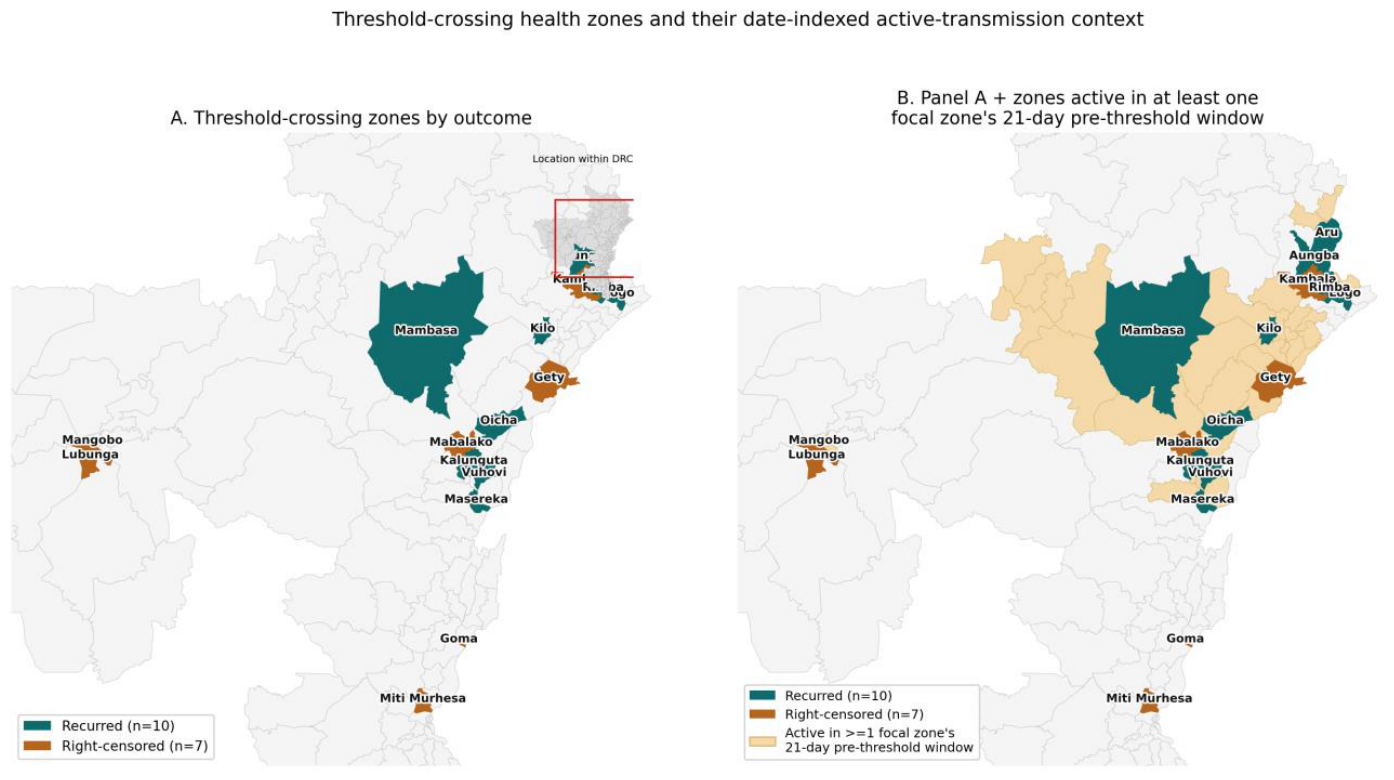
Table 1.
Frequency and timing of renewed confirmed-case reporting after the 21-day health-zone interval.
Table 1.
Frequency and timing of renewed confirmed-case reporting after the 21-day health-zone interval.
| Panel / estimand | Estimate or timepoint | Number at risk | 95% confidence interval or detail |
|---|---|---|---|
| Panel A: primary estimates | Observed recurrence: 10/17 (58.8%) | — | 32.9% to 81.6% |
| Zone-days at risk: 353 | — | Threshold to recurrence or censoring | |
| Incidence: 2.83 per 100 zone-days | — | 1.36 to 5.21 | |
| Median among recurrent zones: 13.5 days | — | Recurrent zones only | |
| Kaplan–Meier median: 22 days | — | All episodes; censoring-adjusted | |
| Panel B: cumulative recurrence | Day 7: 20.0% | 12 | 6.9% to 50.0% |
| Day 14: 41.3% | 9 | 21.0% to 70.0% | |
| Day 21: 48.7% | 7 | 26.8% to 76.0% | |
| Day 28: 56.0% | 6 | 32.9% to 81.5% |
Note: Panel A presents observed cohort measures and time-to-event summaries. The 10/17 recurrence proportion and the 13.5-day median are based on observed events, whereas the Kaplan–Meier median of 22 days is the estimated time by which 50% of zones had experienced recurrence after accounting for right-censoring. Panel B presents Kaplan–Meier estimates of cumulative recurrence probability at selected time points, not observed counts or proportions.
Table 2.
Health-zone recurrence and follow-up chronology during the 2026 Bundibugyo virus disease outbreak, through 2 August 2026.
Table 2.
Health-zone recurrence and follow-up chronology during the 2026 Bundibugyo virus disease outbreak, through 2 August 2026.
| Health zone | Last verified activity | Threshold date | Outcome date and status | Interval, days | Recurrence-date confidence |
|---|---|---|---|---|---|
| Miti-Murhesa | 20 May | 10 June | 2 August; censored | 53 | Not applicable |
| Gety | 21 May | 11 June | 2 August; censored | 52 | Not applicable |
| Kalunguta | 24 May | 14 June | 26 July; recurrence | 42 | High |
| Goma | 25 May | 15 June | 2 August; censored | 48 | Not applicable |
| Mambasa | 1 June | 22 June | 6 July; recurrence | 14 | High |
| Aru | 4 June | 25 June | 17 July; recurrence | 22 | High |
| Rimba | 4 June | 25 June | 5 July; recurrence | 10 | High |
| Masereka | 10 June | 1 July | 3 July; recurrence | 2 | Moderate (3 vs 5 July) |
| Vuhovi | 10 June | 1 July | 2 August; recurrence | 32 | High |
| Mabalako | 13 June | 4 July | 2 August; censored | 29 | Not applicable |
| Aungba | 18 June | 9 July | 26 July; recurrence | 17 | High |
| Oicha | 18 June | 9 July | 22 July; recurrence | 13 | High |
| Kilo | 24 June | 15 July | 17 July; recurrence | 2 | High |
| Logo | 25 June | 16 July | 19 July; recurrence | 3 | High |
| Kambala | 30 June | 21 July | 2 August; censored | 12 | Not applicable |
| Lubunga | 11 July | 1 August | 2 August; censored | 1 | Not applicable |
| Mangobo | 11 July | 1 August | 2 August; censored | 1 | Not applicable |
Note: All dates refer to 2026. For Masereka, the national report date of 3 July was used in the primary analysis, while the World Health Organization date of 5 July was examined in sensitivity analysis.
Table 3.
Adjacency to recent confirmed-case activity at health-zone threshold crossing.
| Health zone | Outcome | Adjacent active zone | Number of active adjacent zones | Minimum boundary distance, km |
|---|---|---|---|---|
| Aru | Recurrence | Yes | 1 | 0.0 |
| Aungba | Recurrence | Yes | 2 | 0.0 |
| Kalunguta | Recurrence | Yes | 2 | 0.0 |
| Kilo | Recurrence | Yes | 3 | 0.0 |
| Logo | Recurrence | Yes | 1 | 0.0 |
| Mambasa | Recurrence | Yes | 2 | 0.0 |
| Masereka | Recurrence | Yes | 2 | 0.0 |
| Oicha | Recurrence | Yes | 3 | 0.0 |
| Rimba | Recurrence | Yes | 2 | 0.0 |
| Vuhovi | Recurrence | Yes | 4 | 0.0 |
| Gety | Censored | Yes | 3 | 0.0 |
| Goma | Censored | No | 0 | 70.8 |
| Kambala | Censored | Yes | 2 | 0.0 |
| Lubunga | Censored | Yes | 1 | 0.0 |
| Mabalako | Censored | Yes | 2 | 0.0 |
| Mangobo | Censored | Yes | 1 | 0.0 |
| Miti-Murhesa | Censored | No | 0 | 236.0 |
Note: “Minimum boundary distance” is the shortest distance between the boundary of the focal health zone and the boundary of the nearest zone with confirmed-case activity during the previous 21 days. A value of 0 km indicates that the two health zones shared a boundary. For health zones without an adjacent active zone, the value is the shortest boundary-to-boundary distance to the nearest active zone.
Disclaimer/Publisher’s Note: The statements, opinions and data contained in all publications are solely those of the individual author(s) and contributor(s) and not of MDPI and/or the editor(s). MDPI and/or the editor(s) disclaim responsibility for any injury to people or property resulting from any ideas, methods, instructions or products referred to in the content. |
© 2026 by the authors. Licensee MDPI, Basel, Switzerland. This article is an open access article distributed under the terms and conditions of the Creative Commons Attribution (CC BY) license (http://creativecommons.org/licenses/by/4.0/).
Copyright: This open access article is published under a Creative Commons CC BY 4.0 license, which permit the free download, distribution, and reuse, provided that the author and preprint are cited in any reuse.


